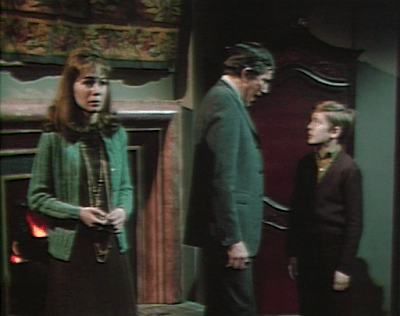
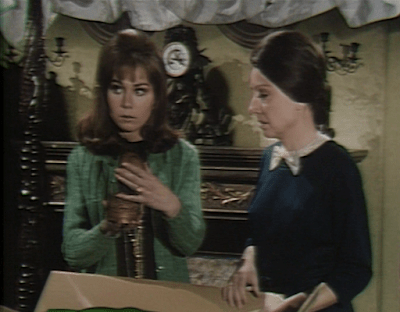
Episode 680: Chicken Little was right

Strange and troubled boy David Collins and nine year old Amy Jennings are falling under the sway of the evil spirit of the late Quentin Collins. Quentin has been gaining strength gradually; at first he was confined to a small chamber hidden behind a wall in a storage room in the long deserted west wing of the great house of Collinwood, and was dependent on Amy and David to do his bidding elsewhere. Now he can move around the estate and do things for himself. He is still able to control only one of the children at a time, though, and when Amy found out that Quentin had poisoned her brother Chris she made up her mind to fight him.

Today, David goes to the west wing to tell Quentin that Amy will cooperate with him if he promises to leave Chris alone. When David puts this to Quentin, he nods in agreement. If Quentin is still weak enough that he must give in to Amy on this point, he is still weak enough to be stopped before he does any great harm. That builds suspense- the show has invested so much time in building up the threat Quentin poses that it would feel like a cheat if he were defeated now, but we can look forward to seeing him survive a series of close calls between now and the time when his storyline approaches its climax.

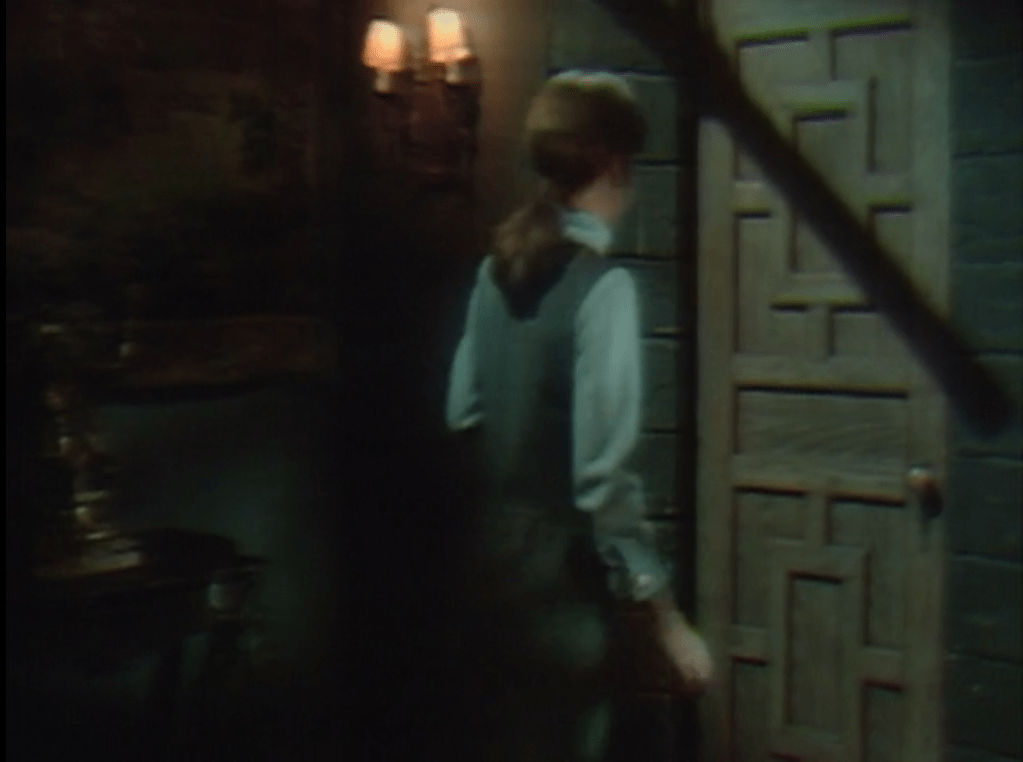
David was not the only one who went from the main part of the house to the west wing. Governess Maggie saw him go there, in direct defiance of her orders that he stay in his room. Maggie followed David down the corridor and saw him go into the storage room. By the time she entered that room, David had gone into Quentin’s secret chamber and closed the panel behind him, leaving Maggie baffled as to where he could be. She went back to the main part of the house to wait for David.

In David’s room, Maggie sits in the armchair by the wall. She is still there when David comes back. This recreates a pair of scenes in #667, when David sat in the chair and was still there when Amy entered. That was supposed to be a power move, and it worked, more or less. David asserted his role as Quentin’s spokesman, and Amy acquiesced.

But Maggie can’t pull it off. She doesn’t give in to David when he denies everything, tells her her eyesight must be failing, claims that she doesn’t have the right to punish him, and yells at her that he will “get even.” But her visible nervousness encourages him to try each of these tactics. It’s only when she reminds him that he had his flashlight with him when he went into the west wing and says she will look for it in the storage room that she shuts him down, and then only for a moment.

David protests his innocence to Maggie, but he tells us that the sky is falling.

Maggie goes back to the west wing, where she sees Quentin. David looks directly into the camera and recites the epigram “I do not love thee, Dr Fell.” In the first months of the show, David was the only character who made eye contact with the audience. He stopped doing that late in 1966, when he stopped being a menace, and several other characters have been called on to do it since. It’s good to see him revisit the technique, and he is quite effective at it today.

Closing Miscellany

As my screen name may have led you to suspect, I make my living as a Latin teacher. So I would be remiss if I did not mention that “I do not love thee, Dr Fell” is a translation of a piece often used on the first day of introductory Latin classes, Martial’s Epigram 32:

Non amo te, Sabidi, nec dicere possum quare.

Hoc tantum possum dicere: non amo te.

When poet Tom Brown translated the epigram in 1680, he changed the name “Sabidius” to “Dr Fell” in memory of the dean of the Oxford college which he had briefly attended. A literal translation should enable you to figure out the meaning of each of the Latin words: “I do not love you, Sabidius, and I cannot say why. I can say only this: I do not love you.”

In a conversation with housekeeper Mrs Johnson, matriarch Elizabeth Collins Stoddard says that “David is twelve years old.” This is the first time in a while David’s age has been specified explicitly.

Liz orders Mrs Johnson to take David’s dinner to him on a tray and sit in his room while he eats. Longtime viewers may remember that when Mrs Johnson started working in the house in #77 and #79, David was afraid she would be his “jailer”; in #189, she actually did sit in his room and function as his jailer for a little while. She is reluctant to do that again today, because she has caught on that David and Amy are involved with something uncanny and she is afraid of them.

Danny Horn devotes his post about this episode on his great Dark Shadows Every Day to a tour of the props and decor of David’s room. It’s a lot of fun. One of his commenters, “Jayson O’Neill,” links to a 2014 post on the Dark Shadows News blogspot page focusing on David’s posters; another, “John E. Comelately,” points out that famed rock and roll band The Turtles released a track in 1967 called “Chicken Little Was Right.” I made a comment myself finding fault with the acting and blaming director Dan Curtis for it; I don’t agree with that anymore, but you’re welcome to read it if you want.

Episode 670: A nice couple

The only story that reliably worked in the first 38 weeks of Dark Shadows was the attempt of well-meaning governess Vicki Winters to befriend her charge, strange and troubled boy David Collins. Its success was less to do with the writers than with the actors. When we saw Vicki in David’s room giving him his lessons, her dialogue was as bad as anything else the actors found in the scripts, including one moment when she had to read a description of the coastline of Maine to him from a geography textbook. But Alexandra Moltke Isles and David Henesy used everything other than the words to show us a young woman and a hurting boy learning to trust each other. Their use of space, of body language, of facial expressions, of tones of voice, all showed us that process step by step, and it was fascinating to watch.

Vicki and David’s story reached its conclusion in #191, when David’s mother, undead blonde fire witch Laura Murdoch Collins, tried to lure David to his demise in a burning shack while Vicki tried to rescue him. At the end, David ran from the shack into Vicki’s arms. When he chose Vicki and life over his mother and death, there was nowhere left for their relationship to go. We saw a few more tutoring scenes in the spring and summer of 1967, when vampire Barnabas Collins was first on the show, but have seen none since. Mrs Isles left Dark Shadows in November, and the recast Vicki made her final appearance a week ago, in #665.

The new governess in the great house of Collinwood is Maggie Evans, who was introduced in #1 as a wisecracking waitress and a hardboiled representative of the working class of the village of Collinsport, but whom actress Kathryn Leigh Scott shortly afterward reinvented as The Nicest Girl in Town. The town barely exists anymore, so when Vicki disappeared into a rift in the fabric of time and space it was almost a foregone conclusion Maggie would move into Vicki’s room upstairs in the great house. After all, the room was first occupied in the 1790s by the gracious Josette, whom Miss Scott played in the parts of the show set in that period.

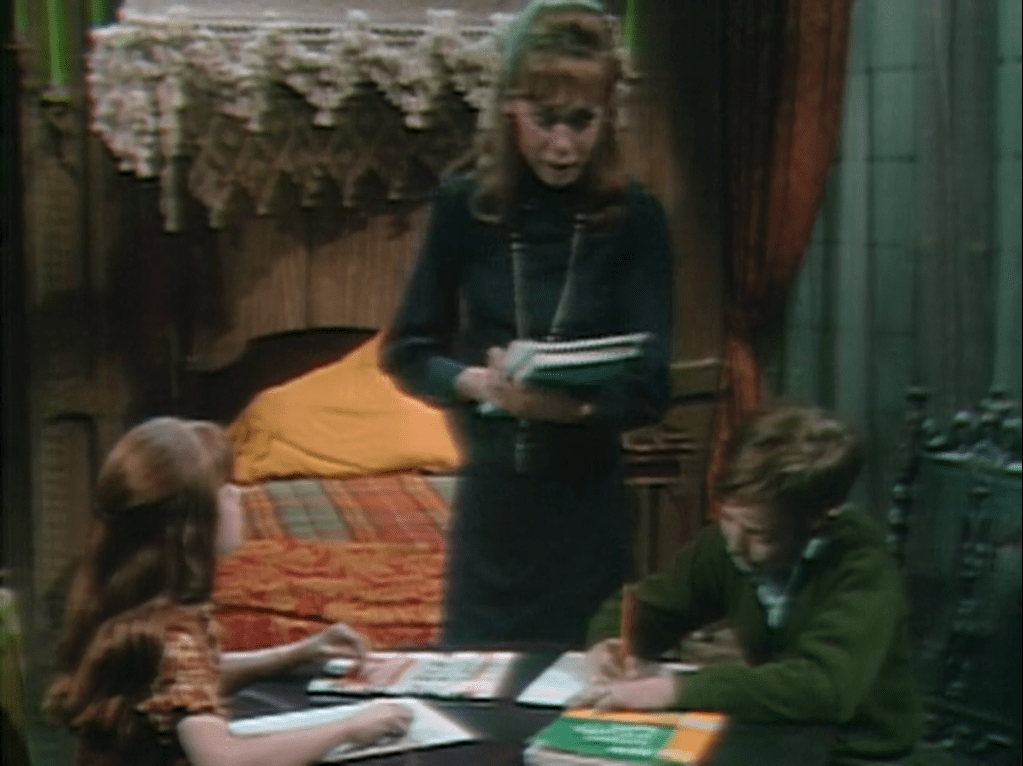
Today, we see our first tutoring scene in over a year and a half. David isn’t Maggie’s only charge; he has been joined by permanent houseguest Amy Jennings. Yesterday and the day before, we saw evidence that Maggie is a poor disciplinarian. We see further such evidence at the beginning of the tutoring scene, when the children complain about their lessons and Maggie quickly starts to explain herself and bargain with them. Amy and David are coming under the influence of the evil spirit of the late Quentin Collins. If the adult who is employed full-time to supervise David and Amy were up to her job, they wouldn’t be much help to him. So it’s no wonder the show three days in a row tells us that Maggie is a squish.

Maggie on the job.

To advance a plan of Quentin’s, Amy pretends to be ill and to faint during the lesson. David Collins is almost as subtle an actor as is David Henesy; when he is pretending to see signs of illness in Amy’s face, he looks at her with one eye and speaks with a most convincing note of concern. By contrast, Amy’s performance is exaggerated, showing none of the easy fluency Denise Nickerson brought to her roles. My wife, Mrs Acilius, chuckled at Amy’s fake faint and at some of the fussing she and David do when they are left alone together. She said it was refreshing to see that David and Amy are still kids. It certainly adds to the poignancy of what we are seeing Quentin do to them when we think of them as real children whose innocence he is exploiting for his evil project.

Amy’s fake faint convinces Maggie, and it leads to a lot of running around, ending with Maggie going to the cottage on the estate where Amy’s big brother Chris is staying as a guest of heiress Carolyn Collins Stoddard. Chris is a werewolf and is about to transform, and Quentin’s goal was to get Carolyn to go to the cottage. David has been making terrible pronouncements to Amy about how Carolyn will never bother them again, and the two of them are distressed to hear that Maggie rather than Carolyn is going to see Chris. So we are supposed to take it that Quentin knows about Chris’ situation and wants him to attack Carolyn.

Episode 669: Hide and seek

Governess Maggie Evans forbids her charges, David Collins and Amy Jennings, from going outside. They ask her to play hide and seek. She agrees, and accepts the role of It. She searches for them for a long time, ultimately finding them outdoors. She points out that she had told them to stay indoors, and they pretend not to have understood that this applied to their hiding places.

Maggie does not punish Amy and David for this obvious insubordination. This establishes that Maggie is a squish who will not maintain discipline. That point had already been made in yesterday’s episode, when Maggie caught Amy hiding in David’s room, in defiance of orders from heiress Carolyn Collins Stoddard. At that time, Maggie lied to housekeeper Mrs Johnson to cover up what the children had done. Maggie’s irresolution bears repeated exposure, though, since the children are coming under the influence of the evil spirit of the late Quentin Collins and would not be very effective as his helpers if they were subject to even moderately competent adult supervision.

Today Mrs Johnson and her son Harry are under orders from Carolyn to fix up the caretaker’s cottage on the estate. Carolyn has invited mysterious drifter Chris Jennings, Amy’s big brother, to live in the cottage. In the opening, Mrs Johnson tells Maggie she objects to this idea on the grounds that the cottage is cursed. Maggie dismisses Mrs Johnson’s belief in such a curse, but she really shouldn’t. Mrs Johnson keeps calling it “Matthew Morgan’s cottage” after the crazed handyman who lived there for eighteen years. Matthew killed Mrs Johnson’s beloved employer Bill Malloy, then tried to kill Maggie’s dear friend and predecessor as governess at Collinwood, Vicki Winters. Maggie knows all about those incidents. Mrs Johnson also says that no good happened at the cottage after Matthew; the only resident of the cottage since Matthew’s death was David’s mother, undead blonde fire witch Laura Murdoch Collins. Maggie knows plenty about Laura as well, since her father Sam was deeply involved in the strange goings-on concerning Laura and Vicki led the fight against her.

Under orders from Quentin, the children contrive to trap Mrs Johnson in the cottage by herself. Quentin appears to her there. She is terrified. This is quite a surprise to regular viewers. Quentin has appeared on screen only once before, in #646. Moreover, the children have made it very clear that Quentin is confined to the little room hidden in the long-deserted west wing of Collinwood where they found him. We are left to wonder how he gained the ability to manifest himself in the cottage and even to walk outside it when no one is looking.

Quentin terrifies Mrs Johnson. Screenshot by Dark Shadows Before I Die.

Perhaps we are to think that Quentin is in some way connected with the curse on the cottage, and with Chris. When the children first contacted Quentin, Amy could communicate with him before David could. This left David miffed, since “Quentin Collins is my ancestor.” That line of David’s led us to expect that we would learn that Quentin is also Amy and Chris’ ancestor. Tomorrow, David will tell Amy that Quentin is “quite pleased” that Chris is living in the cottage. Maybe it was Amy’s presence in the room in the west wing that activated the ghost of Quentin there, and Chris’ impending arrival in the cottage that activates it in that space.

This episode marks the last appearance of Harry. Until today, he was played by Craig Slocum. Edward Marshall takes Harry over the horizon. Mr Marshall must have been watching the show; he does a flawless imitation of Slocum’s very peculiar line delivery. His Harry is just as petulant and resentful as Slocum’s was, but he is so much more physically relaxed and so much more responsive to his scene partners that he is enjoyable to watch in a way Slocum never was. I can’t help but wonder if Harry would have caught on and become a bigger part of the show had Mr Marshall taken the part earlier. Harry’s personality made it impossible for him to figure in a romance of any kind, limiting his usefulness on a soap, but there’s plenty of room on Dark Shadows for comic relief in the form of an inept, grumbly, dishonest servant.

Episode 657: We will never leave this house

Old world gentleman Barnabas Collins, temporarily in charge of the great estate of Collinwood, has decided to place children David Collins and Amy Jennings in boarding school in Boston. Under the influence of the evil ghost of Quentin Collins, Amy and David want to remain in the house. While they pretend to be enthusiastic about Barnabas’ plan, they try to thwart it by talking about when exactly certain clothes had been in or out of certain closets. As it plays out on screen, this plan is somehow even more tedious than you might expect. Eventually Barnabas sets aside the idea of Boston, not because of anything the children have done or know about, but because the ghost of their former governess, the well-meaning Victoria Winters, made its presence known. Barnabas is attached to Vicki and he doesn’t want to miss a visit from her.

David and Amy’s new governess is Maggie Evans, The Nicest Girl in Town. For the first year of the show, Maggie was a waitress, her father Sam was a drunken artist, and their house was a counterpoint to Collinwood. As a working-class residence in the village of Collinsport, it represented all the homes affected by the crises the Collinses put themselves through, and scenes there suggested that there is a whole community of people whose futures hinge on what happens on top of the hill. In 1966, there were even stories about the Collins family business and its employees, and events at the Evans cottage were key to those.

When Barnabas joined the cast in April 1967, he was a vampire, and he soon took Maggie as his victim. In time, she escaped, her memory was erased, and he was cured of vampirism. Sam died in #518 and left the show in #530. Maggie’s engagement to hardworking young fisherman Joe Haskell ended a while ago; there isn’t much left to happen in the Evans cottage. When Maggie was hired to replace Vicki in #652/653, she moved into the mansion. The show formally bade farewell to the Evans cottage as a place in its own right at the end of that episode and beginning of the next, when Joe went there to get Maggie’s things and was attacked by a werewolf. From now on our excursions out of Collinwood will be brief; we don’t have any place left to stay.

Maggie looks like she’s rethinking her decision to move into the mansion. Screenshot by Dark Shadows Before I Die.

For some time one of the cameras has been on its last legs. In this one, it is almost completely unusable. It is something of a peculiar effect to cut back and forth between two cameras, one of them up to the broadcast standards of the period, the other of which produces only ghostly green images. The episode was directed by Henry Kaplan, who was a poor visual artist under any circumstances. The only remotely ambitious composition he tries today is a shot from a point of view inside a fireplace. They did this several times between December 1966 and March 1967, when David’s mother, undead blonde fire witch Laura Murdoch Collins, was on the show, often to good effect. But this time it is done with the defective camera, and it is simply difficult to see what is going on.

Episode 656: Mister Jonathan

The residents of the estate of Collinwood are under the impression that the mistress of the great house, Elizabeth Collins Stoddard, is dead. Her brother, Roger Collins, is on a business trip to London, and cannot be reached, even by the executives of the business he is there to represent. Liz’ daughter Carolyn is her heir, but she is apparently too doped up on sedatives prescribed by permanent houseguest Julia Hoffman, MD, to take any part in the action of today’s episode. So it falls to Barnabas Collins, Liz’ distant cousin and the master of the Old House on the estate, to move in and start making decisions.

Barnabas is the show’s chief protagonist and its main attraction, and he ran out of story three and a half weeks ago. The ongoing plot-lines both involve Amy Jennings, a nine year old girl who is staying at the great house as Liz’ guest. Amy’s brother Chris is a werewolf, and she and strange and troubled boy David Collins are under the power of the evil ghost of Quentin Collins. The urgent thing is to make Barnabas responsible for Amy so that he can take the lead in addressing both Chris’ lycanthropy and Quentin’s haunting. To that end, it is key that he should be in charge of the great house for a while.

A stranger comes to the door and asks housekeeper Mrs Johnson if he can speak to “Mister Jonathan.” Without batting an eye, she leads him to Barnabas. This proves that Barnabas has become such a breakout hit that even the other characters know that he is played by Jonathan Frid. Perhaps we are to imagine them reading about him in the fan magazines.

The stranger is a mortician who received a telephone call about Liz’ death. Barnabas informs him that they have made other arrangements, and his services will not be needed. Barnabas and Mrs Johnson are puzzled as to who made the call. It turns out that David did it at Quentin’s bidding; how this advances Quentin’s purposes is not clear.

Amy and David’s governess, the well-meaning Victoria Winters, vanished into a gap in the space-time continuum the other day and is not expected to return. Liz hired Maggie Evans, The Nicest Girl in Town, to replace her. Barnabas sticks up for Maggie when Mrs Johnson makes an unflattering comparison of her with Vicki, but he has evidently decided to eliminate her position almost immediately. He wants her to accompany him and the children on a trip to Boston where he will choose boarding schools for them to attend.

Barnabas has not spoken with Roger, who is David’s father. It is not clear who Amy’s legal guardian is. Her parents are dead, and her brother Tom was taking care of her before he died (the first time- he became a vampire and kept coming back.) Chris was away spending the nights of the full moon in the woods at that time, so Amy was sent to Windcliff, a sanitarium a hundred miles north of town. Julia is the nominal head of Windcliff and is Amy’s doctor, so it is possible she is Amy’s legal guardian. Julia is also Barnabas’ closest friend and most frequent accomplice, so it is possible she has agreed to his plan.

Even though Maggie’s job may not last for more than another week, she still needs a place to stay. So she, Mrs Johnson, and Barnabas clear Vicki’s stuff out of her room. Barnabas was hung up on the idea that he and Vicki might someday fall in love, an idea he did remarkably little to put into practice, and so he finds it distressing to be around her clothes. He demands that Mrs Johnson destroy them all. This shocks her. She finds an antique music box, and asks what to do with that. Barnabas orders her to destroy that too. Maggie takes the music box, listens to it for a second, grows wide-eyed, then hurriedly hands it to Mrs Johnson.

I can name that tune in three tinkles. Screenshot by Dark Shadows Before I Die.

This moment amounts to a programmatic statement. In May and June of 1967, Barnabas was a vampire and Maggie was his victim. He forced her to listen to the music box for hours on end, believing that it had a hypnotic power that would erase her personality and replace it with that of his lost love Josette. Several times it has seemed that her memory of what Barnabas was and what he did to her would come back, only for her to be subjected to one magical mind-wipe after another. That she is so quick to give Mrs Johnson the box when Barnabas has ordered her to destroy it, and that her relaxed and friendly attitude towards Barnabas does not change for one second, is a sign that the question “Will Maggie’s memory come back?” will not be coming up in Dark Shadows version 5.0.

Maggie looks for David and Amy and finds them in the drawing room. Amy is playing “London Bridge” on the piano. We have seen David interact with only one other child, the ghost of Barnabas’ nine year old sister Sarah. Sarah sang and played the recorder, and the only song she seemed to know was “London Bridge.” Evidently, David has a type.

Mrs Johnson can’t bring herself to destroy Vicki’s clothes. She tells Maggie she has closed them up in a storeroom in the basement. The only room we have heard referred to this way is the one that was kept locked for the first 54 weeks of the show because Liz was under the mistaken impression that the corpse of her husband Paul was buried there, so that must be the room she means. Longtime viewers will appreciate the reference; Vicki herself was intrigued by the room in the early days of the show, and now her things have found a home there.

They don’t stay there for long. Maggie goes to hang up her own clothes, only to find that Vicki’s are back in the closet. She asks Mrs Johnson what could have happened. In #69, her second appearance, Mrs Johnson declared that “I believe in signs and omens!” Ever since, she has shown an attitude that might be called superstitious in our world, but that in the universe of Dark Shadows is just plain common sense. She ends the episode with a monologue about how “no human hand” had moved the clothes, that it must have been some supernatural force announcing that Vicki will be coming back.

This is disappointing for a couple of reasons. First, the character of Vicki was played out at the end of #192, and the show refused to find anything interesting for her to do for the 90 weeks that followed. Alexandra Moltke Isles finally gave up and used her pregnancy as grounds to get out of her contract early, but they recast the part to continue wasting screen time on this exhausted figure. The second Vicki, Betsy Durkin, was condemned to be a fake Shemp, moping her way through utterly pointless activities unconnected with anything the audience could care about. It was a great relief when she finally vanished.

Second, the show has a poor record of using objects to evoke its themes. The music box was an exception, but most have been pretty bad. The most famous example is Burke Devlin’s filigreed fountain pen, which was the main focus of 21 episodes spread from August through November of 1966. It was supposed to be evidence in a homicide investigation and to suggest a number of things about Roger’s feelings towards his friend-turned-nemesis Burke, but at the end it was just a bunch of people looking for a pen. The most recent at this point was a wristwatch that fake Vicki gave to her husband shortly before his disappearance. It turned up after he was gone and would occasionally start ticking when his spirit was near. Miss Durkin had to play scene after scene with that watch as her main partner, and it is no reflection on her acting ability that the results were so uniformly dismal. There’s a definite sinking feeling when we see Vicki’s wardrobe presented as another symbolic object.

Episode 652/653: Someone to take care of them immediately

Well-meaning governess Victoria Winters has vanished into the past, sarcastic dandy Roger Collins is on a long business trip overseas, and matriarch Elizabeth Collins Stoddard is in the grips of a paralyzing depression. That leaves a shortage of adults in the great house of Collinwood, and old world gentleman Barnabas Collins has left his own house on the estate to be of assistance. He is fussing over Liz and insisting that she take the sedatives permanent houseguest Julia Hoffman, MD, prescribed for her. Liz says that all she cares about is that someone take Vicki’s place in the lives of the children in the house, Roger’s son David Collins and houseguest Amy Jennings. To address that concern she orders Barnabas to telephone Maggie Evans, The Nicest Girl in Town, and ask her to replace Vicki starting tonight.

Maggie is in her house talking with her ex-boyfriend Joe Haskell about his plan to move out of town soon when the telephone rings. Soon the two of them are in the drawing room at the great house, where Barnabas fills them in about recent developments.

Joe is Amy’s cousin. He has been doing what he can to fill the void left in her life by the deaths of her parents and her brother Tom, and more particularly by the puzzling refusal of her brother Chris to settle down and live with her. Amy comes downstairs and sees Joe; she is delighted to spend time with him while Maggie is upstairs with Liz, accepting the offer.

Amy’s delight gives way to alarm when she sees a pentagram superimposed on Joe’s face. She does not know what the returning viewers do, that Chris is a werewolf and the pentagram is the mark of his next victim, but she does know that it is a sign that Joe is in great danger. She pleads with him not to go to Maggie’s house and collect her things; she tells him that if he stays at Collinwood tonight, he will be safe. Joe dismisses her concerns as the result of staying up past her bedtime.

Joe enters the Evans cottage. While he is looking over the list Maggie gave him, he hears growling noises outside the window. He turns to look, and sees the window shatter and the werewolf jump through the glass.

The episode has a definite high point and an equally definite low point. The high point comes when Amy is staring at the full moon, which she senses is associated with something very bad. She cries as she does so. That is a powerful enough image that the following scene, when Barnabas sees her tears, asks her what is wrong, and she hugs him, is quite effective.

The low point comes when we see the werewolf sleeping on his bed. A werewolf can be terrifying if you catch only brief glimpses of him, and then only when he is in the middle of attacking someone. But this furry little fella isn’t scary at all. You keep expecting him to start flopping his legs because he’s dreaming about chasing a bunny. It generates a bad laugh that undercuts the final scene of the attack on Joe.

Whooooo‘s the goodest boy? Are you the goodest boy? I bet you are! Screenshot by Dark Shadows Every Day.

Amy has a couple of great one-word lines, too. Barnabas asks, “Amy, what are you doing with the door open?” To which she replies, “Nothing.” Later, Joe asks “Well what was all that you two were talking about?” To which she replies, “Nothing.” She really is a kid!

Episode 638: Red Riding Hood

Maggie Evans, The Nicest Girl in Town, is visiting the great house of Collinwood to sit with her sick friend Vicki. There, she meets mysterious drifter Chris Jennings. Maggie is furious with Chris, because he refuses to stay in Collinsport and take his little sister Amy in. Ever since their brother Tom died, Amy has been living at Windcliff, a mental hospital 100 miles north of town. Chris won’t explain to Maggie or anyone else why he keeps moving.

Julia Hoffman, MD, is the director of Windcliff, and she has been a permanent houseguest at Collinwood since last summer. Julia comes downstairs, and finds Maggie still reading the Riot Act to Chris. When she tells Maggie that Vicki is ready to see her, Maggie looks contemptuously at Chris, exclaims “Good!,” and stalks out.

Julia picks up where Maggie left off. Chris tells her he came to Collinwood to give her some money to pass on to Amy; Julia gives the money back to him, and says “She doesn’t need money, she needs you!” Chris won’t tell Julia where he is going or why. She asks if he will at least stop at the hospital on his way out; he says he will not.

In #632, we saw Chris visit Amy at Windcliff. Also in that episode, it became very clear that Chris is a werewolf. Returning viewers who remember that about him also know that Julia is an expert in vampires and Frankensteins with secondary interests in ghosts and witches, so if Chris came clean with her she might well have a prescription for him. But wherever Chris has been wandering, it isn’t a market where the ABC affiliate runs Dark Shadows, so he misses his opportunity to seek specialist medical attention.

Vicki has some symptoms that require Julia’s attention. On her way upstairs, she asks Chris not to leave before she comes back, since she has some more scolding to do. When Julia does come back down, she gets a telephone call from Windcliff. Amy has run away. She asks where Chris is, only to find that he did not comply with her request.

Matriarch Liz decides to go to the Old House on the estate, home of her distant cousin Barnabas. She explains that Barnabas and Vicki have always been close, so that she thinks he might be able to help calm her. Julia apologizes that she can’t accompany Liz on the walk through the woods, explaining that she has to wait by the telephone in case Windcliff calls again.

Liz is wearing a bright red dress we haven’t seen before, and as she leaves the house she puts on a bright red coat that is also new. This striking ensemble makes her look very much like Red Riding Hood. We see Chris skulking in the woods as Liz is walking nearby; he isn’t wearing character makeup, but is bending down and panting, suggesting The Big Bad Wolf. Liz hears him and calls out, asking who is there. She is looking into the camera, a look of alarm growing on her face, while we zoom in on her. Growling, snarling noises play on the soundtrack, suggesting that our point of view is that of the attacking werewolf. Liz has been a major character since episode #1; also introduced in #1 was the keeper of the Collinsport Inn, Mr Wells, whom we saw the werewolf brutally kill in #632. The show has been dropping major characters from the story and important actors from the cast recently, so it is not in fact impossible that this might really be the death of Liz.

Red Riding Hood from the Big Bad Wolf’s point of view. Screenshot by Dark Shadows Before I Die.

When I was a teenager and first started reading long books, page 638 was always a milestone for me. When I’d read page 638, I was always sure I would make it to the end, no matter how many pages were left. Ever since, 638 has been my lucky number. I can’t claim to be certain I will carry this blog all the way to #1245-WordPress has been getting steadily buggier lately, blogging itself is an increasingly old-fashioned pastime, and who knows what might happen to me between now and April of 2027- but it does give me a boost to have reached this point.

Episode 633/634: Now was the moment, or never at all

Suave warlock Nicholas has had bad news. His boss, Satan, will be recalling him to Hell, and does not plan to send him out to the world of the living again. Satan gave Nicholas two tasks to complete before his time runs out. He is to perform a Black Mass during which he will sacrifice Maggie, The Nicest Girl in Town, and afterward take her to Hell with him as his bride. He is also to complete the project he has been working on, forcing mad scientist Julia and old world gentleman Barnabas to resurrect Eve, the mate of Frankenstein’s monster Adam. Yesterday, we saw that Nicholas plans to make Barnabas and Julia use Maggie as the donor of the “life force” that will bring the mate back to life. It was entirely unclear how Maggie could both be sacrificed on Nicholas’ altar and used as the “life force.”

We open today with a reprise of yesterday’s closing sequence, showing Nicholas performing a rite while Maggie lies on his altar. We then cut to the basement of Barnabas’ house, where Eve’s body lies on a bed in a laboratory full of mad science equipment. Barnabas vows to Julia that this is the last time they will ever go through the vivification procedure; she asks “What’s the point of saying that? We’re at Nicholas’ mercy.” The other day, Barnabas confronted Nicholas with some demands, threatening to stop cooperating with his project unless he complied. Nicholas gave some ground in response, suggesting there might yet be some dramatic tension left in his relationship with Barnabas and Julia. But when Julia sounds this note of total defeat she is telling us that their conflict with Nicholas is exhausted, that the Frankenstein story has nowhere to go, and that Barnabas is therefore right and this is the last time we will see them run the experiment.

Julia looks at the body and expresses sympathy for “poor motherless Eve.” “There’s a poem about that,” she says. Indeed there is, and it is an apt reference here. Nicholas’ attachment to the ingenuous Maggie has always been jarringly out of character for him; Ralph Hodgson’s 1913 poem “Eve,” with its juxtaposition of the innocent Eve with the crafty serpent, not only tells a story that is as broadly melodramatic as any episode of Dark Shadows, but also dwells on the incongruity of Eve and the serpent, the sheer strangeness of the fact that they coexist at all. “Here was the strangest pair/ In the world anywhere.”

Yesterday we caught our first glimpse in a long time of a character who, like Maggie, was introduced in the first episode. He was Mr Wells, the innkeeper. Maggie has been with us through all of the show’s transformations, but we hadn’t seen Mr Wells since #61, when Dark Shadows was all about what went on among people while they were drinking coffee together. Seeing him again puts that 1966 show side by side with this dramatization of “The Monster Mash,” and that contrast is as jolting as anything Hodgson manages.

Visitors let themselves into the lab. First comes Nicholas. He is trying to seem cheerful. He comes down the stairs with a bounce in his step and greets Julia and Barnabas with a jokey “Why are my conspirators so reluctant?” He might be trying to evoke the same unholy jollity that we see at the end of Hodgson’s poem, “Picture the lewd delight/ Under the hill tonight/ ‘Eva!’- the toast goes round-/ ‘Eva’ again.” But the imminent prospect of his return to Hell has Nicholas in no jolly mood, and his mask of good cheer falls away the moment Barnabas complains of his untrustworthiness.

It is true that Barnabas’ complaint strikes Nicholas at a most sensitive spot. He tells him that “You seem to specialize in second chances” and gripes that he revived vampire Tom Jennings and left him to do the dirty work of ensuring Tom would never rise again. Giving second chances was the very habit for which Satan reproved Nicholas in #629 when he told him he would soon be returning to Hell. Stung by the echo of his master’s words in Barnabas’ mouth, Nicholas retorts that destroying a vampire must have been “traumatic” for Barnabas, who was until recently a vampire himself. Because of some magical business, Barnabas will revert to that condition if Adam dies, and it is Nicholas’ threat to kill Adam that has compelled him and Julia to assist in his diabolical plan. Having reminded Barnabas and Julia of the source of his power over them, Nicholas composes himself, agrees with Julia that there is no time for quarrels, and leaves the room.

A moment later, Adam enters. Adam hates Barnabas and Julia, believes that Nicholas is his friend, and looks forward to Eve’s resurrection. Barnabas tells Adam he doesn’t want him there, but Nicholas enters with the command “He stays, Mr Collins.” A third visitor follows and shocks Julia and Barnabas even more deeply. It is Maggie.

The rite on the altar dedicated Maggie to Satan, but it did not involve her death. When Julia and Barnabas see that Nicholas has brought Maggie, they declare that they will not go ahead with the procedure. But Maggie declares that she is there of her own free will. Quite calmly, she looks around the laboratory in Barnabas’ basement, and says “I’ve been here so often.” Indeed she has- in May and June of 1967, Barnabas was still a vampire, Maggie was his victim, and he kept her imprisoned in a cell here. Julia used her extraordinary hypnotic abilities to make Maggie forget her ordeal, but this line suggests that she now remembers what Barnabas did to her, and that she is, terrifyingly enough, happy about it.

When Maggie was Barnabas’ prisoner, he was trying to erase her personality and replace it with that of his lost love Josette. Later, the show took us back in time to the year 1795, where we saw Josette when she was alive and realized that she wasn’t on board with Barnabas’ plans then any more than Maggie was in 1967. But it looks like Nicholas has succeeded where Barnabas failed and remade Maggie as a companion fit for a demon. Barnabas is already miserable at being forced to toil in Satan’s cause, and now he goes nuts with jealousy.

Barnabas loudly protests that he will not be a party to the experiment. Nicholas silences him by causing Adam’s heart to beat dangerously fast. Their magic bond gives Adam and Barnabas the connection Alexandre Dumas’ Corsican Brothers had, so that Barnabas also suffers the pain. Julia was originally introduced as Maggie’s doctor, but she long ago betrayed her patient for Barnabas’ sake. She pleads with Maggie to stop Nicholas, but Maggie just smiles and asks “Why should I?” Julia tells her that otherwise Nicholas will kill both Adam and Barnabas. Perfectly relaxed, Maggie responds “Then you stop him. Do what he wants.” Julia capitulates, saying “We’ll use her.”

This glimpse of Evil Maggie is breathtaking for longtime viewers. In #1, Maggie premiered as a wisecracking waitress who was, in the words of the original series bible, “everybody’s pal and nobody’s friend.” Soon, we saw her with her father Sam, the town drunk, and she emerged very clearly as a classic Adult Child of an Alcoholic (ACoA.) In #20, Maggie left behind the short blonde wig she had worn in her first appearances, and from then on she was The Nicest Girl in Town.

When Barnabas first bit Maggie, she went through the phases the vampire’s victim usually experiences, including snappishness towards her loved ones when they try to get between her and the ghoul on whom she is becoming dependent. During her time in Barnabas’ house, her level-headedness and warm-heartedness reasserted themselves, and even when she was in the mental hospital as a psychological wreck after escaping from him she was never far from a display of kindliness. In the eighteenth century flashback, Kathryn Leigh Scott took on the part of Josette. Josette was so unfailingly virtuous that not even Miss Scott could find a way to make her interesting. This brief moment of a Maggie utterly indifferent to the value of human life, even her own, is such an extreme departure that we can immediately see a world of possibilities opening up for her as a character and for Miss Scott as a performer.

Maggie is strapped to a table and Julia and Barnabas get to work. We have seen the procedure often enough that it is far from fresh, but in-universe it is still highly experimental. The equipment doesn’t work as Julia and Barnabas expected; gauges indicate higher readings than they want, and the adjustments that are supposed to bring them down just make them go even higher.

Maggie cries out that she is dying; Eve barely moves. The readings get even worse; Barnabas shuts the apparatus down. Nicholas tries to cast a spell to immobilize Barnabas; he struggles against Nicholas’ power at first, but still smashes the equipment, and soon is free of the spell altogether. Nicholas calls out to his master and pleads “Don’t desert me now!” His powers gone, he runs to Adam and starts trying to choke him, but Adam brushes him aside easily. Nicholas runs away; Barnabas runs after him, saying that he will take the opportunity to kill Nicholas.

Adam is shocked that Nicholas attacked him. He and Julia find that nothing is left of Eve’s body but a skeleton with a wig. Adam sobs, declaring that now he has no one. Adam decides that Barnabas is to blame for Eve’s destruction. He goes upstairs, tells himself that Barnabas “doesn’t deserve to love,” then leaves the house. Later, we see him in the great house of Collinwood. Regular viewers know that Adam has in the past thought of punishing Barnabas by murdering well-meaning governess Vicki, in whom Barnabas does not actually take much interest but whom he frequently claims to love. So we can expect that Friday’s episode will involve some apparent danger to Vicki.

Julia is too busy with Maggie to take any notice of Adam’s doings. The last time Julia ran the experiment, the “life force” donor died. Julia is frightened when she cannot get Maggie to respond to any stimulus. She gives her a shot, and Maggie opens her eyes.

Longtime viewers wonder what Maggie will be like now. If Satan has lost interest in Nicholas, it seems unlikely that the heartless Maggie of a moment ago will stick around. If she returns to her usual sensibilities with her memories of Barnabas’ crimes restored, the show will no longer be able to use the sets representing the houses at Collinwood since Dark Shadows will become a prison drama about the activities of Barnabas and Julia on their respective cell blocks. If she just snaps back to the way she was before she got involved with Nicholas, it will feel like a cheat.

What they actually choose to do is to give Maggie total amnesia. She does not recognize her own name or Nicholas’, refuses to believe she has ever met Julia, and has no idea where she is. Julia tries desperately to reactivate Maggie’s memory. She takes her up to Barnabas’ living room. In a moment longtime viewers will find impossible to believe, Julia takes a music box and plays it for Maggie. She tells her that it once belonged to Josette and that Maggie has heard it many times. Indeed she has- Barnabas forced her to listen to it incessantly during the weeks when he was trying to Josettify her. Julia, who has gone to such great lengths to bury Maggie’s memory of what Barnabas did to her, is now trying to dislodge her recollection of his very worst crimes. When Maggie does not remember the music box, Julia takes her up to Josette’s bedroom, where Barnabas kept her for much of her time as his prisoner. It is simply impossible to imagine what Julia could be thinking at this point.

Meanwhile, Barnabas is skulking in the foliage near the peak of Widow’s Hill. He is eavesdropping on Nicholas, who is pleading with Satan to give him another week to get the Frankenstein project back on track. He dissolves into a process shot depicting flames, and Barnabas smiles the most evil grin anyone has ever managed.

Mr Warmth. Screenshot by Dark Shadows Before I Die.

Even though poor motherless Eve is on screen for only a minute or two, doesn’t open her eyes, has no lines, and moves only a couple of fingers and those just barely, they brought Marie Wallace back to play her. That was $333 well spent. Miss Wallace’s presence on screen convinces us that Eve is really dead and that she will not be back. Combined with Maggie’s amnesia, that leaves Nicholas without any connection to an unresolved storyline. The only former underling of his still at large is witch-turned-vampire Angelique, and she had broken from him decisively a couple of weeks ago. When he vanishes, we can accept it as a line drawn under the part of the show in which he was the principal villain.

Eve’s decomposition and Nicholas’ damnation are not the only departures today. This was the final episode directed by John Walter Sullivan. As “Jack Sullivan,” he was credited as an associate director on a great many episodes, from #15 to #549. When John Sedwick left the show in the summer of 1968, Sullivan took over his share of the directing duties, alternating with Lela Swift. He directed a dozen episodes as “Jack Sullivan,” from #504 to #580. He then took the name “Sean Dhu Sullivan,” and directed 50 more. Sullivan was not as accomplished a visual artist as either Swift or Sedwick, and the camera operators had more trouble keeping his episodes in focus than they did either Swift’s or Sedwick’s. But his scenes were never any more confusing than you would have expected, considering the ridiculously convoluted stories the scripts gave him to work with, and he seems to have been as good a director of actors as either of them. The period when he was helming segments happened to be the one when the show had its most explicitly Christian elements, which you might say made him a Sean Dhu for the Goyim,* but I doubt he had anything to do with that.

*This is my only chance to make this joke, please just let me have it.

Episode 632: A new mate

Two arcs overlap today. Suave warlock Nicholas Blair is in one that is coming to its end, while mysterious drifter Chris Jennings is in one that is beginning.

The fansites I consult when I write these posts vary in how much detail they give about what happens in the episodes. At one pole is John and Christine Scoleri’s Dark Shadows Before I Die, which gives detailed summaries of every plot point, usually illustrating each with at least one screenshot. Their post about this one is no exception.

At the other pole is Patrick McCray and Wallace McBride’s Dark Shadows Daybook. They typically present a brief essay about one key point in an episode. Halfway between the two is Danny Horn’s Dark Shadows Every Day, which occasionally drifts towards one or the other of those extremes and occasionally disregards the episode altogether to focus on some other Dark Shadows related topic, but which as a rule focuses on two or three points and weaves them together as it runs through an overview of the day’s narrative outline. It’s a sign of the thickness of today’s story that not only Danny’s post, but even Patrick’s, approaches a Scoleri-esque level of retelling.

Nicholas is under orders from his boss, Satan, to do two things in a very short time. He must sacrifice Maggie Evans, The Nicest Girl in Town, in a Black Mass. For this, he will be rewarded with Maggie’s eternal companionship in Hell. He doesn’t exactly seem happy about this, but he does drug Maggie, dress her up, and put her on an altar, so it seems like he’s going to comply.

Nicholas’ other task is to create a humanoid species entirely subject to the spiritual forces of darkness. This would seem like a big project, but he already has a start on it. A male Frankenstein’s monster known as Adam lives in his house, and at Nichol;as’ bidding Adam has coerced mad scientist Julia Hoffman and her friend, old world gentleman Barnabas Collins, to revive a female of the same breed known as Eve. As their names suggest, Adam and Eve are to be the parents of this new race of people.

Nicholas finds that Adam has grown reluctant. Eve needs reviving because Adam killed her the first time she was brought to life. She hated Adam and rebelled against Nicholas’ command that she mate with him, and at the end the big guy murdered her. Adam says that if Eve comes back to life with the same personality, he will kill her again. Nicholas tells Adam that the reason Eve was so hard to live with was that the woman who donated the “life force” Julia used to animate her was evil, and that the woman who takes that role when Eve is brought back to life will be very sweet and loving. When Adam is skeptical, Nicholas tells him that Maggie will donate the “life force.” Knowing Maggie, Adam finds this acceptable.

Nicholas doesn’t have time to recruit any other woman, since the experiment must take place tonight. It seems he must be telling Adam the truth about Maggie. Perhaps he will take her to Barnabas’ basement and tell Julia to hook her up to the machinery. But even before the end of the episode, when we see her on the altar, her throat apparently about to be cut, it puzzles returning viewers how this can be. Yesterday Barnabas forced Nicholas to promise he would not harm Maggie in any way, and said that he and Julia would not continue working to revive Eve unless he honored that promise. So it is a mystery how he can expect them to cooperate if he shows up with Maggie and tells them to subject her to a procedure that is more likely than not to kill her.

Meanwhile, Chris is visiting his little sister in the hospital. The hospital is Windcliff, a sanitarium about a hundred miles north of Collinsport; Julia is its nominal head. The sister was first mentioned in #627; her name was “Molly” then. It’s “Amy” now. There’s good precedent for such an identity change. When Julia was first mentioned in #242, she was simply “Dr Hoffman,” and she was “one of the best men in the field” of rare blood diseases. A change from “Molly” to “Amy” isn’t so drastic as that.

Amy reacts blankly to Chris. He offers her a box of paints. He tries to get her to say something in response; at length, she replies “Why didn’t you come before?” He doesn’t have a satisfactory answer to that, and she says “You did what you had to do. You brought me the present. You can go now.” He looks for words to express his wish that he could be with her, and all she hears is that he is about to go away again. He breaks down and promises to stay “right here in Collinsport.” Regular viewers will recognize that as a continuity error, but if we imagine it to be a slip on Chris’ part it is intriguing- he has been so far away for so long that any location in Maine seems like Collinsport. He repeats his promise, and finally she throws her arms around him, bursts into tears, and pleads with him to stay.

This is our introduction to Denise Nickerson. In the hands of another actress, Amy’s transition from suspecting Chris to embracing him could have seemed very pat indeed, but she is so utterly cold to him in the first part of the scene, so subtle in showing signs of hope in the middle of it, and so abrupt when time comes to warm up, that the whole thing plays as a real surprise. When we see that she has those skills, we can be confident that the show will be in good hands as long as Nickerson is part of the cast.

Nickerson and Don Briscoe play part of their scene behind an aquarium. We last saw that aquarium in #276. In that one, we were supposed to be uneasy about Windcliff and about Julia as its director. When we saw her feed the fish, it was a metaphor for her role as the mistress of a strange, self-contained little world whose inhabitants were at her mercy. Julia has been living on the estate of Collinwood for well over a year now, and the only member of Windcliff’s staff whom we see today is a nurse whose bit part was a prize given to beauty contest winner Bobbi Ann Woronko. So our attention is directed not to whoever is in charge of the place, but to Nickerson and Briscoe’s faces distorted in the water as the goldfish pass in front of them. This is rather a heavy-handed way of telling the audience that they are, each in their own way, as much prisoners as are the fish.

In the tank. Screenshot by Dark Shadows Before I Die.

Chris has seen the weather report in the newspaper and realized that the moon will be full tonight. This alarms him. Back at the Collinsport Inn, he asks the innkeeper, whom longtime viewers met in #1 and know as Mr Wells, if he can change his room. He wants the most isolated room in the place. He also wants Mr Wells to lock the door from the outside and to leave the door closed no matter what he hears inside. Mr Wells is reluctant, but agrees to all of these conditions.

Even viewers who stumbled onto Dark Shadows never having heard of it would know from what we have seen between Maggie and Nicholas that it is a horror story. Those who have been to the movies will add Chris’ status as a mysterious drifter to his alarm at the full moon and his request to be locked up and left alone no matter what Mr Wells may hear and will come up with the irresistible conclusion that he is a werewolf. They will also be sure that Mr Wells will eventually decide the sounds coming from behind the door are so terrible he cannot leave Chris alone, and that when he unlocks it Chris will kill him. Of course this is exactly what does happen. Our last shot of Mr Wells shows his face streaked with red and blue markings. The red ones presumably signify blood, and the others signify that most TV sets in the USA in 1968 received only in black and white, so blue lines would look like bruises.

Blue and red. Screenshot by Dark Shadows Before I Die.
The same shot in black and white.

Mr Wells, played by veteran character actor and future TV star Conrad Bain, had last appeared in #61. That was one of the longest gaps between appearances by a cast member, though the record belongs to Albert Hinckley, who like Bain appeared in #1. Hinckley, a train conductor in that one, will return playing a doctor in #868. That’s quite an extended absence from the show, but a remarkably short period to make it all the way through medical school, he must have been very bright.

Also in #1 was Alexandra Moltke Isles as well-meaning governess Victoria Winters; Mrs Isles left the show three days before this episode was taped. Victoria was Dark Shadows’ chief protagonist for its first year, and Mrs Isles’ presence in the cast was a powerful reminder of the show’s history even after the character was relegated to the sidelines of the action. Combining her departure with Mr Wells’ on-screen death, it might seem plausible that Maggie, another survivor from the first episode, might really die on Nicholas’ altar.

Episode 616: When a woman has a man in her power

In June 1967, vampire Barnabas Collins locked his victim Maggie Evans, The Nicest Girl in Town, in the prison cell in the basement of the Old House on the estate of Collinwood. The ghost of Barnabas’ little sister Sarah appeared to Maggie several times while she was in the cell. Sarah told Maggie that no one could know she had been to the cell, and particularly warned her not to tell her “big brother” she had seen her. With some reluctance, Sarah eventually gave Maggie a clue that led her to a hidden passage. Sarah’s father had sworn her to secrecy about the passage, and that not even her big brother knew about it. Maggie finally puzzled out the clue, enabling her to escape just moments before Barnabas came to the cell with the intention of killing her. When Barnabas chased Maggie through the hidden passage in #260, the wondering expression on his face confirmed that he had never had any idea the passage was there.

From November 1967 to March 1968, Dark Shadows was a costume drama set in the years 1795 and 1796, the period when Barnabas and Sarah were living beings and the Old House was their home. We saw how cruelly their father, haughty overlord Joshua, treated his indentured servant Ben, and we saw that Joshua had the great house of Collinwood built with a prison cell in its basement. Joshua confined Ben to that cell in #401. With that, we could be sure that Maggie’s cell was already in the basement of the Old House when Barnabas and Sarah lived there, and could surmise that Joshua really did forbid the living Sarah to share with Barnabas or anyone else what she had found about the hidden passage.

The show never explained how Sarah found out about the passage. We might imagine her hiding and watching Joshua or someone else do maintenance on the cell. But the fact that Joshua kept the existence of the escape hatch from Barnabas suggests he wanted the option of locking his son in the cell. Why not his daughter as well? Perhaps Sarah found the passage while confined in the cell herself. Or perhaps some other, older ghost appeared to her while she was there and told her about it. That the clue she gives Maggie is in the form of a rhyme (“One, two, away they flew…”) would suggest this latter possibility. Sarah may have memorized the rhyme as she memorized the lyrics to “London Bridge” and may have solved the riddle as Maggie solves it.

Shortly after Dark Shadows came back to a contemporary setting in March 1968, Barnabas was cured of vampirism. That cure was stabilized in May, when he donated some of his “life force” to the creation of Frankenstein’s monster Adam in an experiment completed by his friend, mad scientist Julia Hoffman. Barnabas and Julia locked Adam up in the basement prison cell for the first weeks of his life. Vampires and mad scientists are metaphors for selfishness, so it is hardly surprising that they are horribly bad parents. But if Joshua was in the habit of locking his children in that same cell, the moments when Barnabas takes fatherly pride in the imprisoned Adam take on a special pathos. It really does seem like a normal situation to him.

Adam escaped from the cell in #500, demolishing the doorway in the process. Today we see that it has been rebuilt. Perhaps to Barnabas, a house just isn’t a home unless it has a prison cell in the basement.

Now, Barnabas has himself become the blood thrall of a vampire, his ex-wife Angelique. Discovering the bite marks, Julia decides to address the situation by locking Barnabas and his servant Willie in the cell. Barnabas won’t be able to get out to heed Angelique’s summons, and Willie hangs a cross over the door to keep her from materializing inside it.

Left to right: Barnabas Collins (Jonathan Frid); Willie Loomis (John Karlen); Julia Hoffman (Lady Elaine Fairchilde.) Screenshot by Dark Shadows Before I Die.

We cut to Maggie’s house. Maggie’s memory of her ordeal as Barnabas’ victim has been wiped from her mind a couple of times. She receives a visitor, the suave Nicholas Blair. Unknown to Maggie, Nicholas is a warlock and Angelique’s master. He has a crush on Maggie which has distracted him from his managerial responsibilities, which to be frank he had not been handling very diligently in the first place. Maggie gives Nicholas several pieces of news that he really ought to have been aware of for some time. She tells him that her ex-fiancé, Joe Haskell, is still alive; that she visited Joe twice while he was at the Old House recovering from some injuries; that Joe is now in the hospital under police guard; and that Joe tried to kill Barnabas and keeps vowing that he will try again, since he believes Barnabas is trying to kill him. Nicholas is flummoxed by all of this, and meekly goes along when Maggie insists on visiting the Old House to pay a call on dear, sweet Barnabas.

The scene in Maggie’s house has an odd feature. We’ve just had a closeup of Willie hanging a cross above the door in the cell to keep Angelique away. In the early days of the vampire storyline, it was not at all clear that the cross would deter vampires in the world of Dark Shadows, since Barnabas was often seen strolling comfortably through a cemetery where half the grave markers were cross-shaped. It was not until #450, during the 1790s flashback, that we saw Barnabas recoil from a cross. In #523, we learned that the cross also immobilizes Nicholas. Yet Maggie is today wearing a dress the front of which is dominated by a red cross, and it doesn’t bother Nicholas a bit. The show is drifting into a spot where it may have to stop and spend time explaining its theurgy. Does the cross only work against a demonic creature if it is specifically aimed at that creature? Or if the person setting it up knows about the creature? Or is there some other qualification? It’s getting confusing.

At the Old House, Julia tells Maggie and Nicholas that they cannot see Barnabas, because he is resting. Maggie keeps insisting, and Julia shifts her ground, claiming that Barnabas went out, she knows not where. When Julia says this, Maggie is incredulous, but Nicholas brightens. Evidently he wants to believe that Barnabas has gone off to respond to Angelique’s call, and accepts Julia’s statement happily. Maggie apologizes for demanding to see Barnabas, and she and Nicholas leave.

Meanwhile, Barnabas is scheming to get out of the cell. While Willie is complying with his request to pour a glass of water, Barnabas bashes him on the head with an empty bottle. He then goes to the hatch for the secret panel, remembers that “Maggie found it a long time ago!” and figures out how to open it. Since we saw Willie open the hatch and show Adam Barnabas’ jewel box in #494, you would think Barnabas already knew how it worked. At that time, it also seemed that the passage behind the hatch had been sealed up, so that it no longer led to the beach. Apparently we aren’t supposed to remember that. Barnabas crawls out and closes the hatch behind him before Julia comes back.

As Barnabas, Jonathan Frid usually moves in the stateliest possible manner. When he escapes from the cell today, the camera lingers on him crawling, driving home the contrast with his typical gait. That is quite different from what we saw in #260, when he followed Maggie into the hatch- then, we saw him move toward the opening, but cut away before he had to take an ungainly position. Today, the makers of the show want us to hold the image of a crawling Barnabas in our minds.

Crawling suggests Barnabas’ weakness under Angelique’s power, certainly, but in this setting it suggests more. This is the house where he was born, and what he is crawling into is a lightless passage that it looks like he will have to squeeze through to emerge outside. He has regressed not only to infancy, but all the way back to birth. If Joshua did indeed confine him to this cell in his childhood, Barnabas would likely have experienced that same regression in those days as well.

The sign of the cross reminds us of one who said that we must be born again to receive a life in which our hopes will be fulfilled more abundantly than we can ask or imagine; Barnabas labored for 172 years under a curse that compelled him to die at every dawn and revive at every sunset, but perhaps even before that he was the prisoner of a cycle of abuse that forced him to experience the trauma of birth over and again, each time finding himself in the same narrow space, a stranger to all hope. Indeed, when Barnabas first became a vampire in the 1790s, he put his coffin in this basement, near the cell, and he persisted in putting it there even after it became obvious that it was very likely to be discovered. That persistence made no logical sense in terms of Barnabas’ need for operational security, but if he saw his vampirism as a continuation of his childhood experience of confinement in the basement cell, it would make all the sense in the world. That is his place, that is where he belongs, that is his reality.