Episode 457: I will meet you

This is the first episode of Dark Shadows credited to a director other than Lela Swift or John Sedwick. It is also the first production of any kind directed by Dan Curtis, the series’ creator and executive producer. Curtis’ inexperience shows at several moments when the camera is in an awkward spot or the actors are unsure what to do, and in his post about the episode on Dark Shadows Every Day Danny Horn documents several of the more egregious examples with screenshots and detailed analysis. The impossible deadlines and tiny budget on which Dark Shadows was produced meant that even Swift and Sedwick, who were seasoned professionals and ambitious visual artists, sometimes had to turn in work that wasn’t much better than what first-timer Curtis manages today, and longtime viewers of the show will take even his worst stumbles in stride.

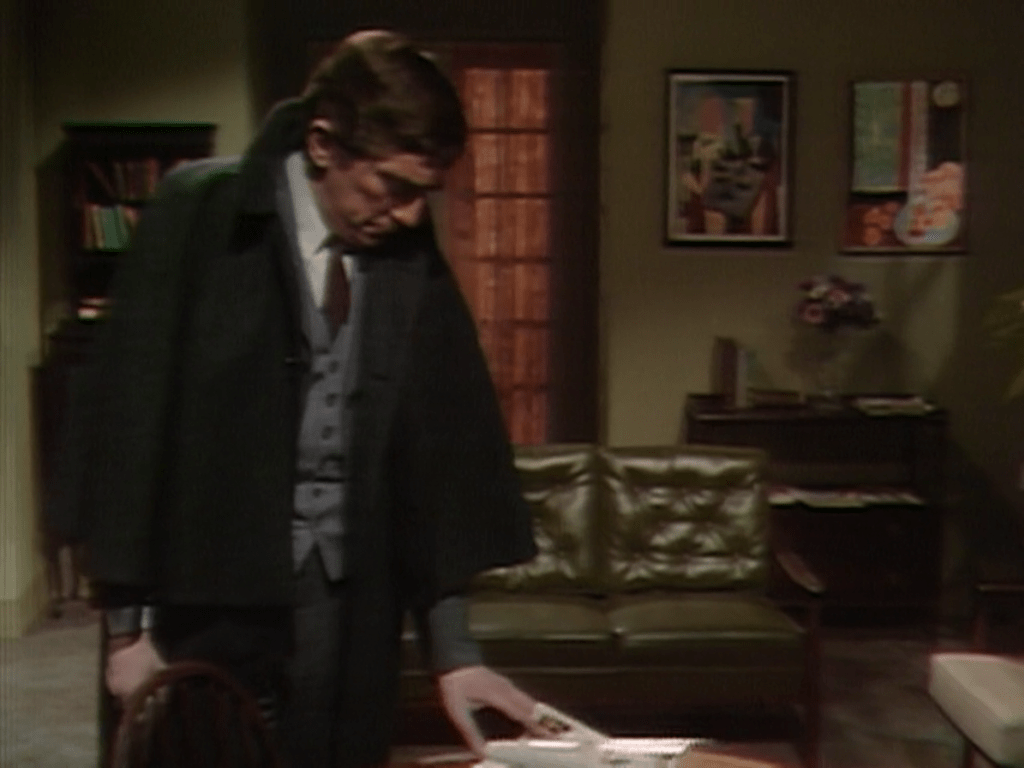
At the top of the episode, it is daytime, and much put-upon servant Ben Stokes (Thayer David) finds the lady of the house, Naomi Collins (Joan Bennett,) standing at an open coffin that holds the corpse of her son, Barnabas. Ben knows that Barnabas is a vampire who will rise at night to prey upon the living. Naomi has never heard of vampires. All she knows is that Barnabas is dead, and that his coffin has been moved from the family mausoleum to a room atop a tower in the mansion. Ben pleads with her to leave the room and to go with him back to the main part of the house.

Naomi questions Ben. Ben tells her that Barnabas has a “sleeping sickness,” and has been in a coma ever since the night he apparently died. Ben does not like to lie to Naomi, but her husband, haughty overlord Joshua, has judged that the truth would kill her, and Ben is governed by that assessment. He does tell her that the “sleeping sickness” is a symptom of a curse, that the wicked witch who placed the curse was Barnabas’ sometime wife Angelique, and that Joshua is in Boston trying to find someone who knows how to lift it.

Ben asks Naomi how she came to be in the tower room. She tells him that naval officer/ sleazy operator Nathan Forbes told her that Barnabas was being kept there, and also that Barnabas was responsible for the series of murders that had recently taken place in the town of Collinsport. At that, Ben vows to kill Nathan. To his chagrin, Naomi forbids him to do this.

Naomi forbids Ben to kill Nathan. Screenshot by Dark Shadows Before I Die.

In the part of Dark Shadows set between August and December of 1966, Bennett played reclusive matriarch Elizabeth Collins Stoddard and David played her fanatically devoted handyman Matthew Morgan. When well-meaning governess Vicki came unstuck in time and arrived in the late 1790s, she at first mistook Naomi for Liz and Ben for Matthew. This scene takes longtime viewers back to the days when Matthew was always on the lookout for someone who represented a threat to Liz’ interests and she was always sternly prohibiting him from murdering anyone for her sake.

Ben is a far saner man than Matthew ever was; the contrast between them shows the effect that growing up in Collinsport, a town suffering from the consequences of a curse that has been working its way for many generations, has had on Matthew’s personality. While Ben is a brave, kind-hearted fellow whose fierce loyalties sometimes overpower his good sense, Matthew is a paranoid ogre who kills Liz’ friend Bill Malloy and tries to kill Vicki. It isn’t just one family that will be warped by Angelique’s curse. It will breed monsters everywhere the Collinses’ influence prevails.

Naomi then turns her attention to the B-plot. Nathan has married fluttery heiress Millicent Collins, only to find that Millicent has signed her share of the Collins fortune over to her little brother Daniel. Nathan responded to that news by crafting a plot to murder Daniel. His first attempt failed when Noah Gifford, the henchman he hired to abduct Daniel and drown him, fell afoul of Vicki. Vicki found Noah strangling Daniel near the place where she was hiding, having escaped from gaol, and shot him to death. After that, Daniel and Vicki went back to the mansion and told Naomi what they knew. Naomi recognized Daniel’s description of his attacker as a man she had seen with Nathan earlier, and realizes that Nathan is trying to murder the boy. So she orders Ben to take Daniel into town to stay with the Rev’d Mr Bland, a clergyman who looks like a duck.

Naomi confronts Nathan, who keeps telling her that whatever Barnabas might look like during the day, he gets up at night and goes out to murder people. She tries to shut him up, but later she is still wondering whether she should go back to the tower room after dark to check his story out.

She sees Millicent standing in the foyer, staring at the portrait of Barnabas that hangs there. The portrait of Barnabas first appeared under the closing credits in #204, and from #205 on it figured as a means through which Barnabas could communicate with the living. Barnabas bit Millicent the other day, and she hears him summoning her.

Among the 1960s characters who receive their commands from the vampire while staring at the portrait is Liz’ daughter Carolyn, who like Millicent is played by Nancy Barrett. Millicent at times evoked an early version of Carolyn. Until the spring of 1967, Carolyn was tempestuous and irresponsible, sometimes friendly to point-of-view character Vicki, sometimes hostile to her. Millicent is as timid and overly dependent as that version of Carolyn was headstrong and self-centered. One way or another, each is a Spoiled Heiress, and evidently that’s a favorite meal of Barnabas’.

Naomi follows Millicent to the gazebo on the grounds of the estate. There, she sees Barnabas. She is stunned that the son whose corpse she was looking at just a few hours before is up and moving. He bites Millicent, and Naomi lets out a scream. Barnabas looks up, and realizes that his mother has caught him in the act.

The vampire’s bite affects each victim differently. The first victim we saw was Willie Loomis, whom Barnabas’ bite transformed from a dangerously unstable ruffian to a sorely bedraggled blood thrall. Willie was at first gravely ill, then ran to Barnabas like an addict desperate for a fix, and eventually settled into life as a sorrowful servant who could not run away from Barnabas but could resist him to the point where Barnabas occasionally found it necessary to keep him in line with beatings.

The second victim we saw was Maggie Evans, The Nicest Girl in Town. She reacted very much like the first victim in the 1790s segment, gracious lady Josette, who, like Maggie, was played by Kathryn Leigh Scott. At first, those two were alternately blissful and snappish, happy to be under Barnabas’ power and defensive with anyone who might interfere with it. But each recoiled from him by the time it became clear he planned to kill her and make her into a vampire herself. Each escaped from him to the shore below Widow’s Hill- Maggie by running through an underground tunnel that rose to the shoreline, Josette by flinging herself to her death from the top of the cliff.

Later, Barnabas bit Carolyn. She initially contemplated his most gruesome crimes with pure glee and showed great energy as his protector and enforcer. Soon her conscience reappeared, but she was still doing his dirty work faithfully when Vicki disappeared into the past.

Millicent differs from all those others in that she simply continues to go about her business in between Barnabas’ meal-times. Granted, she was already deeply disturbed by that point, so that her business was conducted mostly in show-stopping mad scenes. But it’s still odd that she can talk to Nathan as if their marriage were the main thing in her life.

When we finished watching this one, my wife, Mrs Acilius, wondered if these differences were simply the result of the victims’ personalities coming through or if the vampire can pick and choose how to apply the pressure. He wanted Willie as a slave, and the reaction he produced gave him that. He wanted to turn Maggie into a reincarnation of Josette, and wound up getting the same reaction from Maggie that he had got from Josette. He bit Carolyn in a moment of desperation, with no plan in mind, and her reaction is complicated and volatile. He bit Millicent to keep her quiet, and her reaction is remarkably inconspicuous. Maybe we’re just supposed to think that Barnabas is fabulously lucky, but there is an opening there to tell a story about how him deciding what he wants to do to a person when he sucks their blood.

Episode 444: What if she doesn’t?

This one made us think about the nature of suspense. Yesterday, naval officer/ sleazy operator Nathan Forbes schemed with his henchman, the unsightly Noah Gifford, to trick fluttery heiress Millicent Collins into thinking that her second cousin Barnabas was trying to kill her.

Today, we see that plan unfold just as Nathan had hoped it would. Millicent goes to the gazebo on the estate of Collinwood, having received a message asking her to go there. The message appeared to be from Barnabas, but was actually from Nathan. Noah, wearing a Zorro costume and carrying Barnabas’ highly recognizable cane, springs out of the bushes. He attacks Millicent with the cane, then Nathan appears. The men pretend to fight, Noah pretends to lose, and he runs off into the night. Millicent thanks Nathan profusely and wonders why Barnabas would want to hurt her.

Noah really should wear that mask all the time, he has the face for it.

Millicent and Nathan are so interesting to watch together that we can’t stop ourselves hoping Nathan’s scheme works. On the other hand, we know that Nathan is only after Millicent’s money, and that if she marries him he will make her and the rest of the Collinses miserable. So when Barnabas’ mother Naomi shows up and asks Nathan what he was doing on the grounds of the estate of Collinwood, our hope for more Millicent/ Nathan scenes competes with a hope that Naomi will follow up Nathan’s answers with questions that will expose his plot. It would be easy enough to do- he says he was hoping to see Millicent, but how could he know she would be at the gazebo? And how could he have failed to see the assailant, considering that they arrived there at virtually the same moment?

Naomi and her husband Joshua have been telling everyone that Barnabas left for England several weeks ago. Nathan and Millicent both know this is false, because both have seen him since. Nathan has figured out that Barnabas is the serial killer preying on the women of Collinsport, and is apparently planning to use this information to blackmail Joshua. At the moment the Collinses are not afraid of being blackmailed with information about anything Barnabas has done lately. They spread the story about England because Barnabas had died. They thought he died from the plague, and Joshua feared that if that became known the men would not report to work at the family’s shipyard.

What neither Nathan nor any of the Collinses know is that Barnabas has become a vampire. Naomi is depressed that her son has died and that she cannot talk freely about his death with anyone. She is miserable when Millicent keeps claiming it was Barnabas who attacked her, and tries desperately to stop her from talking about him at all. Naomi and Millicent are both good-hearted people, of the sort we would like to see come to happy endings. They also make the most of the dramatic values in this situation. Again, we find ourselves in suspense generated by our conflicting desires. We have a rooting interest in the characters’ well-being, but we want to see a lively story, and the tragedy in which they are locked is providing that. So we can see any number of possible developments that would disappoint us, either by hurting characters we like or by short-circuiting a plot we are enjoying.

A very pure example of suspense comes in a scene between Nathan and Noah in Nathan’s room at a local inn. Noah refuses to leave until Nathan pays the money he owes him; Nathan says he has no money and that he isn’t likely to get any unless Noah leaves at once, since Millicent is on her way and will get suspicious if she sees him there. Noah doesn’t understand this, and Nathan has to keep repeating the point. When Millicent knocks on the door, Noah finally agrees to hide. On his way to let Millicent in, Nathan realizes Barnabas’ cane is in plain view in the middle of the room, and hides it under his bed.

The only danger in this scene is that the Nathan/ Millicent story will end abruptly, but we are sufficiently invested in watching that story play out that our irritation at Noah’s stupidity is combined with suspense as we fear that he will ruin the scheme. Nathan’s success with Noah and his last-second concealment of the cane come as a relief. Again, the suspense is entirely contained within our role as the audience, and is not a product of any concern we have for the characters or anything they represent to us.

Episode 443: Masculine details

Naval officer/ sleazy operator Nathan Forbes seemed to have lost his best chance at getting rich quick when his fiancée, fluttery heiress Millicent Collins, discovered that he was already married when they got engaged. Since then, he has figured out that Millicent’s second cousin, Barnabas Collins, did not go to England as the family has been telling everyone, but that he is still lurking about the village of Collinsport and has murdered several people there. Among Barnabas’ victims was Nathan’s wife Suki.

Widower Nathan has a plan to profit from this information. Today, we see the first step in Nathan’s plan. He persuades his henchman, commercial mariner Noah Gifford, to wear a mask, carry Barnabas’ cane, and assault Millicent while he lies in wait. Apparently he will rescue her, and she will tell her family both that Nathan was the hero of the incident and that the attacker carried Barnabas’ instantly recognizable cane.

The whole episode is full of comic moments, and the climactic scene of the assault at the gazebo had my wife, Mrs Acilius, laughing out loud and making comparisons to A Funny Thing Happened on the Way to the Forum. That reaction shows that Nathan and Noah are a more successful rewriting of Dark Shadows‘ first seagoing con man, Jason McGuire, and his henchman Willie Loomis. Jason was supposed to be a comic villain, but the writers never gave him much that was funny to do or say. Actor Dennis Patrick was such a talented comic that he could pad his part with facial expressions, tones of voice, and gestures that got laughs, especially in his scenes with Willie. But it was never at all clear why he needed Willie, and most of the time he was on camera Jason was grinding the other characters down with a depressing blackmail scheme. But Nathan keeps scrambling to find his way into his marks’ good graces, and he and Noah get up to all sorts of high-jinks. Regular viewers will be happy to see a demonstration of what Jason and Willie might have been had Dark Shadows been able to employ a better writing staff in 1967.

Another major improvement over the period when Dark Shadows was set in 1966 and 1967 is the show’s use of Joel Crothers. He did what he could with the part of hardworking young fisherman Joe Haskell, but since Joe’s only note is earnestness he always winds up as less of a character than a function. But Nathan is always working an angle, is never quite predictable, and is tremendously fun to watch. The prospect of seeing Crothers return to the role of Joe is one of the major reasons the audience might want to prolong our stay in the eighteenth century.

Closing Miscellany

Noah remarks on one of the odd quirks of the Collins family when he mentions that the vacant Old House on their property is still full of all sorts of valuable objects. From the first week of the show, we’ve seen that disused parts of their estate are heavily stocked with high-priced antiques. This acknowledgement of the oddness of that fact leaves us wondering if the show is going to change it.

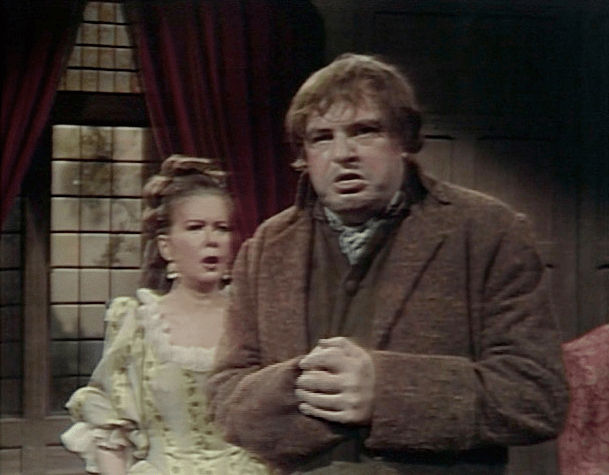
Today marks the only appearance on Dark Shadows of actress Charlotte Fairchild. Fairchild plays a downstairs maid who tells Millicent that a man has brought her a fan. Her angular figure and pale complexion made her a perfect choice to play an eighteenth century servant, and she does a fine job with the dialogue.

Millicent and the downstairs maid. Screenshot by Dark Shadows Before I Die.

Episode 438: A night he will never forget

Dark Shadows often signaled a commercial break by playing an ominous three note motif on the soundtrack. Even in 1968, DUN DUN DUNNNN! was a pretty corny way to punch up your dramatic values. It was even cornier when, as was often the case, it followed a three syllable clausula. So today’s first act ends with vampire Barnabas Collins vowing that he will kill the Rev’d Mr Trask, a visiting witchfinder whose fanatical pursuit of bewildered time-traveler Vicki has helped precipitate many disasters. After Barnabas says Trask is “Going To Die!,” Mrs Acilius and I sang along with the motif- “Going- To- Die!” The missus pointed out that many among the 8-13 year olds who made up so much of the show’s original audience probably sang exactly the same refrain when the episode was first broadcast.

There are a couple of missing transitions in quick succession today. The opening scene between Barnabas and Ben takes place in the Old House on the estate of Collinwood; they take care to show a clock to establish the time of this scene as 4:00 AM. We then cut to the great house on the same estate, where it appears to be dark out. A knock comes at the door; the mistress of the house, Naomi Collins (Joan Bennett,) answers and finds Trask. It isn’t 4:00 AM anymore- Ben enters after a moment, and mentions that the sun is about to set. Inserting a still photo of a daytime scene would have been enough to tell us that many hours have passed, and the lack of that insert really is confusing.

Trask has come demanding the keys to the Old House so that he can gather Vicki’s things and burn them. A different kind of transition is omitted in the scene this demand initiates. Lately, Naomi has become assertive and independent, primarily in her refusal to go along with the persecution of Vicki. She does that for a while in her response to Trask, ordering him to leave, telling him he disgusts her, slapping him in the face, and daring him to hit her. But when Trask threatens to go to her husband, haughty tyrant Joshua, and enlist him against her, she gives in immediately, without any visible change in affect. That is puzzling, and not at all in keeping with Joan Bennett’s usual style. Typically, she makes the most of every chance she gets to show us why she was one of the biggest movie stars of the late 1930s.

Rough patches like these, along with the many many line bobbles from all the actors throughout the episode, make me wonder if writer Gordon Russell was late delivering the script. The show never had more than three credited writers at a time, and there must have been occasions when they couldn’t get the documents to the directors and actors early enough that they could get everything nailed down. It would take considerable thought for any performer to choose the best way to play a brief moment within which Naomi moves from fearless defiance to capitulation. Perhaps the reason she wound up doing nothing was that she didn’t have time to think about the question.

Ben accompanies Trask to the Old House. While Trask goes to Vicki’s old room, Ben meets Barnabas emerging from the basement and apprises him of the situation. We see Trask upstairs and hear Ben and Barnabas’ voices in the distance. Trask reacts, but goes ahead with his mission. He waits until he is downstairs with all of Vicki’s stuff in a bundle before confronting Ben and demanding to know who else is in the house. Ben claims that he was talking to himself. Trask is unconvinced.

Later, we see Trask in his own room at a nearby inn. He hears the rattling of chains and the disembodied voice of Barnabas taunting him. After a while, Barnabas’ hand comes floating towards him. When this happened, Mrs Acilius called out “Got your nose!” We both burst out laughing and were still laughing hard when the closing credits started to roll.

Trask talks to the hand. Screenshot by Dark Shadows Before I Die.

Despite the rough spots and the bad laugh at the end, this installment was a lot of fun. I can’t give it the “Genuinely Good Episode” tag, but we won’t be tempted to skip it if we do another watch-through of the series someday.

Episode 429: Dark conquest of the grave

Viewers who have been with Dark Shadows for some time will remember that in May and June of 1967 vampire Barnabas Collins imprisoned Maggie Evans, The Nicest Girl in Town, in an effort to erase her personality and replace it with that of his lost love, the gracious Josette. When Maggie escaped, he planned to repeat the experiment with a new subject, well-meaning governess Victoria Winters.

Now Vicki has traveled back in time to the late 18th century and taken us with her. We have seen Barnabas become a vampire and Josette die. Today, much put-upon servant Ben Stokes is busily digging Josette’s grave. At the top of the episode, he urges his friend Barnabas not to come out of the secret chamber where his coffin is hidden. Barnabas is grumpy about the fact that Josette is dead, and expresses his unhappiness by choking Ben. He lets Ben go without seriously harming him. At the end of the episode, Barnabas tells Ben that he does not know what powers he acquired when he was cursed to become a vampire, but that he will use them to raise Josette from the dead.

When Barnabas vowed to do that, my wife, Mrs Acilius, said that he had reached the absolute nadir of selfishness. Barnabas has every reason to suppose that Josette is resting in peace, and he knows that his own existence is utterly miserable. He claims that love for Josette is his deepest feeling, yet he is determined to inflict his own curse on her. He is now unmistakably the annihilating ghoul who made the show so memorably bleak at the beginning of the summer of 1967.

In between the scenes with Barnabas and Ben, we see the fanatical Rev’d Mr Trask, visiting witch-hunter. Trask meets with repressed spinster Abigail Collins in the drawing room of the great house of Collinwood. They discuss ways to speed up the witchcraft trial of the hapless Vicki. Trask and Abigail are great fun to watch together; during this episode, Mrs Acilius said she wished the two of them had got married. That’s a thought to hold onto…

Trask and Abigail light up the screen. Screenshot by Dark Shadows Every Day.

Abigail and Trask come up with a plan to exploit the Collins family’s position in the community to bring the trial to a speedier conclusion. Abigail leans on Ben to testify against Vicki, telling him he could be sent back to prison at any moment if he displeases the Collinses. Trask goes to Vicki’s defense attorney, Peter, and tells him that he will never rise above his present poverty if he goes on making enemies of the mighty Collins family. Neither man gives them what they want.

Peter is hiding a book Vicki brought with her from the 1960s, and he knows it will seal her fate if it is found. During his scene with Trask, he scrambles to keep it buried under his coat. After Trask leaves, he thinks of throwing it in his fireplace, but instead goes to the cemetery to bury it within sight of the grave Ben is digging. He catches Barnabas’ attention and nearly discovers Barnabas; Ben intercepts him, shoos him off, then persuades Barnabas not to kill him.

We can be sure the book will be found. Buried in a cemetery near the graves of so many of the people Vicki is accused of having killed, it will be even more damning than it would be were it found anywhere else. Not for the first time or the last, it occurs to us that Peter is not a very good lawyer. Vicki probably would have had a better chance of acquittal if Ben had stepped aside and Barnabas had killed Peter.

In a comment on Danny Horn’s Dark Shadows Every Day, Park Cooper lists a number of direct references to Hamlet in the dialogue of this episode. Before he played Barnabas, Jonathan Frid was best known for his work as a Shakespearean actor, so he has fun with those lines.

Episode 400: Fire knows your name

The Rev’d Mr Trask, a cleric of sorts, is convinced that there is a witch in the Old House on the great estate of Collinwood. He is right about this. He is also convinced that the witch is the eccentric Victoria Winters. He is wrong on this point. The real witch is Angelique Collins, wife of the master of the house, the gallant Barnabas. Barnabas, who as a man of the Enlightenment asserts that there are no witches, is hiding Vicki, and has reluctantly agreed to let Trask perform a rite of exorcism, believing that once he is finished he will have to go away and everyone will have to admit that Vicki is innocent.

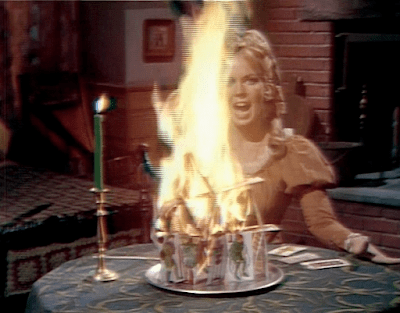
At the top of the episode, we see Angelique building a house of cards and delivering a soliloquy about her plan to cast a spell to make it look like Trask’s fraudulent ritual has proven Vicki’s guilt. There is an element of suspense as we wonder what the character’s actions will lead to, and an even more powerful suspense as we marvel at the courage it took for the actress to remain calm enough build a house of cards on what is essentially a live television show. Forget the Daytime Emmys, Lara Parker deserved a medal for this feat.

Angelique recites a spell over the house of cards, then sets it on fire. The first time they used an incompletely contained fire on Dark Shadows was in #191, and as a result of that daring experiment a load-bearing beam caught fire and collapsed in the middle of a scene. They finished taping before putting the fire out, and somehow everyone survived. There was also an off-camera fire during a conversation between Barnabas and Vicki in #290, and Jonathan Frid and Alexandra Moltke Isles just kept delivering their lines while we heard fire extinguishers blasting in the background. As a result of an excessive pre-treatment of the cards with lighter fluid, today’s fire burns faster and expels debris over a wider area than had been intended. I suppose a technical term for a rapid fire that expels debris is an “explosion.” Parker keeps up her incantation while this explosion progresses directly in her face. That shows an entirely different kind of courage than she showed with the house of cards, but she exhibits it in an equally rare degree.

The fire starts. Screenshot by Dark Shadows Before I Die.

Downstairs, Trask is standing at the threshold of the house, doing his own fire ceremony. He draws Vicki’s initials on the doorstep, holds up a dowsing rod, and jabbers for a while. Then he sets fire to the rod. In her room, Vicki sees flames erupting from the floor. She shouts in panic.

Barnabas is upstairs. He hears Angelique shouting “Eye of fire, heart of ice!” Her shouts grow louder and louder as she repeats the phrases faster and faster. My wife, Mrs Acilius, said that the pattern of Angelique’s voice sounded to her like someone having an orgasm. The willingness to risk the laugh that pattern might bring represents a third form of courage; by this point, we would have to admit that whatever we may think of Angelique, Lara Parker was one of the bravest people imaginable.

Barnabas is about to investigate, but then he hears Vicki shouting “Fire!” Between these two shouting women, he goes to the one who doesn’t sound like she’s enjoying herself. By the time he gets to Vicki’s room, she is gone. He sees no sign of fire.

Vicki runs out the front door, into Trask’s arms. He shouts “I’ve caught the witch!” and forces her to the ground. He looks delighted that his shtick actually worked, for once.

“I caught the witch!” Screenshot by Dark Shadows Before I Die.

This moment is an odd inversion of the ending of #191. That episode ends with strange and troubled boy David running out of the burning building where his mother, undead fire witch Laura Murdoch Collins, was trying to immolate him, and finding refuge in Vicki’s arms. At that moment, life triumphs over death, and Dark Shadows version 1.0 reaches its conclusion.

When Vicki runs out of the house and into Trask’s arms, death and folly win a victory over life and reason. Nothing comes to a conclusion- the story just gains new layers of complexity. We don’t even go to a commercial break, but get a reaction from Angelique first.

Barnabas talks with Angelique, mystified by what just happened. When he mentions that he heard her in her old room shouting strange words, she lies and says she was in the sewing room. After she leaves, we hear his thoughts- he had searched the sewing room, and knows she is lying. He now believes that there is a witch. He would find it much easier to believe that Vicki, a strange girl who claims to be displaced in time from the year 1967, 172 years in the future, is that witch than to face the prospect that his own wife is, but he can neither overlook the lie she has told nor the sheer improbability that so flagrant a quack as Trask came up with the right answer to any question. He remembers that indentured servant Ben claimed to have been enslaved by the witch, and resolves to find out what Ben can tell him.

We first got to know Barnabas in the months between April and November of 1967, when he was a vampire preying on the living in Vicki’s native time. In those days, he never mentioned Angelique, and there was no indication that he suspected any of the witchcraft we have seen since we embarked on our journey to 1795. Perhaps in the original timeline, when the place Vicki has taken was occupied by a woman named Phyllis Wick, Angelique had to proceed more slowly and carefully, with the result that Barnabas was turned into a ghoul without ever picking up on what was going on. If so, it would be Vicki’s complete failure to adapt to her new time in any way that accelerated the pace of events and thereby exposed Angelique to Barnabas’ suspicions.

Episode 395: Stay on as master of the Old House

It is 1795. In the foyer of the great house of Collinwood, young gentleman Barnabas Collins stands on the staircase, his father Joshua stands on the floor. Joshua forbids Barnabas to marry lady’s maid Angelique on pain of disinheritance; when Barnabas declares he will marry her anyway, Joshua announces that they are no longer father and son.

Barnabas on the stairs, Joshua standing on the floor. Screenshot by Dark Shadows Before I Die.

In 1967, Barnabas will return to Collinwood as a vampire. In that year, in episode #214, he will take well-meaning governess Vicki on a guided tour of the foyer of the old manor house, indicate the staircase there, and say that “On these stairs, a father and son hurled words at each other, words that would lead to the death of the son.” He will then begin laughing maniacally and repeat the words “The death!,” seeing the desperate irony of referring to his own death in the past tense.

By today’s episode, the Collinses have moved out of the old manor house without any shocking scenes between Barnabas and Joshua playing out on the stairs there. That isn’t so surprising- that one remark eight months ago was the only reference to the stairs as the site of a fateful quarrel between Barnabas and Joshua, and the writer responsible for that day’s script, Malcolm Marmorstein, has been gone and forgotten since August. Neither today’s screenwriter, Gordon Russell, nor his colleague, Sam Hall, was with the show when Barnabas gave that speech to Vicki, and the third member of the writing staff, Ron Sproat, has been in the background for most of the 1795 segment so far.

But they do go out of their way to put Barnabas on the stairs of the new house for his showdown with Joshua today. It seems likely that they are hoping that at least some viewers will remember Barnabas’ remark in #214 and look for a significance in the connection. They did that sort of thing all the time in the early months of the show. For example, when they were developing a murder mystery about the death of beloved local man Bill Malloy in the last four months of 1966, they would show us a clock face in one episode, then weeks later have a character lie about the time established by that clock. Sproat more or less put a stop to those kinds of wild over-estimations of the audience’s attention span when he joined the writing staff near the end of 1966, but ever since the vampire story began in April of 1967 they had acquired obsessive fans who sent letters and gathered outside the studio. So they do have a reason to try to close the loop on a very long and very slender thread. What might the significance be of this particular nod to Barnabas’ first days on the show?

The 1795 segment began when the ghost of Barnabas’ little sister Sarah took possession of Vicki at a séance in #365, announced she wanted to “tell the story from the beginning,” and hurled Vicki back to her own time as a living being. But it is not simply a flashback explaining what made Barnabas a vampire. Vicki has completely failed to adapt to her new environment, and as a result has made significant changes to the timeline. She is now in hiding, suspected of witchcraft because of her endless stream of bizarre words and actions.

In fact, there is a witch at Collinwood. It is Angelique. Presumably, the first time these events took place Angelique pinned responsibility for her crimes on Sarah’s proper governess, Phyllis Wick. We caught a glimpse of Phyllis in #365; we could tell, not only that she was indigenous to the eighteenth century, but that she was quite cautious about anything that might suggest the paranormal. It would have taken Angelique some time and effort to set Phyllis up as a patsy, while Vicki volunteered for the role without any action at all on Angelique’s part. So maybe Vicki has speeded everything up. Maybe the family was still in the Old House when Joshua disowned Barnabas in the original sequence of events, but Vicki’s blunderings have accelerated matters so that they moved out before the conflict between them came to a head.

There is another puzzle about the writers’ intentions in this episode. It is established that without his inheritance or his position in the family business, Barnabas will be in a most parlous state. In separate scenes, both Barnabas and Joshua talk about the impossibility of Barnabas finding a job in Collinsport. Barnabas tells Angelique they will have to go at least as far as Boston before they can find anyone who will risk Joshua’s displeasure by hiring him. Later, Joshua tells Naomi that Barnabas won’t even be able to reach Boston- he doesn’t have enough money and won’t be able to get enough credit to stay in an inn, and he has no friends who will so much as put him up for a night if they know he doesn’t have an inheritance coming.

Barnabas’ mother, Naomi, has a solution to his financial problems. She gives him the Old House. The Old House is supposed to be a huge mansion, which it takes a very substantial income to maintain. How a man who can’t even afford a room for the night is going to meet those expenses is not made clear.

The frustrating thing about this is that they dwell at such length about the hard realities of dollars and cents immediately before, and then again after, Naomi makes her gift. By the laws of Soap Opera Land, a character who possesses a symbol of wealth such as a mansion does not need an income. We can accept that convention, and do in the 1967 segment, when a moneyless Barnabas occupies the Old House and can pay for all sorts of expensive things. But today they keep rubbing our faces in the implausibility of it.

My wife, Mrs Acilius, suggested they could have presented both themes if they’d dealt with the realistic financial problems in one episode and in a subsequent episode had gone back to the fantasy world. Maybe Joshua disinherits Barnabas on a Friday, he worries about getting a job on Monday, Tuesday we watch someone try to introduce Vicki to the concept of “lying,” Wednesday we see caddish naval officer Nathan woo feather-headed heiress Millicent, Thursday much-put-upon servant Ben Stokes tries to escape from the spell with which Angelique controls him, and then comes another Friday, when Naomi waves her magic wand and gives Barnabas the house. But as it stands, Barnabas talks to Angelique about how they have to go hundreds of miles to eke out a bare subsistence, Joshua talks to Naomi about Barnabas’ impending poverty, and then all of a sudden they remember that none of that matters, sorry sorry we shouldn’t have bothered you with it.

There were times in 1966 and 1967 when Dark Shadows only had one viable storyline, and no readily apparent means of starting others. But now they have several stories in progress, and an abundance of lively characters with whom they can make as many more as they like. There is no need for events in any one plot-line to move so quickly that incompatible themes crash into each other with such an unfortunate result.

Naomi’s gift to Barnabas was legally impossible in 1795. Until 1821, Maine was part of Massachusetts, and married women could not own property in Massachusetts until 1822. Maine did not pass its own Married Women’s Property Act until 1844. The show never brings this up, so it isn’t the same kind of problem as Barnabas’ lack of income.

Still, it does represent a missed opportunity. If Naomi’s family of origin had owned the house, they might have placed it in a trust over which she would have enough influence to deliver it to her son against her husband’s wishes. In fact, the show never makes the slightest allusion to where Naomi came from. If they’d given her relatives of her own, she would have had potential allies in a clash with Joshua and potential goals to pursue independently of him. As it stands, they have put her firmly in his shadow, so that the category of possible stories about Naomi is a subset of stories about Joshua. That’s a sad situation for a character who is capable of the dynamism she shows today, and a criminal waste of the talents of an actress as accomplished as Joan Bennett.

In place of episode 391: Jonathan Frid reads “The Water Ghost of Harrowby Hall”

It used to be customary in many parts of the English-speaking world to tell ghost stories at Christmas. Charles Dickens’ A Christmas Carol is today the most famous of these stories, and it was dramatized in 2021 by the surviving members of the Dark Shadows cast.

But there are many others. John Kendrick Bangs’ “Water Ghost of Harrowby Hall” is one. Here is a recording of Jonathan Frid’s dramatic reading of it. He did it in the fall of 1969, and it was posted to YouTube by Frid’s close friend and longtime business partner Mary O’Leary in 2022.

The story echoes Dark Shadows at several points, most obviously when we hear about a ghost which, like that of Bill Malloy in #85, leaves pieces of the sea in its wake, and when we hear about a maiden who, like so many in the series, jumps off a seaside cliff and finds a watery grave at its foot.

When we listened to it, my reaction prompted my wife, Mrs Acilius, to say that I was “trying to ruin it, like you always do.” I’d pointed out that the Oglethorpes spend the whole story trying to build structures to contain the water that the ghost brings with her. Surely the logical thing would be to build a drain to sluice it all out of the house.

When Mrs A said that this would leave them without a story to tell, I protested that it should give them a more interesting story. Let them make a series of unsuccessful attempts to keep the water out, then an unsuccessful attempt to keep it in, and finally construct a means of draining it out. That would set you up for an ending where you see that the drainage, even though it might be mechanically successful, will still be an unsatisfactory response to the real problem, which is not the water at all but the curse of which the water is a symptom. That led her to agree that I was not “trying to ruin it,” which is about all I could hope for, I suppose.

Episode 386: Innocent until proved innocent

For the first nine months it was on the air, Dark Shadows was the story of well-meaning governess Vicki Winters and her efforts to befriend her charge, strange and troubled boy David Collins. That phase of the show reached a climax with the story of David’s mother, blonde fire witch Laura Murdoch Collins, who was on from December 1966 until March 1967. Vicki rallied the regular characters in opposition to Laura’s evil plans for David, and when Laura went up in smoke David found refuge in Vicki’s arms. He had exchanged his destructive, death-oriented mother for the loving, life-affirming Vicki. At that moment, Dark Shadows version 1.0 ended.

Now, Vicki has been thrust back in time to the year 1795. Vicki has managed to get another job as governess on the great estate of Collinwood, supervising the education of ten year old Sarah Collins and her second cousin once removed, the visiting (but so far unseen) Daniel Collins. There is a blonde fire witch here as well, the mysterious Angelique. Viewers who have been with the show from the beginning will remember Vicki’s leadership of the campaign against Laura, and are waiting to see how she will take charge of the effort to defeat Angelique.

It’s already been a long wait. Vicki has not adapted her thinking at all to her new surroundings. Angelique’s spells have wrought considerable havoc, and members of the Collins household have begun to wonder whether a witch might be at work among them. Angelique hasn’t lifted a finger to deflect suspicion to Vicki, but Vicki’s own behavior has been so bizarre that she is the obvious suspect. As we open today, she has been tied to a tree by the Rev’d Mr Trask, a visiting witch-hunter from Salem, Massachusetts.

Vicki’s ineptitude is particularly frustrating to watch because the major theme of Dark Shadows 2.0, which ran from Laura’s immolation in March to Vicki’s temporal displacement in November, had been a brilliantly successful deception by a different sort of time-traveler. Vampire Barnabas Collins presented himself to the Collinses and their neighbors, not as a blood-sucking ghoul native to another century, but as a distant cousin from contemporary England. Barnabas made plenty of slips and raised miscellaneous suspicions in the minds of various people, but he played his part well enough that the Collinses let him take possession of a house on their estate, the people of Collinsport accepted him as a member of the local aristocracy, and in one way or another he made himself indispensable to everyone around him. We began this version 3.0 expecting to see Vicki do in 1795 something like what Barnabas had done in 1967, and instead we see her as a tedious dingbat.

Barnabas is alive and benevolent in 1795. He and his friend, caddish naval officer Nathan Forbes, are men of the Enlightenment who are appalled that there are still people who believe in witchcraft. They hold Trask in contempt and are committed to saving Vicki from him. Barnabas and Nathan ask the Collins family’s house-guest, the Countess DuPrés, what Trask has done with Vicki. The countess had originally believed Vicki to be a witch, but after seeing Trask’s lunatic behavior while interrogating her came to regret her involvement in bringing him to Collinwood. She tells them that Trask tied Vicki up and took her out of the house, whither he would not say.

Outraged, the men head out of the house. They meet Trask coming in. He refuses to tell them where he has left Vicki. Barnabas thunders that “[I]t perhaps has escaped your memory that we have just fought a war recently-a war to establish certain rights. And I am defending the right of this girl to be judged innocent until she is proved innocent. I am sure that this idea is a little complicated for your mind to absorb.” He’s probably right about that, I certainly find it difficult to absorb.

“Innocent until she is proved innocent!” Screenshot by Dark Shadows Before I Die.

Once Barnabas and Nathan are on their way to look for Vicki, Trask tells the countess he has tied her to a tree somewhere in the woods and that if she is a witch, the tree will be dead by morning. Angelique’s regular job is as the countess’ maid. She is in the room with a tea tray when Trask says this, and she smiles delightedly when she hears it. Later, she will sneak out of the house to go searching for Vicki herself.

Barnabas and Nathan find Vicki and untie her. They decide to hide her in the great house of Collinwood. The great house is Vicki’s home in the 1960s, and is under construction in 1795. They set off, and Angelique comes to the tree.

Once she is alone, Angelique takes a cutting from the tree and sets fire to it. This causes the tree itself to burn. It is not entirely clear why she doesn’t just set fire to the tree, since the cutting she has taken is the greenest and least flammable part of it, but witches gonna witch, I guess.

Building a fire the witchy way. Screenshot by Dark Shadows Before I Die.

The next morning, Trask goes to the tree. The countess insists on accompanying him. They find that Vicki is gone and the tree is a hunk of scorched timber. Trask triumphantly silences the countess’ doubts.

In our time-band, the last witchcraft trial in the English-speaking world was held in Scotland in 1727. The Westminster Parliament finally abolished all laws against witchcraft in 1736, including those still on the books in Massachusetts* and some other British colonies in North America. Had they lived in our 1795, Barnabas and Nathan could have gone to the constable and reported that Trask had abducted Vicki, bound her, and left her outside. The constable would help them find her, arrest Trask, and that would be it. But of course Dark Shadows takes place in a world that differs from ours in many respects, not least in regard to the legal history of Massachusetts.

As the countess, Grayson Hall has been doing an excellent job establishing a character who is distinct from mad scientist Julia Hoffman, the role she plays in the segments of Dark Shadows set in the twentieth century. But as my wife, Mrs Acilius, points out, Hall does lapse into Julia a few times today. When she gasps in horror, she makes a little clicking noise in the back of her throat that is one of Julia’s most recognizable mannerisms. Julia is deeply entangled with Barnabas’ activities, and has developed an emotional attachment to go along with her inability to get away from him; shortly before Vicki took us with her to 1795, we heard Julia address him with a deeply felt “Barnabas, Barnabas.” The countess barely knows Barnabas, but in an anguished moment today, she says “Barnabas, Barnabas” to him. Hall does return to being the countess before the episode is over, but there is a weird little visit from Julia in the middle of it all.

Vicki went back to the past after Sarah’s ghost took possession of her at a séance and said she was going to “tell the story from the beginning.” Vicki has traded places with Sarah’s original governess, a woman named Phyllis Wick. Presumably Angelique chose Phyllis as a patsy, and she wound up as Trask’s target. Maybe Angelique did this simply because Phyllis was new to the house and had no old friends to object that she couldn’t possibly be a witch, but maybe it was because she had caught on to Angelique.

It would make it all the more exciting to see Vicki catch on to Angelique and do battle with her. We’ve already seen Smart Vicki defeat one blonde fire witch, so if we see her try to fight another, we will hope that she might win again. Only when we saw the attempt end in disaster would we realize that everything we’ve seen Vicki doing is what Phyllis Wick did the first time around, and that her intervention won’t have changed a thing. That would be a powerful twist ending to the whole 1795 flashback. Instead, we are subjected to Dumb Vicki doing things neither Phyllis nor anyone else who belonged in 1795 could possibly have done, and we end up wondering what she is doing in this story.

*Collinsport is in Maine, which until 1821 was part of Massachusetts.

Episode 380: No end to your tricks

Indentured servant Ben was unhappy enough when he was under the rule of haughty overlord Joshua Collins. He has now found himself doubly enslaved, still subject to the Collinses, but also under a spell cast by lady’s maid/ wicked witch Angelique that compels him to do her bidding. At least Joshua isn’t bothering him these days- Angelique has, for reasons of her own, turned him into a cat. In Angelique’s room, Ben wields a hatchet, gleefully preparing to decapitate the cat formerly known as Joshua.

Angelique interrupts Ben’s evil plan.

Angelique enters and forbids Ben from committing this act of felicide. Ben is disappointed. When his arguments make no impression on her, he whines “Ple-e-e-ase!” Thayer David gets the full comic value out of that, Mrs Acilius and I laughed out loud.

Angelique’s main business is preventing Joshua’s son Barnabas from marrying the gracious Josette. To that end, she orders Ben to steal some things. When he protests that it will be the end of him if he is caught, she tells him to see to it that he isn’t caught.

In the parts of the show set in 1967, Barnabas is a vampire. We have heard him use the very words Angelique uses here when telling people who were under his power not to be caught, most recently with his distant cousin/ blood thrall Carolyn in #362. The echo is so specific and of so recent an episode that we can’t help but wonder if Angelique’s witchcraft will not only turn Barnabas into a vampire, but will deposit her personality in his body.

Barnabas and Josette’s wedding is supposed to be held in the front parlor of the manor house. When the bride doesn’t come downstairs, her father, André DuPrés, asks his sister, the Countess DuPrés, if he should look for her. She agrees that he should. This is an odd little moment, suggesting that the Bossy Big Sister/ Bratty Little Brother dynamic we have seen among the Collinses of the 1960s may have been familiar in the House of DuPrés in 1795.

André goes up to Josette’s room. He shouts her name, looks for her in the linen chest at the foot of her bed, and shouts for her some more. He reports her absence to the party downstairs. Angelique lifts a flute of champagne, silently toasting her triumph.

Angelique toasts herself.