Episode 522: Brother devil

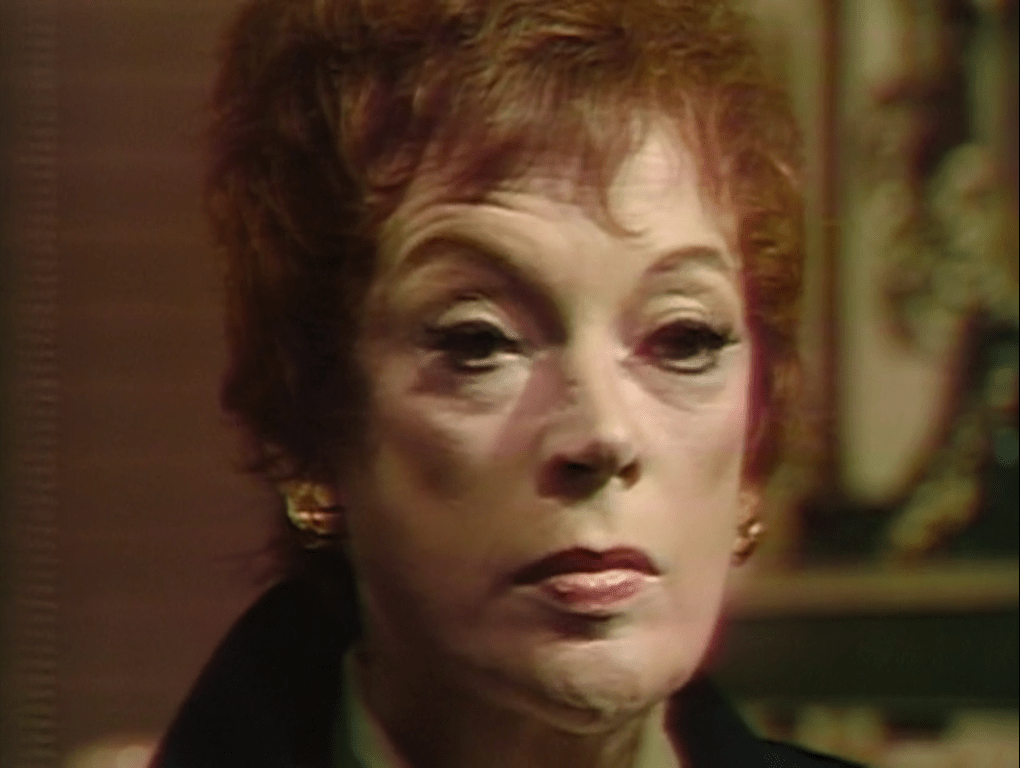
A stranger comes to the great house on the estate of Collinwood and introduces himself as Nicholas Blair, brother of Cassandra Blair Collins. Cassandra’s husband Roger Collins is shocked; Cassandra had never mentioned that she had a brother. Moreover, she has been missing for the last 24 hours, and Roger is convinced something terrible has happened to her. Roger’s distant cousin Barnabas Collins and Dr Julia Hoffman are also shocked, but for a different reason. They know that Cassandra is actually Angelique, a wicked witch who, in the 1790s, turned Barnabas into a vampire. She recently returned to the world of the living when Barnabas’ vampirism went into remission, and she tried to implement a plan to bring it back in full force. When Angelique/ Cassandra went missing, they hoped it meant that she had been defeated. Nicholas’ arrival replaces their hopes with the fear of new battles.

Nicholas at first assumed that Barnabas was Angelique/ Cassandra’s husband, and told him “I should have recognized you anywhere!” This is a sure sign of trouble- Barnabas, who was in fact briefly married to Angelique in 1796, has not been out of the state of Maine since 1795, and has never been photographed. Nicholas says that he has recently been on Martinique, where Barnabas first met Angelique in the eighteenth century, and that he is a “citizen of the world” with no fixed address. He assures Roger that it is Cassandra’s way to disappear abruptly, and that she is sure to return.

Roger, Julia, Barnabas, and Nicholas in the drawing room.

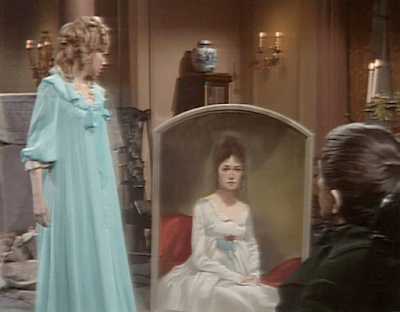
Roger takes Nicholas to the bedroom he and Angelique/ Cassandra share. He shows Nicholas a portrait of Angelique which returning viewers know to have a mysterious connection with Angelique/ Cassandra’s physical being. Roger leaves the room, and Nicholas talks to the portrait. He asks Angelique if she can hear him, and a musical cue associated with her plays on the soundtrack. The cue cuts out, and Nicholas follows up with another question. Dark Shadows stood out from the daytime soaps of the period in having an orchestral score instead of an organ accompanying the action. The meta-theatrical touch of a character who can hear that score is a major departure. It is something people at the time would have seen in animated shorts from Warner Brothers, but likely not anywhere else. Since the biggest and fastest-growing share of Dark Shadows’ audience at this point was children under the age of 13, there was a risk that adult viewers might take that association with cartoons as a sign that it was time for them to find something else to do with their mid-afternoons.

Back in his own house on the same estate, Barnabas finds his servant Willie Loomis holding a rifle. Willie says that he is afraid that man named Adam will come to the house. Barnabas dismisses that fear and orders Willie to put the rifle away. Willie objects. Barnabas repeats the command and leaves. Willie grumbles, but does as he was told. We see a face peering in at the window.

The face belongs to hardworking young fisherman Joe Haskell. Returning viewers know that Barnabas held Joe’s fiancée Maggie prisoner from May to June of 1967 and was extremely cruel to her. When the case was being investigated, Barnabas framed Willie for those crimes. Willie was sent to a mental hospital, and Barnabas had Willie released and brought him back to work for him some weeks ago. Joe thinks that Willie is the perpetrator, and has no patience with him. He knocks on the door and demands Willie let him in.

Joe insists that Willie tell him what he knows about Adam. Willie tries to evade his questions. When Willie says that Adam dislikes him, Joe responds”that means he knows you.” Joe twists Willie’s arm while repeating his questions. Once Joe releases him, Willie runs off and comes back with the rifle. He points it at Joe and orders him out of the house. Joe complies, but says that he will be back, and that he will be having words with Barnabas.

Later, Willie is in the basement. Some bricks are missing from a wall, exposing a skeleton hanging from the ceiling. Viewers who have been with Dark Shadows all along will recognize the basement of Barnabas’ house as a redress of the set that represented the basement of the main house in the first year of the show. The spot with the missing bricks was where a door stood that was always locked in those days. For the first 54 weeks of Dark Shadows, matriarch Liz thought that her husband’s corpse was buried behind that door. That belief turned out to be mistaken, but now we see that there are indeed human remains in the most similar possible spot. We might wonder what else Liz might have been less wrong about than at first sight appeared.

We watch Willie preparing to fill in the missing bricks, leaving the skeleton in place. After all, judging by Liz’ old way of thinking, that’s what ought to be in a space like that. We hear Willie’s interior monologue. He is making himself laugh with a pun on his own name when a stagehand wanders into the shot.

Uh, hello?

That moment of unintentional humor gives way to a scene rich in intentional comedy. Willie goes upstairs and finds that Nicholas has let himself into the house. Nicholas entrances him and extracts information from him. Willie tells him about a meeting with a ghost- “the one downstairs,” he specifies. Nicholas directs Willie to sit down, to remain in a blissed-out state until he leaves, and then to forget all about their encounter.

Nicholas goes to the basement, looks at the skeleton, and calls it “Reverend Trask!” Willie hadn’t given him this name; evidently he recognizes Trask the same way he recognized Barnabas.

The gang’s all here.

Episode 501: You’ve lied your way out of worse situations

Virtually every episode of Dark Shadows begins with one of a handful of still images of the exterior of a mansion in Newport, Rhode Island, known in those days as Seaview Terrace.* Before the series went into production, Dan Curtis took the cast up to Newport and shot some video of them on the grounds of the mansion. In 1966 and the first half of 1967, bits of that footage were occasionally inserted to give the show a more spacious and less static feeling. When they started shooting episodes in color at the end of July 1967, they could no longer use those inserts, and they had neither the time nor the budget to go back to make more.

Now, Dark Shadows uses green screen effects to create the illusion of exterior shots. Twice today, they show us actors in front of the still of Seaview Terrace that most frequently appears at the opening, with foliage hanging next to them to give an illusion of depth. The result isn’t as satisfactory as the location inserts were, but it’s nice to know the makers of the show are trying to broaden their canvas.**

Frankenstein’s monster Adam has escaped from the Old House at Collinwood and finds his way to the principal mansion on the same great estate. There, he stands outside the windows and listens to a conversation in the drawing room between matriarch Liz and her daughter Carolyn. Carolyn tells her mother that she saw Cassandra, Liz’ brother Roger’s new wife, having a romantic moment with local man Tony. Liz’ keynote has always been denial, and true to form she refuses to believe Carolyn. They go on with this until Adam stumbles through the front door and terrifies them.

Adam can only speak a few words. He smiles when he says one of his favorites, “music.” Carolyn turns on a radio we have never seen before and we hear Francois Lai’s theme to the movie “A Man and a Woman,” an instrumental hit of the 1960s which played on the jukebox at the Blue Whale tavern in #307. Adam scowls, declares it “not music,” and smashes the radio. I’ve always had a fondness for the tune, but listening to this arrangement I have to admit he has a point.

Liz reacts to Adam’s violent act by grabbing a letter opener and threatening him. Panicked, he grabs Carolyn. Two more residents of the estate burst in. They are old world gentleman Barnabas Collins, master of the Old House, and Julia Hoffman, permanent houseguest in the great house. Barnabas has a rifle and threatens to shoot Adam if he doesn’t put Carolyn down immediately. Adam flees into the woods, still carrying Carolyn.

Julia stays in the drawing room with Liz. It dawns on Liz that Barnabas must have been hunting Adam. Julia denies this, and Liz asks why Barnabas had a gun. In response, Julia talks very fast and says very little. That gives us a wonderful little scene. It’s always exciting when a brick falls out of the wall Liz built between herself and reality, and Julia is one of the most accomplished liars in drama.

Liz realizes that Barnabas and Julia know more about Adam than they are letting on. Screenshot by Dark Shadows Before I Die.

*A family named Carey bought the place in 1974, so these days it is usually referred to as the Carey mansion.

**The screenshots are from John and Christine Scoleri’s post on their blog Dark Shadows Before I Die.

Episode 470: Nonsense about names

Part One. Roger/ Joshua

Much to her surprise, well-meaning governess Vicki Winters came unstuck in time in #365 and found herself in the year 1795. She spent the first few weeks of her sojourn in the past telling all the characters she met about the other roles that their actors played in the first 73 weeks of Dark Shadows, thereby puzzling them and irritating the audience. After a few months, the people of Collinsport had decided to try Vicki on a capital charge of witchcraft. There were no laws against witchcraft in Massachusetts or anywhere else in the English speaking world in the 1790s, but Vicki had got on so many people’s nerves by that point that they were willing to overlook that technicality and sentence her to hang. She was whisked back to 1968 in #461, with so little time to spare before she died on the gallows that she came back with rope burns on her neck.

Throughout the first year of Dark Shadows, the writers used Vicki more than any other character to move the action. Unfortunately, they sometimes moved it by having her do things that served the plot, but that the character had no reason to do. That gave rise to “Dumb Vicki,” and Dumb Vicki was very much on display throughout the whole segment set in 1795-1796.

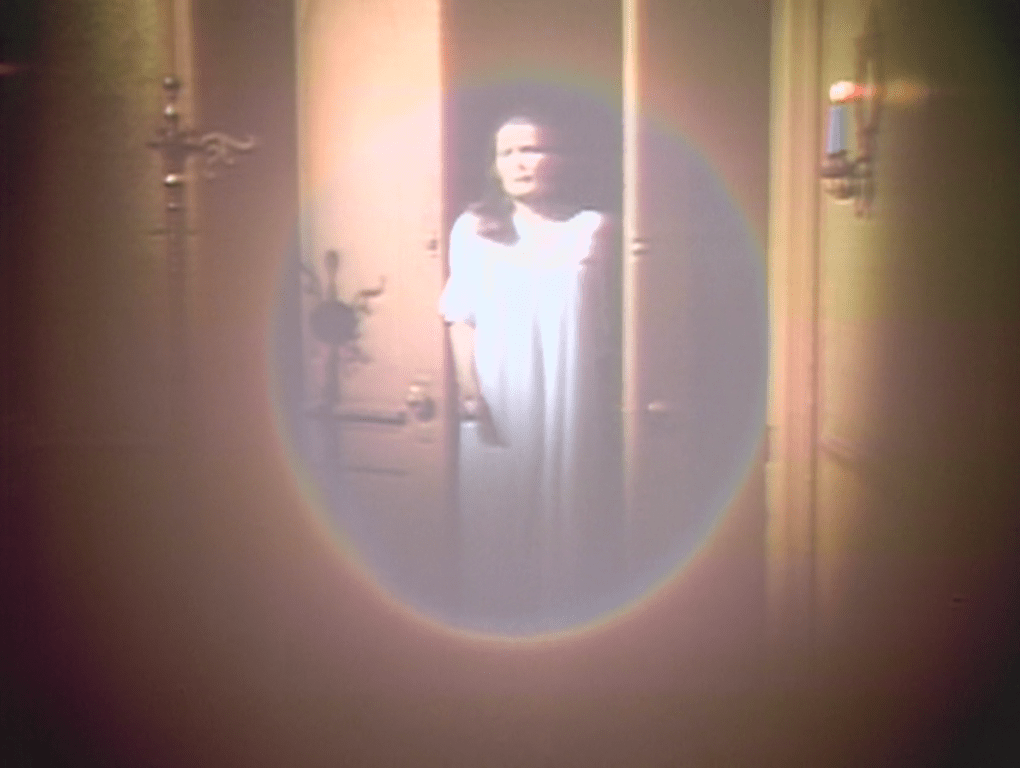
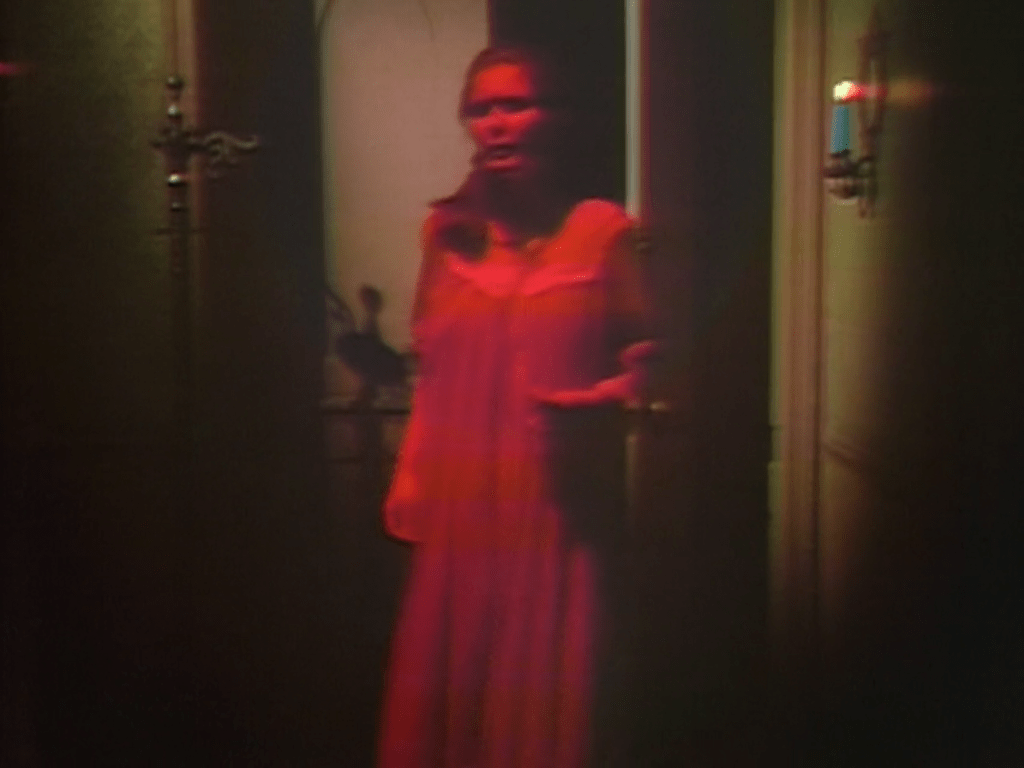
Now, emigrés from the late eighteenth century are starting to join Vicki in her time. We open today as the clock chimes midnight. Vicki, wearing her nightgown, is coming down the grand staircase in the foyer of the great house of Collinwood, roused by the sound of an unexpected voice in the drawing room. It is the voice of haughty overlord Joshua Collins, master of Collinwood in 1795. Vicki enters the room to find sarcastic dandy Roger Collins carrying on a lively, albeit one-sided, conversation with a portrait. Roger is convinced that he is Joshua, and deals with Vicki in just the lofty way Joshua dealt with her during the costume drama segment. He even brings up Vicki’s frequent confusion with names, something Roger could not possibly have known about. This, therefore, is no mere delusion of Roger’s- Joshua’s ghost really is taking possession of him, manipulated by a force with its own malign intentions.

It is no secret from the audience what that force is. Roger has become obsessed with a portrait depicting wicked witch Angelique, who in the 1795 segment wrought terrible harm to the Collins family. Angelique was responsible, in one way or another, for the deaths of both of Joshua’s siblings, both of his children, his wife, and many other people. Too late, Vicki learned that Angelique was the witch for whose crimes she was being condemned to hang. As we have seen other supernatural beings do on Dark Shadows before, Angelique is using her portrait as a means of projecting her powers into the world of the living.

Roger/ Joshua’s remark about the name trouble reminds us of Dumb Vicki, but that is not the version of the character we see today. Instead, we have a visit from Smart Vicki. When Roger keeps insisting that he is Joshua Collins, Vicki picks up a telephone and shows it to him, declaring that it is something that did not exist in Joshua’s time. Roger looks at the receiver in silence for a moment, then groggily asks “Is it for me?”

Vicki says that she will take the portrait back to the antique store where she bought it so that it can be sold to Professor Timothy Eliot Stokes. This is a bit jarring for returning viewers- in #464, Stokes offered Vicki $200 for the painting, and Roger countered with a bid of $50o. Evidently Roger didn’t actually pay Vicki the money, because he doesn’t say that it is his when he urges her to leave it in the house.

Vicki and Roger leave the drawing room. Roger slips back in, takes the painting, and marches out of the house with it. While he does so, a nice little bit of music featuring the harp plays on the soundtrack. I don’t know that it is new, but I didn’t recognize it.

Part Two. Peter/ Jeff

Angelique not only killed Joshua’s son Barnabas, but cursed him to rise at night as a vampire. Barnabas returned to the great estate of Collinwood in 1967. He has been passing himself off to the living Collinses as their distant cousin from England. When Barnabas found that Vicki had visited his native period of history, he bit her in an attempt to keep her from revealing his secret.

Vicki and Barnabas were on their way to spend eternity together when she crashed her car to avoid hitting a pedestrian. In the hospital, the physician on duty when Vicki and Barnabas were brought in, Dr Eric Lang, turned out to be exactly the right sort of mad scientist. He has apparently cured Barnabas of vampirism. It is unclear whether Vicki remembers that Barnabas bit her and sucked her blood, and quite clear that she doesn’t think of him as a monster.

In the 1790s, Vicki met and somehow fell in love with an unpleasant man named Peter. Peter has returned to the present with her; in fact, he was the pedestrian Vicki had to crash her car to avoid hitting. They have seen each other several times since, and for no worthwhile reason Peter keeps insisting he is named Jeff. Peter/ Jeff shows up at Collinwood today. Vicki ushers him into what she alone calls “the living room,” and everyone else calls “the drawing room.” Peter/ Jeff asks Vicki if she loves Barnabas and plans to marry him. She tells him she does not. She says that she doesn’t want to hurt Barnabas’ feelings, but that she will have to break the news to him as soon as possible.

Part Three. Barnabas, Barnabas

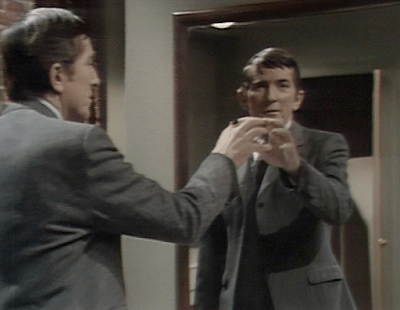
Barnabas is still in the hospital. We see him in his room, in the daylight, looking at himself in the mirror. He can’t resist touching his reflection. It is a genuinely beautiful little moment, and an eloquent image. In the contrast between the solidity and familiarity of Barnabas’ standard right profile shot and the fragile little image slightly distorted in the mirror, we see a point of decision. The ghoul has not been destroyed, but a new and very vulnerable human life now co-exists with him in the same body. Wallace McBride says that “On Dark Shadows, your reflection always tells the truth“; this reflection tells a deep enough truth to keep the show going for years.

Barnabas meets Barnabas. Screenshot by Dark Shadows Before I Die.

Vicki visits Barnabas in his hospital room to tell him that she cannot marry him. She thinks that she and Peter might be meant for each other. She also tells Barnabas that there are signs Angelique is making her influence felt at Collinwood again.

Vicki knows that her news about Peter will hurt Barnabas, but she understands that if they are to fight against Angelique, there can be no secrets between them. Barnabas understands this as well. Therefore, he decides to surrender immediately. Right after his scene with Vicki, we see him telling Lang he has decided to revert to vampirism.

That reaction is absurd, but it goes to the heart of the character as we came to understand him in the part of Dark Shadows set in the years 1795 and 1796. He did not believe that gracious lady Josette could love him, so he had a casual fling with her maid, Angelique. He did not believe Angelique cared very deeply about him, so he cast her aside once it became clear Josette was willing to marry him. He did not believe Josette could forgive him for having come to her from a dalliance with Angelique, so he did not tell Josette when Angelique vowed vengeance on them both. At each point, Barnabas’ underestimation of his own lovableness led to disaster. If only Barnabas could have read Jonathan Frid’s fan mail, he and Josette would have had a happy, quiet life and died in obscurity in the first half of the nineteenth century.

Part Four. Vicki

For her part, Vicki spent the first 38 weeks of Dark Shadows growing close to strange and troubled boy David Collins, who tried to kill her more than once, tried to kill his father Roger and frame her for it, who talks to ghosts, and whose mother is an undead fire witch. In the same time, she fell in love with a man named Burke, who spent years in prison for a killing in which Roger had a part but for which he was also very much responsible. While in the 1790s she fell in love with Peter, who committed many crimes and would doubtless have become a killer had Vicki not killed his man before he got to him. So Barnabas’ weird nature and career of homicide hardly guarantee that Vicki will spurn him.

I often wonder what might have been had the show decided to initiate Vicki into Barnabas’ secret. Alexandra Moltke Isles and David Henesy triumphed over some stunningly bad writing to make the story of Vicki’s bonding with David the one consistently interesting thread of the first year of Dark Shadows. Now that there are good writers and other stories that are working, I can only suppose she and Jonathan Frid would have given us something for the ages if they had been allowed to show Vicki coming to accept the true Barnabas.

There are several ways they could have done that. Maybe she gradually learns the horrible truth, can’t go to the authorities right away because she needs Barnabas as an ally against a more immediate threat, and by the time that threat passes decides he’s a good risk. Or maybe she becomes a vampire herself and finds out about his past in the process of being cured.

Or, most daring of all, maybe it turns out Vicki knew that Barnabas was a vampire all along. Sure, she was upset when she thought he’d killed her friend Maggie- why do you think she invited herself to spend the night at his house during that period? She had the guilts because she had failed to save Maggie and wanted him to bite her as punishment. Sure, there were some sleepless nights when it looked like he might be planning to kill David in order to silence him- why do you think she kept making herself available to Barnabas in that period as well, if she wasn’t offering herself as a tool he could use to keep the boy quiet without hurting him?

Episode 458: Soon her journey will be over

Naomi Collins (Joan Bennett) has learned that her son Barnabas, whom she knows to be dead, gets out of his coffin at night and kills people. At the end of yesterday’s episode, she saw Barnabas bite his second cousin Millicent on the neck and suck her blood.

The year is 1796, and Naomi has never heard of vampires. She is in a daze about the whole thing. It is clear to her that her husband Joshua has been keeping the truth about Barnabas from her. Though Joshua’s habit of concealment has led to one disaster after another, Naomi accepts that in this case it was his way of expressing love, and she embraces him. She asks Joshua to explain what has happened to their son; he says he doesn’t really understand it, and isn’t sure it would help if he did.

Naomi is hiding bewildered time-traveler Vicki. In the parts of Dark Shadows set in the 1960s, Joan Bennett plays matriarch Liz. The show has been hinting heavily since episode #1 that Vicki is Liz’ unacknowledged daughter. They never make that point explicit. They have no reason to. Liz so completely treats Vicki like a daughter that nothing of any importance would change if the biological relationship were confirmed. Nor would any particularly exciting story possibilities open up if it turned out Vicki were not Liz’ daughter. In the early days of the show, there were a few hints that Vicki might have a doomed romance with Liz’ brother Roger, but they’ve long since made it abundantly clear that no such thing was in the cards,* and nothing else about Vicki would change if she turned out to have a different mother.

Naomi’s attitude to Vicki echoes Liz’ maternal affection. Naomi stood up to the tyrannical Joshua, apparently for the first time ever, to insist that he retain Vicki as governess to their daughter Sarah. She defied Joshua again to testify on Vicki’s behalf during her trial for witchcraft. Now Vicki is a fugitive from justice, escaped from gaol and facing a death sentence, and Naomi insists on harboring her. When Naomi decides that Barnabas’ condition leaves her no choice but to commit suicide, she goes first to Vicki and then to Barnabas, speaking to each in the same motherly tone and giving each the same motherly embrace. Throughout the eighteenth century flashback, the characters have served as mirrors of those played by the same actors in the contemporary segments, and in Naomi’s effective adoption of Vicki we see a clear reflection of Liz.

Naomi’s suicide also harks back to Liz. Naval officer/ sleazy operator Nathan Forbes is using Barnabas’ condition to blackmail the family, and that blackmail is one of the things that pushes Naomi hardest towards self-destruction. From March to July of 1967, Liz was blackmailed by another maritime scalawag, seagoing con man Jason McGuire. In her despondency over what Jason was doing to her, Liz three times had to be kept from throwing herself to her death from the cliff on Widow’s Hill.

Closing Miscellany

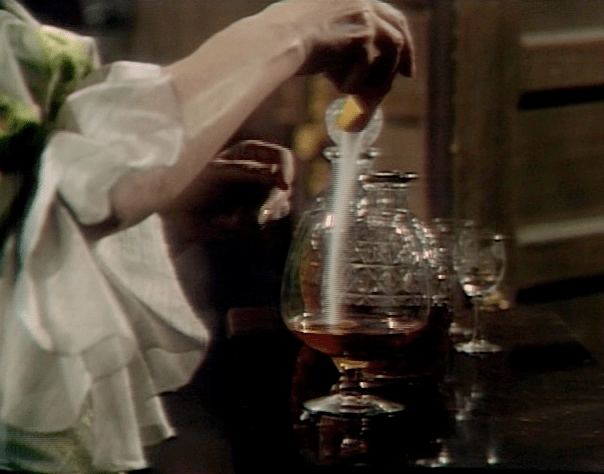
Whatever poison Naomi has decided to take must not be very potent. She pours about a cup of it into her brandy and is still able to stroll over to visit Barnabas and have a long conversation with him before she dies.

What is that, enough salt to cause a life-threatening case of high blood pressure? Screenshot by Dark Shadows Before I Die.

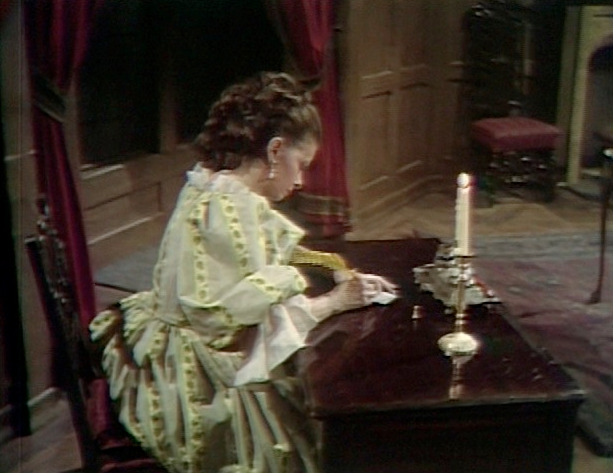
Naomi writes a suicide note and leaves it for Joshua. This raises a question. When did Naomi become literate? When first we saw her, in #366, the show went out of its way to make sure we knew that she could not read even the simplest text, but now she dashes off what appears to be a substantial message in calligraphic script. Naomi has been growing more assertive as time has gone on, but we haven’t seen her learning to read and write, as we saw Barnabas giving much put-upon servant Ben a writing lesson in #375.

Naomi writing her suicide note. Screenshot by Dark Shadows Before I Die.

When Naomi is taking poison, there is some music that I don’t remember. I’m not sure if it is new, or if we just haven’t heard it played in full for a while. It features some pretty impressive theremin playing.

*Much to the dismay of Vicki/ Roger shippers like Tumblr user WidowsHill, creator of fine artworks such as these:

Images and text by WidowsHill, posted on tumblr 17 March 2024.

.

Episode 438: A night he will never forget

Dark Shadows often signaled a commercial break by playing an ominous three note motif on the soundtrack. Even in 1968, DUN DUN DUNNNN! was a pretty corny way to punch up your dramatic values. It was even cornier when, as was often the case, it followed a three syllable clausula. So today’s first act ends with vampire Barnabas Collins vowing that he will kill the Rev’d Mr Trask, a visiting witchfinder whose fanatical pursuit of bewildered time-traveler Vicki has helped precipitate many disasters. After Barnabas says Trask is “Going To Die!,” Mrs Acilius and I sang along with the motif- “Going- To- Die!” The missus pointed out that many among the 8-13 year olds who made up so much of the show’s original audience probably sang exactly the same refrain when the episode was first broadcast.

There are a couple of missing transitions in quick succession today. The opening scene between Barnabas and Ben takes place in the Old House on the estate of Collinwood; they take care to show a clock to establish the time of this scene as 4:00 AM. We then cut to the great house on the same estate, where it appears to be dark out. A knock comes at the door; the mistress of the house, Naomi Collins (Joan Bennett,) answers and finds Trask. It isn’t 4:00 AM anymore- Ben enters after a moment, and mentions that the sun is about to set. Inserting a still photo of a daytime scene would have been enough to tell us that many hours have passed, and the lack of that insert really is confusing.

Trask has come demanding the keys to the Old House so that he can gather Vicki’s things and burn them. A different kind of transition is omitted in the scene this demand initiates. Lately, Naomi has become assertive and independent, primarily in her refusal to go along with the persecution of Vicki. She does that for a while in her response to Trask, ordering him to leave, telling him he disgusts her, slapping him in the face, and daring him to hit her. But when Trask threatens to go to her husband, haughty tyrant Joshua, and enlist him against her, she gives in immediately, without any visible change in affect. That is puzzling, and not at all in keeping with Joan Bennett’s usual style. Typically, she makes the most of every chance she gets to show us why she was one of the biggest movie stars of the late 1930s.

Rough patches like these, along with the many many line bobbles from all the actors throughout the episode, make me wonder if writer Gordon Russell was late delivering the script. The show never had more than three credited writers at a time, and there must have been occasions when they couldn’t get the documents to the directors and actors early enough that they could get everything nailed down. It would take considerable thought for any performer to choose the best way to play a brief moment within which Naomi moves from fearless defiance to capitulation. Perhaps the reason she wound up doing nothing was that she didn’t have time to think about the question.

Ben accompanies Trask to the Old House. While Trask goes to Vicki’s old room, Ben meets Barnabas emerging from the basement and apprises him of the situation. We see Trask upstairs and hear Ben and Barnabas’ voices in the distance. Trask reacts, but goes ahead with his mission. He waits until he is downstairs with all of Vicki’s stuff in a bundle before confronting Ben and demanding to know who else is in the house. Ben claims that he was talking to himself. Trask is unconvinced.

Later, we see Trask in his own room at a nearby inn. He hears the rattling of chains and the disembodied voice of Barnabas taunting him. After a while, Barnabas’ hand comes floating towards him. When this happened, Mrs Acilius called out “Got your nose!” We both burst out laughing and were still laughing hard when the closing credits started to roll.

Trask talks to the hand. Screenshot by Dark Shadows Before I Die.

Despite the rough spots and the bad laugh at the end, this installment was a lot of fun. I can’t give it the “Genuinely Good Episode” tag, but we won’t be tempted to skip it if we do another watch-through of the series someday.

Episode 437: It’s gone on too long

Bewildered time traveler Vicki tells her lawyer/ gaoler/ boyfriend/ accomplice/ therapist/ assailant Peter that her time in the late eighteenth century seems like a nightmare. She then does something she often did in the early months of Dark Shadows, reminiscing about her childhood as an inmate of the farcically horrible Hammond Foundling Home. She says that she had so many nightmares when she was there that she became a connoisseur of nightmares. When she realized she was having a bad dream, she would choose to remain asleep right up to the moment she was about to be killed so that she could see how the whole thing would play out. I suppose that might have been useful training for a career as a character in a horror story, but if so Vicki has not benefited from it. She’s done nothing but make matters worse for herself since she arrived in the year 1795, and she is now in her last day as the defendant in a witchcraft trial which has been going very badly for her.

During this scene, Vicki gets very upset. Peter demands that she calm down and slaps her in the face when she doesn’t. That was a time-honored form of treatment for anxiety in fiction back then. It’s always gross to see, but is especially bad when the actor administering the slap is Roger Davis. Mr Davis was, shall we say, uninhibited in his physicality when dealing with his female scene partners. In his post about the episode on Dark Shadows Every Day, Danny Horn includes screenshots of 10 distinct moments in this episode when Mr Davis aggressively rubs himself all over Alexandra Moltke Isles. Later in the series, he would, in separate incidents, hurt both Terrayne Crawford and Joan Bennett while on camera. His fake slap does not make contact with Mrs Isles today, but his sense of personal boundaries is so severely underdeveloped that we can hardly blame her for visibly ducking to avoid his hand.

Seriously, who needs that guy? Screenshot by Dark Shadows Before I Die.

Vicki takes the stand and says that she is a native of the twentieth century, whisked back in time by what force she knows not. Cross-examined by visiting witchfinder/ fanatical bigot/ prosecuting attorney Rev’d Trask, Vicki admits that her last memory of 1967 was when she was at a séance, and that this was not the first séance she had taken part in. Trask declares that this is an admission of witchcraft, which, if you think about it, it is. Vicki becomes upset, and we cut directly to a commercial break without a musical sting. This is a technique the show very rarely uses, and it is always effective when it does.

One of the witnesses against Vicki, untrustworthy naval officer Nathan, has a scene alone with Trask while they are waiting for the verdict. Nathan tells Trask he never thought he would meet a preacher whose specialty was blackmail. Trask denies that he blackmailed Nathan into testifying against Vicki. He has a point- it was more a matter of extortion, followed up with bribery. Anyway, actors Jerry Lacy and Joel Crothers were sensational together. Mr Lacy is exciting to watch when he’s wound up tight, the usual condition of a character on Dark Shadows, and Crothers always moved loosely and fluidly. The two of them strike an ideal balance.

The episode ends with the judges finding Vicki guilty and sentencing her to hang by the neck until dead. If we take her recollection of her childhood nightmares as a programmatic statement, we should expect her to mount the gallows and stick her head in the noose, then immediately find herself back at the séance.

Episode 433: Quite enough bickering

Today is taken up with the witchcraft trial of bewildered time-traveler Victoria Winters. That is to say, the actors stand around the courtroom set and shout random nonsense at each other until it is time for the closing credits.

Two of the good actors whose talents are wasted in this episode. Screenshot by Dark Shadows Before I Die.

The only line of dialogue that made an impression on me was Vicki shouting “That’s! Not! TROOOO!” when untrustworthy naval officer Nathan Forbes was on the stand falsely accusing her of something or other. In the first months of the show, Vicki often shouted that to strange and troubled boy David, usually in response to David saying something that the audience knew was perfectly true. In those days, the show’s slow pace and its focus on the budding friendship between Vicki and David gave Alexandra Moltke Isles and David Henesy a chance to overcome the crummy writing of their scenes together and show us what it looks like when two people learn to trust each other. But the part of the show set in the late eighteenth century moves at a rapid clip, and nothing human is at stake in the witchcraft trial. So when we hear another “That’s! Not! TROOOO!” this time, we miss the days when Mrs Isles was in a position to rescue us from the writers’ delinquencies.

When Nathan makes his entrance, we hear some music I don’t believe we have heard before. Christine Scoleri of Dark Shadows Before I Die identified it as a piece that it is on Dark Shadows: The Soundtrack Music Collection as “Cue 157: Dramatic Curtain.” It doesn’t fit the situation. It’s a busy little tune, suggestive of fidgety nervousness. It’s true that the whole trial is just so much fidgeting on the part of the show, but the background music really isn’t the place to complain about that.

Episode 402: Name the witch

Well-meaning governess Vicki is in jail, about to be tried on a capital charge of witchcraft. That couldn’t happen in the New England that existed in 1795 in our timeband, but many things were possible in the world of Dark Shadows that we don’t see in ours.

Gallant gentleman Barnabas Collins has figured out that Vicki is innocent and that the real witch is his new wife, Angelique. Rather than go to the authorities with his evidence, he decides to take a more direct approach and murder Angelique. That won’t be much use to Vicki, but Barnabas can’t be bothered with details.

The longest sequence of the episode is a farce in which Barnabas pours two glasses of sherry, puts poison in the one he then gives Angelique, and tries to get her to drink. They don’t do “the old switcheroo” and mix up the glasses, but instead go with an equally hoary device of having Barnabas’ mother show up and take Angelique’s glass. Barnabas has to claim the glass is cracked and knock it from her hand.

After the failure of his attempt to poison Angelique, Barnabas opens a hidden compartment of his desk and takes out a dagger. If it weren’t for Robert Cobert’s solemn musical score, the effect would be that of seeing Wile E. Coyote open yet another crate from the Acme Corporation. He goes up to Angelique’s bedroom and lifts the dagger. Since there has been no indication that she has got into her bed, and all we see on it are a lump of covers, the audience has no reason to suppose she is in there. We end with the distinct impression that Barnabas, having barely avoided matricide, is stabbing a mattress.

We first knew Barnabas in the year 1967, when he will be a vampire and will develop from a profoundly bleak presence and an urgent threat to our favorite characters into a comic villain for whom we can’t help but feel a kind of affection as we watch him fail again and again in his elaborate schemes. In that way, his maladroit attempts on Angelique’s life today are entirely typical of the Barnabas we had met before Vicki traveled back in time in November.

In another way, this episode represents one of the biggest retcons in the whole series. Throughout his first eight months on the show, Barnabas nursed a bitter hatred for his uncle Jeremiah Collins. In the first weeks of the 1795 segment, we saw that Jeremiah eloped with Barnabas’ beloved fiancée, the gracious Josette, and that Barnabas responded to this betrayal by killing Jeremiah in a duel. When Barnabas is talking today about Angelique’s black magic, he realizes that Jeremiah and Josette ran off together only because they were under a spell, and that neither was responsible for betraying him. He has no hostility left for Jeremiah.

In the various accounts the vampire Barnabas gave in 1967 of his last years as a living being, he never mentioned Angelique. Nor did he ever say that he, Josette, or Jeremiah had been the victim of witchcraft. Instead, he had indicated that he himself had gotten involved in black magic. In #345, he told his sometime friend, mad scientist Julia Hoffman, that he became a vampire after trying to gain eternal youth, and that Josette killed herself when he offered her that eternal youth. In #358, he uses “the secret magic number of the universe,” which he had learned while studying witchcraft under a warlock on Barbados, to torment Julia. The Barnabas we met when we came to 1795 hadn’t done any of that. Until he learned the truth about Angelique, Barnabas was a man of the Enlightenment and didn’t believe that witches even existed.

Perhaps this is a change Vicki’s arrival and her bizarre behavior have wrought. The stories Barnabas tells in #345 and #358 both took place years after Josette and Jeremiah were married. So perhaps in the original timeline, with no one around yammering about what the first 73 weeks of the show were like, events moved much more slowly. The change of loves took place gradually enough that Barnabas did not feel he had to challenge Jeremiah to a duel, but he was still full of hatred and resentment. Angelique was able to cover her tracks so that no one suspected witchcraft was underway. She gradually lured Barnabas into the occult arts, perhaps giving up the idea of marrying him at some point, certainly losing his attention. By the time he brought the vampire curse on himself, the version of Barnabas in that timeline would have forgotten Angelique and would have come to be consumed by his grievance against Jeremiah. That fits far better with the April-November 1967 Barnabas than does the character we have seen so far in 1795.

Barnabas asks a key question in this episode. When Angelique says that she will always love him, he asks her what she thinks love is. She answers “Why of course I do!,” which probably means that the script called for him to ask if she knew what love was, but “What do you think love is, Angelique?” is a better question. She’s been destroying every relationship that makes him the man he is in order to have him all to herself, suggesting that if Barnabas pressed Angelique to explain what love is, she would wind up saying that it means having total control over someone. As a vampire, that’s going to be Barnabas’ working definition too, suggesting that he will be more like Angelique then than he already is now.

In this episode, the portrait of Josette is delivered to Barnabas’ home, the Old House on the estate of Collinwood. This portrait, haunted by Josette’s ghost, was the dominant presence in the Old House from its first appearance in #70 until Barnabas moved back in there in #221, and was important as a symbol of Barnabas’ obsession with Josette thereafter. The makers of the show left it on the wall of Josette’s bedroom at the beginning of the 1795 segment; we see it there in #374, but they replace it with a different portrait in #377. It’s hard to understand why it would already have been there before Josette formally became a member of the family- perhaps it was just a slip-up that it was there in #374, and they’d always planned to show its arrival at Collinwood.

The portrait of Josette arrives at the Old House. Screenshot by Dark Shadows Before I Die.

Episode 282: Sense memories

We cut back and forth between an opulent estate called Collinwood and a mental hospital called Windcliff.

At Collinwood, we spend our time with well-meaning governess Vicki. From the beginning of Dark Shadows, Vicki has been the audience’s main point of view character. The audience is now made up chiefly of people who want to see how they are going to fit vampire Barnabas Collins into an ongoing series, and Barnabas’ principal concern is getting hold of a woman, erasing her personality, and replacing it with that of his lost love Josette. So of course Vicki is fascinated with Barnabas and fantasizes about being Josette.

Matriarch Liz has functioned as a blocking figure. Her goal has been to keep her secrets. Her actions in pursuit of that goal have slowed story development in a largely futile attempt to create suspense. She’s fresh out of secrets, but is still trying to put the brakes on. She keeps complaining that Vicki’s interest in Josette is unwholesome.

Liz has a point. Barnabas has settled on Vicki as the next subject of his experiment. To that end, he has given Vicki Josette’s music box. When he was trying his lunatic plan on Maggie Evans, The Nicest Girl in Town, he had given Maggie the music box. Evidently the music box has some kind of magical power over the women to whom Barnabas gives it. When she opens it, Vicki sits for hours staring vacantly into space listening to its simple tune.

The previous night, Vicki had worn Josette’s dress at a costume party Barnabas hosted in his house on the estate. The party ended in a séance in which Josette spoke through Vicki. Liz mentions this possession as a sign that Vicki is becoming too involved with Josette. Vicki doesn’t see anything out of the ordinary. She blandly exclaims “It’s happened before!” Indeed, the show’s first séance, in #170 and #171, climaxed with Vicki channeling a message from Josette. Liz points out that this doesn’t make it better.

Vicki goes to Barnabas’ house to return the dress. She and Barnabas’ sorely bedraggled blood thrall Willie take it to Josette’s restored bedroom upstairs. There, she blissfully tells Willie she wishes she could wear Josette’s clothes all the time. Remembering what Barnabas did to Maggie and knowing his plans for Vicki, Willie winces. He hates the things Barnabas does, but is too far under his power to actively oppose him. Vicki goes on about how close she is coming to feel to Josette, and Willie winces harder. She tells him that she has been listening to the music box for hours at a time, and he shouts “You shouldn’t do that!” When she asks why not, he takes a second to come up with something that he can say. He tells her she might damage the mechanism. Still blissful, she says, “Oh, I’ll be careful.”

Willie tells Vicki that tomorrow is Josette’s birthday. Vicki is delighted with this information. She resolves to go to the cemetery and lay flowers on Josette’s grave. When she tells Liz of this plan, Liz objects to it. Because of Liz’ function as a blocking figure, her opposition implies that it will advance the plot. To appease Liz, Vicki agrees not to go alone, but to take Liz’ fellow narrative speed-bump Burke Devlin.

At Windcliff, Maggie is in session with her therapist, Dr Julia Hoffman. As a result of her time as Barnabas’ prisoner, Maggie has amnesia and can speak only with difficulty. In his effort to Josettify Maggie, Barnabas combined his own supernatural powers with sensory stimuli like the music box that were supposed to elicit the responses he had in mind. Now Julia is trying to recreate those stimuli in her effort to recover Maggie’s memories and restore her personality.

At one point, Maggie tells Julia about a sweet scent that regular viewers know to be that of Josette’s jasmine perfume. As she does so, music starts playing on the soundtrack that we have heard when Josette’s ghost has appeared. When this happened, my wife, Mrs Acilius, said “Josette is there.” Later in the episode, when Vicki is in Josette’s room with Willie, Vicki takes a whiff of the perfume. The music strikes up then too. Josette’s ghost hasn’t manifested since March- maybe the ghost’s musical cue is now the perfume’s.

Their use of sensory stimuli is not the only way in which Julia is a reverse-image reflection of Barnabas. Barnabas is a vampire, so we expect to hate him and oppose his plans. But he is also the character who makes the show fun to watch, so we find ourselves wanting to see more of him. Further, he evolves into a comic villain, with whom we identify as we see him scramble to keep his madcap schemes from backfiring. And the longer we see him, the more of actor Jonathan Frid’s personality comes through, and Frid seems to have been adorable.

Julia is a doctor trying to help a patient we know and care about, so we expect to like her and cheer her on. Yet she always seems more than a little sinister. She takes a stern, occasionally impatient tone with Maggie today, which we might think is part of her therapeutic technique. But in her previous appearance, in #265, she took the same tone with Maggie’s father, boyfriend, and family doctor, none of whom is her patient. More than once in that episode, she made remarks suggesting that she suspected that Maggie’s condition was the result of an encounter with an undead monster, then refused to explain what she meant. We wonder why she would withhold such information. At the end of today’s installment, she insists that Maggie return to a place where something terrible happened to her. When Maggie begs her not to make her go back there, we see a closeup of Julia’s face with a look of satisfaction that led Mrs Acilius to say “Julia can do ‘evil face’ as well as Barnabas can.”*

Julia’s E-face

Julia’s grim satisfaction mirrors ours. Ever since Liz gave her great show of reluctance at Vicki’s plan to lay flowers at Josette’s grave, we’ve been wondering what kind of progress a stop at the cemetery could possibly represent for the story. Julia has unwittingly answered that question for us. The place she is going to take Maggie is, of course, that very cemetery.

*Mrs Acilius had a lot to say about Julia as Barnabas in reverse, this whole section is derived from her insights.

Episode 278: If you become Josette

The first major villain on Dark Shadows was high-born ne’er-do-well Roger Collins, played by Louis Edmonds. Edmonds was a master of the sarcastic remark, so that Roger was often funny. But no matter how often he made the audience laugh, Roger was never a comic villain. That requires a character we can empathize with as we watch them scheme and plot, scramble and improvise, in pursuit of goals that could not be achieved without ruining all the fun. We laugh when we recognize our own foibles in an outlandish character, and laugh again when we realize that our ability to feel with others encompasses even those whose feelings have led them to do dastardly deeds.

Roger’s personality was too cold, his motives too contemptible for us to empathize with him. Where a comic villain thinks fast and puts himself in ridiculous situations, Roger stuck with his fixed ideas, using the same tactics time and again to bully his unwilling co-conspirator Sam to stick with their plan. Even when he bumbled about with a damning piece of evidence, a fountain pen left at a crime scene, he was never the coyote caught in his own over-elaborate trap, but a criminal in a police procedural. He was a melodramatic villain who was only incidentally funny.

The first supernatural menace on the show was Roger’s ex-wife, undead fire witch Laura Murdoch Collins, played by Diana Millay. Millay was hilarious, every bit as funny as Louis Edmonds. It was a shame the two of them didn’t play a married couple in a long-running comedy. They could have raised sarcasm to heights previously unknown to humankind. But while Millay gets laughs every time the script gives her the least chance, Laura was even less of a comic villain than Roger.

It is clear that Laura is a malign presence from beyond the grave and that, if she is not stopped, she will burn her young son David to death. But everything else about her is an impenetrable mystery. She is not part of a familiar mythology, and even the most basic questions about her remain unanswered. We cannot empathize with her motives, since we cannot begin to guess what her motives are or even be sure if she has motives.

The first comic villain on Dark Shadows was seagoing con man Jason McGuire, played by Dennis Patrick. Jason had his first comic turns only after he had been on the show for weeks, during which time we had been subjected to many iterations of a dreary ritual in which he made a demand of reclusive matriarch Liz, Liz resisted, he threatened to expose her terrible secret, and she capitulated. When his henchman Willie slips out of Jason’s control and he starts scrambling to contain the damage Willie is doing to his plan, Patrick finally gets a chance to play Jason as a comic villain, and the result is very engaging. But those scenes are scattered too thinly through Jason’s long-running, relentlessly monotonous storyline to make him a success as a comic villain.

Now, the show has struck gold. Vampire Barnabas Collins is becoming a pop culture phenomenon and bringing the show the first good ratings it has ever had. They have to keep Barnabas on the show indefinitely, and he has to be the most important character. That presents a practical difficulty. Vampires usually figure in folklore and fiction as unstoppable killing machines. Daytime soap operas explore the shifting relationships among large casts of characters. It’s going to be hard to maintain that cast if Barnabas sets about murdering everyone. To square the circle, they try to redefine Barnabas as a comic villain.

Barnabas is giving a costume party for his distant cousins, the living members of the Collins family. He has invited well-meaning governess Vicki to attend and to wear the dress of the legendary Josette Collins. In the first 39 weeks of Dark Shadows, Vicki had developed a close friendship with Josette’s ghost, so she is excited about this. For his part, Barnabas has borrowed an evil scheme from the 1932 film The Mummy. He will erase Vicki’s personality and replace it with Josette’s, then kill her so that she will rise as a vampiric Josette. So he is glad she likes the dress.

Barnabas asks Vicki to come to his house and help him pick out the antique clothes that the family will wear at the party. She enthusiastically agrees, saying that she loves to go through trunks full of old clothes. The clothes are in a trunk in Josette’s old room, which Barnabas has restored.

In the room, we see the ghost of Barnabas’ 9 year old sister Sarah sitting on the trunk. She vanishes a second before Barnabas and Vicki enter. Both of them have a strong feeling that someone just left the room. Barnabas tries to dismiss the sensation as nervousness, but Vicki has had too much experience with ghosts to be put off so easily.

Vicki has been our point of view character for most of the series. At first, that was because she was a newcomer to the great estate of Collinwood and the nearby town of Collinsport, and so we would learn everything we needed to know as we listened to people explain things to her. Later, it was because she was the key protagonist in the stories, so that the action got going once she knew what was going on. So when Barnabas equals Vicki’s sensitivity to Sarah’s presence, he is presented to us as another possible point of view character.

Barnabas keeps talking about the Collinses’ eighteenth century ancestors in terms that make it obvious that he knew them, so that he more than once has to clean up after himself with remarks like “I would imagine.” He does alarm Vicki when he blurts out something about what will happen to her should she “become Josette.” He hastens to say that he means that Vicki will become her for the duration of the party.

“Become Josette?”

Vicki goes back to the great house and talks with Liz about the party. Liz smiles happily, the first time we’ve seen this expression on her face in the whole run of the series.

Happy Liz

Vicki goes on about Barnabas’ connection to the past, saying that he gives the impression of someone who really is misplaced in time. She has the feeling that he needs to recreate a bygone era, and that he is doomed to be unhappy because of the impossibility of traveling backward in time. Vicki does not know what Barnabas’ plans for her are, but she understands his motives perfectly and empathizes with him deeply. That Vicki, Barnabas’ intended victim, can feel this way suggests that we can, too.

Back in Barnabas’ house, Sarah reappears in Josette’s room and sees her blue dress. She is excited to find it. She looks at her reflection in the mirror and smiles. Her good cheer is emphasized when her musical cue, an excerpt from “London Bridge,” is for the first time played in a major key.

Sarah’s reflection looks like it has never seen a ghost before

The minor key was appropriate during Sarah’s previous appearances. The first several times we saw her, Sarah was associated with Barnabas’ imprisonment of Maggie Evans, The Nicest Girl in Town. Maggie was the victim of Barnabas’ first mad attempt at Josettery, and Sarah intervened just in time to keep Barnabas from killing her. The other day, Barnabas killed Jason, and we saw Sarah when Barnabas was forcing Willie to help him hide his old friend’s corpse. Barnabas isn’t killing anyone today, so Sarah can be a bit more cheerful.

Sarah helps to establish Barnabas as a comic villain. As the ghostly sister who returned to the upper world when Barnabas was loosed to prey upon the living, Sarah and he are part of the same eruption from Dark Shadows‘ supernatural back-world into its main continuity. Perhaps she personifies his conscience, certainly she gives him an occasion to make schmaltzy speeches about his days as a human. More important than either of these, when we see that Barnabas’ 9 year old sister is his most powerful adversary, we begin to wonder just how seriously we should take him.

Closing Miscellany

Yesterday and today, Alexandra Moltke Isles delivered the recorded voiceover monologue at the beginning of the episode. The first 270 times she did this, it was in character as Vicki. Now, they’ve given up the idea that Vicki or any other one character will eventually find out about everything that we see on screen, so the openings are delivered by whatever actress is available as a nameless external narrator.

In those first 270 outings, Mrs Isles sounded like Vicki. She adopted Vicki’s distinctive way of speaking, carefully articulating one word at a time and often ending sentences with surprising little inflections- a curl of uncertainty here, a touch of breathy optimism there, a falling note of despair in another place. The voiceovers were usually remarks about the weather or the sea that were supposed to involve some vague metaphor for events in the story, so that it is open to question whether it was really worth Mrs Isles’ time to put so much effort into creating a character with them. But I guess a pro is a pro, and it was a matter of course that she would do her best no matter how little she had to work with.

In these last two, she has used a relatively flat voice, with none of Vicki’s particular vocal traits. The pacing has been structured, not around sentences, but around an attempt to convey an overall sense of urgency. They sound very much like The Narrator. I wonder what Mrs Isles would have made of The Narrator if the voiceover passages had extended beyond the opening moments and run through the episodes.

There is a famous production error under the closing credits, when a stagehand shows up in the window, realizes he’s on camera, and makes himself all the more conspicuous when he tries to escape from his predicament.

From PostImages