Episode 704: The sort of person relatives would want to meet

When vampire Barnabas Collins first came to the great house of Collinwood in April 1967, the living members of the Collins family were embattled, isolated, and desperate for friendship. In 1966, one of the major themes of Dark Shadows had been that the Collinses were running out of money and their nemesis, dashing action hero Burke Devlin, was using his own fortune to buy up their outstanding debts and alienate the people of the village of Collinsport from the Collinses. Everywhere they turned, they met hostility in one form or another. Their two most devoted employees had been plant manager Bill Malloy and handyman Matthew Morgan; in a fit of rage, Matthew killed Bill, and went on to abduct and try to kill well-meaning governess Victoria Winters. Roger Collins’ estranged wife, Laura Murdoch Collins, showed up; she turned out to be an undead blonde fire witch out to kill their son, strange and troubled boy David. No sooner had Victoria rescued David from Laura than seagoing con man Jason McGuire presented himself and set about blackmailing matriarch Elizabeth Collins Stoddard. Jason even forced Liz to give the bedroom next to her daughter Carolyn to his rapey sidekick, dangerously unstable ruffian Willie Loomis.

So when a man knocked on the door who looked exactly like the portrait of an ancestor who lived in a previous century and introduced himself as a distant cousin from England, a wealthy eccentric with courtly manners who wanted only to spend time on the estate where his forebears lived long ago, Liz and Roger were delighted to host him. Barnabas spent most of 1967 as a comic villain scrambling to maintain the pretense that he was native to the twentieth century, but as far as the adult residents of the great house were concerned his authenticity was established beyond doubt the first moment they saw him.

Now Barnabas has traveled back in time to the year 1897. In this period the Collinses of Collinwood are rich, powerful, and paranoid. Unknown to Barnabas, a woman named Magda Rákóczi, whom he had given a ruby ring as a bribe to secure her help after she learned that he was a vampire and that her husband Sandor was his blood thrall, had preceded him to the great house. Magda did not know why Barnabas had come to Collinwood, but she knew that he had some objective and that he would likely leave as soon as he had accomplished it. When Barnabas told Magda that he would keep giving her jewels as long as she helped him, he therefore gave her an incentive to slow him down as much as possible. She therefore told repressed spinster Judith Collins and Judith’s brother, libertine Quentin Collins, that they should beware of a “creature of darkness” who would be calling on them after sundown and who would claim to be “a friend, or perhaps a relative.”

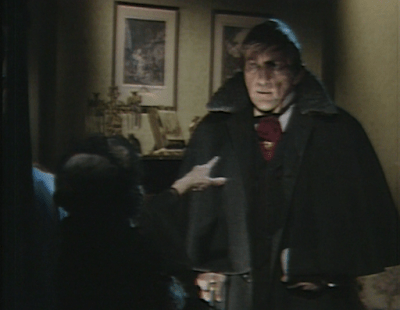
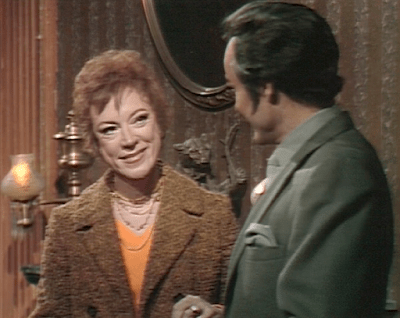
Neither Judith nor Quentin has any respect for Magda, as much because of her Romani ethnicity as because of her mercenary ways. But when Barnabas introduces himself, Judith is deeply shaken. Quentin mocks her, suggesting that the resemblance between Magda’s prediction and Barnabas’ identification is as likely to be a coincidence as anything else, but as soon as he is alone with Barnabas Quentin pulls a sword, holds it at Barnabas’ throat, tells him he knows he is an impostor, and demands the truth within “five minutes” or he will run him through.

With this act, Quentin shows as little strategic nous as Barnabas had shown when he led Magda to believe that it was in her interest to make sure he stayed around for a while. Quentin does not know that Barnabas is a vampire, so that running him through with a sword would do nothing but give whoever saw it a story that he could not tell without branding himself a lunatic. But he does know that he is the black sheep of the family, and that his brothers and sister are eager to get him out of the way before their grandmother dies and her will goes into probate. If he kills a man in cold blood, they would have an excellent reason to have him committed to an asylum and whatever legacy he receives placed in a conservatorship they would control.

So Quentin’s threat is an empty one. Had Barnabas caved in and made a confession that he was a fraud, only Judith would have known of Quentin’s triumph, and she has made it clear that she is not about to yield a penny of her inheritance to him no matter what he does. At most, Quentin would have given Judith a new esteem for Magda, who herself has no use at all for him. And when Barnabas holds his ground, all Quentin can do is back down, losing face and making himself permanently ridiculous in his eyes.

The particulars of the scene are interesting, as well. Quentin tells Barnabas that he has “five minutes” to explain himself. When we heard that, my wife and I laughed out loud. Are we about to be treated to five minutes of silence while they hold their poses? Surely, we thought, it was a blooper- the scripted line must have been “five seconds.” But no! A moment later, Quentin says that “five minutes can go by rather quickly, when a man is about to die.” Had Barnabas been struck with terror at the sight of the weapon so close to him, he might have started confessing as soon as he saw it, but by the time Quentin doubles down on this “five minutes” it is obvious he has already lost the game.

Quentin tells Barnabas that he has just returned from a visit of about six months in England, during which time he discovered that he had no relatives there named Collins. This gives Barnabas an opportunity to insult Quentin, saying that his reputation may have preceded him and driven his relatives to make sure he did not find out about them. This stuns Quentin satisfactorily, but is not strictly necessary. There had been a great deal of migration from Ireland to England by the 1890s, more than enough that an Irish name as widespread as Collins would have been very familiar there. It is hardly likely that even if he had spent six months doing nothing but tracking down every Collins family in the country Quentin would have been able to have confidence that he had not overlooked some descendant of a Collins who had left Collinsport generations before. After all, they didn’t have ancestry dot com back then! It is clear that he must be lying.

Worst of all from Quentin’s perspective, he is still holding the sword at Barnabas’ throat when Judith comes in. At that sight, she has no choice but to set aside her own doubts about Barnabas. She demands Quentin apologize to Barnabas. Barnabas tells them that he can assure Quentin that he does not want any of the family’s money; in fact, he says, the English Collinses are quite comfortable financially and he plans to make some investments in local businesses while he is in Collinsport. Quentin perks up at this, no doubt seeing Barnabas as a possible mark for his next con game. Longtime viewers will remember that when Barnabas introduced himself to the 1960s iteration of the family, Roger was extremely interested in his apparent wealth and had several ideas about how he might help himself to a share of it.

Judith offers Barnabas a room at the great house. He says he would rather stay at the Old House on the estate. Judith breaks it to him that the current head of the family, dying nonagenarian Edith Collins, has let “Gypsies” live there. She makes it sound like a whole Romani clan has settled in, but in fact it is just Magda and Sandor. Barnabas feigns surprise, but still asks permission to inspect the house. Judith consents, and he sets out, alone

Danny Horn’s post about the episode on his Dark Shadows Every Day focuses on the ways it makes Quentin look like a child. I’d say it makes Judith look equally childish, even though she is clearly senior to Quentin. The two of them model one of Dark Shadows‘ signature pairings, that of Bossy Big Sister and Bratty Little Brother. Even when the big sister is in a position to exercise authority, as in the 1960s Liz was in a position to exercise authority over Roger, she winds up being merely bossy because however flagrantly he disobeys her, in the end she covers up his misdeeds and protects him from the punishment they merit. Longtime viewers suspect Judith will find herself doing the same.

In yesterday’s episode, Quentin entered maidservant Beth’s room and found her getting ready to go out. He asked if it was her day off; she said Judith gave her permission to run personal errands in town. He grabbed at her things and found an envelope with $300 cash. She claimed she saved this out of her salary, an obvious lie. He made leering insinuations about her relationship with his oldest brother Edward; she slapped his face.

Now, Beth is on her way back to Collinwood from her mysterious errand. Barnabas sees her in the woods and addresses her by name. She asks who he is and how he knows her. He introduces himself, and explains that he saw her photograph in an album at Collinwood. In fact, his friend Julia Hoffman saw such a photograph in 1969 and described it to him; Barnabas himself never saw it, but he did see Beth’s ghost. Evidently the photo had already been taken and put into the album, because Beth smiles when Barnabas talks about it. He asks Beth about the children at Collinwood. She mentions two; he asks about a third, and she says there is no third. He asks why he thought there was, and she seems uncomfortable. After she leaves, we hear his thoughts in a voiceover monologue. In 1969, Beth’s ghost led Barnabas’ friend Chris Jennings to an infant’s coffin; he wonders if that child has already died, and looks around, as if he might be standing on its grave.

Barnabas’ next stop is at the waterfront. When he was first a vampire in the late eighteenth century, Barnabas once found himself on the docks by chance and was overcome with thirst for the blood of the streetwalkers who worked there. This time he must have made a conscious decision to find a sex worker to drain of blood. Some wonder why he does not feed on Sandor and Magda, but longtime viewers know the answer to that one. When Barnabas was first on the show, Willie was his blood thrall, and each bite left Willie critically ill throughout the daylight hours. Barnabas needs Sandor and Magda to guard him during the day, so others will have to suffer to provide him with blood.

Barnabas picks up a small object from the pavement. He hears a soprano voice nearby, calling for an unseen “Charlie!” to help her find her lost makeup compact. The owner of the voice comes into view and introduces herself to Barnabas as Sophie Baker.* Barnabas gives her the compact. She thanks him and says it was a gift from a dear man, a Captain Strathmore. She asks Barnabas his name. He says he thinks it is best if he doesn’t give his name. “What an odd thing to say,” she responds. If she made her living the way Barnabas hoped the woman he found would make hers, it wouldn’t be odd at all; Sophie’s reaction is that of someone who has no idea that she is in a place where that trade is practiced. Evidently Sophie comes from a sufficiently comfortable background that prostitution does not impinge on her thoughts even as something other women do.

Barnabas tries to get away, and Sophie asks “Well, what’s the matter with me?” Charlie is hopelessly drunk, leaving Sophie without an escort. Barnabas is plainly alone, and the night is young. The pub is nearby- why don’t they stop in for a drink. Barnabas shows great reluctance, but finally agrees to walk Sophie to the door. She takes out her compact to freshen her face, looks in its mirror, and notices that Barnabas does not cast a reflection. She is stunned by this. Barnabas bares his fangs, and sates his bloodlust.

Sophie seals her fate. Screenshot by Dark Shadows Before I Die.

The compact with a mirror was apparently a new invention when one was advertised in the Sears & Roebuck catalogue in 1908, so it is an anachronism in 1897. But it is a perfect touch. Sophie’s discovery that Barnabas does not cast a reflection turns the scene from a little bit of farce into a tale of horror in a fraction of a second. That the compact allows such an efficient use of time makes it no wonder that they used the same prop in 1967, when Julia glanced in her compact to confirm her hypothesis about Barnabas’ nature in #288.

This time, the compact also goes a long way towards explaining Barnabas’ attitude towards Sophie. It shows that she can afford to buy the latest and most sophisticated trinkets, and that she expects to be seen using them. Barnabas picks the compact up and returns it to Sophie as a gentleman might a lady’s handkerchief. Sophie’s personality may have led her to match the outgoing and uninhibited manner that is a professional requirement for sex workers and that made them easy targets for Barnabas, but when he sees that she is not of their class he becomes reluctant to attack her. Thus we learn that snobbery Barnabas has shown in some of his darker moments is not just an occasional failing, but that his whole career as a vampire is primarily a war on poor people.

Back at Collinwood, Quentin spots Beth taking a tray of food upstairs. He waylays her, uncovers the tray, and demands to know who it is for. She says it is for Edith, and he declares that his grandmother is far too ill to eat so much. When he finally lets her go, Beth goes to Edith’s room and tells Judith about Quentin’s interrogation. They confer about the matter in urgent whispers. Judith tells Beth they will have to be far more discreet now that Quentin is back. She urges her to take care Quentin does not see her when she takes the rest of the food “upstairs.” Evidently there is someone in the house Quentin does not know about, and Judith and Beth are conspiring to keep it that way.

Judith leaves the room, and Quentin slips in. He pretends to be Edward. Edith is not fooled, and expresses her annoyance with him. She says she is not as far gone as he thinks she is, and he assures her that she is. She will die tonight, and will tell him the family secret before she does. He seems to be threatening to kill her himself by the time the episode ends.

Every episode of Dark Shadows begins with a voiceover delivered by a member of the cast. This one reuses yesterday’s opening voiceover. I believe this is the first time they have done this.

*The closing credits give her name as “Sophie Barnes,” but she very clearly says “Baker.”

Episode 690: A different mood

We open with governess Maggie Evans entering the bedroom of strange and troubled boy David Collins. She had heard David’s screams and a man’s laughter coming from the room; the man is gone, and David is unconscious on the floor. He has a nasty burn on his arm, and as he is coming to he pleads with “Quentin” not to hurt him.

Once David is fully awake, Maggie asks who Quentin is. David frantically denies that there is any such person, and claims that the laughter she heard was his own voice as he was playing a make-believe game. She says that she knows he couldn’t have made those sounds. He points out that they are the only people in the room. Maggie does not even try to explain how anyone could have left the room unseen; she seems already to have concluded that Quentin is a supernatural being. Maggie identifies Quentin with a strange and frightening man she and housekeeper Mrs Johnson have both seen. David keeps trying to deny everything, and Maggie keeps telling him she wants to help. David sobs, and Maggie holds him.

Maggie holds David.

Quentin is indeed a ghost who is taking possession both of David and of Maggie’s other charge, nine year old Amy Jennings. With their help, Quentin has so far killed two people, tried to kill two others, and set about trying to drive everyone off the estate of Collinwood. Up to this point, Maggie has failed completely to represent any sort of obstacle to Quentin. She is a poor disciplinarian who lets the children run rings around her even when they are themselves, and is altogether at sea when they are doing Quentin’s bidding. This scene promises a breakthrough. Maggie is the first of the adult characters to learn Quentin’s name, she does not flinch from the evidence of his uncanny nature, she vows to fight him, and David finds comfort in her arms.

The breakthrough does not come today, however. After a moment, David declares that no one can help him, and he rushes out of the room. He goes downstairs to the foyer and hears a knocking at the door. He opens it and sees notoriously abusive actor Roger Davis standing there. He reacts to that sight as anyone might, running away without a backward glance.

Maggie follows David downstairs. There is again some question as to how much of the body language in the next scene is the blocking the director gave as an interpretation of Maggie’s response to the character Ned Stuart and how much is Kathryn Leigh Scott’s reaction to Mr Davis. Maggie tells Ned she can’t talk because she must go out in search of David; as she prepares to exit, she circles around with as much space as possible between her and him, never quite making eye contact but glancing back every time he moves towards her. This is not a pattern of movement we have seen before on the show, even when a character was dealing with a vampire or some other murderous foe. Miss Scott looks very much like a woman alone with a man whom she does not trust not to assault her. If he had, it wouldn’t be the first time he has physically abused a castmate on camera.

She keeps her eyes on his hands

A child’s voice is heard, singing the song “Inchworm.” It is Amy, and she is working a jigsaw puzzle in the drawing room. The drawing room brings out Amy’s musical side. She played “London Bridge” on the piano there in #656 and tapped a few random keys on the same instrument in #676. She is quite a good singer, perhaps not surprising since actress Denise Nickerson had been in the cast of the short-lived James Lipton/ Laurence Rosenthal Broadway musical Sherry! in 1967.

Ned enters and introduces himself to Amy. His lines are all perfectly polite and friendly. Amy is supposed to gradually sense that Ned is hostile to her big brother Chris and to become uncomfortable around him, but that is supposed to come at the end of their time together. As it plays out, she already seems uncomfortable when he first enters. A minute or so into the scene, Amy smiles at Ned. Nickerson was remarkably good at flashing quick smiles, but it doesn’t work this time. She looks like she is displaying her teeth to the dentist. When Amy is supposed to start edging away from him, Nickerson turns around and proceeds to her next mark at full speed. The camera pans back, but does not capture her movement- she has gone clean out of the shot, leaving Mr Davis alone in the frame.

She goes as far as she can as fast as she can.

Ned approaches Amy; he grabs her by the shoulders and pulls her back into the shot. Chris enters. Amy starts to warn him against Ned, and he tells her not to be afraid for his sake. Indeed, Chris is safe. It is only women and children who have to be afraid of Roger Davis.

Ned confronts Chris. Evidently something bad happened to Ned’s sister Sabrina. She can’t tell Ned what it was, but he thinks Chris is responsible and wants him to go with him to the Collinsport Inn to see her. Returning viewers know that Chris is a werewolf and that Sabrina saw him transform. He assumed that he had killed her while in his beastly form, and he is surprised to learn from Ned that she is still alive. Chris is a character we are supposed to sympathize with, so it is a bit disturbing that he does not seem particularly relieved to find that he did not kill Sabrina.

In the woods, Amy finds David. She learned some days ago that Quentin wants to hurt Chris, and she has been resisting Quentin’s influence ever since. She and David talk about ways they can work together to fight him. David says that he has decided to tell Maggie what has been happening; Amy objects that this is too dangerous. They seem to be getting somewhere when Quentin appears to them. They are terrified, and then resign themselves to their fate.

Later, the children are in the drawing room with Maggie. Amy is still working her jigsaw puzzle, and David is staring into the fireplace. Longtime viewers will remember that this is something his mother used to do. She was the show’s first supernatural menace and tried to lure David to his doom. Maggie’s predecessor, well-meaning governess Vicki, led the other characters in the campaign that saved David then. We wonder if Maggie will be able to match her success.

Maggie admires the puzzle and calls David over to look at it. David makes a show of being bored, leading Amy to remark airily that boys don’t like jigsaw puzzles. David complains that there is nothing to do. Maggie suggests the three of them sit down together for a heart-to-heart talk, an idea the children reject. They suggest a variety of games they might play. Maggie notices that their manner is quite different than it was earlier in the day. David is more assertive, Amy supercilious. She finally agrees to let them play dress-up.

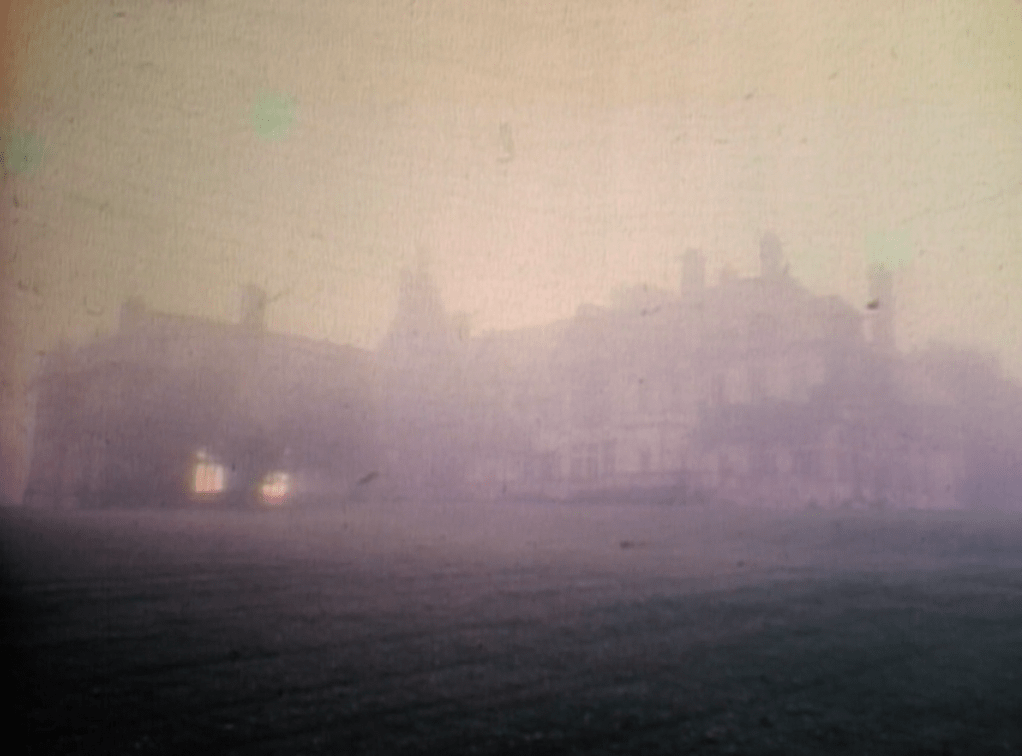
In the first year of the show, the opening voiceovers often involved a weather report. “A cold wind blows from the sea to the great house of Collinwood, but the fog still hangs heavy on its vast lawns” that sort of thing. They stopped doing that some time ago, but today they slip in an almost comically detailed bit about atmospheric conditions- “Soon dark, threatening clouds will gather over Collinwood, and long, ever-lengthening shadows will creep menacingly toward the great house. By late afternoon, rain will come, a rain that will begin slowly but steadily increase into a raging storm.” You expect them to go on with “Expect cooler temperatures and clear skies after 8 PM, with a chance of frost in the morning.” But the rain, at least, plays a part in the story. It explains why David and Amy have to stay indoors, and a roar of thunder gives Amy a chance to sneeringly ask Maggie if she is frightened. It also occasions the use of this still of the exterior of the house, one which I do not believe we have seen before:

We don’t usually see that much of the lawn.

Later, Maggie goes to look for the children. She enters the study. This set has been familiar since early 1967, but today is the first time we see the outside of its door. Lately we have been seeing more of the little spaces that are supposed to join one room to another, part of a strategy to make the house seem like a bigger place.

The sequence before this suggests Maggie is heading into the long-deserted west wing, but once she goes through the door it is clearly the study.

Once in the study, Maggie hears Amy and David calling to her from no particular direction while Quentin laughs. She is bewildered, then the children join Quentin in laughing. His laughter is hearty, theirs is maniacal. Maggie goes out into the corridor, sees something frightening, and retreats into the study. She is only there for a moment when the doorknob starts turning. We end with Maggie staring directly into the camera, its lens representing the point of view of whatever it is that is terrifying her.

Maggie terrified.

This is the first of only two episodes credited to writer Ralph Ellis. Dark Shadows never had more than three writers on staff at any time. I often wish they had had many more. Ellis is one of those whom I would have liked to see as a senior writer on the show right the way through. The episode is well-paced, the characters are clearly defined, and the dialogue is smooth with just a touch of wit. If he had been in charge of, let’s say, every Monday’s script, the whole series would have been a cut above what it actually was. Since he only contributed two scripts, it is especially sad that Roger Davis had to crap on one of them, but even when Mr Davis is on camera you can still tell that Ellis did his job well.

Episode 650: I must see to my luggage

Version 4.0 of Dark Shadows began in #466 when old world gentleman Barnabas Collins was cured of vampirism and ended in #637 when Barnabas and his friend, mad scientist Julia Hoffman, found that witch-turned-vampire Angelique had departed the scene. That version was a Monster Mash in which the main attractions of all Universal Studios horror hits of the 1930s found their counterparts. Version 5.0 is focused on just two monsters, a werewolf and a ghost. The werewolf is Chris Jennings, brother of nine year old Amy. The ghost is Quentin Collins, who is obsessing Amy and her friend, strange and troubled boy David Collins.

Today is taken up with two problems of plot mechanics. First, Barnabas is the undisputed star of the show, and he does not have any particular connection to either of the ongoing stories. Second, well-meaning governess Vicki is too familiar with the supernatural, too secure in her place in the great house of Collinwood, and too familiar to the audience to permit Amy and David to figure in a story based on Henry James’ The Turn of the Screw, even if that story is inverted so that it is the children who see the ghosts and the governess who doubts them.

Today, Vicki’s husband, a repellent man known variously as Peter and Jeff, returns from the dead and takes her with him. He materializes in her bedroom, takes her by the hands, and they both vanish while Barnabas and matriarch Elizabeth Collins Stoddard look on. That solves the second problem.

Peter/ Jeff and Fake Vicki vanish as Barnabas and Liz look on. Screenshot by Dark Shadows Before I Die.

Liz’ brother Roger solves the first problem when he asks Barnabas to hang around the house while he is away on a business trip to London. Barnabas will therefore be on the spot while the children cope with “The Haunting of Collinwood.”

The opening narration is delivered by Roger Davis, who plays Peter/ Jeff. This not only produces a sinking feeling in regular viewers who recognize Mr Davis’ voice and realize that his absence these last few weeks was only a temporary reprieve, it also spoils the surprise when Peter/ Jeff shows up.

This is the last of Betsy Durkin’s 10 appearances as Vicki. The part originated in #1 as the audience’s main point of view character; then and for the next 126 weeks, she was played by Alexandra Moltke Isles. By the time Mrs Isles left the show, Vicki had long since run out of story, and was saddled with the hopelessly unappealing Mr Davis as her primary scene partner. Inheriting those difficulties, Miss Durkin never had a chance to establish herself as part of the show.

Episode 647: Her own sensitivities

This is first of three consecutive episodes featuring Cavada Humphrey as Madame Janet Findley, a medium recruited to investigate the strange goings-on at the great house of Collinwood. Humphrey’s performance dominates these segments completely. Her style is more akin to pantomime than to anything native to spoken drama; she uses every muscle of her body to strike a series of exaggerated poses. Since that includes the muscles of the vocal tract, words occasionally come out in the course of her performance. The result is as bizarre as it sounds like it would be, and on Dark Shadows it is magnificent.

Granted, it is a shock when Humphrey reads the opening voiceover. Without seeing her, it is difficult to know what to make of her speech. When we watched it this time, I tried to make Mrs Acilius laugh by mimicking the poses a person might strike while speaking that way. So far from making the monologue sound silly, that just made it clear to us what Humphrey was doing, and left us both taking her performance seriously.

I’ll make a couple of random remarks about the non-Cavada Humphrey parts of the episode. Under the influence of the ghost of Quentin Collins, children David Collins and Amy Jennings have tried to murder David’s father Roger. Yesterday David took the lead in setting the trap that caused Roger to fall down the stairs while Amy showed reluctance in helping him. Today, the children see that Roger is not seriously hurt. David is relieved and wants to stop doing Quentin’s bidding, while Amy insists that they continue. Denise Nickerson delivers one of Amy’s monologues with her eyes fixed on the camera; the effect is unsettling in the extreme, suggesting as it does that Amy and David have taken leave of the other characters and are now in a dramatic space of their own where they may as well communicate directly with the audience.

Amy tells David and us that Quentin must be obeyed.

On his great blog Dark Shadows Every Day, Danny Horn derides David and Amy’s exchange of roles in their conspiracy. He says that the reason they take turns being “Executive Child” is merely sloppiness on the part of the writing staff:

You can handwave and say that seeing his injured father shocked young David out of his temporary hypno trance, but really the explanation is that Gordon Russell wrote yesterday’s episode and Sam Hall wrote today’s, and they didn’t really bother to synch up on David’s emotional throughline. It happens. This is the “good enough for rock ‘n roll” approach to soap opera dramaturgy.

Danny Horn, “Episode 647: The Wire,” posted 12 May 2015 on Dark Shadows Every Day.

I disagree. There’s nothing hand-wavey about an appeal to David’s motivation. However little attention Hall paid to yesterday’s episode, David’s visit to his father, during which he all but begs for a way to help him in his recovery, leaves no doubt that he meant for us to think that David was relieved that he failed to kill his father and that, having seen where Quentin’s spell would lead, he wanted to break free of it.

And the actual effect of seeing the children waver back and forth in the intensity of their subjection to Quentin, alternating between attempts to break free and turns as “Executive Child” enforcing Quentin’s will on the other, is to show us that we are early in the process of obsession and to create suspense as to whether it will progress all the way to possession. So far, Quentin can dominate only one of the children at a time, while he just tugs at the other. In Madame Findley’s intervention, and for that matter in David’s scene with Roger, we can see paths still open that would lead to breaking his power altogether before he grows strong enough to fully control Amy and David simultaneously.

There is a similarity between David and Amy’s relationship to Quentin at this point and Amy’s brother’s relationship to his curse. Chris has been a drifter for a few years, suggesting that he has been a werewolf for that long, but he is still looking for ways to keep himself from hurting anyone when the Moon is full. The supernatural menaces the show has presented up to this point were introduced as already fully committed to the destruction it was ordained they would cause. David’s mother, undead fire witch Laura Murdoch Collins, was an collection of several entities, some of them more purposeful than others, when she joined the show in December 1966, but it was always her fate to lure David to a fiery death. Vampire Barnabas Collins would eventually become a nuanced character and has now been freed of his curse and become human again, but when he first showed up in April 1967 he was all-in on being a creature of the night. Wicked witch Angelique started her murderous rampage shortly after her arrival in November 1967, and all of the various villains of the Monster Mash period that ran from mid-April to early December 1968 showed up loaded and ready to do their thing. But Chris’ curse has only drawn him halfway into monsterdom, as Quentin’s obsession has only drawn Amy and David halfway into his world of evil.

One inconsistency that may be most profitably explained by carelessness comes when Amy tells David that Quentin calls him by the name “Jamison.” Jamison was the name of David’s grandfather, who was Quentin’s nephew. Earlier, David had, under Quentin’s influence, told Amy to call him “Quentin.” It might have been better if they had decided in advance just who it was whose personality was supposed to overwrite David’s, though I don’t think it is a major flaw.

Episode 626: The sad case of Victoria Winters and Peter Bradford

From November 1967 to March 1968, Dark Shadows was a costume drama set in the years 1795 and 1796. Well-meaning governess Vicki had come unstuck in time, found herself in that period, and failed utterly to adjust to her new surroundings. While she was in gaol charged with witchcraft, she befriended an unpleasant man named Peter, who served as her defense attorney. Peter handled the case so badly that he and Vicki were both sentenced to hang, but they nonetheless fell in love with each other.

Shortly after Vicki was whisked back to the 1960s, she found that Peter had also come back to life. Unfortunately, he had total amnesia covering everything prior to his arrival in the twentieth century, and he became belligerent every time Vicki tried to tell him about himself. These traits did nothing to improve Peter’s already repellent personality, but having fallen in love with him once Vicki remained grimly determined to make a life with him.

The other day, Peter and Vicki were about to get married when a mysterious woman known as Eve presented Peter with evidence that what Vicki has been telling him is true. He ran off to exhume the grave marked with his name and found that the coffin was empty. For some reason he took this to mean that he shouldn’t marry Vicki after all. He has gone back to his room, where he is packing his bags and looking at a train schedule.

Unknown to Peter, there have been two visitors in his room while he was away. Eve came in and called for him, saying aloud that she would “make it all right” for him. A man known as Adam followed her in and overheard this. Adam thus learned that, despite their names, he and Eve would never be a couple. He asked if, when “yesterday, you made me happy- that was a lie, wasn’t it?” She confirmed that it was, that she would never love him, that she had always hated him, and that she found him ugly. That last apparently struck a nerve, because Adam responded with great rage. He choked Eve, and she collapsed.

Vicki drops in on Peter while he is getting ready to leave town. He tells her they cannot be together, and she insists on giving their relationship a second chance. Peter opens his closet to get some more clothes to pack, only to close it quickly. Vicki opens it, and finds Eve’s strangled corpse crumpled on the floor.

There is a genuinely horrifying moment in this episode. Vicki thinks back to the night in the 1790s when she was taken to the gallows, and we see events from her point of view. At one point we see Peter’s face looming towards the camera with his lips puckered. We’ve seen how Roger Davis manhandles his female scene partners, and in particular how miserable Alexandra Moltke Isles is when he kisses her. The sight of him coming at us for a kiss is enough to make even the most seasoned horror viewer flinch.

Get away from me. Screenshot by Dark Shadows Before I Die.

Mrs Isles read the opening narration of episodes 1-274 in character as Vicki. After she lost her monopoly on the opening narrations, she read more than 100 others, no longer as part of that role. This is the final time she takes on that task. It is also the first time “and Alexandra Moltke as Victoria Winters” is followed on screen by other acting credits.

Episode 619: Advantages of being the master

Well-meaning governess Vicki has found a grievously injured Barnabas Collins in the woods. Barnabas insists Vicki not take him to a doctor or anyone else, but hide him somewhere no one will find him. She thinks of a secret door to the long-abandoned west wing of the great house of Collinwood, and uses that to take him to a hiding place there.

For the first year of Dark Shadows, the west wing was strongly associated with Vicki. In #14, she alone saw the locked door separating the bedrooms from the west wing open and close, apparently by itself. That was the first unequivocal evidence of supernatural activity on the show. In #84, Vicki’s charge, strange and troubled boy David, led her into the west wing, the first time we had seen its interior. He then trapped her in a room there, hoping she would die. She would languish in that room until David’s father, high-born ne’er-do-well Roger Collins, rescued her in #87. When Vicki was engaged to Roger’s nemesis Burke Devlin in #338, matriarch Liz offered to restore the west wing and let Vicki and Burke live there. After Burke died in a plane crash in #345, Vicki vowed to go on with the project of restoring the west wing. In #347, permanent houseguest Julia Hoffman, MD, exploited Vicki’s interest in the west wing to get her to stare into a crystal supposedly taken from a chandelier there until she is in a state of deep hypnosis.

More recently, Frankenstein’s monster Adam stayed in the west wing for many weeks as the guest of heiress Carolyn. Vicki’s connection with the wing was renewed when Adam abducted her and hid her there for a few days starting in #553. Today, Vicki hides Barnabas in Adam’s old room, re-establishing the west wing as her space. Thus we loop back to a theme that goes back to the third week of the show.

Later in the episode, Barnabas wakes up and is distressed to find that it is almost sunset. He pleads with Vicki to bring him a cross as quickly as possible. The audience knows, but Vicki does not, that Barnabas is the victim of vampire Angelique. Vicki’s ignorance of this point reminds us that she has been excluded from the show’s A-plots ever since #211, when Barnabas was introduced, himself in those days a vampire. Her calm departure to go fetch a cross reminds us that she knows this part of the house well. Every room in it is stuffed with bric-a-brac, undoubtedly she will have seen something nearby that is in the shape of a cross.

Meanwhile, Julia is in a hospital room, visiting local man Joe Haskell. Julia has become Barnabas’ inseparable friend, and Joe is Angelique’s other victim. She does not know that Angelique is the vampire, though she had surmised as much in #608. She questions Joe. At first he denies everything, but after she discloses that she was for a time the victim of yet another vampire he tells her that she must know why he can’t tell her who has been sucking his blood. She asks if the suave Nicholas Blair is hiding the vampire. Joe closes his eyes and scoffs at the idea. This reaction does nothing to curtail Julia’s suspicions of Nicholas.

Julia goes to Nicholas’ house. He genially escorts her into his living room. There, he takes a seat while she stalks about the room and tells him what she knows about him. Barnabas has a self-defeating habit of showing his cards to his adversaries, and longtime viewers may at first be afraid Julia has picked it up from him. Since Nicholas is a warlock who not only controls Angelique but has a wide range of magical powers that he uses to promote Satan’s interests on Earth, he is not an opponent with whom one can afford to make mistakes. Angelique herself was once a witch who, in #378, was able to turn a man into a cat at a moment’s notice. Nicholas’ command of the black arts goes far beyond Angelique’s. He was able to strip Angelique of her powers, raise her from the dead at least twice, and turn her into a vampire. Julia is simply a mad scientist, and she does not have any equipment with her. There’s no telling what Nicholas might do to Julia if their interview displeases him.

On his great blog Dark Shadows Every Day, Danny Horn lists three reasons why we know Julia will survive this confrontation without being turned into a toadstool:

Really, the thing that everybody wants to know is: why can’t the Stormtroopers shoot straight in Star Wars? It turns out there are three simple answers. #1. Stormtroopers shooting laser bolts are more interesting to look at than Stormtroopers who stand around complaining. #2. Shooting Luke Skywalker in the head halfway through the first movie is going to leave a rather obvious gap in the trilogy. #3. ‘Strong Guy Kills Weak Guy’ is not headline news.

Danny Horn, Dark Shadows Every Day, “Episode 619: The Gunslinger,” posted 4 April 2015

This is all very true- of course Nicholas and Julia will not leave each other alone indefinitely, of course the show cannot spare her, of course she will overcome her disadvantages and come away from their showdown with the upper hand. But it misses the point. Suspense comes when we know what must happen, but cannot see any way it might happen. What makes the scene work is the moment when Julia tells Nicholas that Barnabas is missing. That is news to him, and as Danny says elsewhere in his post, it is “the first sign of a crack that’s going to bring his entire operation crashing down,” as his shocked reaction suggests it might be.

Julia realizes she has won her showdown with Nicholas. Screenshot by Dark Shadows Before I Die.

The scene is one of the best in the series, though it is marred by a miscalculated ending. In the early part, we see Julia making an effort to keep her cool while Nicholas sits watching her smugly. She succeeds in keeping her brave face on until she senses that she has Nicholas off guard, at which point she moves in for the kill and tells him about Barnabas. She is then firmly in command. He composes himself and dismisses her.

That’s when it goes wrong. When Julia is heading out the door, Nicholas recovers his smugness and tells her that he must admit that he admires her for coming to see him. She looks alarmed and asks why. He replies, in a half-whisper, “You know.” She hastens out. I can see that this ending may have seemed like a good idea. We clearly saw in the beginning how hard it was for Julia to keep her fear in check and how easy it was for Nicholas to bask in the superiority his powers give him over a mere mortal. Though Julia has emerged as the winner in this engagement, she still has grounds for immense fear, and he for boundless self-confidence. But it is so broadly drawn as to be confusing. Has Nicholas already found a way to turn Julia’s success against her? Has she realized too late that she has made a mistake we aren’t aware of?

We learn shortly after that neither of these things has happened. Angelique comes upstairs. She sees Nicholas being very still. She makes several attempts to engage him in conversation. He finally approaches her and strikes her across the face. He then orders her to undo what she has done to Barnabas before it ruins his plans.

This is the second time Nicholas has slapped a woman in the face. The first time was in #610, when he struck Frankenstein’s monster Eve. Humbert Allen Astredo and Marie Wallace executed that business well, as he and Lara Parker execute it well today. For that matter, Grayson Hall and Lara Parker had done a good job when Julia slapped Angelique in the face in #535. Watching them, you can admire trained professionals practicing a specialized aspect of their craft. But since Nicholas has such vast powers, he is persuasive as a villain only when we are left guessing about just what he is up to. When we see him is reduced to hitting a woman, he shrinks from avatar of Satan to cheap pimp.

After Julia leaves Nicholas’ house, she lingers in the woods outside, watching his front door. She sees Nicholas leave the house, then sees Angelique and realizes that she is the vampire.

Julia is the most intelligent character on the show, and while we watch her in the woods her face suggests that she is thinking clever thoughts. Unfortunately, we hear her interior monologue in a recorded voiceover, and her lines are remarkably obtuse. On the heels of her overdone fear on the way out of Nicholas’ house, it does as much to undercut Julia’s image as a smart person who can win a duel with the Devil as Nicholas’ physical abuse of Angelique undercuts his image as a demonic sorcerer.

Episode 617: Few people in this world

The opening voiceover is very much to the point:

An autumn dusk has settled over Collinwood, bringing with it not the fear of night but a renewed hope of happiness for a young woman long acquainted with the terrors that have plagued these premises. But as the deepening dark surrenders to the night, a new threat, evil in its creation and awesome in its consequence, will reveal its final purpose, the destruction of Victoria Winters.

We then cut to a scene of Vicki with the evil creation that is destined to destroy her, her fiancé Peter. In place of a personality, Peter has a compulsion to insist that no one use his right name. Instead, he wants to be called “Jeff.” He also has a habit of pawing his scene partners and occasionally jerking them around violently. This loathsome man continually fondles Vicki in their scenes together, each time prompting Alexandra Moltke Isles first to stiffen, then to force an awkward smile when she remembers that her character is supposed to like the creep. It is painful to watch, and the more scenes Vicki has with Peter/ Jeff the sooner we hope she will leave the show.

A woman named Eve has seen Peter/ Jeff and recognized him from their previous acquaintance. She finds Peter/ Jeff alone on the terrace outside the great house of Collinwood and confronts him. He looks as uncomfortable alone with her as Vicki does alone with him. It is satisfying to see Peter/ Jeff get a taste of his own medicine, all the more so for regular viewers who know that Eve is a homicidal maniac and hope she will do him in before he blights any more episodes.

Eve has been kissing Peter/ Jeff passionately for several seconds when sarcastic dandy Roger Collins speaks up and says that he has not been introduced to her. She runs off, and Peter/ Jeff demands that Roger not tell Vicki what he has seen. Roger will not agree to that, but once the two of them are alone with Vicki in the drawing room he backs down and lets Peter/ Jeff off the hook. When Peter/ Jeff realizes Roger will keep his secret he breaks into a gleeful smile. Evil has triumphed once more.

Roger consigns Vicki to her fate, while her destroyer chortles with glee. Screenshot by Dark Shadows Before I Die.

In the early days of Dark Shadows, Roger was rather a dangerous villain. One of his crimes was perjury in a case that sent another man, one Burke Devlin, to prison for a homicide in which they were both implicated. In #201, Roger admitted to that perjury in front of Burke in this very room. That admission came after a long story arc involving the return of Roger’s estranged wife Laura to Collinwood. The Laura story absorbed all the dramatic significance of the conflict between Roger and Burke, leaving Burke nothing to do in response to Roger’s admission but to peace out. To viewers who remember that Vicki was once an interesting character and still have hopes that she will shake free of Peter/ Jeff’s baleful presence, Roger’s concession to Peter/ Jeff is an even bigger disappointment than was the too-late resolution of the Roger vs Burke story.

At the end, Roger has a dream in which it is revealed to him that if Vicki marries Peter/ Jeff, she will die. We suspect that he has missed his last chance to prevent this happening.

Episode 595: The man downstairs

A mysterious woman appears at the front door of the Old House on the great estate of Collinwood. She introduces herself to the master of the house, old world gentleman Barnabas Collins, under the name Leona Eltridge. The door opens further and we see that Leona is accompanied by Frankenstein’s monster Adam. She tells Barnabas that she has come to donate her “life force” to an experiment meant to create a bride for Adam. Barnabas has many questions, none of which Leona will answer. Adam orders Barnabas to find mad scientist Julia Hoffman and ushers Leona to an upstairs bedroom.

Erica Fitz as Danielle/Leona. Some participants on message boards think she looks masculine. Those people are very confused. Screenshot by Dark Shadows Before I Die.

There, Adam tells Leona that he doesn’t know any more about her than Barnabas does. She tells him that he doesn’t need to know more, and reminds him that they must not let Barnabas or Julia know that they met for the first time this night. Moreover, no one must know that she has any connection with suave warlock Nicholas Blair.

Julia shows up with occult expert Timothy Eliot Stokes. Barnabas tells them about Leona, and Adam enters, demanding she start the experiment at once. Julia goes to the basement laboratory, and Stokes goes to question Leona.

Leona tells Stokes that she was in love with Adam’s creator, the late Dr Eric Lang. She also claims to be suffering from a terminal illness, and to have only a short time before she will die a painful death. She therefore wants to continue Lang’s work, and has no fear of the danger involved in the experiment.

Stokes, Julia, and Barnabas all regard Leona’s story as, in Julia’s words, “too pat and sentimental” to be true, but they have little choice but to comply with Adam’s demands. In fact, we know that Leona is really Danielle Roget, an eighteenth century homicidal maniac whom Nicholas conjured up yesterday. Nicholas himself has developed a crush on Maggie Evans, The Nicest Girl in Town, which puts the lie to his pretense to be a stranger to human emotions. That Nicholas thinks anyone who knew the fiendish Lang would believe Danielle/Leona’s sappy story suggests that he might be an even bigger softie than his attraction to the magnificently wholesome Maggie would indicates.

Stokes figures out how the name “Eltridge” is spelled, which somehow means that he must hurry off to work on something or other. In the basement, Julia directs Danielle/Leona to the donor’s table. She offers her a painkiller, which she refuses. Adam watches the experiment. When Danielle/Leona flatlines, Julia pronounces her dead and says that the experiment has been a failure. Adam tells Barnabas and Julia that he ought to kill them. Barnabas disagrees. Before they can explore the issue in any depth, the Bride comes to life and Adam cheers up.

The opening voiceover says that if Barnabas realized that Danielle/Leona was “one of the living dead,” his reaction would be terror. Barnabas was himself a vampire for 172 years, so you might think he would be happy to meet someone with whom he had so much in common, but maybe not.

Episode 540: Intervening factor

Suave warlock Nicholas Blair tells his subordinate, the wicked witch known variously as Angelique and Cassandra, that she has an hour to figure out why her recent attempt to turn Barnabas Collins back into a vampire failed. When she tells him that won’t be enough time, he suggests she spend the hour preparing for her final destruction. At the last minute, her stepson David tells Angelique/ Cassandra about an audiotape message that happens to give her exactly the information she needs.

Nicholas threatens Angelique. Screenshot by Dark Shadows Before I Die.

Angelique/ Cassandra has been an extremely unsympathetic villain, so it is daring to have an episode mostly from her point of view which is suspenseful if and only if we want her to stay around. My wife, Mrs Acilius, says that might have been a reasonable bet when a character as dynamic as Angelique/ Cassandra is played by a performer as appealing as Lara Parker, but it doesn’t pay off today, for two reasons. First, the episode doesn’t have much of a plot. Second, returning viewers will be angry with Angelique/ Cassandra right now. She just subjected us to a three month ordeal called “The Dream Curse,” in which we saw the same dull sequence play out a dozen times, heard it described almost twice as many times, and then found out that there was no point to any of it. We know perfectly well that Angelique/ Cassandra is too interesting to stay off the show for long, so that the “final destruction” Nicholas is threatening will probably last for three weeks at most. But we really do want to see her punished for wasting our time.

This is the first episode in which John Karlen reads the opening narration, and only the third episode in which any male performer reads it. Most cast members have read these narrations more or less in the characters they will play in that day’s episode; Karlen takes his place alongside Kathryn Leigh Scott as one of two who strive to invest the role of Narrator with its own personality.

This was the last of the five episodes credited to director John Weaver. It isn’t hard to find reasons why they wouldn’t have contracted him to do more. There are a number of moments when the action jolts to a standstill for no apparent reason, Humbert Allen Astredo as Nicholas never seems to know what direction he should be facing, and when Angelique/ Cassandra orders the bedraggled Willie Loomis to “Look into my eyes!” we get a shot of him looking past her.

Episode 506: That man again

All of the storylines in the part of Dark Shadows set in 1968 bear a heavy weight of repetitious elements. The “Dream Curse” consists of countless reenactments of the same dream sequence, almost all of them followed by at least one scene in which the character who had the dream struggles with a compulsion to tell it to someone else, and then by a speech in which we hear the details of the dream yet again. That curse was set by wicked witch Angelique, who for no particular reason keeps insisting that her name is Cassandra. Angelique is a time traveler from the eighteenth century, as is shouting man Peter, who for no particular reason keeps insisting that his name is Jeff.

Mad scientist Eric Lang tried to cure Barnabas Collins of vampirism by an experimental procedure that involved the creation of a Frankenstein’s monster. Angelique killed Lang before he could finish the experiment, but fortunately for Barnabas his best friend Julia is also a mad scientist, and she completed it. Barnabas named the creature Adam. Lang left behind an audiotape explaining that Barnabas will be free of vampirism as long as Adam lives, but that he will revert if Adam dies. Barnabas and Julia have not heard this message, but it has been played for the audience many times. Yesterday’s episode closed with yet another replay of the message, and today’s opens with still another. Since the message is nearly a minute long, it will soon have accumulated a full episode’s worth of airtime.

After the message, we see a new set. It represents the rocky shore below the cliff on Widows’ Hill. Barnabas is there with his servant Willie, looking for Adam. Adam jumped off the cliff yesterday. Since episode #2, that plunge has always been shorthand for certain death, so the opening voiceover introduces a new idea when it tells us that Adam’s leap merely “appeared to be” his self-destruction. Barnabas believes that Adam is still alive, though Willie does not. The two of them stand around and shout Adam’s name over and over; after the fifth or sixth repetition, Mrs Acilius and I cracked up laughing. At least they could have broken it up a little, and alternated “ADAM!!!” with “STELLA!!!”

The rocky shore below Widows’ Hill.

Willie had the dream last night, and now feels compelled to tell it to heiress Carolyn. Adam had abducted Carolyn and held her for a couple of days before he dove from the cliff; she is now at home in the great house of Collinwood. Willie wants to sneak into Collinwood to talk to Carolyn. Barnabas points out that Willie was only recently released from the mental hospital where he was confined after he took the rap for Barnabas’ abduction of another young woman, Maggie. If he sneaks into Carolyn’s bedroom it will go badly for him. Barnabas directs Willie to search for Adam inland, prompting Willie to flash a grin. The very first night Willie was back from the hospital, he disobeyed Barnabas’ orders and ran off to visit Maggie. So his grin tells us to expect that he will disobey Barnabas’ orders again, this time to visit Carolyn.

Willie goes to the great house. We see him standing by the wall, below the second-storey window of Carolyn’s room. In her room, Carolyn talks with her mother, matriarch Liz. She explains to her mother that she is neither frightened of Adam nor angry with him, but that she pities him, because he seemed like an inarticulate and lonely little child. After this conversation, Liz leaves the room. Willie scales the wall, slips in through Carolyn’s window, grabs Carolyn, holds her mouth shut, and forces her to listen while he starts to tell the dream. Carolyn bites Willie, screams, and Liz comes.

Willie flees through the window. Carolyn explains to her mother that she is neither frightened of Willie nor angry with him, but that she pities him, because he seemed to be deeply terrified by his dream. She says that she is afraid that she, too, will have the dream.

Three people who live in the house have already had the dream. One of them is Julia, who is careful about who she talks to. The others are strange and troubled boy David, who regularly confides in both Carolyn and Liz, and housekeeper Mrs Johnson, who tells everyone everything. It is surprising that neither of them has mentioned it to either Carolyn or Liz.