Roger Collins is up late. He heads for bed, and finds his distant cousin, old world gentleman Barnabas Collins, in the house. Barnabas apologizes for prowling about at such a late hour, and offers an explanation. He was in the long-disused east wing, where he found a room that contains a parallel universe.
Barnabas takes Roger to the room, which is vacant. He tells him that the parallel universe is visible only occasionally, and that even when it can be seen there is an invisible barrier that keeps him from entering or communicating with the people he sees there. Roger asks Barnabas if he has ever seen the phenomenon during the day. He says he has not. Roger says he will come back himself in the morning and investigate. Roger goes back to the main part of the house, and Barnabas heads for an exit that is closer to his own house.
Before Barnabas gets very far, he hears Roger’s voice. It is coming from the room, which has changed. He sees Roger’s counterpart sipping wine and talking to the portrait that hangs there.
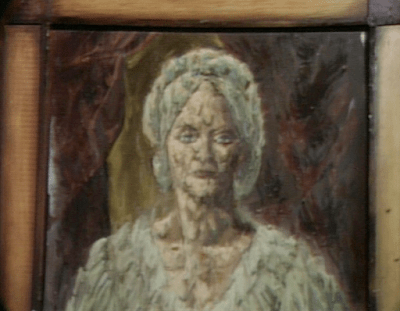
The portrait depicts the counterpart of Barnabas’ ex-wife, wicked witch Angelique. In #464, Roger became obsessed with an eighteenth century portrait of Angelique herself. When he stared at the portrait, his personality collapsed into that of haughty overlord Joshua Collins, who lived in the days when the portrait was painted. Shortly afterward, Angelique showed up, wearing a wig and using a false name. Roger married her.
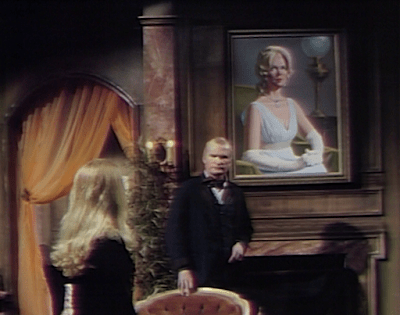
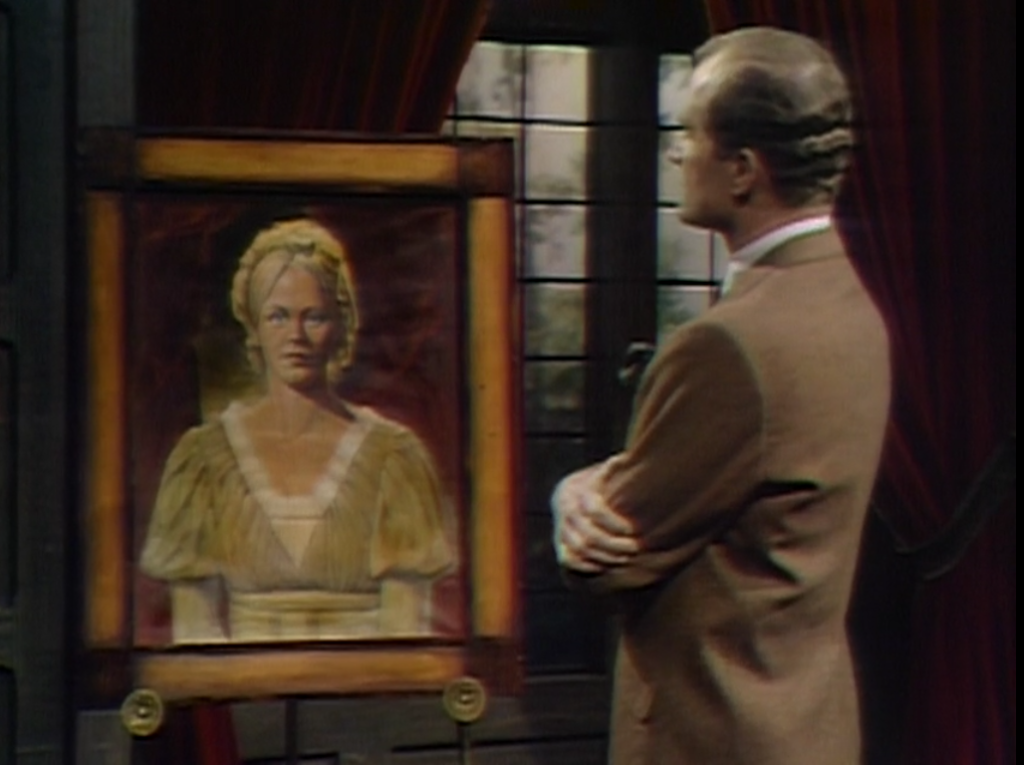
The portrait that holds Parallel Roger’s attention shows Parallel Angelique in contemporary guise. He talks to the portrait, not about a distant past which an ancestor of his might have known, but about the days when he and Parallel Angelique used to meet here, in her room. He says that people thought he was in love with her, but that he wasn’t. He was fascinated by her, but not in love. He says that he has never cared for the wine he is drinking, but that he still buys it, because it was her favorite.
The counterpart of Roger’s niece Carolyn enters. We saw the Roger and Carolyn we have known since the first week of the series earlier in the episode. They were embracing while she cried on his shoulder about some problems she is having in the B story. He called her “Kitten,” a term of endearment he has used for her since #4. That was typical of their interactions. But Parallel Carolyn has little use for her uncle. She snaps at him about talking to himself, he snaps at her about being in the room, and they snap at each other about Parallel Angelique. Parallel Carolyn says she would like to make Parallel Angelique “whirl in her grave,” at which Parallel Roger contemptuously declares Carolyn could never accomplish such a thing.
Even in death, Parallel Angelique dominates Parallel Roger and Parallel Carolyn. Screenshot by Dark Shadows Before I Die.
Parallel Carolyn mentions that she is married to the counterpart of Barnabas’ servant Willie Loomis. Barnabas has seen this other William H. Loomis, and knows that unlike Willie he is an educated man, the author of several books. He is still unable to think of him as anything other than the man he knows, however, and is shocked at the idea that any iteration of Carolyn would marry him.
When Barnabas saw him, Parallel William was wearing pricey clothes and affecting a sophisticated manner, and Barnabas learned that three of his books were bestselling novels that had been made into feature films. But we find out in this scene that the Loomises are now short of funds. Parallel Carolyn is searching for a book that Parallel William wrote and from which he has the opportunity to make a few hundred more dollars by making an abridgment for a magazine. Parallel Roger mocks his niece for scrounging for money; she remarks that their cousin Quentin is not so generous with her as he is with him. This confirms what has been suggested in previous glimpses of the Parallel Time room, that Parallel Quentin is the Master of Collinwood in its universe.
The doors close. When Barnabas opens then again, the room is vacant. He is deeply frustrated that he cannot see more of what happens there. We can understand. We, too, want to watch Dark Shadows, and are disappointed when it isn’t on.
Occasions when we might expect to see Dark Shadows but don’t include most of this episode. The Parallel Time story is just getting started, and it needs a lot of actors who are away doing principal photography for the feature House of Dark Shadows. So we spend the bulk of today on what took up all of yesterday’s episode, a lot of back and forth among characters who aren’t really on the show anymore. They are left over from a couple of exhausted storylines.
A man named Bruno, a remnant of the show’s attempt to tell a story about some events that belong in the tales of H. P. Lovecraft, is holding two prisoners. The prisoners are Chris Jennings and his fiancée, Sabrina Stuart. Chris is a werewolf. He and Sabrina are left over from a story told at the end of 1968 and beginning of 1969, and in the last few months there was a lackadaisical attempt to tie them in with the Lovecraft material. Bruno is hoping to trap Carolyn with Chris when Chris transforms, so that he will kill her. His motivation for this is an overly elaborate plan that no one who has seen the show expects to work, so even though the episode ends with Chris and Carolyn locked up together while the full moon rises it doesn’t leave us in much suspense. I suppose it is a step up from yesterday’s closing cliffhanger, in which Chris found a stooge named Sky Rumson in Bruno’s closet, strung up by his wrists, bleeding and begging for help. That made so little impact it isn’t even mentioned today. For all we know Chris just closed the closet door and let Sky have his privacy.
Yesterday, Amanda Harris told the story of a suicide attempt she made in 1897. A supernatural being whom she calls “Mr Best” thwarted this attempt, and told her that he would arrange for her not only to avoid death, but to remain young, for the years that it had been ordained she would live. If in that time she could reconnect with her lost love, rakish Quentin Collins, she and he would never die. Now it is 1970, and Amanda’s time is up. Mr Best is at her door. Amanda has found Quentin, but he has amnesia and is not ready to resume their relationship as Mr Best’s terms require.
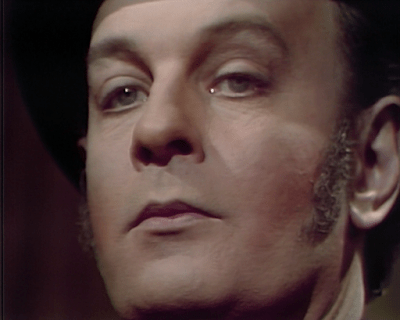
Mr Best has changed startlingly since we met him in the flashback that showed us Amanda’s story. Then he was warm and solicitous; today he is truculent and cold. Even his makeup is different. A pale coloring suggests sunken cheeks, making him look corpse-like.
Amanda has reversed her own attitude as well. In 1897, Mr Best lamented her wish for death and pleaded with her to stay alive; now it is Amanda’s turn to beg Mr Best for more time while he shows impatience with her. When she tells him about Quentin’s amnesia, he asks brusquely “Are you making this up?” It merits a laugh that the story of Dark Shadows has become so far-fetched that even Death Incarnate finds it hard to believe. But Mr Best does soften, and gives Amanda seven more days to get Quentin to tell her he loves her.
Quentin’s own perpetual youth is the result of a magical portrait that immunized him from the effects both of aging and of the werewolf curse that was placed on him in 1897. Quentin’s great-grandson Chris Jennings has inherited that curse. Mad scientist Julia Hoffman had learned that artist Charles Delaware Tate was still alive, and hoped he would paint a portrait of Chris that would free him from lycanthropy. Tate told Chris he no longer had the gift, but Chris forced him to paint his picture anyway. The moon rose, Chris transformed, and as the wolf he murdered Tate.
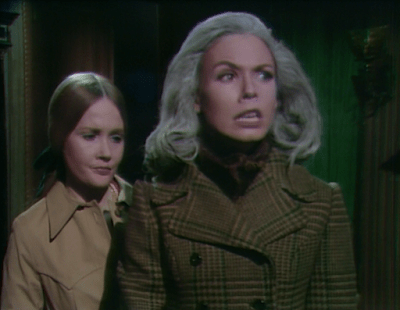
One of Chris’ surviving victims is his ex-fiancée, Sabrina Stuart. Sabrina saw him transform, and as a result was struck dumb for years and went prematurely gray. She can talk now, but she’s still gray. She shows up today at the great house of Collinwood where she calls on heiress Carolyn Collins Stoddard. Carolyn tells Sabrina that she doesn’t love Chris and never will, but that she realizes Sabrina loves him. This adds to a growing list of reasons the show has given us to doubt that Chris will be on much longer. His premeditated murder of Tate establishes him as a pure villain. A villain’s function is to create problems for other characters to solve, and Chris has been too passive and too dependent on Julia to be an interesting villain. His relationship with Carolyn gave him a connection to the core cast, but Carolyn’s conversation with Sabrina makes it clear that that is gone now.
Sabrina insists Carolyn go on a road trip with her. She takes her to Tate’s house and leads her into the room where Chris murdered the artist. She tells her that a man was just killed there. Carolyn asks Sabrina if Chris did it. Sabrina looks pained, and says “Not Chris!” This further undermines Chris’ position. As long as Sabrina was mute, we could wonder whether she would blow the whistle on Chris once she regained the power of speech and if so what the consequences of that would be. But now we see that she is still in denial about him, and can set aside any hope that she might generate a story for him.
Carolyn asks Sabrina how she knows about the murder. No answer is forthcoming, and there doesn’t seem to be any way she could know. Evidently Sabrina has now developed some kind of clairvoyance about Chris’ murders. Since she is apparently determined to use that power to limit Chris’ relevance to the story, it is yet another reason to suspect he will be written out soon.
Julia enters the crime scene. She and Carolyn are surprised to see each other. Sabrina announces that Julia knows all about Chris, and gets upset about it. Julia, a psychiatrist by profession, slaps her in the face, the accepted treatment for angry women in 1960s television shows. Sabrina quiets down, and Julia sends her away with Carolyn. Once they are gone, she settles in at Tate’s desk and starts rummaging through his papers.
Julia wants to cure Quentin of his amnesia. She looked through an old Collins family photo album, and found that two pictures of him had gone missing. She is puzzled as to who took them; this is a continuity error, since in #686 and #687 there was a whole thing about ghosts removing photos relevant to Quentin from albums after Julia had looked through them. Be that as it may, Julia discovers in Tate’s papers that he had painted over Quentin’s portrait and that it is now in a big house on an island nearby.
We see a man holding a telephone and reciting lines of dialogue. He puts the phone down, looks at Julia, and recites more lines in the same unmodulated voice. Grayson Hall stays in character with her responses, and plays Julia asking to see the painting, but the man does not do anything that could be called acting. Dark Shadows has featured its share of lousy performances, but I cannot recall a member of the cast simply enunciating words as if he were in a neurologist’s office demonstrating that he had memorized the unrelated syllables given him to reproduce. It is genuinely bizarre.
The man’s name is Geoffrey Scott, and if anyone had told him he was supposed to act he would be playing a character called Sky Rumson. I suppose “Rumson” is a good name for a character who is identified with a house on the beach, since beach houses are what Rumson, New Jersey is known for, though the beach might not be front of mind in early January in central Maine. Sky is a go-go businessman, and his lines to Julia are about what a great hurry he is in.
Sky shows Julia the painting that covers the portrait of Quentin. He tells her that it isn’t very good. Indeed it is not particularly distinguished, but it is far superior to any of Tate’s other works, some of which they want us to regard as museum pieces. Sky says that he bought the painting for his wife, who has an unaccountable fondness for it. He shows Julia a painting of Mrs Rumson. Julia has seen the painting before, and knows the model very well. It is a portrait of her old frenemy, wicked witch Angelique.
For regular viewers, this ending will be as satisfying and as logical as Geoffrey Scott’s phonetic rendering of his dialogue is disconcerting and inexplicable. Eight weeks ago, the show returned to contemporary dress after a long stay in 1897, beginning a new clutch of stories. Angelique is often absent from the show for extended periods, but she always turns up sooner or later. None of the three major storylines- Chris’ werewolf curse, Amanda’s attempt to rekindle her romance with Quentin, and the menace of the secret cult devoted to supernatural beings known as the Leviathans- is very closely connected to either of the other two, and none of them has any particular sense of urgency. Angelique’s vast powers and maniacal narcissism make it easy for the writers to inject her into every plot and accelerate them all towards a common resolution. In the 1897 segment, they moderated both her might and her mania, so that they can now keep her on indefinitely without overwhelming the show. Angelique is not what Julia expected to find, but she may be just what the doctor ordered.
Wicked witch Angelique defied her supervisor, suave warlock Nicholas, one too many times. Yesterday, Nicholas stripped Angelique of her powers, including her immunity to aging. Since she is 194 years old, this leaves her with a sharply limited future.
Today, Nicholas tells Angelique he will think of sparing her from her imminent demise if she can persuade recovering vampire Barnabas to forgive her for her extreme abuse of him and of everyone he has ever cared about. She goes to Barnabas and begs him for forgiveness. Barnabas replies that when he asked her for forgiveness, she responded by turning him into a vampire. He does show signs of concern for her, but cannot pardon everything she has done. He specifically mentions The Dream Curse, a three month storyline that not only brought great suffering to him and a dozen other characters, but which also made the audience miserable. She dies.
Nicholas’ only acknowledged motivation to this point has been a selfless devotion to evil for its own sake. That makes it odd that he would place a value on forgiveness. Dark Shadows is pervaded with ghost stories, and ghost stories are, first and foremost, explanations of how unresolved conflicts in the past can poison relationships among people in the present. It is also a soap opera, and the biggest events in soaps are changes in the way particular characters feel about each other. So both genres tend to elevate forgiveness, not only as a virtue, but as the highest form of The Good in human life. We saw this in the first year of the show, when well-meaning governess Vicki kept forgiving strange and troubled boy David for his attempts to kill her, acts of forgiveness which culminated in #191 when David ran from the mother who was trying to lure him to his own death into Vicki’s arms and an acceptance of life. Two weeks later, in #201, dashing action hero Burke closed another narrative thread left over from episode #1 when he forgave sarcastic dandy Roger for an old grievance he had against him. With those events, it was pardoning that cleared the flotsam left over from Dark Shadows 1.0, paving the way for the introduction of Barnabas and the advent of Dark Shadows 2.0.
Perhaps Nicholas was so certain Barnabas would not be able to bring himself to forgive Angelique in the time available before her death that making her beg for forgiveness was his way of perverting the world’s best thing into yet another instrument of cruelty. Certainly he suggests this interpretation when he introduces the idea with a laugh and a comment that he might find it “amusing.”
When Nicholas stands over Angelique’s corpse, he tells her that her own hatred had made it impossible for Barnabas to forgive her because it had “become too much a part of him.” That Angelique’s hatred became a part of Barnabas rings a bell for longtime viewers. The show has always depicted supernatural beings, not as self-contained individuals, but as complexes of phenomena that operate more or less independently, often without each other’s knowledge, sometimes in pursuit of mutually exclusive goals. For example, in 1967 the ghost of Barnabas’ little sister Sarah visited David during the day and tried to prevent him finding out Barnabas was a vampire, but she also appeared to David in a dream and showed him everything the daytime ghost wanted to keep hidden. When David told the Sarah of the waking hours what her dream visitation form had shown him, she was horrified and forbade him from following up on any of that information.
When Angelique places a curse, she sometimes seems to create a little version of herself, give it possession of the person she is targeting, and turn it loose in the world. Sometimes that little Angelique turns against her. For example, she raised the body of Barnabas’ uncle Jeremiah from the dead to use for her own nefarious purposes, only to find that it would not return to its grave when she was finished with it. When Barnabas was a vampire, he had some obsessions that were strikingly similar to obsessions Angelique had shown. So Angelique wanted Barnabas to love her, and had the power to cast a spell that would make him do so, but instead wrought immense havoc on everyone else with one wild scheme after another, because she wanted him to come to her “of his own will.” Likewise the vampire Barnabas wanted to make Vicki his victim, but passed up one opportunity after another to bite her because he wanted her to come to him “of her own will.” That similarity is so close that it makes us wonder if the Barnabas we first met was simply Angelique in disguise. Not only her hatred, but all of her quirks had become part of him.
Angelique came from the 1790s to 1968 by some magical process that involved a portrait of her that is now on a stand in Vicki’s room. Today she uses a secret panel to let herself into the room and look at the portrait. We first saw that panel open when the show was a costume drama set in the 1790s. The room was occupied then by gracious lady Josette, and it was the vampire Barnabas who used the panel to enter. We haven’t seen the panel since, leaving it strongly associated with Barnabas in the minds of regular viewers. Angelique’s use of it today further suggests her identity with him when he is in his vampire state.
In the great house of Collinwood, well-meaning governess Vicki awakens to find a strange glow emanating from the portrait of wicked witch Angelique which, for some reason, she keeps on a stand in her bedroom. The portrait transforms itself before her eyes into that of an extremely old woman. Vicki goes to get permanent houseguest Julia. Seeing the transformed portrait, Julia agrees with Vicki that the portrait is like a living thing, says that Vicki knows more about Angelique than anyone else, and is unable to answer when Vicki asks what the portrait’s transformation means for someone called Cassandra.
Vicki and Julia know that Cassandra, wife of sarcastic dandy Roger, is Angelique in a black wig, come from the eighteenth century to wreak a terrible vengeance on old world gentleman Barnabas. Vicki apparently does not know what form that vengeance was meant to take.
In the 1790s, Angelique/ Cassandra turned Barnabas into a vampire, and her curse was in effect for 172 years. After his vampirism went into remission, she returned, obsessively driven to restore him to his undead state. Since it was the vampire story that first made Dark Shadows a hit in May and June of 1967, and it has ever since been known as the “1960s vampire soap opera,” Angelique/ Cassandra’s obsession likely reflected the concern of ABC network executives who must have been nervous when the makers of the show decided to turn Barnabas into a human. Angelique/ Cassandra’s attempts to revive the curse do keep the threat of vampirism at the center of the action.
Julia knows all about Barnabas and Angelique/ Cassandra, and so she rushes from Vicki’s room to Barnabas’ house. There, she finds Angelique/ Cassandra slumped in a chair in the front parlor, her face concealed inside a deep hood. Barnabas explains that Angelique/ Cassandra told him that her associate Nicholas told her she had wasted too much time trying to restore his curse, that Nicholas had then punished her by stripping her of her powers, that one of those powers was her immunity to aging, and that she had come to his house to shoot him to death before her 194 years caught up with her and she turned into a pile of dust. Angelique/ Cassandra began to collapse before she could fire the gun, and now it is on the mantel.
Julia is a medical doctor, and makes an effort to examine Angelique/ Cassandra. Angelique/ Cassandra rushes out of the house, and Julia asks Barnabas why he didn’t kill her when he had the chance. Barnabas, who had already killed his uncle in a duel before he began his long career as a bloodsucking fiend and part-time serial murderer and who within minutes of being freed from the effects of the curse picked up a gun with the intention of shooting a man named Adam, gives a self-satisfied little speech about how much he values life. Julia, who was extremely reluctant to join Barnabas in the murder of her onetime friend Dave in #341 and was miserable when he gleefully taunted her afterward with her “new status” as a “murderer!,” takes the gun and announces that she will go kill Angelique/ Cassandra herself.
Outside the door of the great house, Barnabas tries to talk Julia out of killing Angelique/ Cassandra. Julia says that if Angelique/ Cassandra is out of the way once and for all, she might herself be able to return to her old life. Barnabas points out that she is overlooking the obstacle that a murder charge might present to that plan. Julia says that no one would convict her if they knew what Angelique/ Cassandra was, to which Barnabas replies that no one will know, since no one would believe the true story. He does not mention what he had brought up earlier, that Nicholas is more powerful than Angelique/ Cassandra, or draw the obvious inference, that he must be at least as dangerous. As long as Nicholas is around, killing Angelique/ Cassandra won’t gain Julia or Barnabas very much.
Inside, Barnabas and Julia find that Roger has let Angelique/ Cassandra into the house. She has aged tremendously, so much so that Roger did not recognize her as his wife. She is resting on the couch in the drawing room, where Julia examines her while Roger and Barnabas talk in the foyer.
Julia comes out and tells the men that her patient’s heartbeat is so weak she can have only minutes left to live. Barnabas gives a stern response, and Julia assures him she did nothing to change the woman’s condition. The word “minutes” will strike a chord with returning viewers, who remember that Nicholas yesterday referred to Angelique/ Cassandra’s future as “the minutes remaining to you.” If we also remember how easy it is to underestimate Angelique/ Cassandra, we will not be very surprised when, after Roger insists on driving the old woman to the hospital, they go into the drawing room they find that she is gone and the windows are open. Angelique/ Cassandra is so interesting that the number of minutes she will continue to exist is rarely less than the 22 minutes that make up an episode of Dark Shadows.
Angelique/ Cassandra is Lara Parker’s usual young and beautiful self at the beginning of the episode. She then goes off camera for a moment and comes right back with her face hidden inside a hood. She is in a couple of scenes as a hooded figure before we see her face again, close to the end, when she is wearing the same old age makeup she had on in #499. Considering that the show was done live-to-tape, that leads me to wonder if the makeup was applied in stages during multiple commercial breaks.
Professor Timothy Eliot Stokes (Thayer David) comes home and greets his house-guest Adam (Robert Rodan.) He says that he envies Adam his freedom from the responsibility of attending lectures delivered by people who are “inferior” to him. However snobby Stokes’ attitude towards his faculty colleagues may be, we immediately see that it does not extend to people who lack educational credentials. He takes out a deck of flashcards with words as short as “car” and as long as “dictionary” and is delighted with Adam’s ability to read them aloud.
The Professor takes pleasure in his pupil’s progress.
From November 1967 to March 1968, Dark Shadows was a costume drama set in the 1790s and Thayer David played Stokes’ ancestor Ben, a servant indentured to the mighty Collins family. We saw kindly scion Barnabas Collins (Jonathan Frid) teach Ben to read. Barnabas became a vampire in those days; his vampirism went into remission only a few months ago, when he went through an experimental treatment that involved Adam’s creation as a Frankenstein’s monster. To the extent that Adam is Barnabas’ responsibility, Stokes is repaying his ancestor’s debt to him in kind.
Barnabas and his friend Dr Julia Hoffman (Grayson Hall) knock on Stokes’ door. Stokes does not know that Barnabas used to be a vampire or what he and Julia had to do with Adam’s creation, but he knows enough to distrust them deeply. He insists Adam hide in the back bedroom before he will let Barnabas and Julia in.
Barnabas and Julia tell Stokes that they telephoned him earlier. He explains that he was out, and they say that someone answered the phone and breathed audibly into the receiver, but did not speak. Before he can suggest they misdialled, they notice that his receiver is still off the hook. He speculates that his cleaning lady, who obviously does not exist, must have done it. He furrows his brow and sounds quite stern when he expresses his disapproval of this imaginary person’s behavior. Barnabas and Julia can’t do anything with that, so they change the subject to the matters they originally wanted to discuss.
Those amount to a recap of the storyline concerning wicked witch Cassandra Blair Collins, who in the 1790s was known as Angelique Bouchard Collins. As Angelique, she was the one who made Barnabas a vampire. She returned to the world of the living in the spring of 1968 in a bid to reactivate that curse. Now she has gone missing, and Barnabas and Julia are hoping she is gone forever. While Stokes is in the dark about Barnabas’ past and his true nature, he knows plenty about Angelique/ Cassandra. He tells Barnabas and Julia that to test their hypothesis, they must find the portrait of Angelique that turned up shortly before Angelique/ Cassandra herself returned.
Barnabas and Julia search for the portrait in the great house of Collinwood, where Angelique/ Cassandra has been living as the wife of Roger Collins (Louis Edmonds.) Julia keeps Roger busy downstairs while Barnabas roots around in Roger and Angelique/ Cassandra’s bedroom. The soundtrack plays a recording of Barnabas’ thoughts about his search while we see him staring at the room. When these interior monologues were new to the show, they tended to be very informative. Lately they’ve had less substance, and this one is totally unnecessary.
It turns out that the search itself was equally unnecessary. As soon as Barnabas makes his way back to the drawing room, Roger pulls out the portrait and shows it to him and Julia. Roger found it in the back of a dark closet, but is badly faded, as if it had been left in direct sunlight for a great many days. Barnabas and Julia know that the portrait has some mysterious connection with Angelique’ Cassandra’s physical being, so this is grounds for hope that she is on the way out.
That hope is dashed within seconds. Barnabas answers the front door, and finds a stranger. The man tells Barnabas he should have recognized him at once- “Cassandra’s husband!” Barnabas was briefly Angelique’s husband, 172 years before, but does not bring that up. Instead, he directs the man’s attention to Roger. The man is unfazed when Roger announces that he, not Barnabas, is married to Cassandra. The man then introduces himself as “Cassandra’s brother!” Barnabas and Julia react with shock.
From #133, artist Sam Evans was compelled to paint a series of pictures that explained the evil intentions of undead blonde witch Laura Murdoch Collins, estranged wife of sarcastic dandy Roger Collins. In #146, Laura put a stop to Sam’s work by starting a fire that burned his hands so badly it seemed for a time he might never be able to paint again.
Sam shares his home, the “Evans cottage,” with his daughter Maggie, who is The Nicest Girl in Town and a waitress at the diner in the Collinsport Inn. Between her earnings there and the paintings Sam sells, the Evanses make a living, but it isn’t such a grand living that he can turn down any commissions, even very eccentric ones. Moreover, his work space entirely dominates the interior of the cottage. In the early days of the show, Sam’s old friend Burke Devlin often stopped by, and the conversation always turned to reminiscences of Burke’s youthful days of honest poverty. Nowadays the most frequent visitor is Maggie’s fiancé, hardworking fisherman Joe Haskell. Sam is delighted with the prospect of this upwardly mobile laborer as a son-in-law. When a representative of the moneyed world visits Sam or Maggie at home, as New York art dealer Portia Fitzsimmons did in #193 and old world gentleman Barnabas Collins did in #222, the contrast between their manner and the humble surroundings is meant to jolt us. The Evans cottage is therefore our window on the working class of Collinsport. When the troubles of the ancient and esteemed Collins family have an effect there, Dark Shadows is telling us that the whole town is dependent on the businesses they own and suffers as a result of their problems.
Yesterday, Barnabas came back to the cottage and brought Sam a very odd commission indeed. He presented a painting of a lovely young woman in eighteenth century garb and offered Sam $500* to paint over the image so that before morning the woman would look to be “about 200 years old.” Sam wasn’t in a position to refuse that much money, even though Barnabas wouldn’t explain why he wanted him to do such a thing.
If Sam knew what the audience knows, he would likely have turned the job down even if Barnabas had offered $500,000,000. The woman in the portrait is Angelique, and like Laura she is an undead blonde witch. In the 1790s, Angelique cursed Barnabas and made him a vampire. In #466, Barnabas’ vampirism went into remission. Shortly thereafter, the portrait made its way to the great house of Collinwood, where Roger became obsessed with it. In #473, Roger returned from an unexplained absence with a new wife. She is Angelique, wearing a black wig and calling herself Cassandra. From #366-#461, Dark Shadows had been a costume drama set in the 1790s; during this segment, we saw that Angelique was a far more dynamic and brutal menace than Laura ever was. Sam would hardly want to involve himself in a battle with this wiggéd witch.
For his part, Barnabas first appeared on camera in #210 and #211. But his portrait was first seen hanging in the foyer at Collinwood in #205, having been prefigured in #195. Dangerously unstable ruffian Willie Loomis became obsessed with the portrait of Barnabas. Willie could hear a heartbeat pounding from the portrait in #208 and #209, and followed its sound to the crypt where Barnabas was trapped in his coffin. As Roger’s obsession with Angelique’s portrait would bring her back to the world of the living, so Willie’s obsession with Barnabas’ portrait led to his return.
In the opening teaser, we see Sam working on the painting. He tells it that he can’t understand why Barnabas would want to disfigure such a pretty face, then resumes his task. The camera zooms in on the painting, as it had zoomed in on Barnabas’ portrait in #208 and #209, and the soundtrack plays the same heartbeat. Sam doesn’t react- he can’t hear it. It is addressed to the audience, especially to those members of the audience who remember the show as it was 13 months ago.
Angelique/ Cassandra is in the gazebo on the grounds of Collinwood. She is wearing a hooded cloak to conceal the aging she has already experienced as a result of Sam’s work. Her cat’s paw Tony Peterson, a local attorney, shows up, responding to her psychic summons. She entrances him with a flame and he tells her that the artist who has been in touch with the Collinses most frequently of late is Sam Evans. From this she concludes that Sam is aging her portrait at Barnabas’ bidding. Before Angelique/ Cassandra and Tony can go their separate ways, heiress Carolyn Collins Stoddard comes upon them.
Tony and Carolyn met in #357. In that episode, he was an instance of Jerry Lacy’s Humphrey Bogart imitation. A hard-boiled materialist, Tony had grown up in Collinsport as a working-class boy. He resented the Collinses and attributed all of their unusual characteristics to their wealth and social prominence. At that time, Barnabas was still a vampire and Carolyn was under his power. As a blood thrall, she knew that there was more to life than could be explained by Tony’s reductive logic, but she wasn’t free to offer any explanations. When Tony saw Barnabas biting Carolyn in #463, he interpreted their embrace as a sign of a sexual relationship.
Now their roles are reversed. It is unclear what Carolyn remembers from her time under Barnabas’ control; Nancy Barrett often plays the character as if she remembers everything, but the dialogue doesn’t give her much support for that, and in this scene she is as this-worldly as Tony was in the Autumn of 1967. She interprets Tony and Angelique/ Cassandra’s meeting at the gazebo as proof positive of an adulterous liaison, and declares she will report it to Roger. When Tony tells her that Angelique/ Cassandra has some mysterious power, Carolyn is dismissive, declaring that the Collinses are the ones who have all the power in this town. Tony tries to explain that the power Angelique/ Cassandra has is of an entirely different order from the power their ownership of capital gives the Collinses, and Carolyn responds with unconcealed contempt.
Angelique/ Cassandra knocks on the door of the Evans cottage. Sam opens the door. She ignores his objections and enters. While he keeps ordering her to get out of his house, she stands next to the portrait as he has aged it and points out her resemblance to it. He is astounded, but keeps telling her to leave. She says that she has no grievance against him and that no harm will come to him if he hands the painting over to her. He refuses. She heads out.
Angelique/ Cassandra has barely closed the door behind her when Sam has trouble seeing. After a moment, he realizes he has been struck blind. She comes back in, takes the painting, tells him she warned him, and leaves.
Over the years, several members of the cast said on the record that Sam’s blindness was actor David Ford’s idea. He thought that if he could wear dark glasses it wouldn’t bother the audience that he read all his lines off the teleprompter.
In 2022, a commenter on Danny Horn’s post about this episode on his blog Dark Shadows Every Day identified the portraits of Angelique as the work of ABC Art Department specialist Joseph Guilfoyle:
You asked if anyone knew who painted these portraits. I can verify that the portraits of Angelique were painted by Joseph Guilfoyle. He was an artist in the Art Department at ABC. He was my Godfather and his daughter remembers this very well as it made her a bit of a celebrity at the time. Portraits were not commissioned out but instead were created in the Art Department as it was filled with many talented artists.
Also worthy of note are the two facial makeups representing Angelique’s aging. It’s no wonder they didn’t have the personnel to make David Ford’s fake mustache look convincing when they were lavishing all the work on turning Lara Parker into two quite distinct old crones.
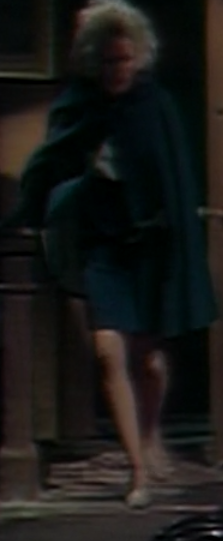
The costumers were involved in a famous production error in the final scene. Angelique/ Cassandra’s hooded cloak cuts off above her knees. There is no old age makeup on her legs, which are featured from every angle, making a ludicrous contrast with her face and wig.
Sarcastic dandy Roger Collins has remarried. His previous wife, undead blonde witch Laura Murdoch Collins, was Dark Shadows’ first supernatural menace, posing a threat to the life of their son David from #123 until she vanished amid a cloud of smoke in #191. The ghost of gracious lady Josette joined in the battle against Laura. Among other things, Josette compelled artist Sam Evans to paint a series of pictures warning of Laura’s evil plans. Laura responded to those paintings in #145 and #146 by causing a fire that burned Sam’s hands so badly it seemed he might never again be able to paint.
Roger’s new wife is also an undead blonde witch, though she wears a black wig all the time. This wiggéd witch calls herself Cassandra, but is actually Angelique, who in the 1790s killed many of Roger’s ancestors and turned his distant cousin Barnabas into a vampire. Angelique/ Cassandra has returned to the world of the living because Barnabas’ vampirism is now in remission, and she is determined to restore it.
Before he met Angelique/ Cassandra, Roger became obsessed with a portrait of her. Barnabas concludes that this portrait is essential to her power. He orders his servant Willie to steal it from the great house of Collinwood. Barnabas takes the portrait to Sam and commissions him to paint over it so that Angelique will look tremendously old. He doesn’t offer Sam any explanations, but we heard him tell Willie his theory that what happens to the painting will also happen to Angelique. If her likeness is aged to reflect her actual years, then she will vanish from 1968 and be confined to the past. At the end of the episode, Angelique’s hands have aged dramatically, suggesting that Barnabas is correct.
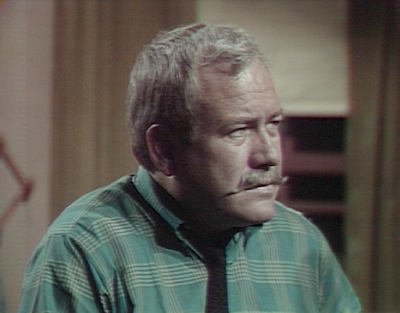
This is David Ford’s first appearance on the show since December, and he had shaved his mustache in the interim. The fake is not up to the makeup department’s usual standards. Screenshot by Dark Shadows Before I Die.
Portraits have been a very prominent part of the visual composition of Dark Shadows from the beginning, and a battlefield on which supernatural combat could be joined for almost as long. So it is hardly surprising that the show would eventually get around to doing a story based on Oscar Wilde’s The Picture of Dorian Gray.
It would seem Barnabas has little time to lose. Angelique/ Cassandra has distributed some malware to the minds of the people around Barnabas by means of a dream that one person after another will have. The first dreamer is beckoned into a Haunted House attraction by someone, opens some doors behind which there are scary images, is terrified, and cannot find relief until telling its details to the beckoner. That person then has the dream, changed in only two particulars, the identity of the beckoner and the image behind the final door. When everyone’s brain has been hacked, this worm is supposed to reset Barnabas as a vampire.
Yesterday, David had the dream, and Willie was his beckoner. Today, we open in Barnabas’ house, where Willie is paralyzed with fear. David has already told him the dream, and Willie knows he will have it. With all the previous instances of the dream, the audience had to sit through a highly repetitious dream sequence, then a scene in which the character agonizes about whether to tell the dream to the next person, and finally a speech repeating all the details of the dream. At least this time we skip the second and third of those rehashings.
Since Willie is so close to Barnabas, it seems likely that he will be the last to have the dream before it gets back to Barnabas and makes him a vampire again. So it’s no wonder that Barnabas decides it’s time for the high-stakes gamble of a burglary at Collinwood.
There’s also a scene in Barnabas’ basement. Barnabas’ vampirism is in remission because some mad scientists created a Frankenstein’s monster, whom Barnabas named Adam. They connected Barnabas to Adam in a way that drains the symptoms of the curse from Barnabas without manifesting them in Adam. Barnabas has no idea how to raise any child, let alone a 6’6″ newborn with the strength of several grown men, and so locks him up in the prison cell where he used to keep Sam’s daughter Maggie.
The imprisonment of Maggie was a dreary, unpleasant story, but Adam’s time in the cell is even harder to take. Maggie was established as a strong, intelligent person who knew her way around, she could speak, and she had many friends who cared about her. So we never quite gave up hope that she would get away and be all right in the end. But Adam has none of that. As a result, his scenes in the basement are a tale of extreme child abuse, made all the harder to watch by Robert Rodan’s affecting portrayal of the big guy’s misery.
Moreover, Maggie was a major character, introduced in the first episode and connected to everyone else. It’s unlikely they would kill her off unless the show had been canceled and they were going out with a bang. But only the people holding Adam prisoner know who he is, and Frankenstein’s monsters meet their deaths practically every time they feature in a story.
Worst of all, the show is basically very silly right now. A story about a child locked in a cell from birth can be made bearable only by joining it to some kind of deep insight into the human condition, and there is little prospect that anything like that will crop up among all the witches and vampires and other Halloween paraphernalia. My wife, Mrs Acilius, watched the whole series with me in 2020-2021. She was avidly rewatching it with me this time. But when they took Adam to the cell, she suggested I start watching it on days when I get home from work before she does. I’m sure she isn’t the only Dark Shadows fan who takes a pass on the Adam story.
This is the first episode credited to director Jack Sullivan. Lela Swift and John Sedwick took turns at the helm until #450, when executive producer Dan Curtis tried his hand at directing a week of episodes. Swift and Sedwick then returned to their usual pattern. Sedwick will be leaving in a few weeks; Sullivan, who has been with the show as an associate director since the third week, will be Swift’s alternate until November, and from #553 on will be credited as Sean Dhu Sullivan.
Much to her surprise, well-meaning governess Vicki Winters came unstuck in time in #365 and found herself in the year 1795. She spent the first few weeks of her sojourn in the past telling all the characters she met about the other roles that their actors played in the first 73 weeks of Dark Shadows, thereby puzzling them and irritating the audience. After a few months, the people of Collinsport had decided to try Vicki on a capital charge of witchcraft. There were no laws against witchcraft in Massachusetts or anywhere else in the English speaking world in the 1790s, but Vicki had got on so many people’s nerves by that point that they were willing to overlook that technicality and sentence her to hang. She was whisked back to 1968 in #461, with so little time to spare before she died on the gallows that she came back with rope burns on her neck.
Throughout the first year of Dark Shadows, the writers used Vicki more than any other character to move the action. Unfortunately, they sometimes moved it by having her do things that served the plot, but that the character had no reason to do. That gave rise to “Dumb Vicki,” and Dumb Vicki was very much on display throughout the whole segment set in 1795-1796.
Now, emigrés from the late eighteenth century are starting to join Vicki in her time. We open today as the clock chimes midnight. Vicki, wearing her nightgown, is coming down the grand staircase in the foyer of the great house of Collinwood, roused by the sound of an unexpected voice in the drawing room. It is the voice of haughty overlord Joshua Collins, master of Collinwood in 1795. Vicki enters the room to find sarcastic dandy Roger Collins carrying on a lively, albeit one-sided, conversation with a portrait. Roger is convinced that he is Joshua, and deals with Vicki in just the lofty way Joshua dealt with her during the costume drama segment. He even brings up Vicki’s frequent confusion with names, something Roger could not possibly have known about. This, therefore, is no mere delusion of Roger’s- Joshua’s ghost really is taking possession of him, manipulated by a force with its own malign intentions.
It is no secret from the audience what that force is. Roger has become obsessed with a portrait depicting wicked witch Angelique, who in the 1795 segment wrought terrible harm to the Collins family. Angelique was responsible, in one way or another, for the deaths of both of Joshua’s siblings, both of his children, his wife, and many other people. Too late, Vicki learned that Angelique was the witch for whose crimes she was being condemned to hang. As we have seen other supernatural beings do on Dark Shadows before, Angelique is using her portrait as a means of projecting her powers into the world of the living.
Roger/ Joshua’s remark about the name trouble reminds us of Dumb Vicki, but that is not the version of the character we see today. Instead, we have a visit from Smart Vicki. When Roger keeps insisting that he is Joshua Collins, Vicki picks up a telephone and shows it to him, declaring that it is something that did not exist in Joshua’s time. Roger looks at the receiver in silence for a moment, then groggily asks “Is it for me?”
Vicki says that she will take the portrait back to the antique store where she bought it so that it can be sold to Professor Timothy Eliot Stokes. This is a bit jarring for returning viewers- in #464, Stokes offered Vicki $200 for the painting, and Roger countered with a bid of $50o. Evidently Roger didn’t actually pay Vicki the money, because he doesn’t say that it is his when he urges her to leave it in the house.
Vicki and Roger leave the drawing room. Roger slips back in, takes the painting, and marches out of the house with it. While he does so, a nice little bit of music featuring the harp plays on the soundtrack. I don’t know that it is new, but I didn’t recognize it.
Part Two. Peter/ Jeff
Angelique not only killed Joshua’s son Barnabas, but cursed him to rise at night as a vampire. Barnabas returned to the great estate of Collinwood in 1967. He has been passing himself off to the living Collinses as their distant cousin from England. When Barnabas found that Vicki had visited his native period of history, he bit her in an attempt to keep her from revealing his secret.
Vicki and Barnabas were on their way to spend eternity together when she crashed her car to avoid hitting a pedestrian. In the hospital, the physician on duty when Vicki and Barnabas were brought in, Dr Eric Lang, turned out to be exactly the right sort of mad scientist. He has apparently cured Barnabas of vampirism. It is unclear whether Vicki remembers that Barnabas bit her and sucked her blood, and quite clear that she doesn’t think of him as a monster.
In the 1790s, Vicki met and somehow fell in love with an unpleasant man named Peter. Peter has returned to the present with her; in fact, he was the pedestrian Vicki had to crash her car to avoid hitting. They have seen each other several times since, and for no worthwhile reason Peter keeps insisting he is named Jeff. Peter/ Jeff shows up at Collinwood today. Vicki ushers him into what she alone calls “the living room,” and everyone else calls “the drawing room.” Peter/ Jeff asks Vicki if she loves Barnabas and plans to marry him. She tells him she does not. She says that she doesn’t want to hurt Barnabas’ feelings, but that she will have to break the news to him as soon as possible.
Part Three. Barnabas, Barnabas
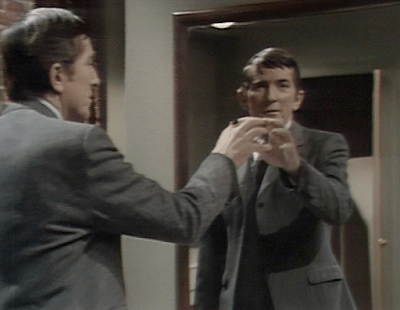
Barnabas is still in the hospital. We see him in his room, in the daylight, looking at himself in the mirror. He can’t resist touching his reflection. It is a genuinely beautiful little moment, and an eloquent image. In the contrast between the solidity and familiarity of Barnabas’ standard right profile shot and the fragile little image slightly distorted in the mirror, we see a point of decision. The ghoul has not been destroyed, but a new and very vulnerable human life now co-exists with him in the same body. Wallace McBride says that “On Dark Shadows, your reflection always tells the truth“; this reflection tells a deep enough truth to keep the show going for years.
Vicki visits Barnabas in his hospital room to tell him that she cannot marry him. She thinks that she and Peter might be meant for each other. She also tells Barnabas that there are signs Angelique is making her influence felt at Collinwood again.
Vicki knows that her news about Peter will hurt Barnabas, but she understands that if they are to fight against Angelique, there can be no secrets between them. Barnabas understands this as well. Therefore, he decides to surrender immediately. Right after his scene with Vicki, we see him telling Lang he has decided to revert to vampirism.
That reaction is absurd, but it goes to the heart of the character as we came to understand him in the part of Dark Shadows set in the years 1795 and 1796. He did not believe that gracious lady Josette could love him, so he had a casual fling with her maid, Angelique. He did not believe Angelique cared very deeply about him, so he cast her aside once it became clear Josette was willing to marry him. He did not believe Josette could forgive him for having come to her from a dalliance with Angelique, so he did not tell Josette when Angelique vowed vengeance on them both. At each point, Barnabas’ underestimation of his own lovableness led to disaster. If only Barnabas could have read Jonathan Frid’s fan mail, he and Josette would have had a happy, quiet life and died in obscurity in the first half of the nineteenth century.
Part Four. Vicki
For her part, Vicki spent the first 38 weeks of Dark Shadows growing close to strange and troubled boy David Collins, who tried to kill her more than once, tried to kill his father Roger and frame her for it, who talks to ghosts, and whose mother is an undead fire witch. In the same time, she fell in love with a man named Burke, who spent years in prison for a killing in which Roger had a part but for which he was also very much responsible. While in the 1790s she fell in love with Peter, who committed many crimes and would doubtless have become a killer had Vicki not killed his man before he got to him. So Barnabas’ weird nature and career of homicide hardly guarantee that Vicki will spurn him.
I often wonder what might have been had the show decided to initiate Vicki into Barnabas’ secret. Alexandra Moltke Isles and David Henesy triumphed over some stunningly bad writing to make the story of Vicki’s bonding with David the one consistently interesting thread of the first year of Dark Shadows. Now that there are good writers and other stories that are working, I can only suppose she and Jonathan Frid would have given us something for the ages if they had been allowed to show Vicki coming to accept the true Barnabas.
There are several ways they could have done that. Maybe she gradually learns the horrible truth, can’t go to the authorities right away because she needs Barnabas as an ally against a more immediate threat, and by the time that threat passes decides he’s a good risk. Or maybe she becomes a vampire herself and finds out about his past in the process of being cured.
Or, most daring of all, maybe it turns out Vicki knew that Barnabas was a vampire all along. Sure, she was upset when she thought he’d killed her friend Maggie- why do you think she invited herself to spend the night at his house during that period? She had the guilts because she had failed to save Maggie and wanted him to bite her as punishment. Sure, there were some sleepless nights when it looked like he might be planning to kill David in order to silence him- why do you think she kept making herself available to Barnabas in that period as well, if she wasn’t offering herself as a tool he could use to keep the boy quiet without hurting him?
In a room at the Collinsport Hospital, very loud physician Eric Lang (Addison Powell) opens the curtains to show his patient, old world gentleman Barnabas Collins, that it is a sunny afternoon. It takes Barnabas a moment to realize that this is Lang’s way of showing him that he has cured him of his longstanding affliction, vampirism. Once he figures it out, Barnabas is very happy to be human again.
Barnabas talks with Lang about the origins of his vampirism. At one point Lang says “Ah, so a curse was responsible.” You know how doctors are, always coming out with the same cliches. Lang does say something novel when he remarks on Barnabas’ “pulsebeat.” That specimen of Collinsport English will be back.
In the great house of Collinwood, Barnabas’ distant cousins Roger and Liz are at odds. Roger keeps having conversations with a portrait, in the course of which he loses track of the time. The correct time is 1968, and he keeps thinking it is 1795. When he does that, he mistakes himself for his collateral ancestor Joshua Collins and his sister Liz for Joshua’s wife Naomi. Today, Liz has to slap Roger to get him back to himself. Louis Edmonds’ alternation between Joshua and Roger is masterful, one of the outstanding moments of acting in the whole series.
The portrait is of Angelique, the wicked witch who made Barnabas into a vampire in the first place. At the hospital, it becomes clear that Angelique’s spirit is controlling Roger through it. He is cold and distant, staring out the window when Barnabas tells Liz he wants to take up gardening, refusing to say a word when Lang enters the room. When he takes his leave, Roger looks at Barnabas and declares “It’s not this easy.” We realize that he is a puppet for Angelique. Roger steals Lang’s cartoonish mirror-bearing headpiece.
We cut back and forth between Barnabas’ hospital room and the drawing room at Collinwood. At Collinwood, Roger shows the headpiece to the portrait and explains that it was Lang’s. He starts to twist it. In the hospital, Lang suddenly leaps up with a splitting headache. Roger stops twisting, and Lang says he’s better. He resumes twisting, and Lang resumes suffering. Roger tells the portrait he cannot obey its command to put the headpiece in the fire, and throws it across the room. In the hospital, Lang suddenly recovers from his headache. Barnabas tells him it was Angelique’s doing, and says that he will have to become a vampire again to spare Lang her attentions.
On his blog Dark Shadows Every Day, Danny Horn identified Addison Powell as “THE WORST ACTOR EVER TO APPEAR ON DARK SHADOWS.” I don’t agree with that. In yesterday’s episode, for example, Powell attained a level that could fairly be described as “competent,” a label that forever eluded figures like Mark Allen (Sam Evans #1,) Michael Currie (Constable/ Sheriff Carter,) and Craig Slocum (Noah Gifford and, later, Harry Johnson.) And there will be times when his ludicrous overacting lends just the note of camp that turns a scene from a tedious misfire to an occasion for chuckling. But he is pretty bad today. When an actor gets to be depressing to watch, I sometimes make his scenes bearable by trying to imagine what it might have been like if, instead of casting him, they had chosen someone else who might have been available.
So many members of the original Broadway cast of the musical 1776 appeared on Dark Shadows at one time or another that I tend to assume that any of them would have accepted any part on the show. Howard da Silva played Benjamin Franklin in 1776, and he is my imaginary Dr Lang.
You can see da Silva’s Franklin in the 1972 movie version of 1776, where he plays the Sage of Philadelphia with frequent chortles that suggest a mad scientist gleefully working to release a murderous nightmare on the world, which is more or less the show’s vision of the founding of the USA. That isn’t Franklin’s only note- he has occasion to speak earnestly about the British Empire’s mismanagement of its North American possessions, and sorrowfully about the need to leave slavery alone while concentrating on the fight for independence. Those who have seen da Silva play subtle and powerfully compassionate men in his other work, for example as the psychiatrist in the 1962 film David and Lisa and as the defense attorney in the 1964 Outer Limits episode adapting Isaac Asimov’s story “I, Robot,” will hardly be surprised that he could be effective in those moments.
So when Powell overdoes the shouting, I imagine da Silva in his place, going through his bag of tricks to show us a man who might be taking a maniacal satisfaction in his blasphemous labors, who might be profoundly devoted to the relief of suffering, and who might be both at once. Sometimes I get a pretty clear image of what that would have been like, and when that happens the show in my head is hard to beat.
High-born ne’er-do-well Roger Collins was Dark Shadows‘ first villain. Through the first 40 weeks of the show, dashing action hero Burke Devlin was determined to prove that Roger, not he, had been driving when his car hit and killed a pedestrian ten years before, and Roger would stop at nothing to keep Burke from succeeding. The Revenge of Burke Devlin storyline was never particularly exciting. By the time Burke formally gave up on his quest for vindication in #201, it had been running on fumes for some time. Roger hasn’t been central to a plot since then. The show has capitalized on actor Louis Edmonds’ unrivaled gift for sarcasm by having him deliver the occasional zinger, and otherwise has used him as a symbol of the inability of the Collins family to use its wealth and connections to solve any of its problems.
For nineteen weeks ending this past Monday, Dark Shadows was a costume drama set in the late eighteenth century and Edmonds played haughty overlord Joshua Collins. That performance was a triumph, and the entire segment turned out to be The Tragedy of Joshua Collins. So returning viewers will have an appetite to see more of what Edmonds can do, and will be excited when we come back from the opening title sequence to a scene focusing on Roger.
Roger spends this scene staring at a portrait and reciting poetry to it while various people enter the room and try to get his attention. That may not sound like a promise of thrills, but it is on this show. For example, Roger’s son, strange and troubled boy David, had a lively if somewhat one-sided conversation with the portrait of Josette Collins that hangs in the Old House on the estate in #102, and that conversation presaged danger for David and an important role for Josette’s ghost. The show’s first supernatural menace was Roger’s estranged wife, undead fire witch Laura Murdoch Collins, and several characters had important relationships with portraits of Laura during the four months she was in the cast. And dangerously unstable ruffian Willie Loomis once spent a week staring at the portrait of the late Barnabas Collins that hangs in the foyer of Collinwood. As a result, Willie wound up opening Barnabas’ coffin, finding that he was a vampire, and turning Dark Shadows into an entirely different kind of show.
Roger talks to the portrait of Angelique.
The portrait that has captured Roger’s attention is of Angelique, the wicked witch who turned Barnabas into a vampire in the first place. Well-meaning governess Vicki found this portrait in an antique store and brought it home yesterday. It was Vicki who took us to the 1790s when she became unstuck in time. While there, she met Angelique and the living Barnabas. Shortly after her return to the 1960s, Vicki found that her memory of her time in the past had become spotty. She can’t explain why she wanted the painting, but it does make sense to her that Barnabas reacts to it with violent dislike.
We first saw the portrait in #449, when it was clear that Vicki would be returning to the 1960s soon but unclear whether Angelique would follow her. Showing us that they had commissioned a portrait of Lara Parker was their way of telling us she would be back. Having Roger become obsessed with the portrait is their way of telling us that he will be the instrument of her arrival, as Willie was the instrument of Barnabas’.
We learn that Roger’s obsession will blur the distinction between him and Joshua when long-term houseguest Julia Hoffman approaches him and he speaks to her in Joshua’s voice, addressing her as the Countess DuPrés, who was a houseguest at Collinwood in Joshua’s time. Julia and the countess are both played by Grayson Hall. Vicki mistook the countess for Julia when she first met her in 1795, and since her return to 1968 has kept mistaking Julia for the countess. Now that Roger has made the same mistake, Julia must be trying to figure out what’s going on.
A man comes to the front door. Vicki answers it and sees a familiar face. It belongs to Professor Timothy Eliot Stokes. She hasn’t met him before, but she met his ancestor, much put-upon servant Ben Stokes, in the 1790s.
Like Ben and crazed handyman Matthew Morgan from 1966, Professor Stokes is played by Thayer David. Matthew and Ben were both major characters, so we can assume that Stokes will be as well. Matthew was a bad guy, Ben a good guy. When Ben was on the show, the contrast between him and Matthew was drawn very heavily to make the point that Matthew’s crimes are what Ben’s virtues would have led him to do had his personality been warped by the environment in which Matthew grew up. That environment was the consequence of the curse that Angelique placed on the Collinses in the 1790s. Burke expressed this idea in #64 when he said of Matthew that “Collinwood breeds murderers,” but he was understating the effect. Matthew grew up, not on the estate, but in the nearby village of Collinsport, and the curse leaves its mark on everyone who comes from there. Since Stokes is an out-of-towner, he is likely to be unaffected by the consequences of the curse, and so we do not know what we will find under his worldly and self-possessed exterior.
Stokes is researching his ancestor Ben, and wanted to buy the portrait because he thought it might depict a woman Ben knew. Stokes says that Ben wrote a memoir. Barnabas is in the room; in the 1790s, Ben was his closest friend, and knew all about his vampirism. So he is alarmed by the idea of a volume of memoirs by Ben. He can take some comfort when Stokes tells him that most of the manuscript was lost in a fire a few years ago.
The idea of a servant writing memoirs that might expose Barnabas’ secret first came up in #326. At that point, Willie was out of his control, and Barnabas told Julia, who is a mad scientist and his confederate, that he was afraid Willie might start “writing his memoirs!” That phrasing was meant to raise a laugh, since Willie is conspicuously not burdened with literary ambitions. But it planted a seed that flowers for the first time here, and that will flower again later.
Stokes offers Vicki $200 for the painting. Barnabas is eager to get the thing out of the house and urges her to take Stokes’ money, but before she can Roger bids $500. Stokes can’t afford that, and so it stays at Collinwood.
Stokes’ interest in family history establishes a contrast between him and Roger. Stokes, like Roger, appears to be a confirmed bachelor. But while Roger’s lack of interest in the responsibilities of marriage is of a piece with his indifference to all family ties, so that he was eager to divorce Laura and palm David off on her even after it had become clear to other characters that she was a danger to the boy, Stokes is an avid genealogist. He has renounced the prospect of marriage because he has other ways to be of service, not simply because he wants to wallow in his own crapulence as Roger does.
Suddenly Vicki remembers that the woman in the portrait is named Angelique, that Angelique was a witch, and that her spells caused all the misfortune that began at Collinwood in 1795. We hear all of this while Barnabas is in closeup, squirming gloriously. Stokes leaves with Barnabas and tells him he knew that the woman’s name was Angelique, but that it’s news to him that she was a witch. He is impressed by Vicki’s knowledge, and says that he can sense that she is attuned to paranormal phenomena. He wants to get to know her better.
Most characters we have met spend a long time slowing the story down by scoffing at the idea of the supernatural. That Stokes is a self-identified student of the occult and immediately receptive to Vicki’s identification of Angelique as a wicked witch tells us that he will serve to speed up the pace of events.
This again makes a stark contrast with Roger. When Vicki managed to get Roger away from the painting for a moment in Act One, he told her that he refused to believe that she traveled to the past and returned to the present. When she lists some of the abundant evidence he and everyone else saw that can be explained no other way, he says he attributes all of that to mass hallucination.
In his Dark Shadows Every Day post about this episode, Danny Horn at one point refers to Stokes as a character whose function is “to backfill Dr. Woodard’s spot in the cast,” referring to a stolid medico whom Barnabas and Julia murdered several months back. But in this contrast, we see that the character whose place Stokes is actually taking is Roger. When the show started, the Collinses of Collinwood were the central frame of reference for the action. But Roger and his sister, matriarch Liz, are for various reasons locked out of the supernatural storylines. Since those are the only storylines they have, the show needs to build another family to anchor the action, and that family is going to be defined, not by marriage and genealogy, but by a shared commitment to getting as deep as possible into the weirdest shit going.
Stokes tells Barnabas that there was a series of unsolved murders in Collinsport in the 1790s, and wonders if it might be possible to prove that Angelique was responsible for them. Barnabas suggests that it is too late to do justice in such an old case, to which Stokes replies that it is never too late to do justice to history. Not only does this reply deepen the contrast between Stokes and the amoral Roger, it has, by happenstance, a deep resonance for many who might see the episode today. It originally aired on 4 April 1968, just a few hours before the Rev’d Dr Martin Luther King, Jr, was assassinated. Millions are still unsatisfied with the official answers about who killed Dr King and why; they might cheer the idea that there is a species of justice that is still possible even after 56 years or more have gone by.
Barnabas bit Vicki the other day in an attempt to control her and keep her from revealing any information about him she may have acquired during her sojourn in the past. Disquieted by his conversation with Stokes, Barnabas stares out his window and summons Vicki to his house. In her bedroom, an enchanted music box Barnabas gave her as part of an earlier brainwashing attempt opens itself and begins to play. She rises from bed and goes to him listening to the music box all the way.
At Barnabas’ house, Vicki gives him the music box. He tells her that the next time he calls her, they will go away together forever. He bites her neck.
We cut to Vicki’s bedroom. The music box is back in its place and she is back in bed, asleep. Julia comes in to check on her. Vicki says she’d had a bad dream, and Julia finds the bite marks on her neck.
In the weeks leading up to Vicki’s visit to the past, Julia had alienated Barnabas by opposing his efforts to seduce Vicki. Now she marches over to Barnabas’ house and renews her opposition. She accuses him of having been in Vicki’s bedroom. He answers that he brought her to his house. This might seem to be a trivial distinction, but perhaps not to viewers who have been with the show from the beginning. Today’s focus on Roger might remind us of #4, when Roger tried to let himself into Vicki’s room while she was sleeping, obviously in search of some kind of sexual thrill that would not be preceded by her consent. Barnabas can’t deny that he is the moral equivalent of a rapist, but he isn’t going to miss an opportunity to differentiate himself from Roger.
Barnabas doesn’t seem very interested in anything Julia is saying. Even when she gives him an ultimatum, threatening to expose him if he doesn’t back off by tomorrow night, he reacts with a mild irritation. Regular viewers, remembering the displays of jeering contempt and seething rage which are typically the options from which Barnabas chooses his response to this sort of thing, will be startled by his relative blandness. Julia should be unnerved by it.









 Dark Shadows Commentary