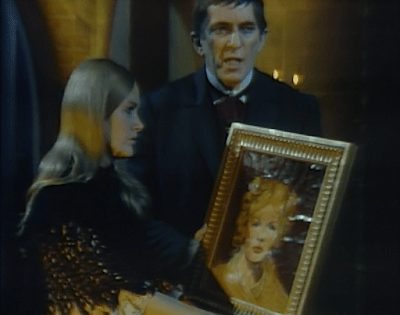
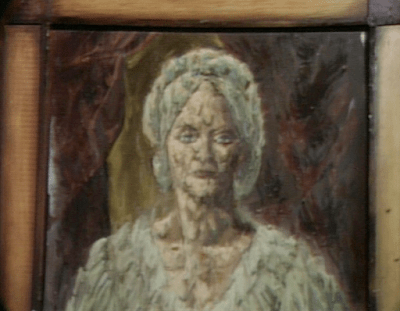
Episode 820: The music and the mirror

Help Me Return to the World of the Living

In Dark Shadows #1, set in 1966, two people came to Collinsport, Maine. They were the well-meaning Vicki Winters and dashing action hero Burke Devlin. Vicki had taken a job as the governess in the great house of Collinwood, hoping that she would find the answers to questions she had about her own mysterious origins. Those questions had left her feeling that she knew nothing about herself.

Burke was a working class boy from Collinsport who had gone to New York City five years before, fresh out of prison and penniless. By 1966 he was a corporate raider, a millionaire many times over. He came back to his hometown because he wanted revenge on high-born ne’er-do-well Roger Collins, who used Burke’s car to kill someone while Burke was passed out drunk in the backseat, then persuaded the court that Burke was solely responsible for the homicide. Burke and Vicki ultimately became a couple, but for some months Burke strung Roger’s niece Carolyn along and used her to cause trouble for the Collinses.

Now the show is set in 1897, and Burke and Vicki are both long gone. Carolyn and Roger are waiting for us when the show returns to contemporary dress, and the actors who play them are in the cast in other roles. But we’ve been reminded of Burke recently. Tim Shaw is a working class boy from Collinsport who, after spending time as a teacher at a miserable boarding school run by the evil Rev’d Gregory Trask, was chosen by Trask to take the fall for the murder of his wife, Minerva Trask. As Burke was physically present but mentally compromised at the killing for which he went to prison, so Tim was present at the killing of Minerva, but not in his right mind. The show is about the supernatural now, so it was a magic spell, not booze, that kept Tim from knowing what was going on when he poisoned Minerva. And the pace is too fast for arrests and trials, so Trask’s plan went wrong and he had to tell the police Tim wasn’t guilty after all. So Tim went straight to New York, and just a few weeks later came back to Collinsport, very rich and out for revenge.

Like Burke, Tim arrives in Collinsport with a woman. Unlike Vicki, Amanda Harris knew Tim before they got on the train. But we learn today that Amanda, like Vicki, is tormented by her ignorance of her own background. Again, the starker palette in which the show draws its stories at this period means that instead of not knowing who her birth parents were, Amanda has no memories at all prior to two years ago.

Amanda first appeared as a hardboiled operator who was attached, not to Tim, but to his money, and who gave him expert assistance in the con game he was running on Trask. As Tim was an elaboration on Don Briscoe’s W. C. Fields’ imitation, Amanda was a nod to Mae West. But the show has decided to make Amanda a long-term addition to the cast, and they already have an all-villain cast. So they soften Amanda’s edges. We see her packing her bags and telling Tim she is going to leave because he doesn’t really care about her and she can’t stand what she is doing with Trask. When she complains that Tim is just using her, she echoes speeches Carolyn made after her bitter realization about Burke’s true intentions. Now that her relationship to Tim mirrors both Vicki and Carolyn’s relationships to Burke, Amanda can inherit the goodwill longtime viewers have towards both of those characters.

To Have Something I Can Believe In

Tim’s sudden wealth came from his possession of a magical object, The Hand of Count Petofi. When Amanda first heard of the Hand, she asked if it was a piece of jewelry or some other kind of artifact. It did not occur to her that it was literally the severed hand of a Hungarian nobleman. This gruesome thing had been cut a century before, in 1797, by nine Rroma men, and had ever since been in the custody of the leader of their tribe.

In #778, broad ethnic stereotype Magda Rákóczi returned to her home in the Old House on the grounds of Collinwood. She had gone to Boston, where King Johnny Romana, possessor of the Hand, was staying with his caravan. She had pleaded with King Johnny to help her remove a curse she had placed that made rakish libertine Quentin Collins and all his male descendants into werewolves. Magda had not known when she placed the curse that Quentin was the father of her sister Jenny’s children. She hoped that King Johnny would take pity on the Rroma children and use the Hand to end the curse. When he did not, she stole it, intending to use its powers herself. Magda soon found that the Hand did no one’s bidding. It helped some people, hurt others, and was stolen by each of a long series of scheming characters.

After Tim brought the Hand back to Collinsport, it was stolen again. This time, the thief turned out to be none other than Count Petofi himself, 150 years old and on the point of death. Once he had the Hand back, it reattached itself to his wrist and he regained his health.

Petofi has some sort of plans for Quentin. He has retained one of his minions, nationally renowned artist Charles Delaware Tate, to paint a portrait of Quentin. That project is finished, but Tate is still living in a cottage he has rented in Collinsport. Today Petofi visits Tate there.

Petofi finds Tate sketching an imaginary woman, one he has been obsessively drawing and painting for about two years. Petofi sets himself up as Tate’s analyst. “Only little boys invent ideal women,” says he. He has a plan to relieve Tate’s childish fixation. It is another project. If Tate had seen A Chorus Line, he might appreciate Petofi’s theory of work as therapy, as explained in the lyric “Give me a job and you instantly get me involved, if you give me a job then the rest of the crap will get solved.” But that show won’t premiere for another 78 years, so Tate resists.

It doesn’t help that the job Petofi has in mind involves another severed hand. The Rroma are on their way, and they want the Hand back. Petofi, whose magical powers were formidable even when he was one-handed, is much mightier now, but the thought of the Rroma agitates him violently. Evidently they know about some weakness of his that enables them to defeat him. King Johnny and his men don’t know that Petofi is in Collinsport. He has cast a spell to silence Magda, but they won’t leave the area without the Hand. Several people know about Petofi and have no reason to protect him. If the Rroma start asking questions, it won’t be long before they close in. So Petofi has exhumed a recently deceased local man, cut off his right hand, and brought it to Tate for detailing.

Tate owes his talents, and his life, to Petofi, so the outcome of their meeting is never really in doubt. His next encounter does involve a surprise. Amanda comes to Petofi’s hiding place, sent by Tim, and asks for his help. Petofi tells Amanda that Tim has a poor strategic sense. Indeed, Petofi has already told Tim that, lovely as Amanda is, he has no use for her at the present time. But when he sees her face to face, Petofi recognizes her as the imaginary woman in Tate’s pictures.

Returning viewers already know that Tate’s portrait of Quentin takes on the features of a wolf when the Moon is full, so it is no surprise that his works, like several other portraits we have seen on Dark Shadows, have magical powers. When we learn that Tate first painted Amanda two years ago and she has no history prior to that time, we figure out that he inadvertently used those powers to conjure her into being.

Tate is played by Roger Davis, an unpleasant man who figured as Vicki’s love interest in her last, woefully ill-conceived storyline. In that arc, made and set in 1968, Mr Davis’ part was variously known as Peter Bradford and Jeff Clark. He had amnesia, and Vicki kept trying to help him recover memories which would prove to him that he has no roots in the 1960s, but that he is an uncanny being who was brought to life by an adventure she had outside the bounds of space and time. Once we recognize what they are suggesting about Amanda’s origin, longtime viewers might expect an inversion of that story, with Mr Davis playing the person trying to persuade his lover that he accidentally created her by a magical process he himself did not understand.

Somebody to Dance For

While all of this action is taking place downstream of Count Petofi, the person who set in motion the events that first brought Petofi to town is in big trouble. Magda comes home to find King Johnny himself waiting for her. He menaces her, calls her names, and twice hits her in the face very hard.
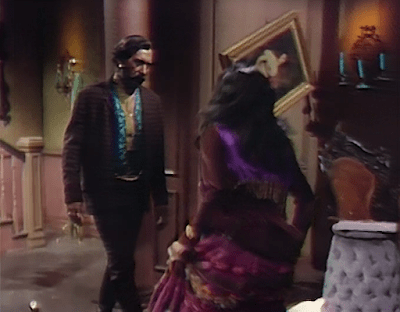
King Johnny closes in on Magda. Screenshot by Dark Shadows Before I Die.

Ever since Violet Welles joined the writing staff, men have been slapping women quite a bit on Dark Shadows. Welles was by far the best writer of dialogue on the show, but I for one could do without the slapping. Fortunately King Johnny is played by Paul Michael, a well-trained actor; no matter how brutally King Johnny abuses Magda, Grayson Hall is in no danger. One could never say the same of Mr Davis’ screen partners.

King Johnny tells Magda that he will take her back to his caravan in Boston to stand trial for the death of Julianka, a Rroma maiden whom he sent to kill her some weeks ago. Since Magda cannot say Petofi’s name, she cannot tell King Johnny that it was he who killed Julianka. Magda is terrified of the trial, and King Johnny tells her that there is a way she can avoid it. If she does not give him the Hand, he will slit her throat immediately.

King Johnny searches the house, and does not find the Hand. He is about to carry out his promise to kill Magda when he sees the wooden box in which the Hand was long kept lying on the floor. He opens it. What he sees inside resembles the Hand closely enough to convince him, and keep Magda alive for another day. Clever as she has been so far, we may wonder how many days are left for her. There doesn’t seem to be anyone around to throw Magda a rope to grab onto.
Episode 807: An award-winning performance, wouldn’t you say?

From #1 to #274, each episode of Dark Shadows began with a voiceover narration by Alexandra Moltke Isles, usually in character as well-meaning governess Vicki. This identified Vicki with our point of view and suggested that she would sooner or later learn everything we knew.

Jonathan Frid joined the cast as vampire Barnabas Collins in #211, and quickly became the show’s great breakout star. If the upright Vicki found out what we knew about Barnabas, one of them would have to be destroyed. Vicki was the favorite of longtime viewers and Barnabas was attracting new ones, so that was out of the question. Therefore, other members of the cast started taking turns reading the voiceovers, and doing so not as their characters, but in the role of External Narrator.

Today marks the first time Frid himself reads the narration. His training first in Canada, then at Britain’s Royal Academy of Dramatic Arts, and later at Yale School of Drama prepared Frid well in the art of dramatic reading, and in later years he would concentrate on that aspect of his craft. Several of his colleagues are his equals in these voiceovers- I would particularly mention Kathryn Leigh Scott, whose conception of The Narrator is always arresting, and Thayer David, who could consistently achieve the most difficult of all effects in voice acting, a perfectly simple reading. So I can’t say I wish Frid had done all of them, but he is always good, and today’s performance is among his most gorgeous.

The action opens on a set known to longtime viewers as the Evans cottage, where from 1966 to 1968 artist Sam Evans and his daughter Maggie served as Dark Shadows‘ principal representatives of the working class of the village of Collinsport. In those days, it was on this set that we saw how the misdeeds of the ancient and esteemed Collins family had consequences that spilled out of the estate of Collinwood and warped the lives of people trying to make a more or less honest living nearby.

Now the dramatic date is 1897, and Sam hasn’t been born yet. But the cottage is already an artist’s studio. It is temporarily occupied by the nationally famous Charles Delaware Tate, who is painting a portrait of rakish libertine Quentin Collins at the behest of evil sorcerer Count Petofi. Charity Trask, a resident of the great house of Collinwood, is visiting Tate in the cottage when she sees the face in the portrait change from that of Quentin. It takes on a great deal of fur and long fangs, and reminds Charity of a wolf.

By the time Tate looks at the painting again, it has resumed its normal appearance. He tells Charity that the transformation must have been in her imagination. She is willing to consider the possibility, but we know better. Quentin is a werewolf, a condition Petofi knows how to cure. Portraits on Dark Shadows have had supernatural qualities at least since #70, including portraits we saw Sam execute on this set in 1966, 1967, and 1968, and the show has borrowed from The Picture of Dorian Gray before. Moreover, Tate’s reaction to Charity is one of barely controlled panic. Nancy Barrett has to ramp up Charity’s own emotional distress to the limit to make it plausible she would not notice Tate’s extreme agitation. Perhaps if Tate were played by a better actor than the ever-disappointing Roger Davis, his response might have been ambiguous enough that Miss Barrett could keep the tone a bit lower, but his unequivocal display of alarm leaves her nowhere to go but over the top.

Mr Davis was under no obligation to play the scene transparently, since Tate later goes to Petofi’s henchman Aristide and lays out in so many words his precise relationship to Petofi’s operations and his knowledge of them. Tate’s career is his reward for selling his soul to Petofi, and he has already experienced great sorrow as a result of that bargain. Tate knows that the portrait changed to reflect the full Moon’s influence on Quentin and that Petofi is currently in possession of twelve year old Jamison Collins. Aristide tells us that Petofi’s own body is in suspended animation while he acts through Jamison. He also says that it was in 1797 that Petofi’s right hand was cut off, and that if he does not reclaim the hand in a few weeks, by the date of the one hundredth anniversary of the amputation, he will die and so will Tate.

Jamison/ Petofi is in the prison cell in the basement of the Old House on the estate of Collinwood. Barnabas has traveled back in time from the 1960s with some vaguely good intentions and is hanging around 1897 causing one disaster after another. Now, he is doing battle with Petofi and has locked him, in the form of Jamison, in the cell. Barnabas’ reluctant sidekick, broad ethnic stereotype Magda Rákóczi, guards Jamison/ Petofi during the day. Early in the episode, Jamison/ Petofi calls Magda and pleads with her to release him. He tells her that he is “just a little boy” and that she is a “rather heartless creature.” She says she wishes he were a little boy again, but that she isn’t stupid and he won’t fool her. Indeed, the phrase “rather heartless creature” and Jamison/ Petofi’s manner in delivering it sound so much like Thayer David as Petofi that they hardly count as an attempt to deceive Magda.

Later, Jamison/ Petofi casts a spell to summon Aristide, then calls to Magda again. When Magda arrives, Jamison/ Petofi gives himself a better script than the one from which he had acted in his previous scene with her. He pretends not to remember how he got into the cell and to be shocked that Magda knows he is there. Perhaps the utter transparency of his earlier pleadings was an attempt to get Magda to underestimate his abilities as a trickster.

In #803, we saw that when Petofi took possession of him Jamison’s right hand disappeared from his wrist, matching Petofi’s own mutilated condition. When Jamison/ Petofi feigns the amnesia that might come upon recovery from possession, we might therefore expect Magda to demand that he remove his gloves to prove that he is himself again. But he plays the part of Jamison so convincingly that we are not really surprised he does fool Magda. She goes into the cell, embraces Jamison/ Petofi, and he kisses her on the cheek. It is this kiss that spreads his magical power, and she realizes too late that she has been had.

Aristide arrives a moment later, and Jamison/ Petofi calls his portrayal of an innocent boy “an award-winning performance.” Indeed, if there had been daytime Emmys in 1969, David Henesy might have won one for his portrayal of Thayer David playing Petofi playing Jamison.

Aristide wants to kill Magda; Jamison/ Petofi forbids this. Under his power, she announces that she is responsible for all the evil that has happened in 1897. She was responsible for releasing Barnabas and therefore for all the murders and other harm he has done; she made Quentin a werewolf, and is to blame for his killings in his lupine form and for the curse his descendants will inherit; she stole Petofi’s severed hand and is at fault for the deaths of Rroma maiden Julianka and of her own husband Sandor that resulted from the hand’s presence. She even takes the blame for Quentin’s murder of her sister Jenny, the act for which the werewolf curse was meant as vengeance. Magda says she must be punished. Jamison/ Petofi tells her that he is not interested in punishing her. He has another use in mind for Magda She will lead him and Aristide to Barnabas’ coffin today, and they will destroy him.

Longtime viewers will perk up twice when Aristide says that Petofi lost his hand in 1797 and that he has exactly one hundred years to recover it. From December 1966 to March 1967, Dark Shadows’ first supernatural menace was undead blonde fire witch Laura Murdoch Collins, who at intervals of exactly one hundred years incinerated herself and a young son of hers, who was always named David, in an unholy ceremony that renewed her existence, but not that of the Davids. Since the usual laws of nature don’t apply, the show needs some other causal mechanism to create suspense, and anniversaries will do as well as anything else. Another iteration of Laura was on earlier in the 1897 segment. It was fun to see her again, but they could shoehorn her into that year only by retconning away the one hundred year pattern in her immolations. It’s reassuring in a way to see that Petofi is bringing centenaries back.

The date 1797 is also significant. It was in 1796 that Barnabas died and became a vampire. We flashed back to that period for the show’s first costume drama segment in November 1967 to March 1968, and Barnabas went back to 1796 for a week in January 1969. So we may go back again some day, and if Petofi was alive and in his prime in 1797, we might run into him there.

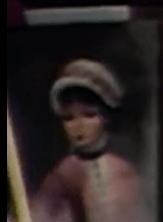
Barnabas and Petofi are not the only characters from the 1790s who might be on the minds of attentive longtime viewers. Barnabas’ little sister Sarah died in 1796, and as a ghost was an extremely important part of the show from June to November 1967. We’ve been getting reminders of Sarah for the last several days. In #792 wicked witch Angelique produced a toy soldier of Barnabas’ that Sarah gave to strange and troubled boy David in #331. In #805, Charity found Sarah’s recorder, a prop that often served as Sarah’s calling card in 1967, and talked about learning to play it. And today, we see a portrait standing on the floor of the Evans cottage, a set which Sarah visited in #260, depicting a girl wearing a bonnet very much like the one Sarah wore as a ghost in 1967 and a pink dress just like the one she wore when we saw her as a living being in the flashback to the 1790s.

Portrait at the cottage.

I wonder if, when they were making up the flimsies for this part of the show, they had thought of reintroducing Sarah. That would have required a recasting of the part- Sharon Smyth was noticeably older when we saw Sarah die in January 1968 than she was when Sarah was a ghost in June 1967, and by now we would wonder what she has been eating in the afterlife that has made her get so much taller. Besides, Miss Smyth* had stopped acting by this point.

The process of planning the stories was in two stages, a rough sketching of themes six months in advance, and a capsule of each episode written thirteen weeks ahead of time. There was a lot of flexibility when it came to putting those plans into effect. Some stories that were supposed to end within thirteen weeks were extended over years, while others that were expected to be a big deal petered out before they got going. In an interview preserved by Danny Horn at his great blog Dark Shadows Every Day, writer Violet Welles said that many of the moments on the show that made the least sense were those written when the plans hadn’t worked out: “toward the end of the cycle, you’d have characters who were really not a lot of interest who had to play scenes with other characters who really didn’t have a lot of interest, dealing with things that basically didn’t concern them. Those were hard to write.”  

This episode was taped on 25 July 1969; thirteen weeks before that was 21 May. Six months before was 25 January. By 25 January, Denise Nickerson had been on the show for two months as Amy Jennings. Nickerson was actually born on 1 April 1957, but they several times say that Amy is nine years old. When the show goes to 1897, Nickerson plays Nora Collins, who is also nine. On 19 May, Nickerson taped #761, the last episode she would appear in until #782. She is currently in the middle of a second long absence from 1897, unseen between #783 and #812. Her characters were so important in the months leading up to the 1897 segment and she played them so well that we wonder what they were thinking leaving her in the background so long.

Maybe they were thinking of bringing her back as Sarah. Nickerson didn’t look all that much like Sharon Smyth, and was a far more accomplished young actress than was Miss Smyth, but she did have brown hair, and the show prioritized hair color above all else in recasting parts. For example, two actresses followed Mrs Isles in the role of Vicki, neither of whom had much in common with her either in acting style or in looks, but who both had black hair. So perhaps there was a time when they intended to travel between 1897 and the 1790s and to meet Sarah, played by Denise Nickerson. If Nickerson were still alive, perhaps someone would ask her if she posed for the portrait that is standing on the floor of the Evans cottage today.

*She’s been using her married name for decades now, but when talking about her as a child it’s pretty weird to refer to her as “Mrs Lentz.” Since I use surnames for people associated with the making of the show and attach courtesy titles to surnames of living people, I have to call her “Miss Smyth.”

Episode 806: You’re not thinking of the foolish things

Charity Trask walks into the drawing room of the great house on the estate of Collinwood and finds a paper on the desk. It is a full confession to the murder of her mother, the late Minerva Trask, signed by her father Gregory and by Collins family attorney Evan Hanley. It also bears a red seal.

Trask enters and Charity tells him what she has read. He rants and raves for a while, claiming that she must be under the Devil’s power if she believes the confession. He forces her onto her knees and orders her to pray, then tries to destroy the paper.

Charity prays. Screenshot by Dark Shadows Before I Die.

Later, Gregory Trask is alone in the drawing room. It goes dark, a violent storm suddenly breaks out, the windows blow open, and the flames surge much higher in the fireplace than we have ever seen them. Trask cries out for Minerva to leave him alone. When he calls himself an innocent man, the storm rages more fiercely than ever.

The storm ends as quickly as it began, and a man appears in the doorway. He asks who Trask was talking to, and Trask denies that he was talking to anyone. Trask mentions the storm, and the man says there hasn’t been a bit of wind all day. Trask turns and sees that the window is closed and there is no sign of a storm outside.

The man identifies himself as Charles Delaware Tate. Trask recognizes the name as that of a nationally famous painter. Tate explains that the late Edith Collins commissioned him to paint a portrait of her grandson, Quentin Collins, but that Quentin has refused to sit for him. He asks Trask for a photograph of Quentin. Trask remembers that there is such a photograph in a drawer in the desk. When he opens the drawer, the confession falls out, undestroyed.

Returning viewers know that Tate is associated with a 150 year old sorcerer known as Count Petofi. We also know that Petofi is currently residing in the body of twelve year old Jamison Collins and is casting spells to expose the secrets of various people connected with Collinwood. Jamison’s distant cousin Barnabas Collins the vampire is doing battle with Petofi, and has locked Jamison/ Petofi in the prison cell in the basement of the Old House on the estate. That has done little to curb his power; from the cell, he was able to project himself into a dream of Evan’s, cast a spell on him, and compel him to draw up the paper Trask keeps trying to destroy. Jamison/ Petofi does seem anxious to get out of the cell, however. He offers to cure Quentin of lycanthropy if he lets him out. When broad ethnic stereotype Magda Rákóczi talks Quentin out of accepting the offer, Jamison/ Petofi growls a threat at her.

We do not know why Petofi wants Tate to paint a portrait of Quentin, but we get a clue at the end of the episode. Tate has rented a house which longtime viewers will recognize as the Evans cottage. For the first two years of the show, the Evans cottage was a frequent set. It was home to artist Sam Evans and his daughter Maggie, The Nicest Girl in Town. In December 1966 and January 1967, an unseen force compelled Sam to paint portraits of undead blonde fire witch Laura Murdoch Collins. Those portraits had supernatural powers. They were not alone. Portraits have been a prominent part of the show’s set decoration from the very beginning, and have been a gateway between the world of the living and the world of the dead since #70. We may well assume, then, that Tate’s portrait of Quentin will also have uncanny powers.

Charity is visiting Tate in the cottage and looking at the portrait. He has only been working for a day or two, and he says it will take him about two weeks to finish. Yet the figure is almost finished now. As Charity studies it, Quentin’s face turns into that of the werewolf. In May and June of 1968, they did a story partly based on Oscar Wilde’s The Picture of Dorian Gray, and in #701, the very first episode in which he could speak, Quentin compared pictures and people, saying that one changes while the other stays the same. So we are prepared to see Quentin’s curse transferred from his body to his portrait.

Episode 740: A doll without pins in it. How unusual.

Laura Murdoch Collins, estranged wife of the stuffy Edward, is settling into the cottage on the estate of Collinwood. Broad ethnic stereotype Magda Rákóczi is acting as her servant. Laura talks quite openly with Magda about Edward’s rakish brother Quentin. When Quentin was banished from Collinwood the year before, that is to say in 1896, Laura followed him to Alexandria, Egypt. That occasioned her estrangement from Edward.

Laura knows that Quentin uses the cottage for rendezvous with the various women in his life, and has Magda go through the place looking for things of his to box up and send to him. They find a doll and a deck of tarot cards; Laura tells Magda that no one knows how thoroughly Quentin is obsessed with the occult. Magda is an expert tarot reader, and Laura asks her to read the cards for her.

Magda lays out the cards, and they keep indicating death. Laura is initially distressed by this, but brightens at the thought that they might mean that Quentin will soon die. When Magda says that the death to which the cards pertain is one that has already taken place, Laura loses all patience and dashes the cards from the table. We know that Laura is an undead fire witch who periodically incinerates herself and reemerges as a humanoid Phoenix, and so it would seem that she is upset that the cards are confirming Quentin’s story that he saw her burn to death the previous year in Alexandria.

A recently arrived, quite distant cousin of Edward’s, the mysterious Barnabas Collins, comes calling on Laura. Barnabas has come with a present. Laura at first believes that this means that her evening has taken a turn for the better, and tells Barnabas that she is glad to think they might become friends. When she unwraps the present and finds an eighteenth century oil painting that appears to be a portrait of her, she is caught off guard. She at first acknowledges the resemblance, saying that she might have sat for it herself; Barnabas agrees that she might have. When she tries to backtrack and asks Magda if her chin looks like the one in the portrait, Magda replies “They look the same to me.” After Barnabas leaves, Laura orders Magda to put the portrait in a closet.

We know that Barnabas is a vampire, who has traveled back in time to 1897 to prevent Quentin from dying and becoming a ghost who will ruin things for everyone at Collinwood in 1969. We also know that he was acquainted with Laura in the eighteenth century, when he was alive. In the early part of the episode, Magda reproached Barnabas with his carelessness, telling him he must want people to know about him. Showing Laura the portrait would seem to prove that Magda was right. It serves no purpose but to arouse her suspicions. All the more so since Barnabas’ own eighteenth century portrait hangs in the foyer of the great house at Collinwood. He has used it as evidence that he is a descendant of an ancient member of the family, and Laura has apparently accepted it as such. But now that he has confronted her with her own portrait from the same epoch, she has every reason to search for another explanation.

Laura was Dark Shadows‘ first supernatural menace, from December 1966 to March 1967. In those days a lot of details were established about her previous incarnations, many of which they have been retconning away with some violence over the last few episodes. We learned then that in each of her appearances, Laura’s maiden name was Murdoch. It is confirmed today that when Edward met her she was Laura Murdoch. We also learned then that in the eighteenth century Laura Murdoch married into the Stockbridge family, one of the most prominent in the area, and that she and her young son David Stockbridge died (by fire!) in 1767. We saw her tomb in a crypt belonging to the Stockbridges and still maintained, two centuries later, by an old caretaker.

Today, Barnabas and his blood thrall, Magda’s husband Sandor, go to the same set. But it does not represent a freestanding building, nor does it have a staff. It is in the basement of “the old meeting house.” And the stone panel sealing Laura’s tomb is quite different. The one we saw in #154 and #157 read “Here Lyes Buried The Body Of L. Murdoch Stockbridge, Born 1735, Died 1767.” Just the initial L because, as the Caretaker explained repeatedly, “The Stockbridges cared nothing for first names!” But this panel is inscribed “In Memory of Laura Stockbridge Collins, Who died in 1785.” The name “Collins” is because the show has neglected to develop any other elites in the Collinsport area, so if Laura is going to keep coming back and marrying into a leading family, she’s going to have to pick a Collins every time.

From #154. Screenshot by Dark Shadows Before I Die (picture quality modified for easier reading.)
From today’s episode. Screenshot by Dark Shadows Before I Die.

The date 1785 is just mystifying. Barnabas said yesterday that he was ten when Laura came along. In November 1968 we flashed back to the year 1795, when he was still human. Actor Jonathan Frid was just about to celebrate his 43rd birthday at that time; if Barnabas is the same age as his player, he would therefore have been born in 1752. That would make him 15 in 1767. That would give him five years to have known Laura before she took her son with her into the flames. It would also be plausible that she would not have been startled when she met Barnabas Wednesday, seeing only the resemblance to the person whom he claims was his ancestor. But if he were born in 1752 and she lived until 1785, she would certainly have realized she was looking at the same person.

It seems that the show really wants us to think that Barnabas was in his twenties in 1795. Of course life was hard back then, but the 43 year old Jonathan Frid was not going to pass for any age much less than his own.

Barnabas orders Sandor to open the wall. In the cottage, Laura can hear the chisel tapping at the stone. Magda can hear nothing. Barnabas orders Sandor to open the coffin; Laura rushes out of the cottage, leaving a bewildered Magda behind. Laura reacted when they messed with her tomb in 1967 as well, so they’ve preserved that much of the continuity, at least.

Episode 739: No one’s daughter

Well-meaning time traveler/ bloodsucking ghoul Barnabas Collins has met Laura Murdoch Collins in 1897, and has recognized her as the Laura Murdoch Stockbridge he knew when he was a ten year old boy in 1767. The audience knows that she is also the Laura Murdoch Radcliffe of 1867, and the Laura Murdoch Collins who was on Dark Shadows as its first supernatural menace from December 1966 to March 1967. We learned in that period that Laura is an undead blonde fire witch who incinerates herself and a young son of hers named David at intervals of exactly one hundred years so that she- but not the Davids- will rise from the ashes as a humanoid Phoenix.

We have already seen two major retcons of Laura’s story as it was told in 1966-1967. The precise regularity of her one hundred year cycle was stressed heavily in those days; it was not only the central piece of evidence that led the other characters to figure out what was going on and rise up against her, but was also the first instance of Dark Shadows using anniversaries as a way of creating suspense when the supernatural elements of the story meant that the usual patterns of cause and effect did not apply. Laura’s presence in 1897, thirty years off her established cycle, tosses all of that into a cocked hat.

Moreover, her identity as the wife of stuffy Edward Collins and mother of twelve year old Jamison and nine year old Nora Collins is also incompatible with the previous story. The Stockbridges were supposed to have been, in their day, among the most prominent families in the part of Maine where the great estate of Collinwood sits. But the fire in which Laura and David Stockbridge went up in smoke occurred two hundred years before. In the USA, that is a long enough interval for anything to be forgotten. Laura and David Radcliffe met their demise only half as long before, but the Radcliffes do not seem to have been quite as well-known or as close geographically to Collinwood as were the Stockbridges. So we could believe that when the twentieth century Laura Murdoch showed up in Collinsport in the 1940s or early 1950s, no one there would have remembered her namesakes. But we saw in #684 and #685 that there were still elderly people around Collinsport in the late 1960s who remembered 1897 quite well. And Jamison was himself the father of Elizabeth Collins Stoddard and Roger Collins, the adults at Collinwood in the 1960s. It is not plausible that no one would have said anything when in 1956 Roger, the only son of the family that owns the town, married a woman named Laura Murdoch who was the exact double of his grandmother who was also named Laura Murdoch.

The show doubles down on that implausibility today, when Barnabas summons his blood thrall Charity Trask to look at a portrait he has found in the Old House at Collinwood. It shows Laura Stockbridge, and is a perfect match for the Laura they have met. Barnabas says that Laura was the first wife of his uncle Jeremiah, and that he himself was ten years old when she came to Collinwood.

Barnabas shows Charity the portrait of Laura Stockbridge. Screenshot by Dark Shadows Before I Die.

This gives us a Laura who does not marry into various leading families of the region, but into the Collinses over and again. That makes a kind of sense- the show has not developed any other leading families, not even as characters who are only mentioned but never appear. The Collinses now make up the entire local upper class. In #474, permanent houseguest Julia Hoffman called the Collinses “a very inbred family”; I don’t think she meant that in quite the sense which this new version of Laura is giving it, but as they move towards a dramatis personae that is all-Collins all the time there’s no escaping it.

It also represents a reverse retcon. When Barnabas talked about Jeremiah in his first months on the show, he said that when he was a young man Jeremiah was an old one, and that Jeremiah’s beautiful young wife fell in love with him. But when from November 1967 to March 1968 Dark Shadows became a costume drama set in the 1790s, we saw that Barnabas and Jeremiah, though nephew and uncle, were virtually the same age. With Jeremiah marrying Laura when Barnabas was ten, we return to the previous conception of their ages.

Barnabas’ first conversation about Laura today with Charity is interrupted when another undead blonde fire witch turns up. She is Angelique, who in the 1790s turned Barnabas into a vampire in the first place. She introduces herself to Charity as Barnabas’ fianceé, which prompts Charity to run away and go to bed. Angelique then tells Barnabas that he ought to leave Charity alone, because her father, the Rev’d Mr Gregory Trask, can make trouble that will defeat his mission. Barnabas starts to explain how bad Trask is, to which Angelique responds that he has one job and he’d better stick to it if he is to have any hope of success. She tells him that he will have to settle for blood slaves he selects from among the girls at the docks, girls who have nothing going for them “and above all no fathers.”

Charity, asleep in an upstairs bedroom in the great house of Collinwood, has a dream in which she is getting married. She is in fact engaged to marry a man named Tim, but in the dream Angelique tells her that she is not marrying Tim. She is, instead, to be the bride of Death. This is a very old image indeed; one of the main motifs that runs throughout Sophocles’ Antigone is that the heroine, engaged to marry Haemon, her first cousin (both simple and once removed- Antigone is the daughter of Oedipus and Jocasta, so she knows from inbred families) will instead be married to Death itself. At the climax of the dream, Barnabas bares his fangs at Charity.

Charity’s father comes to the great house. He meets Angelique, who identifies herself as Barnabas’ fiancée and charms him. She urges him to see to it that Charity marries Tim as soon as possible, and warns darkly that there are many kinds of flames burning around them.

The mistress of the house, spinster Judith Collins, then enters and explains to Trask that Charity is still in bed. Trask is shocked by this “sloth” (which he pronounces “slowth,”) but Judith explains that Charity is ill. Judith is sure Charity will be fine after a day of rest. Judith tells Trask that she is deeply saddened that his boarding school has burned down. She offers Trask a great deal of money to rebuild it, and the use of a house on the estate as temporary quarters for the school in the meantime. Trask is delighted. When Judith mentions that his wife Minerva had said that his health was poor, Trask says that it is in fact Minerva whose health is poor, and getting worse. The audience knows that Trask is evil, and many will interpret this remark as a sign that he plans to hasten the deterioration of Minerva’s physical condition.

Judith takes Trask to Charity’s bedroom. They are shocked to find her gone. Judith is sure that she wandered off in delirium, but the filthy-minded Trask raves that she must have set out on some errand of grievous sin. He’s right about the sinfulness, though wrong to focus the blame on Charity- she has answered Barnabas’ summons and is with him in the Old House.

Charity comes back to the great house. Her father is ranting at her when she collapses. He looks at her neck, and finds the bite marks. Perhaps Angelique’s warning to Barnabas came too late.

Episode 699: If only I could put these images into some kind of a sequence

In the Old House on the estate of Collinwood, nine year old Amy Jennings pops into her governess’ bedroom in the morning. The governess, Maggie Evans, hasn’t been to bed yet. Maggie’s other charge, twelve year old David Collins, disappeared into the haunted corridors of the great house on the estate some time ago, and cannot be found. The evil spirit of the late Quentin Collins has been possessing David and Amy off and on for many weeks, and has now grown so powerful that no one dares go into the great house alone. Maggie is too worried to go to bed.

Maggie questions Amy about David and Quentin. Amy tries to deny knowing anything about Quentin, but Maggie keeps up the pressure until Amy admits she is afraid that if she talks, Quentin will do something to her big brother Chris Jennings. Permanent houseguest Julia Hoffman overhears this admission, and demands to know what Quentin has to do with Chris.

Julia knows something neither Maggie nor Amy does. Chris is a werewolf. As Quentin’s power over the children and the great house has grown, so has Chris’ lycanthropy spread over more of the month. For the past several years, Chris took his wolf form only for the two or three nights the moon was fullest, never for more than four nights, and never during any other lunar phase. Now he has started changing even when the moon is new. What is more, Julia and her friend, old world gentleman Barnabas Collins, just came from the chamber where they coop Chris up when he is the werewolf. They found that he has not changed back even though the sun has been up for two hours. They have no way of knowing when or if Chris will ever be human again.

Amy won’t tell Julia or Maggie anything more about Quentin or about Quentin’s fellow ghost, Beth. Amy has communicated with Beth, knows her name, and she and David first saw Beth with Quentin. She knows also that Beth weeps when she thinks of Chris suffering. For their part, Julia and Barnabas saw Beth when she led them to save Chris when Quentin had tried to kill him. Chris told them that Beth had appeared to him, and when he took Barnabas to the spot where that happened he and Barnabas found a shovel and excavated the unmarked grave of an infant wearing a pendant meant to ward off werewolves. Julia saw a photograph of Beth in an old Collins family album, dated 1897, the same year Quentin disappeared. If they could combine Amy’s knowledge about Beth with what they have learned from these three experiences, Barnabas and Julia might get somewhere.

Julia and Amy leave, and Maggie goes to bed. As she lies under the covers, we see visual effects that might have been impressive on daytime television in 1969, but that we all got pretty sick of seeing people use on video calls in 2020. The picture wiggles in the middle and a transparent sticker of Quentin’s face sweeps around the screen.

Quentin sticker. Screenshot by Dark Shadows Before I Die.

Maggie has a dream. Dream sequences on Dark Shadows are usually messages sent to the dreamer by some supernatural force; the sticker of Quentin’s face suggests at first that he is the sender of this message. Maggie goes to a room in the long-deserted west wing of the great house. She was in the room in #680, and saw Quentin there. When she took matriarch Elizabeth Collins Stoddard and David to the room in #681, there was a tailor’s dummy wearing Quentin’s frock coat, with a face and mutton chops painted on it. Liz was glad to believe that the dummy was what Maggie saw, and David nattered on about how he and Amy called the dummy “Mr Juggins.” In her dream, Maggie recognizes Mr Juggins, then sees an opening in the wall.

Mr Juggins startles Maggie. Screenshot by Dark Shadows Before I Die.

She goes through it, and finds a hidden chamber. Quentin is there. Quentin tried to strangle Maggie in #691, and earlier this week he dressed her up in a lovely outfit and did her hair in an elaborate up-do, so there’s really no telling what is going to happen when the two of them are alone together. This time, he kisses her passionately, and from the way she relaxes in his arms it is clear he is doing a great job.

Awake, Maggie tells Julia about her dream. This will bring back memories for longtime viewers. When we first saw Julia in #265, she was Maggie’s psychiatrist, and was asking her about, among other things, her dreams. The same viewers will have been marveling at the fact that Maggie is staying in the room of the Old House once occupied by the gracious Josette and now dominated by Josette’s portrait. In May and June of 1967, Barnabas was a vampire. He held Maggie prisoner in Josette’s room as part of his scheme to erase her personality and replace it with Josette’s. Julia hypnotized Maggie into forgetting that whole ordeal, and the show has recently been assuring us that they will not revisit the question of whether her memory will return. Putting her back in the room is their most heavy-handed way yet of telling us to stop wondering about that.

Maggie’s discussion with Julia also raises the question of who sent the dream. Had she responded to it by slipping out to the west wing without telling anyone where she was going, we could believe that Quentin was luring her to him by showing her what a good kisser he is. But this conference makes it clear that Maggie is not only consciously determined to do battle against Quentin, but that she is enlisting the support of the allies likeliest to make headway against him. Beth has done a great deal to warn people against Quentin, so she might have sent the dream. Since Maggie is in Josette’s room and the closing credits will run over a shot centered on Josette’s portrait, it is also possible that Josette’s ghost has returned to the business of sending dream warnings.

The image under the closing credits. Screenshot by Dark Shadows Before I Die.

Once Maggie figures out where Quentin’s chamber is, she decides that David must be there. She resolves to go to the chamber and find David. Julia tells her it is too dangerous for the two of them to go to Quentin’s stronghold alone, and insists they wait until Barnabas can join them. Julia goes to fetch Barnabas. When she brings him back to the Old House, Maggie says that now she can’t find Amy. Julia decides to look for Amy while Maggie and Barnabas go to the great house.

It might seem odd that Julia thinks it is OK for Maggie to go to the great house accompanied only by Barnabas when it would have been too dangerous had she herself been Maggie’s only companion. But Julia knows that Barnabas is not an ordinary man. He has been free of the effects of the vampire curse for almost a year, but his history made it possible for him to travel back in time in #661. It seems that he retains enough connection with the supernatural to make him a more formidable adversary for Quentin than is even so adroit a mad scientist as Julia.

Amy overhears Maggie’s conversations, and she goes to the west wing. She uses a crowbar to open the panel that leads to Quentin’s chamber. She goes in and calls for David. David is not there, but Quentin is. Amy tries to tell Quentin that she had come to warn him that Maggie and Barnabas were on their way; as her attempt to lie to Maggie had crumbled when Maggie kept questioning her, so her attempt to deceive Quentin collapses as he keeps staring at her. Amy’s face goes blank, and we realize that Quentin is transmitting commands into her mind.

Barnabas and Maggie do go to the room and they do find the opening in the panel. Barnabas looks through it, and sees a door on the other side. The opening is a small one, close to the floor. The children have been crawling through it, and evidently Maggie did the same in her dream. But Barnabas does not intend to get his suit dirty. He picks up the crowbar, and says he will rip out all the panels and walk through the door.

Barnabas is not going to crawl through that thing. Screenshot by Dark Shadows Before I Die.

Episode 547: I can’t let you lose this moment

In the great house of Collinwood, well-meaning governess Vicki awakens to find a strange glow emanating from the portrait of wicked witch Angelique which, for some reason, she keeps on a stand in her bedroom. The portrait transforms itself before her eyes into that of an extremely old woman. Vicki goes to get permanent houseguest Julia. Seeing the transformed portrait, Julia agrees with Vicki that the portrait is like a living thing, says that Vicki knows more about Angelique than anyone else, and is unable to answer when Vicki asks what the portrait’s transformation means for someone called Cassandra.

Transformed portrait. Screenshot by Dark Shadows Before I Die.

Vicki and Julia know that Cassandra, wife of sarcastic dandy Roger, is Angelique in a black wig, come from the eighteenth century to wreak a terrible vengeance on old world gentleman Barnabas. Vicki apparently does not know what form that vengeance was meant to take.

In the 1790s, Angelique/ Cassandra turned Barnabas into a vampire, and her curse was in effect for 172 years. After his vampirism went into remission, she returned, obsessively driven to restore him to his undead state. Since it was the vampire story that first made Dark Shadows a hit in May and June of 1967, and it has ever since been known as the “1960s vampire soap opera,” Angelique/ Cassandra’s obsession likely reflected the concern of ABC network executives who must have been nervous when the makers of the show decided to turn Barnabas into a human. Angelique/ Cassandra’s attempts to revive the curse do keep the threat of vampirism at the center of the action.

Julia knows all about Barnabas and Angelique/ Cassandra, and so she rushes from Vicki’s room to Barnabas’ house. There, she finds Angelique/ Cassandra slumped in a chair in the front parlor, her face concealed inside a deep hood. Barnabas explains that Angelique/ Cassandra told him that her associate Nicholas told her she had wasted too much time trying to restore his curse, that Nicholas had then punished her by stripping her of her powers, that one of those powers was her immunity to aging, and that she had come to his house to shoot him to death before her 194 years caught up with her and she turned into a pile of dust. Angelique/ Cassandra began to collapse before she could fire the gun, and now it is on the mantel.

Julia is a medical doctor, and makes an effort to examine Angelique/ Cassandra. Angelique/ Cassandra rushes out of the house, and Julia asks Barnabas why he didn’t kill her when he had the chance. Barnabas, who had already killed his uncle in a duel before he began his long career as a bloodsucking fiend and part-time serial murderer and who within minutes of being freed from the effects of the curse picked up a gun with the intention of shooting a man named Adam, gives a self-satisfied little speech about how much he values life. Julia, who was extremely reluctant to join Barnabas in the murder of her onetime friend Dave in #341 and was miserable when he gleefully taunted her afterward with her “new status” as a “murderer!,” takes the gun and announces that she will go kill Angelique/ Cassandra herself.

Outside the door of the great house, Barnabas tries to talk Julia out of killing Angelique/ Cassandra. Julia says that if Angelique/ Cassandra is out of the way once and for all, she might herself be able to return to her old life. Barnabas points out that she is overlooking the obstacle that a murder charge might present to that plan. Julia says that no one would convict her if they knew what Angelique/ Cassandra was, to which Barnabas replies that no one will know, since no one would believe the true story. He does not mention what he had brought up earlier, that Nicholas is more powerful than Angelique/ Cassandra, or draw the obvious inference, that he must be at least as dangerous. As long as Nicholas is around, killing Angelique/ Cassandra won’t gain Julia or Barnabas very much.

Inside, Barnabas and Julia find that Roger has let Angelique/ Cassandra into the house. She has aged tremendously, so much so that Roger did not recognize her as his wife. She is resting on the couch in the drawing room, where Julia examines her while Roger and Barnabas talk in the foyer.

Julia comes out and tells the men that her patient’s heartbeat is so weak she can have only minutes left to live. Barnabas gives a stern response, and Julia assures him she did nothing to change the woman’s condition. The word “minutes” will strike a chord with returning viewers, who remember that Nicholas yesterday referred to Angelique/ Cassandra’s future as “the minutes remaining to you.” If we also remember how easy it is to underestimate Angelique/ Cassandra, we will not be very surprised when, after Roger insists on driving the old woman to the hospital, they go into the drawing room they find that she is gone and the windows are open. Angelique/ Cassandra is so interesting that the number of minutes she will continue to exist is rarely less than the 22 minutes that make up an episode of Dark Shadows.

Angelique/ Cassandra is Lara Parker’s usual young and beautiful self at the beginning of the episode. She then goes off camera for a moment and comes right back with her face hidden inside a hood. She is in a couple of scenes as a hooded figure before we see her face again, close to the end, when she is wearing the same old age makeup she had on in #499. Considering that the show was done live-to-tape, that leads me to wonder if the makeup was applied in stages during multiple commercial breaks.

Episode 499: Fair warning

From #133, artist Sam Evans was compelled to paint a series of pictures that explained the evil intentions of undead blonde witch Laura Murdoch Collins, estranged wife of sarcastic dandy Roger Collins. In #146, Laura put a stop to Sam’s work by starting a fire that burned his hands so badly it seemed for a time he might never be able to paint again.

Sam shares his home, the “Evans cottage,” with his daughter Maggie, who is The Nicest Girl in Town and a waitress at the diner in the Collinsport Inn. Between her earnings there and the paintings Sam sells, the Evanses make a living, but it isn’t such a grand living that he can turn down any commissions, even very eccentric ones. Moreover, his work space entirely dominates the interior of the cottage. In the early days of the show, Sam’s old friend Burke Devlin often stopped by, and the conversation always turned to reminiscences of Burke’s youthful days of honest poverty. Nowadays the most frequent visitor is Maggie’s fiancé, hardworking fisherman Joe Haskell. Sam is delighted with the prospect of this upwardly mobile laborer as a son-in-law. When a representative of the moneyed world visits Sam or Maggie at home, as New York art dealer Portia Fitzsimmons did in #193 and old world gentleman Barnabas Collins did in #222, the contrast between their manner and the humble surroundings is meant to jolt us. The Evans cottage is therefore our window on the working class of Collinsport. When the troubles of the ancient and esteemed Collins family have an effect there, Dark Shadows is telling us that the whole town is dependent on the businesses they own and suffers as a result of their problems.

Yesterday, Barnabas came back to the cottage and brought Sam a very odd commission indeed. He presented a painting of a lovely young woman in eighteenth century garb and offered Sam $500* to paint over the image so that before morning the woman would look to be “about 200 years old.” Sam wasn’t in a position to refuse that much money, even though Barnabas wouldn’t explain why he wanted him to do such a thing.

If Sam knew what the audience knows, he would likely have turned the job down even if Barnabas had offered $500,000,000. The woman in the portrait is Angelique, and like Laura she is an undead blonde witch. In the 1790s, Angelique cursed Barnabas and made him a vampire. In #466, Barnabas’ vampirism went into remission. Shortly thereafter, the portrait made its way to the great house of Collinwood, where Roger became obsessed with it. In #473, Roger returned from an unexplained absence with a new wife. She is Angelique, wearing a black wig and calling herself Cassandra. From #366-#461, Dark Shadows had been a costume drama set in the 1790s; during this segment, we saw that Angelique was a far more dynamic and brutal menace than Laura ever was. Sam would hardly want to involve himself in a battle with this wiggéd witch.

For his part, Barnabas first appeared on camera in #210 and #211. But his portrait was first seen hanging in the foyer at Collinwood in #205, having been prefigured in #195. Dangerously unstable ruffian Willie Loomis became obsessed with the portrait of Barnabas. Willie could hear a heartbeat pounding from the portrait in #208 and #209, and followed its sound to the crypt where Barnabas was trapped in his coffin. As Roger’s obsession with Angelique’s portrait would bring her back to the world of the living, so Willie’s obsession with Barnabas’ portrait led to his return.

In the opening teaser, we see Sam working on the painting. He tells it that he can’t understand why Barnabas would want to disfigure such a pretty face, then resumes his task. The camera zooms in on the painting, as it had zoomed in on Barnabas’ portrait in #208 and #209, and the soundtrack plays the same heartbeat. Sam doesn’t react- he can’t hear it. It is addressed to the audience, especially to those members of the audience who remember the show as it was 13 months ago.

Angelique/ Cassandra is in the gazebo on the grounds of Collinwood. She is wearing a hooded cloak to conceal the aging she has already experienced as a result of Sam’s work. Her cat’s paw Tony Peterson, a local attorney, shows up, responding to her psychic summons. She entrances him with a flame and he tells her that the artist who has been in touch with the Collinses most frequently of late is Sam Evans. From this she concludes that Sam is aging her portrait at Barnabas’ bidding. Before Angelique/ Cassandra and Tony can go their separate ways, heiress Carolyn Collins Stoddard comes upon them.

Tony and Carolyn met in #357. In that episode, he was an instance of Jerry Lacy’s Humphrey Bogart imitation. A hard-boiled materialist, Tony had grown up in Collinsport as a working-class boy. He resented the Collinses and attributed all of their unusual characteristics to their wealth and social prominence. At that time, Barnabas was still a vampire and Carolyn was under his power. As a blood thrall, she knew that there was more to life than could be explained by Tony’s reductive logic, but she wasn’t free to offer any explanations. When Tony saw Barnabas biting Carolyn in #463, he interpreted their embrace as a sign of a sexual relationship.

Now their roles are reversed. It is unclear what Carolyn remembers from her time under Barnabas’ control; Nancy Barrett often plays the character as if she remembers everything, but the dialogue doesn’t give her much support for that, and in this scene she is as this-worldly as Tony was in the Autumn of 1967. She interprets Tony and Angelique/ Cassandra’s meeting at the gazebo as proof positive of an adulterous liaison, and declares she will report it to Roger. When Tony tells her that Angelique/ Cassandra has some mysterious power, Carolyn is dismissive, declaring that the Collinses are the ones who have all the power in this town. Tony tries to explain that the power Angelique/ Cassandra has is of an entirely different order from the power their ownership of capital gives the Collinses, and Carolyn responds with unconcealed contempt.

Angelique/ Cassandra knocks on the door of the Evans cottage. Sam opens the door. She ignores his objections and enters. While he keeps ordering her to get out of his house, she stands next to the portrait as he has aged it and points out her resemblance to it. He is astounded, but keeps telling her to leave. She says that she has no grievance against him and that no harm will come to him if he hands the painting over to her. He refuses. She heads out.

Angelique/ Cassandra and her portrait. Screenshot by Dark Shadows Before I Die.

Angelique/ Cassandra has barely closed the door behind her when Sam has trouble seeing. After a moment, he realizes he has been struck blind. She comes back in, takes the painting, tells him she warned him, and leaves.

Sam realizes he is blind. Screenshot by Dark Shadows Before I Die.

Closing Miscellany

Over the years, several members of the cast said on the record that Sam’s blindness was actor David Ford’s idea. He thought that if he could wear dark glasses it wouldn’t bother the audience that he read all his lines off the teleprompter.

In 2022, a commenter on Danny Horn’s post about this episode on his blog Dark Shadows Every Day identified the portraits of Angelique as the work of ABC Art Department specialist Joseph Guilfoyle:

You asked if anyone knew who painted these portraits. I can verify that the portraits of Angelique were painted by Joseph Guilfoyle. He was an artist in the Art Department at ABC. He was my Godfather and his daughter remembers this very well as it made her a bit of a celebrity at the time. Portraits were not commissioned out but instead were created in the Art Department as it was filled with many talented artists.

“Erin Allan,” posted at 5:55 PM Pacific Time 26 February 2022 on “Episode 499: A Senior Moment,” Dark Shadows Every Day, Danny Horn, 10 October 2014

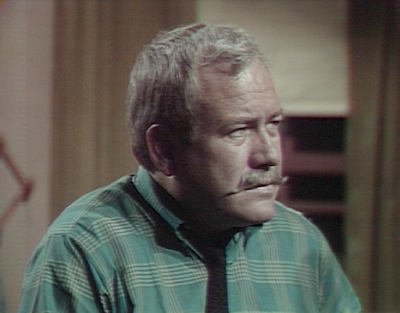
Also worthy of note are the two facial makeups representing Angelique’s aging. It’s no wonder they didn’t have the personnel to make David Ford’s fake mustache look convincing when they were lavishing all the work on turning Lara Parker into two quite distinct old crones.

The costumers were involved in a famous production error in the final scene. Angelique/ Cassandra’s hooded cloak cuts off above her knees. There is no old age makeup on her legs, which are featured from every angle, making a ludicrous contrast with her face and wig.

*In 2024’s money, that’s $4544.17.

Episode 498: One step closer to the dream

Sarcastic dandy Roger Collins has remarried. His previous wife, undead blonde witch Laura Murdoch Collins, was Dark Shadows’ first supernatural menace, posing a threat to the life of their son David from #123 until she vanished amid a cloud of smoke in #191. The ghost of gracious lady Josette joined in the battle against Laura. Among other things, Josette compelled artist Sam Evans to paint a series of pictures warning of Laura’s evil plans. Laura responded to those paintings in #145 and #146 by causing a fire that burned Sam’s hands so badly it seemed he might never again be able to paint.

Roger’s new wife is also an undead blonde witch, though she wears a black wig all the time. This wiggéd witch calls herself Cassandra, but is actually Angelique, who in the 1790s killed many of Roger’s ancestors and turned his distant cousin Barnabas into a vampire. Angelique/ Cassandra has returned to the world of the living because Barnabas’ vampirism is now in remission, and she is determined to restore it.

Before he met Angelique/ Cassandra, Roger became obsessed with a portrait of her. Barnabas concludes that this portrait is essential to her power. He orders his servant Willie to steal it from the great house of Collinwood. Barnabas takes the portrait to Sam and commissions him to paint over it so that Angelique will look tremendously old. He doesn’t offer Sam any explanations, but we heard him tell Willie his theory that what happens to the painting will also happen to Angelique. If her likeness is aged to reflect her actual years, then she will vanish from 1968 and be confined to the past. At the end of the episode, Angelique’s hands have aged dramatically, suggesting that Barnabas is correct.

This is David Ford’s first appearance on the show since December, and he had shaved his mustache in the interim. The fake is not up to the makeup department’s usual standards. Screenshot by Dark Shadows Before I Die.

Portraits have been a very prominent part of the visual composition of Dark Shadows from the beginning, and a battlefield on which supernatural combat could be joined for almost as long. So it is hardly surprising that the show would eventually get around to doing a story based on Oscar Wilde’s The Picture of Dorian Gray.

It would seem Barnabas has little time to lose. Angelique/ Cassandra has distributed some malware to the minds of the people around Barnabas by means of a dream that one person after another will have. The first dreamer is beckoned into a Haunted House attraction by someone, opens some doors behind which there are scary images, is terrified, and cannot find relief until telling its details to the beckoner. That person then has the dream, changed in only two particulars, the identity of the beckoner and the image behind the final door. When everyone’s brain has been hacked, this worm is supposed to reset Barnabas as a vampire.

Yesterday, David had the dream, and Willie was his beckoner. Today, we open in Barnabas’ house, where Willie is paralyzed with fear. David has already told him the dream, and Willie knows he will have it. With all the previous instances of the dream, the audience had to sit through a highly repetitious dream sequence, then a scene in which the character agonizes about whether to tell the dream to the next person, and finally a speech repeating all the details of the dream. At least this time we skip the second and third of those rehashings.

Since Willie is so close to Barnabas, it seems likely that he will be the last to have the dream before it gets back to Barnabas and makes him a vampire again. So it’s no wonder that Barnabas decides it’s time for the high-stakes gamble of a burglary at Collinwood.

There’s also a scene in Barnabas’ basement. Barnabas’ vampirism is in remission because some mad scientists created a Frankenstein’s monster, whom Barnabas named Adam. They connected Barnabas to Adam in a way that drains the symptoms of the curse from Barnabas without manifesting them in Adam. Barnabas has no idea how to raise any child, let alone a 6’6″ newborn with the strength of several grown men, and so locks him up in the prison cell where he used to keep Sam’s daughter Maggie.

The imprisonment of Maggie was a dreary, unpleasant story, but Adam’s time in the cell is even harder to take. Maggie was established as a strong, intelligent person who knew her way around, she could speak, and she had many friends who cared about her. So we never quite gave up hope that she would get away and be all right in the end. But Adam has none of that. As a result, his scenes in the basement are a tale of extreme child abuse, made all the harder to watch by Robert Rodan’s affecting portrayal of the big guy’s misery.

Moreover, Maggie was a major character, introduced in the first episode and connected to everyone else. It’s unlikely they would kill her off unless the show had been canceled and they were going out with a bang. But only the people holding Adam prisoner know who he is, and Frankenstein’s monsters meet their deaths practically every time they feature in a story.

Worst of all, the show is basically very silly right now. A story about a child locked in a cell from birth can be made bearable only by joining it to some kind of deep insight into the human condition, and there is little prospect that anything like that will crop up among all the witches and vampires and other Halloween paraphernalia. My wife, Mrs Acilius, watched the whole series with me in 2020-2021. She was avidly rewatching it with me this time. But when they took Adam to the cell, she suggested I start watching it on days when I get home from work before she does. I’m sure she isn’t the only Dark Shadows fan who takes a pass on the Adam story.

This is the first episode credited to director Jack Sullivan. Lela Swift and John Sedwick took turns at the helm until #450, when executive producer Dan Curtis tried his hand at directing a week of episodes. Swift and Sedwick then returned to their usual pattern. Sedwick will be leaving in a few weeks; Sullivan, who has been with the show as an associate director since the third week, will be Swift’s alternate until November, and from #553 on will be credited as Sean Dhu Sullivan.

Episode 463: Comfort me

We open in the old cemetery north of town, where well-meaning governess Vicki and matriarch Liz are looking for the grave of Vicki’s old boyfriend Peter. Vicki last saw Peter this past Friday, which was over 170 years ago. That discrepancy was the result of some time travel she did in between. Vicki met Peter while spending nineteen weeks in the late eighteenth century. She came back home on Monday. By the end of her visit to the past, Vicki and Peter were both scheduled to be hanged for their many crimes. Vicki was whisked back to 1968 at the last possible instant, escaping by such a narrow margin that she had rope burns on her neck.

Vicki and Liz find Peter’s grave marker. Liz remarks that his date of death is the same as today’s date- 3 April. This sets Vicki off. She says that the hangings took place at dusk, that it’s dusk now, and that Peter is therefore being hanged even as they speak. Liz declares that this is gibberish. The date on the stone is 3 April 1795, and today’s date is 3 April 1968. Vicki tries to explain that everything that ever happened is happening over and again someplace. Yesterday, Liz heard similarly opaque verbiage from her distant cousin Barnabas. She didn’t buy this line when Barnabas was pitching it, and she isn’t any more impressed when she hears it from Vicki.

Longtime viewers of Dark Shadows are likely to make a connection. From December 1966 to March 1967, Vicki led the battle against the show’s first supernatural menace, undead fire witch Laura Murdoch Collins. When she saw the dates on which Laura’s previous incarnations immolated themselves along with their young sons, Vicki realized that she acted at intervals of exactly one hundred years. Laura was an embodiment of the cyclical nature of time; fighting her, Vicki is trying to break the cycle of death and rebirth, like a comely young Buddha.

I don’t think the show is making a serious metaphysical point by developing this theme. When you’re telling a story about a place where the usual laws of nature don’t apply, you need to substitute some other set of rules the audience can understand in order to create suspense. The power of anniversaries will do as well as anything else.

Back in the great house of Collinwood, we see Liz’ daughter Carolyn come in the front door wearing riding clothes and carrying a crop. This is the first indication that the Collinses have horses. In the early months of Dark Shadows, the family was running out of money, the estate was decrepit and mortgaged to the hilt, and they were barely holding onto control of their business. The stories those circumstances generated never went anywhere, and they’ve gradually been retconning the Collinses to be richer and richer. If they’re up to horse ownership now, by next year they might have a luxury yacht and a private jet.

The drawing room doors open, and lawyer Tony Peterson emerges. He quarrels with Carolyn about their last encounter. That was two weeks ago in story time, but we saw it before Vicki left for the past in November. It’s an even deeper dive for us than that makes it sound, because our view of Tony has changed profoundly in the interim. He was first introduced as an example of Jerry Lacy’s famous Humphrey Bogart imitation, and he still is that. But in the 1790s segment, Mr Lacy played the Rev’d Mr Trask, the fanatical witchfinder who hounded Vicki to her death and occasioned many other disasters. By now, we have come to see most of the 1960s characters as the (not necessarily dark) shadows cast by their eighteenth century counterparts. When Tony shows up today we find ourselves trying to figure out what it is about Collinsport in the twentieth century that could turn a holy terror like Trask into a basically nice guy like Tony.

Carolyn browbeats Tony into coming back at 8 pm to take her to dinner. He leaves, and Carolyn’s distant cousin, Barnabas the vampire, enters. Barnabas asks Carolyn if she’s noticed a change in Vicki. She has no idea what he’s talking about. He asks if she’s “more like you.” Thus first-time viewers learn that Carolyn is under Barnabas’ power. Returning viewers learn something, too. Yesterday’s episode ended with Barnabas about to bite Vicki, but cut to the closing credits before he sank his teeth into her. We’ve seen that before. Now we know that he has finally gone through with it.

In the opening scenes, Vicki showed absolutely no sign that anything had happened to her; Carolyn hasn’t noticed any change in her either. Soon, Vicki and Liz come home, and Vicki doesn’t react to Barnabas any differently than she had before he bit her. The people Barnabas has bitten have shown a wide variety of effects afterward. Perhaps Vicki will be the first victim who just can’t be bothered.

Vicki has a painting with her that she bought in town after she and Liz visited Peter’s grave. It turns out to be a portrait of Angelique, the wicked witch whose curse made Barnabas a vampire in the 1790s. That portrait first appeared in #449, a sign to the characters that Angelique’s evil spirit was still at work and to the audience that actress Lara Parker would be back on the show after the costume drama insert ended. Barnabas is upset to see this token of his old nemesis, and leaves the house. Vicki does not consciously remember the events she saw during her visit to the past, but when she sees Barnabas go she tells Liz that it makes sense that he would not like the picture.

Barnabas freaks out. Screenshot by Dark Shadows Before I Die.

Tony returns and spends a few moments twitting Carolyn for her glamorous attire, describing the homely pastimes in which a working class boy like himself whiles away his idle moments. This prompts her to tease him back. Viewers who remember Tony and Carolyn’s previous interactions will recognize this as their style of flirtatious banter. They agree to go to dinner.

Before Tony and Carolyn can leave, we cut to Barnabas, standing in the window of his own house and staring at the great house. He calls to Carolyn, summoning her to come to him immediately. We cut back to the great house, and see Carolyn’s face go blank while Tony is still talking. She excuses herself, telling him she will meet him later. He is outraged, and vows he will not wait for her.

In Barnabas’ house, Carolyn tells Barnabas she objects to his summons. Irritated by this, he starts talking about Vicki. He says that he couldn’t understand why biting her did not bring her under his power, but that seeing the portrait explained it to him. The witch is interfering with his efforts. Carolyn laughs at the idea of a witch. This is a bit odd. Carolyn has lived her whole life up to this point in a haunted house and is having a conversation with a vampire. It wouldn’t seem to be a stretch for her to believe in witches.

Barnabas has a bad habit of leaving his front window uncovered. Many times, we have seen people peer into that window and discover Barnabas’ secrets. Now, Tony sees Barnabas bite Carolyn’s neck.

No cousinly kiss. Screenshot by Dark Shadows Before I Die.

Carolyn goes home to the great house and finds Tony in the foyer. She is delighted at the idea that he is waiting to go on their date, but such is not the case. He is there to berate her for her perverse relationship with her cousin Barnabas and to storm out.

In this, we see the first point of similarity between Tony and Trask. Trask was right that there was a witch at Collinwood and right that the witch was the source of all the troubles afflicting the Collinses. But he was wrong about her identity, and wrong about the means to combat her. Likewise, Tony is right that Carolyn and Barnabas are manipulating him, and is right that their relationship is unwholesome. But he has no understanding of their goals, and his belief that their relationship is sexual is quite mistaken.

Carolyn’s protest that Barnabas is merely her cousin, like Tony’s indignant implication that their family relationship makes what they are doing incest, is rather strained. In the cemetery, Liz mentioned that Daniel Collins was her great-great grandfather, which would make Daniel’s sister Millicent Carolyn’s great-great-great-great aunt. When Millicent and Daniel were introduced during the 1790s segment, Barnabas’ father Joshua identified them as his second cousins. That was a distant enough relative that Joshua considered Millicent a potential marriage partner for either Joshua’s brother Jeremiah or for Barnabas himself. Since Barnabas and Carolyn are second cousins five times removed, nothing going on between them could very well be called incestuous.

Later, Barnabas goes to the drawing room in the great house and looks at the portrait of Angelique. To his surprise, Carolyn is waiting for him. She tells him that she doesn’t want to be his blood thrall anymore. She declares that he loves Vicki and that she has her own life to live. He is too busy to discuss the matter with her, and she leaves.

Barnabas cuts the portrait out of the frame, and throws it into the fireplace. He gives a little speech about how this is the only way Angelique can be destroyed. He turns from the fire, and sees that the portrait has regenerated. Angelique’s laughter sounds in the air, and Barnabas realizes that she is present.

This is not the first time a portrait of an undead blonde witch has been thrown into the fire in the drawing room, prompting a woman’s disembodied voice to make itself heard. In #149, Laura’s estranged husband, Roger Collins, threw into it a painting featuring her with their son, strange and troubled boy David. When that painting burned, we heard a scream coming from no one we could see. Whether the screamer was Laura or benevolent ghost Josette was never explained. What was clear was that burning the painting accomplished none of the goals Roger may have had in mind, as Barnabas’ incineration of this painting serves none of his purposes.