Governess Maggie Evans forbids her charges, David Collins and Amy Jennings, from going outside. They ask her to play hide and seek. She agrees, and accepts the role of It. She searches for them for a long time, ultimately finding them outdoors. She points out that she had told them to stay indoors, and they pretend not to have understood that this applied to their hiding places.
Maggie does not punish Amy and David for this obvious insubordination. This establishes that Maggie is a squish who will not maintain discipline. That point had already been made in yesterday’s episode, when Maggie caught Amy hiding in David’s room, in defiance of orders from heiress Carolyn Collins Stoddard. At that time, Maggie lied to housekeeper Mrs Johnson to cover up what the children had done. Maggie’s irresolution bears repeated exposure, though, since the children are coming under the influence of the evil spirit of the late Quentin Collins and would not be very effective as his helpers if they were subject to even moderately competent adult supervision.
Today Mrs Johnson and her son Harry are under orders from Carolyn to fix up the caretaker’s cottage on the estate. Carolyn has invited mysterious drifter Chris Jennings, Amy’s big brother, to live in the cottage. In the opening, Mrs Johnson tells Maggie she objects to this idea on the grounds that the cottage is cursed. Maggie dismisses Mrs Johnson’s belief in such a curse, but she really shouldn’t. Mrs Johnson keeps calling it “Matthew Morgan’s cottage” after the crazed handyman who lived there for eighteen years. Matthew killed Mrs Johnson’s beloved employer Bill Malloy, then tried to kill Maggie’s dear friend and predecessor as governess at Collinwood, Vicki Winters. Maggie knows all about those incidents. Mrs Johnson also says that no good happened at the cottage after Matthew; the only resident of the cottage since Matthew’s death was David’s mother, undead blonde fire witch Laura Murdoch Collins. Maggie knows plenty about Laura as well, since her father Sam was deeply involved in the strange goings-on concerning Laura and Vicki led the fight against her.
Under orders from Quentin, the children contrive to trap Mrs Johnson in the cottage by herself. Quentin appears to her there. She is terrified. This is quite a surprise to regular viewers. Quentin has appeared on screen only once before, in #646. Moreover, the children have made it very clear that Quentin is confined to the little room hidden in the long-deserted west wing of Collinwood where they found him. We are left to wonder how he gained the ability to manifest himself in the cottage and even to walk outside it when no one is looking.
Perhaps we are to think that Quentin is in some way connected with the curse on the cottage, and with Chris. When the children first contacted Quentin, Amy could communicate with him before David could. This left David miffed, since “Quentin Collins is my ancestor.” That line of David’s led us to expect that we would learn that Quentin is also Amy and Chris’ ancestor. Tomorrow, David will tell Amy that Quentin is “quite pleased” that Chris is living in the cottage. Maybe it was Amy’s presence in the room in the west wing that activated the ghost of Quentin there, and Chris’ impending arrival in the cottage that activates it in that space.
This episode marks the last appearance of Harry. Until today, he was played by Craig Slocum. Edward Marshall takes Harry over the horizon. Mr Marshall must have been watching the show; he does a flawless imitation of Slocum’s very peculiar line delivery. His Harry is just as petulant and resentful as Slocum’s was, but he is so much more physically relaxed and so much more responsive to his scene partners that he is enjoyable to watch in a way Slocum never was. I can’t help but wonder if Harry would have caught on and become a bigger part of the show had Mr Marshall taken the part earlier. Harry’s personality made it impossible for him to figure in a romance of any kind, limiting his usefulness on a soap, but there’s plenty of room on Dark Shadows for comic relief in the form of an inept, grumbly, dishonest servant.
Thayer David joined the cast of Dark Shadows in August 1966, taking over the role of moody handyman Matthew Morgan from George Mitchell starting with #38. In that first episode, Matthew brawled in a barroom and left dashing action hero Burke Devlin gasping. The main storyline of the next few months was the investigation into the death of beloved local man Bill Malloy; it turned out Matthew had unintentionally killed Bill when they got into a fight and Matthew didn’t know his own strength.
Those two events explain the recast. George Mitchell was a slender little man whose white hair and craggy face made him look older than his 61 years. He was a fine actor, but no one would have believed that he could win a fight with Burke or that he was so strong that he would accidentally kill Bill. David was Mitchell’s equal in acting ability, but more importantly was a burly fellow in his late 30s.
Today, we hark back to David’s original function on the show. The setting is the year 1796; vampire Barnabas Collins has traveled back from the 1960s to rescue his fellow time traveler, well-meaning governess Victoria Winters, from death by hanging. David plays another servant. As Matthew was fanatically loyal to matriarch Elizabeth Collins Stoddard, so Ben Stokes is utterly devoted to Barnabas. Ben finds roguish naval officer Nathan Forbes and visiting Countess Natalie DuPrés about to drive a stake through Barnabas’ heart. Ben demands they stop; Nathan aims his pistol in Ben’s direction and squeezes the trigger. The gun misfires. Ben reflexively clutches at his chest, but finding he is not hurt he advances on Nathan. They fight. As Matthew was so strong he could not fight Bill without accidentally killing him, so Ben accidentally kills Nathan. Ben then tells the countess he doesn’t want to hurt her and that she will be all right if she stays put until he can figure out what to do; she is unable to assure him she will do so, and in his attempt to restrain her he inadvertently kills her, too.
Barnabas had originally lived in the eighteenth century. He passed from that time into the 1960s because he was chained in his coffin in 1796 and discovered in 1967 by would-be grave-robber Willie Loomis. Now, he has rescued Victoria, and he is eager to go back to 1969, when he is free of the effects of the vampire curse. He traveled back by standing in an old graveyard and calling to the spirit of Vicki’s boyfriend, an unpleasant man known variously as Peter and Jeff, to pull him into the past. He went to the same graveyard yesterday and tried the same trick in reverse. Peter/ Jeff isn’t in 1969, so he calls instead to his friend, mad scientist Julia Hoffman. That didn’t work, so he decided to have Ben chain him in the coffin and take the long way back.
Barnabas is unhappy to wake up this evening. He leaves his crypt to find Ben using a shovel to pat down some earth nearby. He asks why Ben did not chain the coffin as he was instructed. Ben tells him about Nathan and the countess; evidently he is only now finishing their shallow graves. Ben has never murdered anyone before, so he asks Barnabas’ expert opinion about the next steps. Barnabas tells him to get rid of the countess’ things and to tell whoever asks that she left for Paris.
The reference to Paris is a bit unexpected to longtime viewers. When the countess first appeared in #368/369, she said that she chose to live on the island of Martinique because metropolitan France had become a republic. She and her servant Angelique came to Collinwood along with the countess’ brother André DuPrés and André’s daughter Josette, who was at that time engaged to marry the still-human Barnabas. André is identified as the owner of a sugar plantation on Martinique.
In 1796, France was of course still a republic. But the Terror had ended shortly after the execution of Robespierre in the summer of 1794. Among the beneficiaries were the real-world counterparts of the DuPrés family, the vaguely aristocratic owners of a sugar plantation on Martinique. Their name was Tascher; the daughter of the family was named, not Josette, but Josephine, the widow of the Vicomte de Beauharnais. Josephine was imprisoned in Paris during the Terror, but she was freed, reunited with her son, and restored to her property by June 1795. In May of 1796, Josephine would marry an up-and-coming artillery officer named Napoleon Bonaparte. It would indeed be plausible that the countess would want to go back to Paris and take the opportunity to reestablish a life there.
After the story of Matthew Morgan and the consequences of the death of Bill Malloy ended in December 1966, Dark Shadows was for 13 weeks dominated by the battle between undead fire witch Laura Murdoch Collins and the forces of good, led by Victoria with assistance from the ghost of Josette. Laura was the show’s first supernatural menace.
The ghost of Josette had been introduced in #70 as the tutelary spirit of the long-deserted Old House on the estate of Collinwood. Matthew held Victoria prisoner in the Old House late in 1966, and in #126 he decided to kill her. Josette led the other ghosts out of the supernatural back-world that exists somewhere behind the action to save Victoria by scaring Matthew to death. During the Laura story, Josette’s ghost was deeply involved in the action, literally painting a picture to explain to the characters what was going on.
Prompted by Josette’s ghost, Victoria figured out that Laura was going to burn her son, strange and troubled boy David Collins, to death on the anniversary of similar immolations. This would turn out to be a key turn in Dark Shadows’ world-building. When you are telling stories about supernatural beings, you can’t rely on the laws of nature or logic to shape the audience’s expectations. You need to give them some other mechanism of cause and effect if you are going to create suspense. So from that point on, the show would use anniversaries as causal forces. “It happened exactly one hundred years ago tomorrow night!” means it will happen again then.
That was the basis of Barnabas’ trip to 1796 and of his hope to return by standing on the same spot. Tombstones indicating that Victoria and Peter/ Jeff had been hanged materialized at times related to the anniversaries of those events, and Barnabas must leave 1969 at a certain point to arrive at a certain point in 1796. Eight o’clock on a given night in 1796 corresponds to eight o’clock on a given night in 1969, and those are the times when Barnabas and Julia go to the graveyard from which he vanished and call out to each other.
Even though the conjoined eight o’clocks don’t facilitate Barnabas’ return trip, the structure of today’s episode plays on the same idea of intercutting timelines. We alternate between scenes of Barnabas and Ben in 1796, and of Julia and Willie in 1969. Barnabas bit Willie and enslaved him when he opened his coffin; by the time Barnabas was cured of the effects of the vampire curse, Willie had let go of any hard feelings about that. Barnabas has made the Old House his home, and Willie voluntarily lives there as his servant. Julia has been a permanent guest in the great house on the estate since 1967, but now is apparently staying at Barnabas’.
Julia is determined that Barnabas will return by rematerializing on the spot from which he vanished, and she keeps going back there. Willie doesn’t believe this will happen, but in a long interior monologue comes up with the idea that he might reappear in his old coffin. In her turn, Julia dismisses that idea. They quarrel about these competing absurdities, and Willie decides to put his hypothesis to the test. He goes to the old mausoleum to check on the coffin, and finds it empty. He returns to the house to report this to Julia.
Julia decides it’s time to sleep, so she goes upstairs- apparently to her own bedroom. Seconds later, a ghost appears to Willie. He recognizes it as Josette. She vanishes, and he calls Julia. When Julia comes he tells her that Josette had never appeared to either of them unless Barnabas was in danger. As far as I can recall the audience has never known Josette to appear to Willie or Julia at all, and Barnabas is always in danger, so that remark is a bit of a mystery to longtime viewers.
In the days leading up to Willie’s discovery of Barnabas in April 1967, he, and he alone, heard a heartbeat coming from the eighteenth century portrait of Barnabas that hangs in the foyer of the great house. While he is talking with Julia, Willie turns to the portrait of Barnabas that artist Sam Evans painted in May 1967 and hears the heartbeat again. Julia cannot hear the heartbeat. Willie combines the sound of the heartbeat with the sight of Josette and concludes that Barnabas has returned and the old coffin is no longer empty. We cut to the hidden room in the mausoleum. Chains materialize around the coffin, and we see Barnabas inside it, struggling to escape.
We may wonder if Barnabas has been struggling that way every night since he was chained there in his attempt to return to the 1960s. That would be 173 years, added to the 171 years the first time. It would seem that 344 years confined to a box would make Barnabas even screwier than he is. In a much later episode, we will see Barnabas released after a long entombment and he will be surprised that more than one day has passed. The 2012 film adaptation of Dark Shadows includes a humorous scene based on the idea that time does not pass for Barnabas while he is chained in his coffin. But when he was first released in April 1967, there were indications that he had undergone a nightly torment through the centuries, and the closing image of Barnabas in the box today echoes those indications.
Nathan’s death marks the final appearance of actor Joel Crothers, who has been one of Dark Shadows’ most valuable cast members since his debut in #3, when he played hardworking young fisherman Joe Haskell. We said goodbye to Joe last week; it was nice to have another glimpse of Crothers in his villainous role before he left for the last time.
Old world gentleman Barnabas Collins, in temporary charge of the great house of Collinwood, has decided to pack children David Collins and Amy Jennings off to boarding schools in Boston. They pretend to be happy about this, but in fact want to stay in the house, where they have come under the power of the evil ghost of Quentin Collins. Neither they nor Quentin can figure out a way to stop Barnabas’ plan. David takes a photo of Barnabas standing with heiress Carolyn Collins Stoddard; when the photo is developed, a mysterious figure appears in the background, hanging by the neck. Barnabas believes that the figure represents vanished governess Victoria Winters, and that he must travel back in time to rescue her. He therefore has no time to go to Boston and put the children in schools, so the plan is off.
Several characters see the photo, but only Barnabas recognizes the hanged woman as Vicki. No wonder- Vicki has been played by two actresses, and neither of them posed for it. The original Vicki was Alexandra Moltke Isles; the second was Betsy Durkin. This is Carolyn Groves, who will play Vicki in a couple of upcoming episodes. The usual rule of nomenclature when discussing recast parts is to give the performers numbers, and so Mrs Isles would be Vicki #1, Miss Durkin Vicki #2, and Miss Groves Vicki #3. But in deference to their first names, we might call them Vicki A, Vicki B, and Vicki C.
Craig Slocum appears on the show for the last time today. He plays Harry Johnson, a household servant. When Carolyn Stoddard orders Harry to fetch the children’s luggage, the camera lingers on the look of distaste she gives him. Carolyn and Harry had some unpleasant dealings several months ago, when she was hiding a Frankenstein’s monster named Adam in the long deserted west wing of the house and Harry tried to use this information to blackmail her. Carolyn kept control of that situation, but her facial expression as she looks at him today shows that she remembers Harry’s behavior and does not regard him as a man to be trusted.
Upstairs, Harry finds the children in David’s room. He catches them using an antique telephone through which they have been able to communicate with Quentin. He wants to know what they have been doing. David says that they might as well tell him, prompting an alarmed reaction from Amy. He gives a partly accurate account. The true parts are the ones Harry instantly disbelieves. This wouldn’t have worked with any of the other grownups at Collinwood; they have all had too much experience of the supernatural to disregard such a story. But Harry is relatively new to the house, and is too dim-witted to understand what he has seen. Their secret is safe with him.
Slocum ‘s performances were uneven in quality. He first appeared as Noah Gifford, a criminally inclined sailor who figured in five episodes from #439 to #455, a period when Dark Shadows was a costume drama set in the 1790s. He was very bad in those five. He didn’t know what to do with his voice, so that he always sounded like he was reading words one at a time off a teleprompter that kept speeding up and slowing down on its own. Dark Shadows returned to contemporary dress a few weeks after Noah’s last appearance, and Slocum returned to the cast as Harry. He had the same trouble with his speech in his early stabs at that role, but he did eventually learn to relax. In #551, he amazed the world by doing a genuinely good job. He has been passable most of the time since, and he is all right today. Still, Harry doesn’t have much room to grow, and Slocum was so bad so many times that it’s a relief to see him go.
There is an intriguing little blooper near the beginning. Barnabas is supposed to say that he is on his way to see Carolyn. Jonathan Frid actually says that he is going to see “Barrah- Carolyn.” In a recent episode, a day player asked to see “Mister Jonathan” and was ushered to Barnabas, so perhaps he caught the bug and is going to call Carolyn “Barrett, Nancy.”
Well-meaning governess Victoria Winters ran out of story at the end of #191, but they kept putting her on the show. Frustrated by her character’s uselessness, Alexandra Moltke Isles finally gave up and left Dark Shadows last week, but not even that sufficed to get the point across to its producers. Today they bring in one Betsy Durkin as a fake Shemp to postpone the character’s departure.
Vicki’s big scene today is a confrontation with suave warlock Nicholas about his plans to marry Maggie, The Nicest Girl in Town. In the course of it, Vicki says “I know you’re going to say it’s none of my business, and it isn’t. Except I’m making it my business!” In other words, Vicki has to meddle in other people’s affairs, since she is not involved in any ongoing story that the audience could possibly care about.
Vicki tells Nicholas everything she knows about him and everything she suspects, leaving the audience with no questions about what is in her mind. Nicholas points out that Maggie would laugh uproariously if Vicki repeated her speech to her. Vicki does not deny this, but nonetheless says she will to go to Maggie unless Nicholas breaks his engagement to her.
This blatantly empty threat draws a contrast between Vicki, who is powerless to change the direction of any story she might join, and mad scientist Julia, who in #619 faced Nicholas down in this same room. Julia also began by ignoring Nicholas’ display of geniality, stating the facts about his nature, and declaring her hostility. But Julia had information Nicholas didn’t have, and when she revealed it to him she knocked him off his guard and took charge of the situation. Vicki has no such cards to play, and comes out of the scene looking more foolish and helpless than ever. Considering these scenes side by side, it is no surprise that Julia has taken over as the audience’s main point-of-view character, a function Vicki served in the show’s first year.
Nicholas does not use his magical powers against Vicki, and after she leaves his house he wonders why he did not. Again the contrast with Julia shows why this is so bad for Vicki’s character. When Julia brought Nicholas news about trouble he did not know he was in, he couldn’t be sure he would not need her help to get out of it. That not only explained how she managed to get out of his house without being turned into a toadstool, it also helped cement her status as Dark Shadows’ most dynamic protagonist. But when the only explanation Nicholas can find for his failure to brush Vicki aside is that he is ceasing to be much of a villain, he is telling the audience in so many words that Vicki is not worth their time.
Nicholas decides that he really ought to do something with Vicki after all. He goes to his basement and rips the tiles out of the floor. Longtime viewers will remember #273, when the flooring in the basement of the great house of Collinwood was torn to reveal that no corpse was buried there. That brought one of the principal storylines of the show’s first year, matriarch Liz’ long seclusion in the great house, to a ridiculous anticlimax.
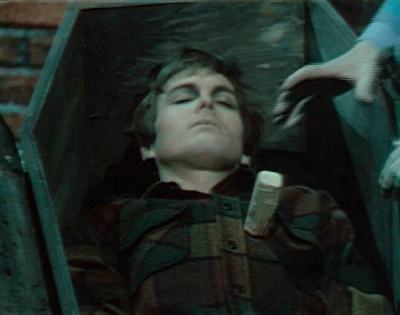
Now the result is rather different. Nicholas drags a coffin up out of the hole he makes in his basement floor, opens it, and exposes a body with a stake in its chest. It is the body of Tom Jennings, who became a vampire in #564 and was staked in #571. Tom’s body disappeared shortly after the staking, and Nicholas was in the area at the time, so we were warned that he may not have been truly destroyed. Today we find that Nicholas did in fact preserve Tom, when he pulls the stake out of Tom’s heart and declares himself to be his master. At the end of the episode, Vicki is in bed when Tom crawls in through her window and bares his fangs at her.
The unstaking feels like a cheat, despite the earlier warning Tom might return. It looks silly when Nicholas pulls the stake out. Vampires are important enough in the world of Dark Shadows that they really oughtn’t to be things you can turn on and off like an electric light.
But the shot of Tom crawling into Vicki’s room is pretty effective, suggesting that he is a feral beast. It makes a nice counterpoint to the scene of ex-vampire Barnabas crawling out of a cell in #616, when Barnabas was reduced to a very basic psychological condition. Barnabas disappeared after his crawl, but Don Briscoe follows Tom’s by wiggling his tongue at the camera in his final closeup, making it look like he is super-excited to drink Vicki’s blood.
Nicholas and Maggie have a funny scene. Yesterday his boss, Satan, ordered Nicholas to sacrifice Maggie in a Black Mass so that she could join him in Hell. Today, Nicholas shows her an ancient cup. He tells her it was made “before your Christ* was born.” Maybe Maggie knows Nicholas isn’t Christian, but certainly she doesn’t know that he isn’t human, much less that he is a minion of the Devil. So you might think that she would react to the bizarre formulation “your Christ,” but she doesn’t seem to pick up on it at all. When Nicholas uses the cup for a little fortune-telling trick and tells her she will have a long and happy life, she does notice that he sounds disappointed.
*The first mention of that title on the show. Dark Shadows is in a weird little quasi-Christian phase at this point.
Nancy Barrett was taken ill not long before shooting began for this episode, and she was replaced in the role of Carolyn Stoddard by Diana Walker. Miss Walker had her sides letter perfect; her only flub comes when she delivers a line in a level conversational tone, and a moment later has to apologize for shouting. She doesn’t seem to have much idea of what was going on in the story, though. Her Carolyn is a calm, practical-minded homemaker of the sort you might find on another daytime soap of the period, not someone who is keeping a stray Frankenstein’s monster in the spare room. Besides, Miss Barrett is probably Dark Shadows’ most reliably entertaining performer, an impossible act for anyone to follow.
Aside from the two actors who at various times filled in for Vince O’Brien in the famously disposable role of Sheriff Patterson, I believe Miss Walker is the only person to have served as a substitute for a temporarily unavailable cast member. Many times, the makers of the show went out of their way to rearrange the shooting schedule or rewrite scripts to avoid substitutions. Many of the show’s fans were extremely young and extremely intense, so I suspect Miss Walker’s mail after this appearance would have included some ugly items that would have confirmed the producers in their reluctance to call up the reserves.
Today is the last time we see Jerry Lacy as lawyer Tony Peterson. Mr Lacy will be back in other roles. In 1969 and 1970, he and Diana Walker were reunited in the original Broadway cast of Play It Again, Sam, in which Mr Lacy scored a triumph with the same Humphrey Bogart imitation that is the basis of Tony’s character, while Miss Walker played Sharon and understudied Nancy.
In the Old House on the great estate of Collinwood, vampire Barnabas Collins frets that his sorely bedraggled blood thrall, Willie Loomis, is failing to die. A couple of weeks ago, the police shot Willie and jumped to the conclusion that he was responsible for the abduction of Maggie Evans, The Nicest Girl in Town, among many other crimes that Barnabas actually committed. He’s been in a coma ever since, and if he dies, Barnabas will be off the hook.
Barnabas tells his co-conspirator, mad scientist Julia Hoffman, that he will go to the hospital and murder Willie. Her assurances that Willie will soon die of natural causes don’t stop Barnabas, but her news that the sheriff is on his way to the house does. Barnabas then orders her to go to the hospital and carry out the murder, but she refuses.
Meanwhile, Sheriff George Patterson, addled quack Dr Dave Woodard, and Maggie’s father Sam are hanging around Willie’s hospital room recapping the story so far. The sheriff wonders where Willie could have kept Maggie during the weeks she was held prisoner. Willie lives in Barnabas’ house and does not appear to have access to any other building. You might think this would be grounds for suspecting Barnabas of involvement, but no such thought crosses the minds of any of the three luminaries keeping Willie company. They just take it for granted that no crime could have taken place in Barnabas’ house.
George, Dave, and Sam, or their intellectual equivalents.
Back in the Old House, Barnabas has had an inspiration. He took a ring from Maggie in #253, and today he hides it in a candlestick in Willie’s bedroom. When the sheriff and Sam come to search that room (but no other part of the house,) Barnabas watches until they’ve given up, then knocks the candlestick over and exclaims in a ridiculously fake voice “Look! A ring!” Sam recognizes it as Maggie’s, and he and the sheriff are convinced it is conclusive evidence of Willie’s guilt.
For her part, Julia has made her way to Willie’s hospital room. She is there with Woodard when Willie shows signs of regaining consciousness. Woodard rushes out to tell the deputy to get the sheriff, and leaves Julia alone with Willie. She looks at Willie’s IV and remembers Barnabas urging her to kill him.
The sheriff and Sam are leaving Barnabas’ house with the ring when the deputy comes to the front door. He announces that Willie is coming to and is likely to start talking at any moment. We end with a closeup of a horrified Barnabas.
During the opening titles, announcer Bob Lloyd tells us that the part of Sheriff Patterson will be played by Vince O’Brien. This week’s episodes were shot out of broadcast sequence, so we will see Dana Elcar as Patterson one more time. O’Brien was on the show four times in January and February of 1967 as the second actor to play Lieutenant Dan Riley of the Maine State Police, an officer attached to an investigation concerning undead fire witch Laura Murdoch Collins. Patterson isn’t much of a character, and even an actor as distinguished as Elcar had trouble making him interesting. If we remember O’Brien from his time as Dan Riley Number Two, we know that he was a competent professional, but we won’t have much hope that he will outdo Dana Elcar.
O’Brien does show beyond all doubt that he belongs on Dark Shadows, though. While the closing credits are rolling, he strolls onto the set behind technical director J. J. Lupatkin’s name.
On Thursday, reclusive matriarch Liz admitted to well-meaning governess Vicki that she is being blackmailed. Eighteen years ago, Liz killed her husband, Paul Stoddard. Seagoing con man Jason McGuire then buried Stoddard in the basement. Now, Jason is threatening to expose this secret unless Liz marries him.
Today, Liz asks Vicki to be the legal witness at her wedding to Jason. Vicki demurs, saying that she might be compelled to speak up when the officiant asks if there is anyone who present who knows why these two people should not be joined in matrimony. The conversation then shades off into Vicki urging Liz to share her secret with her daughter, flighty heiress Carolyn. Liz won’t look directly at Vicki when Carolyn’s name is mentioned.
Word is spreading that Maggie Evans, The Nicest Girl in Town, is dead. Vicki had just received that news when Liz brought up the wedding. Alexandra Moltke Isles does a fine job of expressing Vicki’s emotional tumult as she reels from one kind of shock to another. When Vicki breaks the news of Maggie’s death to Carolyn and then quarrels with Carolyn about her plan to marry motorcycle enthusiast Buzz, Mrs Isles reprises this transition from fresh bereavement to festering conflict, again quite effectively.
Carolyn goes out with Buzz, and Vicki goes for a walk on the beach with her boyfriend, Burke Devlin. Each episode begins with a voiceover which Mrs Isles delivers in character as Vicki. Typically, these consist of remarks about the sea and the weather which have some vaguely metaphorical connection to what’s happening on the show. While Vicki sits with Burke and stares out at the water, she launches into one of these monologues. In response, my wife, Mrs Acilius, started laughing so hard we had to pause the streaming. When Burke joins in with the observation that it is getting dark and “may get darker”- sometimes that happens as the evening goes on, seems to be some kind of pattern there- we both burst out laughing and had to pause it again. Before we restarted it that second time, Mrs Acilius asked “What does it say about us that we are sitting here watching this? That we choose to watch it when we’ve seen it before?” I’m not sure I want to know the answer to that one.
Vicki gets home shortly before Carolyn. Carolyn tells Vicki and Liz that after she saw Maggie’s boyfriend Joe walking down the street looking sad, she just wanted to go home and mourn. After Carolyn leaves them alone together, Vicki again urges Liz to tell her the truth. Vicki judges that Carolyn would listen to her sympathetically in the mood she is in now. Liz says she might tell Carolyn tomorrow, Vicki says that Carolyn might not be in the same frame of mind tomorrow, Liz says she can’t do it now.
In fact, Maggie is alive- her doctor decided to promote the story that she is dead as a lamebrained scheme to keep the person who tried to kill her from trying again. The blackmail plot, on the other hand, has barely shown a sign of life since it first arrived on the show ten weeks ago.
Jason is supposed to sweep away the last non-paranormal story elements left over from the period before Dark Shadows became a supernatural thriller/ horror story in December 1966. So far he has managed to disclose to the audience, but not to the other characters, why Liz hasn’t left home since the night Stoddard was last seen. That wasn’t an especially interesting question, as they have never shown us anyplace she would want to go, and it’s the only thing he has cleared up.
Another unanswered question is the one that led Vicki to come to Collinwood in the first place. She grew up in a foundling home, with no idea of who her parents were. The show has been hinting heavily that Liz is Vicki’s mother. Indeed, when Jason was brought on the show, the plan was that the grand finale of his storyline would confirm this. If that is still the plan, then the relationships among Vicki, Liz, and Carolyn are due for a drastic upheaval. That prospect lends a certain interest to the scenes among these characters today.
Closing Miscellany
This episode originally aired on 27 June 1967, the first anniversary of the broadcast of #1.
From #1 until #248, dashing action hero Burke Devlin was played by Mitchell Ryan. Ryan showed up at the set too drunk to work when they were supposed to tape #254 and was fired off the show. Today announcer Bob Lloyd tells us that “The part of Burke Devlin will be played by Anthony George.” There was never very much on Dark Shadows for a dashing action hero to do, and now that the most popular character on it is a vampire there isn’t going to be. It was only Ryan’s star quality that kept the character on the show so long.
Anthony George had appeared in feature films in the 1950s, had guest-starred in several prime-time shows, had been a regular cast member on the hit series The Untouchables, and had played one of the leads on a series called Checkmate. When the original audience saw him, many of them would have recognized him as a famous actor and would have expected the character to go on to do something important. Evidently they haven’t given up on Burke yet. But they had better come up with a story for him- George may have had a terrific resume, but he doesn’t have any fraction of Ryan’s charisma.
Unfortunately, they have given up on Buzz. He is on screen only briefly today, and we don’t see him again. Worst of all, while his first three episodes left us with the impression that he could not fail to be hilarious, he manages not to be even a little bit funny in this final appearance. He is just nasty and inconsiderate, demanding that Carolyn forget about whatever it is that’s bothering her and come to the loud party he’s planned.
Getting Buzz off the show the day Anthony George comes on as Burke does solve one problem. As of this episode, the three young women on Dark Shadows all have boyfriends. Maggie has Joe, played by Joel Crothers; Vicki has Burke, played by Anthony George; and Carolyn has Buzz, played by Michael Hadge. Those three actors were all gay. That wasn’t widely known at the time (except perhaps in the case of Mr Hadge, who really does not seem to be making an effort to keep the closet door shut while playing Buzz,) but now that everyone knows all about it, it does seem to be a sign that the show was spending a lot of energy on things that aren’t going anywhere.
Today is only the second time we hear a voice announce a recast over the opening title. The first time was in #35, when David Ford took over the part of drunken artist Sam Evans from wildly incompetent actor Mark Allen. This time Robert Gerringer is taking over the part of addled quack Dr Woodard from Richard Woods. Woods only played the role twice, and neither time could he find a way to distract the audience from the ignorance of medicine that the writers showed in their scripts.
Gerringer’s lines don’t make much more sense than did the ones they dumped on Woods, but he acts up a storm. Woodard is examining Sam’s daughter Maggie Evans, The Nicest Girl in Town. Unknown to Sam or Woodard, vampire Barnabas Collins has been sucking Maggie’s blood. Woodard is firm with Maggie when she resists his examination. He seems to be somewhat on edge, just enough that we wonder if there is more to it than the difficulties we can see Maggie giving him. Perhaps he is thinking something he isn’t saying. Woods never managed to make us wonder if his version of the doctor was doing that.
When Woodard and Sam leave Maggie’s room, Woodard assumes an alarmed tone. He tells Sam that Maggie is on the point of death and needs a blood transfusion at once. By showing us that Woodard was concealing the true nature of his concern when he was with Maggie, Gerringer gives substance to our hopes that the character’s nonsensical words and deeds will turn out to be a screen hiding something interesting.
Maggie’s boyfriend, hardworking young fisherman Joe, joins Sam and Woodard. Woodard asks if either Sam or Joe has blood type A. Joe does. Woodard doesn’t ask about Rh factors or Joe’s medical history or anything else, he simply marches Joe into Maggie’s room and the bodily fluids start pumping right away. Joe holds Maggie’s hand at first, but her violent protests force him to let go.
Transfusion
In Bram Stoker’s Dracula, Professor Van Helsing and Dr John Seward give blood transfusions to the vampire’s victims. That novel was written in 1897, and blood types weren’t discovered until 1900, so Van Helsing and Seward take blood indiscriminately from all the men cooperating in the effort to defeat Dracula. Van Helsing is particularly enthusiastic when he learns that Arthur Holmwood has given blood to Lucy Westenra, because Arthur “is the lover of her!” Van Helsing is Dutch, and speaks in a vaguely comical broken English. Woodard doesn’t seem particularly excited that Joe is “the lover of her,” but audiences who had read the book will recognize the allusion.
At this point in the production of Dark Shadows, the tentative plan was that Dr Woodard would become something like the expert on paranormal dangers that Dr Peter Guthrie had been during the Phoenix storyline, and that Barnabas would be destroyed in episode 275. Like Stoker’s Dracula, the Phoenix arc had featured a group of stout-hearted men and one valiant young woman coming together to do battle with an undead menace. Dr Guthrie had been their Van Helsing, an expert from out of town who leapfrogs over some weaknesses in the evidence actually available to the protagonists to get them to the same level of understanding that the audience has been given. Also like Van Helsing, Guthrie is the first to realize that the one female member of the team is the key to the success of their efforts, and so he insists on putting her in situations the other men regard as too dangerous for her. As Mina had been instrumental in the destruction of Dracula, so well-meaning governess Vicki is the person who finally thwarts the plans of the Phoenix.
If Woodard and Vicki are going to destroy Barnabas in #275, we have to wonder what story the show will have to tell in #276. The only other plotline going at the moment is the blackmail of reclusive matriarch Liz by seagoing con man Jason McGuire, and that can’t continue indefinitely. Not only will Liz run out of things for Jason to take away from her, but Dennis Patrick, the actor playing Jason, will leave the show no later than the end of June. Since the end of June is when #275 will be airing, we can hardly expect Jason to take the show over after that time.
In fact, Jason is an in-betweener brought on the show to clear away the last non-paranormal plot elements left over from the period before the show became a supernatural thriller in December 1966. By the time he leaves, both the reason for Liz’ long self-immuration in the great house of Collinwood and the identity of Vicki’s parents are supposed to be laid bare for all to see. Neither of those secrets ever generated an interesting story, but as long as they are around it is at least theoretically possible that the show will become a conventional daytime soap opera again. Without them, they are altogether committed to the spook show route. Destroy Barnabas, and you just have to come up with yet another menace from beyond the grave.
I remember Gerringer’s acting style from the first time I saw Dark Shadows. That was back in the 90s, when it was on what was then called the SciFi Channel. He so perfectly represented the doctor characters on the soaps my mother used to watch when I was a kid twenty years before that seeing him in the middle of a story about a vampire told me everything about the strangeness of a conventional daytime serial switching to a horror theme. If that guy is the one to drive the stake through Barnabas’ heart, or if he is even part of the team that finishes him off, it will be a statement that the makers of Dark Shadows have decided to stop being silly and start imitating The Guiding Light.
My wife, Mrs Acilius, was particularly frustrated with the dialogue in this episode. As Maggie, Kathryn Leigh Scott does a good job with nonverbal communication creating the image of a reluctant patient trying to get out of her skin, but her lines consist chiefly of repeating whatever is said to her. The other members of the cast are equally effective at projecting concern for a loved one whose grave illness they don’t understand and can’t help, but their lines too are so heavily loaded with repetition that we started to suspect that Malcolm Marmorstein was writing for a cast of myna birds. In particular, Woodard’s lines to Sam in the living room repeat the word “shock” so many times that they start to sound like he’s stuttering.
The original choices for the roles of Sam, Joe, Dr Woodard, and Maggie. Photo by Bird Ecology Study Group
In his post about this episode, Danny Horn complains that there is not a single interesting still image in it. I agree with that, though I would say that the actors’ movements tell a story. Granted, it is a story that could have been told in a tiny fraction of the actual running time, but they deserve credit for holding the show together when the script gave them zero support.
Danny says that the episode would have been just as good if it were a radio show. Mrs Acilius says that it would have been “a thousand times better” than it is if it were a silent movie. Maybe they could compromise, and it could be presented with neither audio nor video, and the audience could spend the 22 minutes doing something else.
Villains on soap operas can never be quite as destructive as they at first seem they will be, and heroes can never be quite as effective. To catch on, villains and heroes have to seem like they are about to take swift action that will have far-reaching and permanent effects on many characters and storylines. Yet the genre requires stories that go on indefinitely, so that no soap can long accommodate a truly dynamic character.
This point was dramatized in Friday’s episode. The chief villain of the moment, seagoing con man Jason McGuire, stood in front of some candles, placed to make him look like he was the Devil with long, fiery horns. Seconds after this image of Jason, his henchman Willie loses interest in him and wanders off, first listening to a lecture from a nine year old boy, then becoming obsessed with an oil painting. They aren’t making Devils the way they used to.
Jason and Willie look at the portrait of Jeremiah Collins
Today, dashing action hero Burke Devlin goes to the great house of Collinwood and confronts Willie. Well-meaning governess Vicki asks Burke why he wants to defend the ancient and esteemed Collins family from Willie and Jason if the Collinses are his enemies. He gives a flip answer to her, and is equally unable to explain himself to reclusive matriarch Liz. Regular viewers remember that the “Revenge of Burke Devlin” storyline never really led to anything very interesting, and that last week the show formally gave up on it. Without it, Burke has nothing to do. So, if the character can’t keep busy as the Collinses’ nemesis, he may as well try to justify his place in the cast with a turn as their protector.
In the foyer of Collinwood, Burke orders Willie to leave Vicki alone. Willie taunts him, and Burke picks him up and holds him with his back against the great clock. Vicki and Liz become upset, demanding that Burke let Willie go. Willie himself remains collected. After Burke releases him, Willie goes to his room, and the ladies scold Burke further. He doesn’t appear to have accomplished a thing.
Willie, off his feet but undisturbed
This is John Karlen’s first episode as Willie Loomis. His interpretation of the character is poles apart from that of James Hall, who played Willie in his previous five appearances. When I was trying to get screenshots to illustrate the moods of Hall’s Willie, I found that I had an extremely difficult task on my hands. His face would fluctuate wildly, showing a mask of calculated menace for a few seconds, then a flash of white-hot rage for a tenth of a second, then sinking into utter depression for a moment before turning to a nasty sneer. These expressions followed each other in such rapid succession it was almost impossible to catch the one I set out to get. The overall impression Hall creates is of a man driven by desperate, unreasoning emotions, lashing out in violence at everyone around him because of the chaos inside himself.
Karlen’s Willie is just as dangerous as Hall’s, but he is as composed as Hall’s Willie was frantic. At rise, he is staring at the portrait of Barnabas Collins, studying the baubles Barnabas is wearing. When housekeeper Mrs Johnson enters, Willie asks her about the Collins family jewels. When she uncharacteristically manages to be less than totally indiscreet, he shows considerably more cleverness and infinitely more calmness than Hall’s Willie ever did in maneuvering her to the subject again. If Hall’s Willie was a rabid dog charging heedless in every direction, Karlen’s is a deliberate hunter, acting coolly and undaunted by resistance.
Hall played Willie with a lighter Mississippi accent than he uses in real life, while the Brooklyn-born Karlen assumes a vaguely Southern accent in parts of this episode. That trace of Hall’s influence will remain for some months- eventually Willie will become a Brooklynite, but between now and then Karlen’s accent will go to some pretty weird places.
This was also the first episode of Dark Shadows which ABC suggested its affiliates broadcast at 3:30 PM. It would not return to 4:00 until 15 July 1968. When the core demographic of the show’s audience shifts from housewives and the chronically ill to school-age kids, as will happen quite soon, this earlier time slot will present a major problem. Those kids are now in their 60s, and they usually begin their reminiscences of Dark Shadows with “I used to run home from school to see it!” If school let out at 3:00 and the TV set at home took as long to warm up as most of them did in those days, you’d have to run pretty fast to be sure to catch the opening teaser even if you lived nearby.
David Ford joins the cast as Sam Evans, replacing the woeful Mark Allen. Ford was always one of my favorites. He was one of the reasons I started watching the show when it was on the Sci-Fi channel in the 90s- I remembered him from one of my favorite movies, the musical 1776, where he plays John Hancock.
Marc Masse made a point in his Dark Shadows from the Beginning that I hadn’t thought of before. I’d always thought of Thayer David as the founder of the Dark Shadows house style of acting (“Go back to your grave!”) That isn’t wrong, as we will see when Thayer David joins the cast next week. But David Ford made a much bigger contribution than I realized. Several members of the cast, especially Louis Edmonds and Nancy Barrett,* tend to play their roles in a big, stagy manner, but Ford represents a step beyond them.
Masse writes:
To this point Dark Shadows has been written, directed, and acted solely as a vehicle for television.
Here in episode 35, the style of acting on Dark Shadows takes a theatrical turn with the debut of David Ford, who, with one grand and sweeping wave of the arm and eloquent turn of phrase, will single-handedly transform the acting approach from that of a standard television show to that of a teleplay:
“A façade, my dear boy!”
You have to wonder if that line was an ad lib; it fit in perfectly with the gesture, and thus far Art Wallace has never written with such a fanciful flourish.
Masse also gives some very interesting information about what Ford was doing when he landed the role of Sam Evans, information that points towards an approach to casting that will become a marked feature of the show in the years ahead:
In the year preceding Dark Shadows, Ford was performing on the Hartford Stage in a successful production of the Tennessee Williams play Cat on a Hot Tin Roof in the role of Big Daddy. That’s why when he first appears on Dark Shadows he has that half a beard type style, having fashioned his performance of Big Daddy after the one made famous in the 1958 motion picture adaptation, especially the way he scrunches up his eyes for the effect of dramatic intensity, giving it his best Burl Ives.
There is indeed a good deal of Burl Ives in today’s iteration of Sam, enough that we can assume that Ford was hired in part as a Burl Ives imitator. In future years, we’ll see Jonathan Frid, who looks like Bela Lugosi and walks and talks like Boris Karloff, playing a character who is a mashup of Lugosi’s Dracula and Karloff’s Imhotep.** And Jerry Lacy, who was most famous for his Humphrey Bogart imitation, and whose first role on the show was as a Bogart-inflected lawyer. And David Selby, who, if you listen to him with your eyes closed, you’d swear was Joseph Cotten. And Roger Davis, who Joan Bennett famously described as show business’ answer to the question “What would Henry Fonda be like if he had had no talent?” Ford is the first of that company of mimics, and among the best.
This is also the first episode where Carolyn and David have a scene together, rather odd considering we’ve had 34 episodes mostly set in the house where they are two of the five residents. Carolyn can’t stand the boy to start with, and in this one she’s just found out he tried to murder his father, her beloved uncle Roger. Besides, she’s in a bad mood because Joe called her up and told her he found Vicki in Burke’s hotel room. So they have a shoving match, she tells him he’s a monster, etc. Nancy Barrett and David Henesy ham these scenes up so grandly that it’s hard to imagine why they haven’t been on camera together before, it’s tremendous fun.
This is a bad episode for Alexandra Moltke Isles. Carolyn is nasty to Vicki about Burke, then apologizes and gets mad at herself, all while Vicki stands perfectly still with a smile plastered on her face. Vicki’s own lines are patronizing and inappropriate, starting with “Carolyn, you idiot” and going downhill from there. When Carolyn makes the painful admission that she has a tendency to grab for everything, Vicki delivers a smugly sanctimonious “That’s a good way to end up with nothing.” At the end of the episode, Vicki has a brief confrontation with David, which Mrs Isles plays well enough, but there isn’t much to it.
I think Mrs Isles’ technique was to start with the emotions the character was supposed to be feeling and to project those through whatever dialogue she is given. That’s served her well so far. Dark Shadows was her first professional acting job, and she fits right in with old pros like Joan Bennett and Broadway up-and-comers like Mitch Ryan. But she’s just awful in these scenes. My guess is that she couldn’t figure out what Vicki was feeling or thinking, since no one would do or say the things she does or says in today’s show, and so she just tried to stay out of Nancy Barrett’s way. Or maybe she read the script, thought Vicki was being an ass, and decided to play the character in the most asinine way possible. Either way, I winced to see it.
*Both natives of Louisiana. I doubt that means anything, but as the series goes on and gradually loses all interest in creating an illusion of being Down East someplace near Bar Harbor, I get more and more interested in the geographical origins of the actors. I’ll try to confine that topic to footnotes for the next three years, but when we hear David Selby’s voice we’re going to talk about the idea of a New England Brahmin with a West Virginia accent.
**Imhotep is the title character from The Mummy. Originally I was going to say that Frid moves and sounds “like Boris Karloff’s Mummy,” but that rather overstates the feminine side of his role.





 Dark Shadows Commentary