In November 1967, well-meaning governess Victoria Winters came unstuck in time. She went to the year 1795, and took the audience with her. For the next four months, Dark Shadows was a costume drama set in the late eighteenth century. That segment was a triumph for the show, but a disaster for Vicki. She had left her brain in the 1960s. Her behavior was so idiotic that she drove the people of Collinsport to put her to death on a charge of witchcraft, even though the witchcraft laws had been repealed in 1735. She also found herself mired in a romance with an intolerable character called Peter Bradford, played by an intolerable actor named Roger Davis.
Vicki returned to her own time as the noose was being placed around her neck. Peter followed her there, calling himself Jeff Clark and suffering from amnesia. Jeff felt the same way about Vicki that Peter did, and had no memories of or connections to anyone but her, so there was no point at all in his continual insistence that “My name is Jeff Clark!” Nor was there any obstacle in the way of their desire to marry each other. In fact, there was no reason for either of them to be on the show at all by that point. Eventually, whatever supernatural force was keeping Peter/ Jeff in existence gave out, and in #650 he and Vicki disappeared into a time warp, returning to the 1790s.
In January 1969, old world gentleman Barnabas Collins traveled back in time to 1796 to find that Vicki was back in the Collinsport Gaol, about to be hanged a second time. Barnabas rescued her, and she and Peter went out west to get married.
Longtime viewers may have been reminded of Vicki and Peter/ Jeff yesterday. The show formally gave up on an effort it had been making to plug the cast into some themes derived from the tales of H. P. Lovecraft and make a story out of it. One of the characters introduced during the Lovecraft segment is a tall young man who at his first appearance asked people to “Call Me Jabe.” In fact, Jabe is a monster from beyond space and time, and the tall young man is only a disguise he assumes. But he fell in love with heiress Carolyn Collins Stoddard and wanted to marry her, so he destroyed everything that gave the menace in that segment its power. When he had done so, he learned that his humanoid form cannot survive indefinitely without that power.
As Peter/ Jeff married Vicki when he was about to vanish from the visible world, so Jabe is frantically trying to persuade Carolyn to marry him tomorrow and run off with him. But a ghost keeps interfering. Today, he learns that the ghost is none other than Peter himself.
Peter tells Jabe that he hates him and will do anything to prevent him from finding happiness with Carolyn. His hatred dates from 1797. In that year, Jabe lured Vicki to kill herself by jumping off the cliff at Widows’ Hill. Peter then shoved Jabe off the cliff, causing him to drown. Peter was hanged for killing Jabe, and as a ghost he still wears a noose around his neck.
This makes zero sense. Jabe came into being only four months ago. He emerged as a whistling sound from a box which Barnabas brought back with him after another trip to the 1790s, but when that trip took place Vicki and Peter had not returned to Collinsport.
It’s even worse when Peter says that drowning is “the only way” Jabe can be killed. When Jabe was a monster, they made a big deal of his vulnerability to werewolves and also mentioned that ghosts could kill him. Granted, the estate of Collinwood is the world capital of both ghosts and werewolves, but it takes a bit of doing to get either of them to work on your schedule. Jabe’s enemies would feel pretty silly if they realized that they could at any point have thrown him in the water and had done with him. Now that his powers are gone, Jabe is going to vanish on his own before long, and if Peter wants the satisfaction of killing him himself he can open any drawer in any piece of furniture at Collinwood, take out a loaded revolver, and gun him down.
Before Jabe took his adult form, he manifested as a series of boys. Antique shop owners Megan and Philip Todd were under the psychic control of the forces Jabe represented, and they acted as his foster parents. Now Philip is in Vicki’s old cell at the Collinsport Gaol. He has confessed to three murders that Jabe committed. When Jabe destroyed the power of the paleogean menace, the control it had over people’s minds broke, and Philip does not remember the murders or why he confessed to them.
For her part, Megan has become a vampire. We find her with her blood thrall, a non-entity named Sky Rumson, who is pleading with her to stay. Her body is relaxed and her voice is dreamy, a mode absolutely new to Marie Wallace on Dark Shadows. In the three roles she has played so far, Miss Wallace has been the single most extreme exponent of the ultra-intense Dark Shadows house style of acting. This Zen version of Megan is refreshing, and disconcertingly sexy. She tells Sky she will call him when she needs him, and wafts away to visit Philip in his cell. She is just as relaxed with him as she was with Sky, and after a couple of minutes she bares her fangs and moves in for the bite.
Megan about to break the news to hubby.
Peter also appears in Philip’s cell. He tells him that it is Jabe’s fault that Megan is a vampire. He breaks Philip out of gaol and invites him to take revenge.
Peter tricks Jabe into going to Widows’ Hill. There, he meets Philip. They wrestle. Evidently Philip is trying to push Jabe over the edge.
When Peter said that Vicki had gone over Widows’ Hill, he harked back to the earliest days of the show. She was standing at the edge of the cliff when high-born ne’er-do-well Roger Collins startled her in #2, and Carolyn told her in #9 that two governesses had already jumped to their deaths from there, and that legend said a third would someday follow. She stood on the edge of the cliff and thought about jumping in #641 and #642, but some people showed up and talked her out of it.
Presumably Peter’s appearance and his story about Jabe’s involvement with Vicki was originally meant to herald yet another return to the 1790s. But in just a couple of weeks, executive producer Dan Curtis will take most of the main cast out of NYC to start principal photography on the feature film House of Dark Shadows. Whatever comes next on the show will have to be written around the absence of the actors who will have major parts in the movie. Perhaps they had trouble writing the time travel segment without them.
Moreover, Vicki has been gone for over a year, and Alexandra Moltke Isles flatly refused to return to the role of Vicki, or to the show at all unless she could play a villain. Two other actresses had briefly taken the part after her departure, but neither of them made much of an impression. Even those who remembered the character would feel that they were watching a different show if yet another new actress were suddenly playing the imperiled heroine. So it isn’t much of a surprise that they did not go with the idea of an eighteenth century backstory connecting Jabe with Vicki and Peter.
In #701, broadcast at the beginning of March 1969, recovering vampire-turned-bumbling protagonist Barnabas Collins was trying to solve some problems his distant cousins were having, and inadvertently came unstuck in time. He found himself in the year 1897, where his vampirism was once more in full force. Barnabas spent the next eight months in that year, precipitating one disaster after another around the estate of Collinwood and the village of Collinsport.
As summer gave way to fall of 1897, Barnabas’ friends managed to put his vampirism back into remission. In #844, he met Kitty Soames, the dowager countess of Hampshire. Despite what her title would suggest, Kitty was an American woman in her twenties. Barnabas recognized her as the reincarnation of his lost love Josette. In February of 1796, Josette found out that Barnabas had become a vampire and that he wanted to kill her and raise her from the dead as his vampire bride. She flung herself to her death from the cliff on Widows’ Hill rather than let him do that to her.
In the eight weeks following Kitty’s first appearance, Josette’s personality irrupted into her conscious mind more and more frequently. Josette wanted to live again and to be with Barnabas. By last week, Kitty could hear Josette’s voice talking to her through the portrait of her that hangs in the Old House on the grounds of Collinwood. Josette suggested that if Kitty stopped resisting her, the two of them could both live, resolving themselves into a composite being.
In Thursday’s episode, the boundary between Kitty and Josette had become very indistinct. As Kitty, she agreed to marry Barnabas that night, later to wonder why she had done so. She was holding Josette’s white dress in her hand and struggling with the idea of putting it on when she abruptly found herself wearing it. Barnabas entered the room just in time to see her bodily assumed into the portrait. He reached up to the moving image of Kitty overlaid on the painted likeness of Josette, and both he and Kitty vanished at the same instant.
In Friday’s episode, Barnabas found himself lying on the ground, wearing clothes he had last put on in 1796. He learned that it was the night of Josette’s death. He is a vampire in this period, but he is confident he can again be free of the effects of the curse. He does not want to kill Josette, but to take her back to 1897 with him. His efforts to that end were not at all successful, and Friday ended with her on the edge of the cliff. She hears footsteps, which she and the audience have every reason to think are Barnabas’. If she sees him, she is prepared to jump.
Neither Kitty’s assumption into the portrait nor his own translation to 1796 prompt Barnabas to ask a single question about what forces are at work around him. Regular viewers would not expect him to. He lives in a universe where time travel is easy. Not only did he travel from March 1969 to 1897 without even trying to do so, but in #661 he managed to get from January 1969 to 1796 by standing in a graveyard at night and shouting for one of the residents to give him a ride. And in #365, he was present at a séance where the ghost of his little sister Sarah, speaking through well-meaning governess Vicki Winters, said that she would “tell the story from the beginning.” Vicki then vanished from the circle and Sarah’s governess, Phyllis Wick, materialized in her place. For the next four months the show was a costume drama set in the 1790s, where Vicki flailed about helplessly while Barnabas became a vampire, Sarah died of exposure, and Josette jumped off Widows’ Hill.
Barnabas and we also know that portraits are powerful in the universe of Dark Shadows. When he is in full vampire-mode, he communicates with his victims and potential victims through a portrait of him that hangs in the foyer of the great house of Collinwood. Much of the action in the 1897 segment had to do with a magical portrait that keeps Barnabas’ distant cousin Quentin from turning into a werewolf. Quentin had a romance with Amanda Harris, a woman who came to life when another magical portrait was painted.
Barnabas knows, not only that portraits in general have power, but also that Josette’s portrait in particular is powerful. In his second episode, #212, he went to the Old House and talked with strange and troubled boy David Collins, who often communed with Josette through her portrait. After David left him alone there, Barnabas addressed the portrait and told Josette that she would no longer function as the tutelary spirit of the Collins family. At that point Josette was supposed to be Barnabas’ grandmother who sided against him in a fateful family battle, but even after she was retconned as his lost love he felt the portrait’s power. So in #287, Vicki had invited herself to spend the night at Barnabas’ house. While she slept, Barnabas entered the room, intending to bite her. But he looked at the portrait of Josette and found that something was stopping him from doing so.
Barnabas would not have any way of knowing it, but in #70 Dark Shadows‘ first major special effect came when we saw Josette’s ghost take shape in front of her portrait and take three steps down from it to the floor of the room where it was hanging then, the front parlor of the Old House. She then turned, looked at the portrait, and went outside, where she danced among the columns of the portico. Longtime viewers will see Kitty’s assumption into the portrait as a reversal of this momentous little journey.
Most people nowadays who have been watching the show for some time will therefore take the strange goings-on as much in stride as Barnabas does. But viewers at the time may have had a different reaction. Friday’s episode and today’s originally ended with announcements over the closing credits. These announcements were not on the original master videotapes from which Amazon Prime Video and Tubi and the other streaming apps take their copies of the episodes, and so most viewers these days don’t hear them. But evidently one of the DVD releases reproduces them as they were preserved on some kinescopes. One promises that in Tuesday’s episode “one of the most terrifying tales ever told” will begin; the other, that it will be “one of the most unusual tales ever told.”
A terrifying tale suggests a mighty villain. By the end of the 1897 segment, all the villains have either turned into protagonists, as Barnabas, Quentin, and wicked witch Angelique had done; been heavily defeated, as sorcerer Count Petofi had been; or were dead and forgotten. So “one of the most terrifying tales ever told” would seem to require a new villain, or perhaps a new group of villains. And if it is also “one of the most unusual tales ever told,” those villains will have to be strikingly different from anything we have seen before.
So, having heard those announcements, we will be less inclined to chalk Barnabas’ latest adventure in anachronism up to the usual way things are on Dark Shadows. We will be looking for signs that some previously unknown and hugely formidable malevolent force is luring him into a trap.
At first, no such signs seem to be forthcoming. The footsteps that alarm Josette turn out not to be Barnabas’, but those of her aunt, the Countess DuPrés. The countess talks Josette down and takes her back to the great house of Collinwood. Having saved Josette’s life, the countess takes her to a room occupied by fluttery heiress Millicent Collins. The countess asks Millicent to sit with Josette while she runs an errand.
Millicent means well, but always makes everything hilariously worse. Seeing that Josette is shaking, she observes that she is suffering a shock. She asks very earnestly “Was your shock a romantic one?” Josette responds by wailing. Millicent keeps talking about the dangers of love, causing Josette to get more and more upset. Longtime viewers will remember that Millicent will turn from a comic figure to a tragic one soon after this, when she falls in love with an evil man. That tinges our reaction with sadness, but Millicent’s total insensitivity to the effect she is having on Josette makes for an effective comedy scene. No matter how much the oblivious Millicent is worsening Josette’s mood, this hardly seems likely to be part of a grand evil scheme.
It turns out that the errand the countess had to run was a visit to Barnabas, who is waiting in Josette’s room. This time Barnabas has actually had a sensible idea. Rather than go to Josette on top of the cliff as he did the first time through these events, he asked the countess to go. The countess confronts him about his status as a walking dead man. Barnabas will not explain- how could he? He asks the countess if she thinks he is a ghost; she does not answer. He insists on seeing Josette; she says she will not allow it. He says he does not want to force her to help him; she declares that he cannot force her. Finally, he ends the exchange by biting her.
The countess goes to Millicent’s room and tells Josette to go back to her own room. Millicent is surprised the countess doesn’t go with her, protesting that Josette is in no condition to be left alone. The countess responds numbly.
The countess is one of three characters we have so far seen Grayson Hall play. The first, mad scientist Julia Hoffman, offered herself to Barnabas as a victim in #350; he declined the offer. Julia was motivated by a mixture of despair over the failure of her first attempt to cure Barnabas’ vampirism, an obligation to prevent him harming others, and her own unrequited love for him, so she was disappointed when he said no. The other, broad ethnic stereotype Magda Rákóczi, told Barnabas to “Bite me!” when they were at the grave of her husband, his onetime blood thrall. He refused to do that, too. Magda was angry and defiant, wanting to get something horrible over with, so her reaction was more ambiguous. The countess didn’t know Barnabas was a vampire until his fangs were in her neck, so she is just dazed.
That Hall’s other characters expected Barnabas to bite them, and in Julia’s case hoped he would do so, shows that no new force is needed to explain why he bites the countess. And bad as a vampire’s bite is, from what we have seen in previous segments of the show we can be sure that the countess will forget all about her experience as Barnabas’ victim once he leaves. Besides, when he came back in time in January Barnabas triggered a chain of events that led to the countess’ death- we can assume that whatever he has put in motion this time will have a different outcome for her. So while the bite still has its echoes of rape and is therefore a horror, it in no way shows the presence of any fresh villain that is about to set off “one of the most terrifying tales ever told.”
Josette is in her room. The secret panel opens, and Barnabas enters. She is shocked to see him. He assures her that he does not want to kill her and raise her as his vampire bride; after a bit of prodding, she gets him to admit that this was, at one point, his plan. He starts explaining to her that he has come to her after a sojourn in the 1890s. She reacts with disbelief and confusion. He keeps talking. He asks her if she remembers Kitty Soames. At first the name does not ring a bell, but as he goes on she recognizes what she had thought to be a dream in which she was talking with her portrait. He tells her that it was no dream, but that just a few hours before they were together in that other century.
Finally, Barnabas persuades Josette to meet him at the Old House. He says they must go separately, since he has to go to his friend Ben Stokes and ask him to stand guard for them while they disappear into the portrait. She wants to say goodbye to her aunt the countess, and Barnabas tells her to write a note. They kiss passionately. One wonders if Josette notices the taste of her aunt’s blood on Barnabas’ lips.
Barnabas’ decision to go to Ben and send Josette to the house on her own doesn’t make much sense. This is the first we have heard they need someone to stand guard, and there is no apparent reason why they should. Moreover, the countess is right there in the house with them, and she is under Barnabas’ power. The three of them can go to the house together, Josette can say goodbye to her there, and if they need someone to stand guard she can do it. Afterward she can tell Ben what she saw and tell lies to anyone else who has questions about where Josette went. Besides, regular viewers of Dark Shadows know that when two people are supposed to go to a place separately, they never actually meet there. A smart character who understood how things work in this universe would know that Barnabas’ decree that he and Josette must take their own paths to the house means that they are doomed. But contrary to the glimmers of brainpower Barnabas showed earlier, he has never been that smart. He is so much a creature of habit that his decision to send Josette to the Old House by herself bears no traces at all of any outside influence, least of all the influence of the new villain we are looking for.
Barnabas is on his way across the grounds of Collinwood to meet Ben when it dawns on him that he is lost. This is the first thing he has done today that is out of character. He has been on the estate for centuries, and knows it surpassingly well. He looks around and sees a cairn, a large stone structure. The cairn has a flat surface in the middle and is flanked with torches and decorated with carvings resembling coiled serpents. Though he does not know where he is, he knows he has been following the same path he used shortly before, and that no such thing was there at that time or in the area ever before. Hooded figures approach, a man and a woman. They make gestures that he cannot understand. He cannot see or feel anything binding him, but neither can he move his feet or use his vampire powers to dematerialize. At last we have encountered the new presence that is supposed to deliver “one of the most terrifying tales ever told.”
Back in the great house, Millicent and the countess discover that Josette is gone. They read the note. When Millicent reads that Josette has gone to be with Barnabas, she is puzzled. All she knows is that Barnabas is dead. As a visitor from light comedy, she assumes that death is a full-time occupation. She tells the countess that to be with Barnabas, Josette will have to die. The countess replies that “Many have died for love.” Millicent is shocked by the countess’ resigned tone, and declares that she will not give up on Josette even if the countess does.
It would have been impossible for Barnabas to explain the situation to the countess while she was actively opposing him, but one might have thought that after he had bitten her and broken her will he might have tried to reassure her that his plans for Josette were now benevolent. The utter hopelessness in her voice when she says that no one can help Josette suggests he didn’t even try. Again, it wouldn’t have taken the influence of any outside force to cause Barnabas to skip this. As a vampire, he is a metaphor for extreme selfishness, and when he is pressed for time he is especially unlikely to take other people’s feelings into account in any way. Though it is a bit of a shame he didn’t try to smooth things over with the countess, there is nothing in his behavior that needs explaining, and too little at stake here for us to imagine that the mysterious forces launching “one of the most terrifying tales ever told” would care much about it.
In the Old House, Josette is looking at her portrait and wondering why Barnabas is late. She talks herself into believing that he was lying when he told her the story about 1897. She jumps to the conclusion that he really is going to turn her into a vampire, and declares she has nothing left to live for. She takes out a vial she had with her when she was with Millicent and drinks it. It is poison, and she dies.
Back in the mysterious clearing in the woods, Barnabas loses consciousness. The hooded figures say some prayers to Mother Earth, then lay him on the cairn. They place some foliage on him. This action recalls the sprinkling of grain on the necks of animals led to altars in ancient Indo-European paganism, an act known in Latin as sacrificium- it was this ritual act, not the killing of the animal, that made the animal sacer, that is, set aside for the gods. The man declares that when Barnabas awakens he will recognize him and the woman, and that he will then lead them “to a new and everlasting life.” My wife, Mrs Acilius, and I reacted to the idea of Barnabas as a guide to enlightenment the same way every regular viewer of Dark Shadows would, viz. with gales of laughter.
If the hooded figures represent the force that has directed the events of this episode and Friday’s, the force that we have been promised will bring us “one of the most terrifying tales ever told,” then something that happened in them must have been a necessary precondition for the sacrifice of Barnabas. After all, that force had him under its power when he disappeared from 1897 and found himself lying on the ground. He could just as easily have materialized on the cairn, accompanied by the hooded figures with their foliage.
The only development in these two installments that would seem to be significant enough to qualify as such a precondition is Josette’s poisoning of herself. That Josette jumped to her death from Widows’ Hill is one of the most firmly established parts of the show’s continuity. Artist Sam Evans told Vicki about it in #5. In #185, a very different version of Sam saw Josette’s portrait for the first time and identified her as “the lady who went over the cliff.” In #233, Barnabas gave a vivid and rather indiscreet account of Josette’s death to Vicki and heiress Carolyn. We saw Josette make her leap in #425, and in #876 the leap was reenacted with maidservant Beth Chavez in Josette’s role and Quentin in Barnabas’. So having Josette poison herself instead of taking the jump is an example of something Dark Shadows did several times in the later phases of the 1897 segment, making a retcon into a self-conscious plot point. That leaves us with a puzzle. Why does it matter so much just how Josette went about killing herself?
Josette’s original death was a desperate flight from vampirism. It barely qualified as a suicide at all. Josette was cornered at the edge of the cliff, seeing no way but a mortal leap to escape transformation into a bloodsucking fiend. She went over the cliff in a spontaneous act that prevented the killings and enslavements that she would have inflicted on others had Barnabas succeeded in making her into the same kind of monster he was. This time, she has been keeping a vial of poison with her, so that her suicide is a premeditated act. Moreover, she drinks it when she is still alone, motivated not by a clear and present danger but by her purely intellectual, and as it so happens faulty, analysis of the situation. She still has options, and she is helping no one. So it could be that “one of the most terrifying tales ever told” is supposed to begin with the audience disapproving of Josette’s suicide on moral grounds.
This doesn’t seem very promising, but we should mention that writer Sam Hall probably did not approve of suicide. He was a churchgoer, serious enough about his Lutheran faith that he insisted Shirley Grossman convert from Judaism before they married and she became Grayson Hall. Christians have traditionally regarded despair as a sinful state and suicide as a religious offense. And Hall does seem to have been in a religious mood at this period. Lately his episodes have shown evidence that he was reading the novels of George MacDonald, a nineteenth century Congregationalist minister whose works of fantastic fiction were enormously popular in their day, but which are suffused with such a heavily Christian atmosphere that by the late 1960s their readership was a subset of that of such self-consciously Christian fans of MacDonald’s as C. S. Lewis, J. R. R. Tolkien, and W. H. Auden. Indeed, the three priests who hosted the podcast God and Comics admitted in a 2022 installment of their show that MacDonald’s novels reminded them a little too strongly of their day jobs to count as fun reading for them.
If Hall was feeling pious enough to keep reading MacDonald, he may well have seen Josette’s intentional and unnecessary self-poisoning as a prelude to “one of the most terrifying tales ever told.” Still, nothing we have seen so far explains just how that would work. Maybe we will find out later that Josette’s soul is in need of some kind of intervention from the other characters to avoid damnation. Lutherans aren’t supposed to think in those terms, but not even MacDonald, churchy as he was, ever let any kind of orthodoxy get between him and a good story.
Today marks the final appearance of both Millicent and the countess. It is also the last time we will visit the 1790s.
The hooded figures Barnabas meets today are identified in the credits as Oberon and Haza. Oberon, King of the Fairies, was a figure in medieval and Renaissance folklore whom Shakespeare used as a character in A Midsummer Night’s Dream. Also, MacDonald mentioned Oberon occasionally in his novels. I don’t know where Hall came up with “Haza.” Bookish people pick up vocabulary items all the time, so any of the various words in the world that take that form might have popped into his head when he was writing this episode.
Oberon is played by Peter Kirk Lombard, Haza by Robin Lane. Miss Lane’s acting career seems to have peaked with her turn as Haza, but for the last six years she has been releasing videos on various platforms under the title Badass Women 50+. As of this writing, her bio on YouTube says that she is 89 years old. Until 2022, her videos ran on a cable TV service in NYC, where she was still living then and for all I can tell is still living now.
Peter Lombard died in 2015. He worked steadily on Broadway for a couple of decades. From the point of view of a Dark Shadows enthusiast, the most interesting work he did there was in the original production of 1776, a cast which also included Dark Shadows alums David Ford, Daniel F. Keyes, Emory Bass, and Virginia Vestoff. Those four were all principal members of the cast, while Lombard was a stage manager and Ken Howard’s understudy in the role of Thomas Jefferson. When the cast appeared on The Ed Sullivan Show, Howard was absent, but the part of Jefferson was played not by Lombard, but by Roy Poole. I think I can spot Lombard in the background in the costume worn by Poole’s main character, Stephen Hopkins of Rhode Island.*
The old age makeup makes it impossible to be sure, but I suspect this is Lombard as Stephen Hopkins.
Lombard bore a resemblance to Carel Struycken, the actor who played the very tall man in Twin Peaks. So much so that when I first saw this episode I was certain he was the same person. But they aren’t related. I do wonder if David Lynch or Mark Frost or casting director Johanna Ray saw this episode and had Lombard in mind when they cast Mr Struycken as “The Fireman,” who like Oberon appears unexpectedly and represents a remote and mysterious world.
*Stephen Hopkins is not only a character in 1776, but also figures in H. P. Lovecraft’s “The Strange Case of Charles Dexter Ward.” Lovecraft says that (the fictional) Joseph Curwen had been a friend and supporter of his when (the historical) Hopkins was first governor of Rhode Island, but that when Curwen was exposed as a menace Hopkins personally took part in the raid on Curwen’s place. Since the story beginning today is based on another of Lovecraft’s tales, a connection between Lombard and Stephen Hopkins qualifies as a mildly amusing coincidence.
It is 20 October 1897. Angelique, immortal witch and time-traveler, has discovered that her sometime fiancé, Quentin Collins, is not himself. He is 150 year old sorcerer Count Petofi, and Petofi is him, having used his magic powers to force Quentin to trade bodies with him. I will refer to the villainous Petofi who looks like Quentin as Q-Petofi, and to the forlorn Quentin who looks like Petofi as P-Quentin.
Q-Petofi
Yesterday, Q-Petofi caught Angelique trying to help P-Quentin. He attacked her, and we open today in a cave where he has imprisoned her. He tells her he has stripped her of her powers. He demands she tell him what she and time-traveling mad scientist Julia Hoffman have been doing. Regular viewers know that Julia is gone, having vanished from 1897 and returned to the 1960s in #858. That Q-Petofi does not know this is one of the few signs we have had recently that he has limitations.
Q-Petofi leaves Angelique in the cave with a chained coffin. He tells her that it is the one in which her ex-husband, vampire Barnabas Collins, was staked (#845.) She looks at the coffin and gives a little soliloquy about how she needs Barnabas, but he cannot help her.
Q-Petofi is not the only resident of the great house of Collinwood who is not the person he seems to be. Kitty Soames, a young American woman who is the dowager countess of Hampshire, came to Collinwood intending to get Quentin’s stuffy but lovable brother Edward Collins to marry her by concealing some key facts about her financial status. But the very day she arrived, in #844, Kitty found that she was the one most gravely deprived of information about herself. As soon as she saw the portrait of Barnabas that hangs by the front door in the foyer, she became possessed by the spirit of Barnabas’ lost love Josette.
Kitty’s episodes of Josettification have continued. Today’s begins with another look at the portrait and a longing sigh. As sight of the chained coffin sets off Angelique’s yearning for Barnabas, so the portrait is the visual cue that triggers Josette to come to the surface of Kitty’s mind. By the end of the episode, she will be in Josette’s bedroom at the Old House on the estate, telling an unseen person that she is waiting for him.
Kitty is still herself most of the time. And we can assume that sooner or later, Petofi will be defeated and Quentin will return to his right body. But a third resident of the great house has made a permanent and irreversible change of spirit. Her body is that of Charity Trask, whose father, the odious Gregory Trask, is married to Quentin and Edward’s sister Judith. But in #819, Petofi annihilated Charity’s personality and replaced it with that of Pansy Faye, a Cockney showgirl/ mentalist who came to Collinwood in #771 and was killed that very night, without ever having met Charity.
Angelique and Kitty/ Josette yearn for Barnabas’ return. Increasingly, the audience does too- there doesn’t seem to be anywhere the story can go until he comes back. That sets them and us against Pansy. She doesn’t share our concern for narrative progression- she is such a daffy invention she can amuse us all by herself. And she knows that Barnabas was a vampire, who preyed on Charity and was ultimately, if indirectly, responsible for Pansy’s death. Indeed, it was she who drove the stake in #845. So Barnabas is absolutely the last person Pansy wants to see again. But now someone else has emerged in next to last place.
On Friday, Pansy looked at Q-Petofi and realized that he was not Quentin. She confronted him with questions that Quentin could answer but he couldn’t, exposing him to Angelique as an impostor. When Pansy shut herself in her room, Q-Petofi went upstairs and through her door threatened that if she didn’t keep quiet “her days [would be] numbered.” Now, she has passed a note to Edward reporting on the incident. Edward and Q-Petofi meet with Pansy in her room. She tells Edward about the visions and sensings that led her to conclude that the man with him is not really Quentin. Edward thinks Pansy is just a delusion Charity is having, and so cannot ascribe much evidentiary value to these experiences. Q-Petofi claims that when he said “her days are numbered” he meant that her days as a resident of the house were numbered if she went on saying bizarre things about him. Edward asks Pansy if she might be mistaken in her interpretation of her psychic data. She says she never has been before, but allows, in a very reasonable tone, that it is possible she could be this time.
Pansy is, at the moment, the only person who could possibly be an ally for P-Quentin in his attempt to return to his own body. She does not seem to be a match for Q-Petofi’s magical powers, and so others would have to be recruited to help in the fight. But if she is now as unsure as it seems, P-Quentin doesn’t even have a place to start.
When Kitty/ Josette is in the room at the Old House, she looks at the portrait of Josette and sees that it is signed and dated. We’ve seen the portrait many times since its first appearance in #70, and it has never before borne either a signature or a date. The signature is “Coswell,” which is as good as any.
The date on the portrait is 1797, which is rather less good. In #402, set early in January 1796, we saw the portrait delivered to the Old House. Moreover, it was in #425, set in February 1796, that Josette flung herself to her death from the top of Widows’ Hill. So if this portrait is a replacement for the original, it was painted at a time when the subject was unavailable for further sittings.
Moreover, Kitty misstates the current date as 1797 in a letter to her mother, which is supposed to be a sign of her Josettification. Viewers who remember the 1790s flashback will just be puzzled by this, while those who do not are unlikely to see much significance in the date at all. It is hard to see why they’ve decided to retcon this particular point.
In #836, the ghost of maidservant Beth Chavez appeared to Julia Hoffman in the year 1969. Beth told Julia what happened on the night in 1897 when she shot the rakish Quentin Collins to death.
Regular viewers would have recognized the events Beth described as different from what would have happened when Quentin originally died in 1897. For the last 28 weeks, the show has been set in that year because Julia’s friend, recovering vampire Barnabas Collins, accidentally traveled back in time while trying to figure out why Quentin had become a ghost bringing death and misery to everyone on the estate of Collinwood. In 1897, Barnabas met the living Quentin and befriended him, but also changed the history of the period substantially. So a wicked witch named Angelique, who was not at Collinwood the first time through 1897, is there on this iteration of events. Beth’s night took the turn that would lead her to shoot Quentin when Angelique told her that her engagement to Quentin was off and that Angelique would be marrying Quentin instead.
After Beth told her what happened in the latest version of 1897, Julia herself traveled back in time, determined to rescue both Quentin and Barnabas. Once she got to her destination, she was too dazed to speak. But Quentin found a letter in her pocket that Barnabas had written, and it led him to Barnabas. Barnabas was able to tell Quentin that he was fated to be killed tonight, after his nephew Jamison rejected him. He had no more to tell him, nor could he restore Julia’s ability to speak.
We open today with Quentin holed up in his room, waiting for midnight to come and go. Sorcerer Count Petofi knocks on his door; Quentin jumps to the conclusion that it is Petofi who will kill him. In fact, Petofi has learned of Quentin’s current fate, and offers to help save him. Quentin has ample reason to distrust Petofi, and refuses the offer.
Jamison then knocks. Quentin lets him in; the two have a happy talk about how much they enjoy each other’s company, and Quentin decides he won’t stay in his room after all. This leads directly to the reenactment of the scenes Beth had described, including Beth’s conversation with Angelique, Jamison’s discovery of Beth in the act of attempting suicide, Jamison’s consequent rejection of Quentin, and Beth’s pointing a loaded pistol at Quentin while she declares that she has decided to kill him.
Quentin’s time in his room shows that his behavior afterward is the direct result, not only of Barnabas’ intervention, but of Julia’s as well. So what we are seeing today is not what happened the first time through 1897 or the second, but is yet a third version of events. It does end quite differently- Petofi turns up in the nick of time and prevents Beth from shooting Quentin. The whole basis of the fantasy of going back in time to change events is the experience of rewriting stories, of what fandoms call “retroactive continuity” (“retcons” for short.) In the contrast between the two versions of the night of 10 September 1897 that Dark Shadows shows us, and in the contrast between each of those and the original events that we never saw, the story merges into the process of writing the scripts, and the characters explicitly create their own retcons.
Petofi tells Beth that she ought to leave Collinwood at once and go as far away as possible, because “Your part in this drama is ended.” The incorporation of retcons as an overt story element shows that metatheatricality can be fun, but I have to say it was pretty cold of Dan Curtis to delegate the job of firing actress Terrayne Crawford to the character Petofi.
Count Petofi tells Terrayne Crawford she won’t be getting another contract.
Petofi then goes to Quentin’s room and tells him the price for his services- Quentin must betray Barnabas. Quentin resists this demand until Petofi shows what else he has already done for him. Petofi commissioned a portrait of Quentin. Quentin saw the portrait the other night when there was a full Moon, and he was horrified by what he saw. The portrait bore, not his usual features, but those of a wolf. Since Quentin is a werewolf, he thought the portrait was a cruel reminder of his curse. But when Petofi bids him look at the portrait again tonight, Quentin sees his accustomed face. Petofi explains that the reason Quentin remained human that previous night was that the portrait changed, and that as long as the portrait remains intact Quentin will be free of the effects of the curse. Quentin’s blissful reaction to that news suggests that Petofi was right to tell him that he belonged to him now and would be able to refuse him nothing.
Sadly, this episode marks the last appearance of the character Jamison Collins. David Henesy plays the same scenes with the same dialogue he had on Monday, but he did a great job then and does an equally great one today. He’ll be back tomorrow for a brief appearance as his 1960s character, David Collins, then will be absent from the cast for almost 11 weeks. We’ll miss him while he is away.
From December 1968 to through February 1969, strange and troubled boy David Collins (David Henesy) and his friend Amy Jennings (Denise Nickerson) were falling under the power of the malign ghost of Quentin Collins. Occasionally the children were possessed by the spirits of David’s grandfather Jamison and great-aunt Nora; at other times they were possessed by Quentin’s own spirit and that of Quentin’s sometime lover, maidservant Beth. In those same days, Amy’s brother Chris (Don Briscoe) was suffering from a curse that made him a werewolf.
As Quentin’s power over David and Amy grew, so did the frequency and duration of Chris’ spells in lupine form. By #700, Quentin so dominated the great house on the estate of Collinwood that its residents fled to the Old House on the estate, home of their distant cousin Barnabas Collins. David, entirely possessed by Jamison, was close to death. For his part, Chris was stuck in wolf form, apparently permanently, and Barnabas had locked him in a secret room in the old Collins family mausoleum.
Desperate to remedy the situation, Barnabas and his associate, occult expert Timothy Eliot Stokes (Thayer David,) searched Quentin’s old room in the long-deserted west wing of the great house. They found some I Ching wands there. Under Stokes’ direction, Barnabas threw the wands, meditated on them, and found himself transported back in time to 1897. In that year, Quentin, Beth, Jamison, and Nora are alive, and Barnabas is a vampire.
Barnabas had no idea what led Quentin to become a malevolent ghost or what first brought the werewolf curse on Chris, but he had reason to believe that 1897 was an important year in the events leading up to both of those unhappy circumstances. So once he arrived in that period, he spent his nights meddling in all the affairs of the Collins family he found there. Vampires are not problem-solvers; their function in a story is to create problems that other characters will have to solve. So all of Barnabas’ well-intentioned interventions backfired badly. Even disregarding the many murders he committed for his own selfish ends, including the murder of Quentin’s brother Carl Collins, his trip would by any standard have to be considered a disaster.
Now, evil sorcerer Count Petofi (Thayer David) has found that Barnabas is a visitor from the future and is determined to go with him when he returns to 1969. When he demanded Barnabas tell him his secret, Barnabas quite truthfully told him he had no idea what was going on when he found himself transported from one period to another. Petofi did not believe him, and is trying to extort the information he wants by summoning the spirit of David to come from 1969 and possess Jamison (David Henesy) in 1897.
Not only is this an intriguing reversal of the 1968-1969 story in which the ghost of Quentin caused Jamison’s spirit to possess David, it also picks up on some recent hints that they might retcon the whole “Haunting of Collinwood” story to put Quentin’s ghost under the control of Petofi. Even if he can’t hitch a ride with Barnabas, perhaps Petofi will find a way to use Quentin to go back to 1969 with us.
Nora (Denise Nickerson) is with her brother Jamison when the possession takes hold. She is puzzled that he insists on calling her “Amy” and himself “David” and that he tells her to call Quentin on the telephone, even though he is in the house. When Quentin shows up, he recognizes the name David Collins from something Barnabas has told him about the future. But Barnabas has not told Quentin that he is fated to become a family-annihilating ghost, and so Quentin cannot understand how David knows who he is.
Meanwhile, a man named Tim Shaw (Don Briscoe) comes to the house and visits Nora in her room. Tim is Amy’s former teacher, and she considers him a friend. She does not know that since she first knew him, he has lost his moral compass, found the severed Hand of Count Petofi, stolen it, and used its magical powers to make a small fortune in New York City. Evidently all working-class Collinsport boys get rich quick when they go to NYC. In 1961, ex-fisherman Burke Devlin got out of prison and went to that city. By the time he returned to Collinsport in 1966, Burke was a big-time corporate raider who had to think for a moment when David Collins asked him if he’d already made his first $100,000,000. He answered “Not yet.” If he’d had the Hand, no doubt he would have passed that milestone long before.
A couple of days ago, Tim asked Nora to hide a box for him. Unknown to her, the box contained the Hand. Tim asks Nora to return the box to him. She tells him Jamison has it, and he flies into a rage. He gets very rough with her. Briscoe and Nickerson were both good actors, and we’ve seen them share tender moments both as Nora and Tim and as Amy and Chris, so the resulting scene is as uncomfortable as it needs to be to show us that Tim is no longer the long-suffering nice guy we once knew. Moreover, longtime viewers who recognize Tim’s echo of Burke and remember that Burke, though sometimes villainous, was always good with David, will be shocked that Tim does not mirror the earlier character’s consistent soft spot for children.
Tim goes downstairs and sees Quentin coming out of the drawing room. He demands to see Jamison. Quentin tells him that Jamison is ill, and it will be impossible for anyone to talk to him. Tim starts to get ugly about it, and Quentin cuts him off, saying that Jamison doesn’t have the Hand. Tim is shocked that Quentin knows about the Hand, but recovers sufficiently to ask who does. Quentin cheerfully tells Tim that if he goes to the abandoned mill at the end of the North Road, he will find his onetime acquaintance Aristide, and that Aristide will direct him to the man who has the Hand.
Tim knows Aristide only slightly, but he has a grudge against him. Aristide attacked Tim’s girlfriend Amanda and demanded she tell him where the Hand was. Even after he realized Amanda did not know what he was talking about, he beat her and threatened to kill her, forcing her to tell him whatever she did know that would help him retrace Tim’s steps. When Tim found Amanda, Aristide had left her unconscious, and Tim feared at first she might be dead.
We cut to the hideout in the mill, where Tim is waiting with a pistol and thinking that he would be justified in killing Aristide for what he did to Amanda. When Aristide comes, Tim holds him at gunpoint and demands the Hand be returned to him. Aristide tells him that is not possible. They quarrel until another man enters. It is Petofi, who shows Tim that the Hand has resumed its place at the end of his right arm.
That suffices to show Tim that the Hand is no longer available to him. Petofi tells him he should consider himself lucky that the Hand, which followed no one’s commands, chose to make him rich and happy. Tim says he is not happy, and will not be until he can take revenge on the hypocritical Rev’d Gregory Trask and lawyer/ Satanist Evan Hanley. This again reminds longtime viewers of Burke, whose original goal in returning to Collinsport was to wreak vengeance on Roger Collins. As Trask and Evan involved Tim in a homicide when he was not in his right mind and tried to make him alone pay the legal penalty for it, so Roger killed someone with Burke’s car while Burke was passed out drunk in the back seat and saw to it that the court concluded that Burke was driving.
Petofi laughs and congratulates Tim on his choice of enemies. Tim brightens and asks if Petofi will join with him in bringing Trask and Evan down. Petofi explains that he does nothing without a price. Tim says he has a lot of money, and Petofi says he doesn’t have any use for money. Petofi brings up Amanda, only to say that he doesn’t have a use for her either, at least not at the moment. He sends Tim along his way.
Aristide is talking when Petofi dismisses him. He tells him that two visitors are coming, and that he wants to be alone when they arrive. He will not explain further, and so Aristide is in rather a huff when he leaves.
The visitors are Quentin and Jamison/ David. Quentin is carrying his nephew/ great-great-nephew. He demands that Petofi cure Jamison of the possession, which seems to be killing him. Petofi refuses. When Jamison/ David calls Quentin by name, Petofi asks him how a boy who lives in 1969 knows who he is. Quentin’s bewildered reaction leaves us wondering how he will respond if Barnabas ever tells him just why he went to the past.
In the opening teaser, Petofi stood over the coffin in which he has trapped Barnabas. He told Aristide that he and Barnabas have been at war for what even he, at his immense age, considers to be a very long time. He says that they are now engaged in the final battle of that war.
Petofi’s remarks make absolutely no sense whatever in the context of what we have seen. It has been clear so far that Petofi’s presence at Collinwood is an accident, that Barnabas never heard of him before, and that Petofi only just learned that Barnabas has traveled through time. Many of the oddest dead ends on the show were left over from advance plans that hadn’t worked out; so when they were drawing up broad outlines six months before taping, or when they were writing episode summaries (called “flimsies”) thirteen weeks before, they would often include ideas that depended on story points that they never got around to making happen or characters who never worked out. Once in a while, the writers tasked with filling in the flimsies wouldn’t be able to make up a complete 22 minute script without incorporating some of this irrelevant material. So perhaps at some point in the planning process they meant to have stories about Barnabas going back to the eighteenth century and fighting Petofi there. They may still have been kicking that idea around when they shot this installment.
If Dark Shadows has offended, Think but this, and all is mended — That you have but slumbered here While these visions did appear. And now, a word from All Temperature Cheer.
Danny Horn, “Episode 816: Midsummer,” posted 1 February 2016 at Dark Shadows Every Day.
This is the first episode to feature a scene in the restaurant at the Collinsport Inn since #227 in May 1967. The show was in black and white then; apparently the restaurant set cannot be seen in color, since this one, set in the year 1897, survives only in kinescope.
Aristide, Tim, and Jamison/ Petofi in the restaurant at the Collinsport Inn. Screenshot by Dark Shadows Before I Die.
Schoolteacher turned adventurer Tim Shaw is at a table in the restaurant when he is joined by twelve year old Jamison Collins, a former student of his. Unknown to Tim, Jamison’s body is currently a vessel for the spirit of 150 year old sorcerer Count Petofi. Tim is startled to see Jamison, and tells him he had heard he was ill. Jamison asks where he heard this. Tim pauses, then claims that he telephoned Jamison’s home, the great house of Collinwood. He says that Jamison’s nine year old sister Nora answered the phone and told him of his illness. Tim tells Jamison that he is waiting for a young lady, and that after she arrives he would like to be alone with her.
A man enters and talks with Tim. After he goes, Jamison asks who he is. Tim says he has only met him once, and that he knows almost nothing about him beyond the fact that his name is Aristide. We have seen Aristide in the woods with Jamison/ Petofi, and know that he is Petofi’s servant. Jamison/ Petofi told him in that scene that he felt weak and had only a few hours left if he did not recover “The Hand.”
We also saw Aristide in Tim’s room with Amanda, the young lady Tim is waiting to meet. He confronted Amanda, roughed her up, and threatened her with a prop representing a dagger with a curved blade. He wanted Amanda to tell him where “The Hand of Count Petofi” is. Amanda asked if “The Hand of Count Petofi” was a piece of jewelry or something. She had no idea it is literally a severed hand, cut from the wrist of Count Petofi 100 years ago. Aristide questioned her and learned that Tim took a box from the Inn earlier that night and returned without it.
Tim excuses himself, saying that he will go to the front desk to ask if Amanda left a message there explaining why she is so late. Jamison/ Petofi meets Aristide back in the woods. When Aristide tells him that Tim took a box from the Inn and returned without it, he remembers that Tim said he had talked on the telephone with Nora. He deduces that Tim actually talked to Nora in person when he took the box to Collinwood and enlisted Nora’s help hiding it there.
Jamison/ Petofi goes to Nora’s room and wakes her. He tricks her into telling him that Tim was there, but she refuses to tell him where the box is. He twists her arm until she does so. In the parts of Dark Shadows set in the 1960s, David Henesy played strange and troubled boy David Collins, and Denise Nickerson played nine year old Amy Jennings. David and Amy were intermittently possessed by Jamison and Nora in late 1968 and early 1969, and when Amy/ Nora resisted David/ Jamison in #667 and #679, he twisted her arm. When we see the same violent act here, we see a dramatization of a cycle of abuse. We may also wonder if they are going to retcon that “Haunting of Collinwood” segment to include Petofi as a driving force.
Jamison/ Petofi takes the box from Nora’s armoire, opens it, and holds up the Hand. Regular viewers can expect Petofi to return to his own physical form, reattach the Hand to his wrist, and increase his magical powers greatly.
All of the male cast members have trouble with their dialogue today, even the usually line-perfect David Henesy. I wonder if writer Gordon Russell was late finishing the script. Mr Henesy and Michael Stroka manage to give good enough performances that their bobbles don’t really matter, but Don Briscoe is just bad today. When Tim is talking with Nora in the teaser, his intonations are bizarre, and in his later scenes he is flat and lifeless, including a long stretch when he is openly reading off the teleprompter. Perhaps that’s because of his acting style- he worked from the inside out, finding his character’s motivations and developing those first, adding the dialogue last. Give an actor like that less time than he needs, and he might not have anything at all to offer.
One unfair criticism that Briscoe gets from many of the fans who post comments online is that Tim does not have romantic chemistry with any of the women he is paired with. He isn’t supposed to have romantic chemistry with them! At first we see him linked with neurotic intellectual Rachel Drummond. Tim and Rachel were students together at the boarding school run by the sadistic Gregory Trask. When Jamison and Nora are sent to the same school, Tim and Rachel illustrate the horror that lies in store for them. If Tim and Rachel were a hot and exciting couple, they would send the message that kids subjected to Trask’s abuse can grow up to be happy adults, muffing the whole point of the story.
The second woman attached to Tim was Trask’s daughter Charity. Nora points out to Jamison today that Tim and Charity never got along with each other, and regular viewers remember that this is true. Trask forced them to get engaged, a situation that made them both miserable, and then led them both to believe that Tim had murdered Charity’s mother. Again, the whole point of the relationship is to demonstrate how cruel Trask is.
Now Tim is traveling with Amanda. We met Amanda yesterday, and saw that she is impatient with Tim and tolerates him only because he has a lot of money and keeps spending it on her. As possessor of the Hand of Count Petofi, Tim has managed to get rich quick and turn into a tragic version of the character W. C. Fields played in vaudeville routines and stage plays and films set in the Gay Nineties. Amanda is the sort of woman Fields’ characters invariably failed to impress. Again, the last thing you would want would be for Amanda to seem actually to be attracted to Tim.
Though Michael Stroka, in spite of his line bobbles, does a good job as Aristide, there is one moment today when he does make a bad mistake. Aristide makes a big deal out of his dagger, which he initially called “The Dancing Girl.” The prop is obviously just a flat piece of wood, which we might be able to accept if we don’t have to look at it for an extended period. But when he is threatening Amanda today, he holds “The Dancing Girl’s” blade in the palm of his hand, squeezes it, rolls it around, and caresses it. If there were a sharp edge anywhere on it, his hand would be bleeding profusely. They really are not making it easy for us to believe Aristide is going to cut anyone.
Early in 1969, the great estate of Collinwood became uninhabitable. The ghost of Quentin Collins took possession of the place and was about to kill strange and troubled boy David Collins. Quentin and David’s distant cousin Barnabas Collins traveled back in time to the year 1897, when Quentin was a living being, and hoped to somehow prevent Quentin from becoming an evil spirit.
So far, Barnabas has managed to make everything much, much worse. As soon as he arrived in 1897, he found that he had become a vampire. So far, he has been responsible for at least six homicides that did not take place the first time through this period of history. He has also enslaved three people by biting them. He has not prevented a curse that has made Quentin a werewolf, which is evidently the origin of the disaster at Collinwood in 1969.
Moreover, Barnabas’ blunderings have caused Judith Collins, who owns Collinwood and the Collins family businesses, to become close to the hypocritical Rev’d Gregory Trask. Trask has responded to Judith’s interest in him by enlisting lawyer/ Satanist Evan Hanley to carry out a particularly cruel plan to murder Trask’s wife Minerva. Now Trask and Judith are married. Today she tells her brothers, Quentin and the stuffy Edward, that she is changing her will. Edward’s twelve year old son Jamison will still be her heir, but Gregory will administer the estate if Judith dies before Jamison is 21. Regular viewers know, not only that Gregory killed Minerva on the off-chance that he would thereby get a shot at taking Judith’s money, but that he is a sadist who takes special pleasure in making Jamison miserable. So this provision is a death sentence for Jamison. Since the residents of the great house at Collinwood in the 1960s are Jamison’s daughter Liz, son Roger, and grandchildren Carolyn and David, Trask will negate Dark Shadows‘ contemporary timeline if he murders Jamison.
It is not impossible that this might happen. The show is now chiefly about time travel, and the 1960s are not an indispensable destination. Barnabas did leave a few interesting characters behind when he traveled to the nineteenth century- sooner or later he is going to have to be reunited with mad scientist Julia Hoffman, MD, and occult expert Professor Timothy Eliot Stokes also has a lot to offer. But if Barnabas could find a way to come unstuck in time, Julia and Stokes can too. Wicked witch Angelique has already made her way to 1897. And anyone else we might miss can be replaced by the same actor playing a similar part. It does seem unlikely Collinwood will become Traskwood. But in April 1967 it seemed even less likely that the ABC network would devote thirty minutes of airtime five days a week to showing a vampire feeling sorry for himself, yet here we are.
Quentin is amused by Judith’s marriage to Trask, Edward appalled. Edward tells Judith that their grandmother’s will specified that he and Quentin would have the right to stay in the house as long as they wished, a point Judith concedes. This is a retcon. When the will was read in #714, it was made very clear that only Quentin was given a place in the house. Jamison was named as contingent heir. Edward was not mentioned at all. Neither was Carl Collins, another brother of Judith’s, whom Barnabas murdered a couple of days ago and who has already been forgotten.
Judith runs Edward and Quentin out of the drawing room. When she comes back in, she finds that the new will has been torn to shreds, a dagger has been stuck into a Bible under a verse lamenting the sufferings of the righteous, and there is a childish drawing tacked to the wall labeled “Mrs Trask.” Although “Mrs Trask” is now her own name, a fact which she proudly declared to Edward a few minutes before, she immediately assumes the drawing depicts Minerva.
Not the usual sort of portrait one finds on the walls of the great house. Screenshot by Dark Shadows Before I Die.
This resonates with two stories that longtime viewers will remember. From November 1967 to March 1968, Dark Shadows was set in the 1790s. The ancestor of the future Collinses in that period was Daniel Collins, who like Jamison and David is played by David Henesy. Daniel’s big sister Millicent married roguish naval officer Nathan Forbes, who set about trying to murder Daniel in order to get all of Millicent’s wealth for himself.
Yesterday Judith saw Minerva’s ghost in the same part of the drawing room where these odd occurrences have taken place, and the Biblical verse is very much the sort of thing Minerva would have been likely to quote. So we are to assume that she is indulging in a little poltergeist activity. But the “Mrs Trask” drawing is so unlike anything the somber Minerva would have made herself that we can only assume she took it from some other spirit out in the unseen realm. Since “Mrs Trask” is Judith’s name now, the question of who that spirit might be brings up a second old story.
From March to July 1967, Liz was being blackmailed by seagoing con man Jason McGuire. Jason’s ultimate demand was that Liz should marry him, giving him control of the Collins family fortune. Liz’ daughter Carolyn was outraged when it looked like she was going to marry Jason, and in #252 she taunted her mother by shouting the name “Mrs McGuire!” over and again. Perhaps Minerva’s dead spirit has crossed paths with Carolyn’s unborn one, and Carolyn has drawn the picture as a way of rehearsing for that scene. Though Carolyn is an adult, Jamison had a dream in #767 in which he caught a glimpse of the Collinwood of 1969 and saw that Carolyn has a fondness for childish imagery.
There is also some business in this episode about broad ethnic stereotype Magda Rákóczi’s effort to lift the werewolf curse she placed on Quentin. Magda has stolen a severed hand that has magic powers and plans to put it on Quentin’s heart when he begins transforming tonight. Yesterday, Evan forced Magda to let him see the hand; when he looked at it, the hand grabbed him. It left him unconscious and severely disfigured. Now Magda is keeping Evan in her home, the Old House at Collinwood, and treating him with surprising tenderness. Quentin sees Evan there. He does not recognize him, even though he and Evan were close friends, Evan is wearing the same gray suit he always wore, and his very distinctive hair and beard are unchanged. Eventually Evan regains the ability to say his name, and Quentin freaks out. He does not want to go through with Magda’s plan, but when the transformation begins he drops his opposition.
The hand looks very much like a Halloween decoration, so much so that I wonder if Dan Curtis hoped to make some money by getting copies of it into department stores by October 1969. It’s pretty disgusting to look at, but that’s the point.
One of the problems Dark Shadows had throughout its run was that it tended to veer between appealing exclusively to adults and exclusively to children. In the early months, its glacial pace, heavy atmosphere, psychological depth, and reliance on the star power of Joan Bennett drew a rather mature audience. As the supernatural and fantastic themes came to predominate, the average age of the viewers dropped towards the single digits. By the end of the big Monster Mash that ran through 1968, the show’s strongest demographic was probably elementary school pupils. Dividing an episode between the relatively adult melodrama of Edward’s reaction to the Judith/ Trask marriage and the undisguised kids’ stuff of The Hand of Count Petofi would seem to be a way of offering something to both the oldest and youngest viewers.
This episode originally aired on 27 June 1969. That was the third anniversary of the show’s premiere. That first installment, like 332 of those that followed it, revolved around the character of well-meaning governess Victoria Winters, played by Alexandra Moltke Isles. Mrs Isles left the show in November 1968; her son Adam Isles, who would in the 2000s become a top official of the USA’s Department of Homeland Security, was born this day. Mrs Isles has said in interviews that while she was recovering from the birth she tuned in to Dark Shadows, but that the show had changed so much in her time away from it that she couldn’t figure out what was going on.
I imagine Mrs Isles had changed a great deal as well. Like so many members of the cast and production staff, she was a fashionable, sophisticated New York society figure. While she was working on the show, she was immersed in its imaginary world, but after several months away she would have refocused her attention on the sorts of things she was raised to care about when she was growing up as the daughter of Countess Mab Moltke. One doubts that magical severed hands, werewolves, devil worshipers, and actors in brownface makeup would have ranked especially high on that list.
The opening voiceover plays over this image, a type of visual effect we have not seen before at the beginning of an episode:
A transparent sticker of Barnabas superimposed on the exterior of the Old House. Screenshot by Dark Shadows Before I Die.
Barnabas Collins has bitten dimwitted servant Dirk Wilkins, turning Dirk into a vampire like himself. Barnabas has been out all night, searching for Dirk’s hiding place. He hopes to expose Dirk and frame him for his own crimes.
Barnabas comes home to the Old House on the estate of Collinwood to find that Dirk seems to be trying to do the same thing to him. There is a blood-drained corpse in an armchair in his front parlor. It is that of Miss Pansy Faye, Cockney showgirl and Dirk’s first victim.
Barnabas’ distant cousins live in the great house on the estate. One of them, prankster Carl Collins, brought Pansy home with the intention of making her his bride. No sooner does Barnabas discover Pansy’s remains than Carl starts banging on the front door, shouting that he wants to speak with her.
Barnabas hides what’s left of Pansy in a secret chamber behind a bookcase, then lets Carl in. Grisly as the circumstances are, one person lying to another about the presence of a third nearby is a stock situation from farce, and John Karlen and Jonathan Frid play the scene with the particular brand of desperate seriousness that only works in farce. Barnabas persuades Carl to go away and search the grounds of the estate.
That takes a few minutes, starting from what the opening voiceover told us in so many words was “an hour before dawn.” In what remains of that hour, Barnabas takes Pansy’s body to a cemetery and buries her in a shallow grave between tombstones, telling her to “rest in peace.”
Barnabas comes home, and finds Carl, who has in the interval not only gone to the great house, the groundskeeper’s cottage, and a house on the estate which is currently occupied by a school, but has also gone into the village of Collinsport and made inquiries about Pansy. A speedy bunch, the Collinses.
Before Barnabas returned to the house, Carl had heard Pansy’s disembodied voice singing the song she had so memorably performed for Barnabas in yesterday’s episode. He had spoken to Pansy’s voice telling her that his grandmother’s will gave him a house to live in and that she could live there with him. This is puzzling for returning viewers. In #714, it was made perfectly clear that the will did not mention Carl at all. Edith Collins left her entire estate to Carl’s sister Judith, and the only one of the brothers who was mentioned was Quentin, who received no money or negotiable assets of any kind but who was guaranteed the right to stay at Collinwood as long as he pleased. Perhaps they are retconning that away, perhaps Carl is lying to Pansy, or perhaps Carl is losing his grip on reality.
Whether or not we are supposed to doubt Carl’s sanity, Barnabas talks Carl into suspecting that he might have hallucinated Pansy’s voice. Carl leaves, and Barnabas has time to return to his coffin before dawn.
The rest of the episode is taken up with doings at the school Carl had visited. We saw Carl questioning Charity Trask, daughter of the school’s master, the overwhelmingly evil Gregory Trask. The prim Charity was exasperated that Carl kept asking about Pansy after she had already denied having seen her. The scene is an interesting one- Charity and Pansy are such total opposites that it is a shame they never met. It would be amusing to see them juxtaposed.
Charity is engaged to marry Tim Shaw, a teacher at the school. Neither of them is happy about this situation. Tim was in love with Rachel Drummond, another of the teachers, and Charity is Barnabas’ blood thrall. But Gregory blackmailed Tim and bullied Charity into accepting the arrangement.
Charity’s mother, prudish Minerva Trask, does not like Tim or want him as a son-in-law. She urges Charity to set her sights on Carl. Charity says that she would rather marry Barnabas; Minerva says that her instincts are sound, but that she ought not to settle for a cousin of the rich Collinses when one of the brothers is available. Even if they have retconned Carl into owning a house, he is clearly not a rich man, so this reveals that Minerva knows as little about his financial position as she does about the curse under which Barnabas labors.
Charity tries to engage Tim in conversation, and is baffled that he is not willing to talk to her. Indeed, he does not seem like himself at all. Not only is he dismissive with Charity, but when Minerva confronts him he is bold and insolent, a far cry from the broken man we have seen interacting with the Trasks previously. When Charity tells him their engagement is off, he does not express the relief that she and we expect, but puts on a stagey voice we have not heard him use before and marches off to apologize to her mother.
There is a reason for Tim’s behavior. Gregory enlisted warlock Evan Hanley to brainwash Tim so that he would kill Minerva. There is some business with the Queen of Spades, first when Tim mutters the phrase “Queen of Spades,” then when Evan sends him a note on which is scrawled “Queen of Spades,” and lastly when he walks in on Minerva playing solitaire and sees her turn up the Queen of Spades. Many viewers in 1969 would have remembered Richard Condon’s 1959 novel The Manchurian Candidate and its 1962 film version. In Condon’s novel, Raymond Shaw became a robot capable of murder when he saw the Queen of Hearts; in the film, the card was the Queen of Diamonds. Many first time viewers, seeing Tim Shaw’s reaction to the Queen of Spades, would have made the connection and understood why he ends the episode by poisoning Minerva’s tea.
Tim Shaw differs from Raymond Shaw in that he is under a spell for a long while, including the whole time we see him today, and he can talk and act independently while it operates on him. Raymond simply became catatonic when he saw the card and remained that way until he heard a command. He then executed the command and came back to himself once he was finished. Tim’s behavior may suggest a nod to another literary work, Pushkin’s story “The Queen of Spades.” That tale, which Tchaikovsky turned into an opera and which in 1949 was made into a feature film, is about a timid man who inadvertently kills a powerful woman and loses control of himself as a consequence. Like Tim, Captain Herman is coerced into marrying a woman he does not love. Presented with an opportunity to get out of the marriage, he finds himself making extraordinary efforts to go through with it, efforts which bring about his ultimate downfall.
In its early months, Dark Shadows was set in contemporary times, and from December 1966 to March 1967 undead blonde fire witch Laura Murdoch Collins was its first supernatural menace. Now it is a costume drama set in 1897, and another version of Laura is on the show.
Well-meaning time-traveler/ bloodsucking ghoul Barnabas Collins recognized Laura from their acquaintance in the eighteenth century. Barnabas has taken it upon himself to engage Laura in battle, for no apparent reason. The scripts have also been hard to explain. At moments, they have dug deep into the old stories. So today, Laura orders ethnic stereotype Magda Rákóczi to take a portrait of her and burn it in the fireplace. Magda tells her to burn it herself, and Laura says she cannot. In her first tour of duty on the show, Laura was distressed to find herself depicted in a couple of portraits, which she was relieved to have burned. Late in the episode, a telegram comes from the authorities in Alexandria, Egypt, providing official documentation that Laura died there the year before. This echoes the police reports that kept coming to Collinsport from Phoenix, Arizona, substantiating a story that Laura had died in that city in 1966. And yesterday and today, we see Barnabas and his henchman Sandor on virtually the same set that Laura’s adversaries visited in 1967 when they looked for the tomb of her eighteenth century incarnation, and like them they open that tomb and find the coffin empty.
At other times, they deviate sharply from the old continuity. It was hugely important the first time that Laura’s previous dates of death were 1767 and 1867. Now they’ve changed that first date to 1785. That one is explicable as part of a doomed effort to pretend that actor Jonathan Frid was the age one would expect him to be, considering that he had somehow become a teen idol. Originally, Laura had married into a different prominent family in the Collinsport area with each incarnation. Now she always marries a Collins. That is also easy to explain. Dark Shadows has failed to develop any other prominent families, even as names of people we never see, so if she’s going to marry a rich guy the Collinses are the only game in town.
Another retcon is introduced today that is really hard to make sense of. The main thing about Laura in 1966 and 1967 was that each time she appeared, she had a son, named him David, and when he was about nine years old she incinerated herself with him so that she, but not he, would rise from the ashes as a humanoid Phoenix. In this episode, Barnabas declares that the Laura who died by fire in 1785 “had no children!”
This not only blows up the continuity completely, it also renders Barnabas’ insistence on making an enemy of Laura unintelligible. He has come to the past as part of an effort to prevent curses and hauntings that will make life impossible for everyone on the estate of Collinwood in 1969. The Laura of 1897 is the mother of Jamison Collins, a boy who will become the father of the adults at Collinwood in the 1960s. If Barnabas knew that Laura represented a danger to Jamison, we could understand his motive in undertaking this side-quest, even though his tactics would still be obviously self-defeating. But they kick that explanation away when Barnabas announces that the Laura he knew was childless. It seems they must have made a deliberate decision to deny any rational foundation for Barnabas’ behavior.
It’s true that they have established that Laura represents a danger, and that Barnabas is clearly the chief protagonist. Therefore, we expect the two of them to have a showdown sooner or later, and we might not notice if it isn’t really explained just how the two of them got on the path that leads to the climax. That would explain why they don’t wade into all the details they spent time on at the beginning of 1967. But there is no reason for them to do that. All they need are a few lines here and there affirming that the previous Lauras took their children into the flames with them, and it’s all settled. The decision to retcon David Stockbridge away really is bizarre.
Laura Murdoch Collins, estranged wife of the stuffy Edward, is settling into the cottage on the estate of Collinwood. Broad ethnic stereotype Magda Rákóczi is acting as her servant. Laura talks quite openly with Magda about Edward’s rakish brother Quentin. When Quentin was banished from Collinwood the year before, that is to say in 1896, Laura followed him to Alexandria, Egypt. That occasioned her estrangement from Edward.
Laura knows that Quentin uses the cottage for rendezvous with the various women in his life, and has Magda go through the place looking for things of his to box up and send to him. They find a doll and a deck of tarot cards; Laura tells Magda that no one knows how thoroughly Quentin is obsessed with the occult. Magda is an expert tarot reader, and Laura asks her to read the cards for her.
Magda lays out the cards, and they keep indicating death. Laura is initially distressed by this, but brightens at the thought that they might mean that Quentin will soon die. When Magda says that the death to which the cards pertain is one that has already taken place, Laura loses all patience and dashes the cards from the table. We know that Laura is an undead fire witch who periodically incinerates herself and reemerges as a humanoid Phoenix, and so it would seem that she is upset that the cards are confirming Quentin’s story that he saw her burn to death the previous year in Alexandria.
A recently arrived, quite distant cousin of Edward’s, the mysterious Barnabas Collins, comes calling on Laura. Barnabas has come with a present. Laura at first believes that this means that her evening has taken a turn for the better, and tells Barnabas that she is glad to think they might become friends. When she unwraps the present and finds an eighteenth century oil painting that appears to be a portrait of her, she is caught off guard. She at first acknowledges the resemblance, saying that she might have sat for it herself; Barnabas agrees that she might have. When she tries to backtrack and asks Magda if her chin looks like the one in the portrait, Magda replies “They look the same to me.” After Barnabas leaves, Laura orders Magda to put the portrait in a closet.
We know that Barnabas is a vampire, who has traveled back in time to 1897 to prevent Quentin from dying and becoming a ghost who will ruin things for everyone at Collinwood in 1969. We also know that he was acquainted with Laura in the eighteenth century, when he was alive. In the early part of the episode, Magda reproached Barnabas with his carelessness, telling him he must want people to know about him. Showing Laura the portrait would seem to prove that Magda was right. It serves no purpose but to arouse her suspicions. All the more so since Barnabas’ own eighteenth century portrait hangs in the foyer of the great house at Collinwood. He has used it as evidence that he is a descendant of an ancient member of the family, and Laura has apparently accepted it as such. But now that he has confronted her with her own portrait from the same epoch, she has every reason to search for another explanation.
Laura was Dark Shadows‘ first supernatural menace, from December 1966 to March 1967. In those days a lot of details were established about her previous incarnations, many of which they have been retconning away with some violence over the last few episodes. We learned then that in each of her appearances, Laura’s maiden name was Murdoch. It is confirmed today that when Edward met her she was Laura Murdoch. We also learned then that in the eighteenth century Laura Murdoch married into the Stockbridge family, one of the most prominent in the area, and that she and her young son David Stockbridge died (by fire!) in 1767. We saw her tomb in a crypt belonging to the Stockbridges and still maintained, two centuries later, by an old caretaker.
Today, Barnabas and his blood thrall, Magda’s husband Sandor, go to the same set. But it does not represent a freestanding building, nor does it have a staff. It is in the basement of “the old meeting house.” And the stone panel sealing Laura’s tomb is quite different. The one we saw in #154 and #157 read “Here Lyes Buried The Body Of L. Murdoch Stockbridge, Born 1735, Died 1767.” Just the initial L because, as the Caretaker explained repeatedly, “The Stockbridges cared nothing for first names!” But this panel is inscribed “In Memory of Laura Stockbridge Collins, Who died in 1785.” The name “Collins” is because the show has neglected to develop any other elites in the Collinsport area, so if Laura is going to keep coming back and marrying into a leading family, she’s going to have to pick a Collins every time.
The date 1785 is just mystifying. Barnabas said yesterday that he was ten when Laura came along. In November 1968 we flashed back to the year 1795, when he was still human. Actor Jonathan Frid was just about to celebrate his 43rd birthday at that time; if Barnabas is the same age as his player, he would therefore have been born in 1752. That would make him 15 in 1767. That would give him five years to have known Laura before she took her son with her into the flames. It would also be plausible that she would not have been startled when she met Barnabas Wednesday, seeing only the resemblance to the person whom he claims was his ancestor. But if he were born in 1752 and she lived until 1785, she would certainly have realized she was looking at the same person.
It seems that the show really wants us to think that Barnabas was in his twenties in 1795. Of course life was hard back then, but the 43 year old Jonathan Frid was not going to pass for any age much less than his own.
Barnabas orders Sandor to open the wall. In the cottage, Laura can hear the chisel tapping at the stone. Magda can hear nothing. Barnabas orders Sandor to open the coffin; Laura rushes out of the cottage, leaving a bewildered Magda behind. Laura reacted when they messed with her tomb in 1967 as well, so they’ve preserved that much of the continuity, at least.

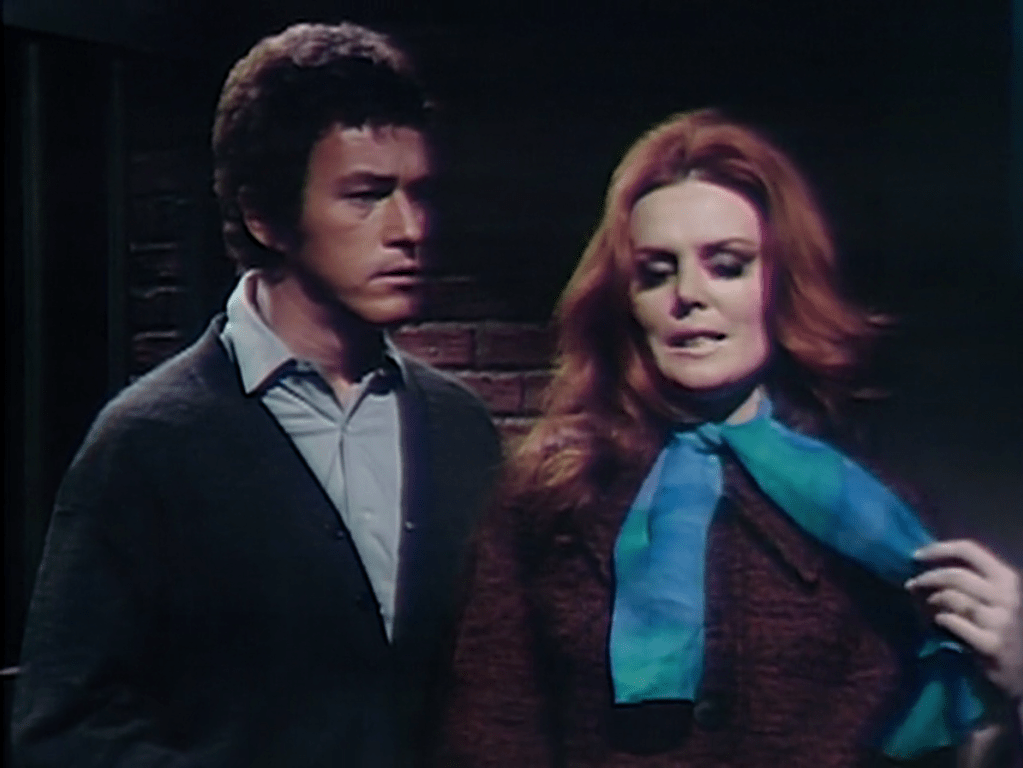


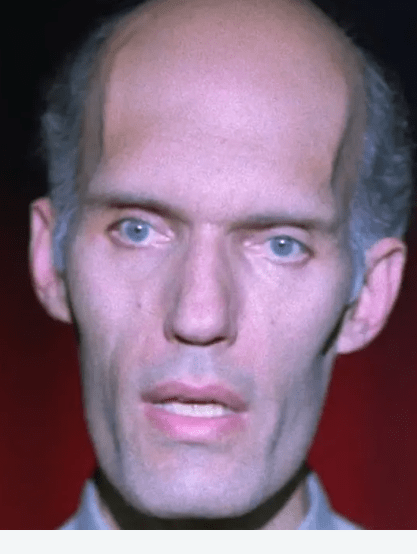


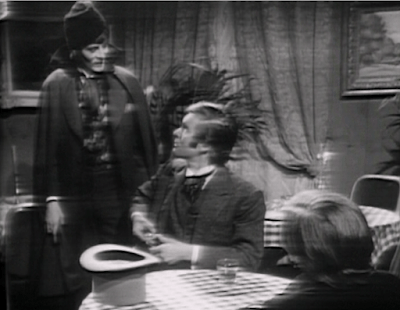

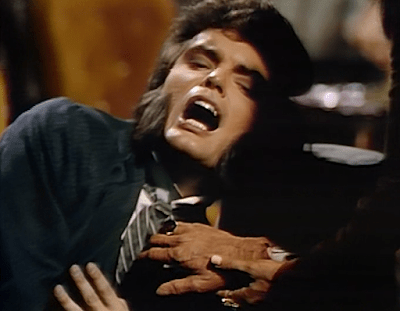
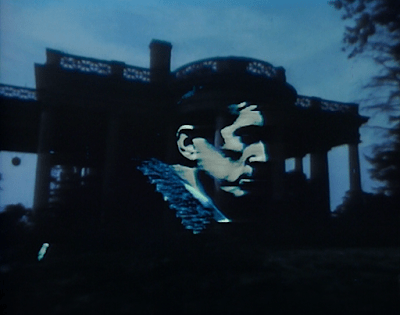

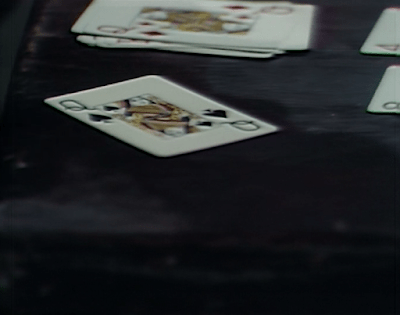


 Dark Shadows Commentary