Episode 675: The best alibi you can have in this town

In #128, wisecracking waitress Maggie Evans opened a conversation in the diner at the Collinsport Inn with that old familiar ice-breaker, “Whaddaya hear from the morgue?” The show took us all the way to Phoenix, Arizona for a trip to that city’s morgue in #174, but it is only today we see the inside of Collinsport’s own morgue for the first time. Sheriff George Patterson brings heiress Carolyn Collins Stoddard in to identify a body found on her property. Carolyn is shocked to find that it is her friend, Donna Friedlander.

Last night, Carolyn and Donna were in the drawing room of the great house of Collinwood with permanent houseguest Julia Hoffman and old world gentleman Barnabas Collins, who lives in the Old House on the same estate. Also in the room was Chris Jennings, a mysterious drifter who caught Carolyn’s fancy and who now lives in the caretaker’s cottage on the estate as her guest. Barnabas invited everyone to dinner at his house. The ladies delightedly accepted, but Chris begged off, saying he would have to leave immediately to keep an important business engagement in Bangor, Maine. Donna said that she was going home to Bangor and that she was ready to leave, and asked Chris for a ride. When he tried to squirm his way out of taking her, Barnabas looked on with smug self-satisfaction.

This morning in the morgue, Carolyn tells Sheriff Patterson that the last time she saw Donna, she was leaving with Chris. But she recoils from the implication. She cannot believe that Chris had anything to do with Donna’s death.

Carolyn does not know what Barnabas has figured out. Chris is a werewolf. When Barnabas told Julia that he had come to that conclusion, she was unconvinced. Barnabas’ dinner invitation was a ploy intended to elicit just the panicked reaction Chris did have. Barnabas’ look of triumph at Chris’ frantic attempts to ensure that he is alone on this night of the full Moon reflects his belief that he has been proved right.

Barnabas went to the cottage some time after the Moon rose, intending to use his silver-headed cane to take control of Chris in his werewolf form. But he delayed too long, and by the time he got there the cottage was vacant and Donna’s mangled corpse lay in the woods nearby.

We cut to the cottage, where we see a disheveled and bloodstained Chris come home. He has just had time to change his shirt and set some furniture right side up when Carolyn drops in. She has come to warn Chris that Sheriff Patterson is coming. The sheriff is right behind her. Carolyn leaves the two of them alone. Chris refuses to allow a search of the premises; when he spots Donna’s purse on his table, he throws a newspaper over it. The sheriff somehow fails to notice this, but takes Chris to his office for questioning.

In the drawing room, Barnabas and Julia are fretting over Donna’s death. Barnabas asks “Could we have stopped it?” He decides that they could not have, and that whatever sequence of events led to the killing must have been “Donna’s fault.” It is always fun to watch the scenes where Barnabas faces the horrific results his actions have on other people, strikes a noble pose while briefly considering the possibility that he may be partially responsible for them, and then agrees with Julia that it is pointless for him to blame himself. Julia and Barnabas’ self-exculpatory attitudes are so transparently absurd that you have to admire Grayson Hall and Jonathan Frid for keeping straight faces while delivering their dialogue.

Meanwhile, Carolyn has called the Collins family lawyer, Richard Garner. Garner agrees to help Chris. We saw Garner and his son Frank a number of times in the first months of 1967, but he hasn’t been on screen since #246. He has only been mentioned a handful of times since then, most recently in #577. This is the last time his name will come up.

Back in the drawing room, Barnabas tells Julia that he can see “So many possibilities” for dealing with Chris’ problem. Frid’s delivery of this line made my wife, Mrs Acilius, shudder. She could hear the evil in his voice as he shows us Barnabas playing God.

Chris is in an interrogation room, telling Sheriff Patterson a series of mutually contradictory lies about what he did last night. The sheriff says he’s going to leave him alone for a few minutes so that he can come up with a more plausible story. You might think this was a sarcastic remark, but in this context it seems it might actually be sincere. Sheriff Patterson’s failure to notice Donna’s purse on Chris’ table is of a piece with the complete nonfeasance he has shown all along, and Vince O’Brien delivers the line so warmly it doesn’t sound like a joke. Moreover, Sheriff Patterson’s predecessor as Collinsport’s chief representative of law enforcement, Constable/ Sheriff Jonas Carter, capitulated to the Collins family’s directions to cover up a crime in his final appearance on the show, back in #32. Longtime viewers may suspect that Sheriff Patterson is as averse to the tough parts of his job as was Constable/ Sheriff Carter.

While Chris is alone in the interrogation room, he decides to tell Sheriff Patterson the truth when he comes back. He does in fact open his mouth and get the first few words of a confession out when the sheriff cuts him short. He says that Barnabas Collins called the office to tell him Chris was with him last night, and that Barnabas is “about the best alibi you can have in this town.” He shakes Chris’ hand and sends him on his way. Law enforcement characters on Dark Shadows are symbols of helplessness, and after that moment Sheriff Patterson has reached the zenith of that quality, achieving a measure of futility that cannot be surpassed. We never see him again.
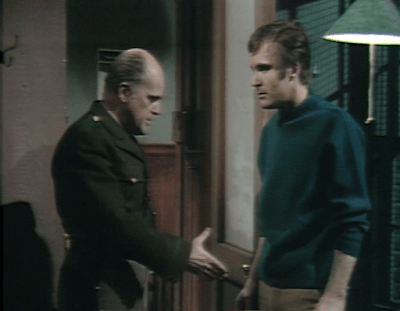
Sheriff Patterson completes his quest. Screenshot by Dark Shadows Before I Die.

Chris goes home and finds Barnabas waiting for him. Chris expresses his gratitude for the alibi Barnabas gave him, but keeps trying to get him to leave before the Moon rises. Barnabas tells him that when he leaves, Chris will leave with him. Barnabas closes the episode by telling him that he knows that he is not only Chris Jennings, but that “You are also the werewolf.”

This episode marks the final appearance not only of Sheriff Patterson, but also of Vince O’Brien. O’Brien joined the show in #148 as the second actor to play Lieutenant Dan Riley of the Maine State Police. O’Brien’s stolid manner suited the role of that ineffective investigator, but he was much less fun to watch than was the man who originated the part, the charming John Connell.

O’Brien took over as the second Sheriff Patterson in #328. He was again a step down from his predecessor; the first Sheriff Patterson was Dana Elcar, an extraordinary performer who always found a way to give the audience hope that his character was only playing dumb. Other actors filled in for O’Brien a couple of times, Angus Cairns in #341 and #342 and Alfred Sandor in #615, leading some fans to refer to “the Patterson brothers” (whose parents named all of their sons George) and others to speculate that for a time Collinsport allowed any man to be sheriff who was willing to change his name to “George Patterson.” Like O’Brien, Cairns and Sandor were accomplished professionals, but none could match Elcar’s gift for overcoming bad writing and keeping our attention focused on the sheriff.
Episode 615: Protecting the vampire

Sheriff Patterson is at the estate of Collinwood. In yesterday’s episode, local man Joe Haskell tried to strangle old world gentleman Barnabas Collins in his house on the estate. Joe is in custody now, and the sheriff opens the episode with questions for some people in the great house.

Sheriff Patterson is played today by one-time substitute Alfred Sandor. I don’t know how much notice Sandor had that he would be playing the part, but it wasn’t enough for him to memorize his sides. He takes at least as many glances at the teleprompter as he has lines. He has a fine sonorous voice, an easy physicality, and when he can break free from the teleprompter he creates the impression that the sheriff is listening and thinking. I wish that he, rather than Vince O’Brien, had become the default Sheriff Patterson after Dana Elcar left Dark Shadows. The sheriff never gets to catch any of the bad guys, but it would be nice if he at least seemed like he had some brains.

The sheriff tells Barnabas’ inseparable friend, Julia Hoffman, MD, that Joe had claimed Barnabas was trying to kill him. Julia dismisses this as absurd. Joe says he was in Barnabas’ house recuperating from an injury, and awoke to find Barnabas offering him medicine that was poisoned. Only Julia’s intervention kept Joe from taking the medicine. Julia concedes that this is true.

Julia wondering what to say. Screenshot by Dark Shadows Before I Die.

New viewers might conclude from this that Julia is a compulsive truth-teller; after all, she is the only one who really knows that the medicine was poisoned, and she found that out by conducting tests which would probably consume all of it. But not only does she share her findings with the sheriff, she went out of her way to leave a sample of the poisoned medicine for the police to do follow-up testing on.

In fact, Julia is Dark Shadows‘ most fluent and most persuasive liar. It is unaccountable, not only that she confirms that the medicine was poisoned, but that the only suspects she lists when the sheriff asks who could have added the poison to the medicine are herself, Barnabas, Barnabas’ servant Willie, and Maggie Evans, The Nicest Girl in Town. While she and Barnabas have already proven their willingness to pin their crimes on Willie, he is too closely associated with them to be a desirable choice for the role of patsy, and no one will believe Maggie is guilty of anything- “The Nicest Girl in Town” might as well be her legal name.

Barnabas has been under the power of vampire Angelique for a couple of weeks. Julia is an expert on vampirism; she joined the cast in the summer of 1967 when she was treating Maggie for the aftermath of abuse she suffered from Barnabas when he was a vampire. She then won her way into Barnabas’ confidence and used him as the subject for an experimental treatment she had devised to cure vampirism. After that treatment failed, another mad scientist devised a different procedure for freeing Barnabas of the effects of his curse, and it was Julia who completed that procedure successfully. She then herself spent time as the victim of another vampire, giving her another perspective on the topic and making her uniquely knowledgeable on it. She has seen abundant evidence of Barnabas’ condition in the many days since Angelique first bit him, but it is only at the end of today’s episode, when she pulls back his cravat and sees the bite marks, that she finally puts two and two together. Combined with her sudden fit of honesty when the sheriff is questioning her, her slowness in figuring out what’s going on with Barnabas makes us wonder what is wrong with her. It’s true she hasn’t been getting much sleep lately, maybe that’s the problem.

There is a little support for this idea in a scene when the sheriff meets Julia in the woods. He is coming from Barnabas’ house, she is going there. He says that he’s surprised to find her in the woods at night, and she says “The woods are- are scary.” It isn’t like her to stumble and repeat a word, nor is “scary” a word she would typically use. Educated adults on Dark Shadows favor a more formal lexical register, saying “frightening” or something like that, leaving such words as “scary” to mark a grossly uneducated character like Willie or a child like young David Collins. Perhaps this line indicates that Julia just needs a good rest.

Many commenters remark on some irregularities in Angelique’s costume, speculating that one of them might be Lara Parker’s left nipple. I don’t think so; it just looks like fabric pilling, as witness the fact that there are multiple prominences in different spots. In the first year of Dark Shadows, Joan Bennett and Alexandra Moltke Isles sometimes did wear tight-fitting tops that revealed the shape of the flesh underneath more precisely than you might expect; that happened often enough that I took it to be a conscious decision to challenge the audience to take a matter-of-fact attitude toward female anatomy, and thought the grownup thing to do was not to mention it. But the show long ago forgot about grownup attitudes, so it is only to be expected that people are still giggling about what they think they can see in this shot.

There is a small prominence in the right spot, but the more conspicuous one is some inches above and to the left. So I suggest you all calm down. Screenshot by Dark Shadows Before I Die.

Episode 505: Prepare yourself for an ordeal

Sheriff Patterson, leading his deputies through the woods in search of a very tall man named Adam who has escaped from gaol, finds a scrap of Adam’s clothing on a tree. He looks ahead and sees the Old House on the estate of Collinwood. He remarks “That’s the old Collins house. Every time anything goes wrong around here, that’s where all roads seem to lead.” He takes his party toward the house. Once they are gone, Adam comes out from behind a tree, and goes in another direction. Unknown to the sheriff and his men, Adam is a Frankenstein’s monster. He is four weeks old and has a vocabulary of fewer than a dozen words, but he easily outwits Collinsport’s entire law enforcement community.

The Old House is home to Barnabas Collins, whom the audience knows to be a recovering vampire. The sheriff calls on Barnabas and recaps the story for his benefit. In his post about the episode, Danny Horn ridicules every part of this preposterous scene, getting half a dozen genuine laughs. I won’t compete with him, but I do want to point out that while in both Wednesday’s episode and yesterday’s, the sheriff said it took twenty men to subdue Adam and take him into custody, today he says it took six. Maybe by next week it will be down to one deputy and a mynah bird.

Adam has abducted heiress Carolyn Collins Stoddard. When he eludes the police, he goes to the abandoned structure where he has cooped her up. He had left her there to go look for food. That mission was interrupted by his arrest. Now, she asks to go home. He is carrying her back there when they meet the sheriff, his deputies, and Barnabas at the top of Widows’ Hill. From the second episode, we have known that people plunge to their deaths from this hill. We’ve heard stories about several such incidents, have seen a number of characters come close to falling from it, and in #425 we saw gracious lady Josette make the fatal leap. Carolyn slips from Adam’s arms to the edge of the cliff; the deputies see him pull her up. She runs into Barnabas’ arms, and Adam falls.

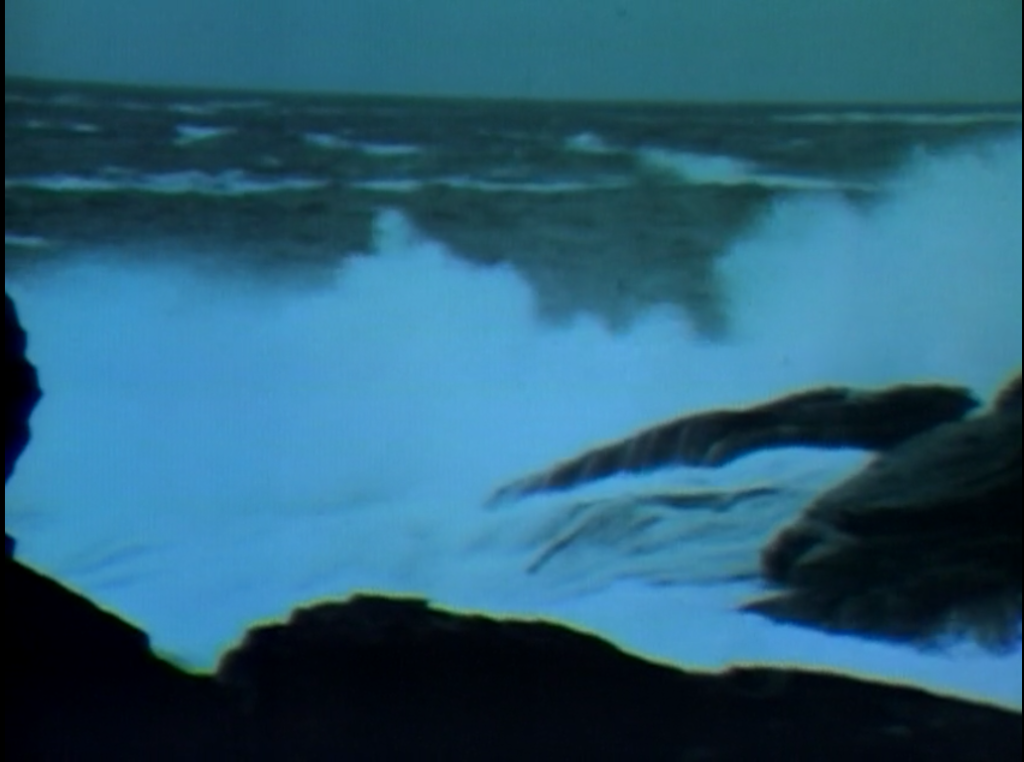
After Adam’s fall, we hear a message that is very familiar to us, but that Barnabas and his friends have never heard. Adam was created in an experimental procedure that was meant to relieve Barnabas of his vampirism. His creator, mad scientist Eric Lang, died shortly after recording an audiotape explaining that as long as Adam lives, Barnabas will be human, but that he will become a vampire again if he outlives Adam. This message plays out over images of the waves crashing into the rocks of the shore. It’s an effective visual complement to the message, a metaphor for the overwhelming power that will engulf Barnabas and the rest of them if Adam is in fact dead.

Episode 504: A talent for making everyone feel guilty

Well-meaning governess Vicki was the main character of Dark Shadows for its first year, but has been receding further and further to the margins since. Today she returns after a 14 day absence, the first time she has been off screen so long.

Vicki is in the drawing room of the great house of Collinwood with her employer, matriarch Liz. Liz is distraught because her daughter Carolyn has been abducted by a strange man. Liz fears that Carolyn is dead or dying; Vicki urges her to set those fears aside. The police telephone; they have captured the man, but Carolyn was not with him, and he has not answered any of their questions. Liz and Vicki set out for the gaol to see him.

They are accompanied by a sheriff’s deputy. The Collinsport police are exceptionally useless, but even by their standards this deputy is a low performer. Though the man is so strong that it took twenty men to subdue him and bring him in, the deputy enjoys taunting him. He sticks his service revolver in the cell; the man is shackled to the wall, but he is so tall he sweeps his hand into contact with the gun. If the script didn’t say otherwise, he could easily take it from the deputy. Liz orders the deputy to stand back out of the man’s line of sight. Since she owns most of the town, he grudgingly obeys.

The deputy puts his weapon within Adam’s reach.

Yesterday, Liz went looking for Carolyn at the Old House on the estate, home to her distant cousin Barnabas. She found Barnabas’ servant Willie on the ground, suffering from a fresh head wound. Willie told her that the man had been by a few minutes before, and that he had been carrying the unconscious Carolyn. He also referred to the man as “Adam.” When Liz asked him why he used that name, he denied that he did and began jabbering about some bad dream that had frightened him. Today, Liz addresses the man as Adam, and he responds, proving that Willie does in fact know more about him that he will admit.

Liz and Vicki tell Adam that they will treat him as a friend if he tells them where Carolyn is. Adam knows the word “friend.” He repeats it, and adds “food!” Again he says “Friend, food!” The women do not know what he is driving at. They give up and go home.

Returning viewers know that Adam has stashed Carolyn in an abandoned structure that looks exactly like Fred and Wilma Flintstone’s house, that he calls Carolyn “Friend,” and that he had gone out to look for food for her when he was captured. He is dejected when he cannot make it clear that she is hungry.

Liz and Vicki return to Collinwood. They spend several seconds taking off their coats in unison. In the early days of the show, there were a number of scenes designed to emphasize Liz and Vicki’s resemblance and to present each as the other’s reflection in support of a storyline that led us to believe that Vicki was Liz’ unacknowledged daughter. That storyline was forgotten long ago, and it isn’t entirely clear what director Jack Sullivan is getting at here.

Back in the drawing room, Liz tells Vicki her reasons for believing that Barnabas knows a great deal about Adam. Apparently the doors separating the drawing room from the foyer amplify sound, because as the camera takes us from the drawing room to the foyer Liz and Vicki’s conversation only becomes more audible. Liz’ new sister-in-law is in the foyer. This woman calls herself Cassandra, but regular viewers know that she is in fact wicked witch Angelique. Vicki knows that perfectly well. Vicki traveled back in time in #365 and spent nineteen weeks living under the same roof as Angelique while Angelique wrought havoc on the Collins family of the 1790s and framed Vicki for her crimes. Angelique’s only disguise as Cassandra is a black wig- otherwise, she looks, sounds, and moves exactly as she had when Vicki knew her in the eighteenth century. As a result, Vicki is very much on her guard around her.

Angelique/ Cassandra enters the drawing room. Liz excuses herself, and Angelique/ Cassandra demands to know why Vicki doesn’t like her. When Vicki says that she resembles someone she didn’t get along with, Angelique/ Cassandra proclaims that she isn’t that person, bursts into tears, and runs out. Vicki stays in the drawing room, but the camera follows Angelique/ Cassandra to the staircase, where we see her smile gleefully.

Liz returns, and Vicki tells her she may have misjudged Cassandra. It doesn’t speak well of Vicki’s brainpower that a single display of crocodile tears would override the memory of their long and painful acquaintance, but since Barnabas and the others who are doing battle with Angelique/ Cassandra refuse to accept Vicki’s help, she may as well forget everything she knows. Liz tells her that she doesn’t think she misjudged Cassandra, and says she doesn’t trust her either.

Back in the gaol, the idiotic deputy goes back to Adam’s cell to taunt him some more. When Adam protests, the deputy opens the door and waves his baton at him. He places himself within easy reach of Adam, who grabs him and knocks him unconscious.

Yesterday, the high sheriff said “I’m not a stupid man.” He may not have been as stupid as is this grinning imbecile, but it is on his responsibility that he has a badge and a gun.

Another deputy enters. He sees his moronic colleague on the floor, the bars twisted in the window, and no sign of Adam.

Window.

Adam is 6’6″, so it’s difficult to see how he could fit through this opening. Perhaps he is not only tremendously strong, but is also a contortionist.

Episode 503: Man made monster

Adam the Frankenstein’s monster has abducted heiress Carolyn and taken her to an abandoned structure. Carolyn says the structure looks like a root cellar. She doesn’t have a television, or she would have recognized it at once. It’s the old Flintstone place.

Screenshot by Dark Shadows Before I Die.

Adam was created in an experimental procedure mad scientist Julia Hoffman completed, an experiment that Julia’s late colleague Eric Lang designed to free old world gentleman Barnabas Collins from vampirism. The experiment was a success, but Barnabas and Julia are the world’s worst parents. They have kept Adam chained to the wall of the prison cell in the basement of Barnabas’ house for the first three and a half weeks of his life. As far as Adam is concerned, it is normal for people to confine one another in underground spaces.

The cell was in the basement of the house when Barnabas and his little sister Sarah were growing up there in the eighteenth century; in #260, we found that Sarah had found a secret passage leading out of the cell, suggesting she must have spent a lot of time there in her nine years of life. Perhaps the cycle of abuse that Adam is perpetuating goes back a very long way.

Barnabas is out searching for Adam and Carolyn. Julia is in his house, along with his servant Willie. Julia finds that Willie has had a nightmare and is compelled to tell Carolyn about it. The nightmare is part of The Dream Curse. One person after another has the same dream, which the audience sees dramatized every time. Then that person wrestles with a compulsion to tell the nightmare to someone else. We usually see that, too. Finally, the person does tell the dream, giving a speech to repeat the material to us yet again. This time-waster will go on indefinitely, and is supposed to end with Barnabas reverting to vampirism.

Julia knows all about this. She had the dream herself, and has interacted with others who have had it since. Today, she tries to hypnotize Willie into forgetting the dream.

It is very strange Julia hasn’t tried this before. She has a phenomenal ability to use hypnosis to erase memories, so regular viewers would expect her to turn to that right away. When she starts giving Willie the instructions, kaleidoscopic colors pulse on the screen, suggesting that she will have yet another great triumph. Willie does have a vision of Carolyn in the Flintstone house, so Julia must have unlocked his capacity for extrasensory perception. But he still remembers the dream, and is still driven to tell it to Carolyn.

The sheriff comes by. He tells Julia and Willie about evidence that Adam has a connection with the house. They deny everything. Willie is a panicky mess. He is still upset because of the dream, and the barking of the police tracking hounds outside triggers his memories of the nights when Barnabas’ bloodlust prompted dogs to howl. Julia is able to parry all of the sheriff’s questions and observations, but she is too shaken to produce her usual stream of perfectly plausible lies.

Adam comes to the house. He is hungry, and it is the only place he has ever seen food. The sheriff sees him, threatens to shoot him unless he stops, and opens fire immediately. Adam isn’t killed; in fact, he is so healthy that it takes twenty (20) men to subdue him and take him to gaol.

The sheriff sticks around and tells Julia and Willie that Adam gave them a look of recognition. Julia dismisses that, and the sheriff protests “I’m not a stupid man!” Regular viewers know that he is in fact an utterly stupid man, and that Julia is extraordinarily intelligent. Typically, she wouldn’t need more than five seconds to distract him from whatever was on his mind and get him chasing after an imaginary squirrel. But she is so run down from the ongoing crises that she is reduced to challenging him to “Prove it!”

Episode 341: A fatal curiosity

Mad scientist Julia Hoffman and vampire Barnabas Collins are visiting Dr Dave Woodard in his office. Woodard has stolen the notebook in which Julia has recorded the truth about Barnabas and is planning to hand it over to the sheriff. At Barnabas’ insistence, Julia has prepared a hypodermic with a potion that will induce a heart attack. He orders her to give Woodard the lethal injection.

In her reluctance to kill her onetime friend, Julia suggests that Barnabas turn Woodard into a vampire. Julia believes she will soon find a cure for vampirism. So, Woodard will just be one more patient who will benefit from her imminent success. Neither he nor Barnabas receives her brainstorm with any great enthusiasm.

Woodard claims that, even if he became a vampire, he would have free will and would be able to fight Barnabas and destroy himself. He then asserts that Barnabas, too, has the ability to do the right thing. As viewers of drama, we are predisposed to believe that characters whom we hear talking and who have motivations we can understand are at liberty to choose what they will do, so we may believe that Woodard is right. But we haven’t seen any evidence to support his contention.

Julia keeps trying to postpone the killing. Exasperated with her procrastination, Barnabas tells her to hand him the hypodermic. She does so. As he is about to give the shot, Woodard claims to see the ghost of Barnabas’ little sister Sarah. Barnabas is so desperate to see Sarah that he falls for this and lets Woodard go. Julia calls out “Stop him!”

Barnabas is furious that Woodard has hit him at his most sensitive spot. As he regains his grip on Woodard, he jabs him in the shoulder with the needle. While Woodard crumples at his feet, Barnabas picks up on the words Woodard had earlier used to describe him, exclaiming “Loathsome I am, and evil! You can mock me for that, but leave my pain alone!” Even after that exclamation, Barnabas asks Julia if Sarah really was there. We don’t see her, but we do hear the strains of “London Bridge,” a song that has always before told us that Sarah is present.

Barnabas places Woodard’s corpse in the desk chair. He appears to be enjoying himself hugely while he taunts Julia for her squeamishness. He asks her, as a medical doctor, to verify that Woodard is dead; she can’t bring herself even to look at the body. She wants to leave immediately; he asks if she plans to leave the needle on Woodard’s desk. Once she puts the murder weapon in her purse, she again wants to rush out; he asks if she is planning to leave the notebook in Woodard’s pocket.

Even after they return to his house, Barnabas continues tormenting Julia. He tells her she will soon grow accustomed to her new identity as a murderer. She resists the label, and he magnanimously agrees to share half the responsibility for the killing. She says she will stop trying to cure him and go away; he tells her that will no longer be possible. They need each other more than ever now. When he tells her that he is her only friend, she hears Woodard’s voice saying “You no longer have friends.” As those words sound, so do the notes of “London Bridge.”

Barnabas is at his most compelling in these scenes, thanks to the actor who plays him. Jonathan Frid’s style of acting was rather old-fashioned even in 1967, but his achievement today is extraordinary. He takes us on a dizzying ride from horror at the brutal killing of Dr Woodard, to pity for the vastly lonely man longing for his little sister, and back to horror at Barnabas’ glee in bestowing the title of murderer on Julia. I can’t imagine any performer doing a better job.

The killing of Dr Woodard is quite a shock. It is only the second premeditated murder we see on Dark Shadows. Undead fire witch Laura Murdoch Collins used black magic to cause parapsychologist Peter Guthrie to have a fatal car crash in #186. There’s no magic this time- this is a plain old death by poisoning. We also saw Barnabas kill seagoing con man Jason McGuire, but that was not a premeditated act. Jason opened Barnabas’ coffin at sunset, and Barnabas, apparently by reflex, strangled him. That’s a reflex many of us might understand, I’m certainly not at my best when I first wake up. So when Barnabas wrestles with Woodard and jabs him with the needle, we are entering new territory.

When Julia and Barnabas are back in his house, she throws the needle into the fireplace. The Dark Shadows wiki disapproves of this action:

The destruction of the murder weapon was taken more lightly in this scene than it would have been in real life. The heat from a normal fireplace would not be hot enough to melt glass. The metal needle would have been blackened, and if someone looked through the ashes thoroughly, it would have been discovered. Had the syringe been discovered, Woodard’s death would have been ruled a homicide.

Dark Shadows wiki, episode 341.

I don’t see why the presence of a warmed-over medical sharp in Barnabas’ fireplace would mean that “Woodard’s death would have been ruled a homicide.” The police haven’t made any connection between Woodard’s death and Barnabas’ house. Even if they had, they would have no reason to suppose a hypodermic needle in his fireplace would have anything to do with Woodard. Julia is keeping it quiet that she is a medical doctor, but it isn’t a secret from the authorities. She spends most of her time at Barnabas’ house and is treating him for what she believes to be a rare blood disease, so she’s likely to have all sorts of medical supplies there. It is never specified what the chemical was that caused Woodard’s death, but if it was potassium chloride, it would have had the effects Julia describes and the heat of the fireplace would be sufficient to cause it to disappear without a trace in a little flash of dark purple flame. And of course potassium chloride dissolves in the bloodstream so completely that even a large dose of it cannot be detected in a normal postmortem examination. Unless they had dripped some of it into Woodard’s ashtray, Julia and Barnabas would have no reason to believe that the police would be looking for potassium chloride.

Julia moves to throw her notebook into the fire after the needle. Barnabas intercepts it in a move that looks so much like what you’d see on a basketball court that I count it as a blooper.

“Hoffman goes up, and is DENIED by Collins!” Screenshot by Dark Shadows Before I Die.

In between the scenes with Barnabas and Julia, there is some stuff with the sheriff and artist Sam Evans. The sheriff ambles into The Blue Whale tavern and finds Sam starting his fourth shot of whisky. They talk about Woodard, and Sam insists they go to his office to look for him. For the first 40 weeks of Dark Shadows, Sam’s alcoholism was a substantial story element, part of the “Revenge of Burke Devlin” arc. When that arc finally dried up in #201, Sam’s alcoholism went away. He’s a social drinker now. Still, he used to be the town drunk, and apparently that’s a higher post than sheriff. The sheriff follows Sam’s orders and accompanies him to Woodard’s office.

They knock on the office door. There is no answer. Sam suggests they break the door down. They haven’t tried to turn the knob, so they have no reason to suppose it is locked. Returning viewers will recall that yesterday Julia just walked into the office, without even knocking, and she and Barnabas did not lock the door behind them. So we can be fairly sure it is not locked. Still, orders are orders, so when the Town Drunk (Retired) says it’s time to break the door down, the sheriff watches him respectfully. Of course the whole set is made of a sheet of plywood, so when Sam “flings himself” against the door, he has to maintain a ludicrous gentleness to keep any part of it standing.

Inside, they find Woodard dead in his chair. Their response is bewildering. At first they are going to call for help, but then decide that because Woodard is dead there is no point. Eventually the sheriff remembers that he ought to call the coroner. They also take turns declaring that they believe Woodard’s death was the result of foul play.

Episode 329: The truth about Willie

We open in the Old House on the great estate of Collinwood, home to courtly gentleman Barnabas Collins. In a bedroom there occupied by Barnabas’ servant Willie, Sheriff George Patterson and artist Sam Evans have found evidence that convinces them they have solved the case of the abduction of Sam’s daughter Maggie. They found Maggie’s ring hidden in a candlestick. The room is in Barnabas’ house and he has unlimited access to it. Further, the house is the only place Willie could possibly have kept Maggie if he had held her prisoner. But for some unexplained reason, they are sure that the ring proves that Willie and only Willie abducted Maggie. When Barnabas says that he feels somehow responsible, Sam rushes to tell him that he mustn’t blame himself.

The sheriff says that he will be going to the hospital, where Willie is recovering from gunshot wounds the sheriff’s deputies inflicted on him when they were looking for a suspect. Barnabas hitches a ride with him.

At the hospital, Willie’s doctor, addled quack Dave Woodard, is conferring with his medical colleague Julia Hoffman. When he steps out of the room for a moment, we hear Julia’s thoughts in voiceover. She is thinking about killing Willie before he can regain consciousness and tell a story that will make it impossible for her ever to practice medicine again. She thinks of Barnabas’ voice demanding that she kill Willie. She is reaching for the catheter through which Willie is receiving fluids when Woodard comes back in. She tells him she was checking it, and he is glad when she confirms it is working correctly.

Returning viewers know that Barnabas is the one who abducted Maggie and committed the other crimes of which Willie is suspected, that he is a vampire, that Julia is a mad scientist trying to cure him of vampirism, and that in pursuing her project she has become deeply complicit in Barnabas’ wrongdoing. We also know that she has several times told him that she will draw the line at killing anyone herself, but that she has involved herself in so many other evil deeds that it was just a matter of time before she found herself on the point of crossing that line.

Barnabas and the sheriff arrive at the hospital. In the corridor, Barnabas is bewildered to find that the sheriff will not allow him to be present while he questions Willie. The sheriff has been so careless about treating miscellaneous people as if they were his deputies- for example, enlisting Sam yesterday to help him search Willie’s room- that Barnabas’ puzzlement is understandable. The conversation goes on for quite a while.

Note the poster that reads “Give Blood.” That’s a message Barnabas could endorse. Screenshot by Dark Shadows Before I Die.

The sheriff enters Willie’s room, and greets Julia as “Dr Hoffman.” Woodard thinks Julia has come to Collinsport to investigate Maggie’s abduction, and so he has agreed to keep her professional identity secret from most people in town, including the sheriff for some reason. Therefore, she is startled at this form of address. Woodard explains that now that Maggie’s abductor has been identified, he doesn’t see a point in keeping law enforcement in the dark.

Julia meets Barnabas in the corridor. When she tells him that she didn’t kill Willie, he fumes and calls her a “bungling fool.” He says he will do the job himself, but Julia points out that Woodard and the sheriff are in the room with Willie now. They wind up staring at the clock for hours.

Willie regains consciousness. He doesn’t recognize Woodard. When the sheriff shows him Maggie’s ring, his eyes gleam and he claims that it is his. Returning viewers will remember that before Willie ever met Barnabas, he was obsessed with jewelry. He is terrified when he learns that it is night-time, and says that he knows why he is afraid.

The sheriff and Woodard go out into the corridor to talk with Julia and Barnabas. Woodard tells Julia that she was right- Willie is hopelessly insane. Apparently when they asked him what he was afraid of, he mentioned “a voice from a grave. Nothing else made more sense than that.”

Julia and Barnabas go into Willie’s room. He looks at Barnabas and asks “Who are you?” Barnabas shows surprise that Willie doesn’t know him. Willie asks if he is a doctor. “Yes,” replies Barnabas. “I am a doctor.”

Sheriff Patterson is played by Dana Elcar today. It is Elcar’s 35th and final appearance on Dark Shadows. He would go on to become one of the busiest and most distinguished character actors of his generation.

Elcar had his work cut out for him with the part of Sheriff Patterson. If a police officer on the show ever solved a case, or followed any kind of rational investigative procedure, or interpreted a clue correctly, the story would end immediately. So all the sheriffs and constables and detectives have to be imbeciles. Elcar reached into his actorly bag of tricks almost three dozen times, and always came out with some way to make it seem as if something more was going on in Sheriff Patterson’s mind than we could tell.

My wife, Mrs Acilius, exclaimed “I’m so glad Dana Elcar is playing this scene!” when Barnabas and the sheriff had their long conversation in the hospital corridor. This week’s episodes were shot out of sequence, so yesterday’s was made after Elcar had left. It featured Vince O’Brien as Sheriff Patterson. O’Brien was by no means a bad actor, but he didn’t make the character seem any smarter than the script did. Elcar seems so much like he has something up his sleeve that Jonathan Frid’s insistent pleading makes sense as a cover for a mounting panic. Without Elcar to play against, it might just have come off as whining.

With the conclusion of Willie’s story, this is John Karlen’s last appearance for a long while. Beginning shortly after Barnabas’ introduction to the show in April, his conversations with Willie have been the main way we find out what he is thinking and feeling. More recently, Willie and Julia have been having staff conferences in which they come up with new ideas and add a new kind of flexibility and dynamism to the vampire storyline. From time to time, Willie’s conscience gets the better of him, and he adds an unpredictable element to the story as he tries to thwart one of Barnabas’ evil plans. For all these reasons, removing Willie from the show drastically reduces the number of possible outcomes in any situation they might set up involving Barnabas. His departure, therefore, seems to signal that some sort of crisis is at hand.

In fact, Karlen wanted to leave Dark Shadows because he had a better offer from a soap called Love is a Many Splendored Thing. But the producers knew that no one else could play Willie after the audience had got used to Karlen, and so they wrote the character out until they could get him back. Still, losing Willie puts Barnabas’ story on a much narrower track. So far, each development has led us to speculate about an ever-growing list of directions the story might possibly take. From now on, we are entering a phase where we will often be stumped as to what might be coming next.

Episode 328: My entire career

In the Old House on the great estate of Collinwood, vampire Barnabas Collins frets that his sorely bedraggled blood thrall, Willie Loomis, is failing to die. A couple of weeks ago, the police shot Willie and jumped to the conclusion that he was responsible for the abduction of Maggie Evans, The Nicest Girl in Town, among many other crimes that Barnabas actually committed. He’s been in a coma ever since, and if he dies, Barnabas will be off the hook.

Barnabas tells his co-conspirator, mad scientist Julia Hoffman, that he will go to the hospital and murder Willie. Her assurances that Willie will soon die of natural causes don’t stop Barnabas, but her news that the sheriff is on his way to the house does. Barnabas then orders her to go to the hospital and carry out the murder, but she refuses.

Meanwhile, Sheriff George Patterson, addled quack Dr Dave Woodard, and Maggie’s father Sam are hanging around Willie’s hospital room recapping the story so far. The sheriff wonders where Willie could have kept Maggie during the weeks she was held prisoner. Willie lives in Barnabas’ house and does not appear to have access to any other building. You might think this would be grounds for suspecting Barnabas of involvement, but no such thought crosses the minds of any of the three luminaries keeping Willie company. They just take it for granted that no crime could have taken place in Barnabas’ house.

George, Dave, and Sam, or their intellectual equivalents.

Back in the Old House, Barnabas has had an inspiration. He took a ring from Maggie in #253, and today he hides it in a candlestick in Willie’s bedroom. When the sheriff and Sam come to search that room (but no other part of the house,) Barnabas watches until they’ve given up, then knocks the candlestick over and exclaims in a ridiculously fake voice “Look! A ring!” Sam recognizes it as Maggie’s, and he and the sheriff are convinced it is conclusive evidence of Willie’s guilt.

For her part, Julia has made her way to Willie’s hospital room. She is there with Woodard when Willie shows signs of regaining consciousness. Woodard rushes out to tell the deputy to get the sheriff, and leaves Julia alone with Willie. She looks at Willie’s IV and remembers Barnabas urging her to kill him.

The sheriff and Sam are leaving Barnabas’ house with the ring when the deputy comes to the front door. He announces that Willie is coming to and is likely to start talking at any moment. We end with a closeup of a horrified Barnabas.

Closing Miscellany

In his post about this episode on The Collinsport Historical Society, Patrick McCray gives a fine analysis of the intentional comedy that runs throughout it. In his post on Dark Shadows Every Day, Danny Horn presents an equally fine analysis of the maybe not quite so intentional comedy of the thick-headed Dave, George, and Sam.

During the opening titles, announcer Bob Lloyd tells us that the part of Sheriff Patterson will be played by Vince O’Brien. This week’s episodes were shot out of broadcast sequence, so we will see Dana Elcar as Patterson one more time. O’Brien was on the show four times in January and February of 1967 as the second actor to play Lieutenant Dan Riley of the Maine State Police, an officer attached to an investigation concerning undead fire witch Laura Murdoch Collins. Patterson isn’t much of a character, and even an actor as distinguished as Elcar had trouble making him interesting. If we remember O’Brien from his time as Dan Riley Number Two, we know that he was a competent professional, but we won’t have much hope that he will outdo Dana Elcar.

O’Brien does show beyond all doubt that he belongs on Dark Shadows, though. While the closing credits are rolling, he strolls onto the set behind technical director J. J. Lupatkin’s name.

Screenshot and annotation by Danny Horn at Dark Shadows Every Day.

Episode 323: Partly responsible

Maggie Evans, The Nicest Girl in Town, has amnesia and can’t remember who abducted her in episode #235 and held her prisoner until #260. So the police started a rumor that her memory was returning, camped out in her yard, shot the first guy who strayed into it, and declared him to be the guilty party.

The man with five bullets in his back is Willie Loomis, servant to Old World gentleman Barnabas Collins. Sheriff Patterson tells Maggie, her father Sam, and her boyfriend Joe that he will be going to visit Barnabas and break the news to him about Willie. Maggie expresses sympathy for “poor Barnabas,” who will no doubt be heartbroken to hear ill-tidings about Willie. Sam is sorry to hear the sheriff will have to blight the dear fellow’s night, but the sheriff says Barnabas must be told. Willie lives in Barnabas’ house and, so far as anyone knows, has no access to any other building. So if he held Maggie prisoner for five weeks, you’d think the sheriff would have more to do on a visit to Barnabas’ place than simply deliver a message.

As it happens, Barnabas is the one responsible for Maggie’s plight. Willie was trying to get to Maggie to warn her that Barnabas had heard that her memory was coming back and was on his way to kill her. When the sheriff gets to Barnabas’ house, he finds him with his co-conspirator, mad scientist Julia Hoffman. Julia explains that she just came to the house to borrow a book. It’s four o’clock in the morning, by the way, but the sheriff takes that in stride and tells them what happened to Willie. He apologizes for disturbing them and says he can come back later if they would like. Barnabas says he wishes he could talk to Maggie, and the sheriff offers to take him and Julia to the Evans cottage. They accept this offer, and the sheriff goes outside to wait for them. Barnabas has long since cleaned up the evidence left over from Maggie’s weeks in his dungeon, so he doesn’t have to spend the time the sheriff so thoughtfully provides in tidying up. He and Julia can devote all of it to further conspiring.

Screenshot by Dark Shadows Before I Die.

Only Julia knows that Barnabas was the one who abducted Maggie in May, and only she knows that he has been planning to kill her ever since. But the sheriff and the Evanses drift into their own odd little conspiracy to shelter Barnabas from accountability.

Barnabas tells Maggie that he can’t help but “feel partly responsible” for what happened to her. She and Sam fall over themselves assuring him that he has nothing to feel bad about, that it was wonderful of him to try to rehabilitate Willie and that everyone was very impressed with how far he seemed to have got with that project.

Barnabas goes home. Julia accompanies him. She assures him that Willie will probably die, and urges him to relax, because he is “completely in the clear.” He bids her goodnight, by which I mean he grabs her throat and threatens to kill her if she is wrong. Once he is alone in the house, he thinks of the various people who might be able to bring his secrets to light. He settles on his ten year old cousin David, and resolves that “something must be done to keep him from exposing me, and it must be done soon!”

There is a touch of social satire in the deference everyone pays Barnabas. In #26, high-born ne’er-do-well Roger Collins wanted a particular service from Sheriff Patterson’s predecessor, the hapless Constable Jonas Carter. He told Carter that “My family is responsible for over half the jobs in this town,” and made a dark reference to an upcoming election. In #32, Carter went along with the Collins family’s cover-up of a case involving David, and in #272 and #273 Sheriff Patterson himself showed a mind-bending amount of solicitude to matriarch Elizabeth Collins Stoddard when she called to report that she had murdered her husband and that his body was buried in her basement.

Among the jobs for which the town has the Collinses to thank was an important one of Sam’s. In #222, Barnabas commissioned Sam to paint his portrait. When he offered to pay $1000, Sam and Maggie’s electrified reactions showed that this was more money than they had seen in a long time. They have good reason to think as highly of Barnabas as they possibly can.

Not only is Barnabas a member of the Collins family of Collinsport, but he is, again unknown to any of his protectors but Julia, a vampire. As such, he is a symbol both of extreme selfishness and of the dead past holding back people who want to make a new future. Dark Shadows does not often explore political themes in depth, to put it mildly. But today it does give us a glimpse of the way working people can find themselves defending the position and privileges of their very deadliest enemies.

Closing Miscellany

Barnabas looks at a “portrait” of his little sister Sarah, who died in 1796. We’ve seen this “portrait” many times, but usually it was at something of a distance from the camera, often at an oblique angle, and rarely shown for more than a brief moment. The typical TV set in 1967 would have allowed the viewer to believe it was a painting. But this time it fills the screen and is stationary for several seconds. Even though this episode only survives in an especially low-quality kinescope, it is impossible to overlook the fact that it is a photograph of Sharon Smyth, the child actress who plays Sarah’s ghost, taken at least 30 years before Joseph Nicéphore Niépce built his first camera.

Sarah Collins, d. 1796

This episode has an unusually large cast. In addition to the six regular actors, three of Sheriff Patterson’s deputies appear. None of them is credited, but the Dark Shadows wiki names them as Ed Crowley, Ted Beniades, and Dennis Johnson.

Episode 272: Nothing downstairs

Reclusive matriarch Liz has spoiled her wedding to seagoing con man Jason by telling everyone that she was only marrying him to keep him from telling that she’d murdered her first husband and he’d buried the body in the basement. Fake Shemp Burke has found a gun and points it at every other character.

Jason denies Liz’ story, knocks the gun out of Burke’s hand, and runs out of the house. Burke runs after him and fires a couple of shots at a figure he assumes to be Jason, though it could be the sheriff or a small child or some other target of convenience for all he knows. The original Shemp Howard might have thought that last display of stupidity was a bit over-the-top for the Three Stooges. On Dark Shadows Every Day, Danny Horn has a bit of fun with Burke’s carelessness. His whole post about this episode is funny.

Out in the woods, Liz’ brother Roger looks directly at Jason, fails to see him, and moves on.

He’s right there, for crying out loud. Screenshot by Dark Shadows Before I Die

The sheriff comes and tells Liz that he is very sorry for bothering her with all of this, and assures her that his men will do everything they can to catch Jason and make things as easy for her as they can. Meanwhile, he needs some help digging up the body buried in her basement.

Liz has loudly refused to talk to her lawyers, a wildly bad move in our world, but under Soap Opera Law she has every reason to believe that, as a good person who has already suffered for her deeds, all she has to do is to tell the authorities about a bad person who has profited from his iniquity. The sheriff’s attitude confirms this assessment.

Liz tells well-meaning governess Vicki that she often went into the room where Paul is buried and cried. Vicki had heard sobbing coming from that room several times in the early days of the show, as had housekeeper Mrs Johnson on her first night in the house. At first, the show was equivocal as to whether it was Liz crying or a ghost. That equivocation fit with the show’s initial attitude towards the supernatural, which was to hint that there might be literal ghosts in the background, but to use the word “ghost” primarily as a metaphor for unresolved conflicts based on past events. Eventually, they showed us the door to the room locked from the outside while sobbing came from the inside, confirming that it couldn’t have been Liz. This week the show is committing totally to stories of the paranormal, yet they retreat to the idea that The Sobbing Woman was Liz all along.