Episode 902: I heard breathing

Heiress Carolyn Stoddard is working for her friends, Megan and Philip Todd, in their antique shop. She goes upstairs to tell Megan that Philip has telephoned. Carolyn hears heavy breathing coming from the room where a baby the Todds are taking care of sleeps. Megan comes out of the room and in a most imperious tone demands to know what Carolyn is doing there. She tells her Philip called, and asks about the breathing sounds. Megan sweetens up and says “It’s the radiator!” She says she’ll have to call the plumber about it. Carolyn is unconvinced.

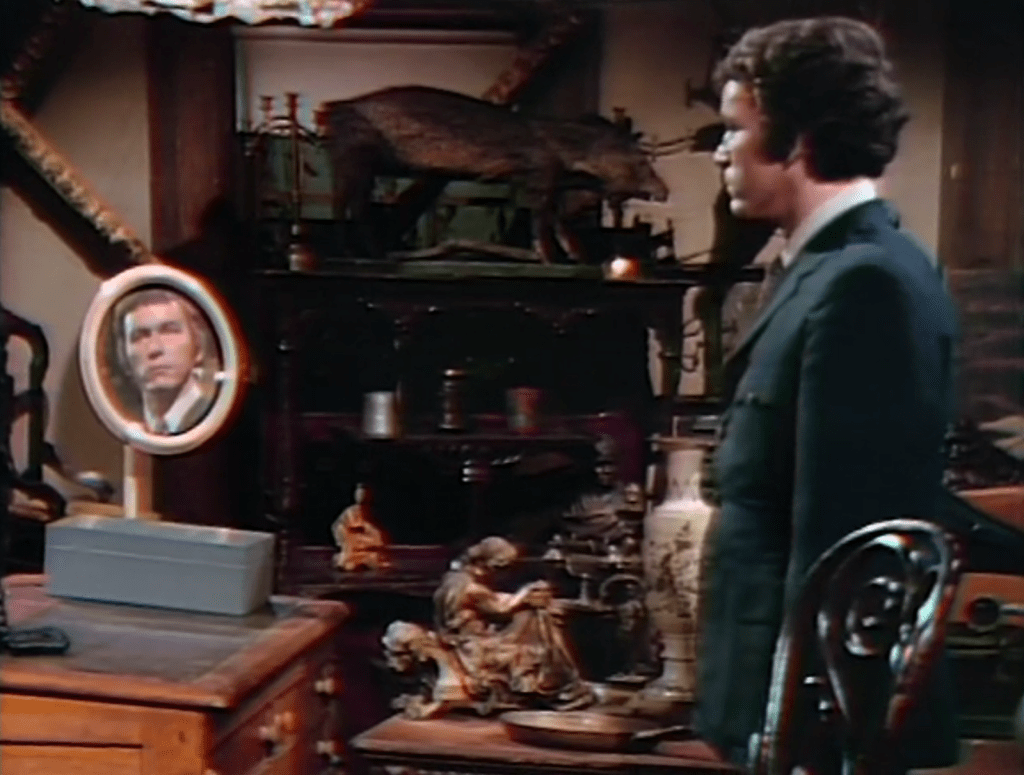
Downstairs in the shop, Carolyn and Megan notice someone looking in the window. The shop is open for business and there is merchandise displayed in the window, but for some reason it unnerves them that they have attracted the notice of a potential customer. All we can see of the man is his clean-shaven upper lip. When Carolyn approaches the window, he runs away. The only sneaky man we have met so far in the current phase of the show is Carolyn’s long-absent and recently returned father Paul. Since Paul wears a mustache, the upper lip is enough to show us that this is a new character, at least new to the ongoing stories.

No mustache. Screenshot by Dark Shadows Before I Die.

Carolyn and her mother Liz live in the great house on the estate of Collinwood. Also among the residents of the great house are Liz’ brother Roger Collins and Roger’s son, strange and troubled boy David. We cut to David’s bedroom, where a book opens by itself. We have seen books do this before on Dark Shadows, but I believe this is the first time I couldn’t see a cord being pulled. They really have come a long way with practical effects.

David reads aloud from the book, something about a child being cloaked in radiant garments. He is interrupted by his Aunt Liz. She asks him to notice that she knocked on the door, and tells him that she is learning to respect his privacy. She says she heard him reading aloud, and asks what it was. He says it was a school book. She starts talking about how terribly cold it is in his room. He brings up her ex-husband, Paul. Liz hadn’t known David was aware of Paul’s return, and gets very uncomfortable. She says he needs friends his own age, and hurries out of the room. Once she is gone, he goes through the room and gathers a lot of cash. Evidently David raised the subject of Paul to get the room to himself.

David does have one friend his own age, Amy Jennings. Amy lives in the great house, down the hall. We just saw Amy in #893 and #896, but she tends to be unmentioned in between appearances. Amy is a favorite of mine, and when they don’t use her name for long stretches I worry they are about to drop her from the show. It would have reassured me if Liz had named Amy as someone David ought to spend more time with.

Joan Bennett tends to do a lot of acting with her eyes when she plays a two-scene with David Henesy, and this is a good example. When Liz is pointing out her own good manners in knocking, it is her eyes that convey her mild amusement at the situation; when she is offering to help David with his schoolwork, her eyes follow him so closely that we notice all of the little movements he makes as he tries to get out of a tutoring session; when she talks about the coldness in the room, she looks from side to side, searching for the open window with increasing consternation; when he asks about Paul, her eyes bulge in their sockets, showing deep alarm. When she tells him he needs friends his own age, she raises her eyebrows, making it sound like a threat. Bennett had been so famous for so long that many of her scene partners would not react to what she was actually doing, but to what they expected her to do, forcing her to add Joan Bennett-isms to her performances. With Mr Henesy, she was free to work simply, and the result was consistently very effective.

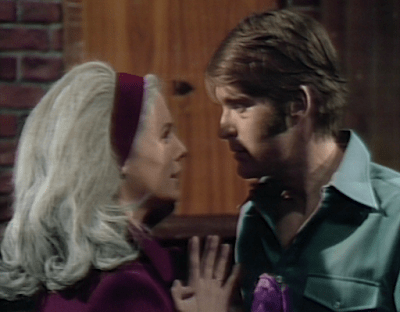
Downstairs, Liz answers the telephone. To her disgust, Paul is calling. He tells her that if she doesn’t meet with him for a talk, she is in danger of losing Carolyn. She agrees to go to his hotel. Carolyn enters in time to catch the end of the conversation. Liz doesn’t want to talk about Paul with her any more than she did with David, and she exits.

Carolyn and David have a scene in the drawing room. She tells him he should go to bed; he says he wants to read the newspaper. He asks her if she hasn’t noticed that he has grown. Since the thirteen year old David Henesy was about the same height as Nancy Barrett, this question is worth a chuckle. David gets excited when he sees that Brewster’s Department Store in the village of Collinsport is going to be open nights until Christmas. He tears the Brewster’s ad out of the paper while Carolyn reminds him he can’t leave the house tonight. He says that of course he can’t, it’s late.

In his post about the episode on his great Dark Shadows Every Day, Danny Horn asked if David’s reaction to the Brewster’s ad is the only reference to Christmas in the whole series. His commenters responded that Christmas is also mentioned in #92, #123, #257, #810 (twice,) #887, and #1050. It’s hilarious to read through the thread and see the citations mount up. I sympathize with Danny, though- I tagged my posts about the first couple of episodes on that list with “Christmas,” because I, too, was sure that the holiday was only named once or twice in Dark Shadows.

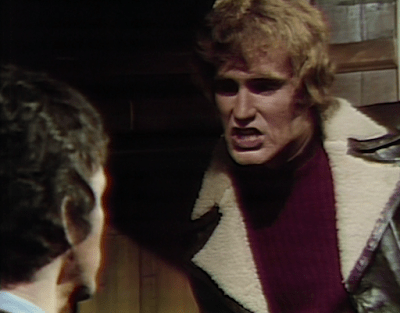
Carolyn exits, and David sneaks out the front door. As he does, a man in a belted overcoat walks into the house. We see him only from the midsection down. He straightens the portrait of the Collinses’ distant cousin Barnabas that hangs in the foyer of the great house. This suggests that whoever he is, he has some connection with Barnabas. Carolyn comes back, and the man hides behind the curtains in the drawing room. This has been a favored hiding place for the last several months, suggesting that the man knows the house. Carolyn leaves, and the man goes out. If all he wanted to do was straighten that portrait, he could count his journey a success. Otherwise, it’s hard to see what the point of it was.

At the hotel, Paul struggles to explain his concerns to Liz. He is hampered by his own ignorance- he does not know exactly who is after him or what they want to do, but he knows they have some kind of sinister plan for Carolyn. Paul admits that Liz has no reason to believe anything he says, after his total failure as a husband, but he keeps urging her to take Carolyn and go far away, not telling anyone that they are going. She is exasperated with what she takes to be yet another of his scams, and tells him that “I’ll never figure out this latest plot of yours.” Indeed, the story is taking shape slowly enough that some viewers will have been saying the same thing.

Bennett and Dennis Patrick had many scenes together from March to July 1967, when he played seagoing con man Jason McGuire. Liz’ relationship with Jason was one-dimensional, consisting of nothing but a series of blackmail threats from him followed by capitulations from her. As her ex-husband, Paul offers far more for Liz to react against, and this scene is far richer and more satisfying than was anything we saw in the dreary Liz/ Jason story.

Liz goes out of the Collinsport Inn and sees David entering the antique shop across the street. The Inn has been part of the show from episode #1, but this is the first time we see a set representing its outside. Cutting between that set and the set representing the exterior of the antique shop, they make an attempt to create a sense of Collinsport as a place. When the show was in black and white, they would occasionally insert video they had taken at various locations in upstate New York and southern New England to achieve that effect, but they haven’t left 433 West 53rd Street since they went to color in August 1967. This quick cut between minimally decorated parts of the studio doesn’t work as well as that footage did, but it is a valiant effort in its own way.

Liz goes into the antique shop and insists Megan let her search the place for David. Since Liz essentially owns the town, Megan can’t say no. We conclude with Liz outside the door of the room upstairs from which Carolyn heard the breathing when we began. We hear the breathing again. David is inside the room, telling some unseen presence that it will like what he bought for it at Brewster’s. Perhaps he found it in the Unseen Presences section of the store. It’s in Collinsport, after all. David stops talking when he hears Liz’ voice; the breathing cuts out at the same time.

Episode 901: In Collinsport, where your only hope lies

Heiress Carolyn Collins Stoddard thinks that her recently returned father, Paul Stoddard, is mentally ill. She knows that her mother Liz and Liz’ brother Roger are deeply hostile to Paul, and thinks that her distant cousin Barnabas is friendly to him.

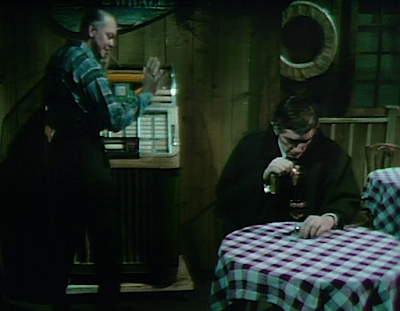
We open in the Blue Whale tavern, where Carolyn has been pleased to discover Paul and Barnabas sitting together at a table. Barnabas says that Carolyn is her father’s most precious possession, and she happily agrees. Paul angrily denies that this is the case, and jumps up. He asks Carolyn to go away with him, and leaves the tavern.

Carolyn is bewildered by this reaction, and annoyed when Roger enters. She exits to follow Paul, and Roger goes to the table to warn Barnabas that friendship with Paul would mean trouble with Liz. Barnabas assures him they are not friends.

In Paul’s hotel room, Carolyn tells her father that his troubles are all in his head. She says that she will try to help him, and mentions Julia Hoffman, a psychiatrist who is permanently in residence at the great house of Collinwood. Paul insists that he really does have enemies, and pleads with Carolyn to join him in running far away. She refuses, and insists that he must solve his problems where he is.

Carolyn goes home to the great house. She and Roger have a confrontation. He gives her a check for $5000, payable to Paul. He tells her that the only reason Paul has come back is that he wants to get money out of the Collinses, and that if she gives him that check, he will leave again.

Carolyn goes to the antique shop where she has been working for her friends Megan and Philip Todd. Megan is holding a baby, whom she identified to Carolyn as her nephew Joseph, her sister’s son. Barnabas is with Megan and the baby. Carolyn apologizes to Megan for being late to work, and tells Barnabas she has been late many times. Megan says that it isn’t a problem, that she couldn’t have got away from the shop any earlier even if Carolyn had been there. Barnabas exits.

Carolyn tells Megan that is strange to be reunited with a father who left when she was a newborn. Megan says that she was close to her own father growing up, and that she was an only child. Carolyn furrows her brow, looks at the baby, and asks if he isn’t her sister’s son. Megan scrambles for a second, then claims that Joseph’s mother is her stepsister, one of two daughters of the widow her father married.

Megan takes the baby to his bedroom upstairs. Carolyn answers the telephone, and tells Philip that she will have Megan call him right back. She waits a moment, then goes upstairs. She hears a loud breathing sound coming from the baby’s room, as if a gigantic obscene telephone call were in progress.

Unknown to Carolyn, her father’s troubles are not imaginary, and Barnabas is not his friend. Between her two scenes in the antique shop, we saw Paul in his room. A true Collinsporter, he was in bed fully clothed, wearing even his tie and his shoes, but still he had difficulty sleeping. Barnabas entered the room and told him it was odd to sleep on such a sunny day. To demonstrate the day’s sunniness, he turns a light on. He also ruffles the window-shades, but does not open them. Evidently that would be a little too on-the-nose.

Paul aims a revolver at Barnabas and says that he will kill him if he doesn’t leave him alone. Barnabas says that if he kills him, someone else will be sent in his place. Paul says that he will also kill that person, and he squeezes the trigger several times. That only makes a clicking sound. Barnabas tells him that “we” knew about the gun, as “we” know about everything Paul might do before he does it, and that the ammunition was therefore removed. He also tells Paul that if he leaves Collinsport without permission from whomever it is Barnabas represents, Carolyn will suffer.

The telephone rings, and Barnabas orders Paul to answer it. It is Carolyn. He tells her that he is feeling better, and that he does not want to go away. Barnabas praises him for beginning to see things “our way.”

Paul telling Carolyn that everything is just great with him. Screenshot by Dark Shadows Before I Die.

Today’s closing credits are the first headed by “Starring Jonathan Frid as Barnabas Collins.” From now on, Frid will get the “Starring” designation unless Joan Bennett is in the day’s cast, in which case she gets “Starring” and he follows with “Also Starring.”

Episode 891: The only one there is

About Time

Dark Shadows committed itself to supernatural stories in late 1966 and early 1967, when the chief villain was undead blonde fire witch Laura Murdoch Collins. Since the usual laws of nature weren’t going to restrain Laura, they needed another set of rules that could predict her behavior sufficiently to create suspense. One of the things they settled on was that the barrier between past and present grows thin on the anniversaries of deadly events. So when well-meaning governess Vicki and the team she had assembled to fight Laura discovered that, in a previous iteration, she had taken a young son of hers to his fiery death “exactly one hundred years ago,” they knew that the crisis was at hand.

Anniversaries continued to have this effect in subsequent periods. So when in January 1969 recovering vampire Barnabas Collins wanted to take a day trip to the 1790s, he stood in a graveyard and shouted at a man who had died exactly 172 years previously to ask for a ride. It worked.

Barnabas was using a different form of mumbo-jumbo at the end of February, trying to contact the ghost that had made the great house of Collinwood uninhabitable, when he came unstuck in time and found himself in the year 1897.

In the middle of Barnabas’ long stay in 1897, the show decided to take its conceit that two events occurring on the same date in different years were mystically connected and show us both sides of the link. In #835, Barnabas was locked up in a cell with a secretary cabinet that he knew would be in the front parlor of his home, the Old House at Collinwood, in 1969. He wrote a letter to his friend, mad scientist Julia Hoffman, and hid it in a secret compartment of the secretary. We cut to the front parlor in 1969, exactly 172 years later, where a series of events leads Julia to discover the letter, travel back in time, and precipitate Barnabas’ rescue.

By #839, the events of 1897 had played out differently enough from whatever happened the first time through that year that the ghosts found peace. As we cut back and forth between that year and 1969, we saw that the 1960s characters remembered the haunting and the disasters that accompanied it and were relieved that they were over.

That gives us the present as the result, not of any one series of events in the past, but of a composite of many separate and mutually incompatible pasts. This idea is the logical culmination of substituting anniversaries for natural laws. In the first part of Barnabas’ trip to 1897, he had not yet done enough to lay the ghosts to rest. So the haunting continued, because it was happening on the anniversaries of events that were much the same as those that took place originally. By the time the living people of 1897 who would become the ghosts of 1969 had changed enough that they were no longer doomed to haunt the house, the date was one that would fall almost ten months into the haunting. In #836, Julia had a conversation in which one of the ghosts tells her about events in 1897 that could not have happened in the original timeline without Barnabas’ intervention, and which do not happen in #838 after Julia herself travels to that year. So each anniversary creates another past that becomes another ingredient in the stew that makes up the present.

This conception of the relationship between past and present shows the difference between a set of fantastic tales like Dark Shadows and a science fiction story exploring more-or-less plausible consequences of open questions in science. The “Copenhagen Interpretation” of quantum mechanics posits that the cosmos is made up of countless parallel universes, and that everything that could ever have happened did happen in at least one of those universes. Since that is a defensible position within science, an author can incorporate as much fact and reality as s/he likes in a story based on it. But since the idea that one period of history is the result of a confluence of many conflicting pasts is not only not a live option in science, but does not really make any practical sense except as a metaphor, the logic that really matters is dream logic. As dreams seem perfectly convincing to us when the only connections that lead from one moment to another are random similarities in names or shapes, so all that matters in a fantastic tale is that there is a pattern the audience can follow, whether or not that pattern corresponds to anything in the world where we spend our waking hours.

Now Barnabas has returned to 1969, brought back by a mysterious cult that has brainwashed him and adopted him as its leader. The characters he knew before he left are delighted to see him again. Today, matriarch Elizabeth Collins Stoddard comes to the Old House and is overjoyed that the haunting is over and that she and her family have been able to return to the great house. She is grateful to Barnabas for undertaking his harrowing journey back in time.

Liz and Barnabas talk about Chris Jennings, a young man in whom Liz’ daughter Carolyn is interested. Barnabas gives it as his firm opinion that Carolyn should avoid Chris, and he urges Liz to encourage her to do this. Barnabas knows that Chris is a werewolf, and we saw last week that the cult that has co-opted him has plans for Carolyn which do not include her death as one of Chris’ victims, so this will not surprise returning viewers.

Chris himself is another example of the weird metaphysics the show has stumbled upon. When Barnabas left 1969 for 1897, Chris was in his wolfish form all the time, apparently never to become human again. We learned during the 1897 segment that his lycanthropy is a curse inherited from his forebear, Quentin Collins. The version of 1897 we saw was changed sufficiently from the original that Quentin avoided his own death and was for a time relieved of the effects of the werewolf curse, though at the end of the segment it looked like they might be on their way back. That he is now human part of the time but still subject to transformation suggests that the difference in Quentin’s experiences in the later part of the 1897 stories had some effect on him. It’s unclear whether Chris’ condition fluctuated every time the date marked the 72nd anniversary of something happening to Quentin that hadn’t happened when he was living in a Barnabas-free zone, but it wouldn’t contradict anything we’ve seen if it did.

The Time to Come

Barnabas brought one object back with him from the past, a wooden box. The box must be opened only at a certain time, by certain people, for the cult’s plan to take effect. Today, Barnabas receives a visit from the people. They are Megan and Philip Todd, owners of the new antique shop in the village of Collinsport. Carolyn sent them, thinking that Barnabas would likely have some things they could add to their inventory. He sees that Megan is wearing a necklace with a symbol representing intertwined snakes, which Barnabas calls a “Naga.” When Megan is unable to explain just how she came into possession of the necklace, he shows them the box, which is topped with an oval in which the same symbol is carved. They are both thrilled at the prospect of buying the old furniture he has in the upstairs rooms of his house, but Megan is particularly fascinated by the box.

Later, Philip and Megan are back in their shop. They are confident they can buy a great deal of furniture from Barnabas, but are also sure that they wouldn’t be able to afford the box, even if he were willing to part from it. This is a bit odd- we get a good look at the box, and it is absolutely nothing special. The actors manage to sell the scene, but it would be better if they had either invested in a showier prop or been more sparing about putting it on camera.

Megan and Philip with the box. Screenshot by Dark Shadows Before I Die.

Barnabas comes to the shop and gives Megan and Philip the box as a present. After he goes, Megan is overwhelmed by an urge to open the box, which is locked. She is so consumed by this urge that she actually says “Let’s force it!” Since they had just minutes before been talking about it as if it were more expensive than anything they have for sale in their shop, this is a startling line. But when Philip opens the envelope Barnabas left to look at the list of furniture he is willing to sell them, he finds a key.

Philip is reluctant to open the box, having a strange feeling that if they do, nothing will ever be the same for them again. The other day it was Megan who had a strange feeling of impending doom. She wanted to sell the shop and flee Collinsport forever, lest they suffer an irretrievable disaster. That time it was Philip’s turn to urge her to set her misgivings aside. We’ve seen this kind of back and forth before. At the end of 1968, the great house of Collinwood was coming under the control of ghosts. Children Amy Jennings and David Collins kept trading the roles of possessed agent of the ghosts and unwilling sidekick. That alternation showed that the ghosts were not yet powerful enough to possess both children at once, and it faded as the haunting became more intense. It built suspense by suggesting that possible avenues of escape were gradually but inexorably closing.

As Philip and Megan begin to open the box, there is a whistling sound. They are unsettled, but decide they have to finish opening it anyway. They do, and we see their reaction to whatever is inside. Longtime viewers have seen similar reactions as cliffhangers many times; always before, they have indicated amazement that the container is empty.

New People

One of the less appealing villains of the 1897 segment was magically gifted artist/ surly criminal lowlife Charles Delaware Tate. Tate lived in a house that in the parts of Dark Shadows set in the 1960s was known as “the Evans Cottage,” home to drunken artist Sam Evans and his daughter Maggie, The Nicest Girl in Town. The cottage burned down in #883, leading us to wonder if it would still be there when the show returned to 1969.

Sam died last year, and Maggie now lives at Collinwood, where she is David and Amy’s governess. Today she goes to the cottage to prepare it for some tenants to whom she will be renting it. Evidently it must have been rebuilt before the Evanses moved in.

The only movable property in the cottage is a portrait of Maggie’s mother which her father painted. That portrait also appeared in the cottage a few times when Tate was living there; that was just carelessness on the part of the production staff, but it is kind of reassuring to see it again.

A man who has been in a couple of episodes knocks on the door. He identified himself as a friend of Sam’s and is saddened to hear of his death. He enters and asks Maggie to do him a favor. He keeps refusing to give her his name. We haven’t heard his name at all; evidently his identity is supposed to be a mystery to us. Word of that apparently did not reach the department responsible for making up the credits; they’ve been billing actor Dennis Patrick as Paul Stoddard, whom regular viewers know as the long-missing husband of matriarch Liz and father of Carolyn. They do that again today.

This is the last time we will see the Evans Cottage. In 1966 and 1967, the set was a symbol of the village of Collinsport, and scenes there showed the consequences that the doings of the rich people in the big house on the hill had for the working class who live in its shadow. By the time Maggie moved into Collinwood, they had long since given up on those kinds of stories. Dark Shadows is sometimes called “Star Trek for agoraphobes”; as we go, less and less of the action takes place anywhere other than Collinwood, and eventually they won’t even let us outside.

Liz agreed to let Barnabas live in the Old House in #218; by #223, she was talking about it, not only as his home, but as if he owned it and its contents. For while they went back and forth on the question of Barnabas’ legal status regarding the property, but when, at the suggestion of Liz’ daughter Carolyn, he gives the Todds a list of its furnishings that he is prepared to sell to them, I think we can take it for granted that Liz no longer has any claim on it.

Episode 888: The place that he disappeared

The Prowler

Yesterday, we spent a lot of time watching an unidentifiable man wandering around the estate of Collinwood. We only saw him from the back; he was wearing a dark coat and hat, and had silver-gray hair. Evidently we were supposed to expect his face would mean something to us when it was finally revealed.

At the end of yesterday’s episode, permanent houseguest Julia Hoffman caught the prowler coming out of the Old House on the grounds of the estate, home of her friend, missing person Barnabas Collins. She did not recognize the man, and he refused to identify himself. We see him in today’s opening reprise. His face would not be familiar to her, but it is instantly recognizable to longtime viewers. It is that of actor Dennis Patrick, who from March to July 1967 played seagoing con man Jason McGuire. Jason blackmailed reclusive matriarch Elizabeth Collins Stoddard to the point of marriage. When Liz finally stood up to Jason, his scheme collapsed. On his way out of town, Jason went to the Old House hoping to steal jewels from Barnabas. That attempt also failed, and Barnabas strangled Jason.

We spend most of the episode wondering how Jason managed to rise from the dead. Near the end, Liz’ daughter Carolyn runs into the prowler. She gets a good look at him and talks to him for a few minutes, but does not recognize him. Carolyn would certainly recognize Jason, whom she was ready to shoot if Liz had gone through with the wedding. So Patrick must be playing another character. He does not give Carolyn his name, but his strong emotional reaction when she gives hers tells us that he has some kind of connection to her. We are again supposed to leave the episode wondering who he might be.

Unfortunately, word of that did not get to the people who make up the closing credits. Patrick is billed today as “Paul Stoddard.” Paul is Carolyn’s long-missing father, Liz’ ex-husband, and a close friend and partner in crime of the late Jason McGuire. This is not the first time on Dark Shadows the closing credits have identified a character whose identity was supposed to keep us guessing. For example, at the end of #124 we are supposed to be in suspense as to which of a few people a mysterious woman is, but the closing credits identify her as “Laura Collins,” a name which blows the secret completely for attentive longtime viewers. A mysterious little girl turns up in #255 and for a few episodes we are supposed to be in the dark as to who she is. But at her first appearance the character was billed as “Sarah Collins.”

It’s interesting to cast Patrick as Paul. Jason’s scheme was based on Liz’ belief that she had killed Paul, when in fact Paul and Jason had worked together to fake his death and swindle her of some money. Since Paul and Jason committed the two halves of the same crime, they merge together in the disastrous effects they have had on Liz’ life. So they may as well look and sound exactly alike.

Waiting for Barnabas

Barnabas vanished from his basement some time ago while he was involved with some supernatural doings. Julia has been hanging around the house for over a month, waiting for him to rematerialize. She explains to Carolyn that because he disappeared from the basement, it is the only place where he can reappear. They go into the house and Julia almost immediately suggests they leave. She is sure he isn’t there, because she locked the basement door. Evidently Julia has spent all this time waiting to hear Barnabas banging on that door demanding to be let out.

Carolyn points out that Barnabas might be unconscious, and if he is he would not be banging on the door even if he has come back. Julia exclaims “I hadn’t even thought of that! He- he could be down there now!” At this, my wife, Mrs Acilius, laughed and said “He could have been down there for a month!” By profession, Julia is a mad scientist. She knows how to cure vampirism, bring Frankenstein’s monsters to life, rewrite people’s memories at will, and travel back in time, but she has her blind spots.

Be that as it may, Julia checks the basement and finds Barnabas is not there.

The Antique Shop

Carolyn takes Julia to an antique shop that has just opened in the village of Colllinsport. Carolyn called the shop “divine” yesterday, and is still thrilled about it today. I suppose it reminds her of home- like all the unoccupied spaces in the great house of Collinwood, it is crammed with a lot of miscellaneous junk.

Carolyn may have a soft spot for the place, but she hasn’t lost all capacity for judgment. The proprietors, a young couple named Philip and Megan Todd, have just unpacked a painting they bought that morning. Philip says that when it came up for auction he couldn’t resist it. Carolyn widens her eyes, tilts her head back, and says in an incredulous voice, “Hmm, your taste must be quite different from mine, Philip. I could have resisted that.”

The painting Philip couldn’t resist.

Philip mentions that the artist’s name is Charles Delaware Tate. At that, Julia perks up. She asks Philip if he is certain that it is an authentic Tate; he assures her that he is. He astonishes her by saying that it was painted only about twenty years ago. Julia says that Tate would have been in his 80s then. Seeing that the painting is about as good as anything Tate ever did, she says that he was still at the height of his powers despite his advanced age. She wonders if, having been in such good shape so recently, he could still be alive. Philip doesn’t know about that.

Julia asks for the price. When Philip says he will part with the painting for $300, Julia takes out her checkbook. Carolyn looks on, amazed to see her shell out so much money so quickly for a mediocre picture. When it is time to go, Julia asks her if she is ready. Still agape, Carolyn replies “Yes.. for practically anything!”

For eight months, from #701 at the beginning of March to #884 last week, Dark Shadows was a costume drama set in the year 1897. In the second half of that segment, Tate was one of the minor villains. He had made a bargain with evil sorcerer Count Petofi. Petofi made him a nationally famous painter whose works were very much in demand. Many of his paintings also had magical powers. The magical powers were the result of Petofi’s spell, but it was never made entirely clear whether Tate’s fame was the result of a talent Petofi gave him to paint well or if Petofi’s intervention was more direct and he simply bewitched people into admiring Tate’s paintings and wanting to buy them. Indeed, if we had to classify the works of Tate that we saw, the most secure categorization would be “Nothing Special.” They certainly do not stand comparison to the best of the portraits that the ABC Network’s Art Department prepared for the Collinwood sets. Carolyn’s reaction today clearly suggests that once Petofi’s influence receded, the paintings lost their charm.

Julia’s interest in Tate is not aesthetic. Julia traveled back in time for a couple of weeks in September. She knows that Tate’s portrait of Quentin Collins prevented Quentin from turning into a werewolf. The prospect that Tate might still be alive leads her to hope that her friend Chris Jennings, a great-grandson of Quentin’s, might also be cured of lycanthropy.

The audience is unlikely to find much ground for optimism in the thought of more Tate. As is usual for characters played by Roger Davis, Tate is hard to watch. He delivers most of his lines in a shout, and he amplifies his voice by clenching his rectal sphincter muscles. The result is what Pauline Kael used to call an “anal screech.” He also has what we might tactfully call a poor sense of personal space; indeed, two of the tags that most often appear together on posts on this blog are “Roger Davis” and “Abusive Behavior on Camera.” So I would just as soon Julia give up her search for Tate.

The Todds

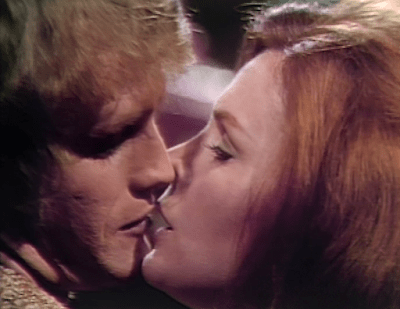
Megan and Philip exult over Julia’s purchase. They are in the middle of talking about how it is a good sign for their new business, when Megan is suddenly seized with a fit of foreboding. She wants to close the shop early; Philip protests that they still have time to make a few more sales. Megan then says she has a premonition that if they stay in Collinsport something terrible will happen to them. She says she wants to sell the shop and move away. Philip tries to soothe her. He puts his head against hers and kisses her. She just looks straight on, her eyes full of dread.

Philip working his way to Megan’s neck while it dawns on her that they are now characters on Dark Shadows.

Megan is the third role Marie Wallace played on Dark Shadows. Her first two were Eve, the Fiancée of Frankenstein, and Crazy Jenny Collins, Quentin’s estranged and deranged wife. Miss Wallace had a lot of fun with those parts, but neither of them gave her much opportunity to interact meaningfully with her scene partners. Eve was unyieldingly nasty to everyone, whatever they might say or do, and Jenny was just one long mad scene. As Megan, she gets to listen to Philip and react to what he says. That ends when she ignores his kissing her neck, but while it lasts it’s good to see.

Philip is played by Christopher Bernau. Some fans say that Bernau and Miss Wallace lacked “chemistry,” but their last shot today shows how misguided that criticism is. The key to chemistry is for one character to initiate a kiss and the other to kiss back. Megan is supposed to be too preoccupied with her premonition to notice anything in her environment, even her beloved husband kissing her. If she had responded to him at all, the whole point of the scene would have been lost.

It is true that Bernau does not perfectly embody a romantic lead in Philip’s scenes with Megan. As a happy couple, Philip and Megan constantly make little jokes with each other. The jokes in the script aren’t very good, and Bernau tries to put some life into them by imitating Jack Benny. In the 1920s and 1930s, Benny’s persona struck people as a spoiled rich kid, and in later years he was so famous that it just meant Jack Benny. But by the 1960s, any man other than Jack Benny would send a very different message if he were to speak with that drawl and walk with that mincing gait. When the man in question is an antique dealer wearing a belted sweater that looks suspiciously like a dress, it does not seem especially likely that he will passionately in love with his wife.

I think Philip borrowed this from Maggie Evans…

Several times in his career Bernau proved he could be effective in love scenes with women, most famously as ladies’ man Alan Spaulding on The Guiding Light. I mentioned that role in a comment on Danny Horn’s post about this episode on his great Dark Shadows Every Day:

I was a kid when Bernau joined GUIDING LIGHT. My mother watched that show, and I had several times attempted to watch it with her, but it always defeated me after 5 or 10 minutes. It just seemed like a window into the deepest level of Hell, the frozen cavern where absolutely nothing happens. But Bernau caught my imagination. I could watch entire episodes if he was in them.

Years later, when I watched DARK SHADOWS on the Sci-Fi Channel, I realized what made Bernau so compelling on GUIDING LIGHT. He was doing a Jonathan Frid imitation. Within moments of first seeing Barnabas, I exclaimed “Alan Spaulding!” It was only years later that I learned Bernau had been on DARK SHADOWS.

Comment left 10 December 2020 by Acilius, on Danny Horn, “Episode 888: Little Shop,” 26 June 2016, Dark Shadows Every Day.

I’m very fond of John Gielgud’s story that from the time he first saw Claude Rains give a performance, his acting style consisted of imitating Claude Rains. Gielgud went on to say that this represented a great improvement over his previous style, which consisted of imitating Noël Coward. I doubt Bernau’s style ever depended entirely on either Jack Benny or Jonathan Frid, but he certainly learned a great deal by watching each of them.