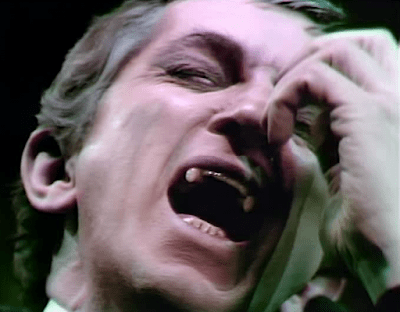
Old world gentleman Barnabas Collins has fallen afoul of a shape-shifting monster from beyond time and space who once hoped people would call him “Jabe.” The monster, who has settled for the name “Jeb,” turns Barnabas back into what he was from the 1790s until 1968, a vampire.
Re-vamped, Barnabas suddenly gets a lot of gray in his hair and a much darker complexion. Makeup artist Vince Loscalzo deserves a lot of credit for these bits of color, they are placed perfectly to emphasize the look of anguish as Barnabas realizes what has happened to him and struggles to resist his urges. The actors’ faces were the medium of Loscalzo’s art, and he outdid himself with these complements to Jonathan Frid’s face.
People talk endlessly about the heroic makeup work Dick Smith did with Jonathan Frid one week in October 1967 and again on a feature film, but Vince Loscalzo did great stuff like this day in and day out for years. Screenshot by Dark Shadows Before I Die.
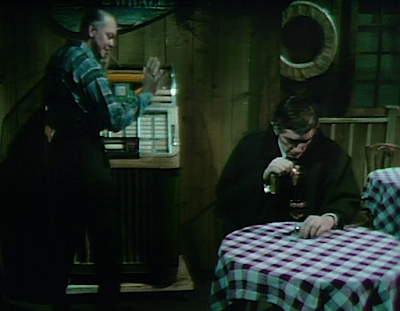
We see Barnabas sitting at a table in The Blue Whale, the tavern in the village of Collinsport. He is the only patron in the room. He has a glass of reddish liquid in front of him, and the bartender is moving around the room. The bartender looks at Barnabas, as if to ask, “How do you like your glass of AB negative, Mr Collins?” But he turns away and moves on.
A young woman enters. Barnabas invites her to join him at his table. He sees that she is wearing a pendant that identifies her as a member of the secret cult that serves Jabe and other creatures who intend to seize control of the Earth, supplanting humankind. Barnabas introduces himself, and says that he was the one who made it possible for Jabe to come to life. This is true, but it is also true that he has become disaffected from the cult. Even after Jabe turned him back into a vampire, Barnabas is still determined to thwart it.
The young woman introduces herself as Nelle Gunston, who was recruited into the cult while living a dreary life with her parents in Virginia. Nelle tells Barnabas that everything has changed for her since she joined the cult. She says that she will gladly do anything she can to advance its objectives, including murder. They have this conversation in nice loud voices while the bartender is nearby.
Barnabas’ friends, mad scientist Julia Hoffman and recovering werewolf Quentin Collins, enter. He introduces them to Nelle, then explains to them that he and Nelle have a private matter to discuss. Quentin and Julia go to the bar, where Quentin orders brandies. They talk about Nelle’s pendant and their fear that Barnabas is falling back under the power of the cult while the bartender is in their space serving them drinks. Evidently they’ve learned to rely on his discretion. They are still deep in conversation when Barnabas leaves with Nelle.
Barnabas takes Nelle back to his place on the pretext that Jabe will meet them there. She asks him why it is so dark in there; he asks her how she got into the cult. She catches on that Jabe is not coming and that Barnabas is not loyal to him. She draws a knife and is about to stab Barnabas when he bares his fangs to her.
Quentin and Julia let themselves into Barnabas’ house. They find Nelle dead on the floor and Barnabas wallowing in self-pity next to her. Julia takes a second look at Nelle and sees the puncture wounds on her neck. She tells Barnabas she will renew the treatments that first put his vampirism into remission two years before; he says there is something else he has to do first. After he rushes out, Quentin and Julia talk about how they will hide Nelle’s body.
Nelle was the perfect victim for Barnabas- no one in town knew her, no one expected her to come, no one will notice she is missing. And he is determined to weaken the cult, so reducing its numbers by one fits his goals.
Barnabas goes to the antique shop in the village. Jabe is in an upstairs room; Barnabas is convinced that Jabe can assume his true form and lay it down only in that room. We saw him do that in a house on an island many miles away in #946, and he told Barnabas that he had done so in #947, but apparently that doesn’t count, somehow. Jabe is far more powerful in his true form than he is when he is man-shaped, but he cannot mingle with humans in that form. So Barnabas believes that he will limit Jabe’s options if he destroys the room. He pours gasoline all around the first floor of the shop and sets a match to it.
Nelle is played by Elizabeth Eis, in her first appearance on Dark Shadows. They say that the first thing actors have to do to work effectively is to pay attention to each other. Eis shows how far this can take you. She listens ravenously to everything Frid says and never takes her eyes off him. The script doesn’t give her a huge amount to work with, but simply by giving her scene partner her total attention she creates a sensational performance. The producers noticed; she will be back later this year in two quite different roles.
This episode is the last time we see either the Blue Whale or Bob O’Connell as the Bartender. The Blue Whale was an important part of the show from its debut in June 1966 until the first costume drama insert began in November 1967. O’Connell appeared as the Bartender in 60 episodes (three of them as other bartenders in other periods of history) and had speaking parts in 6. It’s too bad he doesn’t get to say anything today, but at least he is in the closing credits.
Hail and farewell to Bob the Bartender, the jukebox, and the tavern. Screenshot by Dark Shadows Before I Die.
Heiress Carolyn Collins Stoddard thinks that her recently returned father, Paul Stoddard, is mentally ill. She knows that her mother Liz and Liz’ brother Roger are deeply hostile to Paul, and thinks that her distant cousin Barnabas is friendly to him.
We open in the Blue Whale tavern, where Carolyn has been pleased to discover Paul and Barnabas sitting together at a table. Barnabas says that Carolyn is her father’s most precious possession, and she happily agrees. Paul angrily denies that this is the case, and jumps up. He asks Carolyn to go away with him, and leaves the tavern.
Carolyn is bewildered by this reaction, and annoyed when Roger enters. She exits to follow Paul, and Roger goes to the table to warn Barnabas that friendship with Paul would mean trouble with Liz. Barnabas assures him they are not friends.
In Paul’s hotel room, Carolyn tells her father that his troubles are all in his head. She says that she will try to help him, and mentions Julia Hoffman, a psychiatrist who is permanently in residence at the great house of Collinwood. Paul insists that he really does have enemies, and pleads with Carolyn to join him in running far away. She refuses, and insists that he must solve his problems where he is.
Carolyn goes home to the great house. She and Roger have a confrontation. He gives her a check for $5000, payable to Paul. He tells her that the only reason Paul has come back is that he wants to get money out of the Collinses, and that if she gives him that check, he will leave again.
Carolyn goes to the antique shop where she has been working for her friends Megan and Philip Todd. Megan is holding a baby, whom she identified to Carolyn as her nephew Joseph, her sister’s son. Barnabas is with Megan and the baby. Carolyn apologizes to Megan for being late to work, and tells Barnabas she has been late many times. Megan says that it isn’t a problem, that she couldn’t have got away from the shop any earlier even if Carolyn had been there. Barnabas exits.
Carolyn tells Megan that is strange to be reunited with a father who left when she was a newborn. Megan says that she was close to her own father growing up, and that she was an only child. Carolyn furrows her brow, looks at the baby, and asks if he isn’t her sister’s son. Megan scrambles for a second, then claims that Joseph’s mother is her stepsister, one of two daughters of the widow her father married.
Megan takes the baby to his bedroom upstairs. Carolyn answers the telephone, and tells Philip that she will have Megan call him right back. She waits a moment, then goes upstairs. She hears a loud breathing sound coming from the baby’s room, as if a gigantic obscene telephone call were in progress.
Unknown to Carolyn, her father’s troubles are not imaginary, and Barnabas is not his friend. Between her two scenes in the antique shop, we saw Paul in his room. A true Collinsporter, he was in bed fully clothed, wearing even his tie and his shoes, but still he had difficulty sleeping. Barnabas entered the room and told him it was odd to sleep on such a sunny day. To demonstrate the day’s sunniness, he turns a light on. He also ruffles the window-shades, but does not open them. Evidently that would be a little too on-the-nose.
Paul aims a revolver at Barnabas and says that he will kill him if he doesn’t leave him alone. Barnabas says that if he kills him, someone else will be sent in his place. Paul says that he will also kill that person, and he squeezes the trigger several times. That only makes a clicking sound. Barnabas tells him that “we” knew about the gun, as “we” know about everything Paul might do before he does it, and that the ammunition was therefore removed. He also tells Paul that if he leaves Collinsport without permission from whomever it is Barnabas represents, Carolyn will suffer.
The telephone rings, and Barnabas orders Paul to answer it. It is Carolyn. He tells her that he is feeling better, and that he does not want to go away. Barnabas praises him for beginning to see things “our way.”
Paul telling Carolyn that everything is just great with him. Screenshot by Dark Shadows Before I Die.
Today’s closing credits are the first headed by “Starring Jonathan Frid as Barnabas Collins.” From now on, Frid will get the “Starring” designation unless Joan Bennett is in the day’s cast, in which case she gets “Starring” and he follows with “Also Starring.”
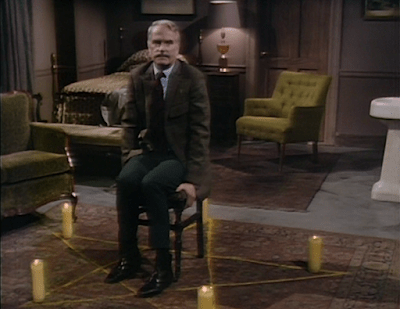
We open with the sight of a man (Dennis Patrick) sitting nervously on a chair placed in the middle of a pentagram marked on a rug. At each point of the pentagram there is a candle. The man is Paul Stoddard.
Regular viewers will remember #752, in which Quentin Collins was told to sit on a chair in the middle of a similar pentagram. Quentin’s friend, amateur warlock Evan Hanley, told him that by doing this he could keep from turning into a werewolf. Paul isn’t afraid of turning into a werewolf, and he doesn’t have a friend like Evan. His worry is vague, but urgent- he knows that someone is after him, that if that someone catches up to him they will do something horrible, and that whoever it is keeps sending him messages that it is time for him to pay his debt. But he has no idea who that is, what they will do, or what the debt they are talking about. Sitting in the pentagram was a suggestion that came from a sailor who cruised him in a gay bar met him in a local tavern.
Paul’s pursuers are a cult associated with mysterious beings known as “the Leviathan people.” It has been made clear to us that both Paul and his daughter, heiress Carolyn Collins Stoddard, are, unknown to themselves, part of its orbit. In #888, Paul and Carolyn ran into each other at a cairn that is the cult’s ceremonial center and looked at it. Carolyn had been on its site many times, and could not understand why she had not seen it before. In #894/895, the cult’s acting leader, Carolyn’s distant cousin Barnabas Collins, took antique shop owner Philip Todd to the cairn. Philip told Barnabas he had walked past the site a few days before and that the cairn was not there then; Barnabas explained that only those connected with the Leviathan cult can see it. Barnabas has also been highly solicitous of Carolyn’s well-being since he became part of the cult, and he keeps telling her that he knows she has an extraordinary future ahead of her. So we know that the cult has plans for her, and Paul’s distress suggests that they have less attractive plans for him.
Paul sees the doorknob turning. He is terrified. Instead of the enemy Paul expects, Carolyn enters. He yells at her to leave. She stays. When he is unable to explain what he is afraid of, but that the pentagram on the floor will protect him, she notices that it is the same as the symbol she has been wearing on a chain around her neck. Barnabas gave it to her some days ago and urged her to wear it always. The audience knows, but she does not, that he intends it to protect her from the local werewolf. When she sees the similarity, the show invites us to wonder what the Leviathans have to do with werewolves. Carolyn tells Paul that if the symbol will protect him from his enemies in the form of chalk or gaffer tape on the floor, it will also protect him when it is composed of a silver pendant. He puts the pendant on and declares that he feels much better. He can no longer hear the voices that have been telling him his payment is due immediately. He embraces Carolyn and tells her he trusts only her.
When Carolyn mentioned Barnabas to Paul, he responded “Who is Barnabas?” Carolyn seems surprised he does not know, since she saw him near Barnabas’ house. Indeed, we saw him enter Barnabas’ house and wander through it the night he first returned to Collinwood, after an absence of twenty years. But he doesn’t remember anything about that.
Not that Carolyn’s own long acquaintance with Barnabas is all that enlightening to her just now. Ever since the Leviathans adopted him as one of their own, he has not been himself at all. We see him in his front parlor with mad scientist Julia Hoffman, who has for a year and a half been his inseparable best friend. She is trying to interest him in some information she has gathered about another storyline, and he makes it clear he could not be less interested in it or in her. She demands to know what he is interested in, and he refuses to answer. Carolyn enters, and suddenly Barnabas is all ears. Julia, frustrated, snaps that now she can see what he does care about.
In the autumn of 1967, Barnabas was a vampire and Julia had failed in an attempt to make him human again. He bit Carolyn and made her his blood thrall. He also decided that he would kill Julia to prevent her exposing him. Julia soon learned that Carolyn was both a wily operator and a most devoted servant. Julia had already realized that she was in so deep with Barnabas that she would be unlikely ever to make a life with anyone else, and so she conceived an unrequited love for him. In her dealings with Carolyn in those days, terror mingled with jealousy. Her bitter remark when she sees that Barnabas, who has been so dismissive of her, is now so concerned with Carolyn, reminds longtime viewers of that jealousy. Combined with the story of a daughter reunited with her long-absent and none too respectable father, this faint suggestion of a love triangle is enough to remind us that we are watching a daytime soap.
For her part, Carolyn was freed of her subservience to Barnabas as soon as he was freed of the effects of the vampire curse in March 1968. For some time, Nancy Barrett went out of her way to play Carolyn in a way that left us wondering if Carolyn remembered her time in his power. The scripts didn’t give her a lot of support in that endeavor, but the closeness she feels towards him combines with Julia’s jealousy to bring it back to our minds.
Carolyn has come to ask Julia to help Paul. Julia is back in the great house of Collinwood getting her medical bag to take to Paul’s hotel room when Paul himself bursts in. He demands to see Carolyn. Julia tells him that she left a little while ago to go to his hotel, and is probably there now. The telephone rings. Julia answers it, and tells Paul it is for him. This doesn’t strike her as odd, even though he hasn’t set foot there in twenty years, not since the night he left his wife Liz thinking she had killed him. Julia hands the phone to Paul. He expects to hear Carolyn, but instead hears the same voice that has been taunting him, saying that his bill is due now. He hangs up, and it starts ringing again. He forbids Julia to answer it, and runs out. We cut to his hotel room, and see that this time it is Carolyn trying to reach her father. Later, Carolyn will come home and Julia will tell her that Paul doesn’t seem to want help, however much he may need it.
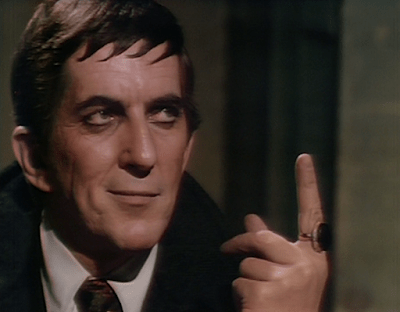
Paul goes back to his room, and hears the phone there ringing. Terrified, he runs out, returning to the bar where he’d picked up trade met a new friend the night before. He sees another stranger sitting at a table, looking him over and beckoning him by rolling back one finger. The stranger is Barnabas.
Paul reluctantly goes to the table, and Barnabas introduces himself. Paul says he doesn’t know Barnabas, but Barnabas makes it clear he knows all about Paul. He asks him to think back to the night he left Collinwood in 1949. We dissolve to a flashback.
Paul is at the bar, and another strange man strikes up a conversation with him. The man encourages him to assume that he has the power to grant any wish Paul might make in return for a price they would agree on. Paul says that in that case, he will ask for twenty years of boundless prosperity. At the end of those twenty years, Paul will give up anything he has, even his “most precious possession.” They shake hands on this deal. Paul laughs, and says he has won the game. He said that he would surrender anything he has, present tense- not anything he might gain in the course of his successful future, but anything he has as of 4 December 1949. On that date, Paul assures the man, he has nothing anyone could possibly want. The man laughs, and wants to drink to congratulate Paul on his cleverness.
Back in the present, Barnabas is laughing as heartily as the other man did twenty years before. He finds it preposterous that Paul could have forgotten such an important encounter. Paul can’t see anything important in it- it was just a silly little game, and its only consequence was that a strange man bought him a drink. Barnabas says that on the contrary, the bargain he struck was quite real. The Leviathans kept their side of it by giving him the success he has had over the last twenty years. Now that the twenty years are up, the time has come for them to claim the most precious possession he had the night he fled Collinwood.
Paul says that he supposes Barnabas is talking about his soul. He laughs heartily at that, and tells Barnabas that he is welcome to it. He is telling Paul that that is not what he meant as Carolyn enters. Paul is still laughing, and is delighted to see his daughter. She says she is relieved that the two of them found each other, and he tells her everything will be all right now. Barnabas says that Carolyn is her father’s most precious possession.
The scenes of Paul rushing around in a steadily mounting panic he is unable to explain are highly reminiscent of The Twilight Zone. The last line is a twist worthy of that classic series, especially as delivered by Jonathan Frid. His icy performance as Barnabas in these early episodes of the Leviathan arc not only recalls the malign representatives of alien powers on that show, but is superb in itself. He stumbles a little over his words in Barnabas’ scene with Julia, but is perfectly composed otherwise, and the effect is quite frightening.
I remarked on the gay subtext of the barroom scenes in the comment thread on Danny Horn’s post about the episode at his great Dark Shadows Every Day:
So far, this has been the gayest storyline the show has taken on yet.
In 899, the sailor offers to buy Paul a drink, and Paul shouts “I buy my own drinks!” This isn’t subtext- any man getting that reaction in a bar will know that the other fellow has interpreted his offer as including more than the drink. Paul apologizes and becomes friendly, indicating that he is willing to abandon that interpretation and set aside the hostility that accompanied it.
In this episode, we’re back in the same bar. Barnabas beckons Paul to his table with his index finger. I invite any man who doesn’t think we are intended to read this as a reference to a sexual come-on to try that move on a homophobic tough guy in a bar.
Paul’s face shows his inner struggle as he tries to resist Barnabas’ advances, but he can’t. Barnabas coaxes him into reminiscing about yet another night in the same bar, when a casual encounter with yet another guy led to something that seemed at the time like a little harmless tomfoolery, but that has now grown into a threat to his relationship with his family, his standing in the community, his physical well-being, and everything else.
Comment by “Acilius,” left 12 December 2020 on Danny Horn, “Episode 900: The Long Con,” posted on Dark Shadows Every Day, 18 July 2016.
In response to someone who said some kind words about that comment, I made a remark that I no longer think is very good:
Thanks! It’s a bit of a puzzle- so far as I know, none of the writers on the show at this time was gay, so I’m not sure why they decided to go so deep into these themes just then.
Comment by “Acilius,” left 11 April 2021 on Danny Horn, “Episode 900: The Long Con,” posted on Dark Shadows Every Day, 18 July 2016.
What I think now, and probably would have thought then if I had stopped and considered it for a minute before I hit “Post Comment,” is that the writing staff’s sexuality has nothing to do with it. They were worldly, sophisticated people with long experience in the theatrical profession in New York City. They all probably had many gay friends, and when they are called upon to write a story about people being drawn into a secret underworld and learning uncomfortable truths about themselves in the process their minds will naturally turn to themes having to do with closeted homosexuality. Granted, that doesn’t fully account for Christopher Bernau’s decision to play Philip as a much queenier version of Paul Lynde, but it is hardly a “puzzle” that the writers would draw on motifs suggestive of the closet when that’s the story they have to work with.
The man who met Paul in the bar in 1949 is unnamed in today’s dialogue, but will later be referred to as Mr Strak. Strak is played by John Harkins, who appeared in #174 as Lieutenant Costa of the Arizona State Police and in #878, 879, 880, 881, and 883 as Garth Blackwood, formerly the keeper of England’s Dartmoor Prison, and by that time a creature raised from Hell to wreak vengeance on an escaped prisoner and anyone else who caught his attention.
Strak’s name may remind longtime viewers of another minor character whom we saw in episodes #1 and #2, Wilbur Strake, private eye. We saw Strake in this same bar, where he gave reports about Carolyn and other members of the Collins family to his employer, Burke Devlin. Like Strak, Strake was a rather smug, sardonic sort. Add to this the rarity of the names “Strak” and “Strake” and the fact that they sound so much alike, and it seems obvious that there is an intentional reference of some kind. Paul’s presence in this storyline is the result of the writers reaching back to the show’s early days to find a loose end they could attach to this storyline to incorporate it into the Collins family saga, so they probably were looking through the scripts from the first week. Still, I can’t imagine they thought many people would remember Wilbur Strake by this point. Likely the reference is an inside joke, but who was on the inside and what the point of the joke was, I can’t begin to guess.
I wasn’t writing detailed posts with background information when I covered the first weeks of the show, so I will mention here Strake was played by Joseph Julian, who later became a regular on Somerset, a soap that aired on NBC opposite Dark Shadows for the last year of its run. The cast of Somerset included several Dark Shadows alums, including Dennis Patrick, Joel Crothers, and Christopher Pennock in major roles, and, as day players, Dolph Sweet and Humbert Allen Astredo.
When Dark Shadows debuted in June 1966, matriarch Elizabeth Collins Stoddard (Joan Bennett) had not left the estate of Collinwood in eighteen years. We soon gathered that Liz was afraid that if she strayed far from the house someone might open the locked room in the basement and discover that her husband Paul was buried there, dead of a blow she dealt him when he was trying to run off with a chunk of her patrimony.
Liz’ reclusiveness was a major theme of Dark Shadows‘ first 55 weeks. After the show committed itself to becoming a supernatural thriller with the story of Laura the humanoid Phoenix, which ran from December 1966 to March 1967, they brought in Paul’s old friend and partner in crime Jason McGuire (Dennis Patrick) as an in-betweener to sweep away the few miscellaneous this-worldly narrative threads not already subsumed in the Laura story and to help introduce the next uncanny Big Bad, vampire Barnabas Collins.
It turned out Jason was the one who agreed to bury Paul for Liz, in return for the money Paul had been trying to steal from her. Upon his return to Collinwood, Jason blackmailed Liz with this information. Time and again she caved in to his demands. Liz let him stay in the great house, gave him money, hired him for a lucrative non-job in the family business, let his rapey sidekick Willie Loomis stay in a room just down the hall from those occupied by her daughter Carolyn Stoddard and her all-but-acknowledged daughter, well-meaning governess Victoria Winters, and was in the middle of a wedding ceremony meant to unite her with Jason when she finally burst out with the truth. When she did that, Carolyn dropped the loaded pistol with which she had planned to prevent Jason becoming her stepfather. For his part, Jason said that Paul wasn’t dead, and that he hadn’t buried him. Perhaps the whole thing started when Jason said “cranberry sauce,” and Liz misheard it as “I buried Paul.” With that, the wedding was off, and a few days later Barnabas killed Jason. Since Jason was on his way out of town and had no friends left, no one missed him. He has barely been mentioned since.
Now, Paul himself has come back. Like Jason, he is played by Dennis Patrick. He has charmed Carolyn into thinking he had nothing to do with faking his own death, and she is falling over herself in her eagerness to establish a relationship with the father who left the family when she was an infant. Carolyn and Liz are on their way out the front door of the great house, heading to a committee in charge of raising funds for the hospital, when the phone rings. It is Paul, asking Carolyn to come to his hotel room at once. She agrees. She gives her mother a vague excuse, irking her, and the women leave the house separately.
In the hotel room, Paul tells Carolyn that he is in some kind of trouble that he can’t explain. Someone is trying to do something terrible to him, but he does not know who or what. Carolyn takes a firm tone when she urges him to tell her what he does know, and when she tells him that whatever is happening she will help him.
Father and daughter embrace, and Liz enters. She is furious to see Paul. She demands Carolyn leave the room. Only when Paul says that he and Liz need a moment together does Carolyn comply. The ex-spouses have a confrontation in which Liz gets to voice her righteous indignation with Paul. She tells him that she expects him to be on the next train out of town. She lists some of the people she will call if he isn’t. Among these is the proprietor of the hotel, who will presumably throw him out in the street at her behest.
In its first months, Dark Shadows tended to attract an aging audience, largely composed of people who still thought of Joan Bennett as the star she was in the late 1930s and early 1940s. Now, with its cast of vampires and werewolves and witches and ghosts and zombies and mad scientists and heaven knows what, it is more of a kid’s show. By the end of the costume drama segment set in the year 1897 that ran from March to November of 1969, viewers over the age of twelve would find themselves reacting to more and more episodes with little more than an indulgent chuckle.
Now that they have returned to contemporary dress, they have swung sharply back towards an adult audience. Carolyn was supposed to be a teenager when the show started; Nancy Barrett was significantly older than the character, and they let Carolyn catch up to her age after a while. But having her spend her evenings serving alongside her mother on the hospital’s fundraising board suggests that they’ve aged her up quite a bit further than that, foreclosing any youth-oriented stories. The conventionally soapy situation the Stoddards find themselves in today is of course something that will be of little interest to the elementary school students who are running home to see the show at this period. And while the main overall story is supernatural, about a cult controlled by unseen beings called the Leviathans that assimilates to itself one character after another, it is understated in tone, allegorical in development, and densely allusive in its relation to its literary antecedents. However many older viewers the show may have lost in the second half of the 1897 segment, they are in danger of shaking off an even larger number of their very young fans if they continue down this road.
In Art Wallace’s original story bible for Dark Shadows, titled “Shadows on the Wall,” the blackmail story was to be followed immediately by Paul’s return. Wallace called for Paul to be a man pursued by dark forces from his past. They made major changes to “Shadows on the Wall” long before they taped the first episode, and it has been almost entirely forgotten for years now. Indeed writer Ron Sproat, who was with the show from October 1966 to January 1969, said that executive producer Dan Curtis told him when he joined the staff that they were going to be leaving “Shadows on the Wall” behind and never let him see it. But they did dip into it in the case of Paul’s return- he is indeed being pursued by dark forces from his past. The Leviathan cult is after him.
After his confrontation with Liz, we see Paul sitting at the bar in the Blue Whale tavern. The jukebox plays a tune familiar from the early days of the show, when the Blue Whale was a frequent set and there were usually extras dancing in the background. Today the only people we see there are Paul and a middle aged sailor sitting next to him.
The sailor keeps looking at Paul. We hear Paul’s thoughts as he wonders if the sailor is “one of them.” Paul irritably asks him why he is looking at him. The sailor says that he wants to buy Paul a drink. Paul angrily snaps back that “I buy my own drinks!” After some sharp words, the two men warm to each other. They wind up getting handsy with each other and disappear for some private time together.
This scene turns out to be motivated by the two men’s mutual awareness of the Leviathan cult. Over the years, I’ve seen lots of guys in bars interact with each other in exactly this way. I don’t know what that’s all about, maybe the Leviathans are real.
Since I mentioned “Shadows on the Wall” above, I should say that the tavern figures in there as well. Only it isn’t called “The Blue Whale,” but “The Rainbow Bar.” I don’t know, somehow I think Paul and the sailor might not have got off to such a rocky start if the show had gone with that name. Sounds friendlier, somehow, at least to lonesome sailors and the mature men for whom they want to buy drinks.
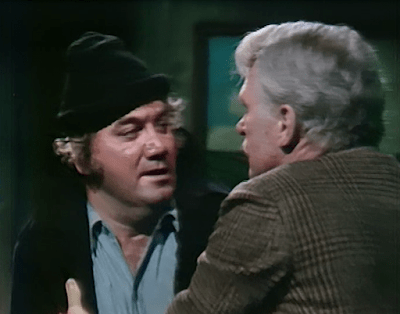
Paul’s new buddy, unnamed in the dialogue, is identified in the closing credits as “Jack Long.” He is played by Kenneth McMillan, in his first screen credit. In the 1970s and 1980s, McMillan was one of the busiest television actors in the USA. I always mixed him up with Dolph Sweet, who was a similar physical type. Sweet appeared on Dark Shadows once, in #99. He played Ezra Hearne, the most loyal employee at Liz’ cannery. Sweet was a tremendous actor, McMillan a very good one, and they occasionally worked together. So long as they are doing normal soap opera stuff, it would have been nice if they could have had a little story about Ezra’s reunion with his long-lost cousin Jack. Maybe Jack could have introduced Paul to Ezra, we could have seen how he’d fit in with the family.
Heiress Carolyn Collins Stoddard is sitting at a table in the Blue Whale, a tavern. A man who refused to give his name when she caught him trespassing on her property invites himself to sit down with her. She objects to this. He identifies himself as her father, the long-missing Paul Stoddard. She objects far more strenuously to that. Not only did Paul leave the family when Carolyn was an infant, he and his friend Jason McGuire faked his death. Jason convinced Carolyn’s mother, Liz, that she had killed Paul and he had buried the corpse in the basement. In response, Liz immured herself in the house for nineteen years. Only after Jason came back and was blackmailing Liz into marrying him did the truth come out and Liz break free of her reclusive ways.
Paul tells Carolyn that he didn’t know Jason told Liz that she had killed him. Longtime viewers may suspect this is a lie, not least because Paul and Jason are both played by Dennis Patrick. Nonetheless, Carolyn falls for it. Soon she is agreeing to sound Liz out to see how she might react were she to hear that Paul had returned. He walks her home to the great house on the estate of Collinwood. He can’t go in, but gives her a goodnight kiss on the forehead.
Carolyn’s young cousin, strange and troubled boy David Collins, sees Paul kissing her. When she goes inside, he asks who her new boyfriend is. Carolyn is vexed. She refuses to tell David anything, and sends him to bed.
Carolyn’s friend Philip Todd comes to the door. He tells her that he and his wife Megan want Carolyn to work at their antique shop in the village. It may seem rather odd for the keeper of a little shop to go to a vast mansion and ask the daughter of its proprietor to take a job as his assistant, but Carolyn loves the shop and was volunteering there yesterday. She agrees happily, and mentions that a man might be leaving messages for her there.
In the shop the next morning, Carolyn sees that Megan has a baby. Megan says it is her sister’s son. Carolyn asks his name. Megan thinks for quite a while before coming up with “Joseph!”
Carolyn is alone in the shop when David comes in with his friend and fellow resident of Collinwood, Amy Jennings. We haven’t seen Amy since #835; that in turn was her first appearance since #700. For eight months, from #701 to #884, Dark Shadows was set in the year 1897, with only a few brief glimpses of the 1960s. In the 1897 segment, Denise Nickerson played Nora Collins, whose own final appearance was in #859. Both Nora and Amy had long absences from the cast, and were usually unmentioned while they were away. So we’ve been afraid that we wouldn’t see Amy or any other Nickerson character again. It’s good to have her back. She even pulls her signature move and gives a meaningful look directly into the camera at one point.
A Nickerson special.
Amy and David see a doll that longtime viewers will recognize as Samantha, favorite plaything of the late Sarah Collins both when we saw her as a living being in the 1790s from November 1967 to March 1968 and before that, when she was a ghost haunting Collinwood and its environs in 1967. There are also a couple of toy soldiers from “The Regiment,” which Sarah’s brother Barnabas played with when he was a young boy and which Sarah gave to people in 1967 as protection against Barnabas, who was at that time a vampire. Barnabas did sell a bunch of things to Megan and Philip the other day, but neither Samantha nor the members of The Regiment were in Barnabas’ possession when last we saw them. Presumably the camera lingers on the toys, not because we are supposed to know how Philip and Megan got them, but because we are supposed to be pleased with ourselves for recognizing them.
Paul comes into the shop. David recognizes him as the man he saw kissing Carolyn. Carolyn addresses Paul as “Mr Prescott,” sends him into a back room, and hustles the children out of the shop. She tells Paul who David is, and explains that he saw them together, complicating their plans.
When Carolyn was minding the shop yesterday, her friend Maggie noticed an old book on a table. Neither of them knew what it was, but viewers knew it was an object of great importance to a cult into which Philip and Megan have been inducted. It seemed inexplicable that they would leave it on a table in their shop, as if it were for sale. We get a hint today as to what they may have been thinking. In his room at Collinwood, David shows Amy that he has stolen the book. She asks why he would want it. He explains that Carolyn said that if they damaged anything in the shop, his father, Roger, would have to pay for it, and he creased a page in the book. David’s fear that his father would punish him drove several stories in the early months of the show. Roger has mellowed enormously since then, but evidently David is still so afraid of him that he will make a bad situation worse rather than face his wrath.
Indeed, many major storylines have begun with David. The 1897 flashback started because Barnabas was trying to keep a ghost from killing David, as the 1790s segment started when David’s governess Vicki participated in a séance meant to solve a mystery concerning him. For that matter, the whole show started when Vicki was summoned to Collinwood to take charge of David’s education. David doesn’t always have a lot to do in the stories, and when they are over it is often as not forgotten that he was in peril when they began. But he is so often the catalyst that we can suppose that David was supposed to find the book so that the current story could move into its major phase.
If that was the intention, Megan and Philip didn’t know about it. When they discover that the book is gone from the shop, they fly into a panic and declare that whoever took it must be killed. It may turn out that the mysterious forces behind the cult want David to become involved and that they created a situation in which he would find the book and take it with him, but if so, those forces are operating outside the cognizance of anyone in today’s episode.
Old world gentleman Barnabas Collins has given a present to antique shop owners Megan and Philip Todd. It is a wooden box. This box has a strange effect on the Todds, filling them with a mixture of irresistible fascination and nameless dread.
When the Todds go to open the box, it makes a whistling noise. They find a book inside it. The book is noticeably larger than the box. It is written in a script they do not recognize. There is also a scroll. That is in English, but may as well not be- neither Philip nor Megan can understand it, though Megan does say that she feels as if she almost can.
Later, Megan has a dream. It is the sort of dream people had in the first year of the show, before there were special effects. Like the dreams in ancient Greek literature, it takes the form of someone standing by the bed and making a speech. The speaker is Barnabas, and he tells Megan to empty the bedroom of furniture, board up its windows, and let no outsiders enter it. She calls him “master,” and he tells her she will not recognize him as such when she is awake. When she does wake up, she finds that Philip is already following the instructions, and realizes they had the same dream.
Downstairs, heiress Carolyn Collins Stoddard is minding the antique shop. She receives a telephone call from someone wanting to buy a cradle that is on the shop floor. At the end of the call, we hear Carolyn’s thoughts as she congratulates herself on making a sale. She is shocked when Megan comes down and tells her the cradle is not for sale. Philip comes afterward, and with a blank expression on his face carries the cradle upstairs. Carolyn is left to call the buyer back and apologize.
Philip and Megan set the cradle in the special room. They are apparently in awe. They look like any new parents stunned by the fact that they have brought a new life into the world, but the cradle is empty. After they leave the room, it starts rocking by itself.
The cradle is an interesting choice of prop. It was important early in 1969 in the “Haunting of Collinwood” story, when it was associated with the ghosts and rocked by itself. We then saw it a couple of months later in the 1897 flashback, when we learned why it was haunted. Those stories have been resolved in such a way that it won’t occur to us that the consequences of the same tragic events are animating it this time. The cradle seems to have become a generic symbol of spookiness. Considering that its back is coffin-shaped, that’s an understandable association.
Meanwhile, Maggie Evans, The Nicest Girl in Town, has come into the shop. Maggie is the governess in Carolyn’s home, the great house on the estate of Collinwood, and they are friends. Maggie notices the sacred book on a table and asks Carolyn what it is. Carolyn doesn’t know anything about it. Why the Todds would leave such a thing on a table in their shop, a placement that implies it is for sale, is not explained.
Maggie tries on a feather boa. Like the cradle, this prop was significant in the 1897 segment. In that part of the show, Nancy Barrett, who plays Carolyn, was introduced as a woman named Charity Trask. Charity’s body was eventually taken over by late Cockney showgirl/ mentalist Pansy Faye. She wore the boa to indicate that she was Pansy. We last saw Charity/ Pansy, boa and all, in #883, and heard her voice in #887, so when we see it in the shop regular viewers will have fresh memories of her. We may well hope Carolyn will put it on and start singing Pansy’s song. But Maggie is the only one who is interested in the boa, and she doesn’t seem possessed at all. She wants to buy it, but Megan comes in and prevents her doing even that. She declares she is going to be closing the shop early.
Maggie leans very heavily on Carolyn to join her for a drink at the local tavern, The Blue Whale. Even after she drags Carolyn there, Maggie keeps pressuring her to stay for another drink. This is not at all typical of Maggie. When we find out her reason, it turns out to be even less characteristic. A mysterious gray-haired man who has been lurking around Collinwood lately wants to sit with Carolyn. When he comes to the table, Maggie gets up and leaves Carolyn alone with him. She has a self-satisfied smirk on her face as she does so, not a look we have ever seen her give before.
The man introduces himself to Carolyn as Paul Stoddard, her father. Paul abandoned the family when Carolyn was an infant, in the process faking his own death and prompting Carolyn’s mother Liz to believe that she had killed him. That belief led Liz to confine herself in her home for nineteen years, terrified that she would be caught. So it is simply inexplicable that Maggie would think Carolyn would be happy about having this bomb dropped on her.
Paul’s introduction of himself to Carolyn is the first time he is identified in a scene, but it is not the first time viewers have been told who he is. His name appeared in the closing credits for #887 and #891, ruining the surprise that is supposed to give a punch to the ending of today’s episode.
Edward Collins isn’t what he seems. His stuffy manner is real enough, as are his kind impulses when he sees people in distress. But he allows those who meet him to believe that he is the heir to the vast Collins family fortune, which in fact belongs in its entirety to his sister Judith. Judith is currently an inmate in a mental hospital. During her absence, her husband, the odious Gregory Trask, exercises control of all the family’s assets. Edward hopes to get out from under Trask’s thumb by marrying the dowager countess of Hampshire, a young American woman named Kitty Soames. He befriended Kitty while a houseguest of the late Earl’s, and now that she is widowed and is his guest at the great house of Collinwood he sees an opportunity to take over the Hampshire interests.
Kitty isn’t what she seems. The Earl was bankrupt when he died. He had lost all his wealth and been driven to suicide by sorcerer Count Petofi. Kitty wrote a letter to her mother the other day saying that unless she marries Edward and becomes the mistress of Collinwood she didn’t think she could raise train fare from central Maine to her home in Pennsylvania. Nor is this all. If Kitty were simply without funds, she and Edward would be on an even footing. But she is not what she seems in a metaphysical sense as well as a financial one. She is intermittently possessed by the ghost of the late Josette Collins. Regular viewers have reason to believe that she is Josette’s reincarnation, and that the fits of possession are part of the process by which Josette is reuniting her spirit with her body. But the characters don’t know what we know. As far as they are concerned, Kitty seems to be a plain lunatic.
At rise, Edward catches Kitty in his brother Quentin’s room. She is rummaging through an armoire, apparently looking for something. He asks her what she is doing, and she feigns one of her fits. Kitty is not nearly as good an actress as Kathryn Leigh Scott; she doesn’t fool us for a minute. But Edward believes her. He gently escorts her out of the room. As they leave, we see a face peering at them from the shadows. It is Quentin’s face.
Downstairs, we hear Kitty’s thoughts as she takes satisfaction in having fooled Edward into thinking she was having a fit. Mental health professionals often talk about how people learn to use the resources they have, so that patients who carry diagnoses of major disturbances will sometimes find ways to exaggerate their symptoms for effect. It’s true that psychotic episodes are not usually an asset in the husband-hunting business, but everyone in the segment of Dark Shadows set in 1897 has some issue or other, and Edward really does have a soft spot for mentally ill women (unless they are married to Quentin, but that’s another thing altogether.) So Kitty may as well play up her particular case of dissociative identity disorder.
Kitty was in Quentin’s room trying to steal a portrait of him. She was doing this from her fear of Petofi, whom she believed to have ordered her to bring him the portrait before 9 PM lest he use his magical powers and make her vanish. It is almost that time now, and she has no idea how to find the portrait, let alone get it to him before the deadline. While she is worrying about this situation, a woman named Angelique enters.
Angelique isn’t what she seems. She is one of Quentin’s fiancées, and Edward takes her to be an innocent woman, about 30 years old, who has been hard done by in the course of the supernatural doings of the last several months. In fact, she is a wicked witch who wrought immense destruction the first time she was at Collinwood, in the 1790s, and again the second time, in 1968. She has traveled back in time to 1897, and has been one of the most powerful participants in all of the strange goings-on.
Kitty tells Angelique that she saw Petofi in the vacant rectory on Pine Road, and that he told her the woman who had been squatting there vanished into thin air before his eyes. At this, Angelique turns and rushes off to investigate. It dawns on Kitty that Angelique knows more than she is saying. We cut to the drawing room, where Edward is bracing for a conversation with Quentin.
Quentin isn’t what he seems. In fact, he isn’t Quentin at all. Petofi forcibly swapped bodies with him a few days ago. It is Petofi, using Quentin’s body as a disguise, who confronts Edward and demands to know what he and Kitty were doing in the room. I refer to this form of Petofi as Q-Petofi, and the Quentin who looks like Petofi as P-Quentin.
Edward tells Q-Petofi that Kitty had had a “seizure.” Q-Petofi expresses skepticism about this claim. He proceeds to tell Edward that Kitty’s late husband died in poverty, shortly after being released from prison for a jewel theft. Edward is thunderstruck. He calls the story a lie, and forbids Q-Petofi from repeating it to anyone.
Kitty goes to the village of Collinsport, and pays a visit to The Blue Whale, the local tavern. She wants to see the entertainer, Miss Pansy Faye.
Pansy isn’t what she seems. She has met the Collinses twice. Miss Charity Trask, daughter of Gregory and enforcer in his operation, came to the great house in #727 and took up residence when her father married Judith. Pansy Faye, mentalist and Cockney showgirl, came to the estate in #771 as the coldly cynical fiancée of the childlike Carl Collins. Pansy was killed the night she arrived. A few weeks later, Pansy started to take possession of Charity, and in #819 Petofi erased Charity’s personality altogether and gave her body over to Pansy.
When Kitty enters, Pansy is alone in the bar. She is picking out her theme song on the piano. When Petofi was in the process of switching bodies with Quentin, Quentin was with Pansy in this room. Petofi took control of him briefly and played the same song on this piano. He played it very impressively.
Kitty is desperate to find out what is happening to her, and she knows that Pansy has powers. Once Pansy assures her that she doesn’t work for Count Petofi, Kitty offers her a diamond-encrusted brooch in return for information. Pansy is offended. She says that she will take a gift in return for her services after she has rendered them, but that she does not accept payment in advance. She tells Kitty that there is one way to find out what is happening to her, which is to have a séance. Kitty gets up to leave, and Pansy presses the brooch on her.
The diamond brooch is a puzzle. Perhaps Kitty was lying to her mother when she said that she couldn’t buy a train ticket to Pennsylvania? Or perhaps the brooch is part of the late Earl’s ill-gotten gains, and Kitty doesn’t want to show it to anyone more reputable than Pansy.
Nancy Barrett’s approach to all her roles on Dark Shadows was to throw herself completely into whatever the character was doing at any given moment. That isn’t to say that her performances lacked nuance or that she didn’t support her scene partners, but that her method was to take her part from the outside in, letting the action supply the motivation. As Kitty, Miss Scott has opportunities to take this same approach. But in Kitty and Pansy’s scene in the Blue Whale, she deliberately lets Miss Barrett drive the action. Since Pansy has already completed a process of possession and transformation like that into which Kitty is now entering, Miss Scott can convey a great deal of information about Kitty’s state of mind by giving rather subtle reactions to Pansy’s behavior.
Back at Collinwood, Edward and Q-Petofi are drinking. Edward shakes his head at his brother’s ability alternately to enrage him and charm him. Q-Petofi asks him to be the best man at his wedding to Angelique; Edward agrees at once. Angelique enters, and Edward exits.
Angelique says that she doesn’t want to get married after all. Q-Petofi insists they go ahead. She points out that it was her idea, and he was extremely reluctant to agree to it. This is true- the engagement was part of Angelique’s price for invoking the power of Satan to break spells Petofi had cast on Edward and his son Jamison. While Q-Petofi has managed to copy Quentin’s behavior towards Edward almost exactly, his behavior towards Angelique has been radically different than was Quentin’s. We don’t know what Angelique has made of this.
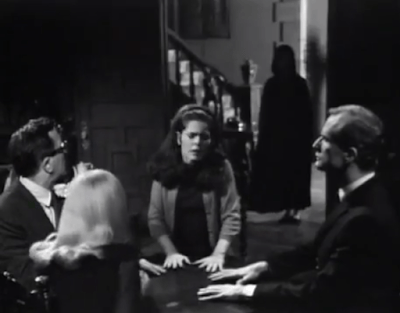
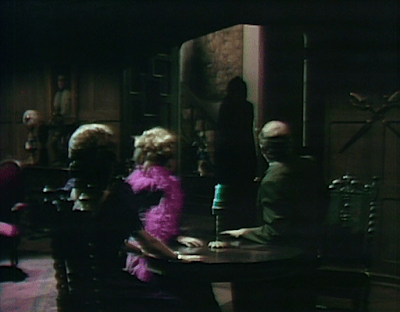
Edward finds Kitty and Pansy preparing the séance. After an initial protest, he declares he will join them. It ends with a visual quote from Dark Shadows‘ first séance, back in #170. As in that episode, a hooded figure appears in the doorway.
Episode 170Episode 860
The hooded figure in #170 turned out to be undead blonde fire witch Laura Murdoch Collins. Another iteration of Laura was on the show as Edward’s estranged wife in April and May. It seems unlikely she is coming back, so longtime viewers are in suspense as to the significance of the allusion.
The hooded figure today is Natalie Norwick, making the last of her seven appearances as an uncredited stand-in on Dark Shadows. Norwick was in many plays on Broadway, as the lead in more than one, appeared in three feature films, and worked steadily in television from 1945 until the mid 1960s. She retired from acting in 1982, returning to the Broadway stage as understudy to her friend Julie Harris in 145 performances of The Gin Game from 1997 and 1998 when she was in her mid-70s. When Harris had a fall in 1999, Norwick took over the part, playing it in Florida and Washington, DC. She was chiefly based in Los Angeles in the late 1960s; perhaps she took the stand-in work to pay some bills during visits back east.
Norwick is best remembered for a single supporting performance on television in 1966. She appeared in “The Conscience of the King,” an episode of the original Star Trek, as Martha Leighton, the wife of Captain Kirk’s troubled friend Tom. She didn’t get much screen time, but she made the most of it. After Tom is murdered, she plays Martha’s understated reaction with a quietness that startles you no matter how many times you’ve seen it. Norwick is another of the significant talents one wishes Dark Shadows had found more to do with.
Tim Shaw was a poor put-upon fellow when first we met him in #731, an episode set in April 1897. He had spent his childhood among the pupils imprisoned at Worthington Hall, a dungeon masquerading as a school, and when he was of age the headmaster, the evil Gregory Trask, coerced him into staying on as a teacher. In company with another man, Trask contrived to use Tim as an unwitting instrument in his plot to murder his wife Minerva. Trask’s plan to frame Tim for the murder fell apart, and Tim managed to keep his freedom. Not only that- he stole the legendary Hand of Count Petofi and took it to New York City, where within weeks he used its magical powers to make himself very rich. In August, he returned to Collinsport determined to take revenge on Trask.
Shortly after coming back to his hometown, Tim lost the Hand. (Which, to be clear, was an actual human hand severed from a sorcerer named Count Petofi a century before.) The 150 year old Petofi himself reclaimed it, and reattached it to his wrist. The ill-fortune Tim suffered in his youth left him a weak and cowardly man, who betrayed his only friend when Trask was looking for her. But his good fortune when he was in possession of the Hand has corrupted him much more severely. He used to be kind to children and even risked his life to rescue nine year old Nora Collins when Worthington Hall burned down in #736, but in #816 he violently shook Nora when he found that she had let the box containing the Hand out of her sight. In his pursuit of another gimmick that will enable him to continue getting rich, he has developed a number of schemes, the worst of which do not stop at murder.
This morning, Tim is sitting at a table in the Blue Whale, Collinsport’s tavern. The place isn’t open yet, and Tim does not appear to have any connection with it, so it is simply a mystery how he got in and why he wants to be there. The only other person in the room is sitting at the bar. She is a woman who used to be Trask’s daughter Charity, but who has since been transformed into Cockney showgirl and sometime mentalist Pansy Faye, who died in June.
Pansy’s presence makes some kind of sense, as she works at the tavern doing her act. But returning viewers know that she isn’t still there from the night before. After closing, she went back to the great house of Collinwood, where Trask and she live, and talked with the rakish and profoundly drunk Quentin Collins. After dawn, Pansy followed Quentin from the house to a cave. In the cave, she found a mallet and stake Quentin left behind, and next to them the coffin occupied by vampire Barnabas Collins. She drove the stake into Barnabas’ heart. Now she wants a good stiff drink, and she doesn’t care if she has to pour it herself.
Tim stops Pansy’s attempt to pilfer her employer’s stock, and she tells him that she has destroyed Barnabas. Dollar signs flash in his eyes as he calculates what it is worth to the Collins family to know that their single most embarrassing relative is no longer going to be exsanguinating the locals. Pansy does not want to go back to the great house or even to tell the Collinses what happened, and she steadfastly declares she does not want any of their money. But Tim insists.
At the house, stuffy Edward Collins makes it clear he wants nothing to do with Tim and that he regards Pansy as a lunatic. When Tim makes him listen to the story, Edward dismisses it out of hand. But Edward finally agrees to go to the cave with Tim while Pansy stays in the drawing room.
Edward sees that Pansy was telling the truth, and returns to Collinwood in time to see the aftermath of a strange conversation. Pansy meets Edward’s guest, a young American woman named Kitty Soames who is the widow of the Earl of Hampshire. Pansy’s reaction when the dowager countess introduces herself as “Lady Hampshire” is a very characteristic “Well, la-dee-dah!”
Pansy’s delighted smile and relaxed manner suggest that in Kitty she has recognized a kindred spirit. Returning viewers know she’s onto something- we’ve heard Kitty’s interior monologue as she’s screwed up her courage to try to connect with the rich Collinses. We also know that she and her husband were mixed up with Petofi, who is not an individual who often attracts the innocent. And while she is so quick to deny to Edward that her husband’s suicide had anything to do with business reverses that he assumes she is still imposingly rich, later today we will hear the text of a letter in which she tells her mother that if she doesn’t get something going with Edward, she won’t be able to raise enough money to pay the train fare from Maine to Pennsylvania. So Kitty’s presentation of herself is misleading, and she is not so different from the living Pansy, who was what in the parlance of the 1890s might have been called an adventuress.
In her letter to her mother, Kitty mentions that she first came to the earl’s home as the governess. This circumstance reminds us of two other characters played by the same actress. In the parts of Dark Shadows set in 1969, Kathryn Leigh Scott’s Maggie Evans was the governess at Collinwood. And in the first part of the 1897 segment, she took the role of neurotic intellectual Rachel Drummond, who held the same job in that year.
Rachel was the friend whom Tim betrayed to Trask, and the contrast between her and Kitty reflects the change in Tim. Rachel and Tim were both well-meaning but helpless before Trask. They stood out in the 1897 segment as almost the only characters who weren’t playing an angle of their own. Rachel died in Tim’s arms, in the same room where he would later find the Hand. As his discovery of the Hand opened the way for Tim to become a schemer, so the death of Rachel allowed Miss Scott to return as a someone who could keep up with the quick-witted and merrily vicious characters who make 1897 such a delight. Moreover, we are in suspense as to what sort of person Kitty will turn out to be. She could end up being as innocent as Miss Scott’s previous roles, she could be as detestable as Tim has become, or she could land anywhere in between.
Pansy has a vision of a music box. She vocalizes its tune, and tells Kitty that if she ever receives one like it she must destroy it at once. If she does not, she will die. Kitty is upset by the whole conversation. Pansy tells Kitty that she ought to listen to her, because she has “powers.” “I guess… I didn’t use to have, but now I do.” Pansy often mentions this point, which harks back to her first appearance. In #771, the living Pansy came to Collinwood as the fiancée of the childlike Carl Collins. She was astounded to find that in the spirit-charged atmosphere of the estate her phony “mentalist” act really did conjure up a voice from the supernal realms. In turn, that echoed #400, when Charity’s ancestor, the fanatical Rev’d Mr Trask, was delighted that an exorcism he was performing seemed actually to work.
When Edward comes back, he assures Kitty that Pansy is mad and that he will “deal with her.” Kitty goes upstairs to her room, where she will later find that the music box Pansy described has materialized. This music box has a long history, and in 1967, when the show was set in contemporary times, Barnabas used it to try to convince girls that they were his lost love Josette. Even if Barnabas hadn’t been staked, we wouldn’t suspect him of planting the music box in Kitty’s room- it appears there during the daytime. Viewers who have been with the show from the beginning will remember that Josette’s ghost used to be quite active around Collinwood, and might wonder if she did it.
In the drawing room, Edward talks with Tim and Pansy. He refuses to call Pansy anything other than “Charity Trask”; she is indignant at being live-named, but he won’t relent. He asks her to stay in the house, and offers to provide her with the best possible mental health care. She angrily declares “I! Ain’t! Sick!”
Tim says that he will see to it that Pansy doesn’t tell anyone about Barnabas; Edward doesn’t bother to conceal his contempt for Tim, and makes it clear that he will not pay him for this or any other service he might offer to perform. Pansy tells Tim that it is time for them to leave. She invites Edward to catch her act at the Blue Whale; he says he doesn’t expect to find the time, but that he is sure Tim will come back to Collinwood when he wants something.
When Tim first came back to town, he had a girlfriend named Amanda whom he planned to use in the game he was going to run on Trask. Eventually we learned that this plan was to involve the murders of the former Judith Collins, who is now Trask’s wife, and of Trask himself. Amanda would marry Trask after she had incited him to kill Judith, they would then kill Trask, and Tim would marry Amanda, thereby becoming the master of Collinwood. Amanda was never fully sold on the homicides, and she and Tim now seem to have gone their separate ways. So Tim is left without friends and without a plan. Nor does he seem to understand how dangerous the people he is dealing with truly are. He thinks that he can bluff his way into partnership with the enormously powerful and thoroughly evil Petofi, and is only dimly aware of the other monsters lurking in the area. One might surmise that Tim’s happiest days are firmly behind him.
Most of the episode revolves around the fact that Julia Hoffman cannot speak. Grayson Hall uses a whole new set of acting techniques playing a mute character than we had seen in her appearances as the most talkative human beings imaginable, and the result is absolutely fascinating. I’d have been glad to watch the episode again as soon as it ended.
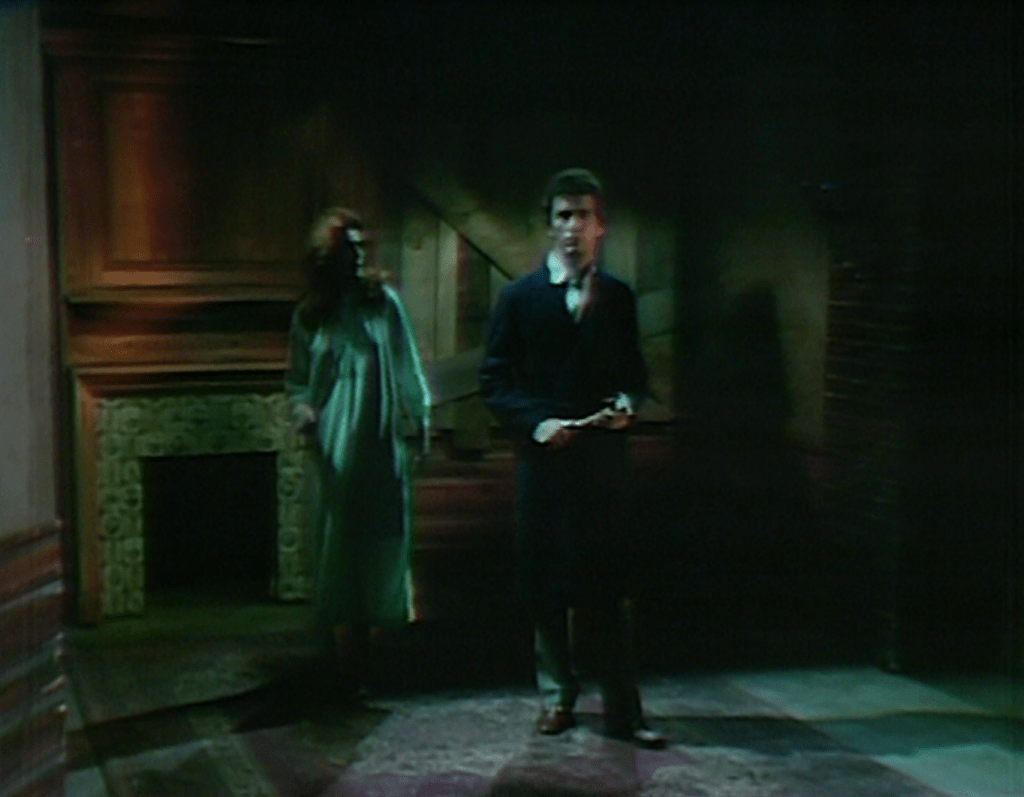
We open in the basement of the Old House on the estate of Collinwood. Julia is sitting at a table in front of a set of I Ching wands. These wands are still in the pattern recovering vampire Barnabas Collins cast several months ago, when he was trying to contact the malign ghost of Quentin Collins. Barnabas meditated on them, and his “astral body” went back in time to 1897. Since his physical body was also in 1897, confined to the coffin in which he was at that time trapped, he became a resident of that year, and met the living Quentin.
Julia has decided that she, too, must travel to 1897. So she meditates on the wands. She tells herself that she must visualize them on a door, and she tells herself to “Empty your mind of everything else.”
She follows this injunction only too well. After passing through a series of doors, she collapses outside the great house at Collinwood in 1897. When stuffy Edward Collins takes her into the drawing room and questions her, she can respond only with a blank stare. Quentin comes in and finds a letter from Barnabas in Julia’s pocket. He asks her if she is the Julia addressed in the letter and why she has a letter from Barnabas. She does not recognize her own name or Barnabas’.
Quentin has become Barnabas’ friend, and his brother Edward has become his enemy. When he reads the letter Julia brought, Quentin realizes that Edward has locked Barnabas in the prison cell in the basement of the Old House. When dawn comes, Barnabas will not be able to get back to his coffin. Since he is a full-fledged vampire in 1897, that means he will disintegrate into dust.
Quentin leaves Edward with Julia and goes to Barnabas’ rescue. Quentin knows that Barnabas is a vampire and that he is trying to help him, and he knows that if things keep on as they are going he might become a family-annihilating ghost at Collinwood in 1969. But it is only while talking to Barnabas about the letter that he learns that he has come to 1897 from that year. The pieces start falling into place in Quentin’s mind as he absorbs this information.
Barnabas goes to hide in “the old rectory on Pine Road.” Quentin takes Julia there. Barnabas can’t get any information out of her, but he is sure that she knows how to save Quentin’s life. He is also sure that if they don’t find out what she knows, Quentin will be killed on this night, 10 September 1897.
The basis of Barnabas’ certainty regarding this latter point is a vision that a woman had. This woman used to be the repressed Charity Trask, but has now by supernatural means been transformed into the late Cockney showgirl/ psychic Pansy Faye. Pansy’s psychic act was fake until she came to Collinwood in #771. In the spirit-laden atmosphere of the estate, even her phony mumbo-jumbo called up real voices from the great beyond. Pansy’s stunned reaction when she actually contacted a ghost reminded longtime viewers of #400, when Charity’s ancestor, the fanatical witchfinder the Rev’d Mr Trask, conducted an exorcism to drive a witch out of the Old House and showed delight and not a little astonishment when the person he believed to be the witch came running out at the climax of the ceremony. Perhaps Pansy reminded the writers of Trask as well, and that was where they got the idea of having her spirit take possession of Charity.
Charity/ Pansy is in today’s episode. She’s the one who finds Julia, and she tells Edward that Julia “has death written all over her face!” She also says that she has a job. She is working at the tavern in the village of Collinsport, the Blue Whale. Presumably she is doing Pansy Faye’s old act there, singing, dancing, and doing psychic readings. We can imagine what Charity’s father, the hypocritical Rev’d Gregory Trask, must think of that.
Broad ethnic stereotype Magda Rákóczi is in her home, the Old House on the estate of Collinwood. She takes a hatchet and chops a plastic model of a severed hand into two plastic models, each representing half of a severed hand. She then throws a handkerchief into the fireplace, all the while declaring that no further trouble will come from the hand. Later, she goes to the great house on the estate and tells handsome libertine Quentin Collins about this; to her surprise, he responds by flying into a rage and choking her.
Quentin’s rage abates when a huge image of the hand materializes in the room and floats towards Magda’s rear end. After she goes home, it materializes again and again drifts towards the same destination. With that, she runs outside.
Meanwhile, some activity is going on at The Blue Whale tavern. One man asks another for information about Quentin. The inquirer is named Aristide; the other, Tim Shaw. Tim identifies himself as an employee of the Collins family. Tim tells Aristide that all he knows about Quentin is that he is an arrogant jerk and that the only reason his family lets him live in their mansion is that their grandmother’s will requires them to. Aristide says that he already knew those things, and he asks Tim to carry a message to Quentin.
Tim is in the foyer of the great house while Magda and Quentin are in the drawing room. He eavesdrops on their conversation about the hand. He overhears them saying that the hand is magical, that properly used its powers are limitless, and that it is in a box at Magda’s. After the hand’s second attempt to grope Magda’s buttocks drives her from her house, Tim sneaks in, finds the hand, and tells it that it is just what he needs.
The message Tim brought from Aristide invited Quentin to meet at The Blue Whale. Quentin goes and brings up something that happened a few days ago, when Aristide tied him to a table and tried to kill him. Aristide agrees that this was not a good plan. Aristide says that Quentin can be “cured”; returning viewers know that Quentin is a werewolf, and that it is for this condition that he wants a cure. Aristide admits that he does not know what the cure is; Quentin says that if he had claimed he did know, he would have killed him. But he says that someone else does know. Quentin learned yesterday that Aristide is in the service of a man whom he knows as Victor Fenn Gibbon; evidently Aristide was not aware Quentin had picked up on that, because he is alarmed when Quentin drops Fenn Gibbon’s name. Nonetheless, Quentin does agree to meet Aristide again, and to give him proof that he has the magical hand. Once he has been cured, Quentin will surrender the hand to him.
Before Magda entered the drawing room at the great house, Quentin had been talking with Miss Charity Trask, his sister’s new stepdaughter. Returning viewers know that Charity’s father, the evil Gregory Trask, has decided she ought to marry Quentin. This scene is the first time we see Charity trying to follow this plan. She mentions that Quentin is a widower. It has not been clear to us whether this is generally known. His wife Jenny was hidden away the year before, after he left her, and she was buried very quickly after he murdered her in #748. For all we know, Charity may not know that Jenny is dead, or even that she ever existed. Quentin’s siblings have been holding information about Jenny very tightly; it was just yesterday that Quentin learned Jenny bore twins while he was away. At the same time, he learned that one of those twins has died. He tells Charity that he is a father, and she is confused.
I don’t suppose any of this sounds very exciting, but it is a remarkably fast half-hour. The script is crisp and rapid; even viewers who haven’t missed an episode and know all the background will appreciate the air of mystery that arises from leaving so much unsaid and unexplained. And the actors are uniformly excellent. I can imagine a first-time viewer seeing this one and making a note to watch again tomorrow.







 Dark Shadows Commentary