Episode 873: Charming and exquisitely dangerous

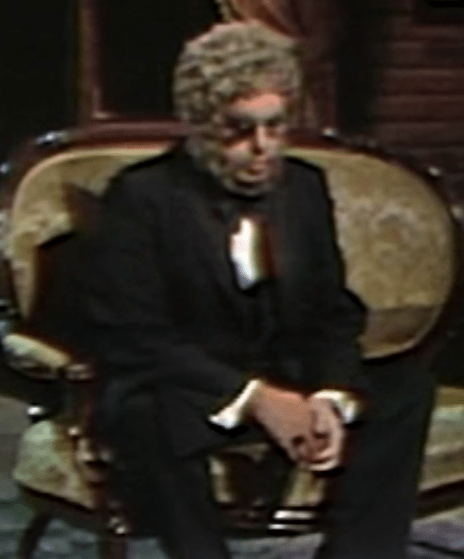
In October 1897, sorcerer Count Petofi has used his magical powers to swap bodies with Quentin Collins. I refer to the villainous Petofi who looks like Quentin as Q-Petofi, and to the forlorn Quentin who looks like Petofi as P-Quentin.

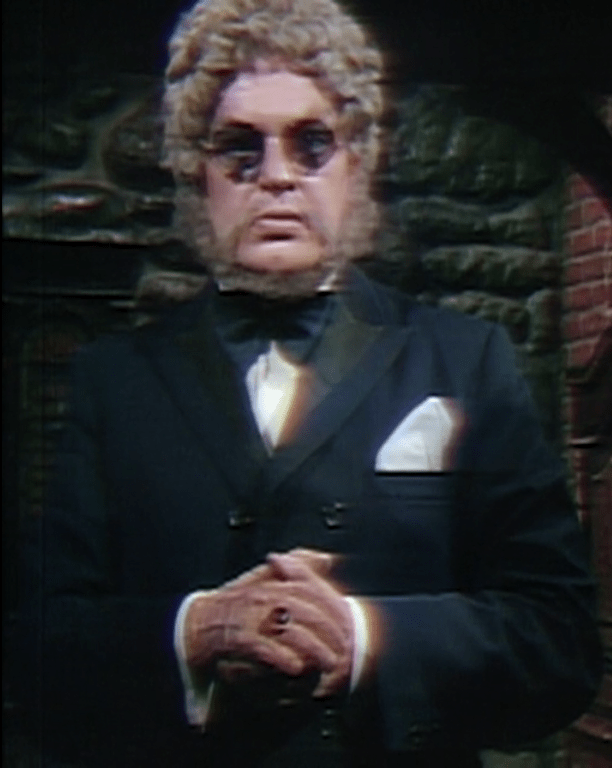
We open with Q-Petofi meditating on a lineup of I Ching wands. He goes into a trance which unlocks a cosmic force that transports him to the great house of Collinwood in 1969. He wanders into the drawing room, finds a newspaper dated 28 October of that year, and starts exulting. Maggie Evans, governess in the great house in the late 60s, hears him and comes downstairs.

As the segment of Dark Shadows set in 1897 winds down, we’ve been thinking of ways they might have moved forward. Some of the possibilities involve splitting the week between episodes set in 1897 and others set in 1969. Maggie has been on the show from episode #1, and has been central to several of the storylines that take place in contemporary dress. The last of these stories before the move to 1897 centered on Quentin’s malevolent ghost haunting Collinwood and making it impossible for anyone to live there. In the course of that, he appeared to Maggie several times. In #682, Maggie had a dream in which Quentin’s ghost strangled her to death. Though the events we have seen in 1897 have changed the future, we saw in #839 that the 1960s characters remember Quentin’s haunting. So when Maggie is on her way to meet someone who is to all outward appearances Quentin, we have a hint that a story might be brewing in which Q-Petofi finds himself carrying the can for all of the horrors Quentin’s ghost wrought between December 1968 and September 1969.

Alas, it is not to be. By the time Maggie reaches the drawing room, Q-Petofi has vanished. A few moments after he left 1897, maidservant Beth scattered the wands and brought him back. He is furious when he comes to, and she explains that she had to do it. The magical portrait that keeps Quentin, and presumably also Q-Petofi, from becoming a werewolf is not in the suitcase Q-Petofi gave her earlier in the evening to bury. Q-Petofi has been in possession of Quentin’s body and of his portrait for weeks, and he has vast powers of sorcery, so you’d think he would have hidden the portrait long before. His magic powers would seem to give him the ability to do anything at all to hide it. My favorite idea is that he would impose onto Quentin’s portrait an exact copy of the portrait that hangs above the mantel in the drawing room of the great house and hang it in its place, so that it would be hidden in plain sight for years to come.

Besides, if Q-Petofi was going to bury the portrait surely he would at least have put it in something airtight and made of metal, not a wooden suitcase that doesn’t close all the way and that will likely rot to dust in a year or two. Apparently he isn’t as big on long-term plans as he led us to believe when he claimed he was working on a design to become the ruler of the cosmos.

Q-Petofi orders Beth to bring Pansy Faye, a deceased Cockney showgirl/ mentalist who has for some time been inhabiting the body once occupied by the stunningly dreary Charity Trask, to Quentin’s room at Collinwood. He demands information which she refuses to give. She storms out.

Pansy has a dream in which she and Quentin dance in the drawing room of Collinwood while a specially recorded version of her song, I Wanna Dance for You, featuring the voices of Nancy Barrett and David Selby, plays in the background. Colors flare on the screen while we hear them sing. Miss Barrett was an excellent singer, Mr Selby an adequate one. He does speak a few of his lines, which damages the rhythm of the song, and the flaring colors often obscure the actors completely. Mr Selby and Miss Barrett are so lovable that we very much want to overlook these flaws in the number’s conception.

The dream ends with Quentin turning into Petofi and laughing evilly at Pansy. She awakes in horror. She has known for some days that Q-Petofi isn’t Quentin, and she knows enough about Petofi that it is strange she hasn’t already figured out that he is the one hiding inside his body. But when she sits up with a gasp, we know that she has finally put it all together.

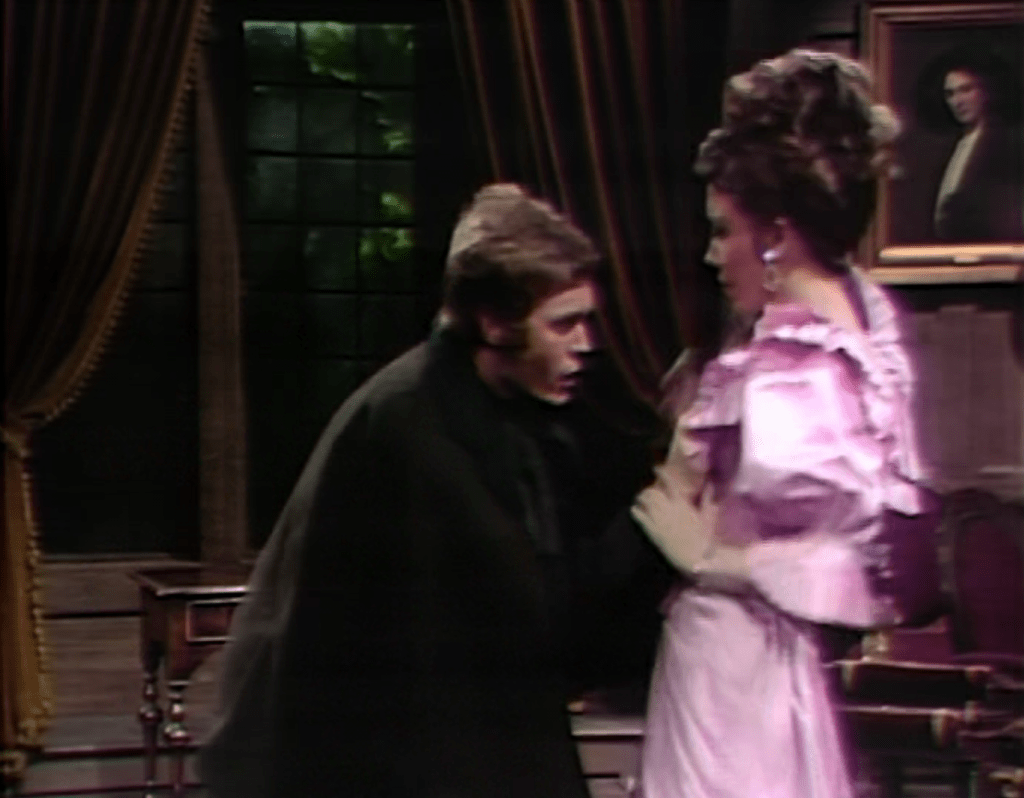
Time-traveler Barnabas Collins, a recovering vampire, meets Q-Petofi in the drawing room at Collinwood. Q-Petofi is convinced that Barnabas stole the portrait of Quentin, and is very aggressive about pressing his suspicions. Barnabas has been playing dumb ever since his vampirism went into remission, but after a couple of minutes of Q-Petofi’s hectoring he addresses him as “Count Petofi.” When Barnabas cannot tell him what he wants to hear, Q-Petofi declares that he will restore the vampire curse to its full potency. He touches Barnabas’ forehead with the right hand in which his powers are concentrated. Barnabas squeezes his eyes shut for a moment, then opens them with a look of triumph. He asks Q-Petofi what has become of his powers.

The rest of the episode revolves around yet another possessed person. Kitty Soames, a young American woman who is the dowager countess of Hampshire, is also Josette DuPrés, who plunged to her death from the cliff at Widow’s Hill 101 years before. Barnabas was supposed to marry Josette at one point, and he has been obsessed with recreating her ever since.

In May and June of 1967, when the show was set in the present, Barnabas abducted Maggie and tried to brainwash her into becoming Josette. In those days, the show was ambiguous about why Barnabas picked Maggie. Strange and troubled boy David Collins was an intimate friend of Josette’s ghost, and when he saw Maggie in Josette’s dress in #240 and #241, he thought she was Josette, looking just as she always did. Indeed, Miss Scott had played the ghost a few times, always behind a veil. When Barnabas was about to give up on Maggie in #260 he very earnestly told her “But you are Josette!” Yet after Maggie escaped, he picked another girl and planned to repeat the experiment with her, explaining to his sorely-bedraggled blood thrall Willie in #274 that all you have to do is “Take the right individual, place her under the proper conditions and circumstances, apply the required pressure, and a new personality is created.”

But when the show made its first trip back in time, visiting the 1790s from November 1967 to March 1968, Kathryn Leigh Scott played Josette. That was a bold move. Longtime viewers were left with the uncomfortable feeling that Barnabas may have had a point when he devised the horrifying program of torture that made the show so terribly bleak for several weeks. When we see Miss Scott playing Kitty, who really is Josette and really does have to accept that fact, longtime viewers can only squirm as they remember Barnabas shoving Maggie into his old coffin and later walking down the long gray corridors of his basement on his way to the prison cell where he was going to murder her. We’ve since come to know Barnabas as an endearingly ineffectual comic villain, but it is a stretch to remind us of him as he was in those grim days and ask us to concede that he was in any sense right.

Kitty confronts Barnabas at Collinwood and accuses him of orchestrating her Josettifying psychosis. He denies that he is responsible, and claims to know that Josette’s spirit lives in her and that she ought to yield to it. When she asks how he knows, he makes up a story about being a boy in England, falling in love with a portrait of Josette, and reading her diaries. She is unconvinced.

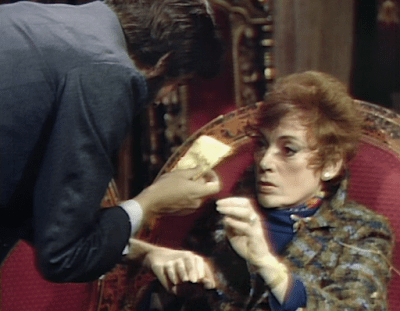
Later, Josette goes to P-Quentin in Petofi’s old squat, the abandoned mill on the North Road. She believes he is Petofi, and asks him to use his power to resolve her identity crisis. He tries to explain that he only looks like Petofi, and has none of his power, but she refuses to believe him. Having nothing to lose, he decides to play along. He tells the right hand to tell Kitty the truth about herself, and touches her forehead. She suddenly realizes that she is both Josette and Kitty. P-Quentin just as suddenly realizes that Petofi’s power has returned to the body in which he is now an unwilling tenant.

Kitty/ Josette keeps telling P-Quentin that she remembers what he was able to do with his right hand when he was staying with her and her late husband in England a few years before. This is a pretty bad continuity error. For eight weeks from #778, the most dynamic story on the show centered on the fact that Petofi’s hand was cut off in 1797 and kept in a box by a Romani tribe for the hundred years since, until broad ethnic stereotype Magda Rákóczi stole it in an attempt to lift the werewolf curse from Quentin. It was only in #815, in August, that Petofi reattached his hand and with it regained the bulk of his power. Granted, #815 is eleven and a half weeks ago, but the show now takes so little time to onboard new viewers by recapping that the writers are clearly counting on the audience to have a great deal of information about the story so far in their heads. As such, it is very surprising that they would break from established continuity on such a major point of the recent months.

Episode 872: Favors for enemies

At the beginning of March 1969, recovering vampire Barnabas Collins meditated on some I Ching wands and found himself transported back in time to 1897. Ever since, Dark Shadows has been a costume drama set in that year. For the first several months of the 1897 arc, there were multiple intertwined storylines, each involving several characters, threatening to negate the version of the Collins family we see in the parts of the show set in the 1960s, and requiring a lot of intricate action to unravel.

Now, the original stories are all resolved. Most of the things keeping us from returning to a contemporary setting qualify as fairly minor loose ends- we can see that Judith Collins will get rid of her evil husband Gregory Trask one way or another, and we can see that Kitty Soames, a young American woman who is the dowager countess of Hampshire, will realize she is really the reincarnation of Barnabas’ lost love Josette and will then become unavailable to him. Both of these could be wrapped up in the same episode, and the fates of the other characters don’t need any further explanation. The one exception is the story about sorcerer Count Petofi and rakish Quentin Collins. Petofi has used his magic powers to swap bodies with Quentin. I refer to the villainous Petofi who has hijacked Quentin’s body as Q-Petofi, and to the forlorn Quentin trapped in Petofi’s aging form as P-Quentin.

Now, Q-Petofi has found out that meditating on the right lineup of I Ching wands releases powers that can transport a person to a different period of history, and he makes arrangements for a departure to 1969. Barnabas tries to stop him, but at the end of the episode we see him standing in the drawing room of Collinwood in that year.

Q-Petofi in 1969. Screenshot by Dark Shadows Before I Die.

Episodes like this present a challenge to someone blogging about the 1897 segment of Dark Shadows. It’s taken up with intricate plot mechanics that depend on story points that would sound ridiculous if you explained them to someone who hasn’t been watching for the last few months, and as Danny Horn explains in his post about the episode on his great Dark Shadows Every Day, many of the scenes don’t make logical sense if you stop and think about them. But it is well-paced, the dialogue is good, the through-line of Q-Petofi’s busyness and Barnabas’ scheming is effectively realized, Nancy Barrett has some charming scenes as Cockney showgirl/ mentalist Pansy Faye, and the image of Q-Petofi in 1969 is a strong ending. So it really is a half hour well spent, but if you aren’t going to watch it you will just have to take my word for that.

The drawing room figures in five scenes set in 1897 before it appears in its 1969 configuration. Since the show was done live-to-tape, the stage hands had to change the furniture gradually in between those scenes. Danny lists the changes we can see:

The drawing room set changes from the 1897 set to the 1969 set over the course of the episode, but the change actually happens in stages rather than all at once. The couch and chairs are replaced while they’re still doing 1897 scenes, and then the lamps, telephone and desk are changed for the final scene.

There are six scenes set in the drawing room, but in some of them, you only see a small part of the set, so it’s hard to say exactly when the switches are made. But here’s what you can see:

Act 1, Tate tells Pansy that he’s seen the future: She’s sitting on a red couch. There are red padded chairs facing the couch. Various round lamps around the room, old telephone on the credenza. Act 2 picks up with Tate and Pansy again, no visible change to the set dressing.

Act 3, Barnabas tells Pansy a secret: They huddle in a corner of the drawing room, where you can’t see much. It’s all shot by one camera.

Act 3, Petofi and Pansy drink champagne: The couch has changed from the 1897 red couch to a green 1969 model. We still see the round lamps and the old telephone.

Act 3, Barnabas finds Pansy’s drunk the rest of the champagne: There are now green chairs facing the green couch. There’s also a sideboard with a clock and a green shaded lamp.

Act 3 finish, Petofi enters the 1969 drawing room: All of the lamps have been changed to modern style, and the old telephone has become a modern telephone. The green chairs are facing the green couch. The sideboard has been replaced with a desk, holding some books, a lamp, and the newspaper.

Danny Horn, “Episode 872: Tick Tock,” posted 4 June 2016 on Dark Shadows Every Day.

There is one important set decoration they left in its 1897 position. In the 1960s, a portrait of Jeremiah Collins hangs above the mantel; in 1897, a portrait identified in #3 as that of Isaac Collins hangs there. Isaac is still in place when Q-Petofi enters the 1969 drawing room.

Episode 857: Champagne for Wanda

Sorcerer Count Petofi is wearing the body of rakish libertine Quentin Collins as a disguise, while Quentin is trapped in Petofi’s own aging and pudgy form. I will call the villainous Petofi played by David Selby Q-Petofi, and the forlorn Quentin as played by Thayer David P-Quentin.

We open with Q-Petofi at the front door of the great house of Collinwood. Yesterday we saw P-Quentin on the same spot, and heard David Selby’s voice articulating the miserable thoughts that showed on Thayer David’s face. Today the roles are reversed, and we see Mr Selby looking exultant while the voice of Thayer David talks about the glories of his situation.

We see that Q-Petofi is accompanied by his henchman, Aristide. He dismisses Aristide’s fear that he will somehow reveal his true identity to the occupants of the great house. He twits Aristide for a little while, pretending that he will use him as a guinea pig in a dangerous experiment he has planned for later in the evening, then sends him off to find someone else to serve that purpose.

Q-Petofi walks in on an argument in the drawing room between stuffy Edward Collins and the overbearing Gregory Trask. Trask is in charge of the house while his wife, Edward’s sister Judith, is in a mental hospital. Trask is going over the household accounts and complaining that Edward is spending too much on his houseguest, Kitty Soames, the dowager countess of Hampshire. Edward asks Q-Petofi to explain Collinwood’s tradition of hospitality to Trask, setting Trask off with a rant about Quentin’s relationship with Trask’s own former houseguest, the lovely and mysterious Amanda Harris. Q-Petofi’s indifference to the whole discussion strikes both Trask and Edward as odd, but it really is quite typical of the old Quentin.

After Trask exits, Edward tells Q-Petofi that he thinks he can subdue Trask by marrying Kitty. He says that it takes money to run Collinwood, and the late Earl’s estate gives Kitty ownership of half the county of Hampshire. Returning viewers know that the Earl died bankrupt, and so far from owning great swathes of southern England Kitty doesn’t even have train fare to get from Collinwood in central Maine to her mother’s house in Pennsylvania. So we have confirmation that Kitty has been less than fully honest with Edward. On the other hand, Kitty is under the impression that Edward is rich, while in fact their grandmother left every penny to Judith. So neither is leveling with the other about their financial status. Q-Petofi knows all of this, but it has nothing to do with his plans, and so he struggles to feign interest.

For his part, P-Quentin is sitting in the caretaker’s cottage on the estate. It seems right to longtime viewers that a character played by Thayer David should seek refuge here. When we first saw the cottage, it belonged to handyman Matthew Morgan, who was at that time played by George Mitchell. In #38, Mitchell was replaced in the part of Matthew by Thayer David, in the first of the many roles he would play on Dark Shadows. When Matthew had to leave the cottage for the last time in #112, his whole world fell apart. So when Aristide comes in and brutally evicts him, we can feel the full weight of the disaster that has befallen P-Quentin.

With nowhere else to go, P-Quentin returns to the great house. Once again it is Thayer David’s turn to look soulfully at the camera while David Selby’s voice speaks desperate words in voiceover. He tells himself that his brother Edward will have to believe him when he tells him the truth.

As it happens, Edward likes Petofi and is glad when he believes he is receiving a visit from him. Based on Edward’s earlier remarks about Collinwood’s tradition of hospitality, we could be quite sure that if P-Quentin presented himself as Petofi, Edward would be glad to offer him a place to stay. But P-Quentin plunges right in and tries to tell Edward the whole story. Of course Edward is not convinced. He treats it as a joke in questionable taste, and offers P-Quentin a brandy. When P-Quentin tells him to forget the brandy, he says that if he really were Quentin, he would never forget the brandy.

P-Quentin insists on going ahead with the lunatic tale, and keeps clutching at Edward’s arm. Edward finds the whole experience revolting, and firmly escorts him to the door. If it has occurred to P-Quentin to tell Edward any of the little stories of childhood that only he and Edward would know, it is too late now to do so. Edward orders P-Quentin to stop talking and go home. Little does he know that P-Quentin has no home to go to.

At the waterfront, the fog machine is working overtime, and so is one of the locals. In a comment on Danny Horn’s post about the episode at his great Dark Shadows Every Day, user “Goddess of Transitory” remarks:

I was remarking to my husband about the really remarkable size and relative wealth of the hooker population of Collinsport. They may hang at the docks (makes sense in a port town–you troll for lonely sailors) but they all have really nice clothes and jewelry and no matter how many of them Barnabas et al. tear through, there’s always more.

Makes you wonder what modern day Collinsport’s main economic generator really is…

Comment by “Goddess of Transitory,” left 7 April 2021 on Danny Horn, “Episode 857: All of Him,” 5 May 2016, Dark Shadows Every Day.

We find today’s well-bathed, well-coiffed, well-made-up young woman of professionally agreeable disposition drinking from a flask. Aristide emerges from the fog and takes the flask from her. When she protests, he says that if she follows him, she will be drinking champagne, and her protests subside. Her name is Wanda Paisley.

Aristide takes Wanda to the cottage, where Q-Petofi is waiting. Wanda is quite pleased at the prospect of sharing her favors with two handsome young men at once, but less pleased when Q-Petofi says that before the festivities get underway she will have to throw some I Ching wands and meditate on them. He assures her that she will be well paid for whatever services she may render, and asks her to agree that this is what really matters. Wanda’s agreement is not forthcoming. When Q-Petofi keeps yammering on about the wands and the hexagrams and the trance and the doors, it dawns on Wanda that this evening is not going to be what she signed up for, and she gets up to leave. Aristide grabs her, and Q-Petofi uses his magical powers to coerce her into cooperating.

Wanda casts the wands and meditates on them. She has a vision of a skeleton with big plastic eyeballs reaching its arm bones out to her. She screams. Where she had been sitting is another skeleton with big plastic eyeballs, this one also wearing a dress and a wig. Q-Petofi tells Aristide that “beyond the door anything is possible.”

Her turn as Wanda today marks Karen Lynn’s only appearance on Dark Shadows. She’s very good, it’s a shame they couldn’t find more for her. Her only other screen credit is a 1963 feature called The Orgy at Lil’s, which an IMDb reviewer says made history as “the first roughie.” I don’t know what a “roughie” is, and based on the description of The Orgy at Lil’s I rather doubt that my education in cinematic history would be significantly deepened by finding out. At any rate, it sounds like Miss Lynn was well-prepared to portray Wanda’s enthusiastic response when Q-Petofi first joined her and Aristide.

I made a contribution of my own to the comment thread on Danny’s post:

This has to be the archetypal Dark Shadows episode. It has Jerry Lacy modeling the style of acting he and Lara Parker invented for the show, Louis Edmonds being sarcastic, a squabble about control of Collinwood, people drinking brandy, a prostitute picked up on the docks while the [fog] machine runs, several kinds of supernatural mumbo-jumbo presented as if we will of course understand them, a dream sequence, and a skeleton in a wig. The next episode opens with a grave-digging scene, which is pretty nearly the only thing missing from this one.

Comment left by “Acilius,” 3 December 2020, on Danny Horn, “Episode 857: All of Him,” 5 May 2016, Dark Shadows Every Day.

It’s true no actors blow their lines, none of the boom mic shadows obstruct our view of anything crucial, and there is only one audible cough from a crew member, so it is an unusual episode in some ways. But I could have mentioned another very typical thing- a practical effect they try for the first time. I believe the split screen shot of Q-Petofi in the drawing room and P-Quentin at the cottage is the first time the show has used this device. It doesn’t work very well, but they were always pushing to do something new:

P-Quentin (Thayer David) and Q-Petofi (David Selby.) Screenshot by Dark Shadows Before I Die.

Episode 847: Some new and astounding piece of information

Julia Hoffman, MD, has followed her friend, vampire Barnabas Collins, on an uncertain and frightening journey into the past. They are now in the year 1897, where Barnabas hopes to prevent disasters that would befall the Collins family in 1969. Today, Julia is in their hiding place, the old rectory on Pine Road, trying to replicate the experimental treatment that put Barnabas’ vampirism into remission for a while early in 1968. A knock comes at the door.

It is Julia and Barnabas’ current arch-nemesis, sorcerer Count Petofi. Julia reacts to the sight of him with fear. Petofi assures Julia that he does not now have any intention of making another attempt on her life. He tells her that she is alive thanks to the incompetence of his henchman Aristide and to Barnabas’ bravery, but that if she finds herself in danger again she must not count on Barnabas to save her. When he tells her that this is because a woman drove a stake through Barnabas’ heart, Julia reacts with shock. She asks if Petofi plans to hand her back over to Aristide for another try; he says that his plan is rather to keep her under constant surveillance so that when she returns to 1969, he will go along with her.

Julia learns that Barnabas is dead, and not just because it is daytime. Screenshot by Dark Shadows Before I Die.

Julia’s displays of fear and bravery are a bit of an attention-getter for returning viewers. Last week she learned that it is only her “astral body” that is in 1897, while her physical body is in 1969. She is therefore immune to any physical harm. It is tactically sound to keep this information from Petofi, of course, but characters on Dark Shadows do not always have sufficient discretion to observe this basic rule of gamesmanship. Barnabas particularly is in the habit of showing all his cards to his enemies while hiding everything from those who would like to help him, and even Julia, who is the smartest character on the show, has done the same thing from time to time. The most celebrated example is probably #619, when she marched into a hostile warlock’s living room, told him everything he wanted to know, and somehow walked away the winner. But today not only does she keep shtum during the scene, the show doesn’t even let the audience in on what she’s doing. First time viewers are as much in the dark as Petofi is.

Later, Julia goes to the great house of Collinwood to tell rakish libertine Quentin Collins that Barnabas had asked her to take a message to him in the event that he died. Quentin is in terrible danger from Petofi, and must flee at once. Quentin says that he has already come to that conclusion, and urges her to do the same. Julia tells him that she cannot. Barnabas left several tasks uncompleted that must be attended to for the future of the Collins family to take its necessary shape. She assures Quentin that she is not in as much danger as he is. She says that Petofi thinks she is his ticket to 1969, and that he will not kill her. Again, she does not even hint at her immunity to physical harm.

Earlier in the episode, Petofi had ordered Quentin to keep watch on Julia. When he resisted, Petofi reminded him that if it were not for his intervention, Quentin would be a werewolf and the lovely Amanda Harris, whom Quentin has asked to run off with him, would be lethally mauled the next time she is in his vicinity during a full Moon. Quentin has betrayed Barnabas and Julia on Petofi’s orders before, and we have little doubt that he will do so again.

Barnabas knew that Quentin was under Petofi’s control, and he shared his information with Julia. The other day he told Quentin where his coffin was kept during the day, leading directly to his staking. Longtime viewers may have taken this as another example of Barnabas showing his cards to his enemies. Those watching closely will have noticed an enigmatic look Barnabas gave Quentin as he was leaving the room at the end of that conversation, and will have asked if he was up to something. That Julia holds back the fact that she cannot be killed in 1897 suggests that she knows that whatever she tells Quentin will get back to Petofi. This will prompt us to ask the same question.

Last week, Julia made an agreement with wicked witch Angelique to fight Petofi together. Angelique would not tell her what her plan of action was, but when Julia looked in the mirror and saw, not her own reflection, but Angelique’s, she said that she understood what the plan was and knew that it would work. So if we have been watching regularly, we are likely confident that Julia, Angelique, and Barnabas have a surprise in store for Petofi.

One of Petofi’s vulnerabilities is prominently featured today. As a supervillain, he is committed to the idea of exercising as much control as possible over the world. With that commitment comes a blind spot. He is slow to understand events that take place outside anyone’s control. When he learned that Barnabas and Julia had traveled through time while meditating on I Ching wands, he himself cast such wands, meditated on them, and had a terrifying experience. He was convinced Julia had directed that experience, and it was when she could not tell him how she had done so or how to subject the consequences of meditation to his will that he ordered Aristide to kill her.

Petofi has now learned that Julia was telling the truth when she said that the effects of the meditative state were not within her power. But he is still experimenting with the wands, trying to develop a technique to subdue the power that meditation on them unlocks. He uses a man named Tim Shaw as the subject of his experiment today; Tim has a vision in which a masked man, who turns out to be Quentin, kills Amanda.

Tim had come to Petofi with the news of Barnabas’ death, hoping to collect some kind of reward from him. Petofi was quite cheerful at the news, but uninterested in the details until Tim told him that the killer was a woman he knows by the name Charity Trask. That threw Petofi for a loop, and he went to Quentin.

Petofi had ordered Quentin to stake Barnabas. He congratulated him on manipulating Charity into doing it for him, and was visibly disconcerted when Quentin said it was an accident Charity followed him- he hadn’t even known she was there. Again, Petofi’s overestimation of the efficacy of plans reveals a soft spot. If Angelique, Julia, and Barnabas can strike him there, they have an excellent chance of bringing him down.

Episode 841: Beyond it lies the future

From April to July 1968, Dark Shadows was bogged down in a repetitious story called “The Dream Curse.” Each of a dozen characters had the same nightmare, in which they were in a small room with several doors. Behind each door they saw something that was supposed to be frightening.

When occult expert Timothy Eliot Stokes (Thayer David) had the dream in #508, he defied its rules, caused wicked witch Angelique to appear in it, and brought the curse to a halt. Angelique had to cast another spell later to restart it.

Now the show has gone back in time and is a costume drama set in 1897. Thayer David plays sorcerer Count Petofi, who is among other things a vision of what Stokes might have been as a supervillain. Petofi has learned that both vampire Barnabas Collins and mad scientist Julia Hoffman have traveled to 1897 from 1969. Petofi is convinced that they would not have made this journey unless they knew exactly what they were doing and had a foolproof plan for getting home. Petofi does not know Barnabas and Julia very well.

Petofi and his servant Aristide are holding Julia prisoner in their home, an old mill. This might be called a hiding place, except that virtually everyone in the village of Collinsport and its environs has visited Petofi and Aristide there at least once. There’s so much foot traffic in and out of it someone could make a fortune if they set up a food cart outside the door.

Yesterday, Petofi forced Julia to tell him that she and Barnabas each came back in time by meditating on a set of I Ching wands. Petofi then cast the wands, and his “astral body” was transported to a room very much like that in which the nightmares of the Dream Curse took place. At first it seems that he will match Stokes’ performance when he had The Dream. There is in the world one person over whom Petofi has no power and who is sworn to kill him. All Petofi knows is that this person is Rroma by ethnicity, and is going to try to use a particular scimitar to cut off his right hand, where his magical powers are concentrated. As Petofi is entering the room, he sees the scimitar. When the unseen person holding the scimitar points it at Petofi’s throat rather than his wrist, he realizes that he is not in jeopardy, and he orders the wielder of the scimitar to be gone.

In the room, Petofi opens a couple of doors. Behind one is Barnabas baring his fangs; behind the other, a wall of fire. One of the notable features of the room are red velvet curtains hanging from the ceiling to the floor. Fans of Twin Peaks sometimes say that “Once you learn to see it, the Red Room is everywhere”; I guess they’re right.

This is the waiting room. Do you like Count Petofi? Screenshot by Dark Shadows Before I Die.

Petofi keeps his cool when he sees the gimmicks behind Door #1 and Door #2, but he does seem uncomfortable when he hears the voices of a male chorus singing a Romani song. After a moment, he finds his magical right hand squeezing his throat. All of a sudden he is back in his physical body, with Julia and Aristide by him, strangling himself. Petofi’s powers are so great that there are times when it seems that he will overwhelm all opposition and leave the show without a story to tell; the image of him crushing his own windpipe with his right hand suggests that he will ultimately be a victim of his own power.

Petofi recovers. He is sure Julia created his experience; he cannot conceive of events taking place outside anyone’s control. This marks a contrast with Stokes. Stokes, an upright and decent man, knows that Barnabas and Julia are keeping many secrets from him. When he has to work with them, he grumbles about this and makes it clear that he has dark suspicions. But though Stokes wishes he knew more about them, he does not press them very hard to reveal what they are hiding. Further, he was the one who explained the I Ching to them, including that meditation is a process of giving up control. Unlike Petofi, Stokes can easily accept that there are things that happen whether or not anyone wants them to.

When Julia cannot answer any of his questions, Petofi tells her why he keeps Aristide around:

Look at Aristide here. In point of fact, I don’t need a servant. The boy himself is no intellectual giant. He detests all forms of culture. Why then do I keep him on? Because I am a man who by nature shuns all forms of violence. I loathe the sight of blood. Aristide, on the other hand, has no such scruples. He revels in every form of torture and bloodshed known to the mind of man. I believe he even invented a few himself. He kills without the slightest feeling for his victims. He will kill you, Dr. Hoffman, if you do not tell me what I want to know.

As Aristide, Michael Stroka’s reactions when Petofi delivers this speech are quite funny. He looks really wounded when Petofi says that he is “no intellectual giant” and that he “detests all forms of culture,” but when he starts talking about how sadistic he is, he brightens up. When Petofi tells Julia that Aristide will kill her unless she tells him what he wants to know, he looks positively blissful.

Since Julia has nothing to tell, Petofi leaves Aristide to do his worst. He ties her to a chair in the back room. He rigs a string to the trigger of a revolver so that turning the doorknob will fire a round into Julia. He tells Julia that he hopes Barnabas will come to her rescue and therefore be her executioner.

Barnabas does shows up and confront Aristide. He turns the knob. We hear a shot, and see Julia slumped over in the chair.

Julia after the shot. Screenshot by Dark Shadows Before I Die.

One of the recurring faults on Dark Shadows is that when people are bound and gagged, they often have to use their teeth to hold the gags in place. Today they don’t even bother wrapping the cloth around Grayson Hall’s head- Michael Stroka just tucks it into her mouth. The suspense as Barnabas approaches the door depends on Julia’s inability to warn him not to turn the knob, and the closing shot loses its shock value when we can see Julia still biting down on the cloth. So this time it really is a problem.

Episode 840: A man who has betrayed a friend

Artist Charles Delaware Tate goes to the great house of Collinwood, where he interrupts a passionate kiss between handsome rake Quentin Collins and mystery woman Amanda Harris. Quentin is getting pretty serious about Amanda. That is to say, one of his two fiancées tried to kill him the other day, so that engagement is off, leaving him with some free time.

Tate has been commissioned to paint a portrait of Amanda, and he leverages that fact to bully Quentin into leaving him alone with her. Tate goes on a lunatic rant, claiming that he caused Amanda to exist by painting a picture of her two and a half years before, in the spring of 1895. As returning viewers know, this happens to be true, but it sounds preposterous and Tate has no way of getting past Amanda’s instant rejection of it. He doesn’t help his cause when he keeps pawing at her and shouting in her face.

Unclear how much of the reaction is Amanda thinking Tate is a crazy man and how much of it is Donna McKechnie shocked that Roger Davis is groping her breasts on camera. Screenshot by Dark Shadows Before I Die.

Amanda runs out of the room. She passes Quentin on the staircase. He asks what Tate did to her; she refuses to talk about it and keeps running. Quentin confronts Tate, who tells him that he will know all about it soon enough, since he, like Tate, is now under the thumb of sorcerer Count Petofi.

Petofi is staying in an abandoned mill nearby. This was originally a hiding place, but virtually everyone on the show has visited him there by now. He may as well move someplace more comfortable. We saw in #813 that the Collinsport Inn already houses the restaurant which was often featured in the first year of the show, when it was set in contemporary times; if he stayed there, at least he’d be able to get something to eat.

Tate calls on Petofi at the old mill. He tests him, and finds that even though Petofi gave him his skills as an artist he does not realize that he conjured up Amanda and that he can do the same with inanimate objects. Regular viewers have already heard Petofi admit to his henchman Aristide that he does not fully understand his own magical powers, and we have seen him attempt tricks that have not worked very well. So, while Petofi is mighty indeed, his powers have some very definite limits. Perhaps Tate will draw Petofi helpless before one of his enemies.

The enemies Petofi most fears are the Rroma people, to whom he always refers as “Gypsies.” He narrowly escaped death at the hands of Rroma chieftain/ New England crime boss King Johnny Romana in #827 and #828. King Johnny had caught up to Petofi and was about to use his sacred scimitar on him when Aristide threw a knife and got him in the back. With his dying breath, King Johnny told Petofi that another Rroma would be along soon.

Petofi thinks he has hit upon the perfect means of escaping from the Rroma. He has learned that vampire Barnabas Collins traveled to 1897 from the year 1969, and now Barnabas’ friend, mad scientist Julia Hoffman, has followed him. Petofi is convinced Barnabas must have known what he was doing, and that he must have a means of returning to the future. But regular viewers know that Barnabas never knows what he is doing. He stumbled into the past while trying to do something else, and hasn’t the faintest clue how to get back to the 1960s. He has told Petofi as much, and Petofi flatly refused to believe him.

Petofi has Julia in custody. He forces her to tell him that she and Barnabas both traveled back in time using the I Ching. Barnabas cast a particular hexagram, meditated on it, and found himself in 1897. The wands were still in place some time later, and Julia meditated on them with the same result.

Petofi goes to Collinwood and visits Quentin in his room. He knows that Quentin has a set of I Ching wands, the very set Barnabas and Julia used to make their journeys, and he wants to borrow them on the assumption that while meditating on them he will be able to will himself into the 1960s.

Quentin is unhappy to see Petofi. As Tate said, Quentin is under Petofi’s control. Petofi forced him to reveal Barnabas’ hiding place; that’s how he was able to abduct Julia. Quentin rails against the injustice of all this, and declares that he won’t do any more favors for Petofi. But Petofi tells him that he is his slave now. Petofi gloats that while Quentin hasn’t always been a slave, he himself has always been a master. Quentin winds up telling him where the wands are.

Back in the old mill, Julia gives Petofi some pointers about the I Ching. She reads from the Book of Changes, and when she gets to a part that makes it clear it is not a tool that can be used to gain control of anything, he angrily orders her to stop. He casts the wands, meditates on them, and his “astral body” passes through a door. The door leads to a chamber where he sees a hand raising the scimitar King Johnny had wielded.

Episode 837: Somewhere locked up in her mind

Most of the episode revolves around the fact that Julia Hoffman cannot speak. Grayson Hall uses a whole new set of acting techniques playing a mute character than we had seen in her appearances as the most talkative human beings imaginable, and the result is absolutely fascinating. I’d have been glad to watch the episode again as soon as it ended.

We open in the basement of the Old House on the estate of Collinwood. Julia is sitting at a table in front of a set of I Ching wands. These wands are still in the pattern recovering vampire Barnabas Collins cast several months ago, when he was trying to contact the malign ghost of Quentin Collins. Barnabas meditated on them, and his “astral body” went back in time to 1897. Since his physical body was also in 1897, confined to the coffin in which he was at that time trapped, he became a resident of that year, and met the living Quentin.

Julia has decided that she, too, must travel to 1897. So she meditates on the wands. She tells herself that she must visualize them on a door, and she tells herself to “Empty your mind of everything else.”

She follows this injunction only too well. After passing through a series of doors, she collapses outside the great house at Collinwood in 1897. When stuffy Edward Collins takes her into the drawing room and questions her, she can respond only with a blank stare. Quentin comes in and finds a letter from Barnabas in Julia’s pocket. He asks her if she is the Julia addressed in the letter and why she has a letter from Barnabas. She does not recognize her own name or Barnabas’.

Quentin takes the letter from Julia. Screenshot by Dark Shadows Before I Die.

Quentin has become Barnabas’ friend, and his brother Edward has become his enemy. When he reads the letter Julia brought, Quentin realizes that Edward has locked Barnabas in the prison cell in the basement of the Old House. When dawn comes, Barnabas will not be able to get back to his coffin. Since he is a full-fledged vampire in 1897, that means he will disintegrate into dust.

Quentin leaves Edward with Julia and goes to Barnabas’ rescue. Quentin knows that Barnabas is a vampire and that he is trying to help him, and he knows that if things keep on as they are going he might become a family-annihilating ghost at Collinwood in 1969. But it is only while talking to Barnabas about the letter that he learns that he has come to 1897 from that year. The pieces start falling into place in Quentin’s mind as he absorbs this information.

Barnabas goes to hide in “the old rectory on Pine Road.” Quentin takes Julia there. Barnabas can’t get any information out of her, but he is sure that she knows how to save Quentin’s life. He is also sure that if they don’t find out what she knows, Quentin will be killed on this night, 10 September 1897.

The basis of Barnabas’ certainty regarding this latter point is a vision that a woman had. This woman used to be the repressed Charity Trask, but has now by supernatural means been transformed into the late Cockney showgirl/ psychic Pansy Faye. Pansy’s psychic act was fake until she came to Collinwood in #771. In the spirit-laden atmosphere of the estate, even her phony mumbo-jumbo called up real voices from the great beyond. Pansy’s stunned reaction when she actually contacted a ghost reminded longtime viewers of #400, when Charity’s ancestor, the fanatical witchfinder the Rev’d Mr Trask, conducted an exorcism to drive a witch out of the Old House and showed delight and not a little astonishment when the person he believed to be the witch came running out at the climax of the ceremony. Perhaps Pansy reminded the writers of Trask as well, and that was where they got the idea of having her spirit take possession of Charity.

Charity/ Pansy is in today’s episode. She’s the one who finds Julia, and she tells Edward that Julia “has death written all over her face!” She also says that she has a job. She is working at the tavern in the village of Collinsport, the Blue Whale. Presumably she is doing Pansy Faye’s old act there, singing, dancing, and doing psychic readings. We can imagine what Charity’s father, the hypocritical Rev’d Gregory Trask, must think of that.

Episode 835: A past that runs parallel to our present

Stuffy Edward Collins was under a spell for several weeks that prevented him from keeping up with what has been happening on the estate of Collinwood in 1897. He knows that his distant cousin Barnabas is a vampire who originally died in the 1790s and has come back to prey on the living. From this, he has drawn the eminently logical conclusion that he is a character in a horror story, and that it is his responsibility to be the hero who destroys the undead ghoul.

Barnabas is beside himself. Screenshot by Dark Shadows Before I Die.

In fact, Dark Shadows stopped being that kind of show long ago. Others know that it is chiefly about time travel now. That point is made when we flash forward to the year 1969, from which Barnabas has traveled to prevent a disaster that had its roots in 1897. Barnabas’ friends Julia Hoffman and Timothy Eliot Stokes talk about the intersection of past and present, so that the events of 5 September 1897 are somehow also taking place on 5 September 1969. The show has been using anniversaries as substitutes for natural laws in this way since #157, broadcast and set in January 1967, and they spin this out much further today. In his post about the episode at his great Dark Shadows Every Day, Danny Horn writes a big prose poem about the weirdness of the show’s conception of time at this point, it’s well worth reading.

When Barnabas first came on in the spring of 1967, it was set in contemporary times and the writers had a lot of fun with characters who mistook the genre of show they were on. Dangerously unstable ruffian Willie Loomis heard the plot of Daphne du Maurier’s Frenchman’s Creek, concluded he was part of a Gothic romance, and wound up freeing Barnabas and becoming his blood thrall. That mistake continued to shape Willie’s character. Willie was forced to be Barnabas’ accomplice in the abduction and attempted brainwashing of Maggie Evans, The Nicest Girl in Town. Willie listened to Barnabas’ own rantings about his motive being an attempt to recreate his lost love Josette, and kept imagining that he would somehow overcome Barnabas to rescue Maggie and become her lover. Willie also harbored a deep hostility towards Burke Devlin, who was left over from a period when the show really was inspired by Gothic romance.

Willie’s sometime friend Jason McGuire made a similar mistake, believing that the show was still the noir crime drama it was when it spent weeks on the question of where Burke’s fountain pen had got to. So he sleuthed out signs of where Willie went when no one was looking and where Barnabas got his money. All that Barnabas could contribute to that kind of story was murder, and so he unceremoniously strangled Jason in #275.

Local physician Dr Dave Woodard thought he was on the usual daytime dramas of the period. Actor Robert Gerringer had a lot of fun playing Woodard as if he were on The Guiding Light. There were whole episodes built around that conceit- for example, we spend #235 in the Collinsport Hospital, where everyone acts just as you would expect them to on any other soap, except for Maggie, who is there being treated for vampire bites. Woodard notices that his friend Julia is growing close to Barnabas, and in #324 comes to the logical daytime conclusion- they are having an affair. Eventually Woodard finds out that he has misidentified the genre of the show, but it is too late- Barnabas and Julia murder him in #341.

Today, that is to say 5 September 1897, Edward catches Barnabas and locks him in the prison cell in the basement of the Old House at Collinwood. Barnabas kept Maggie in that cell when she was his prisoner, and the ghost of his little sister Sarah helped Maggie find a secret panel that led to a tunnel to the beach. In #260, Maggie escaped through that tunnel at the last minute before Barnabas could kill her, and Barnabas himself later used the same tunnel to escape from the cell in #616. In #781, Edward made it clear that he knew all about the tunnel and expected everyone else at Collinwood to know about it as well. So it is no surprise when he tells Barnabas that he has blocked it off. In fact, he says that he has blocked “all” of the secret passages- we may wonder just how many escape routes there are.

Edward leaves Barnabas alone in the cell, saying he will be back before dawn. There is a writing desk in the cell; Barnabas remembers that Willie moved that desk to the front parlor for him in 1967, and so he describes his predicament in a letter to Julia and closes it in a secret compartment of the desk.

In 1969, nine year old Amy Jennings is in the parlor, playing with her dolls. One of the dolls is named “Amanda”; this will catch the attention of returning viewers. The 1897 story features a character named Amanda, who is an oil painting come to life. If artist Charles Delaware Tate could make his paintings come to life, as in Greek myth the sculptor Pygmalion made a statue come to life as a woman named Galatea, then perhaps we should find out who made Amy’s doll before we let it out of our sight.

Amy first came on the show in November 1968, at the beginning of the story that led from contemporary dress to the 1897 segment. Her very first night at Collinwood, Amy went straight to the room where the magic objects were hidden that would trigger that story. She often delivers her lines directly into the camera, as if she knows perfectly well where the audience is. Amy is at the opposite pole from Edward and such earlier characters as Willie, Jason, and Woodard- she not only knows what genre the show is, she’s read the flimsies for next month’s episodes and is getting a head start on them.

Amy looks in the desk for a book to read to her dolls, and inadvertently opens the secret compartment. She eventually gives the letter to Julia; this is what prompts Julia and Stokes to have their talk about the ontological status of past events and what philosophers call “the reality of tense.” They know all about the time travel aspect of the show; Julia, in fact, has for some time been the closest thing the audience has in the parts of Dark Shadows set in the 1960s to a point of view character, one who knows everything we do. She was certainly the first one to know that the show was transitioning from vampire horror to quasi-science fiction. She surprised Barnabas in #291 with a proposal to develop a medical treatment that might put his vampirism into abeyance.

In the letter, Barnabas refers to his “secret.” Stokes does not know what this is, and is not satisfied with Julia’s lame attempts to answer his questions about it. This makes sense to regular viewers; shortly after Stokes arrived in Collinsport, another mad scientist got hold of Barnabas and succeeded where Julia had failed in putting the symptoms of the vampire curse into remission. For all the time he has known Barnabas, Stokes has seen him moving about in the day, casting reflections in mirrors, eating food not derived from human blood, etc. In 1968 and 1969, his ignorance of his Barnabas’ past vampirism is not much more serious than his ignorance of the details of the automobile accident that killed Mr Hanson in 1956. But the vampirism came back in full force when Barnabas went to the past, so Stokes is at a loss as to what the letter means.

Julia decides that she will try to travel into the past using the same mumbo-jumbo that transported Barnabas there. While Stokes reads up on that, Julia and Amy make a stop at the great house on the estate, which is impenetrably haunted by the ghost of Quentin Collins. That errand seems to be going sideways when the episode ends.

Episode 834: Gentlemanly greetings

Stuffy Edward Collins arrives at the cottage in the village of Collinsport which artist Charles Delaware Tate is currently occupying. He has come in response to an invitation apparently from Tate.

Tate lets Edward into the cottage, but he cannot explain what occasioned the invitation. Another man enters and says that it was he, not Tate who sent the invitation. Edward is visibly displeased.

Edward once knew the man as Victor Fenn-Gibbon, friend of the English aristocracy, but subsequently learned that he was actually Count Andreas Petofi, Hungarian nobleman and reputed sorcerer. When Edward tells Petofi that his brother Quentin Collins told him that he was the cause of the spells that have recently been cast on many members of the Collins family, including himself and his son, Petofi asks him if he believes everything Quentin says. That earns him a hearing.

Petoi tells Edward that he knows the greatest threat to the Collinses is one of their own number- Barnabas Collins. Edward insists on playing dumb, and Petofi has to say out loud that Barnabas is a vampire. We see Tate eavesdropping on this conversation, and wonder what effect it will have on the story that he now knows Barnabas’ secret.

Edward agrees to work with Petofi to find and destroy Barnabas. Meanwhile, we see that Barnabas is hiding out under Edward’s own roof, in the great house of Collinwood. He and broad ethnic stereotype Magda Rákóczi are in Quentin’s room. They know that Quentin is a werewolf, Quentin and Magda know that Barnabas is a vampire, and all of them are working together to frustrate justice and keep the show fun.

Barnabas and Magda see a portrait that Tate painted of Quentin. There is a full Moon tonight; Quentin did not change. But the portrait did. The year is 1897, and The Picture of Dorian Gray has been in the bookstores for seven years. Moreover, Barnabas is a time traveler from the 1960s, so he had even more opportunity to read it. He catches on right away, and explains to Magda that from now on it will be the portrait that changes, while Quentin remains the same.

Barnabas made his voyage from 1969 by accident. Collinwood was uninhabitable because Quentin’s ghost was haunting it so aggressively that everyone was dying. Barnabas went to Quentin’s old room, and found some I Ching wands. Under the guidance of occult expert Timothy Eliot Stokes, he cast the wands, meditated on them, and his “astral body” found itself animating the physical body that lay in a hidden, sealed coffin in 1897. Now Barnabas looks through the room again, searching for the wands. He finds them, and with Magda goes to the basement of the Old House on the estate. He explains that this is where he did his thing in 1969, and that he will do the same thing on the same spot in order to contact Quentin’s ghost in 1969 and ask him what’s going to happen next. He also says that his physical person will be sitting there motionless, perhaps for several days. Since Edward and Petofi are on their way, and they both know that the basement of the Old House is Barnabas’ very favorite hangout, this would seem to be rather a hazardous plan.

Barnabas settles in for a nice long sit. Screenshot by Dark Shadows Before I Die.

Episode 767: Birthdays are for people who get older

For the first several months of Dark Shadows, heiress Carolyn Collins Stoddard made no attempt to conceal her loathing of her young cousin, strange and troubled boy David Collins (David Henesy.) That changed at the beginning of 1967, during the storyline centered on David’s mother, undead blonde fire witch Laura Murdoch Collins. Laura cast a spell that caused Carolyn’s mother, reclusive matriarch Liz (Joan Bennett,) to enter a catatonic state. When that happened, Carolyn assumed responsibility for the family’s properties and enterprises. In that position, Carolyn took on a new maturity, and the capricious and often thoughtlessly cruel character we knew in the early days was gone forever.

Laura went up in smoke in March 1967, and the next month vampire Barnabas Collins succeeded her as the show’s supernatural menace. The adults in the great house of Collinwood- Liz, Carolyn, David’s father Roger, and well-meaning governess Vicki- were all taken with Barnabas. Liz gave him the Old House on the estate to live in, and none of them could see the abundant evidence that their distant cousin was a bloodsucking ghoul from beyond the grave. But the ghost of Barnabas’ nine year old sister Sarah appeared to David and led him to suspect that something was off about the new arrival. By late September, David had all but solved the puzzle, and was trying to get the grownups to see the obvious.

In #335, broadcast in October 1967, a psychiatrist named Dr Fisher came from Boston to examine David. Dr Fisher explained Sarah as an imaginary friend David had created in his attempt to control the fear of death he had developed after seeing his mother burn up, and his claim that Barnabas was an undead monster as that fear reasserting itself. We know that this is entirely wrong as far as David goes, but it does go a long way towards explaining the appeal Dark Shadows has for its audience.

In November 1967, Vicki came unstuck in time and Dark Shadows turned into a costume drama set in the late eighteenth century. When she came home and the show returned to contemporary dress in March 1968, David’s understanding of Barnabas and the resulting danger Barnabas would kill David, which had been the chief driving force of the action when she left, had been forgotten. Later that month Barnabas was freed from the effects of the vampire curse, and he set about fighting other uncanny monsters.

Now we are in the fourteenth week of the show’s second major costume drama segment. In late 1968 and early 1969, the malign ghost of Quentin Collins ruined things for everyone. David was under his possession and on the point of death when Barnabas decided the time had come to sit in his basement, throw some I Ching wands, and meditate on them. As a result, he found himself in the year 1897, when Quentin was a living being.

Barnabas has again managed to install himself as master of the Old House, though the Collinses of 1897 are a much less trusting lot than are their descendants in the 1960s. Barnabas and Quentin are becoming friends, but Quentin is increasingly irritated with Barnabas’ refusal to tell him anything about himself beyond the cover story that he concocted when he arrived. The owner of the house, spinster Judith Collins (Joan Bennett,) is more or less satisfied with that story, but her nephew and presumptive heir, twelve year old Jamison Collins (David Henesy,) has come to share Quentin’s belief that there is far more to Barnabas than meets the eye.

Today, Judith approaches Barnabas with a question. She says that Jamison has awoken from a terrible nightmare, and that while he was thrashing about in bed he called out “David Collins is dead!” This comes as a shock to Barnabas, suggesting a message from the future that he has already failed in his weird mission.

Judith has never heard of anyone named “David Collins” and can find no record of such a person, and asks Barnabas if he, who seems to know so much about the family history, has ever heard of an ancestor with that name. This will be of interest to longtime viewers. In #153, it was established that David was the first of his name in the Collins family, and that his mother, undead blonde fire witch Laura, had insisted on calling him that. This would eventually become evidence that Laura’s evil plans for David were in place long before he was born. But in #288, David would see a portrait of a long-forgotten ancestor named “David Collins” in an old volume, and would wonder if he was named for him. The name “David” had such a profound significance in the Laura story that it seemed like a major retcon when David delivered the line, but nothing came of it. Another iteration of Laura was on the show recently, and it seems we are back to the original understanding of how David got his name.

Shaken, Barnabas says that “David Collins is no one who exists!” Judith reacts to his obvious shock and his odd phraseology with the suspicion you would expect it to elicit, but still urges Barnabas to talk with Jamison. By the time she gets the boy to the drawing room, Quentin has joined Barnabas there and is sniping at him about his interest in the family. When Barnabas asks Judith and Quentin to leave him alone with Jamison, Quentin resists, demanding to know why they can’t stay. Barnabas doesn’t give much of an explanation, and it seems to be only Judith’s unwillingness to let Quentin win any argument that leads her to insist that Barnabas get his way.

As it turns out, the reason Judith and Quentin had to leave is that the dream will be played for us as a flashback, and Joan Bennett and David Selby feature in it. We have seen a great many dream sequences on Dark Shadows, but this is the first time one has been presented in retrospect while the dreamer is telling us about it. All previous dream sequences have begun with a character in bed and have shared that character’s experience with us. Several times, including the countless sequences during the “Dream Curse” storyline of April to July 1968, there was a vague possibility that the person would either die during the dream or wake from it irreversibly changed. So even longtime viewers might be surprised when Jamison sits down with Barnabas, starts talking, and we find ourselves in his dream.

Jamison doesn’t know it, but his dream is set in 1969. After Quentin’s ghost made the great house uninhabitable, the family took refuge in the Old House. Jamison goes to its basement, where he sees Barnabas immobilized before the I Ching wands. Unable to get his attention, he goes upstairs to the front parlor, where Carolyn, Liz, and Roger are preparing a birthday party for David. Carolyn is opposed to the exercise. She manipulates a hand puppet while making unpleasant remarks in a high-pitched voice, and says that “Birthdays are for people who get older!” Evidently time is passing in 1969 while Barnabas is struggling with his mission in 1897.

When Vicki was in the 1790s from November 1967 to March 1968, we did not catch any glimpses of the period she had left. Only for a few minutes immediately after she vanished and a few more immediately before she reappeared did we see the drawing room at the great house, and those minutes represented the whole passage of time the contemporary characters experienced during the four months of Vicki’s absence. We’ve already been in 1897 longer than we were in 1795-1796 then, and Jamison’s dream suggests that contemporary time is passing more rapidly now. Since David was within hours of death when Barnabas departed so many weeks ago, his prognosis would seem grim.

The dream is one longtime viewers can imagine David having. Carolyn has been friendly to her little cousin since early 1967, but she was so nasty to him in 1966 that he might well imagine her being impatient with his failure to finish dying sooner. Roger was even more openly hostile to David in those days, and only began to show normal fatherly feeling for him after he realized that he had narrowly escaped death at Laura’s hands. But even though David returned Roger’s open hatred and tried to kill him, he did after all retain a wish for a healthier relationship with him, and so it is not surprising that Roger would appear in a dream of his as someone wishing him well.

David wonders where Barnabas and Quentin are. The adults say that Barnabas is away, but do not recognize Quentin’s name. Roger looks Quentin up in a volume of family history, and finds that there is no entry for him. He declares that this means that there can never have been any such person. Again, if we think of this as a dream of David’s that has intruded itself onto Jamison’s consciousness, it makes sense that Roger, and for that matter Liz and Carolyn, are clueless about what is really going on around them.

Roger can find no reference to Quentin in the family history. Screenshot by Dark Shadows Before I Die.

Quentin appears, at first as the unspeaking ghost he was in when we first saw him from December 1968 to March 1969. Roger, Liz, and Carolyn vanish, and David talks with Quentin. Quentin says that the Roger, Liz, and Carolyn could not see him because he is dead, and that David can see him because he will soon be dead.

Quentin tells David that his own death was preceded by three events, and that if he had understood the significance of any of those events at the time he might have survived. The first event was the discovery of a silver bullet at Collinwood. The second was the murder of someone who might have been able to help him. The third was the turning of the one person he truly loved against Quentin; when that happened “there was almost no time left for Quentin Collins.”

Jamison asks Barnabas what the dream means. Barnabas claims not to know. Jamison replies that he thinks Barnabas knows exactly what it means, and is very upset with him for refusing to share his knowledge. In #660, David had said that “Barnabas knows lots of things he doesn’t tell anyone”; Jamison has already caught on to this same fact.

One of the people with whom Barnabas will not share his knowledge is Quentin. Even though Quentin’s ghost explicitly said in Jamison’s dream that his own demise could have been prevented, and Barnabas’ mission therefore completed, had he known about the three upcoming events, Barnabas flatly refuses to tell Quentin about them. Even when the silver bullet is discovered at Collinwood at the end of the episode, Barnabas still will not pass the dream’s warning on to Quentin.

Instead, Barnabas reenacts Dr Fisher’s part from #335. He seizes in Jamison’s description of the 1960s wardrobe he saw David, Roger, Liz, and Carolyn wearing, and says that it is the key- it shows that the whole scene is a masquerade. As Dr Fisher had said that Sarah Collins was an imaginary figure David had fabricated to contain the fear of death that had afflicted him since he saw his mother Laura die, so Barnabas claims that David Collins is a figure Jamison has fabricated to contain the fear of death that had afflicted him since he saw his mother Laura die. As Dr Fisher’s interpretation was all wrong in-universe but was quite plausible as an explanation of the audience’s responses to the show, so Barnabas’ interpretation is a grotesque lie in-universe but is quite plausible as writer Violet Welles’ description of the creative process that led to the decision to reuse Laura in the 1897 segment of the show. It allows them to pair David with Jamison and Roger with Edward, comparing and contrasting their personalities.