Heiress Carolyn Collins Stoddard and her new husband, who answers to the name of Jeb Hawkes even though when he first appeared he wanted to be called Jabe, have given up on their honeymoon. Jabe is being plagued by a magical shadow that follows him about, as does the shadow that plagues the protagonist of George MacDonald’s 1858 novel Phantastes. Jabe woke up in the bed he and Carolyn were sharing on their wedding night, saw the shadow, and insisted they flee the hotel at once. Since then, they have fled many hotels, and Jabe has kept refusing to explain why. Only after Jabe has ordered Carolyn out of his place in the carriage house on the estate of Collinwood and told her he doesn’t want her anymore does she see the shadow and find out what is going on.
The wedding night scene was the first time we saw two people in bed together on Dark Shadows. Jabe’s shirtlessness, another novelty, emphasized that he and Carolyn had had sex. For its first years, Dark Shadows was as chaste as any daytime soap of the 1960s; there were long stretches when you could not prove that sex even existed in its universe. But it’s the 1970s now, and Carolyn wants more than one experience of connubial intercourse.
Carolyn is determined to help Jabe fight the shadow. He won’t tell her where it came from. She suggests a series of people who might be possible allies in their battle; he responds to each name with a demand that she forget the person. She grows frustrated. She says she will try to enlist the aid of suave warlock Nicholas Blair. Jabe can block this only by going off himself to meet with Nicholas’ henchman Bruno and plead for help against the shadow.
As Jabe is leaving, governess Maggie Evans enters. Maggie brightly asks Carolyn how married life is treating her. When she does not get the usual enthusiastic response, she repeats the question in an uncertain tone. When Carolyn dodges that, Maggie changes the subject. It emerges that Maggie has a dinner date with old world gentleman Barnabas Collins. Carolyn responds, “Oh, maybe someday, you and Barnabas…”
They’ve made something recently of a budding romance between Maggie and Barnabas. As Jabe is keeping terrible secrets from Carolyn, so Barnabas is keeping a terrible secret from Maggie. All of Jabe’s secrets stem from a storyline that never took off, that is now extinct, and that we didn’t particularly want to hear about even when it was going on, so we can sympathize with his reluctance to bring it back up.
But Barnabas’ secret presents immediate practical difficulties. He is a vampire. Where are they going to go for dinner? If they go to a restaurant where the cuisine might appeal to Maggie, there won’t be anything for Barnabas. If they go to the docks and he drinks the blood of a sex worker, there won’t be anything on the menu for her. Also, the most famous storyline on the whole series, the one that first made it a hit, was in May and June of 1967, when Barnabas fed on Maggie, imprisoned her, and tortured her in hopes of erasing her personality and replacing it with that of his lost love Josette. The memory of that has repeatedly been wiped from Maggie’s mind, but even viewers who joined the show long after it ended are aware of it. In fact, right now they are gearing up to take most of the principal cast to Tarrytown, New York to film a feature film adaptation of that story. The sight of Maggie falling in love with Barnabas would therefore be at least a little queasy-making for much of the audience.
Carolyn and Jabe, Barnabas and Maggie, are only two of the troubled couples in this springtime episode. Sabrina Stuart wants to marry werewolf Chris Jennings. She talks with Chris’ great-grandfather, Quentin Collins. There is a strong family resemblance between great-grandfather and great-grandson, in that they are both twenty nine years old. Apparently, at least- Quentin is in fact a centenarian, but the magic spells that put his own lycanthropy in remission also immunized him against aging.
Sabrina says that there is no hope for Chris as long as Bruno is hanging around. Bruno knows that Chris is a werewolf, and has evil plans for him. She tells Quentin that she wants to offer Bruno money to go away and forget about Chris. Quentin doubts this will work, but agrees to go with Sabrina. He promises to come back in an hour. Of course, we know that if he were actually going to go with her he wouldn’t go away in the interim. We probably wouldn’t even have this planning scene, we would find them already on their way to Bruno’s. So the suspense is about what will happen to prevent Quentin meeting Sabrina at the appointed time.
We cut to Bruno’s place. Jabe is there, telling Bruno he needs Nicholas’ help. Bruno ridicules Jabe, saying that Nicholas has no interest in helping him. He also tells him that it wouldn’t matter if someone did help him- he’s going to die soon anyway. When the storyline in which he was introduced ended, he lost the power that enabled him to live. Jabe insists that he can will himself to stay alive. The longer he stays with Bruno, the more opportunities Bruno has to be nasty to him. Bruno says that Carolyn will soon be a young widow, and that she will “need a lot of consoling.” Bruno is in the same amorous mood as everyone else in the episode, and he speculates that he himself might give her some of that consoling. This angers Jabe further.
Quentin makes it all the way to Sabrina’s door when a trident appears on his hand. Returning viewers know that this is the sign of a spell that was cast on him and Maggie, causing them to have an intense passion for one another at irregular intervals. He turns away from Sabrina’s door and goes to call on Maggie. We see the two of them on the terrace at Collinwood. The terrace is often a place for smooching, but it is usually rather stagey, decorous smooching. This is a real make-out session.
Quentin and Maggie getting busy (pronounced “bizz-ay.”)
Sabrina gives up on Quentin an hour after he was supposed to come to her apartment and goes to Bruno’s alone. When Bruno tells her that the money won’t persuade him to forget about Chris, she draws a pistol and announces that she is going to kill him. We cut to the credits.
Again, we know that if Sabrina were really going to shoot Bruno, she wouldn’t have said anything- she would just have taken the gun from her purse and opened fire. My wife, Mrs Acilius, pointed out that the suspense this generates is not whether she will make good her threat, but what will happen to prevent her doing so.
Vampire Barnabas Collins has discovered that he can occasionally see into a parallel universe through a doorway in the long-disused east wing of the great house of Collinwood. He cannot enter that universe or get the attention of its inhabitants, but yesterday a book came flying out of it and landed at his feet. It is titled The Life and Death of Barnabas Collins, and its author is William Hollingshead Loomis.
The Barnabas of the book’s title is our Barnabas’ counterpart in the parallel universe. He never became a vampire, but married his great love Josette, enjoyed prosperity as head of the Collins family, and died a natural death in 1830. It sounds like Parallel Barnabas lived a quiet life of the sort that would make for a dull biography.
Author William Hollingshead Loomis is the counterpart of Willie Loomis, once Barnabas’ sorely bedraggled blood thrall. Willie is back in Barnabas’ house, not as a slave, but as a volunteer in the battles Barnabas and Julia recently waged against the Leviathan People, a race of Elder Gods who sort of wanted to retake the Earth and annihilate humankind, but who could never figure out a way to get started. The Leviathans have been defeated now, and Willie’s fiancée Roxanne expects him to leave with her. But Barnabas and Julia are still bullying Willie into sticking around while they clean up the messes they have made recently. Most notably, yesterday they made him stake Megan Todd, a victim whom Barnabas inadvertently made into a vampire. Today Willie is still talking about how traumatic it was for him to do that.
Parallel William H. Loomis is identified on the back of his book as the author of three best-selling novels that had been made into motion pictures, Pride of Lions, Gold Hatted Lover, and World Beyond the Doors. When Barnabas shows the book to our Willie, he reacts with panic. When he sees in the prefatory material that Parallel William dedicated the book to “the Clio who inspired” him, Willie declares that he doesn’t know anyone by that name. Barnabas contemptuously tells him that Clio was the Muse of History. Willie has never been represented as an especially literate fellow- when Frankenstein’s monster Adam began using standard grammar and diction in August 1968, Willie’s response was to ask “How come he talk so good?” While one suspects that a writer capable of publishing a book under the title Gold Hatted Lover is not exactly Thomas Hardy, Parallel William is clearly more bookish than is our Willie.
Barnabas tells occult expert Timothy Eliot Stokes about the room and takes him there. Stokes is excited by the possibility of examining this direct evidence for the many-worlds hypothesis, but alarmed by Barnabas’ apparent determination to cross over into the parallel universe he has glimpsed. He tells him of the dangers involved, and Barnabas does not want to hear it.
Meanwhile, heiress Carolyn Collins Stoddard is on her honeymoon with a man who once hoped people would call him Jabe. Like all his other hopes, that was summarily dashed, and he answers to Jeb. A leftover from the Leviathan arc, Jabe is plagued by an autonomous shadow that manifests itself to him in the manner of the shadow that plagues Anodos, the protagonist of George MacDonald’s 1858 novel Phantastes. Every time the shadow appears, Jabe insists on fleeing. Today, Carolyn sees the shadow herself, and finally understands why they haven’t been able to spend a whole night in any of the hotels they’ve checked into.
The shadow is not the most impressive special effect on Dark Shadows. In their post about the episode on their blog Dark Shadows Before I Die, John and Christine Scoleri said that the little dance the shadow does ought to be underscored with some Herb Alpert-style music, and they post a video to prove their point.
In #808, set in the year 1897, the chief villain was sorcerer Count Petofi. Petofi’s henchman Aristide threatened an enemy with “the mysterious shadow he can cast, the shadow that isn’t your own that follows you.” That suggested a borrowing from George MacDonald’s once-famous 1858 novel Phantastes, one of the forerunners of the “fantasy” genre. MacDonald’s protagonist, Anodos (whose name comes from the Greek for “No Way,”) travels through Fairyland. Anodos falls afoul of an ash tree, which uses its magical powers to plague him with an autonomous shadow. The shadow comes and goes as Anodos makes his journey; at times he finds himself morbidly attached to it, at other times full of despair at the sight of it. In a climactic section, he is trapped in a tower, alone with the shadow and afraid he will remain solitary forevermore. He is freed of the shadow in the end.
Though MacDonald’s popularity faded as the years went on, he was still quite popular in some circles in the 1960s, a beneficiary of the enthusiastic endorsements of writers like C. S. Lewis, J. R. R. Tolkien, and W. H. Auden, who admired not only his manner of evoking a dream but also his intense Christian fervor. He still has a following today. Writer Meredith Finch and artists Christine Norrie and Andrew Pepoy adapted Phantastes into a graphic novel in 2022.
Shortly after the shadow is attached to him, Anodos happens upon a cottage in the woods. He enters, and meets a wise woman. She tells him what has happened:
The woman never raised her face, the upper part of which alone I could see distinctly; but, as soon as I stepped within the threshold, she began to read aloud, in a low and not altogether unpleasing voice, from an ancient little volume which she held open with one hand on the table upon which stood the lamp. What she read was something like this:
“So, then, as darkness had no beginning, neither will it ever have an end. So, then, is it eternal. The negation of aught else, is its affirmation. Where the light cannot come, there abideth the darkness. The light doth but hollow a mine out of the infinite extension of the darkness. And ever upon the steps of the light treadeth the darkness; yea, springeth in fountains and wells amidst it, from the secret channels of its mighty sea. Truly, man is but a passing flame, moving unquietly amid the surrounding rest of night; without which he yet could not be, and whereof he is in part compounded.”
As I drew nearer, and she read on, she moved a little to turn a leaf of the dark old volume, and I saw that her face was sallow and slightly forbidding. Her forehead was high, and her black eyes repressedly quiet. But she took no notice of me. This end of the cottage, if cottage it could be called, was destitute of furniture, except the table with the lamp, and the chair on which the woman sat. In one corner was a door, apparently of a cupboard in the wall, but which might lead to a room beyond. Still the irresistible desire which had made me enter the building urged me: I must open that door, and see what was beyond it. I approached, and laid my hand on the rude latch. Then the woman spoke, but without lifting her head or looking at me: “You had better not open that door.” This was uttered quite quietly; and she went on with her reading, partly in silence, partly aloud; but both modes seemed equally intended for herself alone. The prohibition, however, only increased my desire to see; and as she took no further notice, I gently opened the door to its full width, and looked in. At first, I saw nothing worthy of attention. It seemed a common closet, with shelves on each hand, on which stood various little necessaries for the humble uses of a cottage. In one corner stood one or two brooms, in another a hatchet and other common tools; showing that it was in use every hour of the day for household purposes. But, as I looked, I saw that there were no shelves at the back, and that an empty space went in further; its termination appearing to be a faintly glimmering wall or curtain, somewhat less, however, than the width and height of the doorway where I stood. But, as I continued looking, for a few seconds, towards this faintly luminous limit, my eyes came into true relation with their object. All at once, with such a shiver as when one is suddenly conscious of the presence of another in a room where he has, for hours, considered himself alone, I saw that the seemingly luminous extremity was a sky, as of night, beheld through the long perspective of a narrow, dark passage, through what, or built of what, I could not tell. As I gazed, I clearly discerned two or three stars glimmering faintly in the distant blue. But, suddenly, and as if it had been running fast from a far distance for this very point, and had turned the corner without abating its swiftness, a dark figure sped into and along the passage from the blue opening at the remote end. I started back and shuddered, but kept looking, for I could not help it. On and on it came, with a speedy approach but delayed arrival; till, at last, through the many gradations of approach, it seemed to come within the sphere of myself, rushed up to me, and passed me into the cottage. All I could tell of its appearance was, that it seemed to be a dark human figure. Its motion was entirely noiseless, and might be called a gliding, were it not that it appeared that of a runner, but with ghostly feet. I had moved back yet a little to let him pass me, and looked round after him instantly. I could not see him.
“Where is he?” I said, in some alarm, to the woman, who still sat reading.
“There, on the floor, behind you,” she said, pointing with her arm half-outstretched, but not lifting her eyes. I turned and looked, but saw nothing. Then with a feeling that there was yet something behind me, I looked round over my shoulder; and there, on the ground, lay a black shadow, the size of a man. It was so dark, that I could see it in the dim light of the lamp, which shone full upon it, apparently without thinning at all the intensity of its hue.
“I told you,” said the woman, “you had better not look into that closet.”
“What is it?” I said, with a growing sense of horror.
“It is only your shadow that has found you,” she replied. “Everybody’s shadow is ranging up and down looking for him. I believe you call it by a different name in your world: yours has found you, as every person’s is almost certain to do who looks into that closet, especially after meeting one in the forest, whom I dare say you have met.”
Here, for the first time, she lifted her head, and looked full at me: her mouth was full of long, white, shining teeth; and I knew that I was in the house of the ogre. I could not speak, but turned and left the house, with the shadow at my heels. “A nice sort of valet to have,” I said to myself bitterly, as I stepped into the sunshine, and, looking over my shoulder, saw that it lay yet blacker in the full blaze of the sunlight. Indeed, only when I stood between it and the sun, was the blackness at all diminished. I was so bewildered—stunned—both by the event itself and its suddenness, that I could not at all realise to myself what it would be to have such a constant and strange attendance; but with a dim conviction that my present dislike would soon grow to loathing, I took my dreary way through the wood.
The Visionary Novels of George MacDonald: Lilith and Phantastes, edited by Anne Fremantle (Noonday Press, 1954) pages 311-314*
Petofi never got round to casting the mysterious shadow on any of his enemies or doing anything else to remind people of MacDonald’s works. But today wicked witch Angelique picks up on Aristide’s suggestion. One-man wrecking crew Jeb Hawkes, alias Jabe, comes home to the carriage house on the estate of Colllinwood and finds Angelique waiting for him. She tells Jabe she blames him for something that happened to her husband. He denies responsibility. Ignoring his protests, she trims a piece of black construction paper into a crude figure. She places the figure on his chest and tells him it will spell his doom.
Jabe has no idea how this could be. Angelique thinks aloud for a moment about keeping him guessing, then decides she may as well tell him. She instructs him to look into the fire. When he does, he has a vision of himself asleep in bed (fully clothed, of course, it’s Collinsport) when a shadow in the form of Angelique’s cutout appears, engulfs him, and makes him scream. We cut back to the carriage house, where Jabe keeps telling Angelique that she while she may be able to make him have visions, she can’t cause such a thing to happen in reality. She assures him she can.
The carriage house is a cottage in the woods, so in this scene Angelique combines the roles of the wise woman who explains the shadow curse to Anodos and the ash tree that places it. The cutout is a much sillier visual than was the image Anodos saw in chapter four of Phantastes, when his curse began:
When [the Moon] shone out again, with a brilliancy increased by the contrast, I saw plainly on the path before me—from around which at this spot the trees receded, leaving a small space of green sward—the shadow of a large hand, with knotty joints and protuberances here and there. Especially I remarked, even in the midst of my fear, the bulbous points of the fingers. I looked hurriedly all around, but could see nothing from which such a shadow should fall. Now, however, that I had a direction, however undetermined, in which to project my apprehension, the very sense of danger and need of action overcame that stifling which is the worst property of fear. I reflected in a moment, that if this were indeed a shadow, it was useless to look for the object that cast it in any other direction than between the shadow and the moon. I looked, and peered, and intensified my vision, all to no purpose. I could see nothing of that kind, not even an ash-tree in the neighbourhood. Still the shadow remained; not steady, but moving to and fro, and once I saw the fingers close, and grind themselves close, like the claws of a wild animal, as if in uncontrollable longing for some anticipated prey. There seemed but one mode left of discovering the substance of this shadow. I went forward boldly, though with an inward shudder which I would not heed, to the spot where the shadow lay, threw myself on the ground, laid my head within the form of the hand, and turned my eyes towards the moon. Good heavens! what did I see? I wonder that ever I arose, and that the very shadow of the hand did not hold me where I lay until fear had frozen my brain. I saw the strangest figure; vague, shadowy, almost transparent, in the central parts, and gradually deepening in substance towards the outside, until it ended in extremities capable of casting such a shadow as fell from the hand, through the awful fingers of which I now saw the moon. The hand was uplifted in the attitude of a paw about to strike its prey. But the face, which throbbed with fluctuating and pulsatory visibility—not from changes in the light it reflected, but from changes in its own conditions of reflecting power, the alterations being from within, not from without—it was horrible. I do not know how to describe it. It caused a new sensation. Just as one cannot translate a horrible odour, or a ghastly pain, or a fearful sound, into words, so I cannot describe this new form of awful hideousness. I can only try to describe something that is not it, but seems somewhat parallel to it; or at least is suggested by it. It reminded me of what I had heard of vampires; for the face resembled that of a corpse more than anything else I can think of; especially when I can conceive such a face in motion, but not suggesting any life as the source of the motion. The features were rather handsome than otherwise, except the mouth, which had scarcely a curve in it. The lips were of equal thickness; but the thickness was not at all remarkable, even although they looked slightly swollen. They seemed fixedly open, but were not wide apart. Of course I did not remark these lineaments at the time: I was too horrified for that. I noted them afterwards, when the form returned on my inward sight with a vividness too intense to admit of my doubting the accuracy of the reflex. But the most awful of the features were the eyes. These were alive, yet not with life.
They seemed lighted up with an infinite greed. A gnawing voracity, which devoured the devourer, seemed to be the indwelling and propelling power of the whole ghostly apparition. I lay for a few moments simply imbruted with terror; when another cloud, obscuring the moon, delivered me from the immediately paralysing effects of the presence to the vision of the object of horror, while it added the force of imagination to the power of fear within me; inasmuch as, knowing far worse cause for apprehension than before, I remained equally ignorant from what I had to defend myself, or how to take any precautions: he might be upon me in the darkness any moment. I sprang to my feet, and sped I knew not whither, only away from the spectre. I thought no longer of the path, and often narrowly escaped dashing myself against a tree, in my headlong flight of fear.
The Visionary Novels of George MacDonald: Lilith and Phantastes, edited by Anne Fremantle (Noonday Press, 1954) pages 284-286
The only images of the sky we ever see on Dark Shadows are stock footage and stills; a massive translucent figure looming in front of the moon, an immense shadow itself casting a shadow on the ground below, is far beyond anything they have attempted. So we can understand why they decided to go to the opposite extreme, and try to build an initially unprepossessing prop into something powerful. Moreover, the show at this point has an audience consisting very largely of elementary school students, so the sight of a major character using scissors to trim a figure out of construction paper will be relatable.
The shadow that follows Anodos does not develop the ability to cause physical harm to him. It wears him down psychologically, and is the Reverend MacDonald’s allegory for anxiety resulting from sin. Jabe’s vision tells us that this story will deviate from the source material, and that his shadow will grow in size and intensity until it kills Jabe.
Of course, a story about a dark shadow involves the show making reference to its own title. Around the time Dark Shadows was on the air, it was a fad for teenagers in movie theaters to cheer whenever a character said the title of the film. I wonder if the appearances of Jabe’s unwanted companion prompted many members of the original audience to cheer.
Closing Miscellany
There is a moment that may not mean much to first-time viewers, but that will astonish confirmed fans. Jabe goes into the drawing room of the great house of Collinwood. Matriarch Elizabeth Collins Stoddard introduces him to Angelique, whom she knows only as a fellow rich lady. When Liz starts telling Jabe about Angelique’s stately home, Angelique volunteers that Jabe has been there and that he is close to her husband. Throughout the preceding 193 weeks, characters have been able to count on their enemies to keep their secrets for them. Disclosing information relevant to the plot to Liz is particularly inconceivable, even in the most desperate circumstances. When Angelique disregards these rules, she is going so far against the grain that my wife, Mrs Acilius, wondered for a second if Lara Parker had decided to throw the script away and blow up the show.
Today marks the final appearance of two actors on Dark Shadows. Roger Davis first appeared in #404 as an unpleasant man named Peter Bradford; today he is Peter’s ghost. Mr Davis played several other parts in the interval, all of them selfish, handsy men with an irritating habit of shouting their lines in a voice rising, not from the diaphragm, but from tightened rectal sphincters. Making matters even worse, Mr Davis is a highly trained, accomplished actor who is capable of doing excellent work. Once in a rare while, he deigns to put his skills to use on Dark Shadows, and he was part of one or two of the best scenes on the show. But most of the time, he chooses to put all of that aside and instead assaults his female scene partners on camera and subjects us to his unvarying anal screech. When Angelique dismisses him, we forgive her all her past misdeeds. Mr Davis will be back as the juvenile lead in the feature House of Dark Shadows, but at least we no longer have to dread 4:00 PM on weekdays.
Christopher Bernau also makes his departure as Philip Todd, Jabe’s onetime foster father. The part of Philip didn’t give Bernau much to work with, and he compounded the difficulties by playing him as if he were Jack Benny. But Bernau, too, was a very capable actor, and he was a true professional. A few times he has shown us what he can do, and he will be missed. Later in the 1970s Bernau achieved fame in two parts that harked back to Dark Shadows. He played Dracula on Broadway in 1977. That same year, he joined the cast of The Guiding Light as womanizing rogue Alan Spaulding, a part he played for several years until his death, of AIDS, in 1989. I reminisced about Bernau’s Alan Spaulding on Danny Horn’s great Dark Shadows Every Day:
I was a kid when Bernau joined GUIDING LIGHT. My mother watched that show, and I had several times attempted to watch it with her, but it always defeated me after 5 or 10 minutes. It just seemed like a window into the deepest level of Hell, the frozen cavern where absolutely nothing happens. But Bernau caught my imagination. I could watch entire episodes if he was in them.
Years later, when I watched DARK SHADOWS on the Sci-Fi Channel, I realized what made Bernau so compelling on GUIDING LIGHT. He was doing a Jonathan Frid imitation. Within moments of first seeing Barnabas, I exclaimed “Alan Spaulding!” It was only years later that I learned Bernau had been on DARK SHADOWS.
Comment left 10 December 2020 by Acilius, on Danny Horn, “Episode 888: Little Shop,” 26 June 2016, Dark Shadows Every Day.
Alan Spaulding was such a hit for Bernau that there can be no doubt a Jonathan Frid imitation was a better starting place for him than was a Jack Benny imitation, at least in daytime.
The closing credits run over a view of the landing at the top of the foyer stairs. We see this space straight-on, an unusual angle. Typically they tilt the camera way back and look up at it. Perhaps they are showing off some new equipment.
*I first heard of Phantastes from a January 2022 episode of God and Comics, a podcast that three Episcopal priests did until shortly after one of them flaked off and became a Roman Catholic. When they talked about Anodos’ shadow, I wished I had a Dark Shadows blog, so I could tell people about the connection to this story.
My copy of The Visionary Novels of George MacDonald is one I came across at a charity book sale in May of 2025. I’ve had it on the table next to the spot where I sit when I write these posts ever since. It isn’t my kind of writing. I usually enjoy dry, matter-of-fact prose, while MacDonald was rarely less florid than in the passages above. Besides which, MacDonald was a sometime clergyman whose evangelistic zeal led even the Reverend Misters hosting God and Comics to admit that his books reminded them too much of their day jobs for their taste. For my part, I say there’s a place for everything, and the proper place for MacDonald’s heavy-handed style of preaching is a pulpit in a church I don’t attend.
**As the saying goes, people who call Twitter “X” would have turned you in to the Stasi.
Ten year old Amy Jennings is at home in the great house on the estate of Collinwood. Evidently she’s in a literal mood- she’s in the drawing room, so she’s drawing. Heiress Carolyn Collins Stoddard sees Amy’s work and asks why she is doing it. Amy says she thinks the design is “pretty”; Carolyn replies that “pretty” is the last thing she would call it. That may seem rather rude, but as Amy hasn’t been seen since #912 I suppose she’ll take what she can get.
The design is one which on Dark Shadows is called simply a Naga. It is the secret emblem of a secret cult serving the Leviathan People, a race of Elder Gods. Secret cultist Megan Todd wears the Naga on a large pendant around her neck; Megan’s husband, secret cultist Philip, wears it on a shining ring; Carolyn’s mother, secret cultist Elizabeth Collins Stoddard, wears it as an oversized broach. Amy herself is a secret member of the secret cult, but she hasn’t yet acquired any conspicuous jewelry emblazoned with the secret symbol, leaving her to do her own artwork. Carolyn wonders aloud why so many people are so preoccupied with the design.
Quentin Collins enters. Amy is terrified. Starting in December 1968, Quentin’s ghost haunted Collinwood. By March, the house was uninhabitable and strange and troubled boy David Collins was near death. Old world gentleman Barnabas Collins tried some mumbo-jumbo in hopes of communicating with Quentin; he came unstuck in time and found himself in the year 1897, where he remained for eight months. While Barnabas was flailing about in the late Victorian era, time continued to pass in 1969, and Quentin’s obsession of David finally killed him in September. But a sequence of events with which Barnabas had a tenuous connection changed the circumstances on the night in September 1897 when Quentin originally died, causing him to survive. That night, as it happened, was exactly 72 years before David’s death. On Dark Shadows, anniversaries have the power that laws of nature have in our world, so that caused the haunting to break and David to come back to life. Due to a series of spells cast on him during Barnabas’ sojourn in the past, Quentin is still alive and still apparently in his late twenties in 1970. But the haunting still happened between December 1968 and September 1969, and everyone who lived through it still remembers it.
Quentin has introduced himself to Carolyn as his own great-grandson. Since Carolyn never actually saw his ghost, she is willing to accept this. But Amy had more dealings with the ghost than anyone but David, and it is obvious to her that they are one and the same. She clings to Carolyn.
Carolyn laughs at Amy’s fear and tells her that this Quentin is not the ghost, but is “a cousin of ours.” This is intriguing to regular viewers. It was during the 1897 segment that the audience learned that Quentin was the great-grandfather of Amy and her brother Chris, and just a few weeks ago that Chris learned about that relationship. It is through their descent from Quentin that Amy and Chris are cousins to Carolyn. So if Amy knows she is a Collins, she must have been told that the ghost that tormented her and David was that of her great-grandfather. A scene in which someone gave her that information might have been a good use of Denise Nickerson’s considerable acting talent, but they didn’t bother to produce one.
Quentin tells Carolyn to leave him alone with Amy. Still chuckling, she complies. Once they are alone in the drawing room, Quentin kneels and touches Amy’s face, assuring her that he is “not that Quentin Collins.” David Selby brought immense charm to the role of Quentin, so this scene isn’t as revolting as it might have been, but it is still pretty bad, and we can’t be surprised that Amy is not satisfied.
Amy goes to the village of Collinsport to seek guidance from her spiritual advisor. He is a shape-shifting monster from beyond space and time who usually takes the form of a very tall young man. When he first assumed that form, he invited people to “Call me Jabe,” but no one did. They call him “Jeb” instead, and he answers to it.
Jabe lives in a room above Megan and Philip’s antique shop, and when Amy enters the shop she finds him looking after the place. Apparently shape-shifting monsters from beyond space and time aren’t above doing a little work in retail now and then. She tells Jabe about her encounter with Quentin, and then tells him about a dream she had. In the dream, she went into the long-disused room where she and David first met Quentin. Quentin’s theme song, a sickly little waltz, was playing; she exclaims “It was terrible!” Longtime viewers know the feeling. The tune played incessantly during the “Haunting of Collinwood” period, and when they went back to 1897 characters kept complaining to the living Quentin that he was making them miserable by playing it on his phonograph all the time.
In the dream, Quentin appeared to Amy wearing the nineteenth century clothing and the angry scowl that he wore when he was a ghost. But when he was a ghost, he never spoke words the audience could hear. The only exception was a dream sequence in #767, when Quentin’s ghost spoke to David. That was also the only other dream sequence to be presented as this one is, in flashback as the dreamer is recounting it after the fact. That sequence marked a watershed, the first attempt to explain how Quentin the cranky ghost emerged from Quentin the charming scoundrel we had got to know in the 1897 segment.
This episode, also, has to do with the relationship between these two iterations of Quentin. Amy tells Jabe that Quentin’s ghost in the dream warned her against him by name, and says that she is therefore convinced that the living man she met in the drawing room today is in some way identical to the ghost who haunted the house for those ten months. Amy’s dream marks the final appearance of Quentin’s ghost, but we can see the ghost will not be forgotten.
A state police investigator named Lawrence Guthrie is in town looking into two murders Jabe has committed, those of Carolyn’s father Paul and of a law enforcement officer whose gravestone revealed that his given name was “Sheriff Davenport” (we never learn what Mr Davenport’s title was.) Jabe orders Philip to kill Guthrie. Philip calls Guthrie and asks him to come to the antique shop when Jabe will be out. Once Guthrie is there, Philip tells him that the upstairs room where Jabe stays is an important part of the story of the murders. He shows Guthrie into the room. He stays outside, and locks Guthrie in. Guthrie encounters Jabe there in his true form; Jabe kills him. This is quite effectively handled. My wife, Mrs Acilius, was completely caught off guard by the killing. She believed Philip really was trying to break free of the Leviathan cult, and wondered what Guthrie was supposed to find in the room.
Neither Jabe nor Philip is an especially well-developed character, but Christopher Bernau and Christopher Pennock were both fine actors, and they play off each other very well today. It is a tribute to their performances that Guthrie’s death scene comes as a surprise.
At the end, Quentin is at Collinwood trying to tell Carolyn that it was Jabe who killed her father and Mr S. Davenport. Inexplicably, Carolyn is interested in dating Jabe, and is unwilling to listen to this. Jabe bursts in and announces that there has been another murder, that the murderer is in custody, and that he has confessed to it and to the killings of Paul and Sheriff. That murderer, Jabe says, is Philip. That’s another surprise- after the murder of Guthrie, Jabe did tell Philip that he had another task to perform, and once we hear that he has confessed to the killings it makes perfect sense that that would have been what Jabe meant. But I don’t think anyone could have predicted it. It makes for a strong ending.
Danny Horn’s post about this episode on his great blog Dark Shadows Every Day is a lovely little bit of fanfic proceeding from the assumption that Lawrence Guthrie is the brother of Dr Peter Guthrie, the parapsychologist whom undead blonde fire witch Laura Murdoch Collins killed in March 1967.
The closing credits again misspell writer Violet Welles’ name as “Wells.” They started doing that last week, around the same time the misspelling of wardrobe house Ohrbach’s as “Orhbach’s,” a frequent goof in the show’s first year, reappeared after a long absence.
A werewolf is prowling through the woods on the great estate of Collinwood, and Sabrina Stuart, a young woman with white hair, sees him. She knows that when the moon is not full, the werewolf is her ex-fiancé Chris Jennings. She screams at the sight of him. This would be an understandable reaction if the werewolf were scary looking, but since he is a man whose face and hands are covered with hairy makeup appliances while the rest of him is wearing clothes, he is a just cute little doggie who might like a bickie. Television, they say, is a visual medium; that means that the images you put on the screen will stimulate the audience’s imaginations. If you are telling a story about a monster, you must show only enough of him to get them to wonder what terrible things he might do. Once you’ve shown so much that they start to laugh, you’re sunk.
Sabrina composes herself, and tries to reason with the werewolf. He stands there listening to her attentively, being the goodest little boy. This ends when a man emerges from the brush and jumps him. The man shoots the werewolf, who yips and runs away. Sabrina is upset with the man, who is surprised she does not regard him as her rescuer. She identifies herself by name.
The man’s name is Bruno, and he works for another monster, one whom we see only when he is masquerading as a young man. That monster once said he wanted to be called Jabe, but everyone very inconsiderately keeps calling him Jeb instead. Jabe has told Bruno that he is vulnerable to werewolves. Bruno disregarded Jabe’s report that only silver bullets can kill a werewolf, and fired regular ammunition. Jabe is upset about this.
Bruno tells him all is not lost. Since Sabrina was not afraid of the werewolf, his human form must be that of a man to whom she is close. Bruno says Sabrina has a brother, and thinks out loud that he ought to just go ahead and kill him. Regular viewers know that Sabrina’s brother, though he is not a werewolf, is a character played by Roger Davis, so we’re all for Bruno’s idea. But Jabe vetoes it, saying that if a werewolf is killed while in human form he will turn into the wolf and remain in that form forever. That’s new information on Dark Shadows, though there had been so many werewolf movies by 1970 I can’t imagine it was original.
Old world gentleman Barnabas Collins stops by the antique shop where Jabe lives. Barnabas had been the leader of the cult that serves Jabe, but has become disaffected. Jabe knows this. Each wants to kill the other, but neither has been able to make a substantive move. Jabe demands Barnabas do something about the werewolf, in the process exposing his vulnerability. Barnabas is friendly with Chris and knows all about him, so this exposure makes it possible for him and Jabe to join battle.
In the closing credits, writer Violet Welles’ name is misspelled “Wells.” Today’s script is not up to her usual standards; maybe “Violet Wells” was her guild-approved pseudonym.
Antique dealers Megan and Philip Todd have called Julia Hoffman, MD, to the apartment above their shop in the village of Collinsport. They have been looking after a boy named Michael, and Michael has suddenly been taken very ill. Julia examines Michael and picks up the telephone to call for an ambulance. Before she can finish dialing, Michael has a seizure. She gives the boy a shot, but it does not stabilize him. She pronounces him dead.
Julia has many abilities that far exceed those of any other doctor- she can build Frankenstein’s monsters and bring them to life, cure vampirism, rewrite people’s memories with a wave of her medallion, and, when the occasion calls for it, transcend time and space and treat patients located in bygone centuries. But she has a curious shortcoming regarding death pronouncements. She has pronounced at least a dozen people dead, and almost all of them turned out to be alive and well. The death toll on Dark Shadows is so high that no category of character has as good a chance of survival as those who have been pronounced dead by Julia. So it isn’t much of a surprise when Michael comes downstairs into the shop at the end of the episode, none the worse for his experience.
Philip and Megan are members of a cult devoted to serving a supernatural force of which Michael is an embodiment. They have plotted to fake his death, perhaps to involve the actual death of his body in preparation for his reemergence in another form, to allay the suspicions that Julia and others have started to show. As a further step in this plot, Megan mentions the town of Coleyville, where a woman named Mrs Hutchins lives. She tells Julia that Mrs Hutchins took care of Michael before he came to live with her and Philip, and Julia goes to see her.
Violet Welles, writer of today’s script, likes to take us out of town. All we see of Coleyville is Mrs Hutchins’ living room and the area around her front door, but even so it is good to get away from Collinsport for a little while.
Mrs Hutchins tells Julia that Michael’s family were “the Hacketts.” The name “Hackett” has a history on Dark Shadows. In #223, dashing action hero Burke Devlin met with matriarch Elizabeth Collins Stoddard in the study of the great house of Collinwood and tried to talk her out of selling some properties to a man called “Hackett,” never heard of before or since. We also saw the name on screen twice. A few weeks after Burke tried to talk Liz out of the Hackett deal, her daughter Carolyn started dating a motorcycle enthusiast identified in the credits for #252 and #257 as “Buzz Hackett,” though in his other appearances he was listed simply as “Buzz” and his surname was never mentioned in the dialogue. Hackett is hardly a rare name, but it isn’t so common that this is likely to be a coincidence. Maybe Dan Curtis was a fan of comic Buddy Hackett, he was a big deal in those days.
Returning viewers know that everything Mrs Hutchins tells Julia is a lie. Michael did not exist until he took shape in an upstairs room of Megan and Philip’s shop in #913/914. Therefore, we pay close attention to Camila Ashland’s acting. She is a bit larger than life, but that is nothing unusual on Dark Shadows. After Julia exits, Philip enters and pays Mrs Hutchins for her performance; she asks him if there really was a little boy who died, and he sternly reproves her for asking questions. Ashland tones her performance down for Mrs Hutchins’ scene with Philip, suggesting that with Julia she really had been playing the role of an actress at work.
Julia admires Mrs Hutchins’ acting, while we admire Camila Ashland’s.
Philip leaves by the front door, and of course Julia is waiting behind the shrubbery to see him go. She goes to her friend Professor Timothy Eliot Stokes and tells him what she has learned. Stokes later goes to the antique shop to meet the Todds. He tells them he is in a hurry, but they peek out their window a few minutes after he has gone and see him across the street, looking at them. No one on Dark Shadows has much of a flair for OpSec, so this isn’t a great surprise.
The closing credits run over a shot of Mrs Hutchins’ birdcage. The parakeet moves around as they roll. It is a charming shot, almost as good as the motorized puppets under the credits at the end of #904. That was another Violet Welles script, I suppose she was the one who decided to liven up the credits.
Mrs Acilius and I did our first watch-through of Dark Shadows on streaming starting in the spring of 2020, when there was no live theater to attend. When we got to the episodes introducing Barnabas Collins the vampire, I found Danny Horn’s Dark Shadows Every Day, which picks up with those and follows the series to its conclusion. I enjoyed Danny’s blog very much, and soon became one of his regular commenters. When we started this watch-through to coincide with the 56th anniversary, I looked for someplace to leave my comments on the episodes Danny didn’t cover, and found that all I could do was to start this blog of my own.
In his post about #412, Danny wrote: “This actor, Roger Davis, plays five roles on Dark Shadows, and they just get more and more angry. By the time we get to Harrison Monroe in late 1969, his character is literally an automaton sitting behind a desk, who yells at people nonstop until his head falls off. That is actually true.” I remember reading that in 2020 and doubting that it was actually true, but by the time we got to this episode and saw it happen, we had learned not to underestimate Dark Shadows. It is far and away the best Roger Davis moment on Dark Shadows. In fairness to Mr Davis, he is a highly trained actor who can do good work, but he chose to do so only a handful of times on the show. When we see that the writers are as sick of his obnoxiousness as we are, it’s an occasion to stand up and cheer.
Much of the episode is taken up with some business about whether matriarch Elizabeth Collins Stoddard and her thirteen year old nephew David Collins are going to murder permanent houseguest Julia Hoffman. Liz and David have been absorbed into a secret cult devoted to unseen supernatural beings called the Leviathans, and Julia, who cannot be absorbed into the cult, is on track to uncover its existence. Liz takes a pistol and aims it at Julia’s back. Julia is absorbed in another crisis, and by the time she notices that someone else is in the room, Liz has put the pistol down.
Liz tells David she can’t bring herself to kill Julia, who has been very helpful to the family in the past. David sternly tells her that they must put aside all such considerations and think only of their duty to the Leviathans. They consult a sacred book the Leviathans have entrusted to them, and read that they must not kill anyone, since the ghosts of their victims are more formidable to them than are living people. Since most of the principal characters on the show, including Julia, Liz, and David, have committed or at least attempted homicide, this prohibition would seem to imply that the Leviathans are the good guys.
There is also a story about Quentin Collins and his great-grandson Chris Jennings. Quentin was a werewolf in the nineteenth century and Chris has inherited that curse. In 1897, a repellent little man named Charles Delaware Tate painted Quentin’s portrait. The portrait had magical powers, relieving Quentin of the effects both of lycanthropy and of aging. Quentin recently came back to town, suffering from amnesia and refusing to listen to Julia or Chris when they try to tell him he is 99 years old. Julia and Chris hope that Tate will be able to do for Chris what he did for Quentin, and they have figured out that he is still alive and using the name Harrison Monroe.
The moon was full enough last night to trigger the werewolf transformation, and will be again tonight. Chris turns up. She had taken him to a mental hospital she controls, to be locked up securely while he is in his lupine form; he checked himself out, and says he can’t stand being caged. Since the alternative is killing at least one person at random, it is rather difficult to sympathize with Chris’ insistence on letting himself out.
For her part, Julia was already afraid that a werewolf was on the loose before she knew Chris had left the hospital. She suspects Quentin may have reverted to lycanthropy. She goes to the apartment of the woman who has been keeping Quentin and finds him there, his face soiled and his clothing tattered as it might be the morning after a fit of werewolfery. It turns out that he did not transform- he simply got into a bar fight. When she tells Chris about this, he goes to his great-granddad and demands he accompany him to Tate/ Monroe’s house. Quentin isn’t interested in Chris or his problem or Tate/ Monroe, but he is too drunk to hold his ground for long.
Tate/ Monroe doesn’t want to let anyone in, but when Quentin announces himself he opens the door. Chris and Quentin see a young man sitting at a desk in a darkened room. The young man sees Quentin’s apparent youth and yells “Liar!,” shouting that he is too young to be Quentin. Quentin points out that Tate/ Monroe looks just as young as he does, and Tate/ Monroe responds by shouting something about being a genius. Within seconds, he is shouting that of course he recognizes him as Quentin. Confusing as this transition is, I don’t think it is a flaw in the writing, but in the acting. I suspect Mr Davis was supposed to put some sort of inflection on the lines in between to show that Tate has figured something out, but doing that would not be compatible with his technique of delivering all of his lines in an unvarying petulant shout.
Quentin can’t take Tate’s personality any more than the audience can. He throws a vase at him and runs out of the room. It’s when the vase hits the automaton that the head falls off.
The Leviathan story is based on some of H. P. Lovecraft’s stories. Chris and Quentin do not appear to have a direct connection to the Leviathans, but Harrison Monroe, and today’s closing revelation that he is a pile of junk arranged to look like a person, are taken from Lovecraft’s novella The Whisperer in Darkness. So perhaps werewolves and Leviathans have something to do with each other after all.
For eight months, from March through November of 1969, Dark Shadows was a costume drama set in the year 1897. Among the characters we got to know during that period were Amanda Harris (Donna McKechnie,) who came to life when an artist named Charles Delaware Tate used magical powers he didn’t know he had and painted a portrait of an imaginary woman. As long as the portrait exists, Amanda will live, remaining young and beautiful. Tate also painted a portrait of the rakish Quentin Collins. As Amanda’s story is a retelling of the ancient Greek tale of Pygmalion and Galatea, so Quentin’s portrait is a version of Oscar Wilde’s Picture of Dorian Gray. Quentin had been a werewolf when Tate painted him, but as long as the portrait is intact it will change on moonlit nights, while Quentin remains human. Like Amanda, Quentin is immune from aging while his portrait lasts.
These two conditionally immortal beings found each other towards the end of the 1897 storyline and fell in love. They were going to run off together, but Tate had stolen Quentin’s portrait and Quentin couldn’t leave without it. Shortly before the show came back to contemporary dress, it seemed that the portrait had been destroyed when Tate’s cottage burned down, though we did not see this happen.
In September, mad scientist Julia Hoffman managed to travel back in time and spend a few weeks in 1897. She befriended Quentin and saw Amanda’s portrait. After returning to 1969, Julia found a mediocre landscape Tate painted in 1949 at an antique shop in the village of Collinsport and shelled out a ridiculous sum for it, hoping that it would help her find out whether Quentin is alive, where his portrait is, and whether Tate himself might be alive and able to help Quentin’s great-grandson Chris Jennings, who has inherited the werewolf curse.
Another woman is interested in the portrait. She is Olivia Corey (Donna McKechnie,) a famous Broadway actress. Olivia has come to Collinsport to try to persuade Julia to sell her the painting. Julia sees Olivia’s resemblance to Tate’s paintings of Amanda and suspects that the women are one and the same, but since she did not meet Amanda when she was in 1897 she cannot disprove Olivia’s story that she is Amanda’s granddaughter.
We fade in on Julia today, sitting with Olivia on a couch in Olivia’s suite in the Collinsport Inn. We can tell Olivia is staying there, because she has decorated it with a copy of her professional headshot, among other things.
What, don’t you set your headshot on a table when you stay in a hotel room? Screenshot by Dark Shadows Before I Die.
The two are having a conversation in which they declare themselves to be devoted admirers of Tate’s works. We saw many of Tate’s works in the 1897 segment, and few of them were any better than the crummy landscape that has brought them together. When Julia found the painting, heiress Carolyn Collins Stoddard expressed amazement she would pay a hefty sum for such an undistinguished piece, and later today Olivia will say in so many words that it is of little interest to anyone but a Tate completist, so the show is not pretending that Tate’s pictures had great aesthetic value. We can therefore be sure that Olivia, like Julia, has an ulterior motive.
Olivia claims to be working with a figure in the fine art business in New York City who wants to stage an exhibition of Tate’s works. She refers to this figure as “he,” disappointing our hopes that she might be in league with the show’s most interesting character, NYC art dealer Portia Fitzsimmons, whom we met in #193. Then again, Olivia represented herself as “Mr Corey” in the telegrams she sent to the antique shop inquiring after the painting in an attempt to conceal her identity, so maybe she is doing the same thing on behalf of Mrs Fitzsimmons.
Olivia asks to be allowed to photograph the painting, and under the circumstances Julia can hardly refuse that request. Olivia asks when she can call at the great house on the estate of Collinwood, where Julia has been in residence since 1967. Julia says that she will have the chauffeur bring the painting to the hotel later that evening.
This is only the second time we have heard anything about a chauffeur at Collinwood. The first time was in #543, when Carolyn hired unsightly ex-convict Harry Johnson to help her manage Frankenstein’s monster Adam and covered up his true responsibilities by putting him on the payroll as chauffeur. We haven’t seen or heard of Harry since #669, which was also the only episode in which he was played by Edward Marshall. In previous episodes Harry had been played by Craig Slocum, usually pretty badly, but Mr Marshall did such a good job with the character we would be glad to see him again.
We have little hope this will happen, however. Not only is Harry generally forgotten after his long absence, he and Julia never had much to do with each other when he was on the show. Since her activities concerning the painting are a big secret, she would choose only an assistant whom she could trust. That means Chris.
Carolyn hired Chris as groundskeeper at Collinwood in #677, by which time he was already living in the cottage on the estate that goes with the job. By the time the show went to 1897, his lycanthropy had surpassed all bounds and he was a wolf at all times, even during the day. In #889, set in 1969, we saw that he had regained his human form and spent the eight months of the 1897 flashback confined to a mental hospital Julia controls. We also saw that Carolyn had no idea where he had been or what his problem was. That made it rather a surprise in #897, when we saw that he still lived in the cottage. Presumably he still has the job, as well. You’d think an unexplained absence of eight months, followed by a confrontation in which he told Carolyn that he was a monster who would kill her if she didn’t watch out, would lead to a firing, but evidently the Collinses have a relaxed attitude towards their staff.
When we cut to Julia after her scene with Olivia, we see her in the drawing room of the great house with Chris. She shows him a handwritten note from Amanda to Quentin, written in 1897, that she dug up someplace. He tells Chris that he is to take the painting to Olivia’s room and get a sample of her handwriting to compare to that standard. He is to present himself as the chauffeur at Collinwood. Since he is in fact the groundskeeper at Collinwood and he will give Olivia his right name, it’s hard to see what the point is of claiming to have a different position in the household. Chris is skeptical that Olivia and Amanda can be the same person, but Julia tells him that he of all people should be willing to accept the apparently impossible.
Chris is nervous in Olivia’s room, especially when she introduces him to a Mr Nakamura. She gives the painting to Mr Nakamura, who takes it to another room. She explains that Mr Nakamura is a professional photographer and will be taking the picture. She says she will call Chris when Mr Nakamura is finished. Chris says that Julia explicitly told him to wait for the painting. This is odd- if the goal is to get a sample of Olivia’s handwriting, why not insist on leaving it with her? Then she would have to write out a receipt.
Mr Nakamura takes a long time. Olivia takes out her silver tea service and keeps offering Chris more tea. It’s for just such situations that I take my silver tea service with me every time I check into a hotel, it really is a pity more people don’t think ahead like that. Eventually Chris gets restless and barges into the room where Mr Nakamura took the painting. He finds a fancy camera there, but no person and no painting. We don’t see much of the room, but from what we can see of the layout of the suite, there doesn’t appear to be any way Mr Nakamura could have exited except the way he went in. Chris is upset, but eventually Mr Nakamura comes back with the painting. He says that he had to go to a local shop to have it done, and shows Olivia a large photograph of the painting. She says that it is acceptable, and tells him that Chris is ready to call the police if they don’t return the painting to him at once.
Chris takes on a sheepish manner and apologizes for his nervousness. He tells Olivia he is an admirer of hers and asks for an autograph. She writes a little note for him. He takes it and the painting and goes.
Back at the great house, Chris delivers the painting and the autograph to Julia. She can see that Olivia’s handwriting is similar enough to Amanda’s to warrant an expert analysis. She thinks of her friend, Professor Timothy Eliot Stokes. Stokes is an expert on the occult, an expertise which typically arises in fields like history or classics that involve the study of manuscripts, so it makes sense that he would be trained in recognizing hands. Chris marvels at Olivia’s attractiveness.
Alone with Olivia, Mr Nakamura says that he found the best radiographer in Collinsport. He paid him to x-ray the painting and to keep quiet about it. Since Collinsport is supposed to be a very small town, one wonders how many radiographers Mr Nakamura had to choose from. At any rate, the x-ray confirms that there is another painting underneath the landscape. Olivia looks at the x-ray exposure, and says that it looks like a portrait.
Chris’ attraction to Olivia recalls the 1897 segment. Amanda came to Collinsport in the company of miserable schoolteacher-turned-unscrupulous adventurer Tim Shaw, who like Chris was played by Don Briscoe. Amanda and Tim stayed in the Collinsport Inn together, perhaps in this suite. We don’t know if Tim and Chris are supposed to resemble each other, and Olivia doesn’t show any signs of recognition. But regular viewers will enjoy seeing Briscoe and Donna McKechnie together in a situation so different from those they explored before.
Olivia’s conversation with Julia, like her headshot on the table, emphasizes that she is A Big Broadway Star. A few years after this episode, Miss McKechnie originated the role of Cassie in A Chorus Line, and actually became A Big Broadway Star. Watching this episode, I wonder if she found herself imitating Olivia when that happened to her.
Mr Nakamura is played by Sho Onodera. Onodera was born in Seattle in 1915 and died in New York in 1974. According to his obituary in The New York Times, Onodera served in US military intelligence during the Second World War, and was the court’s chief interpreter at the Tokyo war crimes trials after the war ended. In later years he.worked as a reporter for both American and Japanese news services. The Times does not mention that Onodera, like 120,000 other Americans of Japanese extraction, spent part of the period of US involvement in the war as an internee, in his case at the Manzanar camp. That fact is recorded in his IMDb biography. As an actor, he appeared in several television shows and a couple of movies, most notably the 1974 film The Taking of Pelham One Two Three, in which he took the role of Mr Matsumoto.
This episode marks Onodera’s only appearance on Dark Shadows. He was one of only three visibly non-white actors to appear in the series. The others were Beverly Hope Atkinson, who had a speaking role as an unnamed nurse in #563, and Henry Judd Baker (also known as Judd Henry Baker,) who was visually prominent but silent as Rroma tough guy Istvan in #821, #825, #826, and #827. From now on, the cast will be all-white. Granted, fishing villages in central Maine in the late 1960s and early 1970s didn’t tend to have a lot of racial diversity, but enough visitors come to town that you might think they could have found more opportunities than that to use the talents of the nonwhite actors who were working in New York in 1966-1971.
Yesterday we saw strange and troubled boy David Collins (David Henesy) go to a mysterious cairn in the woods, the ceremonial center of the cult of the Leviathan people, and announce that he was now one of the cult. The cairn then opened, revealing a little gap. David crawled into the gap. The gap was not quite big enough for him, so that the episode ended with an extended sequence of David Henesy wiggling his rear end at the camera while he tried to wedge himself into place.
Today we learn that the carpenters were not the only ones who haven’t caught on that Mr Henesy isn’t nine years old anymore. David has followed the gap to an underground chamber with a steaming cauldron. He takes some vegetation out of the cauldron and recites a cryptic poem, all the while staring portentiously off into space. His manner, words, and actions would be effective as part of a creepy little kid sequence, but the thirteen year old Mr Henesy looks mature enough that we just chalk him up as one more member of the Leviathan cult.
The Trouble with Chris
Heiress Carolyn Collins Stoddard calls on drifter Chris Jennings in his cottage. They talk about someone named Sabrina who has told Carolyn that while Chris is a nice enough guy, he will, in spite of himself, kill her if she keeps hanging around him. Chris tells Carolyn that this is true and that he is “a monster.” He does not explain. She leaves, and he takes out a pistol. First-time viewers will wonder if Chris has a compulsion to fire his pistol at people. Regular viewers know that he is a werewolf, and that his particular case of lycanthropy is so advanced that he sometimes transforms even when the moon is not full. We can assume that he plans to use the pistol to put himself out of his misery.
Regular viewers also know that Chris was safely confined to a mental hospital until he checked himself out recently. When he returned to the great house of Collinwood, he told his psychiatrist, permanent houseguest Julia Hoffman, that he just couldn’t stand the conditions at the hospital. Since leaving the hospital means that Chris will resume killing at least one random person a month, this decision just about completely erased any sympathy we might have for him as a character. It also undercuts his motivation in this scene. If Chris really wants to stop killing, he is free to go back to the hospital at any time.
The ghost of Chris’ great-grandmother, Jenny Collins (Marie Wallace,) appears. She tells him not to commit suicide. Dark Shadows was a costume drama set in 1897 from March to November 1969; in those days, we got to know Jenny as “Crazy Jenny,” who played nothing but one mad scene after another. She was sane and well-put-together just once, when she appeared as a ghost in #810 and #811. In this second postmortem appearance, Jenny is extra mad, wearing a disheveled wig that reaches heights few hairpieces have dared. She does not tell Chris to return to the hospital, but to find his great-grandfather, Quentin Collins. She says that she cannot help him, but Quentin can.
This confirms what the show has been hinting, that Quentin is alive. Chris doesn’t know that, nor does he know of his relationship to Quentin. He is left bewildered and helpless by Jenny’s pronouncement. His response would no doubt be more complex if he were up to date, but he has been so ineffective at managing his curse and so irresponsible generally that we can’t imagine he would do anything constructive even if he knew everything we do. The character seems to have reached a dead end.
The Trouble with Barnabas
Upset by her conversation with Chris, Carolyn goes to her distant cousin, old world gentleman Barnabas Collins. She enters his home, the Old House on the estate of Collinwood, and finds the front parlor empty. She hears Barnabas’ voice coming from behind a bookcase, repeating over and over that “There is no margin for error. Punishment is necessary.”
Longtime viewers know, not only that a room is hidden behind this bookcase, but that Carolyn knows about that room. Her friend, David’s well-meaning governess Vicki, was held prisoner there by a crazy man in December 1966, several months before Barnabas joined the show. Carolyn is moving her hands, as if she is looking for the release that makes the bookcase swing open, when Barnabas comes downstairs.
When Carolyn says that she heard his voice, Barnabas explains that he was simply keeping busy by “conducting an experiment in electronics.” The candles around the room will suffice to show that the house doesn’t have electricity, and even if Barnabas weren’t so resolutely technophobic it would still require explanation that the text he set his speakers to reproduce over and over was “There is no margin for error. Punishment is necessary.” Moreover, Carolyn knows Barnabas well, and she can’t have overlooked that he is not his usual self these days. He is distant, calm, and utterly self-possessed, a far cry from the fussy, excitable chap who so often stumbles over his words. He remains formidably well-composed as he reiterates his position that Chris is a dangerously unstable person whom Carolyn should avoid, and that she has a bright future ahead of her. He gently but firmly guides her to the front door, and she is out of the house in record time.
Carolyn does not know that Chris is the werewolf, but at least she knows that there is a werewolf. She does not know that the Leviathan cult exists, and so it is understandable that she does not suspect that Barnabas is acting as its leader. But as the story unfolds, others will no doubt catch on that something is up, and so many people have spent so much time with Barnabas that it is difficult to see how they can all fail to notice the drastic change in his personality and to connect it with the strange goings-on. Putting him in this position makes it likely that the writers will have a harder time managing the story’s pace than they would if his involvement were more subtle.
Once Carolyn has exited, Barnabas opens the bookcase and reveals Philip Todd, antique shop owner. He rewinds a reel-to-reel tape and replays “There is no margin for error. Punishment is necessary.” Philip and his wife Megan are members of the cult, entrusted with the care of many of its most sacred items. Yesterday Barnabas found out that one of these, a book, had gone missing. He summoned Philip to the cairn, and it seemed he might be about to kill Philip. But now, he sends Philip off to administer the punishment to someone else, presumably Megan.
The Trouble with Megan
Megan (Marie Wallace) has been in an extremely overwrought state ever since she found that the book was gone. Today’s episode ends with a long scene in which she is alone in the shop, feeling that someone is coming to kill her, reacting sharply to every noise.
Danny Horn devotes most of his post about the episode on his great Dark Shadows Every Dayto reasons why this scene does not work, among them the fact that a depiction of a person descending into madness requires that the person start off as something other than over-the-top loony. Megan has been so frenzied for the last few days that Miss Wallace has nowhere to go when she hears the ominous noises. Moreover, her first two characters on Dark Shadows, fiancée of Frankenstein Eve and Crazy Jenny, were both intense, overbearing characters who were so inflexible that they had little opportunity to respond to anything their scene partners might do. Longtime viewers therefore expect to see Miss Wallace screaming and carrying on by herself, so nothing she does here will unsettle us. They lampshade this iconography problem by showing us Crazy Jenny’s ghost today, but that doesn’t help at all.
Many fans compare this scene to episode #361. Most of #361 is devoted to a one-woman drama in which Julia is tormented by sights and sounds in her bedroom, suggesting that her mind is collapsing. I don’t think that episode is a success, but because Julia had always been in control of herself up to that point we can see what is supposed to be at stake in it. That’s more than we can say for Megan’s fearful turn.
In John and Christine Scoleri’s post about the episode on Dark Shadows Before I Die, Christine points out the prominence of the taxidermied animals in the background, and speculates that the scene is an homage to The Night of the Living Dead. I wouldn’t have guessed that director Lela Swift or writer Violet Welles would have studied that film, but Christine provides screenshots from it and from the episode, and the parallels are so striking that I can’t see how she could be wrong.
Closing Miscellany
I think the tape recorder is the same one we saw in the summer of 1968, when it was part of the Frankenstein story. It also appears to be the one that parapsychologist Peter Guthrie brought to Collinwood early in 1967.
Her haunting of Chris marks Jenny’s final appearance. Miss Wallace reprised the role decades later in a couple of the Big Finish audio dramas.
During Megan’s big scene, the camera swings a bit to the left and we can see beyond the edge of the antique shop set. We get a good look at a tree that stands near the cairn in the woods. Making matters worse, when they turn the camera away from the tree they go too far right, showing a stage light on the other side.
As the opening credits begin to roll, the camera is pointed a bit too far to the right and a stagehand is visible, adding dry ice to the steaming cauldron in the underground chamber.
Like many episodes of Dark Shadows, this one ran long and ended with credits only for the cast and for Dan Curtis Productions. The entry on the Dark Shadows wiki says that the director was Lela Swift. I am sure that it was in fact directed by Henry Kaplan. This shot of Nancy Barrett as heiress Carolyn Collins Stoddard is proof positive:
There is another flagrant Kaplanism in today’s first scene between antique shop owners Philip and Megan Todd (Christopher Bernau and Marie Wallace.) Philip enters from upstairs. He stops with his waist at the top of the frame. That’s where he stays for the first part of the scene, ending with Megan raising a paper that covers part of her face. Evidently what’s happening between the characters is none of the audience’s business.
Philip makes an entranceMegan interacts with Philip
Swift was a talented and ambitious visual artist, Kaplan a sloppy and unimaginative one. He relied heavily on closeups. When it dawned on him that it was dull to hold the frame just beyond the edges of an actor’s face, his response was to zoom in and give us an extreme closeup of some part of the actor’s face. It’s above average for him that the first shot above includes Miss Barrett’s eyes- he specialized in shots displaying the face from the nostrils down, and often held them even after the actors had to move, leaving us with the sight of an ear drifting out of our view.
Even when Kaplan’s tight little frames do not keep us from figuring out what is happening in a scene, they deprive us of the energy that comes from seeing the players interact with each other. We don’t get statements and reactions simultaneously, and we don’t see the actors using the space between them to tell us how the characters feel about each other. Kaplan was also a pretty bad director of actors, regularly poking them with a stick as his way of telling them he wanted them to play a scene differently and on one occasion fastening a handle to a child actor so that he could physically place him on his mark during rehearsal. So perhaps his mania for closeups reflected a lack of awareness of what actors do and how the choices they make contribute to the audience’s experience. As a result of his insensitivity to these and other visual aspects of the medium, Kaplan’s episodes would often be better suited to radio than to television.
Fortunately, the dialogue today is peppered with snappy lines. So Danny Horn devotes his post about the episode on his great Dark Shadows Every Dayto a selection of memorable pieces of dialogue. That also makes me suspect the wiki is not entirely correct. It attributes the script to Gordon Russell, an able writer overall but one who is not at all given to bons mots. I use bits of dialogue whenever possible as the titles of these posts, and I often have to search very hard through Russell’s to find suitable ones. It was Violet Welles who excelled at producing those. Russell and Welles often collaborated, so it could be that he wrote a draft to which she added the quotable quotes.
The current story centers on a mysterious cult that has sent time traveler Barnabas Collins back to 1969 from a long sojourn in 1897, by way of a couple of days in 1796. Under the influence of the cult, Barnabas is being a real jerk to his friend, mad scientist Julia Hoffman. Barnabas was a vampire for a long time, and even when he is free of the effects of that curse he habitually resorts to murder to solve his problems. But the victims of those murders are imaginary, played by actors who will go on to find other work, so we don’t usually stay mad at him for any length of time when he commits them. His friendship with Julia, on the other hand, is the emotional core of the show. Barnabas’ coldness to her in yesterday’s episode and today’s leads us to see what the cult is doing to him as the greatest crime anyone has ever committed on Dark Shadows.
Barnabas was a pop culture phenomenon familiar to many millions of people who never saw a single minute of Dark Shadows. The show’s fanbase largely consisted of his devoted followers. So a story about a cult which co-opts him as its leader and changes his personality so that he is impossible to get along with directly addresses a fear that must have blacked out the mind of Dan Curtis every time the postal service truck loaded with Jonathan Frid’s fan mail backed up at ABC Studio 16.
Barnabas brought a box with him from his visit to the eighteenth century, and it is of the utmost importance to the vast eternal plan the cult is working on that the box not be opened until the right time. So Barnabas put it on the mantel in his living room, and when Julia was standing a few inches from him he lifted it from the mantel and placed it on a table in the middle of the room. When she asked what it was, he became flustered and refused to answer any questions about it.
When Julia left the house, Barnabas left the room, with the front door unlocked and the box still on the table. Today, we open with Julia coming back in, hearing the sound of breathing coming from the box, finding its key on the table next to it, and placing the key in its lock. Barnabas comes in just in time to stop her opening it, but we can see that the cult probably could have chosen an agent with a better sense of operational security. Barnabas’ function in the story is to make messes that other people will have to clean up, so as soon as we heard that the box must not under any circumstances be opened we expected him to leave it where it would inevitably fall into the hands of someone bent on opening it, though it is a bit disappointing he has done so this quickly.
After he has taken the box from her, Barnabas berates Julia, orders her from his house, and tells her he owes her nothing. He abruptly sweetens up and tells her that he is only carrying on that way because of some kind of temporal jet lag. He reminds her that when she traveled back in time in September, she was very ill for a while; he suggests that his surly mood might be the result of the same shock that caused that reaction. About a minute after he starts on this new tack, just as Julia has started smiling again, a knock comes at the door. It is Carolyn.
We don’t know what effect the cult’s co-optation of him has had on Barnabas, but regular viewers know that characters on Dark Shadows are always acquiring one magical power and losing another. For the last few months of the 1897 segment, the show’s main villain was sorcerer Count Petofi. One of Petofi’s signature moves was to become aware of visitors shortly before they arrived. It could be that the writers have decided to give the cultified Barnabas that power, and that it was because Carolyn was on her way that he wanted to put Julia in a good mood.
That interpretation is supported by what follows. Carolyn is delighted to see Barnabas; she hadn’t known he was back from his trip to 1897. She hugs him and he smiles, a stark contrast to his icy reaction when Julia hugged him yesterday. She wants to talk about Chris Jennings, a young man she dated a few times and whom she has been told is dangerous. Julia and Barnabas have befriended Chris and know that he is a werewolf. Julia thinks she can somehow control Chris’ transformations, and she urges Carolyn to think well of him. Barnabas tells her to trust her instincts and to avoid Chris. He keeps telling her that she is too important to be allowed to come to harm. Later, he visits Carolyn in her home, the great house on the estate of Collinwood, and he keeps going on and on about how important she is and how confident he is about her future. He also gives her a silver pentagram, an amulet to ward off werewolves, and urges her to wear it at all times. He subsequently has another scene with Julia in his own house, and he is just as cold and dismissive as he was in the first scene, exploding at her for being “irrational.” Evidently the cult has plans for Carolyn, but not for Julia.
Julia bought a painting from the Todds the other day, and now they have received a telegram offering to buy it regardless of price. Julia goes to their shop and discusses the telegram with them. She believes that the telegram, which is signed “Corey,” may actually be from Quentin Collins, a distant cousin of Barnabas’ whom he befriended during his time in 1897 and who may have been immortalized by a magical portrait painted by the same artist responsible for the picture Julia bought. She tells the Todds that she is not certain she wants to part with the painting, but that she would very much like to meet “Mr Corey,” and that she believes others in town would also like to do so. She urges them to reply to the telegram with an invitation.
Barnabas stands over the box. We hear his thoughts as he mulls over his questions about it. He suddenly declares “It is time!” Then he goes to his chair and sits down. Evidently, it is time to take a load off.
Barnabas has a vision of one of the hooded figures who inducted him into the cult. The figure, a man named Oberon, addresses him as “Master” and tells him that he is to give the box to people who wake him by knocking at his door. There is a knocking, he does awaken, and he goes to the door.

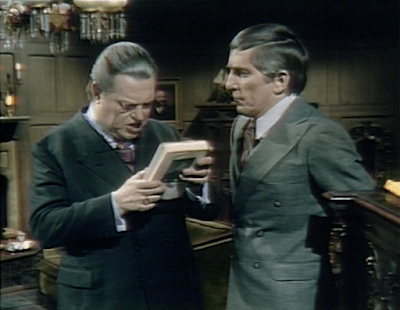
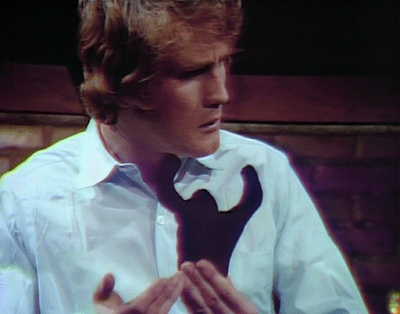
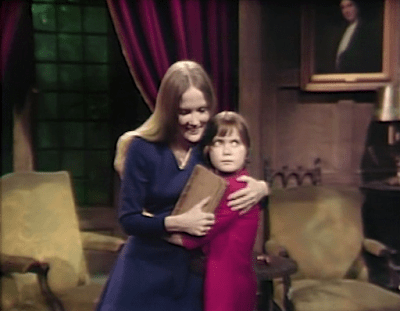
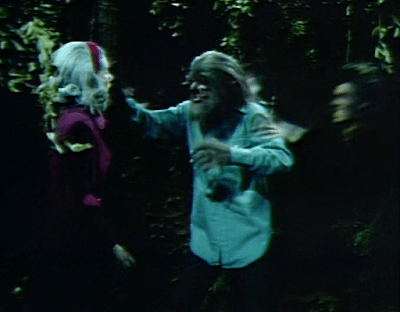
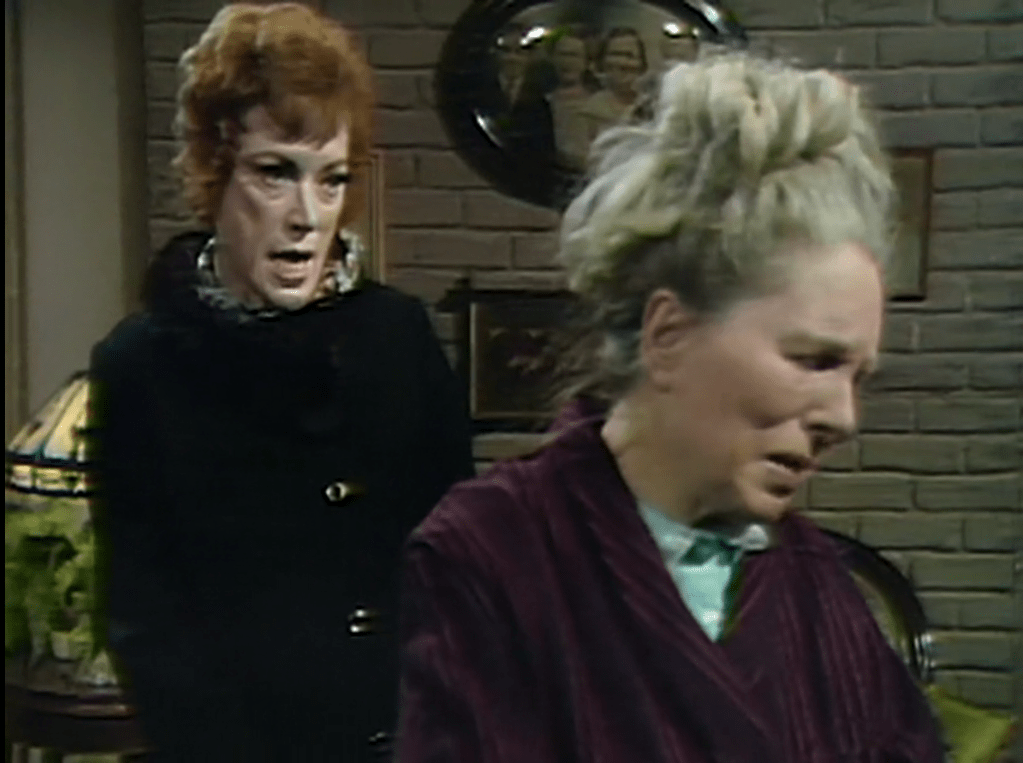
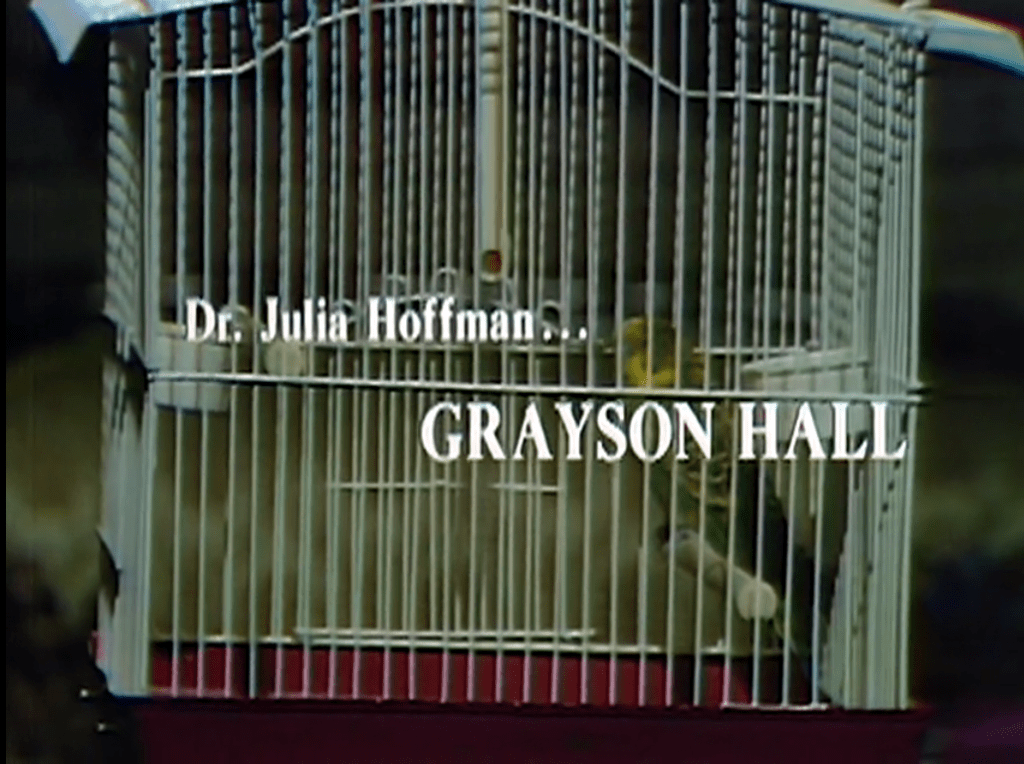
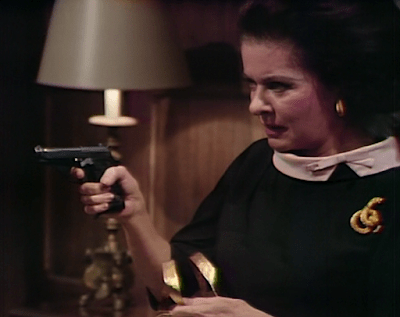
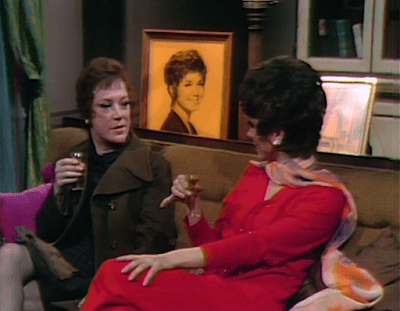
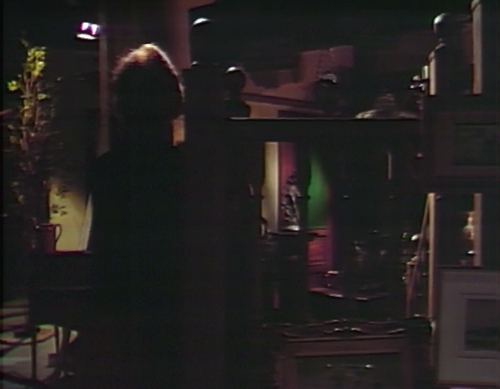
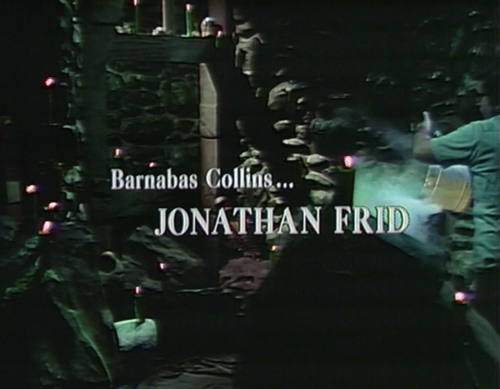


 Dark Shadows Commentary