Heiress Carolyn Collins Stoddard is attracted to mysterious drifter Chris Jennings, so much so that she has set Chris up in the caretaker’s cottage on the estate of Collinwood. Today, Carolyn’s friend Donna Friedlander is visiting her. The day’s main action is a classic farce plot. Donna wants Chris to drive her home to Bangor, Maine, but in order to keep a secret from her he makes a series of increasingly frantic attempts to avoid doing so. In the end Donna doesn’t get her ride, and Chris doesn’t keep his secret.
The episode deviates from the typical farce in that Chris is not a man trying to keep his or his roommate’s girlfriends from finding out about each other. He is a werewolf, and the Moon is full. If Donna is with him after dark, he will kill her, as he has already killed an unknown number of people in the last several years.
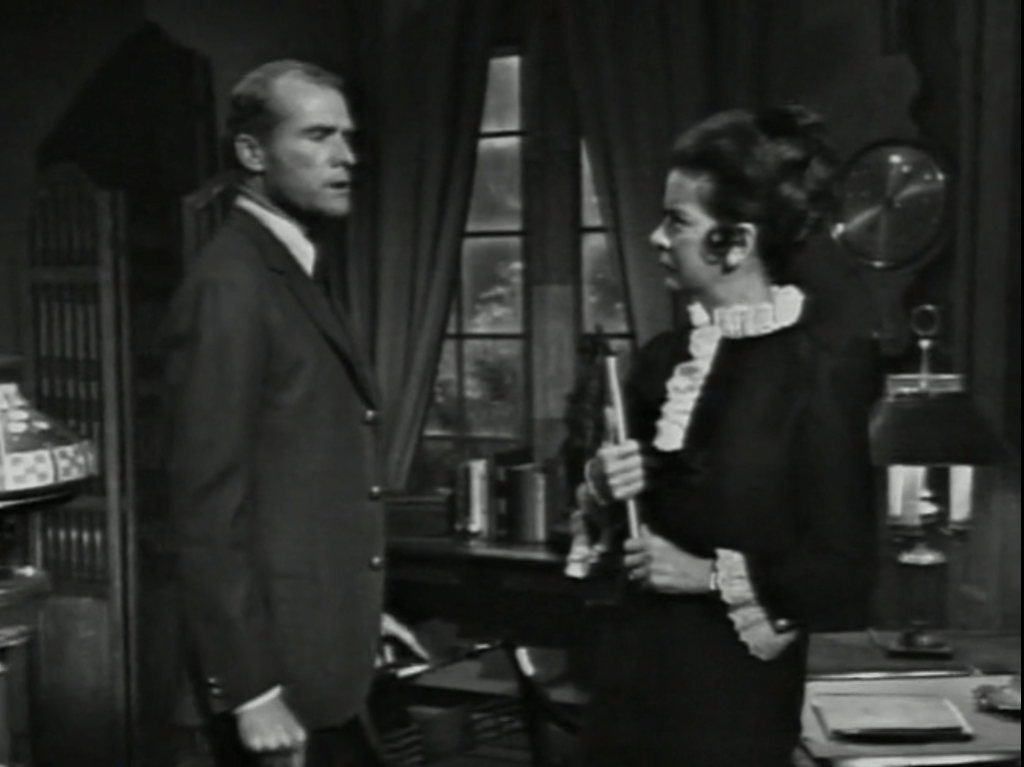
Donna is a student of interior design, and Carolyn is showing her around the great house. We first see her when Carolyn brings her into the study. Chris is in the room with his sister, nine year old Amy, who has been staying at the great house. Chris is distracted, abrupt, and rude with Donna. His manner grows even less inviting when he sees an inverted red pentagram on Carolyn’s face, typically the sign that the person will be the werewolf’s next victim. His eyes bug out, he breaks into a sweat, and turns his back on the ladies, stalking off to stare out the window.
Donna and Carolyn leave the room. In the hallway outside the study, Donna exclaims “Wow!” and exhales as if she were very worked up. She tells Carolyn that Chris is her type. She summarizes that type as “moody”; a more fitting description of what Donna saw of Chris’ behavior would be “not interested,” but hey, I’m not the sex police. If Donna gets excited by foul-tempered guys who ignore her and want her to go away, that’s none of my business.
Donna expresses her interest in Chris.
The little space in which Donna tells Carolyn she is attracted to Chris is a new set. We’ve been seeing a lot more of these tiny nondescript corners representing hallways lately, and Donna’s identification with interior design makes us conscious of this one. In #664, they even had actors walk from one set to another through some undecorated studio space that they tried to persuade us was a corridor. It seems they are developing a strategy to make us feel that the great house is a bigger place than they have managed to create in our minds just by cutting from one room to another.
Complicating matters for Chris are old world gentleman Barnabas Collins and mad scientist Julia Hoffman. Barnabas has figured out that Chris is the werewolf, and today explains this to Julia.
Barnabas uses the word “werewolf” as he is bringing Julia up to date. This represents a departure from the show’s previous practice. Barnabas was himself a vampire when he first came on the show in #211, but they didn’t use the word “vampire” for 40 weeks, until #410. They aren’t afraid of vocabulary anymore.
Julia doubts Barnabas’ interpretation of the facts, and he decides to demonstrate his thesis by putting Chris in an awkward position. He invites Chris, Carolyn, and Donna to join him and Julia for dinner at his home, the Old House on the estate. Chris excuses himself by claiming to have a business meeting in Bangor for which he must leave at once. At this, Donna asks for a ride to that town. Barnabas watches Chris’ discomfort with a smug grin, confident that he is being proven right.
Outside the front door of the great house, Chris tries to wriggle out of giving Donna a ride by saying that now he is getting a migraine and will have to cancel his meeting. He offers to give Donna his keys, suggesting she hide them under the front seat when she parks his car at the bus station in Bangor. She initially accepts this, but later comes to the cottage to say she has decided against it. She is there when he transforms, and runs away.
Back in the great house, Barnabas is telling Julia that werewolves are vulnerable to silver weapons, so he will be able to use the head of his cane to control Chris. Julia wonders if Chris may already have left with Donna. Barnabas airily dismisses this, assuring her that he knows Chris well enough to be sure that Donna is perfectly safe. In fact, Barnabas barely knows Chris at all, but he is so pleased with himself for having figured out who the werewolf is that we can see there wouldn’t be much point in reminding him of this. At his leisure, Barnabas sets out for the cottage, which he finds to be unoccupied and in disarray. Donna’s mauled corpse lies in the woods nearby.
We might wonder why Chris saw the pentagram on Carolyn and not on Donna during the scene in the study. Is the show telling us the pentagram is out of order as a warning system? If so, is it just breaking down from overuse, or is some other supernatural presence interfering with it? Or maybe it isn’t automatic, but is a message from some spirit that has guessed wrong this time? They don’t explain, and the pentagram has been a big enough part of the werewolf story up to this point that it produces a lot more confusion than you might expect.
Yesterday’s episode ended with a bewildered Chris finding Amy in the cottage. Amy was listening to a mysterious voice Chris could not hear. Chris’ bewilderment deepened when Amy obeyed the voice’s command to hurry away. He finally discovered that Amy lit a fire in his hearth and burned a shirt of his in it. Chris took us to the final blackout holding the scorched remains of his shirt, giving a look in the direction Amy had fled, and exclaiming “My shirt!” in a pained voice that would make anyone laugh.
Today’s episode opens with a reprise of that interaction, but it is played very differently. Instead of a light scene that ends with a note of comedy, we have a heavier confrontation that builds to a melodramatic shock. Chris is alarmed, not bewildered, to find Amy in his cottage, and his alarm mounts when she responds to the mysterious voice. When he goes to the hearth, he is forceful, apparently angry. He still exclaims “My shirt!” even though the wardrobe department did not provide a shirt, but his voice is not the high-pitched, defeated squawk that had made the end of yesterday’s installment so funny. This is a full-throated baritone shout. The more serious tone of the scene sets us up for an outing that is technically a comedy and is at several turns quite funny, but that finally concerns itself with a matter of life and death.
Donna is played by Beverly Hayes, in her only appearance on Dark Shadows. Miss Hayes’ IMDb page tells us that for a few months in 1965 she was a regular on a soap called A Flame in the Wind, that in 1968 and 1969 she had a recurring part on The Secret Storm, and that after her one shot on Dark Shadows she was absent from the screen for 41 years, returning in a 2010 production called Marathon. Since then she has been in other little-known independent films, including something from 2015 called House of Shadows, which sounds suspiciously like an imitation of Dark Shadows. She also has some writing credits. Donna is perfect as a one-shot, but Miss Hayes does such a good job with her I wish they’d cast her in other roles later on.
In January 1969, old world gentleman Barnabas Collins learned that governess Vicki Winters had traveled through time to the year 1796, where she and her boyfriend Peter Bradford were hanged for their many crimes. Barnabas decided to follow Vicki to that year in order to save her and Peter. Barnabas himself lived in the 1790s, and is alive in the 1960s because for 172 of the years between he was a vampire. Once he made his way back to 1796, Barnabas reverted to vampirism.
Yesterday, Barnabas killed a streetwalker named Crystal. After he watched her corpse sink in the bay, he went home to the great house of Collinwood to get to work on his main occupation, feeling sorry for himself. To his shock and bewilderment, he found that Crystal’s body had materialized in an armchair in the study.
Today, Barnabas calls his servant Ben Stokes to help him dispose of Crystal’s body. We have seen that when characters go from the foyer to the study, they walk past the camera, exiting stage right. Once, it seemed the camera might follow a character into the space beyond the foyer. That was in #196, when matriarch Elizabeth Collins Stoddard took several steps towards the camera while telling seagoing con man Jason McGuire that if he wanted to stay at Collinwood he could use a room that direction. Jason called Liz back before she went too far, and insisted on a room upstairs. This time, Barnabas leads Ben all the way off the set. They walk through some darkened space for a couple of minutes before entering the study.
Barnabas and Ben leave the set.
The camera is tight on the two of them throughout this sequence, concealing the fact that there is no set decoration behind them. The episode was directed by executive producer Dan Curtis. Barnabas and Ben’s walk through the void bears Curtis’ directorial signature. Curtis was extremely audacious in everything he did, but had very little experience as a visual artist. He wanted to create the illusion that Collinwood was a big place, but the tight closeup results in a static composition and leaves the audience guessing where Barnabas and Ben are supposed to be. Moreover, making the sequence work at all requires that half the studio be plunged into darkness, creating problems throughout the episode.
In the study, Barnabas and Ben find that Crystal is gone and Barnabas’ ex-wife, wicked witch Angelique, is sitting in the chair. Angelique and Barnabas send Ben away so they can talk privately. Barnabas hasn’t tried to explain to Ben that he is on a return trip to the eighteenth century after 20 months in the 1960s; he hasn’t even told Vicki that he is the man she knew in her own time. But he recognizes that Angelique is not a continuation of her 1795 self, but is a fellow time traveler from 1968. Once Ben is gone, he asks her why she has returned to the era.
Barnabas and Angelique play out their big scene in the lighting dictated by the walk through the nonexistent hallway.
She explains that after she failed to advance the plot in 1968, her demonic masters punished her by sentencing her to remain in “this time forever.” It is not at all clear what that means. Will she relive the year 1796 over and over, like Bill Murray in the 1993 movie Groundhog Day? Or will she just go on living forever and experience time in the usual linear fashion? In the latter case, she would rejoin the 1960s in episodes to be broadcast in the 2130s. Not only would that negate all the timelines we’ve heard about and establish a whole new continuity, it would also mean that Lara Parker had secured the longest-term contract in the history of professional acting.
Angelique tells Barnabas she will help him free Vicki if he will agree to stay and resume their marriage. He is appalled by the notion, but she asks if he can save Vicki without her. He says that he cannot. This is a bit of a puzzle. Barnabas’ vampirism comes with a wide array of powers he could use to break someone out of jail. He could bite the jailers and establish control over them sufficient to force them to let Vicki out. If he isn’t thirsty, he has great physical strength, and is invulnerable to most weapons, so he could just force his way in to the gaol and carry Vicki off. He might not even have to bother with the front door. In #242, Barnabas ripped the iron bars out of the windows of a doctor’s office, and Vicki’s cell at the Collinsport gaol has a window with bars that can’t be much stronger than those were. But I suppose he is worried about distorting the course of subsequent history if he does something spectacular, and he certainly doesn’t want Vicki to find out that he is something other than a human. So he makes a deal with Angelique.
The idea is that Vicki will go to the gallows, appear to drop dead before the hangman does his thing, and that after Barnabas and Peter take Vicki’s body back to Collinwood Angelique will revive her. Both Peter and Ben are horrified at the idea of trusting Angelique, but Barnabas seems to think he has no choice. He insists that Vicki and Peter both wait patiently for Angelique to accomplish her part.
The hanging goes ahead as scheduled. Peter is enraged that Barnabas let Angelique cheat them out of the chance to thrash around and scream during the execution. They take the body to Collinwood and lay it out in the study, a few feet from where Crystal’s body had been at the beginning of the episode. They leave it alone, and Angelique appears. Evidently she does intend to bring Vicki back to life, but she vows that Vicki will be under her power from now on.
The wicked witch known variously as Angelique and Cassandra is standing in the drawing room of the great house of Collinwood, thinking evil thoughts. The camera zooms out and we see that her stepson, strange and troubled boy David Collins, is standing next to her. She starts to speak her thoughts out loud, saying “You will pay!” David asks “Who will pay?” Angelique/ Cassandra is startled to discover that David is there, and is flustered when she tries to change the subject. She so often delivers incriminating soliloquys while standing out in the open that the comic effect of this scene must be intentional.
Angelique/ Cassandra oblivious to David’s presence.
David asks Angelique/ Cassandra to help him figure out the correct operation of a tape recorder he received some time ago as a present from permanent houseguest Julia Hoffman. After Angelique/ Cassandra refuses to help, he goes upstairs and finds his cousin, heiress Carolyn Collins Stoddard, emerging from the long-deserted west wing of the house. He asks Carolyn what she was doing in the west wing. She asks him why he thinks she was in the west wing. When he says he saw her coming out of it, she drops her attempt to evade his question and tells him she was looking for some old family photos to show well-meaning governess Vicki. She has enough trouble remembering this story that it must be obvious to David that it is a lie, but he isn’t interested enough to follow it up. He just wants someone to help him figure out which buttons to push on the tape recorder.
On their Dark Shadows Before I Die, John and Christine Scoleri speak for longtime viewers of the show when they say that it is surprising David needs help with the tape recorder. When the show started, David was two years younger and had the mechanical skill to sabotage his father’s car in a very creditable attempt at patricide. All Carolyn has to do to get the tape going is read the label that identifies the play button. This apparent loss of cognitive function is of a piece with David’s massive loss of narrative function. For the first 39 weeks of Dark Shadows, David was the fulcrum on which every story turned, and actor David Henesy had abundant opportunities to show a level of professional skill that would be remarkable in a performer of any age. But he has been receding into the background for a long time now, and his extraordinary dim-wittedness today marks a low point for him.
Once the tape starts playing, Carolyn makes a hasty exit. David listens to a minute or so of Eine Kleine Nachtmusik, hoping it will end and he will hear “something spooky.” His wish is granted when the music abruptly stops, giving way to a voice addressing itself to Julia. The voice rambles about David’s distant cousin Barnabas Collins, saying that if both he and “my creation” live, Barnabas will be all right, but that if “Adam” dies, “Barnabas will be as he was before.” The name “Adam” should mean something to David. He shared a confused and frightening moment with a mysterious man of that name in #495. That man subsequently abducted Carolyn, and is still the object of a police search.
What only Julia, Barnabas, and Barnabas’ servant Willie know is that Adam is a Frankenstein’s monster created in an experiment that freed Barnabas of the effects of the vampire curse that Angelique/ Cassandra placed on him in the 1790s. The voice on the tape is that of Eric Lang, the mad scientist who began the experiment. Minutes before he died of the effects of one of Angelique/ Cassandra’s spells, Lang recorded this message for Julia. The audience has heard this message approximately a gazillion bajillion times, but until now, the only character to have heard it was Adam, and he could make no sense of it.
Angelique/ Cassandra recently made an unsuccessful attempt to renew Barnabas’ curse, and is desperately searching for the obstacle that prevented it from working. Carolyn’s actual task in the west wing was showing Adam to a hiding place there. So Angelique/ Cassandra is now under the same roof with both the information she needs to identify her obstacle and the person she can remove that obstacle by killing. Things are looking bad for Barnabas and for Adam.
While David is upstairs with the tape recorder, Vicki is sobbing in the drawing room. Suave warlock Nicholas, who is staying in the house in the guise of Angelique/ Cassandra’s brother, enters and asks her what’s wrong. She says that she has just learned that Barnabas is dead. His back to her, Nicholas smiles brightly when he first hears this news, then puts on a sad face and turns to her with sympathetic words. In response, Vicki reveals that she knows all about Angelique/ Cassandra and that she has little patience for Nicholas’ pretensions. Carolyn enters and doubts Vicki’s news. Angelique/ Cassandra is the last to enter. She says that she saw Barnabas alive and well after the time when he is supposed to have been dead. Vicki and Carolyn look at each other, and do not see Nicholas’ look of disappointment. They go upstairs, and Nicholas and Angelique/ Cassandra go into the drawing room.
Nicholas scolds Angelique/ Cassandra for her failure. He addresses her as “dear sister.” He suggests she may not hate Barnabas sufficiently to impose a curse on him. When she denies this, he leans to her ear and teasingly asks if she loves him. He threatens to send her back where she came from if she doesn’t re-vamp Barnabas by midnight, and to focus her mind replaces her arm with a fleshless bone.
Director John Weaver was not much of a visual artist, and in his post about the episode on Dark Shadows Every Day Danny Horn analyzes the dismally inept blocking of the scene between Vicki and Nicholas. Danny also has some unkind words for writer Ron Sproat, but I think those are unfair. It’s true the opening scene between Adam and Carolyn goes on too long, David’s helplessness with the tape recorder is dismal, and Vicki and Carolyn’s reaction to Angelique/ Cassandra’s report that Barnabas is still alive doesn’t make sense. That’s a long enough list of flaws that we might fairly classify Weaver and Sproat as the B-team, not on a par with director Lela Swift and writers Sam Hall and Gordon Russell.
But it is genuinely funny when we first see David standing next to Angelique/ Cassandra, David’s questioning of Carolyn is intelligently written, Lang’s message is for once an actual source of suspense, Vicki’s lines to Nicholas as Alexandra Moltke Isles delivers them show the character’s strength, Nicholas’ teasing Angelique/ Cassandra with her alleged love of Barnabas raises a laugh as it makes them sound like a couple of kids, and the final gag with the arm bone is at once goofy enough to keep up the humor in the episode and startling enough to be effective as a touch of horror. All in all, it’s an enjoyable episode, if not one that fans would be tempted to use to turn their friends on to the show.
Much to her surprise, well-meaning governess Vicki Winters came unstuck in time in #365 and found herself in the year 1795. She spent the first few weeks of her sojourn in the past telling all the characters she met about the other roles that their actors played in the first 73 weeks of Dark Shadows, thereby puzzling them and irritating the audience. After a few months, the people of Collinsport had decided to try Vicki on a capital charge of witchcraft. There were no laws against witchcraft in Massachusetts or anywhere else in the English speaking world in the 1790s, but Vicki had got on so many people’s nerves by that point that they were willing to overlook that technicality and sentence her to hang. She was whisked back to 1968 in #461, with so little time to spare before she died on the gallows that she came back with rope burns on her neck.
Throughout the first year of Dark Shadows, the writers used Vicki more than any other character to move the action. Unfortunately, they sometimes moved it by having her do things that served the plot, but that the character had no reason to do. That gave rise to “Dumb Vicki,” and Dumb Vicki was very much on display throughout the whole segment set in 1795-1796.
Now, emigrés from the late eighteenth century are starting to join Vicki in her time. We open today as the clock chimes midnight. Vicki, wearing her nightgown, is coming down the grand staircase in the foyer of the great house of Collinwood, roused by the sound of an unexpected voice in the drawing room. It is the voice of haughty overlord Joshua Collins, master of Collinwood in 1795. Vicki enters the room to find sarcastic dandy Roger Collins carrying on a lively, albeit one-sided, conversation with a portrait. Roger is convinced that he is Joshua, and deals with Vicki in just the lofty way Joshua dealt with her during the costume drama segment. He even brings up Vicki’s frequent confusion with names, something Roger could not possibly have known about. This, therefore, is no mere delusion of Roger’s- Joshua’s ghost really is taking possession of him, manipulated by a force with its own malign intentions.
It is no secret from the audience what that force is. Roger has become obsessed with a portrait depicting wicked witch Angelique, who in the 1795 segment wrought terrible harm to the Collins family. Angelique was responsible, in one way or another, for the deaths of both of Joshua’s siblings, both of his children, his wife, and many other people. Too late, Vicki learned that Angelique was the witch for whose crimes she was being condemned to hang. As we have seen other supernatural beings do on Dark Shadows before, Angelique is using her portrait as a means of projecting her powers into the world of the living.
Roger/ Joshua’s remark about the name trouble reminds us of Dumb Vicki, but that is not the version of the character we see today. Instead, we have a visit from Smart Vicki. When Roger keeps insisting that he is Joshua Collins, Vicki picks up a telephone and shows it to him, declaring that it is something that did not exist in Joshua’s time. Roger looks at the receiver in silence for a moment, then groggily asks “Is it for me?”
Vicki says that she will take the portrait back to the antique store where she bought it so that it can be sold to Professor Timothy Eliot Stokes. This is a bit jarring for returning viewers- in #464, Stokes offered Vicki $200 for the painting, and Roger countered with a bid of $50o. Evidently Roger didn’t actually pay Vicki the money, because he doesn’t say that it is his when he urges her to leave it in the house.
Vicki and Roger leave the drawing room. Roger slips back in, takes the painting, and marches out of the house with it. While he does so, a nice little bit of music featuring the harp plays on the soundtrack. I don’t know that it is new, but I didn’t recognize it.
Part Two. Peter/ Jeff
Angelique not only killed Joshua’s son Barnabas, but cursed him to rise at night as a vampire. Barnabas returned to the great estate of Collinwood in 1967. He has been passing himself off to the living Collinses as their distant cousin from England. When Barnabas found that Vicki had visited his native period of history, he bit her in an attempt to keep her from revealing his secret.
Vicki and Barnabas were on their way to spend eternity together when she crashed her car to avoid hitting a pedestrian. In the hospital, the physician on duty when Vicki and Barnabas were brought in, Dr Eric Lang, turned out to be exactly the right sort of mad scientist. He has apparently cured Barnabas of vampirism. It is unclear whether Vicki remembers that Barnabas bit her and sucked her blood, and quite clear that she doesn’t think of him as a monster.
In the 1790s, Vicki met and somehow fell in love with an unpleasant man named Peter. Peter has returned to the present with her; in fact, he was the pedestrian Vicki had to crash her car to avoid hitting. They have seen each other several times since, and for no worthwhile reason Peter keeps insisting he is named Jeff. Peter/ Jeff shows up at Collinwood today. Vicki ushers him into what she alone calls “the living room,” and everyone else calls “the drawing room.” Peter/ Jeff asks Vicki if she loves Barnabas and plans to marry him. She tells him she does not. She says that she doesn’t want to hurt Barnabas’ feelings, but that she will have to break the news to him as soon as possible.
Part Three. Barnabas, Barnabas
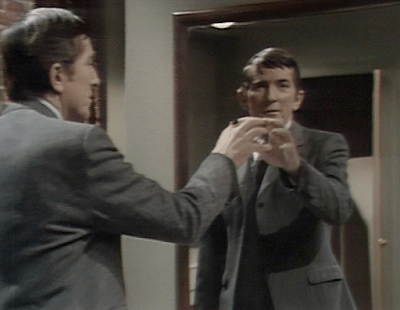
Barnabas is still in the hospital. We see him in his room, in the daylight, looking at himself in the mirror. He can’t resist touching his reflection. It is a genuinely beautiful little moment, and an eloquent image. In the contrast between the solidity and familiarity of Barnabas’ standard right profile shot and the fragile little image slightly distorted in the mirror, we see a point of decision. The ghoul has not been destroyed, but a new and very vulnerable human life now co-exists with him in the same body. Wallace McBride says that “On Dark Shadows, your reflection always tells the truth“; this reflection tells a deep enough truth to keep the show going for years.
Vicki visits Barnabas in his hospital room to tell him that she cannot marry him. She thinks that she and Peter might be meant for each other. She also tells Barnabas that there are signs Angelique is making her influence felt at Collinwood again.
Vicki knows that her news about Peter will hurt Barnabas, but she understands that if they are to fight against Angelique, there can be no secrets between them. Barnabas understands this as well. Therefore, he decides to surrender immediately. Right after his scene with Vicki, we see him telling Lang he has decided to revert to vampirism.
That reaction is absurd, but it goes to the heart of the character as we came to understand him in the part of Dark Shadows set in the years 1795 and 1796. He did not believe that gracious lady Josette could love him, so he had a casual fling with her maid, Angelique. He did not believe Angelique cared very deeply about him, so he cast her aside once it became clear Josette was willing to marry him. He did not believe Josette could forgive him for having come to her from a dalliance with Angelique, so he did not tell Josette when Angelique vowed vengeance on them both. At each point, Barnabas’ underestimation of his own lovableness led to disaster. If only Barnabas could have read Jonathan Frid’s fan mail, he and Josette would have had a happy, quiet life and died in obscurity in the first half of the nineteenth century.
Part Four. Vicki
For her part, Vicki spent the first 38 weeks of Dark Shadows growing close to strange and troubled boy David Collins, who tried to kill her more than once, tried to kill his father Roger and frame her for it, who talks to ghosts, and whose mother is an undead fire witch. In the same time, she fell in love with a man named Burke, who spent years in prison for a killing in which Roger had a part but for which he was also very much responsible. While in the 1790s she fell in love with Peter, who committed many crimes and would doubtless have become a killer had Vicki not killed his man before he got to him. So Barnabas’ weird nature and career of homicide hardly guarantee that Vicki will spurn him.
I often wonder what might have been had the show decided to initiate Vicki into Barnabas’ secret. Alexandra Moltke Isles and David Henesy triumphed over some stunningly bad writing to make the story of Vicki’s bonding with David the one consistently interesting thread of the first year of Dark Shadows. Now that there are good writers and other stories that are working, I can only suppose she and Jonathan Frid would have given us something for the ages if they had been allowed to show Vicki coming to accept the true Barnabas.
There are several ways they could have done that. Maybe she gradually learns the horrible truth, can’t go to the authorities right away because she needs Barnabas as an ally against a more immediate threat, and by the time that threat passes decides he’s a good risk. Or maybe she becomes a vampire herself and finds out about his past in the process of being cured.
Or, most daring of all, maybe it turns out Vicki knew that Barnabas was a vampire all along. Sure, she was upset when she thought he’d killed her friend Maggie- why do you think she invited herself to spend the night at his house during that period? She had the guilts because she had failed to save Maggie and wanted him to bite her as punishment. Sure, there were some sleepless nights when it looked like he might be planning to kill David in order to silence him- why do you think she kept making herself available to Barnabas in that period as well, if she wasn’t offering herself as a tool he could use to keep the boy quiet without hurting him?
Fluttery heiress Millicent Collins has been staying at the great estate of Collinwood as the guest of her second cousin, haughty tyrant Joshua Collins, and Joshua’s wife Naomi. Today, Millicent has news for Joshua and Naomi. She has agreed to marry naval officer/ sleazy operator Nathan Forbes.
Joshua and Naomi are stunned by this announcement. Millicent had been obsessed with avenging herself on Nathan for some time, ever since she discovered that when they became engaged on a previous occasion he was already married. But now Nathan has apparently rescued her from an attempt on her life by Joshua and Naomi’s son Barnabas, and Millicent no longer holds Nathan’s late wife against him. For their part, Joshua and Naomi are quite sure that Barnabas did not attack Millicent, and suspect that the whole thing was a ruse by Nathan. Joshua forbids Millicent to marry Nathan, and threatens to have her declared insane if she tries to go through with the marriage.
Nathan shows up. He tells Joshua that he and Millicent will not marry without his consent. At that, Joshua agrees to meet privately with Nathan. Joshua withdraws. Millicent tells Nathan that she wishes he had not told Joshua that they would accede to his demands, and Nathan tells her that he has the situation in hand.
In this scene, played out in the entryway and seen from a point of view inside the coat closet, director John Sedwick makes some clever use of a portrait. The portrait, which hangs in the drawing room in the parts of Dark Shadows set in the 1960s and which is identified by fans as that of Joshua,* at first mirrors the furious Joshua as he looks at a sheepish Nathan:
Richard Wagner Collins is on Joshua’s side.
Nathan screws up his courage to face his accusers.
As Nathan begins to make his play, his face overlaps with the portrait, creating the momentary illusion of a kiss. Joshua is startled by Nathan’s assertiveness.
Smoochy-smoochy!
When Nathan and Millicent are alone in the entryway, Nathan stands where Joshua had stood. The portrait now mirrors him as before it had mirrored Joshua, suggesting that he is in the process of taking Joshua’s place.
Big Richard energy
Joshua and Nathan meet in the study. The study was a set that first became prominent during a blackmail story that played out from March to June of 1967, when Dark Shadows was set in contemporary times. Then, seagoing conman Jason McGuire had established the drawing room of the great house at Collinwood as his base, and the study was a place to which his victim, reclusive matriarch Liz, would retreat, only to discover that Jason had even more power over her than she had thought.
Now, the show is a costume drama set in the 1790s, and Nathan is coming to resemble Jason more and more strongly. Joshua is in Liz’ place as head of the household. When Nathan starts talking about a secret he is sure Joshua very much wants to keep from public view, Joshua at first has no idea what he is talking about. He assumes, to his scornful amazement, that Nathan is taking a shot in the dark, hoping that Joshua might have some shameful secret and gambling that he will be able to convince him that he is in a position to expose it.
Nathan shows Joshua Barnabas’ cane with its distinctive wolf’s-head handle. He assures Joshua that Barnabas dropped it when he attacked Millicent. Joshua does not believe that Barnabas had anything to do with the attack on Millicent, for the excellent reason that he knows Barnabas is dead. Joshua cannot share this information with Nathan, since he has insisted on lying to everyone and claiming that Barnabas is alive and well and living in England. In fact, Nathan and a henchman of his did fake the attack on Millicent, but Barnabas’ situation is not so simple as his parents believe. Unknown to them, or to Nathan, or to any of the Collinses, Barnabas has risen from the dead and now preys upon the living as a vampire.
For his part, Nathan knows that his one-time friend Barnabas is in town, and that he is responsible for the many killings that have recently taken place there. He believes that Barnabas is alive and has become a serial killer, and that the family spread the story about England to cover up this new hobby. Nathan presses more information on Joshua about sightings he and others have recently made of Barnabas, and about evidence connecting Barnabas with the murders. Since Joshua himself had seen that Barnabas’ coffin was vacant in #422 and occupied again in #428, he cannot simply dismiss Nathan’s story. Nathan tells him that Barnabas is hiding in the Old House on the estate, and Joshua decides to go there.
While Joshua prepares to go, Nathan makes himself at home in the great house. He pours himself a drink in the drawing room, as Jason McGuire often did. We cut from the shot of him doing that to the study, where Naomi pours her own drink. Longtime viewers, remembering the miserable state to which Jason reduced Liz while blackmailing her, will be apprehensive that Nathan’s blackmail of the family will bring the alcoholic Naomi to an equally profound despair.
At the Old House, Joshua encounters much put-upon servant Ben Stokes, who tries to keep him from going to the basement. Ben has reason to hate Joshua, and often expressed such hatred earlier in the 1795 flashback. But there is no hatred in him today. He sincerely wants to spare Joshua the sight that he knows awaits him downstairs. But Ben is powerless to stop Joshua, and sadly watches him go through the cellar door.
Joshua finds Barnabas’ coffin at the foot of the stairs. The lid opens, and Joshua sees a hand under it wearing a familiar ring. As Jason had inadvertently pushed Liz to discover a secret she had herself not dreamed of when he directed her attention to the basement of the great house once too often, thereby losing his power over her and leading to his death at Barnabas’ hands, so Nathan is about to change Joshua’s awareness of the situation in ways he himself could not have anticipated and which are likely to lead to his own downfall.
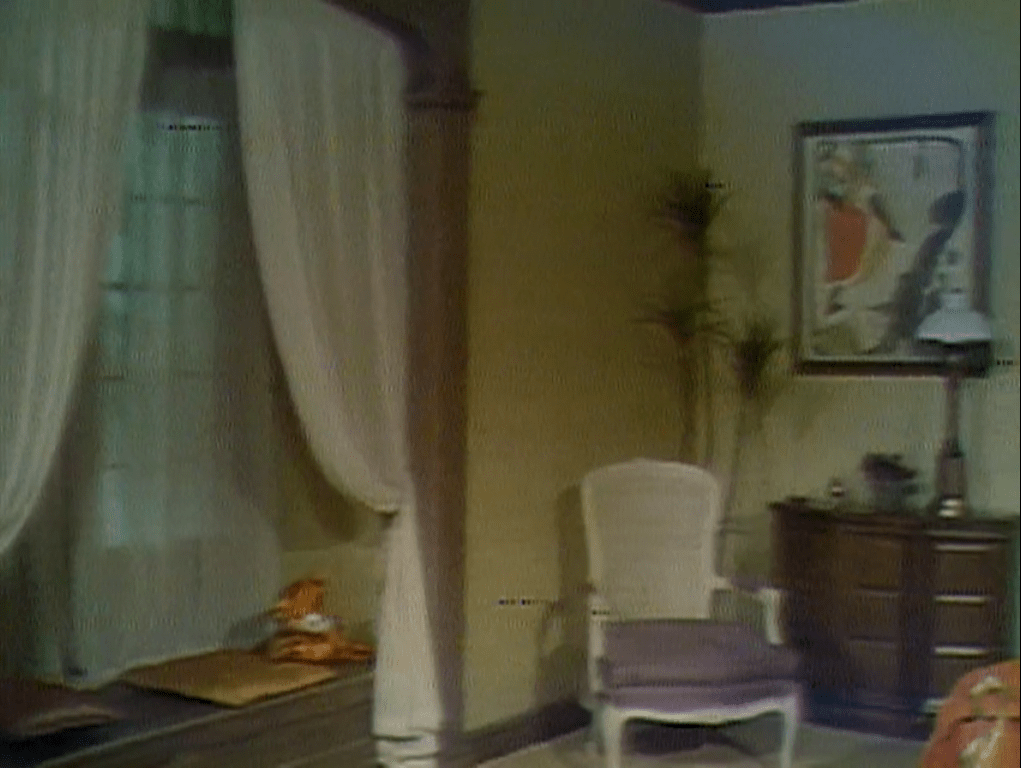
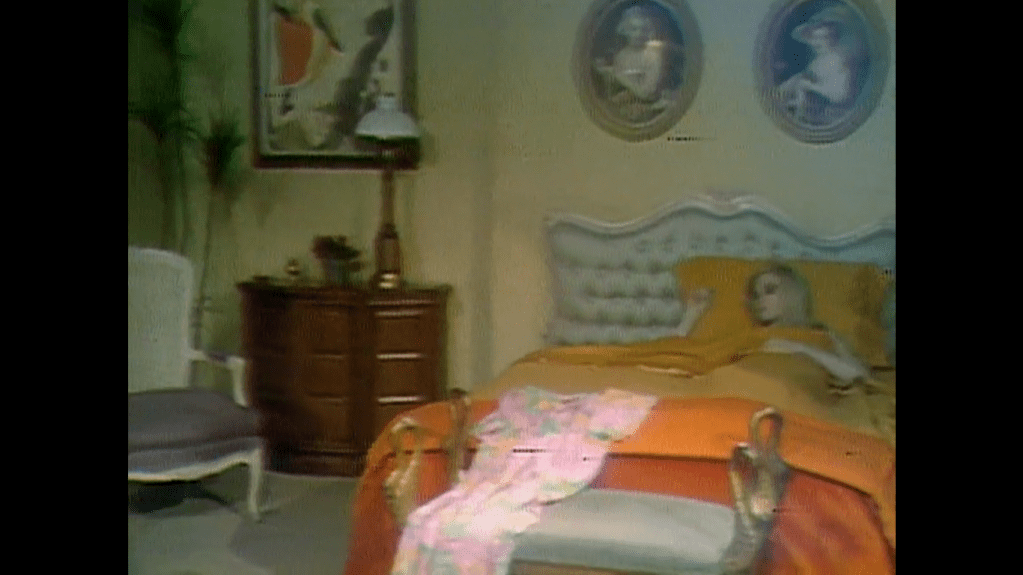
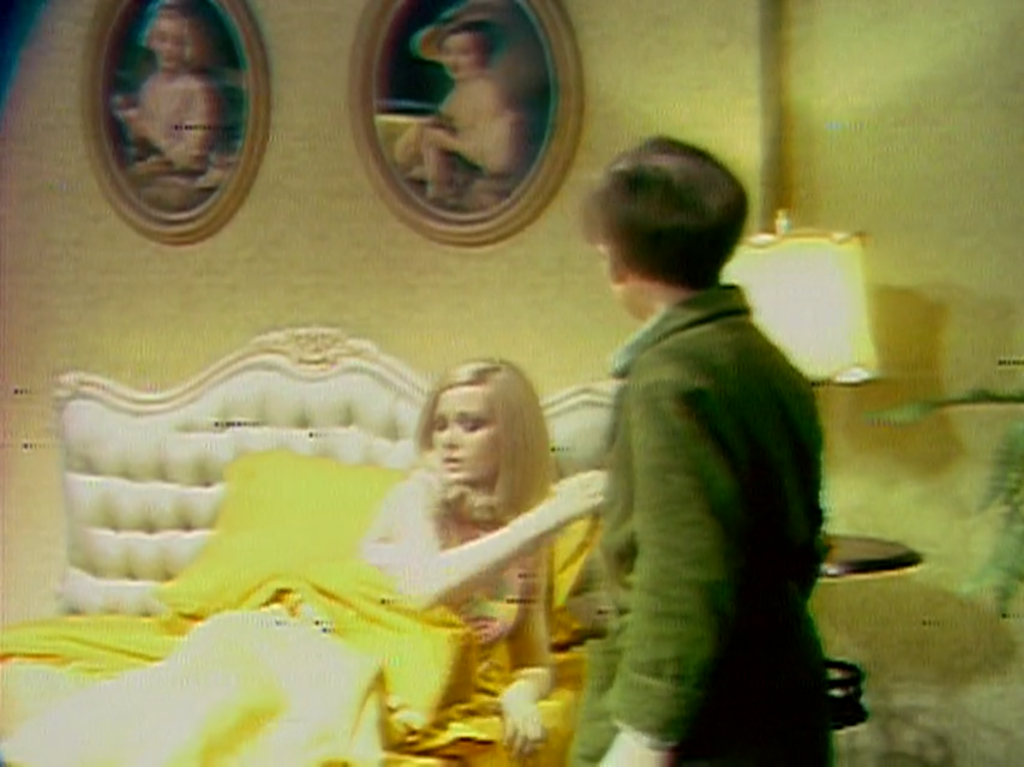
We open on a new set, the bedroom of heiress Carolyn Collins Stoddard in the great house of Collinwood. Dark Shadows has been in color since #295 in August. Though directors Lela Swift and John Sedwick were both ambitious visual artists, they haven’t been able to do much with color so far. With Carolyn’s bedroom, Swift and the staging team have accomplished one of their first real essays in color. It is composed mostly of shades of yellow, pink, and orange.
The color schemes of the other interiors we’ve seen up to this point run the gamut from sedate to subdued to drab to dank, so we already know we are in a unique space. The only other room in Collinwood that might have matched this one for brightness was the kitchen, but we haven’t seen that since #208.
Carolyn’s young cousin, strange and troubled boy David, lets himself into her room. He touches her, and she awakes with a scream. He explains that he just dropped in to make sure she wasn’t dead. When she turns on the light, the screen is so bright that I reflexively squinted, a reaction I’d never before had to an image on Dark Shadows.
Bright room.
David can’t quite explain why he was afraid Carolyn might be dead, but he does insist that she take an antique toy soldier, saying that she will be safe if she keeps it with her. Carolyn’s mother, matriarch Liz, comes into the room to investigate Carolyn’s scream. Liz wonders what David is doing there. Carolyn hastens to say that he was just making sure she was all right.
David goes, and Carolyn tells Liz she doesn’t think anything can be done for him at home. Liz is reluctant to send him away. Regular viewers will not be surprised by this. We know that Liz took David and his father, her ne’er-do-well brother Roger, into Collinwood at the beginning of the summer of 1966 and summoned her unacknowledged daughter, well-meaning governess Vicki, to come look after David starting with #1 on 27 June 1966, so that her conviction that the family ought to look after him got the whole show started. Nonetheless, Liz is so disturbed by David’s unusual statements and depressive affect that she agrees that he needs residential care.
We cut to the Old House on the estate. Vampire Barnabas Collins is sitting in a basement room where mad scientist Julia Hoffman maintains a laboratory. The room is full of electrical equipment, a bit odd since the Old House has no electricity; the laboratory itself is lit by flaming torches. But if we’ve ever seen a Universal Studios production from the 1930s, we know that where you find a mad scientist, you will find electrical currents, so naturally things start buzzing when Julia flips a switch.
Barnabas confined
Julia is trying to implement a medical cure for Barnabas’ vampirism. In the first shot of this scene, we see a visual metaphor for that project. Barnabas, an uncanny being, is confined to a small space in the middle of an elaborate collection of technology. If Julia succeeds, the supernatural will be vanquished altogether and scientific rationality will fill the whole world. The color scheme emphasizes the contrast between Julia’s optimistic goal and the terrain on which she operates. The walls and floor are dominated by the grays and browns of the basement, but the frames and tubing of her equipment are a bright metallic hue, light plays on the glass components, and the intense greens, reds, and blues of the potions are distributed in a slightly unbalanced, lively pattern. The irregular shapes of the frames and tubing emphasize this pattern, and contrast with the solid gray of the floor and the even grid of the brickwork on the walls.
This image not only represents Julia’s plans, but also one of the major themes the show is exploring at this period. Too many characters have encountered too much evidence of supernatural forces and beings for anyone to simply deny that such things exist. But even those who have been most heavily exposed to them keep reverting to a naturalistic frame of reference. Sure, Julia spends all her time hanging around with a vampire and has encountered a couple of ghosts, but she’s determined to ring all of those phenomena around with scientific explanations and technological interventions until they yield to rational control.
Julia’s project has hit its first major setback, as the latest treatment led Barnabas’ hands to age dramatically. He expresses the fear that time will catch up with him, and his apparent age will soon catch up with his actual age, something like 200 years. Julia’s hope that her experiment will not only free Barnabas of his curse, but found a new kind of medicine that will free everyone else of aging and death, will thus be defeated.
Barnabas gives a remarkable little speech about the situation he finds himself in:
I’ve been granted privileges given to few other men… For most men, time moves slowly, so very slowly. They don’t even realize it. But time has revealed itself to me in a very special way. Time is a rushing, howling wind raging past me, withering me in one relentless blast and then continues on. I have been sitting here passively, submissive to its rage, watching its work. Listen. Time, howling, withering.
Writer Joe Caldwell has a fine sense of what actors can do, and this odd little bit of purple prose is right in Jonathan Frid’s wheelhouse. It doesn’t make a whole lot of sense, but the sound of his voice delivering it is so gorgeous it may as well be Shakespeare. Well, maybe not Shakespeare, but Ben Jonson at least.
It is possible to read this speech as a programmatic statement. Daytime soap operas of the 1960s were famously slow-paced; the old joke was that a viewer saw an episode that ended with a character hearing a telephone ring, missed four months of the show, and tuned back in to see the episode that started with the same character saying “Hello.” Even by the standards of the period, the first months of Dark Shadows were notoriously leisurely, with action often as not playing out in real time. When we are watching the 21 episodes centering on Roger’s attempts to find a fountain pen he misplaced, it is indeed the case that “time moves slowly, so very slowly.” But those days are behind us. The show is whipping through plot points at a pace that many prime time series contemporary with it would have had a hard time matching.
If the speech is programmatic, it is also autobiographical on the part of the screenwriter. A fast pace promises excitement for the viewers, but makes life hard for a writing staff that never numbered more than three. Indeed, this is the last episode Joe Caldwell will write for two and a half years. Perhaps he felt the demands of the new pace as “a relentless blast” withering his talents, and had to bow out.
We return to Carolyn’s room. She is in front of her mirror, contemplating the toy soldier. She hears the strains of “London Bridge” playing on a wooden flute, which she has learned is a sign that the ghost of ten year old Sarah Collins is present. Carolyn grew up in this haunted house, so it may not be entirely surprising that her response is to lean back and enjoy the music. But she sits up when Sarah manifests herself in visible form.
Ghost in the mirror
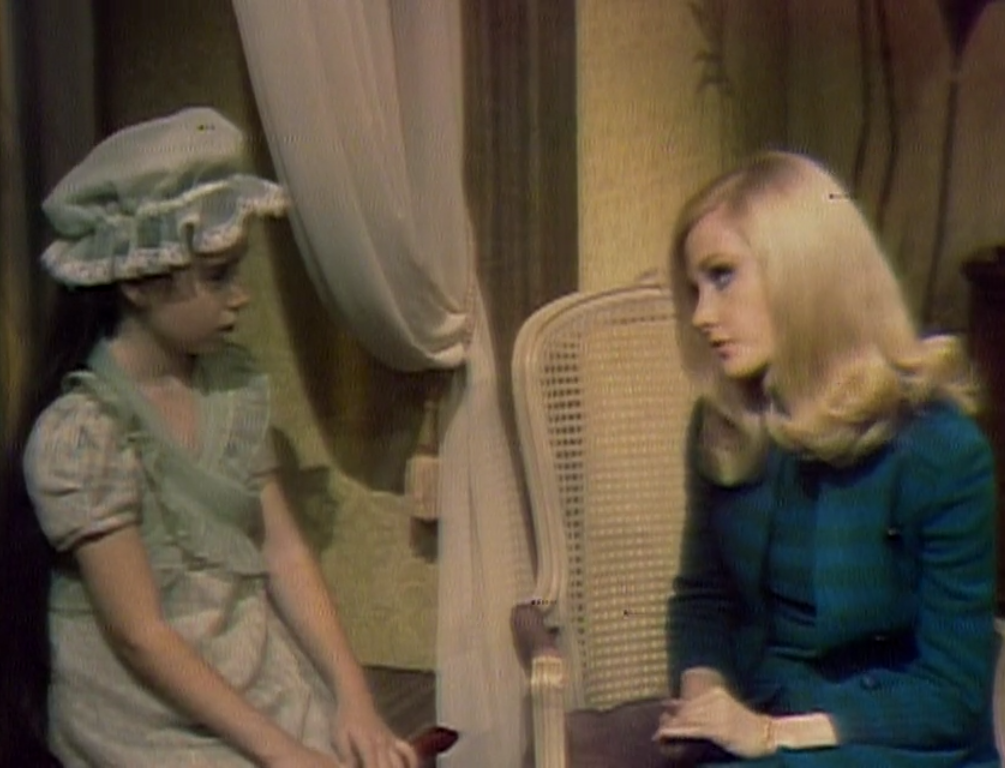
Sarah speaks, and Carolyn sees her reflected in her mirror. The following scene is so extraordinary I’m going to transcribe all of the dialogue:
Sarah: David must have given you that.
Carolyn: Sarah!
Sarah: He told you my name.
Carolyn: Sarah, how did you get in here?
Sarah: Didn’t David tell you?
Carolyn: Tell me what?
Sarah: All about me.
Carolyn: I’m not sure I understand.
Sarah: I think I’m a ghost. Matter of fact, I’m sure I am.
Giving the facts
This is the first time Sarah has described herself in any terms, certainly the first time she has called herself a ghost. Her coyness about herself had left David confused about what she was; it was not until #325 that he finally concluded that she was a ghost. After that, she became more forthright with him. When he wasn’t sure what she was, she would wait until she was out of his line of sight to appear and disappear. But in #327, she fades away while he’s looking right at her.
Coming out to David not only allowed Sarah to relax around him, but has led her to discard her coyness altogether. She is startlingly blunt with Carolyn as this conversation goes on:
Carolyn: B-but- I don’t believe in-
Sarah: Yes you do. Or I wouldn’t have been able to come here. You’re not afraid of me, are you?
Carolyn: No…
Sarah: If you are, I understand.
This is the first confirmation that Sarah can appear only to those who are prepared to believe in her. It’s true that most of the people who have seen and heard her- David; Maggie Evans, The Nicest Girl in Town; Maggie’s father Sam; Vicki; Barnabas; Julia; Barnabas’ sometime blood thrall Willie; and local physician Dave Woodard- have either had extensive contact with the supernatural or had reasoned their way to the conclusion that she existed. But she also showed herself to Maggie’s nurse at the mental hospital Julia runs, and we don’t know anything about her background or beliefs. And local man Burke Devlin heard Sarah when she and David were talking in #327. While Burke has had plenty of contact with supernatural beings and in the early days of Dark Shadows, when he was fun, was willing to believe in them, he was at that point tearing around bellowing that there were no such things as ghosts. So this is new and unexpected information.
Carolyn’s denial that Sarah frightens her is given in a trembling voice that shows it to be a lie. Still, she isn’t as frightened as she might be. The other day, in #344, Carolyn was in David’s room when Sarah manifested there, not in the visible form of a little girl, but as the sound of “London Bridge” and as information appearing in David’s mind about Burke’s imminent death. Carolyn was terrified of Sarah when she came that way.
Carolyn: Well, what do you want?
Sarah: Don’t send David away.
Carolyn: How do you know about that?
Sarah: I don’t know, I just do.
At this point, we see Carolyn’s fear fading. She is starting to react to Sarah as if she really were a ten year old girl.
Carolyn urging Sarah to be reasonable.
Carolyn: But Sarah, we have to send David away. It’s the only way we can help him.
Sarah: But if you send David away, I won’t have anyone to play with.
Carolyn: Well, maybe it isn’t good for David to play with you.
Sarah: Why do you say that?
Carolyn: Because it leads him into believing all sorts of things that aren’t true.
Sarah: How do you know they’re not true?
Carolyn: Well, they’re just not, they couldn’t be.
Sarah: He wasn’t lying about me, was he?
Carolyn: No.
Sarah: Well.. then maybe David is acting the way he is because no one will believe him.
Carolyn: But… it isn’t possible.
Sarah: People say I’m not possible, but I am. Why doesn’t that make the rest possible?
Carolyn: Sarah, maybe you don’t know the stories David’s been telling!
Sarah: Why do you think that?
Carolyn: Because they’re too fantastic! And besides, they’ve all been proved false.
Sarah: How do you know they’ve been proved false?
Carolyn: Sarah, are you trying to tell me that Barnabas actually slee-
This exchange is the ultimate example of a character accepting the existence of a particular supernatural being and then snapping back into a frame of reference that does not allow for supernatural beings. Carolyn knows that Sarah is a ghost, and starts arguing with her about how fantastic the world is permitted to be.
There comes a knock at the door. Carolyn turns away from Sarah to look at the door, and when she looks back, Sarah has vanished. Regular viewers know that Sarah was Barnabas’ little sister, that she wants to keep him from doing horrible things to people she likes, but that she will not say anything against him. So when Carolyn says Barnabas’ name, we know that Sarah is about to vanish.
Sarah’s part is an outstanding example of writing to an actor’s abilities, even more so than was Barnabas’ speech. Caldwell knew that Jonathan Frid had a flair for making flowery gibberish appealing, because that is what he has been doing the whole time he’s been on Dark Shadows. What Sharon Smyth has been doing well as Sarah is being a cutie pie and creating a vague and mysterious impression. When she has more than a few lines to deliver, things tend to get very wobbly. Today, she has to maintain a commanding tone and an adult demeanor throughout an extended patch of rapid-fire dialogue. Absolutely nothing we have seen on screen would suggest that she could handle that. But she pulls it off, more than competently. There are a few glances at the teleprompter, but at no point does she break out of the patient and authoritative manner she has to adopt. It is an impressive job of acting by any standard.
The person at Carolyn’s door is Liz. Liz is Dark Shadows‘ queen of denial. Viewers who have been with the show from the beginning have seen a few cracks in her facade of disbelief in the supernatural. In #10, she dozed off in the drawing room and started talking in her sleep about ghosts. When Vicki insisted to her in #127 that she had seen a ghost, Liz said she believed her. And in #280 and #281, Liz reluctantly agreed to participate in a séance, and afterward agreed that Vicki had been possessed by a spirit. But even in those moments Liz was fighting to keep the topic of ghosts at bay, and the rest of the time she has presented a blank wall to any attempt to face facts about the strange goings-on. So it is not surprising that Carolyn tells her mother she was talking to herself while tidying up her room.
Having talked Liz into sending David away, she now has to talk her back out of it. She manages to get her to agree to wait a few days. “London Bridge” plays. Carolyn reacts to it, Liz does not.
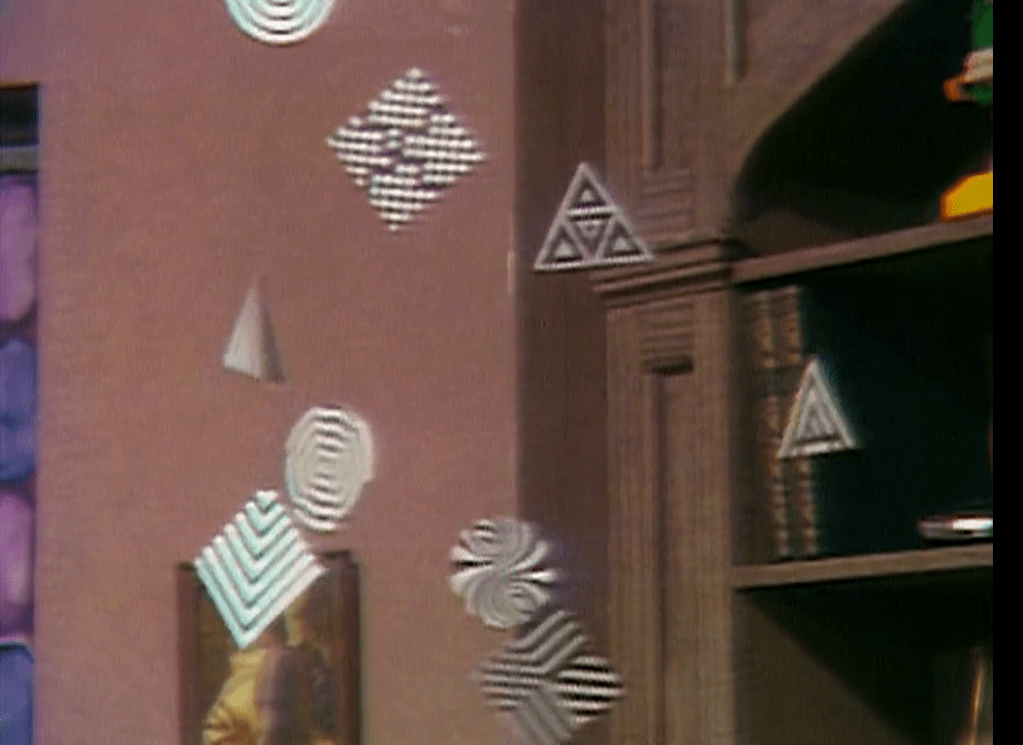
In his room, a distraught David is looking at a mobile. Its whimsical black and white markings suggest a puzzle and make a stark contrast with the vivid colors around them.*
Puzzling shapes.Back to the wall.
Carolyn comes in. She brings the toy soldier and tells David she doesn’t think she will need it. He insists that she will, but she explains that Sarah visited her and now she believes him and knows how to help him. David is horrified by this. He says that Sarah visited Dr Woodard, that Woodard believed him, and that led to his death. He begs Carolyn not to believe him and claims to have been lying. He sobs and clutches her.
Anguished embrace.
Back in the Old House, Julia prepares to give Barnabas another treatment. He snaps at her. She tells him that whatever happens, she wants him to know that she always wished him well. That prompts him to unload a further stream of sour remarks about her competence and intentions. Julia carries out the treatments, only to find that the aged appearance of Barnabas’ hands has spread to his head.
In his post about this episode on Dark Shadows Every Day, Danny Horn puts it well when he says that “This is just good soap opera construction. People that we care about, facing terrible danger, and desperate to help each other.” He’s referring specifically to the scenes between David and Carolyn and Liz, but it applies to everyone. We care not only about the good people in the great house (well, they’ve been relatively good, lately,) but also about Barnabas and Julia, evil people who are the terrible danger David and Carolyn and Liz are facing, but who make the show fun to watch. We care about Sarah too, and she’s desperately trying to accomplish exactly the result we most want to see, an outcome in which David, Barnabas, and everyone else we enjoy watching stays on the show.
*Evidently this mobile was a commercially produced item. One of the commenters on Danny Horn’s Dark Shadows Every Dayreports having had one like it as a child.
Maggie Evans, The Nicest Girl in Town, suffered from an ailment her doctor, Dave Woodard M. D., could not identify. She then vanished from her hospital room in a manner law enforcement, led by Sheriff George Patterson, could not explain. The opening voiceover says that Maggie’s troubles “mystify the finest minds.” This is the first and last time either Woodard or Patterson is classed with “the finest minds” even among the low-functioning characters who abound in the period when Dark Shadows is being written by Ron Sproat and Malcolm Marmorstein. Well-meaning governess Vicki is still the single smartest character on the show, and she turns into an absolute moron every two or three days.
In the opening teaser, dashing action hero Burke Devlin asks Dr Woodard if his studies of Maggie’s blood samples will help find her. He says that they won’t, but that if he can diagnose her he might be able to help her after she is found. Burke asks if he is about to make a diagnosis. He says that he might be making progress towards that goal. At that point, there is a dramatic musical sting, and we cut to the credits. That’s the hook, a statement that further study is needed.
Dr Woodard tells Burke that he has contacted “Hoffman, one of the best men in the field,” and that he hopes Hoffman will be able to get things moving. Under Burke’s questioning, he admits that he is pessimistic that Hoffman will see anything he has missed. This is the first mention of the name “Hoffman” on Dark Shadows. I believe it is only the second mention* of any surname that is not derived from Irish (as are such names as Collins, Devlin, Malloy, and McGuire,) English (as are names such as Woodard, Patterson, Loomis, Johnson, Stockbridge, and Garner,) Welsh (as are names such as Evans and Morgan,) Scottish (as are the names Adair and Murdoch,) or French (as are the names La Freniere, Bilodeau, and du Près.)** It is certainly the first name we have heard that suggests there might be Jewish people in the universe of Dark Shadows.
We then cut to the study in great house of Collinwood, where high-born ne’er-do-well Roger Collins has to confront his sister, reclusive matriarch Liz. The auditors have told Roger that the books are out of balance at the family business. Roger knows that the reason for this is that Liz is giving money to buy the silence of seagoing con man Jason McGuire. He reminds Liz that he himself was afraid of blackmail for the first 40 weeks of the show, so he knows from personal experience that it is no way to live. Liz refuses Roger’s plea that she tell him her secret. As he probes and she resists, they move around the room at times like fencers, at times like dancers performing a paso doble. Their movements are easily the most interesting element of the episode, a credit to director John Sedwick.
Roger’s first approach to the shielded LizLiz parries Roger’s thrustRoger’s second approach
Roger admits that he hasn’t been much help to Liz over the years, but begs her to let him help her now. Liz won’t tell him anything, but she is touched to see her bratty brother sincerely trying to step up.
Liz goes to the drawing room. The camera is behind her as she approaches the room. Jason is standing at the fireplace under the large portrait, the spot furthest from the camera. Not only does he look as small as possible, but at the moment we first see him he is turned away from us, his head tilted far back as he takes a drink. Jason’s smallness and obscurity, coming so soon after Roger’s speech about the dreariness of blackmail, feels like an acknowledgment that Jason doesn’t have much to offer the audience.***
Coming upon Jason
Liz tells Jason she can’t give him any more money without blowing the secret they share. He amazes her by accepting this information calmly, but she is sure he is not done tormenting her.
Liz returns to the study, where Roger is still sitting. She tells him that she has talked to the auditor and straightened out the books. That sounds like something that would take quite a while, even if you are sitting across from each other, and Liz and the auditor had to do it over the telephone. So how long has Roger been sitting there?
Then we rejoin Burke and Woodard in the doctor’s office, which someone has ransacked. The perpetrator wrenched the metal bars out of the window and stole Maggie’s blood samples. Dr Woodard says that the only way the bars could have been twisted was by someone with the “supernatural strength of madness.” I’m not an expert in mental health, but that does not sound like a conventional psychiatric opinion to me.
*After Lieutenant Costa of the Arizona State Police, whom we saw when Dark Shadows took us to Phoenix in #174.
**It is pretty weird that a show set in Maine has so few French-surnamed characters. We’ve only heard of one working-class Mainer with a French name, Amos Bilodeau. La Freniere was given in #45 as the maiden name of Josette, a grand lady who came from France to marry into the Collins family in a previous century; eventually, Josette’s birth name will be retconned to du Près.
***My wife, Mrs Acilius, was the one who really noticed the visual strategy both in Liz and Roger’s first scene in the study and in Liz’ entry into the drawing room.
The opening voiceover complains about “a frightening and violent man.” We then see a fellow with a crazed look on his face trying to break into a coffin. Assuming that he is the frightening and violent man, a first time viewer might not be especially upset when a hand darts from the coffin and chokes him, even though something like that can’t be altogether a good sign.
At a mansion identified as the great house of Collinwood, an aristocratic lady is demanding that a man in a captain’s hat account for the whereabouts of someone called Willie. The man answers to the name of Jason and calls the lady Liz. Liz has had all she can take of Willie, whoever he might be, and is not at all happy that Willie’s things are still in her house. Jason does a lot of fast talking, but cannot satisfy Liz either that Willie is really leaving or that he himself does not know where Willie is.
Jason talks with the housekeeper, a woman named Mrs Johnson. He asks her a series of questions about what she knows about Willie and she asks why he wants to know. Even though Mrs Johnson was in the room when Liz was insisting that Jason find Willie and get rid of him, for some unaccountable reason he will not tell her that he is looking for Willie.
Despite Jason’s inexplicable reticence, Mrs Johnson does tell him that Willie was preoccupied with the portrait of an eighteenth century figure named Barnabas Collins, that he was also interested in a legend that another eighteenth century personage, someone named Naomi Collins, was buried with a fortune in jewels, that Naomi Collins is buried in a tomb in a cemetery five miles north of town, and that the night before she saw Willie hanging around the toolshed. Returning viewers will recall that in yesterday’s episode, well-meaning governess Vicki had also told Jason that she had seen Willie in the vicinity of the toolshed, carrying a bag. There doesn’t seem to be a television set in the house, so everyone spends the evenings looking out the windows at the toolshed.
We see a cemetery. It soon becomes clear that it is the same cemetery we saw in the opening teaser. The gate of the tomb in which the frightening and violent man did his sinister work is swinging in the breeze. An old man in a three piece suit and celluloid collar comes upon it. He shows alarm and mutters that he can feel evil in the air.
Jason arrives at the cemetery and meets the old man. Jason says that he is looking for a friend of his, a young man. The old man identifies himself as the caretaker of the cemetery and laments the fact that a young man meeting the description Jason gives was there last night and broke the lock on the gate to the tomb. A first-time viewer’s suspicion that Willie and the frightening and violent man from the teaser are one and the same finds confirmation.
The caretaker can’t believe that Jason is unable to sense the palpable evil that emanates from the tomb. Jason overcomes the caretaker’s attempts to keep him out and makes his way into the tomb. The caretaker keeps warning Jason of the perceptible evil and Jason keeps failing to perceive it. Jason does find a cigarette on the edge of a casket in the tomb, and in closeup gives a look that can only be his recognition of a trace of Willie’s presence.
Jason finds Willie’s cigarette
Jason returns to the great house. Liz is exasperated that he still can’t tell her where Willie is, and Mrs Johnson is irritated he doesn’t put his hat and coat where they belong. After Jason and Liz have left her alone in the foyer, Mrs Johnson takes Jason’s things to the coat closet.
We see Mrs Johnson fussing with the hat and coat from inside the coat closet, an unusual perspective that has in the past been used during shots when characters have stumbled onto important evidence about whatever mystery they were puzzling over at the moment. The shot goes on long enough to lead us to wonder if Mrs Johnson is about to find something important. My wife, Mrs Acilius, mentions that each time she has seen this shot she expected Mrs Johnson to find Willie’s cigarette in Jason’s pocket and to recognize it.
Mrs Johnson fussing with Jason’s coat
That expectation is thwarted when there comes a knock at the door. Mrs Johnson answers and greets the visitor.
The next shot is from the perspective of the visitor. We see a look of astonishment on Mrs Johnson’s face as a man in a fedora and an overcoat asks to be announced to “the mistress of this house, Mrs Elizabeth Collins Stoddard.” He identifies himself as Mrs Stoddard’s cousin from England. Mrs Johnson invites the man in. He hastens across the threshold.
We cut back to the interior, and see the man and Mrs Johnson facing each other. As she bustles up the stairs, the camera tracks around to show him standing next to the portrait of Barnabas Collins, a portrait he resembles strongly. He says, “Oh, madam! If you would, you may tell her that it is Barnabas Collins.”
For regular viewers, it is refreshing to see Jason on the defensive. Ten times in the first eight episodes where they appeared together, he and Liz had a conversation in which he made a demand of her, she resisted, he threatened to expose her terrible secret, and she capitulated. Today is the second episode in which they have interacted without reenacting this drab ritual. Liz is driving the action, Jason is thinking fast, and they are each in their element. For a first time viewer wondering about the hand that came out of the coffin, it’s a lot of filler, but for those of us who have been suffering through the tedium of the blackmail plot it is a fun change of pace.
Regular viewers will also be glad to see the return of the caretaker. He appeared four times* in the storyline of Laura Murdoch Collins, the humanoid Phoenix, and managed to be simultaneously eerie and funny. His catchphrases “Died by fire!” and “The dead must rest!” are all it takes to make Mrs Acilius laugh out loud. His return in #209 moved Patrick McCray to label him a refugee from the EC comics universe, and in my post about that episode I pointed to a shot that looks so much like a panel from an EC comic book that I wonder if the similarity might have been intentional.
While first time viewers may be confused or impatient with the caretaker’s oft-repeated attempts to alert Jason to the nimbus of evil that hangs in the air around him, regular viewers know that the caretaker is the one who understands the show he is on. Jason thinks that he’s on a noir crime drama, and indeed there had been a period when Dark Shadows just about met that description.
But for months now, all the action has been pointing towards the supernatural back-world behind the visible setting. Jason’s own storyline was introduced the very day Laura’s ended, and it is a means for wrapping up all the non-supernatural narrative elements still lying around. Jason’s insensibility to the evil in the tomb is not only a sign that he is himself too corrupt to tell the difference between a wholesome space and a cursed one, but also that he doesn’t fit into the genre where Dark Shadows will be from now on. The audience in 1967 wouldn’t have known that actor Dennis Patrick always insisted on fixing a date for his departure when he joined the cast of a daytime soap, but this scene should give them a strong indication that Jason McGuire is not to be with us indefinitely.
Patrick McCray’s commentary on this episode includes an analysis of director John Sedwick’s visual strategy in the last two shots, those in which Jonathan Frid first appears as Barnabas Collins. McCray confines himself to the first thing photography students are usually taught, the “Rule of Thirds.” But that’s all it takes to get us to look closely at the imagery and to see how Sedwick tells his story with pictures:
Two clear and subtly clever images with a bridge. His introduction comes from his own perspective, rather than Mrs. Johnson’s. It’s an exterior shot of the entrance, looking in.
The grid helps us divide the image. People in the west read from left to right, and tend to circle in our gaze back to the left. Sedwick uses this model of composition in all three shots. In image 1, we see someone — him? — through the eyes of Mrs. Johnson as the camera hangs over his shoulder, minimizing her (1.1). Why is she so transfixed? We follow her gaze up to the towering figure (1.2). Following the slope of his collar, we come back to Mrs. Johnson… specifically, her throat (1.3). After that, we circle back up to her gaze, even more worried. For what reason?
Then he enters with purpose, and we next see him again from the back, divesting himself of his cane and hat, getting a glimpse of his strangely antique cloak. His voice is rich with a uniquely tentative sense of authority. We still don’t see his face, just bits of his profile. These moments tease us, and yet they put us in the position of a confidant of the vampire’s. The composition mirrors what we saw outside. Within, Mrs. Johnson (2.1) is minimized, and the turn in the figure shows him looming, ready to pounce. Again, we begin with her, following her gaze from left to right. The mystery of what bedevils her, bedevils us, as well. The man towers (2.2) in the right, blocking the exit. Instead of following a sloping collar, we follow its larger, expanding offspring in the cape, which takes us circling to the left again where we stop on the poor, miniscule shield of his hat and then, like a wolf pulling her away, his feral looking cane (2.3).
Situated so close to the predator, with his gaze elsewhere, we have a strange safety. We don’t see him from the eyes of his prey. Instead, we are a quietly unacknowledged friend. Finally, as Mrs. Johnson goes to summon Elizabeth, the figure turns to face the portrait, rotating upstage to let us see him from profile to profile. As she exits, and we are alone with him, the chiseled face comes into focus from the side. It is alien. It is familiar. We think we know why, but then we see why. They are only face to face for a moment before the camera takes us away from him and uncomfortably close to the painting from 1795, cold and haughty and haggard and sad. He then steps even uncomfortably closer to it and spins to give his inevitable name. We see the two men in mutual relief.
The painting of Barnabas is a prisoner in a four-sided frame on the wall, disapproving and distant as the first thing our eyes rest on (3.1). Is the painting gazing at the man? No. The more we look, the more the painting is gazing at us, as if we’ve been caught looking. It’s natural to avert our eyes from this, and by comparison, section 3.2 is practically benevolent. His impossible doppelganger is standing before it in three dimensions on our 2D screen. Liberated, he smiles, and there is something optimistic about it. He’s gazing upward to the landing, yes, but it’s also to the future. Gazing left, he’s anticipating the next image rather than look for one that has passed. Subtly, our eyes wander down to 3.3, his medal, a subtle reminder that, despite his strange warmth, he’s a soldier as well, and a force to be reckoned with.












 Dark Shadows Commentary
