Evil sorcerer Count Petofi tells the disastrously repressed Charity Trask that he will show her a vision of her own death. He’s tried that twice before on other characters, with mixed success, and it doesn’t work at all with Charity. He can’t see the visions he causes her to have; when she describes them to him, he is afraid that she has seen, not her own impending demise, but his. He casts a spell on her and rushes out.
Petofi meets his boyfriend Aristide and takes him on a shopping trip through the cemetery. What he wants with the body he orders Aristide to exhume is not made clear.
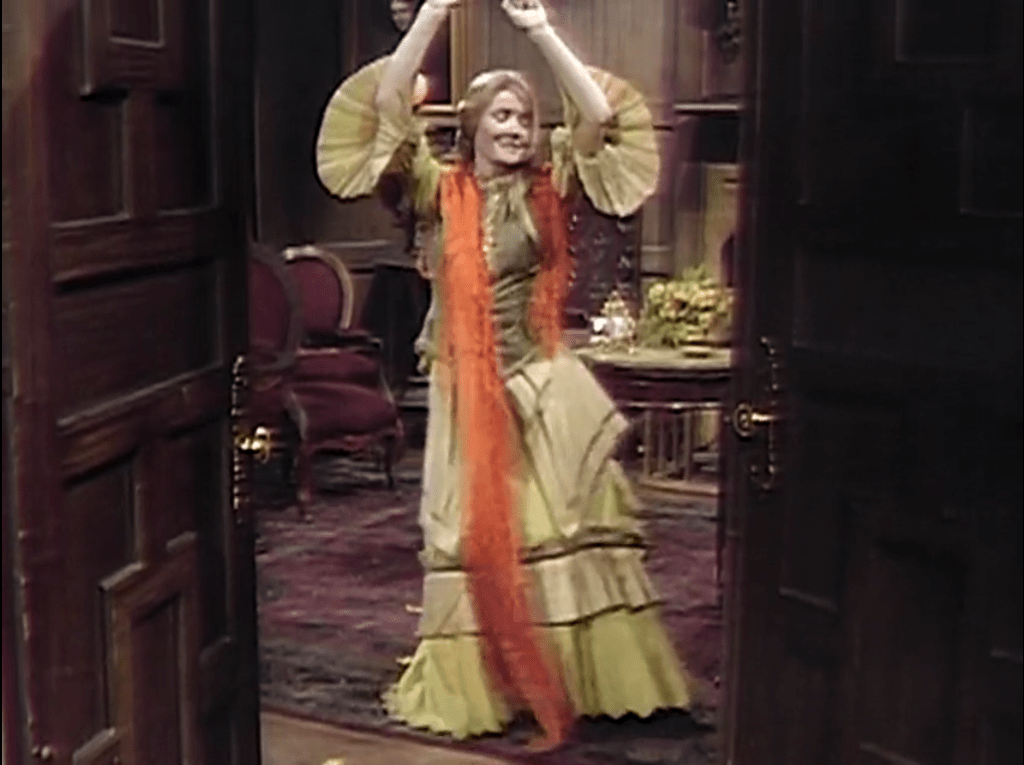
The importance of the episode is in the spell Petofi casts on Charity. He effectively murders her. For the rest of the segment of Dark Shadows set in the year 1897, Nancy Barrett will play, not Charity, but Pansy Faye, Cockney showgirl who came to the great estate of Collinwood as the fiancée of the daffy Carl Collins. The show often tends towards the somber, so it is a joyous thing to see Charity/ Pansy enthusiastically shake her moneymaker.
It is sometimes said that Petofi makes Charity believe that she is Pansy, but this is not correct. Charity never met Pansy, and barely knew the late Carl. She certainly never saw Pansy perform on stage. Yet she sings Pansy’s theme song word for word and note for note as she did, and does the dance that went with it just as Pansy did it. She has Pansy’s garish sense of style, her not-very-convincing East London accent, and her memories of Carl. Petofi has caused Pansy to take possession of Charity and to live again through her body, as he has caused David Collins, strange and troubled boy indigenous to the mid-twentieth century, to take possession of his grandfather Jamison Collins. While David’s spirit is killing Jamison’s body, Pansy seems to be having a wonderful time in Charity’s person, certainly far more than Charity ever had herself. As for Charity’s mind, that seems no longer to exist.
The disastrously repressed Charity Trask knows that rakish libertine Quentin Collins is a werewolf, and she wants to warn everyone about him without actually saying the facts out loud. She corners maidservant Beth Chavez in the drawing room of the great house at Collinwood and urges Beth to end her romance with Quentin.
Charity keeps saying that there is something about Quentin that Beth does not know. In fact, Beth not only knows everything Charity does about Quentin’s curse, but a great deal more. She was the very first person to know that Quentin was a werewolf, before Quentin himself knew. She was with him the first time he transformed, and when he became human again in the morning she refused to tell him what she had seen. She had previously seen Quentin murder his wife Jenny, she knows that Jenny’s sister Magda placed the curse as vengeance for that murder, and she was the one who told Magda that Jenny had borne children to Quentin who would inherit their father’s curse. Beth is the foremost authority on Quentin’s condition. But she is protecting him anyway.
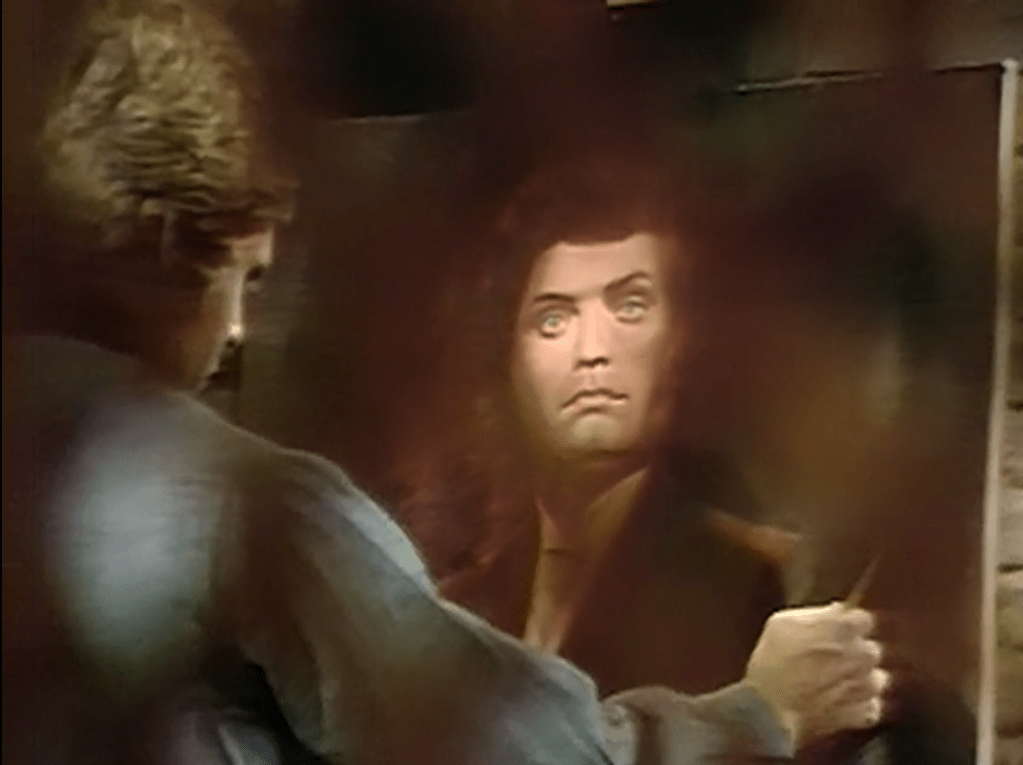
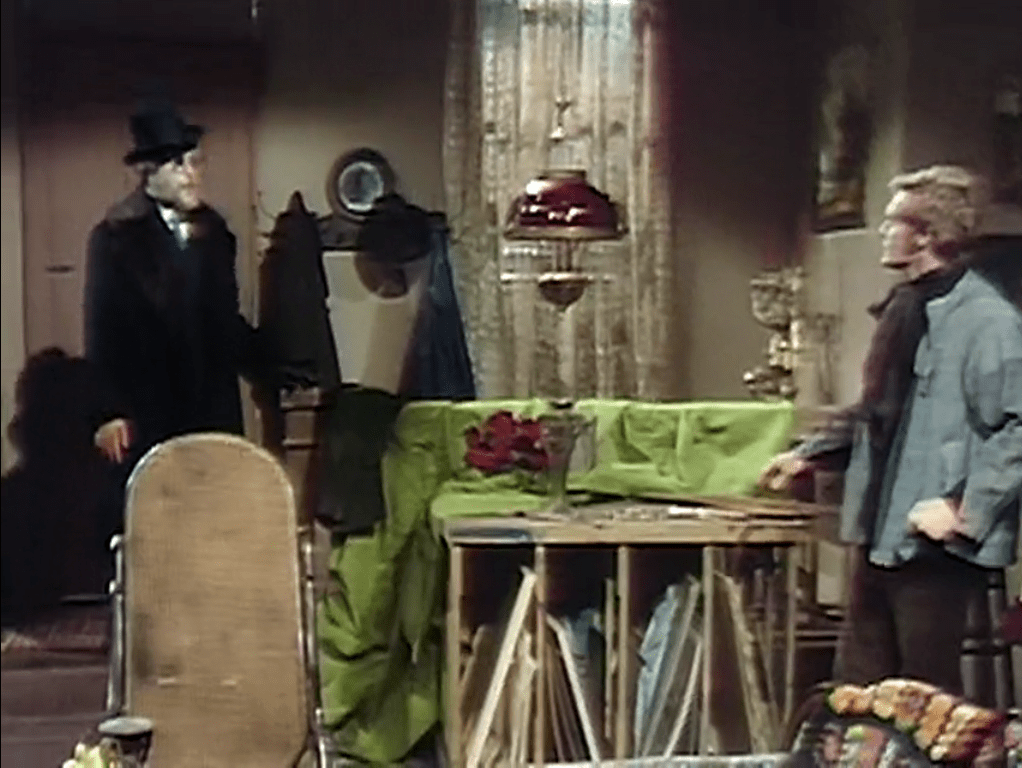
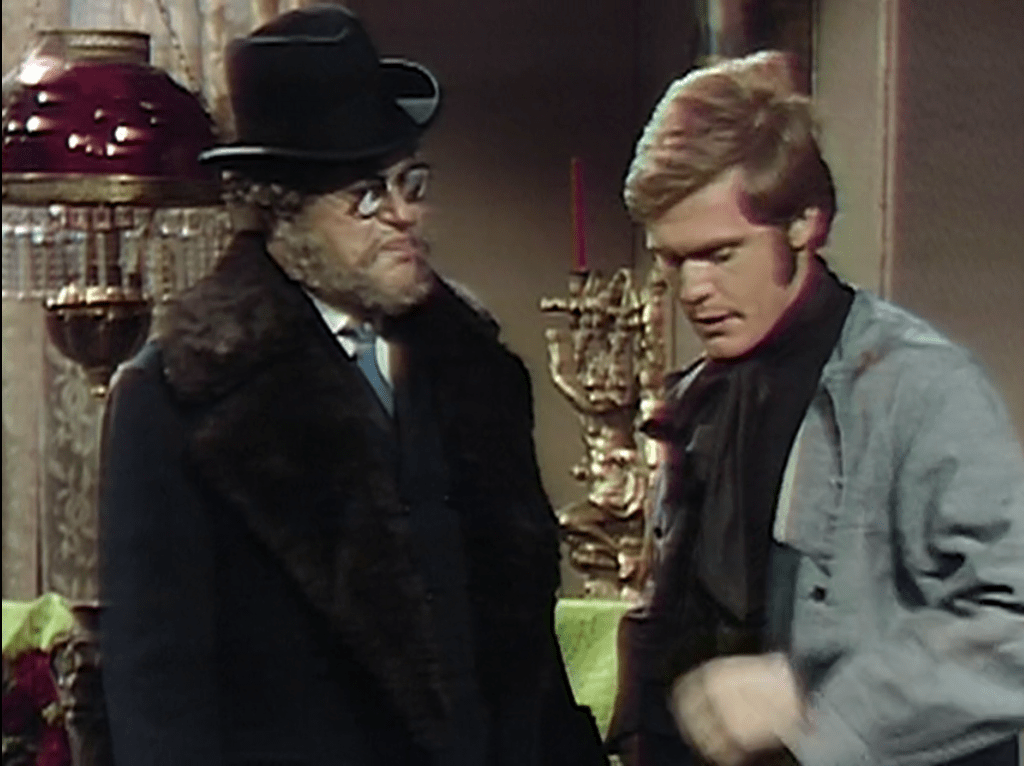
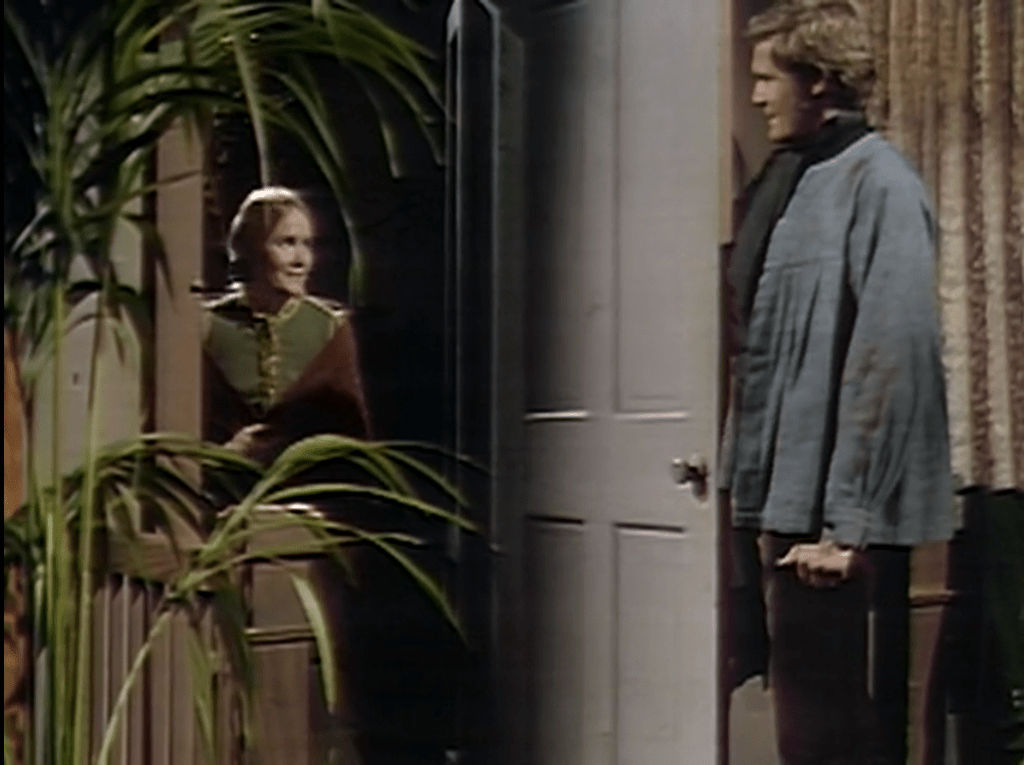
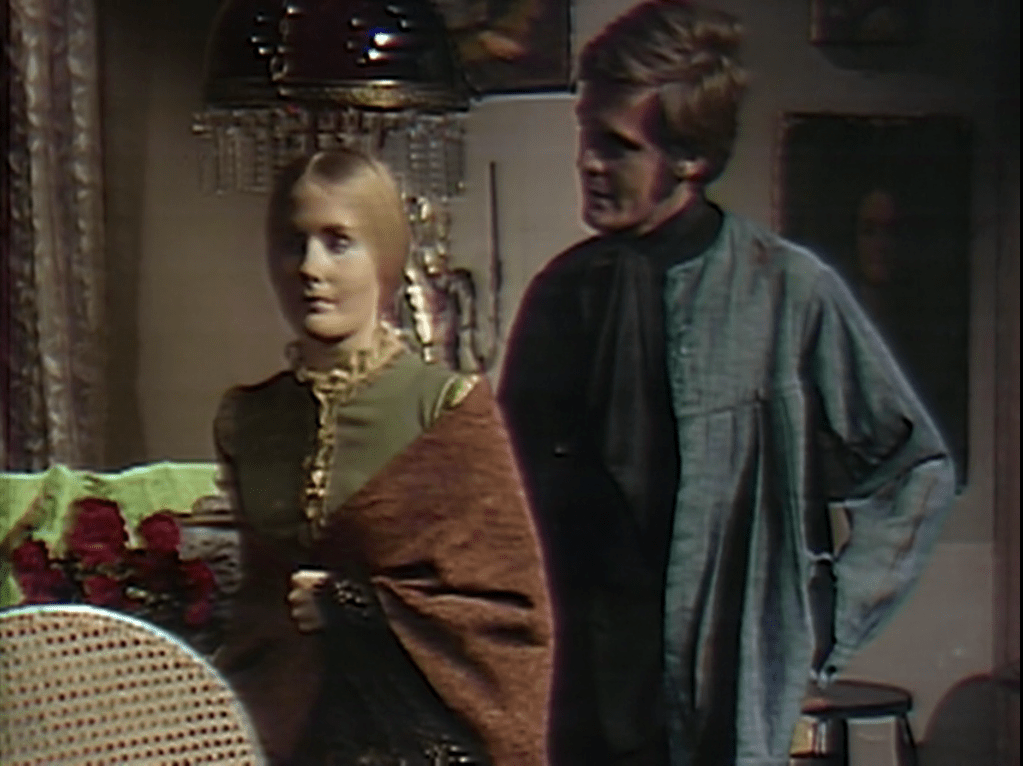
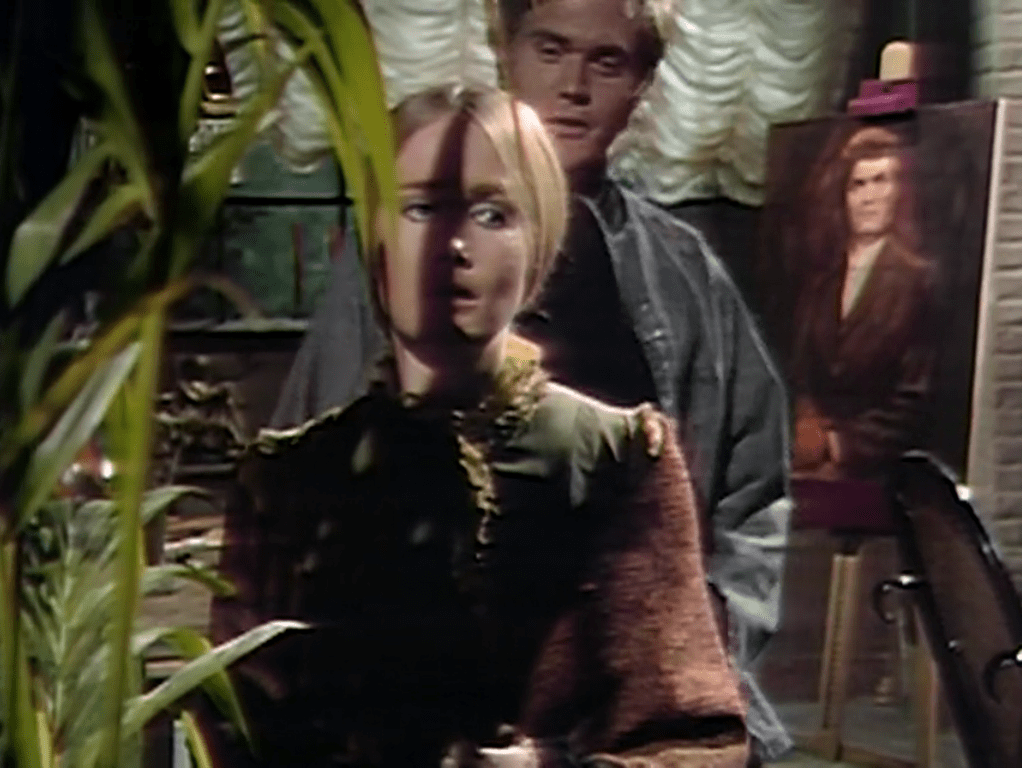
Charity then goes to a set known to longtime viewers as the Evans cottage. In the parts of Dark Shadows set between 1966 and 1968, this set is home to artist Sam Evans and his daughter Maggie, The Nicest Girl in Town. Today the dramatic date is 1897, but the cottage is already an artist’s studio. It is occupied by Charles Delaware Tate, a nationally renowned painter who was commanded by the evil sorcerer Count Petofi to execute Quentin’s portrait. When we first saw Tate in the cottage, he said that he rented it because he’d heard about it from a friend who had stayed there some time before.
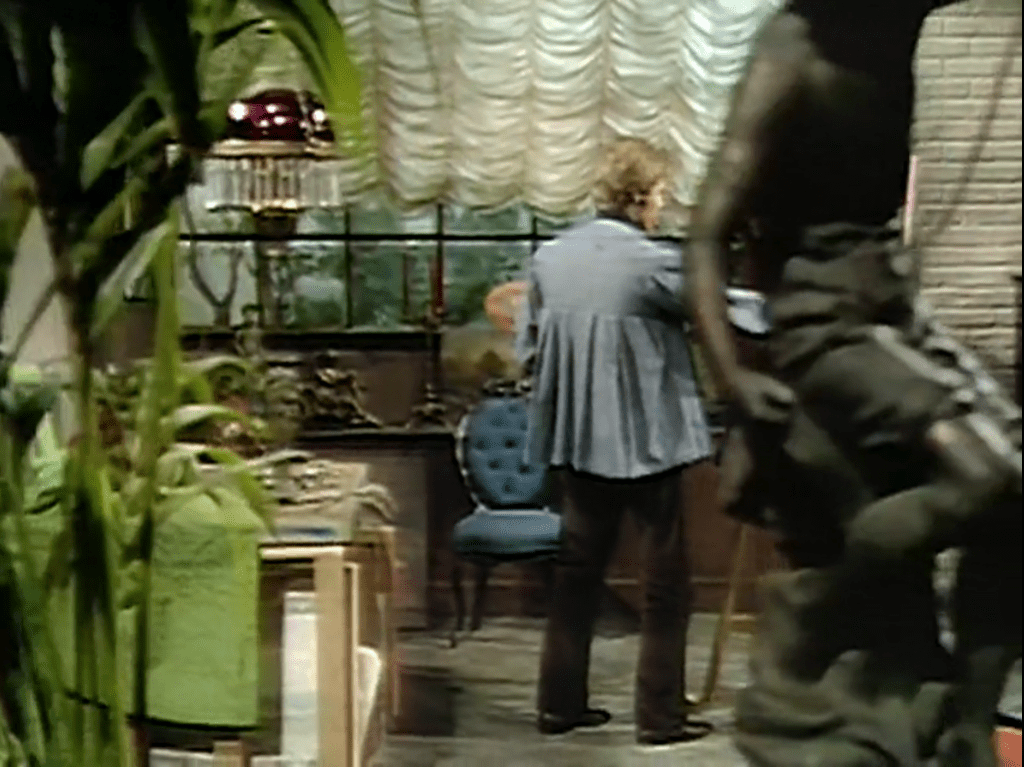
The cottage is full of paintings and sculptures. This is odd for a rental. Several possible explanations come to mind. Did Tate bring a dozen or more of his own works to keep him company? Did his friend or other artists who had rented it leave their completed pieces behind? Did the landlords display their own collection there for the edification of their tenants? Easy as these explanations are to think of, none of them seems very likely, and the question is never addressed in the show. The out-of-universe explanation is of course that when the audience looks at an artist’s studio, it expects to see a lot of artwork, and the artwork here gives director Lela Swift a chance to make good use of color.
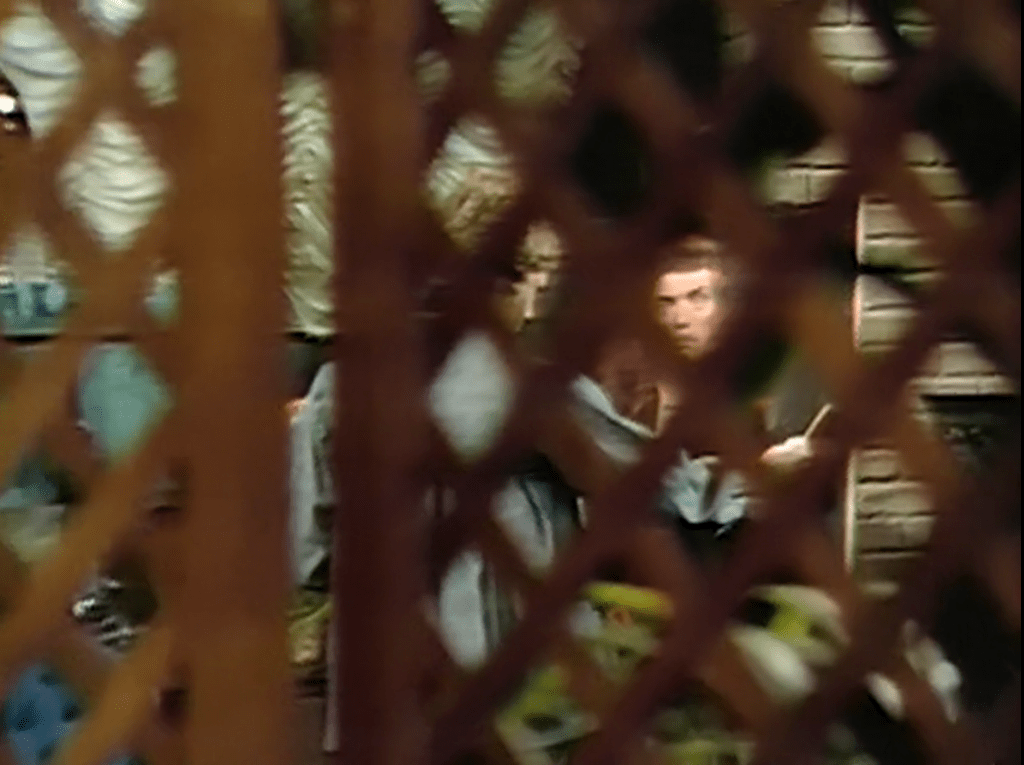
At any rate, the set is gorgeous today, full of bright greens and mixed reds. Swift was a highly ambitious visual artist, and she outdoes herself here. The first shot in the cottage begins with a closeup of the portrait of Quentin. It then pulls back further than any previous shot of this very familiar set, showing us a lattice that used to be part of the set representing the kitchen/ breakfast nook area at Collinwood. Behind it is a plant with some large, intensely green foliage. We then track around the set to see several sculpted pieces in black, paintings in a variety of tones, and a whole array of vivid colors in the furniture and other decorations. Dark Shadows has come a long way from the clumsiness that marked its use of color when it first switched from black and white in #295.
Charity is unaware that she and Tate are not alone. Tate’s master, Petofi, is in the next room eavesdropping. Charity is horrified to see the portrait of Quentin, and reminds Tate that she saw Quentin’s features in the portrait change into those of a wolf when she visited the cottage on the night of a full Moon. Tate tries to convince her she did not really see such a thing, but she will not have it. Charity gives Tate a warning somewhat less incoherent than the one she had given Beth. After she exits, Petofi and Tate talk. Tate had suspected Quentin was a werewolf, and now is sure. Petofi says that his plans for Quentin are none of Tate’s concern.
Petofi goes to the great house. Quentin confronts him there, demanding to know by what gods he swears. He replies “I have but one, and his name is Petofi!” Charity sees Petofi and vehemently demands he leave. I don’t know why she does this. As far as I can recall, Charity knows Petofi only as Victor Fenn-Gibbon, an honored guest of the Collins family. He did cast rather a nasty spell on her when he was using that alias, but I don’t see why she would realize that he was to blame for it, or for any of his other misdeeds.
Whatever the motive for Charity’s angry reaction to him, Petofi responds by magically robbing her of the power of speech. When he tells her that he has a healing touch, his manner and the background music indicate that after he touches her, what Charity will say will never again be up to her.
No episode of Dark Shadows premiered on ABC 56 years ago today, since the network had decided to cover the visit of the Apollo 11 astronauts to Chicago instead. So I’ve decided to take this opportunity to link to videos of some interesting discussions about the show posted on Youtube.
They couldn’t have in-person conventions with panels including original cast members in the year 2020, what with Covid-19. So they had a big Zoom call instead. That one is especially interesting, because it brought out some people who hadn’t made themselves visible to fandom in decades. In the case of David Henesy, it may have been his first act of fanservice since the show went off the air. When Alexandra Moltke Isles says that her first encounter with a fan was with someone who grabbed her hair and tried to rip it out of her head, that absence is perhaps understandable. The video shows the meeting in speaker view. Fans who groan every time Roger Davis turns up will find it grimly appropriate that he couldn’t figure out how to mute his camera, and so he keeps flashing in when other people have the floor. I can’t embed it, but here is the link.
Another Zoom recording some might enjoy seeing is of an April 2021 gathering in honor of Danny Horn’s great blog Dark Shadows Every Day. I was there, under my off-screen name. The discussion got a bit awkward when some podcasters started vying with each other and with the actual host to take over the moderator’s role, but I think all of us who wanted to do so eventually made ourselves heard. It was a good time.
Since 2020, Dark Shadows fan gatherings have taken on the character and often the label of memorial services, since so many of the people who used to appear on the panels are either deceased or otherwise unable to travel. But some of them have maintained a jolly spirit even so. For example, in this 2024 panel appearance Marie Wallace and Donna Wandrey amusingly complain about some appalling behavior by director Henry Kaplan. Sharon Smyth, who wasn’t on the show when Kaplan was, listens.
This July, Danielle Gelehrter hosted Kathryn Leigh Scott and David Henesy for a Zoom chat under the aegis of her “Terror at Collinwood” podcast. Mr Henesy has his own stories about Kaplan’s misdeeds.
I wouldn’t want you to think that Mrs Acilius and I watch nothing but 56 year old TV shows. Why, this very night, after I’d written the above and scheduled it to go live at 4 PM on Wednesday the 13th, we watched a 61 year old episode of To Tell the Truth. One of the impostors had a voice that sounded terribly familiar to us, but a face we didn’t recognize at all. When the game was over, he said his name was “Bobby Lloyd, and I’m a TV announcer at WHEC TV in Rochester, New York!” Two years later, he was Bob Lloyd, and he was on staff as an announcer for the ABC network, where he would say “Dark Shadows is a Dan Curtis production.”
In #425, set in the year 1796, vampire Barnabas Collins had bitten his lost love Josette and brought her under his power. He summoned her to join him as his eternal bride. At the last moment, wicked witch Angelique caused Josette to have a vision of what it would mean to join with Barnabas. Josette saw herself risen from the grave as a vampire herself. Horrified, she flung herself to her death from the top of the cliff at Widows’ Hill before Barnabas could get to her.
Josette’s death seemed like it might mark the end of the 1790s flashback. It explained the last of the major events we had heard about before well-meaning governess Vicki took us along on her uncertain and frightening journey into the past. As it happens, that first costume drama segment was a hit, and they had enough story to keep us there for a while. So it was seven more weeks before Vicki went home to the 1960s.
Shortly after Vicki’s return to her own time, Barnabas was freed of the effects of the vampire curse and had convinced himself that he was a good guy. So when in early 1969 two ghosts, the malevolent one of Quentin Collins and the ambiguous one of maidservant Beth Chavez, haunted the great house of Collinwood so aggressively that everyone was driven out of it and strange and troubled boy David Collins was left on the point of death, Barnabas appointed himself chief defender of the living against the evil dead. After a series of futile attempts, he stumbled so badly that he fell backwards in time and found himself in 1897, when Quentin and Beth were living beings. Barnabas, however, found that his curse reasserted itself in full force once he left the 1960s. He is now a vampire again.
Barnabas is in the middle of his twenty-fourth week in 1897, and things could hardly be going worse for him. He has failed to solve any of the problems that led to the disaster of 1969, has killed many people, has been exposed as a vampire, and is now a prisoner of the evil sorcerer Count Petofi. Petofi knows that Barnabas has traveled back in time, is under the mistaken impression that he knew what he was doing when he did so, and demands that Barnabas take him back to 1969 with him. Petofi refuses to believe Barnabas when he tells him he has no idea how to get back. To force Barnabas to use knowledge which he does not have, Petofi has called David’s spirit from the future and caused it to possess his grandfather, Jamison Collins, who will soon die if the possession continues. Petofi has placed a cross on Barnabas’ chest, immobilizing him in his coffin.
Barnabas does have allies in 1897. He has befriended Quentin and enslaved Beth. Quentin comes to Petofi’s hiding place today; Petofi allows him to talk privately with Barnabas, but Quentin finds he cannot touch the cross to free him. Barnabas uses his psychic power over Beth to summon her, but she does not help him either. Petofi takes a page from Angelique’s book, and shows Beth an image of herself as a vampire. She is as horrified by that prospect as was Josette. Not only will longtime viewers remember Josette’s suicide, but earlier in this episode Jamison/ David had talked to Beth about her upcoming suicide. Since the topic has been introduced, we might expect Beth to react to the vision as Josette did, by immediately taking her own life. But she does not. Instead, Petofi tells her that all she has to do is turn her back on Barnabas and he will free her of his power. She does, and he is as good as his word.
With that, no one is left to help Barnabas. For some time it has seemed that the show might return to contemporary dress soon. Petofi has been doing a lot of interesting things, but he really doesn’t have any reason to stick around Collinwood, and everyone else has pretty well run out of road. The nod to Josette’s death scene seems like another hint that they are getting ready to go back to the 1960s. We’ve had a number of callbacks to earlier phases of the show recently. Vicki’s name has been mentioned twice lately, and schoolteacher-turned-adventurer Tim Shaw has become an homage to dashing action hero Burke Devlin. Those reminders of long-forgotten characters would suggest that they are looking over the show’s stockpile of narrative material and trying to figure out what to do next. The 1790s flashback ended only when Vicki was all alone and standing on the gallows with her neck in a noose; perhaps the 1897 flashback will end with Barnabas all alone and lying in his coffin with a wooden stake about to be driven into his heart.
From December 1968 to through February 1969, strange and troubled boy David Collins (David Henesy) and his friend Amy Jennings (Denise Nickerson) were falling under the power of the malign ghost of Quentin Collins. Occasionally the children were possessed by the spirits of David’s grandfather Jamison and great-aunt Nora; at other times they were possessed by Quentin’s own spirit and that of Quentin’s sometime lover, maidservant Beth. In those same days, Amy’s brother Chris (Don Briscoe) was suffering from a curse that made him a werewolf.
As Quentin’s power over David and Amy grew, so did the frequency and duration of Chris’ spells in lupine form. By #700, Quentin so dominated the great house on the estate of Collinwood that its residents fled to the Old House on the estate, home of their distant cousin Barnabas Collins. David, entirely possessed by Jamison, was close to death. For his part, Chris was stuck in wolf form, apparently permanently, and Barnabas had locked him in a secret room in the old Collins family mausoleum.
Desperate to remedy the situation, Barnabas and his associate, occult expert Timothy Eliot Stokes (Thayer David,) searched Quentin’s old room in the long-deserted west wing of the great house. They found some I Ching wands there. Under Stokes’ direction, Barnabas threw the wands, meditated on them, and found himself transported back in time to 1897. In that year, Quentin, Beth, Jamison, and Nora are alive, and Barnabas is a vampire.
Barnabas had no idea what led Quentin to become a malevolent ghost or what first brought the werewolf curse on Chris, but he had reason to believe that 1897 was an important year in the events leading up to both of those unhappy circumstances. So once he arrived in that period, he spent his nights meddling in all the affairs of the Collins family he found there. Vampires are not problem-solvers; their function in a story is to create problems that other characters will have to solve. So all of Barnabas’ well-intentioned interventions backfired badly. Even disregarding the many murders he committed for his own selfish ends, including the murder of Quentin’s brother Carl Collins, his trip would by any standard have to be considered a disaster.
Now, evil sorcerer Count Petofi (Thayer David) has found that Barnabas is a visitor from the future and is determined to go with him when he returns to 1969. When he demanded Barnabas tell him his secret, Barnabas quite truthfully told him he had no idea what was going on when he found himself transported from one period to another. Petofi did not believe him, and is trying to extort the information he wants by summoning the spirit of David to come from 1969 and possess Jamison (David Henesy) in 1897.
Not only is this an intriguing reversal of the 1968-1969 story in which the ghost of Quentin caused Jamison’s spirit to possess David, it also picks up on some recent hints that they might retcon the whole “Haunting of Collinwood” story to put Quentin’s ghost under the control of Petofi. Even if he can’t hitch a ride with Barnabas, perhaps Petofi will find a way to use Quentin to go back to 1969 with us.
Nora (Denise Nickerson) is with her brother Jamison when the possession takes hold. She is puzzled that he insists on calling her “Amy” and himself “David” and that he tells her to call Quentin on the telephone, even though he is in the house. When Quentin shows up, he recognizes the name David Collins from something Barnabas has told him about the future. But Barnabas has not told Quentin that he is fated to become a family-annihilating ghost, and so Quentin cannot understand how David knows who he is.
Meanwhile, a man named Tim Shaw (Don Briscoe) comes to the house and visits Nora in her room. Tim is Amy’s former teacher, and she considers him a friend. She does not know that since she first knew him, he has lost his moral compass, found the severed Hand of Count Petofi, stolen it, and used its magical powers to make a small fortune in New York City. Evidently all working-class Collinsport boys get rich quick when they go to NYC. In 1961, ex-fisherman Burke Devlin got out of prison and went to that city. By the time he returned to Collinsport in 1966, Burke was a big-time corporate raider who had to think for a moment when David Collins asked him if he’d already made his first $100,000,000. He answered “Not yet.” If he’d had the Hand, no doubt he would have passed that milestone long before.
A couple of days ago, Tim asked Nora to hide a box for him. Unknown to her, the box contained the Hand. Tim asks Nora to return the box to him. She tells him Jamison has it, and he flies into a rage. He gets very rough with her. Briscoe and Nickerson were both good actors, and we’ve seen them share tender moments both as Nora and Tim and as Amy and Chris, so the resulting scene is as uncomfortable as it needs to be to show us that Tim is no longer the long-suffering nice guy we once knew. Moreover, longtime viewers who recognize Tim’s echo of Burke and remember that Burke, though sometimes villainous, was always good with David, will be shocked that Tim does not mirror the earlier character’s consistent soft spot for children.
Tim goes downstairs and sees Quentin coming out of the drawing room. He demands to see Jamison. Quentin tells him that Jamison is ill, and it will be impossible for anyone to talk to him. Tim starts to get ugly about it, and Quentin cuts him off, saying that Jamison doesn’t have the Hand. Tim is shocked that Quentin knows about the Hand, but recovers sufficiently to ask who does. Quentin cheerfully tells Tim that if he goes to the abandoned mill at the end of the North Road, he will find his onetime acquaintance Aristide, and that Aristide will direct him to the man who has the Hand.
Tim knows Aristide only slightly, but he has a grudge against him. Aristide attacked Tim’s girlfriend Amanda and demanded she tell him where the Hand was. Even after he realized Amanda did not know what he was talking about, he beat her and threatened to kill her, forcing her to tell him whatever she did know that would help him retrace Tim’s steps. When Tim found Amanda, Aristide had left her unconscious, and Tim feared at first she might be dead.
We cut to the hideout in the mill, where Tim is waiting with a pistol and thinking that he would be justified in killing Aristide for what he did to Amanda. When Aristide comes, Tim holds him at gunpoint and demands the Hand be returned to him. Aristide tells him that is not possible. They quarrel until another man enters. It is Petofi, who shows Tim that the Hand has resumed its place at the end of his right arm.
That suffices to show Tim that the Hand is no longer available to him. Petofi tells him he should consider himself lucky that the Hand, which followed no one’s commands, chose to make him rich and happy. Tim says he is not happy, and will not be until he can take revenge on the hypocritical Rev’d Gregory Trask and lawyer/ Satanist Evan Hanley. This again reminds longtime viewers of Burke, whose original goal in returning to Collinsport was to wreak vengeance on Roger Collins. As Trask and Evan involved Tim in a homicide when he was not in his right mind and tried to make him alone pay the legal penalty for it, so Roger killed someone with Burke’s car while Burke was passed out drunk in the back seat and saw to it that the court concluded that Burke was driving.
Petofi laughs and congratulates Tim on his choice of enemies. Tim brightens and asks if Petofi will join with him in bringing Trask and Evan down. Petofi explains that he does nothing without a price. Tim says he has a lot of money, and Petofi says he doesn’t have any use for money. Petofi brings up Amanda, only to say that he doesn’t have a use for her either, at least not at the moment. He sends Tim along his way.
Aristide is talking when Petofi dismisses him. He tells him that two visitors are coming, and that he wants to be alone when they arrive. He will not explain further, and so Aristide is in rather a huff when he leaves.
The visitors are Quentin and Jamison/ David. Quentin is carrying his nephew/ great-great-nephew. He demands that Petofi cure Jamison of the possession, which seems to be killing him. Petofi refuses. When Jamison/ David calls Quentin by name, Petofi asks him how a boy who lives in 1969 knows who he is. Quentin’s bewildered reaction leaves us wondering how he will respond if Barnabas ever tells him just why he went to the past.
In the opening teaser, Petofi stood over the coffin in which he has trapped Barnabas. He told Aristide that he and Barnabas have been at war for what even he, at his immense age, considers to be a very long time. He says that they are now engaged in the final battle of that war.
Petofi’s remarks make absolutely no sense whatever in the context of what we have seen. It has been clear so far that Petofi’s presence at Collinwood is an accident, that Barnabas never heard of him before, and that Petofi only just learned that Barnabas has traveled through time. Many of the oddest dead ends on the show were left over from advance plans that hadn’t worked out; so when they were drawing up broad outlines six months before taping, or when they were writing episode summaries (called “flimsies”) thirteen weeks before, they would often include ideas that depended on story points that they never got around to making happen or characters who never worked out. Once in a while, the writers tasked with filling in the flimsies wouldn’t be able to make up a complete 22 minute script without incorporating some of this irrelevant material. So perhaps at some point in the planning process they meant to have stories about Barnabas going back to the eighteenth century and fighting Petofi there. They may still have been kicking that idea around when they shot this installment.
If Dark Shadows has offended, Think but this, and all is mended — That you have but slumbered here While these visions did appear. And now, a word from All Temperature Cheer.
Danny Horn, “Episode 816: Midsummer,” posted 1 February 2016 at Dark Shadows Every Day.
One night in 1797, nine Rroma men trapped sorcerer Count Petofi in the forest of Ojden. They amputated his right hand, and with it took most of his magical powers. Some time after, Petofi learned that he had exactly one hundred years to reattach the hand. If he managed it within that time, he would become immortal. Otherwise, he would die on the anniversary of the amputation.
Now that anniversary has come, and Petofi has succeeded in regaining his hand with only minutes to spare. Time-traveling vampire Barnabas Collins and his distant cousin, desperately handsome werewolf Quentin, have decided that because Petofi’s spirit is in possession of Quentin’s twelve year old nephew Jamison and Jamison is as close to death as is Petofi himself, only by surrendering the hand to Petofi can they save the boy. Barnabas did get Petofi’s servant Aristide to promise to free Quentin of lycanthropy once he has the hand back, but he put little faith in that promise.
Now Petofi is jubilant and Jamison is still sick. Barnabas tells Petofi about the deal Aristide made, and also says that he wants Jamison and the rest of the Collinses to be freed from the ill effects Petofi has had on them. Petofi could not be less interested. Instead, he wants Barnabas to tell him how he traveled in time from 1969 and how he will travel back there.
Petofi lets slip that he is anxious to go to another period of history because he is afraid of the Rroma people who are still after him. We know, not only that it was Rroma who cut off his hand, but that when Petofi saw a young Rroma woman in a tavern in #794 he couldn’t get out fast enough. While it may have taken nine Rroma men to take his hand, evidently a single Rroma woman, and a tiny one at that, is capable of doing him considerable harm. Barnabas has a Rroma friend, broad ethnic stereotype Magda Rákóczi, who has considerable magic powers of her own, and he knows of a Romany band currently camped near Boston. So Petofi’s apparently well-founded ziganophobia is a sign that Barnabas may be able to defeat him, even though Petofi’s powers were formidable even before he was reunited with his hand.
Petofi says that he will cure Jamison only if Barnabas explains how he traveled to 1897 from 1969. Barnabas tells Petofi he has no idea how he made that journey. This is so. He meditated on some I Ching wands, a process which he was told might have any of an infinite number of effects, and found himself in 1897. Nor does he have any idea how to get back. He might have enlarged on the theme of his complete lack of useful knowledge in this area. In 1968, Barnabas traveled back to his original era, the 1790s, by going to the grave of a man named Peter Bradford on the anniversary of Bradford’s death. Bradford’s ghost had been haunting him, and Barnabas called for Bradford to take him back to the year 1796. After he did so, Barnabas found that he could return to the 1960s only by having himself sealed in his coffin and waiting inside it for 172 years until friends let him out. He doesn’t tell Petofi about that incident, but it does not seem likely to be of any more help to him than the story about the I Ching would be.
Petofi does not believe that Barnabas is so hapless. First he squeezes Barnabas’ hand, depriving him of the power to dematerialize. Then he opens a cupboard and tells Barnabas to look in it. It takes a while to warm up, but eventually it gets an ABC affiliate showing Dark Shadows. Barnabas sees the parlor of the Old House on the estate of Collinwood in 1969. His best friend, mad scientist Julia Hoffman, MD, is sitting there reading a book. We haven’t seen Julia since #700, but she might be on our minds today. At one point Aristide lights his cigar on a candle burning in a large candelabra. In #296, Julia very memorably did the same thing with her cigarette.
Barnabas sees strange and troubled boy David Collins come staggering downstairs, raving deliriously about Quentin. Julia tells him to reject Quentin, who in 1969 is a ghost haunting Collinwood and draining the life from David. David passes out, and Julia injects him with a powerful sedative, as you do with unconscious children.
The cupboard loses the channel, and Barnabas asks Petofi what else is happening in 1969. Petofi cannot answer any questions; it quickly becomes clear that he couldn’t see or hear the scene. Barnabas is intrigued to learn of another of Petofi’s weaknesses, and walks out.
Aristide then speculates that Barnabas might be telling the truth. Petofi rejects this at once, reveals more of his cupboard’s limitations:
No, he’s not a fool, Aristide. He thinks he can win, accomplish whatever he wants to do here, and disappear without me…
Had Petofi ever seen even one episode of Dark Shadows, it would not occur to him to say that Barnabas is “not a fool.” Nor would he surmise that Barnabas is pursuing a plan that includes a plausible method of escape. If Barnabas had a plan of any kind, Petofi would know all about it, since it would have failed spectacularly the moment he took the first step towards putting it into effect.
Petofi and Aristide then go to the Old House. They find Magda there. At the moment, she is under Petofi’s power. Like Julia, Magda is played by Grayson Hall. We may have thought the glimpse into 1969 was a videotaped insert, but evidently it was done live, because Magda is not wearing her usual heavy brownface makeup. She may have a bit of an artificial tan, but Julia’s blue eyeshadow is clearly visible through it.
Magda, looking more like an actual Rroma woman than she ever has before.
Petofi forces Magda to lead her to Barnabas’ hiding place. He has a cross and Aristide has a chain and a padlock. Petofi puts the cross inside the coffin, and orders Aristide to chain the coffin closed. Petofi declares that Barnabas is in for a long journey.
One night in 1797, nine Rroma men trapped the sorcerer Count Petofi in the forest of Ojden and cut off his right hand. With it, the count lost most of his magical powers. Sometime after, Petofi learned that he could live for exactly one hundred years without his hand. If he was reunited with it in that time, he would become immortal; if he was not, he would die.
Now, it is 1897, and the hundred years are almost up. Petofi has vacated his body and has for some weeks been operating in the person of twelve year old Jamison Collins. He has regained the hand, but as Petofi is dying, so is Jamison. Jamison/ Petofi collapses in the woods carrying the hand back to the place where his servant Aristide is waiting with Petofi’s own body. Jamison/ Petofi passes out shortly after Jamison’s uncle, the rakish Quentin Collins, catches up to him. Quentin carries Jamison/ Petofi and the hand to the caretaker’s cottage on the grounds of the estate of Collinwood, where he confers with his distant cousin, Barnabas Collins the vampire.
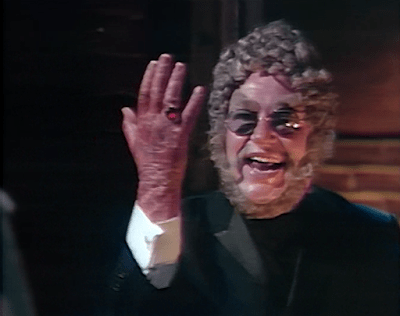
Quentin and Barnabas decide that if Petofi dies, Jamison will die as well. Therefore they have no choice but to take the hand to Aristide. Barnabas does get Aristide to promise that once Petofi has the hand, he will use his powers to cure Quentin’s werewolf curse, but no one seems to regard Aristide’s word as valuable. Barnabas makes a menacing move towards Aristide; Aristide wards him off with a cross. Aristide puts the hand on Petofi’s chest, says some magic words, and waits a little over an hour. During this time, he needles Barnabas by offering him tea, which he must know is not part of a vampire’s diet. Then Petofi comes out of his room, laughing his evil laugh and showing off his reattached hand.
“At last my arm is complete again!” Screenshot by Dark Shadows Before I Die. (Caption by Stephen Sondheim.)
In #767, Jamison had a dream in which Quentin told him that his doom was sealed when the one person he truly loved turned against him. It was already clear at that point that this person was Jamison, but today Quentin tells Jamison in so many words that he is the only person he ever really loved. So we can take this as an announcement that the climactic crisis of the part of Dark Shadows set in 1897 is approaching.
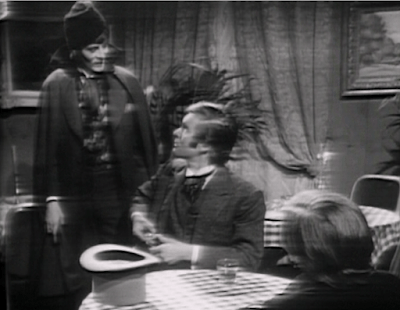
This is the first episode to feature a scene in the restaurant at the Collinsport Inn since #227 in May 1967. The show was in black and white then; apparently the restaurant set cannot be seen in color, since this one, set in the year 1897, survives only in kinescope.
Aristide, Tim, and Jamison/ Petofi in the restaurant at the Collinsport Inn. Screenshot by Dark Shadows Before I Die.
Schoolteacher turned adventurer Tim Shaw is at a table in the restaurant when he is joined by twelve year old Jamison Collins, a former student of his. Unknown to Tim, Jamison’s body is currently a vessel for the spirit of 150 year old sorcerer Count Petofi. Tim is startled to see Jamison, and tells him he had heard he was ill. Jamison asks where he heard this. Tim pauses, then claims that he telephoned Jamison’s home, the great house of Collinwood. He says that Jamison’s nine year old sister Nora answered the phone and told him of his illness. Tim tells Jamison that he is waiting for a young lady, and that after she arrives he would like to be alone with her.
A man enters and talks with Tim. After he goes, Jamison asks who he is. Tim says he has only met him once, and that he knows almost nothing about him beyond the fact that his name is Aristide. We have seen Aristide in the woods with Jamison/ Petofi, and know that he is Petofi’s servant. Jamison/ Petofi told him in that scene that he felt weak and had only a few hours left if he did not recover “The Hand.”
We also saw Aristide in Tim’s room with Amanda, the young lady Tim is waiting to meet. He confronted Amanda, roughed her up, and threatened her with a prop representing a dagger with a curved blade. He wanted Amanda to tell him where “The Hand of Count Petofi” is. Amanda asked if “The Hand of Count Petofi” was a piece of jewelry or something. She had no idea it is literally a severed hand, cut from the wrist of Count Petofi 100 years ago. Aristide questioned her and learned that Tim took a box from the Inn earlier that night and returned without it.
Tim excuses himself, saying that he will go to the front desk to ask if Amanda left a message there explaining why she is so late. Jamison/ Petofi meets Aristide back in the woods. When Aristide tells him that Tim took a box from the Inn and returned without it, he remembers that Tim said he had talked on the telephone with Nora. He deduces that Tim actually talked to Nora in person when he took the box to Collinwood and enlisted Nora’s help hiding it there.
Jamison/ Petofi goes to Nora’s room and wakes her. He tricks her into telling him that Tim was there, but she refuses to tell him where the box is. He twists her arm until she does so. In the parts of Dark Shadows set in the 1960s, David Henesy played strange and troubled boy David Collins, and Denise Nickerson played nine year old Amy Jennings. David and Amy were intermittently possessed by Jamison and Nora in late 1968 and early 1969, and when Amy/ Nora resisted David/ Jamison in #667 and #679, he twisted her arm. When we see the same violent act here, we see a dramatization of a cycle of abuse. We may also wonder if they are going to retcon that “Haunting of Collinwood” segment to include Petofi as a driving force.
Jamison/ Petofi takes the box from Nora’s armoire, opens it, and holds up the Hand. Regular viewers can expect Petofi to return to his own physical form, reattach the Hand to his wrist, and increase his magical powers greatly.
All of the male cast members have trouble with their dialogue today, even the usually line-perfect David Henesy. I wonder if writer Gordon Russell was late finishing the script. Mr Henesy and Michael Stroka manage to give good enough performances that their bobbles don’t really matter, but Don Briscoe is just bad today. When Tim is talking with Nora in the teaser, his intonations are bizarre, and in his later scenes he is flat and lifeless, including a long stretch when he is openly reading off the teleprompter. Perhaps that’s because of his acting style- he worked from the inside out, finding his character’s motivations and developing those first, adding the dialogue last. Give an actor like that less time than he needs, and he might not have anything at all to offer.
One unfair criticism that Briscoe gets from many of the fans who post comments online is that Tim does not have romantic chemistry with any of the women he is paired with. He isn’t supposed to have romantic chemistry with them! At first we see him linked with neurotic intellectual Rachel Drummond. Tim and Rachel were students together at the boarding school run by the sadistic Gregory Trask. When Jamison and Nora are sent to the same school, Tim and Rachel illustrate the horror that lies in store for them. If Tim and Rachel were a hot and exciting couple, they would send the message that kids subjected to Trask’s abuse can grow up to be happy adults, muffing the whole point of the story.
The second woman attached to Tim was Trask’s daughter Charity. Nora points out to Jamison today that Tim and Charity never got along with each other, and regular viewers remember that this is true. Trask forced them to get engaged, a situation that made them both miserable, and then led them both to believe that Tim had murdered Charity’s mother. Again, the whole point of the relationship is to demonstrate how cruel Trask is.
Now Tim is traveling with Amanda. We met Amanda yesterday, and saw that she is impatient with Tim and tolerates him only because he has a lot of money and keeps spending it on her. As possessor of the Hand of Count Petofi, Tim has managed to get rich quick and turn into a tragic version of the character W. C. Fields played in vaudeville routines and stage plays and films set in the Gay Nineties. Amanda is the sort of woman Fields’ characters invariably failed to impress. Again, the last thing you would want would be for Amanda to seem actually to be attracted to Tim.
Though Michael Stroka, in spite of his line bobbles, does a good job as Aristide, there is one moment today when he does make a bad mistake. Aristide makes a big deal out of his dagger, which he initially called “The Dancing Girl.” The prop is obviously just a flat piece of wood, which we might be able to accept if we don’t have to look at it for an extended period. But when he is threatening Amanda today, he holds “The Dancing Girl’s” blade in the palm of his hand, squeezes it, rolls it around, and caresses it. If there were a sharp edge anywhere on it, his hand would be bleeding profusely. They really are not making it easy for us to believe Aristide is going to cut anyone.
Denise Nickerson joined the cast of Dark Shadows in #632 as nine year old Amy Jennings, sister of the doomed Chris (Don Briscoe.) As Amy, Nickerson was central to the show for the next fourteen weeks. In #701 we traveled back in time and Dark Shadows became a costume drama set in 1897. In that year, Nickerson is Nora Collins. Nora was in 10 episodes in the first twelve weeks of 1897, and apart from a two episode stint in #782 and #783 has been unseen and very nearly unmentioned in the ten weeks since. The 1897 segment is packed with so many lively characters that even the best of them disappear for long periods, but the extended neglect of Nora is particularly disappointing. Nickerson was an outstanding young actress, brought out interesting qualities in her scene-mates, and had drawn a significant fan base among the show’s preteen viewers.
Nickerson is back today. In Act One, she walks in on her father Edward trying to strangle her Uncle Quentin. Nora’s scream distracts Edward and saves Quentin. When Nora asks Quentin what got into her father, he tells her that it’s something like a magic spell and will end soon. He refuses to explain further. It is unclear why Nora accepts this refusal. For our part, the audience accepts it because Edward’s attack on Quentin has nothing to do with today’s episode. It’s just left over from yesterday’s cliffhanger.
Don Briscoe is also back, after an absence of twelve episodes. In 1897, he plays Tim Shaw, persecuted schoolteacher turned adventurer. As Chris, Briscoe would do a little W. C. Fields imitation from time to time, occasionally ending a sentence with Fields’ signature inflections. This would raise a smile from other characters in 1969, when such a habit was relatively fashionable. Considering that Fields’ persona was that of a man who belonged in the Gay Nineties, we should have suspected when we first saw the date 1897 that Briscoe would have an opportunity to develop his Fields imitation in greater depth. Indeed, we see him today wearing a hat and coat that might have come from Fields’ closet, accompanied by exactly the sort of woman whom Fields’ characters reliably failed to impress.
I regret to inform you that Tim does not, at any point, address Amanda as “My little chickadee.”
Tim has been in New York, where he made a great deal of money in a very short time by means of something which he keeps in a small box. Returning viewers know that this thing is The Hand of Count Petofi, and that it is the object of a desperate search by many dangerous people, including Quentin. We also know that the Hand is not subject to anyone’s control. If it has made Tim rich, that is because it wanted to do so for purposes of its own, not because Tim had any skill in manipulating it. Tim has used his riches to purchase the companionship of Amanda Harris, a cynical young woman who is impatient with him and appalled at the smallness of the village of Collinsport.
Tim and Amanda are staying at the Collinsport Inn. The Inn was a very important part of the show for its first 40 weeks, when one of the principal storylines was The Revenge of Burke Devlin. Like Tim, Burke was a working class boy from Collinsport who was framed for a homicide of which he was only technically guilty, and who then went to New York City, made a huge amount of money in a very short time, and came back to his home town to even the score with those who set him up to take the blame for a crime for which they were even more responsible than he was. Burke lived at the Inn, and it represented his territory, in opposition to the great house of Collinwood where his adversaries lived. The Revenge of Burke Devlin storyline never really took off, and by #201 Burke himself lost interest in it. Since then, we have gone months at a time without seeing the Inn. We saw a guest room there in #698, but I can’t remember the last time we saw the lobby before today.
Tim orders Amanda to hide the box in her room, then sends her off to Collinwood to make a connection with the cruel and lecherous Rev’d Gregory Trask. Amanda tells Trask that she has been under the power of an evil man and that she wants to change her ways. Trask tells her that he will give her spiritual guidance. He has his back to her when he says that his plan requires that he provide her with “private instruction”; he isn’t looking at her when she rolls her eyes at this. Back in the Inn, Amanda tells Tim that he was right, Trask is despicable.
While Amanda and Tim are taking a stroll by the waterfront, Quentin ransacks Tim’s room looking for the Hand. Quentin hears them on their way back, and leaps out Tim’s window. They’ve gone out of their way to make it clear that Tim’s room is upstairs- we heard Tim on his telephone telling the front desk to send Amanda “up” to him, and we saw him and Amanda getting on the staircase to go to the room. So they are inviting us to wonder how Quentin climbs down the side of the building.
When Tim sees the shambles in his room, he sends Amanda to her room to make sure the box is still there. It is, but he decides that the Inn is not a safe enough place for the Hand. He takes the box to Nora in her bedroom at Collinwood. Regular viewers know that Tim was Nora’s teacher, and Nora considers him her friend. It may seem odd that the person Tim turns to when he needs help with such a sensitive matter is nine years old, but longtime viewers will again remember Burke. He had a way with children; he immediately won the devotion of strange and troubled boy David Collins, and Maggie Evans, The Nicest Girl in Town, remembered him very fondly from her own childhood. Burke and David trusted each other in delicate situations more than once, and we can see the same thing happening between Tim and Nora.
Nora promises to hide the box somewhere in the house and not to tell anyone about it. Tim leaves, and Nora puts the box in her armoire. Nora is a fairly responsible person, but she is nine, and the box is wrapped like a present. As we fade to the credits, she is opening the box.
This leaves us wondering not only how Nora will react to the sight of the Hand, which is a gruesome thing, but also what effect it will have on Nora’s own appearance. In #784, lawyer/ Satanist Evan Hanley looked at the Hand, and it responded to his gaze by disfiguring his face. A few days later, it disfigured Quentin as well. Evan and Quentin have both regained their good looks, frustratingly without explanation. But it would be intensely unpleasant to see little Nora’s face mangled, even temporarily, so this is quite an effective cliffhanger for viewers who have been watching for several weeks.
This episode not only features the welcome returns of Nickerson, Briscoe, and the Inn’s lobby after their absences; it brings an equally welcome newcomer. Amanda Harris is played by Donna McKechnie, six years before she originated the role of Cassie in A Chorus Line and thereby became a permanent star of Broadway. Reviewing TV episodes on the 56th anniversaries of their original airing, recent news about the cast is often sad. For example, Lara Parker died very shortly before the 56th anniversary of the first broadcast of an episode in which she appeared as wicked witch Angelique. I call the cast members by their surnames, and put courtesy titles in front of the surnames of living people. I could have cried when I had to call her simply “Parker.” But Miss McKechnie is alive and well. Just yesterday, I saw a YouTube video (one of two posted on 23 July) of a panel featuring Miss McKechnie at a Dark Shadows convention on 19 July with Kathryn Leigh Scott, Marie Wallace, Sharon Smyth Lentz, and Matt Hall.
In #797, the ghost of Rroma maiden Julianka appeared and placed a curse on her fellow grievous ethnic stereotype, Magda Rákóczi. Julianka blamed Magda for her death, and decreed that everyone Magda loved would die. Today, Magda is trying to prevent Julianka’s curse from taking the life of her desperately ill infant niece Lenore, daughter of her late sister Jenny. Magda goes to Lenore’s crib in company with Lenore’s father, Quentin Collins. Magda and Quentin try to conjure up Julianka’s ghost to plead for Lenore’s life, but instead they get the ghost of another Rroma woman- Jenny.
Jenny assumes physical form. She picks up Lenore and sings the lullaby “All the Pretty Little Horses.” We’ve heard Jenny sing this almost every time she has been on the show. It appears to be the only song she knows. For his part, Quentin has a phonograph and only one record, which he plays obsessively over and over. When they lived together, their home must have been a pretty grim place, playlist-wise.
Jenny lifts Lenore’s illness, and says that if Quentin looks into his heart he will know what he must do to ensure that Lenore has a bright future. She vanishes, and Quentin mutters dismissively at the idea that his heart will be a source of useful information.
Later, Quentin will have a dream while sleeping in the drawing room at the great house on the estate of Collinwood. Jenny visits and tells him that he must have nothing to do with Lenore and that she must grow up far from Collinwood. So far, dream sequences on Dark Shadows have always represented visits from the supernatural, but this one might be an exception. Jenny did say that the information Quentin needed to help Lenore was already in his heart. He is clearly not the stuff of which good fathers are made, and as Jenny explicitly says in the dream no one has ever been happy at Collinwood. So the advice she gives does seem to be correct. Perhaps this is just Quentin’s own knowledge taking a shape he can recognize.
Quentin goes on dreaming that his brother Edward is choking him. He wakes up to find that Edward is in fact choking him. This might seem like a prophetic dream, but it too might just be a natural expression of Quentin’s own unprocessed knowledge. Edward, because of a magic spell not directly connected with today’s events, is under the mistaken impression that he is a valet formerly in the service of the Earl of Hampshire. Quentin has followed the Collinses’ long-established protocol for dealing with mentally ill family members, and locked Edward up in the room on top of the tower in the great house. He knows this makes Edward miserable, and it is reasonable to suppose that he would expect Edward to express anger about it. Strangulation is Quentin’s own preferred method of expressing anger, especially towards members of his immediate family, so it can’t have been hard for him to see that coming.
Edward’s motivation is not as simple as Quentin’s would be if their positions were reversed. The evil Gregory Trask has been visiting Edward in the tower room, and has told him that Quentin is determined to keep him imprisoned in that room forever. He asks him to kill Quentin. Edward apparently has decided to comply.
Earlier in the episode, Edward had been more punctilious about cooperating with Trask. Trask presented him with a document to sign, promising that by signing it he would secure his freedom. Edward read the document, even after Trask very loudly insisted that it was unnecessary to do so. When Edward saw that it involved making Trask guardian of his son, Edward protested that he had no son. Trask said that this did not matter, but Edward would not be moved. Edward later tells Quentin about this encounter.
The tower room is a re-dress of the set used as the bedroom of strange and troubled boy David Collins in the parts of Dark Shadows set in the 1960s. Today it includes the bed from that set, and we see Edward trying to sleep in it. This is a powerful image for longtime viewers. Louis Edmonds plays Edward in this costume drama segment and David’s father Roger in contemporary dress. Edward is the father of Jamison, who like David Collins is played by David Henesy. Not only has the spell robbed Edward of the memory of Jamison and of his role as a father, it has reduced him to curling up in a bed made for a boy rather than a man.
Roger was, for the first year of Dark Shadows, a spectacularly bad father. He openly hated David and exploited David’s miseries to try to manipulate him into doing his own criminal dirty work. He was indifferent to the family’s name and the fate of its businesses, would go to any lengths to hide from the consequences of his actions, had killed someone, and was an alcoholic. Edward shares none of these shortcomings. On the contrary, he goes to the opposite extreme. He is as brave as Roger is cowardly and tenderly loves his children, Jamison and Nora. But he is also stuffy, name-proud, and money-grubbing. The contrast with Roger shows these failings, not simply as negatives, but as the overgrowth of the virtues that separate Edward from Roger. Though Louis Edmonds and Jerry Lacy are such accomplished comic actors that Edward’s scenes with Trask are funny enough to be worthy of a staging of the Jeeves and Wooster stories, Edward’s loss of his identity as father of Jamison and Nora is a genuine tragedy.
Quentin is fond of Jamison, and once he learns that his children exist he seems to wish them well. Nonetheless, he shares most of the other vices of early Roger. As Edward shows us what Roger might have been had he had stronger moral fiber, Quentin is Roger with his vices magnified by black magic. When Jenny tells Quentin that he must not raise Lenore, longtime viewers remember Roger as he was when first we knew him, and remember how grim David’s future seemed at that time. It was only after well-meaning governess Vicki became the chief adult influence in his life that we could have hopes for David. So we cannot doubt that Jenny is right.
This is the last of 21 episodes of Dark Shadows directed by executive producer Dan Curtis. When Curtis first took the helm in #457, he had no experience as a director, and it showed. But he learned very quickly. This one looks great and the scenes play very smoothly. He would later direct the feature films House of Dark Shadows and Night of Dark Shadows, as well as six episodes of the 1991 prime time revival of Dark Shadows and many other productions.












 Dark Shadows Commentary