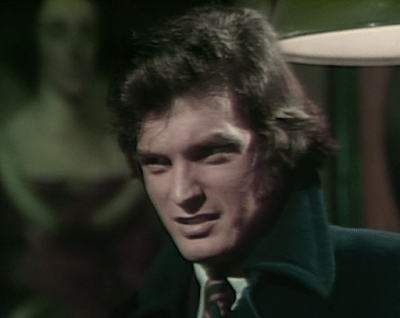
For the last eleven weeks, the A story on Dark Shadows has been about the Leviathan People, a mysterious race of Elder Gods who are trying to retake the Earth from humanity by enlisting a few people in central Maine into a secret cult and saddling them with responsibility for an ungovernable monster. The cultists have agreed to go along with the monster’s murders and other acts of physical violence, but drew the line when he asked them to call him “Jabe.” He answers to “Jeb” now.
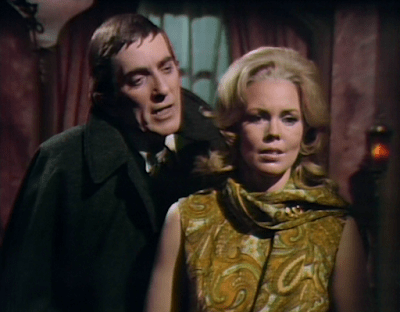
The Leviathans chose old world gentleman Barnabas Collins as the first leader of the cult. This put him at odds with his longtime best friend, mad scientist Julia Hoffman. Now Barnabas has become disaffected from the cult, and he and Julia bring each other up to date on recent developments.
Julia and Barnabas’ conversation frames a series of clips, two of them selected from episode #884 and fulfilling Dan Curtis Productions contractual obligations to feature Roger Davis and Kathryn Leigh Scott in a certain number of episodes. There is also a newly produced clip of Barnabas’ induction into the Leviathan cult, in which a hooded figure named Oberon explains the terms and conditions of membership. When we first saw Oberon, the part of his scalp we could see was completely bald, but he has a tuft of hair growing there now. His part today is so dull that you can’t very well blame actor Peter Lombard for refusing to shave his head for it.
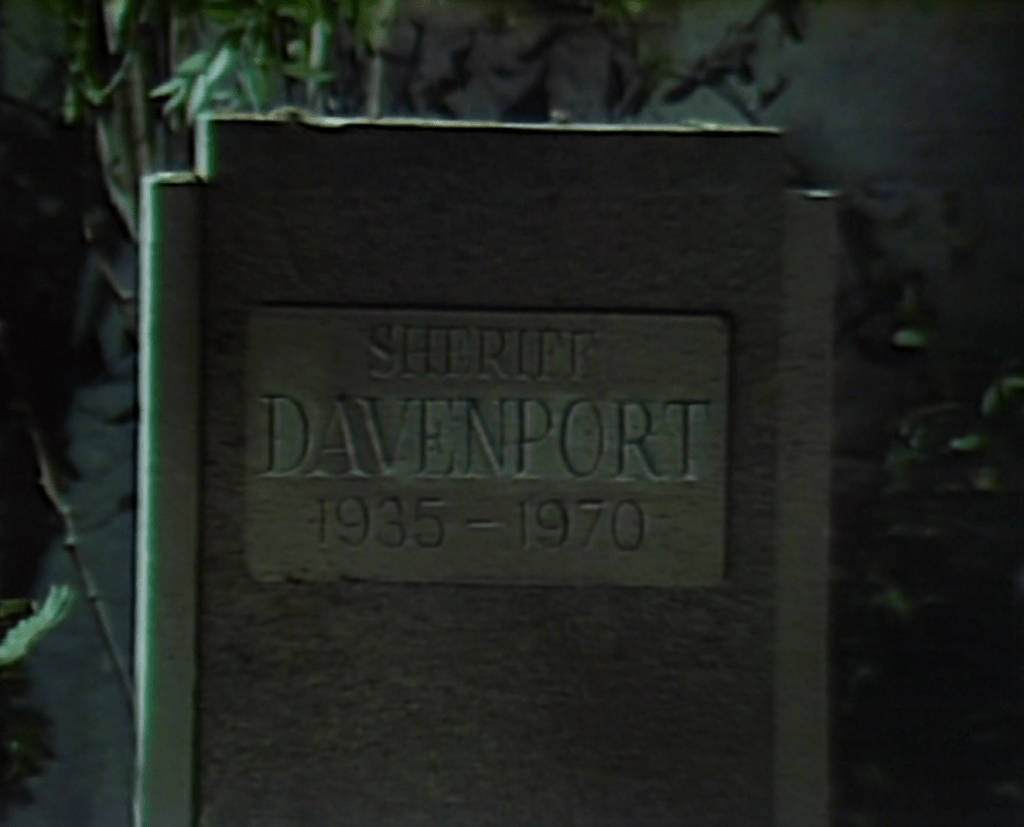
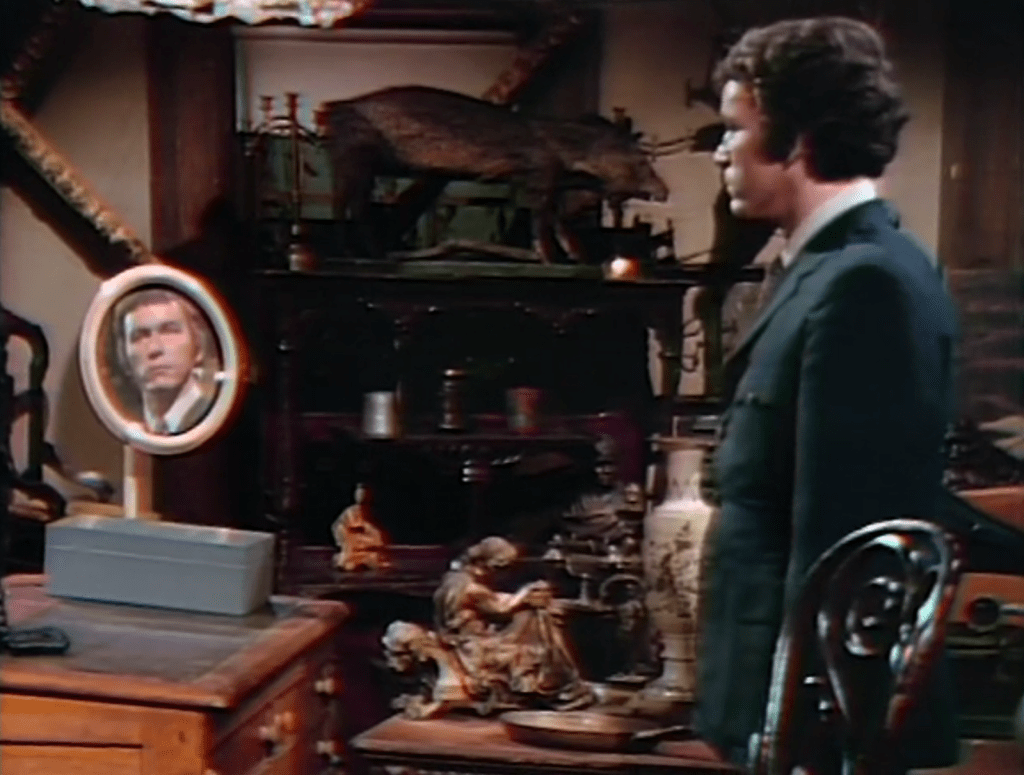
There is also some new information at the end of the episode. Barnabas says that Jabe can raise the corpses of those he has killed and use them as “an Army of the Dead.” We cut to a new grave with a marker reading “Sheriff Davenport.” The other day Jabe killed a law enforcement officer named Davenport; Davenport appeared to be the sheriff of Collinsport, but it turns out “Sheriff” was simply his first name. Sheriff’s hand bursts out of the soil.
I watched the closing credits, wondering if today would be the day they finally acknowledged the videotape editors. It’s due- there have been several obvious cuts over the last few weeks. But they are still toiling in anonymity.
A monster from beyond space and time has taken the form of a vicious man-child and asked people to call it “Jabe.” A cult devoted to the Leviathan People, mysterious Elder Gods who brought the monster to Earth, have decided to put up with its murders and depredations, but even they draw the line at calling the monster “Jabe.” It answers to “Jeb” instead.
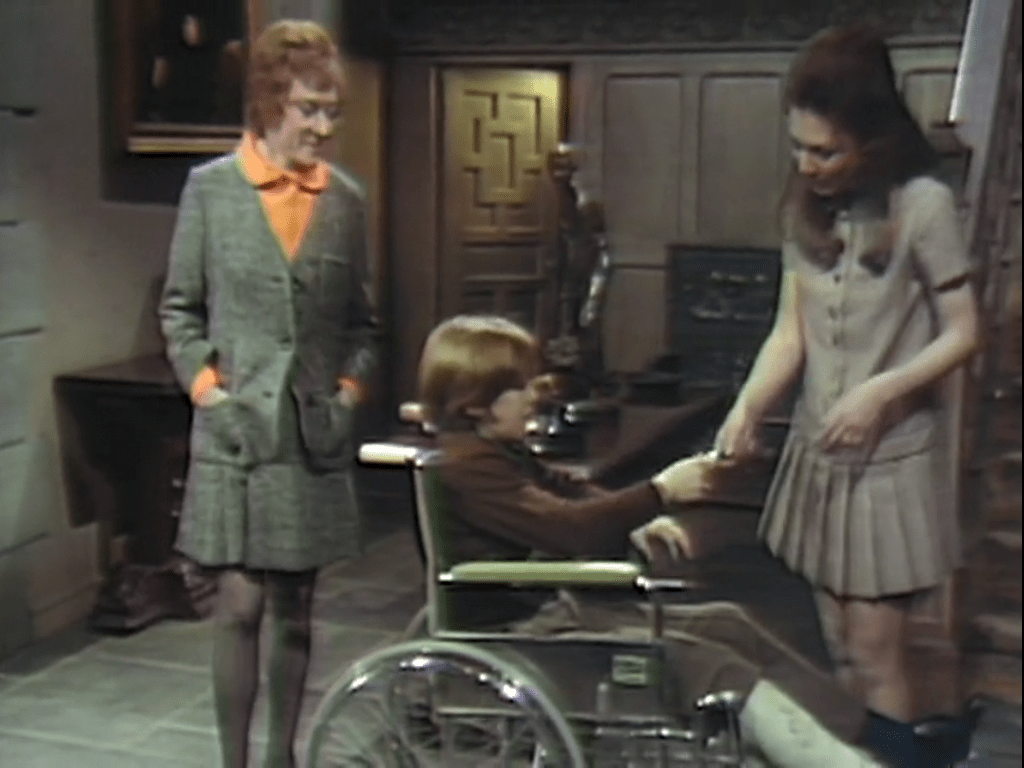
Jabe’s latest pointless act of cruelty was to break the leg of one of his faithful servants, thirteen year old David Collins. A couple of times today, Jabe is about to explain why he broke David’s leg, and each time they cut away to some other scene. At one point we cut back to Jabe telling David that “Now you know why I had to do that, don’t you?,” to which David agrees that he does. That just lampshades the fact that the writers couldn’t come up with a reason.
David wants Maggie to be the first to sign his cast.
The actual reason David Collins is wearing a cast and using a wheelchair is that actor David Henesy took a nasty spill on the ice. And since Jabe’s untrammeled violence is the big menace on the show right now, it makes sense that they would have him be at fault. It certainly makes more sense than does the fact that the family insists on David climbing the stairs to his bedroom with crutches, when they have a whole disused wing of servants’ bedrooms on the first floor in any one of which he could stay while he recuperates. On the other hand, that insistence does produce a moment of real hilarity. The instant David begins his ascent, governess Maggie Evans (Kathryn Leigh Scott) and permanent houseguest Julia Hoffman start talking as if he weren’t there. He must be lumbering up the stairs a couple of feet from them the whole time they are carrying on this conversation.
For his part, Jabe doesn’t generate any laughs. Nor is he pursuing any goals that lead us to wonder what he will do next. We just know that if he has a chance to do something nasty, he’ll probably take it.
If they want Jabe to be a character in whom we take an interest, they ought to give him some kind of cockamamie motivation that is intelligible only to him. That’s what they did in 1967, when vampire Barnabas Collins held Maggie prisoner and tortured her. They showed us that Barnabas thought he was going to turn Maggie into his lost love Josette. That idea, borrowed from the 1932 film The Mummy, was so utterly bonkers the show eventually decided to run with it, casting Miss Scott as Josette when they went back in time to explain how Barnabas became a vampire. Meanwhile, the ever-mounting zaniness kept viewers tuning in, wondering if they would ever expose a layer of Barnabas’ psychology that was composed of something other than nonsense.
The opening voiceover today labels Jabe “evil”; that’s no problem, all the most popular characters, including David, started off as appallingly evil, and they have retained their popularity to the extent that they stayed in touch with their roots. But Jabe is not only evil, he is monotonous, and that makes him a deadly threat to the show’s entertainment value.
Barnabas is not currently subject to the effects of the vampire curse, and Julia long ago used her powers as a mad scientist to erase Maggie’s memory of his crimes against her. Barnabas was the original leader of the Leviathan cult, but has become disaffected. Jabe tells Barnabas today that he wants to kill just about everyone at Collinwood, including ten year old Amy Jennings, who is a faithful member of the cult. He also wants to marry heiress Carolyn Collins Stoddard. Barnabas goes to Collinwood and warns Maggie that Carolyn is in danger. He asks her to keep an eye on Carolyn and to urge her to go away. He does not mention Amy. At least Amy’s name comes up in this episode- when she is on camera she is often the best thing in the show, but throughout her long absences she usually goes unmentioned.
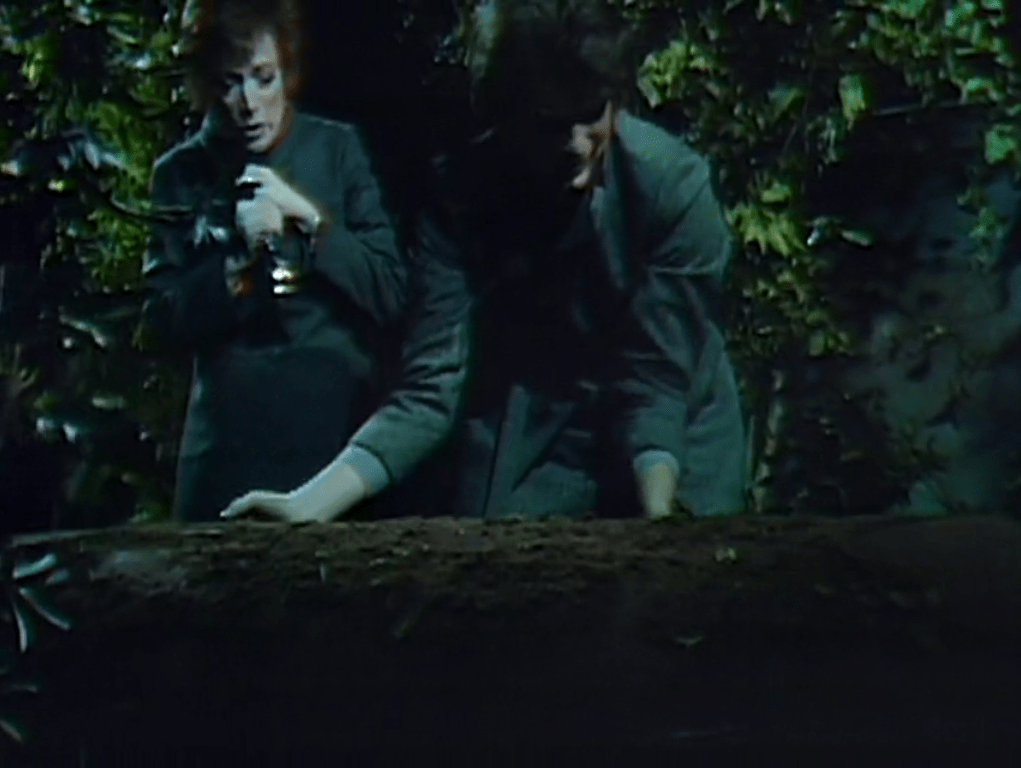
Julia goes to Amy’s great-grandfather, centenarian Quentin Collins, who has recently returned to Collinsport after an absence of many decades and who, because of a series of spells that were cast on him, looks like he is not quite 29 years old. Julia recruits Quentin to dig up the grave of Michael Hackett, Jabe’s previous incarnation. This gives us the first exhumation scene on Dark Shadows since, if I recall correctly, #820. It’s the longest the show has gone without digging up a coffin since the first exhumation scene, in #179. It feels like a homecoming when Quentin sticks his shovel in the plot. Of course they find an empty coffin.
As is usual when digging up a coffin, Quentin wears a three-piece suit with dress shoes, none of which is smudged in the process. Less typically, his coat appears to be somewhat wrinkled.
Afterward, Julia confronts Barnabas. When she tells him how much she already knows, he gives in and says he will tell her everything. With that, we have the promise that Barnabas and Julia will resume the partnership that has been the single most dynamic narrative element on Dark Shadows.
The Leviathan People, a mysterious race of Elder Gods, are planning to retake the Earth from humankind. They’ve started small, putting together a secret cult of devotees in and around the village of Collinsport, Maine, and placing a rapidly growing creature in a room above an antique shop there. Now the creature has taken the form of a 24 year old man, murdered a couple of people, and lost interest in the plan. All he wants is his intended bride, heiress Carolyn Collins Stoddard, and he wants her by Friday. Since she does not know the creature and is in mourning for her father Paul Stoddard, whom the creature murdered a couple of days ago, he would seem to have put some obstacles in his own way.
When he is in human form, the creature calls himself Jabez Hawkes. When we first saw him, he told people to “Call me Jabe.” Everyone called him Jeb instead. “Jabe” is such an unusual name, and the creature is so obnoxious and uninteresting, that it is understandable they would disregard his wishes in this matter, but I believe in calling people by the names they choose, so I’ll call him Jabe.
The Leviathan story has so far been pitched to an adult audience far more heavily than most segments of Dark Shadows, and today’s episode is a case in point. Carolyn’s family gathers in the foyer of the great house of Collinwood, ready to depart for Paul’s funeral. They have a big scene where Carolyn gets upset with her mother and uncle because they didn’t like Paul, and the bad feelings flare up again after the funeral, when they are at the graveside. That’s typical fare for soap operas meant for grownups, but we’ve never seen anything like it before on Dark Shadows, where graves are less often places of mourning than targets for robbing.
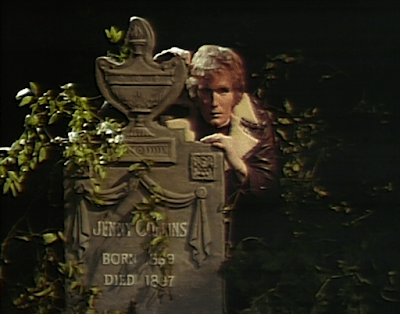
Jabe spies on Carolyn from behind the tombstone of Crazy Jenny Collins. For most of 1969, Dark Shadows was a costume drama set in 1897. Marie Wallace played Crazy Jenny then. Since the show returned to contemporary dress, Miss Wallace has been Megan Todd, fanatically devoted Leviathan cultist and foster mother to the creature now known as Jabe. They’ve had some fun depicting an erotic dimension to the relationship between Megan and the creature; Jabe clings to the tombstone suggestively, echoing this hint of Oedipal tension.
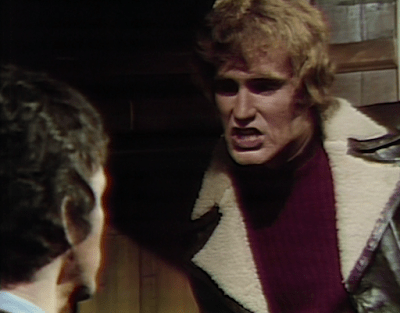
Carolyn goes to the antique shop to leave a note thanking Megan and her husband Philip for attending the funeral. Jabe sneaks up behind her and puts his hands over her eyes by way of introduction. You might think that Jabe, being just a couple of months old, would be ignorant enough to expect Carolyn to be charmed by this invasion of her space. But he pulled the same stunt on her when he was in the form of a thirteen year old boy, and she objected to it fiercely then. When she reacts just as negatively now, it leaves regular viewers with the sense that Jabe is going to keep doing the same pointless things over and again, not learning anything from his experiences. By the end of the scene she is showing some signs of attraction for Jabe, but she’s the only one. They haven’t given the audience any reason to expect him to be worth watching.
Later, Jabe tells old world gentleman Barnabas Collins that when the time comes, all members of the Leviathan cult will share his shape-shifting abilities, that “each one of you will be able to take on any form.” We know that Jabe is sometimes an inhuman monster, and that he once assumed the form of Carolyn as she was when she was eight, but this is our first confirmation that he can turn into anything he wants. It is also the first suggestion that the Leviathans’ human accomplices will receive any benefits at all from their triumph.
Sheriff Davenport and his new sidekick, mad scientist Julia Hoffman, have come to the top of the stairs above Philip and Megan Todd’s antique shop in the village of Collinsport. The sheriff has a search warrant that specifies the room by the landing as a place of interest in connection with the violent death of one Paul Stoddard. Philip begs the sheriff not to enter the room, saying that a boy who lived there recently died and that any disturbance would “defile” it. He swears the room is entirely empty. The sheriff expresses his sympathy, but opens the door anyway.
Inside is a young man. Philip seems as surprised at the sight of him as are the sheriff and Julia. He gives his name as “Hawkes, Jeb Hawkes. Short for Jabez… Call me Jabe.” No one calls him Jabe, which seems a bit rude. Jabe claims that he came by earlier when Megan was in and Philip was out, and that she offered to let him live in the room.
The room does not contain any furniture, any luggage, or any other movable property whatsoever. Moreover, while it is possible Megan might have rented the room without mentioning it to Philip, it is difficult to see what Jabe has been doing up there since she left, and since Philip has been moving around the rest of the building it is even more difficult to suppose Jabe could have left his belongings elsewhere without attracting Philip’s notice. Jabe claims to be a photographer, but does not appear to have any camera equipment. Moreover, the sheriff will later tell Julia that he noticed a distinctive odor on Jabe that was prominent on Paul’s corpse, and that he found one of Paul’s cufflinks, damaged as by fire, on the floor of the antique shop. In the finest traditions of Collinsport law enforcement, the sheriff does not take Jabe or Philip into custody, question either of them more than cursorily, or close off the antique shop for a further search. He does come back later to tell Jabe that he should think about finding another apartment.
Jabe is the latest embodiment of a mysterious creature that has previously taken the form of a newborn boy, an eight year old boy, an eight year old girl, and a thirteen year old boy. The boys were vicious little tyrants who did not seem to think at all, only to follow impulses to dominate and humiliate whomever they met. The girl was a Doppelgänger of Paul’s daughter Carolyn as she was when she was eight, and she existed specifically to make Paul feel worthless because he was a deadbeat dad. None of these children engaged with another character in a way that meant there was anything at stake for them in any scene. They as much as tell us that the same will be true of Jabe. When Philip complains today that he has put him and Megan in a difficult position by failing to tell them of his plans, Jabe answers “Maybe I just didn’t want to let you know. Maybe I just wanted to see you sweat it out.”
The only time one of the children did anything surprising in an effort to take on an adversary was when the eight year old boy shape-shifted and became the young Carolyn. Had the sheriff not shown the clownish ineptitude typical of his office, but instead done what a real cop would do and arrested Jabe and Philip, they might have created a situation in which Jabe would have to surprise us again. It might be interesting to see him turn into the grown-up Carolyn, for example. As it is, Jabe just insults Philip, goes to the police station, and murders the sheriff.
This puts a new spin on Roger Ebert’s category of “Idiot Plot.” Ebert said that a movie had an Idiot Plot when its story would end immediately if any of the characters had the brains of an average member of the audience. In this case, the story stays stuck in an angry and utterly predictable rut because of the sheriff’s inexplicable nonfeasance.
The first time Mrs Acilius and I watched Dark Shadows through, we hated Jabe and didn’t want to see Christopher Pennock again. Later, Pennock will return in several quite different roles, each of them more appealing than the one before. By the end of the series he had become one of our favorites, and it occurred to us that even as Jabe he managed to do a lot of things right. But there is only so much an actor can do to work around a script problem, and as written Jabe is barely a character at all. His actions cause problems for several other people, but nothing we see him do or hear him say makes us care about why he takes those actions as opposed to any others. It certainly doesn’t help that half of his episodes, including this one, are directed by Henry Kaplan, whose idea of visual composition was to shove a camera so close to an actor’s face that you can see about one half of one cheekbone.
It didn’t have to be that way. Not only was Pennock a fine actor when he had something to work with, but in this episode we have a scene between Julia and rakish libertine Quentin Collins that shows how a character with a bizarre backstory and a record of evil deeds can become an audience favorite. Quentin is down in the dumps because he just failed to rescue his one true love, Amanda Harris, from the realm of the dead. Julia urges him to reconnect with the Collinses of Collinwood. He asks how he can possibly explain that he is 72 years older than he looks and is now alive, even though his ghost carried out a protracted and deadly haunting of the estate. This dialogue shows that Quentin’s origins require us to believe any number of impossible things, and longtime viewers remember that he is a murderer who killed his wife in cold blood, among other unspeakable acts. But all we see in this scene are his charm and the affection that he and Julia have for each other, and we want to see more of that, as much as they can give us. With similar material, Pennock could have achieved similar results. But it is already clear that he won’t get it as Jabe.
Postscript
In his scene with Julia, Quentin says that no one at the hotel where he and Amanda have been staying remembers her, and that all traces of the alias she had been using seem to have disappeared. Julia speculates that when he lost her in the underworld, the last 72 years of Amanda’s life were negated, that the past was reset so that she did in fact die on a night in the 1890s when she might have died had one of the gods of the dead not intervened.
This raises two questions. First, Amanda has been keeping Quentin. If they are now in a timeline where she never came to town, who’s paying his hotel bill and buying his liquor? It’s a standard feature of soap operas that unless they are telling a story about conflicts over ownership of a business or a house or some other valuable property, everyone just has an inexhaustible supply of money, but they put enough time into Amanda and Julia’s squabble as to which one of them would be Quentin’s sugar mama that you might have expected a line or two about this question.
Second, if everyone else has forgotten Amanda, how does Julia remember her? Quentin journeyed through the infernal regions with her, and so I suppose it makes a kind of sense that from that supernatural location he would have a perspective that would transcend our perception of time and space. But Julia was in and around Collinsport the whole time Quentin and Amanda were harrowing the abode of the permanently unavailable. I suppose the real answer is that she is the audience’s point of view character, and as such knows everything we know. But it does leave us wondering if, in the course of her adventures, some kind of uncanny power may have rubbed off on her.
We open with a reprise of the end of yesterday’s episode. Quentin Collins and Amanda Harris are reenacting the myth of Orpheus and Eurydice. As in the ancient Greek story, they will live together if they can escape all the perils on the road from the realm of the dead to that of the living. Unlike that story, they are allowed to look at each other along the way, but they are not allowed to touch.
The teaser ends where Wednesday’s episode ended, with Amanda falling through a gap in a footbridge and Quentin crying out in anguish. After the opening title, we are surprised to find ourselves at the same scene. Amanda is not yet lost. Quentin pulls her up from the ravine she fell into. But that involves touch, so the ceiling of the cavern collapses and buries her. Suddenly, Quentin finds himself lying on the ground, in the upper world, with no sign of any way back to the place from which he just came.
Amanda’s demise marks Donna McKechnie’s final appearance on Dark Shadows. Miss McKechnie left to be in the original cast of Stephen Sondheim’s Company, paving the way for her enormous success on Broadway in the 1970s. Much later, Miss McKechnie would reprise the role of Amanda in a couple of Big Finish Productions’ Dark Shadows audio dramas, and nowadays she appears at the Dark Shadows conventions.
Any account of Donna McKechnie’s last day at 433 West 53rd Street would be incomplete without this story from Hamrick and Jamison’s book Barnabas and Company:
In rehearsal, we went through the scene with a few Styrofoam boulders and a little peat moss, no big deal. Nobody told me there was going to be ten times as much dropped during the taping. So, when it was time to tape the scene, I was looking up, and I just got buried. I got peat moss in my eyes and in my mouth and ears and nose… and I was covered in rocks. The way things worked at the studio, at the end of that scene, the lights went out, and the camera and crew and actors all moved on to the next scene, in another part of the studio. So there I was, laying under all those Styrofoam rocks and peat moss, and nobody helped me get out. I had to dig myself out, and that was my last experience on Dark Shadows.
Craig Hamrick and R. J. Jamison, BARNABAS AND COMPANY: THE CAST OF THE TV CLASSIC DARK SHADOWS (2nd edition, 2012) page 245.
They’ve been doing a bit of videotape editing recently, as several awkward cuts have made clear. One might think that the whole Underworld sequence, pre- and post-title, was edited in from tape left over from yesterday’s shoot. But Miss McKechnie’s story proves that is not so. The episodes were done in sequence, so if the last bit of tape they shot yesterday had been the crushing of Amanda there wouldn’t have been any next scene to run off to and Miss McKechnie would have had plenty of help digging herself out from under.
Some Sort of Monster was After Him
Meanwhile, the sheriff is at the home of occult expert Timothy Eliot Stokes. Stokes and his friend, mad scientist Julia Hoffman, have called him in because a monster wrecked Stokes’ bedroom, in the process killing a man named Paul Stoddard.
No law enforcement officer on Dark Shadows has yet solved a case, and Sheriff Davenport seems likely to prove the most useless member of the fraternity yet. At no point does he interrogate Stokes and Julia, or even show much interest in what they were doing while Paul was being killed. He refuses to believe Julia when she says that he should be looking for a monster, even though Collinsport has been overrun with monsters for years now and he has acknowledged that the wreckage at Stokes’ is like nothing he has ever seen. Julia tells him that the monster lives in the room at the top of the stairs in the antique shop operated by Megan and Philip Todd. In response, he flatly states that “They wouldn’t have anything to do with his death.” He finally agrees to get a search warrant for the Todds’ place, but when he presents it to Philip he says that he will execute it “unless of course, you don’t want me to?”
The meatiest part of the episode is a long scene between Megan and Philip. She is exultant that the monster has killed Paul and certain that it will go on to do other, even more wonderful things. He’s scared to death of what the monster will do to them if it is not defeated and of the retribution that will come to them if it is. She sneers at him as a coward. He admits that he is a coward, but insists that they run away and count themselves fortunate if they can escape with their lives.
In her first role on Dark Shadows, as Eve, The Fiancée of Frankenstein, Marie Wallace was called upon to show an unbending, unvarying contempt for Adam, the patchwork man she was supposed to marry. Since that was the only feeling Eve had ever shown for Adam, it wasn’t very interesting. But Megan loved Philip when we first met them. The other day, when she told the monster that she had loved Philip for a long time, we could believe her. So her scorn today does carry some force, and no one knows better how to play scorn and play it to the hilt than does Miss Wallace.
The part of Philip has not been a particularly congenial one for Christopher Bernau up to this point, but he too excels in the scene. He has lots of lines you would expect a man to find it hard to say, calling himself a coward and so on, but he speaks them smoothly and fluently. He shows his hesitancy and anguish not in his delivery of the lines, but in his facial expressions and movements while Megan is speaking. You can see him deciding to put aside all male ego and say something that might get through to Megan, no matter how humiliating it is for him to say it. With lines proclaiming his cowardice, Bernau creates the image of a remarkably brave Philip.
That in turn makes it possible for the episode to end on a suspenseful note. The closing cliffhanger has Sheriff Davenport turning the doorknob to the monster’s room, while Philip is frenziedly trying to come up with a way to talk him out of entering it. When we watched that, my wife, Mrs Acilius, said to the screen “If you don’t tell him what’s in there, it’s murder,” in a tone that suggested she thought Philip actually might tell the sheriff the truth. That such an idea could even form is a testament to Bernau’s outstanding performance in this episode.
In the middle of The Odyssey, Odysseus and his companions enter a certain cave and follow a path that leads to the realm of the dead. There, Odysseus talks with several people whom he knew when they were alive, then comes back to the upper world. This passage, known in Greek as the νέκυια (nekyia,) led many subsequent epic poets to include journeys to and from the Underworld in their works. In the Aeneid, his Latin language response to the Iliad and the Odyssey, Vergil put Aeneas’ voyage to the Underworld in the same halfway spot where the nekyia stands in the Odyssey. The words of warning the Cumaean Sibyl speaks when she gives Aeneas directions to reach the Underworld by way of a path leading through the crater in Mount Avernus are quite famous:
Facilis descensus Averno: Noctes atque dies patet atri ianua Ditis; Sed revocare gradum superasque evadere ad auras, Hoc opus, hic labor est.
The road down through Avernus is easy.
The doors of dark Dis lie open by day and by night.
But to reverse your stride and escape to the air above,
This is the achievement, this is the feat.
(Vergil, Aeneid 6:126-129, my translation.)
It wasn’t only warrior princes like Odysseus and Aeneas who had to go to the realm of the dead and back in the mythology of the ancient Mediterranean. The legendary poet Orpheus was so disconsolate when his wife Eurydice died that he journeyed to the Underworld to plead with the gods of the dead to let him take her back with him. As Ovid tells the story in Book 10 of his Metamorphoses, Orpheus made his case in a song that was so beautiful that the whole pantheon of deities who dwell among the ghosts of humans wept. Their chief, known by a long list of names including Pluto, Dis, and Hades, was no exception. Through his tears, he agreed to release Eurydice. But the god knew his business too well not to make conditions. First, Orpheus and Eurydice would have to take the hard and treacherous road that separates the shades of the dead from the world of the living. Second, they would have to complete the whole journey without once looking at each other.
They made it through all the ruggedness and the many snares. At the moment Orpheus felt the warmth of the sun on his cheeks once more, he became so excited that he forgot everything. He turned his head to face Eurydice and exclaim that they had succeeded. But she was still in the shadows. He saw only her silhouetted figure, and that only for an instant. She shrank from him at impossible speed, disappearing forever into the darkness of death.
Dark Shadows steals from every writer, sooner or later, and they’ve stolen a woman named Amanda Harris from a story that comes later in Book 10 of Ovid’s Metamorphoses. A sculptor named Pygmalion was a sour misogynist, who sought a substitute for the companionship of the real live women he so disliked by making a statue of a woman he thought he could get along with. Much to his surprise, the statue came to life and they fell in love, more or less.
In 1969, we learned that an artist named Charles Delaware Tate, who was every bit as unpleasant a person as Ovid’s Pygmalion, had painted a portrait of an imaginary woman and that, because of some magic powers Tate was unaware he had, that woman had popped into existence and started calling herself Amanda Harris. It was a couple of years after her inception that Amanda met Tate. Unlike Pygmalion’s statue, Amanda was as repulsed by her creator as one would expect her to be. Instead, she fell in love with the boundlessly charming, albeit none too admirable, Quentin Collins.
Now Amanda has died, and Quentin is willing to do anything to be reunited with her. A god of death named Mr Best has offered him a sporting proposition. If he and Amanda can walk the whole of the hard and treacherous road that separates the shades of the dead from the world of the living without once touching each other, they can share an eternal life. But if they do touch, or if either of them falls victim to one of the many traps along the way, they will be separated forever.
Their journey almost ends before it begins. Amanda sees Quentin looking out the door that opens on the road home, and reaches out to touch him. At the last second he tells her not to, explaining the conditions Mr Best had laid down. They set out. Along the way, Amanda is caught in a giant web where she is menaced by a giant spider, twists her ankle when she trips over some rocks, has to walk over a rickety rope bridge, and experiences a series of phobic reactions. She is just about to make it when, not looking down lest her fear of heights get the better of her, she puts her foot through a gap in the rope bridge and falls into oblivion.
It’s unclear what this will mean for Quentin. He has no direct connection to any other unresolved story, and while there are characters who care about him he isn’t particularly interested in having anything to do with them. He has been one of the show’s great breakout stars, second only to Jonathan Frid as occasional vampire Barnabas Collins, so it is hard to believe they won’t come up with something new for him to do, but it is not at all clear what that might be.
Book 10 of Ovid’s Metamorphoses does not seem like it will be very helpful. When Orpheus loses Eurydice, he can no longer stand the sight of any other woman, so to pass the time he invents male homosexuality. He has great success popularizing his invention throughout his homeland of Thrace. When the Thracian women find that many of their menfolk have lost interest in them, they signal their displeasure by killing Orpheus. I very much doubt that the American Broadcasting Company’s office of Standards and Practices would have been too happy at the idea of dramatizing that story five days a week at 4 PM in 1970. Besides, Dark Shadows has been so antiseptically sexless that the women of Collinsport wouldn’t be any worse off if the men devoted all their eroticism to each other, so you couldn’t use that ending.
The Orpheus and Eurydice story only takes up half of today’s episode. The rest recounts the final hours of the life of Mr Paul Stoddard. Paul has found out that a group of people in and around the village of Collinsport are in the service of invisible supernatural beings known as the Leviathans. Earlier this week he encountered a nonhuman creature that is central to the Leviathan cult. Contact with the creature caused his clothes to rot and stink and left him dazed and unable to speak.
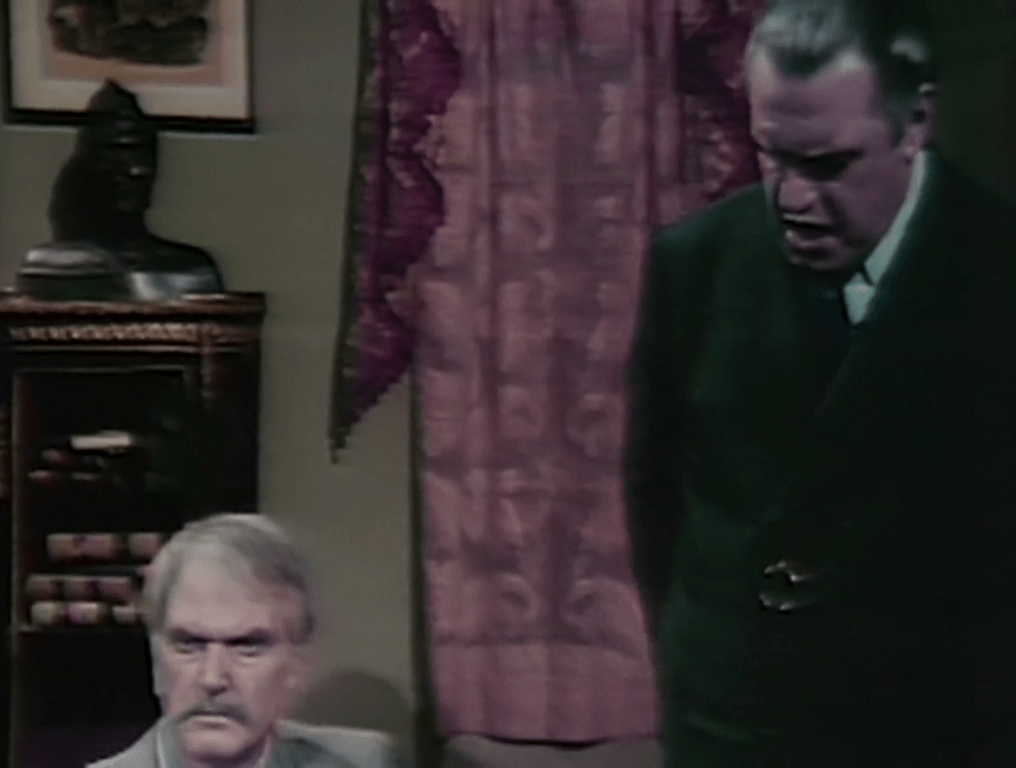
Paul is currently sitting and staring into space in the apartment of Professor Timothy Eliot Stokes, expert on the occult. When we cut to Stokes’ apartment from Quentin and Amanda on the way back to the world of the living, we see a bust of the poet Dante, reminding us that Christian poets followed ancient pagans in writing epics about visits to the realms of the dead. It also suggests that Quentin’s experience in Mr Best’s domain may give him some knowledge or power that will allow him to join Stokes and mad scientist Julia Hoffman in their battle against the Leviathans.
Dante watches over Paul and Stokes.
Stokes tries to get Paul to tell him what happened when he encountered the creature, but he will neither speak nor move. Stokes leaves the room for a moment, and Paul gets up to call the police. Stokes stops him doing that, for some reason. Paul runs to Stokes’ bedroom and locks himself in. Julia enters, and they try to persuade him to come out. Julia pretends to call the sheriff. A loud noise comes from the room, and Paul comes reeling out. He falls down and dies. Stokes reports that the room is entirely destroyed. Its ruins are covered with a slime that emits an unbearable stench. In a mild tone, he adds that perhaps it might now be a good idea to call the police after all.
This episode marks the final appearance of Dennis Patrick on Dark Shadows. We will see an extraordinary still photograph of Paul in #953, but the actor is gone. Patrick left to produce and appear in the movie Joe, which was quite an event in its day. Patrick got out of his contract by offering to punch Dan Curtis in the face; evidently Curtis didn’t take offer that too seriously, because he gave Patrick a small part in the feature film House of Dark Shadows later in 1970.
For most of 1969, Dark Shadows was a costume drama set in the year 1897. Among the characters we got to know were Quentin Collins, Charles Delaware Tate, Count Petofi, and Amanda Harris. Quentin was a rakish libertine and occasional murderer who was cursed to be a werewolf. Tate was an artist. Petofi was a sorcerer who had, for reasons of his own, given Tate the power to paint portraits with magical effects. Tate painted a portrait of Quentin that cured him of the effects both of lycanthropy and of aging. He painted a portrait of an imaginary woman, and she popped into being and became Amanda.
The story of Quentin’s portrait is borrowed from Oscar Wilde’s 1895 novel The Picture of Dorian Gray. The story of Amanda is borrowed from the story of Pygmalion and Galatea that Ovid told in Book 10 of his Metamorphoses. While Pygmalion’s statue of the ideal woman loved him when it came to life, Amanda can’t stand Tate. That’s understandable; like all characters played by Roger Davis, Tate had an intolerable personality. Amanda fell in love with Quentin, who is cruel and evil, but very charming.
Now it is 1970. Quentin has come back to the village of Collinsport, still young and handsome, but suffering from amnesia and unwilling to believe that he is a hundred years old. Amanda is back too. She is also young, not because of the painting, but because a god of death named Mr Best gave her several decades to reconnect with Quentin, get him to say he loves her, and then live with him ever after, perhaps happily.
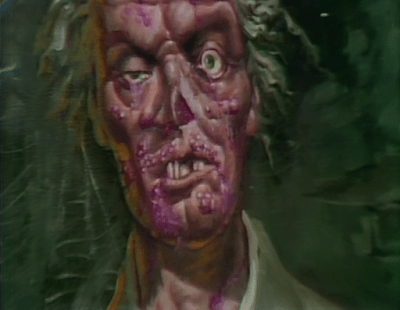
Mad scientist Julia Hoffman has been working with Amanda to restore Quentin’s memory. Julia, Amanda, and Quentin go to see Quentin’s portrait, which Julia has just had restored. It is suitably gruesome, and Amanda runs out screaming when she sees it. But Quentin examines it, and his memory comes back to him. Julia tells him about Amanda’s deal, and says that Mr Best is on his way. He could catch up with Amanda at any time. Quentin runs out to tell Amanda that he loves her, but gets to the scene a moment too late.
Quentin’s portrait, a face only a fan of EC Comics could love. Screenshot by Dark Shadows Before I Die.
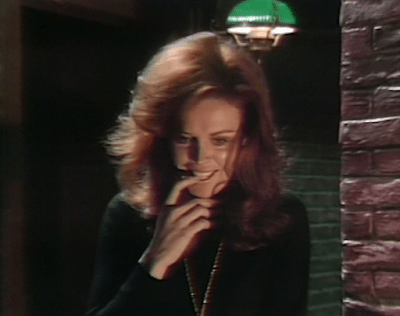
Mr Best takes Amanda to a hotel lobby. She described this lobby to Julia in #922 when she explained her arrangement with Mr Best, but he has to explain it to her today. In #922 he called it “The Stopping-Off Place”; today he calls it “A Passing-Through Place.” He excuses himself, since he has other souls to harvest.
Amanda is alone for a moment with a bellhop in a white costume with an accent that is supposed to be sort of Cockney, or perhaps Australian. The bellhop makes it clear that he used to be alive, and that his current job makes him nostalgic for his days as a human. When he mentions things he can’t do anymore, he looks Amanda up and down for a half second. The wistfulness of his tone, the frankness of his look, and the sadness with which he turns away from her leaves no doubt what he misses. It’s a surprisingly lovely moment, and a much more adult one than we expect from the show at this point.
Back in the land of the living, Quentin and Julia have a scene in Amanda’s suite at the Collinsport Inn. Julia leaves, and Quentin tries to kill himself. Mr Best stops him. He tells him that he knows he is alive “by courtesy of Count Petofi”; this is the first time we have heard Petofi’s name since the show came back from 1897, and the first vague hint that Petofi might have survived the fire that appeared to have killed him in #884. He says that it is not Quentin’s time to die.
Quentin says he doesn’t want to live without Amanda, and Mr Best gets a bright idea. He says he likes experiments, and he has one he will run with the two of them. He takes Quentin to The Stopping Off/ A Passing-Through Place. He explains his idea. As befits Amanda, it is derived from the tale of Orpheus and Eurydice which Ovid tells earlier in Book 10 of the Metamorphoses. As Orpheus was allowed to bring his wife Eurydice back from the realm of the dead so long as they could make the long, arduous journey without looking at each other, so Quentin will be allowed to bring Amanda back so long as they do not touch each other until they return to the sunlight. The episode ends with Quentin deep in thought about this proposition while Amanda walks up behind him, stretching her hand towards him.
Mr Best tells Quentin that if he and Amanda can make their way through the countless traps and perils of the journey back to the upper world, they will be together “for eternity- whatever that means.” It’s intriguing he doesn’t know- he explicitly identifies himself as an immortal being today, and he has such a wide range of discretion that he can only be called a god. Apparently writer Sam Hall is imagining a cosmos where even the gods are left guessing about the answers to the big questions.
The story of Orpheus and Eurydice has long been a popular favorite. In the 1960s, Jean Cocteau’s 1950 Orphée and the 1959 Brazilian hit Black Orpheus were both staples of art cinema and would have been familiar to NYC theater people like the makers of Dark Shadows, so it is hardly surprising that when they start looking to classical antiquity as a source of material that was one of the first stories to come to mind.
This is Emory Bass’ final appearance as Mr Best, and Brian Sturdivant’s only appearance as the bellboy from Hell. Each will return in another small part later this year.
The closing credits roll over an image of Quentin’s portrait. Most of them do, anyway. Sturdivant’s was cut into the middle of the roll over a black background. Apparently they forgot about him until the last minute.
Some invisible Elder Gods known as the Leviathans have taken control of a group of individuals in and around the area of Collinsport, Maine and formed them into a cult serving their plan to reclaim the Earth. Confusingly enough, the cultists are also known as Leviathans.
In 1949, deadbeat dad Paul Stoddard was leaving his family. On his way out of town, he stopped in a bar, where he ran into a Leviathan (whether one of the mortal or supernatural variety is never explained.) This being tricked Paul into selling his infant daughter Carolyn to the Leviathans. Late in 1969, Paul came back to town, where the leader of the new cult, old world gentleman Barnabas Collins, explained to him what he had done that night twenty years before. Since the deal was already made, it is unclear why Paul had to come back to Collinsport, why he had to be told what he had done, and why Barnabas had to be a big jerk to him about it.
Paul has been trying to warn people that something terrible is happening, and Barnabas has become disaffected from the cult. The Leviathans are based on concepts H. P. Lovecraft developed in his tales of cosmic horror, and the specific Lovecraft story from which they have been drawing most heavily is The Dunwich Horror. In that one, what appeared to be a rapidly-growing, unaccountably precocious boy named Wilbur Whateley turned out to be one half of an unearthly creature of vast destructive power. Their Wilbur analogue has been a series of children who live in the antique shop that cultists Megan and Philip Todd own. There is a room above the shop where the creature takes its true, invisible form. Yesterday Barnabas helped Paul escape from captivity, and Paul went directly to the shop where he let himself into the upstairs room. Barnabas and the Todds got Paul out of the room and locked him in the prison cell in the antique shop’s basement.* The episode ended with the creature approaching the door of the cell and Paul holding a chair to use as a weapon against it.
Today we open with the creature entering the cell. The metal door jumps off its hinges and disappears; the chair flies from Paul’s hands; and Megan looks down from the top of the stairs, a gleeful look on her face as she anticipates Paul’s grisly end.
Danny Horn devotes his post about the episode at his great blog Dark Shadows Every Day to a series of complaints about the invisibility of the creature, claiming that it is unsuitable to have something important on a television show that does not come with striking visuals, but I can’t believe that any monster effect would be as impressive as this sequence. Director Lela Swift really delivers with it.
Barnabas shows up in the nick of time and orders the creature to leave Paul alone. He wrangles it back to its room, then scolds Megan for letting it out. While this is going on, Paul staggers out of the shop.
In the street, Paul meets mad scientist Julia Hoffman. Julia knows that Barnabas is involved in an evil scheme. It is very unlike him to leave her out of those, so she is alarmed. She takes Paul to the apartment of her non-evil friend, occult expert Timothy Eliot Stokes.
Stokes and Julia comment on Paul’s appearance. His clothes are rotting away, as if they had been dipped in acid, and something is on him that emits a strong odor. This is a nod to The Dunwich Horror, in which the Elder Gods cannot be seen, but boy oh boy can they be smelled. “As a foulness you shall know them,” goes the refrain. Paul is in terrible shape and can’t talk. Julia vetoes Stokes’ suggestion that they call the police, and even after she notices Paul’s blood pressure dropping she does not suggest taking him to the hospital.
Stokes then shifts Julia’s attention to the B-story. He tells her that a friend of his is just about finished removing an overpainting from the portrait of Quentin Collins. Julia knows that this portrait, painted in 1897, freed Quentin of the effects both of the werewolf curse and of aging. Like the picture of Dorian Gray, it changes while Quentin himself remains the same. Quentin is back in town now, but he has amnesia. Julia believes that showing the portrait to him will jolt his memory back into place.
Julia lives as a permanent houseguest on the estate of Collinwood. We cut there, and see a woman named Amanda Harris pacing nervously in the foyer of the great house. Amanda was Quentin’s girlfriend in 1897, and was in that year granted more than 70 years of youth by a supernatural being named Mr Best. Mr Best said she could go on living even beyond that time if she could reunite with Quentin and get him to tell her her loved her. She has reconnected with Quentin, but since he doesn’t remember their past he doesn’t know he is in love with her. For some reason they don’t reveal to the audience she can’t tell him the truth. She has told Julia everything, and they have joined forces. We can assume Amanda is at Collinwood waiting for Julia to come back.
The telephone rings and Amanda answers it. It is Megan asking to speak with Elizabeth Collins Stoddard, owner of Collinwood and a member of the Leviathan cult. Amanda tells her no one is home. Megan asks who she is, and Amanda gives her current alias, Olivia Corey. As Olivia, she is a big star on Broadway, a fact which will be mentioned later today. There is quite a bit of overlap between antique dealers and Broadway fans, especially in the northeastern USA, and Amanda/ Olivia has been in Collinsport long enough that everyone must know she is in town. I try to imagine an antique shop owner in Bar Harbor or Kennebunkport asking a person on the telephone who they were, hearing “I’m Donna McKechnie,” and not getting excited. I suppose Megan’s continued focus on her own problem shows just how profoundly she is committed to the Leviathan cause.
Julia enters, and Amanda tells her that Mr Best will be coming for her in two hours. Julia replies that they must get Quentin to the portrait within that time.
They manage it. Quentin is noisily skeptical about the whole thing. He is frustrated that Julia keeps telling him he’s a hundred years old when he doesn’t look like he’s quite 29 yet, and even more frustrated that Amanda (who introduced herself to him as Olivia, and only today admits that isn’t her original name) won’t tell him when they met before and why she is so interested in him. Several times he threatens to leave the room before Julia can unveil the portrait. When she finally does, Amanda screams and runs out. Quentin reacts with fascinated horror.
Regular viewers, remembering the Dorian Gray bit, would have expected these reactions. If the moon is full enough, it will be the portrait of a wolf wearing an adorable little suit. Otherwise, it will show all the effects of 73 years of dissolute living. In neither case will it look much like the Quentin we know.
*That’s how people tell you they aren’t from Collinsport without saying they aren’t from Collinsport, they get all surprised when basements have prison cells.
The current A-story is about a group of people under the control of the Leviathans, unseen supernatural beings. The Leviathans’ plan involves a mysterious force that has incarnated itself in a series of children, most recently an apparently thirteen year old boy named Michael, and will culminate in the obliteration of the human race. Since all of the actors who are under contract to appear on Dark Shadows are human beings, the success of this plot would leave Dan Curtis on the hook for a lot of buyouts, so we can be fairly sure the Leviathans will eventually fail. Besides, the non-human day players, such as the parakeet we saw in Wednesday’s episode, just haven’t caught on with the public.
Recovering vampire Barnabas Collins was originally the leader of the cultists who serve the Leviathans. Since his introduction in April 1967, Barnabas has been far and away the show’s biggest draw, so it is unlikely he will go down with the ship whenever the Leviathan story ends. Making him the chief villain means that we once more get to see him as he was when he was first on the show, an ice-cold, merciless villain, and also that we are in suspense the whole time as to how and when he will return to the side, not of good exactly, but of sustainable narrative development.
Three weeks ago, they decided to throw all of that away. Episode #915, aired on Monday 29 December 1969, was an homage to Charles Dickens’ A Christmas Carol. As A Christmas Carol begins with Scrooge in his place of business denying a request from his subordinate Bob Cratchit, so #915 began with Barnabas in an antique shop in the village of Collinsport refusing to comply with a demand from Michael, who is currently under his charge. As Marley’s ghost appeared to Scrooge and warned him that he would come to a bad end if he did not become more obliging to Bob Cratchit, so an embodied Leviathan appeared to Barnabas and warned him that he would have to be more deferential to Michael. As Scrooge was visited by spirits representing his past, present, and possible future, so Barnabas is visited by a bat representing his former existence as a vampire, antique shop owner and fanatical Leviathan cultist Megan Todd representing his present, and a woman played by future four-time Academy Award nominee Marsha Mason representing the grim future that awaits him if he does not obey. As Scrooge ends by knuckling under to Marley’s insistence that he become joyous and loving, so Barnabas gives in to the Leviathan’s command that he go on acting on behalf of the plan.
Barnabas’ main activity yesterday was helping Paul Stoddard, who has been trying to warn people about the Leviathan cult, to escape from captivity in the great house of Collinwood, and his main activity today is trying to help Paul after he has sneaked into to the antique shop and come face to face with the mysterious force in its true form. Since his efforts are so completely counterproductive, they might have led viewers who missed #915 to wonder if Barnabas, still loyal to the Leviathans, has deliberately led Paul into a trap, or if he is sincere when he says he wants to help him and is just bungling as he usually does.
They might have, that is, had the show not gone out of its way to ensure it would not create any such suspense. Yesterday’s opening voiceover told us in so many words that the Leviathans were extorting Barnabas’ participation in their plot and that he was “desperate to find a way of stopping the menace.” Today, it tells us that Barnabas “has been forced to do things against his own will” but is trying “to secretly fight back.” As if that weren’t enough, today’s episode also interrupts a conversation between Barnabas and his sometime best friend, mad scientist Julia Hoffman, to give us an interior monologue in which Barnabas tells us exactly what’s on his mind.
Not only do they tell us too much today, they show us too much. Yesterday ended with Paul going into the room where the mysterious force is kept; we closed with a shot zooming in on the terrified expression on his face as he saw this force. We open with a reprise of that scene, which is harmless enough. But after the opening title, we return to the room and see Paul still standing around, still looking terrified. Eventually, Megan, her husband Philip, and Barnabas all come into the room as well and try to figure out how to get Paul out. The four-scene drags on and on, turning a quick moment of horror into a protracted scene of low comedy.
We also see too much of the antique shop itself. Yesterday Philip mentioned to Megan that he was going to add “a bolt” to the door of the room to keep the mysterious force from escaping. That left us free to picture a metal insert as massive as we please. But today we get a clear look at Philip’s handiwork, and it’s one of those little things that you accidentally tear out of the wall if you open the door when you forget it is latched. The mysterious force can’t be all that much of a threat if that bolt is enough to keep it in.
When Barnabas and the Todds finally extract Paul from the room, they take him to the prison cell in the basement of the antique shop. It has been well established by now that all houses in and around the village of Collinsport have prison cells in their basements, and since the Todds live above the shop they wouldn’t be up to code if they didn’t have one. The basement prison cells we’ve seen previously have been sparsely decorated, but this one features a stuffed deer’s head, a kerosene lamp, and several other objects. In that way it fits with the rule for disused spaces on Dark Shadows, which is to cram them with peculiar-looking junk. But since the only way into the cell is through a solid metal door, it would be easy for a prisoner to find a blunt instrument to bean any jailer who might come calling.
Again, this is a matter of showing too much. A person in a cell is already an intriguing visual- we are inclined to examine every detail of their expression, appearance, and attire to see how they got there, how they feel about it, what might happen to them while they are confined, and whether they might get out any time soon. You can add to that interest by juxtaposing them with other people or showing them looking at objects they can’t reach, but heaping up miscellaneous props is at best a distraction.
For the first 55 weeks of Dark Shadows, matriarch Elizabeth Collins Stoddard was under the impression that she had killed her husband Paul and that Paul’s associate Jason McGuire had buried his corpse in the basement of the great house on the estate of Collinwood. She spent nineteen years at home, terrified that if she left the estate someone might find Paul’s grave and hold her to account for his killing. Finally it turned out that she had only stunned Paul. He and Jason had faked his death to trick Liz into giving them a lot of money. Soon, Liz was no longer a recluse and that whole story was forgotten.
Now, Paul has returned. He denies knowing anything about his fake death, claiming that Jason acted alone. Longtime viewers will be skeptical of this claim, and Liz certainly is. But she doesn’t care about it as much as you might expect. She is now part of a secret cult that serves mysterious supernatural forces known as the Leviathan People, who plan to take over the earth, supplanting the human race. Paul has learned that he inadvertently sold Carolyn Collins Stoddard, his daughter with Liz, to the Leviathans, and he has been trying to sound the alarm about them. As a serenely happy devotee of the Leviathan cult, Liz has agreed to keep Paul at Collinwood where she can drug him into immobility.
The power of the Leviathans has taken bodily form in a succession of children who live in an antique shop in the village of Collinsport. The shop’s owners, Megan and Philip Todd, were the first people inducted into the cult by Liz’ distant cousin, old world gentleman Barnabas Collins. The latest manifestation of this being, an apparently thirteen year old boy known as Michael, had been attracting attention that threatened to blow the cult’s cover, so Philip and Megan faked his death. They held a funeral this morning.
Michael is supposed to retire into his room above the antique shop and stay there until he has graduated to his next form. He comes out and tells Megan and Philip that he has decided not to go through with this plan. Philip picks him up and carries him there, putting a new lock on the outside of the door to keep him in until he has gone through another transformation.
Carolyn calls the Todds and extends her mother’s invitation to an evening at Collinwood. They accept.
Unknown to Liz or the Todds, Barnabas has become disaffected from the cult. He visits Paul in his room. He gives Paul clothes and a lot of money and urges him to go far away. Paul doesn’t trust Barnabas, and holds him at gunpoint throughout their entire conversation.
When the Leviathan cult first emerged, its members were siloed off from each other. Barnabas gave Philip and Megan their instructions in dream visitations. When they were awake, they would not recognize him as their leader. They and Liz were not aware of each other’s connection to the cult, though Liz did know that Barnabas was her leader and her nephew David Collins was a fellow cultist. It reminded us of secret operations in the real world, where only people who work with each other directly are allowed to know of their shared allegiance.
Now, all that security is out the window. Liz and the Todds stand around the drawing room at Collinwood having drinks and talking about what Barnabas has and has not told them about the Leviathans and their goals. They do still keep some secrets, however. Liz says that she can’t help but wonder what Carolyn’s role will be in the time to come. Barnabas and the Todds know that she is fated to be the bride of the force currently incarnated as Michael, but they are not allowed to tell Liz this. They look at each other with alarm, and Barnabas gives her some vague and hasty assurances.
There is an unintentionally hilarious moment during the cocktail party scene. Megan is seized by enthusiasm for the Leviathan project, and starts babbling all sorts of portentous phrases about the new world that is taking shape through their efforts. Marie Wallace was one of the most committed exponents of the Dark Shadows house style of acting, which consists largely of delivering your lines so vehemently that you are in constant danger of spraining your back. For her part, while Joan Bennett sometimes played to the balcony as Liz and her other characters, she never really let go of the urbane and relatively understated approach that made her one of the biggest movie stars of the late 1930s. When Liz responds to Megan with the amiable smile and subtly musical voice of a sophisticated society hostess, it all of a sudden strikes regular viewers who have got used to the show’s peculiarities just how incredibly bombastic Miss Wallace was.
Meanwhile, Paul goes through a lot of business with Barnabas and Carolyn in which he is told to wait an hour, no half an hour, no ten minutes, before leaving the house. He steals the keys from Megan’s purse and sneaks off to the antique shop. He has decided he must figure out what exactly is going on there. He lets himself into the room where the Leviathan force is kept when it is not embodied as a child. He hears a heavy breathing. The camera zooms in on his shocked face. With that, the episode closes. Paul’s future would appear to be extremely brief. On the day of Michael’s phony funeral, he seems likely to bring the show’s first fake death firmly into the realm of the actual.
Today marks Michael Maitland’s last appearance as Michael. He did a lot of acting as a child, including major roles on Broadway both before and after his run on Dark Shadows. Playing Michael didn’t give him much chance to show what he could do. His resume suggests that is a shame- he must have had a lot to offer to get all those big parts. And by all accounts, he was a very nice guy.
Michael Maitland died of cancer in 2014, at the age of 57. That means that three of the five child actors who appeared on Dark Shadows during the Leviathan segment have died. Denise Nickerson, who played Amy Jennings, was 62 when she died in 2019; Alyssa Mary Ross Eppich, who under the name Lisa Ross played the Leviathan child in the guise of an eight year old version of Carolyn in #909, was 60 when she died in 2020. David Henesy, who played David Collins, and David Jay, who played the Leviathan child as an eight year boy called Alexander, are still going strong. So too is Sharon Smyth Lentz, who played the ghost of nine year old Sarah Collins in 31 episodes in 1967 and the living Sarah in six episodes in 1967 and early 1968.