Episode 701: Welcome home the prodigal

We begin the part of Dark Shadows set in the year 1897 with an episode featuring a glittering script, a strong cast, and a hopeless director. Henry Kaplan’s visual style consisted of little more than one closeup after another. The first real scene in the episode introduces us to Sandor and Magda Rákóczi, a Romani couple who live in the Old House on the estate of Collinwood. They bicker while Sandor throws knives at the wall. Thayer David really is throwing knives, but since we cut between closeups of the targets and of the actors we cannot see anything dynamic in that action. He may as well be whittling.

Magda ridicules Sandor’s pretensions as a knife-thrower and as a patent medicine salesman, and busies herself with a crystal ball. She tells him that when “the old lady” dies, they will have to leave Collinwood. He says he knows all about that. She wants him to steal the Collins family jewels so that they can leave with great riches. He eventually caves in and sets out for the great house on the estate, more to escape her nagging than out of greed.

Regular viewers will remember that we heard Magda’s name in December 1968. The show had introduced two storylines, one about the malevolent ghost of Quentin Collins and the other about werewolf Chris Jennings, and the characters were starting to notice the strange goings-on that Quentin and Chris generated. The adults in the great house had no idea that Quentin was haunting them or that Chris was a werewolf, so they held a séance in #642. Speaking through heiress Carolyn Collins Stoddard, Magda mentioned “My curse!” and said that “He must not come back!” It was clear in the context of the episode that the “He” who “must not come back” was Quentin. Chris was a participant in the séance, and he broke the circle before Magda could explain what she meant by her “curse.” Séances held in #170 and #281 were cut short by the person whose secret the medium was about to expose; that it is Chris who interrupts this one would suggest to longtime viewers that Magda not only knew Quentin, but that the curse she is about to explain was the one that made Chris a werewolf. Carolyn and her uncle Roger Collins talked a little about Magda in #643, and psychic investigator Janet Findley sensed the ghostly presence of a woman whose name started with an “M” in #648. We haven’t heard about Magda since.

As the living Magda, Grayson Hall manages rather a more natural accent than Nancy Barrett had when channeling her concerns about “my currrrrssssse.” The exaggerated costumes Hall and Thayer David wear make sense when we hear them reminiscing about the old days, when they made their livings as stage Gypsies with a knife-throwing act, Tarot card readings, and a magic elixir. Even the fact that Magda is peering into a crystal ball during this scene is understandable when they make it clear that they are staying in the Old House as guests of the mistress of the great house, an old, dying lady who enjoys their broadly stereotypical antics. But there is no way to reconcile twenty-first century sensibilities to Hall and David’s brownface makeup. Some time later, Hall would claim that one of her grandmothers was Romani. If that was a lie, it is telling that only someone as phenomenally sophisticated as Hall could in the 1970s see that she would need to invent a story to excuse playing such a character.

Objectionable as Sandor and Magda are, their dialogue is so well-written and so well delivered that we want to like them. Moreover, the year 1897 points to another reason fans of Dark Shadows might be happy enough to see Romani or Sinti characters that they will overlook the racist aspects of their portrayal. It was in 1897 that Bram Stoker’s Dracula was published, and it depicted the evil Count as surrounded by “Gypsy” thralls. The character who has brought us on this journey into the past is Barnabas Collins, and upon his arrival he found that he was once more a vampire.

In addition to the strengths of the dialogue, the acting, and the intertext, there is also a weakness in this episode that softens the blow of the brownface. Today the picture is so muddy that it is possible to overlook the makeup. That’s Kaplan’s fault. It would often be the case that one or the other of the cameras wasn’t up to standard, but when the director was a visual artist as capable as Lela Swift or John Sedwick, there would always be at least some shots in a scene using the good camera, and others where the lighting would alleviate some of the consequences of the technical difficulties. But Kaplan doesn’t seem to have cared at all. He had made up his mind to use a particular camera to shoot the Old House parlor with a subdued lighting scheme, and if that camera was not picking up the full range of color, too bad. He’d photograph a lot of sludge and call it a day.

Meanwhile, a man knocks on the door of the great house. He is Quentin, and the person who opens the door is Beth Chavez. We first saw these two as ghosts in #646. Beth spoke some lines during the “Haunting of Collinwood” story, but Quentin’s voice was heard only in his menacing laugh.

We already know Quentin as the evil spirit who drove everyone from the house and is killing strange and troubled boy David Collins in February of 1969. His behavior in this scene is no less abominable than we might there by have come to expect. He pushes past Beth to force his way into the foyer, does not bother to deny that he has come back to persuade his dying grandmother to leave him her money, pretends to have forgotten someone named “Jenny,” makes Beth feel uncomfortable by saying that her association with Jenny makes her position in the house precarious, orders Beth to carry his bags, twists her arm, and leeringly tells her that she would be much happier if she would just submit to his charms. David Selby sells the scene, and we believe that Quentin is a villain who must be stopped. But Mr Selby himself is so charming, and the dialogue in which he makes his unforgivable declarations is so witty, that we don’t want him to go away. He establishes himself at once as The Man You Love to Hate.

In an upstairs bedroom, the aged Edith Collins is looking at Tarot cards. Quentin makes his way to her; she expresses her vigorous disapproval of him. She says that “When Jamison brought me the letter, I said to myself ‘He is the same. Quentin is using the child to get back.'” Quentin replies “But you let me come back.” She says that she did, and admits that he makes her feel young. With that, Edith identifies herself with the audience’s point of view.

The reference to Jamison and a letter reminds regular viewers of #643, when Magda’s ghost caused a letter from Quentin to fall into Roger’s hands. It was addressed to Roger’s father, Jamison, and was written in 1887. It read “Dear Jamison, You must return to Collinwood. I need your help. You must intercede with Oscar. Only you can save me.” They’ve revised the flimsies quite a bit since then; now it is 1897, Jamison is 12, and we don’t hear about anyone named Oscar.

Not about any character named Oscar, anyway. Edith tells Quentin that “Men who live as you do will not age well.” Quentin tells Edith that she ought not to believe in the Tarot, because “This card always has the same picture and people change, even I.” On Dark Shadows, which from its beginning has taken place on sets dominated by portraits, these two lines might make us wonder what it would be like if it were portraits that changed while their subjects remained the same. Oscar Wilde’s Picture of Dorian Gray was published in serial form in 1890 and as a novel in 1891, and it was a sensation on both sides of the Atlantic. The dialogue is so witty that the characters must be well-read, making it quite plausible that Quentin’s remark was meant to remind Edith of the book. Especially so, since Wilde was released from prison in 1897, bringing him back to public notice in that year.

Edith tells Quentin that old and sick as she may be, she can still out-think him. She declares that all of her grandchildren will get what they deserve. All, that is, except Edward. Roger mentioned Edward in #697, naming him as his grandfather and Jamison’s father. Edith says that Edward is the eldest, and therefore she must tell him “the secret.” There is a note of horror in her voice as she says this; Quentin misses that note, and reflexively urges her to tell him the secret. She only shakes her head- the secret isn’t a prize to contend for, it is a burden to lament.

Isabella Hoopes plays this scene lying on her side in bed, a challenging position for any performer. Her delivery is a bit stilted at the beginning, but after she makes eye contact with David Selby she warms up and becomes very natural. I wonder if the initial awkwardness had to do with Kaplan. He held a conductor’s baton while directing, and he used to poke actresses with it. I can’t imagine a person in bed wearing a nightgown would have an easy time relaxing if her attention was focused on him. Once she can connect with Mr Selby, though, you can see what an outstanding professional she was.

Quentin goes to the drawing room, and finds Sandor behind the curtains. He threatens to call the police, and Sandor slinks back to the Old House. Magda berates him for his failure to steal the jewels, and he insists there are no jewels in the great house.

Meanwhile, Barnabas is in his coffin, trying to will someone to come and release him. In #210, dangerously unstable ruffian Willie Loomis had become obsessed with Barnabas’ portrait in the foyer of the great house, so much so that he could hear Barnabas’ heart beating through it. Barnabas called Willie to come to the secret chamber in the old Collins family mausoleum where his coffin was hidden. In his conscious mind, Willie thought he was going to steal a fortune in jewels. His face distorted with the gleeful expectation of that bonanza, he broke the chains that bound the coffin shut, and Barnabas’ hand darted out, choking him and pulling him down.

In the Old House, an image suddenly appears in the crystal ball. We can see it, the first time they have actually projected an image in such a ball since the first one made its debut in #48.
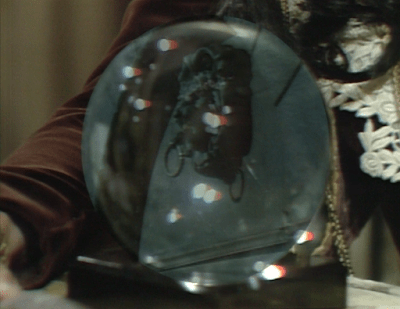
Picture in picture. Screenshot by Dark Shadows Before I Die.

Magda notices the image, and tells Sandor to look. He recognizes the old mausoleum. She says that the jewels must be in “the room,” implying that they already know about the hidden panel and the secret chamber behind it. Sandor says it is absurd to imagine Edith going to and from the mausoleum to retrieve pieces of her jewelry collection. Magda ignores this, and urges him to go there. He reluctantly agrees to go with her.

The two of them are heading for the door when they hear a knock. It is Beth, come to say that Edith wants to see Magda. Edith wants what she always wants- to be told that Edward will return before she dies. Sandor says Magda can’t go, but Beth says she will regret it for the rest of her life if she does not. Magda tells Sandor to go on his way without her, and says that she will bring Edith some ancient Gypsy cards, cards older than the Tarot. When she talks about Romani lore, Magda taunts Beth- “but you wouldn’t know anything about that, would you?” Her sarcastic tone implies that Beth has tried to conceal her own Romani heritage.

Sandor opens the secret panel and looks at the chained coffin. He tells himself the jewels can’t be hidden there, then decides he may as well open it anyway- if he doesn’t, Magda will just send him back. Longtime viewers remembering the frenzy in which Willie opened the coffin in #210 will be struck by the utterly lackadaisical attitude with which Sandor performs the same task. Men’s lust for riches may release the vampire, but so too may their annoyance with the wife when she won’t stop carping on the same old thing.

When Willie opened the coffin, it lay across the frame lengthwise and he was behind it. When he raised the lid it blocked our view of his middle. We could see only his face when he realized what he had done, and could see nothing of Barnabas but his hand. The result was an iconic image.
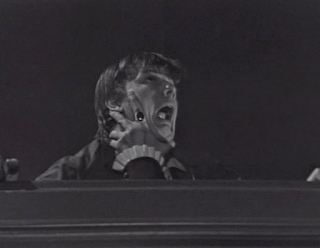
Farewell, dangerously unstable ruffian- hello, sorely bedraggled blood thrall. Screenshot by Dark Shadows Before I Die.

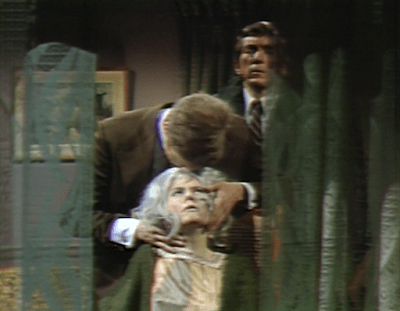
When Sandor opens the coffin, its end is toward us. We see Barnabas at the same time he does. Barnabas’ hand darts up, and also for some reason his foot. The camera zooms in as Barnabas clutches Sandor’s throat. Unfortunately, the shot is so dimly lit that not all viewers will see this. My wife, Mrs Acilius, has eyesight that is in some ways a bit below average, and she missed it completely, even on a modern big-screen television. It’s anyone’s guess how many viewers would have known what was going on when they were watching it on the little TV sets of March 1969, on an ABC affiliate which was more likely than not the station that came in with the poorest picture quality in the area. As a result, the image that marks the relaunch of Barnabas’ career as a vampire is nothing at all. There is so much good stuff in the episode that it easily earns the “Genuinely Good” tag, but Kaplan’s bungling of this final shot is a severe failure.

Grab and kick, and one and two! Screenshot by Dark Shadows Before I Die.

Episode 700: Beyond the door, anything is possible

Old world gentleman Barnabas Collins and governess Maggie Evans make their way into a dusty little room in the long-deserted west wing of the great house of Collinwood. Until last week, the ancient and esteemed Collins family lived in the main part of the great house, but now the evil spirit of the late Quentin Collins has emerged from the west wing and made life unbearable there. They have taken refuge in Barnabas’ home, the Old House on the same estate. Maggie’s charges, twelve year old David Collins and nine year old Amy Jennings, are possessed by Quentin, and David has gone missing.

Last night Maggie had a dream in which she entered this room, found a hole in the wall, and saw a door on the other side. She passed through that door and found a chamber crowded with Victorian bric-a-brac. She met Quentin there, and he gave her a kiss that looked very pleasant indeed. After she awoke, Maggie decided that she would go to the room to see if there was such a chamber behind the wall, convinced she would find David there. Or maybe that she would get another kiss, who can say.

Barnabas and his friend, mad scientist Julia Hoffman, MD, told Maggie it was far too dangerous for anyone to go to the great house alone, and insisted Barnabas accompany her on her expedition. This would seem to reduce the likelihood of another smooch from Quentin, but Maggie acquiesced.

Before we see Maggie and Barnabas, we are treated to a closeup of the tailor’s dummy to whom David referred in #681 as “Mr Juggins.” The camera pulls back, and we see that Mr Juggins is standing in front of a stone bust and next to a globe. The effect is quite stately. Unfortunately, this is Mr Juggins’ final appearance on the show. I think he had a lot of potential.

Barnabas and Maggie finds that there is indeed an opening where she had dreamed one would be and a door behind it. Barnabas pries the rest of the paneling off the false wall, and they enter the chamber beyond. Maggie confirms that it matches her dream perfectly.

They are marveling at this discovery, one made possible only by the intervention of whatever supernatural agency sent Maggie’s dream, when the doorknob starts turning. Occult expert Timothy Eliot Stokes enters.

Maggie and Barnabas look wonderingly at Stokes, and ask how he knew about the chamber. Regular viewers will be at least as surprised to see him as they are. Stokes tells them he was searching a nearby corridor and could hear the noise Barnabas made when he ripped the paneling out. That deflates the moment a little, but does leave us with a sense that there is more to Stokes than we know.

Stokes joins Barnabas and Maggie in searching the chamber, and quickly finds Amy hiding behind a curtain. Amy passes out, and the men urge Maggie to take her to the Old House. Alone with Barnabas, Stokes finds a set of I Ching wands and a couple of books in a desk. He says that it tells him a great deal about Quentin that he had these things. He also says that they will never find David by searching the house- the only way to rescue him is by studying the I Ching.

Maggie has taken Amy back to the Old House. There, Amy suddenly exclaims “Stokes is wrong!” Evidently whatever spirit is possessing Amy is streaming audio from Quentin’s chamber. Maggie asks what she means, and Amy avers that David is in the great house, but that he will soon be entirely subsumed by the spirit of his grandfather Jamison. Maggie rushes out to get him.

We cut back to the great house. Maggie enters the foyer, and David comes to the head of the stairs. She calls to him; he answers and calls her by name, but is struggling. The door at the head of the stairs opens, indicating that Quentin is there. Maggie confronts him and demands David do the same. David struggles further. He is in Maggie’s arms when the door closes, indicating Quentin has left. Maggie exclaims “We won! We won!” But there is no victory. David collapses. Maggie takes him back to the Old House, where Julia examines him and concludes that he will be dead within hours unless the possession is broken.

This situation is familiar to longtime viewers. Dark Shadows version 1.0 ran from June 1966 to March 1967. Its main theme was David’s difficult relationship with Maggie’s predecessor as his governess, Vicki Winters. It reached its end in #191, when David’s mother, undead fire witch Laura Murdoch Collins, tried to kill him. At the last moment, David ran from Laura into Vicki’s arms. With that, he had chosen life over death, and the story of Vicki and David had nowhere to go.

Maggie and Vicki were close friends, and so we can suppose she heard all about how David escaped from Laura. She knows what we know, and so she must feel the same shock we do when the scenario does not reach the same happy ending.

As David’s embrace of Vicki marked the end of Dark Shadows 1.0, his embrace of Maggie today marks the end of Dark Shadows 5.0.* This iteration of the show has focused on two intertwined stories. They concern werewolf Chris Jennings and the ghost of Quentin. Chris’ lycanthropy has been getting steadily more aggressive, and now he cannot revert to his human form at all. Quentin’s power has been growing in tandem with the expansion of Chris’ curse, so that there is nothing left for him to achieve. Both of these stories have, therefore, reached their conclusion. Moreover, the great house has been the constant element at the center of the show. Now that it is closed to the surviving characters, they cannot pick up a new plot and continue the series. It seems that this is to be the final episode of Dark Shadows.

In November 1967, it seemed that Dark Shadows had foreclosed every possible avenue of story development. The characters gathered for a séance, something we had seen them do three times before. Those previous séances had been dramatic high points, but this one had an outcome unlike anything we had seen. Vicki vanished from the circle. A woman unknown to the company took her place and identified herself as Phyllis Wick, governess at Collinwood in the year 1795. She and Vicki had traded places. Vicki took us with her, and for the next four months Dark Shadows was a costume drama set in the late eighteenth century. The result was a triumph that turned the show into a full-fledged hit, one of the major pop culture phenomena of the 1960s.

By now, we’ve seen ten séances, and they’ve gotten sloppy with them. In #600, a séance to contact someone named Philippe Cordier takes less time and trouble than it would have in 1969 to place a station-to-station telephone call. In #682, four characters held a séance in which no one objected when the medium went into the trance, breaking from a ritual form they had observed very strictly up to that point. In #698, we even heard about a séance held off-screen. So it is unlikely they will use a séance to get us from the conclusion of Dark Shadows 5.0 to the beginning of whatever it is that will compose Dark Shadows 6.0.

Barnabas and Stokes take Quentin’s I Ching wands and books to the basement the Old House, where Julia joins them. Stokes explains the I Ching more or less accurately, then Barnabas decides he will use the wands in an attempt to communicate with Quentin. Stokes warns him that the effects of the method are extremely unpredictable, and Julia keeps trying to stop the proceedings. Among them, the three represent the roles of convener, medium, and objector that we have seen in one séance after another.

But Quentin does not speak through any of the participants. Instead, Barnabas’ spirit leaves his body and walks towards a door. He opens it, and finds a coffin on the other side. It seems he is about to become a vampire again, as he was for the 172 years ending in March 1968. He is able to speak while this is going on; Julia knows what he means when he mentions a coffin and a mausoleum. Stokes is not a party to their criminal conspiracies, and so is puzzled. He asks Julia if she knows what Barnabas is talking about, and it is obvious that she is lying when she says she does not. Barnabas heads off towards the chained coffin, and an entirely new show.

Barnabas returns to the darkness from which he came. Screenshot by Dark Shadows Before I Die.

*Version 2.0, running from March 1967 to November 1967, introduced Barnabas as a vampire. Barnabas occasionally preyed upon the living, but spent most of his time trying to fit in to the twentieth century. He was so successful in that project that matriarch Elizabeth Collins Stoddard gave him the Old House on the estate of Collinwood to live in, and the viewing public started tuning in in large numbers.

Version 3.0, running from November 1967 to March 1968, was the 1790s segment. It was the inverse of version 2.0. Vicki’s attempt to navigate an alien time failed as spectacularly as Barnabas had succeeded, getting her condemned to death by the other characters and losing the loyalty of the audience.

Version 4.0 was a Monster Mash full of creatures familiar from Universal Pictures horror films of the 1930s; it ran from March to November 1968, and its main theme turned out to be the growing friendship between Barnabas and Julia.

Episode 699: If only I could put these images into some kind of a sequence

In the Old House on the estate of Collinwood, nine year old Amy Jennings pops into her governess’ bedroom in the morning. The governess, Maggie Evans, hasn’t been to bed yet. Maggie’s other charge, twelve year old David Collins, disappeared into the haunted corridors of the great house on the estate some time ago, and cannot be found. The evil spirit of the late Quentin Collins has been possessing David and Amy off and on for many weeks, and has now grown so powerful that no one dares go into the great house alone. Maggie is too worried to go to bed.

Maggie questions Amy about David and Quentin. Amy tries to deny knowing anything about Quentin, but Maggie keeps up the pressure until Amy admits she is afraid that if she talks, Quentin will do something to her big brother Chris Jennings. Permanent houseguest Julia Hoffman overhears this admission, and demands to know what Quentin has to do with Chris.

Julia knows something neither Maggie nor Amy does. Chris is a werewolf. As Quentin’s power over the children and the great house has grown, so has Chris’ lycanthropy spread over more of the month. For the past several years, Chris took his wolf form only for the two or three nights the moon was fullest, never for more than four nights, and never during any other lunar phase. Now he has started changing even when the moon is new. What is more, Julia and her friend, old world gentleman Barnabas Collins, just came from the chamber where they coop Chris up when he is the werewolf. They found that he has not changed back even though the sun has been up for two hours. They have no way of knowing when or if Chris will ever be human again.

Amy won’t tell Julia or Maggie anything more about Quentin or about Quentin’s fellow ghost, Beth. Amy has communicated with Beth, knows her name, and she and David first saw Beth with Quentin. She knows also that Beth weeps when she thinks of Chris suffering. For their part, Julia and Barnabas saw Beth when she led them to save Chris when Quentin had tried to kill him. Chris told them that Beth had appeared to him, and when he took Barnabas to the spot where that happened he and Barnabas found a shovel and excavated the unmarked grave of an infant wearing a pendant meant to ward off werewolves. Julia saw a photograph of Beth in an old Collins family album, dated 1897, the same year Quentin disappeared. If they could combine Amy’s knowledge about Beth with what they have learned from these three experiences, Barnabas and Julia might get somewhere.

Julia and Amy leave, and Maggie goes to bed. As she lies under the covers, we see visual effects that might have been impressive on daytime television in 1969, but that we all got pretty sick of seeing people use on video calls in 2020. The picture wiggles in the middle and a transparent sticker of Quentin’s face sweeps around the screen.

Quentin sticker. Screenshot by Dark Shadows Before I Die.

Maggie has a dream. Dream sequences on Dark Shadows are usually messages sent to the dreamer by some supernatural force; the sticker of Quentin’s face suggests at first that he is the sender of this message. Maggie goes to a room in the long-deserted west wing of the great house. She was in the room in #680, and saw Quentin there. When she took matriarch Elizabeth Collins Stoddard and David to the room in #681, there was a tailor’s dummy wearing Quentin’s frock coat, with a face and mutton chops painted on it. Liz was glad to believe that the dummy was what Maggie saw, and David nattered on about how he and Amy called the dummy “Mr Juggins.” In her dream, Maggie recognizes Mr Juggins, then sees an opening in the wall.

Mr Juggins startles Maggie. Screenshot by Dark Shadows Before I Die.

She goes through it, and finds a hidden chamber. Quentin is there. Quentin tried to strangle Maggie in #691, and earlier this week he dressed her up in a lovely outfit and did her hair in an elaborate up-do, so there’s really no telling what is going to happen when the two of them are alone together. This time, he kisses her passionately, and from the way she relaxes in his arms it is clear he is doing a great job.

Awake, Maggie tells Julia about her dream. This will bring back memories for longtime viewers. When we first saw Julia in #265, she was Maggie’s psychiatrist, and was asking her about, among other things, her dreams. The same viewers will have been marveling at the fact that Maggie is staying in the room of the Old House once occupied by the gracious Josette and now dominated by Josette’s portrait. In May and June of 1967, Barnabas was a vampire. He held Maggie prisoner in Josette’s room as part of his scheme to erase her personality and replace it with Josette’s. Julia hypnotized Maggie into forgetting that whole ordeal, and the show has recently been assuring us that they will not revisit the question of whether her memory will return. Putting her back in the room is their most heavy-handed way yet of telling us to stop wondering about that.

Maggie’s discussion with Julia also raises the question of who sent the dream. Had she responded to it by slipping out to the west wing without telling anyone where she was going, we could believe that Quentin was luring her to him by showing her what a good kisser he is. But this conference makes it clear that Maggie is not only consciously determined to do battle against Quentin, but that she is enlisting the support of the allies likeliest to make headway against him. Beth has done a great deal to warn people against Quentin, so she might have sent the dream. Since Maggie is in Josette’s room and the closing credits will run over a shot centered on Josette’s portrait, it is also possible that Josette’s ghost has returned to the business of sending dream warnings.

The image under the closing credits. Screenshot by Dark Shadows Before I Die.

Once Maggie figures out where Quentin’s chamber is, she decides that David must be there. She resolves to go to the chamber and find David. Julia tells her it is too dangerous for the two of them to go to Quentin’s stronghold alone, and insists they wait until Barnabas can join them. Julia goes to fetch Barnabas. When she brings him back to the Old House, Maggie says that now she can’t find Amy. Julia decides to look for Amy while Maggie and Barnabas go to the great house.

It might seem odd that Julia thinks it is OK for Maggie to go to the great house accompanied only by Barnabas when it would have been too dangerous had she herself been Maggie’s only companion. But Julia knows that Barnabas is not an ordinary man. He has been free of the effects of the vampire curse for almost a year, but his history made it possible for him to travel back in time in #661. It seems that he retains enough connection with the supernatural to make him a more formidable adversary for Quentin than is even so adroit a mad scientist as Julia.

Amy overhears Maggie’s conversations, and she goes to the west wing. She uses a crowbar to open the panel that leads to Quentin’s chamber. She goes in and calls for David. David is not there, but Quentin is. Amy tries to tell Quentin that she had come to warn him that Maggie and Barnabas were on their way; as her attempt to lie to Maggie had crumbled when Maggie kept questioning her, so her attempt to deceive Quentin collapses as he keeps staring at her. Amy’s face goes blank, and we realize that Quentin is transmitting commands into her mind.

Barnabas and Maggie do go to the room and they do find the opening in the panel. Barnabas looks through it, and sees a door on the other side. The opening is a small one, close to the floor. The children have been crawling through it, and evidently Maggie did the same in her dream. But Barnabas does not intend to get his suit dirty. He picks up the crowbar, and says he will rip out all the panels and walk through the door.

Barnabas is not going to crawl through that thing. Screenshot by Dark Shadows Before I Die.

Episode 698: The kind of scene you should be avoiding

Barnabas Collins, old world gentleman extraordinaire, and Julia Hoffman, MD, are helping mysterious drifter Chris Jennings cover up the fact that he is a werewolf, responsible for a great many violent deaths. Lately Chris has started transforming into his lupine shape even on nights when the moon is not full, and this morning they find that he has not changed back even after dawn.

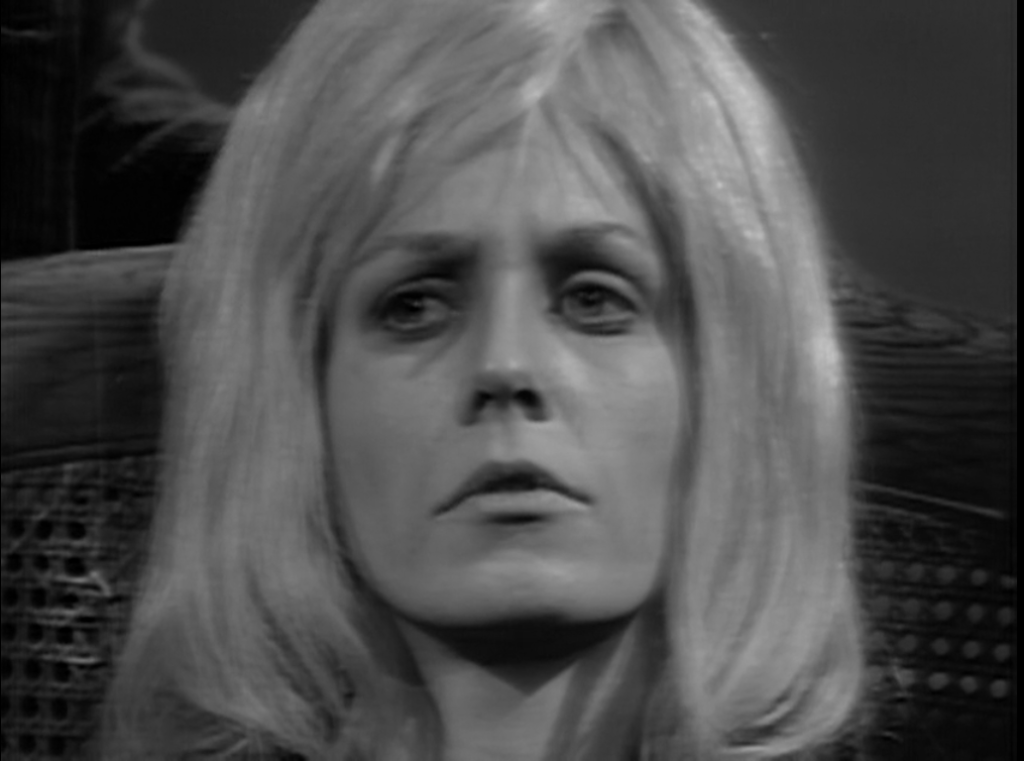
As if that did not present enough difficulty to Julia and Barnabas, one of Chris’ surviving victims is in town. She is his onetime fiancée, Sabrina Stuart. Two years ago, Sabrina saw Chris as the werewolf. She hasn’t told anyone about him, because she hasn’t been able to speak since. Her hair turned white, her skin turned pale, and she has been nearly catatonic.

Others have encountered the werewolf, and none has had this reaction. It’s true that Chris’ cousin Joe had to be taken to a mental hospital after he saw the transformation, but Joe had just been through a very long train of supernaturally induced traumas that had shattered his sensibilities and taken away everything he cared about. Seeing Chris change was just the last step in that process. Sabrina, as we see in a flashback segment today, was fine until she encountered Chris as the werewolf, and she didn’t even see the transformation itself. Yet here she is two years later, unspeaking, immobilized, and wearing the same makeup that Eli Wallach wore as Mr Freeze in the 1960s Batman TV show.

In a comment on Danny Horn’s post about this episode at Dark Shadows Every Day, “Cole” speculates that the show might have meant to tell us that the real reason Sabrina’s condition is less to do with what happened that on night in Chris’ apartment than with her brother and sole caretaker, Ned, played by Roger Davis:

I am once more getting through the Ned/Sabrina scenes thanks to this blog and the comments here; and although I still have to frequently avert my eyes from the screen to hold back the nausea, I keep concentrating on the dialogue while speculating further on JRM’s theory.

It does seem that we– and Julia– might be meant to feel especially concerned by Ned’s refusal to even consider allowing Sabrina to stay at Windcliff. He even says (or, rather, since it is Roger Davis, he SCREAMS), ​”I won’t be separated from her!”

I don’t think his character is meant to be overly suspicious of Julia and Barnabas so the vehemence behind his already rather alarming declaration becomes more baffling unless the viewer concludes he has … extremely unnatural feelings of possessiveness towards sad, PTSD-afflicted Sabrina.

It is almost half as frustrating as it is disturbing because, with any other actors, we would surely know for certain how to interpret these scenes.

We would perhaps recognize that when Sabrina stares pleadingly at Julia once Ned leaves the room, that her muteness is caused as much by her horror at being an ongoing victim of her brother’s unspeakable abuse as by having once witnessed Chris’s transformation into a werewolf. We wouldn’t wonder, instead if the actress, Lisa Richards, is actually pleading with Hall to help her endure Davis’s deliberate act of molesting and assaulting her through out these scenes.

If it wasn’t Roger Davis in this role, we would know who Ned is really meant to be since there is no way any of the other regular male cast members would willingly subject their costars to type of abuse Davis is inflicting on Richards.

If it were … say, Jerry Lacy who was currently playing “Ned Stuart” in a manner even remotely similar to Roger Davis’s ‘interpretation’ of the role, we would recognize at once that the character of Ned is obviously scripted to be an incestuous rapist (and I am sure Lacy would still keep his hands professionally and respectfully away from Lisa Richards’s/”Sabrina’s” breasts, instead using actual acting techniques to portray his character’s warped nature). But with Davis ..

It really could be, as Mary commented below, that he is trying to get the poor actress to break character. And how could we expect other than that he would use his usual disgusting and violent Drumph-like/”‘you can grab them by the pussy” sense of Curtis-granted entitlement to assault her as “Ned,” regardless of the intent of the writer and director.

Either way, what a horrifically mistaken choice in casting.

Lisa Richards: fifty years later, I am thinking of you and hoping you weren’t forced to endure PTSD after filming these scenes with Davis.

Comment left 29 August 2021 by “Cole” on “Episode 698: Sister Act,” Dark Shadows Every Day, Danny Horn, 8 August 2015

When I mentally recast the many parts Roger Davis played on Dark Shadows, I divide them between two men who were background players in the show’s first months. I imagine Fredric Forrest playing the two characters with aliases, Peter Bradford (a.k.a. Jeff Clark) and Charles Delaware Tate (a.k.a. Harrison Monroe.) Forrest excelled both as a quietly intense man under pressure and as a sweet, goofy, overgrown kid. In the hands of an actor who, unlike Mr Davis, could project those qualities, those two unloved characters might both have become fan favorites. His other two parts, Ned Stuart and Dirk Wilkins, would have been perfect for Harvey Keitel, who is unsurpassed as a man who is agitated by a deep anger that he himself barely understands and that he certainly cannot explain to anyone else. Not that it’s any secret why Ned is angry at Chris, but when he takes a break from pawing at Sabrina’s face and breasts he handles her so roughly that he is obviously angry with her, and that is something he isn’t going to be giving any thought.

Mr Davis’ behavior wasn’t much better in episodes directed by Lela Swift and others, but it is little surprise director Henry Kaplan didn’t rein him in. Kaplan directed with a conductor’s baton, and actresses complain that he would jab them with it. When the person in charge has that light a regard for women’s personal space, it’s no wonder a creep like Mr Davis felt free to rub himself all over Ms Richards.

Episode 697: He was so cold and evil, he touched me.

Chris Jennings is a werewolf, a fact which old world gentleman Barnabas Collins is helping him conceal. Two years ago, Chris’ fiancée Sabrina Stuart chanced to see him transform; she hasn’t been able to speak since. Her hair turned white, and she is in a nearly catatonic state. Sabrina’s brother, a very loud man named Ned, has brought her to the village of Collinsport and keeps demanding that Chris visit them and explain what happened.

There is a full moon tonight, so Barnabas has sealed Chris up in the secret chamber hidden in the old Collins family mausoleum. He tells Chris that he will try to persuade the Stuarts to leave town and forget about him. Chris tells him that is impossible; Barnabas seems to believe he can pull it off.

In the Stuarts’ suite at the Collinsport Inn, Barnabas tells Ned that he is harming Sabrina by taking her along on his mission to confront Chris and that he ought to take her home and move on with his life. Preposterous as this is, Ned makes it seem credible. To be more precise, it is actor Roger Davis who makes it seem credible. He rubs himself all over Lisa Blake Richards’ scalp, face, and chest while she is required to remain motionless. To the extent that we accept them as their characters, we are forced to think of Ned as a caretaker who abuses his disabled sister sexually; to the extent that we recognize Mr Davis’ behavior as typical of his previous performances on Dark Shadows, we wonder how bad things were for women in show business in the late 1960s that Miss Richards didn’t contact the union and bring him up on charges. It isn’t every performer who can make an audience sympathize with an ex-vampire’s attempt to keep a woman in a comatose state lest she endanger his werewolf buddy, but you can always trust Mr Davis to enlist the viewers’ support for any plot development that will get him off the screen.

I wonder how much of that look is Barnabas reacting to Ned’s story and how much is Jonathan Frid wondering if he should stop tape and call Equity. Screenshot by Dark Shadows Before I Die.

There are also some indications that the show is firming up some of its world-building. For the first time, we hear the name “Edward Collins” as the grandfather of the senior generation now resident at the great house of Collinwood. We hear that Edward was the father of Jamison Collins and the brother of Quentin Collins. Quentin was first mentioned months ago as Jamison’s uncle, but on Friday Barnabas had a line identifying him as his brother, suggesting some behind-the-scenes wavering about this point. Quentin’s ghost is the chief villain in the current A story, and we heard several weeks ago that he wants to turn strange and troubled boy David Collins into a replica of Jamison, so these relationships are important to the action.

Longtime viewers will have fond memories when stuffy Roger Collins sees a book open by itself on the table in the drawing room of the great house. The same book opened itself on the same table in #52, one of the first unmistakable signs that ghosts were at work. No one but the audience was around to see that, but when it happened again in #182, Roger was there. It jolted him out of his refusal to face the facts about the supernatural menace operating at that time.

Episode 696: Not anywhere at all

The ghost of Quentin Collins drove all of his living relatives out of the great house on the estate of Collinwood the other day, and now he has fetched two of them back. They are twelve year old David Collins and nine year old Amy Jennings. Today, governess Maggie Evans, old world gentleman Barnabas Collins, and Barnabas’ bedraggled servant Willie Loomis search the great house looking for the children.

When they find Amy, she is possessed by the evil spirits and insists that the house is where she belongs. She willingly leaves with Willie. When they get back to Barnabas’ house, she calmly tells Willie that he will never again have reason to worry about Maggie. “Maggie is not anywhere anymore… anywhere at all. You’ll see.” In the great house, Barnabas finds that Maggie has been dressed in clothing appropriate to the period when Quentin lived, the 1890s. She does not recognize him or respond to her own name. When he asks who she is, she struggles, then faints.

Barnabas finds Maggie. Screenshot by Dark Shadows Before I Die.

Dark Shadows first became a hit in May and June of 1967, when Barnabas was a vampire trying to erase Maggie’s personality and overwrite it with that of his lost love Josette. Since then, Maggie’s memory has been wiped, Barnabas has been cured, and the show has made it clear they will not be revisiting the question of whether he will have to pay for his crimes against her. They are great friends now. It is ironic that Barnabas is the one trying to get Maggie to return to herself, but it does further confirm that Maggie’s memory of her days in his dungeon is gone for good.

In a comment about John and Christine Scoleri’s post about this episode on their Dark Shadows Before I Die, someone known as “D. Wor” points out that the dress Maggie is wearing when Barnabas finds her harks back to his attempted Josettification of her:

I remember this episode well. At first I thought the Victorian dress Maggie suddenly was wearing didn’t add up to anything Josette-essential until I took a good look at the colours. I thought the dark green sash was horribly out of place, and then? I realized all three of those colours are representative of Josette’s bedroom at The Old House. The green sash represented her drapes. Wild, eh?

Comment left 25 February 2019 by “D. Wor” on “Dark Shadows Episode 696: 2/24/69” (25 February 2019) at Dark Shadows Before I Die, John and Christine Scoleri.

In Friday’s episode, Barnabas meditated on the idea that he and Quentin never knew about each other. Longtime viewers, seeing Maggie out of touch with her own identity and her proper time, might wonder if Quentin now knows what Barnabas did to her in 1967 and if he is taunting him with a reminder of it.

Episode 695: Collinwood belongs to the ghosts now

The ghost of the evil Quentin has driven the living members of the Collins family from the great house on the estate of Collinwood. They have taken refuge in the Old House on the estate, home to their distant cousin, old world gentleman Barnabas. Quentin wants to take possession of children Amy and David. Knowing of his plans for them, David and Amy sneak into the great house to recover and destroy the antique telephone Quentin first used to communicate with them. The children do not find the telephone there, and governess Maggie comes to the house and takes them away. Later, Maggie goes to their rooms in Barnabas’ house. She discovers that the children are missing, and Quentin’s telephone has appeared in David’s room.

Dark Shadows first became a hit in the late spring and early summer of 1967, when Barnabas was a vampire and Maggie was his victim. That story was chiefly modeled on the 1932 film The Mummy. As Boris Karloff’s Imhotep saw Zita Johanns’ Helen as the reincarnation of his lost love Ankh-Esen-Amun, so Jonathan Frid’s Barnabas saw Kathryn Leigh Scott’s Maggie as the reincarnation of his lost love Josette. As Imhotep took Helen prisoner and tried to replace her personality with Ankh-Esen-Amun’s, so Barnabas took Maggie prisoner and tried to replace her personality with Josette’s. As the movie showed us flashbacks to Imhotep’s time as a living being with Zita Johanns playing Ankh-Esen-Amun, so from November 1967 to March 1968 Dark Shadows became a costume drama set in the 1790s and featuring Miss Scott as Josette. Even Frid’s acting style and mannerisms were strongly reminiscent of Boris Karloff’s.

Since those days, Maggie’s memory has been repeatedly erased and Barnabas has been cured of vampirism. More than once, there were stories suggesting Maggie’s memory might come back and blow the whole show up, but those always ended with yet another mind-wipe. Several times lately, the show has gone out of its way to emphasize that they will not be revisiting that theme. There are two such moments today. David complains that the Old House is “like a prison”; Maggie, who was for long weeks kept in the barred cell in the basement, doesn’t miss a beat before replying “For a very good reason!”

In 1967, Barnabas’ only interest was recreating the history of the Collins family. His attempted Josettification of Maggie was part of that antiquarian project. Today, we catch a glimpse of what he might have been hoping for in that period. He and Maggie are sitting in the parlor reading family histories, and she glances at him with a fond smile. Granted, if his original project had been successful Maggie would have forgotten her own name, they would both have been vampires, and no living human would be safe from their creeping terror, but between feedings the two of them would probably have sat around like this.

A cozy evening at home.

Episode 694: Enough tragedy in this house

For months, the evil ghost of Quentin Collins has been gaining strength, secretly manipulating children Amy Jennings and David Collins as he prepares to drive everyone from the great house of Collinwood so that he can have the place to himself. Now he has cast aside all secrecy and he openly menaces the adult residents of the house. Today, they give up and leave. Once they are all gone, Quentin stands on the walkway at the top of the staircase in the foyer and laughs heartily.

Collinwood belongs to matriarch Elizabeth Collins Stoddard. Liz’ brother Roger, David’s father, lives there as her guest. Up to this point, Liz and Roger have served primarily as blocking figures. Each is devoted to denial as a way of life. Occasionally a fact bursts upon them that is so enormous that one or the other of them has no choice but to face it for a little while. Usually they snap back into their characteristic mode of willful ignorance the moment the crisis is past, and even while it is going on the other responds by digging even deeper into the insistence that nothing is happening. When I first watched Dark Shadows, I could imagine the characters fleeing Collinwood one by one, then venturing back to get Liz and Roger, only to find them sitting serenely in the drawing room, assuring their would-be rescuers that everything was all right while leather-winged demons fluttered about their heads.

On Monday, Liz saw enough of Quentin’s power that she gave up her attitude of denial, apparently forever. Today, Roger does what we have been led to expect, and loudly declares that the whole issue is imaginary and that the other adults should be ashamed of themselves for encouraging the children to be afraid of ghosts. When the whole house starts to resound with the crepuscular tones of an old-timey waltz Quentin plays when he is exercising power, Roger declares that it is a trick the children are playing on them. The others go to pack their things while Roger stays in the drawing room.

Alone there, Roger sees Quentin materialize before him. On their way out, Liz and occult expert Timothy Eliot Stokes check the drawing room one last time, and find Roger sitting motionless in a chair. For a moment we wonder if he will fall over dead. He starts speaking, though, and admits that he was wrong. As they leave, Roger looks back into the house and shouts a defiant pledge to return. Apparently the makers of Dark Shadows have decided they no longer need two major characters whose primary function is to put the brakes on the action.

Roger reacts to the sight of Quentin. Screenshot by Dark Shadows Before I Die.

After everyone has gone, the camera pans across sets representing several rooms in the great house. This must have taken some doing. The foyer and drawing room were the only standing sets; the others were built as needed. The show was done live to tape, so these sets must all have been standing simultaneously. The studio was not very big at all. I wonder if they crammed some of these into space that was not generally used for action.

The walkway at the top of the foyer stairs is a commanding position, and the show has been sparing in its use of it. Quentin’s triumphant laugh is the first time we see a villain stand there and exult in his new position as Master of Collinwood. In the early days of the show, the dashing and enigmatic Burke Devlin threatened to take control of the house. He never came very close to doing that, but it could have been interesting to see him stand on the walkway, survey the foyer, and think about the day when the house would be his. For a long period in 1967, seagoing con man Jason McGuire was bossing Liz around; there were several days when he might have stood on the walkway, looked around with smug satisfaction, and chuckled.

Yesterday’s episode ended with the drapes in a bedroom in flames. That was a real fire, not a special effect, and you could see it spreading rapidly and putting out a lot of smoke. Having failed in that attempt to murder everyone in the building, the technical staff in today’s reprise of the sequence settles for lighting some gas burners behind a window dressing.

Episode 693: Contemptuous and evil spirits

Dark Shadows showed its first exorcism in #400. At that point the show was a costume drama set in the 1790s. The fanatical Rev’d Mr Trask was convinced that time-traveling governess Victoria Winters was a witch and that she was hiding in the Old House on the estate of Collinwood. He stood outside that house with a forked stick. He set the points of the stick on fire and shouted commands for the forces of darkness to come out.

Vicki was indeed hiding in the house, but she was not alone there. The actual witch, the wicked Angelique, set a fire of her own. She built a house of cards and burned it to cast a spell that caused Vicki to see flames in her room and respond by running out into Trask’s clutches. What surrounded Vicki were special effects superimposed on the screen, but what was in Angelique’s room was real fire, and it flared alarmingly close to actress Lara Parker’s lovely face. You’d think they’d have learned from #191, when an on-camera fire went out of control and nearly killed the entire cast, or perhaps from #290, when an off-camera electrical mishap led to fire extinguisher noise almost drowning out some dialogue. But apparently the prevailing philosophy was no injuries, no problem, so they went right on playing with fire.

Today we have another unsuccessful exorcism, and its failure leads them to make another attempt to burn down the set. Occult expert Timothy Eliot Stokes is informed that the evil spirit of the late Quentin Collins is haunting the great house of Collinwood and taking possession of strange and troubled boy David Collins. Stokes follows Trask’s rubric of standing outside the house, pointing a forked stick at it, and shouting inhospitable remarks at the spirits, but he doesn’t set fire to the points of the stick as Trask had done. There is a lot of excitement while he is performing the ritual, and once he finishes all of it dies down. Unsure of the outcome, he arranges to stay the night; while he is getting ready for bed, the curtains in his room catch fire. These are not special effects images; the curtains are really on fire, they are burning rapidly, and they are putting out a lot of smoke. The little building at 442 West 54th Street where Dark Shadows was made was packed with sets made of plywood and crammed with props, many of them highly flammable. Several sets were draped with huge fake cobwebs; I’m not sure what those were made of, but I doubt it was anything that would make a fire marshal very happy. It’s just amazing anyone who worked on the show lived to see 1971.

Hey, what’s the worst that could happen? Screenshot by Dark Shadows Before I Die.

There is a lot of very good stuff in this one. All of the acting is top-notch. David Henesy and Thayer David had scenes together as several characters, first as David Collins and crazed handyman Matthew Morgan in 1966, then as young Daniel Collins and much put upon indentured servant Ben Stokes when the show was a costume drama set in the 1790s, and now in 1969 as Ben’s descendant Professor Stokes and David. Those scenes all crackled, and today when Stokes catches David hiding behind the secret panel in the drawing room, demands he tells him the truth about what is happening to him, tricks him into admitting that he is afraid of Quentin, and warns him of the dangers ahead, the two make the exchange work magnificently.

There is also a scene in the drawing room between David Collins, his cousin Carolyn Collins Stoddard, and permanent houseguest Julia Hoffman while Stokes is performing the exorcism. He has to shout and writhe around a lot during this scene, very difficult things for child actors to do convincingly. But Mr Henesy had been acting professionally for four years before he joined the cast of the show in 1966, at the age of nine, and had studied acting under several distinguished teachers, among them Uta Hagen.

That background pays off; violent as the symptoms of the incipient possession are, Mr Henesy does not overplay them. It helps that he has support from Grayson Hall and Nancy Barrett; Hall plays Julia as firmly in control of herself, but obviously uneasy with the situation, while Miss Barrett shows Carolyn’s anxieties mounting until she shouts that David might be in real trouble. Since he is in convulsions and the crepuscular sound of the creaky old waltz that plays when Quentin is exercising power is emanating from the walls of the house, it would seem obvious that David is in real trouble. The line shows that Carolyn is starting to panic. When we see that neither the determinedly calm Julia nor the increasingly anxious Carolyn is having any particular influence on David’s emotions, we know that they are coming from someplace far removed from his visible surroundings.

Episode 692: The only existing link

There are two ongoing narrative threads in this part of Dark Shadows. One is the story of mysterious drifter Chris Jennings. Mad scientist Julia Hoffman knows Chris to be a werewolf and she is trying to help him. The other is the story of Quentin Collins, a ghost who is gradually gaining power and planning to drive everyone away from the great estate of Collinwood so that he can have the place to himself. Chris’ story had been the fast-paced A plot that kept expanding to involve more and more characters, while Quentin’s was the slow-paced B plot that consistently involved only Chris’ nine year old sister Amy, strange and troubled boy David Collins, and their governess Maggie Evans, with intermittent small parts for other established characters and the occasional chance for a day player to act a death scene. That changed yesterday, when Quentin decided that he had grown so strong he no longer needed to conceal himself from matriarch Elizabeth Collins Stoddard or the other adults in the great house. Quentin’s story is now the main topic, and Chris is the secondary feature.

We open today with Liz telling Julia what happened the night before. Julia tells Liz that she and old world gentleman Barnabas Collins had suspected that an evil ghost was at work in the house, and that they have seen another spirit that seems to be opposed to it. Liz says she has called occult expert Timothy Eliot Stokes. Stokes arrives and questions everyone.

Liz is alone at the desk in the drawing room when a secret panel leading to a passage to the long-deserted west wing opens. A cutout meant to suggest a disembodied hand appears on the screen. It picks up a letter opener from the desk and is about to stab her when Stokes enters.

Stokes shouts. The hand drops the letter opener and vanishes. He tells Liz what he saw. He notices the panel is open, and asks Liz about it. She says that it leads to the west wing, but that, as far as she knows, no one has used it in years. That answers a question that has been on the audience’s minds since October 1966. In that month, we saw Liz’ brother, high-born ne’er-do-well Roger, use the panel to play a dirty trick on well-meaning governess Victoria Winters. The panel was not seen or mentioned again until David and Amy started using it to do Quentin’s bidding several weeks ago. This line is our first confirmation that Liz knows that the panel and the passage behind it exist. Stokes asks Liz’ permission to perform an exorcism.

Meanwhile, Julia gets a telephone call from Chris. Liz’ daughter, heiress Carolyn Collins Stoddard, has taken a fancy to Chris and installed him in a cottage on the estate. Chris tells her that he is facing an emergency. Someone has come to the village of Collinsport who might know his secret.

In the cottage, Chris tells Julia that an unpleasant man named Ned Stuart has brought his sister Sabrina to the village and that he is demanding Chris meet with Sabrina. Chris had assumed Sabrina was dead, because she was in the room with him one night two years before when he underwent the transformation into his lupine form. Ned had told Julia and Barnabas that he was looking for Chris because he wanted to know what happened to his sister; he had always referred to Sabrina in the past tense, leading them to assume she was dead. Now Chris is in a panic, convinced that Sabrina will tell the police about him and that he will be punished for the many, many homicides he has committed as the werewolf.

Julia points out that if Sabrina were going to do that, she could have done so at any time. He would already have been arrested. Sabrina must not have told Ned or anyone else what she saw, and Ned must be telling the truth when he says he does not know what happened the last time Chris and Sabrina were together. She persuades Chris to go to visit the Stuarts in their suite at the Collinsport Inn.

Julia accompanies Chris on the visit. Ned is irritated that Chris did not come alone. His remarks are uncomfortable to hear, chiefly because of actor Roger Davis’ habit of clenching his anal sphincters when he raises his voice, making him sound like he is suffering from agonizing constipation.

After Ned makes this fingernails-on-a-blackboard noise for a couple of minutes, he lets Chris and Julia into Sabrina’s room. She is in a catatonic state. Her hair is white, and her face is tinged with light blue makeup. The makeup makes her look haggard in color, but most TV sets in the USA in the 1960s received only in black and white. In black and white, the makeup is not very effective.

Ned says that Sabrina was like that when he found her, the morning after she paid her last visit to Chris’ apartment. Several takes of a framed copy of actress Lisa Blake Richards’ professional headshot invite us to imagine the before-and-after. Ned calls Sabrina’s attention to Chris; she rises from her chair, starts towards him, and collapses.