We are in the fourteenth week of a story about the Leviathan People, a race of Elder Gods who are planning to retake the Earth from humankind. At first, old world gentleman Barnabas Collins was a zealous acolyte of the Leviathans and the faithful leader of a cult devoted to their service. The first chapter of the story came to an end when a shape-shifting monster from beyond space and time, the harbinger of the Leviathans’ return, ordered Barnabas to kill his best friend, mad scientist Julia Hoffman. Barnabas refused that order and became disaffected from the cult, held in line only by the Leviathans’ threats.
The shape-shifting monster has grown, and now spends most of his time as a young man whom everyone calls Jeb, despite his initial request to be called Jabe. Barnabas learned the other day that some of the threats the Leviathans had been making were empty, and so tried to smash a small wooden box that is important to them. Jabe stopped him, and punished the attempt by turning Barnabas back into what he was from the 1790s until 1968, a vampire.
Jabe’s home is a room above an antique shop owned by cultists Megan and Philip Todd. There is a lot of talk about this room as the only place where Jabe can change form. This is confusing to regular viewers. We saw him change from boy to girl while visiting the great house of Collinwood in #909, and in #946 and #947 he changed from his true, non-human, form into Jabe while at a house on an island many miles from the village of Collinsport. Today, Barnabas burns the antique shop down in order to destroy the room; Jabe says that he left the room through the window when the fire started, and changed from his true form into his human shape while outside. I keep trying to give them the benefit of the doubt about this, but at this point the whole theme of the “Chosen Room” falls apart completely.
Nonetheless, the antique shop sets and the troubled relationship between Philip and Megan have been signatures of the Leviathan story so far. Now the shop is gone, and Megan is gleeful that Philip is in jail, having confessed to three murders Jabe committed and unlikely ever to live with her again. So we can say that chapter two of the Leviathan story is over.
Barnabas’ re-vamping marks a transition in more than this storyline. He is the central character of the show and its main attraction; whether or not he is a vampire determines a great deal about what kind of show it is. You could periodize the show into segments depending on whether he is a vampire or not. I’ll risk a spoiler and tell you we have now begun a long segment of Barnabas-as-vampire.
Barnabas goes to the jail and has a conference with Philip. Jabe overtaxed Philip’s allegiance to the Leviathans, as he overtaxed Barnabas’. Philip has confessed to Jabe’s murders only because he loves Megan, believes she still loves him, and fears that if he does not do what Jabe commands he will kill Megan. Barnabas tells him that in fact Megan no longer cares about him at all, but is entirely devoted to Jabe.
In the real world, the state of Maine did away with capital punishment in 1887, a fact which applied to the universe of Dark Shadows in 1966. In #101, high-born ne’er-do-well Roger Collins disappointed his son, strange and troubled boy David, by mentioning it. But the prospect of a gallows is more melodramatic than is that of any prison sentence, however long, and so Philip announces that he is going to be hanged for Jabe’s murders.
Matriarch Elizabeth Collins Stoddard, owner of the great estate of Collinwood and of the businesses that employ most of the people in and around the village of Collinsport, is a devoted member of the Leviathan cult. Liz gives Jabe the carriage house on the estate to live in, telling him its back room will be suited to take the place of the now-destroyed Chosen Room. He tells her that Barnabas has betrayed the cult, but that she need not act against him yet. The carriage house was mentioned a few times in 1969, when Dark Shadows was a costume drama set in 1897 and the Collinses were still traveling by carriage. I believe this is our first confirmation that the carriage house still exists in the twentieth century.
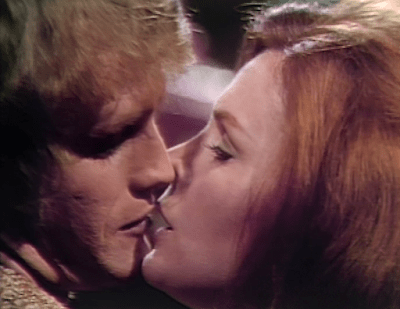
Megan comes to visit Jabe at the carriage house. She is exultant that Philip is in jail. Jabe tells her he has no intention of resuming his true form; she is appalled. The plan has been that he will take Liz’ daughter Carolyn as his bride, and that she will then turn into the same kind of being he is. If he is going to be humanoid all the time, then he will just be taking Carolyn out on dates. Megan says that this was not the point. Jabe dismisses her objections, and tells her that their own relationship is different now than it was when he was first taking shape and she and Philip were his foster parents. He pulls her close to him and gives her a passionate kiss.
Jabe spent several weeks in the form of a succession of children. The children showed violent hostility towards Philip and remarkably little sense of boundaries in their relationship with Megan; the reference to the Freudian Oedipus complex was not subtle then, and the kiss he gives to Megan while he is setting Philip up for a judicial murder makes the connection explicit.
Old world gentleman Barnabas Collins has fallen afoul of a shape-shifting monster from beyond time and space who once hoped people would call him “Jabe.” The monster, who has settled for the name “Jeb,” turns Barnabas back into what he was from the 1790s until 1968, a vampire.
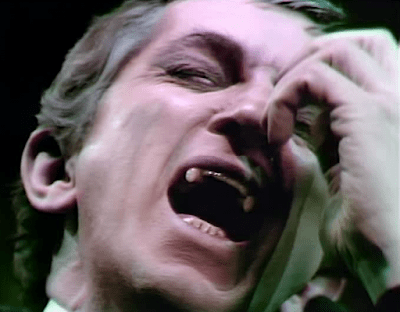
Re-vamped, Barnabas suddenly gets a lot of gray in his hair and a much darker complexion. Makeup artist Vince Loscalzo deserves a lot of credit for these bits of color, they are placed perfectly to emphasize the look of anguish as Barnabas realizes what has happened to him and struggles to resist his urges. The actors’ faces were the medium of Loscalzo’s art, and he outdid himself with these complements to Jonathan Frid’s face.
People talk endlessly about the heroic makeup work Dick Smith did with Jonathan Frid one week in October 1967 and again on a feature film, but Vince Loscalzo did great stuff like this day in and day out for years. Screenshot by Dark Shadows Before I Die.
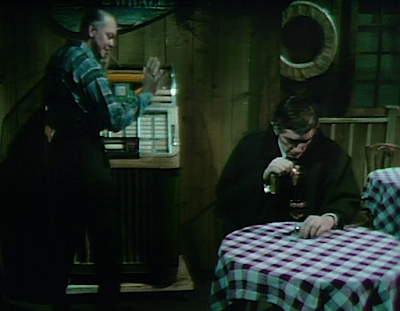
We see Barnabas sitting at a table in The Blue Whale, the tavern in the village of Collinsport. He is the only patron in the room. He has a glass of reddish liquid in front of him, and the bartender is moving around the room. The bartender looks at Barnabas, as if to ask, “How do you like your glass of AB negative, Mr Collins?” But he turns away and moves on.
A young woman enters. Barnabas invites her to join him at his table. He sees that she is wearing a pendant that identifies her as a member of the secret cult that serves Jabe and other creatures who intend to seize control of the Earth, supplanting humankind. Barnabas introduces himself, and says that he was the one who made it possible for Jabe to come to life. This is true, but it is also true that he has become disaffected from the cult. Even after Jabe turned him back into a vampire, Barnabas is still determined to thwart it.
The young woman introduces herself as Nelle Gunston, who was recruited into the cult while living a dreary life with her parents in Virginia. Nelle tells Barnabas that everything has changed for her since she joined the cult. She says that she will gladly do anything she can to advance its objectives, including murder. They have this conversation in nice loud voices while the bartender is nearby.
Barnabas’ friends, mad scientist Julia Hoffman and recovering werewolf Quentin Collins, enter. He introduces them to Nelle, then explains to them that he and Nelle have a private matter to discuss. Quentin and Julia go to the bar, where Quentin orders brandies. They talk about Nelle’s pendant and their fear that Barnabas is falling back under the power of the cult while the bartender is in their space serving them drinks. Evidently they’ve learned to rely on his discretion. They are still deep in conversation when Barnabas leaves with Nelle.
Barnabas takes Nelle back to his place on the pretext that Jabe will meet them there. She asks him why it is so dark in there; he asks her how she got into the cult. She catches on that Jabe is not coming and that Barnabas is not loyal to him. She draws a knife and is about to stab Barnabas when he bares his fangs to her.
Quentin and Julia let themselves into Barnabas’ house. They find Nelle dead on the floor and Barnabas wallowing in self-pity next to her. Julia takes a second look at Nelle and sees the puncture wounds on her neck. She tells Barnabas she will renew the treatments that first put his vampirism into remission two years before; he says there is something else he has to do first. After he rushes out, Quentin and Julia talk about how they will hide Nelle’s body.
Nelle was the perfect victim for Barnabas- no one in town knew her, no one expected her to come, no one will notice she is missing. And he is determined to weaken the cult, so reducing its numbers by one fits his goals.
Barnabas goes to the antique shop in the village. Jabe is in an upstairs room; Barnabas is convinced that Jabe can assume his true form and lay it down only in that room. We saw him do that in a house on an island many miles away in #946, and he told Barnabas that he had done so in #947, but apparently that doesn’t count, somehow. Jabe is far more powerful in his true form than he is when he is man-shaped, but he cannot mingle with humans in that form. So Barnabas believes that he will limit Jabe’s options if he destroys the room. He pours gasoline all around the first floor of the shop and sets a match to it.
Nelle is played by Elizabeth Eis, in her first appearance on Dark Shadows. They say that the first thing actors have to do to work effectively is to pay attention to each other. Eis shows how far this can take you. She listens ravenously to everything Frid says and never takes her eyes off him. The script doesn’t give her a huge amount to work with, but simply by giving her scene partner her total attention she creates a sensational performance. The producers noticed; she will be back later this year in two quite different roles.
This episode is the last time we see either the Blue Whale or Bob O’Connell as the Bartender. The Blue Whale was an important part of the show from its debut in June 1966 until the first costume drama insert began in November 1967. O’Connell appeared as the Bartender in 60 episodes (three of them as other bartenders in other periods of history) and had speaking parts in 6. It’s too bad he doesn’t get to say anything today, but at least he is in the closing credits.
Hail and farewell to Bob the Bartender, the jukebox, and the tavern. Screenshot by Dark Shadows Before I Die.
The Leviathan People, a race of Elder Gods, are planning to retake the Earth from humankind. Step one in their plan was to bring old world gentleman Barnabas Collins under their sway and make him the leader of a secret cult headquartered in the village of Collinsport, Maine. Step two was to bring a shape-shifting monster from beyond time and space to life and put him up in a room above an antique shop in the village. Step three is to get heiress Carolyn Collins Stoddard, Barnabas’ distant cousin, to pair up with the monster and turn into a creature like him.
The monster usually takes the form of a young man. When he first appeared in this guise, he said he wanted to be called “Jabe” For all his powers and his willingness to kill, he can’t persuade anyone to use that name, so he answers to “Jeb.” Jabe has somehow succeeded in charming Carolyn, but his personality drove Barnabas away from the cult. Determined to prevent Jabe from having his way with Carolyn, Barnabas has enlisted another distant cousin, Quentin Collins, among his allies in this battle.
For the last few days, Barnabas has been telling Quentin and his other comrades that their only resource against the Leviathans is that Jabe and his loyalists still trust him. Today Jabe comes to the great house of Collinwood and has an argument with Barnabas and Quentin. Jabe accuses Barnabas of disloyalty, and Barnabas immediately declares that he never believed in the Leviathan cause and will do everything in his power to defeat it.
Barnabas intends to launch his attack by using two objects with great cultic significance to the Leviathans. One is a small wooden box that is kept in Jabe’s room. The other is a large stone altar in the woods on the grounds of Collinwood that only people associated with the Leviathan cult can see. With Quentin’s help, he steals the box. He forbids Quentin to accompany him to the altar. He sets the box on the altar and raises his cane to smash it. Suddenly the box opens, and he freezes. A bat comes flying out.
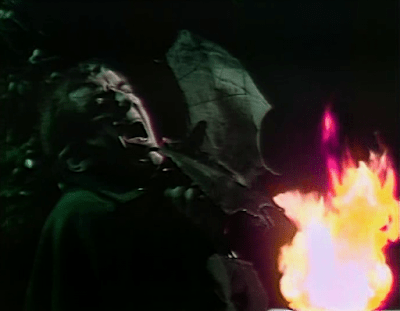
In the 1790s, Barnabas was cursed to become a vampire. He remained in that horrid condition until two mad scientists worked together to free him of the effects of the curse in 1968. Jabe has decided to make him a vampire again. He put the bat in the box, and it bites Barnabas, renewing the curse.
The bat was about the size of a real bat when Jabe put it in the box. Even at that, it must have been a pretty tight fit for the little fellow. But when it bites Barnabas, it is as big as a California condor.
Jabe calls Carolyn “honey” in their scene together. We’ve heard many endearments, most often “dear” and “darling,” but never before “honey,” not so far as I can recall. It makes Jabe seem a bit more up to date than the other characters.
Ten year old Amy Jennings is at home in the great house on the estate of Collinwood. Evidently she’s in a literal mood- she’s in the drawing room, so she’s drawing. Heiress Carolyn Collins Stoddard sees Amy’s work and asks why she is doing it. Amy says she thinks the design is “pretty”; Carolyn replies that “pretty” is the last thing she would call it. That may seem rather rude, but as Amy hasn’t been seen since #912 I suppose she’ll take what she can get.
The design is one which on Dark Shadows is called simply a Naga. It is the secret emblem of a secret cult serving the Leviathan People, a race of Elder Gods. Secret cultist Megan Todd wears the Naga on a large pendant around her neck; Megan’s husband, secret cultist Philip, wears it on a shining ring; Carolyn’s mother, secret cultist Elizabeth Collins Stoddard, wears it as an oversized broach. Amy herself is a secret member of the secret cult, but she hasn’t yet acquired any conspicuous jewelry emblazoned with the secret symbol, leaving her to do her own artwork. Carolyn wonders aloud why so many people are so preoccupied with the design.
Quentin Collins enters. Amy is terrified. Starting in December 1968, Quentin’s ghost haunted Collinwood. By March, the house was uninhabitable and strange and troubled boy David Collins was near death. Old world gentleman Barnabas Collins tried some mumbo-jumbo in hopes of communicating with Quentin; he came unstuck in time and found himself in the year 1897, where he remained for eight months. While Barnabas was flailing about in the late Victorian era, time continued to pass in 1969, and Quentin’s obsession of David finally killed him in September. But a sequence of events with which Barnabas had a tenuous connection changed the circumstances on the night in September 1897 when Quentin originally died, causing him to survive. That night, as it happened, was exactly 72 years before David’s death. On Dark Shadows, anniversaries have the power that laws of nature have in our world, so that caused the haunting to break and David to come back to life. Due to a series of spells cast on him during Barnabas’ sojourn in the past, Quentin is still alive and still apparently in his late twenties in 1970. But the haunting still happened between December 1968 and September 1969, and everyone who lived through it still remembers it.
Quentin has introduced himself to Carolyn as his own great-grandson. Since Carolyn never actually saw his ghost, she is willing to accept this. But Amy had more dealings with the ghost than anyone but David, and it is obvious to her that they are one and the same. She clings to Carolyn.
Carolyn laughs at Amy’s fear and tells her that this Quentin is not the ghost, but is “a cousin of ours.” This is intriguing to regular viewers. It was during the 1897 segment that the audience learned that Quentin was the great-grandfather of Amy and her brother Chris, and just a few weeks ago that Chris learned about that relationship. It is through their descent from Quentin that Amy and Chris are cousins to Carolyn. So if Amy knows she is a Collins, she must have been told that the ghost that tormented her and David was that of her great-grandfather. A scene in which someone gave her that information might have been a good use of Denise Nickerson’s considerable acting talent, but they didn’t bother to produce one.
Quentin tells Carolyn to leave him alone with Amy. Still chuckling, she complies. Once they are alone in the drawing room, Quentin kneels and touches Amy’s face, assuring her that he is “not that Quentin Collins.” David Selby brought immense charm to the role of Quentin, so this scene isn’t as revolting as it might have been, but it is still pretty bad, and we can’t be surprised that Amy is not satisfied.
Amy goes to the village of Collinsport to seek guidance from her spiritual advisor. He is a shape-shifting monster from beyond space and time who usually takes the form of a very tall young man. When he first assumed that form, he invited people to “Call me Jabe,” but no one did. They call him “Jeb” instead, and he answers to it.
Jabe lives in a room above Megan and Philip’s antique shop, and when Amy enters the shop she finds him looking after the place. Apparently shape-shifting monsters from beyond space and time aren’t above doing a little work in retail now and then. She tells Jabe about her encounter with Quentin, and then tells him about a dream she had. In the dream, she went into the long-disused room where she and David first met Quentin. Quentin’s theme song, a sickly little waltz, was playing; she exclaims “It was terrible!” Longtime viewers know the feeling. The tune played incessantly during the “Haunting of Collinwood” period, and when they went back to 1897 characters kept complaining to the living Quentin that he was making them miserable by playing it on his phonograph all the time.
In the dream, Quentin appeared to Amy wearing the nineteenth century clothing and the angry scowl that he wore when he was a ghost. But when he was a ghost, he never spoke words the audience could hear. The only exception was a dream sequence in #767, when Quentin’s ghost spoke to David. That was also the only other dream sequence to be presented as this one is, in flashback as the dreamer is recounting it after the fact. That sequence marked a watershed, the first attempt to explain how Quentin the cranky ghost emerged from Quentin the charming scoundrel we had got to know in the 1897 segment.
This episode, also, has to do with the relationship between these two iterations of Quentin. Amy tells Jabe that Quentin’s ghost in the dream warned her against him by name, and says that she is therefore convinced that the living man she met in the drawing room today is in some way identical to the ghost who haunted the house for those ten months. Amy’s dream marks the final appearance of Quentin’s ghost, but we can see the ghost will not be forgotten.
A state police investigator named Lawrence Guthrie is in town looking into two murders Jabe has committed, those of Carolyn’s father Paul and of a law enforcement officer whose gravestone revealed that his given name was “Sheriff Davenport” (we never learn what Mr Davenport’s title was.) Jabe orders Philip to kill Guthrie. Philip calls Guthrie and asks him to come to the antique shop when Jabe will be out. Once Guthrie is there, Philip tells him that the upstairs room where Jabe stays is an important part of the story of the murders. He shows Guthrie into the room. He stays outside, and locks Guthrie in. Guthrie encounters Jabe there in his true form; Jabe kills him. This is quite effectively handled. My wife, Mrs Acilius, was completely caught off guard by the killing. She believed Philip really was trying to break free of the Leviathan cult, and wondered what Guthrie was supposed to find in the room.
Neither Jabe nor Philip is an especially well-developed character, but Christopher Bernau and Christopher Pennock were both fine actors, and they play off each other very well today. It is a tribute to their performances that Guthrie’s death scene comes as a surprise.
At the end, Quentin is at Collinwood trying to tell Carolyn that it was Jabe who killed her father and Mr S. Davenport. Inexplicably, Carolyn is interested in dating Jabe, and is unwilling to listen to this. Jabe bursts in and announces that there has been another murder, that the murderer is in custody, and that he has confessed to it and to the killings of Paul and Sheriff. That murderer, Jabe says, is Philip. That’s another surprise- after the murder of Guthrie, Jabe did tell Philip that he had another task to perform, and once we hear that he has confessed to the killings it makes perfect sense that that would have been what Jabe meant. But I don’t think anyone could have predicted it. It makes for a strong ending.
Danny Horn’s post about this episode on his great blog Dark Shadows Every Day is a lovely little bit of fanfic proceeding from the assumption that Lawrence Guthrie is the brother of Dr Peter Guthrie, the parapsychologist whom undead blonde fire witch Laura Murdoch Collins killed in March 1967.
The closing credits again misspell writer Violet Welles’ name as “Wells.” They started doing that last week, around the same time the misspelling of wardrobe house Ohrbach’s as “Orhbach’s,” a frequent goof in the show’s first year, reappeared after a long absence.
The first ghost we saw on Dark Shadows was that of the gracious Josette Collins, who came down from her portrait and danced around the outside of the Old House on the grounds of the estate of Collinwood in #70. We had first heard of Josette in #5, when drunken sad sack Sam Evans told well-meaning governess Vicki Winters about her, and she had been mentioned many times in the first fourteen weeks. From #70 until #191, Josette’s ghost became a steadily bigger part of the story. She rallied the other ghosts of Collinwood to rescue Vicki from crazed handyman Matthew in #126, and from that point until #191 guided Vicki in her battle with undead blonde fire witch Laura Murdoch Collins. By the end of the Laura story, Josette was firmly established as the chief figure in the show’s supernatural back-world, a world which the action is continually tugging into view.
Vampire Barnabas Collins succeeded Laura as the show’s supernatural Big Bad. Josette was well-suited to do battle with the distant and indefinable Laura, but was too wispy to be very effective against the more dynamic Barnabas. In #212, Barnabas addressed Josette through her portrait in the Old House, which we had seen strange and troubled boy David Collins use to carry on conversations with her in #102 and #162. Barnabas spoke to Josette then as if she were his grandmother, who had sided with his father against him in a fateful conflict, and told her he was kicking her out of the house. Over the next few weeks, there were several episodes when David lamented Josette’s absence from the Old House, suggesting that Barnabas had succeeded in banishing her.
As it became clear Barnabas was a hit and would be kept on the show for a while, they decided to connect him to Josette. So they borrowed the story of the 1932 film The Mummy. As Boris Karloff’s undead Imhotep decided that Helen Grosvenor was the reincarnation of his lost love Princess Ankh-Esen-Amun, so Barnabas decided that Josette, retconned as his lost love, had been reincarnated as Maggie Evans (Kathryn Leigh Scott,) daughter of Sam. As Imhotep abducted Helen and tried to turn her into Ankh-Esen-Amun, so Barnabas abducted Maggie and tortured her in an attempt to erase her personality and upload Josette’s in its place.
In the movie, Helen and Ankh-Esen-Amun were both played by Zita Johann. The original viewers wouldn’t have known it, but Miss Scott, wearing a veil, played the ghost of Josette in #70 and voiced Josette’s lines to Vicki in #126. In the scenes during the Laura story when we caught glimpses of Josette’s face, the ghost was played by frequent stand-in Rosemary McNamara, who looked enough like Miss Scott that viewers may have wondered if she was playing the role. So the idea of a connection between Maggie and Josette had been rattling around the writers’ room for a while. In #240, David saw Maggie wandering around Barnabas’ house. She was wearing Josette’s dress but no veil, in a daze and answering to Josette’s name. Afterward, David said that he had seen Josette and that she looked exactly the same as she did when he had seen her as a ghost. That confirmed that Maggie was at least a Josette lookalike, if not her reincarnation.
Maggie eventually escaped from Barnabas. Her psychiatrist, Julia Hoffman, saw in Barnabas her chance to make a career as a mad scientist, and so she sold Maggie out, using her magical power of hypnosis to delete her memory of what Barnabas did to her and leave her with a feeling of goodwill towards Barnabas. By that time, Barnabas had turned his attentions to Vicki, toying with the idea of Josettifying her. Josette’s ghost made it clear to him that she would try to stop any such effort when she spoke through Vicki at a séance in #280 and 281; after that, Barnabas gave her portrait another talking-to, telling her that she was lost to him forever and must let him live in the present. It sounded like he was going to stop trying to turn girls into Josette, but he kept pushing Josette’s hypnotic music box on Vicki, so if that’s what he meant he didn’t stick with it.
In November 1967, Vicki went back in time to the days when Barnabas and Josette were living human beings. From then until March 1968, Dark Shadows was a costume drama set in the 1790s. Miss Scott was cast as the living Josette, completing the parallel with the flashbacks to ancient Egypt in The Mummy and suggesting that Barnabas, though he was appallingly cruel and thoroughly crazy, was onto something when he told Maggie she was Josette.
The whole idea of supernaturalism is that what appears to be powerless is in fact most powerful and vice versa, so having been powerful as a ghost, Josette has to be at least somewhat understated as a living being. Making matters worse for her, the 1790s segment moved at a breakneck speed, piling one bizarre disaster on top of another, so that there was no time to develop the kind of subtle strength a lady of her sort might be expected to have or to give us much of a look at Josette and Barnabas as a loving couple before everything went horribly wrong for them. She winds up as a pleasant but ineffectual person. The 1790s period was the show’s first great triumph, but it did knock Josette out of the spotlight permanently.
A couple of weeks after Dark Shadows returned to contemporary dress in March 1968, Barnabas’ vampirism went into remission and he tried to function as a good guy. His bumbling attempts at heroism generated as much trouble for everyone as had his villainy. Julia had made herself a permanent houseguest at Collinwood, and she was the one who was busiest with the work of containing his damage. Throughout the part of the show made and set in 1968, Josette was all but forgotten.
Early in 1969, Barnabas came unstuck in time and found himself in 1897, once more subject to the vampire curse. During his eight months in that period, he met two more characters played by Miss Scott. Each of them led him into a fresh bout of Josettery. He gave the music box to neurotic intellectual Rachel Drummond; after her death, he met Kitty Soames, dowager countess of Hampshire, who despite her title was a young woman from Pennsylvania. The music box showed up in Kitty’s room at a time when Barnabas could not possibly have been around, and it became clear that this time, it was Josette herself who was trying to take possession of Kitty.
In #884, airing in November 1969, Kitty was assumed bodily into Josette’s portrait. Barnabas saw this happen. He then returned to the 1790s, to the night when Josette originally flung herself to her death from the cliff at Widows’ Hill rather than let Barnabas turn her into a vampire. Josette had only the vaguest memory of 1897 or of Kitty; as far as she is concerned, she was living through this night for the first time, and was experiencing time in the usual linear fashion.
Barnabas tried to prevent Josette’s suicide, but succeeded only in changing the method she used to do herself in. By the time he returned to the twentieth century, he had fallen under the sway of the Leviathan People, a race of Elder Gods who are trying to retake the Earth from humankind. For a time he led a cult that served them in this goal, but eventually became disaffected. He hesitates to take any very definite action against the Leviathans, because they told him they were “holding Josette prisoner in the past” and that they would inflict on her a more horrible death than either of those she has already died if he defied them in any way.
Vicki was written out of the show in 1968, and Maggie succeeded her as governess to the children at Collinwood. The Leviathans have sent a shape-shifting monster from beyond space and time as the harbinger of their conquest. The monster usually takes the form of a young man who initially asked people to call him “Jabe,” but whom everyone instead calls “Jeb.” Jabe is always obnoxious and often homicidal, and has alienated many people from the Leviathans, including Barnabas. He abducted Maggie and thought he had brainwashed her into joining the cult; once he let her go, she made an alliance with Barnabas and Julia to fight the Leviathans.
Barnabas is convinced Jabe is about to do something especially horrible, and so he wants to open the battle. But his concern for Josette is still holding him back. He and Julia talk about this. It dawns on them that the Leviathans may have been lying, and that they may not have the power to make Josette re-die. The only way they can be sure is to ask Josette, so they decide to hold a séance. They enlist Maggie to be the third member of the circle.
The typical Dark Shadows séance involves three roles- the convener, who gives detailed instructions and barks about the importance of following them, even if everyone in the room has attended multiple séances already; the medium, who goes into the trance and channels the voice from the realm of the dead; and the objector, who tries to interrupt and is sternly hushed by the convener. Recent séances have omitted the objector; today, Julia keeps up a running commentary from the time Barnabas starts the incantations until Maggie goes into the trance, but she doesn’t object and Barnabas doesn’t hush her.
Through Maggie, Josette says she had a hard time getting to the séance, but that it had nothing to do with the Leviathans. She says she doesn’t even know the Leviathans. Barnabas doesn’t believe her, and she says that if he wants proof he should come to her grave.
He does. The tinkling tune of the music box plays on the soundtrack; Barnabas does not mention the original signature of Josette’s presence, the scent of jasmine. Her ghost manifests before him:
THE GHOST OF JOSETTE: It is I. And I will tell you what you must know, now and forever. You asked me if the Leviathans held me prisoner. They do not. But you hold me, just as I hold you with my love. But now the time has come for us both to go free.
BARNABAS: I cannot be free without you.
GHOST: But you must. For I belong to the past. For you there is a future with someone else.
BARNABAS: But I don’t want anyone else.
GHOST: Then you must be lonely, for you cannot have me. But you will find someone else. I know it. And when you do, give her this. The ring that you gave to me, give to her, whoever she may be. This ring is a sign of your freedom and of mine. (Returns her engagement ring to him and vanishes.)
This is Josette’s final appearance on Dark Shadows, not counting a parallel universe version of Josette who will feature in the last weeks of the show, played by another actress. As for the “someone else,” it would be logical for Barnabas to get with Julia, since the two of them are so deeply complicit in each other’s crimes that neither of them will ever be able to make a life with anyone else. But there have been some hints lately that romance might be budding between Barnabas and Maggie, and if that’s going to happen they are going to have to keep us from thinking very clearly about Josette and Barnabas’ attempts to recreate her. We might suppose that her farewell is meant to clear the path for such a development.
There’s also some business about the Leviathan story. In the opening reprise, Jabe catches a bat, which he plans to use to turn Barnabas back into a vampire.
After Barnabas gets the green light from Josette, he meets with Philip Todd, another person whom Jabe has driven out of the Leviathan cult. Philip tells Barnabas how much he hates Jabe and agrees to steal the Leviathan box, an object which does not play music but which is a lot more effective at controlling the minds of people who open it than was that box of Josette’s. At the end of the episode, Jabe catches Philip with the box.
A commenter on Danny Horn’s great Dark Shadows Every Day who identifies herself as “Melissa”* wrote this lyric about Jabe in twocomments about the post covering today’s episode:
Come and listen to my story ’bout s man named Jeb, Poor Leviathan, barely kept his evil web. Then, one day, he and Barney had a spat, And out from the cage came a rubberized bat. (Vampire bat, that is: Nylon string, Terror teeth.)
Next thing you know,ol’ Jeb has got a girl. Cult folk said, “Jeb, come and rule the world!” They said, “In the attic is the place you want to be,” So they threw themselves a seance and they called on J.D.C. (Josette Collins, that is. Swimming fail. Newly scarred.)
Comments left 31 October 2016 by “Melissa” on Danny Horn “Episode 948: War Games,” posted 30 October 2016 at Dark Shadows Every Day.
I’m singing that aloud right now. I realize you might be reading this years after I wrote it, but believe me, I’m singing it right now.
Old world gentleman Barnabas Collins comes home shortly after dawn and finds that the window of his front parlor has been smashed in. Entering the house, he finds two young men passed out. He knows both of these men, and knows that neither is what he seems to be. The taller of them, who once asked to be called Jabe, is in his true form an indescribable monster from beyond space and time, the harbinger of the Leviathan People, a race of Elder Gods who mean to retake the Earth and destroy humankind. The other, Chris Jennings, is a werewolf. The Leviathans are vulnerable to werewolves, and Barnabas realizes that Chris reverted to his human form when the sun rose, just as he was about to kill Jabe.
Chris comes to, and Barnabas hustles him out of the house. He then wakes Jabe. He tells Jabe that he fought the werewolf off, killing it and saving Jabe’s life. Barnabas was the original leader of a cult devoted to serving the Leviathans, but has since become disaffected. Jabe had seen evidence of this, and set out for Barnabas’ house meaning to punish him for his disloyalty. But by the time the werewolf chased him into the house he was crying out for Barnabas to help him, so he is ready to believe the story. Taking credit for things he had nothing to do with is one of Barnabas’ core competencies, so it is no surprise to longtime viewers that Jabe decides that he can trust Barnabas after all.
Barnabas’ ex-wife Angelique is now married to a man named Sky Rumson. She does not believe that Sky knows anything about her past or about anything supernatural, but the audience has seen over the last few episodes that he is an agent of the Leviathans. Angelique put Barnabas’ distant cousin Carolyn up in a house she and Sky have on an island to help Barnabas in his fight against the Leviathans while Sky was away on a business trip. At the end of that trip, Sky called to ask Angelique to pick him up at an airport far from the island house. When she got to the airport, she found he had already left. She wound up spending several hours alone on the road. Returning viewers know that Sky’s call was a trick to get her away from the house so Jabe could come and have his way with Carolyn. We also know that Jabe chickened out of his evil plan when he actually saw Carolyn, and that she is fine now.
Angelique comes home from her long wild goose chase and asks Sky what happened. He said he had an important phone call coming at the house, so he had to leave early. Angelique accepts this surprisingly easily. Barnabas shows up to take Carolyn home. He and Sky meet. After Barnabas is gone, Sky asks what the deal is with Carolyn. He presses the point, and Angelique tells him everything she knows about Barnabas and the Leviathans, including that he is now “their most dedicated enemy and he means to use every power he has to stop them.”
This scene is bad news for Barnabas, but it is worse for the audience’s image of Angelique. She used to be a wicked witch of vast destructive power, and was supposed to be the ultimate Soap Opera Vixen. But you wouldn’t have to be a witch, or even a vixen, to avoid the situation Angelique puts herself in. Leaving the airport when he knew she was on the way was a colossal act of thoughtlessness, and no husband who committed it could expect to hear a word from his wife about anything else for at least a week. After that, there will be a long period when she will have an unanswerable source of material to keep him off his guard any time he tries to bring up topics she doesn’t want to discuss. By the time Sky is able to start asking questions about why Angelique had Carolyn spend the night, it will probably be another full moon.
That isn’t even the worst of it. Angelique believes that Sky is simply a denizen of the sunlit world known to us in our everyday experience and explained well by science, and she further believes that he sees her in the same way. That makes it all but impossible for her to tell him what she tells him here. She launches right in with “the Leviathans, they’re terribly dangerous creatures, completely evil and they mean to start a whole new society.” If he really were a total naïf in supernatural matters, this story would lead him to pick up the telephone and call the men in the white coats to come and take Angelique to a place where she could get a good long rest.
I don’t think Angelique’s scene with Sky could have worked in any case, but Geoffrey Scott’s limitations as an actor make it even worse than it had to be. He underacted so severely that he could hardly be said to be giving a performance at all. That makes a stark contrast with Lara Parker, who as Angelique fully embraced the hyper-intense Dark Shadows house style of acting, which, in honor of her own hilarious explanation of it, is sometimes known as “Go back to your grave!” That contrast is interesting at a technical level. It goes a long way towards explaining what Orson Welles meant when he said that hamminess was not overacting, but false acting. Parker goes as far over the top as she can, but there is rarely anything false about Angelique, while every tinny note Scott strikes in his flat recitation of his lines is thoroughly fake.
A charismatic actor might have been wasted as Sky, as Parker is wasted today. But the audience might have been able to meet the show halfway if we could believe that Sky was so fascinating to Angelique that she didn’t realize what she was saying. As it is, Scott looks so much like he is modeling menswear for the Sears catalogue that it is always a bit of a surprise when he moves and speaks. However much Angelique might enjoy Sky’s company, it never occurs to us that he would be a match for her in any sense.
Sky goes to Jabe and repeats what Angelique told him about Barnabas. There is an exchange which looks fine in print, but which Scott’s delivery makes sound like a blooper:
JABE: So everything he told me this morning was a lie! And I thought he had saved my life!
SKY: Evidently, everything he told you was a lie.
You would deliver Sky’s line with an emphasis on “everything,” as would I, as would anyone else. But Scott emphasizes “Evidently” and pauses slightly after “you,” making it sound as if he hadn’t heard Jabe. For a fraction of a second, you can see the amazement in Christopher Pennock’s face as he reacts to this clanger.
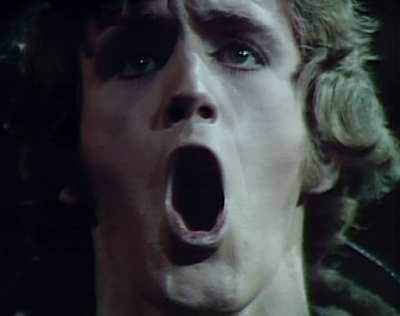
Jabe carries a cage with him as he goes to an old graveyard. The camera locks in on him in closeup as he shouts that, while death might be an adequate punishment for a mere murderer, Barnabas must suffer “More! MORE! MO-O-O-ORE!!!” More, more, more, how do you like it, how do you like it….
The first time I saw this scene, I regarded it as a low point- I imagined someone tuning in to Dark Shadows for the first time at that moment, and instantly turning it off, believing ever after that only people of an extremely low mentality could like the show. I still think it’s pretty embarrassing writing, but having seen him in other roles I’ve come to realize that Pennock was in fact a good actor and that as Jabe he was saddled with an impossible task. Also, I’ve seen video of him on panels of original cast members at Dark Shadows conventions, and it is obvious that he was as sweet as Jabe is vicious. So watching the scene today, I ignored Jabe and looked at Christopher Pennock, studying his face to see what he was thinking as he struggled to find a way to give the audience something worth their while.
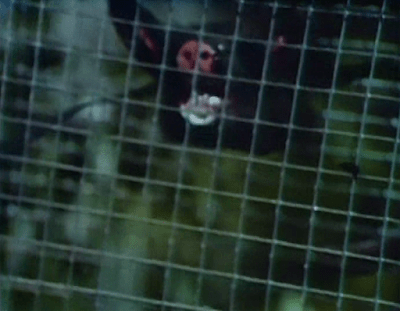
Jabe makes an incantation, and a bat comes flying to him. He catches it in the cage. We get a closeup of the bat puppet in the cage, which looks very much like a humane trap from Havahart. We know that Jabe plans to use the bat to make Barnabas back into a vampire, which he was for 172 years, but the realistic cage and the adorable little puppet prevent the situation from generating any terror. Dan Curtis said that when he was producing Dark Shadows, his young daughters used to urge him to make the show more frightening. When we were chuckling at the sight of the bat today, Mrs Acilius imitated a child saying “Make it scary, Daddy!”
In May and June of 1967, vampire Barnabas Collins held Maggie Evans, The Nicest Girl in Town, prisoner. He drank her blood, tortured her, and drove her insane. When Maggie escaped, he turned his attentions to well-meaning governess Vicki Winters. Maggie’s imprisonment was the storyline that first made Dark Shadows a hit, but it was bleak and often difficult to watch, and if its horrors had shortly after been reenacted with Vicki as the victim many viewers would likely have given up on the show. So Barnabas decided that he wanted Vicki to come to him of her own will. That avoided the problem, but left the show stuck in a rut. For the next several months, Barnabas did not have a coherent goal. Since he was the main figure in the A story, that left Dark Shadows spinning in circles.
They escaped from that rut in November 1967, when Vicki went back in time to the 1790s. The audience followed her there, and we found out how Barnabas first became a vampire. He had fallen afoul of wicked witch Angelique. Angelique wanted Barnabas to love her. Since her enormous powers were explicitly shown to include the ability to make people fall in love with each other, we wondered why she didn’t simply use that ability on Barnabas. They answered that question by having Angelique declare that she wanted him to come to her of his own will. She tried to attract his love by casting a series of spells on everyone around him, spells that resulted in death and ruin for the people he most cared about. When Barnabas found out what was going on and tried to kill Angelique, she turned him into a vampire.
Now it is January 1970, and Barnabas’ vampire curse is in abeyance. A race of Elder Gods called the Leviathan People are trying to retake the Earth from humankind, and have threatened to reactivate the curse if he does not help them. The Leviathans control a group of people whom they have formed into a cult devoted to their service. The Leviathans have brought a shape-shifting monster to life, and it is written that the monster will marry Barnabas’ distant cousin Carolyn Collins Stoddard and turn her into a creature like himself.
Angelique has renounced her powers and is trying to live as a mortal woman. The other day, Barnabas asked her to help him protect Carolyn from the Leviathans. Angelique no longer wants anything to do with Barnabas or anyone else from the estate of Collinwood, but she understands the threat the Leviathans pose and is willing to help Barnabas against them, provided she can do so without losing what she has in her current life. Barnabas arranged for Carolyn and her mother, matriarch Elizabeth Collins Stoddard, to hide out at Angelique’s house while he tried to figure out a way of fighting the monster. Liz is a dedicated member of the cult, and believes Barnabas to be its faithful leader, so when Barnabas told her to take Carolyn to Angelique’s she complied at once.
Unknown to Angelique, her husband, hard-charging businessman Sky Rumson, is himself a member of the Leviathan cult. Thursday, he telephoned the monster and told him Carolyn was at the house; Friday he opened the door to the monster, and the monster went to Carolyn. Today, the monster decides that he will not impose the transformation on Carolyn after all. Instead, he will wait for her to come to him of her own will. This keeps the story from ending here, but it makes it unclear where it can go.
The monster’s decision poses a deeper problem for him as a presence on the show than the similar decisions did for Barnabas and Angelique. They pursued identifiable goals, and were influenced by thoughts and feelings they had while they interacted with others. The only goal the monster has is to take possession of Carolyn, and now it is unclear what that means. Nor is anything at stake for him in any encounter with another person. He keeps saying that he doesn’t need anyone, and that seems to be true- there is no reason to pay attention to him in any scene. He has, in short, been established not as a character at all, but simply as a function. All he has ever been is Threat. Now that he has decided to be nice to Carolyn, he will no longer even fulfill that function. His future would appear to be quite limited.
Sky also appears to be a short-timer. When Dark Shadows started, one of its most dynamic characters was hard-charging businessman Burke Devlin, played ably by the charismatic Mitchell Ryan. Despite all of Ryan’s magnetism, they could never come up with anything very interesting for Burke to do. Hard-charging businessman just isn’t a type they have much use for. They signal that Sky won’t be around long by casting Geoffrey Scott in the role. Scott was very handsome and would go on to a long career on screen, but in early 1970 he did not appear to have any skills of any kind as an actor. Not only does he deliver his dialogue as if he were reading a series of nonsense syllables aloud, but he is noticeably bad at hitting his mark. For example, on Friday Sky at one point backed away from Carolyn during a conversation. He took a step too far, with the result that his rear end was a few inches from a hearth with a vigorously burning fire. It was hard not to watch the seat of his pants and wait for it to ignite. There were times when they cast actors who still needed a lot of training and kept them around for quite a while, but Scott was at this point in his career so amazingly inept that it is hard to imagine they meant to use him for anything more than the decorative value his good looks offered.
Liz is at home in the great house of Collinwood when a man she has not seen before appears on the walkway above the foyer and starts giving her orders. He comes down and introduces himself to her by the name Bruno. He shows her that he is wearing a ring that identifies him as a member of the Leviathan cult. Liz says that he must have come to give her instructions. He confirms that this is so.
A howling resounds outside, and Bruno asks Liz about it. She tells him that she long ago met a wolf-like creature in the woods, and she suspects the howling comes from that creature. Returning viewers know that the Leviathans are vulnerable to werewolves and that the monster is terrified of them. Bruno knows this too, so he goes out to hunt for it.
The monster, in the form of a tall young man, comes to the great house to introduce himself to Liz. She is concerned when he tells her to stop taking orders from Barnabas, but delighted when he says that Carolyn has a future with “us.” Carolyn telephones from Angelique’s house, and Liz puts the monster on the phone.
Carolyn is all smiles when she is talking to the monster. They’ve met a few times, and he has been nothing but a jerk to her. She had objected to his behavior, and his responses had ranged from frightening to slimy. That she is all of a sudden attracted to him undercuts her character almost as badly as nerfing his threat to her undercuts his position on the show.
After the phone call, Bruno returns. He tells the monster he couldn’t find the werewolf. The monster declares that he will go to the Old House on the estate to confront Barnabas, whom he labels a traitor. Bruno points out that it is almost daybreak, and if he waits just a little while he will not be in danger from the werewolf. The monster says that it is too important to wait.
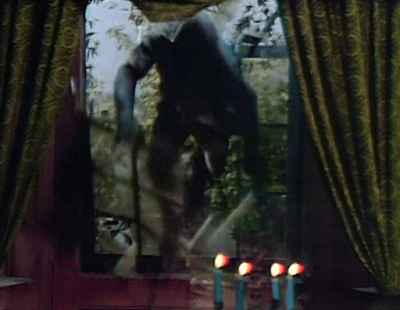
The werewolf chases the monster through the woods. By the time the monster gets to the Old House, he is shouting for Barnabas, the “traitor” he was planning to deal with, to come and help him. Barnabas is nowhere to be seen, and we end with the werewolf bursting through the window. The werewolf got a few closeups earlier in the episode, when he was nosing around in the woods. These always make him look like a cute widdle doggie. If they hadn’t given us those ridiculous images, his entrance through the window might have been a genuinely scary moment.
Carolyn’s scene at the beginning involves a couple of notable wardrobe-related points. She went to bed Friday fully dressed, even wearing shoes, and is still that way when she is back in bed today. Several times we have seen men go to bed shoes and all, but usually the women wear nighties. I think this is the first time we have seen a shod woman asleep in bed.
Carolyn falls on her back in the opening reprise. She is wearing a very short skirt, and this fall exposes her underwear. She is lying on the bed in several subsequent shots, and it must have taken some doing to keep the undies from making another unscheduled guest appearance.
Episode 361 was virtually a one-woman show, featuring Grayson Hall as Julia Hoffman, MD. Julia was being tormented by haunted house-style effects resulting from her involvement with a supernatural entity. The script, by Ron Sproat, was largely a recycling of an episode Sproat had written for Never Too Young, the soap opera that ran on ABC at 4 PM before Dark Shadows premiered.
Episode 658 consisted largely of a one-man show, featuring Joel Crothers as fisherman Joe Haskell. Joe was being tormented by haunted house-style effects resulting from his involvement with a supernatural entity. The script, by Gordon Russell, owed a good deal to Sproat’s work on #361.
Episode 897 ended with a long scene that amounted to a one-woman show, featuring Marie Wallace as antique shop owner Megan Todd. Megan was being tormented by haunted house-style effects resulting from her involvement with a supernatural entity. The script, by Violet Welles, drew from both #361 and #658.
Many fans consider #361 to be The Worst Episode of Dark Shadows, and many consider Megan’s turn at the end of #897 to be The Worst Scene on Dark Shadows. To the extent that #658 is remembered at all, it is because it is one of Crothers’ last appearances on the show. The memory of this fine and well-loved actor makes the fans so weepy that no one can be very harsh about his final star turn.
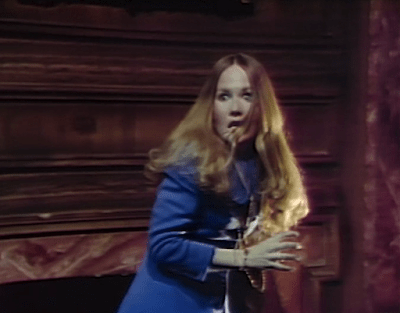
Today, the second half of the episode is virtually a one-woman show featuring Nancy Barrett as heiress Carolyn Collins Stoddard. Carolyn is being tormented by haunted house-style effects resulting from her involvement with a supernatural entity. The script, by Gordon Russell, recycles elements of #361, #658, and #897.
Russell was usually one of the most careful writers on Dark Shadows, but this one is remarkably shoddy. Carolyn and her mother, matriarch Liz, are staying at the home of a woman named Angelique. Angelique tells them that she has to drive to the airport to pick up her husband, and that she will be away for “several hours.” A couple of minutes later, Liz is also called away, and she tells Carolyn that she is sure “Angelique will only be gone an hour or so.”
Worse, all the action of the episode is completely, flagrantly unnecessary. The calls that leave Carolyn alone in the house are part of a monster’s scheme to get at Carolyn. But Liz is the monster’s loyal servant- if he had told her to bring Carolyn to him, she would gladly have done so.
Carolyn’s torments aren’t quite a monodrama, since they are interrupted by a couple of brief scenes with other actors. But one of those is a dream sequence in which she talks to the monster while we see him silhouetted in darkness. The interaction between them is so limited he may as well be a recorded voice. She also has a few interactions with Angelique’s husband. Since he is played by Geoffrey Scott, he may as well be a cardboard standee.
One advantage this episode has over #361 is that Nancy Barrett was excellent at screaming, second only to Clarice Blackburn in her ability to produce a true blood-curdler. Grayson Hall, accomplished as she was, had asthma and was physically incapable of controlling the timbre of her voice when she raised its volume above a certain level. Sproat’s script for #361 required Julia to scream several times, and every time she tried it Hall emitted a croaking sound that raised a bad laugh. Miss Barrett’s closing scream today, by contrast, really puts the “opera” in “soap opera,” it sounds great.
This is one of the few episodes with no scenes on the estate of Collinwood, and one of very few to take place primarily in a location many miles from the village of Collinsport.
There’s also an interesting moment when Angelique claims to have met Liz and Carolyn’s distant cousin Barnabas while they were both living in England. Barnabas never lived in England, that’s a lie he has been telling his relatives to conceal the fact that he is a recovering vampire who hasn’t left Maine since George Washington was president. Liz is part of the current supernatural storyline and Carolyn has at various times known all about Barnabas, so we don’t expect to be reminded that he’s still peddling the “cousin from England” bit.
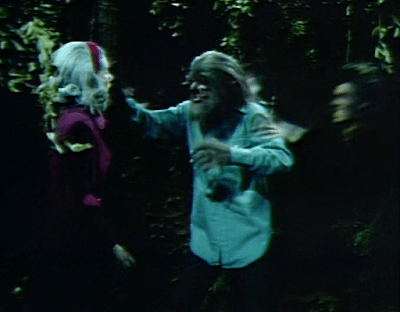
A werewolf is prowling through the woods on the great estate of Collinwood, and Sabrina Stuart, a young woman with white hair, sees him. She knows that when the moon is not full, the werewolf is her ex-fiancé Chris Jennings. She screams at the sight of him. This would be an understandable reaction if the werewolf were scary looking, but since he is a man whose face and hands are covered with hairy makeup appliances while the rest of him is wearing clothes, he is a just cute little doggie who might like a bickie. Television, they say, is a visual medium; that means that the images you put on the screen will stimulate the audience’s imaginations. If you are telling a story about a monster, you must show only enough of him to get them to wonder what terrible things he might do. Once you’ve shown so much that they start to laugh, you’re sunk.
Sabrina composes herself, and tries to reason with the werewolf. He stands there listening to her attentively, being the goodest little boy. This ends when a man emerges from the brush and jumps him. The man shoots the werewolf, who yips and runs away. Sabrina is upset with the man, who is surprised she does not regard him as her rescuer. She identifies herself by name.
The man’s name is Bruno, and he works for another monster, one whom we see only when he is masquerading as a young man. That monster once said he wanted to be called Jabe, but everyone very inconsiderately keeps calling him Jeb instead. Jabe has told Bruno that he is vulnerable to werewolves. Bruno disregarded Jabe’s report that only silver bullets can kill a werewolf, and fired regular ammunition. Jabe is upset about this.
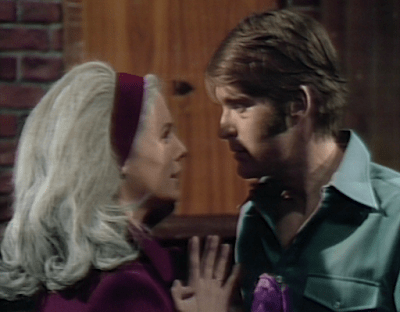
Bruno tells him all is not lost. Since Sabrina was not afraid of the werewolf, his human form must be that of a man to whom she is close. Bruno says Sabrina has a brother, and thinks out loud that he ought to just go ahead and kill him. Regular viewers know that Sabrina’s brother, though he is not a werewolf, is a character played by Roger Davis, so we’re all for Bruno’s idea. But Jabe vetoes it, saying that if a werewolf is killed while in human form he will turn into the wolf and remain in that form forever. That’s new information on Dark Shadows, though there had been so many werewolf movies by 1970 I can’t imagine it was original.
Old world gentleman Barnabas Collins stops by the antique shop where Jabe lives. Barnabas had been the leader of the cult that serves Jabe, but has become disaffected. Jabe knows this. Each wants to kill the other, but neither has been able to make a substantive move. Jabe demands Barnabas do something about the werewolf, in the process exposing his vulnerability. Barnabas is friendly with Chris and knows all about him, so this exposure makes it possible for him and Jabe to join battle.
In the closing credits, writer Violet Welles’ name is misspelled “Wells.” Today’s script is not up to her usual standards; maybe “Violet Wells” was her guild-approved pseudonym.
Maggie Evans, governess in the great house on the estate of Collinwood, is being held prisoner in a big mausoleum somewhere. Her captor appears to be a young man, but is actually a monster from beyond space and time. He is associated with the Leviathan People, a race of Elder Gods who are planning to take the earth away from humankind with the aid of some people whom they control and whom they have formed into a cult. The cultists call the monster Jeb, even though when we first saw him he said he wanted to be called Jabe.
Jabe orders Maggie to open a wooden box and look inside. He makes it clear to her that she is supposed to be under his control after she has done this, so she plays along. He lets her go, with orders that she is to spy on old world gentleman Barnabas Collins, a leader of the cult who has become disaffected from it and is working against Jabe.
Back in the great house, Maggie tells Barnabas what happened. Barnabas’ best friend, mad scientist Julia Hoffman, enters; he tells Julia that Maggie is their new ally in the fight against the Leviathans. When Barnabas was still loyal to the Leviathans, he tried to absorb Julia into the cult. That effort failed, and Barnabas explained that “certain people” were immune from absorption because of their “genetic structure.” Since Julia is the only Jewish character on the show, this sounded jarringly like a claim that the Leviathans were a restricted club. Evidently Maggie is now among those “certain people.” Since Maggie has a Welsh name and is played by a Minnesota-born actress of Scandinavian descent, that retroactively takes some of the anti-Semitic edge off Barnabas’ earlier remark for viewers who remember that episode (unless she converted.)
Maggie had taken an apologetic tone when she told Julia she wanted to be alone with Barnabas; Julia is very circumspect when she comes in at the end of their conversation. For a long time now, the show has been working on the idea that Julia wants a romantic relationship with Barnabas and is sad that he does not share her desire; for the last couple of weeks, they have been hinting that Barnabas and Maggie are getting pretty cozy. Regular viewers will be interested to see Grayson Hall playing Julia being a good sport about losing Barnabas to Maggie, and Kathryn Leigh Scott playing Maggie wishing she didn’t have to hurt her friend’s feelings.
We learned yesterday that Jabe is vulnerable to werewolves. As luck would have it, there is a werewolf at large in the Collinsport area. He is Chris Jennings, and Barnabas and Julia have been trying to cure him of the effects of his curse. He had been spending the nights of the full moon in a cell at Windcliff, a mental hospital Julia is in charge of, but last month came back to the caretaker’s cottage on the grounds of Collinwood. He couldn’t stand being cooped up, and chose to go back to his old practice of killing someone at random every month.
Julia and Barnabas don’t know that Chris is a weapon they can use against Jabe, and they want him to go back to Windcliff. The moon will be full tonight, so they are particularly anxious. But his onetime fiancée, Sabrina Stuart, has a different idea. She has been in contact with an expert on lycanthropy, and he has shipped her the only surviving specimen of the Moon Poppy. She brings the potted plant to Chris and tells him that the flower will open when the moon starts to rise. If he eats it while it is blooming, he will be cured. Otherwise, he will lose his chance- the plant will be dead before morning.
Chris’ transformation begins with moonrise, and once he has become the wolf he has no will of his own. When Barnabas stops by to take him to Windcliff, he points this out to Chris. But Chris is determined to try Sabrina’s cure. He is like every addict who talks himself into believing that this time, it will be different. Of course his determination fails him at the last moment, and by the time he can reach for the opening flower, it is a hairy paw, not a hand, that stretches towards it.
The flower cure and Chris the unlikable protagonist are both borrowings from the 1941 film The Wolf Man. Jabe lives in an antique shop; there’s an antique shop in that movie, too. There were some hints early on that werewolves were a threat to the Leviathans; evidently they had planned to bring these two stories together all along.
Closing Miscellany
Sometimes the closing credits are on cards, one after another; other times, they are on a continuous roll. Through the first year of the show, when they were on a roll costume supplier Ohrbach’s would be misspelled “Orhbach’s.” We haven’t seen that misspelling for a long time, but it’s back today. It will keep cropping up for the rest of the series.
Barnabas and Julia find a fake letter from Maggie saying that she’s been away visiting her Aunt Louise in Quebec. This is the first time we’ve heard of any members of Maggie’s family other than her late parents. Since the letter is a phony meant to cover up her abduction and neither Julia nor Barnabas seems to have heard of Louise before, it is possible there is no such person. Still, Maggie has been a major character since the first episode, so it does get longtime viewers thinking about how little we know about her background.
This is only marginally relevant to the episode, but I can’t resist bringing it up. The other day, a Twitter user named Zach Wilson (whose bio describes him as “watcher of TV, all of it, one episode at a time”) posted an image of pages of TV Guide from 22 April 1966 with the question “What would you watch?” An Educational TV station in whatever market it was running a WGBH-Boston produced telecast of the Boston Theater Company’s production of Gertrude Stein’s “Yes is for a Very Young Man,” starring Lisa Blake Richards. The Harvard Crimson had reviewed the stage production in November 1965; they said that “the play was lousy,” but they praised the cast for making the most of a bad script, singling out Miss Richards for the “outstanding job” she did “with a whining, pathetic character.” Sabrina isn’t exactly Lady MacBeth, either, and Miss Richards had her work cut out for her finding a way to make us want to see more of her.

 Dark Shadows Commentary