Nineteen weeks ago, well-meaning governess Vicki disappeared from a séance in the drawing room of the great house at Collinwood and found herself in the year 1795. Her miserable failure to adapt to her new surroundings led to her conviction on charges of witchcraft. At the end of Friday’s episode, we attended her hanging.
Today we begin with an unusually long opening voiceover. These typically end before we see the actors; only a couple of times have they picked up again after a scene. This episode marks the first and only time the narration resumes after the opening title. It is necessary- they have to explain that what’s happening to Vicki in the 1790s is somehow simultaneous with the séance in the 1960s.
When Vicki disappeared in #365, a woman named Phyllis Wick materialized in her place. Now, we cut back and forth between the hanging and the séance. Phyllis clutches her neck and cries out in pain as the rope tightens around Vicki’s neck. Then Victoria reappears in the drawing room, wearing the dress she wore in the 1790s and bearing the wounds she sustained then. Back in the eighteenth century, the hangmen remove the hood they had put on Vicki and see Phyllis’ dead face underneath.
It’s a standard of stage magic for the magician to get into a box, for the box to be sealed tight, and for the magician’s assistant to be the one who gets out when the box is opened. That gag may not have been so familiar in the eighteenth century, but the inexplicable substitution can hardly undermine the certainty the executioners feel that Vicki was a witch.
By the end of the scene in the drawing room, first time viewers will be very largely caught up on what was going on when Vicki left in November. Before Vicki even appeared, we learned that Barnabas Collins recognized Phyllis Wick and was alarmed to see her, telling us that he is an interloper from the past trying to conceal a secret. Permanent house-guest Julia Hoffman announces that she is a medical doctor. Julia apologizes to Liz for having concealed this fact, which not only lets us know that she did conceal it but also tells us that the house belongs to Liz. Julia and Carolyn exchange frosty words, making it clear that they are enemies. Julia is even chillier to Barnabas, while Barnabas and Carolyn exchange a conspiratorial look. In contrast to all of these promises of drama, the reasonable observations Roger makes and his straightforward helpfulness suggest that he hasn’t been an active part of a storyline for some time.
The scene in the drawing room does not match the one Vicki left. Everyone is sitting in a different spot, the conversation after Vicki disappeared doesn’t seem to have played out the same way, and Phyllis is played by another actress. The Dark Shadows wiki has some fun with this, saying that the changes “can be rationalized as a changed history due to Victoria’s presence in [the] past.” This is the kind of theory that I enjoy very much, but I’m afraid it doesn’t work. If Vicki has come to a later stage of the time-band in which she spent the last nineteen weeks, Barnabas would remember her, not Phyllis, as his little sister’s governess.
As it is, Barnabas is desperate to find out what Vicki learned when she was in the era that holds the key to his secret. Julia leaves Vicki alone for a moment, and Barnabas appears at her bedside. She talks to him in a quiet, urgent voice about her fragmentary recollections of the 1790s. Alexandra Moltke Isles’ performance in this scene is so beautiful that I can’t imagine it failing to touch even the most shriveled hearts.
We end with Barnabas telling Carolyn that if Vicki knows enough to be a threat to him, he will stop at nothing to silence her. When Carolyn asks what he means, he repeats his ominous vow.
There are many line bobbles and a couple of physical stumbles today. Most obvious is a moment when Grayson Hall, as Julia, stumbles over a piece of metal equipment while entering Vicki’s room. But the whole thing is so well-structured and the actors are so completely into it that none of them bothered us.
In #365, well-meaning governess Vicki came unstuck in time and found herself in the year 1795. Now, Vicki is about to be hanged for witchcraft, and the last of the story threads that have been playing out around her are about to be tied up.
Yesterday’s episode ended in the study at the great house of Collinwood, where naval officer/ sleazy operator Nathan Forbes shot a wooden bolt from a crossbow into the chest of vampire Barnabas Collins. At the top of today’s episode, Barnabas pulls the bolt out, telling Nathan that the bolt didn’t hit him. Barnabas’ voice is dubbed in over this, clarifying that Nathan missed his heart. We then switch to Nathan’s point of view and see Barnabas approaching for the kill.
After the opening title, we see that Barnabas is still in the study. Time has apparently passed. Barnabas’ father Joshua enters. Barnabas asks him if Nathan has been buried. Joshua says that he has, and lists the stories that he will tell to cover up all the deaths that Barnabas has been involved with over the last few months. Barnabas wants Joshua to shoot him through the heart with a silver bullet right now and destroy him forever. Joshua cannot do that, but he promises that he will put Barnabas out of his misery come daylight, when he is in his coffin. Barnabas asks two more favors of his father, that he free much put-upon servant Ben and that he prevent the execution of the wrongly convicted Vicki. Joshua promises to do these things as well.
Throughout this scene, actors Louis Edmonds and Jonathan Frid hold back tears. Patrick McCray remarks: “Crying is not the most powerful thing an actor can do on stage. Rather, it is the attempt not to cry that seizes audiences. In these moments, Frid and Edmonds seize. In a medium of love scenes, there is none more poignant.”
The performers have a powerful theme to work with, one that Danny Horn explicates when he considers the question of why Joshua is still alive at the end of this storyline. When she made Barnabas a vampire, wicked witch Angelique decreed that everyone who loved him would die. Yesterday, Joshua confessed that he feared he was incapable of love, and Barnabas told him that such a disability might save his life. But when we see Edmonds and Frid struggling against the urge to weep, we know that Joshua loves Barnabas very deeply indeed, as we have in recent weeks seen that he loved others he has lost. Danny explains:
The reason why Joshua is spared from the curse is that the love he feels for Barnabas isn’t the kind of love that Angelique recognizes, and so he slips under her radar.
Angelique’s love is selfish, and spiteful. She uses it as a convenient excuse for running over anyone who gets in her way. She doesn’t understand love that arises from respect, and strength of character. And she will never feel the kind of deep, honest love that Joshua now realizes for the first time that he is in fact capable of.
Danny goes on to explain that, while others had love for Barnabas that included a selfless element, there was also something in their feelings that Angelique could recognize, while Joshua’s love for him comes entirely from this higher plane. The portion of Dark Shadows set in the years 1795-1796 turns out to be The Tragedy of Joshua Collins, not only because Joshua has the highest social status among the characters, makes the most important decisions, and is played by one of the best actors, but because he grows into the sort of person who is governed by this kind of love. When the world around him is being ground down into dishonesty and cheapness, largely due to the consequences of his own misguided actions, Joshua discovers a new kind of strength within himself. Even amid the ruins of a world he himself did as much as anyone to wreck, Joshua represents the hope that something better might yet come into being.
After daybreak, Joshua stands beside Barnabas’ coffin in the secret chamber hidden inside the Collins family mausoleum, the pistol in his hand. Joshua cannot bring himself to fire the silver bullets into his son’s heart. Ben enters. Joshua orders him to affix a silver crucifix to the inside of the coffin to immobilize Barnabas there, and then to chain the coffin shut. Joshua and Ben assure each other that Barnabas will never be released. Later, we see Ben in the chamber, alone with the chained coffin. He looks at it and says “Goodbye, Mr Barnabas, goodbye.” Thayer David delivers that line with an unforgettable simplicity.
Returning viewers know that Joshua’s plan to keep Barnabas confined will work only until April of 1967, when Barnabas will be freed to prey upon the living once more. That July, in #276, Barnabas will stand in the hidden chamber and say that, while in chaining the coffin rather than destroying him his father “thought he was being merciful, what he did was no act of mercy.” This remark, combined with a story he told Vicki in #214 about his conflict with Joshua, just may have been the germ from which the whole story of Joshua grew. At any rate, the promise ABC-TV made to its viewers when it aired this promotional spot in November 1967 has been fulfilled:
Back in the study, Joshua frees Ben and gives him a severance packet of $100, worth about $2500 in 2024 dollars. When Ben thanks him for his generosity, Joshua denies that he is being generous. I have to agree with Joshua there- that amount might get a fellow out of town, but he’d have to find a new job pretty fast if he wanted to stay in the habit of sleeping indoors.
Another servant brings a note while Joshua and Ben are in the study. The governor has refused Joshua’s plea that Vicki’s execution be stayed. She will be hanged tonight.
At the gaol, Vicki’s boyfriend, an unpleasant man named Peter, is brought to her cell. The gaoler tells them they have five minutes before Vicki will be taken to her death. It is little wonder Vicki’s last request was to have time with Peter. Spending five minutes with him is like living to a ripe old age. Peter vows to overcome death and reunite with her. The last time we heard that was when Barnabas died the first time. In #409, he used his dying breaths to ask gracious lady Josette to wait for him to return to her. Fool that she was, Josette did, leading to disaster for her. Returning viewers may well wince, not only at the ominous parallel with Josette’s grim fate, but also at the memory of the many tedious scenes in which Josette at first insisted that Barnabas was coming back and was then at a loss when asked to explain herself. Besides, we don’t want to see any more of Peter.
The scene of Vicki’s hanging is quite elaborate by Dark Shadows standards. They’ve built a fairly realistic gibbet, hired several extras, put hats on them, and given them burning torches to hold. They test the equipment with a heavy sack, slowly lead Vicki to the place of honor, ask her if she wants a mask, and command the Lord to have mercy on her unrepentant soul. The camera drifts up to the top of the rigging, leaving Vicki out of the shot. When the time comes, we hear the drop and see the rope tighten.
This marks the end of the 1795 flashback, but not necessarily of Dark Shadows 3.0. In #437, Vicki told Peter that she often had nightmares in her childhood, so often that she became a connoisseur of nightmares. She would stay asleep throughout the whole process, waking up only at the very moment she was about to be killed. That was a rather heavy-handed way of telling the audience that Vicki would ascend the gallows, put her head in the noose, and find herself back in the 1960s. Once she is back in her own time, what she has learned in the 1790s will have consequences for what she does next. So we can expect an epilogue of some kind before Dark Shadows 4.0 begins.
Like every episode of Dark Shadows, this one begins with a voiceover by a member of the cast. Unlike all the preceding voiceovers, this one is delivered by a man. Thayer David does the honors.
We open in the drawing room of the great house of Collinwood. For the first time in months, Barnabas Collins is there. Barnabas died and rose as a vampire in January, and has been concealing his existence since. But now his secret is known to several people in the house. One of those, his mother Naomi, reacted to the knowledge by taking poison. In his agony, Barnabas is pacing the floor, complaining to his friend, much put-upon servant Ben, that the doctor hasn’t come. Barnabas’ father Joshua comes downstairs and announces that there is no longer any need for a doctor- Naomi has died.
Joshua dismisses Ben and talks with Barnabas. He confesses his doubts that he is able to love anyone. Barnabas tells him that such a disability might save his life- the curse wicked witch Angelique placed on him means that everyone who loves him will die. Joshua says that he must end the curse, and will do so by destroying Barnabas. Barnabas asks if he will drive a stake through his heart. Joshua replies that he found a book in Boston that tells of another way. Come morning, he will fire a silver bullet through Barnabas’ heart.
This is the first we have heard that silver bullets will kill vampires. There is some lore that suggests vampires avoid silver, but we know that doesn’t apply to Barnabas- one of his chief trademarks is a cane with a mostly silver handle. The 1941 film The Wolf Man established silver bullets as a means of killing werewolves, and the Lone Ranger fires silver bullets to knock the guns out of the bad guys’ hands, so I guess they might have come to mind in the 1960s if you were thinking of exotic weaponry.
Barnabas has plans for his final night. It was naval officer/ sleazy operator Nathan Forbes who led Naomi to discover Barnabas’ secret, and who is to that extent responsible for her death. Ben enters to inform Joshua and Barnabas of another item to add to the list of Nathan’s misdeeds. Nathan has evidently apprehended bewildered time traveler Victoria Winters and taken her into town, where she faces death on the gallows after being unjustly convicted of witchcraft. The Collinses knew Vicki to be innocent and had been harboring her since shortly after she escaped from gaol. Joshua and Barnabas are certain that Nathan turned her in solely to collect the reward that has been posted for her capture. Barnabas vows to kill Nathan, and Joshua can’t talk him out of it.
We cut to Nathan in the Eagle tavern, where he is spending the money he sold Victoria for. The Eagle has changed pretty dramatically in the last several weeks. In #419, bartender Mr Mooney greeted a female patron with the announcement that the Eagle did not admit unaccompanied women. Since the Eagle is a public house on the waterfront, the management evidently thought this policy was necessary to keep the place from becoming a headquarters for the sex workers of Collinsport.
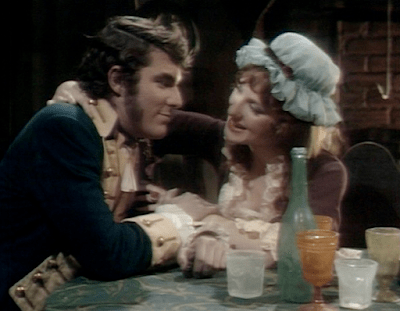
Now Mr Mooney is nowhere to be seen, and the only person in the barroom with Nathan is identified in the closing credits as “Barmaid.” She is played by Rebecca Shaw, whom we saw the other day as a streetwalker whom Barnabas was about to bite when good witch Bathia Mapes summoned him away with a magical incantation. She is sitting with Nathan, drinking with him, and flirting with him pretty heavily. A bat squeaking at the window frightens her, and when she catches her breath she announces that she will be leaving him alone in the bar for a bit while she lies down. Nathan replies to that by saying he will see her soon, and she turns to take a look at him, apparently expecting him to follow her to bed. It seems possible she is the same character who was working the docks, now employed in a similar capacity in the Eagle. If this is the person who has taken over from Mr Mooney, the management must have given up the hopes it formerly had for its reputation.
Once the woman leaves Nathan alone, Barnabas appears. He confronts Nathan about his many crimes. Nathan pulls a gun and tells Barnabas he will take him to the constable and turn him in as the Collinsport Strangler. Barnabas jeers. Nathan shoots, and Barnabas keeps standing there. He declares that Nathan cannot kill him, because he is already dead. He then informs Nathan that he will wait until 9 pm to kill him. Since it is now 8:30, this does not give Nathan a great deal of time.
At 8:45, Nathan appears at Collinwood. He finds Joshua and Ben in the drawing room, and tells them what has happened. They are neither surprised nor sympathetic. Joshua leaves the room, explaining that he would prefer not to see a gruesome murder. Ben is willing to stay for a while. When Nathan asks how Barnabas can be destroyed, Ben decides to have a little fun. He tells him that if he finds Barnabas resting in his coffin after sunrise and drives a wooden stake through his heart, that will take care of it. Ben is quite jolly when he points out that Nathan will be dead long before sunrise, so that this information would seem to be of little practical use to him. Ben then decides that he doesn’t want to watch the murder either, so he also takes his leave of Nathan.
With five minutes to go, Nathan tells himself that Barnabas will not kill him if Joshua is in the room. He finds Joshua in the study. He begs Joshua to stay. As Joshua is refusing, Nathan looks at the wall and sees a crossbow mounted there, with three wooden bolts next to it. Suddenly his cowardice gives way to wild hope. He tells Joshua he will wait in the study for Barnabas. Joshua goes.
Nathan takes a practice shot at the door, then stands waiting. Barnabas does open the door, Nathan does release another bolt, and does strike him in the chest, a bit to the left of the sternum. Barnabas cries out in pain, and as the episode ends it looks very much as if Nathan may have managed to stake him.
Barnabas is the reason the show is a hit, so we can be quite sure he won’t actually die. Still, the episode is good enough that it feels for a moment that he might. The contrast between the prospect of Joshua killing Barnabas in the stately manner he described earlier in the episode and the idea of Nathan killing him is instructive. Had Joshua carried out his plan or even attempted it, the result would have been what Aristotle was talking about in his Poetics when he described the majestic terror of tragedy. It would have been at once horrifying and awe-inspiring to see a father duty-bound to kill his son. But Nathan is a cheap bum, trying only to save himself so that he can live to abuse and exploit more people. When we root against Nathan destroying Barnabas, we do not want only to continue the pleasure of watching the show. We are rejecting a resolution that would be unworthy of what we have seen so far.
Nathan, indeed, is unworthiness incarnate. When he was first on the show, Nathan was a likable rogue, but in recent weeks he has become both cruel and dreary. So cruel that he has tried to arrange the murder of an eleven year old; so dreary that he works through a conspicuously dim-witted, relentlessly unappealing henchman. Many fans complain about Nathan’s turn, and some speculate that the show just ran out of villains sinister enough to be worthy of Barnabas’ vengeance. On that theory, Nathan’s grave crimes are a last-minute, slapdash invention.
I don’t agree. We met Nathan before Angelique came to Collinwood. In those days, there was room for light comedy, for grand gestures, for dashing heroism, for fairy tale whimsy, and for tender romance. But as her curses have done their work, everyone and everything has been ground down. The ceiling has been lowered, and there is no longer space for the bouncy good cheer of the Old Nathan, much less for the Satanic majesty of villains like Angelique or that Rev’d Mr Trask. The whole world is pervaded by cheapness and sordidness now, and growing more so by the minute.
The only grandeur left is in The Tragedy of Joshua Collins. Were Nathan to destroy Barnabas, that grandeur would vanish, not in sublime pity, but with a taunt. That would be a harsh ending indeed.
Naomi Collins (Joan Bennett) has learned that her son Barnabas, whom she knows to be dead, gets out of his coffin at night and kills people. At the end of yesterday’s episode, she saw Barnabas bite his second cousin Millicent on the neck and suck her blood.
The year is 1796, and Naomi has never heard of vampires. She is in a daze about the whole thing. It is clear to her that her husband Joshua has been keeping the truth about Barnabas from her. Though Joshua’s habit of concealment has led to one disaster after another, Naomi accepts that in this case it was his way of expressing love, and she embraces him. She asks Joshua to explain what has happened to their son; he says he doesn’t really understand it, and isn’t sure it would help if he did.
Naomi is hiding bewildered time-traveler Vicki. In the parts of Dark Shadows set in the 1960s, Joan Bennett plays matriarch Liz. The show has been hinting heavily since episode #1 that Vicki is Liz’ unacknowledged daughter. They never make that point explicit. They have no reason to. Liz so completely treats Vicki like a daughter that nothing of any importance would change if the biological relationship were confirmed. Nor would any particularly exciting story possibilities open up if it turned out Vicki were not Liz’ daughter. In the early days of the show, there were a few hints that Vicki might have a doomed romance with Liz’ brother Roger, but they’ve long since made it abundantly clear that no such thing was in the cards,* and nothing else about Vicki would change if she turned out to have a different mother.
Naomi’s attitude to Vicki echoes Liz’ maternal affection. Naomi stood up to the tyrannical Joshua, apparently for the first time ever, to insist that he retain Vicki as governess to their daughter Sarah. She defied Joshua again to testify on Vicki’s behalf during her trial for witchcraft. Now Vicki is a fugitive from justice, escaped from gaol and facing a death sentence, and Naomi insists on harboring her. When Naomi decides that Barnabas’ condition leaves her no choice but to commit suicide, she goes first to Vicki and then to Barnabas, speaking to each in the same motherly tone and giving each the same motherly embrace. Throughout the eighteenth century flashback, the characters have served as mirrors of those played by the same actors in the contemporary segments, and in Naomi’s effective adoption of Vicki we see a clear reflection of Liz.
Naomi’s suicide also harks back to Liz. Naval officer/ sleazy operator Nathan Forbes is using Barnabas’ condition to blackmail the family, and that blackmail is one of the things that pushes Naomi hardest towards self-destruction. From March to July of 1967, Liz was blackmailed by another maritime scalawag, seagoing con man Jason McGuire. In her despondency over what Jason was doing to her, Liz three times had to be kept from throwing herself to her death from the cliff on Widow’s Hill.
Closing Miscellany
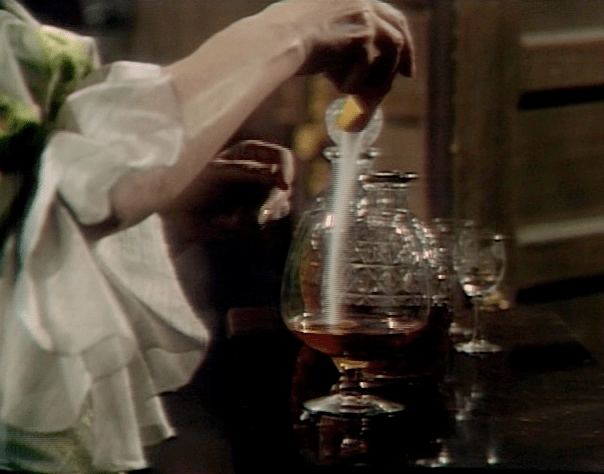
Whatever poison Naomi has decided to take must not be very potent. She pours about a cup of it into her brandy and is still able to stroll over to visit Barnabas and have a long conversation with him before she dies.
What is that, enough salt to cause a life-threatening case of high blood pressure? Screenshot by Dark Shadows Before I Die.
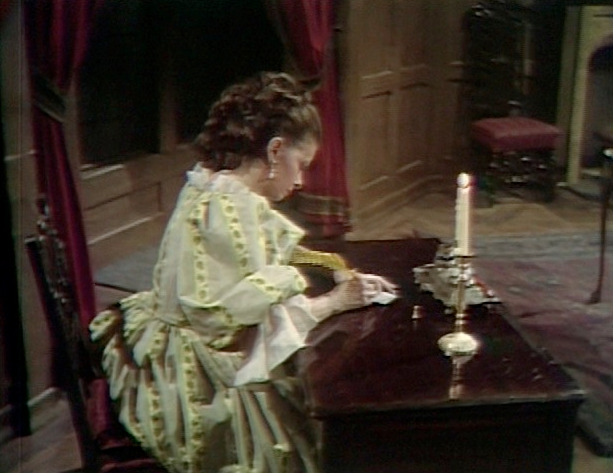
Naomi writes a suicide note and leaves it for Joshua. This raises a question. When did Naomi become literate? When first we saw her, in #366, the show went out of its way to make sure we knew that she could not read even the simplest text, but now she dashes off what appears to be a substantial message in calligraphic script. Naomi has been growing more assertive as time has gone on, but we haven’t seen her learning to read and write, as we saw Barnabas giving much put-upon servant Ben a writing lesson in #375.
When Naomi is taking poison, there is some music that I don’t remember. I’m not sure if it is new, or if we just haven’t heard it played in full for a while. It features some pretty impressive theremin playing.
*Much to the dismay of Vicki/ Roger shippers like Tumblr user WidowsHill, creator of fine artworks such as these:
Images and text by WidowsHill, posted on tumblr 17 March 2024.
This is the first episode of Dark Shadows credited to a director other than Lela Swift or John Sedwick. It is also the first production of any kind directed by Dan Curtis, the series’ creator and executive producer. Curtis’ inexperience shows at several moments when the camera is in an awkward spot or the actors are unsure what to do, and in his post about the episode on Dark Shadows Every Day Danny Horn documents several of the more egregious examples with screenshots and detailed analysis. The impossible deadlines and tiny budget on which Dark Shadows was produced meant that even Swift and Sedwick, who were seasoned professionals and ambitious visual artists, sometimes had to turn in work that wasn’t much better than what first-timer Curtis manages today, and longtime viewers of the show will take even his worst stumbles in stride.
At the top of the episode, it is daytime, and much put-upon servant Ben Stokes (Thayer David) finds the lady of the house, Naomi Collins (Joan Bennett,) standing at an open coffin that holds the corpse of her son, Barnabas. Ben knows that Barnabas is a vampire who will rise at night to prey upon the living. Naomi has never heard of vampires. All she knows is that Barnabas is dead, and that his coffin has been moved from the family mausoleum to a room atop a tower in the mansion. Ben pleads with her to leave the room and to go with him back to the main part of the house.
Naomi questions Ben. Ben tells her that Barnabas has a “sleeping sickness,” and has been in a coma ever since the night he apparently died. Ben does not like to lie to Naomi, but her husband, haughty overlord Joshua, has judged that the truth would kill her, and Ben is governed by that assessment. He does tell her that the “sleeping sickness” is a symptom of a curse, that the wicked witch who placed the curse was Barnabas’ sometime wife Angelique, and that Joshua is in Boston trying to find someone who knows how to lift it.
Ben asks Naomi how she came to be in the tower room. She tells him that naval officer/ sleazy operator Nathan Forbes told her that Barnabas was being kept there, and also that Barnabas was responsible for the series of murders that had recently taken place in the town of Collinsport. At that, Ben vows to kill Nathan. To his chagrin, Naomi forbids him to do this.
In the part of Dark Shadows set between August and December of 1966, Bennett played reclusive matriarch Elizabeth Collins Stoddard and David played her fanatically devoted handyman Matthew Morgan. When well-meaning governess Vicki came unstuck in time and arrived in the late 1790s, she at first mistook Naomi for Liz and Ben for Matthew. This scene takes longtime viewers back to the days when Matthew was always on the lookout for someone who represented a threat to Liz’ interests and she was always sternly prohibiting him from murdering anyone for her sake.
Ben is a far saner man than Matthew ever was; the contrast between them shows the effect that growing up in Collinsport, a town suffering from the consequences of a curse that has been working its way for many generations, has had on Matthew’s personality. While Ben is a brave, kind-hearted fellow whose fierce loyalties sometimes overpower his good sense, Matthew is a paranoid ogre who kills Liz’ friend Bill Malloy and tries to kill Vicki. It isn’t just one family that will be warped by Angelique’s curse. It will breed monsters everywhere the Collinses’ influence prevails.
Naomi then turns her attention to the B-plot. Nathan has married fluttery heiress Millicent Collins, only to find that Millicent has signed her share of the Collins fortune over to her little brother Daniel. Nathan responded to that news by crafting a plot to murder Daniel. His first attempt failed when Noah Gifford, the henchman he hired to abduct Daniel and drown him, fell afoul of Vicki. Vicki found Noah strangling Daniel near the place where she was hiding, having escaped from gaol, and shot him to death. After that, Daniel and Vicki went back to the mansion and told Naomi what they knew. Naomi recognized Daniel’s description of his attacker as a man she had seen with Nathan earlier, and realizes that Nathan is trying to murder the boy. So she orders Ben to take Daniel into town to stay with the Rev’d Mr Bland, a clergyman who looks like a duck.
Naomi confronts Nathan, who keeps telling her that whatever Barnabas might look like during the day, he gets up at night and goes out to murder people. She tries to shut him up, but later she is still wondering whether she should go back to the tower room after dark to check his story out.
She sees Millicent standing in the foyer, staring at the portrait of Barnabas that hangs there. The portrait of Barnabas first appeared under the closing credits in #204, and from #205 on it figured as a means through which Barnabas could communicate with the living. Barnabas bit Millicent the other day, and she hears him summoning her.
Among the 1960s characters who receive their commands from the vampire while staring at the portrait is Liz’ daughter Carolyn, who like Millicent is played by Nancy Barrett. Millicent at times evoked an early version of Carolyn. Until the spring of 1967, Carolyn was tempestuous and irresponsible, sometimes friendly to point-of-view character Vicki, sometimes hostile to her. Millicent is as timid and overly dependent as that version of Carolyn was headstrong and self-centered. One way or another, each is a Spoiled Heiress, and evidently that’s a favorite meal of Barnabas’.
Naomi follows Millicent to the gazebo on the grounds of the estate. There, she sees Barnabas. She is stunned that the son whose corpse she was looking at just a few hours before is up and moving. He bites Millicent, and Naomi lets out a scream. Barnabas looks up, and realizes that his mother has caught him in the act.
The vampire’s bite affects each victim differently. The first victim we saw was Willie Loomis, whom Barnabas’ bite transformed from a dangerously unstable ruffian to a sorely bedraggled blood thrall. Willie was at first gravely ill, then ran to Barnabas like an addict desperate for a fix, and eventually settled into life as a sorrowful servant who could not run away from Barnabas but could resist him to the point where Barnabas occasionally found it necessary to keep him in line with beatings.
The second victim we saw was Maggie Evans, The Nicest Girl in Town. She reacted very much like the first victim in the 1790s segment, gracious lady Josette, who, like Maggie, was played by Kathryn Leigh Scott. At first, those two were alternately blissful and snappish, happy to be under Barnabas’ power and defensive with anyone who might interfere with it. But each recoiled from him by the time it became clear he planned to kill her and make her into a vampire herself. Each escaped from him to the shore below Widow’s Hill- Maggie by running through an underground tunnel that rose to the shoreline, Josette by flinging herself to her death from the top of the cliff.
Later, Barnabas bit Carolyn. She initially contemplated his most gruesome crimes with pure glee and showed great energy as his protector and enforcer. Soon her conscience reappeared, but she was still doing his dirty work faithfully when Vicki disappeared into the past.
Millicent differs from all those others in that she simply continues to go about her business in between Barnabas’ meal-times. Granted, she was already deeply disturbed by that point, so that her business was conducted mostly in show-stopping mad scenes. But it’s still odd that she can talk to Nathan as if their marriage were the main thing in her life.
When we finished watching this one, my wife, Mrs Acilius, wondered if these differences were simply the result of the victims’ personalities coming through or if the vampire can pick and choose how to apply the pressure. He wanted Willie as a slave, and the reaction he produced gave him that. He wanted to turn Maggie into a reincarnation of Josette, and wound up getting the same reaction from Maggie that he had got from Josette. He bit Carolyn in a moment of desperation, with no plan in mind, and her reaction is complicated and volatile. He bit Millicent to keep her quiet, and her reaction is remarkably inconspicuous. Maybe we’re just supposed to think that Barnabas is fabulously lucky, but there is an opening there to tell a story about how him deciding what he wants to do to a person when he sucks their blood.
In 1966, the well-meaning Victoria Winters (Alexandra Moltke Isles) came to the great house of Collinwood to be governess to strange and troubled boy David Collins (David Henesy.) Throughout the first 25 weeks of Dark Shadows, Vicki gradually learned that David’s stories of ghosts and other paranormal phenomena were not signs of a disordered imagination, but were simple statements of fact. Once she came to terms with that reality, Vicki and David became the closest of friends.
Now it is 1796. Vicki has come unstuck in time. For a brief period she served at Collinwood as governess to the children there, including Daniel Collins (David Henesy,) with whom she became the closest of friends. Vicki’s signal failure to adapt to her new surroundings soon led her to be convicted of witchcraft and sentenced to death. She escaped from gaol and found a hiding place in the secret room of the Collins family mausoleum. Daniel joined her there.
Daniel, too, had been fleeing for his life. An unsightly man had abducted him. Daniel got away from him and made his way to the cemetery, where he had earlier seen Vicki duck into the mausoleum. When Daniel went out again, the man appeared and tried to strangle him. Vicki found out what was going on and shot the man to death.
Daniel and Vicki then left the cemetery and went to the great house. The lady of the house, Naomi Collins, believes that Vicki is innocent. Daniel is sure Naomi will help her.
Today, Daniel and Vicki arrive at the house, and Naomi does indeed hide them. The three of them are in the study when Daniel’s brother-in-law, naval officer/ sleazy operator Nathan Forbes, knocks on the door. Naomi hustles Vicki into a closet and lets Nathan in. Nathan dismisses Daniel’s claim that he was attacked, but when Daniel gives a description of his assailant Naomi realizes that it matches a man she saw Nathan with earlier. She is convinced that Nathan tried to do away with the boy.
She is correct. Nathan wooed Daniel’s sister Millicent for her money, only to discover after they were married that she had signed all of it over to Daniel. If Daniel dies, it reverts to her, which is to say to her husband. So Nathan set about scheming to have Daniel killed. As it was always dangerous to disbelieve David, so it would be dangerous to disbelieve Daniel.
When Naomi tells Nathan that the authorities will investigate Daniel’s story, he warns her against attracting the attention of the constable. He can see that she doesn’t know what he’s talking about. So he tells her that it is to do with her son Barnabas. Naomi declares that Barnabas is in England, repeating a lie that her husband Joshua commanded her to propagate. Nathan says that isn’t true. “So you know Barnabas is dead,” replies Naomi. Nathan denies that as well, and says that Barnabas has recently been murdering people in the town of Collinsport.
Naomi was in the house when Barnabas died and saw him in his coffin afterward, so she is not inclined to accept Nathan’s assertion. But Millicent keeps saying that she has seen Barnabas, Naomi thought she heard Barnabas’ voice the other day, and Joshua is obviously keeping some secret from her. So when Nathan tells her that Barnabas is in the room on top of the tower attached to the house, she can’t resist going up there to see for herself. At the end of the episode, Naomi is in the tower room, opening Barnabas’ coffin.
In Dark Shadows #316, broadcast and set in September 1967, strange and troubled boy David Collins (David Henesy) escaped from the hidden chamber in the Collins family mausoleum, only to find himself in the clutches of his distant cousin, Barnabas the vampire. He was spared from Barnabas’ murderous intentions when local man Burke Devlin happened by.
Today’s episode was broadcast in March 1968 and set in the 1790s. Young Daniel Collins (David Henesy) leaves the hidden chamber in the Collins family mausoleum, only to find himself in the clutches of a criminal named Noah Gifford. Daniel is spared from Noah’s murderous intentions when bewildered time-traveler Vicki, who was once Daniel’s governess, emerges from the hidden chamber and shoots Noah dead.
The contrast between the two scenes shows how much thicker the narrative texture of the show is in the 1790s flashback than it was before. In #316, David had accidentally got himself trapped in the hidden chamber. That led to a whole week of episodes where he was helpless and people looked for him, Barnabas with the intention of killing him because he overestimated how much David knew about him. Burke just chanced to be there at the right moment to rescue David. That was all there was to it, really, and once it was over it didn’t change the story very much.
But Daniel deliberately went to the hidden chamber because he was fleeing from Noah, who was working as an agent of naval officer/ sleazy operator Nathan Forbes. Nathan is married to Daniel’s sister, fluttery heiress Millicent Collins, and is scheming to get control of her money. Murdering Daniel is one part of that plan. Vicki is in hiding because she has been convicted of witchcraft, sentenced to die, and has escaped from gaol. She chooses to rescue Daniel at the risk of her own life because she loves him, and also because he will grow up to be the ancestor of the Collinses whom she knew in the 1960s. All of the characters involved in Daniel’s encounter with Noah know what they are doing, have chosen to pursue important goals, are brought together by the convergence of ongoing plot-lines, and take actions that propel the flashback segment towards its conclusion.
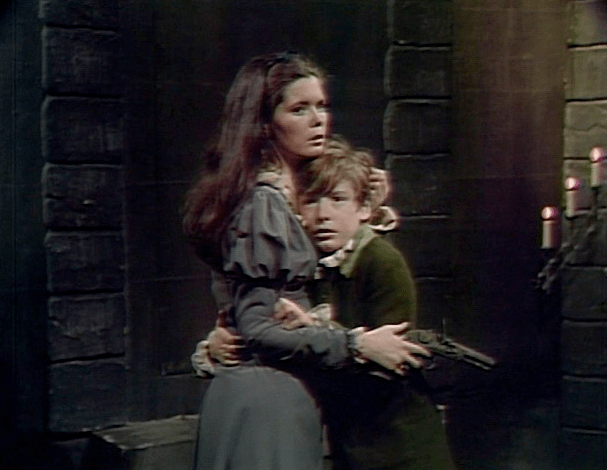
One of the themes Danny Horn developed on his great blog Dark Shadows Every Day was that the actors didn’t know how to handle firearms. Alexandra Moltke Isles provides several spectacular examples in today’s episode. Danny’s post about it includes several screenshots of Vicki pointing her loaded gun at Daniel, including one of her aiming it directly at his crotch. Since one of Vicki’s chief goals is safeguarding Daniel’s ability to someday produce offspring, this would seem to be a particularly maladroit gesture.
Throughout its first 38 weeks, Dark Shadows told the story of well-meaning governess Vicki and her attempts to befriend strange and troubled boy David (David Henesy.) This story reached its conclusion in #191, when David’s mother, undead fire witch Laura Murdoch Collins, beckoned David into the flames of a burning fishing shack. David ultimately fled from the shack, running into Vicki’s arms. Once David had chosen Vicki and life over his mother and death, there was nowhere for their story to go. Since there was nothing going on in any of the other narrative arcs on the show at that point, #191 marked the end of Dark Shadows 1.0.
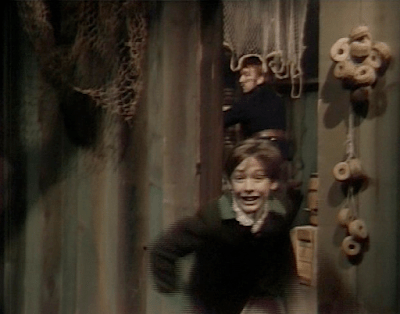
In #365, Vicki became unstuck in time and found herself in the year 1795. That inaugurated Dark Shadows 3.0, successor to the period when we got to know Barnabas Collins, vampire. Today’s opening voiceover tells us that the eighteenth century flashback is almost over. Longtime viewers will get this message not only from the voiceover, but from an echo of #191. Daniel Collins, played by David Henesy, runs from the fishing shack, thereby escaping from mortal jeopardy, and goes to Vicki in search of safety.
Vicki has utterly failed to adapt to the eighteenth century, with the result that she has been convicted of witchcraft and sentenced to death. With her repellent boyfriend Peter, Vicki has escaped from gaol. Fugitives Vicki and Peter are hiding out in the secret chamber hidden in the Collins family mausoleum when Vicki has a dream that young Daniel is about to be murdered by naval officer/ sleazy operator Nathan Forbes. Before Vicki’s witchcraft trial, she had been Daniel’s governess, and he is still her friend. He ran into her and Peter after they escaped from gaol, knows that they are in the mausoleum, and is faithfully keeping their secret.
Vicki has brought with her from the 1960s the knowledge that Daniel will be the ancestor of the Collins family she knew in her own time. She fears that her dream will come true, her young friend will die, and his descendants will never be born.
As it happens, Nathan is scheming to kill Daniel. Nathan has married Daniel’s sister Millicent. After the wedding, Nathan discovered that Millicent had signed her vast fortune over to Daniel. If Daniel dies, the money all reverts to Millicent. So Nathan summons his unsightly henchman Noah to a fishing shack on the grounds of the estate of Collinwood and demands that he abduct Daniel, put him on a boat, and throw him into the ocean. When Noah balks, Nathan threatens to go to the constable and turn Noah in for the crimes they have already committed together. The show has out of its way to demonstrate that Noah isn’t very bright, so it isn’t a complete shock that he would think it was safer to murder a child than to call Nathan’s bluff.
Noah finds Daniel in the woods, grabs him, takes him to the fishing shack, and tells him they will be taking a boat ride together. Noah is then distracted by the wind, allowing Daniel to run away and find refuge with Vicki in the hidden chamber.
Throughout her time in the 1790s, Vicki has made a series of attempts to prevent the terrible events recorded in the history of the Collinses. She has failed every time, and the past has fallen into the same shape it took when these events originally played out and a woman named Phyllis Wick was the governess at Collinwood. But by trying to save Daniel, Vicki is not trying to change the course of history- she is trying to preserve it. It is not explained whether Phyllis rescued Daniel in the first version of this history, or if Nathan’s murder plot was somehow the result of Vicki’s intervention. Either way, it reinforces the message of the opening voiceover. Vicki has now passed all of the tragic milestones of the period, and is left with nothing to do but to contain damage that she herself might have done. It is time for her to go home.
In December 1966, crazed handyman Matthew Morgan (Thayer David) abducted well-meaning governess Vicki and held her prisoner in a secret room behind the bookcase in the front parlor of the Old House on the estate of Collinwood. Vicki had run into Matthew there when she saw his dusty footprints leading up to the bookcase in #115. Vicki’s charge, strange and troubled boy David Collins (David Henesy,) did not know that Matthew had abducted Vicki, and was convinced that he had gone into hiding because he was unjustly accused of murdering local man Bill Malloy. So when David found out Matthew was in the Old House, he brought him food and water. In #120, David heard Vicki’s muffled voice behind the bookcase; in #123, he pulled the bookcase back and found her; in #124, he was too frightened to help her escape.
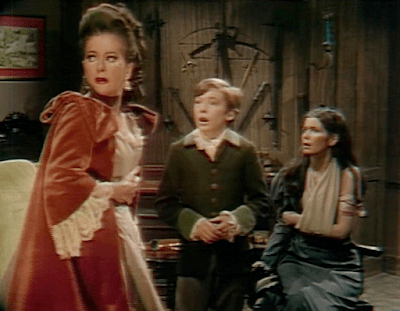
Now, Vicki has come unstuck in time, and found herself in the late eighteenth century. She made a promising start, landing a position as governess to the children at Collinwood, among them Daniel (David Henesy.) But she has adapted poorly to her new surroundings, so poorly that she has been convicted of witchcraft and sentenced to death. Accompanied by her boyfriend, an unpleasant young man named Peter, she has escaped from gaol. Vicki was shot in the arm while escaping, and is still bleeding. She and Peter have made their way to the Old House. There, much put-upon servant Ben (Thayer David) at once gives Vicki and Peter such help as he can.
When a knock comes at the door, Ben tells Vicki and Peter he will hide them. He goes to the bookcase, and Vicki whispers “The secret room.” When Vicki first saw Ben, they were in this parlor, and she was frightened because she mistook him for Matthew. In her hushed voice and the look of awe on her face when she sees Ben trying to save her life by putting her in the room where his Doppelgänger will try to kill her in 1966, Alexandra Moltke Isles’ Vicki conveys the thought that Ben and Matthew really are two versions of the same guy. Ben is a kind-hearted sort whose fierce loyalties sometimes overcome his good sense; Matthew a paranoid ogre whose single-minded devotion to matriarch Liz leads him to kill and menace those dearest to Liz. The difference between the two men begins in the events that have been taking place around Vicki in the 1790s. Ben grew up in the ordinary world of day and night, where natural laws apply and there is hope for goodness. Matthew has spent his whole life in a town laboring under an ancient curse. Matthew’s crimes would be the fruit of Ben’s virtues, had Ben been warped by the evil of centuries that hangs over the Collinsport of the 1960s.
While Vicki and Peter huddle in the secret room, Daniel bursts into the parlor. Ben tries to hurry him out, but the lad notices a trail of bloodstains leading to the bookcase. Before Ben can stop him, Daniel opens the bookcase and finds the fugitives.
Daniel is as convinced of Vicki’s innocence as David will be of Matthew’s, and he is eager to help her and her friend. Ben says he will take the fugitives to a safer hiding place, and forbids Daniel to follow them. Of course Daniel does follow them, and sees them enter the Collins family mausoleum in the old cemetery north of town. He cannot see inside, where Ben opens a secret panel and ushers Vicki and Peter into the hidden chamber behind. This chamber will be hugely important in 1967. Vicki will hear about it in that year after David, who spent a week trapped there ending in #315, tells people about it in #334. But David will be unable to show the chamber to Vicki or anyone else, and most adults assumed it was just something he had imagined. Vicki is astonished to see it today.
Daniel goes home to the great house of Collinwood, where his brother-in-law, naval officer/ sleazy operator Nathan Forbes, handles him roughly and demands to know where he saw Vicki. When Daniel denies having seen Vicki, Nathan asks him how he came to have a bloodstain on his sleeve. He tells Daniel that Vicki was wounded when she escaped from gaol, and declares that it is her blood on Daniel. He warns Daniel that it is a crime to withhold information about a fugitive. Daniel keeps denying everything.
Back in the hidden chamber, Vicki is asleep. She dreams that Nathan is trying to kill Daniel. Returning viewers know that this is in fact true. Nathan married Daniel’s sister, fluttery heiress Millicent, because wanted her vast fortune. He found out on their wedding day that she had signed everything over to Daniel. It has occurred to him that if Daniel should die, it will all revert to Millicent, so he is scheming to bring that death about. Vicki has been in gaol since all of this started; nothing she has seen or heard could have led her to conclude that Nathan was a threat to Daniel. We must take it as a message from the supernatural world. This is not the first time we have seen Vicki receive such a message while in a concealed place. In #126, when Matthew was bringing an ax to decapitate her, Vicki was visited in the secret room behind the bookcase in the Old House by the ghost of gracious lady Josette bringing her good news.
The segment of Dark Shadows set in the 1790s is nearing its end. They have killed off most of the characters, have stopped introducing new ones, and those who remain are all facing crises that can be resolved only by further reducing the number of people available to participate in the action. The echoes of #123 and #124 will underline that point for viewers who have been with Dark Shadows from the start. Not only did those episodes tip Matthew into the final part of his storyline, they introduced David’s mother, undead fire witch Laura Murdoch Collins, marking a new phase of the show. Calling back to those installments, and condensing the action of #115 through #126 into a few minutes, they are telling us that the end of the 1790s segment is near, and that when it comes it will come fast.
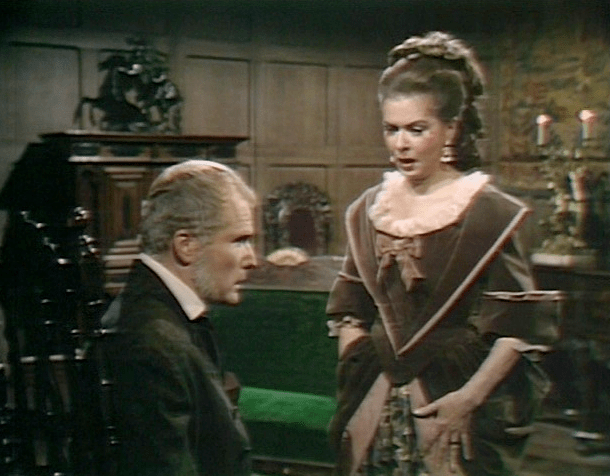
Joshua Collins comes back home to the great house of Collinwood. His wife Naomi asks what he was doing the night before, when she found him at the Old House on the estate. He tells her that he had summoned a woman named Bathia Mapes who tried to exorcise the curse that is upon the family. It’s news to Naomi that Joshua believes in curses, and he explains that so much has happened lately that he feels he has no choice but to believe in such things.
Naomi says that when she found Joshua in the Old House she heard the voice of their son Barnabas in the front parlor. Joshua reminds her that she saw Barnabas’ body after he died. He says that he has come to agree with her that Victoria Winters, the family’s former governess who is currently in the Collinsport Gaol awaiting execution on charges of witchcraft, is innocent. He now believes that Barnabas’ sometime wife, Angelique, was the real witch, and that he will do whatever he can to free Victoria. Naomi insists that Joshua isn’t telling her the whole story. He doesn’t contradict her. He keeps saying that he has told her everything she needs to know, and pleads with her to accept that for her sake as well as his own.
Joshua realizing he has to admit to Naomi that he has been wrong. Screenshot by Dark Shadows Before I Die.
Returning viewers know that Joshua is withholding a great deal of information from Naomi. Barnabas did die, but Joshua has learned that at night he rises as a vampire. Bathia Mapes came to lift the curse from Barnabas. When Naomi interrupted the proceedings, Bathia lost her mojo and Angelique struck her dead. Joshua is desperate to protect Naomi from the horrible truth about their son, and he certainly doesn’t want her to know that her action led to Bathia’s death. More than once he stumbles over his words, often seeming to catch himself just in time to keep from telling her everything. In his reticence, we see that he really does love Naomi, but he is so firmly entrenched in his habits of concealment and denial and so attached to the control those habits give him over other people that he cannot stop measuring out the truths he will tell.
Joshua goes to the gaol, where Victoria is with her lawyer/ boyfriend/ etc, an unpleasant young man named Peter. Joshua tells Victoria that he wants to apologize to her for having helped convict her. Peter keeps interrupting with his nasty little shouts, and Joshua keeps looking away from him. Victoria accepts Joshua’s apology, and he vows to do whatever he can to prevent her execution.
Joshua talks with the judge who presided over Victoria’s trial. With difficulty, he brings himself to say that his sister Abigail, who was one of the driving forces behind the prosecution of Victoria, was not a reliable witness because of her preoccupation with the Devil. Regular viewers will understand his difficulty. After Abigail died, we saw Joshua, in #434, utterly despondent, freshly broken in ways we had not expected to see. He had already lost his brother, both of his children, and several other people he cared about, so it was no wonder the death of his beloved sister brought him to such a low state. In #446, he learned that Barnabas was responsible for Abigail’s death. When he has to say things about her to which she would object, all of that anguish comes flooding back. The judge asks Joshua if Abigail was insane; evidently that would make a difference. But he reflexively says “Of course not!”
The judge tells Joshua that nothing he has said justifies a new trial or even a postponement of Victoria’s execution. He asks if Joshua knows of a witness who could give unequivocal testimony that Angelique was the witch. As he had when Naomi alluded to the idea of such a witness earlier, Joshua falls silent for a moment. When they talk about this hypothetical witness, the judge and Naomi are both describing Barnabas. But Joshua, sincerely though he wants to spare Victoria, cannot reveal the truth about his son.
Joshua and Peter return to the cell and tell Victoria that nothing has changed. Joshua bids her farewell, looking more deeply defeated than we have seen him before.
A while later, Peter leaves the cell. Desperate, he steals the gaoler’s gun and forces him to unlock the cell. Victoria objects when she first sees what Peter is doing, but holds the gun for him while he tries to bind the gaoler. The gun goes off in the course of the struggle, injuring Victoria’s arm. Peter beats the gaoler unconscious and leads Victoria out of the cell. They hear the voices of a crowd outside and wander from room to room inside the gaol.
Howard Honig plays the gaoler, his first screen appearance. Honig would have a long and distinguished career in television and features from the 1970s to the 1990s. I remember him from the movie Airplane!, where he played a passenger named Jack. In the terminal, a friend greets him with “Hi, Jack!” bringing a bunch of very aggressive security guards. I first saw that movie when I was about 12, and that scene fascinated me so much that for a couple of years my father was reluctant to take me on an airplane, fearing I would try to recreate it.







 Dark Shadows Commentary
