Episode 911: I might forget I’m dead

The Story So Far

In December 1968, children David Collins and Amy Jennings explored the long-deserted west wing of their home, the great house on the estate of Collinwood. They stirred up the ghost of Quentin Collins, who turned out to be David’s great-great uncle and Amy’s great-grandfather. For the next several weeks, Quentin steadily gained power and wrought ever graver havoc, until by the end of February the great house had become uninhabitable and David was hovering between life and death. At that point, David and Amy’s distant cousin Barnabas Collins did some mumbo-jumbo to try to contact Quentin’s ghost, only to come unstuck in time and find himself in the year 1897, when Quentin was a living being.

For the next eight months, Dark Shadows was primarily a costume drama set in 1897. Occasional glimpses of 1969 showed us that the haunting was continuing. In #839, we saw David lying dead before his father Roger, finally having succumbed to the effects of the haunting. But while Roger was lamenting him, David came back to life. The events in the part of the episode set in 1897 had changed the future, so that the ghost of Quentin found peace and Collinwood returned to its usual condition. But that took effect as of the anniversary of the change. Everyone’s memories of the ten months of Quentin’s haunting and of the eight months of Barnabas’ absence in the past are intact.

Not only is Quentin no longer a ghost, he isn’t even dead. In the altered version of 1897 that we saw, an artist named Charles Delaware Tate painted a portrait of Quentin that had the same magical effects on him that Dorian Gray’s portrait had in Oscar Wilde’s novel. Quentin looks, moves, and sounds exactly like he did when he was 28 years old. He has recently returned to Collinsport, and has amnesia. He was found carrying identity papers in the name of Grant Douglas. He’s open to the possibility that that may not be his right name, but when he finds Dr Julia Hoffman, MD trying to convince him he is the 99 year old Quentin, he is incredulous.

At Collinwood

We open today in Quentin’s old room in the west wing. Julia has persuaded Quentin to sit there and listen to his record player. In the unaltered timeline, he was obsessed with a sickly little waltz, listening to it over and over in 1897 and inflicting it on Collinwood when he was a ghost. Julia plays the record, and it doesn’t mean a thing to him. She becomes frustrated and accuses him of lying when he says that he doesn’t remember that he is Quentin.

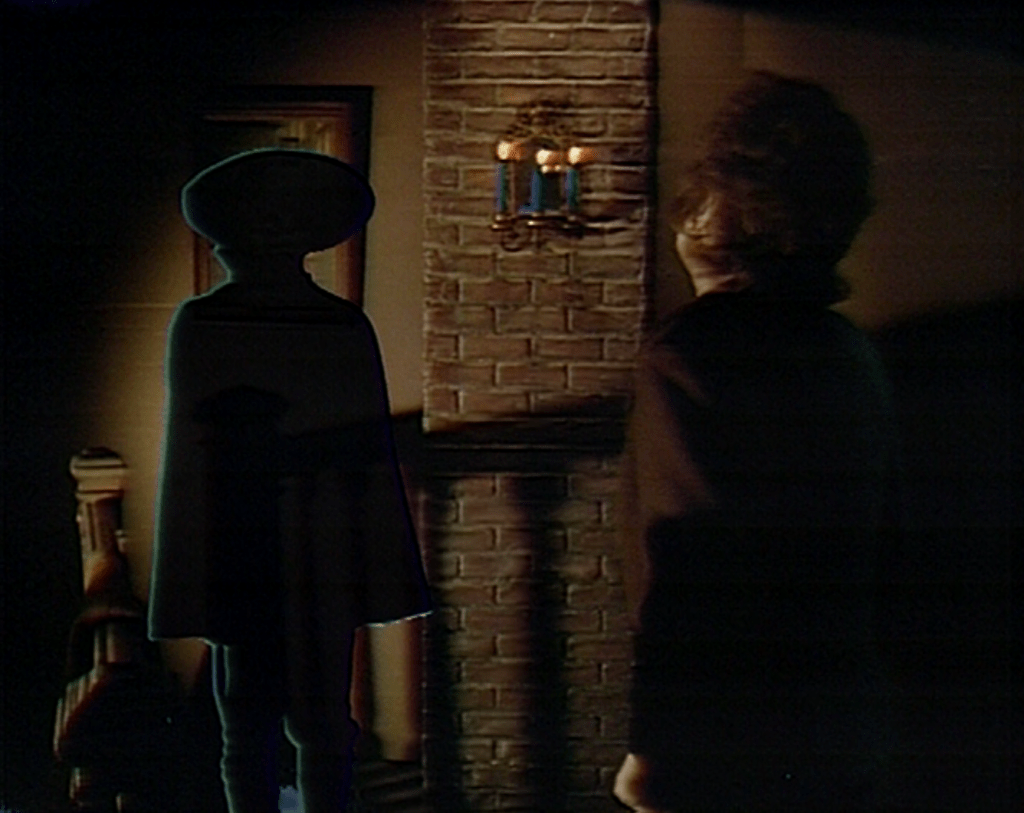
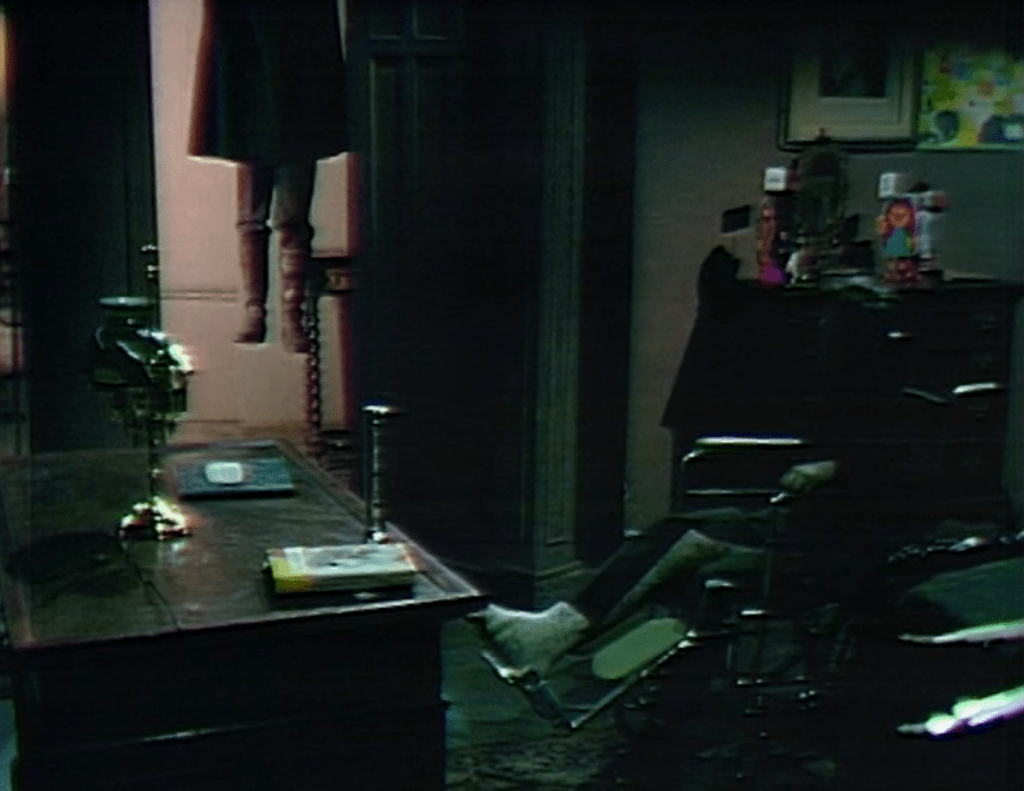
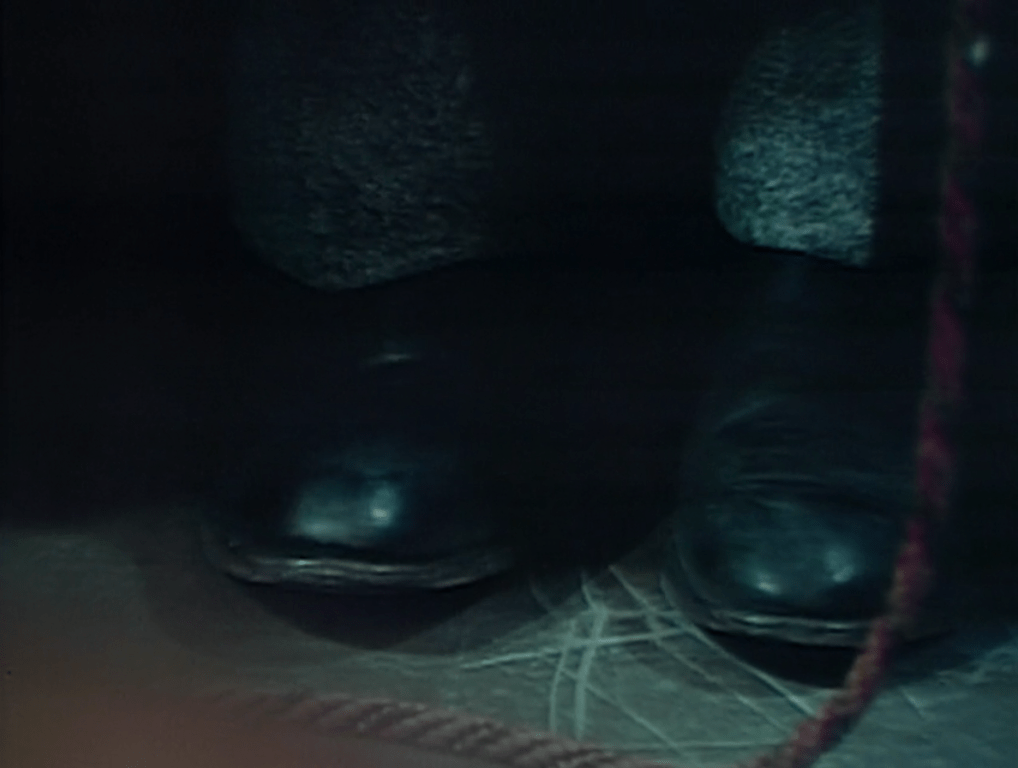
The music does ring a bell for someone else in the house. The sound of it reaches David and wakes him. Alarmed, he makes his way to Quentin’s room. By the time he gets there, Quentin is hiding behind a curtain. Julia tells David she went in to look for a painting, and that she thoughtlessly started the record player. He accuses her of hiding Quentin. While she is denying it, he sees Quentin’s shoes sticking out from under the curtain.

Quentin’s shoes, as seen by David.

In 1963, philosopher Edmund Gettier published a little paper about the traditional definition of knowledge as “justified true belief.” He gave several examples of justified true beliefs that most people would not regard as knowledge. His examples were kind of far-fetched, but it is easy to come up with more plausible instances. For example, I first read Gettier’s paper when I was in college, and at the same time I was reading Anthony Trollope’s novel The Eustace Diamonds. The main point of that novel is that everyone believes that Lizzie Greystock has stolen some diamonds from her late husband’s estate. She has in fact done so, and they have good reason for believing that she did so, but those reasons are so mixed up with misunderstandings of Lizzie’s motives and other circumstances that we wouldn’t say any of them really knows anything about her. My epistemology professor was excited when I told her about the novel, since the example she gave to our class to show that Gettier’s contrivances were not the only cases illustrating his point was something overly elaborate about believing that you have recognized someone whom you have partially seen while he is hiding most of himself behind a curtain.

David’s claim that Julia is hiding Quentin is another Gettier case. He believes it, the sight of Quentin’s shoes in Quentin’s room provides compelling justification for believing it, and it is true. Yet the Quentin whom Julia is hiding does not have any of the characteristics that give David’s belief the significance that he draws from it. His presence is not a sign that the haunting has resumed and that David is back in mortal danger. He is not a ghost at all and is not a threat to David or anyone else in the house. So while David has a justified true belief that Julia is hiding Quentin, that belief is so deeply entangled with a severe misunderstanding of the situation that we wouldn’t count it as knowledge.

Once David is gone, Quentin emerges and demands answers from Julia. She tells him something about Quentin’s ghost; he already finds her insistence that he is 99 years old to be so preposterous that the additional detail that he used to be dead prompts a merry laugh. By the time he is at the front door ready to leave, he is stern and telling Julia that he expects a “full explanation” tomorrow. Lotsa luck on that- ghosts, time travel, magical portraits, and a universe where the present is a stew made up of the consequences of several mutually incompatible pasts? And those are just the elements you can’t avoid in the executive summary of the situation. A “full explanation” involves werewolves, vampires, a humanoid Phoenix bent on incinerating her children, demons conjured from the depths of Hell, a sorcerer who still misses his pet unicorn, and about a thousand other fantastical topics.

David eavesdrops on Quentin and Julia’s parting conversation. When he was a ghost, we never heard Quentin speak- he communicated telepathically with David and Amy, and they could apparently hear his voice on a particular telephone, but he never stood around and talked with anyone like this. So the mere fact of the conversation undermines David’s belief that the man he is looking at is Quentin’s ghost. When David hears Julia call Quentin “Mr Douglas,” he can see that whoever this person may be, he is not exactly Quentin, not as he knew him. He does recognize the name “Mr Douglas” as that of a man his cousin Carolyn Stoddard met at the antique shop in the village where she works and whom she visited in the hospital when he first had amnesia, so his attitude towards him changes.

In the Antique Store

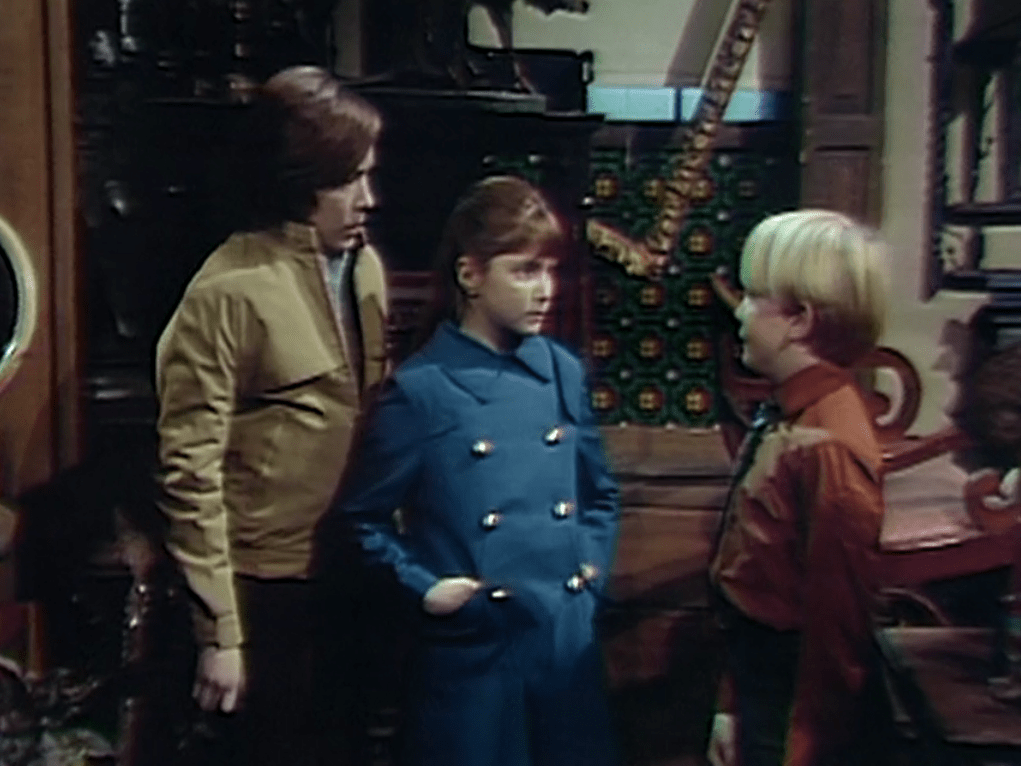
Unknown to Julia or Carolyn, David has been assimilated to a cult that serves unseen supernatural beings known as the Leviathans. Carolyn’s mother, Elizabeth Collins Stoddard, has also been absorbed into the cult, as has Barnabas. Megan and Philip Todd, the owners of the antique store, are members too, and they are fostering a mysterious creature who currently appears to be an eight year old boy and answers to the name Alexander. Liz takes David and Amy to the antique store, where they interrupt an uncomfortable conversation between Alexander and Julia.

Liz suggests to Julia that they should leave Amy and David in the store to play with Alexander. Julia doesn’t think this is such a hot idea, but Liz insists.

We then have the first scene on Dark Shadows populated by three child actors. It was a breakthrough when the ten year old David played with the ghost of nine year old Sarah Collins in the spring and summer of 1967; their scenes, the first interaction between children on Dark Shadows, advanced it towards becoming a kids’ show. David had up to that point been the only child on the show. He was first a homicidal monster who threatened the adults, then a figure threatened by his mother Laura and in need of rescue. When we saw him with Sarah, the two of them built a relationship that was of importance in itself and that had consequences which grew to dominate the story, leading directly to the show’s first time travel segment in November 1967. In David and Sarah, the fans running home from elementary school to watch the show could see characters their own age driving the action.

The current phase has been very heavy in adult interest. This first three-scene among children might be expected to take us back to territory Sarah and David did so much to open, but it does nothing of the kind. The three children do not really interact with each other at all. David is under the control of the Leviathans, Alexander is a manifestation of their power, and Amy is at a loss to figure out what’s going on. The forces motivating the action are not on screen, any more than they would be if the boys’ parts were played by marionettes.

David, Amy, and Alexander

Amy finds that Alexander has a photograph of Carolyn as she was when she was eight. She realizes that he stole it from a photo album at Collinwood. She declares that she will take it back to the house. Alexander forbids her to do so, and David takes his side. Amy is puzzled by David’s attitude. David threatens to sic Quentin on her. That shakes her up, but she says that Quentin is gone. David says he isn’t, and he and Alexander force her to play hide and seek. Once she is out of the room, David tells Alexander to keep her away for a couple of minutes. He telephones “Grant Douglas” and asks him to come to the shop to pick up a book he left there.

Amy comes back just in time to see and recognize Quentin. She runs upstairs and goes into the room which belongs to Alexander. She hears a heavy breathing there and sees something that terrifies her. Returning viewers know that what she saw was some inhuman thing that is of the Leviathans.

For his part, David is quite calm with “Grant.” Though we saw at the beginning that his connection to the Leviathans has not removed his fear of Quentin, he has reached the conclusion that he doesn’t need to be afraid of “Grant Douglas.” Maybe he thinks that someone using the names of two such prominent Canadians can’t be all bad. He gives Quentin the book and assures him Amy will be all right.

Quentin accepts David’s assurance, but we cannot. Amy is absent from the cast for long periods, and is usually unmentioned during those intervals. The same was true of Nora Collins, the character Denise Nickerson played in the 1897 segment. The show seems to be deliberately telling us not to get used to having this fine young actress in the cast. And the Leviathans haven’t done anything truly horrible yet- they are due to murder a character we really like. So it is quite possible we will tune in tomorrow and find that Amy is dead. Again, the contrast with the David and Sarah story is telling. David Henesy was a core member of the cast from the first week of the show, and the ghost of Sarah was a key part of the show for months. Dark Shadows was as much their show as it was that of any of the adults on screen. Keeping both Amy and Denise Nickerson at the margins, they make it clear that the kids are going to be taking a back seat.

David Henesy and Denise Nickerson were both highly capable performers, but eight year old David Jay just stands on his mark and shouts his lines. That need not have been a problem. Alexander has only been in human form for a week or two, so we don’t expect subtlety from him, and to the extent that he sounds like a real child he is supposed to be a vicious little bully trying to figure out what he can get away with. Such children often do put on acts and sound awkward, so Mr Jay’s professional ineptitude dovetails with the requirements of his part. That’s similar to the way Sharon Smyth’s limitations fit with the part of Sarah. We were supposed to be unsure whether Sarah knew that she was a ghost, whether she knew what year it was, and what if anything she remembered from one appearance to the next. Since Miss Smyth* was, as she says now, “clueless” about the craft of acting, she did a great job keeping us guessing. Later we saw Sarah as a living being, and Miss Smyth’s performance was less satisfactory. We know that Alexander is likely to transform into a shape that is not compatible with David Jay soon, so his shortcomings aren’t a particular concern. But again, the fact that Alexander comes with an expiration date keeps us from regarding him as one of the main characters.

The Store Room

While the kids were alone in the antique shop, Liz took Julia to a store room in the west wing of Collinwood to show her some photographs she had been asking about. While there, they come upon a painting. Liz says that she bought it about a year before at a charity auction, and that when her brother Roger saw how lousy it was he said he hoped that it was a worthy cause. She took it directly to the store room. It is signed “Harrison Monroe” and dated 1968. We will learn tomorrow that it depicts a place called Indian Hill. Julia recognizes the painting as extremely similar to an equally undistinguished landscape she bought a few weeks ago.

Detail from “A View of Indian Hill,” Harrison Monroe, 1968.

That painting was the work of Charles Delaware Tate, executed about 20 years previously. That Tate had been alive and working as recently as that gave Julia the hope that he might still be around and able to help a friend of hers who has problems. Yesterday, an expert called on to remove the landscape and reveal the portrait underneath it said that Tate died in 1959. But this painting is apparently the product of the same hand. Julia hopes that “Harrison Monroe” is a pseudonym of Tate’s.

It has been clear to the audience ever since Julia found the first painting that Tate would be back. That can’t be welcome news to many people. Like all characters played by Roger Davis, Tate is a loathsome man who shouts his lines and assaults his scene partners. So this pseudonym, as strongly redolent of old Virginia as “Grant Douglas” is of twentieth century Canada, will bring a sinking feeling to much of the audience. Our reprieve that began when we left Tate in the nineteenth century five weeks ago cannot last much longer.

*Her name is Mrs Lentz nowadays, but that’s an odd title to give a nine year old. So I refer to her as Miss Smyth.

Episode 896: Those who have been hidden shall show themselves

David and the Book

Strange and troubled boy David Collins has stolen an old book from an antique shop. He didn’t want the book, but had damaged it slightly and was terrified that he would be punished if this was discovered and his father had to pay for the rare volume.

David’s friend and fellow resident of the great house of Collinwood, Amy Jennings, catches him with the book in the drawing room. He tells her he is going to burn it in order to conceal his crime. She points out that this will make a bad situation much worse. As a creature of Soap Opera Land, David can have no higher calling than to make bad situations worse, so this does not deter him.

While Amy offers to take the book to the nearest grownup and to claim that she was the one who stole it, David opens it to a page depicting a group of intertwined snakes, a symbol the show refers to simply as “the Naga.” He is transfixed by the symbol. His whole manner changes. His posture becomes more rigid, his voice grave and authoritative. He tells Amy he no longer wants to burn the book. Instead, he will read it. Since the book is written in a script neither of them has seen before, Amy tells David he cannot read it, but he assures her he can. She asks him to read it to her, and he says that it is forbidden for her to hear any of it. She says that she doesn’t like the game David is playing and would rather turn to another; he says it is no game. She leaves him alone with the book.

The book was not in fact part of the antique shop’s merchandise, though it was on a display table there. The owners of the shop, Megan and Philip Todd, have been inducted into a mysterious cult led by David’s distant cousin, old world gentleman Barnabas Collins, and the book is one of that cult’s most sacred objects. The Todds flew into a panic when they realized the book was missing, and Barnabas told Philip that he faced a severe penalty for losing it. Those reactions make it hard to understand why Philip and Megan left the book on the table in the first place.

Longtime viewers know that many of the major plot-lines on Dark Shadows start with David. So we may suspect that the supernatural forces behind the cult, unknown to Barnabas or the Todds, caused the book to be left on the table and led David to take it so that he could become part of the story. Indeed, once he is alone with the book David intones a statement from it: “And then those who have been hidden so long shall rise and show themselves, and the others will know their time is ended and the time of the people of the Leviathan will begin.” Later, he goes to the mysterious cairn in the woods that is the center of the Leviathan cult’s ceremonial activity, and announces that he is one of them now. The stones at the bottom of the cairn part, revealing a small opening. David crawls into it. The words are solemn, the music melodramatic, the action of the boy stuffing himself into the little hole preposterous. It is the perfect Dark Shadows sequence.

David Henesy was nine years old when the show started, and was thirteen by this time. It would seem no one told the carpenters he had grown in the interval. That gap is such a tight fit for him that he has to wiggle his rear end at the camera for quite a while as he tries to wedge himself into it. Screenshot by Dark Shadows Before I Die.

We Actresses are Vain

As David is leaving to go to the cairn, he has to refuse a request from permanent houseguest Julia Hoffman. Julia wants him to go to the Old House on the estate and give a note to Barnabas. She keeps telling him that it is urgent, but he tells her he is already on his way to do something urgent.

Julia does not know about the Leviathan cult, much less about Barnabas’ connection with it. All she knows is that Barnabas has been her best friend for a year and a half, and when last they had a chance to spend time together they were concerned with the rakish Quentin Collins, whose whereabouts they do not know. Now it is 4:45 PM, and Julia is expecting a Mr Corey to come to the house at 5:00 and look at a painting she bought from the Todds a little while ago. She thinks this Mr Corey might be Quentin, and is keen for Barnabas to meet him.

When David cannot help her, Julia decides to take the note to the Old House herself. The show is usually fairly vague and inconsistent about the geography of Collinwood, but several times they have said that it takes about fifteen minutes to walk between the great house and the Old House. They stick with this today. Julia leaves at 4:45, and returns as the clock is striking 5:15. Barnabas was not at home, so she just turned right around.

Julia hears voices in the drawing room. They are heiress Carolyn Collins Stoddard and another woman. Julia gathers that Mr Corey is actually Ms Olivia Corey. When she enters the room, she sees that Olivia is a dead ringer for Amanda Harris, a woman who lived in 1897. Julia became aware of Amanda in September, when she and Barnabas were traveling in time and met each other in that year. Julia did not meet Amanda, but evidently must have seen at least one of the many portraits of her that magical artist/ dreary goon Charles Delaware Tate painted. She mentions these portraits to Olivia, who claims that Amanda was her grandmother. Amanda was in love with Quentin, and Julia takes an excited breath when she asks Olivia who her grandfather was. Olivia gives his name as Langley. Quentin may well have used an alias, so that doesn’t rule out the possibility that Olivia may be his granddaughter, though Dark Shadows fans looking back in these later days will think of another member of the Collins family when they hear that name.

Olivia is a famous New York actress. Julia tells her that she has seen her on stage and has seen her photograph in the newspapers, but that she never noticed her resemblance to Amanda. Olivia asks where Julia heard about Amanda; she says that she must have read about her somewhere in connection with one of the portraits. She also tells Olivia that she isn’t likely to want the painting, since it is not a portrait. Olivia says that she wants any painting of Tate’s she can get. Julia tells her there is no portrait of Quentin Collins in the house; Olivia pauses for a fraction of a second, then blandly asks if she is supposed to know who that is.

Some of Tate’s paintings had supernatural effects. When Tate painted pictures of his ideal woman, Amanda came into being as their embodiment, like Galatea emerging from Pygmalion’s statue. And when he painted Quentin’s portrait, Quentin was freed of the effects of the werewolf curse. Like a Halloween version of The Picture of Dorian Gray, the portrait turned into a wolf on the nights of the full moon, while Quentin remained human.

As long as the portraits of Amanda and Quentin are intact, they themselves will remain alive and well and youthful. So Julia’s hope that Quentin might still be traveling the world and using false names 72 years after the period when she and Barnabas knew him is not ill-founded, and her surmise that Olivia might be, not Amanda’s granddaughter, but Amanda herself, is also plausible.

Episode 893: We serve him now

Heiress Carolyn Collins Stoddard is sitting at a table in the Blue Whale, a tavern. A man who refused to give his name when she caught him trespassing on her property invites himself to sit down with her. She objects to this. He identifies himself as her father, the long-missing Paul Stoddard. She objects far more strenuously to that. Not only did Paul leave the family when Carolyn was an infant, he and his friend Jason McGuire faked his death. Jason convinced Carolyn’s mother, Liz, that she had killed Paul and he had buried the corpse in the basement. In response, Liz immured herself in the house for nineteen years. Only after Jason came back and was blackmailing Liz into marrying him did the truth come out and Liz break free of her reclusive ways.

Paul tells Carolyn that he didn’t know Jason told Liz that she had killed him. Longtime viewers may suspect this is a lie, not least because Paul and Jason are both played by Dennis Patrick. Nonetheless, Carolyn falls for it. Soon she is agreeing to sound Liz out to see how she might react were she to hear that Paul had returned. He walks her home to the great house on the estate of Collinwood. He can’t go in, but gives her a goodnight kiss on the forehead.

Carolyn’s young cousin, strange and troubled boy David Collins, sees Paul kissing her. When she goes inside, he asks who her new boyfriend is. Carolyn is vexed. She refuses to tell David anything, and sends him to bed.

Carolyn’s friend Philip Todd comes to the door. He tells her that he and his wife Megan want Carolyn to work at their antique shop in the village. It may seem rather odd for the keeper of a little shop to go to a vast mansion and ask the daughter of its proprietor to take a job as his assistant, but Carolyn loves the shop and was volunteering there yesterday. She agrees happily, and mentions that a man might be leaving messages for her there.

In the shop the next morning, Carolyn sees that Megan has a baby. Megan says it is her sister’s son. Carolyn asks his name. Megan thinks for quite a while before coming up with “Joseph!”

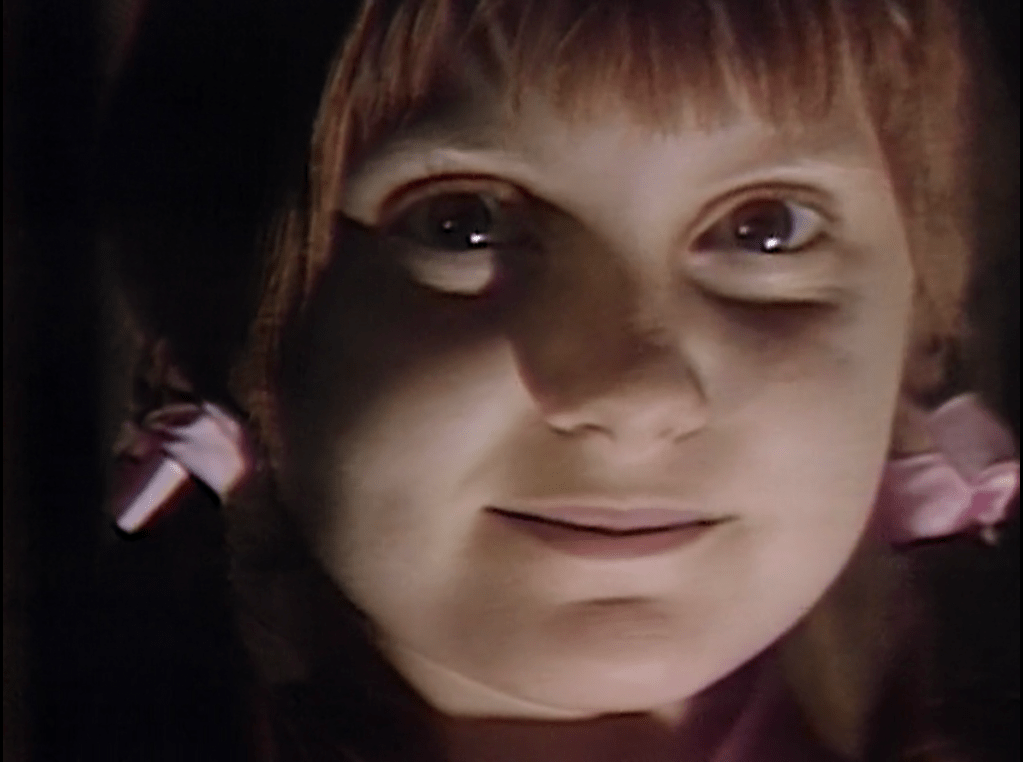
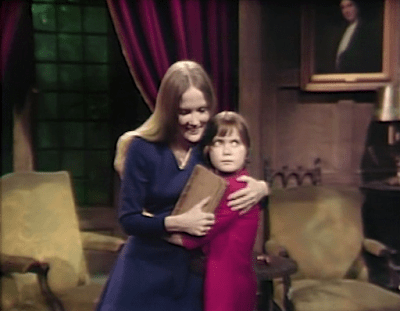
Carolyn is alone in the shop when David comes in with his friend and fellow resident of Collinwood, Amy Jennings. We haven’t seen Amy since #835; that in turn was her first appearance since #700. For eight months, from #701 to #884, Dark Shadows was set in the year 1897, with only a few brief glimpses of the 1960s. In the 1897 segment, Denise Nickerson played Nora Collins, whose own final appearance was in #859. Both Nora and Amy had long absences from the cast, and were usually unmentioned while they were away. So we’ve been afraid that we wouldn’t see Amy or any other Nickerson character again. It’s good to have her back. She even pulls her signature move and gives a meaningful look directly into the camera at one point.

A Nickerson special.

Amy and David see a doll that longtime viewers will recognize as Samantha, favorite plaything of the late Sarah Collins both when we saw her as a living being in the 1790s from November 1967 to March 1968 and before that, when she was a ghost haunting Collinwood and its environs in 1967. There are also a couple of toy soldiers from “The Regiment,” which Sarah’s brother Barnabas played with when he was a young boy and which Sarah gave to people in 1967 as protection against Barnabas, who was at that time a vampire. Barnabas did sell a bunch of things to Megan and Philip the other day, but neither Samantha nor the members of The Regiment were in Barnabas’ possession when last we saw them. Presumably the camera lingers on the toys, not because we are supposed to know how Philip and Megan got them, but because we are supposed to be pleased with ourselves for recognizing them.

Paul comes into the shop. David recognizes him as the man he saw kissing Carolyn. Carolyn addresses Paul as “Mr Prescott,” sends him into a back room, and hustles the children out of the shop. She tells Paul who David is, and explains that he saw them together, complicating their plans.

When Carolyn was minding the shop yesterday, her friend Maggie noticed an old book on a table. Neither of them knew what it was, but viewers knew it was an object of great importance to a cult into which Philip and Megan have been inducted. It seemed inexplicable that they would leave it on a table in their shop, as if it were for sale. We get a hint today as to what they may have been thinking. In his room at Collinwood, David shows Amy that he has stolen the book. She asks why he would want it. He explains that Carolyn said that if they damaged anything in the shop, his father, Roger, would have to pay for it, and he creased a page in the book. David’s fear that his father would punish him drove several stories in the early months of the show. Roger has mellowed enormously since then, but evidently David is still so afraid of him that he will make a bad situation worse rather than face his wrath.

Indeed, many major storylines have begun with David. The 1897 flashback started because Barnabas was trying to keep a ghost from killing David, as the 1790s segment started when David’s governess Vicki participated in a séance meant to solve a mystery concerning him. For that matter, the whole show started when Vicki was summoned to Collinwood to take charge of David’s education. David doesn’t always have a lot to do in the stories, and when they are over it is often as not forgotten that he was in peril when they began. But he is so often the catalyst that we can suppose that David was supposed to find the book so that the current story could move into its major phase.

If that was the intention, Megan and Philip didn’t know about it. When they discover that the book is gone from the shop, they fly into a panic and declare that whoever took it must be killed. It may turn out that the mysterious forces behind the cult want David to become involved and that they created a situation in which he would find the book and take it with him, but if so, those forces are operating outside the cognizance of anyone in today’s episode.

Episode 835: A past that runs parallel to our present

Stuffy Edward Collins was under a spell for several weeks that prevented him from keeping up with what has been happening on the estate of Collinwood in 1897. He knows that his distant cousin Barnabas is a vampire who originally died in the 1790s and has come back to prey on the living. From this, he has drawn the eminently logical conclusion that he is a character in a horror story, and that it is his responsibility to be the hero who destroys the undead ghoul.

Barnabas is beside himself. Screenshot by Dark Shadows Before I Die.

In fact, Dark Shadows stopped being that kind of show long ago. Others know that it is chiefly about time travel now. That point is made when we flash forward to the year 1969, from which Barnabas has traveled to prevent a disaster that had its roots in 1897. Barnabas’ friends Julia Hoffman and Timothy Eliot Stokes talk about the intersection of past and present, so that the events of 5 September 1897 are somehow also taking place on 5 September 1969. The show has been using anniversaries as substitutes for natural laws in this way since #157, broadcast and set in January 1967, and they spin this out much further today. In his post about the episode at his great Dark Shadows Every Day, Danny Horn writes a big prose poem about the weirdness of the show’s conception of time at this point, it’s well worth reading.

When Barnabas first came on in the spring of 1967, it was set in contemporary times and the writers had a lot of fun with characters who mistook the genre of show they were on. Dangerously unstable ruffian Willie Loomis heard the plot of Daphne du Maurier’s Frenchman’s Creek, concluded he was part of a Gothic romance, and wound up freeing Barnabas and becoming his blood thrall. That mistake continued to shape Willie’s character. Willie was forced to be Barnabas’ accomplice in the abduction and attempted brainwashing of Maggie Evans, The Nicest Girl in Town. Willie listened to Barnabas’ own rantings about his motive being an attempt to recreate his lost love Josette, and kept imagining that he would somehow overcome Barnabas to rescue Maggie and become her lover. Willie also harbored a deep hostility towards Burke Devlin, who was left over from a period when the show really was inspired by Gothic romance.

Willie’s sometime friend Jason McGuire made a similar mistake, believing that the show was still the noir crime drama it was when it spent weeks on the question of where Burke’s fountain pen had got to. So he sleuthed out signs of where Willie went when no one was looking and where Barnabas got his money. All that Barnabas could contribute to that kind of story was murder, and so he unceremoniously strangled Jason in #275.

Local physician Dr Dave Woodard thought he was on the usual daytime dramas of the period. Actor Robert Gerringer had a lot of fun playing Woodard as if he were on The Guiding Light. There were whole episodes built around that conceit- for example, we spend #235 in the Collinsport Hospital, where everyone acts just as you would expect them to on any other soap, except for Maggie, who is there being treated for vampire bites. Woodard notices that his friend Julia is growing close to Barnabas, and in #324 comes to the logical daytime conclusion- they are having an affair. Eventually Woodard finds out that he has misidentified the genre of the show, but it is too late- Barnabas and Julia murder him in #341.

Today, that is to say 5 September 1897, Edward catches Barnabas and locks him in the prison cell in the basement of the Old House at Collinwood. Barnabas kept Maggie in that cell when she was his prisoner, and the ghost of his little sister Sarah helped Maggie find a secret panel that led to a tunnel to the beach. In #260, Maggie escaped through that tunnel at the last minute before Barnabas could kill her, and Barnabas himself later used the same tunnel to escape from the cell in #616. In #781, Edward made it clear that he knew all about the tunnel and expected everyone else at Collinwood to know about it as well. So it is no surprise when he tells Barnabas that he has blocked it off. In fact, he says that he has blocked “all” of the secret passages- we may wonder just how many escape routes there are.

Edward leaves Barnabas alone in the cell, saying he will be back before dawn. There is a writing desk in the cell; Barnabas remembers that Willie moved that desk to the front parlor for him in 1967, and so he describes his predicament in a letter to Julia and closes it in a secret compartment of the desk.

In 1969, nine year old Amy Jennings is in the parlor, playing with her dolls. One of the dolls is named “Amanda”; this will catch the attention of returning viewers. The 1897 story features a character named Amanda, who is an oil painting come to life. If artist Charles Delaware Tate could make his paintings come to life, as in Greek myth the sculptor Pygmalion made a statue come to life as a woman named Galatea, then perhaps we should find out who made Amy’s doll before we let it out of our sight.

Amy first came on the show in November 1968, at the beginning of the story that led from contemporary dress to the 1897 segment. Her very first night at Collinwood, Amy went straight to the room where the magic objects were hidden that would trigger that story. She often delivers her lines directly into the camera, as if she knows perfectly well where the audience is. Amy is at the opposite pole from Edward and such earlier characters as Willie, Jason, and Woodard- she not only knows what genre the show is, she’s read the flimsies for next month’s episodes and is getting a head start on them.

Amy looks in the desk for a book to read to her dolls, and inadvertently opens the secret compartment. She eventually gives the letter to Julia; this is what prompts Julia and Stokes to have their talk about the ontological status of past events and what philosophers call “the reality of tense.” They know all about the time travel aspect of the show; Julia, in fact, has for some time been the closest thing the audience has in the parts of Dark Shadows set in the 1960s to a point of view character, one who knows everything we do. She was certainly the first one to know that the show was transitioning from vampire horror to quasi-science fiction. She surprised Barnabas in #291 with a proposal to develop a medical treatment that might put his vampirism into abeyance.

In the letter, Barnabas refers to his “secret.” Stokes does not know what this is, and is not satisfied with Julia’s lame attempts to answer his questions about it. This makes sense to regular viewers; shortly after Stokes arrived in Collinsport, another mad scientist got hold of Barnabas and succeeded where Julia had failed in putting the symptoms of the vampire curse into remission. For all the time he has known Barnabas, Stokes has seen him moving about in the day, casting reflections in mirrors, eating food not derived from human blood, etc. In 1968 and 1969, his ignorance of his Barnabas’ past vampirism is not much more serious than his ignorance of the details of the automobile accident that killed Mr Hanson in 1956. But the vampirism came back in full force when Barnabas went to the past, so Stokes is at a loss as to what the letter means.

Julia decides that she will try to travel into the past using the same mumbo-jumbo that transported Barnabas there. While Stokes reads up on that, Julia and Amy make a stop at the great house on the estate, which is impenetrably haunted by the ghost of Quentin Collins. That errand seems to be going sideways when the episode ends.

Episode 691: Too late to be afraid

Throughout its first 73 weeks, Dark Shadows was usually very slow-paced, even by the standards of a 1960s daytime soap. Major characters like matriarch Liz and her brother, high-born ne’er-do-well Roger, often seemed to exist solely for the purpose of refusing to accept the facts in front of their faces and thereby slowing down the progression of the plot. Even characters who did face facts would often as not have the memory of goldfish, so that weeks of character development would evaporate with a sudden display of inexplicable ignorance.

That changed when well-meaning governess Vicki came unstuck in time in #365. For the next few months, Dark Shadows was a costume drama set in the 1790s, and events came thick and fast. When Vicki returned to the present and Dark Shadows returned to contemporary dress in March 1968, the show was a genuine hit. They tried to sustain the breakneck pace of the 1790s segment throughout 1968, with mixed success. That period was a Monster Mash, featuring multiple witches, vampires, mad scientists, Frankensteins, ghosts, and the Devil himself, or perhaps one of his middle managers. That attracted a new audience of preteen viewers, but all too often left the characters spinning their wheels as they tried to make room for each other within one small fishing village near Bangor, Maine.

A few months ago, they dumped all of those larger than life but ultimately unproductive figures and started concentrating on two storylines. The A story so far has been that of werewolf Chris and the efforts old world gentleman Barnabas and mad scientist Julia have made to keep him from killing quite so many people. That one has been moving along at a steady clip.

The B story has not progressed nearly as fast. At times, it has matched the leisurely pace of the show’s early days. Today is dedicated to that story, and in today’s pre-title teaser it appears that it has brought narrative progression to a total halt.

Maggie is the new governess in the great house of Collinwood, charged with the education of Chris’ nine year old sister Amy and of strange and troubled boy David. As usual, we open with a reprise of the previous episode. This time, the reprise is 5 minutes and 45 seconds of Maggie wandering around the house looking for the children and hearing voices, while doors open themselves. That was OK at the end of Friday’s installment, but on its own it is stupefying.

The story is that the evil spirit of the late Quentin is taking possession of David and Amy in order to destroy the Collins family and have the house to itself. It made sense that that story would start slow. Quentin was at first very weak. He existed only in a sealed chamber the children stumbled upon while exploring the long deserted west wing, and could influence events outside that chamber only by persuading them to do his bidding. He gradually gained the power to control one child at a time, and to manifest himself outside his little room. A while ago he was able to put strychnine into Chris’ drink; by the end of Friday’s episode he had Amy and David under his power simultaneously.

Once the action finally gets underway in today’s episode, Quentin is about to strangle Maggie and the children are screaming at him to stop. Housekeeper Mrs Johnson and Liz enter the room. Mrs Johnson sees Quentin, Liz does not. Maggie is unconscious and the children are in a state. By the end of the episode, Liz, Maggie, and Mrs Johnson know Quentin’s name, his plan, and his power. He has managed to create some kind of bubble around the house so that the people inside it cannot hear the rain. The children pass out. David comes to, and announces that it is too late to be afraid. He laughs maniacally, and in the background we also hear Quentin’s laughter.

Quentin no longer needs to hide from Liz and Mrs Johnson. Screenshot by Dark Shadows Before I Die.

With this slam-bang ending, the Haunting of Collinwood takes over as the A story and Liz forever sheds her role as a blocking figure. This phase of the show is approaching its climax, and there is a chance that what comes next will be exciting.

Episode 690: A different mood

We open with governess Maggie Evans entering the bedroom of strange and troubled boy David Collins. She had heard David’s screams and a man’s laughter coming from the room; the man is gone, and David is unconscious on the floor. He has a nasty burn on his arm, and as he is coming to he pleads with “Quentin” not to hurt him.

Once David is fully awake, Maggie asks who Quentin is. David frantically denies that there is any such person, and claims that the laughter she heard was his own voice as he was playing a make-believe game. She says that she knows he couldn’t have made those sounds. He points out that they are the only people in the room. Maggie does not even try to explain how anyone could have left the room unseen; she seems already to have concluded that Quentin is a supernatural being. Maggie identifies Quentin with a strange and frightening man she and housekeeper Mrs Johnson have both seen. David keeps trying to deny everything, and Maggie keeps telling him she wants to help. David sobs, and Maggie holds him.

Maggie holds David.

Quentin is indeed a ghost who is taking possession both of David and of Maggie’s other charge, nine year old Amy Jennings. With their help, Quentin has so far killed two people, tried to kill two others, and set about trying to drive everyone off the estate of Collinwood. Up to this point, Maggie has failed completely to represent any sort of obstacle to Quentin. She is a poor disciplinarian who lets the children run rings around her even when they are themselves, and is altogether at sea when they are doing Quentin’s bidding. This scene promises a breakthrough. Maggie is the first of the adult characters to learn Quentin’s name, she does not flinch from the evidence of his uncanny nature, she vows to fight him, and David finds comfort in her arms.

The breakthrough does not come today, however. After a moment, David declares that no one can help him, and he rushes out of the room. He goes downstairs to the foyer and hears a knocking at the door. He opens it and sees notoriously abusive actor Roger Davis standing there. He reacts to that sight as anyone might, running away without a backward glance.

Maggie follows David downstairs. There is again some question as to how much of the body language in the next scene is the blocking the director gave as an interpretation of Maggie’s response to the character Ned Stuart and how much is Kathryn Leigh Scott’s reaction to Mr Davis. Maggie tells Ned she can’t talk because she must go out in search of David; as she prepares to exit, she circles around with as much space as possible between her and him, never quite making eye contact but glancing back every time he moves towards her. This is not a pattern of movement we have seen before on the show, even when a character was dealing with a vampire or some other murderous foe. Miss Scott looks very much like a woman alone with a man whom she does not trust not to assault her. If he had, it wouldn’t be the first time he has physically abused a castmate on camera.

She keeps her eyes on his hands

A child’s voice is heard, singing the song “Inchworm.” It is Amy, and she is working a jigsaw puzzle in the drawing room. The drawing room brings out Amy’s musical side. She played “London Bridge” on the piano there in #656 and tapped a few random keys on the same instrument in #676. She is quite a good singer, perhaps not surprising since actress Denise Nickerson had been in the cast of the short-lived James Lipton/ Laurence Rosenthal Broadway musical Sherry! in 1967.

Ned enters and introduces himself to Amy. His lines are all perfectly polite and friendly. Amy is supposed to gradually sense that Ned is hostile to her big brother Chris and to become uncomfortable around him, but that is supposed to come at the end of their time together. As it plays out, she already seems uncomfortable when he first enters. A minute or so into the scene, Amy smiles at Ned. Nickerson was remarkably good at flashing quick smiles, but it doesn’t work this time. She looks like she is displaying her teeth to the dentist. When Amy is supposed to start edging away from him, Nickerson turns around and proceeds to her next mark at full speed. The camera pans back, but does not capture her movement- she has gone clean out of the shot, leaving Mr Davis alone in the frame.

She goes as far as she can as fast as she can.

Ned approaches Amy; he grabs her by the shoulders and pulls her back into the shot. Chris enters. Amy starts to warn him against Ned, and he tells her not to be afraid for his sake. Indeed, Chris is safe. It is only women and children who have to be afraid of Roger Davis.

Ned confronts Chris. Evidently something bad happened to Ned’s sister Sabrina. She can’t tell Ned what it was, but he thinks Chris is responsible and wants him to go with him to the Collinsport Inn to see her. Returning viewers know that Chris is a werewolf and that Sabrina saw him transform. He assumed that he had killed her while in his beastly form, and he is surprised to learn from Ned that she is still alive. Chris is a character we are supposed to sympathize with, so it is a bit disturbing that he does not seem particularly relieved to find that he did not kill Sabrina.

In the woods, Amy finds David. She learned some days ago that Quentin wants to hurt Chris, and she has been resisting Quentin’s influence ever since. She and David talk about ways they can work together to fight him. David says that he has decided to tell Maggie what has been happening; Amy objects that this is too dangerous. They seem to be getting somewhere when Quentin appears to them. They are terrified, and then resign themselves to their fate.

Later, the children are in the drawing room with Maggie. Amy is still working her jigsaw puzzle, and David is staring into the fireplace. Longtime viewers will remember that this is something his mother used to do. She was the show’s first supernatural menace and tried to lure David to his doom. Maggie’s predecessor, well-meaning governess Vicki, led the other characters in the campaign that saved David then. We wonder if Maggie will be able to match her success.

Maggie admires the puzzle and calls David over to look at it. David makes a show of being bored, leading Amy to remark airily that boys don’t like jigsaw puzzles. David complains that there is nothing to do. Maggie suggests the three of them sit down together for a heart-to-heart talk, an idea the children reject. They suggest a variety of games they might play. Maggie notices that their manner is quite different than it was earlier in the day. David is more assertive, Amy supercilious. She finally agrees to let them play dress-up.

In the first year of the show, the opening voiceovers often involved a weather report. “A cold wind blows from the sea to the great house of Collinwood, but the fog still hangs heavy on its vast lawns” that sort of thing. They stopped doing that some time ago, but today they slip in an almost comically detailed bit about atmospheric conditions- “Soon dark, threatening clouds will gather over Collinwood, and long, ever-lengthening shadows will creep menacingly toward the great house. By late afternoon, rain will come, a rain that will begin slowly but steadily increase into a raging storm.” You expect them to go on with “Expect cooler temperatures and clear skies after 8 PM, with a chance of frost in the morning.” But the rain, at least, plays a part in the story. It explains why David and Amy have to stay indoors, and a roar of thunder gives Amy a chance to sneeringly ask Maggie if she is frightened. It also occasions the use of this still of the exterior of the house, one which I do not believe we have seen before:

We don’t usually see that much of the lawn.

Later, Maggie goes to look for the children. She enters the study. This set has been familiar since early 1967, but today is the first time we see the outside of its door. Lately we have been seeing more of the little spaces that are supposed to join one room to another, part of a strategy to make the house seem like a bigger place.

The sequence before this suggests Maggie is heading into the long-deserted west wing, but once she goes through the door it is clearly the study.

Once in the study, Maggie hears Amy and David calling to her from no particular direction while Quentin laughs. She is bewildered, then the children join Quentin in laughing. His laughter is hearty, theirs is maniacal. Maggie goes out into the corridor, sees something frightening, and retreats into the study. She is only there for a moment when the doorknob starts turning. We end with Maggie staring directly into the camera, its lens representing the point of view of whatever it is that is terrifying her.

Maggie terrified.

This is the first of only two episodes credited to writer Ralph Ellis. Dark Shadows never had more than three writers on staff at any time. I often wish they had had many more. Ellis is one of those whom I would have liked to see as a senior writer on the show right the way through. The episode is well-paced, the characters are clearly defined, and the dialogue is smooth with just a touch of wit. If he had been in charge of, let’s say, every Monday’s script, the whole series would have been a cut above what it actually was. Since he only contributed two scripts, it is especially sad that Roger Davis had to crap on one of them, but even when Mr Davis is on camera you can still tell that Ellis did his job well.

Episode 678: This time, I saved him

At the estate of Collinwood, two ghosts are at odds over the fate of a werewolf. Caught in the crossfire are a mad scientist, a recovering vampire, and a couple of kids.

The ghosts are the evil Quentin Collins and a weepy woman so far known only as Beth. The werewolf is Chris Jennings, who is staying in the caretaker’s cottage on the estate. The mad scientist is Julia Hoffman, MD, a permanent guest in the great house. The recovering vampire is Julia’s inseparable friend Barnabas Collins, master of the Old House. The kids are Chris’ nine year old sister Amy and strange and troubled boy David Collins, who live in the great house.

Yesterday, Quentin went to the cottage and put strychnine in Chris’ whiskey. Beth appeared to Julia and led her and Barnabas to the cottage in time to save Chris; today, they figure out that Beth is a ghost.

Quentin has been exercising power over David and Amy, at first with Beth’s cooperation. Beth appears to Amy in a dream visitation. While she guides Amy to images of Chris and David and to the realizations that Quentin means to kill Chris and that David has tried vainly to stop him, we hear Beth speak for the first time. She says everything twice, giving her dialogue a lyrical quality that could be quite lovely. Unfortunately, Terrayne Crawford’s limitations as an actress keep that loveliness from coming through.

Barnabas and Julia know that Chris is a werewolf and have persuaded him to accept their help. They question Chris and are satisfied that he did not poison himself. When he mentions that David visited him the previous morning, Barnabas decides to go interrogate David. Longtime viewers know that David has extensive experience with ghosts, a fact of which Barnabas has at times been most uncomfortably aware. Once Barnabas has learned that Beth is a ghost, it will strike us as reasonable that he will be interested in David’s connection with the matter.

Amy goes to the cottage and sees Julia tending to Chris. They tell her he just had an upset stomach and will be fine. She does not believe them, and says she had a dream that convinced her Chris was in mortal danger. This intrigues Julia, who presses for more details about the dream. Amy clams up, but now Julia and Barnabas, the show’s two chief protagonists, have figured out that David and Amy have something to do with ghosts, and that those ghosts in turn have to do with Chris. The Haunting of Collinwood story hasn’t made any real progress for several weeks, but that can now change.

Back in the great house, Barnabas questions David about his visit to Chris. He doesn’t get any more information out of him than Julia had got out of Amy. There is a bit of intentional humor when Barnabas tells David he thought it would be pleasant to share breakfast with him and Amy. David says it isn’t so pleasant at breakfast- housekeeper Mrs Johnson is in a bad mood in the mornings. Barnabas suggests they ignore her, and David replies that it is not easy to do that. David Henesy delivers this line with perfect comic timing.

Barnabas realizes David knows more than he is telling. Screenshot by Dark Shadows Before I Die.

Amy shows up and responds favorably to Barnabas’ self-invitation to their breakfast. After Barnabas leaves the room, Amy confronts David about Quentin’s attempt to kill Chris. David has despaired of opposing Quentin, and is terrified when Amy tells him she will go tell matriarch Elizabeth Collins Stoddard everything that has been going on. He is convinced Quentin will kill them if she does this. He is pleading with her to come back when the episode ends.

Episode 677: To contain your violence

Old world gentleman Barnabas Collins and mad scientist Julia Hoffman have figured out that mysterious drifter Chris Jennings is a werewolf. Last night, Barnabas took Chris to the room hidden behind the secret panel in the old Collins family mausoleum and locked him up there. That had the desired effect- Chris transformed, but couldn’t get out and didn’t kill anyone.

This morning, Barnabas walks with Chris as he returns home to the caretaker’s cottage on the grounds of the estate of Collinwood. They find Julia already there. Barnabas had neglected to tell Chris that Julia also knows his secret, so he is puzzled to find her in his house. When she explains that she knows he is the werewolf, she also says that she advised Barnabas against helping him. She seems to be in quite a snippy mood.

Chris says that Julia was right; Barnabas replies “Right or wrong, I have made my decision and I intend to follow it through!” That’s a perfectly characteristic remark for Barnabas, who often shows great tenacity but never shows any signs of a functional conscience. Julia warms up and tells Chris that she will come back the following morning and begin a series of tests meant to discover a medical intervention to deal with his condition. Later, Chris will call Barnabas “a good man.” When Barnabas says that some would dissent from this view, Chris says that those who do are “wrong, very wrong.” Chris hasn’t been watching Dark Shadows!

While werewolf Chris was cooped up in the mausoleum, strange and troubled boy David Collins was at home in the great house of Collinwood. David is friends with Chris’ nine year old sister Amy, and both children are coming under the sway of the evil spirit of the late Quentin Collins. Last night, Quentin showed David a bottle of strychnine and ordered him to poison Chris with it. David refused that order. A moment after Barnabas and Julia leave the cottage, David knocks on the door.

David asks who it was he saw “sneaking out” of the cottage. Chris tells him that he may have seen Julia and Barnabas, but that they probably weren’t “sneaking”- they had simply stopped by to visit him. When David is surprised that they came so early in the morning, Chris points out that he dropped in only a few minutes later. David declares that he always gets up early, and is surprised Chris doesn’t know that. Chris does not seem to believe that it is reasonable for David to expect him to know what time he gets up.

David tells Chris he likes what he has done with the interior of the cottage. Chris says he hasn’t changed a thing- it is just as he found it. This will interest longtime viewers. The last person to stay in the cottage was David’s mother, undead blonde fire witch Laura Murdoch Collins, who occupied it early in 1967. David often visited her there in those days. We remember those scenes when he takes a seat in front of the fireplace, where he and Laura used to sit.

David in a familiar spot.

Chris tells David he was up all night and has to get some sleep. He offers him a soda “to give you some energy for your hike through the woods.” Once they have collected their sodas, Chris tells David “Well, I tell ya, I like a carbonated grape soda myself. It reminds me of the vineyards in the south of France.” He delivers this line in the voice of W. C. Fields. This is the first unmistakable occurrence of Briscoe’s W. C. Fields imitation; it is a seed from which much will grow. In August, another character of Briscoe’s will make an appearance wearing Fields’ signature costume, top hat and all.

David’s comment about the figures he saw “sneaking” from the cottage shows that he is worried about Chris, and he keeps talking and asking questions until Chris all but pushes him out. His concern is quite understandable in the light of the command Quentin gave him the night before.

After David leaves the cottage, the camera stays in the front room by itself and focuses on the door for such a long time we begin to wonder whether anyone else is coming. Maybe they just want us to see what a nice door the set department has put together. Finally it does open, but we do not see anyone enter. The stopper rises from a decanter of brandy on the table, apparently by itself. The strychnine bottle Quentin showed David comes into view; it tips over, and its contents are emptied into the decanter.

When the day is done, we are at the great house. Julia and Barnabas have had a conversation about a book she is reading, The Lycanthrope of Angers. Coupled with Chris’ joking reference to the south of France, this mention of a city in northwestern France suggests that there is something French about being a werewolf. Barnabas used to be a vampire; that condition came upon him because of his involvement with some French people. Perhaps the makers of the show were planning to turn to the same country to explain the origin of Chris’ troubles. It might not be so far-fetched. The show is set in Maine, after all, home to a great many Franco-Americans.

Alone in the cottage, Chris decides to celebrate the end of the Moon’s “cycle of fullness” by taking a drink of whiskey before bed. He sickens. At first he thinks he is transforming into the werewolf. He collapses, but does not go into the convulsions typical of strychnine poisoning.

Julia is in bed in her room in the great house. She is awakened by the sound of sobbing. A tall, very thin blonde woman in a long white dress appears. She beckons Julia and leaves the room. Julia pauses to put on a robe.

Barnabas is downstairs; he sees the woman. He initially mistakes her for heiress Carolyn Collins Stoddard, the only blonde woman in the house, but by the time the woman in white has reached the bottom of the stairs and gone out the front door he knows it is not her.

Given their shared hair color, it is unsurprising Barnabas mistakes the woman in white for Carolyn. But there is a bit of an Easter egg here for sufficiently obsessive fans. As the Dark Shadows wiki notes, actress Terry Crawford appeared in a 1969 commercial for the “Barnabas Collins Dark Shadows Board Game” with her hair styled so that she would look like Nancy Barrett as Carolyn.

Julia arrives downstairs and asks if Barnabas saw the woman. The two of them go out the front door and spot her in the distance, on the path to Chris’ cottage. We cut to the cottage, and see the woman enter. Barnabas and Julia enter a moment later, at which point she is gone. They find Chris unconscious, and Julia says he is dying.

Returning viewers recognize the woman in the white dress as Quentin’s associate Beth. We do not know why Quentin wants Chris to be poisoned, or why Beth wants Julia and Barnabas to find him while he is still alive. Perhaps they are working at cross-purposes, and Beth is trying to keep Quentin from killing Chris. Or perhaps they are working together, and their shared plan was to injure Chris but to get Julia, who is after all a doctor, to him in time to prevent the worst.

Episode 676: Scared of the funniest things

Chris Jennings turns into a werewolf when the moon is full, which it is about half the time in the universe of Dark Shadows. Old world gentleman Barnabas Collins has learned of Chris’ plight and decided to help him. As they make their way through an old cemetery to the hidden chamber where Barnabas will lock Chris up so that he doesn’t hurt anyone tonight, Barnabas asks Chris to confirm that he doesn’t remember anything he does in his lupine form. Chris does, saying that waking up and not knowing what he did the night before “is the most agonizing part of the whole thing.” You might think that he would find it even more agonizing to know that he has been killing one or two random human beings a month for the last seven years, but different things bother different people.

Chris asks how Barnabas knew that he didn’t remember what he did as the werewolf. Barnabas replies “Well, it’s obvious you’ve forgotten that you attacked me in this graveyard the night before last.” Chris says that “It’s a wonder you’re still alive.” To which Barnabas replies “No, it’s a wonder YOU’RE still alive!” For a moment we wonder how long this will go on, but Barnabas explains that werewolves can be killed by silver weapons. The head of the cane he carries is silver, and he struck him with it.

Barnabas shows Chris to the hidden room in the back of the old Collins family mausoleum. Barnabas himself was kept in a chained coffin in this room for over 170 years, when he was a vampire. He tells Chris that the room was originally constructed to hide ammunition from the British during the Revolution, which we have heard before. The coffin is still there; he tells him it is empty, and denies knowing anything about it. He says that the walls of the tomb are solid granite a foot thick; this is the first we’ve heard this detail. When Chris asks if anyone else knows about the room, Barnabas concedes that “A few” do. He assures him that none of them will be around tonight. Regular viewers will start making up a list of all the characters currently on the show who know about the room; Barnabas’s friend Julia Hoffman and his servant Willie Loomis know about it, as does strange and troubled boy David Collins. Barnabas can tell Julia and Willie to stay clear, and David has no reason to come to the cemetery tonight.

Barnabas explains that he will not show Chris the mechanism that unlocks the door from the inside, but promises to come back to release him after dawn. Chris urges Barnabas to leave at once; Barnabas insists on sticking around and asking more questions, saying that the moon isn’t up yet. Chris tells him that he first transformed shortly after he graduated from architecture school. “Oh, I was going to be an architect to be reckoned with, bold, imaginative, revolutionary. I thought nothing could stand in my way. Then something did.”

After Chris delivers a monologue about what a soulful and remorseful serial killer he is, Barnabas finally does close the secret panel. He sticks around until he hears the sounds of the werewolf snarling in the hidden room.

Chris’ nine year old sister Amy is staying at the great house of Collinwood. David finds her standing outside the front door, staring at the moon. She tells him that the moon scares her sometimes. His response is “Well, then don’t look at it,” which does seem logical. But she tells him that she can’t help it. David complains about how odd she is. We will hear more of this grumbling; it makes them seem like an old married couple, and is hilarious.

Amy and David are coming under the influence of the evil spirit of the late Quentin Collins. Quentin keeps trying to get them to set various members of the Collins family up for lethal traps; they haven’t succeeded yet in killing anyone, but housekeeper Mrs Johnson has caught on that there is something peculiar going on with the two of them, and she is frightened.

Mrs Johnson enters the drawing room to do some straightening up and finds the children playing a game with a deck of stage magician’s oversized cards. She and they stare silently at each other for a minute or two, and she protests. They say they were just watching her work, and she orders them to go to bed. They object that it isn’t bedtime yet. Of course it isn’t, Mrs Johnson doesn’t work around the clock. They get even more intensely on her nerves by bringing up a recent incident when she saw Quentin’s ghost, and in her exasperation she chases them out of the room.

Amy and David irritate Mrs Johnson. Screenshot by Dark Shadows Before I Die.

There isn’t anything about Quentin in the episode prior to that scene, so I cannot imagine what viewers would make of it. It’s late in the day, a domestic is tired, and a couple of kids are trying to annoy her. That is a relatable situation, but it doesn’t match with the heavy, melodramatic Dark Shadows music and the terrified affect with which Clarice Blackburn plays Mrs Johnson. I suppose that by January 1969, Dark Shadows was so widely known as a supernatural thriller that most people tuning in for the first time would assume that something paranormal was going on, but if they turned the television on after the opening titles and didn’t realize what show they were watching, they could only have concluded that they were witnessing an utterly ludicrous case of exaggerated seriousness. After David and Amy are out of Mrs Johnson’s sight, we see them go upstairs laughing, but that proves only that they are trying to upset her, not that they are connected to a malign power greater than themselves.

Barnabas enters and sees that Mrs Johnson is upset. She begins to tell him why, but interrupts herself to declare that he won’t believe her. He assures her that he will, and keeps asking her to go on. After she has told him everything she and the audience both know, he asks her to start over. The scene cuts out, suggesting that Barnabas is taking pains to get as much information from Mrs Johnson as he possibly can.

The children go to the little room in the long-deserted west wing of the house where they first met Quentin. Quentin is there when they arrive. This is the first time we have seen Quentin waiting for them; previously, they have had to summon him. Quentin does not speak; David can sense that he wants Amy to go back to the main part of the house so that they can talk privately.

Alone with Quentin, David asks where “the bottle” is. Quentin opens a rolltop desk, and David sees a bottle. He is shocked to find that the bottle is labeled “strychnine.” He declares that he won’t hurt Chris, and he runs out of the room.

Downstairs, Amy is in the drawing room, where she presses a few keys of the piano. We heard her play “London Bridge” in #656, but this doesn’t seem to be a part of any song. She is just idly pecking at the keyboard. When David comes, Amy complains about how long he was gone. He is distant, refusing to maintain eye contact or to answer any of her questions. He says they won’t be playing tonight.

We cut back upstairs, where Quentin is picking up the bottle of strychnine. Mrs Johnson saw Quentin in Chris’ cottage, so we know that he can go there. If David won’t poison Chris, perhaps Quentin will do it himself.

Episode 674: When there is a moon

Heiress Carolyn Collins Stoddard is attracted to mysterious drifter Chris Jennings, so much so that she has set Chris up in the caretaker’s cottage on the estate of Collinwood. Today, Carolyn’s friend Donna Friedlander is visiting her. The day’s main action is a classic farce plot. Donna wants Chris to drive her home to Bangor, Maine, but in order to keep a secret from her he makes a series of increasingly frantic attempts to avoid doing so. In the end Donna doesn’t get her ride, and Chris doesn’t keep his secret.

The episode deviates from the typical farce in that Chris is not a man trying to keep his or his roommate’s girlfriends from finding out about each other. He is a werewolf, and the Moon is full. If Donna is with him after dark, he will kill her, as he has already killed an unknown number of people in the last several years.

Donna is a student of interior design, and Carolyn is showing her around the great house. We first see her when Carolyn brings her into the study. Chris is in the room with his sister, nine year old Amy, who has been staying at the great house. Chris is distracted, abrupt, and rude with Donna. His manner grows even less inviting when he sees an inverted red pentagram on Carolyn’s face, typically the sign that the person will be the werewolf’s next victim. His eyes bug out, he breaks into a sweat, and turns his back on the ladies, stalking off to stare out the window.

Donna and Carolyn leave the room. In the hallway outside the study, Donna exclaims “Wow!” and exhales as if she were very worked up. She tells Carolyn that Chris is her type. She summarizes that type as “moody”; a more fitting description of what Donna saw of Chris’ behavior would be “not interested,” but hey, I’m not the sex police. If Donna gets excited by foul-tempered guys who ignore her and want her to go away, that’s none of my business.

Donna expresses her interest in Chris.

The little space in which Donna tells Carolyn she is attracted to Chris is a new set. We’ve been seeing a lot more of these tiny nondescript corners representing hallways lately, and Donna’s identification with interior design makes us conscious of this one. In #664, they even had actors walk from one set to another through some undecorated studio space that they tried to persuade us was a corridor. It seems they are developing a strategy to make us feel that the great house is a bigger place than they have managed to create in our minds just by cutting from one room to another.

Complicating matters for Chris are old world gentleman Barnabas Collins and mad scientist Julia Hoffman. Barnabas has figured out that Chris is the werewolf, and today explains this to Julia.

Barnabas uses the word “werewolf” as he is bringing Julia up to date. This represents a departure from the show’s previous practice. Barnabas was himself a vampire when he first came on the show in #211, but they didn’t use the word “vampire” for 40 weeks, until #410. They aren’t afraid of vocabulary anymore.

Julia doubts Barnabas’ interpretation of the facts, and he decides to demonstrate his thesis by putting Chris in an awkward position. He invites Chris, Carolyn, and Donna to join him and Julia for dinner at his home, the Old House on the estate. Chris excuses himself by claiming to have a business meeting in Bangor for which he must leave at once. At this, Donna asks for a ride to that town. Barnabas watches Chris’ discomfort with a smug grin, confident that he is being proven right.

Outside the front door of the great house, Chris tries to wriggle out of giving Donna a ride by saying that now he is getting a migraine and will have to cancel his meeting. He offers to give Donna his keys, suggesting she hide them under the front seat when she parks his car at the bus station in Bangor. She initially accepts this, but later comes to the cottage to say she has decided against it. She is there when he transforms, and runs away.

Back in the great house, Barnabas is telling Julia that werewolves are vulnerable to silver weapons, so he will be able to use the head of his cane to control Chris. Julia wonders if Chris may already have left with Donna. Barnabas airily dismisses this, assuring her that he knows Chris well enough to be sure that Donna is perfectly safe. In fact, Barnabas barely knows Chris at all, but he is so pleased with himself for having figured out who the werewolf is that we can see there wouldn’t be much point in reminding him of this. At his leisure, Barnabas sets out for the cottage, which he finds to be unoccupied and in disarray. Donna’s mauled corpse lies in the woods nearby.

We might wonder why Chris saw the pentagram on Carolyn and not on Donna during the scene in the study. Is the show telling us the pentagram is out of order as a warning system? If so, is it just breaking down from overuse, or is some other supernatural presence interfering with it? Or maybe it isn’t automatic, but is a message from some spirit that has guessed wrong this time? They don’t explain, and the pentagram has been a big enough part of the werewolf story up to this point that it produces a lot more confusion than you might expect.

Yesterday’s episode ended with a bewildered Chris finding Amy in the cottage. Amy was listening to a mysterious voice Chris could not hear. Chris’ bewilderment deepened when Amy obeyed the voice’s command to hurry away. He finally discovered that Amy lit a fire in his hearth and burned a shirt of his in it. Chris took us to the final blackout holding the scorched remains of his shirt, giving a look in the direction Amy had fled, and exclaiming “My shirt!” in a pained voice that would make anyone laugh.

Today’s episode opens with a reprise of that interaction, but it is played very differently. Instead of a light scene that ends with a note of comedy, we have a heavier confrontation that builds to a melodramatic shock. Chris is alarmed, not bewildered, to find Amy in his cottage, and his alarm mounts when she responds to the mysterious voice. When he goes to the hearth, he is forceful, apparently angry. He still exclaims “My shirt!” even though the wardrobe department did not provide a shirt, but his voice is not the high-pitched, defeated squawk that had made the end of yesterday’s installment so funny. This is a full-throated baritone shout. The more serious tone of the scene sets us up for an outing that is technically a comedy and is at several turns quite funny, but that finally concerns itself with a matter of life and death.

Donna is played by Beverly Hayes, in her only appearance on Dark Shadows. Miss Hayes’ IMDb page tells us that for a few months in 1965 she was a regular on a soap called A Flame in the Wind, that in 1968 and 1969 she had a recurring part on The Secret Storm, and that after her one shot on Dark Shadows she was absent from the screen for 41 years, returning in a 2010 production called Marathon. Since then she has been in other little-known independent films, including something from 2015 called House of Shadows, which sounds suspiciously like an imitation of Dark Shadows. She also has some writing credits. Donna is perfect as a one-shot, but Miss Hayes does such a good job with her I wish they’d cast her in other roles later on.