Well-meaning governess Victoria Winters has vanished into the past, sarcastic dandy Roger Collins is on a long business trip overseas, and matriarch Elizabeth Collins Stoddard is in the grips of a paralyzing depression. That leaves a shortage of adults in the great house of Collinwood, and old world gentleman Barnabas Collins has left his own house on the estate to be of assistance. He is fussing over Liz and insisting that she take the sedatives permanent houseguest Julia Hoffman, MD, prescribed for her. Liz says that all she cares about is that someone take Vicki’s place in the lives of the children in the house, Roger’s son David Collins and houseguest Amy Jennings. To address that concern she orders Barnabas to telephone Maggie Evans, The Nicest Girl in Town, and ask her to replace Vicki starting tonight.
Maggie is in her house talking with her ex-boyfriend Joe Haskell about his plan to move out of town soon when the telephone rings. Soon the two of them are in the drawing room at the great house, where Barnabas fills them in about recent developments.
Joe is Amy’s cousin. He has been doing what he can to fill the void left in her life by the deaths of her parents and her brother Tom, and more particularly by the puzzling refusal of her brother Chris to settle down and live with her. Amy comes downstairs and sees Joe; she is delighted to spend time with him while Maggie is upstairs with Liz, accepting the offer.
Amy’s delight gives way to alarm when she sees a pentagram superimposed on Joe’s face. She does not know what the returning viewers do, that Chris is a werewolf and the pentagram is the mark of his next victim, but she does know that it is a sign that Joe is in great danger. She pleads with him not to go to Maggie’s house and collect her things; she tells him that if he stays at Collinwood tonight, he will be safe. Joe dismisses her concerns as the result of staying up past her bedtime.
Joe enters the Evans cottage. While he is looking over the list Maggie gave him, he hears growling noises outside the window. He turns to look, and sees the window shatter and the werewolf jump through the glass.
The episode has a definite high point and an equally definite low point. The high point comes when Amy is staring at the full moon, which she senses is associated with something very bad. She cries as she does so. That is a powerful enough image that the following scene, when Barnabas sees her tears, asks her what is wrong, and she hugs him, is quite effective.
The low point comes when we see the werewolf sleeping on his bed. A werewolf can be terrifying if you catch only brief glimpses of him, and then only when he is in the middle of attacking someone. But this furry little fella isn’t scary at all. You keep expecting him to start flopping his legs because he’s dreaming about chasing a bunny. It generates a bad laugh that undercuts the final scene of the attack on Joe.
Whooooo‘s the goodest boy? Are you the goodest boy? I bet you are! Screenshot by Dark Shadows Every Day.
Amy has a couple of great one-word lines, too. Barnabas asks, “Amy, what are you doing with the door open?” To which she replies, “Nothing.” Later, Joe asks “Well what was all that you two were talking about?” To which she replies, “Nothing.” She really is a kid!
Mysterious drifter Chris Jennings telephones the great house of Collinwood. Old world gentleman Barnabas Collins answers. Chris asks to speak to permanent houseguest Julia Hoffman, MD. Barnabas tells him Julia is busy with a patient, and Chris says that it is extremely urgent Julia call him back the moment she is free.
Julia comes downstairs. She had been tending to matriarch Elizabeth Collins Stoddard. Liz is mentally ill. She is deeply depressed and fixated on the idea that she will soon be buried alive. Barnabas starts talking about the witch whose spell started Liz’ illness; Julia points out that the origin doesn’t really matter. Indeed it does not. Liz’ condition is quite logical when we realize that she has been exposed to a long series of traumatic events of supernatural character. Of course she feels helpless- her world really does not make rational sense, and there really are forces beyond her control that are determined to bring misery to her and those she loves. And of course she is preoccupied with death- she is surrounded, not only by people in mortal jeopardy, but also by figures who are at once dead and alive. Unknown to her, Barnabas is one of these- he died in the 1790s, became a vampire, and was restored to humanity less than a year ago. The story of Liz’ depression is not really a tale of the supernatural, but of a person responding to her environment in a perfectly natural way.
Liz’ depression is not exactly a fun story, and the show hadn’t done anything with it for months. We might have hoped it was all over. What has brought it back is the disappearance of well-meaning governess Victoria Winters. The other day, Vicki embraced her husband, an unpleasant man known variously as Peter and Jeff, and vanished into thin air as Barnabas and Liz watched. She and Peter/ Jeff were traveling back in time to the 1790s, never to return. Liz was very close to Vicki; the show spent its first year hinting heavily that she was Vicki’s biological mother, though they never got round to saying so explicitly or telling us anything about Vicki’s father. Now that Vicki is gone, Liz is inconsolable.
That is the in-universe explanation for Liz’ trouble. There are two real-world reasons. First, Joan Bennett was going away for a few weeks to do a play in Chicago, and the show needed to explain why Liz wasn’t going to be around when so much of the action was taking place in her house. Second, the key figure in both of the ongoing storylines is Chris’ eleven year old sister Amy, who is staying at Collinwood. Barnabas is the show’s chief protagonist, and so far he does not have any particular connection to either of those stories. Plunging Liz into a paralyzing depression completes the task they started by sending her brother Roger on a business trip overseas. It means that Barnabas has a reason to camp out in the main house and act as a father figure to Amy.
Barnabas had a vague notion about a romance with Vicki, though he did almost nothing to develop such a relationship. His basic feeling towards her seems to have been that he might want her someday, and so he reacted with petulant anger to any person or event that made her unavailable to him. Thinking about Vicki’s departure with Peter/ Jeff, he spends several minutes pouting while Julia tries gently to reason with him.
Barnabas is very upset that Vicki was so inconsiderate as to move on with her life when he might someday have wanted her. Screenshot by Dark Shadows Before I Die.
At the end of his tantrum, Barnabas declares that he and Julia should go back upstairs and talk with Liz. As they are going, he sees the telephone and says “Oh. By the way, Chris Jennings called. He said it was urgent.” It’s even funnier that Barnabas remembers this call so late in the scene than it would be if he had forgotten it altogether. Chris may use words like “emergency” and “extremely urgent,” but in Barnabas’ world there is only one truly urgent matter, and that is whatever his feelings are at the moment.
Vampires are metaphors for extreme selfishness. Barnabas may not be a vampire anymore, but he is still very selfish. But perhaps is attitude towards Vicki is not so unsympathetic as I have made it out to be. When he was still under his curse, he thought he might be able to remake Vicki as an eighteenth century woman, then turn her into a vampire and take her as his bride. Vicki did indeed have an attachment to that era, so much so that she traveled back in time to the 1790s. And when he became human again, Barnabas was immediately embroiled with a succession of witches and monsters, to none of whom did he want to expose Vicki. He wanted to clear them out of the way so his life could start, and once it did he would be free to approach her. But her life was already underway, and of course his was too. The nemeses Barnabas and Julia fought together throughout 1968 are gone now, but so is Vicki, and it is the two of them who are alone together.
The other day, Chris dropped by to ask Julia for sedatives. She was unimpressed with his drug-seeking behavior, and so when Barnabas tells her about Chris’ call she says that he can wait. What she does not know is that Chris is a werewolf, and he was hoping that strong enough pills could knock him out throughout the night of the full moon.
Chris and Amy’s cousin Joe Haskell has been trying to fill in for Chris in the big brother role. He and Amy have gone to the movies, and we see them on their way back to the great house, looking at the moon. Amy tells Joe that she is terribly afraid of the moon, for reasons she can’t explain. Joe asks if she really saw a pentagram on his face in #648; she confirms that she did. Joe knows that someone else saw it too, visiting medium Janet Findley. He also knows that when he told Chris about it he was terribly upset. Neither Joe nor Amy knows what Chris and Madame Findley knew, that it is the sign that he will be the werewolf’s next victim.
Amy is alone in the foyer of the great house when Liz comes down the stairs, apparently in a trance. She does not respond when Amy calls out to her, but walks out into the night. Amy is standing in the open doorway, watching her, when Barnabas comes and asks what she is doing. She tells Barnabas what happened. He tells her to go to bed; she refuses. He then decides it will be good enough if she waits in the drawing room until he brings Liz back. She goes to the drawing room, but when he goes off to tell Julia what has happened she slips out to look for Liz. Barnabas learns that she has left when Julia, whom he has sent to sit with her, reports that she is not in the drawing room.
Barnabas is out looking for Liz and Amy when Chris comes to Collinwood. He is upset that Julia did not call him back; she is skeptical of him. He tries to give a reasonable-sounding explanation; if only he knew of her background treating vampires and Frankensteins, he would realize that he has everything to gain by telling her the truth. She finally gives him a bottle of sleeping pills, along with a wary look and an injunction to use the pills only as directed.
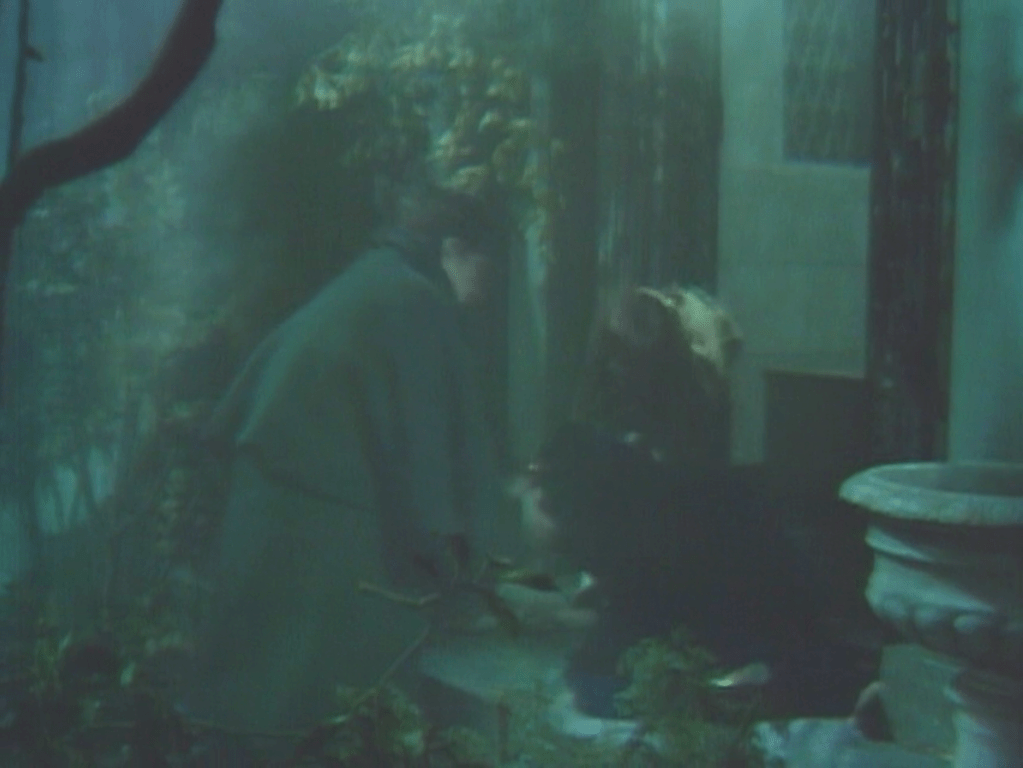
Liz goes to the old Collins family mausoleum. Barnabas’ parents and sister are buried there, and he was himself trapped there for 172 years when he was a vampire. She thinks of it now as her tomb, and tells herself that she is ready to be buried there now. She collapses. Amy finds her, fears that she is dead, and cries out. Her voice brings Barnabas, who tells Amy that Liz is alive. He also says that they must get her back to the house at once. Barnabas puts his arms under Liz’ left side, Amy puts hers under her right, and they lift her. This brief glimpse of the two of them working together goes a long way towards establishing Barnabas’ closeness to Amy.
I’ve altered the saturation and exposure a bit in this still. Though the original is darker and the fog machine was working overtime, in the moving image you can see what Amy is doing clearly enough.
Joe pays another visit to Chris’ room. Chris has taken a bunch of sleeping pills from the bottle Julia gave him. Joe scolds Chris for his failure to visit Amy. Chris knows that he could transform at any time, and is desperate to get Joe to leave. Joe does leave. Chris goes to bed. He falls asleep. The camera pans to his hand, which has already become a werewolf’s paw.
This is the second of three episodes featuring Cavada Humphrey as Madame Janet Findley, a medium called in to investigate the strange goings-on at the great house of Collinwood. Humphrey’s performance so utterly dominates the segment, and I have so little to add to what I said about her style in yesterday’s post, that all I can do is make a series of more or less miscellaneous observations about its other aspects.
Today Madame Findley meets children David Collins and Amy Jennings. Amy and David are coming under the influence of evil spirit Quentin Collins. She questions them in the drawing room, and finds a hidden panel that leads to the long-abandoned west wing of the house. Over the children’s objections, she enters the secret passage. As soon as she is in, they hurriedly close the panel, locking her in. Evidently their objections were part of a ruse designed to lead her to Quentin’s stronghold. All too often on Dark Shadows, the audience knows too much about what characters are trying to do. This scene stands out, because they really do keep us guessing whether the children want Madame Findley to go into the secret passage. We don’t really know what their goals are until we see them shut her in.
Earlier in the episode, Amy’s brother Chris dropped in. He was very eager to see permanent houseguest Julia Hoffman, MD. Amy mentioned to Chris that there was another visitor in the house. When Chris asked who it was, Amy replied, “Her name is Madame- Madame something- at least that’s what they call her.”
I heard these lines in the voice of T. S. Eliot. The rhythm is reminiscent of a section of his poem The Waste Land, which in 1968 was an extremely familiar text to people with literary ambitions:
Madame Sosostris, famous clairvoyante,
Had a bad cold, nevertheless
Is known to be the wisest woman in Europe,
With a wicked pack of cards. Here, said she,
Is your card, the drowned Phoenician Sailor,
(Those are pearls that were his eyes. Look!)
Here is Belladonna, the Lady of the Rocks,
The lady of situations.
Here is the man with three staves, and here the Wheel,
And here is the one-eyed merchant, and this card,
Which is blank, is something he carries on his back,
Which I am forbidden to see. I do not find
The Hanged Man. Fear death by water.
I see crowds of people, walking round in a ring.
Thank you. If you see dear Mrs. Equitone,
Tell her I bring the horoscope myself:
One must be so careful these days.
It was indeed a mysterious Tarot card that prompted matriarch Elizabeth Collins Stoddard to call for help, and that call brought Madame Findley to the house. The card she interprets is the Tower of Destruction, which unlike the cards Eliot’s Madame Sostris describes actually appears in existing Tarot decks. She doesn’t have a cold, and she isn’t in the business of selling horoscopes door to door. On the contrary, as Humphrey plays her she is a dazzling presence.
Liz did not call Madame Findley directly. She telephoned occult expert Timothy Eliot Stokes, who introduced her to La Findley. At first sight, Stokes appears to be a stuffy academic with an impossible Anglophile manner, but as we get to know him he turns out to be very much at home in the bizarre netherworld in which the show takes place, so much so that his supernatural adversaries fear that he may have powers surpassing theirs. T(homas) St(earn)s Eliot was so much like T(imothy) Eliot St(oke)s in the first impression he made, so highly regarded by the sort of people who wrote Dark Shadows, and so generally famous in the 1960s that it is very likely that Stokes’ name was at least partly inspired by him.
It’s true that Madame Findley’s name lacks the exotic glamour Eliot gave his character. I suppose if you have all of Europe to choose from, you can take your stray Tarot cards to someone named “Madame Sosostris,” but if you are limited to central Maine, you have to settle for “Janet Findley.”
I made a remark about Madame Findley’s name in the comments on Danny Horn’s post about episode #647 on his great Dark Shadows Every Day:
It’s just delightful that they introduce an otherworldly, mystical character, played with an actress who brings a genuinely eerie note to her performance, and her name is… “Janet Findley.” It’s like Monty Python and the Holy Grail, when they meet the wizard who is known as “Tim.”
I wonder if there’s any connection between the name “Janet Findley” and the name “Janet Fisher,” whom Carolyn mentioned as a friend once of twice in the first season. Seems like a lot of Janet Fs. For that matter, I wonder if there’s a connection between Tim the Wizard from Monty Python and Tim(othy Eliot) Stokes, who a couple of episodes back had to tell Vicki that he isn’t a wizard.
–Comment left by Acilius, 8 October 2020, on Danny Horn, “Episode 647: The Wire,” Dark Shadows Every Day, 12 May 2015
That remark drew a response from a commenter who posts as “Mary”:
Findley is a popular name on Dark Shadows. In addition to Janet, Margaret Findley is one of the ghostly widows, Thomas Findley is one of Jeb’s zombies in the Leviathan storyline and Findley’s cove is the location of Carolyn’s cottage in 1995.
Comment left by “Mary,” 18 February 2021, on Danny Horn, “Episode 647: The Wire,” Dark Shadows Every Day, 12 May 2015
When Madame Findley asks about the closed-off parts of the house, Liz tells her about both the west wing and an east wing. The phrase “east wing” had come up a couple of times in the first year of the show, but it always seemed to be either a case of the writers not having made up their minds which side of the house the deserted wing was on or a slip of the tongue by the actors. This is the first time the show makes it clear that the house really does have two deserted wings.
Humphrey was too perfect for Dark Shadows to play only one role. In a comment on Danny’s post about this episode, I indulged in a little fanfic about another part that would have been right for her:
Cavada Humphrey looks quite a bit like Jonathan Frid. I wonder what 1795 would have been like if Barnabas had had an older sister who bossed him around, stood around during his ridiculously childish fits of petulance, occasionally acted as his conscience, and time and again serve as his enabler and protector. It would have been funny to see Grayson Hall’s Countess express disapproval of such a relationship.
Heck, that older sister could have been Sarah. Just because she’s a child in her ghost form doesn’t mean she has to have died at that age. Maybe she comes back in the form in which her relationship to her brother took its permanent shape, when she was about nine and he was about seven. Of course, that possibility is foreclosed at Sarah’s first appearance, when she tells Maggie not to let her “big brother” know she saw her, but I suppose they could have retconned that away with a phony flashback where she says “little brother.”
Comment left by Acilius, 8 October 2020, on Danny Horn, “Episode 648: Astral Disturbances,” Dark Shadows Every Day, 14 May 2015.
I’m very fond of Sharon Smyth, and Sarah’s last appearance in the 1795 segment was so poignant it would have been a substantial loss for her not to have been in it. On the other hand, she had so much less to do when she was playing a living being than she did in the preceding months when Sarah was a ghost, and so much of what she did get to do was outside her rather sharply limited range, that it is not difficult to imagine a different kind of Sarah making the eighteenth century insert a more compelling drama.
This is first of three consecutive episodes featuring Cavada Humphrey as Madame Janet Findley, a medium recruited to investigate the strange goings-on at the great house of Collinwood. Humphrey’s performance dominates these segments completely. Her style is more akin to pantomime than to anything native to spoken drama; she uses every muscle of her body to strike a series of exaggerated poses. Since that includes the muscles of the vocal tract, words occasionally come out in the course of her performance. The result is as bizarre as it sounds like it would be, and on Dark Shadows it is magnificent.
Granted, it is a shock when Humphrey reads the opening voiceover. Without seeing her, it is difficult to know what to make of her speech. When we watched it this time, I tried to make Mrs Acilius laugh by mimicking the poses a person might strike while speaking that way. So far from making the monologue sound silly, that just made it clear to us what Humphrey was doing, and left us both taking her performance seriously.
I’ll make a couple of random remarks about the non-Cavada Humphrey parts of the episode. Under the influence of the ghost of Quentin Collins, children David Collins and Amy Jennings have tried to murder David’s father Roger. Yesterday David took the lead in setting the trap that caused Roger to fall down the stairs while Amy showed reluctance in helping him. Today, the children see that Roger is not seriously hurt. David is relieved and wants to stop doing Quentin’s bidding, while Amy insists that they continue. Denise Nickerson delivers one of Amy’s monologues with her eyes fixed on the camera; the effect is unsettling in the extreme, suggesting as it does that Amy and David have taken leave of the other characters and are now in a dramatic space of their own where they may as well communicate directly with the audience.
Amy tells David and us that Quentin must be obeyed.
On his great blog Dark Shadows Every Day, Danny Horn derides David and Amy’s exchange of roles in their conspiracy. He says that the reason they take turns being “Executive Child” is merely sloppiness on the part of the writing staff:
You can handwave and say that seeing his injured father shocked young David out of his temporary hypno trance, but really the explanation is that Gordon Russell wrote yesterday’s episode and Sam Hall wrote today’s, and they didn’t really bother to synch up on David’s emotional throughline. It happens. This is the “good enough for rock ‘n roll” approach to soap opera dramaturgy.
I disagree. There’s nothing hand-wavey about an appeal to David’s motivation. However little attention Hall paid to yesterday’s episode, David’s visit to his father, during which he all but begs for a way to help him in his recovery, leaves no doubt that he meant for us to think that David was relieved that he failed to kill his father and that, having seen where Quentin’s spell would lead, he wanted to break free of it.
And the actual effect of seeing the children waver back and forth in the intensity of their subjection to Quentin, alternating between attempts to break free and turns as “Executive Child” enforcing Quentin’s will on the other, is to show us that we are early in the process of obsession and to create suspense as to whether it will progress all the way to possession. So far, Quentin can dominate only one of the children at a time, while he just tugs at the other. In Madame Findley’s intervention, and for that matter in David’s scene with Roger, we can see paths still open that would lead to breaking his power altogether before he grows strong enough to fully control Amy and David simultaneously.
There is a similarity between David and Amy’s relationship to Quentin at this point and Amy’s brother’s relationship to his curse. Chris has been a drifter for a few years, suggesting that he has been a werewolf for that long, but he is still looking for ways to keep himself from hurting anyone when the Moon is full. The supernatural menaces the show has presented up to this point were introduced as already fully committed to the destruction it was ordained they would cause. David’s mother, undead fire witch Laura Murdoch Collins, was an collection of several entities, some of them more purposeful than others, when she joined the show in December 1966, but it was always her fate to lure David to a fiery death. Vampire Barnabas Collins would eventually become a nuanced character and has now been freed of his curse and become human again, but when he first showed up in April 1967 he was all-in on being a creature of the night. Wicked witch Angelique started her murderous rampage shortly after her arrival in November 1967, and all of the various villains of the Monster Mash period that ran from mid-April to early December 1968 showed up loaded and ready to do their thing. But Chris’ curse has only drawn him halfway into monsterdom, as Quentin’s obsession has only drawn Amy and David halfway into his world of evil.
One inconsistency that may be most profitably explained by carelessness comes when Amy tells David that Quentin calls him by the name “Jamison.” Jamison was the name of David’s grandfather, who was Quentin’s nephew. Earlier, David had, under Quentin’s influence, told Amy to call him “Quentin.” It might have been better if they had decided in advance just who it was whose personality was supposed to overwrite David’s, though I don’t think it is a major flaw.
The ghost of Quentin Collins has lured children Amy Jennings and David Collins to the room in the long deserted west wing of the great house of Collinwood where his skeleton is hidden. For the first time, Quentin appears. Later, a woman in a white dress will also materialize.
An old gramophone starts playing a sickly waltz, and David snaps into an odd mental state. He is slow to respond when Amy calls him by name, and tells her she knows that the waltz is his favorite piece of music. She does not know this, and is puzzled to hear it, since he hadn’t heard the waltz until the night before. Soon it becomes apparent that David is coming to be possessed by Quentin. He tells Amy that they have things they must do, including a conversation with “Roger.” Roger is David’s father; this is the first time we have heard him refer to him by name, and it makes it clear to regular viewers that David is not himself. Later, they are wearing clothes of the same period as those Quentin and the woman in the white dress wore, and they decide to address each other as “Quentin” and “Beth.”
Longtime viewers will also recognize the motif of a piece of music as a device with the power to overwrite a character’s personality. In #155, David’s mother, undead fire witch Laura, gave him a music box, apparently as part of her plan to prepare him to follow her to a fiery doom.
Another music box became much more famous a little later. In the summer and fall of 1967, David’s distant cousin Barnabas was a vampire, and he was determined to re-create his lost love, the gracious Josette. His plan involved forcing a young woman to listen to Josette’s music box incessantly. Barnabas hoped that someone who spent enough time listening to the box would forget her old habits and memories and turn into Josette. The music box did seem to have some measure of the power Barnabas had in mind. First Maggie, The Nicest Girl in Town, then Vicki, David’s well-meaning governess, did spend substantial amounts of time listening to the music box with a vacant look on her face. Episode #303 ended with Vicki’s boyfriend Burke listening to the music box and staring off into space; Mrs Acilius wondered if that meant Burke was going to think he was Josette. Burke wouldn’t have looked so good in the dress that comes with the part, but who knows, maybe he and Barnabas would have been happy together.
David and Amy carry a chest out the front door of the great house. Roger and his sister, matriarch Liz, see them do this and ask what is in the chest. David says that it is full of his toys, and that he and Amy want to play with them outdoors. Roger points out that David has never taken a chest full of toys outdoors before, and asks what has led him to do so now. David tells him it is a military secret. Amy explains that one of David’s toy soldiers is broken and they are going to bury him with full military honors. Amused by this idea, Roger holds the front door open and salutes the children as they carry the chest past. In fact, the chest holds, not a toy soldier, but Quentin’s skeleton. It is that which Amy and David bury.
At night, Roger is about to go to sleep when a knock comes on his bedroom door. It is Amy, telling him she heard from sounds from the downstairs that made her suspect someone might be trying to break into the house. Roger takes this concern seriously enough that he retrieves a pistol from his nightstand and carries it as he goes to investigate.
David ties a wire across the second stair from the top of the case from the bedrooms to the foyer, opens the front door, then hides. Roger enters. He is alarmed to see that the front door is open. He stumbles on the trap David has set. He lies unconscious and bleeding at the foot of the stairs. Amy and David enter, see his condition, and nod at each other gravely.
This is the second time David has tried to kill Roger. The first time, in #15, he had sabotaged the brakes on Roger’s car. As he watched the car pull away, he called to his mother. Laura was not physically present, and would not be for another 22 weeks, but when those who watch the show from the beginning learn of her supernatural character they will ask if she influenced David to patricide. Today there is no doubt that David and Amy are doing the bidding of the ghosts, and so we wonder again if David was under Laura’s power when he took the bleeder valve from the wheel cylinder of Roger’s car.
I don’t know how much of a spoiler it is to tell someone reading a Dark Shadows blog that in the spring of 1969 Quentin would become a major breakout star, rivaling Barnabas’ popularity. Quentin would be such a big part of the show’s appeal that Dan Ross would give the last 16 of the 32 original Dark Shadows novels he wrote under his wife Marilyn’s name titles beginning with the words “Barnabas, Quentin, and the.” They were:
Barnabas, Quentin, and the Mummy’s Curse, April 1970
Barnabas, Quentin, and the Avenging Ghost, May 1970
Barnabas, Quentin, and the Nightmare Assassin, June 1970
Barnabas, Quentin, and the Crystal Coffin, July 1970
Barnabas, Quentin, and the Witch’s Curse, August 1970
Barnabas, Quentin, and the Haunted Cave, September 1970
Barnabas, Quentin, and the Frightened Bride, October 1970
Barnabas, Quentin, and the Scorpio Curse, November 1970
Barnabas, Quentin, and the Serpent, December 1970
Barnabas, Quentin, and the Magic Potion, January 1971
Barnabas, Quentin, and the Body Snatchers, February 1971
Barnabas, Quentin, and Dr Jekyll’s Son, April 1971
Barnabas, Quentin, and the Grave Robbers, June 1971
Barnabas, Quentin, and the Sea Ghost, August 1971
Barnabas, Quentin, and the Mad Magician, October 1971
Barnabas, Quentin, and the Hidden Tomb, December 1971
Barnabas, Quentin, and the Vampire Beauty, March 1972
My first choice is always to title these entries after lines of dialogue from the episodes, and “morbid games children play” was so perfect that I couldn’t pass it up. But Barnabas, Quentin, and the Bleeder Valve was also very tempting, and I do suspect I will use at least a few Barnabas, Quentin, and the titles in the next two and a half years.
The ghost of the mysterious Quentin Collins has trapped children David Collins and Amy Jennings in a storeroom in the long-deserted west wing of the great house of Collinwood. Unable to open the door to the corridor, David and Amy have found another room hidden behind a panel in the storeroom. A room inside another room is often referred to as a “closet,” and this is the perfect soap opera closet- there is literally a skeleton in it.
On Dark Shadows, a fashion-conscious skeleton is never seen without a wig. This one is no exception. It is seated in a chair that swivels towards the children, revealing its face. This swivel reminds us of one of the most famous reveals of a bewigged skeleton in cinema, that of Norman Bates’ mother in Alfred Hitchcock’s Psycho.
Amy and David conclude that the skeleton in the closet must be Quentin’s. The skeleton sits beside an antique gramophone that plays a sickly old waltz over and over; Amy wonders how it started playing. David has been living in the house for two and a half years, so his experience with ghosts is already very extensive, and the gramophone is the least of his concerns.
The adults in the great house have noticed David and Amy’s absence and have gone looking for them. Matriarch Elizabeth Collins Stoddard calls at the other residence on the estate, the home of her distant cousin Barnabas Collins. She tells Barnabas that she wonders if they may have slipped in while he was sleeping. Barnabas tells Liz that he locked all the doors before going to bed, to which she responds “Barnabas, a locked door never kept David Collins out.” In 1967, Barnabas was a vampire and David kept endangering himself by sneaking into his house. In those days, David’s father Roger once made a similar remark. Barnabas isn’t a vampire anymore, but everyone other than Dark Shadows‘ hardcore fans will always think of him as one. David’s inability to get out of the room where Quentin kept him and Amy would suggest that he too has changed, and is now at a loss before locked doors. But for Liz, her nephew will always be a master burglar.
Barnabas searches his house and does not find the children. He and Liz leave for the great house. Hiding nearby, the children see them go and sneak in. As per Quentin’s orders, they go upstairs and take a wooden cradle. Later, we will see them put the cradle in the room with the skeleton and interact with Quentin’s ghost there. Their activities in the room don’t make any sense to the audience; they clearly are not meant to. They come after Amy and David have agreed to “play the game,” using a phrase we hear for the first time today. Those familiar with the mysterious atmosphere of ghost stories can assume it will be some time before we will get enough information even to guess what sort of game it is.
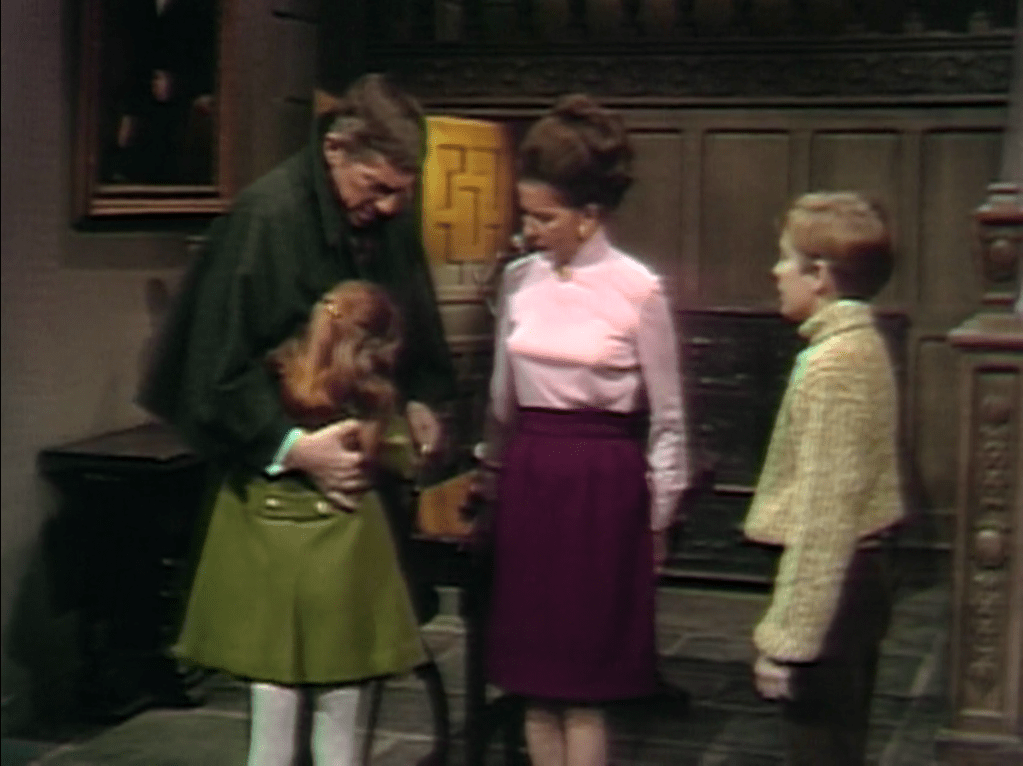
For longtime viewers, the highlight of today’s episode comes when Amy meets Barnabas and gives him a hug. Amy has dominated the show since her first appearance in #632; Barnabas has been its undisputed star since he joined the cast in #211. It turns out that the two of them became friends when they were both patients at Windcliff, a mental hospital a hundred miles north of town.
Amy hugs Barnabas while Liz and David look on.
The director of Windcliff is Julia Hoffman, MD. For almost a year and a half, Julia has been a permanent houseguest at Collinwood; as 1968 has gone on, she has become Barnabas’ inseparable friend. She hugged Barnabas for the first time in #635, to his evident discomfort. But as we saw when he interacted with the ghost of his little sister Sarah in #364 and again when we saw him with the living Sarah in the extended flashback to the 1790s that ran from November 1967 to March 1968, Barnabas gets along well with little girls, so it isn’t such a surprise that he returns Amy’s embrace.
In #629, Liz told Julia that Barnabas was miserable at Windcliff. If Barnabas were still a vampire, it would be easy to imagine his evil overwhelming the scientific rationality at the heart of a psychiatric facility, as it has long since overwhelmed Julia’s professional ethics. But his curse is in abeyance now. They’ve had to work to keep us thinking that he is exotic and uncanny and dangerous; one look at him in a group therapy session would undo all that work so abruptly that we would never stop laughing. Of course we never see him as a patient there. It was daring of them even to include Liz’ line, inviting us to imagine him in such a mundane setting.
There’s an implication that Barnabas and Amy hung out at Windcliff, because apparently exposing small children, in shock over the deaths of family members, to middle-aged mental patients is part of the healing process. The Barnabas/Amy scene makes me laugh at loud because it’s as if the writers think Windcliff is a vacation resort and Barnabas and Amy met by the pool.
Stephen E. Robinson, comment left 11 May 2015 at 6:59 AM Pacific time, on Danny Horn, “Episode 645: Spirited Away,” 10 May 2015, Dark Shadows Every Day.
Stephen is being generous- Barnabas was in the hospital because he had himself been the victim of a vampire, and Amy was there because her brother Tom had died. She did not know, but Julia did, that Tom had also come back as a vampire, and it was Barnabas who destroyed him, first by driving a stake through his heart, later by forcing him into the sunlight. I’m no psychiatrist, but with that history of closely related but non-discussable traumas I wouldn’t think the two of them ought to spend much time together.
But of course none of that matters. Barnabas and Julia are the show’s principal protagonists, and they ran out of story two weeks ago. Ever since Amy took over, we’ve been waiting to see how she will connect with them. Now that we know she is Barnabas’ substitute sister and Julia’s sometime patient, they are ready to rejoin the action.
The whole episode takes place within the great house of Collinwood. We start with conversations between heiress Carolyn Collins Stoddard, mysterious drifter Chris Jennings, and sarcastic dandy Roger Collins. They are trying to determine the significance of the events of a séance that took place yesterday, during which Carolyn was possessed by the spirit of someone named “Magda.” This name is unknown to anyone in the house.
Through Carolyn, Magda uttered a command to “Stop them!” because “My curse!” means that “He must stay where he is!” Returning viewers know that Chris’ little sister Amy and Roger’s young son David are in touch with the ghost of Quentin Collins, a great-uncle of Roger’s who lived in the late nineteenth century and whom the family history falsely records as having gone to France and died there. We can assume that Magda was a contemporary of Quentin’s, that he is the one who must remain where he is, and that she means the children when she says “Stop them!” But none of the adult characters knows what Amy and David are up to, and Magda’s words mystify them.
Roger is alone in the drawing room while Carolyn is showing Chris out of the house. He is about to take care of some work he brought home from the office when a book flies off the piano and lands on the floor. He finds a letter tucked in the book. Carolyn comes back, and he tells her what happened. He says that the letter is addressed to his father, Jamison Collins; this is the first time we have heard Jamison’s name. He says that it is dated 1887, when Jamison would have been a boy. And he tells her that it is signed “Quentin.” With a look of recognition, he says “We have a Quentin Collins as an ancestor. Actually, I didn’t know very much about him. I think he spent most of his time abroad.”
Roger reads the letter to her. The text is: “Dear Jamison, you must return to Collinwood. I need your help. You must intercede with Oscar. Only you can save me.” Considering how the book spontaneously leapt from the piano, Carolyn is sure that Magda’s ghost must have wanted them to read the letter, and that she is trying to warn them that someone in the house is in danger. It calls Quentin to their attention.
Roger goes upstairs to check on David. As it happens, Amy is in David’s room at the time, and they are about to go looking for Quentin’s ghost. They know that the adults will not tolerate this, and so David jumps into bed and Amy hides behind the door. There is some farcical business as Roger starts to go, Amy starts to come out, then he stops and she scurries back to her hiding place. Once his father is gone, David tells Amy that it was very unusual for him to drop in. “He never says good night to me.”
When Roger returns to the drawing room, Carolyn, who a few minutes ago announced that someone in the house- “It could be any one of us!”- was in imminent danger, asked Roger why he was “suddenly so concerned about David.” Even longtime viewers who remember Roger as the phenomenally bad father he was in the first 38 weeks of the show will think that this is overdoing it. After all, Magda’s warning to him and Carolyn came in the form of a letter addressed to a boy, and David is the only boy in the house. It is natural enough that the reference to Jamison would bring David to mind.
Amy had slipped into David’s room while he was sleeping. She woke him to say that Quentin was angry because “Something has happened.” She knows nothing about the séance or the conversations going on downstairs, and so cannot share our conjecture that Magda is an old enemy of Quentin’s and it is her activities that are disturbing him. David is at first reluctant to get up and irritated when Amy wants to contact Quentin. As he grumbles at her, they begin to sound like an old married couple, even though they only met on Monday and are eleven years old.
David grudgingly agrees to pick up the antique telephone through which he has heard Quentin’s breath and Amy has heard him speak. The breath is audible, and when he gives the receiver to Amy she hears Quentin says that “she would try to stop” them. He didn’t specify who “she” was, but Amy has drawn the conclusion that they should go to the room in the long deserted west wing of the house where they originally found the telephone and contacted Quentin. Every time David resists her ideas, Amy strikes exactly the note that will lead him to do what she wants. At one point, Amy tells David “You’re braaver than I am!” to which he bluffly replies “Because you’re a girl!” He then presses forward with the plan she had formulated.
The children find that the door they had previously used to get into the west wing is now locked. David says that there is another way in, but that it is a secret very few people know about. He leads her to the door of the drawing room, only to find that Roger and Carolyn are still in there. They hide. Once the coast is clear, David leads Amy to a secret panel behind a chair next to the fireplace. We have seen this panel before, in #87. On that occasion, Roger had used it to sneak into the west wing unobserved and release well-meaning governess Vicki from the room to which David had confined her, hoping that she would die. It was unclear whether anyone other than Roger knew of its existence. We haven’t seen it since. Dark Shadows‘ ratings were very low in October 1966, and most of the people watching now hadn’t heard of it then. So when David says that very few people know about the secret panel in the drawing room, his words apply to the audience as well as to the characters.
David opens the panel. He and Amy go into the passage. When the panel is closed behind them, we see the chair move itself back into place in front of it, suggesting an occult power is at work.
David and Amy encounter various signs of supernatural opposition as they make their way to the room. At one point Amy sounds genuinely frightened and suggests turning back, but she has done her work too well- David is now determined to prove his courage. Once they are in the room, the door slams shut and they find that they are trapped. Longtime viewers who remember what David did to Vicki way back when will see an irony in his captivity in the west wing.
Skillful as Amy is in her management of David Collins, Denise Nickerson and David Henesy haven’t quite figured out how to work together yet. They had very different styles of acting, his coming from inside out as he uses his lines and stage directions to project the character’s feelings and intentions, hers coming from outside in as she throws herself into whatever the character is doing at the moment and finding her inner life through those. She is on top of her form right from the start, but he keeps getting thrown off, atypically mangling his dialogue several times and putting the emphasis in odd places in the lines he does get right. That won’t last long- soon David and Amy will be a “supercouple,” as fun to watch together as any other pairing on the show. But this episode is a bad day at the office for Mr Henesy.
Danny Horn’s post about this episode on his Dark Shadows Every Day takes the bits and pieces of information that will fit well with continuity months down the line, contrasts them with the bits and pieces that won’t, and focuses on a case that the writers didn’t have any plan in mind when they were writing the show. I think Danny simultaneously goes too far and not far enough with this point.
In a 1991 interview that Danny himself put online, writer Violet Welles confirmed that the writing on Dark Shadows, as on other soaps, began with a six month story projection that the writers would break down into “flimsies,” day by day outlines of how it might all play out. No one was going to force them to stick with those projections, much less with the flimsies, but creating them meant that the writers spent a lot of time kicking ideas around for possible plots and possible characters. They also meant that there were stacks of paper recording those ideas, so if someone suggests in November that Quentin might have been enemies with a witch named Magda, it won’t require a feat of memory to recall that suggestion in January. So it is going too far to dismiss all thought of a connection between what the characters say today and what we will see next year.
But he doesn’t go far enough when he suggests that the pressure the writers were under to crank out five scripts a week would have kept them from planning for events we wouldn’t see for several more months. They were indeed subject to impossible deadlines, and they did indeed have to improvise at the last minute. So much so that they did not know whether any given event would happen next week, next month, six months from now, or not at all. They may well have planned a story out in detail thinking they might need it soon, only to have it sit on the shelf until next summer.
I always try to write these commentaries as if I hadn’t seen any of the subsequent episodes, so when I mention foreshadowing I try not to say whether or how it will pay off. I also try to write from a perspective that would have been more or less possible for someone watching the show when it was originally broadcast, so when foreshadowing does pay off or when in other ways an episode echoes something we had seen earlier I try to note that echo first and to speculate about what it might mean later, confining any references to information that became public afterward to the bottom of the post. So I won’t quote the particulars of Danny’s argument, or of my comment on it. I hesitated to say as much as I have about Magda, but when I tried to make the same point without using names the results looked like algebra (“Let x be a ghost and y be a witch. Suppose that x and y lived in the same period; call this period P.”) Since the episode leans so heavily into the relationship between Magda and Quentin today, I resigned myself to the spoiler.
In #2, high-born ne’er-do-well Roger Collins saw governess Victoria Winters standing at the edge of a high cliff overlooking the ocean. She didn’t know he was there until he startled her by asking her if she was planning to jump. As the weeks go on, Vicki will learn of other women who have leapt to their deaths from that spot, including a story that over the years two governesses were among them and that legend says a third will someday follow suit. The cliff is the face of Widows’ Hill, named after women whose husbands never returned home from the sea; several times during storms an eerie note sounds in the wind, a note known as “The Widows’ Wail,” which the locals believe to be the ghosts of the Widows announcing that a tragic death will soon take place.
Vicki stands at the edge of the cliff again at the end of this installment while the Widows’ Wail sounds. She is distraught that she has herself become a widow and is dwelling on the idea that she can be reunited with her husband in death.
Though occult expert Timothy Eliot Stokes told her earlier in the episode that “Your time is now!,” Vicki’s time as a lively part of the show in fact ran out in March 1967, with the resolution of the story about her effort to befriend her charge, Roger’s strange and troubled young son David. Actress Alexandra Moltke Isles finally gave up on the character and left Dark Shadows after #627. Her successor in the role, Betsy Durkin, has essentially nothing to work with. We do not share her grief for the husband she is mourning; he was one of Dark Shadows‘ most repellent characters, and it is such a relief that he is away that we sympathize only too much with everyone who tells her to stop bringing him up. Nor do we have any other reason to care about her, since she is relevant to no ongoing plotlines. Even longtime viewers who remember the foreshadowing of Vicki’s possible death by a jump off the cliff will not react strongly to the sight of her there, since Miss Durkin is not Mrs Isles and does not bring her screen iconography to the reprise of the theme.
This phase of the show actually belongs to a character introduced in #632, eleven year old Amy Jennings. When Amy meets Stokes today she announces that she likes him because he is funny; he replies that he is pleased to find that “My appeal extends to all ages now.” Indeed it does; in its first year, Dark Shadows was very much aimed at adults, some of whom remembered Joan Bennett as one of the great movie stars of the 1930s and 1940s and were impressed by her presence in the cast as matriarch Liz, some of whom appreciated it as a specimen of slow-paced, highly atmospheric Gothic romance, and some of whom were fascinated by the story of Vicki and David and its theme of a grownup trying to make a difference in the life of a troubled child. But by the time Stokes arrived in #464, Dark Shadows had become a kids’ show. As Thayer David plays him, Stokes is amusing enough that anyone can like him, but the absolute seriousness with which he regularly expounds the most preposterous mumbo-jumbo is designed to make him a favorite of the very young.
Amy’s friendship with David develops in scenes that kids will find engaging, as they go exploring the big haunted house of Collinwood and find their way into spooky adventures. She also takes the lead in her relationships with adults more consistently than David ever did. While in the first year and a half of the show David often knew things the adults didn’t know, that was usually because he accepted the facts they refused to see. No matter what he said or did, he couldn’t move them from their habits of denial and evasion. But Amy has sources of information that the grownups around her don’t have. So today she has a vision of her brother Chris in some kind of terrible trouble. When she tells Vicki and Liz about her vision, Liz tries to telephone Chris and is deeply disturbed when he doesn’t answer. As my wife, Mrs Acilius, pointed out, it is after one o’clock in the morning, so you wouldn’t expect her to attach great importance to his failure to pick up the phone. That she does suggests that she is taking Amy seriously.
Returning viewers know that Amy’s vision is correct. Chris is a werewolf, and he just killed a barmaid. That Amy not only has a paranormal means of knowing how Chris is doing, but that she is also able to get through to the adults and influence their actions, suggests that she will have a major impact on the werewolf story as long as it continues. Indeed, she already has- the werewolf was about to eat Liz the other day, but backed off when he saw Amy nearby.
Amy is central to the other storyline that is beginning at this point. That is “The Haunting of Collinwood,” in which the ghost of Liz and Roger’s’ great-uncle Quentin Collins is going to be creating difficulties for everyone. Amy and David went into the long-deserted west wing of the house and retrieved an antique telephone from a room there. Though its cord is cut, Amy can sometimes hear Quentin’s voice through its receiver. When she is alone and worried about Chris, she picks the telephone up and asks for Quentin. She is disappointed he does not answer. None of the adults knows about Quentin’s ghost or the telephone. Not even David has heard more than Quentin’s breathing through the receiver. Again, Amy is uniquely positioned to understand and affect the action.
According to the closing credits, this week’s five episodes were directed by “Penberry Jones.” The name “Penberry Jones” is unknown to Google aside from these credits, and it sounds like a joke of some sort. Though the fansites all mention the improbability of Jones’ name and the likelihood that it is a pseudonym, none that I could find offers any clue as to who might have been behind that pseudonym. From the early 1970s until the quarantines of Covid-19 in 2020, Dark Shadows fans would organize festivals a couple of times every year at which panels of people who had been involved in making the show took questions from the audience. If any of those audiences asked who Penberry Jones was, either they did not get an answer or that answer was not recorded.
The name “Penberry” may remind longtime viewers of Dark Shadows of episode #83, which is about Roger burying a pen. Roger was a major villain then, and his part gave actor Louis Edmonds an opportunity to show what he could do. Roger has long since been demoted to occasional comic relief; one might imagine that Edmonds wanted to take a turn in the director’s chair, and that he chose his whimsical pseudonym as a nod to his character’s origins. Appealing as that idea may be, it does not seem at all likely. So many of the panel discussions among cast members abounded in fond stories about Edmonds that surely someone would have mentioned it if he had directed five episodes.
Indeed, most of the longer-lived members of the cast participated in so many of those panels that they all had moments when they had to grope more or less desperately for something fresh to say. If anyone whose name fans would recognize and who worked closely with the cast were “Penberry Jones,” it’s hard to imagine that one or another of them wouldn’t have brought it up in one of those moments.
Whoever it was must have been known to executive producer Dan Curtis and line producer Bob Costello, and probably quite well known to them. The Directors Guild of America does allow its members to change the names under which they are credited, as for example John Walter Sullivan was allowed to direct several episodes of Dark Shadows as “Jack Sullivan” and several more as “Sean Dhu Sullivan.” But it does not allow them simply to use pseudonyms at will. It wasn’t until 1969 that directors working in features could be billed as “Alan Smithee,” and then they had to prove that they did not really have control of the final product before they were allowed to substitute that name for their own. The first television production credited to “Alan Smithee” didn’t appear until 1970. So it is unlikely that “Penberry Jones” directed any screen productions under any other name. Curtis and Costello probably wouldn’t have chosen a first-time director with no imminent prospects of other screen work unless it were someone they already knew and trusted.
If “Penberry Jones” didn’t cover anyone the cast knew well or a director who worked under another name, but was someone who was close to Dan Curtis or Bob Costello, it should be possible to compile a short list of suspects. I’m not so deeply immersed in the behind-the-scenes lore that I can compile that list myself, but maybe you are. If so, I’d like to hear from you in the comments!
The director’s name isn’t the only puzzle in the closing credits. Every previous episode of Dark Shadows ended with the credits playing in front of a stationary shot of one or another set. It was always one shot per closing credits sequence. This time they start with a stationary shot of Vicki’s room, then cut to a stationary shot of the foyer. It’s hard to see what the point of that transition is. Perhaps we could ask “Penberry Jones,” if we had any idea who that was.
Eleven year old Amy Jennings and her big brother Chris joined the show recently, and they are the stars today. Amy has discovered the ghost of Quentin Collins, who haunts a room in the long deserted west wing of the great house of Collinwood. Strange and troubled boy David Collins is rather miffed that Quentin prefers Amy’s company to his- after all, “Quentin Collins is my ancestor,” not Amy’s. They hold a séance in an attempt to bring Quentin to them. David has only participated in one séance, back in #186, when he went into a trance and gave voice to the late David Radcliffe, a boy who died (by fire!) in 1867. So he hasn’t had a chance to catch on that séances on Dark Shadows require a minimum of three people- the first to begin the ceremony and bark orders at everyone else, the second to go into the trance and act as medium, and the third to grow alarmed, try to wake the medium from the trance, and be sternly rebuked by the first. Since David and Amy have no third person, they have no chance of contacting Quentin.
Instead, a shadowy figure appears in the doorway. She is well-meaning governess Vicki, or a rough approximation thereof. David Collins’ scenes with Vicki had been the highlight of the first year of Dark Shadows, not because of the writing or the direction but entirely due to the rapport between actors David Henesy and Alexandra Moltke Isles. A few weeks ago Mrs Isles left the show, and Vicki was recast. Her brief appearance is Mr Henesy’s first scene with the new actress, Betsy Durkin. They can’t recreate his chemistry with Mrs Isles, and Vicki ran out of story long ago. As a result, the scene sounds a discordant note for longtime viewers, reminding us that Miss Durkin, whatever her talents, is here nothing more than a fake Shemp taking up screen time.
Unknown to the other characters, Chris is a werewolf. Chris accepts an offer from the Collins family to host Amy at Collinwood while he deals with his mysterious problems; in gratitude, he takes heiress Carolyn for a drink at the Blue Whale tavern. While there, he sees a pentagram on the barmaid’s face and hurriedly excuses himself. Later, he transforms into his lupine shape and returns to the barroom, not through the door this time but through the window. He kills the barmaid.
The barmaid appears only in this episode; she doesn’t even get a name. But we see her face in closeup often enough that she feels like a person. Even more importantly, she is wearing the same wig that Maggie Evans, The Nicest Girl in Town, wore in her first four episodes (#1, #3, #7, and #12.) Since Maggie was also a server, working the counter at the diner in the Collinsport Inn, this wig tells longtime viewers that the werewolf’s victim could just as easily have been Maggie, one of everyone’s favorite characters.
Don Briscoe played Chris in his human phase, Alex Stevens as the werewolf. Stevens was credited not as an actor, but as “Stunt Coordinator.” Yet today, his credit card appears in between Briscoe’s and that of Carol Ann Lewis, who was cast as the luckless barmaid. Some of the original audience may have caught on that Stevens was the man in the character makeup, but others who noticed the odd billing order would have chalked it up as another of the show’s frequent imperfections.
The only story that consistently worked in the first year of Dark Shadows was well-meaning governess Victoria Winters’ quest to befriend her charge, strange and troubled boy David Collins. In #191, David’s mother, blonde fire witch Laura Murdoch Collins, was trying to immolate him and herself. At the climactic moment, David ran from the flames into Vicki’s arms. When David chose Vicki and life over Laura and death, their story was concluded, and Dark Shadows 1.0 came to an end.
Vampire Barnabas Collins would first appear on Dark Shadows in #211 and quickly become its main source of interest. The show never made up its mind how Vicki would relate to Barnabas’ story. The obvious move would have been to follow Bram Stoker’s Dracula and make Vicki the vampire’s first victim, rising from the dead like Lucy Westenra as “The Bloofer Lady,” a friend to children in life who in her undead afterlife feeds on the blood of children. In that case, Vicki would be destroyed as she was about to kill David. But Vicki had been an effective protagonist throughout the Laura story, which was itself in large part an adaptation of Dracula, and if as seemed likely the show was going to be cancelled with #265 they would have wanted Vicki to stake Barnabas at the end of that episode. So she was spared his bite, and instead he turned his fell gaze upon Maggie Evans, The Nicest Girl in Town.
With Vicki walled off from the vampire story, David’s contact with it was initially limited to the inconvenience he could make for Barnabas by sneaking into his house during the day. When Barnabas was keeping Maggie in his basement, a new character was introduced who would meet David and relate to him in a way that would bring him to the center of Barnabas’ concerns. This was the ghost of Barnabas’ little sister Sarah, a girl about David’s age.
David Henesy had been the only child actor on Dark Shadows until Sharon Smyth joined the cast as Sarah in #255. Miss Smyth had very little of the training and experience Mr Henesy brought to the show, but playing a ghost she didn’t really need them. Our main reaction to Sarah is puzzlement, puzzlement as to what she wants, what she can do, and whether she knows anything at all about herself and the world she finds herself in. Miss Smyth was just as puzzled as the audience about all of these questions, and that works to her advantage. In Sarah’s scenes with David Collins, Sharon Smyth’s feelings about David Henesy- a precocious crush mixed with fear of his propensity for playing rather nasty practical jokes on her- added a touch of urgency without erasing any of the character’s mystery. At the same time, Mr Henesy’s acting skills made it possible for us to believe that David Collins had gone a tremendously long time without catching on that Sarah was a ghost. Once David Collins finally did figure it out, David Henesy made the most both of scenes where he coolly presented skeptical adults with irrefutable evidence of Sarah’s true nature and of scenes where he became overwrought at his inability to convince them of the truth.
Sarah’s ghost hasn’t appeared since #364. A couple of weeks ago Alexandra Moltke Isles left the show and the part of Vicki was recast; Mr Henesy hasn’t shared a scene with the new actress, but he had barely shared a scene with Mrs Isles for a year. Throughout 1968, his appearances on the show have been few and far between. Today, for example, he makes his first appearance since #609, which was in turn only his second appearance since #541. That changes when he meets a new co-star who will change the trajectory of his character and of the show.
Amy Jennings is played by Denise Nickerson, whose preparation was fully equal to Mr Henesy’s. Her style was quite different from his- while he, like Mrs Isles, tended to play his characters from the inside out, figuring out what is in their minds and then using the dialogue and action to project that understanding, she tended to start with the action and find the character in the middle of it. Today she shows up on the grounds of the estate of Collinwood just as David’s aunt, matriarch Elizabeth Collins Stoddard, comes face to face with a werewolf. The werewolf was about to attack Liz, but he runs off at the sight of Amy. Liz takes her unlikely rescuer home with her to the great house on the estate.
There, Amy meets permanent houseguest Julia Hoffman, MD. Julia is the nominal head of Windcliff, a sanitarium from which Amy recently escaped. Liz describes the encounter with the werewolf, and Amy explains that she is looking for her brother Chris. Returning viewers know that Chris is the werewolf, but none of the characters knows this yet. The adults are mystified by Chris’ wandering ways and his refusal to take responsibility for his little sister, while Amy is convinced that he is ready to give that up and settle with her in the village of Collinsport.
Julia wants to ship Amy back to Windcliff at once, but Liz talks her into letting Amy stay the night. David strolls in; he meets Amy, and Liz sends the two of them to get housekeeper Mrs Johnson.
We see David and Amy looking out the window of a guest room during a storm. David is disappointed to hear that Amy won’t be staying through the next day, and talks about what they will do the next time she visits. He asks if the thunder and lightning frightens her, she says no, “It can’t hurt you.” To this he replies, “Sure can! Lightning can strike you dead.” After a brief pause, he adds “Well, if you’re not afraid, I guess you don’t need me.” That sequence of lines is so funny the humor must have been intentional.
Amy asks David to stay. They sit on the floor in front of the fireplace in her room, and at her suggestion they decide to explore the long-deserted west wing of the house. They go straight to a room in which they find an antique telephone. They decide to play a game in which they pretend to talk to the ghosts of the people who used to live in the house using the telephone. Amy actually gets through to one of them. David thinks she’s kidding him, and takes the phone. To his amazement, he hears breathing on the other end, even though the telephone’s line is cut.
David only heard the breathing, no words. Amy tells him that the voice identified itself as that of Quentin Collins. David, whose avid interest in Collins family history made it logical that he, in #205, would be the first character to mention the name “Barnabas Collins,” says he has never heard of Quentin.
Later, they return to Amy’s room and find Quentin’s picture in a family album. Liz comes in, and when David asks her about Quentin she tells him that he was her great-uncle, that he left for Europe when he was young, and that he died in Paris. Regular viewers will remember that when Barnabas became a vampire, the Collinses put about the story that he had gone to London, and when he came back in 1967 he introduced himself to Liz as a cousin from England. Thus the show suggests that Quentin may be its next attempt to match Barnabas’ breakout success.
Amy has taken the telephone to her room, and at the end of the episode she talks to Quentin again. He beckons her to return to the room in the west wing, and she goes. If Quentin is indeed going to succeed Barnabas as Dark Shadows‘ great supernatural menace, evidently it is Amy who is in danger of becoming his first victim.
In #636, occult expert Timothy Eliot Stokes remarked that he had never heard of a ghost communicating by telephone. During this period, the show was going through a lot of last minute rewrites; the Dark Shadows wiki reports on several flimsies and drafts that were cast aside and replaced with new scripts. So I can imagine that Stokes’ line may have inspired the idea of using the telephone to introduce Quentin, though perhaps it is likelier that they already had the prop and Stokes’ line was a private joke among the writers.







 Dark Shadows Commentary