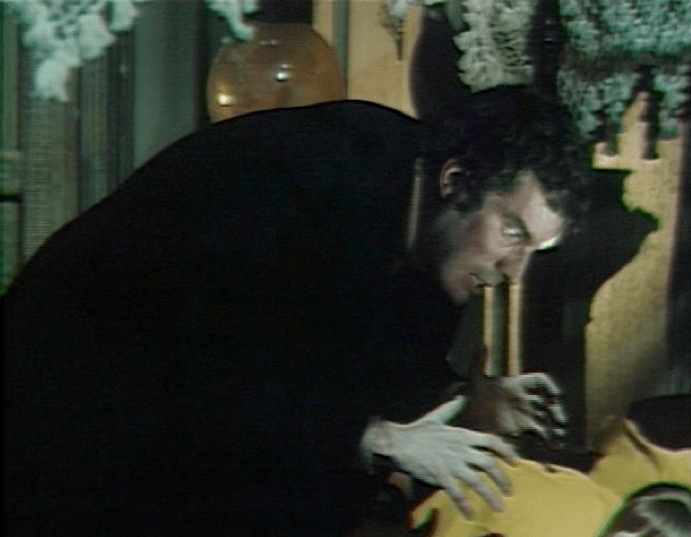
Episode 712: A pawn in this cruel game

Dark Shadows first developed its conception of the supernatural in depth when undead blonde fire witch Laura Murdoch Collins was on the show from December 1966 to March 1967. Laura was not so much one person as she was a complex of at least three distinct beings. There was a charred corpse in the morgue in Maricopa County, Arizona; a phantom that Laura’s son, strange and troubled boy David Collins, can sometimes see through his window as she flickers above the lawns of the estate of Collinwood; and a living woman who carries on conversations with people but is never seen eating or drinking. People who encounter Laura also experience dream visitations that resemble her and unaccountable compulsions to do things relating to her, but it is never clear which of those psychic phenomena come from Laura and which from her arch-nemesis, the ghost of the gracious Josette. It is clear that the various parts that make up Laura are not always aware of each other, and sometimes work at cross-purposes with each other.

Laura’s successor as Dark Shadows‘ chief supernatural menace was vampire Barnabas Collins, who joined the show in April 1967. Like Laura, Barnabas comes in several parts, not all of them working together harmoniously. For example, sometimes doors slam shut when he is in a house, and only he can open them. This is never shown as something he deliberately makes happen, and it does not always serve any intelligible purpose of his. Also, when he is active dogs start howling. Sometimes that immobilizes his targets with fear and confusion, but just as often it costs him the element of surprise and foils his plans. So whatever uncanny forces cause these things to happen are clearly not subject to Barnabas’ will. They accompanied him out of the darkness.

Shortly after Barnabas’ arrival, the show retconned Josette as his lost love and cast her as Princess Ankh-Esen-Amun to his Imhotep in a remake of the 1932 film The Mummy. In that film, the undead man tried to remake contemporary woman Helen Grosvenor in the image of the ancient Ankh-Esen-Amun. Taking that role in Barnabas’ attempt to recreate Josette was Maggie Evans, The Nicest Girl in Town. As in the 1932 film Zita Johanns played Helen in the contemporary scenes and Ankh-Esen-Amun in a flashback to ancient Egypt, so in #70 and #126 had Miss Scott already played the ghost of Josette.

While Barnabas pursued his crazed and evil plan to Josettify Maggie, the ghost of his little sister Sarah showed up. Sarah befriended Maggie and helped her escape from her “big brother.” Sarah did more and more, ultimately sending well-meaning governess Vicki back in time so that from November 1967 to March 1968, Dark Shadows was a costume drama set in the 1790s, when Barnabas and Sarah were alive.

Like Laura and Barnabas, Sarah may have looked like single person, but was in fact a complex of independent beings. In #325, she visits David in a dream and gives him information only she would have. In #327, David sees Sarah during waking hours and tells her about the dream, and it all comes as news to her. This daylight Sarah makes it clear to David that she does not want him to have the information the dream version of her gave him so shortly before.

Moreover, child actress Sharon Smyth was instructed to play Sarah as Barnabas’ conscience. When Barnabas is freed to prey upon the living, he unknowingly pulls Sarah out of the supernatural back-world behind the action of the show, the unseen realm where Josette’s ghost, the “Widows,” the ghost of Bill Malloy, and the rest of them lurk, and brings her with him into 1967. Sarah, however many of her there are, is part of the same complex that includes Barnabas and the forces that surround him.

In the 1790s portion, we met wicked witch Angelique and saw her place the curse that turned Barnabas into a vampire. Like the other supernatural forces, Angelique was a complex of multiple beings, some of which were opposed to each other. In her case, spellcasting was a matter of breaking off little bits of herself that took on lives of their own. Angelique was obsessed with the idea that Barnabas would fall in love with her. She could easily cast a spell to make him do that, but insisted to her helper that Barnabas must come to her “of his own will.” Those were the exact words Barnabas used when talking to his own thrall about Vicki, who succeeded Maggie as the object of his gruesome fantasies. When we heard Angelique take the same line, it dawned on us that the Barnabas we saw from April to November 1967 was not merely cursed by Angelique, he was possessed by her. His thoughts were her thoughts, his plans were her plans. When Barnabas fights Angelique, it is one of her replicas of herself coming back to oppose her, as the zombie version she created of Barnabas’ uncle Jeremiah came back to bury her alive in #396.

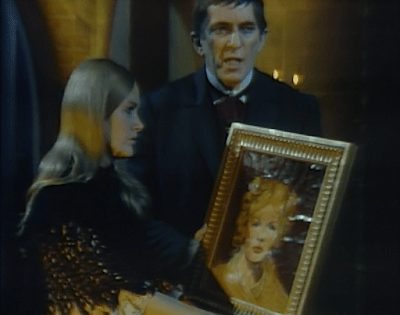
Now, Barnabas has traveled back in time to 1897. He has met governess Rachel Drummond, who is played by Kathryn Leigh Scott and whom he recognizes as a double of Josette. Angelique has also come to 1897, conjured up by some Satanists whom Barnabas has antagonized for no apparent reason. Angelique peered through the windows of the great house of Collinwood just in time to see Barnabas giving Rachel Josette’s music box. Dismayed, she went to the Old House on the estate, looked at Josette’s portrait, and declared “I am Angelique, and I hate you!” She, like Barnabas, looks at Rachel and sees another Josette.

Angelique’s motivation in the 1790s segment was ostensibly about her desire for Barnabas, but it was her hatred for Josette that drove her at every turn. Now we see that Barnabas is compelled to create another Josette whom he can love; Angelique is just as powerfully compelled to create another Josette to hate. Since Barnabas’ “love” involves killing its object and raising her as a vampire, it would seem to be as hateful as is Angelique’s overt hostility.

After Angelique proclaimed her hatred to the portrait, she took a cloth doll representing Rachel and strangled it. Rachel herself collapsed, unable to breathe. Angelique mouthed words; Rachel spoke them, leading Barnabas to believe that they were a message from Josette.

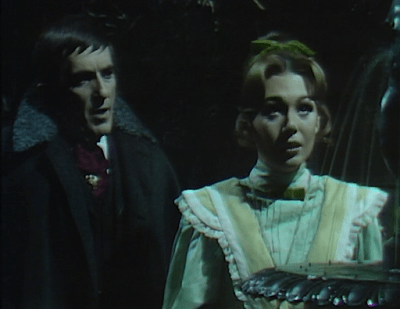
Today, Rachel is in the drawing room at the great house, recovering from her choking episode. Barnabas is holding her and looking longingly at her neck when stuffy Edward Collins enters. Edward demands to know what is going on, and Barnabas explains that Rachel had trouble breathing and fainted. Edward becomes concerned and wants to call a doctor; he becomes suspicious when Rachel, who he just met a few days ago, does not want to see a doctor. Barnabas manages to distract Edward from his suspicions with some chatter about the circumstances under which Rachel fainted.

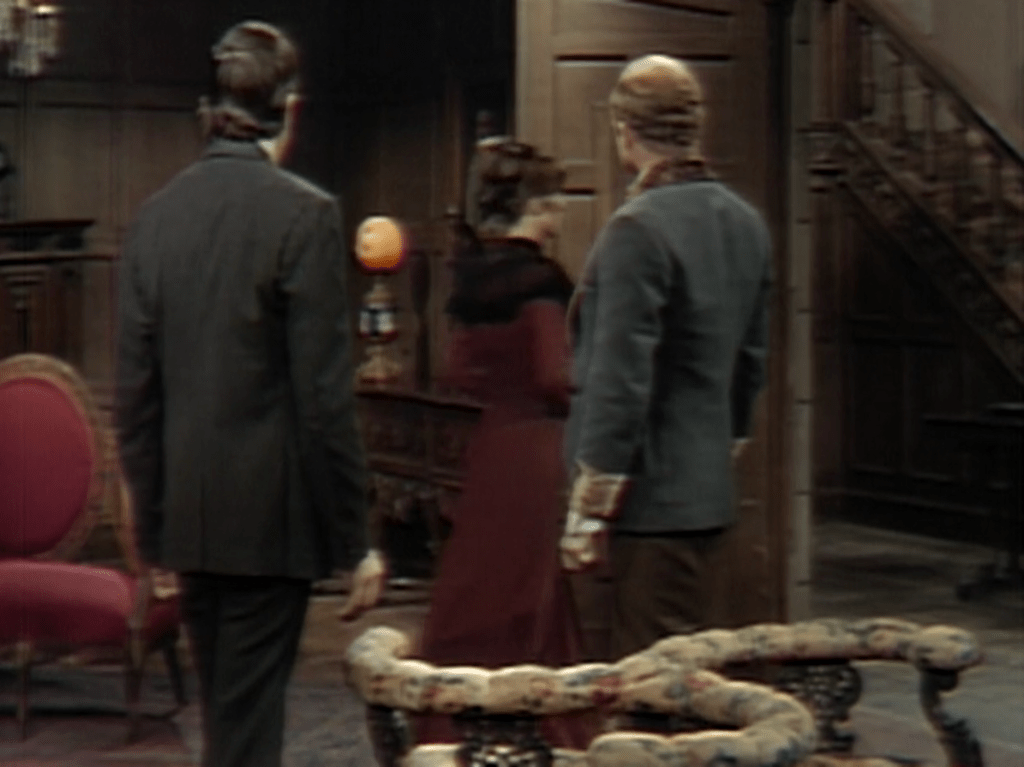
In the groundskeeper’s cottage on the estate, Angelique casts a spell to summon Rachel. Back in the great house, Rachel suddenly looks up, her eyes wide open and focused at a point in the middle distance. She stands up and walks with her neck very still, moving like a wind-up doll. She announces to Edward and Barnabas that she will be going outside for a breath of fresh air. She refuses Barnabas’ offer to accompany her. Edward and Barnabas watch her wonderingly as she marches out with her robotic gait.

Barnabas and Edward wonder what has got into Rachel all of a sudden

Rachel arrives at the cottage and finds Angelique. Angelique calls Rachel “Josette.” When she protests that her name is Rachel, Angelique echoes the Barnabas we first knew and tells her that, when she wills it, her name will be Josette. She tells Rachel that she will not understand what is happening to her, but that Barnabas will soon understand very well.

Back in the great house, a servant tells Edward that he found a woman in the cottage. Barnabas is there, and he reacts to the description with alarm. He goes to the cottage, clearly afraid that he will find Angelique there. Before he can complete a search, a rooster crows and Barnabas hastens back to his coffin in the basement of the Old House on the estate.

Barnabas opens the coffin, and finds Rachel lying in it, unconscious. This sets up a comedy of manners. He hardly knows her well enough to lie down with her, and he can’t very well wake her and ask her to make way for him. We end with him facing this problem in etiquette.

We may also remember #248, when Barnabas expressed his frustration with Maggie’s refusal to turn into Josette by forcing her into his coffin. Perhaps Angelique knows that he did that, and is taunting him with a memory of which he has since shown an ability to be ashamed. If so, the point of the taunt is that he is not different from her. Angelique called Rachel a “pawn” in the “cruel game” she is playing with Barnabas. Angelique, who when we first saw her in the 1790s segment was so monomaniacally devoted to her goals that she could not see events from any perspective other than her own, can now understand that what she is doing to Rachel is horrible. That’s why she is doing it, to show Barnabas that he is part of the same horror as herself and that he can never transcend it.

Episode 711: Our beautiful black-hearted child of the angels

In the groundskeeper’s cottage on the estate of Collinwood, Satanists Evan Hanley and Quentin Collins call on the powers of Hell to send a demon to help them fight Quentin’s recently arrived and deeply mysterious distant cousin Barnabas. The call is answered by none other than our old friend Angelique the wicked witch.

Quentin and Evan have no idea who Angelique is, and she does not know them either. Evan introduces himself to her as a lawyer; he seems genuinely surprised that this does not impress her. Evan tells Angelique that he and Quentin summoned her from Hell and can send her back; she agrees that they summoned her, but is not so sure they can send her back. Quentin tells her that the year is 1897, that she is on an estate known as Collinwood, and that he and Evan have an enemy called Barnabas Collins. Angelique is intrigued by the year, familiar with the estate, and thrilled to hear about Barnabas. Evan starts making demands; Angelique causes him to choke and gasp. She is quite friendly to Quentin, and when Quentin suggests she let Evan breathe and speak again, she indulges him.

Angelique puts Evan in his place.

Evan is played by Humbert Allen Astredo, who in 1968 played suave warlock Nicholas Blair. He plays Evan with exactly the same bearing, tone of voice, and range of facial expressions he had brought to the role of Nicholas. Viewers who remember Nicholas have been bewildered by this. Barnabas knew Nicholas and fought him; when he met Evan the other day, his reaction left open the possibility that he recognized him as the same person. But Evan’s dabbling in the occult, as we saw it yesterday, shows only an infinitesimal fraction of Nicholas’ vast abilities in that field, and his buffoonish response when Angelique appears shows that he is no relation.

It is when Angelique strikes Evan dumb that we learn why Astredo played him in the same way he played Nicholas. Nicholas was introduced as Angelique’s boss, the master of magical powers much greater than hers. Since the main difficulty with fitting Angelique into a story was that she could easily accomplish any goal if she just kept her focus, adding a character who is even more powerful took the show to an absolute dead end. They had to box Nicholas up inside a lot of pointless business, and he quickly became a source of frustration to the audience. Seeing Astredo as another Nicholas reminds us of that frustration, and when Angelique brushes him aside with a flick of her finger our unease evaporates. We are assured that the plot will keep moving this time, and that Astredo will be free to show us what he can do as an actor.

At the end of Friday’s episode, it was Quentin who tried to stop the ceremony when Angelique’s visage began to take shape in the fire, fearing they had gone too far. Today Quentin realizes there is no turning back, but Evan keeps saying he wants to return Angelique whence she came. It’s hard to see what he expected- he was calling on the Devil to send a demon. I suppose he really is disappointed that Angelique is not excited to find herself in the company of a member of the bar.

Quentin goes home to the great house on the estate. He sneaks up behind governess Rachel Drummond while she is dozing on the sofa in the drawing room and puts his hand on her face. That wakes her. When she protests, he asks if he did it unpleasantly. She answers, “No… I mean, yes!… I don’t know.” That summarizes precisely the natural reaction to Quentin. His behavior is abominable in the extreme, but David Selby’s charisma and easy charm come through even in the character’s darkest moments, and the audience can no more want him to stay off-screen than the female characters can want him to leave them alone.

Quentin and Rachel sit together; his hands are on her face again when Barnabas shows up. Quentin gets up and twits Barnabas with his obvious closeness to Rachel, then excuses himself to go to bed.

Barnabas gives Rachel a music box that once belonged to the gracious Josette. This will induce further flashbacks in longtime viewers. Barnabas is a vampire, and as a living man in the 1790s he was in love with Josette. In May and June of 1967, Barnabas lived in contemporary times. He abducted Maggie Evans, who like Rachel in the portion of the show and like Josette in the portion set in the 1790s, is played by Kathryn Leigh Scott. He tried to erase Maggie’s personality, overwrite it with a copy of Josette’s, and to turn her into his vampire bride. The music box played a crucial part in this remake of the 1932 film The Mummy.

When Barnabas urges Rachel to listen to the music box, we pan to the window and see Angelique peeking in. As Angelique’s great power is the main difficulty with fitting her into a plot, so her single-mindedness is the main difficulty with making an audience enjoy watching her. This shot of her does as much to enlist the sympathies of longtime viewers as does the moment when she shuts Evan up. The whole time Barnabas and Rachel are involved with the music box, we are groaning. It was during the imprisonment of Maggie that Dark Shadows first became a hit, and it is a story that the show has been strongly identified with ever since. But we do not need to see it again. Angelique once married Barnabas and is maniacally possessive of him, and she does not want to see it either.

Angelique is as dismayed as we are, though for a different reason.

In the 1790s segment, which ran from November 1967 to March 1968, we saw that Angelique was motivated at least as much by her hatred of Josette as by her desire for Barnabas. After she has seen Barnabas getting up to his old tricks with Josette-lookalike Rachel, Angelique visits the portrait of Josette which hangs above the mantel in the parlor of the Old House on the estate. Longtime viewers know that Josette’s ghost inhabits the portrait. In #70, the portrait glowed, her ghost (also played by Miss Scott) emerged from it, then went outside and danced among the pillars. In #102, strange and troubled boy David Collins stood in front of the portrait and had a lively conversation with it. We could hear only his side, but it was clear the portrait was answering him. Today Angelique stands where David stood then. She scowls at the portrait and declares “I am Angelique, and I hate you!” She then goes back to the cottage where Evan and Quentin conjured her up and chokes a cloth doll, causing Rachel to collapse. She mouths words, and Rachel speaks them. Hearing Rachel talk about Josette’s death, Barnabas cries out in anguish.

This was the first episode credited to writer Violet Welles, who worked as a Broadway publicist before and after working on Dark Shadows. Ms Welles had been an uncredited collaborator with Gordon Russell on a great many of his projects, including several episodes of Dark Shadows prior to this one. She was by far the best writer of dialogue on the show. It is no wonder that the “Memorable Quotes” section of the Dark Shadows wiki entry for this episode includes whole scenes; the lines glitter with wit. Now that she is with Dark Shadows as a senior writer under her own name, the show enters its most successful period, both artistically and commercially.

Episode 665: Burn, witch, burn!

Vampire Barnabas Collins has traveled back in time to the year 1796 in order to save well-meaning governess Vicki Winters from being hanged. To his disappointment, she was hanged yesterday, and now appears to be dead. The audience knows that wicked witch Angelique intervened so that Vicki would survive the hanging and appear to be dead so that she can be buried alive. Angelique explains at the beginning of today’s episode that she will lift the spell once Vicki is in the ground so that she can die a slow, painful, terrifying death.

When Barnabas left 1969 on his mission of mercy, matriarch Elizabeth Collins Stoddard had been dealing with the effects of a curse Angelique cast on her in 1968 that caused her to be obsessed with a fear of being buried alive. In fact, Liz appeared to have died, and was in a coffin. That story was unexciting when it was introduced, and had been dragging on for months and months.

Regular viewers may sigh when they see that Angelique is still hung up on the idea of live burial, but this time the whole thing moves very swiftly. Angelique goes to Barnabas in the tower room of the great house of Collinwood. She tells him Vicki is still alive and that if he goes away with her she will save her. He disbelieves her, and signals his servant Ben to rush in with a burning torch and immolate Angelique. Lara Parker enjoys the part of the burning Angelique so hugely that I laughed out loud watching it, but that didn’t detract from the episode. On the contrary, the joy Parker took in performance was one of the most appealing things about her.

Angelique’s dying screams attract the attention of a long-term guest in the house, the Countess DuPrés. The countess goes to the tower room to investigate, and catches sight of Barnabas. The countess had seen Barnabas die, and is shocked that he appears to be alive. She talks with perpetually confused heiress Millicent Collins, who has also seen Barnabas and who has discussed him with her husband, roguish naval officer Nathan Forbes. The countess gathers from what Millicent says that Barnabas is a vampire. This doesn’t quite fit with the previously established continuity- Barnabas returned to a night sometime after the events of episodes 449-451, when the countess helped Barnabas’ father Joshua in an effort to free Barnabas of his curse. It seems rather unlikely that it would slip the countess’ mind that Barnabas is a vampire. At any rate, this time she vows to destroy him at the first opportunity.

When Angelique is destroyed, her spell is broken and Vicki revives. Barnabas goes to the drawing room of the great house and is astounded that Vicki is alive. We may wonder if he would have gone away with Angelique had he known she was telling the truth when she said Vicki was not really dead. He urges Vicki and her boyfriend, the irksome Peter Bradford, to go away as quickly as possible, as far as possible. Vicki asks for a few seconds alone with Barnabas; Peter leaves them, and she tells Barnabas that she will always feel close to him. She gives him a little kiss, and rushes off. Barnabas was hung up on Vicki for a long time; his facial expression as he watches her leave with another man suggests that he has for the first time managed to perform a selfless act. It’s a lovely moment. I only wish Vicki had been played by Alexandra Moltke Isles, who played the part for the first 126 weeks of Dark Shadows, instead of Carolyn Groves. Miss Groves wasn’t a bad actress, but if the goal is to give the character some kind of closure it is unsatisfying to see her as someone who only had the part for three episodes as opposed to the person who was there in 335.

Barnabas sees Vicki go.

Barnabas sees that the time has come to return to 1969. Ben does not know that Barnabas has traveled through time; as far as he knows, he was there all along. But when Barnabas announces he will be leaving, Ben insists on following him. Ben stands by and watches while Barnabas stands in a graveyard and calls out to his friend Julia. Ben does not know who Julia is, any more than he knows that Barnabas was standing on this same spot in #661 when he left 1969. Neither he nor Barnabas knows that the countess and Millicent are spying on them from the bushes.

Barnabas keeps calling out to Julia, but nothing happens. Barnabas decides that he will have to make the trip to the 1960s the same way he did before- as a vampire chained in a coffin hidden in the secret room of the Collins family mausoleum. He takes Ben to that room, and tells him to chain the coffin up after dawn. He tells him they will never see each other again. In its own way, this farewell is as poignant as the one Barnabas shared with Vicki. It is also shadowed with menace, as we see the countess and Millicent still watching.

The next morning, the countess comes to the mausoleum with Nathan. It is a bit puzzling to see Nathan. The night before, Barnabas bit Nathan and forced him to confess to many serious crimes; we last saw him in gaol. Yet here he is, not only free but wearing his federal coat with officer’s braid. The countess says that she got him out of gaol to stake Barnabas. Even in Soap Opera Land, this is a bit of a stretch. It’s an even bigger stretch that, having been under Barnabas’ power, Nathan is now able to stake him.

Nathan is holding the stake over Barnabas’ heart and raising the hammer when the lights go down. We hear a loud bang, and the episode ends.

In his post about this one at the Collinsport Historical Society, Patrick McCray outlines its slam-bang plot, full of sudden reversals and poignant farewells. Patrick does such a great job of capturing the verve and joy of this Genuinely Good Episode that I wondered whether I should even bother writing a post about it. At the opposite extreme, Danny Horn’s post on Dark Shadows Every Day was so full of irritable complaints about continuity problems and other imperfections in Ron Sproat’s script that I was inclined to write a long and impassioned defense.

But I will leave the debate to the two of them. I’ll just say that if anyone is curious about what Dark Shadows is like and wants to watch a single episode to get the flavor of the thing, this would be as good a choice as any.

Episode 664: Consigned to this time forever

In January 1969, old world gentleman Barnabas Collins learned that governess Vicki Winters had traveled through time to the year 1796, where she and her boyfriend Peter Bradford were hanged for their many crimes. Barnabas decided to follow Vicki to that year in order to save her and Peter. Barnabas himself lived in the 1790s, and is alive in the 1960s because for 172 of the years between he was a vampire. Once he made his way back to 1796, Barnabas reverted to vampirism.

Yesterday, Barnabas killed a streetwalker named Crystal. After he watched her corpse sink in the bay, he went home to the great house of Collinwood to get to work on his main occupation, feeling sorry for himself. To his shock and bewilderment, he found that Crystal’s body had materialized in an armchair in the study.

Today, Barnabas calls his servant Ben Stokes to help him dispose of Crystal’s body. We have seen that when characters go from the foyer to the study, they walk past the camera, exiting stage right. Once, it seemed the camera might follow a character into the space beyond the foyer. That was in #196, when matriarch Elizabeth Collins Stoddard took several steps towards the camera while telling seagoing con man Jason McGuire that if he wanted to stay at Collinwood he could use a room that direction. Jason called Liz back before she went too far, and insisted on a room upstairs. This time, Barnabas leads Ben all the way off the set. They walk through some darkened space for a couple of minutes before entering the study.

Barnabas and Ben leave the set.

The camera is tight on the two of them throughout this sequence, concealing the fact that there is no set decoration behind them. The episode was directed by executive producer Dan Curtis. Barnabas and Ben’s walk through the void bears Curtis’ directorial signature. Curtis was extremely audacious in everything he did, but had very little experience as a visual artist. He wanted to create the illusion that Collinwood was a big place, but the tight closeup results in a static composition and leaves the audience guessing where Barnabas and Ben are supposed to be. Moreover, making the sequence work at all requires that half the studio be plunged into darkness, creating problems throughout the episode.

In the study, Barnabas and Ben find that Crystal is gone and Barnabas’ ex-wife, wicked witch Angelique, is sitting in the chair. Angelique and Barnabas send Ben away so they can talk privately. Barnabas hasn’t tried to explain to Ben that he is on a return trip to the eighteenth century after 20 months in the 1960s; he hasn’t even told Vicki that he is the man she knew in her own time. But he recognizes that Angelique is not a continuation of her 1795 self, but is a fellow time traveler from 1968. Once Ben is gone, he asks her why she has returned to the era.

Barnabas and Angelique play out their big scene in the lighting dictated by the walk through the nonexistent hallway.

She explains that after she failed to advance the plot in 1968, her demonic masters punished her by sentencing her to remain in “this time forever.” It is not at all clear what that means. Will she relive the year 1796 over and over, like Bill Murray in the 1993 movie Groundhog Day? Or will she just go on living forever and experience time in the usual linear fashion? In the latter case, she would rejoin the 1960s in episodes to be broadcast in the 2130s. Not only would that negate all the timelines we’ve heard about and establish a whole new continuity, it would also mean that Lara Parker had secured the longest-term contract in the history of professional acting.

Angelique tells Barnabas she will help him free Vicki if he will agree to stay and resume their marriage. He is appalled by the notion, but she asks if he can save Vicki without her. He says that he cannot. This is a bit of a puzzle. Barnabas’ vampirism comes with a wide array of powers he could use to break someone out of jail. He could bite the jailers and establish control over them sufficient to force them to let Vicki out. If he isn’t thirsty, he has great physical strength, and is invulnerable to most weapons, so he could just force his way in to the gaol and carry Vicki off. He might not even have to bother with the front door. In #242, Barnabas ripped the iron bars out of the windows of a doctor’s office, and Vicki’s cell at the Collinsport gaol has a window with bars that can’t be much stronger than those were. But I suppose he is worried about distorting the course of subsequent history if he does something spectacular, and he certainly doesn’t want Vicki to find out that he is something other than a human. So he makes a deal with Angelique.

The idea is that Vicki will go to the gallows, appear to drop dead before the hangman does his thing, and that after Barnabas and Peter take Vicki’s body back to Collinwood Angelique will revive her. Both Peter and Ben are horrified at the idea of trusting Angelique, but Barnabas seems to think he has no choice. He insists that Vicki and Peter both wait patiently for Angelique to accomplish her part.

The hanging goes ahead as scheduled. Peter is enraged that Barnabas let Angelique cheat them out of the chance to thrash around and scream during the execution. They take the body to Collinwood and lay it out in the study, a few feet from where Crystal’s body had been at the beginning of the episode. They leave it alone, and Angelique appears. Evidently she does intend to bring Vicki back to life, but she vows that Vicki will be under her power from now on.

Episode 655: The doctor’s office

Hardworking young fisherman Joe Haskell has been through a lot lately, and it is taking its toll. He was bitten and enslaved by a female vampire, with the result that he lost his job and his fiancée. He was still under her power when he realized that his cousin and close friend, Tom Jennings, was also a vampire. Now he has been attacked by a werewolf and has discovered that that werewolf is, on the few nights of the month when the moon is not full, Tom’s brother Chris. Last night he saw Chris transform in his lupine shape. He took Chris’ revolver and emptied it into the werewolf’s furry chest, but that only slowed him down. Joe escaped from the werewolf’s wrath, but we see today that he is never going to be right again.

Chris’ nine year old sister Amy is staying at the great house of Collinwood as the guest of matriarch Elizabeth Collins Stoddard. As we open, Liz’ daughter Carolyn is in the drawing room, recently returned from a trip. She is terribly distraught to hear a recap of the last couple of weeks from permanent houseguest Julia Hoffman, MD. While they talk, Joe slips into the house, crazy-eyed and bent-backed.

Joe makes his way up to the bedroom where Amy is asleep. He dwells on what her brothers became, then approaches her bed with his hands in strangling position. After a commercial break, he says “Save her!,” then agrees with himself that he ought to save Amy.

Joe calls on Amy. Screenshot by Dark Shadows Before I Die.

Joe wakes Amy, urges her to be silent, and starts packing her clothes. She asks if they are going to join Chris, and Joe becomes violently agitated. Amy grows frightened. Joe grabs her, puts his hand over her mouth, and carries her out of the house, leaving her half-packed bag behind.

In the woods, Joe hears sounds which he believes to be the werewolf. He starts shouting that he won’t let it have Amy. He is so absorbed in this that Amy gets loose and runs from him.

Joe’s derangement is entirely explainable as a natural response to the horrible and incomprehensible traumas he has undergone. The same could be said of the other mentally ill character in today’s episode, Liz, and in Monday’s episode Julia very nearly said it. Today, however, the show raises the possibility that Liz’ trouble might be the result of ongoing persecution by the spiritual forces of darkness.

Months ago, Liz fell afoul of her brother Roger’s wife. She called herself Cassandra, but was really an evil sorceress named Angelique wearing a black wig. This wiggéd witch cast a spell that caused Liz to sink into a deep depression, obsessed with the idea she would be buried alive. Twice before, Liz has sunk into similar depressions. The first was the result of a spell cast by Roger’s previous wife, Laura Murdoch Collins, who like Angelique/ Cassandra was an undead blonde fire witch. (Roger has a type.) The second was a response to a long blackmail to which a seagoing con man named Jason McGuire subjected her. For the last several weeks it has seemed that this third bout might be lifting, but it came back with a vengeance last week when well-meaning governess Victoria Winters dematerialized before Liz’ eyes.Vicki’s departure was as much a shock to Liz, in its own way, as Chris’ transformation was to Joe. Even before any spells were cast on her, Liz had shut herself up in the house and refused to leave for eighteen years. So we know that Liz is given to depression.

Today Liz has a nightmare. The dream sequence begins with a melody that for all the world sounds like “Rock-a-bye Baby” played on a kazoo, but which turns out to be a distorted recording of Amy singing that lullaby. Liz sees Amy atop the cliff on Widows Hill, a place associated with death and peril. In the past, several women have fallen to their deaths from Widows’ Hill; we have seen Liz and Vicki attempt suicide there. Amy’s image is as distorted as is the sound of her voice. She is swaying from side to side, perhaps dancing the hula; the visual effects exaggerate this sway.

Liz is trying to get Amy away from the cliff when she sees Angelique/ Cassandra. The witch tells her that she will fulfill her curse and see that Liz is buried alive. Liz finds that she can no longer communicate with Amy, for which Angelique/ Cassandra taunts her.

Shortly after Liz wakes up from her dream, Carolyn and Julia come to her room. They hear her crying out that “she” is a danger to her, but a moment later Liz cannot remember who that was. Julia mentions to Carolyn today that multiple psychiatrists have reported that Liz cannot remember how her depression started; that she sees Angelique/ Cassandra in the nightmare but cannot remember who she was so shortly after suggests that the nightmare is part of the depression. If Angelique/ Cassandra’s continued activity is causing the one, it must therefore be causing the other.

Liz says that she is afraid for Amy and asks Carolyn to check on her. When she finds Amy missing, she asks Julia what to tell her mother. Without missing a beat, Julia says “Lie to her!” This is perfectly fitting- Julia is the show’s most fluent and most accomplished liar. Julia and Carolyn begin a search. Julia is on the phone asking for the sheriff when Amy comes in the front door, followed by Joe.

Julia is at first relieved to see Amy with good ol’ Joe. But Amy is terrified of Joe, and when she runs upstairs Julia blocks the staircase to keep him from following. Joe says that he must take Amy far away from Collinsport at once. Julia says that if he can explain why, she will let him. Nothing he can put into words makes much sense to her, and he is so obviously unhinged that there is no way anyone would think he was the right person to assume responsibility for a child. Julia tells Joe that whatever he may have encountered in the village poses no threat to Amy in the mansion. He laughs, shakes his head, and mutters “You don’t know… you don’t know…”

Julia’s attempt to reassure Joe is interrupted by a blood-curdling scream from upstairs. She hurries up to see what is happening. Joe goes on laughing and muttering, wandering out of the house. That the scream coming from upstairs, where Amy is, does not catch his attention when he is so determined to protect Amy from imminent danger shows that he is truly lost, never to recover.

Julia finds a distraught Carolyn standing over an immobile Liz. She gives Liz a quick look, and tells Carolyn that she is dead. You might think Julia would be more careful about this. She has several times made erroneous death pronouncements, most recently when she pronounced Liz herself dead in #604. That incident led Julia to conclude that Liz had an unusual disorder that could cause her to appear to be dead. Especially since Julia knows about Liz’ overwhelming fear that she will be mistakenly thought dead and be buried alive, this hasty diagnosis is bizarre. Of course we end with a shot of Liz on the floor and hear her voice on the soundtrack saying “I’m not dead! I’m not dead!”

Liz had collapsed after she had a vision of Angelique/ Cassandra appearing in her room and touching her. This would seem to be a strong suggestion that the show wants us to think that Liz is still actively hag-ridden, and that her depression is therefore among Dark Shadows‘ supernatural storylines. On the other hand, the vision might have been an hallucination on Liz’ part, and her apparent death might be the result of a psychological syndrome. There may not be any mental process in our world that can induce a seizure so complete that it would fool doctors into thinking that a patient was dead, but in the world of Dark Shadows Julia, whose abilities are all supposed to be strictly the result of her scientific training, can use hypnosis to erase and rewrite people’s memories at will. If the power of suggestion is that great in this fictional universe, it is easy to suppose that self-hypnosis could conceal anyone’s vital signs from the most sophisticated examination.

This was the first episode directed by Henry Kaplan. Lela Swift directed the first twenty episodes of the show, and half of the rest. From #21, she shared directing duties with John Sedwick, usually trading off from one week to the next. Sedwick left the show in June, and several other men have taken turns as Swift’s relief. Kaplan will occupy that spot until the end of the series.

Swift and Sedwick were both ambitious and accomplished visual artists, and the others have more or less lived up to the standard they set. Today’s episode doesn’t look particularly bad, but a great many of the hundreds of segments Kaplan would go on to direct would be made up of one closeup after another, most of them badly out of focus. Swift will continue to work at her usual high level, but the sludge Kaplan dumps on our screens day after day will go a long way towards breaking people of the habit of watching Dark Shadows and discrediting it in the eyes of critics and television professionals.

Moreover, Kaplan did not work well with actors. Many of the cast hated Kaplan for his habit of using a stick, not only to point to their marks, but often to prod them physically. Others hated him for the verbal abuse he casually heaped on them. In a recent panel discussion, Marie Wallace and Donna Wandrey share stories about the difficulties of working with this disagreeable hack. The performances in this one do not show Kaplan’s malign influence. Joel Crothers does a marvelous job as Joe. While the actresses step on each others’ lines so often that it is clear they are nervous, that is not so very unusual.

Episode 637: Too late for anything to happen

Well-meaning governess Vicki ran out of story in #191, and has been at the fringes of the show ever since. Since March, Vicki has been stuck in a relationship with an unpleasant man named Peter who preferred to be called Jeff.

As long as Alexandra Moltke Isles played Vicki, longtime viewers could hold onto some sliver of hope that she would eventually reconnect with an interesting plotline. Mrs Isles’ last episode was #627, and the part was taken over by Betsy Durkin, who stresses random words in her lines (such as, “Jeff, you’ve got to stop thinking about the past!,”) keeps looking at her scene partners with her face still for a few seconds too long after delivering her lines, and moves about awkwardly, as if she were afraid of tripping over her costume. For his part, Peter/ Jeff is played by Roger Davis, a highly trained actor who doesn’t do any of those things, but who routinely assaults actresses on camera and who clenches his rectal sphincters whenever he raises his voice, causing him to sound like he is struggling with constipation. Miss Durkin and Mr Davis are a difficult pair to watch, and since there is no reason in the story for either fake Vicki or Peter/ Jeff to be on the show their scenes are an unwelcome intrusion.

Today, fake Vicki and Peter/ Jeff get married. The morning after their wedding, he fades into nothingness while she watches, which considering his personality is the best case scenario for her.

We spend the middle of the episode with recovering vampire Barnabas and mad scientist Julia, who unlike fake Vicki and Peter/ Jeff are actually characters on Dark Shadows. Barnabas and Julia enter the great house of Collinwood. They have been at pains to keep the residents of the great house from finding out about any of the supernatural doings, yet when they walk in the front door they blab about everything in nice loud voices.

Matriarch Liz comes in and tells Barnabas and Julia that Vicki has married Peter/ Jeff. Once Liz leaves, Barnabas, stunned and dejected, moans “Julia, why did she do it? Why did Vicki marry him?” Barnabas has often claimed to be in love with Vicki, but in fact takes remarkably little interest in her, so it is no surprise that less than a minute goes by before he shrugs the whole thing off with “I’ll accept it and pray that she’ll be happy with it.”

Julia reacts to Barnabas’ reaction to the news of Vicki’s wedding. Screenshot by Dark Shadows Before I Die.

Barnabas and Julia go off to drive a stake through the heart of witch-turned-vampire Angelique. It’s a rule on Dark Shadows that a wedding scene leads to the exposure of an empty coffin, so it will be no surprise to longtime viewers that when Barnabas and Julia open Angelique’s coffin they find she isn’t in today. Barnabas fears that she has changed in some way that will make her even more dangerous when she eventually returns.

Angelique and Peter/ Jeff were the last loose ends left over from the big collection of storylines introduced in the spring of 1968; her absence and his vanishing wrap up the Monster Mash period that constituted Dark Shadows 4.0. The only indication we have had so far as to what version 5.0 will turn out to be was a scene in #632 between werewolf Tom Jennings and his sister Amy. It remains to be seen how the Jenningses will connect with the Collinses and what other characters will join them.

Episode 628: Taking it to corporate

Angelique, wicked witch turned vampire, is dissatisfied with her boss, suave warlock Nicholas. She finds out that Nicholas has botched his current project and sees an opportunity to report him to his boss, a figure identified in the dialogue simply as “The Master” but in the closing credits as “Diabolos.” She performs a ceremony that is intended to get Diabolos to come to her in the basement of Nicholas’ house, but Diabolos insists she meet him in his office. That is obviously a redress of the set used for the basement of old world gentleman Barnabas Collins’ house. The show never does explain where Barnabas gets his income, so I guess it makes sense he rents out space to local businesses.

Diabolos is impatient with Angelique. When she starts complaining that Nicholas has been harsh with her, he responds “From what I know, you deserved it.” When she persists on this point, he says “I don’t want to hear anymore.” He goes on to praise Nicholas, saying that “His plan for creating a super-race which will follow only me is excellent.” Angelique then tells him that this plan has in fact failed. “One of the beings chosen for the plan has destroyed the other.” Indeed, the male Frankenstein’s monster known as Adam killed the woman built to be his Eve on Monday. Diabolos is shocked to hear this, and at the end of the episode we hear his voice telling Nicholas that he will soon face judgment.

Diabolos and Angelique. Screenshot by Dark Shadows Before I Die.

Duane Morris plays Diabolos. Morris appeared several times as a stand-in for Adam before Robert Rodan wa s cast in the part; this is his first speaking role on the show. It would be a very difficult challenge for any actor. In the first place, his costume conceals his face altogether, so his physical movements and his voice acting in his scene with Angelique are two separate performances which he has to give simultaneously. Second, in that scene he spends much of his time looking away from her, so he cannot use his imposing height to create a sense of menace. Third, his voiceover at the close plays during an extreme closeup on the motionless face of Maggie, The Nicest Girl in Town, who is supposed to be acting as his medium. But there is nothing to suggest Maggie is in peril, so even the mood lighting and other practical effects that precede the speech do not focus our attention on Diabolos as a threat. Fourth, the lines Morris has to deliver are written for a middle manager in a mundane office, not for one of the principalities of Hell. At every turn, Morris has to convince us of Diabolos’ dread might with only his voice. Unfortunately, his voice was anything but intimidating. As a result, the whole episode falls flat.

There is also some business with Adam and mad scientist Julia. An unpleasant man known variously as Peter and Jeff is in police custody, charged with Eve’s killing, and Julia tries to convince Adam to help her clear him. In recent months Julia has become the audience’s chief point of view character, but in this case it is Adam’s resolute indifference to Peter/ Jeff’s fate that reflects our attitude. Julia tells Adam that Peter/ Jeff’s life may be on the line if he is tried for murder. In the state of Maine that exists in our universe, capital punishment was abolished for the last time in 1887. In November 1966, this was also true of the version of Maine in which Dark Shadows was set. It was mentioned in #101, broadcast that month, that the state did not carry out executions. Perhaps the fictional Mainers in the show’s universe responded to the horrendous news continually emanating from Collinsport by reestablishing the death penalty, or perhaps Julia realizes that no true statement could enlist anyone’s sympathy for the entirely repellent Peter/ Jeff and so she is resorting to a desperate lie.

Episode 622: A position to help each other

Well-meaning governess Vicki is on the terrace of the great estate of Collinwood. A man known variously as Peter and Jeff keeps clutching at Vicki’s arms so sharply that her biceps pulse, then holds her with one hand and paws her with the other as she stands rigidly still. First time viewers, knowing only that Dark Shadows features stories of monsters and crime, would think that the man had some power over the woman and that they were seeing him abuse that power. They would be right. Unfortunately, the man and woman are not Peter/ Jeff and Vicki, but actors Roger Davis and Alexandra Moltke Isles. Vicki is supposed to be in love with Peter/ Jeff and reluctant to part from him, but the instant she has spoken her last line she turns her face from him and runs away, without the slightest attempt to suggest that she wants to linger.

Roger Davis has his fun.

After Vicki escapes from Peter/ Jeff’s repellent attentions, a woman named Eve emerges from the bushes. Peter/ Jeff is angry with her. He grabs her roughly and throws her out of the frame. Peter/ Jeff then stalks off. Eve comes back into the frame. It’s a relief to see her upright and well-put-together- Mr Davis shoved Marie Wallace so hard she had to struggle to right herself as she spun out of view. It looked like she might have slammed her head against the floor.

Marie Wallace using her arm to regain her balance and keep from sustaining a serious injury.

In a comment on Danny Horn’s post about this episode on his blog Dark Shadows Every Day, Marc Masse reports what happened when this scene came up at a panel discussion at a Dark Shadows convention many years later:

This was the episode where Grabby Davis got so overly excited in his scene with Marie Wallace on the terrace that he grabbed her by the arms and threw her completely out of frame. You see her struggling to remain on her feet as she stumbles off to the right. Some 20 years later at a fan convention (it’s in Dark Shadows 25th Anniversary Special from the disc set that has the last episode of the series), Marie Wallace brought this up as Roger Davis was telling the audience of how they (or rather he) would cut up and laugh and have fun while they were making the episode, and of how they would just laugh off their flubs. Wallace then broke in to remind Davis of episode 622 as she recalled, “Hey, Roger? I didn’t laugh when you threw me out of frame in that scene, on camera. Remember that? Several times?” She explained to the audience how all during dress rehearsal he’d never touch her and then when he’d done it on camera he’d come up to her and apologize profusely, but Wallace told him then and there at the convention that she never believed him.

Marc Masse, as “Prisoner of the Night,” in a comment left 8 April 2015 on “Episode 622: Heated Conversations on Somebody Else’s Lawn,” Danny Horn, Dark Shadows Every Day, 8 April 2015.

In a response to another post of Danny’s, Marc added that in the same video you can see actress Donna Wandrey’s appalled reaction to Mr Davis’ statement, and her increasingly visible disdain for him as Miss Wallace makes her case against him.

After Peter/ Jeff is gone, another visitor comes and addresses Eve by name. She is Angelique. Angelique is not a Roger Davis character, she is merely a vampire, so everyone can relax.

Regular viewers have been wondering what would happen when Angelique shared a scene with Eve. Marie Wallace’s style as Eve relies on many of the same techniques Lara Parker uses as Angelique. Both use an elevated style with many catches of breath, changes of volume in mid-sentence, and striking of oratorical poses. Each was capable of making this exaggerated method work, but no one could conceal its profound silliness, and a scene consisting of two characters both using it would be too ridiculous even to make a good joke in a cartoon. What actually happens is that Parker demonstrates the quietest possible version of the style, while Miss Wallace shows a more typically brassy version. Recognizing their approaches as two poles of the same axis, we are not only interested in their encounter, but also in what they show us about the craft of acting.

Angelique persuades Eve to join her in an alliance against warlock Nicholas. This might be an exciting development. Nicholas is the show’s chief villain at the moment, and between them Angelique and Eve just might be able to bring him down. It is also the first alliance we have seen take shape in a long time. Many characters have tried to control other characters, to deceive them, to imprison them, to enslave them, to brain-wash them. But the only group working towards a common end is made up of old world gentleman Barnabas, mad scientist Julia, occult expert Stokes, and servant Willie. That team formed long ago, has not managed to get anywhere lately, and is, at the moment, immobilized by Barnabas’ absence. Yesterday Julia tried to form an alliance with Nicholas against Angelique, but at the last minute his inability to talk with her forthrightly aborted that effort. So it is refreshing to see that the show is still capable of imagining a new alliance.

Danny’s post about this one is one of his very best, a composition in free verse weaving together quotes from the dialogue with retellings of the overarching narrative with meditations on a number of topics that the episode touches on. If you are a Dark Shadows fan and haven’t read Dark Shadows Every Day, this is a fine post to start with. It’s like a song- you may not understand all the lyrics the first time you hear it, but the sound of it will carry you along.

The comments below it include some great stuff too. I’ve already mentioned Marc Masse’s remark about Marie Wallace’s confrontation with Roger Davis. There are also two fanfic ideas about how the show might have resolved the question of who Vicki’s parents were. Someone posting under the name “William” had this plausible one:

My own theory: Victoria the daughter of Jamison Collins and Betty Hanscomb. So she’s Roger and Liz’s half-sister. Liz knows and Roger doesn’t.

Jamison aggressively seduces Betty, on whom Roger had teenage crush. He makes her pregnant and then coldly casts her out. A pregnant Betty shows up at Collinwood and tells Liz and Roger about what happened.

Roger confronts his father in a fit of rage in the Tower Room during one of Collinwood’s famous storms.

Jamison Collins has a heart attack during the confrontation, and Roger leaves him in the room to die. Roger staggers out, and Liz finds her father dead.

Roger has a complete breakdown and is sent to Windcliff, where Dr. Julius Hoffman, uncle of Julia Hoffman, wipes out his memory of that night in the summer of 1946.

Liz, with the help of new guy in town Paul Stoddard, pays off Betty Hanscomb to leave town and arranges for her half-sister to be raised at the foundling home in New York. Grateful to Paul for his help, Liz starts to fall for his charms …

(And this is why Liz is so fond of Victoria, but not like she is with Carolyn. And this is why she refuses to tell Roger anything about why she brought Victoria back).

–“William,” in a comment left 22 August 2016 on “Episode 622: Heated Conversations on Somebody Else’s Lawn,” Danny Horn, Dark Shadows Every Day, 8 April 2015.

That has a lot of potential. Liz doesn’t seem ever to have loved Paul, she did marry him shortly after her father’s death, and Roger’s attitude towards Vicki in the first months of the show was a strange mixture of extreme hostility and obvious attraction. “William’s” story would account for all of those things. But it doesn’t hold a pale blue candle to this theory posted by Pedro Cabezuelo:

Everybody, we’re missing the obvious! Vicki IS Betty Hanscombe!!!!! Somehow she managed to time travel AGAIN and ended up in Collinsport circa the 1940s and adopted the Betty Hanscombe identity, working her way as a servant at Collinwood. She had an affair with Paul Stoddard, gave birth to herself (at which point the adult Vicki ceased to exist) and THAT’S what caused all the irreperable harm to the time stream/parallel time/anything else you want to blame on Vicki.

Pedro Cabezuelo, in a comment left 10 April 2015 on “Episode 622: Heated Conversations on Somebody Else’s Lawn, Danny Horn, Dark Shadows Every Day, 8 April 2015.

I have my own fanfic idea about Vicki’s origin. I’ve shared it here before, and will again. But Pedro’s is so good I want it to be the last word today.

Episode 621: The only known cure

Mad scientist Julia Hoffman and bedraggled servant Willie Loomis have been in the woods, looking for old world gentleman Barnabas Collins. Barnabas has become the victim of vampire Angelique, and loss of blood has brought him very low. Julia and Willie fear that if they do not find Barnabas before nightfall, he will die. Barnabas was a vampire himself until March; they fear he will revert to that condition if they cannot save his life.

Despairing of the search, they return to Barnabas’ house. Julia remarks that “I actually found myself feeling that we’d come home and find him here.” Willie lives there, Julia doesn’t, but as Barnabas’ inseparable friend and partner in all his adventures she may as well. Julia and Willie decide that the only way to save Barnabas is to drive a stake through Angelique’s heart. She tells Willie that she believes the suave Nicholas Blair to be keeping Angelique’s coffin in his house. She sends Willie to fetch a stake and mallet, and she ventures forth to visit Nicholas.

Julia and Nicholas had a very dramatic confrontation in his living room in #619. Today, she tells him she has come to provide medical attention to Frankenstein’s monster Adam. Adam and Barnabas have a Corsican brothers connection, so Julia knows that Barnabas’ injuries will have reduced Adam to a dire state. Nicholas is keeping Adam at his house because he has plans for him, and if those plans fail it “will bring down the Master’s wrath.” Facing that prospect, Nicholas has little choice but to allow Julia to attend to Adam. She gives him some shots, which do provide him with considerable relief. But she says this is only temporary. She proclaims that “the only known cure” for Adam and Barnabas’ joint condition is Angelique’s destruction.

Early in the scene, Julia says that she and Nicholas must work together to help Adam and Barnabas. Nicholas tells her that he has no healing powers. At that, we may think he is about to talk forthrightly about himself as a warlock. But when she asks where Angelique’s coffin is, Niccholas starts playing dumb again. This frustrates Julia, as it might frustrate the audience. Danny Horn’s whole post about the episode on Dark Shadows Every Day is about how much it frustrates him. Julia leaves the stake behind when she goes, and Nicholas takes it downstairs to Angelique’s coffin with the intention of destroying her.

Meanwhile, Julia’s ministrations have done enough to revive Adam and Barnabas that the latter is able to cry out in the woods. Willie finds him and takes him home. Julia comes back, sees them, and sends Willie to call for an ambulance to take Barnabas to Windcliff, a sanitarium of which she is the nominal head and which is located about a hundred miles away. Barnabas objects to that, but Julia insists.

There is a spectacular goof in this one. We see Barnabas lying on the “grass” in the “woods.” For several seconds we can see the edges of the little green rug Jonathan Frid is on, and a studio light on the floor next to it.

“The woods”

Episode 619: Advantages of being the master

Well-meaning governess Vicki has found a grievously injured Barnabas Collins in the woods. Barnabas insists Vicki not take him to a doctor or anyone else, but hide him somewhere no one will find him. She thinks of a secret door to the long-abandoned west wing of the great house of Collinwood, and uses that to take him to a hiding place there.

For the first year of Dark Shadows, the west wing was strongly associated with Vicki. In #14, she alone saw the locked door separating the bedrooms from the west wing open and close, apparently by itself. That was the first unequivocal evidence of supernatural activity on the show. In #84, Vicki’s charge, strange and troubled boy David, led her into the west wing, the first time we had seen its interior. He then trapped her in a room there, hoping she would die. She would languish in that room until David’s father, high-born ne’er-do-well Roger Collins, rescued her in #87. When Vicki was engaged to Roger’s nemesis Burke Devlin in #338, matriarch Liz offered to restore the west wing and let Vicki and Burke live there. After Burke died in a plane crash in #345, Vicki vowed to go on with the project of restoring the west wing. In #347, permanent houseguest Julia Hoffman, MD, exploited Vicki’s interest in the west wing to get her to stare into a crystal supposedly taken from a chandelier there until she is in a state of deep hypnosis.

More recently, Frankenstein’s monster Adam stayed in the west wing for many weeks as the guest of heiress Carolyn. Vicki’s connection with the wing was renewed when Adam abducted her and hid her there for a few days starting in #553. Today, Vicki hides Barnabas in Adam’s old room, re-establishing the west wing as her space. Thus we loop back to a theme that goes back to the third week of the show.

Later in the episode, Barnabas wakes up and is distressed to find that it is almost sunset. He pleads with Vicki to bring him a cross as quickly as possible. The audience knows, but Vicki does not, that Barnabas is the victim of vampire Angelique. Vicki’s ignorance of this point reminds us that she has been excluded from the show’s A-plots ever since #211, when Barnabas was introduced, himself in those days a vampire. Her calm departure to go fetch a cross reminds us that she knows this part of the house well. Every room in it is stuffed with bric-a-brac, undoubtedly she will have seen something nearby that is in the shape of a cross.

Meanwhile, Julia is in a hospital room, visiting local man Joe Haskell. Julia has become Barnabas’ inseparable friend, and Joe is Angelique’s other victim. She does not know that Angelique is the vampire, though she had surmised as much in #608. She questions Joe. At first he denies everything, but after she discloses that she was for a time the victim of yet another vampire he tells her that she must know why he can’t tell her who has been sucking his blood. She asks if the suave Nicholas Blair is hiding the vampire. Joe closes his eyes and scoffs at the idea. This reaction does nothing to curtail Julia’s suspicions of Nicholas.

Julia goes to Nicholas’ house. He genially escorts her into his living room. There, he takes a seat while she stalks about the room and tells him what she knows about him. Barnabas has a self-defeating habit of showing his cards to his adversaries, and longtime viewers may at first be afraid Julia has picked it up from him. Since Nicholas is a warlock who not only controls Angelique but has a wide range of magical powers that he uses to promote Satan’s interests on Earth, he is not an opponent with whom one can afford to make mistakes. Angelique herself was once a witch who, in #378, was able to turn a man into a cat at a moment’s notice. Nicholas’ command of the black arts goes far beyond Angelique’s. He was able to strip Angelique of her powers, raise her from the dead at least twice, and turn her into a vampire. Julia is simply a mad scientist, and she does not have any equipment with her. There’s no telling what Nicholas might do to Julia if their interview displeases him.

On his great blog Dark Shadows Every Day, Danny Horn lists three reasons why we know Julia will survive this confrontation without being turned into a toadstool:

Really, the thing that everybody wants to know is: why can’t the Stormtroopers shoot straight in Star Wars? It turns out there are three simple answers. #1. Stormtroopers shooting laser bolts are more interesting to look at than Stormtroopers who stand around complaining. #2. Shooting Luke Skywalker in the head halfway through the first movie is going to leave a rather obvious gap in the trilogy. #3. ‘Strong Guy Kills Weak Guy’ is not headline news.

Danny Horn, Dark Shadows Every Day, “Episode 619: The Gunslinger,” posted 4 April 2015

This is all very true- of course Nicholas and Julia will not leave each other alone indefinitely, of course the show cannot spare her, of course she will overcome her disadvantages and come away from their showdown with the upper hand. But it misses the point. Suspense comes when we know what must happen, but cannot see any way it might happen. What makes the scene work is the moment when Julia tells Nicholas that Barnabas is missing. That is news to him, and as Danny says elsewhere in his post, it is “the first sign of a crack that’s going to bring his entire operation crashing down,” as his shocked reaction suggests it might be.

Julia realizes she has won her showdown with Nicholas. Screenshot by Dark Shadows Before I Die.

The scene is one of the best in the series, though it is marred by a miscalculated ending. In the early part, we see Julia making an effort to keep her cool while Nicholas sits watching her smugly. She succeeds in keeping her brave face on until she senses that she has Nicholas off guard, at which point she moves in for the kill and tells him about Barnabas. She is then firmly in command. He composes himself and dismisses her.

That’s when it goes wrong. When Julia is heading out the door, Nicholas recovers his smugness and tells her that he must admit that he admires her for coming to see him. She looks alarmed and asks why. He replies, in a half-whisper, “You know.” She hastens out. I can see that this ending may have seemed like a good idea. We clearly saw in the beginning how hard it was for Julia to keep her fear in check and how easy it was for Nicholas to bask in the superiority his powers give him over a mere mortal. Though Julia has emerged as the winner in this engagement, she still has grounds for immense fear, and he for boundless self-confidence. But it is so broadly drawn as to be confusing. Has Nicholas already found a way to turn Julia’s success against her? Has she realized too late that she has made a mistake we aren’t aware of?

We learn shortly after that neither of these things has happened. Angelique comes upstairs. She sees Nicholas being very still. She makes several attempts to engage him in conversation. He finally approaches her and strikes her across the face. He then orders her to undo what she has done to Barnabas before it ruins his plans.

This is the second time Nicholas has slapped a woman in the face. The first time was in #610, when he struck Frankenstein’s monster Eve. Humbert Allen Astredo and Marie Wallace executed that business well, as he and Lara Parker execute it well today. For that matter, Grayson Hall and Lara Parker had done a good job when Julia slapped Angelique in the face in #535. Watching them, you can admire trained professionals practicing a specialized aspect of their craft. But since Nicholas has such vast powers, he is persuasive as a villain only when we are left guessing about just what he is up to. When we see him is reduced to hitting a woman, he shrinks from avatar of Satan to cheap pimp.

After Julia leaves Nicholas’ house, she lingers in the woods outside, watching his front door. She sees Nicholas leave the house, then sees Angelique and realizes that she is the vampire.

Julia is the most intelligent character on the show, and while we watch her in the woods her face suggests that she is thinking clever thoughts. Unfortunately, we hear her interior monologue in a recorded voiceover, and her lines are remarkably obtuse. On the heels of her overdone fear on the way out of Nicholas’ house, it does as much to undercut Julia’s image as a smart person who can win a duel with the Devil as Nicholas’ physical abuse of Angelique undercuts his image as a demonic sorcerer.