
It is 1795, and we are on the great estate of Collinwood. Under the influence of wicked witch Angelique, the kindly Jeremiah and the gracious Josette have eloped, breaking the heart of Josette’s fiancé, Jeremiah’s nephew and best friend Barnabas Collins. Barnabas, up to that point an idealistic man of the Enlightenment, responded by going against his beliefs and challenging Jeremiah to a duel.
Angelique is a lady’s maid. She was introduced as maid to Josette’s aunt, the Countess DuPrés, but today it seems she is Josette’s maid. She comes to Barnabas’ room. He demands to know why her mistress has sent her, meaning Josette, to which she replies she has come on her own account.
Angelique asks Barnabas why he has challenged Jeremiah to a duel, since he has never fought a duel or even seen one before. He explains that he could not stand being an object of pity- “I couldn’t be poor Barnabas.” In 1967, Barnabas will be a vampire. We saw him in that year, in #345, telling his sometime associate mad scientist Julia Hoffman the story of his relationship with Josette. The story he told was different from other versions he had told previously, for example in #233 and #236, and radically different from what we have seen play out in this extended flashback. In the story he told Julia, as in all other versions we had heard before coming to 1795, Josette was originally Jeremiah’s fiancée. One theme developed that resonates here was that all he could be to Josette was a faithful friend, and that he found that role humiliating. He was “poor Barnabas” in that version of the story, and he implies that it was to escape from that identity that he did whatever it was that made him the undead monster he became.
Angelique cast her spell on Josette and Jeremiah because she wanted Barnabas for herself. Now that she sees that he is likely to get himself killed before she can make her play for him, she asks him to wear a medallion of hers, one which she says will bring good luck. In the 1960s, a portrait of Barnabas hangs in the foyer of the great house of Collinwood. He is wearing a medallion in that portrait. Is Angelique’s medallion the one in the portrait? We can’t be sure.
Josette and Jeremiah have a conversation. They try to figure out what came over them. They don’t love each other, and regret hurting Barnabas. As their conversation goes on, Josette realizes that Jeremiah regrets it so deeply that he is planning to let Barnabas kill him in the upcoming duel. She is horrified by this. She doesn’t want anyone to die, and has accepted the fact that Jeremiah is the only husband she’s got. Nevertheless, she cannot dissuade him.
Josette’s father arranges for Jeremiah to have a final talk with Barnabas. Barnabas accuses Jeremiah of lusting for Josette all along, saying that “you wanted her the moment you saw her.” This is not true of Jeremiah, but in #345 it is exactly what Barnabas tells Julia he himself did. In that version, he conceived a wild passion for Jeremiah’s bride-to-be the moment he first saw her.
Barnabas tells Jeremiah “You must have hated me all your life.” As we have seen over these last few weeks, Jeremiah and Barnabas have been dear friends all their lives. But from his early days on the show in the spring of 1967 until we left for our voyage to the past in #365, Barnabas consistently said that he hated Jeremiah from his earliest days. The overall effect of comparing Barnabas’ various accounts of the past with each other and with what we are seeing in this flashback is something like reading the accounts of the patient’s memories in a case study by Freud. Not only does the order of the events jumble as retcon follows retcon, but guilt floats from one person to another and back again.
When Jeremiah tries to explain how he and Josette found themselves stricken with intermittent attacks of intense desire for each other and how they struggled against those attacks during the intervals between them, Barnabas asks “Why didn’t you come to me then?” That’s a good question, and it suggests another, equally good question. Angelique is casting spells because she and Barnabas had a brief affair before he became engaged to Josette. Why hasn’t he come clean to Josette about his past? If he had, Josette would not have put herself so completely in Angelique’s hands that she could bind her with her spells at leisure.
Jeremiah and Barnabas have their duel. We see them back to back, getting ready to pace off the prescribed distance. On Jeremiah’s face, we see his resolution to let Barnabas kill him.
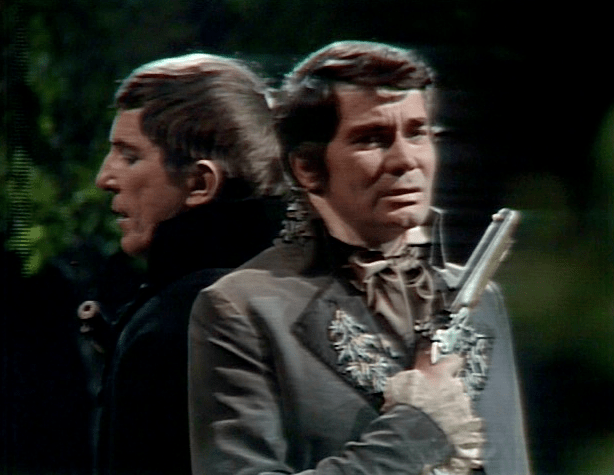
The men are in place when Josette comes running up, pleading with them to stop. She arrives just in time to see Barnabas shoot Jeremiah. Some say they hear only one shot, but I hear two. I think Jeremiah deloped.
Josette goes to Jeremiah’s crumpled body and shouts at Barnabas. “You monster! You madman! You killed the only man I ever loved!” She claims that she and Jeremiah were happy together, and that in his pride Barnabas could not let them be happy. She refuses Barnabas’ offer to help move Jeremiah and get a doctor for him.
Angelique had rubbed Josette’s forehead with some of the rose water in which she had put her love potion not long before this, so Josette’s declarations that Jeremiah is “the only man [she] ever loved” and that they were happy together could be a sign of that influence. It could also be rooted in Josette’s realistic assessment of her situation. Earlier, she had told Jeremiah that she would never again allow herself to say that she loved Barnabas, and when Jeremiah said that his own death would make her a free woman she rejected the idea. Whatever the circumstances that led to the marriage, she is Jeremiah’s wife, and if she becomes his widow she will have an obligation to keep up certain appearances.
This was Anthony George’s last episode. George was woefully miscast when he first joined the show in #262 as the second actor to play Burke Devlin. Writers Ron Sproat and Malcolm Marmorstein kept writing Burke as if he were still being played by the explosively exuberant Mitch Ryan. George’s style was the exact opposite of Ryan’s. He was a cold actor whose characters keep us guessing as to their motives and intentions. He was utterly lost as the hot-headed Burke.
When Gordon Russell joined the writing staff in #292, things looked up for George. Russell understood what actors could do, and gave George some scenes he played very well indeed. In Jeremiah Collins, Russell and Sam Hall created a character who was perfect for George. It’s fascinating to watch Josette scrutinize Jeremiah until she gradually realizes that he has decided to throw his life away to do penance for the offense he and she have committed against Barnabas. It is also credible that, while we can see what Jeremiah is doing, Barnabas, who has known him all his life, would not catch on. George was so bad as Burke in the Sproat/ Marmorstein era that it seemed anything that got him off the show would be welcome. But Russell and Hall know so well how to take advantage of his strengths that it is sad to see him go.
All of the actors have trouble with their dialogue today, even the usually reliable Kathryn Leigh Scott and Lara Parker. Jonathan Frid always struggles, but is especially rough this time, and as for David Ford, what can we say. He mangles virtually every line. His character is supposed to be French; he doesn’t sound French, but doesn’t exactly speak English, either. Danny Horn transcribes many of Ford’s flubs in his post about the episode on Dark Shadows Before I Die, but you really have to hear it for yourself to absorb the sheer bizarreness of the speechlike sounds that come out of Ford’s mouth. I always enjoy watching Ford, and I think he made a major contribution to Dark Shadows‘ acting style when he first came on the show, but when he is off he is way, way off.









 Dark Shadows Commentary