From April to July 1968, Dark Shadows was bogged down in a repetitious story called “The Dream Curse.” Each of a dozen characters had the same nightmare, in which they were in a small room with several doors. Behind each door they saw something that was supposed to be frightening.
When occult expert Timothy Eliot Stokes (Thayer David) had the dream in #508, he defied its rules, caused wicked witch Angelique to appear in it, and brought the curse to a halt. Angelique had to cast another spell later to restart it.
Now the show has gone back in time and is a costume drama set in 1897. Thayer David plays sorcerer Count Petofi, who is among other things a vision of what Stokes might have been as a supervillain. Petofi has learned that both vampire Barnabas Collins and mad scientist Julia Hoffman have traveled to 1897 from 1969. Petofi is convinced that they would not have made this journey unless they knew exactly what they were doing and had a foolproof plan for getting home. Petofi does not know Barnabas and Julia very well.
Petofi and his servant Aristide are holding Julia prisoner in their home, an old mill. This might be called a hiding place, except that virtually everyone in the village of Collinsport and its environs has visited Petofi and Aristide there at least once. There’s so much foot traffic in and out of it someone could make a fortune if they set up a food cart outside the door.
Yesterday, Petofi forced Julia to tell him that she and Barnabas each came back in time by meditating on a set of I Ching wands. Petofi then cast the wands, and his “astral body” was transported to a room very much like that in which the nightmares of the Dream Curse took place. At first it seems that he will match Stokes’ performance when he had The Dream. There is in the world one person over whom Petofi has no power and who is sworn to kill him. All Petofi knows is that this person is Rroma by ethnicity, and is going to try to use a particular scimitar to cut off his right hand, where his magical powers are concentrated. As Petofi is entering the room, he sees the scimitar. When the unseen person holding the scimitar points it at Petofi’s throat rather than his wrist, he realizes that he is not in jeopardy, and he orders the wielder of the scimitar to be gone.
In the room, Petofi opens a couple of doors. Behind one is Barnabas baring his fangs; behind the other, a wall of fire. One of the notable features of the room are red velvet curtains hanging from the ceiling to the floor. Fans of Twin Peaks sometimes say that “Once you learn to see it, the Red Room is everywhere”; I guess they’re right.
Petofi keeps his cool when he sees the gimmicks behind Door #1 and Door #2, but he does seem uncomfortable when he hears the voices of a male chorus singing a Romani song. After a moment, he finds his magical right hand squeezing his throat. All of a sudden he is back in his physical body, with Julia and Aristide by him, strangling himself. Petofi’s powers are so great that there are times when it seems that he will overwhelm all opposition and leave the show without a story to tell; the image of him crushing his own windpipe with his right hand suggests that he will ultimately be a victim of his own power.
Petofi recovers. He is sure Julia created his experience; he cannot conceive of events taking place outside anyone’s control. This marks a contrast with Stokes. Stokes, an upright and decent man, knows that Barnabas and Julia are keeping many secrets from him. When he has to work with them, he grumbles about this and makes it clear that he has dark suspicions. But though Stokes wishes he knew more about them, he does not press them very hard to reveal what they are hiding. Further, he was the one who explained the I Ching to them, including that meditation is a process of giving up control. Unlike Petofi, Stokes can easily accept that there are things that happen whether or not anyone wants them to.
When Julia cannot answer any of his questions, Petofi tells her why he keeps Aristide around:
Look at Aristide here. In point of fact, I don’t need a servant. The boy himself is no intellectual giant. He detests all forms of culture. Why then do I keep him on? Because I am a man who by nature shuns all forms of violence. I loathe the sight of blood. Aristide, on the other hand, has no such scruples. He revels in every form of torture and bloodshed known to the mind of man. I believe he even invented a few himself. He kills without the slightest feeling for his victims. He will kill you, Dr. Hoffman, if you do not tell me what I want to know.
As Aristide, Michael Stroka’s reactions when Petofi delivers this speech are quite funny. He looks really wounded when Petofi says that he is “no intellectual giant” and that he “detests all forms of culture,” but when he starts talking about how sadistic he is, he brightens up. When Petofi tells Julia that Aristide will kill her unless she tells him what he wants to know, he looks positively blissful.
Since Julia has nothing to tell, Petofi leaves Aristide to do his worst. He ties her to a chair in the back room. He rigs a string to the trigger of a revolver so that turning the doorknob will fire a round into Julia. He tells Julia that he hopes Barnabas will come to her rescue and therefore be her executioner.
Barnabas does shows up and confront Aristide. He turns the knob. We hear a shot, and see Julia slumped over in the chair.
One of the recurring faults on Dark Shadows is that when people are bound and gagged, they often have to use their teeth to hold the gags in place. Today they don’t even bother wrapping the cloth around Grayson Hall’s head- Michael Stroka just tucks it into her mouth. The suspense as Barnabas approaches the door depends on Julia’s inability to warn him not to turn the knob, and the closing shot loses its shock value when we can see Julia still biting down on the cloth. So this time it really is a problem.
In 1897, King Johnny Romana is the hereditary chieftain of a Rroma tribe that has long been at war with ancient sorcerer Count Petofi. King Johnny is at the supreme moment of his destiny, standing over Petofi with his scimitar raised, ready to deal the ultimate blow, when a creepy little guy ruins it all for him. Petofi’s henchman Aristide throws a knife and catches King Johnny in the back. Aristide has a dagger with a curved blade that he sometimes calls “The Dancing Girl,” other times “The Dancing Lady”; he makes a big deal of it, the thing fascinates him. But when he kills King Johnny, Aristide doesn’t even use his special knife. It’s a brutal anticlimax for King Johnny.
King Johnny does live long enough to tell Petofi that he isn’t safe yet. After nine days pass, he will appear to another Rroma, somewhere in the world, and will pass on to that person his immunity to Petofi’s magical powers and his mission to kill him. After Aristide buries King Johnny, he finds that the scimitar has vanished. Evidently it will go to the new avenger.
Meanwhile, at the great house of Collinwood, twelve-year old Jamison Collins is dying. Petofi cast a spell causing Jamison to be possessed by the spirit of his grandson David Collins, who will live in 1969. But David won’t live at all unless the spell is broken, because it is killing Jamison. Jamison’s devoted uncle, rakish libertine Quentin Collins, makes a deal with wicked witch Angelique. He will marry her if she manages to break Petofi’s spell and save Jamison. They made a similar bargain previously, but that time her magic failed.
Petofi senses that his spells are being challenged. He marches to Collinwood and orders Quentin to make Angelique stop what she is doing. Angelique herself enters; she and Petofi confront each other, then she goes back to the study to resume her attempts to free Jamison. We end with Petofi preparing to cast a spell against her.
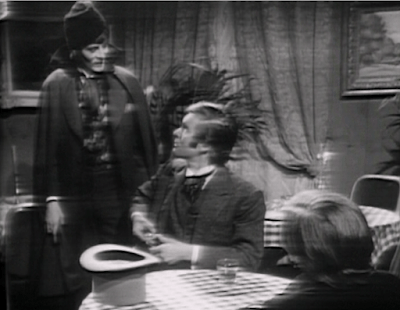
Petofi confronts Angelique in the drawing room at Collinwood while Quentin looks on. Screenshot by Dark Shadows Before I Die.
This is an entertaining, fast-paced episode. It’s too bad it is the final appearance of actor Paul Michael in the series. He played the most unpromising part of King Johnny so skillfully that we barely noticed he was little more than a menacing pose, an evil laugh, and an ethnic stereotype. He does return with a small part in the feature film House of Dark Shadows, but it would have been fun to see what he could do with a really meaty role.
Rroma chieftain/ New England crime boss King Johnny Romana has cornered broad ethnic stereotype Magda Rákóczi in her living room in the Old House on the estate of Collinwood. He turns his back on Magda, closes his eyes, and starts reciting a lot of nonsense. Magda sees an opportunity to escape, and creeps over to the front door. When she opens it, a large man enters, blocking her exit.
The man is King Johnny’s minion Istvan. He is played by Henry Judd Baker, who was the only Black man ever to appear on Dark Shadows. He does not have any dialogue; Istvan, King Johnny will tell us later today, lost his tongue as the penalty for a misdeed. We do hear him laugh and grunt. He also wears trousers from the Lilli Von Shtupp “It’s Twoo! It’s Twoo!`” collection.
After Dark Shadows, Baker would reunite with Jonathan Frid, manhandling him in the movie Seizure. He also had a memorable turn in the lamentable 1980 film Cruising as a scantily clad man who slaps the main character. He died in 2016; the funeral home’s website calls him “Judd Henry Baker.” Maybe that’s a mistake on their part, or maybe he flipped the two parts of his given name for his acting work.
Meanwhile, evil sorcerer Count Petofi is holding time-traveling vampire Barnabas Collins prisoner. Petofi threatens to burn the great house of Collinwood to the ground and kill its residents if Barnabas does not take him to the year 1969. Barnabas realizes that this is an empty threat, and refuses to comply. This is notable as one of the few times Barnabas actually outwits someone. Also, Petofi’s sidekick Aristide spends the scene showing off two big flaming torches, continuing the show’s longstanding mockery of the fire marshals of New York City.
King Johnny found a severed hand at Magda’s house, which he thinks is the one that was cut from Petofi’s right wrist long before. Little does he know that Petofi has taken that one and reattached it. When he and Istvan take Magda with them as their prisoner, what they actually have is a hand Petofi cut off a corpse he ordered Aristide to dig up. They haven’t got very far when the ghost of that man appears and reclaims the hand. King Johnny responds to this unusual sight with fury, realizing that Magda pulled a fast one on him. She manages to get away from him and Istvan.
From December 1968 to through February 1969, strange and troubled boy David Collins (David Henesy) and his friend Amy Jennings (Denise Nickerson) were falling under the power of the malign ghost of Quentin Collins. Occasionally the children were possessed by the spirits of David’s grandfather Jamison and great-aunt Nora; at other times they were possessed by Quentin’s own spirit and that of Quentin’s sometime lover, maidservant Beth. In those same days, Amy’s brother Chris (Don Briscoe) was suffering from a curse that made him a werewolf.
As Quentin’s power over David and Amy grew, so did the frequency and duration of Chris’ spells in lupine form. By #700, Quentin so dominated the great house on the estate of Collinwood that its residents fled to the Old House on the estate, home of their distant cousin Barnabas Collins. David, entirely possessed by Jamison, was close to death. For his part, Chris was stuck in wolf form, apparently permanently, and Barnabas had locked him in a secret room in the old Collins family mausoleum.
Desperate to remedy the situation, Barnabas and his associate, occult expert Timothy Eliot Stokes (Thayer David,) searched Quentin’s old room in the long-deserted west wing of the great house. They found some I Ching wands there. Under Stokes’ direction, Barnabas threw the wands, meditated on them, and found himself transported back in time to 1897. In that year, Quentin, Beth, Jamison, and Nora are alive, and Barnabas is a vampire.
Barnabas had no idea what led Quentin to become a malevolent ghost or what first brought the werewolf curse on Chris, but he had reason to believe that 1897 was an important year in the events leading up to both of those unhappy circumstances. So once he arrived in that period, he spent his nights meddling in all the affairs of the Collins family he found there. Vampires are not problem-solvers; their function in a story is to create problems that other characters will have to solve. So all of Barnabas’ well-intentioned interventions backfired badly. Even disregarding the many murders he committed for his own selfish ends, including the murder of Quentin’s brother Carl Collins, his trip would by any standard have to be considered a disaster.
Now, evil sorcerer Count Petofi (Thayer David) has found that Barnabas is a visitor from the future and is determined to go with him when he returns to 1969. When he demanded Barnabas tell him his secret, Barnabas quite truthfully told him he had no idea what was going on when he found himself transported from one period to another. Petofi did not believe him, and is trying to extort the information he wants by summoning the spirit of David to come from 1969 and possess Jamison (David Henesy) in 1897.
Not only is this an intriguing reversal of the 1968-1969 story in which the ghost of Quentin caused Jamison’s spirit to possess David, it also picks up on some recent hints that they might retcon the whole “Haunting of Collinwood” story to put Quentin’s ghost under the control of Petofi. Even if he can’t hitch a ride with Barnabas, perhaps Petofi will find a way to use Quentin to go back to 1969 with us.
Nora (Denise Nickerson) is with her brother Jamison when the possession takes hold. She is puzzled that he insists on calling her “Amy” and himself “David” and that he tells her to call Quentin on the telephone, even though he is in the house. When Quentin shows up, he recognizes the name David Collins from something Barnabas has told him about the future. But Barnabas has not told Quentin that he is fated to become a family-annihilating ghost, and so Quentin cannot understand how David knows who he is.
Meanwhile, a man named Tim Shaw (Don Briscoe) comes to the house and visits Nora in her room. Tim is Amy’s former teacher, and she considers him a friend. She does not know that since she first knew him, he has lost his moral compass, found the severed Hand of Count Petofi, stolen it, and used its magical powers to make a small fortune in New York City. Evidently all working-class Collinsport boys get rich quick when they go to NYC. In 1961, ex-fisherman Burke Devlin got out of prison and went to that city. By the time he returned to Collinsport in 1966, Burke was a big-time corporate raider who had to think for a moment when David Collins asked him if he’d already made his first $100,000,000. He answered “Not yet.” If he’d had the Hand, no doubt he would have passed that milestone long before.
A couple of days ago, Tim asked Nora to hide a box for him. Unknown to her, the box contained the Hand. Tim asks Nora to return the box to him. She tells him Jamison has it, and he flies into a rage. He gets very rough with her. Briscoe and Nickerson were both good actors, and we’ve seen them share tender moments both as Nora and Tim and as Amy and Chris, so the resulting scene is as uncomfortable as it needs to be to show us that Tim is no longer the long-suffering nice guy we once knew. Moreover, longtime viewers who recognize Tim’s echo of Burke and remember that Burke, though sometimes villainous, was always good with David, will be shocked that Tim does not mirror the earlier character’s consistent soft spot for children.
Tim goes downstairs and sees Quentin coming out of the drawing room. He demands to see Jamison. Quentin tells him that Jamison is ill, and it will be impossible for anyone to talk to him. Tim starts to get ugly about it, and Quentin cuts him off, saying that Jamison doesn’t have the Hand. Tim is shocked that Quentin knows about the Hand, but recovers sufficiently to ask who does. Quentin cheerfully tells Tim that if he goes to the abandoned mill at the end of the North Road, he will find his onetime acquaintance Aristide, and that Aristide will direct him to the man who has the Hand.
Tim knows Aristide only slightly, but he has a grudge against him. Aristide attacked Tim’s girlfriend Amanda and demanded she tell him where the Hand was. Even after he realized Amanda did not know what he was talking about, he beat her and threatened to kill her, forcing her to tell him whatever she did know that would help him retrace Tim’s steps. When Tim found Amanda, Aristide had left her unconscious, and Tim feared at first she might be dead.
We cut to the hideout in the mill, where Tim is waiting with a pistol and thinking that he would be justified in killing Aristide for what he did to Amanda. When Aristide comes, Tim holds him at gunpoint and demands the Hand be returned to him. Aristide tells him that is not possible. They quarrel until another man enters. It is Petofi, who shows Tim that the Hand has resumed its place at the end of his right arm.
That suffices to show Tim that the Hand is no longer available to him. Petofi tells him he should consider himself lucky that the Hand, which followed no one’s commands, chose to make him rich and happy. Tim says he is not happy, and will not be until he can take revenge on the hypocritical Rev’d Gregory Trask and lawyer/ Satanist Evan Hanley. This again reminds longtime viewers of Burke, whose original goal in returning to Collinsport was to wreak vengeance on Roger Collins. As Trask and Evan involved Tim in a homicide when he was not in his right mind and tried to make him alone pay the legal penalty for it, so Roger killed someone with Burke’s car while Burke was passed out drunk in the back seat and saw to it that the court concluded that Burke was driving.
Petofi laughs and congratulates Tim on his choice of enemies. Tim brightens and asks if Petofi will join with him in bringing Trask and Evan down. Petofi explains that he does nothing without a price. Tim says he has a lot of money, and Petofi says he doesn’t have any use for money. Petofi brings up Amanda, only to say that he doesn’t have a use for her either, at least not at the moment. He sends Tim along his way.
Aristide is talking when Petofi dismisses him. He tells him that two visitors are coming, and that he wants to be alone when they arrive. He will not explain further, and so Aristide is in rather a huff when he leaves.
The visitors are Quentin and Jamison/ David. Quentin is carrying his nephew/ great-great-nephew. He demands that Petofi cure Jamison of the possession, which seems to be killing him. Petofi refuses. When Jamison/ David calls Quentin by name, Petofi asks him how a boy who lives in 1969 knows who he is. Quentin’s bewildered reaction leaves us wondering how he will respond if Barnabas ever tells him just why he went to the past.
In the opening teaser, Petofi stood over the coffin in which he has trapped Barnabas. He told Aristide that he and Barnabas have been at war for what even he, at his immense age, considers to be a very long time. He says that they are now engaged in the final battle of that war.
Petofi’s remarks make absolutely no sense whatever in the context of what we have seen. It has been clear so far that Petofi’s presence at Collinwood is an accident, that Barnabas never heard of him before, and that Petofi only just learned that Barnabas has traveled through time. Many of the oddest dead ends on the show were left over from advance plans that hadn’t worked out; so when they were drawing up broad outlines six months before taping, or when they were writing episode summaries (called “flimsies”) thirteen weeks before, they would often include ideas that depended on story points that they never got around to making happen or characters who never worked out. Once in a while, the writers tasked with filling in the flimsies wouldn’t be able to make up a complete 22 minute script without incorporating some of this irrelevant material. So perhaps at some point in the planning process they meant to have stories about Barnabas going back to the eighteenth century and fighting Petofi there. They may still have been kicking that idea around when they shot this installment.
If Dark Shadows has offended, Think but this, and all is mended — That you have but slumbered here While these visions did appear. And now, a word from All Temperature Cheer.
Danny Horn, “Episode 816: Midsummer,” posted 1 February 2016 at Dark Shadows Every Day.
One night in 1797, nine Rroma men trapped sorcerer Count Petofi in the forest of Ojden. They amputated his right hand, and with it took most of his magical powers. Some time after, Petofi learned that he had exactly one hundred years to reattach the hand. If he managed it within that time, he would become immortal. Otherwise, he would die on the anniversary of the amputation.
Now that anniversary has come, and Petofi has succeeded in regaining his hand with only minutes to spare. Time-traveling vampire Barnabas Collins and his distant cousin, desperately handsome werewolf Quentin, have decided that because Petofi’s spirit is in possession of Quentin’s twelve year old nephew Jamison and Jamison is as close to death as is Petofi himself, only by surrendering the hand to Petofi can they save the boy. Barnabas did get Petofi’s servant Aristide to promise to free Quentin of lycanthropy once he has the hand back, but he put little faith in that promise.
Now Petofi is jubilant and Jamison is still sick. Barnabas tells Petofi about the deal Aristide made, and also says that he wants Jamison and the rest of the Collinses to be freed from the ill effects Petofi has had on them. Petofi could not be less interested. Instead, he wants Barnabas to tell him how he traveled in time from 1969 and how he will travel back there.
Petofi lets slip that he is anxious to go to another period of history because he is afraid of the Rroma people who are still after him. We know, not only that it was Rroma who cut off his hand, but that when Petofi saw a young Rroma woman in a tavern in #794 he couldn’t get out fast enough. While it may have taken nine Rroma men to take his hand, evidently a single Rroma woman, and a tiny one at that, is capable of doing him considerable harm. Barnabas has a Rroma friend, broad ethnic stereotype Magda Rákóczi, who has considerable magic powers of her own, and he knows of a Romany band currently camped near Boston. So Petofi’s apparently well-founded ziganophobia is a sign that Barnabas may be able to defeat him, even though Petofi’s powers were formidable even before he was reunited with his hand.
Petofi says that he will cure Jamison only if Barnabas explains how he traveled to 1897 from 1969. Barnabas tells Petofi he has no idea how he made that journey. This is so. He meditated on some I Ching wands, a process which he was told might have any of an infinite number of effects, and found himself in 1897. Nor does he have any idea how to get back. He might have enlarged on the theme of his complete lack of useful knowledge in this area. In 1968, Barnabas traveled back to his original era, the 1790s, by going to the grave of a man named Peter Bradford on the anniversary of Bradford’s death. Bradford’s ghost had been haunting him, and Barnabas called for Bradford to take him back to the year 1796. After he did so, Barnabas found that he could return to the 1960s only by having himself sealed in his coffin and waiting inside it for 172 years until friends let him out. He doesn’t tell Petofi about that incident, but it does not seem likely to be of any more help to him than the story about the I Ching would be.
Petofi does not believe that Barnabas is so hapless. First he squeezes Barnabas’ hand, depriving him of the power to dematerialize. Then he opens a cupboard and tells Barnabas to look in it. It takes a while to warm up, but eventually it gets an ABC affiliate showing Dark Shadows. Barnabas sees the parlor of the Old House on the estate of Collinwood in 1969. His best friend, mad scientist Julia Hoffman, MD, is sitting there reading a book. We haven’t seen Julia since #700, but she might be on our minds today. At one point Aristide lights his cigar on a candle burning in a large candelabra. In #296, Julia very memorably did the same thing with her cigarette.
Barnabas sees strange and troubled boy David Collins come staggering downstairs, raving deliriously about Quentin. Julia tells him to reject Quentin, who in 1969 is a ghost haunting Collinwood and draining the life from David. David passes out, and Julia injects him with a powerful sedative, as you do with unconscious children.
The cupboard loses the channel, and Barnabas asks Petofi what else is happening in 1969. Petofi cannot answer any questions; it quickly becomes clear that he couldn’t see or hear the scene. Barnabas is intrigued to learn of another of Petofi’s weaknesses, and walks out.
Aristide then speculates that Barnabas might be telling the truth. Petofi rejects this at once, reveals more of his cupboard’s limitations:
No, he’s not a fool, Aristide. He thinks he can win, accomplish whatever he wants to do here, and disappear without me…
Had Petofi ever seen even one episode of Dark Shadows, it would not occur to him to say that Barnabas is “not a fool.” Nor would he surmise that Barnabas is pursuing a plan that includes a plausible method of escape. If Barnabas had a plan of any kind, Petofi would know all about it, since it would have failed spectacularly the moment he took the first step towards putting it into effect.
Petofi and Aristide then go to the Old House. They find Magda there. At the moment, she is under Petofi’s power. Like Julia, Magda is played by Grayson Hall. We may have thought the glimpse into 1969 was a videotaped insert, but evidently it was done live, because Magda is not wearing her usual heavy brownface makeup. She may have a bit of an artificial tan, but Julia’s blue eyeshadow is clearly visible through it.
Magda, looking more like an actual Rroma woman than she ever has before.
Petofi forces Magda to lead her to Barnabas’ hiding place. He has a cross and Aristide has a chain and a padlock. Petofi puts the cross inside the coffin, and orders Aristide to chain the coffin closed. Petofi declares that Barnabas is in for a long journey.
This is the first episode to feature a scene in the restaurant at the Collinsport Inn since #227 in May 1967. The show was in black and white then; apparently the restaurant set cannot be seen in color, since this one, set in the year 1897, survives only in kinescope.
Aristide, Tim, and Jamison/ Petofi in the restaurant at the Collinsport Inn. Screenshot by Dark Shadows Before I Die.
Schoolteacher turned adventurer Tim Shaw is at a table in the restaurant when he is joined by twelve year old Jamison Collins, a former student of his. Unknown to Tim, Jamison’s body is currently a vessel for the spirit of 150 year old sorcerer Count Petofi. Tim is startled to see Jamison, and tells him he had heard he was ill. Jamison asks where he heard this. Tim pauses, then claims that he telephoned Jamison’s home, the great house of Collinwood. He says that Jamison’s nine year old sister Nora answered the phone and told him of his illness. Tim tells Jamison that he is waiting for a young lady, and that after she arrives he would like to be alone with her.
A man enters and talks with Tim. After he goes, Jamison asks who he is. Tim says he has only met him once, and that he knows almost nothing about him beyond the fact that his name is Aristide. We have seen Aristide in the woods with Jamison/ Petofi, and know that he is Petofi’s servant. Jamison/ Petofi told him in that scene that he felt weak and had only a few hours left if he did not recover “The Hand.”
We also saw Aristide in Tim’s room with Amanda, the young lady Tim is waiting to meet. He confronted Amanda, roughed her up, and threatened her with a prop representing a dagger with a curved blade. He wanted Amanda to tell him where “The Hand of Count Petofi” is. Amanda asked if “The Hand of Count Petofi” was a piece of jewelry or something. She had no idea it is literally a severed hand, cut from the wrist of Count Petofi 100 years ago. Aristide questioned her and learned that Tim took a box from the Inn earlier that night and returned without it.
Tim excuses himself, saying that he will go to the front desk to ask if Amanda left a message there explaining why she is so late. Jamison/ Petofi meets Aristide back in the woods. When Aristide tells him that Tim took a box from the Inn and returned without it, he remembers that Tim said he had talked on the telephone with Nora. He deduces that Tim actually talked to Nora in person when he took the box to Collinwood and enlisted Nora’s help hiding it there.
Jamison/ Petofi goes to Nora’s room and wakes her. He tricks her into telling him that Tim was there, but she refuses to tell him where the box is. He twists her arm until she does so. In the parts of Dark Shadows set in the 1960s, David Henesy played strange and troubled boy David Collins, and Denise Nickerson played nine year old Amy Jennings. David and Amy were intermittently possessed by Jamison and Nora in late 1968 and early 1969, and when Amy/ Nora resisted David/ Jamison in #667 and #679, he twisted her arm. When we see the same violent act here, we see a dramatization of a cycle of abuse. We may also wonder if they are going to retcon that “Haunting of Collinwood” segment to include Petofi as a driving force.
Jamison/ Petofi takes the box from Nora’s armoire, opens it, and holds up the Hand. Regular viewers can expect Petofi to return to his own physical form, reattach the Hand to his wrist, and increase his magical powers greatly.
All of the male cast members have trouble with their dialogue today, even the usually line-perfect David Henesy. I wonder if writer Gordon Russell was late finishing the script. Mr Henesy and Michael Stroka manage to give good enough performances that their bobbles don’t really matter, but Don Briscoe is just bad today. When Tim is talking with Nora in the teaser, his intonations are bizarre, and in his later scenes he is flat and lifeless, including a long stretch when he is openly reading off the teleprompter. Perhaps that’s because of his acting style- he worked from the inside out, finding his character’s motivations and developing those first, adding the dialogue last. Give an actor like that less time than he needs, and he might not have anything at all to offer.
One unfair criticism that Briscoe gets from many of the fans who post comments online is that Tim does not have romantic chemistry with any of the women he is paired with. He isn’t supposed to have romantic chemistry with them! At first we see him linked with neurotic intellectual Rachel Drummond. Tim and Rachel were students together at the boarding school run by the sadistic Gregory Trask. When Jamison and Nora are sent to the same school, Tim and Rachel illustrate the horror that lies in store for them. If Tim and Rachel were a hot and exciting couple, they would send the message that kids subjected to Trask’s abuse can grow up to be happy adults, muffing the whole point of the story.
The second woman attached to Tim was Trask’s daughter Charity. Nora points out to Jamison today that Tim and Charity never got along with each other, and regular viewers remember that this is true. Trask forced them to get engaged, a situation that made them both miserable, and then led them both to believe that Tim had murdered Charity’s mother. Again, the whole point of the relationship is to demonstrate how cruel Trask is.
Now Tim is traveling with Amanda. We met Amanda yesterday, and saw that she is impatient with Tim and tolerates him only because he has a lot of money and keeps spending it on her. As possessor of the Hand of Count Petofi, Tim has managed to get rich quick and turn into a tragic version of the character W. C. Fields played in vaudeville routines and stage plays and films set in the Gay Nineties. Amanda is the sort of woman Fields’ characters invariably failed to impress. Again, the last thing you would want would be for Amanda to seem actually to be attracted to Tim.
Though Michael Stroka, in spite of his line bobbles, does a good job as Aristide, there is one moment today when he does make a bad mistake. Aristide makes a big deal out of his dagger, which he initially called “The Dancing Girl.” The prop is obviously just a flat piece of wood, which we might be able to accept if we don’t have to look at it for an extended period. But when he is threatening Amanda today, he holds “The Dancing Girl’s” blade in the palm of his hand, squeezes it, rolls it around, and caresses it. If there were a sharp edge anywhere on it, his hand would be bleeding profusely. They really are not making it easy for us to believe Aristide is going to cut anyone.
Charity Trask is in the drawing room of the great house on the estate of Collinwood trying to call the police when her abusive step-uncle, Quentin Collins, comes out of a secret panel and takes the telephone from her. He tells her that there is no longer any point in telling the police about Tessie, the injured woman upstairs. Tessie won’t be telling them anything. She has died. Apparently the sheriff of Collinsport is the same in 1897 as are his counterparts in other periods when Dark Shadows has been set- if you’re already dead, it’s too late for them to take an interest in you.
Charity says that Quentin killed Tessie. Charity knows that Quentin is a werewolf. He locks the door to the room and asks “Are you afraid to be locked in alone with a beast, a murderer, a creature of the supernatural?” This would seem to be rather an odd question, especially since he spent yesterday’s whole episode threatening to kill her.
Charity says that her father, Gregory Trask, will see to it that Quentin is brought to justice. Quentin takes a paper from his pocket and shows it to Charity. It is a confession to the murder of Charity’s mother, signed by her father. Charity claims that it was fabricated by Satan, which is what her father told her when she first saw it, and that Trask repeatedly tried to destroy it. This only convinces Quentin that the confession is true. He says that if either Charity or her father tells the police about him, he will hand over the paper. He adds “Now, Charity, I may hang for murder, but your father will be dancing at the end of a rope, too.”
Dark Shadows is set in the state of Maine, which in our universe abolished capital punishment in 1887. That used to be true in the show’s universe, as well. In #101, broadcast and set in November 1966, high-born ne’er-do-well Roger Collins told his son, strange and troubled boy David, that “They don’t hang people anymore. Not in this state, anyway.” But by the time the show left the 1960s for its first costume drama segment a year later, characters were already afraid of being sentenced to death. The morbid fascination of the gallows is so much of a piece with the show’s exaggerated melodrama that there must be a death penalty, no matter when or where the action is supposed to be taking place.
Quentin tells Charity that there is a chance- a small chance, he concedes- that he will be cured of lycanthropy before the next full Moon, so that she need not feel that she is an accessory to murder if she doesn’t turn him in right away. Miserable, frightened, and confused, she takes this seriously enough that she remains quiet at least through this episode.
We cut to a hiding place where a man known as Aristide is looking at himself in a mirror and primping his hair, moving his fingers through it with an exaggerated daintiness. We pan to broad ethnic stereotype Magda Rákóczi , who impatiently asks “Did you send for me so there would be two of us to admire you?” Aristide has some business to discuss relating to plot points not directly involved in this episode, and he and Magda trade menacing insinuations about the danger each faces from the various supernatural forces at work in the area. Magda says that what the ziganophobic Aristide calls her “Gypsy cunning” will protect her, and Aristide says that an amulet he wears around his neck will protect him.
Magda replies “All right, we’ve both got something to protect us. I go now,” and starts to leave. Aristide stops her, and says that she must recover the severed hand of Count Petofi. She says that a man named Tim Shaw stole the hand and ran off with it, and she has no way of knowing where Tim is. Aristide says she must find out and bring it soon, “before time runs out.” She asks “Before time runs out for who? You mean when Petofi comes back!” In fact, Aristide means more than that- his master, 150 year old sorcerer Count Petofi, will die in a matter of days unless he is reunited with the hand that was cut from his right arm a century before, in 1797. If he does recover the hand in time, he will become immortal. Magda fears Petofi and hates him, and would doubtless make any sacrifice to keep the hand away from him if she knew these were the stakes. So Aristide is mortified that he let slip the phrase “before time runs out,” and is anxious to avoid saying anything else.
Back at Collinwood, Quentin confers with a Mrs Fillmore. Mrs Fillmore has been looking after the twin children Quentin’s wife Jenny bore him after he left her and before he murdered her. This is the first time we have seen Mrs Fillmore. It is also the first confirmation we have had that Quentin has seen Mrs Fillmore. He didn’t know about the twins until #798, when the boy twin was already dead as the result of a curse that a woman named Julianka placed on Magda, who is Jenny’s sister. Now Mrs Fillmore tells Quentin that the girl is suffering the same symptoms the boy showed before he died, and that the doctor is at a loss what to do for her. Quentin says he will look for someone who might be able to help, and they both exit.
Charity is alone in the drawing room, making an earnest effort to get drunk. Magda enters and expresses surprise that the unbendingly prudish Charity has been drinking. Charity replies that she merely ate some chocolates that were filled with brandy. At the sight of an empty snifter, she says that after eating the chocolates she poured herself a small brandy. She then picks up and drinks another, regular-sized brandy. Charity starts talking about how terrible life at Collinwood is. Magda mentions Tim Shaw, who was once Charity’s fiancé and who was framed for her mother’s murder. Charity wonders if Magda can use the Tarot cards to find Tim and bring him back. She asks if Tim will have to tell the truth if he comes back, and Magda assures her that he will. Magda may assume that the truth Charity wants is about the end of her relationship with Tim; she does not know that Charity is desperate to revert to believing that Tim, not her father, murdered her mother.
Magda asks Charity to tell her as much as she can about Tim. Charity says that when Tim was a boy, his closest friend was named Stephen Simmons, and that “He and Stephen Simmons used to always say they would go to San Francisco when they grew up.” Magda asks where Stephen Simmons is now, and Charity says she thinks he lives in Worcester, Massachusetts. She goes to her bedroom to look for a Christmas card Stephen sent her last year, hoping it may have his current address.
Quentin returns and finds Magda. He asks Magda how she knew about his daughter. She asks what he means. When Quentin tells her that the girl is suffering the same symptoms that her brother showed immediately before his death, they rack their brains to come up with a potential defense against Julianka’s curse. Magda remembers Aristide’s amulet. It is capable of warding off vampires and witches- perhaps it will defend against Julianka as well. Magda tells Quentin where Aristide is hiding, and he decides to go to Aristide and rob him of the amulet.
Aristide is asleep when Quentin arrives. He awakens before Quentin can take the amulet, and declares “This pendant protects me from witches, warlocks, and unnatural spirits.” Quentin asks “How does it do against flesh and blood, Aristide?” Aristide draws a curvy piece of wood with no sharp edges and replies “For flesh and blood, I have The Dancing Lady.” The piece of wood is supposed to be a knife. When Aristide first displayed it in #792, he called it “The Dancing Girl.” Perhaps this is a case of Soap Opera Rapid Aging Syndrome, and in a couple of weeks it will be The Dancing Dowager, then The Dancing Crone. At any rate, Quentin replies “Then let her dance, Aristide, let her dance.” Quentin wins the subsequent fistfight. He knocks Aristide senseless, then takes the amulet from him.
Quentin and Magda go to Mrs Fillmore’s house, the first time we have seen this set. Appropriately for a member of the Collins family, the baby sleeps in a cradle shaped like a coffin.
Quentin talks with Mrs Fillmore about little “Lenore,” a name we have not heard before today. The only other girl of Lenore’s generation in the Collins family is the daughter of Quentin’s brother Edward, and she is named Nora. Since the name “Lenore” became popular outside Greece because speakers of English and French thought it was an alternative form of “Nora,” that would suggest rather a limited imagination regarding girl’s names on the part of whoever chose them.
But it is appropriate that Quentin and Edward have children with similar names. They are two variations on Dark Shadows’ first archvillain, Roger, whose evil largely expressed itself in his amazingly bad parenting of David. Edward’s attentive and caring interactions with Nora and her brother Jamison show that he is a less villainous Roger, while Quentin’s frequent assaults on his adult family members are among the evidence that he is an even worse version of the same character. Jamison is the only child we have seen Quentin interact with, and he is fond of him. But while we were still in the 1960s, Quentin’s ghost was possessing and killing the children at Collinwood, and in #710, only two weeks into the 1897 flashback, he and his fellow Satanist Evan Hanley used Jamison as a “sacrificial lamb” in a ritual meant to exploit his innocence for their own sinister purposes. Clearly, Quentin is no more to be trusted with the care of a child than was the early Roger.
Quentin asks Mrs Fillmore to leave him and Magda alone with Lenore. They apply the amulet, and it does not seem to work. Magda tries to raise the spirit of Julianka. After some pleadings and whatnot, there is thunder, wind, and other signs of ghostly presence. Magda cries out in hope that Julianka has come with pity. A figure materializes and says “Not with pity, Magda.” But the figure is not Julianka. It is Jenny.
In #804, we saw a photograph of Jenny in Quentin’s room. It was a full length picture in a period-appropriate costume, not just Marie Wallace’s professional headshot, raising a hope that we would see Miss Wallace again before too long. But after a week and a half, those hopes had begun to fade. Perhaps they took the picture months ago and never got around to using it when Jenny was on the show. If they had done that, they wouldn’t be above sticking in a scene of Quentin looking at the picture and discussing it with his distant cousin Barnabas the vampire so that they could get their money’s worth out of it. When Miss Wallace does in fact return, the show sends us out on a high note.
Sorceror Count Petofi has taken possession of twelve year old Jamison Collins. He has also cast a spell on broad ethnic stereotype Magda Rákóczi, compelling her to lead him and his henchman Aristide to the hiding place of vampire Barnabas Collins.
Jamison/ Petofi and Aristide are ready to drive a stake through Barnabas’ heart. They open his coffin and find that he is away from home today. Magda does not know where his other hiding place is. Jamison/ Petofi becomes intrigued with Barnabas and decides to search through Magda’s home, the Old House on the estate of Collinwood, for papers that might give him information about Barnabas.
He and Aristide find a book published in 1965. Since the dramatic date is currently 1897, this seems to be a matter of some interest. Jamison/ Petofi calls for Magda, who tells him that Barnabas told her that the book had been brought back in time from the 1960s by “a girl named Vicki.” Barnabas’ utterance of the name “Vicki” in #797 was the first reference to well-meaning governess Victoria Winters in the 1897 segment, and this is the second. Vicki was the main character of the show for its first year, and remained in the cast for over a year after that. That the name “Vicki” would be heard only in rare and trivial echoes is not something longtime viewers would likely have predicted before she was written out of the show last year.
Magda goes on to explain that Barnabas himself traveled back in time from 1969. She has a vague idea that he was trying to save a dying child, and hasn’t the faintest clue how he made this remarkable journey. Jamison/ Petofi says that they will get the rest of the story from Barnabas himself. He also says that if he can travel in time, he will be able to live forever, a proposition which would seem to require further explanation.
Jamison/ Petofi is satisfied Magda is telling them everything she knows, but Aristide keeps making threats. The most intriguing refers to something Petofi might do to her: “You’ve heard of his powers. Hasn’t anyone in your tribe ever told you about the mysterious shadow he can cast? The shadow that isn’t your own that follows you?” Writer Sam Hall was probably familiar with a novel called Phantastes by George MacDonald, a bestseller of the nineteenth century that was influential among English fantasy writers of the first half of the twentieth century. It tells of a character named Anodos, who is tormented by a malicious shadow that moves by itself and won’t leave him alone. So perhaps Hall is planning to mine MacDonald’s works for an upcoming story.
Meanwhile, in the great house on the estate, Charity Trask has a dream. She sees Jamison/ Petofi with a portrait of rakish libertine Quentin Collins. The portrait is identical to the one she saw turn into a picture of a werewolf the night before, and she asks Jamison/ Petofi if he saw the same thing. He laughs, then tells her Quentin is a lost soul.
Quentin shows up. Charity’s father, the evil Gregory Trask, has directed her to marry Quentin, and she has set out to comply with this command. Quentin has never shown the slightest interest in her in their time awake together, and he isn’t much friendlier in this dream. He asks her to do something to lighten his mood. “Can’t you be happy? Can’t you be gay? Don’t you want to make me happy?” We’ve never seen her happy; as Gregory’s daughter, it’s hard to see how she could be. She has probably never tried to be gay, either, but it would have to be better than marrying Quentin. She does try to make him happy by imitating Cockney showgirl Pansy Faye, whom she never met or saw or heard, but whose spirit has been possessing her off and on for several days now. She sings Pansy’s theme song and does the highly suggestive dance that goes with it, only to find that Quentin has vanished.
Charity turns and finds Quentin embracing and kissing another girl. They are laughing. Quentin tells Charity that, as she can see, she has succeeded in cheering him up, and therefore she should run along. He and the girl then disappear and Magda enters. Magda tells Charity that she should forget Quentin, because he has a terrible secret. She leaves, and Quentin and the other woman reappear, still laughing at Charity.
Charity decides to ask Magda to explain the dream. Before she reaches the Old House, she finds Quentin and the girl from the dream lying on the ground in the woods. Quentin’s clothing is torn and he is unconscious, but he does not appear to be injured. The girl’s face is covered with what in black and white look like slash marks, but in color are obviously purple makeup. She opens her eyes and gasps Quentin’s name. Whether she was calling for Quentin because he was with her when they were attacked or crying out because he is the one who attacked her would not be clear to first time viewers, though returning viewers know that Quentin is a werewolf and will assume he was the attacker.
From #1 to #274, each episode of Dark Shadows began with a voiceover narration by Alexandra Moltke Isles, usually in character as well-meaning governess Vicki. This identified Vicki with our point of view and suggested that she would sooner or later learn everything we knew.
Jonathan Frid joined the cast as vampire Barnabas Collins in #211, and quickly became the show’s great breakout star. If the upright Vicki found out what we knew about Barnabas, one of them would have to be destroyed. Vicki was the favorite of longtime viewers and Barnabas was attracting new ones, so that was out of the question. Therefore, other members of the cast started taking turns reading the voiceovers, and doing so not as their characters, but in the role of External Narrator.
Today marks the first time Frid himself reads the narration. His training first in Canada, then at Britain’s Royal Academy of Dramatic Arts, and later at Yale School of Drama prepared Frid well in the art of dramatic reading, and in later years he would concentrate on that aspect of his craft. Several of his colleagues are his equals in these voiceovers- I would particularly mention Kathryn Leigh Scott, whose conception of The Narrator is always arresting, and Thayer David, who could consistently achieve the most difficult of all effects in voice acting, a perfectly simple reading. So I can’t say I wish Frid had done all of them, but he is always good, and today’s performance is among his most gorgeous.
The action opens on a set known to longtime viewers as the Evans cottage, where from 1966 to 1968 artist Sam Evans and his daughter Maggie served as Dark Shadows‘ principal representatives of the working class of the village of Collinsport. In those days, it was on this set that we saw how the misdeeds of the ancient and esteemed Collins family had consequences that spilled out of the estate of Collinwood and warped the lives of people trying to make a more or less honest living nearby.
Now the dramatic date is 1897, and Sam hasn’t been born yet. But the cottage is already an artist’s studio. It is temporarily occupied by the nationally famous Charles Delaware Tate, who is painting a portrait of rakish libertine Quentin Collins at the behest of evil sorcerer Count Petofi. Charity Trask, a resident of the great house of Collinwood, is visiting Tate in the cottage when she sees the face in the portrait change from that of Quentin. It takes on a great deal of fur and long fangs, and reminds Charity of a wolf.
By the time Tate looks at the painting again, it has resumed its normal appearance. He tells Charity that the transformation must have been in her imagination. She is willing to consider the possibility, but we know better. Quentin is a werewolf, a condition Petofi knows how to cure. Portraits on Dark Shadows have had supernatural qualities at least since #70, including portraits we saw Sam execute on this set in 1966, 1967, and 1968, and the show has borrowed from The Picture of Dorian Gray before. Moreover, Tate’s reaction to Charity is one of barely controlled panic. Nancy Barrett has to ramp up Charity’s own emotional distress to the limit to make it plausible she would not notice Tate’s extreme agitation. Perhaps if Tate were played by a better actor than the ever-disappointing Roger Davis, his response might have been ambiguous enough that Miss Barrett could keep the tone a bit lower, but his unequivocal display of alarm leaves her nowhere to go but over the top.
Mr Davis was under no obligation to play the scene transparently, since Tate later goes to Petofi’s henchman Aristide and lays out in so many words his precise relationship to Petofi’s operations and his knowledge of them. Tate’s career is his reward for selling his soul to Petofi, and he has already experienced great sorrow as a result of that bargain. Tate knows that the portrait changed to reflect the full Moon’s influence on Quentin and that Petofi is currently in possession of twelve year old Jamison Collins. Aristide tells us that Petofi’s own body is in suspended animation while he acts through Jamison. He also says that it was in 1797 that Petofi’s right hand was cut off, and that if he does not reclaim the hand in a few weeks, by the date of the one hundredth anniversary of the amputation, he will die and so will Tate.
Jamison/ Petofi is in the prison cell in the basement of the Old House on the estate of Collinwood. Barnabas has traveled back in time from the 1960s with some vaguely good intentions and is hanging around 1897 causing one disaster after another. Now, he is doing battle with Petofi and has locked him, in the form of Jamison, in the cell. Barnabas’ reluctant sidekick, broad ethnic stereotype Magda Rákóczi, guards Jamison/ Petofi during the day. Early in the episode, Jamison/ Petofi calls Magda and pleads with her to release him. He tells her that he is “just a little boy” and that she is a “rather heartless creature.” She says she wishes he were a little boy again, but that she isn’t stupid and he won’t fool her. Indeed, the phrase “rather heartless creature” and Jamison/ Petofi’s manner in delivering it sound so much like Thayer David as Petofi that they hardly count as an attempt to deceive Magda.
Later, Jamison/ Petofi casts a spell to summon Aristide, then calls to Magda again. When Magda arrives, Jamison/ Petofi gives himself a better script than the one from which he had acted in his previous scene with her. He pretends not to remember how he got into the cell and to be shocked that Magda knows he is there. Perhaps the utter transparency of his earlier pleadings was an attempt to get Magda to underestimate his abilities as a trickster.
In #803, we saw that when Petofi took possession of him Jamison’s right hand disappeared from his wrist, matching Petofi’s own mutilated condition. When Jamison/ Petofi feigns the amnesia that might come upon recovery from possession, we might therefore expect Magda to demand that he remove his gloves to prove that he is himself again. But he plays the part of Jamison so convincingly that we are not really surprised he does fool Magda. She goes into the cell, embraces Jamison/ Petofi, and he kisses her on the cheek. It is this kiss that spreads his magical power, and she realizes too late that she has been had.
Aristide arrives a moment later, and Jamison/ Petofi calls his portrayal of an innocent boy “an award-winning performance.” Indeed, if there had been daytime Emmys in 1969, David Henesy might have won one for his portrayal of Thayer David playing Petofi playing Jamison.
Aristide wants to kill Magda; Jamison/ Petofi forbids this. Under his power, she announces that she is responsible for all the evil that has happened in 1897. She was responsible for releasing Barnabas and therefore for all the murders and other harm he has done; she made Quentin a werewolf, and is to blame for his killings in his lupine form and for the curse his descendants will inherit; she stole Petofi’s severed hand and is at fault for the deaths of Rroma maiden Julianka and of her own husband Sandor that resulted from the hand’s presence. She even takes the blame for Quentin’s murder of her sister Jenny, the act for which the werewolf curse was meant as vengeance. Magda says she must be punished. Jamison/ Petofi tells her that he is not interested in punishing her. He has another use in mind for Magda She will lead him and Aristide to Barnabas’ coffin today, and they will destroy him.
Longtime viewers will perk up twice when Aristide says that Petofi lost his hand in 1797 and that he has exactly one hundred years to recover it. From December 1966 to March 1967, Dark Shadows’ first supernatural menace was undead blonde fire witch Laura Murdoch Collins, who at intervals of exactly one hundred years incinerated herself and a young son of hers, who was always named David, in an unholy ceremony that renewed her existence, but not that of the Davids. Since the usual laws of nature don’t apply, the show needs some other causal mechanism to create suspense, and anniversaries will do as well as anything else. Another iteration of Laura was on earlier in the 1897 segment. It was fun to see her again, but they could shoehorn her into that year only by retconning away the one hundred year pattern in her immolations. It’s reassuring in a way to see that Petofi is bringing centenaries back.
The date 1797 is also significant. It was in 1796 that Barnabas died and became a vampire. We flashed back to that period for the show’s first costume drama segment in November 1967 to March 1968, and Barnabas went back to 1796 for a week in January 1969. So we may go back again some day, and if Petofi was alive and in his prime in 1797, we might run into him there.
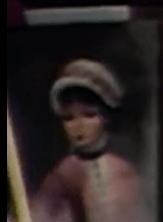
Barnabas and Petofi are not the only characters from the 1790s who might be on the minds of attentive longtime viewers. Barnabas’ little sister Sarah died in 1796, and as a ghost was an extremely important part of the show from June to November 1967. We’ve been getting reminders of Sarah for the last several days. In #792 wicked witch Angelique produced a toy soldier of Barnabas’ that Sarah gave to strange and troubled boy David in #331. In #805, Charity found Sarah’s recorder, a prop that often served as Sarah’s calling card in 1967, and talked about learning to play it. And today, we see a portrait standing on the floor of the Evans cottage, a set which Sarah visited in #260, depicting a girl wearing a bonnet very much like the one Sarah wore as a ghost in 1967 and a pink dress just like the one she wore when we saw her as a living being in the flashback to the 1790s.
Portrait at the cottage.
I wonder if, when they were making up the flimsies for this part of the show, they had thought of reintroducing Sarah. That would have required a recasting of the part- Sharon Smyth was noticeably older when we saw Sarah die in January 1968 than she was when Sarah was a ghost in June 1967, and by now we would wonder what she has been eating in the afterlife that has made her get so much taller. Besides, Miss Smyth* had stopped acting by this point.
The process of planning the stories was in two stages, a rough sketching of themes six months in advance, and a capsule of each episode written thirteen weeks ahead of time. There was a lot of flexibility when it came to putting those plans into effect. Some stories that were supposed to end within thirteen weeks were extended over years, while others that were expected to be a big deal petered out before they got going. In an interview preserved by Danny Horn at his great blog Dark Shadows Every Day, writer Violet Welles said that many of the moments on the show that made the least sense were those written when the plans hadn’t worked out: “toward the end of the cycle, you’d have characters who were really not a lot of interest who had to play scenes with other characters who really didn’t have a lot of interest, dealing with things that basically didn’t concern them. Those were hard to write.”
This episode was taped on 25 July 1969; thirteen weeks before that was 21 May. Six months before was 25 January. By 25 January, Denise Nickerson had been on the show for two months as Amy Jennings. Nickerson was actually born on 1 April 1957, but they several times say that Amy is nine years old. When the show goes to 1897, Nickerson plays Nora Collins, who is also nine. On 19 May, Nickerson taped #761, the last episode she would appear in until #782. She is currently in the middle of a second long absence from 1897, unseen between #783 and #812. Her characters were so important in the months leading up to the 1897 segment and she played them so well that we wonder what they were thinking leaving her in the background so long.
Maybe they were thinking of bringing her back as Sarah. Nickerson didn’t look all that much like Sharon Smyth, and was a far more accomplished young actress than was Miss Smyth, but she did have brown hair, and the show prioritized hair color above all else in recasting parts. For example, two actresses followed Mrs Isles in the role of Vicki, neither of whom had much in common with her either in acting style or in looks, but who both had black hair. So perhaps there was a time when they intended to travel between 1897 and the 1790s and to meet Sarah, played by Denise Nickerson. If Nickerson were still alive, perhaps someone would ask her if she posed for the portrait that is standing on the floor of the Evans cottage today.
*She’s been using her married name for decades now, but when talking about her as a child it’s pretty weird to refer to her as “Mrs Lentz.” Since I use surnames for people associated with the making of the show and attach courtesy titles to surnames of living people, I have to call her “Miss Smyth.”
When broad ethnic stereotype Magda Rákóczi learned that her sister Jenny had been murdered, she placed a curse on the murderer, Jenny’s husband Quentin Collins. The curse makes Quentin and his male descendants werewolves. In #763, Magda learned that Jenny had given birth to Quentin’s twin children, and ever since she has been trying desperately to lift the curse. It was only this week Quentin found out about the children, after another witch’s curse had already claimed the life of the boy twin. Now he and Magda are debating what risks they should take in their further efforts to save Quentin and any descendants his infant daughter may have.
In #778, Magda returned to her home in the Old House on the estate of Collinwood. She had gone to Boston because she had heard that a Rroma group was in the area and that an old woman who knew how to cure werewolves might be among them. The woman wasn’t there, so Magda did the next best thing. She infiltrated the private quarters of a tribal leader/ organized crime boss known as King Johnny Romana and stole his prized possession. This is a severed hand in a wooden box. It is known as “The Hand of Count Petofi,” after a Hungarian nobleman from whom it was detached over hundred years before, and it has magic powers.
Neither Magda nor anyone she knows has the slightest idea how to control the hand. It has not cured Quentin, briefly disfigured him and his sometime friend Evan Hanley, led to the death of a young woman named Julianka, has been stolen by one person after another, and must soon bring an emissary of King Johnny tasked with Magda’s murder. Moreover, two mysterious and unsavory men known as Aristide and Victor Fenn Gibbon have come to town intent on stealing the hand; at Fenn Gibbon’s bidding, Aristide tortured Quentin and tried to kill him last week, and now he is trying to lure him into a deal.
Magda tells Quentin he is a fool to do business with Aristide and Fenn Gibbon, but Quentin says they have nothing to lose. Aristide implied that Fenn Gibbon can lift the curse; no one else can. They find Fenn Gibbon and Aristide ransacking the Old House. Magda recognizes a design on one of Fenn Gibbon’s buttons. Fenn Gibbon and Quentin struggle, and Fenn Gibbon loses a prosthetic right hand. We have known all along that he was not using his right name, and Magda tells us who he really is. He is Count Petofi himself, still alive more than a century after his mutilation, come to reclaim the hand and all its powers.
Quentin seizes, not the Hand of Count Petofi, but the Hand of Mr Fenn Gibbon. Screenshot by Dark Shadows Before I Die.
Magda and Quentin don’t actually have the hand or know where it is. It has been stolen yet again. This time it is in the possession of Tim Shaw, schoolteacher turned junior executive for the Collins family enterprises. Tim took the hand from the Old House when Magda was out. He takes it to Evan today. Evan is terrified of the hand. Tim threatens him with it. Evan tells Tim what he knows about the hand, and also confesses that he and the evil Gregory Trask brainwashed Tim some time ago and used him to murder Trask’s wife Minerva.
When Evan and Trask decided to use Tim for their evil scheme, he was an innocent. The audience may have known that Tim had the same last name as Raymond Shaw, the main character in The Manchurian Candidate, but nothing else about him suggested he was likely to be of use to sinister figures like Evan and Trask. With his theft of the hand and his interrogation of Evan, we see that Tim has lost his innocence. The stuffy and repressed pedagogue whom we first met was a better fit for Don Briscoe’s heavily interiorized acting style than were the parts he played when the show was set in 1968 and 1969, accursed brothers Tom and Chris Jennings. Briscoe often seemed to be at sea as a vampire or a werewolf, but when he has to show a tortured soul peeking out from inside a three-piece suit he does an expert job. Now that Tim is capable of driving the story, we have a chance to see what Briscoe can do with a starring role crafted for his particular strengths as an actor.






 Dark Shadows Commentary