In the 1790s, wicked witch Angelique turned scion Barnabas Collins into a vampire. When Barnabas realized what she had done to him, he killed Angelique.
In 1967, Barnabas was freed from a long captivity once more to prey upon the living. In 1968, Angelique also returned. Wearing a black wig and calling herself Cassandra, Angelique met sarcastic dandy Roger, ensorcelled him into marrying her, and thereby established herself as a resident of the great house of Collinwood. Wiggéd witch Angelique/ Cassandra found that Barnabas’ vampirism had gone into remission as a result of treatments he had received from mad scientist Eric Lang. She killed Lang before he could complete the process meant to make the cure permanent, but the senior mad scientist in the area, Barnabas’ friend Julia Hoffman, finished his work.
Angelique/ Cassandra and Julia know these facts about each other, but it is unclear how much Angelique/ Cassandra knows about Lang’s process. In particular, when today’s episode begins we do not know whether she has figured out that the main part of it was building a Frankenstein’s monster named Adam and trying to transfer Barnabas’ “life force” into him. Still less do we know whether Angelique/ Cassandra is aware that when Julia took over the experiment she brought Adam to life without killing Barnabas, and that as long as Adam is alive Barnabas will be free of the effects of the vampire curse.
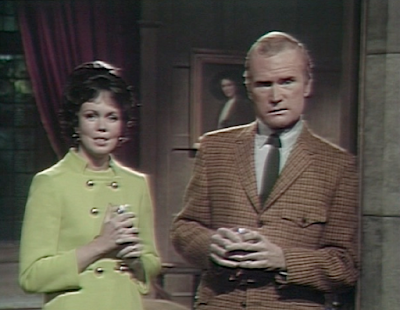
Julia lives at Collinwood as a permanent guest. Today’s episode opens with her and Angelique/ Cassandra coming home, both smiling and chirpy, talking about an exciting conversation they had while they were out together. They had visited Angelique/ Cassandra’s former professor, Timothy Eliot Stokes. Stokes is an expert on paranormal phenomena. In #488 Barnabas told Stokes that Angelique/ Cassandra was a witch and he resolved to join Julia and Barnabas in the battle against her. Julia tells Roger that the exciting conversation she and Angelique/ Cassandra had at Stokes’ home was about the occult.
Considering what these three people know about each other, this conversation would have been fascinating to watch. Julia and Stokes want to probe for Angelique/ Cassandra’s weaknesses; she wants to make sure neither of them has any powers she doesn’t know about, to find out their plans, and if possible to bring them under her influence. Properly written and played by actors as accomplished as Grayson Hall, Lara Parker, and Thayer David, that scene might have been one of the highlights of the whole series. But it doesn’t happen. They just tell us about it in the first 30 seconds of the episode, then move on. It’s one of the major what-ifs of Dark Shadows.
Yesterday Adam escaped from the cell in the basement of Barnabas’ house where he has been confined and met several members of the family who live in the great house. They spend the day recapping that incident. Roger tells Cassandra that Adam seemed to know Barnabas, and she is all ears. It quickly becomes clear that Adam’s existence is news to her, that she is putting everything together, and that Adam is now in grave danger from her.
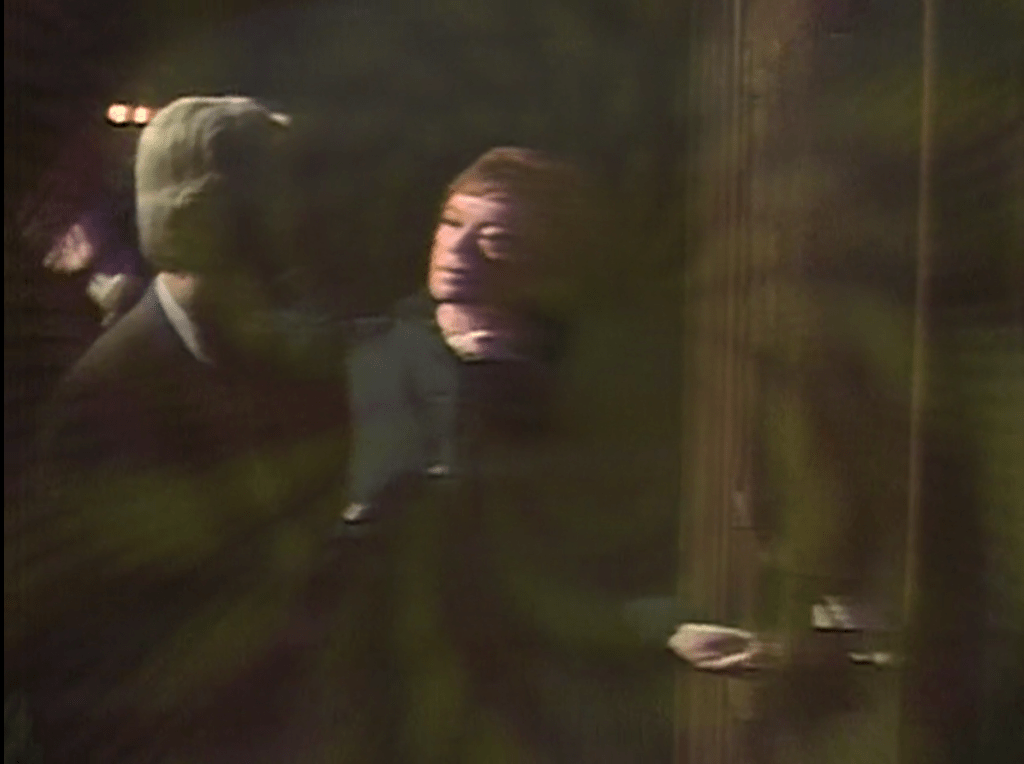
Angelique/ Cassandra takes in the news Roger has brought her. Screenshot by Dark Shadows Before I Die.
In #134, strange and troubled boy David saw his mother Laura Murdoch Collins for the first time in years. To everyone’s surprise, not least his own, David reacted to Laura with terror. It turned out that he had good reason for this reaction, as Laura was actually an undead blonde fire witch come to lure him to his own death.
In #489, David learned that his father Roger had remarried. Like everyone else in the great house of Collinwood, David was stunned to learn that Roger had known his new wife for less than a day before he married her. Unlike the others, his speechless reaction prompted Roger to jump to the conclusion that he disliked his new stepmother. Roger scolded David and sent him to play outside until he could come back and be charming.
While outside, David had stumbled upon the new Mrs Collins kissing a man other than her husband. Later, he found her alone in the drawing room, told her what he had seen, and informed her that he would tell his father about it.
Roger’s new wife wears a black wig and calls herself Cassandra. What the audience knows, but neither Roger nor David do, is that she is actually an undead blonde witch. Roger does have a type.
The new Mrs Collins’ real name is Angelique. She has come to 1968 from the late eighteenth century to resume her punishment of Barnabas Collins, whom she turned into a vampire in their time, but who has now been freed from the symptoms of the curse. When David told Angelique/ Cassandra that he would report her misconduct to Roger, she used her magic powers to strike him dumb. When his muteness became inconvenient for her in #492, she cast another spell to erase his memory and restore his speech. To execute this spell, she took fire from the hearth and spoke words to David that caused him to drift into a trance. We remember #140, when Laura urged David to stare into the flames of this same hearth while she told the story of the Phoenix, causing him to drift into a trance. From that point on, he liked his mother very much.
Today, David meets Roger in the foyer of Collinwood. He tells his father that Angelique/ Cassandra took him into town, where she bought him a Swiss army knife. He says she would have bought him anything he wanted. Thus we learn that, though she is a wicked witch (as well as a wigged one,) Angelique/ Cassandra is in some ways a typical step-parent. When Roger says he is glad to see that David now likes Angelique/ Cassandra, David is mystified. As far as he can recall, he always liked her.
Roger sends David to answer a knock at the door. It is their distant cousin Barnabas. This is the first time we have seen David and Barnabas together since #333, when David barely escaped with his life after Barnabas caught him looking at his coffin. David now greets him quite calmly.
David leaves. In the foyer, Roger scolds Barnabas for his rudeness to Angelique/ Cassandra. Barnabas could hardly be expected to fail to recognize his old nemesis, but he has indeed shown an extreme lack of prudence in his uninhibited talks with her. Not only has he created unpleasant scenes to which Roger is bound to object, but he has also let Angelique/ Cassandra know exactly what he does and does not know about her.
Roger says that if Barnabas cannot be friendly to Angelique/ Cassandra, he shouldn’t come to the great house anymore. Barnabas asks if Roger shouldn’t ask his sister Liz, who after all owns the house, what she thinks. Roger says that will be unnecessary, since Liz has even less tolerance for rude behavior than he does. Barnabas is promising to do better when Liz runs in, frightened by a tall man she met on the grounds. Liz told the man he was on private property and directed him to leave. The man said nothing at all in response to this challenge or to her subsequent questions. He stood still and appeared to be mute until he spoke Barnabas’ name. Liz ran from him when she saw that he had a shackle attached to his leg. Roger flies into a panic, assuming that a shackled man must be dangerous and remembering that David is alone in the woods. He gets his gun, and rushes out. Barnabas accompanies him.
In the woods, David is playing Mumblety-Peg with his new knife. The tall man shows up; when David finds that the man cannot talk, he says that he is glad. He says that he often wishes no one could talk. He goes on at considerable length about the disadvantages that come with the ability to speak. He then explains to the man that you play Mumblety-Peg by dropping the knife into the ground so that it sticks there. The man becomes excited and grabs the knife. David objects and demands he return it. They struggle; David falls and hurts his ankle. David grumbles that all the man had to do was give him his knife back. The man looks alarmed and picks David up. David doesn’t like that one bit, and insists he be put down.
Roger points the gun at Adam and David.
David’s shouting brings Roger and Barnabas. Roger points his gun at the man and orders him to put David down. When the man does not move, Barnabas tells Roger not to shoot. David, in the line of fire, seconds this recommendation. Barnabas talks to the man in a soothing voice, gesturing towards the ground, and the man does set David down. David runs to Barnabas and gives him a hug.
This is the second time David has run into Barnabas’ arms. The first was in #315. David had been trapped in the hidden chamber in the old Collins family mausoleum, where Barnabas was confined in his coffin from the 1790s until 1967. Barnabas learned that David was there, suspected he might have deduced his secret, and decided to kill him. David got out of the chamber just as Barnabas was approaching it, and ran from it directly to him. He had not in fact figured out Barnabas’ secret while in the hidden chamber, but Barnabas’ behavior in the minute before someone else came along was menacing enough that David caught on that he had sinister plans for him. For the next ten weeks, his fear of Barnabas would deepen, leading him to discover the whole horrible truth about his distant relative. All that is forgotten now, evidently.
Roger jumps to the conclusion that the tall man had “tried to kill David!” He shoots him in the shoulder and runs after him with his gun, over Barnabas’ objections. Roger had been quite unconcerned with David’s well-being throughout the first year of the show. In the first months, he openly hated the boy and continually tried to persuade Liz to send him off to an institution; in #83, he coldly manipulated David into attempting to murder someone who posed a problem for him; even after other characters had begun to realize that Laura was a deadly threat to David, Roger continued to press eagerly for her to get full custody of him and take him away; and in #313, when David was trapped in the mausoleum, Roger could barely be bothered to take part in the search. Roger’s behavior will therefore be less likely to suggest to regular viewers that he is overcome with paternal feeling than that he is a panicky fool who is much too excited about an opportunity to shoot someone.
The tall man is Adam, a Frankenstein’s monster created in the procedure that caused Barnabas’ vampirism to go into remission. Though he is 6’6″, Adam is only a couple of weeks old, effectively a baby. Barnabas has been keeping him in his basement, chained to the wall in the prison cell he maintains for those times when he has abducted a pretty girl and has to keep her from running away. The opening voiceover tells us that “no man has suffered more” than Barnabas, just as we cut to Adam, despondent in his shackles. Barnabas comes in to give Adam a cup of broth and a couple of minutes of rigidly formal social interaction, then leaves him alone again. Somehow this sequence makes it difficult to sympathize as deeply with Barnabas as the narration would have us do.
From #227 to #260, Maggie Evans, The Nicest Girl in Town, was under the influence of vampire Barnabas Collins. As Barnabas tried to brainwash Maggie so that her personality would disappear and that of his lost love Josette would take its place, she began to rebel against him. From #251 until she escaped in #260, Barnabas kept Maggie locked up in a prison cell in his basement.
Throughout this whole period, Barnabas’ sorely bedraggled blood thrall Willie Loomis tried to spare Maggie the worst. Willie anonymously telephoned Maggie’s friend Vicki in #230 so she and her friends could interrupt Barnabas’ first attempt to take Maggie into custody; while Maggie was Barnabas’ prisoner he several times pleaded with Barnabas to show her mercy; and when in #260 Barnabas had decided to kill Maggie with extreme cruelty, Willie brought a glass of poison to her cell so she could die painlessly.
Now, Barnabas’ vampirism is in remission. He has brought Willie back to work for him, arranging his release from the mental hospital where he was confined after Barnabas framed him for all of his crimes against Maggie. It is by no means clear what effect Barnabas’ loss of his vampire powers has had on Willie. At times he seems to be confused and childlike; at times, to be the dangerously unstable ruffian he was before he fell into Barnabas’ clutches. But he is still fascinated by Maggie, and still longs for her friendship. The very night Barnabas brought him home from the hospital, Willie sneaked off to visit Maggie and tell her he was innocent.
For her part, Maggie’s memories of her experience with Barnabas were excluded from her conscious mind when mad scientist Julia Hoffman hypnotized her. The other day, Maggie had a nightmare as part of the “Dream Curse,” and in the course of the nightmare she heard the sound of Josette’s music box, which Barnabas forced her to listen to while in captivity. She also saw a skull with eyes, suggesting that her deepest fear has to do with the dead watching her. Since Barnabas, as a vampire, was dead and yet kept Maggie under surveillance, this image combines with the music to suggest that Maggie’s memory might soon return.
Today, Willie is minding Adam, a Frankenstein’s monster whom Julia brought to life in a procedure meant to cure Barnabas of his vampirism once and for all. Barnabas and Julia have no idea what to do with Adam, and so they have chained him up in Maggie’s old cell. Barnabas’ jewel box is stashed behind the secret panel Maggie used to escape from the cell, and Willie shows Adam some of its shinier contents to calm him.
Among the shiniest are a pair of emerald earrings. Barnabas has been talking to Willie as if Willie remembers everything that happened when he was his blood thrall, yet Willie has not confirmed that this is so. When he sees the earrings, Willie gets very intense. He says that he saw Josette wearing them, then realizes that it was Maggie. Perhaps Barnabas, by modeling the conversations they used to have, is inadvertently providing the therapy Willie needs to recover his memory.
Willie decides to give the earrings to Maggie. He goes to Maggie’s house and peeks through the window. He sees her with her boyfriend Joe. When he came to the house the other day to tell Maggie he never meant to hurt her, she was terrified and Joe stated as a matter of fact that he would kill Willie if he ever came near Maggie again. Willie does not knock on the door to greet the two of them.
Instead, he slips into the house while they are out of the room. He plants the earrings in Maggie’s purse, and is gone by the time she and Joe come back. Maggie finds the earrings. The tinkling sound of Josette’s music box plays on the soundtrack while she looks at them. She is fascinated:
Maggie says that the earrings “remind me of something- something I’ve forgotten. I know they don’t belong to me yet. But somehow when I look at them, I seem to think they were meant for me- I mean from the start. They are lovely, a very beautiful and thoughtful gift. Only a man who has gazed into my eyes with deepest love would know they were meant for me.” As she delivers these lines, Kathryn Leigh Scott fades out of Maggie’s voice, into the tones she used while playing Josette from #370 to #430.
Barnabas’ attempt to turn Maggie into Josette would have reminded many viewers at the time of the 1932 film The Mummy, in which the undead Imhotep (played by Boris Karloff, whose voice Jonathan Frid often seems to be imitating as Barnabas) abducts the beautiful young Helen Grosvenor, whom he believes to be the reincarnation of his lost love, the Princes Ankh-esen-amun. In that movie, Helen and the Princess were both played by Zita Johanns, suggesting that Imhotep was onto something. From November 1967 to March 1968, Dark Shadows was a costume drama set in the 1790s and we saw that Maggie and Josette are both played by Kathryn Leigh Scott, suggesting the same about Barnabas. The bleakness and horror of Barnabas’ treatment of Maggie in the summer of 1967 makes this suggestion a daring one, and that Maggie makes a speech blissfully describing the one who looked at her and saw Josette as a “man who gazed into my eyes with deepest love” in the middle of an episode that begins and ends in the cell where he confined her and planned to torture her to death is more daring still.
I don’t think the risk pays off. Miss Scott was usually one of the most reliable performers on Dark Shadows. She found Maggie in her relationship to her father Sam, whose drinking problem was a major story point for the first 40 weeks of the show, and articulates the character as a series of very intelligent answers to the question “How would an Adult Child of an Alcoholic respond to this situation?” This scene presents her with a very complex challenge, as she is supposed to show that the earrings have jarred loose some fragment of a memory but to keep us guessing just what that fragment is. Joel Crothers plays Joe’s disquiet at the appearance of the earrings with a simplicity that sets Miss Scott up for a star turn. But she doesn’t seem to have any idea what to make of her lines. For the first time on the show, she is physically stiff and vocally overbearing. As a result of her atypical overacting, the scene does not deliver the sense of mystery and foreboding it requires. It just leaves the audience confused.
Recovering vampire Barnabas Collins and mad scientist Julia Hoffman brought a Frankenstein’s monster to life the other day. They named him Adam, and are keeping him locked up in the prison cell hidden in the basement of Barnabas’ house. They leave Barnabas’ servant Willie in charge of Adam.
The first two days of the Adam story had their humorous moments as we saw Barnabas and Julia’s farcically total incompetence before the demands of parenthood. Today, Robert Rodan plays Adam as a 6’6″ newborn who is looking for affection and mental stimulation and finds only hostile people and brick walls. Rodan’s commitment to the part is so pure and his face is so expressive that he weighs us down with sorrow for a cruelly neglected child. Moreover, Dark Shadows is so high-concept right now with all of the monsters and black magic and mad science and dream sequences and so on that it is hard to see how it can take a pain that is so raw and make it meaningful for us in a way that will justify showing it.
There are just a couple of moments I want to remark on. In the cell with Adam, Willie smokes a cigarette. He blows smoke in Adam’s face, leading him to freak out, knock Willie unconscious, and flee from the cell to the grounds of the estate of Collinwood.
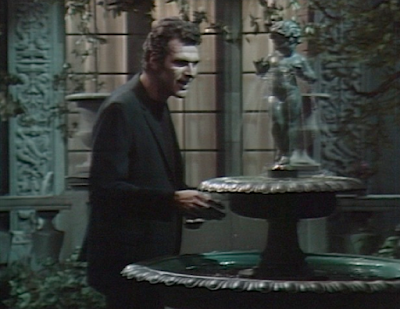
Outside the great house of Collinwood, Adam finds a toy to play with. Screenshot by Dark Shadows Before I Die.
This isn’t the first time Willie’s smoking has got him in trouble. Willie scattered cigarettes in #210, when he was trying to rob a grave in the old Collins family mausoleum. To his surprise, the coffin he opened held, not the jewels he was looking for, but Barnabas, who seized him by the throat and didn’t let him go until he had bitten and enslaved him. A few days later, in #215, Willie’s old partner in crime, seagoing con man Jason McGuire, asked Willie what he had been doing in the mausoleum. Terrified that Jason might discover Barnabas’ secret and bring the vampire’s wrath down on him, Willie denied he had been there. Jason replied that Willie had a habit of leaving cigarette butts on the edges of things. The same vice that brought Willie to the brink of disaster on that occasion has now caused Adam to panic, and Adam is clearly strong enough to kill a man with a single blow. Smoking is even more hazardous for Willie than it is for the rest of us.
In the great house of Collinwood, housekeeper Mrs Johnson is struggling with her part in “the Dream Curse.” In this curse, a person has a nightmare, is terribly distressed until they can tell a particular person about the nightmare, the person they’ve told then has the same nightmare, and the process repeats until the writers can come up with a less tedious way to fill the time on slow days. Mrs Johnson knows that it will be bad to tell the dream to the next person, and is trying not to. Julia knows all about the Dream Curse, and is herself the person who passed it on to Mrs Johnson.
Julia also has a nearly unlimited power to erase people’s memories with hypnosis, yet she doesn’t try to hypnotize Mrs Johnson into forgetting the dream. The Dream Curse is the product of a spell cast by wicked witch Angelique. Another of Angelique’s spells made Barnabas a vampire. Julia was able to hypnotize Maggie Evans, The Nicest Girl in Town, into forgetting weeks and weeks of vampiric abuse Barnabas inflicted on her, and Maggie has been her old self ever since. So, if Julia can wipe away one kind of trauma arising from Angelique’s curses, why not another? It seems like it would be worth a try.
Also, Julia is in charge of a mental hospital called Windcliff. She has used Windcliff to stash Barnabas’ victims Maggie and Willie where they wouldn’t attract the attention of the authorities. Regular viewers can hardly fail to wonder why she doesn’t think to commit Adam to Windcliff. If we must have him on the show, it would be easy enough to write a couple of lines of dialogue explaining why it would be impossible to send him away. That they don’t take the trouble to do even that is an insult to the intelligence of the audience and another reason to find the Adam storyline depressing.
Mad scientist Julia Hoffman and recovering vampire Barnabas Collins have created a Frankenstein’s monster and named him Adam. Adam is 6’6″ and brawny, he can walk, and he seems to have some degree of understanding of speech. Still, he is only a few hours old, and he knows nothing about the world in which he finds himself. When he throws a tantrum and smashes up lab equipment, Barnabas gets a gun and prepares to shoot him to death. Julia stops him. She injects Adam with a powerful sedative and says they should take him to the basement of Barnabas’ house and lock him up in the prison cell where Barnabas sometimes confines his victims.
Returning viewers will be puzzled by this idea. Julia is in charge of a mental hospital a hundred miles away, and has twice stashed victims of Barnabas’ there and used her powers of hypnosis to mutilate their memories so that they cannot tell the authorities about him. Adam has no memories that would threaten Barnabas’ position; all he needs is care and supervision. Of course, sending him away would stop the story, so if Barnabas suggested it the writers would have to give Julia a line to explain why it wouldn’t be possible. That would be so easy to do that it is very odd they don’t bother to do it.
At one point, Julia says “We must make him trust us.” When Barnabas asks how, she admits that she doesn’t know. I suppose the first step would be to ensure that he never learns anything at all about either of them.
Meanwhile, Barnabas’ old nemesis, wicked witch Angelique, has come back to life. Wearing a black wig and calling herself Cassandra, she has married sarcastic dandy Roger Collins, establishing herself as a resident of the great house of Collinwood and as stepmother to strange and troubled boy David. The other day, David caught Angelique/ Cassandra kissing her cat’s paw Tony. Before he could tell his father what he had seen, Angelique/ Cassandra cast a spell on David leaving him unable to speak or write. Now David’s muteness has become an inconvenience to her, so she casts another spell on him, making him forget everything from the moment before he came upon her and Tony, then restoring his power of speech.
For the first several months of Dark Shadows, David had emotional problems resulting from the hostile atmosphere in which he spent the first years of his life. Roger openly hated David, and in #83 deliberately manipulated him into making an attempt on the life of well-meaning governess Vicki. David’s mother, undead fire witch Laura Murdoch Collins, was no better, trying to lure David to his death in the flames which would consume her current form and give her new life.
The only other children on the show until now were Daniel Collins, who like David was played by David Henesy and who was the object of a murder plot by his legal guardian, and Sarah Collins. Sarah was a ghost from #255 to #364, and a living being from #366 to #415. When Sarah was alive, Angelique had abused her very cruelly. Sarah’s big brother Barnabas spurned Angelique’s advances, and Angelique published him by afflicting Sarah with a grave illness. When Angelique placed the curse that made Barnabas a vampire, she declared that it would mean the death of everyone who loved him, and she should have known that as one of those who loved him most dearly Sarah would be among the first to die.
Roger and Angelique/ Cassandra, therefore, are hardly more promising as parents than are Barnabas and Julia. David and Adam might wind up in therapy together some day.
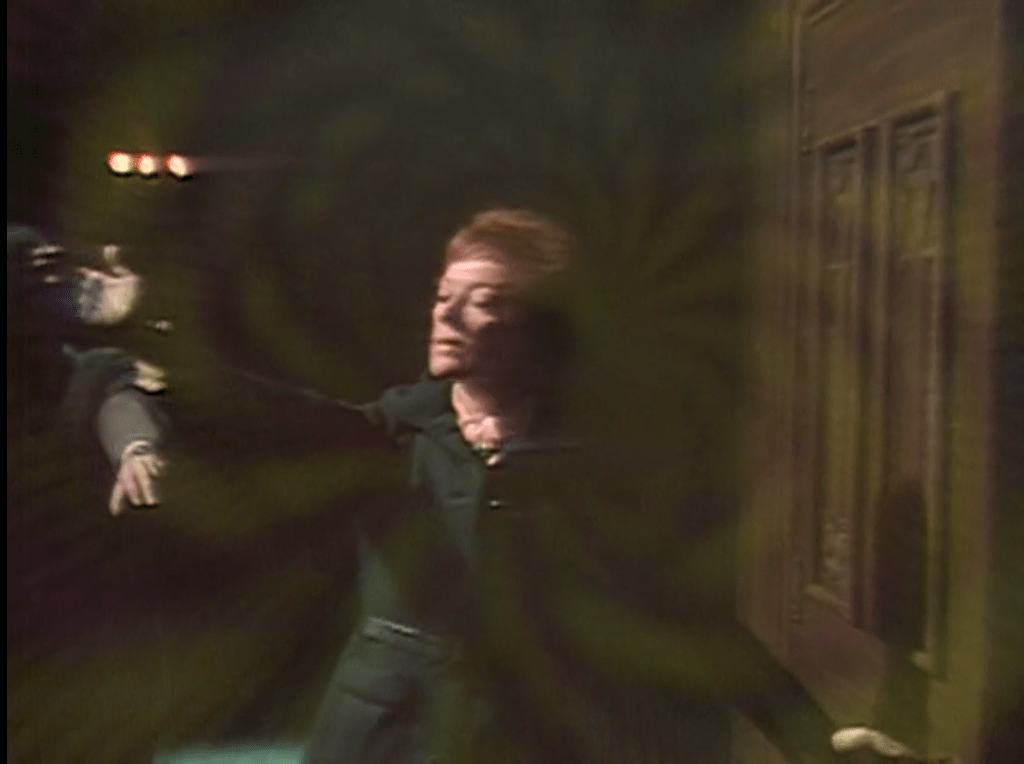
The episode ends with a dream sequence, part of the “Dream Curse” that Angelique decreed would fill time when the writers get stuck. One character after another has the same dream, each time ending with an image that is supposed to suggest some hidden fear that character has. Today’s dreamer is housekeeper Mrs Johnson. Evidently she is afraid of video inserts, because she sees a clip from an educational film about bats. It’s an interesting image, not at all in the thoroughly stagey, vaguely stately visual style director Lela Swift established for Dark Shadows.
And behind Door #3, a Zonk! Thank you for playing “Let’s Make a Nightmare,” we hope you had a good time. Screenshot by Dark Shadows Before I Die.
Vampires and mad scientists are both metaphors for extreme selfishness. The vampire exists only to feed on humans, gaining a night’s nourishment for himself at infinite cost to them; the mad scientist takes skills and equipment that could bring great boons to humanity and uses them only to further some perverse private whim. The Frankenstein’s monster emerges as the logical synthesis of these metaphors. As a botched resurrection and a parody of the Christian story, the Frankenstein’s monster evokes the vampire; as the helpless product of the mad scientist’s hubris, he is a child neglected and abused by a narcissistic parent, bringing home the real-world stakes of the issues raised in stories of uncanny horrors.
Mad scientist Julia Hoffman and vampire Barnabas Collins have finally got round to creating a Frankenstein’s monster of their own. His name is Adam. Julia and Barnabas had expected Barnabas to die and his “life force,” what the opening voiceover today refers to as his “spirit,” to animate Adam. They are surprised that the experiment has ended with Barnabas and Adam both alive. They are entirely bewildered about what to do with this 6′ 6″ newborn. Julia goes to her usual default, and injects him with a sedative.
Matriarch Liz comes from the great house of Collinwood to the house where Julia and Barnabas are working. She brings some information about the B plot. Barnabas makes it clear that he and Julia are deeply involved in an experiment begun by the house’s previous owner, the late Dr Lang. Liz is mystified by Barnabas’ new interest in science. She and Julia go to Collinwood, while Barnabas stays downstairs in Lang’s old consulting room. He is waiting for the dawn, wondering if the process of creating Adam cured him of the symptoms of vampirism or if he will crumble into dust when the sun rises.
In the lab upstairs, Adam regains consciousness. He plays with some of the shiny objects around him. It’s rather an odd playpen for a baby, with its electrical equipment spraying sparks, vials of boiling acid, loaded gun, and medical sharps. But he seems delighted with everything until he grabs a scalpel by the wrong end. Then he starts smashing things.
By that point, Julia is back, the sun is up, and Barnabas has learned he is human again. Julia and Barnabas hear the crashing sounds from upstairs. They try to stop Adam. He flings them aside. The episode ends with him sticking his arm out the door while they press it shut. Grayson Hall and Jonathan Frid do such a good job of playing Julia and Barnabas as farcically clueless that the sequence left me and Mrs Acilius roaring with laughter.
There is a bit of self-reference in this one. The first person Adam sees when he opens his eyes is Barnabas. When he can see Barnabas, he is calm. When he cannot, he becomes agitated and dangerous. Most of the people watching Dark Shadows at this point first tuned in because they were curious about Barnabas, and have stayed with the show because they are fascinated with him. The viewer mail whenever Barnabas was not getting enough of the spotlight to please his fans must have been unpleasant for the writing staff to read, and might have made them apprehensive of the crowds that gathered every weekday outside the studio at 442 West 54th Street. Perhaps Adam’s rampage was their nightmare dramatized.
The late Dr Eric Lang built a Frankenstein’s monster with the intention of draining the “life force” from recovering vampire Barnabas Collins into it. Wicked witch Angelique turned Barnabas into a vampire in the first place, and has returned to the scene to thwart this experiment and make Barnabas once more an undead abomination preying upon the living. Angelique struck Lang dead with one spell, and with another has started a “Dream Curse” that has for the moment compromised the ability of the senior mad scientist in town, Barnabas’ best friend Julia Hoffman, to pick up where Lang left off.
In Lang’s laboratory, Julia and Barnabas recap the plot. Under the stress of the Dream Curse, Julia is having trouble controlling her emotions. At one point she refers to her crush on Barnabas. Every time she has mentioned this before, Barnabas has been a huge jerk about it, ridiculing her and reminding him of the crimes they have committed together, including murder. This time, he is warm and kindly. His non-obnoxious response marks a significant change in their relationship.
Lang left an audio message for Julia on his tape recorder. He said that if she does the experiment and Barnabas and the Frankenstein’s monster, whose name is Adam, both live, neither Barnabas nor Adam will be a vampire. But if Adam dies, Barnabas will revert. His recovery is already hanging by a thread, as he feels ever stronger cravings for blood.
Julia and Barnabas play the tape today, but leave the room before it gets to the part with the message. Lang’s voice plays to an empty set. Addison Powell didn’t do a very good job playing Lang on screen, and he’s no better as a voice actor. Powell appeared in a number of feature films, including hits like The Thomas Crown Affair and Three Days of the Condor, but is best remembered for a series of commercials he did in the 1980s as “The Gorton’s Fisherman.” I remember those spots- I thought he was an actual fisherman they’d hired to read copy. Usually I’m uneasy with the idea of taking a job away from an actor, since I know lots of very talented people who have spent years training in that craft, never to make a living at it. But Powell was so bad I wish my original impression had been correct.
Julia has reached out to Professor Timothy Eliot Stokes, a scholar of the occult, for help with the Dream Curse. When she met with him yesterday, she did not identify Angelique as the witch. She couldn’t tell him anything about the experiment or about Barnabas’ vampirism without confessing to her many crimes. Today, Stokes is trying to fill in the blanks Julia left so that he can help to oppose the Dream Curse. He calls on Barnabas at Lang’s house. He breaks down Barnabas’ resistance and learns that the witch is Angelique, whom he knows under her alias of Cassandra Blair Collins.
Stokes next calls on Maggie Evans, The Nicest Girl in Town, at her house. Maggie was the first person to have the dream, and she gives Stokes a detailed description of it. This gives Kathryn Leigh Scott an opportunity to look into the camera and emote, which is always worth seeing.
There are a lot of shots today using mirrors. In their post on Dark Shadows Before I Die, John and Christine Scoleri include several screenshots of these and of ambitious camera angles from other episodes.
Today’s cast includes a vampire, a wicked witch, two mad scientists, a Frankenstein’s monster, and an irritable housekeeper. The deadly menace turns out to be the housekeeper.
In a laboratory in a house by the sea, mad scientists Eric Lang and Julia Hoffman are trying to transfer recovering vampire Barnabas Collins’ “life force” into the body of the creature Lang has built for the purpose, a creature Barnabas has named Adam. In the drawing room of the great house atop Widow’s Hill, wicked witch Angelique disrupts that attempt by sticking a pin into a clay figure that she addresses as “Dr Lang.” It is unclear how Angelique attached the clay figure to Lang, though since it has roughly the same acting ability as Addison Powell the pairing seems natural enough.
Lang gasps for air. Julia helps both him and Barnabas. Barnabas gets up from the operating table and declares he will go to the great house and stop Angelique. Lang tries to tell Julia how to carry on his work, but keeps breaking down. While Julia is out of the room getting some heart medicine, Angelique removes the pin from the clay figure. During that moment of relief, Lang is alone in the lab. He turns on his tape recorder and says that if both Barnabas and Adam live, Barnabas will be free of the vampire curse. Adam will drain it from him, but will not suffer from its symptoms. If Adam dies, Barnabas will revert to active vampirism.
Angelique resumes tormenting Lang as Julia returns to the laboratory. Lang cannot keep his breath long enough to tell Julia his message or make it clear that she should listen to the tape. Angelique says that Lang has suffered enough for tonight, and that she will put the pin away. As she is about to do so, the door to the drawing room opens and housekeeper Mrs Johnson comes in. Mrs Johnson startles Angelique, who inadvertently drives the pin through the clay figure, killing Lang.
This is the second death to which Mrs Johnson has contributed. The two cases are very similar. She unknowingly gave undead fire witch Laura Murdoch Collins the information she needed to cast the spell that killed parapsychologist Dr Peter Guthrie. Guthrie resembled Lang not only in holding a terminal degree, studying the uncanny, and doing battle with an undead witch, but also in his use of a tape recorder. In #170 and #171, Guthrie recorded the audio of a séance; in #172, Laura erased the recording and replaced it with the sound of fire; and in #185, he was on his way to get his tape recorder to use at another séance when Laura cast the spell that killed him. Mrs Johnson is a menace to a very specific kind of person.
Barnabas comes to the great house and threatens Angelique, calling her by the name “Cassandra,” the alias under which she has married sarcastic dandy Roger Collins and found a place in the house. At first he says he will burn her if Lang dies. She pretends not to know what he’s talking about, and says that she will expose him as a madman. He looks at her neck and leans in, a sign that his vampire urges are coming back. The telephone rings, and Mrs Johnson enters. Angelique/ Cassandra explains their compromising position by claiming that she was fainting; with that, she shows that her threat to air her complaints is a bluff, since she could easily have demanded Mrs Johnson call the police.
Mrs Johnson says the call is for Barnabas. It is Julia reporting Lang’s death. Barnabas makes some grim remarks to Angelique/ Cassandra, then goes back to the laboratory and talks with Julia. She is distraught, but agrees to pick up where Lang left off.
We end with a dream sequence. Angelique has loosed a “Dream Curse” on the people of Collinsport. One after another, they have the same basic dream, in each case beginning with an appearance by the next person to have the dream beckoning them into a haunted house attraction and ending with a door opening to expose something the previous dreamers didn’t see. Julia’s dream begins with Mrs Johnson, telling us she will be the next up. It proceeds with her walking through a foggy room, including a clear shot of the fog machine. It ends with the sight of a skeleton wearing a wedding dress and the sound of Angelique’s distinctive laugh, telling us that the position Angelique has gained by marrying Roger is particularly dangerous to Julia. Since Julia lives in the same house as Angelique and they know all about each other, this is not exactly a major revelation.
The dream involves the beckoner’s voice reciting a little bit of doggerel. As it goes on, some beckoners say “through endless corridors by trial and error,” others say “through endless corridors of trial and error.” I prefer “of trial and error.” That implies that the corridors are themselves made up of decisions people have made and of the consequences of those decisions. Saying that the characters are moving through the corridors “by trial and error” means that the corridors exist whether anyone engages with them or not. We saw Angelique start the curse, so we know it isn’t something that has been out there in reality all along, and it expresses itself in dreams, not in anything that persists when people stop paying attention to it. Besides, the whole idea of drama is to show decisions and their consequences, so “of trial and error” is better on every front.
Mad scientists Julia Hoffman (Grayson Hall) and Eric Lang (Addison Powell) are conferring in Lang’s lab. Lang is putting the finishing touches on a Frankenstein’s monster into which he plans to transfer the “life force” of recovering vampire Barnabas Collins. Julia, Barnabas’ best friend, has been opposed to this experiment, but now has accepted that she can’t stop Barnabas and Lang from going through with it. She volunteers to assist.
Lang is having trouble concentrating because of a nightmare he had last night. Unknown to him, the nightmare was part of the Dream Curse, a dead end storyline about wicked witch Angelique sending a dream that each of a series of people will have. When the last person has the dream, Barnabas is supposed to revert to full-on vampirism.
Lang tells Julia about his nightmare. He says that she was in it. When he tells her that she did not speak, she smiles comfortably and says that that was proof that it was a dream. This is not only a genuinely funny line as Grayson Hall delivers it, but it is an extraordinary moment of self-awareness from Julia, a character who usually exists at the outer edge of heightened melodrama. It’s a shame that Addison Powell doesn’t know how to get out of Hall’s way for the half second it would take for it really to land with the audience.
Barnabas and his ex-blood thrall Willie are at home in the Old House on the great estate of Collinwood. Willie is smirking and Barnabas is rigid with embarrassment while the dogs howl outdoors. Willie laughs a little as he makes a remark about how Barnabas hasn’t changed as much as he thought he had. This exchange reminds us of the moment in #346 when Julia and well-meaning governess Vicki noticed that some fresh flowers Barnabas touched had died and shriveled up. Like the howling of the dogs when Barnabas feels bloodlust, the shriveling of the flowers was a consequence of his vampirism, effectively a bodily function that he cannot control. He squirmed when Julia and Vicki looked at him then, and he is stiff and flustered when Willie laughs at him now.
Barnabas orders Willie to take a letter to matriarch Liz at the great house on the estate. It will explain that he is going away on a long trip, and that Adam Collins, a young cousin from England, will be coming to stay in the Old House. Willie is alarmed by this.
Willie asks what Barnabas will do if Liz won’t let him stay in the Old House when he is in the form of Adam. Barnabas is sure she will, and dismisses Willie’s doubts. This is an interesting sequence to regular viewers. The show has never made it clear whether Liz still owns the house or has signed it over to Barnabas. A whole year ago, in #223, Liz was talking to strange and troubled boy David as if the Old House and its contents were Barnabas’ legal property. Since then, there have been moments that tend to confirm that impression, as when Barnabas takes Liz’ keys to the house away from David and does not give them back to her, and other moments that conflict with it. Willie’s question and Barnabas’ response would seem to prove that the house still belongs to Liz.
Another question we might ask is why Barnabas doesn’t go to Liz himself. Certainly she will be unhappy that he went away without saying goodbye to her. Moreover, when he showed up at the great house in April 1967, Barnabas told Liz that he was the only survivor of the English branch of the family. Liz will be skeptical if another member of this imaginary branch presents himself and expects to take possession of a big mansion on her property. She has had unpleasant experiences with Willie, so much so that a letter he delivers seems unlikely to allay that skepticism.
When Willie gets to the great house, Angelique herself opens the door. She is living there under the name Cassandra. She has cast a spell on Liz’ brother, sarcastic dandy Roger, and married him so that she will have a residence at Collinwood while she works to restore Barnabas’ curse to its full potency. Showing his typical degree of strategic ability, Barnabas has not bothered to tell Willie about any of this.
Angelique/ Cassandra ushers Willie into the drawing room, sits him down, and chats with him. Willie answers her questions about Barnabas, not realizing that he has any more reason to be discreet with her than with anyone else. He tells her that Barnabas has been spending his days with Lang. Angelique/ Cassandra already knows that it was Lang who gave Barnabas the treatments that put his vampirism into remission and that Lang is preparing further treatments for him. Barnabas should know that she knows this, since she went to Lang’s house and tried to kill him. Willie also tells her that sometimes Barnabas doesn’t seem to have changed as much as you might expect. Angelique/ Cassandra’s reaction makes it clear this is new information to her, and that it might help her in her efforts.
The scene raises yet another question. Barnabas had expressed the hope that once the experiment was complete, Angelique would see that his old body was dead, would assume that meant that he no longer existed in any form, and that she would then go away and leave him alone. But he knows that she knows about Lang, and now he is planning to come back to Collinwood, where she lives, as another “cousin from England.” The question is this- how dumb does Barnabas think Angelique is?
Back in the lab, Lang and Julia are preparing for the experiment. Barnabas shows up. When he talks with the doctors, his face is reflected in the mirror above Lang’s creature. Not only does this suggest the idea of his personality moving into the creature’s body, it also reminds us that until Lang gave him his first course of treatment, Barnabas did not cast a reflection. The whole idea of Barnabas’ reflection will remind longtime viewers of #288, when Julia first confirmed her suspicion that Barnabas was a vampire by peeking at the mirror in her compact and not seeing him. That draws a contrast between Lang, whose initial success with Barnabas appears to be leading to disaster because his impersonal, hyper-masculine approach leaves him unable to recognize the threat Angelique poses, and Julia, whose own attempts to cure Barnabas of vampirism did not match Lang’s spectacular results, but whose femininity, as symbolized by the compact, represents a fighting chance against the forces that really govern this universe.
Barnabas takes his place on a bed. He tells Julia he is glad she is with him, and she smiles at him with the sad tenderness of someone saying a final farewell to a loved one. As with her self-deprecating joke in the opening part of the episode, this smile shows a new side of Julia. For a time in October 1967 she tried to launch a romance with Barnabas, and he rejected her. Hall played Julia’s unrequited love in the same larger-than-life style that the rest of her action called for. Her feelings seemed to be an outgrowth of despair- she was by that point so deeply entangled with Barnabas that there was little hope she could ever make a life with anyone else, so even though he was an active vampire, she had little to lose by committing herself to him. But this sweet little exchange is played so gently that it opens a window on a more complex inner life for Julia.
As Lang starts the experiment, we cut to Angelique in the drawing room at Collinwood. She is talking to a clay figure, calling it “Dr Lang,” and saying that it cannot overcome her powers, for they were a gift to her from the Devil himself. She jabs at the clay figure. In the lab, Lang writhes in pain, interrupting the experiment.
It was not until #450 that Dark Shadows let on that there might be anything to Christianity. In that episode, good witch Bathia Mapes held Barnabas at bay by showing him a cross. Up to that point, Barnabas had many times strolled comfortably through the old cemetery north of town, where half the grave markers are in the shape of the cross, and they hadn’t bothered him a bit. The only representatives of the faith who figured in the story were repressed spinster Abigail Collins and fanatical witchfinder the Rev’d Mr Trask, both of whom were fools whom Angelique easily twisted to her own purposes. Now we have a character named Adam, a New Adam through whom a resurrection is supposed to take place, and he is wearing a headpiece that is photographed to look like a crown of thorns. Angelique’s reference to the Devil suggests that she can be defeated only through the aid of a being more powerful than the Devil, and since we haven’t heard about Ahura-Mazda or any other non-Christian deities who represented a supreme principle of good pitted against an otherwise irresistible evil, it looks like we’re drifting Jesus-ward.
It is daring to take that direction, even if it is only for a little bit. Vampire legends are pretty obviously an inversion of the Christian story, in which a man comes back from the dead, not having destroyed the power of death once and for all, but only to die again every time the sun rises. While Jesus feeds us with his body and blood in the Eucharist and thereby invites us to share in his eternal life, the vampire feeds himself on our blood and thereby subjects us to his endlessly repeated death. That’s why Bram Stoker’s Dracula has all those crosses and communion wafers, because it is a religious story of the triumph of the promise of resurrection in Christ over the parody of that resurrection that the vampire has settled for. It also explains why Dark Shadows so studiously avoided Christian imagery for so long. Christianity is such a powerful part of the culture that once you let any of it in, it tends to take over the whole story.
There are many reasons the makers of the show would want to avoid that fate. Not least is the tendency of religions to fracture and stories based on their teachings to become sectarian. Dracula itself is an example of that; the vampire is a Hungarian nobleman from Transylvania, connected with the Szekely clan. There really was such a clan, and like other Hungarian nobles in Transylvania its members were Calvinists, supporters of the same version of Christianity that Abigail and Trask represented. Stoker was a Roman Catholic from Ireland, a country where most Protestants are Presbyterians, a tradition that grew out of Calvinism, and so his depiction of the vampire is clearly driven by sectarian animus. The Collinses have an Irish surname, settled in New England when that region was officially Calvinist, and did very well there. So it would be easy to present their troubles as a cautionary tale about Calvinism. That would seem to be a surefire way to shrink the audience drastically. Not only are there millions of Calvinists whom it would offend, there are billions of people to whom Calvinism means nothing at all, and they would be utterly bored by a denunciation of it.
The episode is daring in several other ways as well. When Barnabas and Willie were first on the show, ABC-TV’s office of Standards and Practices kept worrying that viewers might interpret their relationship, which was founded on Barnabas’ habit of sucking on Willie and swallowing his bodily fluids, as somehow homosexual. Not only is the scene between them at the Old House reminiscent of the scenes that attracted memos from that office in the spring and summer of 1967, but the whole idea of Barnabas draining his “life force” into the body of Adam would seem to invite the same concerns.
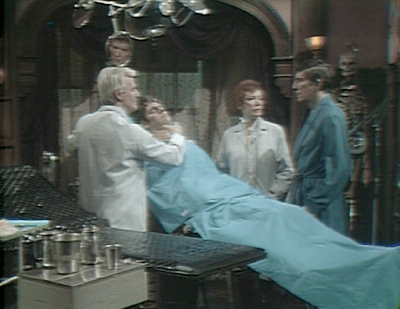
The experiment scene would only intensify such concerns. The experiment is a medical procedure that is supposed to bring a new life into the world, which by 1968 was how Americans usually thought of the process of birth. Barnabas is the patient, he is lying down, and the doctors sedate him. Thus he takes on all the medicalized marks of a mother-to-be. Julia asked Lang if the process would be painful for Barnabas; he does not disappoint, but ends the episode screaming in response to labor pains. Not only does turning Barnabas into Adam’s mother invert the expected gender performance, but it also introduces a homosexual side to Barnabas’ relationship with Lang, who is Adam’s other parent.
Somebody ought to be there telling Barnabas he’s doing great and urging him to push. Screenshot by Dark Shadows Before I Die.
Christian imagery and gender-nonconformity would have been rather a queasy combination for most Americans in 1968. That’s unusual, in historical terms. Before modern times, Christians didn’t hesitate to discuss ways that familiar gender roles break down in the relationship of humans to Christ. The “Fathers of the Church,” the prominent Christian intellectuals of the fourth and fifth centuries, talked about that all the time, going into depth not just with the image of the Church as the Bride of Christ but of each human soul, whether male or female, as one of Jesus’ wives, and of the physical contact between humans and Jesus in the Eucharist as a consummation of their marriage.
For their part, Calvinists tended to be skeptical of the physical aspect of the sacraments, but that didn’t mean that they shied away from conjugal metaphors to describe the relationship between the soul and Jesus. John Donne, like most priests in the Church of England in the 16th and early 17th centuries, was basically a Calvinist, yet his sonnet “Batter my heart, three-person’d God” is one of the most vivid and uncompromising statements of the ancient idea of an erotic dimension to Christian life that transcends the binaries between masculine and feminine, male and female. That tradition makes today’s conjunction of Christian and homoerotic themes all the bolder- imagine if Dark Shadows wrote itself into a corner where they had no choice but to explain nuptial imagery and mystical eroticism in the writings of Saint Ambrose. The whole audience could fit into a seminar room.
Closing Miscellany
Lang and Julia wear white lab coats. This is the first time Julia has worn a white coat. Her previous lab coat was light blue, which looks white on the black and white TV sets most households had in 1968, but now that the show is being produced in color they are buying costumes and props for color televisions.
The idea of a machine that would cause a person to go to sleep in one body and wake up in another was a big deal on TV in the 1960s. Just today I saw this screenshot from The Avengers on Tumblr:
This episode marks the first appearance of Robert Rodan. When Adam was a nameless heap of flesh under a blanket, he was played by a stand-in named Duane Morris. Rodan had a few small parts on TV shows in 1963 and 1964 and was in a couple of commercials between 1964 and 1968. Adam was his first, and last, recurring role on a series. In 1969, he appeared in a little-seen feature film called The Minx, then spent the rest of his life selling real estate in Southern California.
Recovering vampire Barnabas Collins has brought his former blood thrall Willie Loomis home to the Old House on the great estate of Collinwood. Willie had been confined to a mental hospital during the several months that have passed since Barnabas framed him for crimes he himself committed against Maggie Evans, The Nicest Girl in Town. The chief of the mental hospital, mad scientist Julia Hoffman, is now Barnabas’ best friend, and he talked her into releasing Willie to him.
Today, Barnabas tells Willie he is going to send him back to the hospital for the rest of his life. Barnabas is furious that the first thing Willie did after promising not to leave the Old House without him was to sneak off and go to Maggie’s house. Barnabas found out about this when Maggie’s boyfriend Joe came to the Old House and told him about it. Joe also told Barnabas that he would kill Willie if he ever again saw him anywhere near Maggie.
Yesterday, it was impossible to tell what was going on in Willie’s mind. At one point he seemed to be in a childlike state, remembering nothing of his time with Barnabas and believing that they had been friends. When he went to Maggie he seemed to have reverted to the way he was when Barnabas was holding Maggie prisoner in the Old House and Willie was desperately trying to spare her the worst. At the end of the episode he pointed an unloaded rifle at Joe and squeezed the trigger, grinning maniacally when he heard the click. Perhaps two of those attitudes were fakes meant to cover the third, or perhaps his personality really is unstable and was fluctuating as the episode went on.
Barnabas has concluded that Willie’s childlike friendliness is a fake and that he is exactly the same as he was when he lived with him. So he gets impatient with Willie when he doesn’t seem to remember that he was a vampire. He talks to Willie as if he remembers everything. He tells him that he can go around in the daytime now, but that he is not really free of the curse yet. He persuaded Julia to release him so that he could help with an experiment that will complete the cure.
Julia enters in time to hear that, and reacts angrily. The experiment is the work of another mad scientist, Eric Lang. Julia is opposed to the experiment and had no idea Barnabas was planning to use Willie to further it. She and Barnabas stand on either side of Willie and argue. At the end of their argument, Willie says he will do whatever Barnabas and Lang say.
Barnabas and Julia fight over Willie.
Lang comes to the Old House. Julia tells him that Willie was Barnabas’ victim, and says he has hidden resentments against Barnabas that will likely surface and prompt him to sabotage the experiment. This is interesting as an explanation of Willie’s visit to Maggie, which was after all one of the most self-destructive things he could possibly have done. However much damage Willie did to himself by going to Maggie’s house, he also subjected Barnabas to considerable embarrassment and inconvenience. So maybe Willie’s puzzling behavior yesterday was the result of a neurotic complex, unconscious hostilities towards Barnabas combined with feelings of guilt that drove him to actions he himself couldn’t have explained. On this interpretation, Barnabas is accidentally functioning as Willie’s therapist. By modeling the conversations they used to have when Barnabas was a vampire and Willie was his blood thrall, Barnabas is helping Willie recover his memory.
The rest of the episode is taken up with a dead end story called the Dream Curse. This consists of frequent repetitions of an acting exercise that gives each cast member an opportunity to show what they can do when they don’t have many lines and just have to emote. Unfortunately, this time it is Lang’s turn to run through the exercise, and Addison Powell’s abilities as an actor were severely limited. He’s pretty nearly unbearable.
There are two things going on while Powell is shouting and stumbling around that I want to mention. Julia appears to him at the beginning of the sequence, and she makes a series of delightful little balletic movements with her arms. There is no apparent reason in the story for her to turn into a ballerina, but those movements are more worth watching than anything we’ve seen from Powell.
At the end of the sequence, Lang opens a door and is greeted by a headless body with a turtleneck sweater. The men in the segments of Dark Shadows set in the 1960s all wear either neckties or turtlenecks, and lately the turtlenecks have been getting ever more prominent. I suppose it was just a matter of time before a character appeared whose turtleneck replaced his head altogether.
Not sure what this guy’s deal will turn out to be, but he’s already more appealing than Lang.








 Dark Shadows Commentary