Episode 779: Our cousin, who always appears at dusk

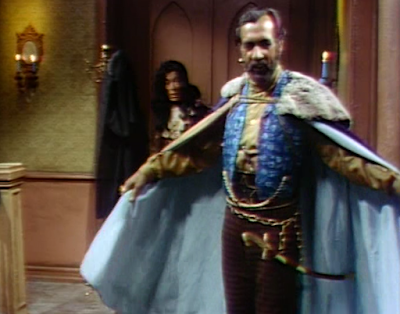
Vampire Barnabas Collins has stashed his coffin in its old hiding place, the hidden chamber inside the mausoleum where his parents and sister are buried. As dawn approaches, he tells his reluctant sidekick, broad ethnic stereotype Magda Rákóczi, that this is the last day he will have to leave the coffin there. The suspicions that had recently surrounded him have cleared, and he will move the coffin back to the basement of Magda’s home, the Old House on the estate of Collinwood, when he next arises.

The graveyard is immersed in a heavy fog. As Barnabas approaches the mausoleum, a familiar voice calls to him. His old nemesis and ex-wife, wicked witch Angelique, implores him to come with her and leave the year 1897. She warns him that he must return to 1969 now, or it will be too late. Barnabas tells Angelique that he has not accomplished the goals for which he came to the past, and that he will not leave until he has done so.

Longtime viewers may be puzzled when Angelique tells Barnabas that she has helped him before. In #757, Angelique did prevent her fellow undead blonde fire witch, Laura Murdoch Collins, from staking Barnabas, but that did not seem to be intended as a service to Barnabas. Rather, it recalled #417, in which Angelique prevented Barnabas’ friend Ben Stokes from staking him and freeing him of the effects of the vampire curse she had placed upon him. She told Ben that she wanted Barnabas to suffer forever, and nothing she says to Laura indicates that she has changed. Indeed, the only time she ever seemed to act out of goodwill towards Barnabas was in #410, when Barnabas was about to rise as a vampire for the first time and she, regretting the curse, tried to stake him herself. Perhaps there is a retcon coming up, in which it will be made possible for Barnabas and Angelique to join forces against some new enemy.

It certainly seems that the show is about to take a new turn of some kind. The major storylines with which the 1897 segment began are all approaching their natural conclusions, and a number of major characters have already been killed off. Longtime viewers will recognize an acknowledgement of these facts, not only in Angelique’s explicit statement that the proper time for Barnabas’ stay in the late nineteenth century is almost up, but also in the doings of another character in the graveyard.

Inveterate prankster Carl Collins suspects Barnabas of being a vampire, and in a dream visitation his late fiancée Pansy directed his attention to the mausoleum. Lurking outside it, he sees Barnabas open the secret panel and go into the chamber where the coffin is kept. Carl declares that “We’ll get him tonight! We’ll get cousin Barnabas… TONIGHT!”

Carl is played by John Karlen, who first appeared on Dark Shadows as the luckless Willie Loomis. It was Willie who, in a misbegotten attempt at jewel theft, inadvertently freed Barnabas to prey upon the living in #210. In consequence, Barnabas bit Willie and enslaved him. When Willie first served him, Barnabas would control him not only by the usual vampiric practices of blood-drinking and telepathic summoning, but also by frequent heavy beatings with his cane. Later, Willie would come to feel that Barnabas was his friend; it was never clear that Barnabas reciprocated this feeling.

Carl first met Barnabas in #706. He introduced himself by holding a gun to Barnabas’ head and threatening to shoot him if he did not admit that his story of being a long-lost cousin from England was a lie. The gun turned out to be loaded with a flag labeled “FIB,” and the whole thing was Carl’s idea of a joke. Barnabas’ icy response, starting with his incredulous tone while asking if “YOU are a COLLINS?,” set the tone for all of his subsequent dealings with Carl, in which his attitude ranged from undisguised contempt to barely disguised contempt. Yet Carl remained convinced that he and Barnabas were going to be great friends, and he even asked Barnabas to be the best man at his wedding to Pansy. Carl is much more enthusiastic about his supposed friendship with Barnabas than Willie is about his, and Barnabas is far more open about his hostility towards him, making the Carl/ Barnabas relationship a spoof of the Willie/ Barnabas one.

Ever since Pansy’s death, Carl’s thoughts about Barnabas have taken a darker cast. When we see him in the mausoleum, watching the panel open, we know that his plan to “get cousin Barnabas” will take him into the chamber where Willie forever lost his freedom. We know, too, that Willie’s misfortune revolutionized the show; when it puts this actor on this set, Dark Shadows is promising to make major changes.

We cut to the drawing room of the great house on the estate. Rakishly handsome Quentin Collins is talking with Magda. As Angelique cursed Barnabas to be a vampire, so Magda cursed Quentin to be a werewolf. Angelique placed her curse because she was upset that Barnabas did not love her and was under the impression she was about to die. Magda placed hers because Quentin had married and then murdered her sister Jenny. Magda did not know then that Jenny had borne twins to Quentin, a son and a daughter. Since the curse is hereditary, Magda has been trying desperately to reverse it ever since she learned of the children’s existence.

The children are still secret from Quentin, and so he does not understand why Magda is trying to help him. When he demands she tell him, she says “I. Did. Not. KNOWWW!” in exactly the same intonation she had used when she first heard about the children in #763. First time viewers don’t know any more than Quentin does what she is talking about- the children are not mentioned today. Magda makes up an obvious lie, saying that she hadn’t known how much Jenny loved him. That isn’t meant to fool the audience, and doesn’t fool Quentin. But when Carl enters, Quentin drops the subject and leaves new viewers in suspense about what Magda now knows that they do not.

Carl knows that Magda lives with Barnabas, and refuses to talk in front of her. She teasingly asks “Mr Carl” if he “don’t like me any more,” and walks out with a bold stride, suggesting that Carl may at some point have shown signs of liking her rather too avidly for her husband’s comfort. Once she is gone, Carl tells Quentin that there is a vampire in their midst. Quentin dismisses this out of hand, telling him that their brother Edward staked a vampire named Dirk and told him about it in vast and gory detail. Carl asks who made Dirk a vampire; Quentin says that it was Laura. No, says Carl, Barnabas made Dirk a vampire, and Barnabas is a vampire himself.

Quentin begins to laugh, but within seconds realizes that there is a great deal of evidence in plain sight to support Carl’s assertion. He agrees to go with Carl to the mausoleum, but we hear his thoughts as he reflects that Barnabas’ efforts to help him are the only hope he has of release from the werewolf curse.

In the mausoleum, Carl wonders aloud where Barnabas came from. Quentin supposes that he was there all along. Carl is horrified at the thought that he is “the real Barnabas- our ancestor! Oh God, that makes it worse!” Quentin orders Carl to open the panel, and Carl obeys. As my wife, Mrs Acilius, points out, John Karlen once again plays the servant’s role.

In the hidden chamber, the brothers open the coffin, finding the diurnally deceased Barnabas. Quentin tells Carl to hand over the gun he has brought; Carl obeys. Quentin asks Carl if he knows how to get out of the chamber. When Carl says that he does not, Quentin turns the gun on him and forces him to stay. Quentin shuts his brother up in the chamber with the vampire.

Quentin consigns Carl to death by vampire. Screenshot by Dark Shadows Before I Die.

In #384, set in the 1790s, Barnabas shot and killed his uncle Jeremiah. Barnabas and Jeremiah were about the same age, and had been very close; they were often compared to brothers. Barnabas was not yet under a curse when he committed that fratricide; it was an act entirely of his own will. Angelique was also partly responsible; she had cast spells on Jeremiah and on Barnabas’ fiancée Josette, causing them to conceive a mad passion for each other and to run off and get married. Enraged, Barnabas broke from the customs of New England and challenged Jeremiah to a duel. Consumed with guilt, Jeremiah deloped and let Barnabas kill him.

Barnabas’ killing of Jeremiah was murder under the laws which prevailed at the time in Maine, which was until 1821 part of Massachusetts. Indeed, Massachusetts’ anti-dueling act of 1730 provided that anyone who had either been killed in a duel or been put to death for winning a duel would “be given an unchristian burial at a gallows or crossroads, with a stake driven through their body.” Since the audience knows that Barnabas is fated to become a vampire, there is a chilling irony in seeing him volunteer for a staked burial.

Dark as was the shadow the duel cast over the subsequent history of the Collinses, at least Barnabas’ act showed a kind of twisted courage. But when Quentin uses Barnabas as a weapon to kill his brother, he is acting from the most abject cowardice. In the century that they have been subject to black magic, the Collinses have sunk from tragic grandeur to infantile squalor.

Quentin goes to the Old House and tells Magda what he has done. Magda is horrified at another murder. “No! Too many people are suspicious now. We’ve got to stop it or we’ll all be found out!” Since Magda is not a member of the Collins family, she is often the straight man reacting to revelations of their misdeeds and monstrosities. And since she is played by the charismatic Grayson Hall, the audience tends to adopt her point of view. So it is easy for us to forget that she is a functional sociopath. Despite all the killings we know to have resulted from her actions, it is still startling that Magda’s only objection to Quentin’s attempt to murder his brother is that she is afraid of getting caught.

We cut to another scene on the same set. Magda has summoned Angelique to the front parlor of the Old House. She asks Angelique to erase Carl’s memory so that Barnabas will not choose to kill him. Angelique taunts Magda as an “amateur” in the occult arts, and declares that she is done helping Barnabas. Magda says that she has read the Tarot, and that the cards tell her that Angelique loves Barnabas. She renews her plea to prevent the killing of Carl, but Angelique will not yield.

The reference to the Tarot rings a bell for longtime viewers. In the 1790s segment, Hall played the Countess DuPrés, Josette’s aunt. Angelique was introduced in that segment; she was the countess’ maidservant, and appeared to be a beginner in witchcraft. The countess was oblivious to Angelique’s sideline, and in #393 declared her to be an uninteresting woman whom she had known ever since she was an uninteresting child. The countess spent most of her time in the front parlor of the Old House reading the Tarot. That Angelique speaks so haughtily to the Tarot reader and “amateur” witch Magda on the same set highlights the reversal of roles in this segment.

Meanwhile, Carl searches the hidden chamber for a way to escape. He finds that one of the stones in the steps slides and reveals a lever. He turns the lever, opening the panel. He runs out and vows to destroy Barnabas, in the process almost knocking over a large tombstone that wobbles as if it were made of Styrofoam.

In episodes #310-315, made and set in 1967, strange and troubled boy David Collins was trapped in the hidden chamber for a whole week. He never did find the release lever- the ghost of Barnabas’ little sister Sarah finally took pity on him, materializing and showing it to him. The show avoids the implication that David is drastically dumber than his great-great uncle Carl by showing that the stone concealing the lever is already slightly ajar.

Episode 778: The strongest magic is always the simplest

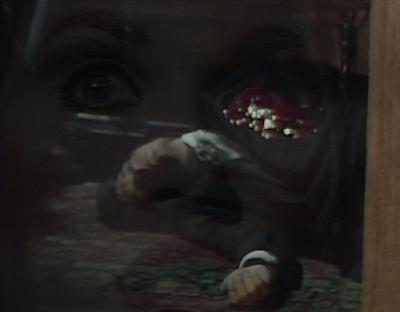
A lot happens in this one. Inveterate prankster Carl Collins realizes that his fiancée, Cockney showgirl Pansy Faye, is dead. He has a dream in which he meets Pansy backstage as she is preparing for her final performance, then sees her standing on stage before him, his sister Judith, and their distant cousin Barnabas; when he awakes from the dream, Carl is sure he has figured out what happened to Pansy, and he sets out for the very place where Barnabas is planning to rest during the day. This seems to imply that Carl will discover that Barnabas is a vampire.

The dream sequence is like nothing we’ve seen before on Dark Shadows, though it is strongly reminiscent of the kind of thing you would have seen on near-contemporary shows like ABC’s prime-time horror anthology Night Gallery hosted by Rod Serling and the Paulist Fathers’ syndicated morality plays Insight hosted by the Rev’d Fr Ellwood Kieser. It starts with a closeup of a sign on which Pansy’s name is emblazoned in glittery letters, and plays over a soundtrack of an audience applauding thunderously. Pansy calls Judith, Barnabas, and Carl to join her on stage, each in their turn; their behavior in this drama-within-a-drama mirrors their behavior in the framing narrative.

Pansy’s sign. Screenshot by Dark Shadows Before I Die.

Meanwhile, Barnabas’ unwilling sidekick, broad ethnic stereotype Magda Rákóczi, has returned from Boston. There, she met with a leading member of the Romani people, whose name she alternately pronounces as “King Johnny Romana” and “King Johnny Romano.” She shows Barnabas a box she took from King Johnny. It contains a severed hand wearing a ring, which Magda declares will solve their troubles. Magda has placed a curse on Judith and Carl’s brother Quentin, turning Quentin into a werewolf. After placing that curse, Magda learned that her sister Jenny had borne two children to Quentin, and since the curse is hereditary she is desperate to find a way to lift it. Barnabas traveled back in time to 1897 in the course of his own attempt to resist the effects Magda’s curse will have in 1969, so they are allied in this effort.

Barnabas is utterly unimpressed with the hand and with Magda’s plan to place it on Quentin as he is about to transform. He seems convinced that Magda is just trying to conceal the fact that she failed to find anyone in King Johnny’s camp who could actually help them. He doesn’t care about the original owner of the hand, a legendary nobleman named Count Petofi who was himself cured of lycanthropy, or about an incantation Magda says over the hand that is supposed to prepare it to draw the curse from Quentin. He isn’t even interested when she admits that she stole the hand from King Johnny and that if they don’t get it back to him before he realizes it is missing he will send someone to kill her. He reacts as if the whole thing is a show she is putting on to build up her cover story.

In a metafictional set of way, Barnabas is onto something. The original storylines the writers had prepared for the 1897 segment are coming to a head. Several of its major characters have already died, and others, such as Carl, would not be very attractive customers for a life insurance salesman. Apparently the original flimsies, written six months ago, gave only a few more weeks until Barnabas was to return to 1969 and take the show back to contemporary dress. But 1897 is a hit. The ratings are soaring, and there are some dynamics among the characters that they want to explore in a lot more depth. So they want to stay, but to keep the momentum going they need more story and a number of new characters, including a major villain whom Barnabas and Quentin can team up to fight together. So the writers find themselves in the same position with regard to us that Magda is in with regard to Barnabas, trying to sell us on their latest preposterous brainstorm.

Pansy’s farewell performance in Carl’s dream is, alas, Kay Frye’s final appearance on Dark Shadows. Some fans seem unable to look past Pansy’s own hilariously inept performance when we first see her doing her act, and to see that Miss Frye herself does a terrific job playing a cold, cynical working girl. She is good today, when Pansy is on stage and in her character as the “world-famous mentalist and singer,” but is also trying to tell Carl the truth about Barnabas. I only wish they could have brought Miss Frye back as someone else, either in the extended 1897 segment or in another time period.

Episode 775: Call it a vampire or whatever you like

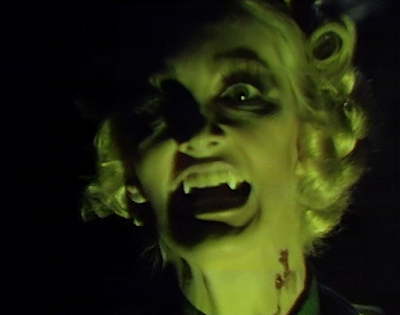
Neurotic intellectual Rachel Drummond is the third character Kathryn Leigh Scott has played on Dark Shadows, and today she joins the other two in becoming the victim of a vampire. In the parts of Dark Shadows set in the 1960s, Miss Scott plays Maggie Evans, The Nicest Girl in Town. Vampire Barnabas Collins took Maggie as his victim in May and June of 1967, and tried to brainwash her into believing she was his lost love Josette. At first Maggie responded to the vampire’s bite with the same addictive behavior it prompted in others, but eventually she shook loose of Barnabas’ power and rebelled against him. She tried to stake Barnabas, and when that failed she escaped from him. It was only because her psychiatrist betrayed her to become Barnabas’ co-conspirator and to hypnotize Maggie into forgetting her experience that she did not expose Barnabas.

When Dark Shadows flashed back to the 1790s to show how Barnabas became a vampire and to suggest that he might still be interesting if he weren’t one, Miss Scott played Josette. After he had brought the vampire curse on himself, Barnabas bit Josette, who like Maggie at first responded blissfully. When Josette realized Barnabas wanted to make her into a vampire as well, she, like Maggie, resolved to escape. Maggie’s escape took her from the prison cell in Barnabas’ basement through a tunnel to the beach below the cliff of Widow’s Hill; Josette’s escape led to very nearly the same spot, but it began, not in the cell, but at the top of the cliff, and it involved her flinging herself to her death on the rocks below.

Early in 1968, Barnabas was freed of the effects of his vampirism, and he set about battling other supernatural menaces. In the course of one such battle, he has come unstuck in time, and taken us with him to the year 1897. In that year, he is once again a vampire. One of his victims was dim-witted servant Dirk Wilkins. Since Barnabas was beginning to attract suspicion, he allowed Dirk to die and rise as a vampire, planning to tip people off to Dirk’s hiding place so that he would be found and destroyed and everyone would attribute all the vampire attacks of the previous few months to him. This plan fell apart immediately, when Barnabas lost track of Dirk as soon as he first rose.

Rachel has stumbled into Dirk’s hiding place. She asks him if he knows what happened to her friend Tim, and he bites her. She shows some signs of a blissful initial reaction to the bite, but still has some questions about Tim. Dirk tells her to forget about Tim and to stay where she is. He returns before dawn to find her waiting. She brings Tim up again, and he ignores her. She helps him close the lid of his coffin, caressing it. Though Rachel is obedient, this does not mean that she is any more under Dirk’s power than Maggie was under Barnabas’ power when she rebelled against him or Josette was when she jumped off Widow’s Hill. Rachel’s personality is something that takes place deep inside her head and prevents her from asserting herself against other people. Even if Dirk were not a vampire, she would probably have been just as compliant.

While Rachel is sitting dutifully in his hiding place, Dirk calls upon Barnabas. He tells Barnabas that he will kill Rachel unless he brings blonde fire witch Laura Murdoch Collins back to life before dawn. Returning viewers know that Barnabas has no idea how to revive Laura. We also know that no one else is going to bring Laura back, because she was running out of story when she vanished in #760 and they already have more characters than they can fully use. Even a fan favorite like Miss Scott is absent from the show for dozens of episodes at a time. So it seems that Rachel is doomed.

Meanwhile, Barnabas has another problem to deal with. His distant cousin, stuffy Edward Collins, has summoned him to the great house of Collinwood. Edward suspects Barnabas of vampirism, and has told him so. Edward’s sister, spinster Judith, has turned up with bite marks on her neck and an oddly subdued affect. Edward brings Barnabas face to face with Judith. When she does not react to him as Edward expects a victim to react to the vampire who bit her, Edward is embarrassed and stumbles through a series of half-expressed apologies. Barnabas declares that he will resume the search for Dirk, and instructs Edward to stay with Judith at all times. He hopes that Judith will lead Edward to Dirk’s lair.

Edward does sit with Judith for a time, but when he hears some noises in the foyer he leaves the room to investigate. He wanders all through the house for a number of minutes, long enough that the recorded background music plays beyond the cues we are used to hearing and gets to some tunes we haven’t heard in months.

While Edward is conducting this journey, Dirk sneaks up behind him on the walkway at the top of the foyer stairs and grabs him by the neck, knocking him out. Dirk then appears in Judith’s room, gives her a gun, and tells her he will have a job for her to do soon. He dematerializes before Edward comes back and finds Judith still in bed.

Later, Edward leaves again to make tea, and when he brings the tray back Judith is gone. In its first months, one of the themes of Dark Shadows was that the Collinses of 1966 were running out of money, so it made sense that they were chronically short of servants. In this period, however, the Collinses are supposed to be at the zenith of their wealth and power. It is simply a flaw in the story that Edward himself has to leave Judith to find out what the noises were in the foyer or to fetch her tea.

The task Dirk set for Judith was to murder Rachel. After dawn, she goes to the hiding place, pulls the gun, and tells Rachel she is sorry for what she must do. In the parts of Dark Shadows set in the 1960s, Joan Bennett plays matriarch Elizabeth Collins Stoddard. In #569 and #570, it looked like Liz might be bitten by vampire Tom Jennings. But the show is firmly committed to a prohibition against involving Liz directly in the plot, so that came to nothing. When Judith presents herself as Rachel’s designated assassin, longtime viewers will be glad to see that Judith is not subject to the same restrictions.

Judith prepares to kill Rachel. Screenshot by Dark Shadows Before I Die.

Episode 772: Apologies are the Devil’s invention

The opening voiceover plays over this image, a type of visual effect we have not seen before at the beginning of an episode:

A transparent sticker of Barnabas superimposed on the exterior of the Old House. Screenshot by Dark Shadows Before I Die.

Barnabas Collins has bitten dimwitted servant Dirk Wilkins, turning Dirk into a vampire like himself. Barnabas has been out all night, searching for Dirk’s hiding place. He hopes to expose Dirk and frame him for his own crimes.

Barnabas comes home to the Old House on the estate of Collinwood to find that Dirk seems to be trying to do the same thing to him. There is a blood-drained corpse in an armchair in his front parlor. It is that of Miss Pansy Faye, Cockney showgirl and Dirk’s first victim.

Barnabas’ distant cousins live in the great house on the estate. One of them, prankster Carl Collins, brought Pansy home with the intention of making her his bride. No sooner does Barnabas discover Pansy’s remains than Carl starts banging on the front door, shouting that he wants to speak with her.

Barnabas hides what’s left of Pansy in a secret chamber behind a bookcase, then lets Carl in. Grisly as the circumstances are, one person lying to another about the presence of a third nearby is a stock situation from farce, and John Karlen and Jonathan Frid play the scene with the particular brand of desperate seriousness that only works in farce. Barnabas persuades Carl to go away and search the grounds of the estate.

That takes a few minutes, starting from what the opening voiceover told us in so many words was “an hour before dawn.” In what remains of that hour, Barnabas takes Pansy’s body to a cemetery and buries her in a shallow grave between tombstones, telling her to “rest in peace.”

Barnabas buries Pansy. Screenshot by Dark Shadows Before I Die.

Barnabas comes home, and finds Carl, who has in the interval not only gone to the great house, the groundskeeper’s cottage, and a house on the estate which is currently occupied by a school, but has also gone into the village of Collinsport and made inquiries about Pansy. A speedy bunch, the Collinses.

Before Barnabas returned to the house, Carl had heard Pansy’s disembodied voice singing the song she had so memorably performed for Barnabas in yesterday’s episode. He had spoken to Pansy’s voice telling her that his grandmother’s will gave him a house to live in and that she could live there with him. This is puzzling for returning viewers. In #714, it was made perfectly clear that the will did not mention Carl at all. Edith Collins left her entire estate to Carl’s sister Judith, and the only one of the brothers who was mentioned was Quentin, who received no money or negotiable assets of any kind but who was guaranteed the right to stay at Collinwood as long as he pleased. Perhaps they are retconning that away, perhaps Carl is lying to Pansy, or perhaps Carl is losing his grip on reality.

Whether or not we are supposed to doubt Carl’s sanity, Barnabas talks Carl into suspecting that he might have hallucinated Pansy’s voice. Carl leaves, and Barnabas has time to return to his coffin before dawn.

The rest of the episode is taken up with doings at the school Carl had visited. We saw Carl questioning Charity Trask, daughter of the school’s master, the overwhelmingly evil Gregory Trask. The prim Charity was exasperated that Carl kept asking about Pansy after she had already denied having seen her. The scene is an interesting one- Charity and Pansy are such total opposites that it is a shame they never met. It would be amusing to see them juxtaposed.

Charity is engaged to marry Tim Shaw, a teacher at the school. Neither of them is happy about this situation. Tim was in love with Rachel Drummond, another of the teachers, and Charity is Barnabas’ blood thrall. But Gregory blackmailed Tim and bullied Charity into accepting the arrangement.

Charity’s mother, prudish Minerva Trask, does not like Tim or want him as a son-in-law. She urges Charity to set her sights on Carl. Charity says that she would rather marry Barnabas; Minerva says that her instincts are sound, but that she ought not to settle for a cousin of the rich Collinses when one of the brothers is available. Even if they have retconned Carl into owning a house, he is clearly not a rich man, so this reveals that Minerva knows as little about his financial position as she does about the curse under which Barnabas labors.

Charity tries to engage Tim in conversation, and is baffled that he is not willing to talk to her. Indeed, he does not seem like himself at all. Not only is he dismissive with Charity, but when Minerva confronts him he is bold and insolent, a far cry from the broken man we have seen interacting with the Trasks previously. When Charity tells him their engagement is off, he does not express the relief that she and we expect, but puts on a stagey voice we have not heard him use before and marches off to apologize to her mother.

There is a reason for Tim’s behavior. Gregory enlisted warlock Evan Hanley to brainwash Tim so that he would kill Minerva. There is some business with the Queen of Spades, first when Tim mutters the phrase “Queen of Spades,” then when Evan sends him a note on which is scrawled “Queen of Spades,” and lastly when he walks in on Minerva playing solitaire and sees her turn up the Queen of Spades. Many viewers in 1969 would have remembered Richard Condon’s 1959 novel The Manchurian Candidate and its 1962 film version. In Condon’s novel, Raymond Shaw became a robot capable of murder when he saw the Queen of Hearts; in the film, the card was the Queen of Diamonds. Many first time viewers, seeing Tim Shaw’s reaction to the Queen of Spades, would have made the connection and understood why he ends the episode by poisoning Minerva’s tea.

Is this your card? Screenshot by Dark Shadows Before I Die.

Tim Shaw differs from Raymond Shaw in that he is under a spell for a long while, including the whole time we see him today, and he can talk and act independently while it operates on him. Raymond simply became catatonic when he saw the card and remained that way until he heard a command. He then executed the command and came back to himself once he was finished. Tim’s behavior may suggest a nod to another literary work, Pushkin’s story “The Queen of Spades.” That tale, which Tchaikovsky turned into an opera and which in 1949 was made into a feature film, is about a timid man who inadvertently kills a powerful woman and loses control of himself as a consequence. Like Tim, Captain Herman is coerced into marrying a woman he does not love. Presented with an opportunity to get out of the marriage, he finds himself making extraordinary efforts to go through with it, efforts which bring about his ultimate downfall.

Episode 771: When the music begins

Vampire Barnabas Collins is about to leave his house with his thrall, maidservant Beth Chavez, to look for Dirk Wilkins, a dimwitted servant whom he inadvertently turned into a vampire and let go. They are stopped when Barnabas’ distant cousin, inveterate prankster Carl Collins, comes in and insists on telling him about his recent trip to “Atlantic City, New Jersey, the Queen of the Boardwalk cities!”

Carl offers Barnabas some saltwater taffy, only to find that the tin is empty. He frets that “she” must have eaten it all on the trip back- “You know how women eat when they are nervous.” This leads to Carl’s second order of business, introducing Barnabas to Miss Pansy Faye. Carl met Pansy on the train, and he intends to marry her.

Carl opens the door, then stands before Barnabas and Beth and announces in his most booming voice “Presenting! Direct from her triumphs before Her Imperial Majesty, Queen Victoria of England, that world-famous mentalist and most beguiling songstress, Miss Pansy Faye!” Pansy enters, singing and dancing. In a vaguely Cockney accent, she intones:

I’m gonna dance for you! Gonna dance your cares away.
I’ll do the Hoochie Koo, and the Ta Ra Boom De Ay!
I’ll sing a happy song, as we dance the whole night long!
When the music begins, I’ll give you some spins,
I’ll even invent a step or two!
So, on with the show! You’ll love it, I know!
Oh, I’m going to dance for you!

Pansy’s dance is not particularly elaborate; it is performed almost entirely below the waist, and ends with her bending over and thrusting her rear end upward. That is followed by a cut to Barnabas wearing a look of stupefaction that all the black magic and demonic intrusions he has witnessed over the centuries have not elicited. He turns to Beth, who is visibly struggling to keep a straight face.

Against the backing track of Dark Shadows super-solemn music, this scene is hilarious. Longtime viewers will savor it even more than others. Carl is played by John Karlen, who in the parts of Dark Shadows set in the 1960s plays the luckless Willie Loomis, Barnabas’ first blood thrall. When Barnabas first enslaved Willie in the spring and summer of 1967, the show was at its bleakest. Barnabas was able to fool his distant relatives in the great house into regarding him as a living being and letting him occupy the Old House, but that was only because they had been isolated and embattled for so many months before. When we saw Barnabas and Willie on this set in those days, Barnabas was as grim as death itself, beating Willie with his heavy cane whenever he dared do more than whimper. That Karlen is now here as the man who is introducing a character as exuberantly and preposterously alive as Pansy and that Barnabas’ current thrall is suppressing a laugh takes the despair of that period and packs it with joy.

The despair reasserts itself at the close of the episode. Pansy will go out into the woods, Dirk will take her as his first victim, and Barnabas will come home to discover her body propped up in a chair in the parlor. But the comedy in between is so strong that we can be confident that this will not be the last word. Carl tries to persuade his sister, spinster Judith, to accept his marriage to Pansy. He tells her that he is a new man thanks to Pansy’s influence; he has actually managed to go 48 hours without playing a practical joke. Judith is impressed by this new record, but still will not believe that Pansy is fit to become a Collins. She controls all the family’s wealth, and threatens to cut Carl off without a penny if he goes through with the marriage. He reacts with a series of facial expressions that the Three Stooges would have admired.

While Barnabas and Carl are out, Pansy stays in the Old House with Beth. Beth offers her a cup of coffee; Pansy says she would prefer sherry. Beth goes to look for sherry, and Pansy is caught off-guard that Beth doesn’t live there. When Beth says that she is based at the big house on the property, Pansy asks how big it is. Beth says that it is very big indeed; Pansy says that Carl had told her it was like a palace, and Beth confirms that it is indeed on that scale. Pansy is surprised that Carl was telling her the truth. She takes the drink at a single gulp. With Carl, Pansy was acting a part, and she was a terrible actress indeed. Alone with Beth, she drops the act. The Cockney accent is still not too well-developed, but Kay Frye is much more convincing as a hard-boiled working class woman than Pansy is in any of her roles.

Carl persuades Judith to sit still in Barnabas’ parlor while Pansy does her mentalist act, trying to locate Dirk. Pansy actually goes into a trance and announces that Dirk is dead and his murderer is in the room. When she comes to, Pansy is as surprised as anyone at what happened. Judith is demanding an apology, and Pansy is shocked when Barnabas tells her that she accused someone in the room of murder. A moment later, she is alone, wondering what came over her and lamenting that she “mucked that one up.”

The Old House is a dangerous place to be a fake practitioner of supernatural arts. In #400, set in the 1790s, fanatical but inept witchfinder the Rev’d Mr Trask performed an exorcism of the Old House, and was visibly delighted when that exorcism seemed to work. That time it was the intervention of wicked witch Angelique that gave Trask his apparent success, but now it seems that Pansy is simply getting it right for the first time.

That Dirk leaves Pansy in a chair in Barnabas’ front parlor is also something that will bring back memories for longtime viewers. In the 1790s segment, another brassy dame on the make brightened up the show for a little while before meeting a grisly demise on this spot. She was Suki Forbes, estranged wife of untrustworthy naval officer Nathan Forbes. Barnabas strangled Suki in #423, after she had discovered his secret. Suki took until #424 to die, but did not manage to disclose what she knew about Barnabas.

An even closer parallel is to #530. In that one, Frankenstein’s monster Adam hates Barnabas for making him what he is. Adam attacks a man called Joe Haskell and thinks he has killed him. At the end of the episode, Barnabas finds that Adam has planted Joe’s body in the front parlor. Any doubt that Adam was trying to frame Barnabas for Joe’s murder would be removed by consulting the novel Frankenstein, in which the Creature frames another character for the murder of his creator’s brother. Dirk knows that Barnabas made him into a vampire, and so has the same motivation to pin a murder charge on Barnabas that Adam had.

Adam was just a few months old when he tried to frame Barnabas for murder, and Dirk is a simpleton. Neither of them had the skills to get the police interested in Barnabas, no matter how many dead bodies they add to the decor of his house. On the other hand, Barnabas himself once very nearly managed to make such a plan work. In #440 and #441, part of the 1790s segment, Barnabas left the corpse of his victim Maude Browning in a bed belonging to Trask. It was only Nathan Forbes’ timely intervention that kept Trask from the gallows that time.

Episode 770: We must give him a vampire

Vampire Barnabas Collins first appeared on Dark Shadows in #210 and quickly became the show’s main character and star attraction, but the word “vampire” was not uttered on-screen until #410, and thereafter was used quite sparingly for a long while. Those days are definitely behind us now; the characters say “vampire” eight times in this one.

Barnabas has traveled back in time to the year 1897, and is embroiled in a great many storylines, none of which he fully understands or has any idea of changing for the better. Yesterday, crazed groundskeeper Dirk Wilkins told twelve year old Jamison Collins (David Henesy) that Barnabas was a vampire, and Jamison, checking on his story, found an empty coffin in Barnabas’ basement. Today, Jamison tells his father, the stuffy Edward (Louis Edmonds,) what Dirk said and what he saw.

Edward comes to Barnabas’ house, repeats Jamison’s story, and asks to see the basement. Barnabas has hidden the coffin, but Edward tells him that he cannot dismiss the story so easily. A few weeks before, Edward discovered that Jamison’s mother Laura was an undead blonde fire witch bent on incinerating her children to renew her own existence; since that experience, he can no longer disregard claims about the supernatural. There have been a number of attacks on the estate of Collinwood and in the village of Collinsport which have left victims drained of blood and showing bite marks on their necks; he must take Jamison’s claims seriously. He is alone with Barnabas in his basement while explaining this to him, rather a foolhardy position in which to lay out to a man one’s grounds for suspecting that he is a vampire.

Edward, unfrightened. Screenshot by Dark Shadows Before I Die.

Edward leaves. Barnabas is in a bind. Jamison’s children will be the adults at Collinwood in the 1960s, and they are the ones who accept Barnabas’ story that he is their distant cousin from England and give him the Old House on the estate to live in. If Jamison knows about him, it will hardly be likely that his children will be so welcoming. Even if he can reverse his journey through time, there will be no future for him to go back to. So he tells his blood thrall, maidservant Beth, that they must provide a vampire to take the blame for his earlier deeds and allay Jamison and Edward’s suspicions.

Barnabas thinks that he has already arranged a solution to this problem. He bit Dirk in order to shut him up and bring him under control, but apparently he over-ate. Dirk is not going to live through the night. When he dies, he will rise as a vampire. Barnabas and Beth will see to it that Dirk is caught and that he takes the fall for Barnabas’ crimes.

Barnabas has stashed Dirk in a secret room off the parlor of the Old House, a space behind the bookcase in the front parlor. Barnabas opens this space, intending to sit by Beth until they see Dirk die, only to find that it is too late- Dirk has wandered off.

Longtime viewers will find satisfactions in the reflections of earlier characters that run throughout this episode. The secret chamber in which Barnabas tried to keep Dirk is not a place which he has used before, but it first appeared on the show long before he did. In #115, another crazed servant, handyman Matthew Morgan, locked well-meaning governess Vicki up in the chamber, eventually attempting to kill her there. When Barnabas suddenly thinks of that chamber, he is emphasizing the echo of Matthew in Dirk’s rampage.

Edward’s fearlessness in standing alone before Barnabas in his basement and telling him that he suspects he may be a vampire is also something we have seen before. From November 1967 to March 1968, when Dark Shadows was set in the 1790s, Louis Edmonds played haughty overlord Joshua Collins. In #446, Joshua found his son Barnabas rising from his coffin in this same basement and confronted him about his bad behavior. When Barnabas moved to kill him, Joshua glared at him and Barnabas slunk away in shame. Edward is quite different from Joshua; on the one hand he lacks the earlier man’s sense of enterprise and drive for power, while on the other he is far more loving towards his children and quicker to set aside his individual pride for the sake of family unity. But we can see that he does share his kinsman’s ability to fend off vampire attacks by insisting on good manners.

The most fully developed echo is of #333. In that episode, set in contemporary times, strange and troubled boy David Collins (David Henesy,) had seen a coffin in Barnabas’ basement. Connecting that with an abundance of other readily available evidence, David concluded that Barnabas was a vampire. David’s father, high-born ne’er-do-well Roger Collins (Louis Edmonds,) refused to consider such a notion. When local men Burke and Dave went to Barnabas’ house and demanded to search the basement, he initially resisted. At length he led them downstairs. The coffin was not there. Burke and Dave went back to the great house of Collinwood, and Roger crowed with triumph that they had been so silly as to take David’s story seriously. Embarrassed, Burke and Dave asked David if he might have made the whole thing up.

Barnabas may have had this incident in mind, and with it a hope that by showing Edward the empty basement he would embarrass him as he had embarrassed Burke and Dave, perhaps turning him into the same kind of ally that Roger was in 1967. But Edward is made of sterner stuff, and he sheds light on what was in the minds of the makers of the show.

Laura was another iteration of the show’s first supernatural menace. From December 1966 to March 1967, we learned that David’s mother, Laura Murdoch Collins, was a humanoid Phoenix who had returned from the dead to incinerate him along with herself and thereby renew her existence. Roger eventually came face to face with that fact and made himself marginally useful in the effort to stop her. Afterward, he was shocked out of his habit of openly expressing hatred for David, and eventually even showed a modicum of affection and concern for the boy. But he quickly snapped back into the Collins family’s traditional attitude of denial that the supernatural could have any role in human events, and he would not be budged from this denial.

The Laura we saw in 1897 was a violent retcon of many of the most important features of the story we saw in 1966 to 1967, and as Jamison’s mother she implies that Roger married his own grandmother. So it seemed inexplicable that the makers of the show would choose to introduce her. It is when Edward explains that his experience with Laura has opened his mind to the possibility of dangers intruding from the world of the supernatural, that we understand why they did it. They are showing us that Edward is on a continuum about halfway between Joshua and Roger.

Joshua was in a way too strong for his world to support, so that he defeated his own aims and produced tragedies for all those he meant to elevate. By contrast, Roger is like one of Nietzsche’s “Last Men,” what nowadays some call “cage-stage,” a person who is so degenerated he cannot exist on his own or create anything lasting but can be happy in captivity. Edward does not have Joshua’s anomalous strength; like Roger, he lives in his sister’s house as her guest and works for her business as an employee. But neither does he have Roger’s cowardly inability to face facts or his vicious glee in the humiliation of others. He is brave enough and strong enough and fair-minded enough to represent a grave threat to Barnabas.

Episode 767: Birthdays are for people who get older

For the first several months of Dark Shadows, heiress Carolyn Collins Stoddard made no attempt to conceal her loathing of her young cousin, strange and troubled boy David Collins (David Henesy.) That changed at the beginning of 1967, during the storyline centered on David’s mother, undead blonde fire witch Laura Murdoch Collins. Laura cast a spell that caused Carolyn’s mother, reclusive matriarch Liz (Joan Bennett,) to enter a catatonic state. When that happened, Carolyn assumed responsibility for the family’s properties and enterprises. In that position, Carolyn took on a new maturity, and the capricious and often thoughtlessly cruel character we knew in the early days was gone forever.

Laura went up in smoke in March 1967, and the next month vampire Barnabas Collins succeeded her as the show’s supernatural menace. The adults in the great house of Collinwood- Liz, Carolyn, David’s father Roger, and well-meaning governess Vicki- were all taken with Barnabas. Liz gave him the Old House on the estate to live in, and none of them could see the abundant evidence that their distant cousin was a bloodsucking ghoul from beyond the grave. But the ghost of Barnabas’ nine year old sister Sarah appeared to David and led him to suspect that something was off about the new arrival. By late September, David had all but solved the puzzle, and was trying to get the grownups to see the obvious.

In #335, broadcast in October 1967, a psychiatrist named Dr Fisher came from Boston to examine David. Dr Fisher explained Sarah as an imaginary friend David had created in his attempt to control the fear of death he had developed after seeing his mother burn up, and his claim that Barnabas was an undead monster as that fear reasserting itself. We know that this is entirely wrong as far as David goes, but it does go a long way towards explaining the appeal Dark Shadows has for its audience.

In November 1967, Vicki came unstuck in time and Dark Shadows turned into a costume drama set in the late eighteenth century. When she came home and the show returned to contemporary dress in March 1968, David’s understanding of Barnabas and the resulting danger Barnabas would kill David, which had been the chief driving force of the action when she left, had been forgotten. Later that month Barnabas was freed from the effects of the vampire curse, and he set about fighting other uncanny monsters.

Now we are in the fourteenth week of the show’s second major costume drama segment. In late 1968 and early 1969, the malign ghost of Quentin Collins ruined things for everyone. David was under his possession and on the point of death when Barnabas decided the time had come to sit in his basement, throw some I Ching wands, and meditate on them. As a result, he found himself in the year 1897, when Quentin was a living being.

Barnabas has again managed to install himself as master of the Old House, though the Collinses of 1897 are a much less trusting lot than are their descendants in the 1960s. Barnabas and Quentin are becoming friends, but Quentin is increasingly irritated with Barnabas’ refusal to tell him anything about himself beyond the cover story that he concocted when he arrived. The owner of the house, spinster Judith Collins (Joan Bennett,) is more or less satisfied with that story, but her nephew and presumptive heir, twelve year old Jamison Collins (David Henesy,) has come to share Quentin’s belief that there is far more to Barnabas than meets the eye.

Today, Judith approaches Barnabas with a question. She says that Jamison has awoken from a terrible nightmare, and that while he was thrashing about in bed he called out “David Collins is dead!” This comes as a shock to Barnabas, suggesting a message from the future that he has already failed in his weird mission.

Judith has never heard of anyone named “David Collins” and can find no record of such a person, and asks Barnabas if he, who seems to know so much about the family history, has ever heard of an ancestor with that name. This will be of interest to longtime viewers. In #153, it was established that David was the first of his name in the Collins family, and that his mother, undead blonde fire witch Laura, had insisted on calling him that. This would eventually become evidence that Laura’s evil plans for David were in place long before he was born. But in #288, David would see a portrait of a long-forgotten ancestor named “David Collins” in an old volume, and would wonder if he was named for him. The name “David” had such a profound significance in the Laura story that it seemed like a major retcon when David delivered the line, but nothing came of it. Another iteration of Laura was on the show recently, and it seems we are back to the original understanding of how David got his name.

Shaken, Barnabas says that “David Collins is no one who exists!” Judith reacts to his obvious shock and his odd phraseology with the suspicion you would expect it to elicit, but still urges Barnabas to talk with Jamison. By the time she gets the boy to the drawing room, Quentin has joined Barnabas there and is sniping at him about his interest in the family. When Barnabas asks Judith and Quentin to leave him alone with Jamison, Quentin resists, demanding to know why they can’t stay. Barnabas doesn’t give much of an explanation, and it seems to be only Judith’s unwillingness to let Quentin win any argument that leads her to insist that Barnabas get his way.

As it turns out, the reason Judith and Quentin had to leave is that the dream will be played for us as a flashback, and Joan Bennett and David Selby feature in it. We have seen a great many dream sequences on Dark Shadows, but this is the first time one has been presented in retrospect while the dreamer is telling us about it. All previous dream sequences have begun with a character in bed and have shared that character’s experience with us. Several times, including the countless sequences during the “Dream Curse” storyline of April to July 1968, there was a vague possibility that the person would either die during the dream or wake from it irreversibly changed. So even longtime viewers might be surprised when Jamison sits down with Barnabas, starts talking, and we find ourselves in his dream.

Jamison doesn’t know it, but his dream is set in 1969. After Quentin’s ghost made the great house uninhabitable, the family took refuge in the Old House. Jamison goes to its basement, where he sees Barnabas immobilized before the I Ching wands. Unable to get his attention, he goes upstairs to the front parlor, where Carolyn, Liz, and Roger are preparing a birthday party for David. Carolyn is opposed to the exercise. She manipulates a hand puppet while making unpleasant remarks in a high-pitched voice, and says that “Birthdays are for people who get older!” Evidently time is passing in 1969 while Barnabas is struggling with his mission in 1897.

When Vicki was in the 1790s from November 1967 to March 1968, we did not catch any glimpses of the period she had left. Only for a few minutes immediately after she vanished and a few more immediately before she reappeared did we see the drawing room at the great house, and those minutes represented the whole passage of time the contemporary characters experienced during the four months of Vicki’s absence. We’ve already been in 1897 longer than we were in 1795-1796 then, and Jamison’s dream suggests that contemporary time is passing more rapidly now. Since David was within hours of death when Barnabas departed so many weeks ago, his prognosis would seem grim.

The dream is one longtime viewers can imagine David having. Carolyn has been friendly to her little cousin since early 1967, but she was so nasty to him in 1966 that he might well imagine her being impatient with his failure to finish dying sooner. Roger was even more openly hostile to David in those days, and only began to show normal fatherly feeling for him after he realized that he had narrowly escaped death at Laura’s hands. But even though David returned Roger’s open hatred and tried to kill him, he did after all retain a wish for a healthier relationship with him, and so it is not surprising that Roger would appear in a dream of his as someone wishing him well.

David wonders where Barnabas and Quentin are. The adults say that Barnabas is away, but do not recognize Quentin’s name. Roger looks Quentin up in a volume of family history, and finds that there is no entry for him. He declares that this means that there can never have been any such person. Again, if we think of this as a dream of David’s that has intruded itself onto Jamison’s consciousness, it makes sense that Roger, and for that matter Liz and Carolyn, are clueless about what is really going on around them.

Roger can find no reference to Quentin in the family history. Screenshot by Dark Shadows Before I Die.

Quentin appears, at first as the unspeaking ghost he was in when we first saw him from December 1968 to March 1969. Roger, Liz, and Carolyn vanish, and David talks with Quentin. Quentin says that the Roger, Liz, and Carolyn could not see him because he is dead, and that David can see him because he will soon be dead.

Quentin tells David that his own death was preceded by three events, and that if he had understood the significance of any of those events at the time he might have survived. The first event was the discovery of a silver bullet at Collinwood. The second was the murder of someone who might have been able to help him. The third was the turning of the one person he truly loved against Quentin; when that happened “there was almost no time left for Quentin Collins.”

Jamison asks Barnabas what the dream means. Barnabas claims not to know. Jamison replies that he thinks Barnabas knows exactly what it means, and is very upset with him for refusing to share his knowledge. In #660, David had said that “Barnabas knows lots of things he doesn’t tell anyone”; Jamison has already caught on to this same fact.

One of the people with whom Barnabas will not share his knowledge is Quentin. Even though Quentin’s ghost explicitly said in Jamison’s dream that his own demise could have been prevented, and Barnabas’ mission therefore completed, had he known about the three upcoming events, Barnabas flatly refuses to tell Quentin about them. Even when the silver bullet is discovered at Collinwood at the end of the episode, Barnabas still will not pass the dream’s warning on to Quentin.

Instead, Barnabas reenacts Dr Fisher’s part from #335. He seizes in Jamison’s description of the 1960s wardrobe he saw David, Roger, Liz, and Carolyn wearing, and says that it is the key- it shows that the whole scene is a masquerade. As Dr Fisher had said that Sarah Collins was an imaginary figure David had fabricated to contain the fear of death that had afflicted him since he saw his mother Laura die, so Barnabas claims that David Collins is a figure Jamison has fabricated to contain the fear of death that had afflicted him since he saw his mother Laura die. As Dr Fisher’s interpretation was all wrong in-universe but was quite plausible as an explanation of the audience’s responses to the show, so Barnabas’ interpretation is a grotesque lie in-universe but is quite plausible as writer Violet Welles’ description of the creative process that led to the decision to reuse Laura in the 1897 segment of the show. It allows them to pair David with Jamison and Roger with Edward, comparing and contrasting their personalities.

Episode 766: The weeping Dorcas

Vampire Barnabas Collins happens upon his unwilling sidekick, ethnic stereotype Magda Rákóczi, after she has fired a silver bullet at his distant cousin, werewolf Quentin Collins. He sternly forbids her to finish Quentin off, and for some reason she decides he is right.

Back in human form, Quentin is haunted by the ghost of Dorcas Trilling, a woman he killed in his first night as a werewolf. He has been telling himself that the evil deeds of the werewolf are not his own responsibilities, but that “he” is the culprit. That comforts him, but Dorcas isn’t having it. So he instantly collapses into, “All right, I did, but I couldn’t help it!” That doesn’t go over any better.

Unfortunately, this is Gail Strickland’s final appearance on Dark Shadows. Screenshot by Dark Shadows Before I Die.

Barnabas and Quentin have a confrontation. Barnabas tells Quentin that he knows his secret and says that he wants only to help him; Quentin angrily responds that he cannot trust Barnabas, who refuses to tell him anything about himself. He does ask Barnabas to kill him if it is the only way to keep him from turning into the werewolf again, so I suppose that is a step towards friendship.

Episode 765: The animal in the woods

In the spring of 1969, the twin crises created by the malign ghost of Quentin Collins and the werewolf curse upon drifter Chris Jennings had combined to kill a number of people, bring others to the point of death, and make life on the estate of Collinwood utterly intolerable. Recovering vampire Barnabas Collins and his friends found some I Ching wands in Quentin’s old room and tried to use them to communicate with the ghost. Instead, they caused Barnabas to come unstuck in time. In #701, Barnabas found himself in the year 1897, his own curse of vampirism once again in full force.

Today, Barnabas bites Quentin’s girlfriend, maidservant Beth Chavez, and makes her tell him everything she knows about the werewolf curse. He was in a position to know all of this before he bit her; much of it he could have figured out if he had been paying attention to the information available to him in the late 1960s. But the show has been gaining lots of new viewers lately, and they probably appreciate the recap.

Quentin was married to a woman named Jenny, who unknown to him was the sister of ethnic stereotype Magda Rákóczi. Quentin left Jenny in 1895. Neither Quentin nor Magda knew at that time that Jenny was pregnant. Quentin’s siblings Edward and Judith put the story out that Jenny had gone away, and locked her up in a room hidden in the house. They enlisted Beth, her former maid, to be Jenny’s keeper. By the time she gave birth to boy-girl twins, Jenny had gone entirely insane.

In #720, Jenny escaped and stabbed Quentin. She escaped again in #748, and Quentin strangled her. When Magda found out that Quentin had killed Jenny, she cursed him and his male descendants to be werewolves. In #763, Beth told Magda about the twins; Magda’s reaction made it clear to Beth that she was powerless to lift the curse. Regular viewers already know that. The audience first heard Magda’s name months before she appeared on the show, when she spoke at a séance in #642 and expressed deep regret about “my currrrrse,” which we knew to be connected to both Quentin and the werewolf. In #684 and #685, Barnabas found a silver pentagram that Quentin and Beth bought in 1897 on a chain around the neck of a dead baby, and identified it as an amulet to ward off werewolves. Barnabas learned yesterday that Beth had bought the pentagram, and she confirms today that it is for Quentin’s son to wear. She also bought a similar pendant for herself, and is wearing it.

There is a full moon tonight, and most of the episode is taken up with the mechanics of people getting ready to go into the woods to hunt the werewolf, coming back from the woods where they have been hunting the werewolf, and telephoning to ask others to join in hunting the werewolf.

Magda has a pistol and loads it with silver bullets. Some wonder where Magda came up with silver bullets, but in a comment on Danny Horn’s post about the episode at Dark Shadows Every Day someone posting as “cslh324” reminds us that in #757 Magda persuaded undead blonde fire witch Laura to give her the money to buy silver bullets with which to shoot Barnabas. One of Magda’s purposes in putting this plan forward was to get Laura to leave her alone in the room so that she could steal a magical doodad from her, but it turns out Magda really did buy the silver bullets.

The werewolf gets into the great house of Collinwood and attacks Judith. Beth shows up in the nick of time and shows the werewolf her pentagram. He flees. Judith asks why the werewolf would run away from her, and Beth refuses to explain. At first she denies that it happened, then she asserts that the werewolf is probably as afraid of them as they are of him.

The confrontation between Judith and the werewolf includes a spectacular stunt. The werewolf jumps over the railing on the walkway above the foyer and holds a stationary two-point landing on the floor twelve feet below. Alex Stevens deserves high praise for that.

When we hear the sound effects associated with the werewolf or see the consequences of his attacks or catch a glimpse of him as a blur in the middle of a cloud of shattering glass, we can be afraid of him. Unfortunately, the show often gives us a long look at him, and he is not scary at all. They didn’t have the schedule or the makeup budget to cover his whole body in fur, so he wears Quentin’s suit. Seeing him standing there in that little outfit you don’t want Magda to shoot him with her silver bullets. At most, you might swat him with a rolled-up newspaper and tell him he is a bad doggie.

You have to stop killing people, or you won’t get any more bickies! Screenshot by Dark Shadows Before I Die.

Beth does not want Judith to suspect that Quentin is the werewolf, but it really doesn’t make any sense that she won’t tell her about the apotropaic power of the silver pentagram. You’d think she would want everyone on the estate and in the neighboring village of Collinsport to wear such pendants for the duration of Quentin’s curse. Surely she could come up with some explanation as to how she knew about the silver pentagram that wouldn’t invite questions she couldn’t answer.

Episode 764: A primitive tribe

Odds and ends today:

The Kindest, Warmest, Bravest, Most Wonderful Human Being I’ve Ever Known in My Life

The show is doing an homage to The Manchurian Candidate this week, with schoolteacher Tim Shaw brainwashed into becoming an assassin when he sees the Queen of Spades. We open with the plan going awry. Lawyer/ warlock Evan Hanley did the brainwashing with the intention that Tim would kill someone else, but when he shows Tim the card, Tim tries to kill him. As Evan, Humbert Allen Astredo shows us a man suddenly becoming frightened and just as suddenly making up his mind to be brave. In other episodes, Astredo has already shown us Evan responding to fear in other ways. He really was a remarkably good actor, and it is a pleasure to see how much variety he can find in his parts.

Later, we see Judith Collins, the mistress of Collinwood, playing solitaire. Tim comes to the house. We know that each episode ends with a cliffhanger, and so this leads us to expect that we will end today with Tim’s hands around Judith’s throat. But that is a misdirection. In fact, Judith turns the Queen of Spades away from Tim at the last second, and he leaves the room without attacking her.

Slight Enough to Vanish, But Too Dense to Live

Tim’s brainwashing is a B-story on the show right now, and it would throw off the rhythm of the week to end two consecutive episodes with cliffhangers from it. The A-story is about the rakish Quentin Collins, who has been cursed to become a werewolf. There is a full moon tonight, and the sheriff’s department is roaming the grounds of the great estate of Collinwood with guns looking for the wolf who walks like a man. Joining in the search is Quentin’s distant cousin, Barnabas Collins, who is, unknown to all but a very few people, a vampire. Barnabas has traveled back in time to the year 1897, and among the things he is hoping to do is to learn how the werewolf curse that has afflicted his friend Chris Jennings in the 1960s first began.

Barnabas learned in 1969 that in 1897 Quentin and a woman named Beth Chavez paid a man named Ezra Braithwaite to make a silver pendant in the form of a pentagram and that a baby boy was buried in that year wearing that pendant. Tonight, Ezra telephones Barnabas at the great house of Collinwood and tells him that Beth just came in, ordered such a pendant, and told him to send the bill to Quentin.

Barnabas knows that the pentagram was an amulet meant to ward off werewolves. Beth is Quentin’s girlfriend, a fact that is no secret to anyone, not even Barnabas. So you might assume Barnabas would have figured out that Quentin is the werewolf. But apparently he has not. He materializes inside Beth’s room and demands she tells him who the werewolf is. When she refuses, he bites her. That bite is the cliffhanger.

Dear cousin Barnabas. Screenshot by Dark Shadows Before I Die.

Barnabas occasionally makes remarks about how he wants to keep the original timeline intact so that the people he knew in the 1960s will still be there when he gets back. But he’s been feasting on the people he meets in 1897 with abandon. Beth is the fourth resident of Collinwood he has bitten, and he has killed at least two young women in the village. Moreover, his approach to every problem he encounters or imagines is to confront the most powerful person associated with it and antagonize them immediately. It’s hard to see how he expects anything to remain unchanged after he inserts this rampage into the history of the late Victorian age.

But You Wouldn’t Know Anything About That

Judith tells Barnabas today that Beth came to Collinwood as a lady’s maid two years ago. Beth claims to have a cousin in town to Judith today while lying to cover up her trip to Braithwaite’s, and when Barnabas asks Judith if Beth is from Collinsport she mentions this cousin as her reason for believing that she is. Judith clearly knows very little about Beth, and cares less.

The lady who brought Beth as her maid was Quentin’s then-wife, Jenny, who was secretly a member of the Romani people. In #701 it was hinted that Beth was concealing a Romani origin of her own. Casting the tall, blonde, blue-eyed, pale Terrayne Crawford as Beth would seem to indicate that they were not committed to following up this hint, but in today’s scenes with Judith they do go out of their way to emphasize that Beth’s background is a mystery.

The Woman Who Never Left

Beth has been helping the family hide the fact that Jenny went mad and bore twins after Quentin left her. Quentin murdered Jenny in #748, eliminating the need for a servant to cover up her existence, and the twins, about whom Quentin does not know, are firmly ensconced in the care of a woman in the village named Mrs Fillmore. In #750, Judith fired Beth, but it didn’t take. Beth never left the house, and after a while the family started giving her orders again. Today Beth tells Judith that Mrs Fillmore reports that the boy twin is feverish, and asks to be kept on staff until he gets well. Judith agrees.

Judith tells Beth that she has decided to tell Quentin about the twins. She hopes that is what will prompt her brother to cast aside his selfish ways and become a mature adult. Beth is horrified and begs her not to do so. Judith, puzzled, says that Beth has always urged her to tell Quentin. She asks why she has changed her mind, and she makes up something obviously false about Quentin being unable to cope with the news that his son has a fever.

Yesterday, Beth learned that Quentin’s curse is hereditary. Returning viewers might wonder if she is afraid that Quentin will also learn that, and that if he does he might kill his children to prevent them passing it on. He does keep saying that he would rather be dead than have the curse, so he might talk himself into regarding such a murder as an act of mercy.

Featuring Edward Marshall as Ezra Braithwaite

Edward Marshall plays Ezra, a part played in #684 and #685 as an 87 year old man living in the year 1969 by Abe Vigoda (who was 48 at the time, but he and the makeup department both knew their business well enough that he was entirely convincing.) Mr Marshall appeared in #669 as unsightly ex-convict Harry Johnson, a part originally created by the not-always-stellar Craig Slocum. Mr Marshall gave Harry the same attitude and many of the same mannerisms Slocum had given him, but was so much more fun to watch that I wanted to see a lot more of him.

Parts of Harry’s costume and most of his surly demeanor are recycled in the 1897 segment in the character of dimwitted groundskeeper Dirk Wilkins, played by the repulsive Roger Davis. Whenever Dirk is on screen, I imagine Mr Marshall in Mr Davis’ place. I recommend that bit of mental recasting, it goes a long way towards making Dirk bearable. Unfortunately this is Mr Marshall’s final appearance on Dark Shadows.