In #425, set in the year 1796, vampire Barnabas Collins had bitten his lost love Josette and brought her under his power. He summoned her to join him as his eternal bride. At the last moment, wicked witch Angelique caused Josette to have a vision of what it would mean to join with Barnabas. Josette saw herself risen from the grave as a vampire herself. Horrified, she flung herself to her death from the top of the cliff at Widows’ Hill before Barnabas could get to her.
Josette’s death seemed like it might mark the end of the 1790s flashback. It explained the last of the major events we had heard about before well-meaning governess Vicki took us along on her uncertain and frightening journey into the past. As it happens, that first costume drama segment was a hit, and they had enough story to keep us there for a while. So it was seven more weeks before Vicki went home to the 1960s.
Shortly after Vicki’s return to her own time, Barnabas was freed of the effects of the vampire curse and had convinced himself that he was a good guy. So when in early 1969 two ghosts, the malevolent one of Quentin Collins and the ambiguous one of maidservant Beth Chavez, haunted the great house of Collinwood so aggressively that everyone was driven out of it and strange and troubled boy David Collins was left on the point of death, Barnabas appointed himself chief defender of the living against the evil dead. After a series of futile attempts, he stumbled so badly that he fell backwards in time and found himself in 1897, when Quentin and Beth were living beings. Barnabas, however, found that his curse reasserted itself in full force once he left the 1960s. He is now a vampire again.
Barnabas is in the middle of his twenty-fourth week in 1897, and things could hardly be going worse for him. He has failed to solve any of the problems that led to the disaster of 1969, has killed many people, has been exposed as a vampire, and is now a prisoner of the evil sorcerer Count Petofi. Petofi knows that Barnabas has traveled back in time, is under the mistaken impression that he knew what he was doing when he did so, and demands that Barnabas take him back to 1969 with him. Petofi refuses to believe Barnabas when he tells him he has no idea how to get back. To force Barnabas to use knowledge which he does not have, Petofi has called David’s spirit from the future and caused it to possess his grandfather, Jamison Collins, who will soon die if the possession continues. Petofi has placed a cross on Barnabas’ chest, immobilizing him in his coffin.
Barnabas does have allies in 1897. He has befriended Quentin and enslaved Beth. Quentin comes to Petofi’s hiding place today; Petofi allows him to talk privately with Barnabas, but Quentin finds he cannot touch the cross to free him. Barnabas uses his psychic power over Beth to summon her, but she does not help him either. Petofi takes a page from Angelique’s book, and shows Beth an image of herself as a vampire. She is as horrified by that prospect as was Josette. Not only will longtime viewers remember Josette’s suicide, but earlier in this episode Jamison/ David had talked to Beth about her upcoming suicide. Since the topic has been introduced, we might expect Beth to react to the vision as Josette did, by immediately taking her own life. But she does not. Instead, Petofi tells her that all she has to do is turn her back on Barnabas and he will free her of his power. She does, and he is as good as his word.
With that, no one is left to help Barnabas. For some time it has seemed that the show might return to contemporary dress soon. Petofi has been doing a lot of interesting things, but he really doesn’t have any reason to stick around Collinwood, and everyone else has pretty well run out of road. The nod to Josette’s death scene seems like another hint that they are getting ready to go back to the 1960s. We’ve had a number of callbacks to earlier phases of the show recently. Vicki’s name has been mentioned twice lately, and schoolteacher-turned-adventurer Tim Shaw has become an homage to dashing action hero Burke Devlin. Those reminders of long-forgotten characters would suggest that they are looking over the show’s stockpile of narrative material and trying to figure out what to do next. The 1790s flashback ended only when Vicki was all alone and standing on the gallows with her neck in a noose; perhaps the 1897 flashback will end with Barnabas all alone and lying in his coffin with a wooden stake about to be driven into his heart.
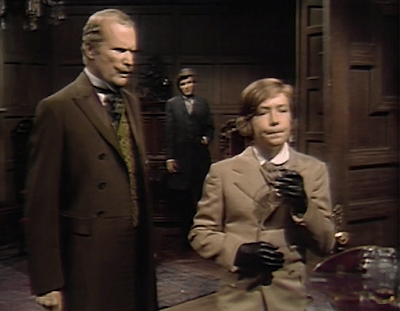
The spirit of evil sorcerer Count Petofi has taken possession of twelve year old Jamison Collins, much to everyone’s consternation. David Henesy spends most of the episode mimicking Thayer David’s Petofi, with hilarious results.
Jamison/ Petofi sipping a glass of “mineral water… for the digestion.” Screenshot by Dark Shadows Before I Die.
We see Jamison’s favorite uncle, Quentin the Satanist, trying to cast a spell to break Petofi’s possession of Jamison. As he always does when he is calling on the dark powers of the unseen realms, Quentin gets very fervent. We pan to Jamison/ Petofi, standing next to Quentin in a state of utter boredom, asking if Quentin will bring him a glass of mineral water once he’s “finished with all the mumbo-jumbo.”
Twice, Jamison/ Petofi pretends he is not possessed, but is his usual preteen self. He does this in order to trick people into letting him kiss them, which is how Petofi’s power spreads to them. This gives Mr Henesy the challenge of showing how Thayer David would play Petofi playing Jamison. That’s the sort of thing an actor needs a director’s help to pull off. Unfortunately, the woeful Henry Kaplan was at the helm today, so we discover that Petofi’s imitation of Jamison sounds exactly like the original, who is in turn uncannily like Jamison’s grandson David Collins and his great-great-grandfather Daniel Collins, who are also played by Mr Henesy.
Those whom Jamison/ Petofi kisses reveal their “true selves.” So maidservant Beth reveals that she was under the power of Jamison’s distant cousin, vampire Barnabas Collins. When Jamison’s father Edward passes this word along to Quentin, Quentin tells him is going to confront Barnabas. Edward has been hunting Barnabas, and by saying this Quentin implies that he knows where Barnabas is and that he has been helping to hide him. For some reason, Edward only smiles in response to this revelation.
Petofi wears a prosthesis in place of his right hand; Edward finds that Jamison’s right hand has also been replaced with a prosthesis. After this horrifying discovery, Jamison/ Petofi kisses Edward. Quentin returns shortly after, and finds that Edward does not recognize him or know the name of the house. Edward identifies himself as a newcomer to the area, and says that he would be glad of any work the family might hire him to do. Evidently his “true self” is a guy who needs a job. Since he has not inherited any assets or accumulated enough to live on, I don’t suppose we can disagree with whatever force it was that declared this to be Edward’s reality.
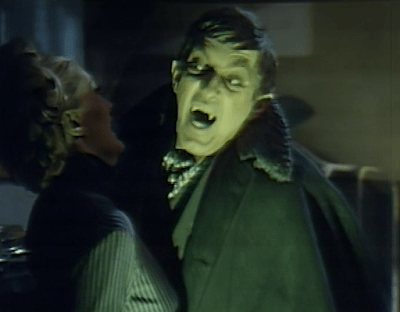
When wicked witch Angelique first turned Barnabas Collins into a vampire in the 1790s, he went to the waterfront and preyed on the women he found spending their nights there. When Barnabas traveled in time from the 1960s to the year 1897, he again made his way to the waterfront. Whether he bit the women or not, he choked them to death, earning the sobriquet “The Collinsport Strangler.”
Once he had become a vampire, Barnabas displayed so many traits he had come to have in common with Angelique that we suspect he is not only cursed by her, but possessed by her. More precisely, it often seems that when Angelique made Barnabas a vampire she created a copy of her own personality and put it in his mind, where it took control of him. We have further support for that interpretation in today’s opening reprise. We see Angelique on the same set where Barnabas has several times been the last person a young woman would encounter. This time, she encounters a young man. He flirts with her, as the women flirted with Barnabas. Before long, he is choking and within seconds of death because of her action. In this case, she has taken his handkerchief and is tightening it around the neck of a toy soldier that once belonged to Barnabas. She is threatening to kill him unless he tells her where he has hidden the legendary “Hand of Count Petofi.”
The man’s name is Aristide. He capitulates, telling her he buried the hand at the old cemetery, in a grave marked with a stone bearing the name of Townsend. She gives the handkerchief another tug, and he falls down, unconscious.
Later, we are in the great house on the estate of Collinwood. Angelique comes down the stairs, carrying the box in which the hand is kept. Stuffy Edward Collins sees her. Regular viewers have seen the box on a table in the upstairs hallway many times, from the first week of the show onward. It is rather odd that Edward doesn’t ask her why she is carrying it around. Even if we decide to forget that the prop is familiar and decide to treat it as representing something Edward hasn’t seen before, people don’t usually walk around carrying wooden boxes in front of themselves.
Still, Edward does have other matters on his mind. Angelique had been introduced to the family as Barnabas’ fiancée, at a time when all the Collinses knew about Barnabas was that he was their distant cousin. She disappeared when he was exposed as a vampire. Edward tells her that the family’s lawyer, Evan Hanley, told him that he knew her before she met Barnabas, and that he believes that her association with him was innocent. Edward also says that he cannot believe that this is true. Angelique tells Edward a story about Barnabas biting her and making him her slave; Edward is convinced instantly, and declines her offer to leave at once. He urges her to stay at Collinwood until she can make new plans.
Meanwhile, we have learned that Aristide is alive and not seriously injured. A man in a set of whiskers that represent the aesthetic sensibilities of the late Victorian era developed to their uttermost extremity finds Aristide crumpled on the ground, rouses him from unconsciousness, and responds to his story about Angelique almost killing him with dismay that she stopped short. He tells Aristide not to do anything more. His own credentials are in order, and he will present them at Collinwood as he sets about his second attempt to get the hand.
The man does go to Collinwood. He gives Edward a letter from their “mutual friend,” the Earl of Hampshire. It attests to the good character of its bearer, Victor Fenn Gibbon. Edward insists that Fenn Gibbon stay in the house, and he accepts.
Angelique emerges from the drawing room, still carrying the box. Edward continues to ignore it; Fenn Gibbon can’t take his eyes off it. Edward introduces her as Angelique Duvall. This is the first time we have heard the name “Duvall” in connection with her; when we met her in the part of the show set in the 1790s, her name was Angelique Bouchard, and when she turned up in 1968 she called herself Cassandra Blair. Fenn Gibbon asks if she is French. She says that she was born in the USA, but that her forebears were French people who lived on Martinique. Indeed, when she was known as Angelique Bouchard she lived on that island, and it was there she met Barnabas. Fenn Gibbon tells her that lovely as France’s colonial possessions may be, none is as “exquisite” as she. She is charmed, and excuses herself. She leaves the house, taking the box with her.
While Fenn Gibbon regales Edward with tales of derring-do from the battle of Khartoum, Angelique takes the box to the Old House. There, she meets the rakish Quentin Collins, whose desperately handsome face has been severely disfigured by a previous encounter with the hand. Angelique dismisses Quentin’s girlfriend, maidservant Beth, telling her that she cannot be present during what she must now do for Quentin. Beth leaves, Angelique shows Quentin the hand, and Quentin demands that Angelique set to work curing him. She says there will be a price for her services. If she cures him, he will have to marry her. He has nothing to lose, and she looks exactly like Lara Parker, so of course he agrees.
Angelique picks up the hand and gets to work casting a spell, but the hand quickly escapes her control. She turns to find that it is on Quentin and he is in agony. He pleads with her to help, she cries out that she can do nothing, and we see Fenn Gibbon peering in through the window.
Fenn Gibbon* is the fifth role Thayer David played on Dark Shadows. The first, second, and fourth were all closely associated with the Old House. They were crazed handyman Matthew Morgan, who holed up there after he killed local man Bill Malloy; much-put-upon indentured servant Ben Stokes, who lived and worked there; and broad ethnic stereotype Sandor Rákóczi, who with his even more offensively conceived wife Magda lives at the Old House in 1897. With this iconography behind David, regular viewers will know that when they see Fenn Gibbon in the window of the Old House, they are seeing a man who knows his way around the place.
David’s third role sheds even more light on Fenn Gibbon. In the parts of the show set in 1968 and subsequent years, he plays Professor Timothy Eliot Stokes, expert on the occult and descendant of Ben. Unlike most of the characters who made a splash on the show, Stokes has a functioning conscience. He does not always live within the law, but he always strives to do what is right. When we see that Fenn Gibbon knows about the hand and has orchestrated a criminal conspiracy to obtain it, we see that he is an evil version of Stokes. At once this makes him fascinating to regular viewers. Stokes himself is a reimagining of the show’s first academic specialist in the paranormal, Dr Peter Guthrie, who was killed by a witch in #186. He is a jovial and talkative eccentric, where Guthrie was a tight-lipped and understated Yankee. Fenn Gibbon seems to have inherited Stokes’ whimsical bent and exaggerated manner; we now have to wonder what Stokes would be like as a villain.
Even those who joined the show after it went to 1897 and who therefore do not know about Stokes will be intrigued when they see David as Fenn Gibbon. Sandor hasn’t appeared since #750, but he is still alive. This marks the first time Dark Shadows has cast the same actor as two living characters in the same time frame.** Sometimes an actor has doubled as a living character and as a ghost, or has appeared in two roles in parts of an episode set in different periods of history. But this is a new frontier for doubling on the show. Sandor is always a lot of fun, so we might hope that he will be back and that he and Fenn Gibbon just won’t have scenes together. But coming on the heels of his long absence, it does have an ominous ring.
In #758, Quentin backed Angelique against a wall and asked her why she preferred Barnabas to him. That was a very good question. The two of them are obviously attracted to each other, and have a lot of fun every time they are alone together. By contrast, the only emotions Barnabas has ever shown in response to Angelique are glumness and rage. Her maniacal insistence that Barnabas should love her drove Angelique to wreak immense havoc in the 1790s, and also motivated some story in 1968. But there is nothing to it beyond his misery and her self-absorption. When we see her turn her attentions to Quentin, longtime viewers will cheer at the hope that we are about to be freed from that dead end once and for all.
*He introduces himself today as “Fenn Gibbons,” which is how he is almost always addressed. But the closing credits leave the S off his name. The closing credits have been unreliable lately, identifying Edward as his grandson Roger and misspelling Aristide’s name. Still, “Fenn Gibbon” sounds better to me; “Fenn Gibbons” suggests a group of small apes found in a peat bog.
**Don Briscoe briefly played both werewolf Chris Jennings and Chris’ brother Tom, but that is only a partial exception- Tom was a vampire at that time.
A day of transformations. At dawn, the werewolf in the cell at the Collinsport jail turned into Quentin Collins. Edward Collins, Quentin’s stuffy brother, witnessed the transformation, and when we first see him he is staring at Quentin in bewilderment. Quentin is wearing the same blue suit he always wears, with the same distinctive hairstyle. But he has a glob of makeup on his face, and that’s enough to stymie Edward’s ability to recognize him.
This may reflect a hereditary disability of some kind. In #784, Quentin’s old friend and fellow Satanist, Evan Hanley, tried to steal the magical Hand of Count Petofi. The hand raised itself to Evan’s face and disfigured him, leaving his gray suit and highly identifiable hair and beard unchanged. But when Quentin saw Evan in #785, he was completely stumped as to who he might be.
Broad ethnic stereotype Magda Rákóczi enters. Edward accuses her of knowing who the man in the cell before them is. Magda does not share the Collinses’ peculiar inability to recognize people wearing facial appliances, so of course she does know. But she denies it. Edward does not believe her denials, and leaves in a huff.
Magda talks to Quentin, and he begins to speak. But he is not replying to her. Instead, he delivers lines that Count Petofi himself might have spoken when he was dwelling on the loss of his hand. He murmurs about “the forest of Ojden” and “the nine Gypsies” and suchlike. Magda realizes that Quentin has no idea who he is or what is going on.
Magda had placed the hand on Quentin’s heart the night before, as the moon was rising, hoping it would prevent the transformation. It didn’t do that, but by inflicting the same kind of facial disfigurement on Quentin that it had previously brought to Evan it does keep the werewolf story going beyond what might seem like a natural conclusion. When Magda leaves Quentin, she says that come nightfall she will consult with Quentin’s distant cousin, time-traveling vampire Barnabas Collins. “He will know what to do!” she declares. Barnabas has been the central character of the show for more than two years, and he has yet to have a non-disastrous idea. Ya gotta have hope, I guess.
At home in the great house of Collinwood, Edward tries to interest his sister Judith in the fact that he just saw a wolf turn into a human. She impatiently declares that she is not going to spend all day thinking about such a thing. Edward starts to remind Judith that she saw the wolf herself. He might have mentioned that she has seen it more than once, including in the very room where they are standing, but she says that it is “morbid” to go on paying attention to the topic once the creature has been caught and they can believe that they are safe.
Judith tells Edward that she had a bad dream. She won’t talk with him about that either. He needles her about her recent marriage to the Rev’d Mr Gregory Trask, which he calls “ridiculous.” She says that she does not regret her marriage, and that even if she did it would not be any more ridiculous than his own marriage. Since Edward’s wife was an undead fire witch who tried to incinerate their children to prolong her existence, all he can say to that is “Touché.”
Edward exits, and Judith dwells on her dream. It concerned Trask’s late wife Minerva. Minerva died in #773; Judith married Trask in #784. Judith knows that a young man named Tim Shaw poisoned Minerva, and that Trask gave Tim an alibi. She believes that Trask has forsworn justice for Minerva’s death for her sake. Tim knew that Judith, while under a magic spell, had shot his girlfriend Rachel Drummond to death, and he threatened to expose her if Trask handed him over to the police. What Judith did not know, and what is not mentioned today, is that Tim himself had acted under a spell. Trask and Evan connived to brainwash Tim so that when the Queen of Spades turned up in a card game he would poison Minerva. In her dream, Minerva told Judith that there was danger, then repeated the phrase “Queen of Spades” several times.
Judith turns around and looks at a table. It had been bare when last she saw it, and there was no one else in the room. But now a solitaire game is laid out there. She screams, and Edward comes. Judith turns up the Queen of Spades, and walks out the front door. Edward follows her to Minerva’s grave.
Judith tells Edward her dream, and he transforms into a psychoanalyst. “Your dream is nothing more than a manifestation of your own guilt.” Judith asks Edward what he imagines her to feel guilty about, and he says that she married Trask so shortly after Minerva’s death. She dismisses this, and soon goes into a trance. She wavers back and forth from the waist for a moment, then straightens up with a jolt. When Edward calls to her by her first name, she replies “I will thank you to call me Mrs Trask!” Edward doesn’t know what to make of this demand, but the audience knows that Minerva has taken possession of Judith.
Back at Collinwood, Edward meets Magda. She tells him that she is there to see maidservant Beth. Edward says that he hasn’t seen her all day. That puts him up on the audience; we haven’t seen her since #771. When they were setting up for the trip to this period, Beth was presented as a major character, and her ghost haunted the Collinwood of 1969 along with Quentin’s. When Barnabas and we first arrived in the year 1897 in #701, Beth figured very largely in the story for several weeks. But Terrayne Crawford’s limitations as an actress required Beth to be written as someone who says just what she means, no more and no less. Since the rest of the cast is able to rise to the task of portraying complex motivations and multilayered communication, and since Dark Shadows finally has a writing staff that can provide those things consistently, Miss Crawford has faded further and further into the background.
Edward goes to the drawing room and telephones Evan. Magda eavesdrops. She knows of Evan’s disfigurement, Edward does not. Edward tells Evan he must come over at once, that there is an emergency he must address in his capacity as Collins family attorney. Evan does not want anyone to see his face, and so he tries to beg off. Edward threatens to fire him if he does not show up. Evan has been making vain efforts to restore his appearance for days; he looks at himself in the mirror, and returning viewers might draw the conclusion that his goose is cooked.
That Evan’s face is still disfigured after we have seen Quentin’s disfigurement raises the possibility that the show is heading towards an all-disfigured cast. Evan is played by the conspicuously handsome Humbert Allen Astredo, and as Quentin David Selby’s good looks have become one of the show’s very biggest draws. If they are both going to be uglified for the duration, then there is nothing to stop anyone from having some plastic glued onto their face.
Judith enters. She does not recognize Magda and announces that she is Minerva. She closes herself in the drawing room.
Evan arrives, looking like his old self. Magda is astonished. When they have a moment alone together, he responds to her questions by saying that he will never tell her what happened to undo the hand’s work. That will hook returning viewers more effectively than any cliffhanger is likely to do- Evan’s case had seemed absolutely hopeless.
When Edward tells Evan what Judith has been doing, Evan starts playing psychiatrist, picking up where Edward had left off. “Well now, tell me exactly how she has been behaving. In what way is this delusion manifesting itself?” Edward sends Evan in to see for himself. Minerva/ Judith reacts to the sight of him with horror. She says that he was the one who made Tim Shaw poison her. Minerva did not know this in life, but it has long since been established on Dark Shadows that the dead pick up a lot of information in the afterlife. The murders have been coming thick and fast in 1897, and if all the victims talk to each other they would have a pretty easy time piecing together what has been happening behind closed doors. We end with Minerva/ Judith holding a letter opener over her head, walking towards Evan with evident intent of stabbing him.
Vampire Barnabas Collins is about to leave his house with his thrall, maidservant Beth Chavez, to look for Dirk Wilkins, a dimwitted servant whom he inadvertently turned into a vampire and let go. They are stopped when Barnabas’ distant cousin, inveterate prankster Carl Collins, comes in and insists on telling him about his recent trip to “Atlantic City, New Jersey, the Queen of the Boardwalk cities!”
Carl offers Barnabas some saltwater taffy, only to find that the tin is empty. He frets that “she” must have eaten it all on the trip back- “You know how women eat when they are nervous.” This leads to Carl’s second order of business, introducing Barnabas to Miss Pansy Faye. Carl met Pansy on the train, and he intends to marry her.
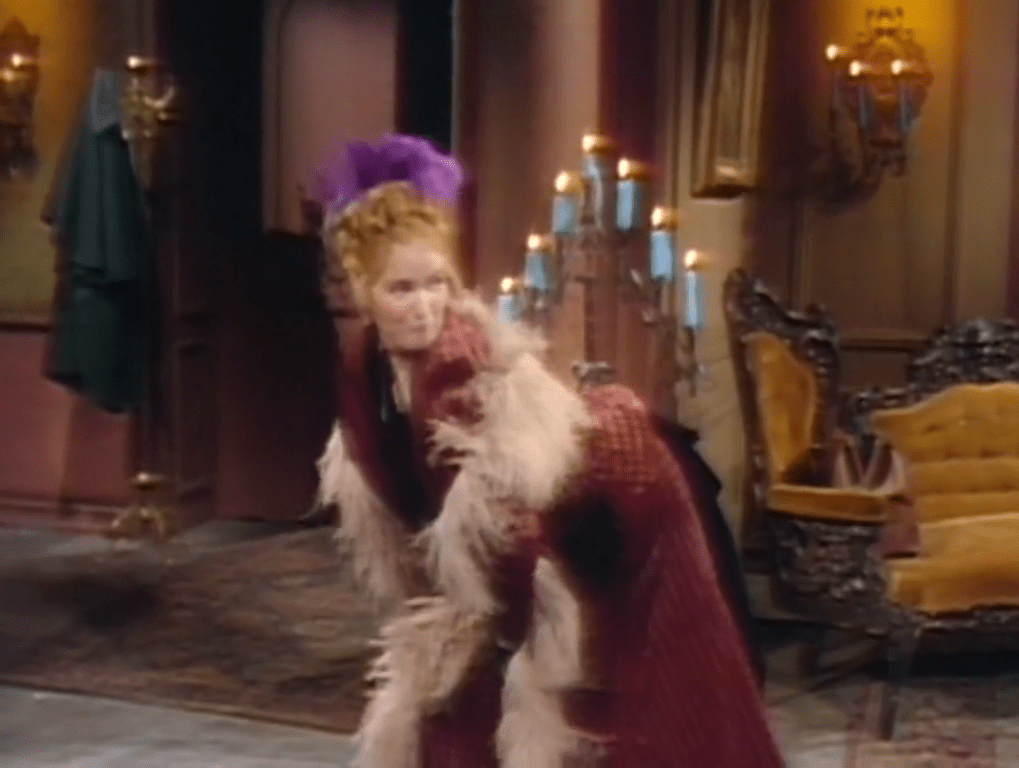
Carl opens the door, then stands before Barnabas and Beth and announces in his most booming voice “Presenting! Direct from her triumphs before Her Imperial Majesty, Queen Victoria of England, that world-famous mentalist and most beguiling songstress, Miss Pansy Faye!” Pansy enters, singing and dancing. In a vaguely Cockney accent, she intones:
I’m gonna dance for you! Gonna dance your cares away. I’ll do the Hoochie Koo, and the Ta Ra Boom De Ay! I’ll sing a happy song, as we dance the whole night long! When the music begins, I’ll give you some spins, I’ll even invent a step or two! So, on with the show! You’ll love it, I know! Oh, I’m going to dance for you!
Pansy’s dance is not particularly elaborate; it is performed almost entirely below the waist, and ends with her bending over and thrusting her rear end upward. That is followed by a cut to Barnabas wearing a look of stupefaction that all the black magic and demonic intrusions he has witnessed over the centuries have not elicited. He turns to Beth, who is visibly struggling to keep a straight face.
Against the backing track of Dark Shadows super-solemn music, this scene is hilarious. Longtime viewers will savor it even more than others. Carl is played by John Karlen, who in the parts of Dark Shadows set in the 1960s plays the luckless Willie Loomis, Barnabas’ first blood thrall. When Barnabas first enslaved Willie in the spring and summer of 1967, the show was at its bleakest. Barnabas was able to fool his distant relatives in the great house into regarding him as a living being and letting him occupy the Old House, but that was only because they had been isolated and embattled for so many months before. When we saw Barnabas and Willie on this set in those days, Barnabas was as grim as death itself, beating Willie with his heavy cane whenever he dared do more than whimper. That Karlen is now here as the man who is introducing a character as exuberantly and preposterously alive as Pansy and that Barnabas’ current thrall is suppressing a laugh takes the despair of that period and packs it with joy.
The despair reasserts itself at the close of the episode. Pansy will go out into the woods, Dirk will take her as his first victim, and Barnabas will come home to discover her body propped up in a chair in the parlor. But the comedy in between is so strong that we can be confident that this will not be the last word. Carl tries to persuade his sister, spinster Judith, to accept his marriage to Pansy. He tells her that he is a new man thanks to Pansy’s influence; he has actually managed to go 48 hours without playing a practical joke. Judith is impressed by this new record, but still will not believe that Pansy is fit to become a Collins. She controls all the family’s wealth, and threatens to cut Carl off without a penny if he goes through with the marriage. He reacts with a series of facial expressions that the Three Stooges would have admired.
While Barnabas and Carl are out, Pansy stays in the Old House with Beth. Beth offers her a cup of coffee; Pansy says she would prefer sherry. Beth goes to look for sherry, and Pansy is caught off-guard that Beth doesn’t live there. When Beth says that she is based at the big house on the property, Pansy asks how big it is. Beth says that it is very big indeed; Pansy says that Carl had told her it was like a palace, and Beth confirms that it is indeed on that scale. Pansy is surprised that Carl was telling her the truth. She takes the drink at a single gulp. With Carl, Pansy was acting a part, and she was a terrible actress indeed. Alone with Beth, she drops the act. The Cockney accent is still not too well-developed, but Kay Frye is much more convincing as a hard-boiled working class woman than Pansy is in any of her roles.
Carl persuades Judith to sit still in Barnabas’ parlor while Pansy does her mentalist act, trying to locate Dirk. Pansy actually goes into a trance and announces that Dirk is dead and his murderer is in the room. When she comes to, Pansy is as surprised as anyone at what happened. Judith is demanding an apology, and Pansy is shocked when Barnabas tells her that she accused someone in the room of murder. A moment later, she is alone, wondering what came over her and lamenting that she “mucked that one up.”
The Old House is a dangerous place to be a fake practitioner of supernatural arts. In #400, set in the 1790s, fanatical but inept witchfinder the Rev’d Mr Trask performed an exorcism of the Old House, and was visibly delighted when that exorcism seemed to work. That time it was the intervention of wicked witch Angelique that gave Trask his apparent success, but now it seems that Pansy is simply getting it right for the first time.
That Dirk leaves Pansy in a chair in Barnabas’ front parlor is also something that will bring back memories for longtime viewers. In the 1790s segment, another brassy dame on the make brightened up the show for a little while before meeting a grisly demise on this spot. She was Suki Forbes, estranged wife of untrustworthy naval officer Nathan Forbes. Barnabas strangled Suki in #423, after she had discovered his secret. Suki took until #424 to die, but did not manage to disclose what she knew about Barnabas.
An even closer parallel is to #530. In that one, Frankenstein’s monster Adam hates Barnabas for making him what he is. Adam attacks a man called Joe Haskell and thinks he has killed him. At the end of the episode, Barnabas finds that Adam has planted Joe’s body in the front parlor. Any doubt that Adam was trying to frame Barnabas for Joe’s murder would be removed by consulting the novel Frankenstein, in which the Creature frames another character for the murder of his creator’s brother. Dirk knows that Barnabas made him into a vampire, and so has the same motivation to pin a murder charge on Barnabas that Adam had.
Adam was just a few months old when he tried to frame Barnabas for murder, and Dirk is a simpleton. Neither of them had the skills to get the police interested in Barnabas, no matter how many dead bodies they add to the decor of his house. On the other hand, Barnabas himself once very nearly managed to make such a plan work. In #440 and #441, part of the 1790s segment, Barnabas left the corpse of his victim Maude Browning in a bed belonging to Trask. It was only Nathan Forbes’ timely intervention that kept Trask from the gallows that time.
In the spring of 1969, the twin crises created by the malign ghost of Quentin Collins and the werewolf curse upon drifter Chris Jennings had combined to kill a number of people, bring others to the point of death, and make life on the estate of Collinwood utterly intolerable. Recovering vampire Barnabas Collins and his friends found some I Ching wands in Quentin’s old room and tried to use them to communicate with the ghost. Instead, they caused Barnabas to come unstuck in time. In #701, Barnabas found himself in the year 1897, his own curse of vampirism once again in full force.
Today, Barnabas bites Quentin’s girlfriend, maidservant Beth Chavez, and makes her tell him everything she knows about the werewolf curse. He was in a position to know all of this before he bit her; much of it he could have figured out if he had been paying attention to the information available to him in the late 1960s. But the show has been gaining lots of new viewers lately, and they probably appreciate the recap.
Quentin was married to a woman named Jenny, who unknown to him was the sister of ethnic stereotype Magda Rákóczi. Quentin left Jenny in 1895. Neither Quentin nor Magda knew at that time that Jenny was pregnant. Quentin’s siblings Edward and Judith put the story out that Jenny had gone away, and locked her up in a room hidden in the house. They enlisted Beth, her former maid, to be Jenny’s keeper. By the time she gave birth to boy-girl twins, Jenny had gone entirely insane.
In #720, Jenny escaped and stabbed Quentin. She escaped again in #748, and Quentin strangled her. When Magda found out that Quentin had killed Jenny, she cursed him and his male descendants to be werewolves. In #763, Beth told Magda about the twins; Magda’s reaction made it clear to Beth that she was powerless to lift the curse. Regular viewers already know that. The audience first heard Magda’s name months before she appeared on the show, when she spoke at a séance in #642 and expressed deep regret about “my currrrrse,” which we knew to be connected to both Quentin and the werewolf. In #684 and #685, Barnabas found a silver pentagram that Quentin and Beth bought in 1897 on a chain around the neck of a dead baby, and identified it as an amulet to ward off werewolves. Barnabas learned yesterday that Beth had bought the pentagram, and she confirms today that it is for Quentin’s son to wear. She also bought a similar pendant for herself, and is wearing it.
There is a full moon tonight, and most of the episode is taken up with the mechanics of people getting ready to go into the woods to hunt the werewolf, coming back from the woods where they have been hunting the werewolf, and telephoning to ask others to join in hunting the werewolf.
Magda has a pistol and loads it with silver bullets. Some wonder where Magda came up with silver bullets, but in a comment on Danny Horn’s post about the episode at Dark Shadows Every Day someone posting as “cslh324” reminds us that in #757 Magda persuaded undead blonde fire witch Laura to give her the money to buy silver bullets with which to shoot Barnabas. One of Magda’s purposes in putting this plan forward was to get Laura to leave her alone in the room so that she could steal a magical doodad from her, but it turns out Magda really did buy the silver bullets.
The werewolf gets into the great house of Collinwood and attacks Judith. Beth shows up in the nick of time and shows the werewolf her pentagram. He flees. Judith asks why the werewolf would run away from her, and Beth refuses to explain. At first she denies that it happened, then she asserts that the werewolf is probably as afraid of them as they are of him.
The confrontation between Judith and the werewolf includes a spectacular stunt. The werewolf jumps over the railing on the walkway above the foyer and holds a stationary two-point landing on the floor twelve feet below. Alex Stevens deserves high praise for that.
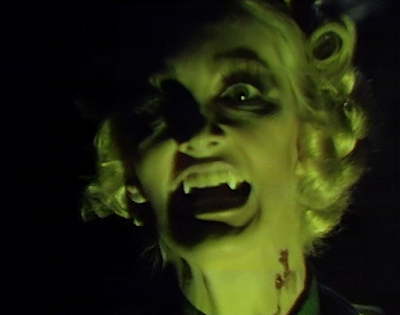
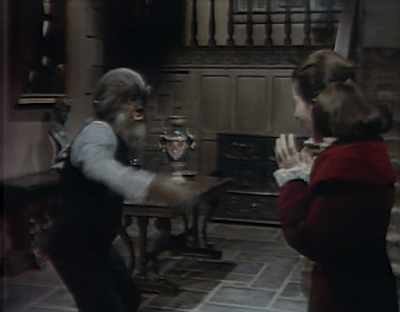
When we hear the sound effects associated with the werewolf or see the consequences of his attacks or catch a glimpse of him as a blur in the middle of a cloud of shattering glass, we can be afraid of him. Unfortunately, the show often gives us a long look at him, and he is not scary at all. They didn’t have the schedule or the makeup budget to cover his whole body in fur, so he wears Quentin’s suit. Seeing him standing there in that little outfit you don’t want Magda to shoot him with her silver bullets. At most, you might swat him with a rolled-up newspaper and tell him he is a bad doggie.
You have to stop killing people, or you won’t get any more bickies! Screenshot by Dark Shadows Before I Die.
Beth does not want Judith to suspect that Quentin is the werewolf, but it really doesn’t make any sense that she won’t tell her about the apotropaic power of the silver pentagram. You’d think she would want everyone on the estate and in the neighboring village of Collinsport to wear such pendants for the duration of Quentin’s curse. Surely she could come up with some explanation as to how she knew about the silver pentagram that wouldn’t invite questions she couldn’t answer.
The Kindest, Warmest, Bravest, Most Wonderful Human Being I’ve Ever Known in My Life
The show is doing an homage to The Manchurian Candidate this week, with schoolteacher Tim Shaw brainwashed into becoming an assassin when he sees the Queen of Spades. We open with the plan going awry. Lawyer/ warlock Evan Hanley did the brainwashing with the intention that Tim would kill someone else, but when he shows Tim the card, Tim tries to kill him. As Evan, Humbert Allen Astredo shows us a man suddenly becoming frightened and just as suddenly making up his mind to be brave. In other episodes, Astredo has already shown us Evan responding to fear in other ways. He really was a remarkably good actor, and it is a pleasure to see how much variety he can find in his parts.
Later, we see Judith Collins, the mistress of Collinwood, playing solitaire. Tim comes to the house. We know that each episode ends with a cliffhanger, and so this leads us to expect that we will end today with Tim’s hands around Judith’s throat. But that is a misdirection. In fact, Judith turns the Queen of Spades away from Tim at the last second, and he leaves the room without attacking her.
Slight Enough to Vanish, But Too Dense to Live
Tim’s brainwashing is a B-story on the show right now, and it would throw off the rhythm of the week to end two consecutive episodes with cliffhangers from it. The A-story is about the rakish Quentin Collins, who has been cursed to become a werewolf. There is a full moon tonight, and the sheriff’s department is roaming the grounds of the great estate of Collinwood with guns looking for the wolf who walks like a man. Joining in the search is Quentin’s distant cousin, Barnabas Collins, who is, unknown to all but a very few people, a vampire. Barnabas has traveled back in time to the year 1897, and among the things he is hoping to do is to learn how the werewolf curse that has afflicted his friend Chris Jennings in the 1960s first began.
Barnabas learned in 1969 that in 1897 Quentin and a woman named Beth Chavez paid a man named Ezra Braithwaite to make a silver pendant in the form of a pentagram and that a baby boy was buried in that year wearing that pendant. Tonight, Ezra telephones Barnabas at the great house of Collinwood and tells him that Beth just came in, ordered such a pendant, and told him to send the bill to Quentin.
Barnabas knows that the pentagram was an amulet meant to ward off werewolves. Beth is Quentin’s girlfriend, a fact that is no secret to anyone, not even Barnabas. So you might assume Barnabas would have figured out that Quentin is the werewolf. But apparently he has not. He materializes inside Beth’s room and demands she tells him who the werewolf is. When she refuses, he bites her. That bite is the cliffhanger.
Barnabas occasionally makes remarks about how he wants to keep the original timeline intact so that the people he knew in the 1960s will still be there when he gets back. But he’s been feasting on the people he meets in 1897 with abandon. Beth is the fourth resident of Collinwood he has bitten, and he has killed at least two young women in the village. Moreover, his approach to every problem he encounters or imagines is to confront the most powerful person associated with it and antagonize them immediately. It’s hard to see how he expects anything to remain unchanged after he inserts this rampage into the history of the late Victorian age.
But You Wouldn’t Know Anything About That
Judith tells Barnabas today that Beth came to Collinwood as a lady’s maid two years ago. Beth claims to have a cousin in town to Judith today while lying to cover up her trip to Braithwaite’s, and when Barnabas asks Judith if Beth is from Collinsport she mentions this cousin as her reason for believing that she is. Judith clearly knows very little about Beth, and cares less.
The lady who brought Beth as her maid was Quentin’s then-wife, Jenny, who was secretly a member of the Romani people. In #701 it was hinted that Beth was concealing a Romani origin of her own. Casting the tall, blonde, blue-eyed, pale Terrayne Crawford as Beth would seem to indicate that they were not committed to following up this hint, but in today’s scenes with Judith they do go out of their way to emphasize that Beth’s background is a mystery.
The Woman Who Never Left
Beth has been helping the family hide the fact that Jenny went mad and bore twins after Quentin left her. Quentin murdered Jenny in #748, eliminating the need for a servant to cover up her existence, and the twins, about whom Quentin does not know, are firmly ensconced in the care of a woman in the village named Mrs Fillmore. In #750, Judith fired Beth, but it didn’t take. Beth never left the house, and after a while the family started giving her orders again. Today Beth tells Judith that Mrs Fillmore reports that the boy twin is feverish, and asks to be kept on staff until he gets well. Judith agrees.
Judith tells Beth that she has decided to tell Quentin about the twins. She hopes that is what will prompt her brother to cast aside his selfish ways and become a mature adult. Beth is horrified and begs her not to do so. Judith, puzzled, says that Beth has always urged her to tell Quentin. She asks why she has changed her mind, and she makes up something obviously false about Quentin being unable to cope with the news that his son has a fever.
Yesterday, Beth learned that Quentin’s curse is hereditary. Returning viewers might wonder if she is afraid that Quentin will also learn that, and that if he does he might kill his children to prevent them passing it on. He does keep saying that he would rather be dead than have the curse, so he might talk himself into regarding such a murder as an act of mercy.
Featuring Edward Marshall as Ezra Braithwaite
Edward Marshall plays Ezra, a part played in #684 and #685 as an 87 year old man living in the year 1969 by Abe Vigoda (who was 48 at the time, but he and the makeup department both knew their business well enough that he was entirely convincing.) Mr Marshall appeared in #669 as unsightly ex-convict Harry Johnson, a part originally created by the not-always-stellar Craig Slocum. Mr Marshall gave Harry the same attitude and many of the same mannerisms Slocum had given him, but was so much more fun to watch that I wanted to see a lot more of him.
Parts of Harry’s costume and most of his surly demeanor are recycled in the 1897 segment in the character of dimwitted groundskeeper Dirk Wilkins, played by the repulsive Roger Davis. Whenever Dirk is on screen, I imagine Mr Marshall in Mr Davis’ place. I recommend that bit of mental recasting, it goes a long way towards making Dirk bearable. Unfortunately this is Mr Marshall’s final appearance on Dark Shadows.
Schoolteacher Tim Shaw was introduced in #731. The name “Shaw” is common enough that few viewers are likely to have found any significance in it at the time. It is true that Dark Shadows is at this point a costume drama set in 1897 and that George Bernard Shaw was coming into his own as a playwright in that year. The show was written, acted, and directed largely by theater people, and is so self-consciously stagy that it is possible there might be a reference of some kind to Bernard Shaw in a character’s name. But there doesn’t seem to be anything especially Shavian about Tim.
Today we learn the reason Tim was called Shaw. Satanist Evan Hanley gives Tim a potion that robs him of his will. He holds up a deck of playing cards and tells him that when he sees the Queen of Spades he will know it is time for him to murder someone. In Richard Condon’s 1959 novel The Manchurian Candidate, soldier Raymond Shaw was brainwashed into becoming an assassin when he saw the Queen of Hearts; in the John Frankenheimer’s 1962 film based on the novel, Raymond’s trigger was the Queen of Diamonds.
Frankenheimer’s film is one of the supreme examples of a movie that shouldn’t have worked, but did. No part of the plot stands up to rational analysis for one second, but when the tale is told through stark black and white imagery that puts us deep in the world of a nightmare it is spellbinding. Unfortunately, the irrationality of the plan the villains carry out and of the other characters’ responses to their evil deeds in The Manchurian Candidate are on full display in this homage, without the paranoid verve that makes the movie compelling. All by itself the potion puts Tim so deep in Evan’s power that he gladly goes to witch Magda Rákóczi to buy poison and insists she sell it to him even after she has pointed out that it is useful for nothing but murder. It doesn’t seem there is anything left for the card to add to the control Evan has over him.
It gets worse. Evan is acting as the agent of the evil Rev’d Gregory Trask. Trask is unhappily married to a woman named Minerva, and is blackmailing Evan into sending an assassin to kill her. When Evan shows Tim the card today, he confirms that the intended victim is a woman. But why not have him kill Trask? As my wife, Mrs Acilius, points out, if Trask dies, Evan will be free of the threat of blackmail. So if he is prepared to be a party to murder, you’d think he would forget Minerva and commit the crime he has a motive to commit.
The highlight of today’s episode doesn’t have anything to do with Evan, Tim, Minerva, or Trask. It is a scene between Magda and sometime maidservant Beth.
Beth has come to the Old House on the great estate of Collinwood to plead with Magda to lift a curse she has placed on Beth’s boyfriend, rakish Quentin Collins. Quentin murdered his estranged wife, Magda’s sister Jenny, and as revenge Magda turned him into a werewolf. Magda is unimpressed with anything Beth says until she tells her that in spite of everything, she will marry Quentin and go away with him. Magda marvels at this and asks Beth if she will really go through with it knowing that any son Quentin might have will suffer from the same curse. Shocked, Beth asks Magda if she means what she has said, and she repeats that Quentin’s son will also be a werewolf. Beth replies that in that case, Magda has laid a curse upon her own kin.
Magda dismisses this, saying that Jenny had no children by Quentin. Beth says she is wrong, that Jenny bore twins, a boy and a girl. Beth lays the story out systematically, and it dawns on Magda that she is telling the truth. Magda calls out to Jenny’s spirit and begs forgiveness, saying she did not know. Beth says that it is time to lift the curse, and Magda tells her to get a pentagram and make sure the boy wears it all the days of his life. Beth has her own moment of horrified realization. “And… you can’t end it? Can you?”
Beth realizes Magda does not know how to undo the curse.
Terrayne Crawford had some weaknesses as an actress that severely undercut her in her first weeks as Beth. But this scene is right in her wheelhouse. She is flawless as she portrays Beth’s progression from weepy begging to methodical explanation to utter shock. And Grayson Hall of course brings great power and vivid color to Magda.
We’ve been waiting for this scene since #642, months before Magda first appeared in #701, let alone before she placed the curse on Quentin in #750. In that episode, back in December 1968, the show took place in a contemporary setting. The characters had noticed some strange goings-on, and held a séance as part of their inquiry. The spirit they reached was Magda, who spoke regretfully of “my currrrse!” It’s taken more than 24 weeks, but Magda has finally learned what she already knew when we first heard from her.
Libertine Quentin Collins presents himself as maidservant Beth Chavez’ great love. He wants her to run away with him and make a new life together, and to do so right now, before the curse he brought upon himself by murdering his wife in front of Beth kicks in. She is inclined to go along with him, but he collapses in agony before they can leave her room.
Teacher Dorcas Trilling presents herself as the most faithful devotee of the Rev’d Gregory Trask, keeper of a brutal dungeon for children disguised as a boarding school called Worthington Hall. Dorcas asks Trask why he keeps her disobedient colleague Rachel Drummond on the faculty. Trask tells Dorcas that he thinks of Rachel as a thorn in his flesh. She stirs up his basest impulses. Regular viewers know how true this is- in their scenes together, Trask has not only extorted Rachel to come to work for him, but has repeatedly made it clear that he wants to force her into a sexual relationship as well. But the base impulse he admits to in his conversation with Dorcas is anger at Rachel’s wickedness. He says that he keeps her around as a way of building his resistance to the sin of wrath. Dorcas takes the bait, and declares that it makes her admire Trask all the more.
Rachel presents herself as the protector of twelve year old Jamison Collins, heir presumptive to spinster Judith Collins as the owner of the great estate of Collinwood and the Collins family’s business enterprises. She slips out of Worthington Hall, which is currently operating from a house on the estate, in order to tell Judith that Trask has falsely accused Jamison of academic misconduct and is refusing to feed him until he confesses. As it happens, Trask confirmed to Dorcas that this is true, and said that by forcing Jamison to confess to something he did not do he will teach him humility. Dorcas is so far gone that this admission of loathsome injustice adds further to her admiration for Trask.
Beth presents herself as Quentin’s representative in a telephone call to the doctor. When she finds that the doctor is out, she urges his assistant to call back as soon as possible. She is about to go back to check on Quentin when Rachel comes to the great house looking for Judith or for Jamison’s father Edward. Beth tells her that they are out, and that there is an extreme emergency in progress. Rachel accompanies her to the room. They find that it is in a shambles and Quentin is gone. They return to the foyer, where the telephone rings. Beth is disappointed it is not the doctor. It is Trask, and he asks to speak to Rachel. Beth hands her the telephone.
Trask presents himself to Rachel as her “most concerned friend.” He also reminds her of his threat to frame her on charges of theft and murder, and demands she return to the school at once. As she has done before, she crumbles and rushes off. Beth watches her go with puzzlement, as others have done on those previous occasions.
Dorcas presents herself as a spy and enforcer for Trask. After Trask tells Rachel he has docked her a week’s pay for trying to feed Jamison against his orders, Rachel catches Dorcas listening at the door. Rachel leaves the room after their confrontation. We see Dorcas alone for a moment, then hear a window breaking and see her horrified reaction. We hear growling and snarling. Rachel comes in, Trask follows, and they see Dorcas’ mangled corpse. Returning viewers know that Quentin’s curse is that he has become a werewolf. Dorcas is his first victim.
Dorcas is played by Gail Strickland, who went on to have a huge career on TV in the 1970s and 1980s. Miss Strickland is a fine actress, and it is a terrible shame she wasn’t on the show more. Terrayne Crawford, who plays Beth, is good today, but she could really only project one emotion at a time. That is a grave weakness in this part of Dark Shadows, when most characters have complex motivations in almost every scene. In Miss Strickland’s hands, several scenes that were flat and tedious due to Miss Crawford’s literalist acting style would have been exciting and nuanced. Beth was originally seen as a ghost who did not speak but made an impression by her stark yet lovely features. Miss Strickland’s looks could have that effect as well as did Miss Crawford’s. Indeed, I suspect she must have attracted the producers’ attention when they were deciding between the two of them for the role of Beth.
As of this writing, every member of today’s cast is still alive. When you’re watching a show and posting about it on the 56th anniversary of its original airdate, that’s an unusual thing to see. I believe it is the first such episode we have come upon.
The name “Magda” was first mentioned on Dark Shadows in #642, broadcast and set in December 1968. At that time, the residents of the great house of Collinwood had noticed unaccountable goings-on, and as they often do they held a séance to appeal to the spirits of the dead for guidance. The spirit they reached in that one identified herself as Magda. She repeated two things- “My curse!” and “He must not return!” Magda said enough to suggest that she had cursed someone and regretted doing so, and that she knew that the Collinses were threatened by the return of someone from her own period, but that was all. Since the Collinses of 1968 had never heard of anyone associated with their house named Magda and could find no record of such a person, those suggestions remained vague and useless to them.
They meant a good deal more to regular viewers. We already knew that the malign ghost of Quentin Collins had appeared in a room in the long-deserted west wing of the great house, that children David Collins and Amy Jennings were falling under the ghost’s influence, and that Quentin lived at Collinwood near the end of the nineteenth century. We therefore assume that Quentin is the one who “must not return!,” and that Magda, whoever she was, must have known Quentin and therefore also have lived sometime in the 1890s.
Among the participants in the séance was Amy’s older brother, mysterious drifter Chris Jennings. Chris broke the séance off before Magda could go into enough detail to help the others. The show had long since established that the person who ends a séance prematurely is the one who harbors a dreadful secret that the voice from beyond might uncover. Even the characters have caught on to this pattern; they treat Chris with suspicion. They do not know what we do, that Chris is a werewolf. So he is indeed under a curse, and we can take it that his curse originated when Magda placed it on one of his ancestors.
Over the next few months, Quentin’s power steadily grew, and at the same time Chris’ periods in his animal form grew longer and more frequent. These two developments moved in such close tandem that we had to suspect that there was some causal relationship between them. This suspicion was reinforced when, in #683, another ghost associated with Quentin, that of a tall, thin, blonde woman named Beth, led Chris to what proved to be the unmarked grave of an infant. That infant was wearing an amulet meant to ward off werewolves. The records of the silversmith who made the amulet showed that it was commissioned and paid for in 1897 by Quentin Collins and Beth Chavez. Thus we learned that a werewolf was active in the area of Collinwood when Beth and Quentin were alive, and that they cared about a baby who died at that time. The logical inference would be that the curse under which Chris labors originated at that time, that Beth and Quentin had something to do with it, and that the baby was related to someone who became one of Chris’ ancestors.
Now, the show has become a costume drama set in 1897. Quentin and Beth are alive. Beth is a maidservant who first came to Collinwood in the train of Quentin’s estranged wife, Jenny. Quentin left Jenny and was banished from the house the previous year; word was put about that Jenny responded to the desertion by going away and leaving no forwarding address. When Quentin returned to Collinwood in #701, he was surprised to find Beth still on staff, and he set to work trying to seduce her.
In #720, Quentin discovered that Jenny had not in fact gone so far away as he and everyone else had been led to believe. She turned up and stabbed him. He then learned that Jenny had become violently insane when he left her and that his sister Judith and brother Edward had responded to her illness by locking her up in a room hidden inside the great house. They kept Beth in their employ because she was the one entrusted to care for Jenny.
Now, Beth has given in to Quentin’s charms. The other night Jenny was hiding in Beth’s room while Beth and Quentin shared a tender moment, and she reacted by coming at them with a knife. Quentin disarmed Jenny, restrained her, and then put his hands around her throat. While Beth pleaded with him to stop, he choked Jenny to death. He keeps protesting that, because Jenny at one point had a knife, this was an act of self defense, but the audience and Beth both saw what happened, and she won’t agree with him any more than we will.
Edward and Judith have decided to shield Quentin from the legal consequences of his actions, and in the village of Collinsport the will of the Collinses supersedes the laws of the state of Maine. But Quentin finds no comfort in his immunity from criminal prosecution. Just hours before he murdered Jenny, Quentin discovered that he knew nothing about her origins. He thought she was some kind of Anglo, but she was passing. She was actually a Romani woman. Her sister is one of the neighbors, broad ethnic stereotype Magda Rákóczi.
In Wednesday’s episode, Edward convinced Magda the police and courts would do nothing to punish Quentin, and so Magda threatened to place a curse on him to avenge Jenny’s death. Edward, a rational-minded modern man, dismissed Magda’s threat as “words.” But Beth and Quentin know things about the universe they occupy that Edward does not know. When Beth heard Magda’s threat, she looked wide-eyed at Quentin, walked backwards away from him, and ran off. Quentin, who is obsessed with the occult, was immediately terrified, and has been dissolving into a puddle ever since.
Yesterday, Quentin fell into a trap Magda set for him and brought a curse upon himself. Today, Magda stands with her husband Sandor by Jenny’s grave, watches the full Moon rise, and recites an incantation specifying that Quentin’s male descendants will suffer from the same curse he does. So far as Magda knows, Quentin does not yet have any descendants, male or female, and so that proviso is just an abstraction for her.
We know more than Magda does. Not only have returning viewers heard her spirit say that she regrets the curse and been led to the conclusion that it fell on Chris Jennings, but even those who are watching the show for the first time today know that Quentin and Jenny are the parents of twin infants whom Judith is paying a Mrs Fillmore to raise in her home in the village of Collinsport. Mrs Fillmore’s name was first mentioned in #707, and it comes up today when Judith is firing Beth.
Judith explains to Beth that, since Jenny is no longer around, she no longer has any work to do at Collinwood. She indicates her dissatisfaction with Beth, and says that it is only through Edward’s influence that she included a severance payment with her letter of dismissal. Beth mentions her task of taking money to Mrs Fillmore to pay her for taking care of Jenny and Quentin’s children; Judith does not see a need to retain an employee simply to carry an envelope full of cash to the village every now and then.
Beth objects that Judith is terminating her employment because she has become involved with Quentin; Judith takes that as an opportunity to castigate her for the impropriety of that relationship. Joan Bennett plays Judith’s reaction to Beth quite effectively; in a comment on Danny Horn’s post about the episode at Dark Shadows Every Day, “Rev Velveteen” writes:
I wanted to mention a Judith Collins, er, Joan Bennett acting moment I found particularly entertaining here. When she’s giving Beth the boot and the servant attempts to “innocently” inquire as to why she’s being let go, Judith turns around and gives her SUCH a look! Huge eyes, a stifled gasp, then bright pursed lips…Her expression goes from incredulous (Are you freaking KIDDING me?) to amused (Just how stupid does she think we are?) to triumphantly satisfied (Fine, we shall just both play out this little charade and I’ll soon be rid of you.) Her chin goes up as she turns away snarkily-“Let’s just say that now Jenny’s gone, your services are no longer needed,” which everyone on and off screen knows is a total lie. It’s such a sweet piece of work by Ms. Bennett, I need to keep an eye out to see if she repeats that expression because it just sums up the whole character of any Collins she plays when as the perpetual straight man, she’s faced with yet another absurd situation. And is also just stunning in that gorgeous green dress.
Comment left by “Rev Velveteen” at 12:43 am Pacific time, 25 June 2020, on Danny Horn, “Episode 750: Gypsy Ascendant,” 18 October 2015, Dark Shadows Every Day
Yesterday, Judith gave the penniless Quentin $10,000 on condition that he leave Collinwood forever and induce Sandor and Magda to do the same. Quentin had hoped to use the money to bribe them into forgoing Jenny’s vengeance, but they only pretended to take it to lure him into bringing the curse on himself. Magda contemptuously threw the cash at him after he did so.
Quentin has told Judith that Magda took the money and agreed to go. Today, Magda comes to the house to ask for Jenny’s things. Judith starts in with lecture about how she must go at once, since she and Sandor have been paid so well to leave, and Magda reveals that she did not take the money. Enraged at Quentin’s childish lie, Judith demands he return the $10,000. He tells her to sue him, and stalks off. Judith fumes, knowing that she has been cheated and that she cannot assert her rights without creating the public scandal that she fears above all else.
Quentin finds Beth packing Jenny’s things. He tells her he has to leave tonight, and announces that she will be coming with him. She responds in a mild tone that she doesn’t seem to have any say in the matter. She tells Quentin that she has lost her job, and says that she will give him her decision in the afternoon.
Sandor comes for Jenny’s things. Quentin offers him the $10,000 all for himself if he can lift the curse. He says he doesn’t know how. Quentin says he will give it all to him if only he will tell him what form the curse will take. Sandor shakes his head at Quentin’s desperation and says that knowing that would be of no benefit to him.
As night falls, Quentin goes to Beth’s room. She agrees to go with him, but insists on running a personal errand first. Even though she just told him that they have to be honest with each other, she will not tell him what it is. She is still honoring Judith and Edward’s decree that Quentin must not know that Jenny gave birth to his twin children after he left her, and that they are in Mrs Fillmore’s care.
Quentin keeps saying there is no time left to do anything but run. We might wonder why he didn’t stop by Beth’s room earlier. She is on her way out the door when Quentin cries out and collapses in severe pain. Regular viewers recognize Quentin’s pains as the same Chris had when he turned into a werewolf. When we see the rising moon and hear the baying of the hounds, we know who Chris’ forebears are, and why Magda came to regret her curse.





 Dark Shadows Commentary