Episode 655: The doctor’s office

Hardworking young fisherman Joe Haskell has been through a lot lately, and it is taking its toll. He was bitten and enslaved by a female vampire, with the result that he lost his job and his fiancée. He was still under her power when he realized that his cousin and close friend, Tom Jennings, was also a vampire. Now he has been attacked by a werewolf and has discovered that that werewolf is, on the few nights of the month when the moon is not full, Tom’s brother Chris. Last night he saw Chris transform in his lupine shape. He took Chris’ revolver and emptied it into the werewolf’s furry chest, but that only slowed him down. Joe escaped from the werewolf’s wrath, but we see today that he is never going to be right again.

Chris’ nine year old sister Amy is staying at the great house of Collinwood as the guest of matriarch Elizabeth Collins Stoddard. As we open, Liz’ daughter Carolyn is in the drawing room, recently returned from a trip. She is terribly distraught to hear a recap of the last couple of weeks from permanent houseguest Julia Hoffman, MD. While they talk, Joe slips into the house, crazy-eyed and bent-backed.

Joe makes his way up to the bedroom where Amy is asleep. He dwells on what her brothers became, then approaches her bed with his hands in strangling position. After a commercial break, he says “Save her!,” then agrees with himself that he ought to save Amy.
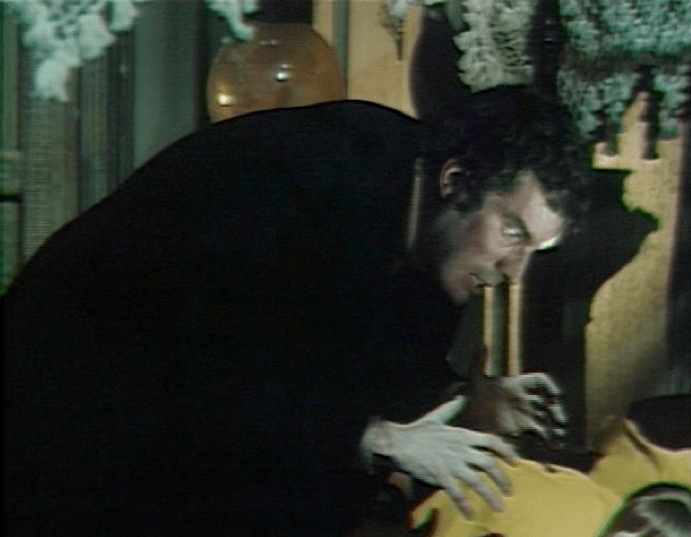
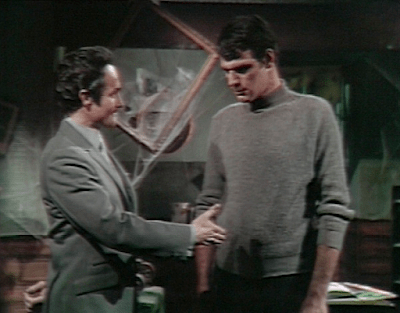
Joe calls on Amy. Screenshot by Dark Shadows Before I Die.

Joe wakes Amy, urges her to be silent, and starts packing her clothes. She asks if they are going to join Chris, and Joe becomes violently agitated. Amy grows frightened. Joe grabs her, puts his hand over her mouth, and carries her out of the house, leaving her half-packed bag behind.

In the woods, Joe hears sounds which he believes to be the werewolf. He starts shouting that he won’t let it have Amy. He is so absorbed in this that Amy gets loose and runs from him.

Joe’s derangement is entirely explainable as a natural response to the horrible and incomprehensible traumas he has undergone. The same could be said of the other mentally ill character in today’s episode, Liz, and in Monday’s episode Julia very nearly said it. Today, however, the show raises the possibility that Liz’ trouble might be the result of ongoing persecution by the spiritual forces of darkness.

Months ago, Liz fell afoul of her brother Roger’s wife. She called herself Cassandra, but was really an evil sorceress named Angelique wearing a black wig. This wiggéd witch cast a spell that caused Liz to sink into a deep depression, obsessed with the idea she would be buried alive. Twice before, Liz has sunk into similar depressions. The first was the result of a spell cast by Roger’s previous wife, Laura Murdoch Collins, who like Angelique/ Cassandra was an undead blonde fire witch. (Roger has a type.) The second was a response to a long blackmail to which a seagoing con man named Jason McGuire subjected her. For the last several weeks it has seemed that this third bout might be lifting, but it came back with a vengeance last week when well-meaning governess Victoria Winters dematerialized before Liz’ eyes.Vicki’s departure was as much a shock to Liz, in its own way, as Chris’ transformation was to Joe. Even before any spells were cast on her, Liz had shut herself up in the house and refused to leave for eighteen years. So we know that Liz is given to depression.

Today Liz has a nightmare. The dream sequence begins with a melody that for all the world sounds like “Rock-a-bye Baby” played on a kazoo, but which turns out to be a distorted recording of Amy singing that lullaby. Liz sees Amy atop the cliff on Widows Hill, a place associated with death and peril. In the past, several women have fallen to their deaths from Widows’ Hill; we have seen Liz and Vicki attempt suicide there. Amy’s image is as distorted as is the sound of her voice. She is swaying from side to side, perhaps dancing the hula; the visual effects exaggerate this sway.

Liz is trying to get Amy away from the cliff when she sees Angelique/ Cassandra. The witch tells her that she will fulfill her curse and see that Liz is buried alive. Liz finds that she can no longer communicate with Amy, for which Angelique/ Cassandra taunts her.

Shortly after Liz wakes up from her dream, Carolyn and Julia come to her room. They hear her crying out that “she” is a danger to her, but a moment later Liz cannot remember who that was. Julia mentions to Carolyn today that multiple psychiatrists have reported that Liz cannot remember how her depression started; that she sees Angelique/ Cassandra in the nightmare but cannot remember who she was so shortly after suggests that the nightmare is part of the depression. If Angelique/ Cassandra’s continued activity is causing the one, it must therefore be causing the other.

Liz says that she is afraid for Amy and asks Carolyn to check on her. When she finds Amy missing, she asks Julia what to tell her mother. Without missing a beat, Julia says “Lie to her!” This is perfectly fitting- Julia is the show’s most fluent and most accomplished liar. Julia and Carolyn begin a search. Julia is on the phone asking for the sheriff when Amy comes in the front door, followed by Joe.

Julia is at first relieved to see Amy with good ol’ Joe. But Amy is terrified of Joe, and when she runs upstairs Julia blocks the staircase to keep him from following. Joe says that he must take Amy far away from Collinsport at once. Julia says that if he can explain why, she will let him. Nothing he can put into words makes much sense to her, and he is so obviously unhinged that there is no way anyone would think he was the right person to assume responsibility for a child. Julia tells Joe that whatever he may have encountered in the village poses no threat to Amy in the mansion. He laughs, shakes his head, and mutters “You don’t know… you don’t know…”

Julia’s attempt to reassure Joe is interrupted by a blood-curdling scream from upstairs. She hurries up to see what is happening. Joe goes on laughing and muttering, wandering out of the house. That the scream coming from upstairs, where Amy is, does not catch his attention when he is so determined to protect Amy from imminent danger shows that he is truly lost, never to recover.

Julia finds a distraught Carolyn standing over an immobile Liz. She gives Liz a quick look, and tells Carolyn that she is dead. You might think Julia would be more careful about this. She has several times made erroneous death pronouncements, most recently when she pronounced Liz herself dead in #604. That incident led Julia to conclude that Liz had an unusual disorder that could cause her to appear to be dead. Especially since Julia knows about Liz’ overwhelming fear that she will be mistakenly thought dead and be buried alive, this hasty diagnosis is bizarre. Of course we end with a shot of Liz on the floor and hear her voice on the soundtrack saying “I’m not dead! I’m not dead!”

Liz had collapsed after she had a vision of Angelique/ Cassandra appearing in her room and touching her. This would seem to be a strong suggestion that the show wants us to think that Liz is still actively hag-ridden, and that her depression is therefore among Dark Shadows‘ supernatural storylines. On the other hand, the vision might have been an hallucination on Liz’ part, and her apparent death might be the result of a psychological syndrome. There may not be any mental process in our world that can induce a seizure so complete that it would fool doctors into thinking that a patient was dead, but in the world of Dark Shadows Julia, whose abilities are all supposed to be strictly the result of her scientific training, can use hypnosis to erase and rewrite people’s memories at will. If the power of suggestion is that great in this fictional universe, it is easy to suppose that self-hypnosis could conceal anyone’s vital signs from the most sophisticated examination.

This was the first episode directed by Henry Kaplan. Lela Swift directed the first twenty episodes of the show, and half of the rest. From #21, she shared directing duties with John Sedwick, usually trading off from one week to the next. Sedwick left the show in June, and several other men have taken turns as Swift’s relief. Kaplan will occupy that spot until the end of the series.

Swift and Sedwick were both ambitious and accomplished visual artists, and the others have more or less lived up to the standard they set. Today’s episode doesn’t look particularly bad, but a great many of the hundreds of segments Kaplan would go on to direct would be made up of one closeup after another, most of them badly out of focus. Swift will continue to work at her usual high level, but the sludge Kaplan dumps on our screens day after day will go a long way towards breaking people of the habit of watching Dark Shadows and discrediting it in the eyes of critics and television professionals.

Moreover, Kaplan did not work well with actors. Many of the cast hated Kaplan for his habit of using a stick, not only to point to their marks, but often to prod them physically. Others hated him for the verbal abuse he casually heaped on them. In a recent panel discussion, Marie Wallace and Donna Wandrey share stories about the difficulties of working with this disagreeable hack. The performances in this one do not show Kaplan’s malign influence. Joel Crothers does a marvelous job as Joe. While the actresses step on each others’ lines so often that it is clear they are nervous, that is not so very unusual.

Episode 548: Too much a part of him

Wicked witch Angelique defied her supervisor, suave warlock Nicholas, one too many times. Yesterday, Nicholas stripped Angelique of her powers, including her immunity to aging. Since she is 194 years old, this leaves her with a sharply limited future.

Today, Nicholas tells Angelique he will think of sparing her from her imminent demise if she can persuade recovering vampire Barnabas to forgive her for her extreme abuse of him and of everyone he has ever cared about. She goes to Barnabas and begs him for forgiveness. Barnabas replies that when he asked her for forgiveness, she responded by turning him into a vampire. He does show signs of concern for her, but cannot pardon everything she has done. He specifically mentions The Dream Curse, a three month storyline that not only brought great suffering to him and a dozen other characters, but which also made the audience miserable. She dies.

Angelique begs Barnabas for forgiveness. Screenshot by Dark Shadows Before I Die.

Nicholas’ only acknowledged motivation to this point has been a selfless devotion to evil for its own sake. That makes it odd that he would place a value on forgiveness. Dark Shadows is pervaded with ghost stories, and ghost stories are, first and foremost, explanations of how unresolved conflicts in the past can poison relationships among people in the present. It is also a soap opera, and the biggest events in soaps are changes in the way particular characters feel about each other. So both genres tend to elevate forgiveness, not only as a virtue, but as the highest form of The Good in human life. We saw this in the first year of the show, when well-meaning governess Vicki kept forgiving strange and troubled boy David for his attempts to kill her, acts of forgiveness which culminated in #191 when David ran from the mother who was trying to lure him to his own death into Vicki’s arms and an acceptance of life. Two weeks later, in #201, dashing action hero Burke closed another narrative thread left over from episode #1 when he forgave sarcastic dandy Roger for an old grievance he had against him. With those events, it was pardoning that cleared the flotsam left over from Dark Shadows 1.0, paving the way for the introduction of Barnabas and the advent of Dark Shadows 2.0.

Perhaps Nicholas was so certain Barnabas would not be able to bring himself to forgive Angelique in the time available before her death that making her beg for forgiveness was his way of perverting the world’s best thing into yet another instrument of cruelty. Certainly he suggests this interpretation when he introduces the idea with a laugh and a comment that he might find it “amusing.”

When Nicholas stands over Angelique’s corpse, he tells her that her own hatred had made it impossible for Barnabas to forgive her because it had “become too much a part of him.” That Angelique’s hatred became a part of Barnabas rings a bell for longtime viewers. The show has always depicted supernatural beings, not as self-contained individuals, but as complexes of phenomena that operate more or less independently, often without each other’s knowledge, sometimes in pursuit of mutually exclusive goals. For example, in 1967 the ghost of Barnabas’ little sister Sarah visited David during the day and tried to prevent him finding out Barnabas was a vampire, but she also appeared to David in a dream and showed him everything the daytime ghost wanted to keep hidden. When David told the Sarah of the waking hours what her dream visitation form had shown him, she was horrified and forbade him from following up on any of that information.

When Angelique places a curse, she sometimes seems to create a little version of herself, give it possession of the person she is targeting, and turn it loose in the world. Sometimes that little Angelique turns against her. For example, she raised the body of Barnabas’ uncle Jeremiah from the dead to use for her own nefarious purposes, only to find that it would not return to its grave when she was finished with it. When Barnabas was a vampire, he had some obsessions that were strikingly similar to obsessions Angelique had shown. So Angelique wanted Barnabas to love her, and had the power to cast a spell that would make him do so, but instead wrought immense havoc on everyone else with one wild scheme after another, because she wanted him to come to her “of his own will.” Likewise the vampire Barnabas wanted to make Vicki his victim, but passed up one opportunity after another to bite her because he wanted her to come to him “of her own will.” That similarity is so close that it makes us wonder if the Barnabas we first met was simply Angelique in disguise. Not only her hatred, but all of her quirks had become part of him.

Angelique came from the 1790s to 1968 by some magical process that involved a portrait of her that is now on a stand in Vicki’s room. Today she uses a secret panel to let herself into the room and look at the portrait. We first saw that panel open when the show was a costume drama set in the 1790s. The room was occupied then by gracious lady Josette, and it was the vampire Barnabas who used the panel to enter. We haven’t seen the panel since, leaving it strongly associated with Barnabas in the minds of regular viewers. Angelique’s use of it today further suggests her identity with him when he is in his vampire state.

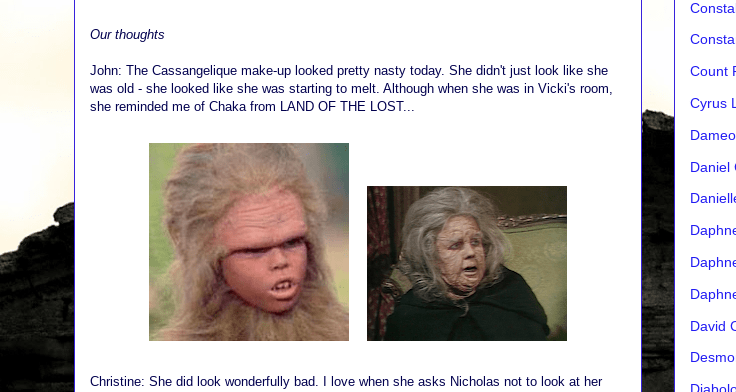
In their post about the episode on Dark Shadows Before I Die, John and Christine Scoleri find a resemblance between Angelique’s old age makeup and another TV character:

Captured from Dark Shadows Before I Die.

But look at Angelique’s creator, writer Sam Hall. She came by her looks honestly:

Episode 547: I can’t let you lose this moment

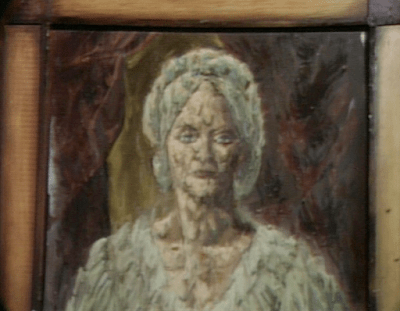
In the great house of Collinwood, well-meaning governess Vicki awakens to find a strange glow emanating from the portrait of wicked witch Angelique which, for some reason, she keeps on a stand in her bedroom. The portrait transforms itself before her eyes into that of an extremely old woman. Vicki goes to get permanent houseguest Julia. Seeing the transformed portrait, Julia agrees with Vicki that the portrait is like a living thing, says that Vicki knows more about Angelique than anyone else, and is unable to answer when Vicki asks what the portrait’s transformation means for someone called Cassandra.

Transformed portrait. Screenshot by Dark Shadows Before I Die.

Vicki and Julia know that Cassandra, wife of sarcastic dandy Roger, is Angelique in a black wig, come from the eighteenth century to wreak a terrible vengeance on old world gentleman Barnabas. Vicki apparently does not know what form that vengeance was meant to take.

In the 1790s, Angelique/ Cassandra turned Barnabas into a vampire, and her curse was in effect for 172 years. After his vampirism went into remission, she returned, obsessively driven to restore him to his undead state. Since it was the vampire story that first made Dark Shadows a hit in May and June of 1967, and it has ever since been known as the “1960s vampire soap opera,” Angelique/ Cassandra’s obsession likely reflected the concern of ABC network executives who must have been nervous when the makers of the show decided to turn Barnabas into a human. Angelique/ Cassandra’s attempts to revive the curse do keep the threat of vampirism at the center of the action.

Julia knows all about Barnabas and Angelique/ Cassandra, and so she rushes from Vicki’s room to Barnabas’ house. There, she finds Angelique/ Cassandra slumped in a chair in the front parlor, her face concealed inside a deep hood. Barnabas explains that Angelique/ Cassandra told him that her associate Nicholas told her she had wasted too much time trying to restore his curse, that Nicholas had then punished her by stripping her of her powers, that one of those powers was her immunity to aging, and that she had come to his house to shoot him to death before her 194 years caught up with her and she turned into a pile of dust. Angelique/ Cassandra began to collapse before she could fire the gun, and now it is on the mantel.

Julia is a medical doctor, and makes an effort to examine Angelique/ Cassandra. Angelique/ Cassandra rushes out of the house, and Julia asks Barnabas why he didn’t kill her when he had the chance. Barnabas, who had already killed his uncle in a duel before he began his long career as a bloodsucking fiend and part-time serial murderer and who within minutes of being freed from the effects of the curse picked up a gun with the intention of shooting a man named Adam, gives a self-satisfied little speech about how much he values life. Julia, who was extremely reluctant to join Barnabas in the murder of her onetime friend Dave in #341 and was miserable when he gleefully taunted her afterward with her “new status” as a “murderer!,” takes the gun and announces that she will go kill Angelique/ Cassandra herself.

Outside the door of the great house, Barnabas tries to talk Julia out of killing Angelique/ Cassandra. Julia says that if Angelique/ Cassandra is out of the way once and for all, she might herself be able to return to her old life. Barnabas points out that she is overlooking the obstacle that a murder charge might present to that plan. Julia says that no one would convict her if they knew what Angelique/ Cassandra was, to which Barnabas replies that no one will know, since no one would believe the true story. He does not mention what he had brought up earlier, that Nicholas is more powerful than Angelique/ Cassandra, or draw the obvious inference, that he must be at least as dangerous. As long as Nicholas is around, killing Angelique/ Cassandra won’t gain Julia or Barnabas very much.

Inside, Barnabas and Julia find that Roger has let Angelique/ Cassandra into the house. She has aged tremendously, so much so that Roger did not recognize her as his wife. She is resting on the couch in the drawing room, where Julia examines her while Roger and Barnabas talk in the foyer.

Julia comes out and tells the men that her patient’s heartbeat is so weak she can have only minutes left to live. Barnabas gives a stern response, and Julia assures him she did nothing to change the woman’s condition. The word “minutes” will strike a chord with returning viewers, who remember that Nicholas yesterday referred to Angelique/ Cassandra’s future as “the minutes remaining to you.” If we also remember how easy it is to underestimate Angelique/ Cassandra, we will not be very surprised when, after Roger insists on driving the old woman to the hospital, they go into the drawing room they find that she is gone and the windows are open. Angelique/ Cassandra is so interesting that the number of minutes she will continue to exist is rarely less than the 22 minutes that make up an episode of Dark Shadows.

Angelique/ Cassandra is Lara Parker’s usual young and beautiful self at the beginning of the episode. She then goes off camera for a moment and comes right back with her face hidden inside a hood. She is in a couple of scenes as a hooded figure before we see her face again, close to the end, when she is wearing the same old age makeup she had on in #499. Considering that the show was done live-to-tape, that leads me to wonder if the makeup was applied in stages during multiple commercial breaks.

Episode 546: A woman, born on Martinique in 1774

Suave warlock Nicholas has expressly forbidden his subordinate, the wicked witch known variously as Angelique and Cassandra, from killing Frankenstein’s monster Adam. But now he has twice caught her trying to do just that. He punishes her by stripping her of her powers. He tells her that she is now a human being, and that she will die soon.

Nicholas de-witches Angelique/ Cassandra, while also trying to hold her wig in place. Screenshot by Dark Shadows Before I Die.

Angelique/ Cassandra’s husband, sarcastic dandy Roger, comes downstairs and confronts her about her indifference to him. She responds that there never was anything between them and never will be, and rushes out of the house. My wife, Mrs Acilius, is a soap opera fan from way back, and she says that as far as she is concerned this archetypal soap moment makes for a “Genuinely Good Episode.”

Angelique/ Cassandra goes to see recovering vampire Barnabas. He opens the door and asks what she wants. She says that she was once the mistress of the house and that as such she has a right to enter.

Ever since she showed up in the year 1968, Angelique/ Cassandra has been trying Barnabas’ patience and the audience’s by pretending that she was not the witch he married in the 1790s. He asks her why she has dropped that pretense now, and she says that she, like he, has become human. She also says that she will die at dawn. It is unclear why she thinks this- all Nicholas told her was that her life expectancy was to be measured in “minutes.” She declares her intention to kill Barnabas, and is pointing a gun at him when the episode ends.

If it does not lead to her immediate demise, depriving Angelique/ Cassandra of her powers would be an intriguing way of making her a more flexible character. In the costume drama segment set in the late eighteenth century, she was so powerful that she painted herself into a corner, facing no real opposition. The only suspense she could generate came when she was indecisive or distracted and got in her own way. In 1968, her subordination to Nicholas has pushed her to the opposite extreme. She has been very busy, but hasn’t done much. If she survives without her powers, it might be interesting to see her learn how to live as a human after all this time.

Angelique/ Cassandra’s appearance reflects the end of her dual identity perhaps more clearly than was intended. When she answered to the name Angelique in the 1790s, she had blonde hair; when she turned up in 1968 calling herself Cassandra, she wore a black wig. Throughout this episode, the wig keeps sliding around on her head.

This episode includes another of the innumerable replays of an audiotape message about Barnabas and Adam. The other day, it seemed that Nicholas and Cassandra had taped over the message, as undead fire witch Laura Murdoch Collins taped over a recording she didn’t want parapsychologist Peter Guthrie to hear in #172. But Friday they played it for us yet again. When Nicholas threatens Angelique/ Cassandra with death if she keeps disobeying him, Mrs Acilius said to the screen “I’ll kill you myself if you play that tape again!” I am glad to report that this is the last time we will hear the thing.

Danny Horn’s Dark Shadows Every Day post about this episode juxtaposes screenshots and dialogue from the scene in which Nicholas strips Angelique/ Cassandra of her powers with screenshots and dialogue from a contemporary episode of General Hospital. The contrast is hilarious. It also shows why even the conventionally soapy scenes with Roger and Barnabas stand out from the other daytime dramas of the period. Director Lela Swift’s use of the camera was incomparably more dynamic and ambitious than anything General Hospital was doing, Robert Cobert’s original orchestral score is comprehensible to a modern audience in a way that an organ playing in the background would never be, and the action is paced so that it takes less time for Angelique/ Cassandra to lose her supernatural powers, end her marriage to Roger, and pull a gun on Barnabas than it took Lucille to explain to Audrey that she had an idea about how she could learn to play bridge.

Episode 545: Another living soul

Suave warlock Nicholas Blair has learned that Frankenstein’s monster Adam is hiding in a room in the long-deserted west wing of the great house of Collinwood. He materializes there and talks as if he’s trying to recruit Adam into a self-esteem cult. He says “You mustn’t worry about what other people think, Adam. And you needn’t always do what other people want you to do. You must learn to be a strong-willed individual.” In response, Adam carefully articulates the new vocabulary item: “In-di-vi-du-al.” It sounds like the big guy will be signing up for courses at the Nathaniel Branden Institute in no time.

Nicholas recruits Adam. Screenshot by Dark Shadows Before I Die.

Later, we see Adam in the main part of the house. He has let himself into the bedroom where his patroness Carolyn Collins Stoddard, the acting mistress of Collinwood, is sleeping. He wakes her and tells her of Nicholas’ visit. Carolyn tells him to wait there while she goes to the drawing room and scolds Nicholas for wandering into parts of the house he had no permission to explore. Nicholas apologizes, and tells Carolyn her secret is safe with him.

In the final part of the episode, the wicked witch known variously as Angelique and Cassandra makes her way to Adam’s room in the west wing. She finds his door locked, and makes a graceful little hand gesture to magically open it. Standing over Adam while he sleeps, she decides that she cannot use magic to kill him, since Nicholas wants Adam to live and she would like him to believe that a human committed the murder. Therefore, she lifts an ax and is ready to chop into him when the episode ends. The ax wasn’t there earlier and she didn’t conjure it up; presumably she found it in “hammerspace,” the dimension where fans of animated cartoon say characters find whatever tools they need to do whatever the script calls for them to do at any given moment.

Adam’s residence in the west wing is a drab storyline, but longtime viewers will notice that it marks a change in the geography of Collinwood. The west wing was introduced as an area separated from the rest of the house, not only by a locked door, but some kind of metaphysical rift. In #14, well-meaning governess Vicki Winters saw the locked door inexplicably open and close itself; that was the clearest indication up to that point that in Collinwood, the word “ghost” referred to something more than unresolved conflicts among people. A reminiscence of that moment in #27 reinforced the suggestion that there was something supernatural about breaching the barrier between that wing and the main part of the house.

From #84 to #87, Vicki’s charge, strange and troubled boy David Collins, locked her up in a room in the wing; that was such an isolated place that it seemed Vicki might die before the family found her. Again, the distance was not only physical- while in captivity there she saw a full fledged ghost, a glowing figure dripping seaweed and singing to her. When sarcastic dandy Roger went to look for Vicki in #87, we saw him open the first of Dark Shadows‘ secret panels, a bit of the wall in the drawing room that opens to a long, dusty passage leading to the west wing. That was startling to see then, and we haven’t had a look at it since. Viewers who remember it have been looking at that spot on the wall ever since, wondering what worlds lie behind it.

Adam’s presence in the west wing fits in with its unearthly character, as do Nicholas and Angelique/ Cassandra’s activities there. But since those two witches live at Collinwood, the rest of the house has taken on that character as well. The separation of the west wing from the main part thus comes to lose its significance. Why shouldn’t Adam be able to visit the rest of the house, and why shouldn’t he know his way around well enough that he goes directly to Carolyn’s bedroom? Why shouldn’t unlovely ex-convict Harry Johnson, the most mundane character on the show now, have adventures in the west wing?

Angelique, the camera in front of her, the secret panel to the west wing behind her. Screenshot by Dark Shadows Before I Die.

Episode 540: Intervening factor

Suave warlock Nicholas Blair tells his subordinate, the wicked witch known variously as Angelique and Cassandra, that she has an hour to figure out why her recent attempt to turn Barnabas Collins back into a vampire failed. When she tells him that won’t be enough time, he suggests she spend the hour preparing for her final destruction. At the last minute, her stepson David tells Angelique/ Cassandra about an audiotape message that happens to give her exactly the information she needs.

Nicholas threatens Angelique. Screenshot by Dark Shadows Before I Die.

Angelique/ Cassandra has been an extremely unsympathetic villain, so it is daring to have an episode mostly from her point of view which is suspenseful if and only if we want her to stay around. My wife, Mrs Acilius, says that might have been a reasonable bet when a character as dynamic as Angelique/ Cassandra is played by a performer as appealing as Lara Parker, but it doesn’t pay off today, for two reasons. First, the episode doesn’t have much of a plot. Second, returning viewers will be angry with Angelique/ Cassandra right now. She just subjected us to a three month ordeal called “The Dream Curse,” in which we saw the same dull sequence play out a dozen times, heard it described almost twice as many times, and then found out that there was no point to any of it. We know perfectly well that Angelique/ Cassandra is too interesting to stay off the show for long, so that the “final destruction” Nicholas is threatening will probably last for three weeks at most. But we really do want to see her punished for wasting our time.

This is the first episode in which John Karlen reads the opening narration, and only the third episode in which any male performer reads it. Most cast members have read these narrations more or less in the characters they will play in that day’s episode; Karlen takes his place alongside Kathryn Leigh Scott as one of two who strive to invest the role of Narrator with its own personality.

This was the last of the five episodes credited to director John Weaver. It isn’t hard to find reasons why they wouldn’t have contracted him to do more. There are a number of moments when the action jolts to a standstill for no apparent reason, Humbert Allen Astredo as Nicholas never seems to know what direction he should be facing, and when Angelique/ Cassandra orders the bedraggled Willie Loomis to “Look into my eyes!” we get a shot of him looking past her.

Episode 539: Child’s play

The wicked witch known variously as Angelique and Cassandra is standing in the drawing room of the great house of Collinwood, thinking evil thoughts. The camera zooms out and we see that her stepson, strange and troubled boy David Collins, is standing next to her. She starts to speak her thoughts out loud, saying “You will pay!” David asks “Who will pay?” Angelique/ Cassandra is startled to discover that David is there, and is flustered when she tries to change the subject. She so often delivers incriminating soliloquys while standing out in the open that the comic effect of this scene must be intentional.

Angelique/ Cassandra oblivious to David’s presence.

David asks Angelique/ Cassandra to help him figure out the correct operation of a tape recorder he received some time ago as a present from permanent houseguest Julia Hoffman. After Angelique/ Cassandra refuses to help, he goes upstairs and finds his cousin, heiress Carolyn Collins Stoddard, emerging from the long-deserted west wing of the house. He asks Carolyn what she was doing in the west wing. She asks him why he thinks she was in the west wing. When he says he saw her coming out of it, she drops her attempt to evade his question and tells him she was looking for some old family photos to show well-meaning governess Vicki. She has enough trouble remembering this story that it must be obvious to David that it is a lie, but he isn’t interested enough to follow it up. He just wants someone to help him figure out which buttons to push on the tape recorder.

On their Dark Shadows Before I Die, John and Christine Scoleri speak for longtime viewers of the show when they say that it is surprising David needs help with the tape recorder. When the show started, David was two years younger and had the mechanical skill to sabotage his father’s car in a very creditable attempt at patricide. All Carolyn has to do to get the tape going is read the label that identifies the play button. This apparent loss of cognitive function is of a piece with David’s massive loss of narrative function. For the first 39 weeks of Dark Shadows, David was the fulcrum on which every story turned, and actor David Henesy had abundant opportunities to show a level of professional skill that would be remarkable in a performer of any age. But he has been receding into the background for a long time now, and his extraordinary dim-wittedness today marks a low point for him.

Once the tape starts playing, Carolyn makes a hasty exit. David listens to a minute or so of Eine Kleine Nachtmusik, hoping it will end and he will hear “something spooky.” His wish is granted when the music abruptly stops, giving way to a voice addressing itself to Julia. The voice rambles about David’s distant cousin Barnabas Collins, saying that if both he and “my creation” live, Barnabas will be all right, but that if “Adam” dies, “Barnabas will be as he was before.” The name “Adam” should mean something to David. He shared a confused and frightening moment with a mysterious man of that name in #495. That man subsequently abducted Carolyn, and is still the object of a police search.

What only Julia, Barnabas, and Barnabas’ servant Willie know is that Adam is a Frankenstein’s monster created in an experiment that freed Barnabas of the effects of the vampire curse that Angelique/ Cassandra placed on him in the 1790s. The voice on the tape is that of Eric Lang, the mad scientist who began the experiment. Minutes before he died of the effects of one of Angelique/ Cassandra’s spells, Lang recorded this message for Julia. The audience has heard this message approximately a gazillion bajillion times, but until now, the only character to have heard it was Adam, and he could make no sense of it.

Angelique/ Cassandra recently made an unsuccessful attempt to renew Barnabas’ curse, and is desperately searching for the obstacle that prevented it from working. Carolyn’s actual task in the west wing was showing Adam to a hiding place there. So Angelique/ Cassandra is now under the same roof with both the information she needs to identify her obstacle and the person she can remove that obstacle by killing. Things are looking bad for Barnabas and for Adam.

While David is upstairs with the tape recorder, Vicki is sobbing in the drawing room. Suave warlock Nicholas, who is staying in the house in the guise of Angelique/ Cassandra’s brother, enters and asks her what’s wrong. She says that she has just learned that Barnabas is dead. His back to her, Nicholas smiles brightly when he first hears this news, then puts on a sad face and turns to her with sympathetic words. In response, Vicki reveals that she knows all about Angelique/ Cassandra and that she has little patience for Nicholas’ pretensions. Carolyn enters and doubts Vicki’s news. Angelique/ Cassandra is the last to enter. She says that she saw Barnabas alive and well after the time when he is supposed to have been dead. Vicki and Carolyn look at each other, and do not see Nicholas’ look of disappointment. They go upstairs, and Nicholas and Angelique/ Cassandra go into the drawing room.

Nicholas scolds Angelique/ Cassandra for her failure. He addresses her as “dear sister.” He suggests she may not hate Barnabas sufficiently to impose a curse on him. When she denies this, he leans to her ear and teasingly asks if she loves him. He threatens to send her back where she came from if she doesn’t re-vamp Barnabas by midnight, and to focus her mind replaces her arm with a fleshless bone.

Director John Weaver was not much of a visual artist, and in his post about the episode on Dark Shadows Every Day Danny Horn analyzes the dismally inept blocking of the scene between Vicki and Nicholas. Danny also has some unkind words for writer Ron Sproat, but I think those are unfair. It’s true the opening scene between Adam and Carolyn goes on too long, David’s helplessness with the tape recorder is dismal, and Vicki and Carolyn’s reaction to Angelique/ Cassandra’s report that Barnabas is still alive doesn’t make sense. That’s a long enough list of flaws that we might fairly classify Weaver and Sproat as the B-team, not on a par with director Lela Swift and writers Sam Hall and Gordon Russell.

But it is genuinely funny when we first see David standing next to Angelique/ Cassandra, David’s questioning of Carolyn is intelligently written, Lang’s message is for once an actual source of suspense, Vicki’s lines to Nicholas as Alexandra Moltke Isles delivers them show the character’s strength, Nicholas’ teasing Angelique/ Cassandra with her alleged love of Barnabas raises a laugh as it makes them sound like a couple of kids, and the final gag with the arm bone is at once goofy enough to keep up the humor in the episode and startling enough to be effective as a touch of horror. All in all, it’s an enjoyable episode, if not one that fans would be tempted to use to turn their friends on to the show.

Episode 537: Reason to stay

Recovering vampire Barnabas Collins is dead, and this time it seems like he might stay that way. At least it seems so to his friend Julia Hoffman, MD, and his servant Willie Loomis; they’ve buried him, and are talking about what to do next. Julia decides they should tell people Barnabas went on a long trip, and that they themselves should leave the area before dawn. They will go to a sanitarium called Windcliff. Julia will resume her duties as its chief, while Willie will take a job there doing whatever he can handle.

Julia orders Willie to pack his things; he asks if he should pack Barnabas’ things also. Julia is impressed that Willie thinks of this. Perhaps he is remembering his onetime friend Jason McGuire, whom Barnabas killed in #275. Jason was hated by all and was under orders from the sheriff to leave town when he fell afoul of Barnabas, and so it was easy for everyone to assume he had simply gone away. Still, in #277, sarcastic dandy Roger wondered why Jason hadn’t taken his clothes or his shaving kit. No one ever tried to tie up that loose end, but perhaps Willie learned of the problem and made a note of it for the next time he had to conspire to conceal a death.

Willie goes directly from Barnabas’ freshly dug grave to Maggie Evans’ house. Willie has an unwholesome preoccupation with Maggie. Longtime viewers will remember Willie’s menacing approach to her in #202 and #207, before Barnabas got hold of him and turned him from a dangerously unstable ruffian into a sorely bedraggled blood thrall; those who are mindful of the period when Dark Shadows first became a hit will remember May and June of 1967, when Maggie was Barnabas’ prisoner and Willie tried desperately to lessen her suffering; and first time viewers will be startled by the beginning of the scene, when we see Willie peeking through the window at Maggie. When Barnabas’ vampirism went into remission, his former victims tended to return to the personalities they had before he bit them. Willie has not quite become the rapey goon he was in his first two weeks on the show, but neither is he the first man a woman would choose to be alone with.

Willie!

Since she is The Nicest Girl in Town, Maggie has long since forgiven Willie what he did when he first came to Collinsport. And Julia used a magical version of hypnosis on Maggie to induce amnesia covering the whole period of her involvement with Barnabas and to leave her with warm feelings of goodwill for him. But it’s late at night, so when Willie knocks, she is reluctant to let him in. He insists, and she relents.

Willie tells her he will be going away soon to take an exciting new job. Maggie says that she is sure everyone will miss him. At first he repeats the story that Barnabas is going away on a long trip, but then he starts crying. When Maggie asks why, he tells her Barnabas has died. He asks her to keep this secret, but the most she will agree to do is to wait until he leaves town to start talking about it.

Meanwhile, Julia has gone to the great house of Collinwood, where she has been a houseguest for about a year. Before she goes upstairs to pack, she stops and tells Roger’s wife Cassandra that Barnabas is dead.

Julia knows that Cassandra is actually Angelique, the wicked witch responsible for Barnabas’ woes. It would seem that the whole point of covering up Barnabas’ death would be to keep Angelique/ Cassandra from finding out about it. Yet Julia not only goes out of her way to tell her, she also declares to her that she will continue to fight against her.

Angelique/ Cassandra spits out that Julia is in love with Barnabas, to which Julia replies “Not nearly as much as you are.” For some time, the show has been developing the theme that Julia would like Barnabas to be her lover. In their post about the episode on Dark Shadows Before I Die, John Scoleri said “So Julia’s true feelings are finally on the table.” To which Christine Scoleri replied, “Where have you been? Julia’s feelings have been on the tablethe wallthe floor…pretty much everywhere for a long time.”

Willie’s visit to Maggie and Julia’s to Angelique/ Cassandra mark a difference between the first year of Dark Shadows and its later phases. When the show started, the characters were too good at keeping secrets, with the result that very little happened. They took this to such an extreme that one of the two principal storylines with which the show began- well-meaning governess Vicki’s attempt to find out who her parents were- died out altogether because reclusive matriarch Liz and her lawyers, the only characters who knew anything about it, would never talk.

Now, the characters involved in the action don’t keep secrets from each other at all, with the result that events comes thick and fast, but it is hard to build complex alliances or to explore nuanced relationships. They still conceal information from Vicki, Liz, Roger, and other characters left over from the early days, rendering them background figures with little to contribute to the story. Video game enthusiasts might call them “NPCs”- non-player characters.

Professor Timothy Eliot Stokes, occult expert, enters. Stokes tells Julia that a man named Adam appears to be dead. Julia goes with him to an abandoned shack in the woods where she examines Adam’s body and pronounces him dead. When Stokes tells her that Adam exhibited sharp pains in his neck starting at about 11 PM, that he called out for Barnabas, that his strength appeared to ebb for no apparent reason, and that he then died, Julia’s eyes widen. Suddenly Adam comes back to life. He starts gasping for air and miming a struggle against an invisible barrier just above his face. Julia tells Stokes she will have to go. He protests that she must stay with her patient. What she says next doesn’t mean much to Stokes, and would mean less to a first-time viewer:

JULIA: He is suffocating- I may know why. No, it’s impossible! But it may be that they are the same. Experiment- perhaps Adam is why-

STOKES: What are you talking about?

JULIA: Barnabas- I buried him- alive!

Regular viewers know that Adam is a Frankenstein’s monster created in an experiment begun by mad scientist Eric Lang. Shortly before he died of wounds inflicted by Angelique/ Cassandra, Lang recorded an audiotape in which he explained that as long as Adam lives, Barnabas’ vampirism will remain in remission. Julia has not heard that tape, but the audience has, time without number. We also know that when Barnabas was sealed up in a wall from #512 to #516, Adam experienced the pains that Barnabas suffered. In these lines, we see Julia for the first time beginning to understand the true nature of the connection between Adam and Barnabas.

Stokes’ approach to Julia is as indiscreet in its own way as were Willie’s to Maggie and Julia’s to Angelique/ Cassandra. Adam hates Julia and Barnabas, because they abused him shockingly in his first weeks of life, and forbade Stokes to bring her. Julia’s closing outburst is also an extreme indiscretion, as Stokes is basically a law-abiding person who could not be expected to help Julia and Willie cover up their many crimes. Again, we have come a long way from the days when the show would drop a major story rather than have a recurring character breach attorney-client privilege.

Like the Scoleris, Danny Horn was in good form when blogging about this part of the show. His post on Dark Shadows Every Day about this episode makes a number of penetrating observations about the connections between Julia and Willie’s opening scene at the grave and absurdist plays like Waiting for Godot and Rosenkrantz and Guildenstern are Dead.

Episode 535: The dream begins

Three months ago, the wicked witch known variously as Angelique and Cassandra cast a spell that has kept the story going in tight little circles ever since. It is “The Dream Curse.” A character has a nightmare, is compelled to tell it to another person, that person has the same nightmare, and the process repeats. When the nightmare makes its way to well-meaning governess Vicki Winters, she is compelled to tell it to old world gentleman Barnabas Collins. She and Barnabas both know that he is Angelique/ Cassandra’s real target. Vicki thinks the dream will kill Barnabas; he knows that it is meant to turn him back into what he was for 172 years, a vampire.

Vicki is struggling against the urge to tell Barnabas the dream. He knows that she is suffering mightily, and is resigned to his fate. So he shows up at the great house of Collinwood and insists that she tell him the dream. When she resists, he says that “I haven’t loved many things in my lifetime, but, Vicki, I love you.” The last time we heard Barnabas say “I love you” was in #415, when his little sister Sarah died in his arms. We have reason to believe that Vicki knows a lot more about Barnabas than she seems to; for example, she officially believes Barnabas’ story that he is the descendant of Sarah’s brother, but in this conversation she mentions that “the original Barnabas” died before he could have had any children. We also know that her feelings about him are complicated; when she looks at him after his “I love you” we see that she has something she very much wants to say. What that might be, we can only imagine.

Vicki has something to say

Vicki tells Barnabas the dream. After he leaves, permanent houseguest Julia Hoffman, MD, sits with Vicki. Julia is Barnabas’ best friend and partner in crime, and she usually has trouble concealing her impatience with the ingenuous Vicki. But today the two women are united in their grief. They share a touching scene that ends when Angelique/ Cassandra enters. Julia slaps Angelique/ Cassandra’s face and storms off. Vicki tells Angelique/ Cassandra she deserves far more than a slap, then walks out as well.

Back in his house, Barnabas takes an evil looking pill. Julia comes in with her medical bag and offers to give him something to stave off the dream. He says that he has already taken a pill to bring sleep on. Further, he tells her that he has ordered his servant Willie Loomis to sharpen a wooden stake. When he has the dream and passes into apparent death, she is to drive the stake through his heart.

In moments of despair, Barnabas has often presented his resignation to reverting to vampirism as his noble self-sacrifice. But this is the first time he has presented a plan to ensure that he will not resume preying on the living. It suggests that there really is something in him other than narcissism. Maybe he knew what the words meant when he told Vicki he loved her.

Barnabas has the dream. It stops short of the climactic moment, and he awakens. He jumps to the conclusion that Angelique/ Cassandra botched her curse and it’s all over. He sends Julia to get Willie. As soon as he is alone, a knock comes at the door. He opens it and goes outside. A bat lowers on him, and he falls to the ground screaming.

This was the last episode of Dark Shadows ABC-TV asked its affiliates to broadcast at 3:30 PM. Starting Monday, it moved to the 4:00 timeslot, suitable for viewing by kids running home from school. In his delightful post about the episode, Danny Horn envisions the show as a patient on a therapist’s couch, talking about its need to leave its tedious recurring dream behind before it makes its big move.

Episode 528: Old girl

In his post about this episode on Dark Shadows Every Day, Danny Horn remarks on the recapping that permeates the dialogue and reckons it as writer Sam Hall’s critique of the ongoing storylines. That assessment will be familiar to those who, unlike Danny, have been watching the show from the beginning. When Ron Sproat joined the writing staff in October 1966, his first several scripts featured a systematic inventory of the available narrative material, with each plot very explicitly marked as suitable or unsuitable for further development.

In its first year, very little happened on Dark Shadows; now, it has swung to the opposite extreme, and there is a climax at every commercial break. But the result is oddly similar. They don’t take the time to explore the overall situation, so that little seems to be at stake even when a spectacular event takes place. No matter how much happens per minute of screen time, it feels like the pace is slow. We see suave warlock Nicholas in the gazebo on the grounds of the estate of Collinwood summoning his subordinate, the wicked witch known variously as Angelique and Cassandra, and hear him complain that she has spent weeks attempting to do what she should have accomplished in minutes. Thus Hall assures us that the pace will be picking up.

Angelique/ Cassandra comes to the gazebo, to which Nicholas refers as a “ga-ZAY-bo” in a bit of Collinsport English Angelique/ Cassandra herself introduced in #489. There, the two of them quarrel about her dilatory approach. They stand behind columns and look like debaters at podiums.

The debaters. Screenshot by Dark Shadows Every Day.

Danny Horn’s commenter “lakeplacidskater” made an interesting observation about the moment screenshotted above:

Maybe I’m reading too much into the set design, but in one of the photos Angelique and Nicholas are sperated by a statue of a Goddess (I assumed Venus). Wouldn’t it be awesome if it was Venus and that statue between them was to represent Angelique’s love for Barnabas blocking her efforts at villainy? More likely that the shot just looked better composed with the statue in the middle but how awesome if it was meant to be subtle symbolism! 🙂

“lakeplacidskater,” posted 25 February 2015 on Danny Horn, “Episode 528: This Tawdry Affair,” 21 November 2014.*

The statue appears to me to represent not Venus, but a harvest goddess. She is fully clothed, and there is a sack at her feet which seems to be full of grain. That makes a lot less sense than does the suggestion “lakeplacidskater” made. The Collinses derive their wealth from fishing and shipping, not from farming, so it is surprising that they would put a symbol of agriculture in such a prominent place. Perhaps she stands for wealth in general, but not for so much wealth that the family could afford to commission a statue of a sea goddess. And neither a bountiful harvest in particular nor wealth in general is any sort of obstacle between Nicholas and Angelique/ Cassandra. I suppose the visual metaphor might be emphasizing the image of the two of them as debaters, with the goddess serving as moderator.

Nicholas dominates Angelique/ Cassandra thoroughly and rather cruelly. Viewers who remember her from the portion of Dark Shadows set in the late eighteenth century may be taken aback by this. In those days, her power often seemed to be limited only by her own carelessness. That made for something of a shapeless narrative, since no one could oppose her effectively. Not only does Nicholas reduce her to a lowly state today, but he himself bungles a simple task when he sets out to do something nasty to well-meaning governess Vicki. Thus we see that the villains will have their work cut out for them.

Later, Vicki is in bed at her friend Maggie’s house. She has gone there to escape a curse Angelique/ Cassandra has placed that has caused several people to have the same nightmare. Since Maggie was at home when she was the first person to have the nightmare, and Vicki’s boyfriend Peter was sleeping there when he had it, it is hard to understand why Vicki thinks it is a place of safety.

We have several closeups of the face of the clock while Vicki goes to sleep. It’s an Ingraham eight day clock, apparently they wanted to make sure we knew that. When Vicki finally nods off, Angelique/ Cassandra materializes in the room with a jar of rose water that is supposed to make Vicki have the nightmare. Ever since the days when humanoid Phoenix Laura Murdoch Collins was on the show, we’ve been seeing undead witches materialize in people’s bedrooms while they sleep. This time, Maggie walks in and sees Angelique/ Cassandra. She screams at the sight. All of the women in the cast were required to scream frequently, so frequently that fans become connoisseurs of screaming. Kathryn Leigh Scott was one of the better screamers, not far behind Clarice Blackburn, so that makes for a satisfying ending.

*I can’t help but point that when “lakeplacidskater” left her post, all the members of the cast were still alive. Humbert Allen Astredo would die in 2016 and Lara Parker in 2023; Alexandra Moltke Isles, Roger Davis, and Kathryn Leigh Scott are still with us.