This episode features two undead blonde fire witches. Laura Collins was Dark Shadows‘ first supernatural menace when she was on the show from December 1966 to March 1967. In those days, the show was set in contemporary times, and it was slow-paced and heavy on atmosphere. Laura began as a vague, enigmatic presence and gradually came into focus as a dynamic villain.
Now the show is fast-paced, action-packed, and set in the year 1897. Laura is once again the estranged wife of the eldest brother of the matriarch of the great estate of Collinwood. This time, she has come back to Collinwood after running off with her husband’s brother, Quentin. Unlike her 1960s iteration, this Laura is not at all happy about the periodic immolations that renew her existence as a humanoid Phoenix. She bears a grudge against Quentin for betraying her to the priests of a secret cult in Alexandria, Egypt, who incinerated her some months before. For his part, Quentin is shocked that Laura is alive now. When he tries to remedy the situation by strangling Laura, a feeling of intense heat overwhelms him and he collapses.
The other undead blonde fire witch is Angelique, who was first on the show from November 1967 to March 1968, when it was set in the 1790s. She appeared in 1897 when Quentin and one of his fellow Satanists conjured her up out of the fireplace in the caretaker’s cottage on the grounds of Collinwood in #711. They wanted a demon to come from the depths of Hell and help them do battle with Quentin’s distant cousin, the mysterious Barnabas Collins. Unknown to Quentin, Barnabas is a vampire and Angelique is the witch who originally made him one. Barnabas has traveled back in time to prevent Quentin becoming a ghost who will ruin things for everyone at Collinwood in 1969. Angelique is delighted to find herself back at Collinwood. She is determined to make Barnabas love her, no matter how many of his friends and relatives she has to kill along the way.
As it turns out, it was Angelique who caused Quentin to collapse before he could kill Laura. She summons Barnabas and tells him she will let Quentin die unless he lives with her as man and wife. When Angelique points out that if Quentin dies now, the results will be disastrous for the Collinses of 1969, Barnabas capitulates.
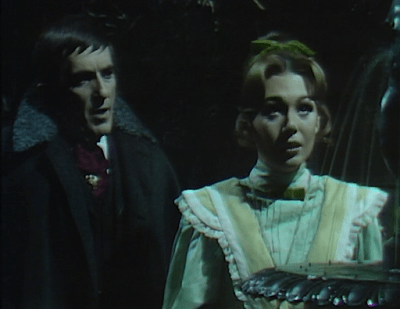
Barnabas takes Angelique to the great house. There, he introduces her to governess Rachel Drummond as his fianceé. Rachel has been falling in love with Barnabas, and their relationship has been the only bright spot in the otherwise extremely stressful time she has had at Collinwood. At one point today Rachel is on the telephone to someone she and Barnabas both hate; Barnabas takes it upon himself to press on the hook, hanging the phone up in the middle of the conversation. Many men do this to women in Dark Shadows, and it is usually very clear that the women don’t like it at all. Rachel objects only mildly, and quickly accepts it. That she isn’t bothered by such an aggressive act suggests that she already feels a very strong bond with Barnabas.
When Rachel hears that Barnabas is committed to someone else, she rushes out as quickly as possible. Later, Barnabas will meet her on the terrace and intimate that his relationship with Angelique is not what it seems. Rachel does not quite know what to make of this, but at moments we catch her rolling her eyes like someone who knows malarkey when she hears it.
Rachel listening to Barnabas explain that they shouldn’t let his fianceé come between them. Screenshot by Dark Shadows Before I Die.
Angelique wakes Quentin. They talk about Laura. By magical means, Angelique discovers that Laura’s life depends on an Egyptian urn that she keeps with her at all times. This is another retcon; we saw every worldly possession Laura had in 1966, and there was no urn in sight. Quentin resolves to find this urn and destroy it, ridding himself of Laura forever.
One of the first “Big Bads” on Dark Shadows was crazed handyman Matthew Morgan, played by Thayer David. Matthew was the most devoted employee of reclusive matriarch Elizabeth Collins Stoddard (Joan Bennett.) Matthew took his devotion to Liz to such an extreme that he was a menace to everyone else. In November and December of 1966, we learned that Matthew had decided that Liz’ second most dedicated employee, plant manager Bill Malloy, was a threat to her. Matthew had tried to put a stop to Bill’s doings. Not knowing his own strength, Matthew accidentally killed Bill. When well-meaning governess Victoria Winters discovered what had happened, Matthew abducted Victoria, held her prisoner in the long-deserted Old House on the grounds of the estate of Collinwood, and was about to murder her when a bunch of ghosts emanated from the show’s supernatural back-world and scared him to death.
In those days, Dark Shadows was a slow-paced “Gothic” drama set in contemporary times. From November 1967 to March 1968, it was a costume drama set in the 1790s, and its plot often moved at a breakneck speed. Among the characters then was much-put-upon indentured servant Ben Stokes, who like Matthew was played by Thayer David. At first Ben made a stark contrast with Matthew. He was as relaxed, friendly, and reasonable as Matthew was tense, forbidding, and paranoid. But when his one ally among the Collins family, scion Barnabas, was cursed to become a vampire, Ben’s devotion made him resemble Matthew ever more closely. In his development, we saw a retrospective reimagining of Matthew. The curses that were placed on Barnabas and the rest of the Collinses from the 1790s on had burdened the village of Collinsport, and people who grew up there labored under the consequences of those curses and of the Collinses’ attempts to conceal them. Ben was what Matthew might have been had he not been warped by the evil that began when black magic was first practiced in the area so many generations before.
In January 1969, the show briefly returned to 1796, to a time coinciding with the last days of the earlier flashback. We saw that by that point, the curses had already transformed life on and around the great estate. In that period, Ben’s efforts to protect Barnabas led him inadvertently to kill a man, not knowing his own strength, and then to cover that crime up by killing a woman, not at all inadvertently. He had become Matthew. The curse placed on Barnabas had become the curse of all those who work for the Collinses and all of those who live in the shadow of their wealth and power.
Before Matthew, Dark Shadows‘ chief villain was high-born ne’er-do-well Roger Collins (Louis Edmonds); after, it was Roger’s estranged wife, undead blonde fire witch Laura Murdoch Collins (Diana Millay.) In this episode, the makers of the show take a page from its 1790s flashbacks. They have Edmonds and Millay reconceive the Roger and Laura of that atmospheric, sometimes almost action-free soap as characters appropriate to the fast-paced supernatural thriller it now is.
Since #701, Dark Shadows has been set in the year 1897. Louis Edmonds plays Roger’s grandfather Edward; Diana Millay plays Edward’s estranged wife, undead blonde fire witch Laura Murdoch Collins. In his days as a villain, Roger’s defining characteristic was his unnatural lack of family feeling. He had squandered his entire inheritance, a fact which did not bother him in the least. When his sister Liz confronted him in #41 about the difficulties he had created by putting his half of the family business up for sale, he airily replied that he had enjoyed his inheritance. When in #273 Liz and Roger discussed a blackmail plot of which she had been the victim, Roger admitted that had he known her terrible secret, he probably would have used it to force her to give him her half of the estate so that he could squander that, as well.
It wasn’t only the family’s material possessions and Liz’ right to them to which Roger was indifferent. He openly hated his son, strange and troubled boy David Collins (David Henesy.) He continually insulted David, badgered Liz to send David away, and in #83 coldly manipulated David’s fears to lead him to try to murder Victoria.
In the 1897 segment, Edward is as stuffily serious about the family business as Roger was in 1966 nihilistically apathetic about it. Edward loves his children, twelve year old Jamison (David Henesy) and nine year old Nora, but his rage at Laura has come between himself and them. Laura left Edward the year before to run after Edward’s brother, breezy libertine Quentin (David Selby.) Edward tried to conceal the fact that his brother cuckolded him. He has repeatedly declared that Laura “No longer exists!” and has forbidden her name to be mentioned in the house.
Edward trapped between the enigmatic Laura and the exuberant Quentin. Screenshot by Dark Shadows Before I Die.
For his part, Quentin bears a striking similarity to the early, wicked Roger. He wants money only to spend it, a fact which he cheerfully admits. He tried to forge a will in his grandmother Edith’s name to cheat his sister Judith (Joan Bennett) out of her inheritance, having previously threatened to kill Edith. He does have great affection for Jamison, but since he often uses the boy as a pawn in Satanic ceremonies, his fondness for his nephew is not much of an improvement over Roger’s hatred for his son. Indeed, Quentin’s resemblance to Roger connects the 1897 segment not only to the early months of the show, but also to the weeks immediately preceding it. Early in 1969, Quentin’s ghost had taken possession of David Collins and was causing him to die. When we see that Quentin is now what Roger was originally, David’s ordeal takes on a new dimension. He is dying for the sins of his father.
In this episode, Laura has returned. Edward has offered her a great deal of money to go away and never come back; she refuses. She threatens to tell the world about her relationship with Quentin if Edward does not let her stay at Collinwood. Edward buckles to this blackmail. Laura tells him that “Family pride is your greatest weakness,” making him Roger’s exact opposite.
When Laura was at Collinwood from December 1966 to March 1967, her old boyfriend Burke Devlin kept pestering her with his suspicion that he, not Roger, was David Collins’ father. Burke was not the first character to bring this idea up. Roger had mentioned it to Liz in #32, when they were talking about an attempt David had made to kill Roger. At that time, Liz was horrified that Roger seemed to want to believe that David was Burke’s natural son.
It seems unlikely that Quentin is Jamison’s father. They have been firm about 1870 as Quentin’s date of birth, and in 1897 Jamison is quite plainly twelve. Laura may have gone on to marry her own grandson, but it would be a bit of a stretch for her to have started sleeping with her brother-in-law when he was fifteen, even if he did look like David Selby.
But Roger’s anger and jealousy about Burke and Laura do mirror Edward’s about Quentin and Laura. It was abundantly clear that Roger and Burke’s deepest pain regarding Laura was that their intense attachment to each other was disrupted when she left Burke for Roger; Diana Millay used her gift for dry comedy to make this explicit in a scene the three of them played in the groundskeeper’s cottage in #139. Likewise, Edward’s frustration with and disappointment in his brother is at least as deep a source of anguish to him as is his loss of Laura’s love.
Laura, too, is quite different this time around. The first Laura story took shape gradually over a period of weeks, as Laura herself emerged from the mist. Now Laura is a forceful presence from her first appearance. Originally we heard that Laura had married into several of the leading families of the Collinsport region; now they have given up on the idea of developing other leading families, and Laura just keeps coming back to the Collinses. In the first story, they laid great emphasis on the interval of precisely one hundred years between her appearances; now, the number of years doesn’t seem to have any particular significance. As we go, we will see an even more important difference. When we first met Laura, she was utterly determined to make her way into a pyre so that she could rise as a humanoid Phoenix; now she is unhappy about the whole thing, and angry with people who have helped her on her fiery way.
Edward lets Laura live in the cottage where Roger and Liz would put her in 1966. In the final scene, she goes there and finds Quentin, drunk and trying to conjure up an evil spirit. Quentin keeps telling Laura that she is dead. Frustrated with her persistent refusal to concur with this statement, Quentin puts his hands around her neck and announces that whether or not she is dead now, she will be by the time he gets through with her.
Roger was uncharacteristically sober at the beginning of his three-scene in the cottage with Burke and Laura in #139, but he did enter brandishing a fire-arm. So Quentin’s homicidal intentions on this set further cement his affiliation with his great-nephew in the eyes of longtime viewers.
Millay and Edmonds are not the only actors whose screen iconography the show turns to advantage today. We first saw Kathryn Leigh Scott and Don Briscoe together in #638, when she was playing ex-waitress Maggie Evans and he was playing mysterious drifter Chris Jennings. They met in the foyer at Collinwood. Maggie was angry with Chris, and Chris was guilt-ridden. Today, Miss Scott plays governess Rachel Drummond and Briscoe plays teacher Tim Shaw. They meet in the foyer at Collinwood. Rachel is angry with Tim, and Tim is guilt-ridden.
Though the same actors are playing the same basic emotions on the same set, the situations are different, and the characters are very different. Maggie is Dark Shadows‘ principal representative of the working class of the village of Collinsport. She speaks directly and bluntly, using the plainest language she can to dare Chris to try to excuse his inexcusable behavior. Chris occupies a lowly and unsettled place in the world, and he dodges her gaze and evades her questions, saying as little as he can, almost mumbling.
But Rachel is a neurotic intellectual, and she expresses her anger in complex sentences featuring vocabulary that only a very well-read person would have used in 1897 (for example, the word “sadist.”) Tim retreats from her anger into a defense of his job that quickly devolves into the tiredest platitudes imaginable. At one point he actually intones “It is better to light one candle than to curse the darkness.” Miss Scott makes Rachel’s highly literate onslaught on Tim as forceful as was Maggie’s unvarnished challenge to Chris, and Briscoe makes Tim’s pompous posturing as pitiable as was Chris’ broken burbling. Writer Gordon Russell must have been delighted that the actors did such good work with his ambitious pages.
When Laura Murdoch Collins first appeared on Dark Shadows in December 1966, it was far from clear what sort of being she was. From the beginning, there were definite hints that she had emerged from the supernatural back-world of ghosts and presences lurking behind the action, but as those ghosts and presences were undefined and vague, so Laura herself was undefined and vague when we met her. We couldn’t even tell how many of her there were- there was a charred corpse in Phoenix, Arizona, a phantom flickering on the front lawn of the great estate of Collinwood, two graves of Laura Murdochs from previous centuries, a woman who turns up in various places that serve food but never eats or drinks, and a series of dream visitations and inexplicable compulsions. Some of those were Laura, maybe all of them were, but how they were connected to each other, if they were connected at all, was anyone’s guess. Diana Millay’s performance reflected that uncertainty. Her Laura was initially blank and distant.
As her storyline went on, Laura came into ever sharper focus. By the time we realized that she was a humanoid Phoenix, an undead fire witch who had returned to Collinwood to take her son, strange and troubled boy David Collins, into the flames with her so that she could renew her life, she had become a dynamic character. As Laura gained force, Millay had the chance to reveal a talent for sarcastic dialogue rivaling that of Louis Edmonds, who played Laura’s estranged husband Roger Collins. Before Laura went up in flames in March 1967, we wished we could have seen a whole series featuring Millay and Edmonds as an unhappily married couple sniping at each other.
In those days, Dark Shadows was set in contemporary times. Now, its dramatic date is 1897, and Edmonds plays Roger’s grandfather, the stuffy Edward Collins. As in the first 24 weeks of Dark Shadows we saw that the name of Roger’s estranged wife was taboo in the great house of Collinwood, so in the first six weeks of the 1897 segment Edward has been furiously insistent that his estranged wife should never be mentioned. When Laura turns up, bearing the same name and played by the same actress as Edward’s granddaughter-in-law, we know what we are in for.
The show moves a lot more quickly now than it did when it debuted. David had shown signs of a psychic connection with Laura from #15 in July 1966, over 21 weeks before she arrived. Edward and Laura’s nine year old daughter Nora had dreams, visions, and an episode of automatic writing directed by Laura yesterday and the day before, and Laura herself shows up today. At first she meets Nora on the peak of Widow’s Hill, as a dream had told her she would. Laura comes to the house and sees Edward the following afternoon. Edward is horrified to see her; she is understated and cool at the beginning of their scene, but by the end of it she is in tears, pleading with Edward to be allowed to see their children, Nora and twelve year old Jamison. She thus recapitulates within minutes a progression that in 1966 and 1967 took months.
When Laura saw Nora on Widow’s Hill, she swore her to secrecy, forbidding her to tell anyone but Jamison that she is back. Nora did try to tell Jamison, only to find that he wouldn’t believe her. She showed him a broach Laura gave her which bears an Egyptian symbol that popped into her head yesterday; Jamison is entirely unimpressed.
We learned the other day that when Edward’s brother Quentin was banished from Collinwood a year before, Laura followed him. The two wound up in Alexandria, Egypt, together. Jamison and Nora come to Quentin’s room today; Quentin sees the broach and flies into a panic. He searches through a book, then demands to know where Nora got the broach. She says only that she found it in the woods, and he keeps asking if someone gave it to her. She keeps denying that anyone did, and he rushes downstairs, looking for Edward.
In the drawing room, Quentin sees Laura. He is utterly shocked. “You’re dead!” he exclaims. “I saw you die!” Last week, Quentin himself died and came back to life. When he told Edward about his death and resurrection, he laughed delightedly. When Edward asked for an explanation, Quentin dismissed the whole subject, having exhausted his interest in it with his laughter. Yet now he is stunned out of his wits to see that Laura too has returned from the dead. Seems to be quite a double standard at work.
Every character we see in this episode bears the surname “Collins.” I believe this is the first episode we have seen with an all-Collins cast.
Libertine Quentin Collins has learned that his estranged wife, madwoman Jenny, is being kept locked up somewhere in the great house of Collinwood. He learned this when Jenny escaped and stabbed him. He also learned that his brother, stuffy Edward, and maidservant Beth Chavez are involved in the plot to keep Jenny in confinement. He spends time today trying to find out where Jenny is, openly telling both Beth and Edward that when he finds her, he will kill her.
Edward is estranged from his own wife, and just yesterday we learned that her name is Laura. Evidently she is the same sort of creature as we came to know from December 1966 to March 1967. In those days Dark Shadows was set in contemporary times, and Edward’s grandson Roger Collins was dismayed at the return of his estranged wife, who was also named Laura. That Laura was an undead blonde fire witch, a humanoid Phoenix who sought to be incinerated with her son, strange and troubled boy David Collins, so that her own life could be renewed.
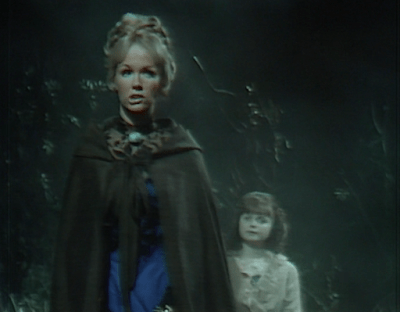
Today, the year is 1897 and Edward and Laura’s nine year old daughter Nora is convinced that her mother will return after a year when she has been away and it has been forbidden to mention her name. Nora has a vision of Laura’s face in the fireplace, a vision of flames in the corridor, and a dream in which she meets Laura in the woods outside the house. At the end of the episode she wakes up, sneaks out to the woods, and finds the cloak Laura was wearing in her dream lying on the ground.
All of this is recapped from previous episodes, but actors David Selby, Louis Edmonds, and Denise Nickerson make it worth watching. As Beth, Terrayne Crawford is stiff and literal, and her awkward performance does detract from her scenes. But everyone else is so good that you don’t notice her weaknesses too much.
This episode marks the second time we hear the name “Mrs Fillmore.” In #707, we learned that Beth took substantial sums of money into the village of Collinsport to a lady of that name as part of the plot to cover up Jenny’s presence in the house. Today Beth has to remind Edward of that fact, and Quentin looks through the envelope with hundreds of dollars in banknotes meant for Mrs Fillmore.
When Nora screams that there is a fire in the upstairs hallway, Edward and Beth run towards it. Quentin just sulks in the drawing room; evidently the idea that the house is on fire bores him. By the time Beth and Edward get upstairs, the flames Nora saw have vanished, and nothing is burned. She swears that there was a fire, they cannot believe her. This echoes #400, when wicked witch Angelique cast a spell that caused time-traveling governess Vicki to see flames in her room in the Old House on the estate, and subsequently Vicki’s friends were puzzled that there was no indication there of anything burned. That confusion led to trouble for Vicki, and longtime viewers can imagine it is a sign of trouble for Nora as well.
Yesterday, Nora drew a series of Egyptian hieroglyphics saying that her mother was coming home. At the beginning of her dream, a maniacal Edward holds an oversized copy of that drawing and rips it up, declaring Laura will never be back. The oversized drawing harks back all the way to episode #722, when Nora’s governess, neurotic intellectual Rachel Drummond, had a dream in which the daffy Carl Collins held a gigantic pocket watch. That was a striking enough image that not even the Vaseline almost entirely covering the lens could ruin it. But today even less of the picture is legible, and the gambit isn’t fresh anymore. Louis Edmonds does do a fine job of laughing maniacally, though, I will grant that.
The picture really does look like that, and it is supposed to look like that. Director Henry Kaplan was not much of a visual artist. Screenshot by Dark Shadows Before I Die.
Well-meaning time-traveler/ bloodsucking abomination from the depths of Hell Barnabas Collins has found himself in the year 1897, where he must take action to prevent his distant cousin Quentin from becoming a malevolent ghost who will ruin everything for everyone on the estate of Collinwood in 1969. He has no idea what that action will be, so has decided to intrude as aggressively as he can in as much of the family’s business as he can until something turns up.
At the moment, Barnabas is strenuously trying to keep Judith Collins, the mistress of Collinwood, from sending her twelve year old nephew Jamison to a boarding school called Worthington Hall. Worthington Hall is run by the Rev’d Gregory Trask, a descendant of one of Barnabas’ old nemeses. Yesterday, Trask had an unsettling encounter with Jamison during which the camera dwelt heavily on Jamison’s nervous habit of fiddling with his belt, prompting us to wonder why Trask gives Jamison the feeling that he ought to make very sure he remains fully clothed.
Today, Trask’s daughter Charity shows up. Nancy Barrett, who previously played the sometimes-capricious, always likable heiress Carolyn and the fragile, highly comic heiress Millicent, makes Charity just as imposing a heavy as her father.
Jamison’s governess, neurotic intellectual Rachel Drummond, tells Barnabas that she was a student at Worthington Hall for many years, and that the place was gruesome. The Trasks kept the children separated from one another, locked them in cupboards for weeks on end when they incurred their displeasure, and generally exploited and abused them. She herself was forced to stay at the school as a teacher when Trask lied to her and claimed that she owed him money, and she escaped with the aid of a fellow sufferer.
Trask confronts Rachel in the drawing room. She tries to stand up for herself, but he breaks her resistance down expertly. Trask’s one moment of weakness comes when he starts talking about Rachel’s lovely hair, and he suddenly turns away. The mask has slipped, and the audience has seen that Trask’s interest in Rachel is sexual. But Rachel is too intimidated to recognize what has happened, and when he resumes his righteous tone she crumbles. When she next sees Barnabas, she rushes away in tears.
Rachel had another traumatic experience over the last few days. Quentin died, turned into a zombie, and abducted her. No one has given her the news yet, but Quentin came back to life yesterday. She is horrified when he comes into the drawing room and sees Quentin. At first he takes on a lumbering gait, and she screams. Then he laughs and starts walking normally. He explains what happened, as best he can, and they have a strangely pleasant conversation. Again, this is a testament to the high quality of the acting. It is hard to imagine that anyone less charming than David Selby could make us believe a woman would be so comfortable with Quentin after what Rachel has been through.
Barnabas takes on the form of a bat and bites Charity in her bedroom. Presumably he does this so that he can use her as an agent against her father. This raises the question of why he didn’t just bite Trask and put an end to the whole thing. Of course, the real-world explanation is that the writers wanted to keep the story going, but usually they take care to maneuver Barnabas into a situation where he is compelled to bite one person rather than another. So it’s rather sloppy to end the episode this way.
Still, this is a very good installment. Too good for some viewers; my wife, Mrs Acilius, refuses to watch the Gregory Trask episodes, because Jerry Lacy plays him so effectively that it ruins her day to spend half an hour in the presence of such an overpowering evil. Kathryn Leigh Scott brings Rachel’s self-doubts and final defeat vividly to life as well. By the time I got to the end of their scene, I was shouting at the screen “Bring back the zombies and werewolves and witches!” So I cheered when Barnabas bit Charity.
In April 1967, Barnabas Collins showed up at the great house of Collinwood, home of Elizabeth Collins Stoddard and her family. Liz (Joan Bennett) was isolated, embattled, and under the control of a blackmailer. When a courtly gentleman claiming to be a distant cousin from England showed up, apparently wanting nothing from her but her friendship, she quickly accepted him, even giving him the Old House on the estate to live in. As Barnabas’ eccentricities became ever more difficult to ignore and bizarre and terrible events piled up around him, Liz steadfastly refused to entertain the idea that Barnabas might be anything less than perfectly trustworthy. Since Barnabas was in fact a vampire escaped from his grave to prey upon the living, this refusal tended to push Liz further and further to the fringes of the story.
Now Barnabas has traveled back in time to the year 1897. Joan Bennett again plays the mistress of Collinwood. Like Liz, spinster Judith Collins has agreed to let Barnabas stay in the Old House and do some work on it, presumably at his own expense. Unlike her, Judith is not desperate for friendship, and she is not at all sure Barnabas is someone she should trust.
Today, Joan Bennett is in closeup while a recorded monologue in her voice tells us what Judith thinks of Barnabas:
What is happening to all of us? Until Barnabas arrived, everything seemed the same. But what has Barnabas to do with it? Something, something, I’m sure. He knows too much, he’s involved himself so quickly, as if he were the center of it.
Had Liz ever thought in those terms for one second, Barnabas would have been exposed and destroyed and Dark Shadows would have gone back to telling stories about the Collins family cannery. But 1897 is a more dynamic setting, in which no one has much time to wonder where Barnabas goes during the daylight hours or why he keeps his cellar door locked.
Today’s great crisis concerns Judith’s brother Quentin and her twelve year old nephew Jamison. Quentin died the other day, which you might expect to mark an ending of sorts. But as it happens, his body is roaming about as a zombie and his spirit has taken possession of Jamison. Yesterday Judith permitted Barnabas to do some mumbo-jumbo that lured Quentin back to his coffin, and, with the help of Judith’s surviving brother Carl, Barnabas buried Quentin and filled the grave with cement. But before the episode was over, Quentin had made his way out of the ground and abducted governess Rachel Drummond. For his part, Jamison is still possessed.
Today, Barnabas announces to Judith that she must let him take Jamison to Quentin’s grave, where he will perform another ceremony. Judith is appalled, as one might expect her to be, but yields to him. By the time Barnabas and Jamison come back to the great house, Judith is entertaining a visitor. He is the Rev’d Mr Gregory Trask.
When longtime viewers see Jerry Lacy wearing a cassock, they will expect to hear Trask’s name and title. Mr Lacy played another Rev’d Trask from December 1967 to March 1968, when Dark Shadows was set in the 1790s, the period when Barnabas first became a vampire. That Trask was a fanatical witchfinder whose zeal was matched only by his ineptitude. Wicked witch Angelique was able to manipulate Trask for her own purposes, and he earned Barnabas’ most cordial hatred.
When Barnabas sees Gregory Trask, he blurts out his surname. Puzzled, Trask asks if they have met. Barnabas does not answer, but immediately begins to display his hostility towards the newcomer. Barnabas is a poor tactician who has a habit of volunteering to his enemies exactly what he thinks of them. His interactions with the first Trask were a case in point, and we see him falling into the same pattern with this second.
Trask has come to Collinwood at the invitation of Judith’s brother Edward, father of Jamison and of nine year old Nora. Just four weeks ago Edward brought Rachel to the great house to be Nora and Jamison’s governess; last we saw, in #715, Edward was optimistic Rachel would work out well in her position. But now he has called Trask to come and take the children away to a school he operates, eliminating the need for a governess.
With Quentin lumbering around the house and Jamison spouting off about his possession, Judith and Barnabas cannot keep Trask from figuring out what is going on. He sits Quentin in a chair, intimidates Jamison into kneeling, sends Barnabas and Judith out of the drawing room, and starts praying for help. When Barnabas tries to enter, Trask tells him he can do nothing but help the devil, and slams the doors in his face. Judith and Barnabas are left standing in the foyer, wondering what will happen.
Ethnic stereotype Magda Rákóczi is at home in the Old House on the great estate of Collinwood when Rachel Drummond, governess to the children in the great house on the same estate, comes to the door. Rachel says that the late Quentin Collins has risen from the dead and attacked her. Quentin was about to bury Rachel in his own disused grave when Magda’s husband Sandor showed up. Sandor fought Quentin, enabling Rachel to escape. Rachel cannot satisfactorily answer Magda’s questions about whether Sandor survived the fight, and Magda will not honestly answer Rachel’s questions about how Sandor knew to come to her aid.
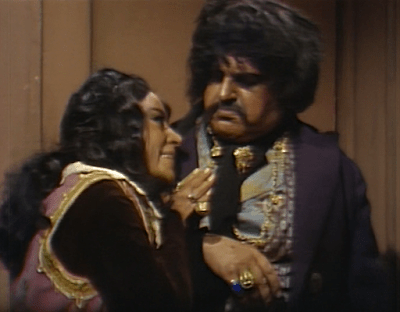
Sandor makes his way back. Magda is overjoyed to see him and throws herself at him with undisguised affection. He responds with his usual grumpiness. At the end, she remembers that they are not alone, and she reverts to their usual form of pretend-quarreling. Their dialogue is great fun, and Grayson Hall and Thayer David make the most of every laugh line:
Sandor: Oh, shut up. I cannot hit you. My arm is too sore.
Magda: Oh, what a brave man you are.
Sandor: Yes.
Magda: What a brave man to fight a zombie, a brave, foolish man.
Rachel: He is a brave man. Thank you, Sandor.
Sandor: I don’t like to see a beautiful lady getting buried before her time.
Magda: But you could have been killed.
Sandor: Yes, that at least would have made you cry. Get me some hot water. My wrist is beginning to swell.
Magda: Oh, so now, I have to nurse you. It is better he should have finished you!
Sandor and Magda are the first happily married couple we have seen on Dark Shadows, and this scene shows them at their very happiest. It is not only a good bit of comedy, it is quite lovely.
Rachel is bookish and intellectually ambitious, very much the sort of young lady you might expect to find in charge of the education of the children in a wealthy family in the late Victorian age. She tells Sandor that she cannot accept that Quentin has risen from the dead and is roaming about as a zombie, even though she has encountered as much evidence of the fact as anyone could want. When Sandor urges Rachel to believe what she has seen, she asks what she will have to believe in next- “Ghosts? Witches? Werewolves?” Sandor affirms that he believes in all of those things, and Rachel replies that she cannot.
Well might Sandor believe in such beings. He is under the power of the new master of the Old House, Barnabas Collins, a vampire. Barnabas rises from his coffin in the basement at dusk, when Rachel is upstairs sleeping. Barnabas knows that Angelique, the same witch who made him into a vampire in the 1790s, is controlling Quentin and persecuting Rachel. When Quentin turns up in the basement, Barnabas remembers a ceremony he saw on Angelique’s home island of Martinique that reunited a zombie’s soul with his body and made him once more a living man. He sends Sandor to the attic to retrieve a packet of letters he wrote to his uncle Jeremiah in those days, describing the ceremony.
Jeremiah’s name will jolt longtime viewers. Angelique raised Jeremiah from his grave as a zombie in #393. Over the next five episodes he initially did Angelique’s bidding, then turned on her. They never did tell us that Jeremiah had returned to his grave, in spite of Angelique’s phenomenally vehement exhortations to him to do so. It’s too bad Barnabas didn’t remember these letters then, he might have been able to un-kill Jeremiah.
Or perhaps not. The ceremony is a total failure today, so maybe Barnabas just doesn’t have what it takes to reunite a soul with a body.
When Sandor and Quentin are fighting in the graveyard, we see a tombstone labeled “Laura Murdoch Radcliffe, born 1840.” The Oxford English Dictionary doesn’t have any examples of the phrase “Easter Egg” meaning hidden content of special interest to devotees until 1986, and for that matter this episode aired a few days before Easter began in 1969. So it is doubly premature to call this an Easter Egg. We learned in #181 that a woman named Laura Murdoch Radcliffe died (by fire!) in 1867, with her young son David in her arms; other Laura Murdochs have died that way in other years, and in #187 the residents of the great house decide that Laura Murdoch Collins is likely to take her own young son David to the same fate. The show has been dropping reminders of the Laura story lately, and any longtime viewers who can read this tombstone will appreciate the reference.
I suspect that the original audience for this particular Easter Egg was pretty nearly limited to the set decorators. The inscription is on screen for less than a second, and it is as clear as it is in the capture above for only a small fraction of that time. It’s hard to see even on a modern television; on a 1960s-vintage TV set tuned to an ABC affiliate, many of which had the worst reception in their markets, it must have been totally illegible to something like 99% of the audience. Moreover, it comes at the end of the fight scene, when most eyes were focused on Sandor’s falling figure. Not very many of the few thousand people who might have had a good enough picture to read the inscription would have been looking at it. And most of the audience who were tuning in at this point had joined the show after Barnabas was introduced, the month after Laura went up in smoke, her name unmentioned since. But in the age of streaming and DVDs, we can all appreciate the reference.
Quentin Collins is dead, his sister Judith would have you know. Their brother Carl is not so sure, but Carl is quite daft. So when high-strung governess Rachel Drummond reports that Quentin has taken a seat in the rocking chair in her bedroom, Judith is exasperated. She orders Carl to stop quivering and go into Rachel’s room himself to look at the rocking chair. Carl obeys Judith, and sees that the chair is vacant. Judith then orders Rachel to accompany her to the drawing room to see Quentin resting in his coffin. To Judith’s consternation, they see that the coffin is empty.
Judith and Rachel wonder who is playing morbid games with Quentin’s corpse. Of all the residents of the great house on the estate of Collinwood, Carl would seem to be the most obvious suspect. He is not only mentally unbalanced, but is also an inveterate prankster whose practical jokes are often disturbingly unpleasant. However, Carl is quick to break into maniacal laughter when he sees that the targets of his japes are uncomfortable, and he is not laughing now. He seems to be quite sincerely terrified. So Judith sends Carl upstairs to see if the body has been returned to Rachel’s room.
While the ladies are alone in the drawing room, Judith and Carl’s distant cousin Barnabas arrives. Judith tells Barnabas what has happened. When Judith expresses puzzlement as to how a dead body could be moved in and out of Rachel’s bedroom without using the door to the corridor, Barnabas mentions that there is a secret panel in the room. Judith is startled. She asks Barnabas how he, who only arrived from England a few weeks before, could possibly know about that panel. He claims that he read a “rare volume” by “the architect of Collinwood.” Judith does not seem entirely convinced, but she lets this explanation pass unchallenged.
Carl does not find the body in Rachel’s room, but he does notice something behind the drapes in the corridor. He pulls them apart to see Quentin. Carl screams. Quentin lumbers towards Carl and begins strangling him. Carl collapses, and Quentin leaves him on the floor.
Carl comes to in the drawing room. He tells Barnabas, Judith, and Rachel what happened. Judith cannot believe that Quentin has risen from the grave, and Barnabas takes it upon himself to tell her about zombies. He claims to have seen a zombie and to have witnessed ceremonies used to put them to rest while he was a young man on the island of Martinique.
Judith agrees to let Barnabas try his mumbo-jumbo. While the ladies are upstairs, Barnabas and Carl are in the drawing room, burning some potpourri next to Quentin’s coffin. Quentin comes lumbering in, and they withdraw to the shadows. The fun Jonathan Frid and John Karlen had working together is one of the most enjoyable things to see on Dark Shadows, but they get a little bit carried away in the moment when Barnabas and Carl hide. As they scurry off, they are so obviously a couple of kids playing that we are distracted from their otherwise outstanding performances.
Quentin comes back and resumes his place in the coffin. At Judith’s insistence, Carl and Barnabas bury the coffin on the grounds and pour cement over it. Judith assures Rachel that this means Quentin will not come back. Rachel is disappointed when Judith says she believes that Barnabas has gone back to the Old House on the estate, where he is staying. Since they have had such an exhausting night and it is almost dawn, Judith assumes that Barnabas will want to go to bed. Judith herself does retire.
Barnabas comes back and tells Rachel that he had to make sure she was all right. She thanks him, and says that during the day she will be leaving Collinwood, never to return. He asks her to reconsider. He says that he wants to see her again, but that he has to leave immediately and he cannot possibly return until the following night. He will not tell her why. Regular viewers know that Barnabas is a vampire and that he will turn to dust if he doesn’t get back into his coffin in a few minutes and stay there until sundown. Barnabas doesn’t seem to think that his relationship with Rachel has come to a point at which he can share secrets like that with her, so he evades her questions and rushes off. Rachel heads upstairs.
We see the doors open by themselves and hear the wind. Thinking Barnabas has returned, Rachel hurries down. Baffled that no one is there, she goes outside. She turns and sees Quentin. He plods towards her, and she faints into his arms. This impressively well choreographed movement brings us to a dramatic conclusion.
Another drab-looking outing from director Henry Kaplan, enlivened with some witty writing by Violet Welles and sprightly acting by John Karlen and David Henesy.
Daft prankster Carl Collins (Karlen) goes to the suite in the west wing of the great house of Collinwood recently occupied by his brother, the late Quentin Collins. Carl finds his nephew, twelve year-old Jamison Collins (Henesy) sitting by Quentin’s gramophone, listening to a sickly sweet waltz of which Quentin was fond. Carl mutters and rambles, claiming at one moment that Quentin is not really dead and at the next that he has a theory about who really killed him. Jamison just stares in response. Carl, agitated, demands that Jamison turn off the gramophone. When he does not answer, Carl declares that he is Jamison’s uncle. Jamison calmly replies that Carl is not his uncle, but his brother.
Carl comes back with his sister Judith. They question Jamison, who seems to know things only Quentin would know. Judith declares that “The child is possessed!” and flounces out of the room.
Jamison’s governess, Rachel Drummond, has a dream in which Jamison and Judith make her uncomfortable. She tries to go to the drawing room, only to find Carl blocking her way. He is wearing a railroad conductor’s hat and holding Jamison’s toy locomotive. He tells her it is too late to pass this point, and shows her a gigantic pocket watch to prove the point. She wakes up to find Quentin’s body sitting in a rocking chair next to her bed.
Well-meaning time-traveler/ bloodsucking fiend Barnabas Collins enters a cottage on the grounds of the estate of Collinwood to find thuggish groundskeeper Dirk Wilkins standing over the freshly stabbed corpse of the rakish Quentin Collins. Since Quentin’s cause of death is a long-bladed thrusting dagger, a weapon also known as a “dirk,” it would seem clear that Wilkins is the culprit. But as it happens, Barnabas saw Wilkins enter the cottage a moment before, so he can be fairly sure he did not kill Quentin.
Nonetheless, Barnabas threatens to go to the police and accuse Wilkins unless he answers “a lot of questions.” Barnabas doesn’t have any witnesses to back up his version of events, and though he claims to be a relative of the ancient and esteemed Collins family he only arrived in town a few weeks before. But Wilkins isn’t hard to intimidate, so he answers some of Barnabas’ questions about madwoman Jenny Collins. Most importantly, he tells Barnabas that Jenny is the estranged wife of Quentin, not of Quentin’s brother Edward as the audience had been led to believe in the four weeks leading up to Friday’s episode.
As Wilkins, actor Roger Davis has been getting very careless with his lines. Jonathan Frid always had a lot of trouble with his own dialogue, but he is clearly sticking with the script in an exchange like this:
Wilkins: Mr. Collins, you gotta understand that she’s crazy in the head! She could hurt herself — or somebody!
Barnabas: Who do you mean by “we”?
This comes to a head with one of Dark Shadows‘ most famous bloopers:
Barnabas: Tell them that you saw no one here. Wilkins: Oh, that’s fine. What am I gonna tell ’em? Barnabas: That you saw no one here!
Jenny is being kept in a cell in the basement of the great house on the estate. Wilkins and maidservant Beth were assigned to watch her. On Friday Jenny bashed Wilkins on the head with her dinner tray, unfortunately not hard enough to kill him and get the odious Mr Davis off the show. She did knock him out, though, and ran off to the cottage to stab Quentin. We cut to the cell, where Jenny is babbling to Beth. It gradually dawns on Beth that Jenny is telling her she stabbed Quentin and killed him. Beth locks Jenny in the cell and rushes off to the cottage.
In the cottage, Barnabas has summoned wicked witch Angelique and asked her to bring Quentin back to life. Angelique points out some of the flaws in Barnabas’ plan, and tells him that even if she does grant his wish the price for her services will be very high. They seem to be approaching a tentative agreement when Beth arrives at the door and Angelique vanishes.
Beth finds Barnabas in the cottage. He tries to keep her out. It has long since been established that, as a vampire, Barnabas is far stronger than any mortal man, yet Beth pushes past him without apparent difficulty. For that matter, we also know that he is as capable as Angelique of vanishing into thin air, yet he hangs around while Beth sees Quentin’s body. Barnabas insists she tell no one what she saw in the cottage, and he is staring at her with the same intensity that has sometimes exerted an hypnotic effect on people. This doesn’t work on Beth. She says that she will tell Judith Collins, the mistress of the estate, that Quentin is dead and that Barnabas was with him. Barnabas just watches Beth go. Evidently he has given up on using his vampiric powers. Terry Crawford’s literal acting style doesn’t win her much enthusiasm from the fans of Dark Shadows, but it does add a touch of humor to a scene like this. Vampire? What’s that? Sounds like bullshit, I’m gonna report this to the boss.
We cut to the drawing room of the great house, where Quentin’s body is laid out in a coffin with candles burning on high stands by its head and foot. Barnabas and Beth are there. Beth tells Barnabas she has not yet spoken to Judith. Apparently she just took Quentin’s body to the great house on her own? And found a coffin? And carried it into the drawing room where she put Quentin in it? And that’s how the family is going to find out Quentin is dead, by seeing him lying in state in the middle of the house?
Barnabas and Beth exit, and Angelique enters. She tells the corpse that she will raise him from the dead, and that once she does Barnabas will really be sorry.






 Dark Shadows Commentary