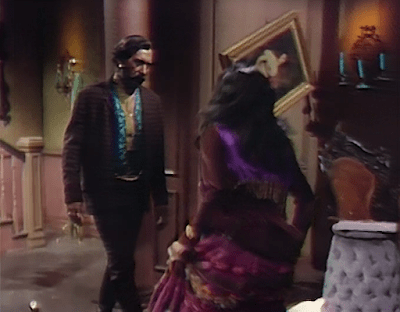
As the full Moon is about to rise, hypocritical Rev’d Gregory Trask is standing outside the prison cell in the basement of the great house of Collinwood. He is taunting its inmate, rakish libertine Quentin Collins. Trask knows that Quentin is a werewolf, and is reveling in the prospect of watching him transform, then going to the police.
To Trask’s great disappointment, Quentin stays human. Once the Moon has been up for a while, Quentin grows jubilant. He threatens to contact the police himself, and points out that Trask is committing a number of felonies by holding him in the cell. With singularly poor grace, Trask lets him out. The scene between them is hilarious.
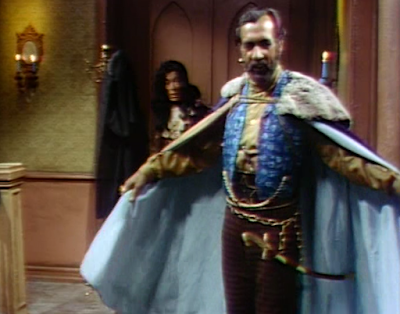
In the foyer, Quentin meets 150 year old sorcerer Count Petofi. He grabs Petofi by the neck, trying the old fellow’s patience. Petofi says that it is quite silly of Quentin to behave as if he can do him physical harm, and that he ought to learn to curb his temper. “But you’re also rather charming, which means there’ll always be somebody who’ll help you.” Of course Quentin is enormously charming- he is played by David Selby. When we first met him, Quentin was a ghost who never spoke but spent months abusing children, murdering day players, threatening to kill our favorite characters, and bringing every storyline screeching to a halt. Still, enough of Mr Selby’s inherently adorable personality came peeking through that Quentin was already a fan favorite long before he delivered a word of dialogue.
Something similar is going on with Amanda Harris, who is an oil painting come to life. Amanda is much nicer than the ghost of Quentin was, but she is a bit shaky in execution. Future Broadway star Donna McKechnie admits nowadays that, while she was a highly trained dancer and singer by 1969, she was still something of a beginner at acting, and that does show when Amanda has a lot to say. But her limited skills really don’t matter at all. Even when Miss McKechnie looks at a scene partner, takes a deep breath, and shouts a whole speech, she is so appealing that your only question is why Amanda acts that way. Maybe that’s how all oil paintings behave two years after they’ve come to life.
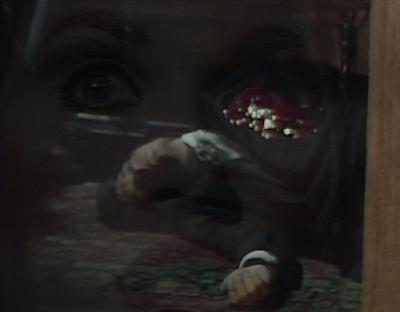
In her two-dimensional form, Amanda was the product of Charles Delaware Tate, an artist who received great talents as the result of a Faustian bargain with Petofi. Tate is in the village of Collinsport now. Petofi summoned him to paint a portrait of Quentin. We’ve had many heavy-handed clues that the portrait would function like the picture of Dorian Gray, and that on nights of the full Moon it would transform and leave Quentin as a human. Today Quentin finds the portrait in his room, and it indeed looks like the werewolf. Unfortunately for the show, the werewolf is a cute doggie who wears a tidy little suit, and unless you see him in the act of killing someone it is impossible for us to be afraid of him. As a painting, he wouldn’t pass muster as a set decoration for the walls of an ostensibly haunted house on Scooby Doo Where Are You.
Sorcerer Count Petofi enters the great house of Collinwood, carrying a large painting covered with a cloth. He finds the hypocritical Rev’d Gregory Trask, who is at the moment master of the house, standing in the drawing room, dazed. Petofi realizes that Angelique the witch cast cast a spell on Trask, and that this spell is part of her effort to obstruct his own evil plans.
Petofi meets broad ethnic stereotype Magda Rákóczi in the foyer. He forces her to tell him that Angelique is upstairs, in Quentin Collins’ suite. He exits, taking the painting with him.
Angelique is casting a spell, ordering Trask to point a revolver at his temple. She is about to make him squeeze the trigger when Petofi surprises her. He overpowers her, both physically and in terms of the spell, and frees Trask.
Quentin is in the prison cell in the basement. Together with the scene between Petofi and Angelique, this circumstance will ring bells for longtime viewers. We first saw this cell in #401, when the show was set in 1795. In that part of the series, Thayer David played much-put-upon indentured servant Ben Stokes, who was a plaything in Angelique’s hands. Ben was the first prisoner confined to the cell, when haughty overlord Joshua Collins was punishing him for some or other things he had been powerless to prevent. Now, the dramatic date is 1897, and the same actor is playing Petofi, who stands at the opposite extreme from Ben. Angelique is not much better able to resist Petofi than Ben had been to resist her, and so far from being a place where he will be imprisoned the cell is just another place for him to exercise his power over everyone else.
Quentin is in the cell because he is a werewolf, and this is the night of a full Moon. The closing cliffhanger comes when Trask, released from Angelique’s spell, comes and tells him he will watch him transform into the animal, then go get the police.
We open in the woods on the estate of Collinwood, where a young woman in heavy makeup and bright clothing is crying. Another woman in even heavier makeup and even brighter clothing approaches and asks her what is wrong. The first woman says that she had a vision which told her that the rakish Quentin Collins will die of stab wounds twelve days from now, on 10 September 1897.
The first woman used to be Charity Trask, the miserably repressed daughter of the evil Gregory Trask. She is now possessed by the spirit of Cockney showgirl Pansy Faye. Charity knew that Quentin was a werewolf, and wanted nothing to do with him. Evidently Pansy did not acquire that knowledge when she took up residence in Charity’s body, and has decided that she will marry Quentin. Quentin has no interest in either Charity or Pansy, and already has two other fiancées, one of whom he loves, at least after his fashion, and the other of whom is sealed to him by a pact with the Devil. Yesterday Charity/ Pansy learned of the second engagement, and tried to kill Quentin to prevent it coming about; week before last, she tried to end the first engagement by killing the fiancée. Pansy had her faults, but she wasn’t inclined to physical violence. That part seems to be Charity’s contribution to the symbiont.
The other woman is broad ethnic stereotype Magda Rákóczi. Magda was the one who made Quentin a werewolf in the first place. She cursed him for murdering his wife Jenny, who was her sister. It was only after she had placed the curse that Magda learned that Jenny had given birth to Quentin’s twin children, a boy and a girl. Since the curse is hereditary, Magda is now desperate to lift it, and she and Quentin have become allies.
Some time ago, we learned that if Quentin dies, there will be no hope of lifting the curse. So Magda is terrified when Charity/ Pansy tells her of her vision of Quentin’s death. She takes her back home to the great house on the estate, where her father and Quentin are bickering while they recap yesterday’s story. Trask tries to deny that Charity/ Pansy is insane or that she is capable of killing, but when she enters and announces that she will murder the first person who comes between her and Quentin he has to admit that it might be time to find a place for her in residential care.
We turn our attention to the upstairs of the great house. We see Charity/ Pansy in bed, with Magda sitting in a chair beside. The gramophone is playing a record of Pansy Faye’s theme song. Regular viewers will wonder where Charity/ Pansy could possibly have found such a thing. Charity never met the living Pansy, who was killed the very evening she arrived at Collinwood. Perhaps Pansy’s fiancé, the childlike Carl Collins, bought the record when he met Pansy in Atlantic City and brought it back with him. Carl himself was killed well before the possession began, but perhaps Charity or Charity/ Pansy found it among Carl’s effects.
Charity asks Magda if she likes the tune. “I only like Gypsy music,” she replies. Charity/ Pansy and Quentin both reiterate their theme songs endlessly, but few other characters in the 1897 segment have so much as a dedicated entrance cue. This line of Magda’s makes us wonder what the show might have been like if they had given every major character a theme song.
Trask has a crisis in the drawing room. He hears a ghostly voice warning him that there will be another killing soon. He starts shouting the name “Minerva!” and pleading for mercy. First time viewers might not know what to make of this. Those who have been with the show for a while know that Minerva was Trask’s wife and Charity’s mother, and that he instigated a plot to murder her so that he could marry wealthy spinster Judith Collins and become master of Collinwood. When the voice starts to talk about “the beast that walks like a man,” Trask says “You’re… not Minerva?” Jerry Lacy is an expert comic actor, and his delivery of that line is laugh-out-loud funny.
The same ghost appears visibly to Quentin in his room. He recognizes it as that of Tessie Kincaid, a woman he killed in a recent fit of lycanthropy. He knows that she is appearing to him because tonight there will be a full Moon.
Magda enters and finds Quentin writing a suicide note. She tells him he must not kill himself. She chains him to a post in his room and stands by with a pistol. Trask enters and finds them in this compromising position. Mrs Acilius and I laughed as we imagined how Magda and Quentin might have claimed they were planning to spend the evening.
But there is no point in lying to Trask. Between what Tessie’s ghost told him and what he overheard while eavesdropping on a conversation Quentin and Magda had earlier in the drawing room, he has figured out Quentin’s problem. He takes the gun from Magda and recognizes the bullets with which it is loaded as silver. He announces that he will wait until the Moon rises and see what happens.
Tessie’s turn today marks Deborah Loomis’ third and final appearance on Dark Shadows. Miss Loomis didn’t get to do very much, but she made the most of all of it, and I wish we had seen more of her.
The dramatic date is 28 August 1897. On 23 July, in #803, sorcerer Count Petofi cast a spell on stuffy Edward Collins. Ever since, Edward has believed he was a valet recently separated from the service of the Earl of Hampshire. This led Edward’s brother, the rakish Quentin, to follow the Collinses’ long-established procedure for responding to mental illness and lock him up in the room on top of the tower in the great house of Collinwood.
In #816, broadcast on 11 August 1969 and therefore set on 11 August 1897, Petofi brought something even stranger on Edward’s twelve year old son Jamison. He called the spirit of Jamison’s grandson David to project itself from 1969 and to take possession of Jamison. In 1969, David is deathly ill because Quentin’s ghost had besieged him and everyone else at Collinwood. Now, Jamison too is dying, and in the moments he has been able to speak he has let the living Quentin in on the fact that he will eventually become a family-annihilating ghost.
Wicked witch Angelique has made a bargain with Quentin. She will try to restore Jamison and Edward to their usual selves, and if she succeeds Quentin will marry her. We see her beside Jamison, talking earnestly with him, praying loudly to “the Master of Darkness” to cure him and Edward so that she and Quentin can devote themselves to the service of that supernatural personage. In 1968, when the show was in contemporary dress, Angelique and others used a lot of euphemisms like “Master of Darkness,” but lately the ratings are high enough that the ABC network’s office of Standards and Practices has been letting them say the name “Satan.” I suppose Angelique’s persistence in the former phrasing shows that she’s still devoted to the old time religion.
Satan comes through, and Jamison and Edward are freed. This leads to a bit of awkwardness in each case. Quentin and Edward’s step-niece Charity Trask has lost her personality as the result of another of Petofi’s spells, and is now hosting that of the late Pansy Faye, Cockney showgirl and onetime fiancée of Quentin and Edward’s late brother Carl. Charity/ Pansy is exploring the great house when she comes to the locked door of the tower room. She hears Edward inside calling for help. He is still in his valet persona, and he is delighted with her when she promises to get a key and let him out. Edward returns to himself, with no memory of anything that has happened since 23 July, while Charity/ Pansy is away. When she comes back up and opens the door, she finds that he is in a foul mood and that he disapproves of her intensely. She is understandably miffed at his apparent fickleness and ingratitude.
For his part, Jamison’s quite different experience has left him with some memories. He tells Angelique of images that are floating around in his mind. She recognizes them as things associated with Petofi, and is distressed. She tells him he is better off not knowing what they are. Quentin is more distressed when Jamison looks at him and asks why he is trying to kill David Collins. Jamison can’t explain who David Collins is or how he learned that Quentin was trying to kill him, but this does confirm everything Quentin has gathered about his post-mortem destiny.
While Edward comforts Jamison in the study, Quentin and Angelique meet in the drawing room. She asks if he will honor his end of their deal; he says that he will, though he makes abundant protests about his reluctance to do so. Charity/ Pansy eavesdrops at the door. She has decided that she will marry Quentin, and is horrified to hear this conversation.
Edward enters and asks Angelique to excuse him and his brother. She exits, and Edward declares that the first order of business must be to hunt and destroy vampire Barnabas Collins. Quentin is appalled at this. He tries to tell Edward that Petofi is their most immediate threat; after he explains who Petofi is, Edward agrees that they will get around to fighting him at the appropriate time, but he insists that Barnabas is their main concern.
Edward exits, and Charity/ Pansy enters. She tells Quentin that she overheard his conversation with Angelique. She says that he will not marry Angelique. Quentin bitterly responds that he will, and that there is nothing she can do to stop it. At this, Charity/ Pansy picks up a knife and tries to stab Quentin. Quentin holds her at bay, and Edward enters in time to see what is happening and to get Charity/ Pansy off of Quentin. Quentin says that Charity/ Pansy’s condition is further evidence of the need to focus on fighting Petofi, but Edward will not swerve from his determination to concentrate on Barnabas. Moreover, he decides that he will now quiet Charity/ Pansy himself. He sends Quentin out of the room and prepares to give Charity/ Pansy a stern talking-to.
Charity/ Pansy’s attempt to prevent Quentin’s marriage to Angelique by stabbing him is of a piece with her attempt to break up Quentin’s relationship with maidservant Beth in #823/824 by poisoning Beth’s brandy. The original Pansy, whom we saw as a live person in #771, was not exactly nice. She was cold, hard, and cynical, trying to exploit the childlike Carl. But she didn’t seem to be bent towards physical violence. That appears to be Charity’s contribution to the composite being that the two of them now make up.
Before Edward can deliver whatever lecture he had planned to give Charity/ Pansy, she goes into a trance. The live Pansy had done a stage act as a “mentalist” and fortune teller, and was astonished in #771 when she tried to do her act at Collinwood and found herself actually channeling spirits from the great beyond. Now Charity/ Pansy routinely acts as a medium.
Charity/ Pansy announces that something terrible will happen on 10 September. Countdowns don’t usually work as a source of suspense on soaps. They might be all right in a play or a feature film, where we know that there will be a final curtain or a last frame after which the imaginary universe will cease to exist, but so long as the series is scheduled to come on every weekday at 4 PM, we know that there is always going to be room to move any deadline a little further out. Besides, since Dark Shadows was done virtually live to tape, they could rarely predict with any accuracy just how many ticks of the clock it would take to get all the movements made and dialogue spoken before the crisis is supposed to be reached. But “10 September” is in a slightly different category. Quentin explicitly says on screen that today is 28 August, which was indeed the original broadcast date in 1969. And when Edward says that his last memories are of 23 July, he is indeed referencing the original broadcast date of #803. So when Charity/ Pansy says “10 September,” she is committing the show to something in the real world. We may well sit up and take notice.
Charity/ Pansy has a vision of what will happen on that date. She sees Angelique looking at a portrait of Quentin in the drawing room. Red paint is dripping from the figure’s chest into a pool on the floor. That pool is next to a trail of other drops of red. In her mind’s eye, Charity/ Pansy follows the drops into the foyer, up the stairs, and into the tower. There, she sees Angelique opening the door to the tower room and finding Quentin sprawled, a sheet of red plastic, or perhaps construction paper, on his chest. Charity/ Pansy screams and runs out. From the dramatic music and Charity/ Pansy’s agitated reaction, I take it the object lying on Quentin’s chest is meant to suggest blood.
The acting is all very strong today. I was fascinated with Nancy Barrett’s use of her face to highlight Charity/ Pansy’s makeup. She relaxes her jaw muscles slightly more than usual, causing the dark treatment around her eyes to stand out. That in turn creates a visual metaphor labeling Charity/ Pansy a “painted lady.”
My wife, Mrs Acilius, was particularly impressed with Louis Edmonds’ realization of Edward. When the spell breaks and he becomes himself again, Edward is alone in an empty room. He has no dialogue, no props, and no scene partner to work with. Yet he instantly conveys what has happened. Even first time viewers will understand that the obliging servant has now become a stuffy authority figure.
Edward’s towering indignation when Quentin first tells him he was the one who locked him in the tower room gives way instantly when Quentin explains that he was under a delusion at the time. Edmonds executes that transition so smoothly that first time viewers will not notice the oddness of it, but longtime fans who remember the many previous occasions when the Collinses locked each other there as a response to mental illness will chuckle.
One of the prominent features of Edward’s personality is his warm relationship with his children. This sets him apart from the first two characters Louis Edmonds played on the show, high-born ne’er-do-well Roger Collins and haughty overlord Joshua Collins. Edward’s dialogue in his scene alone with Jamison involves several discrete points of information, and it would have been understandable if the affection he displays for Jamison while he getting all of those words across had been either perfunctory or mawkish. But he and David Henesy get the emotions exactly right while also delivering the lines very clearly.
Edward’s preoccupation with Barnabas is a delicious little bit of commentary on the show itself. Dark Shadows‘ ratings, chronically low during its first 42 weeks on the air, perked up when it added Barnabas to the cast in April 1967. That summer, schoolkids curious to see a vampire on daytime TV made it into a hit, and not long after Barnabas became one of the pop culture sensations of the 1960s, instantly recognizable to many millions of people who never watched the show. To this day, people who have heard of Dark Shadows are likely to refer to it as “the vampire soap opera from the 60s.” It was Barnabas who took us with him to 1897, when he traveled back in time in the course of his attempt to rescue David from Quentin’s ghost, and for the first months of the 1897 storyline he was the only character who knew what was at stake for the 1969 version of the Collinses in the events going on around him.
But now Barnabas is on the fringes of the story, and Quentin, Angelique, and Petofi all know about 1969. Edward’s idea that the action has to focus on Barnabas is evidence that he hasn’t been watching the show. Petofi is the principal antagonist now, Quentin the chief protagonist, and Barnabas can be absent for weeks at a time while they and others find all sorts of things to do. This represents, not Barnabas’ failure, but his ultimate success. Before he was introduced, every story revolved around well-meaning governess Vicki, the main character. A soap opera can’t really have a main character. It needs to keep multiple storylines running at once, occasionally intersecting with each other, often running for long periods with little or no interaction. When one person had to be at the center of every development, the result was slow and claustrophobic.
Barnabas blew that confining structure open, because as a vampire his function in the story was not to solve problems, but to create problems for other people to solve. So no matter how much time they spent focusing on him, he always directed our attention towards everyone else. We wondered who would catch on to his secret, who would fall victim to his malign intentions, who would find a way to fight him, etc. When a mad scientist managed to free Barnabas of the effects of the vampire curse, he retained his function as a problem-maker, even when he set out to be a problem solver. Every time he announced that he had a plan, we looked forward to seeing how the rest of the cast would react to that plan’s rapid and catastrophic collapse.
Barnabas is as hapless in 1897 as he has been in every other time period, as witness the fact that he has been exposed as a vampire and driven into hiding. But he isn’t even the show’s Screw-Up-in-Chief now. That title belongs to broad ethnic stereotype Magda Rákóczi. In #807, Petofi compelled Magda to review the preceding 22 weeks of the show and admit that she had precipitated every plotline. The first of those was the release of Barnabas into the world of 1897, so that his crimes and misadventures are just a subcategory of hers. Since Magda is played by Grayson Hall, who in her original role of Julia Hoffman is waiting for us in 1969, we can be confident she won’t be coming back to contemporary dress with us, but for the moment she has relegated Barnabas to the status of a secondary character.
In 1897, King Johnny Romana is the hereditary chieftain of a Rroma tribe that has long been at war with ancient sorcerer Count Petofi. King Johnny is at the supreme moment of his destiny, standing over Petofi with his scimitar raised, ready to deal the ultimate blow, when a creepy little guy ruins it all for him. Petofi’s henchman Aristide throws a knife and catches King Johnny in the back. Aristide has a dagger with a curved blade that he sometimes calls “The Dancing Girl,” other times “The Dancing Lady”; he makes a big deal of it, the thing fascinates him. But when he kills King Johnny, Aristide doesn’t even use his special knife. It’s a brutal anticlimax for King Johnny.
King Johnny does live long enough to tell Petofi that he isn’t safe yet. After nine days pass, he will appear to another Rroma, somewhere in the world, and will pass on to that person his immunity to Petofi’s magical powers and his mission to kill him. After Aristide buries King Johnny, he finds that the scimitar has vanished. Evidently it will go to the new avenger.
Meanwhile, at the great house of Collinwood, twelve-year old Jamison Collins is dying. Petofi cast a spell causing Jamison to be possessed by the spirit of his grandson David Collins, who will live in 1969. But David won’t live at all unless the spell is broken, because it is killing Jamison. Jamison’s devoted uncle, rakish libertine Quentin Collins, makes a deal with wicked witch Angelique. He will marry her if she manages to break Petofi’s spell and save Jamison. They made a similar bargain previously, but that time her magic failed.
Petofi senses that his spells are being challenged. He marches to Collinwood and orders Quentin to make Angelique stop what she is doing. Angelique herself enters; she and Petofi confront each other, then she goes back to the study to resume her attempts to free Jamison. We end with Petofi preparing to cast a spell against her.
Petofi confronts Angelique in the drawing room at Collinwood while Quentin looks on. Screenshot by Dark Shadows Before I Die.
This is an entertaining, fast-paced episode. It’s too bad it is the final appearance of actor Paul Michael in the series. He played the most unpromising part of King Johnny so skillfully that we barely noticed he was little more than a menacing pose, an evil laugh, and an ethnic stereotype. He does return with a small part in the feature film House of Dark Shadows, but it would have been fun to see what he could do with a really meaty role.
Rroma chieftain/ New England crime boss King Johnny Romana and his Afro-Romani henchman Istvan have cornered broad ethnic stereotype Magda Rákóczi on top of the cliff at Widows’ Hill. King Johnny declares that he will now kill Magda. She is a major character, it’s a Tuesday, and this is the resolution of yesterday’s cliffhanger, so we have three reasons for expecting her to survive.
However, none of the three reasons is as strong as it might at first appear. First, while Magda precipitated every major storyline in the segment of Dark Shadows set in the year 1897, none of those stories needs any further action from her to continue right now. We’ve also had an indication that Grayson Hall’s original character, Julia Hoffman, will soon be returning to the cast. Second, Dark Shadows never followed the traditional soap opera format in which important developments were reserved for week-ending finales. Third, while the great majority of episode-ending cliffhangers fizzled out in the opening seconds of the next installment, occasionally they did go ahead and resolve one with a death. Besides, as my wife Mrs Acilius points out, Magda laid her husband Sandor’s ghost to rest at the top of the episode, and it is called Widows’ Hill because widows go there to die. So there actually is some suspense as to whether King Johnny will make good on his threat.
Time-traveling vampire Barnabas Collins shows up at the last moment and orders King Johnny to release Magda. King Johnny refuses and orders Istvan to throw Barnabas off the cliff. Barnabas looks into Istvan’s eyes, using his power of hypnosis. Once Istvan is under his control, Barnabas compels him to walk off the cliff. King Johnny then realizes who Barnabas is. He holds Barnabas at bay with a cross. Barnabas tells him that he can reclaim what Magda stole from him, but only if he lets her go. At that, King Johnny becomes cooperative. Too bad Barnabas didn’t open with that- Istvan could have lived. Fortunately for Barnabas and Magda, King Johnny forgets about Istvan instantly.
For a hundred years, King Johnny’s tribe kept as its most prized possession The Hand of Count Petofi. This was literally a severed hand, cut from a Hungarian nobleman. Count Petofi was a sorcerer, and when nine Rroma men severed his right hand in a forest one night in 1797, most of his power went with it. Magda stole the Hand in hopes that she could use that power to undo a spell she herself had cast, but found that the Hand would not obey her. Now Count Petofi himself, 150 years of age, has reclaimed the Hand, and it is once more attached to his wrist. He is hugely powerful and a great problem for Barnabas.
Barnabas tells King Johnny what has happened. King Johnny turns out to be the one person in the world over whom Petofi has no power. In return for Petofi’s location, King Johnny agrees to return with the Hand and lift the curse Magda regrets. In his purple robe, King Johnny goes to Petofi’s hiding place. He and Petofi have a long and rather pointless conversation. Finally, Petofi is strapped to his chair and King Johnny raises his sacred scimitar, ready to re-sever the Hand.
This is a less suspenseful cliffhanger than yesterday’s. Petofi is still generating story; in fact, he is the only character who is. The hideout is Petofi’s territory; we have seen him thwarted there, but the defeats he suffered only confirmed that it is not a place where major changes take place in the direction of the narrative. And the meandering dialogue between Petofi and King Johnny deflates all the dramatic tension. Returning viewers have plenty of time to remember that, while Petofi’s magic may be useless against King Johnny, Petofi’s henchman Aristide is somewhere around, and he is quick with a knife. Without Istvan to run interference for him, King Johnny will be vulnerable to Aristide the whole time he’s dawdling around.
As King Johnny, Paul Michael has a very hard job. Not only is the character an egregious stereotype, but he really is scandalously ill-written. Violet Welles was far and away the best writer of dialogue on the show, and she manages to give a few glittering lines even to King Johnny. Still, he is ridiculous from beginning to end, a lot of menacing poses held together with a sinister laugh. That he is watchable at all is a tribute to Michael’s mastery of his craft. In his facial expressions and body language, we can see evidence of thought that is entirely absent from his words.
Count Petofi, 150 year old sorcerer, is holding time-traveling vampire Barnabas Collins prisoner. Barnabas’ distant cousin, rakish libertine Quentin Collins, is convinced that only Barnabas can free him of the curse that has made him a werewolf and condemned any male descendants he may have to the same fate. Petofi is afraid of the Rroma people, a group of whom are in the area, and Quentin hits on a plan to use this fear to his advantage. He will tell Petofi that he has a confederate who will tell the Rroma where he is unless he releases Barnabas by 12:45 AM.
In fact, Quentin has enlisted his girlfriend, maidservant Beth, to carry this message to the Rroma camp. When Petofi reminds Quentin that his magical powers make it very easy for him both to compel Quentin to tell him who the messenger is and to stop any messenger once he knows her name, Quentin says there is no need to compel him to say the name. He claims that it is wicked witch Angelique.
As soon as Quentin tells this lie, we wonder why he hadn’t thought of Angelique sooner. Angelique has intervened to rescue Barnabas before, and she and Quentin are in touch. Petofi’s powers may be greater than hers, but it would take him more time to outfight her than it would for her to show the Rroma the way to his hiding place.
Petofi insists Quentin drink with him, and Quentin is too civilized to refuse. This is mirrored back at Collinwood. The repressed Charity Trask has lost her personality and became a vessel for the spirit of Cockney showgirl Pansy Faye. Charity/ Pansy insists that Beth drink with her.
While Petofi does not tamper with Quentin’s drink, Charity/ Pansy puts something in Beth’s that knocks her out. Charity/ Pansy wants Quentin for herself. She has thought of killing Beth, and knows Quentin will be upset with Beth if she disappoints him. That leaves us in suspense as to whether she murdered Beth or merely kept her from running her errand.
This diptych emphasizes Petofi’s power and Charity/ Pansy’s unpredictability. Quentin need not fear Petofi will poison him, because there are any number of more elegant ways he could kill him if he wished to do so. As another sorcerer said of himself in #528, he is much too talented to spend his time drugging drinks. But Beth should fear Charity/ Pansy, because she is still connected to the world of the living only uncertainly, and there is no telling what she might do to find her footing.
For some time after the Rev’d Mr Gregory Trask first appeared in #725, he projected an intense evil that overshadowed everything around him. Trask’s daughter Charity debuted in #727. Charity was Trask’s enforcer, and was herself so intensely joyless that her mere presence could drain the life out of anyone she disapproved of. The Trasks are triumphs of acting by Jerry Lacy and Nancy Barrett, but they are so intense they threaten to overload the show. So even as devoted a fan as my wife, Mrs Acilius, chose to skip many of the Trask-driven episodes on this watch-through.
In #771, inveterate prankster Carl Collins brought Cockney showgirl Pansy Faye home to the estate of Collinwood. At that point, Dark Shadows was quite somber; when Pansy starts singing and dancing, she seems to have wandered in from another universe altogether. Pansy bills herself as a mentalist; when she tries to do her act at Collinwood, an actual message from the supernatural interrupts her, much to her astonishment.
Pansy was killed by a vampire named Dirk Wilkins the very night she arrived at Collinwood, leading us to assume that the note of brightness she represented was at an end. But strangely, she has now returned. Charity and Pansy never met; when Carl was looking for Pansy in #772, he asked Charity if she had seen her, and the sheer idea of the two of them sharing a scene was enough to raise a chuckle. But now they share more than that. Sorcerer Count Petofi has cast a spell causing Pansy’s spirit to take up residence in Charity’s body. Now, Charity’s personality seems to have faded away altogether, and all that’s left is Pansy.
Charity/ Pansy has a scene with Trask that blasts away the excessive tension he once introduced. He keeps demanding that she behave as he is used to seeing Charity behave, and she keeps singing, dancing, and making fun of him. Miss Barrett and Mr Lacy are both highly accomplished comic actors, and this scene is among their finest achievements in that field.
It also includes a serious moment that further confirms Charity really is channeling Pansy, not acting out some kind of delusion. At one point she becomes very still and prophesies the circumstances of Trask’s death. As she completes this pronouncement, she says that it is different now when she speaks of things unseen. It used to be a game, but now she hears another voice and reports what it tells her. This picks up on Pansy’s astonishment at her own success in #771, something Charity could not possibly have known about.
Rroma chieftain/ New England crime boss King Johnny Romana has cornered broad ethnic stereotype Magda Rákóczi in her living room in the Old House on the estate of Collinwood. He turns his back on Magda, closes his eyes, and starts reciting a lot of nonsense. Magda sees an opportunity to escape, and creeps over to the front door. When she opens it, a large man enters, blocking her exit.
The man is King Johnny’s minion Istvan. He is played by Henry Judd Baker, who was the only Black man ever to appear on Dark Shadows. He does not have any dialogue; Istvan, King Johnny will tell us later today, lost his tongue as the penalty for a misdeed. We do hear him laugh and grunt. He also wears trousers from the Lilli Von Shtupp “It’s Twoo! It’s Twoo!`” collection.
After Dark Shadows, Baker would reunite with Jonathan Frid, manhandling him in the movie Seizure. He also had a memorable turn in the lamentable 1980 film Cruising as a scantily clad man who slaps the main character. He died in 2016; the funeral home’s website calls him “Judd Henry Baker.” Maybe that’s a mistake on their part, or maybe he flipped the two parts of his given name for his acting work.
Meanwhile, evil sorcerer Count Petofi is holding time-traveling vampire Barnabas Collins prisoner. Petofi threatens to burn the great house of Collinwood to the ground and kill its residents if Barnabas does not take him to the year 1969. Barnabas realizes that this is an empty threat, and refuses to comply. This is notable as one of the few times Barnabas actually outwits someone. Also, Petofi’s sidekick Aristide spends the scene showing off two big flaming torches, continuing the show’s longstanding mockery of the fire marshals of New York City.
King Johnny found a severed hand at Magda’s house, which he thinks is the one that was cut from Petofi’s right wrist long before. Little does he know that Petofi has taken that one and reattached it. When he and Istvan take Magda with them as their prisoner, what they actually have is a hand Petofi cut off a corpse he ordered Aristide to dig up. They haven’t got very far when the ghost of that man appears and reclaims the hand. King Johnny responds to this unusual sight with fury, realizing that Magda pulled a fast one on him. She manages to get away from him and Istvan.
In Dark Shadows #1, set in 1966, two people came to Collinsport, Maine. They were the well-meaning Vicki Winters and dashing action hero Burke Devlin. Vicki had taken a job as the governess in the great house of Collinwood, hoping that she would find the answers to questions she had about her own mysterious origins. Those questions had left her feeling that she knew nothing about herself.
Burke was a working class boy from Collinsport who had gone to New York City five years before, fresh out of prison and penniless. By 1966 he was a corporate raider, a millionaire many times over. He came back to his hometown because he wanted revenge on high-born ne’er-do-well Roger Collins, who used Burke’s car to kill someone while Burke was passed out drunk in the backseat, then persuaded the court that Burke was solely responsible for the homicide. Burke and Vicki ultimately became a couple, but for some months Burke strung Roger’s niece Carolyn along and used her to cause trouble for the Collinses.
Now the show is set in 1897, and Burke and Vicki are both long gone. Carolyn and Roger are waiting for us when the show returns to contemporary dress, and the actors who play them are in the cast in other roles. But we’ve been reminded of Burke recently. Tim Shaw is a working class boy from Collinsport who, after spending time as a teacher at a miserable boarding school run by the evil Rev’d Gregory Trask, was chosen by Trask to take the fall for the murder of his wife, Minerva Trask. As Burke was physically present but mentally compromised at the killing for which he went to prison, so Tim was present at the killing of Minerva, but not in his right mind. The show is about the supernatural now, so it was a magic spell, not booze, that kept Tim from knowing what was going on when he poisoned Minerva. And the pace is too fast for arrests and trials, so Trask’s plan went wrong and he had to tell the police Tim wasn’t guilty after all. So Tim went straight to New York, and just a few weeks later came back to Collinsport, very rich and out for revenge.
Like Burke, Tim arrives in Collinsport with a woman. Unlike Vicki, Amanda Harris knew Tim before they got on the train. But we learn today that Amanda, like Vicki, is tormented by her ignorance of her own background. Again, the starker palette in which the show draws its stories at this period means that instead of not knowing who her birth parents were, Amanda has no memories at all prior to two years ago.
Amanda first appeared as a hardboiled operator who was attached, not to Tim, but to his money, and who gave him expert assistance in the con game he was running on Trask. As Tim was an elaboration on Don Briscoe’s W. C. Fields’ imitation, Amanda was a nod to Mae West. But the show has decided to make Amanda a long-term addition to the cast, and they already have an all-villain cast. So they soften Amanda’s edges. We see her packing her bags and telling Tim she is going to leave because he doesn’t really care about her and she can’t stand what she is doing with Trask. When she complains that Tim is just using her, she echoes speeches Carolyn made after her bitter realization about Burke’s true intentions. Now that her relationship to Tim mirrors both Vicki and Carolyn’s relationships to Burke, Amanda can inherit the goodwill longtime viewers have towards both of those characters.
To Have Something I Can Believe In
Tim’s sudden wealth came from his possession of a magical object, The Hand of Count Petofi. When Amanda first heard of the Hand, she asked if it was a piece of jewelry or some other kind of artifact. It did not occur to her that it was literally the severed hand of a Hungarian nobleman. This gruesome thing had been cut a century before, in 1797, by nine Rroma men, and had ever since been in the custody of the leader of their tribe.
In #778, broad ethnic stereotype Magda Rákóczi returned to her home in the Old House on the grounds of Collinwood. She had gone to Boston, where King Johnny Romana, possessor of the Hand, was staying with his caravan. She had pleaded with King Johnny to help her remove a curse she had placed that made rakish libertine Quentin Collins and all his male descendants into werewolves. Magda had not known when she placed the curse that Quentin was the father of her sister Jenny’s children. She hoped that King Johnny would take pity on the Rroma children and use the Hand to end the curse. When he did not, she stole it, intending to use its powers herself. Magda soon found that the Hand did no one’s bidding. It helped some people, hurt others, and was stolen by each of a long series of scheming characters.
After Tim brought the Hand back to Collinsport, it was stolen again. This time, the thief turned out to be none other than Count Petofi himself, 150 years old and on the point of death. Once he had the Hand back, it reattached itself to his wrist and he regained his health.
Petofi has some sort of plans for Quentin. He has retained one of his minions, nationally renowned artist Charles Delaware Tate, to paint a portrait of Quentin. That project is finished, but Tate is still living in a cottage he has rented in Collinsport. Today Petofi visits Tate there.
Petofi finds Tate sketching an imaginary woman, one he has been obsessively drawing and painting for about two years. Petofi sets himself up as Tate’s analyst. “Only little boys invent ideal women,” says he. He has a plan to relieve Tate’s childish fixation. It is another project. If Tate had seen A Chorus Line, he might appreciate Petofi’s theory of work as therapy, as explained in the lyric “Give me a job and you instantly get me involved, if you give me a job then the rest of the crap will get solved.” But that show won’t premiere for another 78 years, so Tate resists.
It doesn’t help that the job Petofi has in mind involves another severed hand. The Rroma are on their way, and they want the Hand back. Petofi, whose magical powers were formidable even when he was one-handed, is much mightier now, but the thought of the Rroma agitates him violently. Evidently they know about some weakness of his that enables them to defeat him. King Johnny and his men don’t know that Petofi is in Collinsport. He has cast a spell to silence Magda, but they won’t leave the area without the Hand. Several people know about Petofi and have no reason to protect him. If the Rroma start asking questions, it won’t be long before they close in. So Petofi has exhumed a recently deceased local man, cut off his right hand, and brought it to Tate for detailing.
Tate owes his talents, and his life, to Petofi, so the outcome of their meeting is never really in doubt. His next encounter does involve a surprise. Amanda comes to Petofi’s hiding place, sent by Tim, and asks for his help. Petofi tells Amanda that Tim has a poor strategic sense. Indeed, Petofi has already told Tim that, lovely as Amanda is, he has no use for her at the present time. But when he sees her face to face, Petofi recognizes her as the imaginary woman in Tate’s pictures.
Returning viewers already know that Tate’s portrait of Quentin takes on the features of a wolf when the Moon is full, so it is no surprise that his works, like several other portraits we have seen on Dark Shadows, have magical powers. When we learn that Tate first painted Amanda two years ago and she has no history prior to that time, we figure out that he inadvertently used those powers to conjure her into being.
Tate is played by Roger Davis, an unpleasant man who figured as Vicki’s love interest in her last, woefully ill-conceived storyline. In that arc, made and set in 1968, Mr Davis’ part was variously known as Peter Bradford and Jeff Clark. He had amnesia, and Vicki kept trying to help him recover memories which would prove to him that he has no roots in the 1960s, but that he is an uncanny being who was brought to life by an adventure she had outside the bounds of space and time. Once we recognize what they are suggesting about Amanda’s origin, longtime viewers might expect an inversion of that story, with Mr Davis playing the person trying to persuade his lover that he accidentally created her by a magical process he himself did not understand.
Somebody to Dance For
While all of this action is taking place downstream of Count Petofi, the person who set in motion the events that first brought Petofi to town is in big trouble. Magda comes home to find King Johnny himself waiting for her. He menaces her, calls her names, and twice hits her in the face very hard.
Ever since Violet Welles joined the writing staff, men have been slapping women quite a bit on Dark Shadows. Welles was by far the best writer of dialogue on the show, but I for one could do without the slapping. Fortunately King Johnny is played by Paul Michael, a well-trained actor; no matter how brutally King Johnny abuses Magda, Grayson Hall is in no danger. One could never say the same of Mr Davis’ screen partners.
King Johnny tells Magda that he will take her back to his caravan in Boston to stand trial for the death of Julianka, a Rroma maiden whom he sent to kill her some weeks ago. Since Magda cannot say Petofi’s name, she cannot tell King Johnny that it was he who killed Julianka. Magda is terrified of the trial, and King Johnny tells her that there is a way she can avoid it. If she does not give him the Hand, he will slit her throat immediately.
King Johnny searches the house, and does not find the Hand. He is about to carry out his promise to kill Magda when he sees the wooden box in which the Hand was long kept lying on the floor. He opens it. What he sees inside resembles the Hand closely enough to convince him, and keep Magda alive for another day. Clever as she has been so far, we may wonder how many days are left for her. There doesn’t seem to be anyone around to throw Magda a rope to grab onto.