Episode 870: Your Josette, always

In October 1897, the estate of Collinwood and all of the other assets of the Collins family are the property of Judith Collins Trask. Judith has just returned from a stay of more than thirteen weeks in a mental hospital, but even when she was having the breakdown that put her there she was not one of the show’s principal sources of that great motive force of Soap Opera Land, Crazy Lady Energy (CLE.)

In #819, sorcerer Count Petofi erased the personality of Judith’s stepdaughter Charity Trask and gave her body to the late Pansy Faye, Cockney showgirl/ mentalist. Since then, Pansy has been a reliable provider of CLE. But today, she serves as the baseline of sanity.

We open in a bedroom occupied by the mysterious Barnabas Collins. Months ago, the Collinses discovered that their distant cousin Barnabas was a vampire who originally lived in the 1790s. Pansy staked Barnabas in his coffin in #845, and for the four and a half weeks after the characters believed he was destroyed. Now a sickly man has shown up who looks and sounds just like Barnabas. He claims to have been the vampire’s victim. He lives in the daylight, casts a reflection, does not recoil from the sign of the cross, and eats food not derived from human blood. He has been seen alongside the staked vampire. So Judith’s brother Edward has accepted the sickly Barnabas’ story. At Edward’s invitation, he is a guest at Collinwood, resting after his ordeal. Edward wins Judith over to his point of view, and she is glad to welcome Barnabas as a dinner guest.

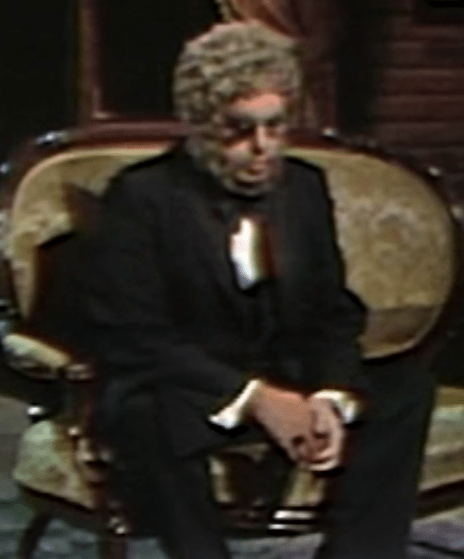
Another resident of the great house is not so sure. He appears to be Judith and Edward’s brother Quentin. He is in fact Petofi, who has cast a spell to hijack Quentin’s body and confine Quentin to his own aging and pudgy form. Q-Petofi has seen all the evidence that Edward has, including the two Barnabases side by side. But he also knows that Barnabas is a time traveler who came to 1897 from 1969, and that several magical beings and science fiction types are in his orbit. So he is looking for a trick. He has coaxed Pansy into the room, telling her that only she can make the final determination about who the man in the bed is. Pansy looks at Barnabas and declares that he is not the vampire. Q-Petofi is still unconvinced, and is about to put some kind of spell on Barnabas when Edward enters.

Downstairs, Pansy meets with Judith. Judith has figured out that her husband, Charity’s father Gregory Trask, gaslighted her into the breakdown that put her in the hospital, and that among his many misdeeds while she was there was his attempt to seduce a woman named Amanda Harris. In #864, Pansy bought a portrait of Amanda for an eye-wateringly large sum; yesterday, she set it up in the drawing room at Collinwood, causing Trask to fly into a rage. We learn in this scene that Judith put Pansy up to buying the portrait as part of a plan to get back at Trask. The two of them share some amusingly salty dialogue, showing us a worldly wise side of Judith that we have not seen before.

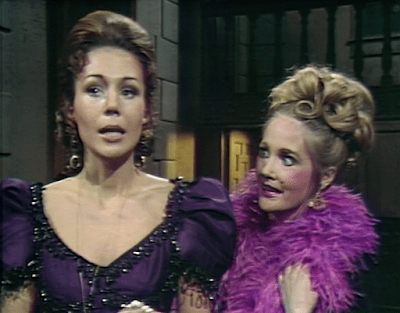
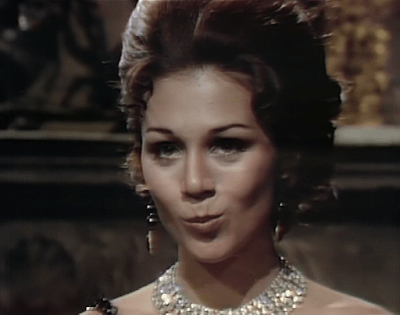
Today’s dose of CLE comes from a houseguest, Kitty Soames. Kitty is a young American woman who is the dowager countess of Hampshire. She is Edward’s guest, and she came to the house in #844 intending to lure Edward into a marriage that would relieve the financial distress she has been in since the late Earl’s bankruptcy. But since the day she arrived, she has been having fits of madness caused by the irruption into her consciousness of the mind of the late Josette, lost love of Barnabas. The conflict between Kitty/ Josette’s two personalities gives her one mad scene after another today.

Kitty enters the foyer, where a portrait of Barnabas hangs. She sees the portrait’s eyes glow and hears a heartbeat, something which has been happening to people under Barnabas’ influence since #205. She has a panic attack. Pansy and Judith come from the drawing room and cluster around her. Pansy walks her upstairs to her bedroom and tries to persuade her to have a cup of broth. Kitty raves about the danger that an antique music box in her room presents to her. After a bit, Edward enters and dismisses Pansy.

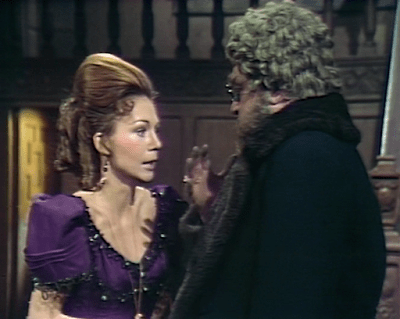
Kitty tells Edward that she thinks she ought to leave Collinwood, since she has been suffering from a severe mental illness throughout her stay. Edward says that he does not believe that the problem is psychological, since the music box and other objects that she finds disturbing have in fact materialized around her inexplicably. He says that to the extent that her problems are rooted in her feelings, a therapy he will suggest might be just the thing to cure them. He asks her to marry him. She agrees, and they kiss.

Edward kisses Kitty

Edward’s first wife was the former Laura Murdoch, an undead blonde fire witch. Laura was quite calm and rational in her way, but she embodied a principle of insanity in the universe. Quentin was married to a woman named Jenny, who may have seemed mentally healthy when they met but who went immensely insane after Quentin ran off with Laura. I suppose that, with that kind of family history, Edward is just cutting out some of the preliminaries by proposing to a lunatic while she is in the middle of a psychotic episode.

Edward and Kitty announce their engagement after dinner. Q-Petofi notices that Barnabas is shocked; he apologizes, smiles, and stands, a champagne glass in his hand and congratulations on his lips. He then excuses himself, saying that he still feels weak and thinks he ought to retire for the evening.

If any longtime viewers harbored doubts that Q-Petofi is right and this Barnabas is our old friend, they are dispelled when we see him in his room moaning about how he doesn’t want to lose Josette again. We end with a blissed-out Kitty entering his room, telling him she heard him calling, and declaring that she will be his Josette always. They share a passionate kiss.

Edward is the third major role Louis Edmonds has played on the show; he has been a principal member of the cast since episode #1. This is his first on-screen kiss on Dark Shadows. Some fans like to show off their knowledge of the actors’ sexual orientations by speculating about a correlation between their private lives and their on-screen kissing of opposite sex scene partners. This particularly settles on Anthony George, who was on the show for a while in 1967 and whose attempts to kiss women always went horribly wrong. But that is obvious nonsense. Jonathan Frid was gay, and the actresses all attested that he was the best kisser in the cast; Barnabas’ kiss with Kitty/ Josette today is a case in point. Joel Crothers, a regular from 1966 to 1968, was gay too, and he was another expert smoocher. Roger Davis is as straight as they come, and rivaled George for traumatic lip collisions. Kitty and Edward’s kiss shows that, while Edmonds might not have been interested in taking Kathryn Leigh Scott home, he was the equal of any heterosexual actor at playing love scenes with women when the cameras were rolling. I believe that what men like Edmonds, Frid, and Crothers did is known as “acting.”

Episode 869: The man who walks in the day

In October 1897, the hypocritical Rev’d Mr Gregory Trask is married to the vastly wealthy Judith Collins, owner of the estate of Collinwood and of the Collins family businesses. For more than thirteen weeks, everything seemed to be going Trask’s way. He had gaslighted Judith into a mental hospital and had almost free rein over all of her assets. In her absence, he invited the lovely and mysterious Amanda Harris to stay in the great house on the estate, and set out to seduce her.

Piece by piece, Trask’s little corner of paradise fell apart. First, 150 year old sorcerer Count Petofi orchestrated a series of events that led Trask to sign a confession to the murder of his first wife, and no matter how many times he destroyed the confession new copies of it kept materializing. Then Petofi erased the personality of Trask’s daughter and enforcer Charity, replacing it with that of late Cockney showgirl/ mentalist Pansy Faye. Later, Amanda fell in love with Judith’s brother Quentin, told Trask off, and wound up leaving for New York by herself. Now, Judith has returned from the mental hospital, all sane and deeply suspicious.

The front door of the great house is Trask’s enemy today. No sooner does he enter it than he finds Pansy in the foyer, singing her song. He demands she stop and tells her he is her father. She laughs at this claim, and reminisces about the late Bertie Faye. Trask goes into the drawing room, and to his horror sees a large oil painting of Amanda on an easel. We saw Pansy setting it up earlier in the episode, and saw her buy it a few days ago. But Trask didn’t see those things, and when she tells him she doesn’t know anything about it, he seems to accept her denials. She exits upstairs.

The front door opens again, and Judith’s brother Edward enters with two other men. One appears to be Quentin, but is in fact Petofi in possession of Quentin’s body. The other appears to be time-traveling vampire Barnabas Collins.

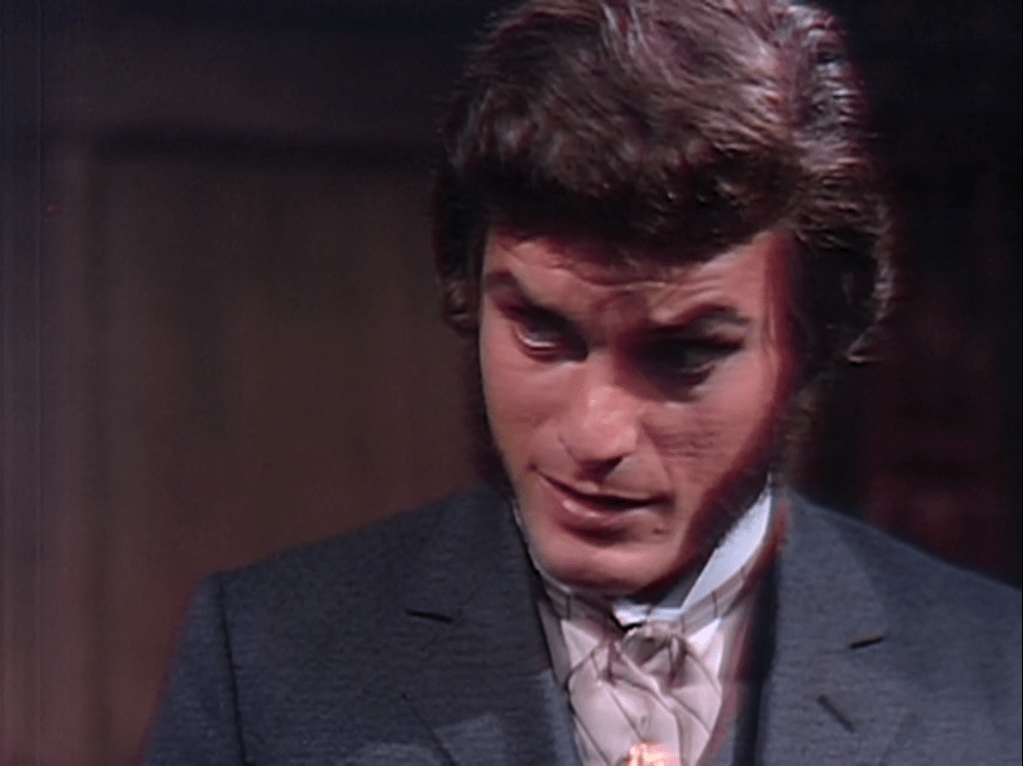
Trask and Edward both believe that Petofi is Quentin; since he is played by David Selby, I call him Q-Petofi. The man who appears to be Barnabas is very weak. He says that his name is indeed Barnabas Collins, but that he is not the vampire. He claims to have arrived from England, to have been attacked by a vampire who looked just like him, and to have little memory of what happened after.

In #845, Pansy went into a cave and found a coffin containing what appeared to be Barnabas. She drove a stake through his heart. When Edward and Q-Petofi met this weak Barnabas yesterday in the doctor’s office, they were skeptical of his story. They took him to the cave, opened the coffin, and saw the body Pansy had staked inside, the stake still lodged in its heart. Since they could see the two of them side by side, Edward could only conclude that the weak man is different from the vampire, and that his story is therefore true. Q-Petofi, well aware of the many magical and science-fictional entities in Barnabas’ orbit, is not at all convinced.

Trask sees the weak Barnabas and is enraged that Edward and Q-Petofi have brought the vampire back from the dead. While Q-Petofi takes the weak Barnabas upstairs to a bedroom, Edward tries to reason with Trask. This is seldom a fruitful exercise. When Edward finally points out that it is broad daylight and the weak Barnabas is alive and moving, Trask is left speechless.

Alone with the weak Barnabas, Q-Petofi tries to trick him into believing that he is Quentin and that he can trust him. When Q-Petofi goes on about all the secrets that Barnabas and Quentin have shared, the weak Barnabas responds only with bewilderment.

Q-Petofi goes back to the cave and sets the coffin on fire, acting on the hypothesis that the destruction of the staked Barnabas will have some kind of effect on the weak Barnabas. We cut back to Collinwood and see that it has none. Trask lets himself into the bedroom. After some small talk, he thrusts a large wooden cross at the weak Barnabas’ face and stands silently for a moment. The weak Barnabas looks up from his bed and asks if Trask is all right. He hurriedly says that he only brought the cross to help him pray for his recovery. The weak Barnabas observes that this is very kind, and closes his eyes while Trask kneels beside the bed.

My wife, Mrs Acilius, points out that not only the actor Jerry Lacy, but the character Gregory Trask, seems to enjoy himself very much when there is something to be righteously indignant about. Not only does Trask have a whole set of self-aggrandizing mannerisms and techniques for silencing everyone else when he is furious, but as a con man an atmosphere of crisis provides him with an opportunity to think on his feet and devise new schemes for bilking people out of whatever they have that he wants. Mr Lacy’s joy in performance runs throughout the whole episode, but Trask’s goes through wild fluctuations, peaking each time he thinks he has found a new way to present himself as the champion of The Almighty and plummeting each time his understanding of the situation is deflated. In his first several appearances, Trask was so overwhelmingly evil and so frequently successful that he was hard to watch. When we see him repeatedly brought up short in an episode like this, all of the discomfort of those early days pays off.

In the drawing room, Edward tells Pansy that there is a sick man in a bed upstairs who looks like the vampire Barnabas and is named Barnabas Collins, but is not the man she staked. She is horrified at the thought. Barnabas was indirectly responsible for the death of Pansy as a physical being, and later murdered her fiancé, the childlike Carl Collins. He also took Charity as one of his victims for a time. Besides, in her manner of dress, quantity of makeup, working-class accent, and brashly friendly manner Pansy is the representative of all the “girls at the docks” upon whom Barnabas has fed down the centuries. So no one has more reason to fear Barnabas than does Pansy in the form of Charity. Edward reassures her as best he can, then goes up to look in on the patient.

Pansy absorbs the news that another Barnabas Collins is in the house.

The scene between Pansy and Edward will remind longtime viewers of the characters the same actors played between November 1967 and
March 1968, when Dark Shadows was set in the 1790s. Nancy Barrett was fluttery heiress Millicent Collins, while Louis Edmonds was haughty overlord Joshua Collins. In #450, Millicent had discovered the horrible truth about Barnabas and it had proven to be too much for her rather fragile grip on sanity. She decided that the vampire was not her cousin, but an impostor, and she told Joshua that it was wrong of him to have “That man who says he is Barnabas” in the house.

Not only is Pansy’s horror at the thought of a man who says that he is Barnabas staying at Collinwood reminiscent of Millicent, but her relationship to Charity also reflects the development of Millicent throughout the 1790s segment. Millicent’s transformation from a lighter-than-air comedy character to a darkly mad victim, first of her wicked husband Nathan, then of Barnabas, marked the transition to the climactic phase of the 1790s segment. Charity’s replacement by Pansy in #819 came at a time when the show was flashing many signals that the 1897 segment was nearing its end. Those signals may well have reflected an earlier plan, but 1897 was such a hit that they kept passing by the off-ramps back to the 1960s and restarting the uncertain and frightening journey into the past. Now it seems they really are getting ready to move on, and Pansy’s prominence reminds us of just how radically different a place Collinwood is now than it was when we arrived in this period in #701, at the beginning of March.

Pansy is still quaking at the thought of another Barnabas Collins when Q-Petofi enters and closes the doors of the drawing room behind him. Pansy hasn’t quite figured out his true identity, but she knows that he is not really Quentin, and that he does not mean her well. She is terrified and says she will scream unless he opens the doors.

Regular viewers have reason to believe Pansy will do more than scream. In #829, she tried to stab Quentin. And those who have been with the show for a long time will remember what happened in #204, broadcast and set in April 1967. Heiress Carolyn Collins Stoddard, another Nancy Barrett character, found herself in the drawing room with dangerously unstable ruffian Willie Loomis. When Willie closed the doors and refused to open them, Carolyn didn’t bother screaming- she pulled a loaded gun on him.

Q-Petofi has magical powers that neither Quentin nor Willie could match, so he is not in mortal jeopardy as they would be were they to put themselves in his position. But he has created a volatile situation, and unless he resolves it within a few seconds he is likely to find himself with a huge mess on his hands. Rather than falling back on his occult talents, Q-Petofi takes a page from Quentin’s book and charms Pansy into cooperating. He tells her that he is as frightened of Barnabas as she is. That intrigues her sufficiently that she starts listening to him. He tells her that only she can discern whether the man in the sick bed upstairs is what he claims to be. A moment later, Q-Petofi has persuaded Pansy to go with him to see the weak Barnabas. The episode ends with Pansy looking at the weak Barnabas lying in bed, her eyes widening in a strong but unspecified reaction. We will have to wait until tomorrow to find out whether she is terrified at the sight of her nemesis or amazed to see an innocent man wearing the hated face.

Episode 868: The man we thought he was

In October 1897, sorcerer Count Petofi has used his powers to steal the body of handsome young Quentin Collins and to trap Quentin in his own aging form. I refer to the villainous Petofi who looks like Quentin as Q-Petofi, and to the forlorn Quentin who looks like Petofi as P-Quentin.

Q-Petofi

We open outside a cave near the estate of Collinwood, where Q-Petofi’s henchman Aristide is on the ground, gradually coming back to consciousness. Q-Petofi had ordered Aristide to hold wicked witch Angelique prisoner in the cave. Shortly after Q-Petofi left, Angelique slipped out of the cave and ran past him. Aristide followed her, and she bashed him on the head with a rock.

Aristide’s eyes focus, and he sees time-traveling vampire Barnabas Collins standing over him. The last time he saw Barnabas was in #842. Barnabas threatened to kill Aristide then, and he was so terrified that he ran away and didn’t come back until he heard that Barnabas had been staked in his coffin. The coffin is in the cave, and Aristide just saw Barnabas in it, the stake still in his heart, so he is shocked to see him up and about.

We cut to the great house of Collinwood, where Q-Petofi and Quentin’s stuffy but lovable brother Edward are recapping another storyline. Edward exits, and a telephone call comes from Ian Reade, MD. Dr Reade says that a strange man is in his office, asking for Edward. When he describes the man, Q-Petofi recognizes him as Barnabas. He takes a gun and goes to Dr Reade’s.

Q-Petofi finds Barnabas lying on Dr Reade’s exam table. He orders Dr Reade to leave. Dr Reade reminds Q-Petofi that they are in his office and refuses to comply with his commands. He does leave for a moment to call Edward again; when he comes back, he finds Q-Petofi holding Barnabas at gunpoint. He bravely tells Q-Petofi that if he wants to kill Barnabas, he will have to shoot him first.

Edward comes. Dr Reade trusts Edward and agrees to leave the room while he is there. After dawn breaks, Edward is astonished to see that Barnabas is still alive. Barnabas tells his old story that he is their cousin from England come to pay his respects. He says that when he first arrived, a man approached him in the dark woods, a man who, when he emerged from the shadows, proved to be his exact double. Until, that is, he opened his mouth and showed two long fangs. Barnabas says that he does not know what happened next or how much time has passed. All he knows is that this strange man kept him captive and dominated his will, from time to time appearing to him and repeating his original assault.

Edward is inclined to believe this story, Q-Petofi to shoot Barnabas on the spot. They compromise, and agree to take him to the cave. If Barnabas’ coffin is empty, they will shoot him. Dr Reade sees Edward and Q-Petofi carrying Barnabas out of his office, and objects that in his condition Barnabas may die if he is subjected to any exertion. When the question is asked if he is willing to go, Barnabas weakly croaks out a “yes.” At that, Dr Reade is willing to wash his hands of the whole thing. For someone who was willing to be shot a few minutes before, it’s quite a startling capitulation.

Q-Petofi does not know that Angelique and Aristide are no longer in the cave, so he insists on leading the way in. He finds that they are gone and the chains around Barnabas’ coffin have been broken. He invites Edward and Barnabas in. He takes it as obvious that the broken chains prove that the coffin is empty, but Edward, with his sense of fair play, insists on opening the coffin before they shoot Barnabas. The body is still there, the stake still in the chest. Barnabas reacts with horror, the others with amazement.

Doppelgänger time.

In #758, Angelique created a Doppelgänger of herself to trick an enemy into thinking that she had killed her, and in #842 she agreed to help Barnabas’ friend Julia Hoffman, MD in a plan to allow him to reestablish himself as a member of the Collins family. Julia was working on a medical intervention to free him of the effects of vampirism, and now we can see that Angelique contributed the grounds for the Collinses to believe that their cousin never labored under that curse.

When Dark Shadows was in production in the 1960s, the legends of King Arthur, the Knights of the Round Table, and the Holy Grail had been fashionable topics in English departments for decades. That vogue was reflected not only in the coursework the writing staff likely did when they were in college, but also in the popularity of novels like The Once and Future King and the Broadway show based on it, Camelot. When I was hanging out in used book stores in the 1980s and 1990s, mass market paperbacks printed in that era collecting the Grail sagas were still a staple.

The coffin in the cave recalls a prominent figure in one of those sagas, a king named Amfortas. In Heinrich of Turlin’s The Crown, Amfortas did not requite the love the mighty sorceress Orgeluse had for him. The humiliated Orgeluse inflicted a wound that both paralyzed Amfortas and made him immortal. In that state, Amfortas was confined to a coffin that was hidden in a cave. Sir Gawain found the coffin and freed Amfortas both of his paralysis and of his immortality.*

Longtime viewers of Dark Shadows will see many parallels to the story of Barnabas and Angelique in Heinrich’s story of Amfortas and Orgeluse. During the part of the show made and set in 1968, two mad scientists played the role of Sir Gawain in returning Barnabas to humanity. The first was a man named Eric Lang, the second was Julia. Now, Angelique herself, who was the original source of the curse that made Barnabas a vampire, combines the functions of Orgeluse and of Gawain. She not only frees Barnabas, but also redeems herself. The Grail legends also abound in other elements that figure prominently in this part of the show. For example, Count Petofi was originally on the show as a severed hand with magical powers, later to be reunited with the rest of its body. Gawain’s most famous story is of his battle with the Green Knight, who starts off as a severed head. Doppelgänger abound in the Grail legends, especially the so-called Vulgate Lancelot where a double of Queen Guinevere sets off a whole arc.

Dr Reade is played by Alfred Hinckley. Hinckley was in plays on and off Broadway, and when the networks ran a lot of programming produced in New York, his was a frequent face on American television. He was in Dark Shadows episode #1 as the conductor of the train that brought well-meaning governess Vicki Winters and dashing action hero Burke Devlin to Collinsport. Longtime viewers were reminded of that train in #850; maybe the production staff was reminded of it too, and that was why they called Hinckley to make his second appearance on the series today. It’s also his final appearance.

*Richard Wagner’s opera Parsifal features another version of the Amfortas legend, calling the sorceress by a different name, omitting Amfortas’ paralysis, leaving out the coffin in the cave, and giving the honor of healing Amfortas and succeeding him as king of the Grail to Percival rather than Gawain.

Episode 863: Homecomings

In episodes #853-#856, Sorcerer Count Petofi (Thayer David) used his powers to force the devastatingly handsome Quentin Collins (David Selby) to trade bodies with him. Ever since, Quentin (Thayer David) has been trying to persuade someone to believe his story about Petofi (David Selby.) For the duration of the switch, I shall refer to Thayer David’s version of Quentin as P-Quentin, and David Selby’s version of Petofi as Q-Petofi.

Yesterday, P-Quentin persuaded his old friend and fellow Satanist, Evan Hanley, of what had happened. Evan agreed to conduct a ceremony to call upon their dark lord and ask for the transfer to be broken. They trick Q-Petofi into coming to Evan’s house and knock him out with chloroform. Then Evan begins an odd incantation:

Oh, Lucifer…

Great God of man and beast, look upon us with favor. Help us correct this evil which has been done in defiance of you.

Renew our bondage as your servants. Grant us the power we need this night, and we will be yours for eternity.

For Baal, who guides your mind.

For Beelzebub, who rules your spirit.

The robber of a soul must not be spared. The robbed must be avenged.

I exorcise thee.

Oh, impure spirit, who is the mind of the enemy, by the holy rite of Hecate, I conjure thee that thou do immediately hear and obey my command. Leave this man’s body, that he may return… Oh, yes, spirits of invisibility, I conjure and constrain thee herewith to consecrate this ceremony. So that surely and without trickery, thou may return each, to the body of [its] origin.

So be it.

Oh, Lucifer, so be it.

So be it…

I charge thee. I conjure thee. I command thee. Answer my demand.

Depart from these alien bodies and return to those from whence you came.

Depart.

So be it.

So be it.

So be it.

Oh, Lucifer, we give thee thanks.

Evan and P-Quentin seem to have the wrong guy. Whatever Satan’s powers may be, undoing evil, restoring property to its rightful owners, and enforcing justice are not exactly among the old fellow’s core competencies. Of course the ceremony fails. Q-Petofi wakes up from the chloroform, tells Evan he has made the greatest and last mistake of his life, and puts the zap on his brain. The next we see him, Evan is digging a grave, refusing P-Quentin’s offer to help him, and listening to Q-Petofi announce that he is about to be buried alive.

Q-Petofi’s announcement is the closing cliffhanger, suggesting that Evan has a somewhat longer life expectancy than we might have imagined when the ceremony fell apart. But once in a while cliffhangers really are resolved with the death of the character who is in peril, and that would seem to be a possibility in this case. Yesterday was Evan’s first appearance after an absence of more than eleven weeks, and he is not associated with any major loose ends in the plot. His alliance with the odious Gregory Trask, husband of Judith Collins Trask, may have given him a foothold now that Judith is back from her own long absence and is looking on Trask with suspicion, but yesterday he seemed to back off from siding with Trask in whatever fight might be coming up. So if the makers of the show are thinking it’s time for Q-Petofi to confirm his credentials as a major villain by killing a familiar character, Evan would be the obvious choice.

Judith confronts Trask today. He lies to her to cover up his misdeeds during the more than thirteen weeks she was confined to a mental hospital. She does not contradict all of his lies, and invites him to embrace her. He seems to think he has regained his control over her, but she tells him two things that make him uncomfortable. First, she says that she has persuaded his daughter to leave her apartment in the village and move back into the great house of Collinwood. When he protests that “She is not my daughter!,” Judith calmly replies that she is, closing the subject and leaving him looking like a petulant child. She also says that she hopes he has not bought or sold any stocks in her name lately, since she has revoked his power of attorney over her holdings. Again, he can say nothing in response.

Judith’s brother, the stuffy but lovable Edward, does not hear the details of this conversation. After Judith leaves the drawing room, Edward enters and tells Trask that he has won again. Trask perks up at this, and becomes his usual overbearing self. But he is just as quickly deflated when Edward tells him that he is looking into what he has been doing for the last thirteen weeks, and that when he finds out he will make a full report to Judith.

When Dark Shadows first became a costume drama set in 1897, Edward assumed he was to inherit the estate of Collinwood and all the family’s businesses. He was haughty and commanding, and Judith was a fragile spinster. But then their grandmother died, and the will left everything to Judith. She fell victim to Trask’s machinations and married him; he gaslighted her into the madhouse. Now that she has come home, Judith has found a new strength, sufficient to hold her own in the household if not to uphold justice and right on the scale which her position in the community would seem to demand. Edward’s dependent financial position, coupled with the many supernatural horrors he has witnessed, have gradually reduced him to a childlike state. In their scenes today, we see that the two of them have come to embody that signature dynamic of Dark Shadows, the relationship between Bossy Big Sister and Bratty Little Brother.

Episode 861: Complete control of my faculties

Judith Collins Trask, owner of the estate of Collinwood and all the Collins family businesses, has returned home after more than thirteen weeks confined to a sanitarium. Her return is supposed to be a big shock, but they spoil it by having Joan Bennett do the opening voiceover. They really should have paid more attention to that sort of thing.

Judith’s husband, the odious Gregory Trask, gaslighted her into the sanitarium, and has been exercising control over the Collins family’s wealth ever since. Today, Judith tells her stuffy but lovable brother Edward that Trask never visited her during her time as a mental patient. Edward is surprised, telling her that Trask left the house for an overnight stay every week during that period, and presented these absences as visits to her. In fact, he is on such a trip now. She does not want to hear any more, and says she will give Gregory a chance to explain himself when he comes back to Collinwood.

Judith claims to be entirely herself. That puts her in the minority today. When she left Collinwood in July, Judith had a stepdaughter named Charity Trask. When she enters today, she sees someone who is to all appearances Charity leading Edward and a lady named Kitty Soames in a séance. The body is indeed Charity’s, but sorcerer Count Petofi erased Charity’s personality in #819 and replaced it with that of the late Pansy Faye, a Cockney showgirl and “mentalist” whom Judith met in #771, when Judith’s late brother Carl brought her to Collinwood as his fiancée. Pansy noticed Judith’s disapproval of her when she was alive, and is quite indignant about it now. That Judith keeps live-naming her, calling her “Charity,” doesn’t help.

Judith does manage to do something Edward failed to do a while ago, and talks Pansy into moving back into the great house of Collinwood. She agrees to give up the apartment she rented in the village of Collinsport after she took a job doing her old act at the local tavern, the Blue Whale. We saw her at the Blue Whale in Friday’s episode; it was shortly before nine PM, and she was the only person in the place. So perhaps her income as a cabaret performer is not particularly lavish, and the mansion is a more appealing place to live than the apartment that job would pay for.

For her part, Kitty is still, most of the time, the dowager countess of Hampshire. But the ghost of Josette Collins has been possessing her off and on ever since she arrived at Collinwood in #844, and the trend is definitely towards “on.” In Friday’s scene at the Blue Whale, Kathryn Leigh Scott played Kitty quietly and let Nancy Barrett’s Pansy provide the scene with all its Crazy Lady Energy; today, it is Miss Barrett’s turn to stand back and let Miss Scott show that Kitty is Pansy’s match in that department.

Crazy Lady Energy, also known as “CLE,” the main driving force of Soap Opera Land. Screenshot by Dark Shadows Before I Die.

Judith and Edward’s brother Quentin is in an even stranger predicament than are Pansy and what’s left of Kitty. Between #854 and #856, Petofi forced Quentin to swap bodies with him, so that David Selby now plays Petofi and Thayer David plays Quentin. I call Mr Selby’s portrayal of Petofi “Q-Petofi,” and Thayer David’s portrayal of Quentin “P-Quentin.”

Kitty with P-Quentin. Screenshot by Dark Shadows Before I Die.

The initial shock of finding himself estranged from his own body and trapped in Petofi’s left P-Quentin bewildered. All he could do was go to one person after another and tell the true story of what had happened, which produced only a widespread belief that Count Petofi had gone mad. Now he is starting to figure out how to use his resources.

P-Quentin’s first attempt to take advantage of the fact that everyone thinks he is Petofi was not successful. In #859, he exploited Kitty’s fear of Petofi and threatened to make her vanish if she did not bring him a portrait of Quentin later that night. Kitty tried to comply, but failed, and now it is long past the deadline. Soon she will realize that his threat was an empty one, and so far from being useful to him as a cat’s paw, she will be in a position to expose him as powerless.

Today, P-Quentin runs a smarter game. He introduces himself to Judith as Petofi, and claims to have psychic abilities. He pretends to read her palm, and tells her a story from their childhood that very few people could know. She is delighted, and decides that Count Petofi is someone she wants to see more of.

P-Quentin and Judith. Screenshot by Dark Shadows Before I Die.

In her bedroom upstairs at Collinwood, Kitty has another fit of Josettification. She opens the trunk at the foot of her bed and finds Josette’s wedding dress. She puts it on and wraps a red cloak around it. She goes to the top of Widow’s Hill, the cliff from which Josette jumped to her death in the 1790s. The ghost of Josette’s husband Jeremiah appears to her.

The show is set in 1897 now. It was set in the 1790s from November 1967 to March 1968. Miss Scott played Josette then, and for most of the segment Anthony George played Jeremiah. After Jeremiah’s death, Timothy Gordon played his ghost in a memorable part of the 1790s story. Gordon made two appearances as the ghost after the show returned to contemporary dress, playing him in #462 and #512. This is Jeremiah’s first appearance in 1897, and the second time, after #462, that Gordon’s name appeared in an on-screen credit on Dark Shadows.

Episode 860: I just say things

Edward Collins isn’t what he seems. His stuffy manner is real enough, as are his kind impulses when he sees people in distress. But he allows those who meet him to believe that he is the heir to the vast Collins family fortune, which in fact belongs in its entirety to his sister Judith. Judith is currently an inmate in a mental hospital. During her absence, her husband, the odious Gregory Trask, exercises control of all the family’s assets. Edward hopes to get out from under Trask’s thumb by marrying the dowager countess of Hampshire, a young American woman named Kitty Soames. He befriended Kitty while a houseguest of the late Earl’s, and now that she is widowed and is his guest at the great house of Collinwood he sees an opportunity to take over the Hampshire interests.

Kitty isn’t what she seems. The Earl was bankrupt when he died. He had lost all his wealth and been driven to suicide by sorcerer Count Petofi. Kitty wrote a letter to her mother the other day saying that unless she marries Edward and becomes the mistress of Collinwood she didn’t think she could raise train fare from central Maine to her home in Pennsylvania. Nor is this all. If Kitty were simply without funds, she and Edward would be on an even footing. But she is not what she seems in a metaphysical sense as well as a financial one. She is intermittently possessed by the ghost of the late Josette Collins. Regular viewers have reason to believe that she is Josette’s reincarnation, and that the fits of possession are part of the process by which Josette is reuniting her spirit with her body. But the characters don’t know what we know. As far as they are concerned, Kitty seems to be a plain lunatic.

At rise, Edward catches Kitty in his brother Quentin’s room. She is rummaging through an armoire, apparently looking for something. He asks her what she is doing, and she feigns one of her fits. Kitty is not nearly as good an actress as Kathryn Leigh Scott; she doesn’t fool us for a minute. But Edward believes her. He gently escorts her out of the room. As they leave, we see a face peering at them from the shadows. It is Quentin’s face.

Downstairs, we hear Kitty’s thoughts as she takes satisfaction in having fooled Edward into thinking she was having a fit. Mental health professionals often talk about how people learn to use the resources they have, so that patients who carry diagnoses of major disturbances will sometimes find ways to exaggerate their symptoms for effect. It’s true that psychotic episodes are not usually an asset in the husband-hunting business, but everyone in the segment of Dark Shadows set in 1897 has some issue or other, and Edward really does have a soft spot for mentally ill women (unless they are married to Quentin, but that’s another thing altogether.) So Kitty may as well play up her particular case of dissociative identity disorder.

Kitty was in Quentin’s room trying to steal a portrait of him. She was doing this from her fear of Petofi, whom she believed to have ordered her to bring him the portrait before 9 PM lest he use his magical powers and make her vanish. It is almost that time now, and she has no idea how to find the portrait, let alone get it to him before the deadline. While she is worrying about this situation, a woman named Angelique enters.

Angelique isn’t what she seems. She is one of Quentin’s fiancées, and Edward takes her to be an innocent woman, about 30 years old, who has been hard done by in the course of the supernatural doings of the last several months. In fact, she is a wicked witch who wrought immense destruction the first time she was at Collinwood, in the 1790s, and again the second time, in 1968. She has traveled back in time to 1897, and has been one of the most powerful participants in all of the strange goings-on.

Kitty tells Angelique that she saw Petofi in the vacant rectory on Pine Road, and that he told her the woman who had been squatting there vanished into thin air before his eyes. At this, Angelique turns and rushes off to investigate. It dawns on Kitty that Angelique knows more than she is saying. We cut to the drawing room, where Edward is bracing for a conversation with Quentin.

Quentin isn’t what he seems. In fact, he isn’t Quentin at all. Petofi forcibly swapped bodies with him a few days ago. It is Petofi, using Quentin’s body as a disguise, who confronts Edward and demands to know what he and Kitty were doing in the room. I refer to this form of Petofi as Q-Petofi, and the Quentin who looks like Petofi as P-Quentin.

Q-Petofi confronts Edward. Screenshot by Dark Shadows Before I Die.

Edward tells Q-Petofi that Kitty had had a “seizure.” Q-Petofi expresses skepticism about this claim. He proceeds to tell Edward that Kitty’s late husband died in poverty, shortly after being released from prison for a jewel theft. Edward is thunderstruck. He calls the story a lie, and forbids Q-Petofi from repeating it to anyone.

Kitty goes to the village of Collinsport, and pays a visit to The Blue Whale, the local tavern. She wants to see the entertainer, Miss Pansy Faye.

Pansy isn’t what she seems. She has met the Collinses twice. Miss Charity Trask, daughter of Gregory and enforcer in his operation, came to the great house in #727 and took up residence when her father married Judith. Pansy Faye, mentalist and Cockney showgirl, came to the estate in #771 as the coldly cynical fiancée of the childlike Carl Collins. Pansy was killed the night she arrived. A few weeks later, Pansy started to take possession of Charity, and in #819 Petofi erased Charity’s personality altogether and gave her body over to Pansy.

When Kitty enters, Pansy is alone in the bar. She is picking out her theme song on the piano. When Petofi was in the process of switching bodies with Quentin, Quentin was with Pansy in this room. Petofi took control of him briefly and played the same song on this piano. He played it very impressively.

Kitty is desperate to find out what is happening to her, and she knows that Pansy has powers. Once Pansy assures her that she doesn’t work for Count Petofi, Kitty offers her a diamond-encrusted brooch in return for information. Pansy is offended. She says that she will take a gift in return for her services after she has rendered them, but that she does not accept payment in advance. She tells Kitty that there is one way to find out what is happening to her, which is to have a séance. Kitty gets up to leave, and Pansy presses the brooch on her.

The diamond brooch is a puzzle. Perhaps Kitty was lying to her mother when she said that she couldn’t buy a train ticket to Pennsylvania? Or perhaps the brooch is part of the late Earl’s ill-gotten gains, and Kitty doesn’t want to show it to anyone more reputable than Pansy.

Nancy Barrett’s approach to all her roles on Dark Shadows was to throw herself completely into whatever the character was doing at any given moment. That isn’t to say that her performances lacked nuance or that she didn’t support her scene partners, but that her method was to take her part from the outside in, letting the action supply the motivation. As Kitty, Miss Scott has opportunities to take this same approach. But in Kitty and Pansy’s scene in the Blue Whale, she deliberately lets Miss Barrett drive the action. Since Pansy has already completed a process of possession and transformation like that into which Kitty is now entering, Miss Scott can convey a great deal of information about Kitty’s state of mind by giving rather subtle reactions to Pansy’s behavior.

Back at Collinwood, Edward and Q-Petofi are drinking. Edward shakes his head at his brother’s ability alternately to enrage him and charm him. Q-Petofi asks him to be the best man at his wedding to Angelique; Edward agrees at once. Angelique enters, and Edward exits.

Angelique says that she doesn’t want to get married after all. Q-Petofi insists they go ahead. She points out that it was her idea, and he was extremely reluctant to agree to it. This is true- the engagement was part of Angelique’s price for invoking the power of Satan to break spells Petofi had cast on Edward and his son Jamison. While Q-Petofi has managed to copy Quentin’s behavior towards Edward almost exactly, his behavior towards Angelique has been radically different than was Quentin’s. We don’t know what Angelique has made of this.

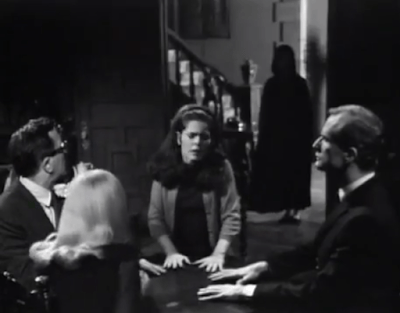
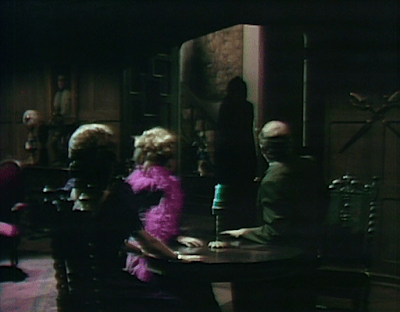
Edward finds Kitty and Pansy preparing the séance. After an initial protest, he declares he will join them. It ends with a visual quote from Dark Shadows‘ first séance, back in #170. As in that episode, a hooded figure appears in the doorway.

The hooded figure in #170 turned out to be undead blonde fire witch Laura Murdoch Collins. Another iteration of Laura was on the show as Edward’s estranged wife in April and May. It seems unlikely she is coming back, so longtime viewers are in suspense as to the significance of the allusion.

The hooded figure today is Natalie Norwick, making the last of her seven appearances as an uncredited stand-in on Dark Shadows. Norwick was in many plays on Broadway, as the lead in more than one, appeared in three feature films, and worked steadily in television from 1945 until the mid 1960s. She retired from acting in 1982, returning to the Broadway stage as understudy to her friend Julie Harris in 145 performances of The Gin Game from 1997 and 1998 when she was in her mid-70s. When Harris had a fall in 1999, Norwick took over the part, playing it in Florida and Washington, DC. She was chiefly based in Los Angeles in the late 1960s; perhaps she took the stand-in work to pay some bills during visits back east.

Norwick is best remembered for a single supporting performance on television in 1966. She appeared in “The Conscience of the King,” an episode of the original Star Trek, as Martha Leighton, the wife of Captain Kirk’s troubled friend Tom. She didn’t get much screen time, but she made the most of it. After Tom is murdered, she plays Martha’s understated reaction with a quietness that startles you no matter how many times you’ve seen it. Norwick is another of the significant talents one wishes Dark Shadows had found more to do with.

Episode 859: Not this grownup

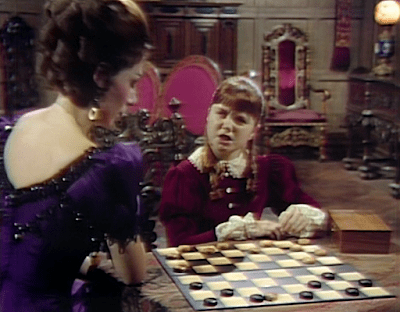
Nine year old Nora Collins enters the drawing room of the great house of Collinwood. She walks in on her father, the stuffy but lovable Edward, embracing Kitty Soames, the dowager countess of Hampshire. She gives them a dirty look and says she supposes Edward is too busy to join her in a game of checkers. He says he does have to run an errand, but suggests that Nora play with Kitty.

Kitty is eager to ingratiate herself with Nora, who clearly wants nothing to do with her. Nora asks, in an icy voice, if the reason Kitty wants to be her friend is that she is planning to marry her father. Returning viewers suspect she is right. Kitty and Edward have more in common than they know. Both are penniless, each is sure the other is very rich, and each imagines marriage to the other will solve all their problems. Kitty can’t very well level with Nora about this, so she claims that the women in the Collins family, being outnumbered by the men, have to stick together. Nora does not hide her distaste at Kitty’s inclusion of herself among the women of the family. Kitty asks Nora if she wants her father to be happy. Nora drills her eyes into Kitty’s face and says in a firm, flat voice “I want that.”

Nora asks Kitty if she is just letting her win at checkers. While she is asking this, Nora moves twice in one turn and takes three of Kitty’s pieces. Kitty watches this without protest and denies that she is letting her win. She then says she wants to concede the game and listen to whatever information Nora is willing to share about the family.

Nora is not impressed with Her Ladyship. Screenshot by Dark Shadows Before I Die.

Edward comes back from his errand to find Nora packing up the checkers and the board. He asks if she enjoyed her game with Kitty. Not looking up, Nora says they never finished it. Kitty hastens back in and asks if she wants to finish it now. Edward points out that it is getting close to Nora’s bedtime. He kisses her, and bids her say goodnight to Lady Hampshire. Kitty asks Nora to call her by her first name. Nora pointedly says “Good night, Lady Hampshire.”

It doesn’t show in her scenes with Nora, but Kitty seems to be suffering from a severe mental health crisis. Returning viewers know that the ghost of Josette Collins is taking possession of her, and suspect that she will turn out to be a reincarnation of Josette. Edward knows enough about the supernatural doings on the estate of Collinwood that he might give Kitty the benefit of the doubt when, for example, she comes running in today and is shrieking about a haunted house, a vanishing woman, and a curse that follows her everywhere. But she is so often so highly distraught that Nora must have noticed that she is not right in the head, and she can hardly look forward to having such a person as a stepmother.

Shortly before Nora enters, Edward calls Kitty “Katie.” This is a small enough slip of the tongue, but Kathryn Leigh Scott’s friends call her Katie, so it is a case of an actor’s name in place of the character’s. I think I can see Louis Edmonds blush a little when he realizes what he has done.

This episode marks the final appearance of Nora, and very nearly the last time we will hear Nora’s name. I think she was badly underused, disappointingly so after the outstanding work Denise Nickerson did as Amy Jennings in the months leading up to the segment set in 1897. She will be back later, in other parts.

Director Henry Kaplan was not much of a visual artist, and his deficiencies are particularly glaring today. Especially during Kitty and Nora’s first scene, the camera keeps drifting up to the actors until we see a randomly selected two-thirds of their faces in extreme closeup. Once the shot excludes the eyes or the mouth, it abruptly pulls back. Even the successfully framed closeups are rarely in focus, and you can forget about finding coherent visual storytelling in any kind of shot other than a closeup. The actors themselves do a good job, in spite of Kaplan’s notoriously unpleasant behavior towards them, but aside from a few evocative facial expressions, most of them by Nickerson, it may as well have been a radio play.

Episode 857: Champagne for Wanda

Sorcerer Count Petofi is wearing the body of rakish libertine Quentin Collins as a disguise, while Quentin is trapped in Petofi’s own aging and pudgy form. I will call the villainous Petofi played by David Selby Q-Petofi, and the forlorn Quentin as played by Thayer David P-Quentin.

We open with Q-Petofi at the front door of the great house of Collinwood. Yesterday we saw P-Quentin on the same spot, and heard David Selby’s voice articulating the miserable thoughts that showed on Thayer David’s face. Today the roles are reversed, and we see Mr Selby looking exultant while the voice of Thayer David talks about the glories of his situation.

We see that Q-Petofi is accompanied by his henchman, Aristide. He dismisses Aristide’s fear that he will somehow reveal his true identity to the occupants of the great house. He twits Aristide for a little while, pretending that he will use him as a guinea pig in a dangerous experiment he has planned for later in the evening, then sends him off to find someone else to serve that purpose.

Q-Petofi walks in on an argument in the drawing room between stuffy Edward Collins and the overbearing Gregory Trask. Trask is in charge of the house while his wife, Edward’s sister Judith, is in a mental hospital. Trask is going over the household accounts and complaining that Edward is spending too much on his houseguest, Kitty Soames, the dowager countess of Hampshire. Edward asks Q-Petofi to explain Collinwood’s tradition of hospitality to Trask, setting Trask off with a rant about Quentin’s relationship with Trask’s own former houseguest, the lovely and mysterious Amanda Harris. Q-Petofi’s indifference to the whole discussion strikes both Trask and Edward as odd, but it really is quite typical of the old Quentin.

After Trask exits, Edward tells Q-Petofi that he thinks he can subdue Trask by marrying Kitty. He says that it takes money to run Collinwood, and the late Earl’s estate gives Kitty ownership of half the county of Hampshire. Returning viewers know that the Earl died bankrupt, and so far from owning great swathes of southern England Kitty doesn’t even have train fare to get from Collinwood in central Maine to her mother’s house in Pennsylvania. So we have confirmation that Kitty has been less than fully honest with Edward. On the other hand, Kitty is under the impression that Edward is rich, while in fact their grandmother left every penny to Judith. So neither is leveling with the other about their financial status. Q-Petofi knows all of this, but it has nothing to do with his plans, and so he struggles to feign interest.

For his part, P-Quentin is sitting in the caretaker’s cottage on the estate. It seems right to longtime viewers that a character played by Thayer David should seek refuge here. When we first saw the cottage, it belonged to handyman Matthew Morgan, who was at that time played by George Mitchell. In #38, Mitchell was replaced in the part of Matthew by Thayer David, in the first of the many roles he would play on Dark Shadows. When Matthew had to leave the cottage for the last time in #112, his whole world fell apart. So when Aristide comes in and brutally evicts him, we can feel the full weight of the disaster that has befallen P-Quentin.

With nowhere else to go, P-Quentin returns to the great house. Once again it is Thayer David’s turn to look soulfully at the camera while David Selby’s voice speaks desperate words in voiceover. He tells himself that his brother Edward will have to believe him when he tells him the truth.

As it happens, Edward likes Petofi and is glad when he believes he is receiving a visit from him. Based on Edward’s earlier remarks about Collinwood’s tradition of hospitality, we could be quite sure that if P-Quentin presented himself as Petofi, Edward would be glad to offer him a place to stay. But P-Quentin plunges right in and tries to tell Edward the whole story. Of course Edward is not convinced. He treats it as a joke in questionable taste, and offers P-Quentin a brandy. When P-Quentin tells him to forget the brandy, he says that if he really were Quentin, he would never forget the brandy.

P-Quentin insists on going ahead with the lunatic tale, and keeps clutching at Edward’s arm. Edward finds the whole experience revolting, and firmly escorts him to the door. If it has occurred to P-Quentin to tell Edward any of the little stories of childhood that only he and Edward would know, it is too late now to do so. Edward orders P-Quentin to stop talking and go home. Little does he know that P-Quentin has no home to go to.

At the waterfront, the fog machine is working overtime, and so is one of the locals. In a comment on Danny Horn’s post about the episode at his great Dark Shadows Every Day, user “Goddess of Transitory” remarks:

I was remarking to my husband about the really remarkable size and relative wealth of the hooker population of Collinsport. They may hang at the docks (makes sense in a port town–you troll for lonely sailors) but they all have really nice clothes and jewelry and no matter how many of them Barnabas et al. tear through, there’s always more.

Makes you wonder what modern day Collinsport’s main economic generator really is…

Comment by “Goddess of Transitory,” left 7 April 2021 on Danny Horn, “Episode 857: All of Him,” 5 May 2016, Dark Shadows Every Day.

We find today’s well-bathed, well-coiffed, well-made-up young woman of professionally agreeable disposition drinking from a flask. Aristide emerges from the fog and takes the flask from her. When she protests, he says that if she follows him, she will be drinking champagne, and her protests subside. Her name is Wanda Paisley.

Aristide takes Wanda to the cottage, where Q-Petofi is waiting. Wanda is quite pleased at the prospect of sharing her favors with two handsome young men at once, but less pleased when Q-Petofi says that before the festivities get underway she will have to throw some I Ching wands and meditate on them. He assures her that she will be well paid for whatever services she may render, and asks her to agree that this is what really matters. Wanda’s agreement is not forthcoming. When Q-Petofi keeps yammering on about the wands and the hexagrams and the trance and the doors, it dawns on Wanda that this evening is not going to be what she signed up for, and she gets up to leave. Aristide grabs her, and Q-Petofi uses his magical powers to coerce her into cooperating.

Wanda casts the wands and meditates on them. She has a vision of a skeleton with big plastic eyeballs reaching its arm bones out to her. She screams. Where she had been sitting is another skeleton with big plastic eyeballs, this one also wearing a dress and a wig. Q-Petofi tells Aristide that “beyond the door anything is possible.”

Her turn as Wanda today marks Karen Lynn’s only appearance on Dark Shadows. She’s very good, it’s a shame they couldn’t find more for her. Her only other screen credit is a 1963 feature called The Orgy at Lil’s, which an IMDb reviewer says made history as “the first roughie.” I don’t know what a “roughie” is, and based on the description of The Orgy at Lil’s I rather doubt that my education in cinematic history would be significantly deepened by finding out. At any rate, it sounds like Miss Lynn was well-prepared to portray Wanda’s enthusiastic response when Q-Petofi first joined her and Aristide.

I made a contribution of my own to the comment thread on Danny’s post:

This has to be the archetypal Dark Shadows episode. It has Jerry Lacy modeling the style of acting he and Lara Parker invented for the show, Louis Edmonds being sarcastic, a squabble about control of Collinwood, people drinking brandy, a prostitute picked up on the docks while the [fog] machine runs, several kinds of supernatural mumbo-jumbo presented as if we will of course understand them, a dream sequence, and a skeleton in a wig. The next episode opens with a grave-digging scene, which is pretty nearly the only thing missing from this one.

Comment left by “Acilius,” 3 December 2020, on Danny Horn, “Episode 857: All of Him,” 5 May 2016, Dark Shadows Every Day.

It’s true no actors blow their lines, none of the boom mic shadows obstruct our view of anything crucial, and there is only one audible cough from a crew member, so it is an unusual episode in some ways. But I could have mentioned another very typical thing- a practical effect they try for the first time. I believe the split screen shot of Q-Petofi in the drawing room and P-Quentin at the cottage is the first time the show has used this device. It doesn’t work very well, but they were always pushing to do something new:

P-Quentin (Thayer David) and Q-Petofi (David Selby.) Screenshot by Dark Shadows Before I Die.

Episode 852: All kinds of spells on people

From November 1967 to March 1968, Dark Shadows was set in the 1790s. The cast included Kathryn Leigh Scott as the gracious Josette, Louis Edmonds as haughty overlord Joshua Collins, and Lara Parker as wicked witch Angelique. Now, the dramatic date is 1897. Miss Scott plays Kitty Soames, an American who went to England to be a governess, married the Earl of Hampshire, and is now widowed, penniless, and scheming to land another rich husband. Edmonds takes the role of stuffy but lovable Edward Collins, who is the focus of Kitty’s ambition. Parker is still Angelique, who is both immortal and a time-traveler.

Ever since arriving at the great house of Collinwood in #844, Kitty has been having psychological breaks during which she acts like Josette. She therefore appears to be suffering from a severe mental illness, an impression which would tend to get in the way when trying to win a new spouse. Today these breaks take a new turn.

Kitty is walking in the woods on the grounds of Collinwood when she is overwhelmed by the sense that she is being watched, and furthermore that the person watching her knows her well and wishes her ill. She runs into the house and flings herself at Edward, describing this paranoid episode to him. Edward has only begun to talk her down when his brother, rakish libertine Quentin, enters with his own fiancée. The fiancée is Angelique.

Edward is about to introduce the two ladies, who have never met. Before he can do so, Kitty becomes Josette. In Josette’s voice, she denounces Angelique. She then grabs her by the throat and vows to kill her for what she has done.

Angelique was responsible for the deaths of Josette and many others at Collinwood in the 1790s, and has been obsessively hostile to her throughout the centuries. When she was first conjured up from Hell to be part of the 1897 segment in #711, she went to the Old House on the estate, looked at the portrait of Josette that hangs over the mantel in the front parlor there, and declared “I am Angelique and I hate you!” During her lifetime, Josette was oblivious to Angelique’s enmity. She knew Angelique as a lady’s maid in service to her aunt, and regarded her as a close friend. But on Dark Shadows, death is a learning opportunity, and we see today that when she is animated by Josette’s spirit Kitty knows everything Angelique hid from Josette when she was alive.

Edward and Quentin separate Kitty and Angelique. In a private conversation with Quentin, Angelique makes it clear to the audience that she knows exactly what is happening with Kitty, and that she regards it as a minor nuisance. Quentin has troubles of his own, and doesn’t ask for an explanation.

Meanwhile, Kitty and Edward have a private conversation of their own. Edward tells Kitty that she is just upset because of her late husband’s death, and assures her that he will help her recover. She flashes a cunning smile at the camera. Well she might- not many people are so good at attaching themselves to rich guys that they can turn a psychotic episode to their advantage.

Kitty takes satisfaction in a job well done. Screenshot by Dark Shadows Before I Die.

Kitty has a dream in which Angelique is her servant and is addressing her as “Mademoiselle.” In the dream, Angelique delivers an arrangement of flowers and a book of poetry that Josette’s fiancé wants her to have before their impending wedding. When she wakes up, Kitty finds the arrangement and the book by her bedside, and she realizes that what is happening to her is not simply a mental aberration.

The dream will puzzle new viewers, even those who know that Angelique was a servant in Josette’s household. When Angelique is busy being Evil, she often laughs a maniacal laugh that breaks in the middle with a sharp intake of breath. She keeps doing this throughout the dream, which doesn’t fit at all with the action of bringing a present from a lover. She also tells Josette that her happy life is of the sort that makes the gods jealous, and speaks the lines with an undisguised and exaggerated hostility that leads into another gale of maniacal laughter. People who have joined the show in the last year will wonder why Angelique is being so crudely obvious.

Lara Parker used to say that she didn’t really learn to act until Humbert Allen Astredo joined the cast of Dark Shadows in June 1968. She’d taken acting classes and appeared in plays and so on, but it wasn’t until Astredo explained acting techniques to her while they were rehearsing that it all clicked in her head. You really can see a sudden improvement in her performances at that time. The dream Josette transmits to Kitty’s mind takes her to a time, not only when Angelique was a servant, but when Lara Parker was not a particularly good actress. The contrast between the reliably capable professional we see in most of the episode and the often bombastic student who appears in the dream makes us appreciate just how far she came in a short time.

Episode 846: Advantage of an unfortunate creature

Tim Shaw was a poor put-upon fellow when first we met him in #731, an episode set in April 1897. He had spent his childhood among the pupils imprisoned at Worthington Hall, a dungeon masquerading as a school, and when he was of age the headmaster, the evil Gregory Trask, coerced him into staying on as a teacher. In company with another man, Trask contrived to use Tim as an unwitting instrument in his plot to murder his wife Minerva. Trask’s plan to frame Tim for the murder fell apart, and Tim managed to keep his freedom. Not only that- he stole the legendary Hand of Count Petofi and took it to New York City, where within weeks he used its magical powers to make himself very rich. In August, he returned to Collinsport determined to take revenge on Trask.

Shortly after coming back to his hometown, Tim lost the Hand. (Which, to be clear, was an actual human hand severed from a sorcerer named Count Petofi a century before.) The 150 year old Petofi himself reclaimed it, and reattached it to his wrist. The ill-fortune Tim suffered in his youth left him a weak and cowardly man, who betrayed his only friend when Trask was looking for her. But his good fortune when he was in possession of the Hand has corrupted him much more severely. He used to be kind to children and even risked his life to rescue nine year old Nora Collins when Worthington Hall burned down in #736, but in #816 he violently shook Nora when he found that she had let the box containing the Hand out of her sight. In his pursuit of another gimmick that will enable him to continue getting rich, he has developed a number of schemes, the worst of which do not stop at murder.

This morning, Tim is sitting at a table in the Blue Whale, Collinsport’s tavern. The place isn’t open yet, and Tim does not appear to have any connection with it, so it is simply a mystery how he got in and why he wants to be there. The only other person in the room is sitting at the bar. She is a woman who used to be Trask’s daughter Charity, but who has since been transformed into Cockney showgirl and sometime mentalist Pansy Faye, who died in June.

Pansy’s presence makes some kind of sense, as she works at the tavern doing her act. But returning viewers know that she isn’t still there from the night before. After closing, she went back to the great house of Collinwood, where Trask and she live, and talked with the rakish and profoundly drunk Quentin Collins. After dawn, Pansy followed Quentin from the house to a cave. In the cave, she found a mallet and stake Quentin left behind, and next to them the coffin occupied by vampire Barnabas Collins. She drove the stake into Barnabas’ heart. Now she wants a good stiff drink, and she doesn’t care if she has to pour it herself.

Tim stops Pansy’s attempt to pilfer her employer’s stock, and she tells him that she has destroyed Barnabas. Dollar signs flash in his eyes as he calculates what it is worth to the Collins family to know that their single most embarrassing relative is no longer going to be exsanguinating the locals. Pansy does not want to go back to the great house or even to tell the Collinses what happened, and she steadfastly declares she does not want any of their money. But Tim insists.

At the house, stuffy Edward Collins makes it clear he wants nothing to do with Tim and that he regards Pansy as a lunatic. When Tim makes him listen to the story, Edward dismisses it out of hand. But Edward finally agrees to go to the cave with Tim while Pansy stays in the drawing room.

Edward sees that Pansy was telling the truth, and returns to Collinwood in time to see the aftermath of a strange conversation. Pansy meets Edward’s guest, a young American woman named Kitty Soames who is the widow of the Earl of Hampshire. Pansy’s reaction when the dowager countess introduces herself as “Lady Hampshire” is a very characteristic “Well, la-dee-dah!”

Pansy’s delighted smile and relaxed manner suggest that in Kitty she has recognized a kindred spirit. Returning viewers know she’s onto something- we’ve heard Kitty’s interior monologue as she’s screwed up her courage to try to connect with the rich Collinses. We also know that she and her husband were mixed up with Petofi, who is not an individual who often attracts the innocent. And while she is so quick to deny to Edward that her husband’s suicide had anything to do with business reverses that he assumes she is still imposingly rich, later today we will hear the text of a letter in which she tells her mother that if she doesn’t get something going with Edward, she won’t be able to raise enough money to pay the train fare from Maine to Pennsylvania. So Kitty’s presentation of herself is misleading, and she is not so different from the living Pansy, who was what in the parlance of the 1890s might have been called an adventuress.

In her letter to her mother, Kitty mentions that she first came to the earl’s home as the governess. This circumstance reminds us of two other characters played by the same actress. In the parts of Dark Shadows set in 1969, Kathryn Leigh Scott’s Maggie Evans was the governess at Collinwood. And in the first part of the 1897 segment, she took the role of neurotic intellectual Rachel Drummond, who held the same job in that year.

Rachel was the friend whom Tim betrayed to Trask, and the contrast between her and Kitty reflects the change in Tim. Rachel and Tim were both well-meaning but helpless before Trask. They stood out in the 1897 segment as almost the only characters who weren’t playing an angle of their own. Rachel died in Tim’s arms, in the same room where he would later find the Hand. As his discovery of the Hand opened the way for Tim to become a schemer, so the death of Rachel allowed Miss Scott to return as a someone who could keep up with the quick-witted and merrily vicious characters who make 1897 such a delight. Moreover, we are in suspense as to what sort of person Kitty will turn out to be. She could end up being as innocent as Miss Scott’s previous roles, she could be as detestable as Tim has become, or she could land anywhere in between.

Pansy has a vision of a music box. She vocalizes its tune, and tells Kitty that if she ever receives one like it she must destroy it at once. If she does not, she will die. Kitty is upset by the whole conversation. Pansy tells Kitty that she ought to listen to her, because she has “powers.” “I guess… I didn’t use to have, but now I do.” Pansy often mentions this point, which harks back to her first appearance. In #771, the living Pansy came to Collinwood as the fiancée of the childlike Carl Collins. She was astounded to find that in the spirit-charged atmosphere of the estate her phony “mentalist” act really did conjure up a voice from the supernal realms. In turn, that echoed #400, when Charity’s ancestor, the fanatical Rev’d Mr Trask, was delighted that an exorcism he was performing seemed actually to work.

When Edward comes back, he assures Kitty that Pansy is mad and that he will “deal with her.” Kitty goes upstairs to her room, where she will later find that the music box Pansy described has materialized. This music box has a long history, and in 1967, when the show was set in contemporary times, Barnabas used it to try to convince girls that they were his lost love Josette. Even if Barnabas hadn’t been staked, we wouldn’t suspect him of planting the music box in Kitty’s room- it appears there during the daytime. Viewers who have been with the show from the beginning will remember that Josette’s ghost used to be quite active around Collinwood, and might wonder if she did it.

In the drawing room, Edward talks with Tim and Pansy. He refuses to call Pansy anything other than “Charity Trask”; she is indignant at being live-named, but he won’t relent. He asks her to stay in the house, and offers to provide her with the best possible mental health care. She angrily declares “I! Ain’t! Sick!”

Tim is sure his angle will open up any second now. Screenshot by Dark Shadows Before I Die.

Tim says that he will see to it that Pansy doesn’t tell anyone about Barnabas; Edward doesn’t bother to conceal his contempt for Tim, and makes it clear that he will not pay him for this or any other service he might offer to perform. Pansy tells Tim that it is time for them to leave. She invites Edward to catch her act at the Blue Whale; he says he doesn’t expect to find the time, but that he is sure Tim will come back to Collinwood when he wants something.

When Tim first came back to town, he had a girlfriend named Amanda whom he planned to use in the game he was going to run on Trask. Eventually we learned that this plan was to involve the murders of the former Judith Collins, who is now Trask’s wife, and of Trask himself. Amanda would marry Trask after she had incited him to kill Judith, they would then kill Trask, and Tim would marry Amanda, thereby becoming the master of Collinwood. Amanda was never fully sold on the homicides, and she and Tim now seem to have gone their separate ways. So Tim is left without friends and without a plan. Nor does he seem to understand how dangerous the people he is dealing with truly are. He thinks that he can bluff his way into partnership with the enormously powerful and thoroughly evil Petofi, and is only dimly aware of the other monsters lurking in the area. One might surmise that Tim’s happiest days are firmly behind him.