The evil Gregory Trask coerced lawyer/ Satanist Evan Hanley into helping him murder his wife, Minerva, so that he could marry wealthy spinster Judith Collins. Now Trask and Evan have conjured up a magical simulacrum of Minerva and caused it to hang around Judith. They claim they can’t see it, which, coupled with some other troubles Judith has had, leads her to believe that she has lost her mind. Trask and Evan strong-arm Judith into signing a paper, Trask locks her up in the tower room, and Evan makes the simulacrum disappear.
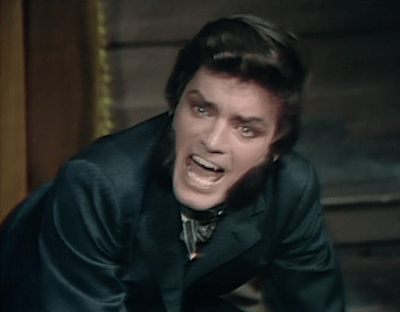
Meanwhile, Judith’s brother Quentin is at large. Quentin is a werewolf, and when he returned to human form this morning his face was disfigured. This worked to his advantage. He was in jail at the time, and he was being watched. The sheriff’s deputy had not recognized Quentin’s brother Edward when he came to jail that night, so it isn’t so surprising he doesn’t recognize Quentin, even though he is six foot four, has a distinctive hairdo and prominent mutton chop sideburns, and is wearing the same blue suit with a frock coat that he always wears. It is surprising that Edward doesn’t recognize him either, but this may be the result of a congenital problem the Collinses have. Not only was Quentin himself stumped when the equally identifiable Evan had a similar glob of makeup on his face recently, but Judith fails to recognize Quentin today when he comes to the drawing room. When Judith found him, Quentin was listening to his favorite record and reciting its lyrics in his unaltered voice, and he identified himself to her by name. Still, she couldn’t see it.
Quentin bursts into Evan’s room shortly after he finishes dissolving the simulacrum of Minerva. He sees that Evan’s face is no longer disfigured, and assumes that he used the magical Hand of Count Petofi to restore his appearance. Evan tells him he did not- he can’t explain why his face reverted, it just did so on its own. This does not satisfy Quentin, and it will not satisfy returning viewers. We saw Evan struggle to fix his problem for some time, and when he found himself in a crisis situation he suddenly turned up looking like his old self. So we’ve been in suspense for several days wondering what the explanation would be for his cure, and we are no more inclined to settle for a non-explanation than is Quentin.
Quentin knocks Evan out with a candlestick; the background music is a cue we have previously heard during on-camera murders, leading us to wonder if Evan will survive the blow. Quentin rummages around for a moment and finds the hand. He is looking at it, wondering how to use it to restore his appearance, when a man in a wool cap enters and orders him to surrender the hand at once.
This episode features one of Dark Shadows‘ all-time great goofs. When Evan is casting the spell to dissolve the simulacrum, a black-clad figure dashes past in front of him. A voice can be clearly heard exclaiming “Jesus, Lacy!” Evidently actor Jerry Lacy was in such a hurry to get from one set to another that he didn’t realize he was crossing a live camera.
In yesterday’s episode, inveterate prankster Carl Collins told his brother, the rakishly handsome Quentin, that their distant cousin Barnabas was a vampire. Quentin has problems of his own, and he is counting on Barnabas to help him. So he locked Carl up in Barnabas’ hiding place, expecting that when night came Barnabas would prune one more branch off the Collins family tree.
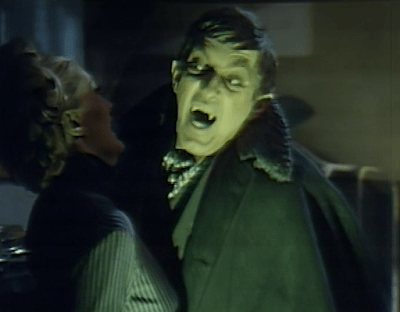
Today, Quentin finds that Carl has escaped. He goes to Barnabas and tells him what has happened. Carl’s practical jokes annoy Barnabas intensely, and Barnabas has never bothered to conceal his disdain for him. He reacts to Quentin’s news with fury and a lot of orders. When Quentin later finds Barnabas standing by Carl’s corpse in the drawing room of the great house of Collinwood, he is really torn up about his brother’s death for almost a whole minute.
A knock comes at the door; it is the oppressively evil Rev’d Gregory Trask. Quentin keeps Trask in the foyer for a bit while Barnabas hides Carl’s body. When Trask forces his way into the drawing room, Barnabas is gone. Carl’s body is cunningly hidden… behind the curtains, propped upright. Of course it falls out almost immediately. Earlier in the episode, Carl took Trask to Barnabas’ hiding place, and we saw that Barnabas had single-handedly lugged his coffin and the structure on which it rests some distance away. If he is strong enough to do that, surely he could have tossed Carl’s body out the window. And regular viewers know that there is a secret panel in this room, of which Barnabas has repeatedly shown that he is well aware. They would probably have expected him to hide the body there. That he just stashes it behind the curtains where it is certain to come into Trask’s view suggests that he isn’t even trying to get away with this particular murder.
Closing Miscellany
John Karlen is breathing pretty deeply during Carl’s big closeup as a corpse. It’s really confusing, I thought they were telling us he wasn’t dead yet.
I don’t know what the writers planned for Carl in the flimsies they sketched out six months before this episode was made, though there is so little room for him in subsequent plot-lines that I suspect he was supposed to die at about this point in the story. Still, his death was accelerated because Karlen had other things to do. He won’t be back on the show until #956, in February of next year.
The creaky little waltz that Quentin listens to obsessively was released as a single in June of 1969 and would hit #13 on the Billboard Hot 100 in August. Regular viewers may be sick of it already, and the characters certainly wish Quentin would get another record. It’s Trask’s turn to complain about it today, giving him something in common with Barnabas.
Trask wears a cross which he uses as a weapon against Barnabas. The show is oddly inconsistent about the effect of the cross on vampires. We’ve seen other characters use crosses against them, and at one point it was said that a cross inside the lid of Barnabas’ coffin immobilized him. But his hiding place is in the middle of a cemetery full of grave markers in the shape of huge crosses, and we see several of them today. Barnabas just walks right past those with no problem. You might think that since the show was made in the USA, where sincerity is so highly regarded, that the cross might be effective against him only if it is wielded by the pure of heart. But Trask is every bit as evil as are Barnabas and Quentin, and it works for him. It’s a puzzlement.
I think of the climax of the Iliad. As Achilles moves in to kill Hector, Athena takes hold of his spear and drives it in, delivering the fatal wound herself.
For modern readers, this may ruin the story. The whole poem has been leading up to this moment; we’ve spent a lot of time with Achilles, listening to him try to figure out what it would mean for him to kill Hector. So why have the goddess take over at the last minute? Isn’t it an evasion of Achilles’ responsibility for his actions, and a cheat for us as we’ve been observing his psychological development?
For the original audience, it was not. They actually believed in their gods. Athena really existed, as far as they were concerned. When an event was important enough, they took a interest. If it was really huge, they would get involved. Moreover, the gods worked closely with each other. So much so that you didn’t pray to one at a time, but always to groups of them. When Athena joins Achilles in his fight, it isn’t her pushing him aside- it’s him doing something so important it blurs the boundary between human and divine.
Something like that is at work in the traditional, pre-modern, conception of demonic possession. To say that a person is possessed is a way of looking at behavior that is reducible neither to moralistic judgment nor to psychological analysis. It isn’t individualistic in the way that those modes of discourse are. Rather, it suggests that the boundaries between the person and the spiritual forces of darkness have broken down. Perhaps the person is partly to blame for that breakdown, but the whole point is that s/he is no longer a distinct being, but is merging into those supernatural forces.
So, imagine a version of Dark Shadows where Elizabeth Collins Stoddard really was the main character. Her whole approach to life is denial. So, you could have had a story with a beginning, middle, and end. In the beginning, we see the lengths she has gone to in her quest to keep from ever having to have an embarrassing conversation. In the middle, we see various horrors take place around her, each worse than the one before, each more obvious than the one before, and each time she finds a way to convince herself it doesn’t exist. At the end, a couple of innocent characters go to her in the drawing room of Collinwood to rescue her from the monsters who are running rampant there. She looks at them placidly and tells them she sees nothing wrong. Why ever do they think she would want to leave her home? All the while leathery-winged demons are fluttering about her head. She doesn’t see them, and they have no choice but to flee.
Comment left 10 November 2020 by “Acilius” on “Episode 780: The Establishment Vampire,” posted 2 December 2015 by Danny Horn at Dark Shadows Every Day
A lot happens in this one. Inveterate prankster Carl Collins realizes that his fiancée, Cockney showgirl Pansy Faye, is dead. He has a dream in which he meets Pansy backstage as she is preparing for her final performance, then sees her standing on stage before him, his sister Judith, and their distant cousin Barnabas; when he awakes from the dream, Carl is sure he has figured out what happened to Pansy, and he sets out for the very place where Barnabas is planning to rest during the day. This seems to imply that Carl will discover that Barnabas is a vampire.
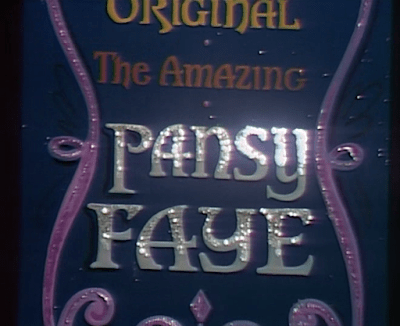
The dream sequence is like nothing we’ve seen before on Dark Shadows, though it is strongly reminiscent of the kind of thing you would have seen on near-contemporary shows like ABC’s prime-time horror anthology Night Gallery hosted by Rod Serling and the Paulist Fathers’ syndicated morality plays Insight hosted by the Rev’d Fr Ellwood Kieser. It starts with a closeup of a sign on which Pansy’s name is emblazoned in glittery letters, and plays over a soundtrack of an audience applauding thunderously. Pansy calls Judith, Barnabas, and Carl to join her on stage, each in their turn; their behavior in this drama-within-a-drama mirrors their behavior in the framing narrative.
Meanwhile, Barnabas’ unwilling sidekick, broad ethnic stereotype Magda Rákóczi, has returned from Boston. There, she met with a leading member of the Romani people, whose name she alternately pronounces as “King Johnny Romana” and “King Johnny Romano.” She shows Barnabas a box she took from King Johnny. It contains a severed hand wearing a ring, which Magda declares will solve their troubles. Magda has placed a curse on Judith and Carl’s brother Quentin, turning Quentin into a werewolf. After placing that curse, Magda learned that her sister Jenny had borne two children to Quentin, and since the curse is hereditary she is desperate to find a way to lift it. Barnabas traveled back in time to 1897 in the course of his own attempt to resist the effects Magda’s curse will have in 1969, so they are allied in this effort.
Barnabas is utterly unimpressed with the hand and with Magda’s plan to place it on Quentin as he is about to transform. He seems convinced that Magda is just trying to conceal the fact that she failed to find anyone in King Johnny’s camp who could actually help them. He doesn’t care about the original owner of the hand, a legendary nobleman named Count Petofi who was himself cured of lycanthropy, or about an incantation Magda says over the hand that is supposed to prepare it to draw the curse from Quentin. He isn’t even interested when she admits that she stole the hand from King Johnny and that if they don’t get it back to him before he realizes it is missing he will send someone to kill her. He reacts as if the whole thing is a show she is putting on to build up her cover story.
In a metafictional set of way, Barnabas is onto something. The original storylines the writers had prepared for the 1897 segment are coming to a head. Several of its major characters have already died, and others, such as Carl, would not be very attractive customers for a life insurance salesman. Apparently the original flimsies, written six months ago, gave only a few more weeks until Barnabas was to return to 1969 and take the show back to contemporary dress. But 1897 is a hit. The ratings are soaring, and there are some dynamics among the characters that they want to explore in a lot more depth. So they want to stay, but to keep the momentum going they need more story and a number of new characters, including a major villain whom Barnabas and Quentin can team up to fight together. So the writers find themselves in the same position with regard to us that Magda is in with regard to Barnabas, trying to sell us on their latest preposterous brainstorm.
Pansy’s farewell performance in Carl’s dream is, alas, Kay Frye’s final appearance on Dark Shadows. Some fans seem unable to look past Pansy’s own hilariously inept performance when we first see her doing her act, and to see that Miss Frye herself does a terrific job playing a cold, cynical working girl. She is good today, when Pansy is on stage and in her character as the “world-famous mentalist and singer,” but is also trying to tell Carl the truth about Barnabas. I only wish they could have brought Miss Frye back as someone else, either in the extended 1897 segment or in another time period.
Vampire Dirk Wilkins has bitten neurotic intellectual Rachel Drummond, fugitive schoolteacher Tim Shaw, and wealthy spinster Judith Collins. As we open, it is early morning and all three of them are gathered in Dirk’s hiding place. At Dirk’s command, Judith shoots Rachel. Tim does not know of Dirk’s wishes for Rachel, whom he loves. He is shocked by Judith’s deed, and takes Rachel to the Old House on Judith’s estate, Collinwood. The Old House is currently home to Judith’s distant cousin, Barnabas Collins. Tim knows that Barnabas is fond of Rachel, and hopes he will help them. But Barnabas is not available, and Rachel dies in Tim’s arms.
In the great house on the estate, Judith’s brother Edward and overwhelmingly evil charlatan Gregory Trask are fretting about the situation. Edward says that Barnabas believes that the vampire is Dirk; Trask replies “Then I would tend to believe it is not.” In #774, Trask found that Judith was bleeding from wounds on her neck and was in a robot-like daze; he had heard her calling Dirk’s name, and drew the conclusion that Dirk was the vampire. But his prejudice against Barnabas is so strong that he forgets about that.
Judith comes back, holding her revolver. Edward takes the gun and finds that it has recently been fired, and three chambers are missing their bullets. Edward leads Judith to her bedroom, and Trask goes into the drawing room, where by himself and in evident sincerity he calls on God to help him smite the forces of evil.
Returning viewers might be amazed at Trask’s attitude. He just completed a deal with a Satanist to use black magic to murder his wife; how can he believe himself to be God’s chosen instrument for this sort of work? But we have already seen that Trask’s hypocrisy is so extreme that it has given rise to its opposite. He has fooled himself, and is capable of the most earnest faith. In this he is the mirror image of his ancestor, whom we came to know between November 1967 and March 1968, when the show was set in the 1790s. That Rev’d Trask was such a true-believing fanatic that he became a hypocrite, so convinced of the rightness of his ends that he could not see how rotten the means were by which he was pursuing them.
Later, Dirk summons Judith. Edward follows her to Dirk’s hiding place, where he manages to stake the vampire, destroying him. He strikes quite a few inches below the heart, pretty well in the mid-gut region, but that apparently suffices.
This is perhaps the bloodiest episode of Dark Shadows so far. Rachel’s blouse is covered with blood, and blood spurts out of Dirk’s mouth while Edward is driving the stake into his belly. There is a good deal of discussion of this in the comments section of Danny Horn’s post about the episode on Dark Shadows Every Day. Many who were too young to remember the original broadcast wondered if there was public pushback against the graphic violence. The original fans among the commenters responded that no, to the extent that people were worried about the content of daytime TV at the time their concerns were focused on sex, not violence. One of the most memorable responses came from Friend of the Blog Percy’s Owner:
Not really. My dad remarried a woman with very conservative ideas about what I should watch and read. She had to prescreen everything. She worked and got home after DS, so she couldn’t have stopped me from watching it, but once I assured her that no one was having sex, she was FINE with it. She actually asked me if this was the soap with the woman who didn’t know who the father of her baby was. When I was able to say with absolute truth that there were no babies at all on DS she didn’t care.
Comment left by “Percy’s Owner,” 24 November 2015, on Danny Horn, “Episode 776: Blood Sports,” Dark Shadows Every Day, 23 November 2015.
I didn’t participate in that part of the discussion, but I did join in on another topic. Some commenters expressed the opinion that the portion of Dark Shadows set in the year 1897 went on too long, and that too many actors played multiple roles in it. I said that I was of the opposite view:
Oh, I disagree- I wish 1897 had gone on longer and had included a lot more doubling. For example, I’d have liked to see John Karlen come back as a suave, smooth-talking fellow. And Don Briscoe as a straight-up imitation of W. C. Fields, in the same way that Tony Peterson gave Jerry Lacy a chance to do a straight-up imitation of Humphrey Bogart. And Clarice Blackburn as the diametric opposite of Abigail/ Minerva- she could have been Magda’s black sheep cousin, the shameless woman.
Comment left by “Acilius” 9 November 2020 on Danny Horn, “Episode 776: Blood Sports,” Dark Shadows Every Day, 23 November 2015.
Vampire Barnabas Collins happens upon his unwilling sidekick, ethnic stereotype Magda Rákóczi, after she has fired a silver bullet at his distant cousin, werewolf Quentin Collins. He sternly forbids her to finish Quentin off, and for some reason she decides he is right.
Back in human form, Quentin is haunted by the ghost of Dorcas Trilling, a woman he killed in his first night as a werewolf. He has been telling himself that the evil deeds of the werewolf are not his own responsibilities, but that “he” is the culprit. That comforts him, but Dorcas isn’t having it. So he instantly collapses into, “All right, I did, but I couldn’t help it!” That doesn’t go over any better.
Unfortunately, this is Gail Strickland’s final appearance on Dark Shadows. Screenshot by Dark Shadows Before I Die.
Barnabas and Quentin have a confrontation. Barnabas tells Quentin that he knows his secret and says that he wants only to help him; Quentin angrily responds that he cannot trust Barnabas, who refuses to tell him anything about himself. He does ask Barnabas to kill him if it is the only way to keep him from turning into the werewolf again, so I suppose that is a step towards friendship.
The Kindest, Warmest, Bravest, Most Wonderful Human Being I’ve Ever Known in My Life
The show is doing an homage to The Manchurian Candidate this week, with schoolteacher Tim Shaw brainwashed into becoming an assassin when he sees the Queen of Spades. We open with the plan going awry. Lawyer/ warlock Evan Hanley did the brainwashing with the intention that Tim would kill someone else, but when he shows Tim the card, Tim tries to kill him. As Evan, Humbert Allen Astredo shows us a man suddenly becoming frightened and just as suddenly making up his mind to be brave. In other episodes, Astredo has already shown us Evan responding to fear in other ways. He really was a remarkably good actor, and it is a pleasure to see how much variety he can find in his parts.
Later, we see Judith Collins, the mistress of Collinwood, playing solitaire. Tim comes to the house. We know that each episode ends with a cliffhanger, and so this leads us to expect that we will end today with Tim’s hands around Judith’s throat. But that is a misdirection. In fact, Judith turns the Queen of Spades away from Tim at the last second, and he leaves the room without attacking her.
Slight Enough to Vanish, But Too Dense to Live
Tim’s brainwashing is a B-story on the show right now, and it would throw off the rhythm of the week to end two consecutive episodes with cliffhangers from it. The A-story is about the rakish Quentin Collins, who has been cursed to become a werewolf. There is a full moon tonight, and the sheriff’s department is roaming the grounds of the great estate of Collinwood with guns looking for the wolf who walks like a man. Joining in the search is Quentin’s distant cousin, Barnabas Collins, who is, unknown to all but a very few people, a vampire. Barnabas has traveled back in time to the year 1897, and among the things he is hoping to do is to learn how the werewolf curse that has afflicted his friend Chris Jennings in the 1960s first began.
Barnabas learned in 1969 that in 1897 Quentin and a woman named Beth Chavez paid a man named Ezra Braithwaite to make a silver pendant in the form of a pentagram and that a baby boy was buried in that year wearing that pendant. Tonight, Ezra telephones Barnabas at the great house of Collinwood and tells him that Beth just came in, ordered such a pendant, and told him to send the bill to Quentin.
Barnabas knows that the pentagram was an amulet meant to ward off werewolves. Beth is Quentin’s girlfriend, a fact that is no secret to anyone, not even Barnabas. So you might assume Barnabas would have figured out that Quentin is the werewolf. But apparently he has not. He materializes inside Beth’s room and demands she tells him who the werewolf is. When she refuses, he bites her. That bite is the cliffhanger.
Barnabas occasionally makes remarks about how he wants to keep the original timeline intact so that the people he knew in the 1960s will still be there when he gets back. But he’s been feasting on the people he meets in 1897 with abandon. Beth is the fourth resident of Collinwood he has bitten, and he has killed at least two young women in the village. Moreover, his approach to every problem he encounters or imagines is to confront the most powerful person associated with it and antagonize them immediately. It’s hard to see how he expects anything to remain unchanged after he inserts this rampage into the history of the late Victorian age.
But You Wouldn’t Know Anything About That
Judith tells Barnabas today that Beth came to Collinwood as a lady’s maid two years ago. Beth claims to have a cousin in town to Judith today while lying to cover up her trip to Braithwaite’s, and when Barnabas asks Judith if Beth is from Collinsport she mentions this cousin as her reason for believing that she is. Judith clearly knows very little about Beth, and cares less.
The lady who brought Beth as her maid was Quentin’s then-wife, Jenny, who was secretly a member of the Romani people. In #701 it was hinted that Beth was concealing a Romani origin of her own. Casting the tall, blonde, blue-eyed, pale Terrayne Crawford as Beth would seem to indicate that they were not committed to following up this hint, but in today’s scenes with Judith they do go out of their way to emphasize that Beth’s background is a mystery.
The Woman Who Never Left
Beth has been helping the family hide the fact that Jenny went mad and bore twins after Quentin left her. Quentin murdered Jenny in #748, eliminating the need for a servant to cover up her existence, and the twins, about whom Quentin does not know, are firmly ensconced in the care of a woman in the village named Mrs Fillmore. In #750, Judith fired Beth, but it didn’t take. Beth never left the house, and after a while the family started giving her orders again. Today Beth tells Judith that Mrs Fillmore reports that the boy twin is feverish, and asks to be kept on staff until he gets well. Judith agrees.
Judith tells Beth that she has decided to tell Quentin about the twins. She hopes that is what will prompt her brother to cast aside his selfish ways and become a mature adult. Beth is horrified and begs her not to do so. Judith, puzzled, says that Beth has always urged her to tell Quentin. She asks why she has changed her mind, and she makes up something obviously false about Quentin being unable to cope with the news that his son has a fever.
Yesterday, Beth learned that Quentin’s curse is hereditary. Returning viewers might wonder if she is afraid that Quentin will also learn that, and that if he does he might kill his children to prevent them passing it on. He does keep saying that he would rather be dead than have the curse, so he might talk himself into regarding such a murder as an act of mercy.
Featuring Edward Marshall as Ezra Braithwaite
Edward Marshall plays Ezra, a part played in #684 and #685 as an 87 year old man living in the year 1969 by Abe Vigoda (who was 48 at the time, but he and the makeup department both knew their business well enough that he was entirely convincing.) Mr Marshall appeared in #669 as unsightly ex-convict Harry Johnson, a part originally created by the not-always-stellar Craig Slocum. Mr Marshall gave Harry the same attitude and many of the same mannerisms Slocum had given him, but was so much more fun to watch that I wanted to see a lot more of him.
Parts of Harry’s costume and most of his surly demeanor are recycled in the 1897 segment in the character of dimwitted groundskeeper Dirk Wilkins, played by the repulsive Roger Davis. Whenever Dirk is on screen, I imagine Mr Marshall in Mr Davis’ place. I recommend that bit of mental recasting, it goes a long way towards making Dirk bearable. Unfortunately this is Mr Marshall’s final appearance on Dark Shadows.
Diana Millay’s Laura Murdoch Collins was instrumental in two of the most important turns in the development of Dark Shadows. When she was on the show from December 1966 to March 1967, she was its first supernatural menace, marking its transition from the Gothic melodrama of its first months to the monster-driven thriller it became. And in her current tour of duty, in April and May of 1969, it is while doing battle against Laura that Barnabas and Quentin Collins become friends, a friendship that will be central to the show from now on.
Today is Laura’s final appearance. Her sendoff is startling. After she bursts into flames, we cut directly to the closing credits, already in progress with Jonathan Frid’s credit for the part of Barnabas scrolling over an image of the outside of the great house typically shown during the opening voiceover. The bottom of the image is atypically cut off, creating a letterbox effect. None of this is in itself spectacular, but each part of it is a deviation from the usual format. Taken together, it leaves us with the feeling that Laura must have exited by way of the control room.
In the opening reprise, Laura thinks she is waking her son Jamison. She pulls the covers back from Jamison’s bed, and finds that she has been talking to a pile of pillows. In the corner of the room, Laura’s fellow undead blonde fire witch Angelique bursts out laughing.
Well might Angelique laugh. Not only is it ridiculous to see an ancient and terrible creature like Laura fall for so childishly simple a trick, but heaping up pillows under covers to make it look like someone is in bed is a favorite practice of Angelique’s. In #402, Barnabas went to Angelique’s bedroom intending to stab her, only to find her in the corner laughing at him after he had chopped up some pillows under her blanket.
It is fitting that Angelique is the one who destroys Laura. Matthew Hall, son of Sam and Grayson Hall, writes in the essay he contributed to The Dark Shadows Companion that when he and his father were among the writers developing the reboot of Dark Shadows that aired briefly on NBC early in 1991, the idea of including a version of Laura was rejected because “the Phoenix was virtually a test run of all the ideas that would subsequently reach fruition in the character of Angelique. Thus: Laura’s ability to cast spells that set fire to distant things is but one if Angelique’s large arsenal of tricks. Of course, on the original show, advantage was taken of how evenly matched these two characters were: they fought viciously during one episode.” There are some odd things in this assessment, but it is certainly that a character like Laura, who was frightening precisely because she herself was unknowable and her presence implied a world that humans could never hope to understand, had no place on a show where the supernatural is represented by figures like Angelique and Barnabas, whose feelings and intentions are overwhelmingly obvious and all too relatable.
Laura’s children are hidden from her in a room in the east wing of Collinwood. It is in this room, in front of them, that she burns up. The east wing has been mentioned only a few times, mostly by actors who were supposed to say “west wing.” This is the first episode with a scene set in the east wing.
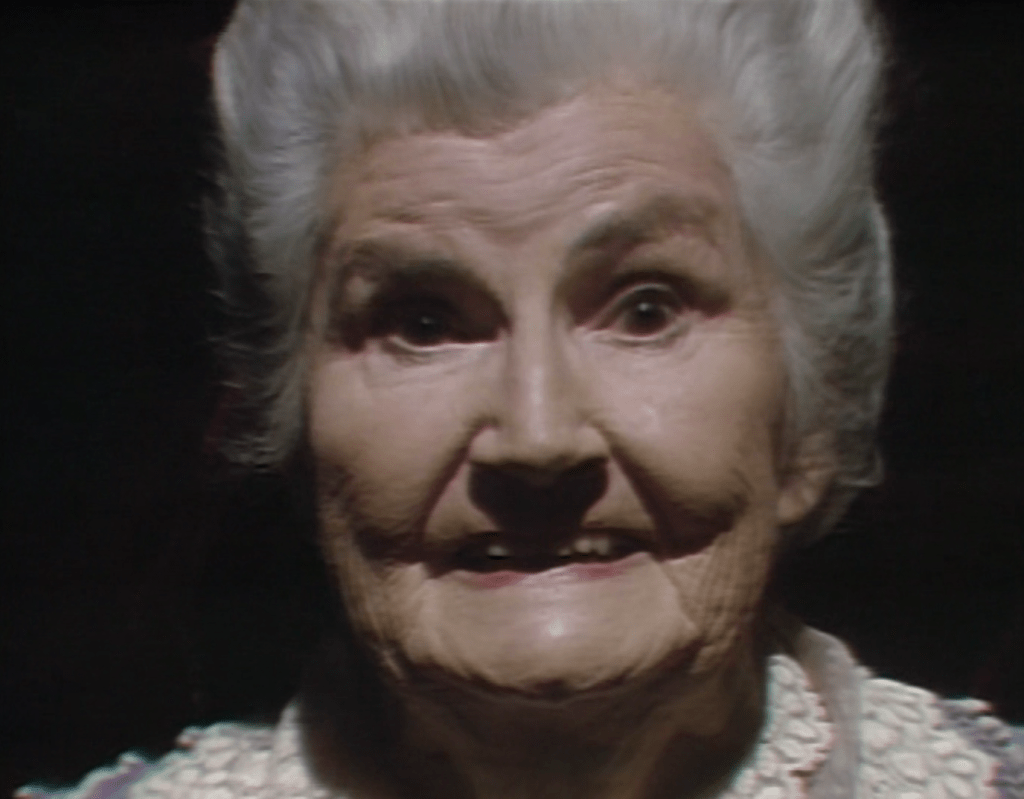
Libertine Quentin Collins has stolen his late grandmother Edith’s will, intending to forge a substitute that will give him control of her vast estate. His distant cousin, the recently arrived and thoroughly mysterious Barnabas, has warned Quentin that Edith’s ghost will haunt him if he persists in this plan. Quentin hears a loud pounding emanating from the walls of the great house of Collinwood. He goes to the study, where Edith lies in her coffin. He sees her there, grinning at him. Quentin returns to his room; the still-grinning Edith sashays in and taunts him. He tells her she is dead; this does not seem to bother her. She just keeps on grinning.
Edith may be dead, but she is clearly having a blast. Screenshot by Dark Shadows Every Day.
Quentin strangles Edith. She falls into an armchair in his room, unmoving but still grinning. He buries her somewhere on the grounds of the estate; her hand sticks up from the earth. He wakes up.
Quentin’s friend, unethical lawyer Evan Hanley, comes calling. Evan asks Quentin to give him the will so he can take it to a forger of his acquaintance. Quentin tells Evan about the dream, and how shaken he is. He also tells him about Barnabas, and his concern that Barnabas is a formidable enemy who may have uncanny powers. When Evan tries to dismiss Quentin’s worries, Quentin responds that he is the last person who should make light of the supernatural. When Quentin speaks of Evan’s “devil-callings,” we learn that the clandestine “meetings” they spoke of the other day are Satanist ceremonies. Evan agrees to meet Quentin at 8:00 that night in the groundskeeper’s cottage on the estate to summon one of the spiritual forces of darkness to fight Barnabas.
Returning viewers know that Quentin is right to fear Barnabas’ connections to the supernatural. Barnabas is a vampire, and his powers include the ability to send hallucinations to torment people with guilty consciences. He is also a time-traveler, who has come to 1897 from 1969 on a mission to prevent Quentin from becoming a ghost who will drive the Collins family of that year out of the great house and plague strange and troubled boy David Collins to the point of death.
First time viewers will not learn that today; aside from the opening voiceover, this episode tells us nothing about Barnabas. It does tell us something about Quentin and Evan. They are super-racist against Romani and Sinti people.
Evan has decided to hire Sandor Rákóczi to forge the will. Sandor and his wife Magda have been staying at the Old House on the estate for some time as Edith’s guests. Quentin’s brother Edward and sister Judith are offended by the presence of these “gypsies” in their midst. Unknown to Evan and Quentin, and unmentioned in today’s episode, Barnabas has bitten Sandor, enslaving him. Presumably Sandor has no secrets from Barnabas, making him a bad choice to be Quentin and Evan’s henchman.
Three times today, Evan addresses Sandor as “Gypsy.” When he is putting it to him that he wants him to forge the will, he barks at him with “Now, one moment, Gypsy.” He insists Sandor fix his price in advance. When Sandor tells Evan he is sad that he does not trust him, he replies “Well, then, be sad, Gypsy, but give me your price, now!” Later, Sandor will express curiosity about Quentin and Evan’s plans, to which Evan will reply “Well, don’t be curious, Gypsy, just do as you’re told.”
Evan told Quentin that the “devil-calling” at the cottage should involve twelve year old Jamison Collins as a “sacrificial lamb.” Quentin sincerely cares about his nephew Jamison, and he protests that he won’t do anything to hurt him. Evan assures him that Jamison will simply be a symbol of the innocence that their dark lord exists to despoil and that the boy himself will not be harmed. When Quentin is talking Jamison into joining him and Evan for a secret meeting that night, he tells him they will look into the future. Jamison asks”How, with a crystal ball?” Quentin replies “No, of course not. That kind of thing is for gypsies. It’s not for men, like you and me.” Scripted television in the US in the 1960s rarely gave such flagrantly racist remarks to recurring characters, not only because the audience included members of minority groups, but also because they are so unattractive that they limit the utility of the characters who make them. In this case, Quentin and Evan are already in league with the Devil, and Quentin is on track to die soon and become a ghost. So we know that they are due for a comeuppance. Moreover, their prejudices may lead them to underestimate Sandor, both on his own account and as a tool of Barnabas, so it is useful to the plot that they are in the grip of such ugly attitudes.
Sandor is in the cottage, preparing to forge a new will for Edith, when Jamison drops in. Jamison does not see what he is doing. He and Sandor spend a couple of minutes sparring verbally. Sandor ends the match when he points out to Jamison that it is getting dark. The boy looks alarmed and runs home while Sandor laughs.
In #701, Sandor and Magda mentioned that the Collinses were afraid of the night. Shortly after, they found out about Barnabas, and learned that they had good reason to be. But Sandor can still laugh when he sees that a boy as old as Jamison runs away at the news that the sun is setting.
Sandor is still in the cottage when Quentin brings Jamison by. Evidently Evan plans to let Sandor participate in the ceremony. Regular viewers will remember that in 1969 the first place Quentin manifested himself outside the little room in the great house where David and his friend Amy discovered him was in the cottage, and that he showed considerable power there. That he and Evan have their Satanic “meetings” in the cottage suggests that the evil he did in 1969 has its roots in what he did during them.
Evan directs Jamison to stare into the fire burning in the hearth. This will ring another bell for longtime viewers. Jamison is played by David Henesy, as is David Collins. From December 1966 through March 1967, David Collins’ mother Laura Murdoch Collins lived in the cottage. She was an undead blonde fire witch, and her plan was to lure David to join her in a fiery death. She would rise from the dead as a humanoid Phoenix, as she had done at least twice before. On each of those previous occasions, she went into the flames with a son named David; the Davids did not rise again, as becomes clear when one of them is available to speak in a séance in #186. Laura often urged David to join her in her favorite pastime, staring into fire. So when Evan urges Jamison to do the same, we wonder if Jamison, too, is in danger of being consumed by its fascination.
As the ceremony goes on, Jamison becomes alarmed. He runs out, and Evan orders Sandor to follow him. Quentin, too, runs to the door and protests that they have gone too far. He points to the flames, in which the likeness of a skull wearing a wig takes shape. We may wonder if more will be added to the skull, perhaps so much as to make up a whole woman, and if this woman will be someone we have met before.
Edith’s role in Quentin’s dream unfortunately marks Isabella Hoopes’ final appearance on Dark Shadows. She was just terrific. I wish they had done a parallel time story set around the period of the Civil War in which Hoopes played an aged Sarah Collins. Her nose, chin, and cheekbones resembled those of Sharon Smyth sufficiently that you can imagine an elderly Sarah looking like her, and she had a playfulness that would make longtime viewers remember the nine year old ghost we met in June 1967.
Old world gentleman Barnabas Collins and governess Maggie Evans make their way into a dusty little room in the long-deserted west wing of the great house of Collinwood. Until last week, the ancient and esteemed Collins family lived in the main part of the great house, but now the evil spirit of the late Quentin Collins has emerged from the west wing and made life unbearable there. They have taken refuge in Barnabas’ home, the Old House on the same estate. Maggie’s charges, twelve year old David Collins and nine year old Amy Jennings, are possessed by Quentin, and David has gone missing.
Last night Maggie had a dream in which she entered this room, found a hole in the wall, and saw a door on the other side. She passed through that door and found a chamber crowded with Victorian bric-a-brac. She met Quentin there, and he gave her a kiss that looked very pleasant indeed. After she awoke, Maggie decided that she would go to the room to see if there was such a chamber behind the wall, convinced she would find David there. Or maybe that she would get another kiss, who can say.
Barnabas and his friend, mad scientist Julia Hoffman, MD, told Maggie it was far too dangerous for anyone to go to the great house alone, and insisted Barnabas accompany her on her expedition. This would seem to reduce the likelihood of another smooch from Quentin, but Maggie acquiesced.
Before we see Maggie and Barnabas, we are treated to a closeup of the tailor’s dummy to whom David referred in #681 as “Mr Juggins.” The camera pulls back, and we see that Mr Juggins is standing in front of a stone bust and next to a globe. The effect is quite stately. Unfortunately, this is Mr Juggins’ final appearance on the show. I think he had a lot of potential.
Barnabas and Maggie finds that there is indeed an opening where she had dreamed one would be and a door behind it. Barnabas pries the rest of the paneling off the false wall, and they enter the chamber beyond. Maggie confirms that it matches her dream perfectly.
They are marveling at this discovery, one made possible only by the intervention of whatever supernatural agency sent Maggie’s dream, when the doorknob starts turning. Occult expert Timothy Eliot Stokes enters.
Maggie and Barnabas look wonderingly at Stokes, and ask how he knew about the chamber. Regular viewers will be at least as surprised to see him as they are. Stokes tells them he was searching a nearby corridor and could hear the noise Barnabas made when he ripped the paneling out. That deflates the moment a little, but does leave us with a sense that there is more to Stokes than we know.
Stokes joins Barnabas and Maggie in searching the chamber, and quickly finds Amy hiding behind a curtain. Amy passes out, and the men urge Maggie to take her to the Old House. Alone with Barnabas, Stokes finds a set of I Ching wands and a couple of books in a desk. He says that it tells him a great deal about Quentin that he had these things. He also says that they will never find David by searching the house- the only way to rescue him is by studying the I Ching.
Maggie has taken Amy back to the Old House. There, Amy suddenly exclaims “Stokes is wrong!” Evidently whatever spirit is possessing Amy is streaming audio from Quentin’s chamber. Maggie asks what she means, and Amy avers that David is in the great house, but that he will soon be entirely subsumed by the spirit of his grandfather Jamison. Maggie rushes out to get him.
We cut back to the great house. Maggie enters the foyer, and David comes to the head of the stairs. She calls to him; he answers and calls her by name, but is struggling. The door at the head of the stairs opens, indicating that Quentin is there. Maggie confronts him and demands David do the same. David struggles further. He is in Maggie’s arms when the door closes, indicating Quentin has left. Maggie exclaims “We won! We won!” But there is no victory. David collapses. Maggie takes him back to the Old House, where Julia examines him and concludes that he will be dead within hours unless the possession is broken.
This situation is familiar to longtime viewers. Dark Shadows version 1.0 ran from June 1966 to March 1967. Its main theme was David’s difficult relationship with Maggie’s predecessor as his governess, Vicki Winters. It reached its end in #191, when David’s mother, undead fire witch Laura Murdoch Collins, tried to kill him. At the last moment, David ran from Laura into Vicki’s arms. With that, he had chosen life over death, and the story of Vicki and David had nowhere to go.
Maggie and Vicki were close friends, and so we can suppose she heard all about how David escaped from Laura. She knows what we know, and so she must feel the same shock we do when the scenario does not reach the same happy ending.
As David’s embrace of Vicki marked the end of Dark Shadows 1.0, his embrace of Maggie today marks the end of Dark Shadows 5.0.* This iteration of the show has focused on two intertwined stories. They concern werewolf Chris Jennings and the ghost of Quentin. Chris’ lycanthropy has been getting steadily more aggressive, and now he cannot revert to his human form at all. Quentin’s power has been growing in tandem with the expansion of Chris’ curse, so that there is nothing left for him to achieve. Both of these stories have, therefore, reached their conclusion. Moreover, the great house has been the constant element at the center of the show. Now that it is closed to the surviving characters, they cannot pick up a new plot and continue the series. It seems that this is to be the final episode of Dark Shadows.
In November 1967, it seemed that Dark Shadows had foreclosed every possible avenue of story development. The characters gathered for a séance, something we had seen them do three times before. Those previous séances had been dramatic high points, but this one had an outcome unlike anything we had seen. Vicki vanished from the circle. A woman unknown to the company took her place and identified herself as Phyllis Wick, governess at Collinwood in the year 1795. She and Vicki had traded places. Vicki took us with her, and for the next four months Dark Shadows was a costume drama set in the late eighteenth century. The result was a triumph that turned the show into a full-fledged hit, one of the major pop culture phenomena of the 1960s.
By now, we’ve seen ten séances, and they’ve gotten sloppy with them. In #600, a séance to contact someone named Philippe Cordier takes less time and trouble than it would have in 1969 to place a station-to-station telephone call. In #682, four characters held a séance in which no one objected when the medium went into the trance, breaking from a ritual form they had observed very strictly up to that point. In #698, we even heard about a séance held off-screen. So it is unlikely they will use a séance to get us from the conclusion of Dark Shadows 5.0 to the beginning of whatever it is that will compose Dark Shadows 6.0.
Barnabas and Stokes take Quentin’s I Ching wands and books to the basement the Old House, where Julia joins them. Stokes explains the I Ching more or less accurately, then Barnabas decides he will use the wands in an attempt to communicate with Quentin. Stokes warns him that the effects of the method are extremely unpredictable, and Julia keeps trying to stop the proceedings. Among them, the three represent the roles of convener, medium, and objector that we have seen in one séance after another.
But Quentin does not speak through any of the participants. Instead, Barnabas’ spirit leaves his body and walks towards a door. He opens it, and finds a coffin on the other side. It seems he is about to become a vampire again, as he was for the 172 years ending in March 1968. He is able to speak while this is going on; Julia knows what he means when he mentions a coffin and a mausoleum. Stokes is not a party to their criminal conspiracies, and so is puzzled. He asks Julia if she knows what Barnabas is talking about, and it is obvious that she is lying when she says she does not. Barnabas heads off towards the chained coffin, and an entirely new show.
*Version 2.0, running from March 1967 to November 1967, introduced Barnabas as a vampire. Barnabas occasionally preyed upon the living, but spent most of his time trying to fit in to the twentieth century. He was so successful in that project that matriarch Elizabeth Collins Stoddard gave him the Old House on the estate of Collinwood to live in, and the viewing public started tuning in in large numbers.
Version 3.0, running from November 1967 to March 1968, was the 1790s segment. It was the inverse of version 2.0. Vicki’s attempt to navigate an alien time failed as spectacularly as Barnabas had succeeded, getting her condemned to death by the other characters and losing the loyalty of the audience.
Version 4.0 was a Monster Mash full of creatures familiar from Universal Pictures horror films of the 1930s; it ran from March to November 1968, and its main theme turned out to be the growing friendship between Barnabas and Julia.
In #128, wisecracking waitress Maggie Evans opened a conversation in the diner at the Collinsport Inn with that old familiar ice-breaker, “Whaddaya hear from the morgue?” The show took us all the way to Phoenix, Arizona for a trip to that city’s morgue in #174, but it is only today we see the inside of Collinsport’s own morgue for the first time. Sheriff George Patterson brings heiress Carolyn Collins Stoddard in to identify a body found on her property. Carolyn is shocked to find that it is her friend, Donna Friedlander.
Last night, Carolyn and Donna were in the drawing room of the great house of Collinwood with permanent houseguest Julia Hoffman and old world gentleman Barnabas Collins, who lives in the Old House on the same estate. Also in the room was Chris Jennings, a mysterious drifter who caught Carolyn’s fancy and who now lives in the caretaker’s cottage on the estate as her guest. Barnabas invited everyone to dinner at his house. The ladies delightedly accepted, but Chris begged off, saying he would have to leave immediately to keep an important business engagement in Bangor, Maine. Donna said that she was going home to Bangor and that she was ready to leave, and asked Chris for a ride. When he tried to squirm his way out of taking her, Barnabas looked on with smug self-satisfaction.
This morning in the morgue, Carolyn tells Sheriff Patterson that the last time she saw Donna, she was leaving with Chris. But she recoils from the implication. She cannot believe that Chris had anything to do with Donna’s death.
Carolyn does not know what Barnabas has figured out. Chris is a werewolf. When Barnabas told Julia that he had come to that conclusion, she was unconvinced. Barnabas’ dinner invitation was a ploy intended to elicit just the panicked reaction Chris did have. Barnabas’ look of triumph at Chris’ frantic attempts to ensure that he is alone on this night of the full Moon reflects his belief that he has been proved right.
Barnabas went to the cottage some time after the Moon rose, intending to use his silver-headed cane to take control of Chris in his werewolf form. But he delayed too long, and by the time he got there the cottage was vacant and Donna’s mangled corpse lay in the woods nearby.
We cut to the cottage, where we see a disheveled and bloodstained Chris come home. He has just had time to change his shirt and set some furniture right side up when Carolyn drops in. She has come to warn Chris that Sheriff Patterson is coming. The sheriff is right behind her. Carolyn leaves the two of them alone. Chris refuses to allow a search of the premises; when he spots Donna’s purse on his table, he throws a newspaper over it. The sheriff somehow fails to notice this, but takes Chris to his office for questioning.
In the drawing room, Barnabas and Julia are fretting over Donna’s death. Barnabas asks “Could we have stopped it?” He decides that they could not have, and that whatever sequence of events led to the killing must have been “Donna’s fault.” It is always fun to watch the scenes where Barnabas faces the horrific results his actions have on other people, strikes a noble pose while briefly considering the possibility that he may be partially responsible for them, and then agrees with Julia that it is pointless for him to blame himself. Julia and Barnabas’ self-exculpatory attitudes are so transparently absurd that you have to admire Grayson Hall and Jonathan Frid for keeping straight faces while delivering their dialogue.
Meanwhile, Carolyn has called the Collins family lawyer, Richard Garner. Garner agrees to help Chris. We saw Garner and his son Frank a number of times in the first months of 1967, but he hasn’t been on screen since #246. He has only been mentioned a handful of times since then, most recently in #577. This is the last time his name will come up.
Back in the drawing room, Barnabas tells Julia that he can see “So many possibilities” for dealing with Chris’ problem. Frid’s delivery of this line made my wife, Mrs Acilius, shudder. She could hear the evil in his voice as he shows us Barnabas playing God.
Chris is in an interrogation room, telling Sheriff Patterson a series of mutually contradictory lies about what he did last night. The sheriff says he’s going to leave him alone for a few minutes so that he can come up with a more plausible story. You might think this was a sarcastic remark, but in this context it seems it might actually be sincere. Sheriff Patterson’s failure to notice Donna’s purse on Chris’ table is of a piece with the complete nonfeasance he has shown all along, and Vince O’Brien delivers the line so warmly it doesn’t sound like a joke. Moreover, Sheriff Patterson’s predecessor as Collinsport’s chief representative of law enforcement, Constable/ Sheriff Jonas Carter, capitulated to the Collins family’s directions to cover up a crime in his final appearance on the show, back in #32. Longtime viewers may suspect that Sheriff Patterson is as averse to the tough parts of his job as was Constable/ Sheriff Carter.
While Chris is alone in the interrogation room, he decides to tell Sheriff Patterson the truth when he comes back. He does in fact open his mouth and get the first few words of a confession out when the sheriff cuts him short. He says that Barnabas Collins called the office to tell him Chris was with him last night, and that Barnabas is “about the best alibi you can have in this town.” He shakes Chris’ hand and sends him on his way. Law enforcement characters on Dark Shadows are symbols of helplessness, and after that moment Sheriff Patterson has reached the zenith of that quality, achieving a measure of futility that cannot be surpassed. We never see him again.
Chris goes home and finds Barnabas waiting for him. Chris expresses his gratitude for the alibi Barnabas gave him, but keeps trying to get him to leave before the Moon rises. Barnabas tells him that when he leaves, Chris will leave with him. Barnabas closes the episode by telling him that he knows that he is not only Chris Jennings, but that “You are also the werewolf.”
This episode marks the final appearance not only of Sheriff Patterson, but also of Vince O’Brien. O’Brien joined the show in #148 as the second actor to play Lieutenant Dan Riley of the Maine State Police. O’Brien’s stolid manner suited the role of that ineffective investigator, but he was much less fun to watch than was the man who originated the part, the charming John Connell.
O’Brien took over as the second Sheriff Patterson in #328. He was again a step down from his predecessor; the first Sheriff Patterson was Dana Elcar, an extraordinary performer who always found a way to give the audience hope that his character was only playing dumb. Other actors filled in for O’Brien a couple of times, Angus Cairns in #341 and #342 and Alfred Sandor in #615, leading some fans to refer to “the Patterson brothers” (whose parents named all of their sons George) and others to speculate that for a time Collinsport allowed any man to be sheriff who was willing to change his name to “George Patterson.” Like O’Brien, Cairns and Sandor were accomplished professionals, but none could match Elcar’s gift for overcoming bad writing and keeping our attention focused on the sheriff.






 Dark Shadows Commentary