Episode 757: All of them witches

Undead blonde fire witch Laura is in the act of driving a stake into the heart of vampire Barnabas when she is interrupted by another undead blonde fire witch, Angelique. Angelique announces that she will always be there to thwart any attempt to stake Barnabas, which rather tends to deflate the suspense inherent in having a protagonist who is a vampire. The two of them exchange threats, and Laura finds that she can hold Angelique at bay by generating the right kind of fire.

Laura leaves Barnabas’ house. His unwilling sidekick, thoroughly human witch Magda, sees her and asks what she was doing there. Laura does not answer, but Angelique enters and tells her. Angelique says that Barnabas would doubtless wreak a terrible vengeance if he found out what had happened while Magda was away. Angelique orders Magda to go to the great house of Collinwood and fetch a fourth witch, black magic enthusiast Quentin. Magda complies reluctantly.

Quentin is falling down drunk, which is not unusual. He has a better excuse than he typically does, however, since he just found out that Magda turned him into a werewolf. He is furious to see her. He says that no matter what she thinks, he will not “lie down and die!” This elicits a laugh from Magda, who points out that he can barely stand up. She tells him that Angelique has ordered him to come to Barnabas’ house, and that he cannot oppose her.

In the house, Angelique tells Quentin he must help her defend Barnabas from Laura. Quentin moans that he is in no condition to help anyone, which only makes Angelique impatient. Unlike her and Magda, Quentin does not know that Barnabas is a vampire, so Angelique keeps reminding herself to say that Barnabas has gone away for the day and that Laura will be a threat to him when he comes back tonight. Quentin tells Angelique about a trinket Laura received from some of the gods of ancient Egypt that keeps her alive, and she sends Magda to steal it from her.

Magda goes to Laura’s cottage. Magda tells Laura that she has more reason to hate Barnabas than she does, since Barnabas enslaved her husband Sandor. She wants Barnabas to be destroyed, but if Laura tells the authorities about him Sandor, too, will be killed. The dramatic date is 1897, and the state of Maine abolished the death penalty in 1887, so Magda is afraid of an extrajudicial killing rather than an execution for complicity in Barnabas’ murders.

Laura tells her that it is necessary to expose Barnabas if he is to be destroyed, but Magda tells her of another way. She says that vampires can be killed by silver bullets through the heart. Laura goes to get money for Magda to buy silver and have it made into bullets. While she is out of the room, Magda steals the trinket. It seems that Magda has given herself a chance to get rid of both Laura and Barnabas.

Once Angelique has the trinket, she tells Quentin that he will have to perform a ceremony using his copy of the Egyptian Book of the Dead. He is still heavily hungover and balks at the orders, but she gives him no choice. Once he starts his incantation, he breaks into a big smile, clasps the book to his chest, and preaches the phrases like a megachurch pastor when the collection plates are circulating. We cut to Angelique. Her expression is so admiring it is hard to tell whether the reaction is the character’s or the actress’. Angelique does some mumbo-jumbo with objects in the fireplace.

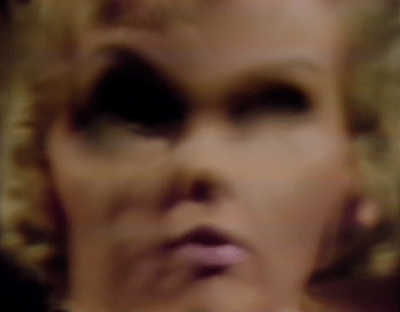
In her cottage, Laura struggles. She looks frantically for the trinket, then prays to Amun-Ra. The final shot of her is filtered to distort her image. It turns her eyes into little black coals, which is an effective visual metaphor.

Screenshot by Dark Shadows Before I Die.

Laura has been important in the history of the show and is key to this little period of the plot, but it is fairly clear that she is a short-timer now. All she cares about is taking her children away and burning them to death so that she can renew her own existence, and she keeps saying she is on a tight deadline for that project. We can be sure she won’t succeed, and even if she does she will be off the show. So she really could die, making the cliffhanger more suspenseful than usual.

Soaps classically divided the days of the week so that very little happened on Tuesday or Wednesday, Thursdays were devoted to plot mechanics setting up a big development, Fridays would show that big development and end with a memorable cliffhanger, and Mondays would resolve the cliffhanger and give a lot of recap to bring new viewers up to speed. Dark Shadows never followed this formula. These last three episodes are a case in point. #755 was all about Laura trying and failing to figure out whether Barnabas was a vampire. That was a mid-week throwaway if ever there was one, but it aired on a Friday. Yesterday she got confirmation that he was, and we ended with a fine cliffhanger with her holding the stake and mallet beside Barnabas’ open coffin. That aired on Monday, but was a perfect Thursday scene-setter. Today, a Tuesday, we have a whiz-bang battle of the witches, with new alignments and new dangers, a great Friday climax with a cliffhanger fitting for the end of any week.

Violet Welles was far and away the best writer of dialogue on Dark Shadows, and today’s script is so full of gems that even the plot summary on the Dark Shadows wiki is full of quotes. I can hardly blame the editor for that deviation from the usual format, there is so much good stuff I would have been tempted to transcribe the entire script if someone else had not already done so.

Episode 748: Here in the past

Madwoman Jenny Collins is hiding in the quarters of her formerly devoted servant, Beth. Beth enters with Jenny’s estranged husband, libertine Quentin. Jenny eavesdrops as Beth tearfully tells Quentin that she was once very close to Jenny, but that now she wishes her ill, because she is in love with him. Quentin and Beth embrace, and Jenny lunges at them with a kitchen knife.

Quentin disarms Jenny and strangles her. We were introduced to Quentin as a murderous ghost haunting the great house of Collinwood in 1969, and when we first came to the year 1897 to meet him as a living being it was a matter of minutes before he was squeezing his grandmother’s throat and threatening to kill her. Quentin has been going around the house announcing for days and days that he plans to kill Jenny, so it comes as no surprise to the audience that he puts his hands around her neck even though she has already been disarmed, fights off Beth’s attempts to stop him, and keeps choking Jenny until some time after she has stopped moving. We have been well-prepared for this unambiguous image of intentional homicide.

Once Quentin has finished his work, he runs out of the room. Beth goes to the foyer and, between sobs, tells Quentin’s stuffy brother Edward that Jenny is in her room, dead.

In Beth’s room, Edward feels Jenny’s wrist and says that she is indeed dead. Once Beth has given him a few of the salient details of the murder, he declares that he has heard enough. He orders Beth to take the knife back to the kitchen and put it where it belongs. They talk briefly about Jenny and Quentin’s children, whose existence has previously only been hinted to the audience and has been denied to other characters as recently as yesterday.

We cut to the foyer. Quentin comes creeping down the stairs, holding a bag and looking from side to side. When Quentin reaches the foot of the stairs, Edward seizes the bag and orders him to stay in the house. In the drawing room, Edward tells Quentin and Beth what story they will put about to cover up the murder and save the family name. Beth is to say that she found Jenny lying at the foot of the stairs, stunned. She helped Jenny to her room, then left her there for a moment while she went to look for help. Finding no one, she came back and saw Jenny lying on the bed. When she could not wake her, she realized she had died of the injuries she sustained in her fall.

Quentin says that the story will not work. He tells Edward that earlier in the evening, Jenny’s presence at Collinwood was revealed to three more people, distant cousin Barnabas Collins and ethnic stereotypes Magda and Sandor Rákóczi. Edward says that as a member of the family, Barnabas will not question the story, and that as “Gypsies,” Sandor and Magda will do anything in return for money. Quentin says that Magda and Sandor will not be so easy to deal with. When they learned that Jenny was in the house, Magda told Quentin something which he tells Edward and Beth “None of us ever knew,” that Jenny was her sister.

Edward is thunderstruck, and exclaims “You married a Gypsy!” Yesterday it seemed that Edward and Quentin’s sister Judith, the owner of the house, had known Jenny’s origin for some time, and that it was why she locked Jenny up in the house when she went insane rather than sending her to a mental institution where Sandor and Magda might be among her visitors. And as far back as #701, it seemed likely that Beth knew secrets relating to Jenny, to Magda, and to Romani heritage. In that episode, Quentin marveled that Beth was still around Collinwood when Jenny, who had brought her to the house as her servant, had left, and Magda taunted Beth by bringing up a bit of Romani folklore and laughing “But you wouldn’t know anything about that, would you?” So while Jenny’s background is news to Quentin and Edward, it may not be true that “None of us” knew.

Magda and Sandor come to the house. On their previous visits to the great house, they have acted like servants or like stage Gypsies come to tell fortunes and sing songs. But now that the word is out about Jenny’s true identity, they come in with their heads up and look Edward in the eye. They say that they have come to see Jenny. Edward turns away from them, and says that there has been an accident. Jenny is dead. Horrified, Magda asks where she is. Edward says that she is in Beth’s room, and offers to have Beth show them the way. Magda says that she knows where it is, and that she and Sandor want to go by themselves. Edward says “Of course,” very much in the tone a gentleman uses with his equals.

In the room, Magda notices that Jenny is holding a button in her hand. She concludes that she pulled it off the coat of a man with whom she was fighting for her life. Sandor notices heavy bruising around her neck.

Meanwhile, Edward is drilling Beth and Quentin in the stories they are to tell. Beth recites the whole thing, and he tells her to remember every word. Quentin is less cooperative, but still seems to have learned his part. He tells them not to speak until they are spoken to.

Sandor and Magda enter. She asks some questions; Edward answers, and shows offense when she tries to direct them to Beth. Before he can proceed to the next act of the little drama he has prepared, letting first Beth and then Quentin corroborate his account with the stories he has given them, Magda looks at Quentin’s coat. She can see that a button is missing and that the ones that remain match the one she found in Jenny’s hand. She calls him a murderer, and says that the police will hear of it.

Edward says that Quentin might have lost the button anywhere at any time. He asks her what the authorities in the village of Collinsport would do if asked to choose between a Romani person’s word and that of a Collins. Magda drops the idea of going to the police, and tells Quentin that she will place a curse on him that will make him suffer as Jenny suffered, but that his suffering will not be subject to the release that death has brought Jenny. Quentin is terrified, Edward dismissive.

Magda tells Quentin she will curse him. Screenshot by Dark Shadows Before I Die.

From the very beginning, one of the main themes of Dark Shadows has been denial, the psychological defense mechanism. In this one, we see that denial is, among other things, the wish that time would stop moving forward. Quentin says that he is not going to go to jail for something he did not mean to do. He obviously did mean to kill Jenny, but he does not want to accept any of the consequences that follow from that act. He wants to be frozen in his comfortable, carefree life, without punishment from the law or vengeance from Magda. Edward wants the family name to be frozen in the lofty regard in which it was held before Quentin murdered Jenny.

For her part, when Magda tells Quentin it will not be possible for him to die, she is promising to give him and Edward what they want, but not in the way they want it. A curse is a way of freezing time. The suffering it brings persists, unchanged, from year to year. It cannot be explained, it cannot be escaped, it falls on one person after another whatever their deserts. Its only logic is to renew itself endlessly.

Episode 747: Triumphant life behind a locked door

Madwoman Jenny, estranged wife of libertine Quentin Collins, is on the loose again, and she is the object of a madcap search by Quentin’s sister, spinster Judith, his girlfriend, maidservant Beth, and his distant cousin, secret vampire Barnabas. Quentin makes two contributions to the process. The less important is to serve as the bait in a cockamamie trap Barnabas and Judith lay for Jenny. The more important is to keep up a running commentary mocking the other characters for the silliness of their activities.

The trap itself involves a moment of intentional humor. Barnabas has returned to the year 1897 to prevent Quentin becoming a ghost who will ruin things for everyone on the great estate of Collinwood in 1969. One of the things Quentin did in that year that terrified the characters and tried the patience of the audience was to cause the strains of a sickly little waltz continually to resound from the walls of the great house. When the show became a costume drama and we got to know the living Quentin, we found that he too played a gramophone record of that same tune incessantly, annoying all and sundry. The trap requires Quentin to play the recording over and again until Jenny hears it and comes. After it has been going for half an hour, Barnabas tells Quentin that the plan didn’t work and they should stop playing the waltz. Quentin asks “Are you tired of hearing this music?” Barnabas speaks for all of us when he replies “Frankly, yes.”

Not only is this a successful comedy, it also gives the cast an opportunity for some of their best dramatic acting. As Judith, Joan Bennett at one point stops, looks at Barnabas, and asks “Can we trust you? Really trust you?” She apologizes for the bluntness of that question, then admits that she has long been busy putting a prettier face on the Collins family than the dark secrets Barnabas has discovered make plausible. “I’m not really very trusting. I try to pretend we’re nicer than we really are.” In the parts of Dark Shadows set in the 1960s, Bennett plays matriarch Liz, whose whole personality is about denial and the pretense that the Collinses are nicer than they really are. Liz latched onto Barnabas as soon as she saw him, and refuses to see any evidence that he is not quite normal. Nor does she ever really face her own habits of concealment and their implications. In this little exchange, we see Bennett playing a character whose superficial similarities to Liz point up her profound differences from her.

“Can we trust you? Really trust you?”

Joan Bennett had one of the most distinguished careers of any American actress of the twentieth century. Terrayne Crawford stands at something of the opposite pole, and her performance as Beth leads most fans to declare that she is the weakest of all the members of the cast of the portion of Dark Shadows set in the year 1897. I don’t really disagree with that, but she is fine today. Miss Crawford’s great limitation was that she could play only one emotion at a time, and she was on the show in a period when the scripts gave every character complex motivations in almost every scene. But today, all Beth has to play is Anguish, and Miss Crawford does a fine job.

Beth took care of Jenny during the year Quentin was away from Collinwood, and became very close to her. In the nine and a half weeks since Quentin’s return, she has fallen in love with him. In a scene at the close of today’s episode, Beth tearfully admits to Quentin that she wishes something would happen to Jenny so that he would no longer have a wife. Beth collapses into Quentin’s arms. Jenny has been hiding in a corner, eavesdropping; she comes out, holding a knife. There have been occasions when we might have rooted for Jenny to succeed in killing Beth, just to spare us the embarrassment of Miss Crawford’s flat, tedious performances. But this time, we want to see more of her, and the prospect that Beth might die makes for an effective cliffhanger.

Episode 745: What I am is what I will be

Broad ethnic stereotypes Sandor and Magda Rákóczi are in the parlor of their home, the Old House on the great estate of Collinwood, quarreling about a locket. Shortly before, Magda found maidservant Beth Chavez and libertine Quentin Collins in the parlor, and she noticed Beth snatch a locket from a table and try to hide it. Beth claimed that the locket was hers, but Magda declared that it was not, and that she knew who it really belonged to. Now Beth and Quentin have left, Magda has the locket, and Sandor is pleading with Magda to stop trying to figure out what it means that the locket is in the house. “She is far away!” he protests.

Returning viewers know that the locket belongs to madwoman Jenny, Quentin’s estranged wife. Unlike Magda, we also know that Quentin’s brother and sister, with the assistance of Beth and another servant, have been keeping Jenny prisoner in a series of cells deep in the great house ever since Quentin left her the previous year. Yesterday Jenny had a strong reaction to Magda’s name, in the course of which she started muttering about Sandor as well, hinting that the Rákóczis are of some importance to Jenny.

Sandor and Magda hear a voice from an upstairs bedroom. They go there, and are astonished to find Jenny. They ask her where she went when Quentin left her; she denies that Quentin ever did leave her, and talks about being locked up in a room. It dawns on Magda and Sandor that the Collinses locked Jenny up in the house and have been keeping her there. Jenny angrily says that yesterday she was horrified when Sandor and Magda’s caravan pulled up at the home she and her husband share, and that she told them never to speak to her again; they tell her that happened years ago. She is shocked and disbelieving.

Sandor and Magda are distressed by Jenny’s madness. Screenshot by Dark Shadows Before I Die.

Jenny sneeringly calls Magda and Sandor “Gypsies.” Magda replies “You are a Gypsy, too.” Jenny replies that “What I was is not what I am.” After a few more moments, Magda and Jenny embrace and Magda calls her sister.

The revelation that Jenny is Magda’s sister is one of the most effective twists in the whole series. When Mrs Acilius and I first watched the show through, we were thunderstruck by it. The most amazing thing is that it makes so much sense we couldn’t believe we hadn’t figured it out. The Collinses have disdain for Jenny, not only because their black sheep brother brought her into the family, but also because she is of obscure birth. So when she became mentally ill, why didn’t they just ship her off to an institution and have done with it? The answer is racism. They are not simply embarrassed that Quentin chose an unsuitable wife; they are frozen with horror that a Romani person now bears their family name. They cannot take the chance that anyone, even the staff of a discreet, high-end sanitarium, will learn of this shame, and so they hide her away in their own house.

In #701, the first episode of the part of Dark Shadows set in the year 1897, it was established that Beth came to Collinwood as Jenny’s maid and that it is surprising she stayed after Jenny ceased to be a visible member of the family. In the same episode, Magda mentioned some Romani folklore to Beth, said, “But you wouldn’t know anything about that!,” and laughed tauntingly while Beth looked alarmed. The implication that Beth has been trying to conceal her own Romani heritage, combined with her association with Jenny, was something else we were surprised we didn’t pick up on the first time through the show. Perhaps that is because of the visuals. As Sandor and Magda, Thayer David and Grayson Hall wear heavy brownface makeup and dark curly wigs. As Beth, the tall, wasp-waisted Terrayne Crawford has her own light blonde hair, pale skin, and blue eyes. So it was easy to take Magda’s line as a reflection of something that was in the flimsies months before they cast the part of Beth Chavez with an obviously Anglo actress, and to assume that we would never hear of it again.

There are some flaws on screen today. Early on, Quentin walks in front of a green-screen with a picture of the Old House, and it is ludicrously fake even by the standards of special effects on Dark Shadows.

The real house in this photo burned down about this time, perhaps because it couldn’t stand the disgrace of having appeared in this shot. Screenshot by Dark Shadows Before I Die.

Later, there are three goofs in thirty seconds. Sandor leaves Magda alone in the room with Jenny. Jenny is supposed to slam a book down on Magda’s head to stun her, but we can clearly see that the book sweeps through a space several inches to Magda’s left. When Magda falls and Jenny runs out, Sandor isn’t supposed to see Jenny, but the two of them are on screen together and their shoulders actually brush against each other. Once downstairs, Jenny is supposed to try the front door, find it locked, and look for a hiding place. But when she touches the door, it opens, and she has to pull it shut before she can play her scene about being unable to get out.

Episode 744: Sometimes he makes himself invisible

The House by the Sea

In September and October 1967, well-meaning governess Vicki and her depressing boyfriend Burke wanted to buy a long-disused property that everyone referred to as “The House by the Sea.” Collinsport is a coastal village, so many of its houses would lie by the sea, but at that point only that one was so designated on Dark Shadows. It was important that The House by the Sea lay on the other side of Collinsport from the great estate of Collinwood. When it was first introduced, matriarch Liz was eager to go there, signaling that the show was done with an old and unproductive theme presenting Liz as a recluse. And Burke was willing to live there with Vicki, whom he is determined to get away from Collinwood and the Collins family.

The house belonged to the Collinses, and the show suggested that it might be haunted in such a way that if Burke and Vicki lived there they would become possessed by the unquiet spirits of its former occupants, Caleb Collins and his wife, whom we know only by the initials “F. McA. C.” When Liz found in #335 that for legal reasons she would not be able to sell Vicki and Burke the house for a few years, the whole story vanished without a trace. We did not hear the phrase “The House by the Sea” again until #679, in January 1969.

At that point, the show was in fact running a story about ghosts taking possession of the living, a coincidence that leads me to wonder if the writers were making an inside joke about a story that was in the flimsies early in 1967, that was reflected in the talk about “The House by the Sea” that autumn, and that went nowhere. At the beginning of January 1969, strange and troubled boy David Collins was intermittently possessed by the ghost of his Aunt Liz’ great-uncle Quentin, and when Liz questioned him about some of his odd doings he made up a story about The House by the Sea to persuade her that he was just being silly.

In between those two stories, we did hear a great deal about another place called “A House by the Sea.” From #549 in August 1968 until #633/634 in November, this house was rented by suave warlock Nicholas Blair. At first it was said to be located at some distance from Collinwood, and it seemed that it might be the house Burke and Vicki had been interested in. But as we saw it, we could see that it was in quite a different architectural style. And as time went on, the house moved closer and closer to Collinwood. After a while, the opening narrations referred to it as “Another house on the same great estate.” That did not stop Big Finish Productions from conflating Vicki and Burke’s “The House by the Sea” with Nicholas’ “A House by the Sea” in their 2012 drama The House by the Sea, but the houses remained distinguishable on the show as of early 1969.

Now, Dark Shadows has become a costume drama set in the year 1897. Well-meaning time-traveler/ bloodsucking fiend Barnabas Collins has gone to that year, when Quentin was a living being, in hopes of preventing the events that made him into the all-destroying evil spirit of 1969. Barnabas does not have the slightest idea what those events were, and in the absence of that information he has decided that the best course of action is to antagonize as many people as possible.

Among the enemies Barnabas has made is the evil Rev’d Gregory Trask, head of a boarding school/ abusive cult called Worthington Hall. Another of Barnabas’ new enemies has, for reasons of her own, burned Worthington Hall to the ground. Trask has captivated the current mistress of Collinwood, spinster Judith Collins, and in #739 Judith offered Trask the use of a “small house on the estate” as a temporary base for the school until she can finance the restoration of the previous site. Today, Judith instructs a servant to take steps to prepare “the house by the sea” for this purpose.

Perhaps this means that Trask’s cruelty center will occupy the house Burke and Vicki wanted to buy. That Judith said it was “on the estate” would suggest that it is the one where Nicholas lived, and they have decided that so few people remember the dead-end storyline of autumn 1967 that they no longer need to keep the two houses distinct by calling only one of them “The House by the Sea.”

No More Knife

While Quentin was haunting Collinwood in late 1968 and early 1969, he showed himself to be a peculiarly corporeal sort of ghost. In addition to the usual ghostly business of materializing and dematerializing inside closed rooms, possessing children, and making noises resound from everywhere and nowhere all at once, he also poisoned one person, choked another, and came and went through a secret passage. Occasionally this served to show that Quentin’s power started small and grew steadily until he was irresistible, but it also left the impression that Quentin simply enjoyed feeling like he had a body. Now that we see Quentin as a living being, the impression that he revels in the flesh is frequently confirmed.

Quentin’s estranged wife Jenny has gone mad and is being kept prisoner in the great house by Quentin’s sister Judith and brother Edward, with the assistance of a couple of the servants. Quentin learned of Jenny’s continued presence at Collinwood only when she escaped and stabbed him a few weeks ago, and he still can’t figure out where in the house she is locked up. He has vowed to kill her once he does find her.

Jenny is on the loose again today. Judith has a close call in the drawing room. She finds Jenny there. Jenny menaces Judith with a knife; just as she gets Judith into a helpless position and it looks like she is about to stab her to death, Jenny picks up a candlestick and knocks Judith unconscious. Shortly after, Quentin comes in and finds Judith recovering from the blow. Judith tells him what happened. He gets a gun and goes out to hunt Jenny down.

Jenny makes her way to the Old House on the estate. She knocks on the door, and Barnabas answers. They introduce themselves to each other. His name means nothing to her; he arrived only nine weeks ago, long after she lost her marbles and was consigned to a hidden cell. No one has told her that Judith invited a distant cousin from England to stay in the Old House. But Barnabas knows exactly who Jenny is, and he listens to her every word and watches her every move with vivid interest.

Jenny announces that she has come to find Quentin. Barnabas says that Quentin is not there, and invites Jenny to search the house. As she walks through the front parlor, Jenny announces that “Sometimes he makes himself invisible.” That line will strike a chord with regular viewers who remember the ghostly Quentin of the 1960s, though Jenny is apparently thinking of a psychotic break she had earlier in the episode when she hallucinated his voice coming from various pieces of furniture in the drawing room. Nonetheless, Jenny is confident that she will know if Quentin is nearby.

Jenny talks about her “children”; Barnabas visited one of her former cells, and saw that there were dolls there. He asks twice if the children she is talking about are dolls, and each time she angrily insists that she has real live children and that they are in her room at Collinwood. She sings a lullaby in a minor key; she forgets the lyrics halfway through, and asks Barnabas if he knows them. She has a lovely voice, and he seems to be sincere when he says he is sorry that he cannot help her finish the song.

As Jenny talks about her children, it dawns on Barnabas that she may in fact have had children who were taken from her. His reaction to this is an important moment. In 1969, Barnabas learned that in 1897 a baby died and was buried in an unmarked grave on the grounds of Collinwood with an amulet meant to ward off werewolves. So far in his trip back to that year, he has found no babies and there is no werewolf. His response to Jenny’s talk of her children looks like a man making a wild surmise. If the baby in the unmarked grave was one of Jenny’s children, the werewolf must be coming very soon.

Barnabas makes the connection.

Jenny is sitting on the staircase for part of this conversation with Barnabas. Ever since Barnabas first met David in #212, he has had his most human moments while standing on the floor and talking to people on that staircase, and his talk with Jenny is an outstanding example. He talks to her very gently. Perhaps he has the presence of mind to try to befriend someone who might be useful to him, but whatever he is thinking he shows a real warmth.

Jenny tries to stab Barnabas; he takes the knife from her. She cowers in a heap on the floor, wailing that now he will kill her. He throws the knife in the fire and tells her she has nothing to fear. Of course, a metal blade could not harm a vampire, so it was easy enough for Barnabas to remain unruffled during the attack.

Barnabas vetoes Jenny’s demand to search the basement, where his coffin is, and takes her upstairs to a bedroom once occupied by his lost love Josette. In 1967, he restored that bedroom to the condition it was in when Josette lived there, and for some reason he has done the same this time. By the time they get to Josette’s room, Jenny thinks that she and Quentin are on their honeymoon and that Barnabas is a bellhop. She apologizes that she has no money to give him as a tip.

Jenny looks into the mirror and is revolted by the terrible person she sees there. Barnabas points to an assortment of lady’s toiletries and assures her that the terrible person will go away if she uses them. He locks her in the room and calls for his servant Magda.

Jenny is so crazy we can never be sure what she will make of any set of facts she encounters, and Barnabas is, for once, keeping his thoughts to himself throughout his scene with her. But however much ambiguity may be built into Barnabas and Jenny’s interactions with each other, there is no question what Marie Wallace and Jonathan Frid are doing. She is supposed to play Jenny without restraint, and she makes the most of that opportunity to be larger-than-life. He also seizes his chance to show what he can do when he has time to really learn his part. He is not only letter-perfect with his lines, but also subtle and precise in his characterization of Barnabas’ reactions and intentions. It is a fascinating performance.

Jenny hears Barnabas calling Magda’s name. She not only repeats it, but also says the name of Magda’s husband Sandor. Magda and Sandor have been in the Old House for quite some time, well before Barnabas showed up and forced them into his service, so it is no surprise that Jenny remembers them. It is interesting that she seems to have strong feelings about them, though. Before she left the great house, Jenny was talking to herself, saying that her father was “a king in India.” Sandor and Magda are Romani, and the Romani people originated in India. Their ethnicity may be what brought that part of the world to Jenny’s mind.

Magda and Sandor are out. The sun is rising. Barnabas leaves a note for Magda, and goes to his coffin for the day. Quentin enters, brandishing his pistol. He finds the note and a key, and goes upstairs. We close with him standing outside Josette’s room. He and Jenny talk to each other through the locked door. He tells her that he is coming to her and that they will never be separated again.

In a comment about Danny Horn’s post about this episode on Dark Shadows Every Day, David Pierce makes an interesting observation:

My favorite line was from Quentin to Judith when he wants to know how Jenny escaped: “What, did she leave by fasting and prayer?” He was misquoting Jesus from the New Testament, Matthew Chapter 17, verse 21 “Howbeit this kind goeth not out but by prayer and fasting.”

David Pierce, comment left at 12:01 PM Pacific time 13 January 2021 on Danny Horn, “Episode 744: Crazy Little Thing,” Dark Shadows Every Day, 9 October 2015

Quentin does paraphrase the Bible quite often, a habit which, combined with his penchant for Satanist ceremonial practice and his gleeful libertinism, suggests that he won’t pass up any potential source of delights.

Episode 738: The rest of the truth

This episode ends with one of the most thrilling moments in all of Dark Shadows.

The show’s first supernatural menace was undead blonde fire witch Laura Murdoch Collins, who was on it from December 1966 to March 1967. Its second was vampire Barnabas Collins, who first appeared in April 1967. Laura herself was presented with many tropes that conventionally mark vampires; for example, they laid great emphasis on the fact that Laura was never seen eating or drinking. And Laura’s story was structured very much like Bram Stoker’s Dracula, with well-meaning governess Vicki taking Mina’s role as the driving force behind the opposition to her. Presumably, if Barnabas had been staked and destroyed as the original plan envisioned, Vicki would have led the fight against him as well, and in #275 driven the stake into his heart. But Barnabas brought the show a new audience, and so Vicki was never called on to go to battle with him. Her character withered and was written out, and he replaced her as its chief protagonist.

In early 1967, Vicki learned that Laura had appeared at least twice before, and had died in strikingly similar ways each time. In 1767, Laura Murdoch Stockbridge was burned to death with her young son David; in 1867, Laura Murdoch Radcliffe was burned to death with her young son David; and in 1967, Vicki found Laura Murdoch Collins beckoning her young son David to join her in the flames consuming a wooden building. At the last second, Vicki broke through David’s trance and he ran to her, escaping the flames.

In November 1967, the show established that Barnabas lived on the great estate of Collinwood as a human in 1795, and that he became a vampire as a result of the tragic events of that year. If Barnabas were the same age in 1795 that Jonathan Frid was in 1967, he would have been born late in 1752, meaning that he would have been a teenager when Laura Murdoch Stockbridge and little David Stockbridge went up in smoke. The Stockbridges were a very wealthy family, so they would likely have been on familiar terms with Barnabas and the other rich Collinses of Collinsport, and the deaths of Laura and David would have been one of the major events in the area in those days. So longtime viewers have been wondering ever since whether Barnabas knew Laura, and if so what he knew about her.

Now Barnabas has traveled back in time to the year 1897, and there he meets another incarnation of Laura. He is thunderstruck at the sight of her. In her bland, enigmatic way, she expresses curiosity about his reaction, and he collects himself sufficiently to make some flattering remarks about her beauty. As soon as he is alone with his blood thrall, Miss Charity Trask, he declares that Laura has been dead for over a hundred years. So has he, but apparently when a woman rises from the dead to prey on the living that’s different, somehow. We saw this same old double standard a couple of weeks ago, when libertine Quentin Collins expressed shock at Laura’s return from the dead, when he himself had died and been a zombie just the week before.

If Laura did know Barnabas when she was as she is now and he was an adolescent, it is no wonder she does not seem to recognize him. She knows that there is a Barnabas Collins on the estate, and has heard that he is a descendant of the eighteenth century bearer of the same name. She would expect him to resemble the boy she knew, but would not necessarily know what that boy looked like when he was in his forties.

This is the first time we’ve seen Charity since Barnabas bit her in #727. She lives in the town of Rockport, which in the 1960s was far enough away from Collinwood that in #521 it was worthy of note that you could dial telephone numbers there directly. In 1897, when automobiles were rare and roads weren’t made for the few that did exist, a long-distance relationship between vampire and blood thrall would seem quite impractical. Still, in #732 we saw a character make two round trips between Rockport and Collinwood in a single evening, so I suppose it could be managed.

Barnabas’ recognition of Laura is a fitting conclusion to a fine episode. Much of it is devoted to a three-cornered confrontation between Laura, her twelve year old son Jamison Collins, and her brother-in-law/ ex-lover/ mortal enemy, Quentin. Danny Horn analyzes this in his post about the episode at Dark Shadows Every Day. I recommend that post highly. All I would add is that as it plays out today, the confrontation makes me suspect that the writers of the show may have done more planning than Danny usually credits them with. Jamison is the only person Quentin loves, and so far we have seen that Jamison loves Quentin back. When he learns that Quentin is his mother’s foe, Jamison turns against Quentin. Barnabas traveled back in time after Quentin’s ghost had made life impossible for everyone in 1969. The evil of Quentin’s spirit fell heaviest on David Collins, whom Quentin had possessed, turned into another version of Jamison, and was in the process of killing. Nothing yet has explained why Quentin’s ghost would focus its malignity on the image of Jamison. Actress Diana Millay used to claim that Laura was added to the 1897 segment at the last minute because she told Dan Curtis she wanted to work, but Millay famously enjoyed testing the credulity of Dark Shadows fans with outlandish remarks. I wonder if a falling-out between Quentin and Jamison over Laura was in the flimsies all along.

Charity makes her first entrance in the great house of Collinwood. Quentin is apologizing to her for some boorish behavior when he realizes she hasn’t been listening to him at all. She is completely absorbed in the eighteenth century portrait of Barnabas that hangs in the foyer. She excuses herself and wafts out the front door.

In Barnabas’ house, Charity says that he makes her feel beautiful, and that she wants to see herself in a mirror. Barnabas is a bit sheepish about the particulars of vampirism, and so he changes the subject. We cut from this exchange to Laura’s room in the great house, where she is with a servant named Dirk whom she has enthralled to serve as a source of body heat. That scene opens with a shot in a mirror, making the point that Laura’s relationship with Dirk is a reflection of Barnabas’ relationship with Charity. Earlier, there had been a clumsy attempt at an artsy shot of Laura reflected in Quentin’s sherry glass. That does show us that Laura casts a reflection and that her relationship with Quentin has been affected by his drinking, but it calls too much attention to itself to do much more than that.

The portrait in the foyer is hugely important to Barnabas. It made its debut on the show in #204, the day before his name was first mentioned and more than a week before he himself premiered. His thralls stare at it and receive his commands through it. He himself uses it as a passport, appealing to his resemblance to it as proof that he is a descendant of its subject and therefore a member of the Collins family. Today, Barnabas is surprised when Charity comes to his house; he wasn’t transmitting a message through the portrait summoning her. Instead, it was functioning as another mirror, in which Charity, who has become a part of Barnabas, could see the motivating force within her own personality.

Dirk is played by Roger Davis, a most unappealing actor. At one point he makes this face while Dirk is involved in some kind of mumbo-jumbo:

Screenshot by Dark Shadows Before I Die.

At one point today, Quentin tells Jamison that he shouldn’t be afraid of telling the servants what to do, since after all he will someday be the master of Collinwood. Jamison takes this altogether too much to heart, and spends the rest of the episode ordering everyone around. David Henesy is a good enough actor to extract the comic value from this. For example, when he turns to Quentin, says “I’ll talk to you later!,” and keeps walking, we laughed out loud.

Episode 735: Defenseless souls

The highlight of today’s episode is a confrontation between two of Dark Shadows‘ most effective villains.

Laura Murdoch Collins (Diana Millay) was on Dark Shadows from December 1966 to March 1967, when the show took place in a contemporary setting. She emerged from the supernatural back-world behind the action, and at first she was as vague and indefinite as are the beings who lurk out of our sight there. Eventually she took on a forceful enough personality that Diana Millay could display her gift for dry comedy, but that personality was only a mask that Laura wore. The real Laura was something entirely different, unreachable, unknowable. The visible Laura marks the boundary between the world we can hope to understand and one where humans would find no points of reference, no standards of comparison. As such, she represents the danger that we might lose our way and find ourselves in a place where our minds will be useless to us. That is to say, she inspired the fear that comes from a well-told ghost story.

Now the dramatic date is 1897, and another iteration of Laura is the mother of twelve year old Jamison and nine year old Nora. Laura’s estranged husband, the stuffy Edward Collins, and Edward’s sister, spinster Judith, have sent Jamsion and Nora to Worthington Hall, a boarding school which doubles as a particularly cruel cult. Laura’s plans for Nora and Jamison require them to be home on the estate of Collinwood, and so she sets out to release them from Worthington Hall.

The headmaster/ cult leader of Worthington Hall is the vile Gregory Trask (Jerry Lacy.) Trask is at the opposite pole from Laura. She is terrifying because we can never understand her or the realm whose existence she implies; he is an overpoweringly oppressive presence because he is so thoroughly comprehensible. It is perfectly obvious what Trask has done, what he plans to do next, and why he wants to do it, but knowing all that is of absolutely no use in stopping him.

In today’s opening scene, Trask confronted fugitive teacher Rachel Drummond, whom he is extorting into coming back to work at Worthington Hall. He kept sidling up to Rachel and touching her, telling her that perhaps the two of them were destined to change each other. He could not make it clearer that he wants to exploit his power over Rachel to coerce her, not only into returning to her old job, but into a sexual relationship.

Trask has been in a position of authority over Rachel since she was a small child, suggesting that his unrelentingly punitive approach to his students and the undisguised joy he takes in being cruel to them are also sexual in their origin. Rachel even used the word “sadist” to describe Trask the other day, a word coined only in 1892. Someone using it in 1897 would certainly have seen it in its original clinical context, and the neurotic intellectual Rachel undoubtedly understood it very well in its technical sense.

We see Laura on a dark set. She looks at a candelabra. She points at its three candles, one by one. As she points at each candle, it lights. Thus first time viewers learn that Laura is a supernatural being with a relationship to fire.

At Worthington Hall, Nora wanders into a room where a fireplace is alight. Nora can hear her mother’s voice urging her to look into the flames, but cannot see her. She is afraid until she looks into the flames and sees Laura’s face. Nora begins to enter a deep trance. Before she can, a teacher finds her and interrupts her. We cut back to Laura, who is pleading with Nora not to look away from the fire. Nora does, and the candles on Laura’s candelabra go out.

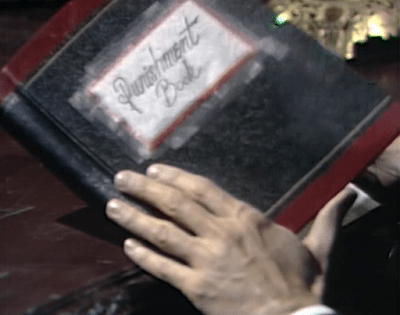
We see Trask in his study, browsing through a Bible. He returns that to his bookshelf and finds more congenial reading. He picks up a ledger and brightens. We see its cover, on which is taped a label reading “PUNISHMENT BOOK.” Trask smiles blissfully and sits down to examine its contents.

The volume that takes Trask to his happy place. Screenshot by Dark Shadows Before I Die.

A knock comes at the door, pulling Trask out of his sun-kissed dream of past cruelties. Irritated, he demands to know who it is, but receives no answer. When the knocking continues, he opens the door and sees Laura.

LAURA: Are there no servants at Worthington Hall? I’m not accustomed to letting myself in.

Longtime viewers will remember that when Laura was first on the show, they made a big deal out of the fact that she never ate or drank. So much so that they had the next uncanny menace, Barnabas Collins, drink a cup of coffee in #221. Even though Barnabas was a vampire and Laura was not, they had used up the traditional indicator of vampirism. non-consumption of food or drink, on Laura. Laura’s inability to open the door herself may be another borrowing from the same stock of imagery, from the idea that the vampire cannot cross a threshold without being invited.

TRASK: Who are you?

LAURA: I am Laura Collins and I come for my children. You are Mr. Trask, of course.

TRASK: Reverend Trask!

LAURA: Anyone can call themselves anything. I knew a woman in Brooklyn, once. Insisted she was a countess.

This is an inside joke. There was quite a well-known fashion correspondent-turned-executive in Brooklyn in 1969 named Mabel Wilson Gross. Mrs Gross’ first husband was a Danish nobleman named Count Carl Adam von Moltke, known to his friends as “Bobby.” Mrs Gross was known professionally as “Countess Mab Moltke.” She and “Bobby” were the parents of Alexandra Moltke Isles, who appeared in 333 episodes of Dark Shadows as well-meaning governess Vicki. I don’t believe Mrs Isles has ever used the title “Countess” herself, though under the laws of Denmark she would have the right to do so. Since it was Vicki who led the battle against Laura in 1967, a remark from Laura twitting Mrs Isles and her family might raise quite a laugh from longtime viewers who get the reference.

LAURA: (Goes to Trask’s desk and leafs through the “Punishment Book.”) But you are Trask. Yes, there’s no doubt about that.

TRASK: But you could be anyone as far as I’m concerned, anyone at all. I have too much respect for the defenseless souls in my charge.

LAURA: Oh, please, don’t be dreary.

TRASK: Dreary, Madam?

LAURA: Surely you know the word. Simply have my children brought down here, if there’s anyone to bring them.

TRASK: And how am I to know that you are their mother?

LAURA: Oh, what a trusting man you are.

TRASK: There is no question of the children leaving the school.

LAURA: Jamison possibly. Nora will leave here tonight. I’m willing to take them one at a time.

TRASK: As far as I know, Madam, their mother is away.

LAURA: You should keep more in touch.

TRASK: My wife returned from Collinwood this afternoon. She made no mention of your return.

LAURA: Hmm. How odd. I thought her a great gossip.

TRASK: Minerva? Madam.

That Minerva appeared to be “a great gossip” will also amuse longtime viewers. She is played by Clarice Blackburn, who in the parts of Dark Shadows set in the 1960s played housekeeper Mrs Johnson. After a brief period in which Mrs Johnson was supposed to be a spy planted in the house by an enemy of the Collins family, she settled into the role of a benevolent but excitable woman whose chief function was to blab everything she knew to the character likeliest to use the information to advance the plot.

LAURA: Now, will you have Nora sent down.

TRASK: I will not. Not without proper orders from Miss Judith Collins or Mr. Edward Collins. I shall call Collinwood and verify your strange appearance.

LAURA: Do.

(TRASK picks up the telephone receiver. Shows pain and drops it.)

LAURA: What’s wrong, Mr. Trask?

TRASK: It burned my hand.

LAURA: I’ve always thought the telephone an instrument of the devil, haven’t you?

TRASK: I have not!

Many times on Dark Shadows, as recently as this week, we have seen men forcibly intervene to stop a woman from talking on the telephone. I believe this is the first time we have seen a woman turn the tables and do this to a man.

TRASK: What a ridiculous conversation. I don’t know what I could have been thinking of to call Mr. Edward Collins. We have rules at Worthington Hall, Madam.

LAURA: Ah, rules are made to be broken.

TRASK: Not here. The children are asleep. They shall remain asleep. We do not encourage visits even from members of the immediate family unless of course it’s an emergency.

LAURA: Then you won’t reconsider?

TRASK: No.

LAURA: Not wise. Not wise at all.

TRASK: Are you threatening me?

LAURA: My children will not spend one more night in this school.

Laura remains perfectly calm throughout this conversation. Even her closing threat is delivered in a light tone, with an easy smile. Trask is agitated at the outset, and becomes ever more so as he realizes he cannot intimidate Laura. Since Diana Millay and Jerry Lacy are two of the most capable comic actors on Dark Shadows, the result is hilarious.

We first saw the effect of Laura’s imperturbability on an earnest interlocutor in #183 and #184, when she confronted a profoundly different character. In those installments, visiting parapsychologist Peter Guthrie called on Laura at the same cottage where she is staying in 1897. He introduced a new word to Dark Shadows‘ lexicon when he told her that he had concluded that she was “The Undead.” He said that he knew of her evil intentions, and said that if she abandoned them and turned to good, he would make every effort to help her live a different kind of life. Guthrie’s offer meant exactly nothing to Laura, and she responded to it with the same sardonic indifference Trask elicits from her today. Her next act was to cast a spell that caused Guthrie to crash his car and die in a ball of flame.

Trask gets off easier. Laura just sets his school on fire. The closing shot shows Nora apparently surrounded by flames. Laura does not want to burn Nora to death, at least not yet, but she is not one of your more detail-oriented otherworldly menaces. It will not surprise longtime viewers that she is blithely assuming that her children will somehow escape alive from the blaze she has started.

Episode 733: From pocket to pocket

A lot of business about a magical urn that belongs to undead blonde fire witch Laura Collins. This is Laura’s second tour on Dark Shadows; she didn’t have an urn the first time around, but the plot is much busier these days and she needs a MacGuffin for her enemies to chase after if she’s going to stay afloat.

There are also a couple of moments when characters deride spinster Judith Collins as “plain Judith,” envious of the “pretty wives your brothers brought home.” This is ridiculous. Judith isn’t even Hollywood ugly; she’s played by Joan Bennett, one of the great beauties of the screen in her youth and still, in her late 50s, a remarkably attractive woman.

But all in all, the episode is quite good. The highlight is a confrontation between governess Rachel Drummond and a villain who makes her first appearance today, Minerva Trask. Minerva is the wife of the loathsome Rev’d Gregory Trask, and with him she runs a boarding school called Worthington Hall. Rachel grew up at Worthington Hall, and like all other children there she was subjected to continual abuse at the hands of the Trasks. We haven’t seen Gregory for several days; as played by Jerry Lacy, he is so overwhelmingly evil a presence that the makers of the show wisely decided to use him sparingly. It looks like Rachel will soon be forced to go back to Worthington Hall as a teacher.

Minerva is played by Clarice Blackburn, whom many consider to be the single best actor in the whole series. For example, Nancy Barrett gave her that title in her interviews with the authors of the book Barnabas and Company. Blackburn is absolutely believable as the sanctimonious Minerva, so much so that I found her scenes as difficult to watch as are those featuring Mr Lacy as Gregory. Kathryn Leigh Scott plays the terror and misery Minerva inspires in Rachel quite effectively, but to be honest I felt those emotions very intensely myself just watching the episode on TV. I suspect that when you have a scene partner like Blackburn, all you need is to learn your lines and remember your training and you’ll connect with the audience.

Rachel and Minerva. Screenshot by Dark Shadows Before I Die.

Rachel tells her troubles to broad ethnic stereotype Magda Rákóczi, who volunteers to help her escape the Trasks. Magda’s plan requires Rachel to do three extraordinary things. She must give her garnet-encrusted broach, the only keepsake her late mother gave her, to Magda to sell to raise money for a coach ride to Boston. She must spend the night in a secret room hidden in an old mausoleum. And once in Boston, she will have to find employment without having recourse to any credentials or references that would make it possible for her to find a situation agreeable to a neurotic intellectual such as herself. We could never believe Rachel would do any of these things if she were facing a less gruesome threat than return to Worthington Hall.

Longtime viewers may wonder just how far Rachel’s fears will drive her. In #9, broadcast and set in the year 1966, flighty heiress Carolyn Collins Stoddard told well-meaning governess Victoria Winters that over the years, two governesses had leapt to their deaths from the precipice atop Widow’s Hill, and that legend had it that a third governess would someday follow their lead. In other episodes, before and after, that story was rephrased as “two women” rather than “two governesses.”

So far, we have only seen one woman take the plunge, and she wasn’t a governess. She was the gracious Josette, also played by Miss Scott. Josette jumped in 1796 because she saw that she was about to be made into a vampire. Now, the dramatic date is 1897. The prospect of turning into a member of the teaching faculty of Worthington Hall is scarcely less horrifying than is the prospect of becoming a vampire, so perhaps it will turn out that Rachel was one of those whom Carolyn had in mind after all.

Episode 731: Your greatest weakness

One of the first “Big Bads” on Dark Shadows was crazed handyman Matthew Morgan, played by Thayer David. Matthew was the most devoted employee of reclusive matriarch Elizabeth Collins Stoddard (Joan Bennett.) Matthew took his devotion to Liz to such an extreme that he was a menace to everyone else. In November and December of 1966, we learned that Matthew had decided that Liz’ second most dedicated employee, plant manager Bill Malloy, was a threat to her. Matthew had tried to put a stop to Bill’s doings. Not knowing his own strength, Matthew accidentally killed Bill. When well-meaning governess Victoria Winters discovered what had happened, Matthew abducted Victoria, held her prisoner in the long-deserted Old House on the grounds of the estate of Collinwood, and was about to murder her when a bunch of ghosts emanated from the show’s supernatural back-world and scared him to death.

In those days, Dark Shadows was a slow-paced “Gothic” drama set in contemporary times. From November 1967 to March 1968, it was a costume drama set in the 1790s, and its plot often moved at a breakneck speed. Among the characters then was much-put-upon indentured servant Ben Stokes, who like Matthew was played by Thayer David. At first Ben made a stark contrast with Matthew. He was as relaxed, friendly, and reasonable as Matthew was tense, forbidding, and paranoid. But when his one ally among the Collins family, scion Barnabas, was cursed to become a vampire, Ben’s devotion made him resemble Matthew ever more closely. In his development, we saw a retrospective reimagining of Matthew. The curses that were placed on Barnabas and the rest of the Collinses from the 1790s on had burdened the village of Collinsport, and people who grew up there labored under the consequences of those curses and of the Collinses’ attempts to conceal them. Ben was what Matthew might have been had he not been warped by the evil that began when black magic was first practiced in the area so many generations before.

In January 1969, the show briefly returned to 1796, to a time coinciding with the last days of the earlier flashback. We saw that by that point, the curses had already transformed life on and around the great estate. In that period, Ben’s efforts to protect Barnabas led him inadvertently to kill a man, not knowing his own strength, and then to cover that crime up by killing a woman, not at all inadvertently. He had become Matthew. The curse placed on Barnabas had become the curse of all those who work for the Collinses and all of those who live in the shadow of their wealth and power.

Before Matthew, Dark Shadows‘ chief villain was high-born ne’er-do-well Roger Collins (Louis Edmonds); after, it was Roger’s estranged wife, undead blonde fire witch Laura Murdoch Collins (Diana Millay.) In this episode, the makers of the show take a page from its 1790s flashbacks. They have Edmonds and Millay reconceive the Roger and Laura of that atmospheric, sometimes almost action-free soap as characters appropriate to the fast-paced supernatural thriller it now is.

Since #701, Dark Shadows has been set in the year 1897. Louis Edmonds plays Roger’s grandfather Edward; Diana Millay plays Edward’s estranged wife, undead blonde fire witch Laura Murdoch Collins. In his days as a villain, Roger’s defining characteristic was his unnatural lack of family feeling. He had squandered his entire inheritance, a fact which did not bother him in the least. When his sister Liz confronted him in #41 about the difficulties he had created by putting his half of the family business up for sale, he airily replied that he had enjoyed his inheritance. When in #273 Liz and Roger discussed a blackmail plot of which she had been the victim, Roger admitted that had he known her terrible secret, he probably would have used it to force her to give him her half of the estate so that he could squander that, as well.

It wasn’t only the family’s material possessions and Liz’ right to them to which Roger was indifferent. He openly hated his son, strange and troubled boy David Collins (David Henesy.) He continually insulted David, badgered Liz to send David away, and in #83 coldly manipulated David’s fears to lead him to try to murder Victoria.

In the 1897 segment, Edward is as stuffily serious about the family business as Roger was in 1966 nihilistically apathetic about it. Edward loves his children, twelve year old Jamison (David Henesy) and nine year old Nora, but his rage at Laura has come between himself and them. Laura left Edward the year before to run after Edward’s brother, breezy libertine Quentin (David Selby.) Edward tried to conceal the fact that his brother cuckolded him. He has repeatedly declared that Laura “No longer exists!” and has forbidden her name to be mentioned in the house.

Edward trapped between the enigmatic Laura and the exuberant Quentin. Screenshot by Dark Shadows Before I Die.

For his part, Quentin bears a striking similarity to the early, wicked Roger. He wants money only to spend it, a fact which he cheerfully admits. He tried to forge a will in his grandmother Edith’s name to cheat his sister Judith (Joan Bennett) out of her inheritance, having previously threatened to kill Edith. He does have great affection for Jamison, but since he often uses the boy as a pawn in Satanic ceremonies, his fondness for his nephew is not much of an improvement over Roger’s hatred for his son. Indeed, Quentin’s resemblance to Roger connects the 1897 segment not only to the early months of the show, but also to the weeks immediately preceding it. Early in 1969, Quentin’s ghost had taken possession of David Collins and was causing him to die. When we see that Quentin is now what Roger was originally, David’s ordeal takes on a new dimension. He is dying for the sins of his father.

In this episode, Laura has returned. Edward has offered her a great deal of money to go away and never come back; she refuses. She threatens to tell the world about her relationship with Quentin if Edward does not let her stay at Collinwood. Edward buckles to this blackmail. Laura tells him that “Family pride is your greatest weakness,” making him Roger’s exact opposite.

When Laura was at Collinwood from December 1966 to March 1967, her old boyfriend Burke Devlin kept pestering her with his suspicion that he, not Roger, was David Collins’ father. Burke was not the first character to bring this idea up. Roger had mentioned it to Liz in #32, when they were talking about an attempt David had made to kill Roger. At that time, Liz was horrified that Roger seemed to want to believe that David was Burke’s natural son.

It seems unlikely that Quentin is Jamison’s father. They have been firm about 1870 as Quentin’s date of birth, and in 1897 Jamison is quite plainly twelve. Laura may have gone on to marry her own grandson, but it would be a bit of a stretch for her to have started sleeping with her brother-in-law when he was fifteen, even if he did look like David Selby.

But Roger’s anger and jealousy about Burke and Laura do mirror Edward’s about Quentin and Laura. It was abundantly clear that Roger and Burke’s deepest pain regarding Laura was that their intense attachment to each other was disrupted when she left Burke for Roger; Diana Millay used her gift for dry comedy to make this explicit in a scene the three of them played in the groundskeeper’s cottage in #139. Likewise, Edward’s frustration with and disappointment in his brother is at least as deep a source of anguish to him as is his loss of Laura’s love.

Laura, too, is quite different this time around. The first Laura story took shape gradually over a period of weeks, as Laura herself emerged from the mist. Now Laura is a forceful presence from her first appearance. Originally we heard that Laura had married into several of the leading families of the Collinsport region; now they have given up on the idea of developing other leading families, and Laura just keeps coming back to the Collinses. In the first story, they laid great emphasis on the interval of precisely one hundred years between her appearances; now, the number of years doesn’t seem to have any particular significance. As we go, we will see an even more important difference. When we first met Laura, she was utterly determined to make her way into a pyre so that she could rise as a humanoid Phoenix; now she is unhappy about the whole thing, and angry with people who have helped her on her fiery way.

Edward lets Laura live in the cottage where Roger and Liz would put her in 1966. In the final scene, she goes there and finds Quentin, drunk and trying to conjure up an evil spirit. Quentin keeps telling Laura that she is dead. Frustrated with her persistent refusal to concur with this statement, Quentin puts his hands around her neck and announces that whether or not she is dead now, she will be by the time he gets through with her.

Roger was uncharacteristically sober at the beginning of his three-scene in the cottage with Burke and Laura in #139, but he did enter brandishing a fire-arm. So Quentin’s homicidal intentions on this set further cement his affiliation with his great-nephew in the eyes of longtime viewers.

Millay and Edmonds are not the only actors whose screen iconography the show turns to advantage today. We first saw Kathryn Leigh Scott and Don Briscoe together in #638, when she was playing ex-waitress Maggie Evans and he was playing mysterious drifter Chris Jennings. They met in the foyer at Collinwood. Maggie was angry with Chris, and Chris was guilt-ridden. Today, Miss Scott plays governess Rachel Drummond and Briscoe plays teacher Tim Shaw. They meet in the foyer at Collinwood. Rachel is angry with Tim, and Tim is guilt-ridden.

Though the same actors are playing the same basic emotions on the same set, the situations are different, and the characters are very different. Maggie is Dark Shadows‘ principal representative of the working class of the village of Collinsport. She speaks directly and bluntly, using the plainest language she can to dare Chris to try to excuse his inexcusable behavior. Chris occupies a lowly and unsettled place in the world, and he dodges her gaze and evades her questions, saying as little as he can, almost mumbling.

But Rachel is a neurotic intellectual, and she expresses her anger in complex sentences featuring vocabulary that only a very well-read person would have used in 1897 (for example, the word “sadist.”) Tim retreats from her anger into a defense of his job that quickly devolves into the tiredest platitudes imaginable. At one point he actually intones “It is better to light one candle than to curse the darkness.” Miss Scott makes Rachel’s highly literate onslaught on Tim as forceful as was Maggie’s unvarnished challenge to Chris, and Briscoe makes Tim’s pompous posturing as pitiable as was Chris’ broken burbling. Writer Gordon Russell must have been delighted that the actors did such good work with his ambitious pages.

Episode 730: The very same dream

When Laura Murdoch Collins first appeared on Dark Shadows in December 1966, it was far from clear what sort of being she was. From the beginning, there were definite hints that she had emerged from the supernatural back-world of ghosts and presences lurking behind the action, but as those ghosts and presences were undefined and vague, so Laura herself was undefined and vague when we met her. We couldn’t even tell how many of her there were- there was a charred corpse in Phoenix, Arizona, a phantom flickering on the front lawn of the great estate of Collinwood, two graves of Laura Murdochs from previous centuries, a woman who turns up in various places that serve food but never eats or drinks, and a series of dream visitations and inexplicable compulsions. Some of those were Laura, maybe all of them were, but how they were connected to each other, if they were connected at all, was anyone’s guess. Diana Millay’s performance reflected that uncertainty. Her Laura was initially blank and distant.

As her storyline went on, Laura came into ever sharper focus. By the time we realized that she was a humanoid Phoenix, an undead fire witch who had returned to Collinwood to take her son, strange and troubled boy David Collins, into the flames with her so that she could renew her life, she had become a dynamic character. As Laura gained force, Millay had the chance to reveal a talent for sarcastic dialogue rivaling that of Louis Edmonds, who played Laura’s estranged husband Roger Collins. Before Laura went up in flames in March 1967, we wished we could have seen a whole series featuring Millay and Edmonds as an unhappily married couple sniping at each other.

In those days, Dark Shadows was set in contemporary times. Now, its dramatic date is 1897, and Edmonds plays Roger’s grandfather, the stuffy Edward Collins. As in the first 24 weeks of Dark Shadows we saw that the name of Roger’s estranged wife was taboo in the great house of Collinwood, so in the first six weeks of the 1897 segment Edward has been furiously insistent that his estranged wife should never be mentioned. When Laura turns up, bearing the same name and played by the same actress as Edward’s granddaughter-in-law, we know what we are in for.

The show moves a lot more quickly now than it did when it debuted. David had shown signs of a psychic connection with Laura from #15 in July 1966, over 21 weeks before she arrived. Edward and Laura’s nine year old daughter Nora had dreams, visions, and an episode of automatic writing directed by Laura yesterday and the day before, and Laura herself shows up today. At first she meets Nora on the peak of Widow’s Hill, as a dream had told her she would. Laura comes to the house and sees Edward the following afternoon. Edward is horrified to see her; she is understated and cool at the beginning of their scene, but by the end of it she is in tears, pleading with Edward to be allowed to see their children, Nora and twelve year old Jamison. She thus recapitulates within minutes a progression that in 1966 and 1967 took months.

Laura trying to figure out what to say to Nora. Screenshot by Dark Shadows Before I Die.

When Laura saw Nora on Widow’s Hill, she swore her to secrecy, forbidding her to tell anyone but Jamison that she is back. Nora did try to tell Jamison, only to find that he wouldn’t believe her. She showed him a broach Laura gave her which bears an Egyptian symbol that popped into her head yesterday; Jamison is entirely unimpressed.

We learned the other day that when Edward’s brother Quentin was banished from Collinwood a year before, Laura followed him. The two wound up in Alexandria, Egypt, together. Jamison and Nora come to Quentin’s room today; Quentin sees the broach and flies into a panic. He searches through a book, then demands to know where Nora got the broach. She says only that she found it in the woods, and he keeps asking if someone gave it to her. She keeps denying that anyone did, and he rushes downstairs, looking for Edward.

In the drawing room, Quentin sees Laura. He is utterly shocked. “You’re dead!” he exclaims. “I saw you die!” Last week, Quentin himself died and came back to life. When he told Edward about his death and resurrection, he laughed delightedly. When Edward asked for an explanation, Quentin dismissed the whole subject, having exhausted his interest in it with his laughter. Yet now he is stunned out of his wits to see that Laura too has returned from the dead. Seems to be quite a double standard at work.

Every character we see in this episode bears the surname “Collins.” I believe this is the first episode we have seen with an all-Collins cast.