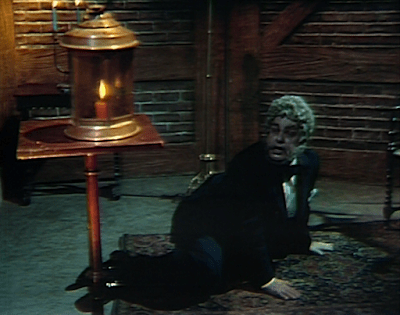
Evil sorcerer Count Petofi has cast a spell causing his mind to take over the body of rakish Quentin Collins, while Quentin is confined to Petofi’s own body. So David Selby begins playing a youthful and handsome Petofi, while Thayer David plays an aging and pudgy Quentin.
In their post about the episode on Dark Shadows Before I Die, John and Christine Scoleri use a wide variety of expressions to refer to the characters Thayer David and David Selby play today. I will just call Thayer David’s character P-Quentin and David Selby’s Q-Petofi.
P-QuentinQ-Petofi
Both of those actors give superb performances today; David Selby makes Q-Petofi’s preening arrogance suitably repellent, while the 42 year old Thayer David shows us P-Quentin reduced to the total helplessness of a despised man in extreme old age. There is a scene that Mrs Acilius and I found particularly hard to watch when Q-Petofi’s henchman Aristide takes the thick glasses without which P-Quentin is effectively blind and holds them away from him.
Q-Petofi and Aristide’s gleeful cruelty to P-Quentin make us wonder how the count and his henchman feel about the body they are looking at. The show’s earlier body swap story, in which vampire Barnabas Collins had hoped to die and come back to life in the form of Frankenstein’s monster Adam, led Adam to ask Barnabas in #587 “How could you hate yourself so much that you wanted to change your body?” We hadn’t known that that the count hated himself at all until we saw this scene, but he must have done to take such delight in tormenting P-Quentin, and Aristide’s revelry shows that he, too, harbors more hostility to his master than he ever dared expose.
P-Quentin staggers away from the lair of Q-Petofi and Aristide and meets broad ethnic stereotype Magda Rákóczi in the woods. He tries to explain his true identity to Magda, who has experience with magic and has for some time now been his ally. But Magda’s fear of the count keeps her from listening to the far-fetched tale, and she rushes off.
P-Quentin makes his way to the door of his home, the great house of Collinwood. He stands there, and we hear his thoughts, in David Selby’s voice. He tells himself he cannot go in, because no one there would believe him if he told them who he was. He slinks off to the caretaker’s cottage, where he meets maidservant Beth, who is his sometime fiancée. He tries to tell her the story, but she too is terrified of the count. When Q-Petofi shows up, she leaves with him.
Magda is a wonderful character, and what we have seen has given us every reason to hope she will be a substantial part of the show for a while yet. Unfortunately, this is her final on-screen appearance. We will hear her voice once more, six weeks from now. The show has always been visually ambitious, and lately they’ve managed to pull some neat tricks with videotape that led me to hope we would see at least one scene in which Grayson Hall appears opposite herself as both Magda and time-traveling physician Julia Hoffman. When Hall appeared in the 1970 film End of the Road, she said that it was a relief from playing Julia, to whom she apparently referred as “that tight-ass doctor.” Magda is earthy enough that it would have been fun to see how Hall would have used her to demonstrate the same attitude towards Julia, even if she had to stick to words approved by the ABC network’s Standards and Practices office, and Julia’s reaction to Magda would doubtless have been just as much fun.
Kitty Soames, a young American woman who is the dowager Countess of Hampshire, is gradually turning into Josette DuPrés, who has been dead for 101 years. Kitty is staying at the great house on the estate of Collinwood. Also among the houseguests is Angelique, the immortal, time-traveling wicked witch who was responsible for Josette’s death.
Kitty has been getting information about Angelique, apparently from Josette’s ghost. She interrogates Angelique’s fiancé, rakish libertine Quentin Collins. Quentin does not give her any useful information about Angelique. When Kitty asks if Angelique has ever lived in England, Angelique herself enters and says that she has not. Kitty asks Angelique if she was ever a servant. Angelique made it quite clear yesterday that she knows perfectly well what is happening to Kitty, but she regards the transformation as a nuisance and does not want to help it along. She chooses to pretend that Kitty is being a snob, and says that Quentin is not marrying beneath his station. With that, Kitty has nowhere to go but back to her room.
Angelique has made an alliance with Julia Hoffman, MD, a fellow time-traveler from the late 1960s. Julia followed her friend and the object of Angelique’s lunatic obsessions, vampire Barnabas Collins, to 1897. Barnabas is now believed to have been destroyed, but we’ve already seen that Julia is continuing work replicating the experimental procedure that put his vampirism into abeyance for a little while in the spring of 1968. Today, Angelique brings some medical supplies to Julia in her hiding place, and Julia asks if she can come a little earlier the next day.
The two women sit down and have a friendly chat. Longtime viewers will find this breathtaking. Angelique was at Collinwood in 1968, wearing a black wig, calling herself Cassandra, and functioning as Julia and Barnabas’ bitterest enemy. Now that Angelique has turned to Quentin and has let go of her drive to dominate Barnabas, she and Julia have made an alliance against sorcerer Count Petofi. Their animosity set aside, they can commiserate about the difficulty of a life yoked to Barnabas.
“Ugh, vampires, all the good ones are either obsessed with recreating their dead ex or gay.” Screenshot by Dark Shadows Before I Die.
Angelique wants to liberate Quentin, whom Petofi has enslaved. Julia is horrified today when Kitty, in Josette mode, bursts into her hiding place and demands to see Barnabas. Quentin follows her in and hears her ask why she is keeping Barnabas in the next room. Neither Kitty nor Quentin believe Julia when she keeps insisting that Barnabas is no more. If Quentin knows that Barnabas is still around, Petofi will soon know it as well, and that can only be bad news.
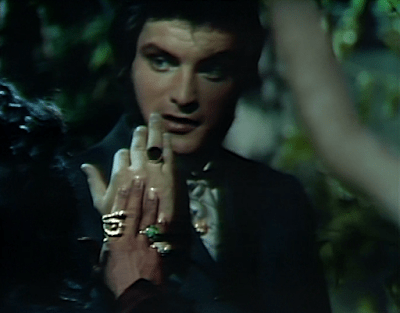
Petofi is not content keeping Quentin as a slave. He wants to abuse him even more totally. We saw the other day that Petofi wants to swap bodies with Quentin as his means of escaping from his deadly enemies, the Rroma people. Petofi visits Quentin in the drawing room at Collinwood this evening and gives him a scalp massage. Quentin notices Petofi’s ring, and agrees that he would like a new life. He falls asleep, then wakes up to find Petofi’s ring on his finger. To his alarm, he cannot take it off. My wife, Mrs Acilius, called out to the screen to suggest he spray some Windex on his finger, but that wasn’t invented until 1933 and the dramatic date is 1897. Presumably the transfer of the ring is the first step towards Quentin’s eviction from his own body and his replacement in it by Petofi.
Closing Miscellany
Danny Horn’s post about the episode at his great Dark Shadows Every Dayis a study of Kathryn Leigh Scott’s facial expressions. His thesis is that Miss Scott is imitating Grayson Hall, who plays Julia. Later in the series there will be a moment when Miss Scott imitates Hall in a scene they play together; Hall’s reaction then will be hilarious.
Kitty sees the portrait of Barnabas Collins hanging in the foyer on the spot by the front door. She Josettifies and becomes fascinated by it. Stuffy but lovable Edward Collins had the portrait removed when Barnabas was exposed as a vampire some time ago, and is shocked to find that it has returned. Presumably whatever supernatural agency is Josettifying Kitty put it there. Longtime viewers, who remember how active Josette’s own ghost was at Collinwood before Barnabas first appeared on the show, will think she is the likeliest suspect.
When Kitty/ Josette is kneeling beside the grave of Josette’s husband Jeremiah Collins (spelled “Jerimiah” on the marker,) Edward shows up and tells her that she was married, not to Jeremiah, but to the late Gerald Soames Earl of Hampshire. That was the first time it dawned on me that both Josette and Kitty married guys named Jerry.
Angelique’s intrusion into the scene between Quentin and Kitty might have been more effective if the camera hadn’t swung wide and shown her standing outside the door waiting to make her entrance. We don’t see Angelique eavesdropping, but Lara Parker standing well upstage waiting to make her entrance.
Most of the episode revolves around the fact that Julia Hoffman cannot speak. Grayson Hall uses a whole new set of acting techniques playing a mute character than we had seen in her appearances as the most talkative human beings imaginable, and the result is absolutely fascinating. I’d have been glad to watch the episode again as soon as it ended.
We open in the basement of the Old House on the estate of Collinwood. Julia is sitting at a table in front of a set of I Ching wands. These wands are still in the pattern recovering vampire Barnabas Collins cast several months ago, when he was trying to contact the malign ghost of Quentin Collins. Barnabas meditated on them, and his “astral body” went back in time to 1897. Since his physical body was also in 1897, confined to the coffin in which he was at that time trapped, he became a resident of that year, and met the living Quentin.
Julia has decided that she, too, must travel to 1897. So she meditates on the wands. She tells herself that she must visualize them on a door, and she tells herself to “Empty your mind of everything else.”
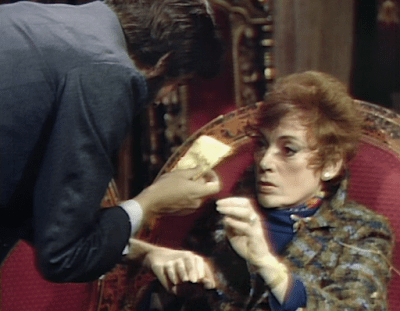
She follows this injunction only too well. After passing through a series of doors, she collapses outside the great house at Collinwood in 1897. When stuffy Edward Collins takes her into the drawing room and questions her, she can respond only with a blank stare. Quentin comes in and finds a letter from Barnabas in Julia’s pocket. He asks her if she is the Julia addressed in the letter and why she has a letter from Barnabas. She does not recognize her own name or Barnabas’.
Quentin has become Barnabas’ friend, and his brother Edward has become his enemy. When he reads the letter Julia brought, Quentin realizes that Edward has locked Barnabas in the prison cell in the basement of the Old House. When dawn comes, Barnabas will not be able to get back to his coffin. Since he is a full-fledged vampire in 1897, that means he will disintegrate into dust.
Quentin leaves Edward with Julia and goes to Barnabas’ rescue. Quentin knows that Barnabas is a vampire and that he is trying to help him, and he knows that if things keep on as they are going he might become a family-annihilating ghost at Collinwood in 1969. But it is only while talking to Barnabas about the letter that he learns that he has come to 1897 from that year. The pieces start falling into place in Quentin’s mind as he absorbs this information.
Barnabas goes to hide in “the old rectory on Pine Road.” Quentin takes Julia there. Barnabas can’t get any information out of her, but he is sure that she knows how to save Quentin’s life. He is also sure that if they don’t find out what she knows, Quentin will be killed on this night, 10 September 1897.
The basis of Barnabas’ certainty regarding this latter point is a vision that a woman had. This woman used to be the repressed Charity Trask, but has now by supernatural means been transformed into the late Cockney showgirl/ psychic Pansy Faye. Pansy’s psychic act was fake until she came to Collinwood in #771. In the spirit-laden atmosphere of the estate, even her phony mumbo-jumbo called up real voices from the great beyond. Pansy’s stunned reaction when she actually contacted a ghost reminded longtime viewers of #400, when Charity’s ancestor, the fanatical witchfinder the Rev’d Mr Trask, conducted an exorcism to drive a witch out of the Old House and showed delight and not a little astonishment when the person he believed to be the witch came running out at the climax of the ceremony. Perhaps Pansy reminded the writers of Trask as well, and that was where they got the idea of having her spirit take possession of Charity.
Charity/ Pansy is in today’s episode. She’s the one who finds Julia, and she tells Edward that Julia “has death written all over her face!” She also says that she has a job. She is working at the tavern in the village of Collinsport, the Blue Whale. Presumably she is doing Pansy Faye’s old act there, singing, dancing, and doing psychic readings. We can imagine what Charity’s father, the hypocritical Rev’d Gregory Trask, must think of that.
A lot of action in this one. Rakish Quentin Collins bluffs sorcerer Count Petofi with a threat that his nemesis, Rroma chieftain/ New England crime boss King Johnny Romana, will be coming. At the last moment, Petofi gives in and releases Quentin’s distant cousin, time traveling vampire Barnabas Collins, whom he has been holding prisoner.
Back in the great house of Collinwood, broad ethnic stereotype Magda Rákóczi discovers maidservant Beth Chavez lying unconscious on the floor. Magda takes her pulse. She then picks up the snifter from which Beth had been drinking, holds it to her nose, and gives a look of discovery. All of a sudden, Grayson Hall looks very much like her first character on Dark Shadows, Julia Hoffman, MD.
Somehow Magda gets Beth back to her room and saves her life. Beth tells her that she was poisoned by a woman called Charity. Magda leaves the room to look for Charity. Before she gets more than a few feet into the hall, King Johnny’s henchman Istvan springs out from the Shadows’ and grabs her.
Quentin comes into the foyer of the great house. Beth is there. He sees that she is upset and weak and asks what is wrong, but she will not explain. He asks if Barnabas can sneak to her bedroom without being observed. She leads the way to make sure no one who is involved in the vampire hunt sees him.
After Beth, Barnabas, and Quentin do some recapping, we see Magda in the woods with Istvan. She tries to talk him into running away with her, but he ignores her. He is supposed to bind and gag her. As we have seen many times on Dark Shadows, Magda has to hold the gag in her teeth. At the very end, an unseen figure approaches with a lantern, and Magda reacts with terror.
In Dark Shadows #1, set in 1966, two people came to Collinsport, Maine. They were the well-meaning Vicki Winters and dashing action hero Burke Devlin. Vicki had taken a job as the governess in the great house of Collinwood, hoping that she would find the answers to questions she had about her own mysterious origins. Those questions had left her feeling that she knew nothing about herself.
Burke was a working class boy from Collinsport who had gone to New York City five years before, fresh out of prison and penniless. By 1966 he was a corporate raider, a millionaire many times over. He came back to his hometown because he wanted revenge on high-born ne’er-do-well Roger Collins, who used Burke’s car to kill someone while Burke was passed out drunk in the backseat, then persuaded the court that Burke was solely responsible for the homicide. Burke and Vicki ultimately became a couple, but for some months Burke strung Roger’s niece Carolyn along and used her to cause trouble for the Collinses.
Now the show is set in 1897, and Burke and Vicki are both long gone. Carolyn and Roger are waiting for us when the show returns to contemporary dress, and the actors who play them are in the cast in other roles. But we’ve been reminded of Burke recently. Tim Shaw is a working class boy from Collinsport who, after spending time as a teacher at a miserable boarding school run by the evil Rev’d Gregory Trask, was chosen by Trask to take the fall for the murder of his wife, Minerva Trask. As Burke was physically present but mentally compromised at the killing for which he went to prison, so Tim was present at the killing of Minerva, but not in his right mind. The show is about the supernatural now, so it was a magic spell, not booze, that kept Tim from knowing what was going on when he poisoned Minerva. And the pace is too fast for arrests and trials, so Trask’s plan went wrong and he had to tell the police Tim wasn’t guilty after all. So Tim went straight to New York, and just a few weeks later came back to Collinsport, very rich and out for revenge.
Like Burke, Tim arrives in Collinsport with a woman. Unlike Vicki, Amanda Harris knew Tim before they got on the train. But we learn today that Amanda, like Vicki, is tormented by her ignorance of her own background. Again, the starker palette in which the show draws its stories at this period means that instead of not knowing who her birth parents were, Amanda has no memories at all prior to two years ago.
Amanda first appeared as a hardboiled operator who was attached, not to Tim, but to his money, and who gave him expert assistance in the con game he was running on Trask. As Tim was an elaboration on Don Briscoe’s W. C. Fields’ imitation, Amanda was a nod to Mae West. But the show has decided to make Amanda a long-term addition to the cast, and they already have an all-villain cast. So they soften Amanda’s edges. We see her packing her bags and telling Tim she is going to leave because he doesn’t really care about her and she can’t stand what she is doing with Trask. When she complains that Tim is just using her, she echoes speeches Carolyn made after her bitter realization about Burke’s true intentions. Now that her relationship to Tim mirrors both Vicki and Carolyn’s relationships to Burke, Amanda can inherit the goodwill longtime viewers have towards both of those characters.
To Have Something I Can Believe In
Tim’s sudden wealth came from his possession of a magical object, The Hand of Count Petofi. When Amanda first heard of the Hand, she asked if it was a piece of jewelry or some other kind of artifact. It did not occur to her that it was literally the severed hand of a Hungarian nobleman. This gruesome thing had been cut a century before, in 1797, by nine Rroma men, and had ever since been in the custody of the leader of their tribe.
In #778, broad ethnic stereotype Magda Rákóczi returned to her home in the Old House on the grounds of Collinwood. She had gone to Boston, where King Johnny Romana, possessor of the Hand, was staying with his caravan. She had pleaded with King Johnny to help her remove a curse she had placed that made rakish libertine Quentin Collins and all his male descendants into werewolves. Magda had not known when she placed the curse that Quentin was the father of her sister Jenny’s children. She hoped that King Johnny would take pity on the Rroma children and use the Hand to end the curse. When he did not, she stole it, intending to use its powers herself. Magda soon found that the Hand did no one’s bidding. It helped some people, hurt others, and was stolen by each of a long series of scheming characters.
After Tim brought the Hand back to Collinsport, it was stolen again. This time, the thief turned out to be none other than Count Petofi himself, 150 years old and on the point of death. Once he had the Hand back, it reattached itself to his wrist and he regained his health.
Petofi has some sort of plans for Quentin. He has retained one of his minions, nationally renowned artist Charles Delaware Tate, to paint a portrait of Quentin. That project is finished, but Tate is still living in a cottage he has rented in Collinsport. Today Petofi visits Tate there.
Petofi finds Tate sketching an imaginary woman, one he has been obsessively drawing and painting for about two years. Petofi sets himself up as Tate’s analyst. “Only little boys invent ideal women,” says he. He has a plan to relieve Tate’s childish fixation. It is another project. If Tate had seen A Chorus Line, he might appreciate Petofi’s theory of work as therapy, as explained in the lyric “Give me a job and you instantly get me involved, if you give me a job then the rest of the crap will get solved.” But that show won’t premiere for another 78 years, so Tate resists.
It doesn’t help that the job Petofi has in mind involves another severed hand. The Rroma are on their way, and they want the Hand back. Petofi, whose magical powers were formidable even when he was one-handed, is much mightier now, but the thought of the Rroma agitates him violently. Evidently they know about some weakness of his that enables them to defeat him. King Johnny and his men don’t know that Petofi is in Collinsport. He has cast a spell to silence Magda, but they won’t leave the area without the Hand. Several people know about Petofi and have no reason to protect him. If the Rroma start asking questions, it won’t be long before they close in. So Petofi has exhumed a recently deceased local man, cut off his right hand, and brought it to Tate for detailing.
Tate owes his talents, and his life, to Petofi, so the outcome of their meeting is never really in doubt. His next encounter does involve a surprise. Amanda comes to Petofi’s hiding place, sent by Tim, and asks for his help. Petofi tells Amanda that Tim has a poor strategic sense. Indeed, Petofi has already told Tim that, lovely as Amanda is, he has no use for her at the present time. But when he sees her face to face, Petofi recognizes her as the imaginary woman in Tate’s pictures.
Returning viewers already know that Tate’s portrait of Quentin takes on the features of a wolf when the Moon is full, so it is no surprise that his works, like several other portraits we have seen on Dark Shadows, have magical powers. When we learn that Tate first painted Amanda two years ago and she has no history prior to that time, we figure out that he inadvertently used those powers to conjure her into being.
Tate is played by Roger Davis, an unpleasant man who figured as Vicki’s love interest in her last, woefully ill-conceived storyline. In that arc, made and set in 1968, Mr Davis’ part was variously known as Peter Bradford and Jeff Clark. He had amnesia, and Vicki kept trying to help him recover memories which would prove to him that he has no roots in the 1960s, but that he is an uncanny being who was brought to life by an adventure she had outside the bounds of space and time. Once we recognize what they are suggesting about Amanda’s origin, longtime viewers might expect an inversion of that story, with Mr Davis playing the person trying to persuade his lover that he accidentally created her by a magical process he himself did not understand.
Somebody to Dance For
While all of this action is taking place downstream of Count Petofi, the person who set in motion the events that first brought Petofi to town is in big trouble. Magda comes home to find King Johnny himself waiting for her. He menaces her, calls her names, and twice hits her in the face very hard.
Ever since Violet Welles joined the writing staff, men have been slapping women quite a bit on Dark Shadows. Welles was by far the best writer of dialogue on the show, but I for one could do without the slapping. Fortunately King Johnny is played by Paul Michael, a well-trained actor; no matter how brutally King Johnny abuses Magda, Grayson Hall is in no danger. One could never say the same of Mr Davis’ screen partners.
King Johnny tells Magda that he will take her back to his caravan in Boston to stand trial for the death of Julianka, a Rroma maiden whom he sent to kill her some weeks ago. Since Magda cannot say Petofi’s name, she cannot tell King Johnny that it was he who killed Julianka. Magda is terrified of the trial, and King Johnny tells her that there is a way she can avoid it. If she does not give him the Hand, he will slit her throat immediately.
King Johnny searches the house, and does not find the Hand. He is about to carry out his promise to kill Magda when he sees the wooden box in which the Hand was long kept lying on the floor. He opens it. What he sees inside resembles the Hand closely enough to convince him, and keep Magda alive for another day. Clever as she has been so far, we may wonder how many days are left for her. There doesn’t seem to be anyone around to throw Magda a rope to grab onto.
One night in 1797, nine Rroma men trapped sorcerer Count Petofi in the forest of Ojden. They amputated his right hand, and with it took most of his magical powers. Some time after, Petofi learned that he had exactly one hundred years to reattach the hand. If he managed it within that time, he would become immortal. Otherwise, he would die on the anniversary of the amputation.
Now that anniversary has come, and Petofi has succeeded in regaining his hand with only minutes to spare. Time-traveling vampire Barnabas Collins and his distant cousin, desperately handsome werewolf Quentin, have decided that because Petofi’s spirit is in possession of Quentin’s twelve year old nephew Jamison and Jamison is as close to death as is Petofi himself, only by surrendering the hand to Petofi can they save the boy. Barnabas did get Petofi’s servant Aristide to promise to free Quentin of lycanthropy once he has the hand back, but he put little faith in that promise.
Now Petofi is jubilant and Jamison is still sick. Barnabas tells Petofi about the deal Aristide made, and also says that he wants Jamison and the rest of the Collinses to be freed from the ill effects Petofi has had on them. Petofi could not be less interested. Instead, he wants Barnabas to tell him how he traveled in time from 1969 and how he will travel back there.
Petofi lets slip that he is anxious to go to another period of history because he is afraid of the Rroma people who are still after him. We know, not only that it was Rroma who cut off his hand, but that when Petofi saw a young Rroma woman in a tavern in #794 he couldn’t get out fast enough. While it may have taken nine Rroma men to take his hand, evidently a single Rroma woman, and a tiny one at that, is capable of doing him considerable harm. Barnabas has a Rroma friend, broad ethnic stereotype Magda Rákóczi, who has considerable magic powers of her own, and he knows of a Romany band currently camped near Boston. So Petofi’s apparently well-founded ziganophobia is a sign that Barnabas may be able to defeat him, even though Petofi’s powers were formidable even before he was reunited with his hand.
Petofi says that he will cure Jamison only if Barnabas explains how he traveled to 1897 from 1969. Barnabas tells Petofi he has no idea how he made that journey. This is so. He meditated on some I Ching wands, a process which he was told might have any of an infinite number of effects, and found himself in 1897. Nor does he have any idea how to get back. He might have enlarged on the theme of his complete lack of useful knowledge in this area. In 1968, Barnabas traveled back to his original era, the 1790s, by going to the grave of a man named Peter Bradford on the anniversary of Bradford’s death. Bradford’s ghost had been haunting him, and Barnabas called for Bradford to take him back to the year 1796. After he did so, Barnabas found that he could return to the 1960s only by having himself sealed in his coffin and waiting inside it for 172 years until friends let him out. He doesn’t tell Petofi about that incident, but it does not seem likely to be of any more help to him than the story about the I Ching would be.
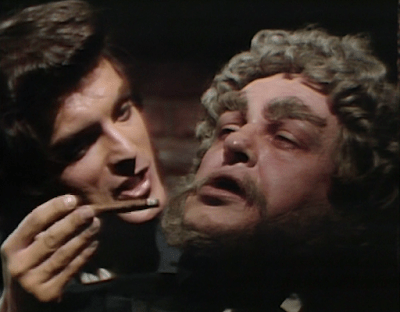
Petofi does not believe that Barnabas is so hapless. First he squeezes Barnabas’ hand, depriving him of the power to dematerialize. Then he opens a cupboard and tells Barnabas to look in it. It takes a while to warm up, but eventually it gets an ABC affiliate showing Dark Shadows. Barnabas sees the parlor of the Old House on the estate of Collinwood in 1969. His best friend, mad scientist Julia Hoffman, MD, is sitting there reading a book. We haven’t seen Julia since #700, but she might be on our minds today. At one point Aristide lights his cigar on a candle burning in a large candelabra. In #296, Julia very memorably did the same thing with her cigarette.
Barnabas sees strange and troubled boy David Collins come staggering downstairs, raving deliriously about Quentin. Julia tells him to reject Quentin, who in 1969 is a ghost haunting Collinwood and draining the life from David. David passes out, and Julia injects him with a powerful sedative, as you do with unconscious children.
The cupboard loses the channel, and Barnabas asks Petofi what else is happening in 1969. Petofi cannot answer any questions; it quickly becomes clear that he couldn’t see or hear the scene. Barnabas is intrigued to learn of another of Petofi’s weaknesses, and walks out.
Aristide then speculates that Barnabas might be telling the truth. Petofi rejects this at once, reveals more of his cupboard’s limitations:
No, he’s not a fool, Aristide. He thinks he can win, accomplish whatever he wants to do here, and disappear without me…
Had Petofi ever seen even one episode of Dark Shadows, it would not occur to him to say that Barnabas is “not a fool.” Nor would he surmise that Barnabas is pursuing a plan that includes a plausible method of escape. If Barnabas had a plan of any kind, Petofi would know all about it, since it would have failed spectacularly the moment he took the first step towards putting it into effect.
Petofi and Aristide then go to the Old House. They find Magda there. At the moment, she is under Petofi’s power. Like Julia, Magda is played by Grayson Hall. We may have thought the glimpse into 1969 was a videotaped insert, but evidently it was done live, because Magda is not wearing her usual heavy brownface makeup. She may have a bit of an artificial tan, but Julia’s blue eyeshadow is clearly visible through it.
Magda, looking more like an actual Rroma woman than she ever has before.
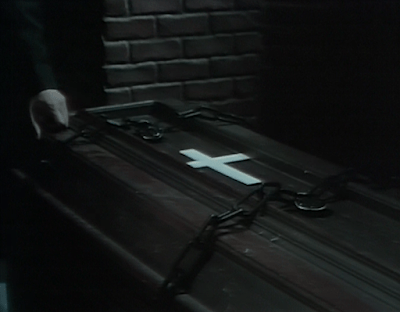
Petofi forces Magda to lead her to Barnabas’ hiding place. He has a cross and Aristide has a chain and a padlock. Petofi puts the cross inside the coffin, and orders Aristide to chain the coffin closed. Petofi declares that Barnabas is in for a long journey.
Charity Trask is in the drawing room of the great house on the estate of Collinwood trying to call the police when her abusive step-uncle, Quentin Collins, comes out of a secret panel and takes the telephone from her. He tells her that there is no longer any point in telling the police about Tessie, the injured woman upstairs. Tessie won’t be telling them anything. She has died. Apparently the sheriff of Collinsport is the same in 1897 as are his counterparts in other periods when Dark Shadows has been set- if you’re already dead, it’s too late for them to take an interest in you.
Charity says that Quentin killed Tessie. Charity knows that Quentin is a werewolf. He locks the door to the room and asks “Are you afraid to be locked in alone with a beast, a murderer, a creature of the supernatural?” This would seem to be rather an odd question, especially since he spent yesterday’s whole episode threatening to kill her.
Charity says that her father, Gregory Trask, will see to it that Quentin is brought to justice. Quentin takes a paper from his pocket and shows it to Charity. It is a confession to the murder of Charity’s mother, signed by her father. Charity claims that it was fabricated by Satan, which is what her father told her when she first saw it, and that Trask repeatedly tried to destroy it. This only convinces Quentin that the confession is true. He says that if either Charity or her father tells the police about him, he will hand over the paper. He adds “Now, Charity, I may hang for murder, but your father will be dancing at the end of a rope, too.”
Dark Shadows is set in the state of Maine, which in our universe abolished capital punishment in 1887. That used to be true in the show’s universe, as well. In #101, broadcast and set in November 1966, high-born ne’er-do-well Roger Collins told his son, strange and troubled boy David, that “They don’t hang people anymore. Not in this state, anyway.” But by the time the show left the 1960s for its first costume drama segment a year later, characters were already afraid of being sentenced to death. The morbid fascination of the gallows is so much of a piece with the show’s exaggerated melodrama that there must be a death penalty, no matter when or where the action is supposed to be taking place.
Quentin tells Charity that there is a chance- a small chance, he concedes- that he will be cured of lycanthropy before the next full Moon, so that she need not feel that she is an accessory to murder if she doesn’t turn him in right away. Miserable, frightened, and confused, she takes this seriously enough that she remains quiet at least through this episode.
We cut to a hiding place where a man known as Aristide is looking at himself in a mirror and primping his hair, moving his fingers through it with an exaggerated daintiness. We pan to broad ethnic stereotype Magda Rákóczi , who impatiently asks “Did you send for me so there would be two of us to admire you?” Aristide has some business to discuss relating to plot points not directly involved in this episode, and he and Magda trade menacing insinuations about the danger each faces from the various supernatural forces at work in the area. Magda says that what the ziganophobic Aristide calls her “Gypsy cunning” will protect her, and Aristide says that an amulet he wears around his neck will protect him.
Magda replies “All right, we’ve both got something to protect us. I go now,” and starts to leave. Aristide stops her, and says that she must recover the severed hand of Count Petofi. She says that a man named Tim Shaw stole the hand and ran off with it, and she has no way of knowing where Tim is. Aristide says she must find out and bring it soon, “before time runs out.” She asks “Before time runs out for who? You mean when Petofi comes back!” In fact, Aristide means more than that- his master, 150 year old sorcerer Count Petofi, will die in a matter of days unless he is reunited with the hand that was cut from his right arm a century before, in 1797. If he does recover the hand in time, he will become immortal. Magda fears Petofi and hates him, and would doubtless make any sacrifice to keep the hand away from him if she knew these were the stakes. So Aristide is mortified that he let slip the phrase “before time runs out,” and is anxious to avoid saying anything else.
Back at Collinwood, Quentin confers with a Mrs Fillmore. Mrs Fillmore has been looking after the twin children Quentin’s wife Jenny bore him after he left her and before he murdered her. This is the first time we have seen Mrs Fillmore. It is also the first confirmation we have had that Quentin has seen Mrs Fillmore. He didn’t know about the twins until #798, when the boy twin was already dead as the result of a curse that a woman named Julianka placed on Magda, who is Jenny’s sister. Now Mrs Fillmore tells Quentin that the girl is suffering the same symptoms the boy showed before he died, and that the doctor is at a loss what to do for her. Quentin says he will look for someone who might be able to help, and they both exit.
Charity is alone in the drawing room, making an earnest effort to get drunk. Magda enters and expresses surprise that the unbendingly prudish Charity has been drinking. Charity replies that she merely ate some chocolates that were filled with brandy. At the sight of an empty snifter, she says that after eating the chocolates she poured herself a small brandy. She then picks up and drinks another, regular-sized brandy. Charity starts talking about how terrible life at Collinwood is. Magda mentions Tim Shaw, who was once Charity’s fiancé and who was framed for her mother’s murder. Charity wonders if Magda can use the Tarot cards to find Tim and bring him back. She asks if Tim will have to tell the truth if he comes back, and Magda assures her that he will. Magda may assume that the truth Charity wants is about the end of her relationship with Tim; she does not know that Charity is desperate to revert to believing that Tim, not her father, murdered her mother.
Magda asks Charity to tell her as much as she can about Tim. Charity says that when Tim was a boy, his closest friend was named Stephen Simmons, and that “He and Stephen Simmons used to always say they would go to San Francisco when they grew up.” Magda asks where Stephen Simmons is now, and Charity says she thinks he lives in Worcester, Massachusetts. She goes to her bedroom to look for a Christmas card Stephen sent her last year, hoping it may have his current address.
Quentin returns and finds Magda. He asks Magda how she knew about his daughter. She asks what he means. When Quentin tells her that the girl is suffering the same symptoms that her brother showed immediately before his death, they rack their brains to come up with a potential defense against Julianka’s curse. Magda remembers Aristide’s amulet. It is capable of warding off vampires and witches- perhaps it will defend against Julianka as well. Magda tells Quentin where Aristide is hiding, and he decides to go to Aristide and rob him of the amulet.
Aristide is asleep when Quentin arrives. He awakens before Quentin can take the amulet, and declares “This pendant protects me from witches, warlocks, and unnatural spirits.” Quentin asks “How does it do against flesh and blood, Aristide?” Aristide draws a curvy piece of wood with no sharp edges and replies “For flesh and blood, I have The Dancing Lady.” The piece of wood is supposed to be a knife. When Aristide first displayed it in #792, he called it “The Dancing Girl.” Perhaps this is a case of Soap Opera Rapid Aging Syndrome, and in a couple of weeks it will be The Dancing Dowager, then The Dancing Crone. At any rate, Quentin replies “Then let her dance, Aristide, let her dance.” Quentin wins the subsequent fistfight. He knocks Aristide senseless, then takes the amulet from him.
Quentin and Magda go to Mrs Fillmore’s house, the first time we have seen this set. Appropriately for a member of the Collins family, the baby sleeps in a cradle shaped like a coffin.
Quentin talks with Mrs Fillmore about little “Lenore,” a name we have not heard before today. The only other girl of Lenore’s generation in the Collins family is the daughter of Quentin’s brother Edward, and she is named Nora. Since the name “Lenore” became popular outside Greece because speakers of English and French thought it was an alternative form of “Nora,” that would suggest rather a limited imagination regarding girl’s names on the part of whoever chose them.
But it is appropriate that Quentin and Edward have children with similar names. They are two variations on Dark Shadows’ first archvillain, Roger, whose evil largely expressed itself in his amazingly bad parenting of David. Edward’s attentive and caring interactions with Nora and her brother Jamison show that he is a less villainous Roger, while Quentin’s frequent assaults on his adult family members are among the evidence that he is an even worse version of the same character. Jamison is the only child we have seen Quentin interact with, and he is fond of him. But while we were still in the 1960s, Quentin’s ghost was possessing and killing the children at Collinwood, and in #710, only two weeks into the 1897 flashback, he and his fellow Satanist Evan Hanley used Jamison as a “sacrificial lamb” in a ritual meant to exploit his innocence for their own sinister purposes. Clearly, Quentin is no more to be trusted with the care of a child than was the early Roger.
Quentin asks Mrs Fillmore to leave him and Magda alone with Lenore. They apply the amulet, and it does not seem to work. Magda tries to raise the spirit of Julianka. After some pleadings and whatnot, there is thunder, wind, and other signs of ghostly presence. Magda cries out in hope that Julianka has come with pity. A figure materializes and says “Not with pity, Magda.” But the figure is not Julianka. It is Jenny.
In #804, we saw a photograph of Jenny in Quentin’s room. It was a full length picture in a period-appropriate costume, not just Marie Wallace’s professional headshot, raising a hope that we would see Miss Wallace again before too long. But after a week and a half, those hopes had begun to fade. Perhaps they took the picture months ago and never got around to using it when Jenny was on the show. If they had done that, they wouldn’t be above sticking in a scene of Quentin looking at the picture and discussing it with his distant cousin Barnabas the vampire so that they could get their money’s worth out of it. When Miss Wallace does in fact return, the show sends us out on a high note.
Dark Shadows fans like to make jokes about the inefficiency of law enforcement in the fictional town of Collinsport, but in this episode we see that the sheriff and his men really never had a chance. The ancient and esteemed Collins family controls everything in the area, and they will go to any lengths to keep the police from obtaining the information they need to do their job effectively.
Stuffy Edward Collins invokes the police when he demands that broad ethnic stereotype Magda Rákóczi vacate the Old House on the estate of Collinwood. Magda laughs and says that if the police show up, she will tell them that Edward’s distant cousin Barnabas is a vampire. Horrified at the damage it would do to the Collins family name were word of Barnabas’ condition to get out, Edward backs down. Barnabas is at large and has been responsible for at least six homicides since traveling through time to the year 1897, including the murder of Edward’s brother Carl in the drawing room of their home just the other day. But evidently that is a small matter to Edward compared to the danger that the sheriff might be indiscreet.
Barnabas materializes at the police station, where a werewolf is being held in custody. A deputy is startled to see Barnabas in front of him all of a sudden. For only the third time in the series, Barnabas says “Look into my eyes!” and induces an hypnotic trance in someone not his blood thrall. It is the first time he has exercised this power on someone other than Edward’s nine year old daughter Nora. Barnabas tells the deputy that once he has completed his task, he will remember nothing. So he is following the family policy with regard to keeping the police in total ignorance.
Edward shows up and sees Barnabas. Edward is wearing a cross and holding a revolver loaded with six silver bullets, which on Dark Shadows are as effective against vampires as they are against werewolves. Barnabas hides behind the deputy and tells Edward that he is acting in the interests of the future of the Collins family. Edward says that he belongs to the past, not the future. Barnabas doesn’t explain anything; he vanishes.
Not exactly an heroic look for ol’ Barney. Screenshot by Dark Shadows Before I Die.
Barnabas’ post-hypnotic suggestion has its effect, and the deputy is bewildered to find himself face to face with Edward. Edward tells him that they must watch the werewolf. The deputy starts to say something about the sheriff, and Edward replies “The sheriff doesn’t realize what this animal is!” Of course he doesn’t, no one will tell him anything about it.
Back in the Old House, Barnabas and Magda lament their failures. He could not take the werewolf from the cell in the police station to the cell in the basement of the house; she could not persuade lawyer/ Satanist Evan Hanley to return a severed hand he stole from them. They wanted to do these things because the werewolf is Edward’s brother Quentin, whom Magda is trying to free from his curse by means of the hand’s magical powers. Barnabas knows that if they do not succeed, terrible consequences will ensue in 1969.
Closing Miscellany
It is a serious mistake to show the werewolf when he is not in the act of committing a spectacular homicide. They didn’t have the budget to put him in full-body makeup, so he wears a tidy little suit, complete with a watch fob. He is so well put together that it is difficult to imagine him inspiring any fear other than the fear that one will not meet his apparently rather exacting standards of attire.
There is a noteworthy blooper in this one. Magda confronts Evan, declaring “The book, I know you took it from the Old House!” Usually actors roll with each other’s bobbled lines, but this is far enough out that Humbert Allen Astredo obviously has no idea where Grayson Hall is in the script. All he can do is ask “The book?” “The hand!” she corrects.
They also make a goof in the closing credits. This is one of three consecutive days when Louis Edmonds is billed not as Edward, but as Roger Collins, the role he plays in the parts of Dark Shadows set in the 1960s. He’s been identified correctly throughout the first seventeen weeks of the 1897 segment and everyone else is identified correctly in these episodes, so it is not clear what happened.
Danny Horn’s posts at Dark Shadows Every Day are often laugh-out-loud funny, and the one for this episode is especially so. His description of the scene between Magda and Evan has some big laughs, and when he imagines the sheriff’s deputies trying to catch the werewolf by “putting on their alluring lady-werewolf disguises a la the Warner Brothers cartoons,” well that’s just super how could anyone improve on it.
Nine year old Nora Collins walks in on her teacher, Charity Trask, being bitten by vampire Barnabas Collins. Barnabas tells Nora to “Look into my eyes!” He hypnotizes Nora and mind-wipes away her memory of him. Barnabas has been on Dark Shadows for more than two years now, and this is only the second time he has pulled the “Look into my eyes!” move with someone whose blood he has not been drinking. The previous occasion was also with Nora, in #756. In the parts of Dark Shadows set in the 1960s, Barnabas is usually paired with mad scientist Julia Hoffman, who is the master of a magical form of hypnosis that allows her to rewrite people’s memories at will. So if Barnabas exercised this traditional vampire power in those segments of the show, he’d be stepping on Julia’s territory. But this episode is part of a time-travel story set in 1897, and Julia is not here.
Barnabas has been exposed and is being hunted by a number of people. His current hiding place is inside a cave. He confers there with his reluctant sidekick, broad ethnic stereotype Magda Rákóczi. Today the show is being taped on new cameras, and the image is crisper and more nuanced than we have seen since it went to color in August of 1967. The cave would barely have shown up through yesterday’s cameras, but it looks nifty today.
Magda is Barnabas’ sidekick, she is quick with lies, and she is played by Grayson Hall, but she does not do hypnosis. Screenshot by Dark Shadows Before I Die.
Magda has stolen a severed hand that a crime boss was keeping in a box, and believes that she can use it to undo a curse she placed on the rakish Quentin Collins. Barnabas is worried that they will not use the hand correctly when the time comes to release Quentin. Since there is no way to test the procedure they plan to use on Quentin, he asks if it will be able to help someone else. Magda says that it should. He has the bright idea to summon Charity. He evidently overate, and she is in danger of dying from loss of blood.
Vampires are metaphors for extreme selfishness, and with this suggestion Barnabas is a case in point. If the hand can lift curses from the people it touches, why does Barnabas not have Magda place it on him? If it freed him of vampirism, that would heal Charity and his other victims, and would allow him to stroll up to the vampire hunters on some sunny day and watch their suspicions of him collapse. But that is out of the question, because he does not know how to control the hand. He is simply using Charity as a laboratory animal.
Barnabas telepathically summons Charity. As it happens, lawyer/ Satanist Evan Hanley is at her bedside. Evan is among the vampire hunters, and knows Charity is under Barnabas’ power. He physically restrains her from leaving her room. Barnabas and Magda despair of bringing Charity and the hand together. The hand then disappears from its box. Magda thinks the hand is simply lost and is terrified that she will not be able to return it to its owner, but Barnabas is serenely convinced that it has gone to Charity under its own power.
This turns out to be true. The hand materializes in Charity’s room. Evan sees it, and, expert that he is in occult lore, exclaims “The hand of Ojden!” It settles on Charity’s face, and when it vanishes the bite marks are gone from her neck and she is once again her brisk, authoritative, and intensely priggish self, no longer a thrall of Barnabas. The hand reappears in the cave next to the box, and Barnabas smugly announces to Magda that it completed its mission.
For some reason, Barnabas’ self-satisfied certitude crumbles and he feels compelled to check on Charity to see that she has indeed been healed. He materializes in her room, but she is not there and the cock is already crowing. When he returns to the cave, Evan meets him, holding up a cross and keeping him from getting back into his coffin.
When vampire Barnabas Collins first appeared on Dark Shadows in April 1967, regular viewers may have thought they knew what to expect. They had just spent four months focused on undead blonde fire witch Laura Murdoch Collins, mother of strange and troubled boy David. David’s well-meaning governess Victoria Winters gradually realized that Laura was a deadly threat to him. After some initial confusion, Vicki rallied the other characters in opposition to Laura. Ultimately Laura went up in smoke and David escaped her clutches, choosing Vicki and life over his mother and death.
In many ways, the Laura story was modeled on Bram Stoker’s Dracula. So when Laura’s successor as supernatural menace was an out and out vampire, we may have expected further mining of that source. Barnabas bit and abducted Vicki’s friend Maggie Evans. As the daughter of drunken artist Sam, Maggie had played a key role in the “Revenge of Burke Devlin” storyline. But that storyline fizzled in the show’s early months, and by #201 even Burke Devlin lost interest in it. Maggie was at that point surplus to requirements, and when Barnabas added her to his diet we might have suspected that she would die and rise as a vampire. As Mina and the group she led in Dracula had to destroy her friend Lucy when Lucy rose as “the Bloofer Lady,” so Vicki and her friends would have to destroy Maggie. Vicki herself would then stake Barnabas. The average viewer would have expected this to be the sign to move on to the next menace; those who were aware of TV ratings and programming decisions might think it would be Dark Shadows‘ way of going out with a flourish before its impending cancellation.
Barnabas turned out to be a hit. The idea of a vampire on a daytime soap was such an oddity that a sizable new audience tuned in out of curiosity, and Jonathan Frid’s portrayal of Barnabas’ scramble to impersonate a living man native to the twentieth century resonated with so many of them that he became a breakout star. So they had to figure out a way to make him a permanent part of the cast. That meant Maggie couldn’t die. In the first place, they couldn’t risk making Barnabas responsible for the death of so likable a character. Second, as the survivor of the horrendous abuse Barnabas inflicts on her Maggie would have a new function, as the witness who might emerge to expose him and wreck the show. Third, while Maggie was in Barnabas’ clutches Kathryn Leigh Scott proved herself such a versatile actress that it would obviously damage the show to lose her. So Barnabas not only failed to kill Maggie, he completed only two homicides in the whole of 1967. Each of his two victims was a male character who had run out of story. As a result, the killings and the victims were quickly forgotten.
Barnabas’ nonlethal vampirism made it easier to keep the cast intact, but it also drained him of the lurid novelty that had made him such a draw. To reassure the audience that Barnabas really was a bloodthirsty fiend from the depths of Hell, the show had Vicki come unstuck in time in #365. She found herself in the 1790s, when Barnabas first became a vampire. That gave us a whole cast of characters whom we did not expect to see again once the show returned to contemporary dress. So Barnabas was free to slaughter people to his heart’s content.
The 1790s flashback was a hit in the ratings. When Vicki brought us back to 1968 in #461, the makers of the show had to figure out a way to keep the momentum going. They cured Barnabas of the effects of the vampire curse and surrounded him with a hectic parade of other refugees from 1930s horror movies- mad scientists, Frankensteins, witches, werewolves, and a couple of fresh vampires. After that Monster Mash period exhausted itself, they took us through a long, deliberately paced segment focusing on just two stories, one about a tormented werewolf and the other about a ghost who takes possession first of two young children, then of the whole estate of Collinwood. Barnabas, who has come to see himself as a good guy and the protector of the family, tries to cure the werewolf and reason with the ghost. His efforts instead transport him back in time to 1897.
In that year, Barnabas is a vampire again. He keeps saying that his only goal is to prevent the evils that will befall the family in 1969, but he is as uninhibitedly murderous as he ever was in the periods when he was unambiguously a villain. In Friday’s episode, he murdered one of the principal members of the Collins family, prankster Carl Collins, uncle of the Jamison Collins whose daughter and son are the adults at Collinwood in the 1960s. Barnabas had become so careless after so many killings that he left Carl’s body propped up behind the curtains in the windows of the drawing room, where it fell into plain view moments after Barnabas’ foe the Rev’d Gregory Trask entered. In this episode, Trask enlists Edward Collins, brother of Carl and father of Jamison, to help him hunt Barnabas.
My wife, Mrs Acilius, points out that when we see a character closing the doors to the drawing room, that person is in charge of the house. So in the early months of the show matriarch Liz was the one to close the doors; when Liz was taken to a hospital and her daughter Carolyn was in charge, Carolyn closed the doors. When Vicki was fully in command of the campaign against Laura, she closed the doors to consult privately with her lieutenants. When Trask and Edward go into the drawing room to discuss the situation, it is Trask who closes the doors. Vicki was good, so consistently so that she had to be written out of the show months ago. But Trask is overwhelmingly evil. That he has ascended to the rank of door-closer means that virtue has no stronghold anywhere.
Edward and Trask go to the Old House on the estate, where Barnabas has been staying. They find Barnabas’ reluctant sidekick, broad ethnic stereotype Magda Rákóczi. Magda denies that Barnabas is in the house and pretends not to know what Trask and Edward are talking about when they say that Barnabas is a vampire. Trask slaps Magda in the face; we have seen many face-slaps on Dark Shadows, but so far as I can recall this is the first delivered while the slap-ee has her back to the camera. Since he does not have to swing his hand very close to Grayson Hall’s face, Jerry Lacy can therefore put full force into the gesture, making it look like Trask is delivering a truly brutal blow to Magda. Afterward, Magda rubs her face and vows revenge on Trask. She quotes a rather confusing “old gypsy saying”: “Walk fast and the Devil will overtake you; walk slow and misfortune will catch you. You’d better not walk slow, because I will never be far behind.”
Edward and Trask search the Old House and find nothing. At dusk, Barnabas emerges from the secret room behind the bookcase in the front parlor. Magda hadn’t thought to look there, and Trask and Edward didn’t know the room existed. Barnabas says he will have to find a new hiding place for his coffin. Magda says she will do whatever she can to help him. Barnabas is surprised at her support for him; after all, he has bitten and enslaved her husband Sandor, and his destruction would mean Sandor’s restoration. Magda has an atypical moment of speechlessness, after which she says that Trask is an “animal” and must be punished at all costs.
Trask and Edward went back to the main house early in the morning to look for the plans to the Old House. It apparently took them all day to find them. By the time they have gone through them and identified all of its secret rooms, Barnabas is already up. They come back to the Old House and find the empty coffin in the secret room. Trask says that he will make the coffin “unusable” for Barnabas before daybreak. He leaves Edward, who is carrying a gun loaded with silver bullets, to guard the house.
Barnabas goes to one of his blood-thralls, Trask’s daughter Charity. He tells Charity that he is “in serious trouble” and commands her to go to the basement of the Old House. There, she will find some soil from his original grave, which he needs to prepare his new resting place. He tells her about a tunnel from the beach to the basement which she can use to elude detection by Edward. Since Barnabas has just materialized in Charity’s room and will shortly materialize in the secret room in the Old House while Edward is standing on the other side of the bookcase, we wonder why he can’t use that same power to get into the basement himself.
Barnabas finds that the coffin is topped with a cross. He can’t get close enough to take hold of the coffin and move it, so presumably even after he gets the soil he needs he will have to plunder a mortuary showroom to get a fresh resting place before dawn.
Charity does go to the basement. She puts some soil in her purse, then knocks over a crate, attracting Edward’s attention. She does not run away, but merely hides in an alcove until Edward comes down, sees her in shadow, and orders her to show herself.





 Dark Shadows Commentary