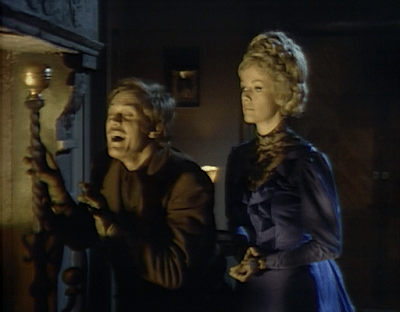
Before Dark Shadows became a costume drama set in 1897, we learned about a number of things erstwhile lady’s maid Beth Chavez had done in that year, none of which she has yet had a chance to do. So when yesterday’s cliffhanger left Beth alone in a small room with her boyfriend Quentin Collins after he had turned into a werewolf, we could be fairly sure she would somehow escape. In today’s opening teaser, we see that she stumbles into the middle of a pentagram that was chalked onto a rug as part of an abortive effort to contain Quentin’s lycanthropy. The werewolf paws at the space above the pentagram, but cannot enter it. As a stunt performer, Alex Stevens must have had considerable occasion to practice miming, but I guess there’s only so much you can do with the old “I’m trapped in an invisible box!” routine. He gives up, goes to the door, turns the knob, and leaves.
After this comic start, the episode turns to the grimmest story they have going. Twelve year old Jamison Collins has been sent to a boarding school that the overwhelmingly evil Rev’d Gregory Trask operates as a dungeon for the torment of children and teachers alike. Jamison has been confined to a closet and kept on a diet of bread and water until he confesses to offenses Trask knows full well he did not commit. The closet adjoins the classroom where teacher Tim Shaw works. Trask’s daughter Charity, temporarily in charge of the school in her father’s absence, sees Tim in the room with some papers; she offers to help him grade them, but he says he needs to go through them himself to judge the students’ progress. When she leaves him there, he smuggles food to Jamison.
Charity catches on, and gives Jamison her father’s “favorite book of meditations” to read while in confinement. She tells him he will have “ample time to browse through it” before her father returns and decrees his additional punishment in the morning. Since the book is about 8 inches thick, it must be in very large print. It is a bit difficult to imagine speed-reading a book of meditations. (“Meditate faster!”)
Charity gives Jamison something to read during the night.
In fact, the book is so thick Jamison can use it as a step to reach a window through which he escapes. Charity is distraught when she realizes that he is gone, and Tim is gleeful to see that he used Trask’s Big Book o’ Meditations to get away.
Charity assumes that Jamison has run back home to the great house of Collinwood. She orders Tim to accompany her there. Beth lets them in and tells them she hasn’t seen Jamison. In her imperious manner, Charity demands that Beth let them search the house, and dismisses out of hand her reply that she does not have the authority to permit such a thing.
In fact, Jamison did come to the house, and Beth is covering for him. He knows the place well enough that even if Charity did have free rein to search for him she probably wouldn’t find him. Jamison went into the drawing room when Charity and Tim came. Charity insists Beth let them into the drawing room. She is disappointed that Jamison isn’t there, and says he must have gone out the window. Regular viewers know that there is a secret passage leading from the drawing room to the west wing, and that the west wing has a myriad of hiding places.
Evidently Beth is unaware of that passage, because she seems to believe Charity is right. She is afraid that Jamison is in the woods, where she knows the werewolf is roaming, and once Charity and Tim have left she goes out there with a gun. Again, those who have been watching the show know something Beth does not, that the gun is formidable to the werewolf only if it is loaded with silver bullets. When she finds the werewolf and points the gun at him, we again come to a cliffhanger ending that leaves Beth’s life in jeopardy.
This episode ends with one of the most thrilling moments in all of Dark Shadows.
The show’s first supernatural menace was undead blonde fire witch Laura Murdoch Collins, who was on it from December 1966 to March 1967. Its second was vampire Barnabas Collins, who first appeared in April 1967. Laura herself was presented with many tropes that conventionally mark vampires; for example, they laid great emphasis on the fact that Laura was never seen eating or drinking. And Laura’s story was structured very much like Bram Stoker’s Dracula, with well-meaning governess Vicki taking Mina’s role as the driving force behind the opposition to her. Presumably, if Barnabas had been staked and destroyed as the original plan envisioned, Vicki would have led the fight against him as well, and in #275 driven the stake into his heart. But Barnabas brought the show a new audience, and so Vicki was never called on to go to battle with him. Her character withered and was written out, and he replaced her as its chief protagonist.
In early 1967, Vicki learned that Laura had appeared at least twice before, and had died in strikingly similar ways each time. In 1767, Laura Murdoch Stockbridge was burned to death with her young son David; in 1867, Laura Murdoch Radcliffe was burned to death with her young son David; and in 1967, Vicki found Laura Murdoch Collins beckoning her young son David to join her in the flames consuming a wooden building. At the last second, Vicki broke through David’s trance and he ran to her, escaping the flames.
In November 1967, the show established that Barnabas lived on the great estate of Collinwood as a human in 1795, and that he became a vampire as a result of the tragic events of that year. If Barnabas were the same age in 1795 that Jonathan Frid was in 1967, he would have been born late in 1752, meaning that he would have been a teenager when Laura Murdoch Stockbridge and little David Stockbridge went up in smoke. The Stockbridges were a very wealthy family, so they would likely have been on familiar terms with Barnabas and the other rich Collinses of Collinsport, and the deaths of Laura and David would have been one of the major events in the area in those days. So longtime viewers have been wondering ever since whether Barnabas knew Laura, and if so what he knew about her.
Now Barnabas has traveled back in time to the year 1897, and there he meets another incarnation of Laura. He is thunderstruck at the sight of her. In her bland, enigmatic way, she expresses curiosity about his reaction, and he collects himself sufficiently to make some flattering remarks about her beauty. As soon as he is alone with his blood thrall, Miss Charity Trask, he declares that Laura has been dead for over a hundred years. So has he, but apparently when a woman rises from the dead to prey on the living that’s different, somehow. We saw this same old double standard a couple of weeks ago, when libertine Quentin Collins expressed shock at Laura’s return from the dead, when he himself had died and been a zombie just the week before.
If Laura did know Barnabas when she was as she is now and he was an adolescent, it is no wonder she does not seem to recognize him. She knows that there is a Barnabas Collins on the estate, and has heard that he is a descendant of the eighteenth century bearer of the same name. She would expect him to resemble the boy she knew, but would not necessarily know what that boy looked like when he was in his forties.
This is the first time we’ve seen Charity since Barnabas bit her in #727. She lives in the town of Rockport, which in the 1960s was far enough away from Collinwood that in #521 it was worthy of note that you could dial telephone numbers there directly. In 1897, when automobiles were rare and roads weren’t made for the few that did exist, a long-distance relationship between vampire and blood thrall would seem quite impractical. Still, in #732 we saw a character make two round trips between Rockport and Collinwood in a single evening, so I suppose it could be managed.
Barnabas’ recognition of Laura is a fitting conclusion to a fine episode. Much of it is devoted to a three-cornered confrontation between Laura, her twelve year old son Jamison Collins, and her brother-in-law/ ex-lover/ mortal enemy, Quentin. Danny Horn analyzes this in his post about the episode at Dark Shadows Every Day. I recommend that post highly. All I would add is that as it plays out today, the confrontation makes me suspect that the writers of the show may have done more planning than Danny usually credits them with. Jamison is the only person Quentin loves, and so far we have seen that Jamison loves Quentin back. When he learns that Quentin is his mother’s foe, Jamison turns against Quentin. Barnabas traveled back in time after Quentin’s ghost had made life impossible for everyone in 1969. The evil of Quentin’s spirit fell heaviest on David Collins, whom Quentin had possessed, turned into another version of Jamison, and was in the process of killing. Nothing yet has explained why Quentin’s ghost would focus its malignity on the image of Jamison. Actress Diana Millay used to claim that Laura was added to the 1897 segment at the last minute because she told Dan Curtis she wanted to work, but Millay famously enjoyed testing the credulity of Dark Shadows fans with outlandish remarks. I wonder if a falling-out between Quentin and Jamison over Laura was in the flimsies all along.
Charity makes her first entrance in the great house of Collinwood. Quentin is apologizing to her for some boorish behavior when he realizes she hasn’t been listening to him at all. She is completely absorbed in the eighteenth century portrait of Barnabas that hangs in the foyer. She excuses herself and wafts out the front door.
In Barnabas’ house, Charity says that he makes her feel beautiful, and that she wants to see herself in a mirror. Barnabas is a bit sheepish about the particulars of vampirism, and so he changes the subject. We cut from this exchange to Laura’s room in the great house, where she is with a servant named Dirk whom she has enthralled to serve as a source of body heat. That scene opens with a shot in a mirror, making the point that Laura’s relationship with Dirk is a reflection of Barnabas’ relationship with Charity. Earlier, there had been a clumsy attempt at an artsy shot of Laura reflected in Quentin’s sherry glass. That does show us that Laura casts a reflection and that her relationship with Quentin has been affected by his drinking, but it calls too much attention to itself to do much more than that.
The portrait in the foyer is hugely important to Barnabas. It made its debut on the show in #204, the day before his name was first mentioned and more than a week before he himself premiered. His thralls stare at it and receive his commands through it. He himself uses it as a passport, appealing to his resemblance to it as proof that he is a descendant of its subject and therefore a member of the Collins family. Today, Barnabas is surprised when Charity comes to his house; he wasn’t transmitting a message through the portrait summoning her. Instead, it was functioning as another mirror, in which Charity, who has become a part of Barnabas, could see the motivating force within her own personality.
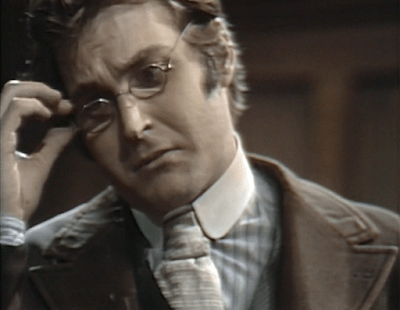
Dirk is played by Roger Davis, a most unappealing actor. At one point he makes this face while Dirk is involved in some kind of mumbo-jumbo:
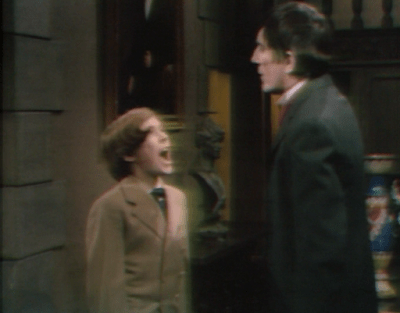
At one point today, Quentin tells Jamison that he shouldn’t be afraid of telling the servants what to do, since after all he will someday be the master of Collinwood. Jamison takes this altogether too much to heart, and spends the rest of the episode ordering everyone around. David Henesy is a good enough actor to extract the comic value from this. For example, when he turns to Quentin, says “I’ll talk to you later!,” and keeps walking, we laughed out loud.
Until November 1967, Dark Shadows was set in contemporary times. So when #283 was shown in July 1967, we could assume that its dramatic date more or less matched its broadcast date.
In that one, psychiatrist Julia Hoffman (Grayson Hall) brought her patient Maggie Evans (Kathryn Leigh Scott) to the old cemetery north of the village of Collinsport, Maine. When Maggie reacted to one or another of the sights of the cemetery with a particularly strong emotion, Julia pressed closer to it. This technique led the two women to a mausoleum. Once inside the mausoleum, Maggie had the strongest reaction of all. Julia was trying to break through Maggie’s amnesia. She did not yet know that vampire Barnabas Collins had held Maggie prisoner, and that there was a secret room hidden in the mausoleum where he once tortured her.
Now, the dramatic date is 1897. Broad ethnic stereotype Magda Rákóczi (Grayson Hall) brings neurotic intellectual Rachel Drummond (Kathryn Leigh Scott) to the old cemetery north of the village of Collinsport, Maine. Rachel’s position as governess in the great house on the estate of Collinwood has been eliminated, and she is terrified that she will have to return to Worthington Hall, a hideously abusive school where she was forced to spend a miserable childhood as a pupil and an equally miserable first part of adulthood as a teacher. The headmaster of Worthington Hall, the evil Gregory Trask, is demanding Rachel return to his school-cum-cult, extorting her with threats of false criminal charges against her and her one friend from the school, fellow student-turned-teacher Tim Shaw. Magda takes Rachel to the same mausoleum we saw in #283, because she knows about the secret room and has decided it is the perfect place for Rachel to hide from Trask.
Meanwhile, Tim is on the job at the school, shaking his head at Rachel’s former charge, twelve year old Jamison Collins. Tim is played by Don Briscoe, who when the show was set in 1968 and 1969 played cursed brothers Tom and Chris Jennings. The Jenningses were supposed to be bad-boy sex symbols, and Briscoe often seemed stiff and uncomfortable when he had to take his shirt off or be aggressive. But as a beaten man who takes refuge from his guilt in pomposity, he’s just terrific. They found the perfect part for him.
On Dark Shadows Before I Die, Christine Scoleri says that she finds Tim Shaw the fretful schoolteacher to be “Totally hot!” Evidently Don Briscoe didn’t have to play a troubled bad boy to be a sex symbol for some people.
Jamison hasn’t done his schoolwork, and Tim is keeping him after class. Trask enters, and asks why Jamison is in detention. Tim claims that Jamison is not being punished, but that the two of them are just talking. Trask is displeased with that hint of friendliness, and before long he finds a reason to lock Jamison in a storage closet. Jamison objects to this confinement, prompting Trask to gleefully declare that “there are worse punishments! Much worse!” When Jamison lets himself out of the closet, he finds Trask waiting for him, grinning. Trask says that they will spend the day together tomorrow, and that in the course of their time together he will ordain Jamison’s further punishment.
Trask sends Tim to Collinwood to fetch Rachel. He makes a show of resistance before going. At first he has trouble finding her; he goes back to the school and reports to Trask that he has failed. Trask refuses to accept this, and sends him back. Tim meets Magda and persuades her that he is Rachel’s friend. She leads him to the secret room, and leaves him alone with Rachel. When Rachel and Tim leave the room, Trask is waiting for them.
One of the first “Big Bads” on Dark Shadows was crazed handyman Matthew Morgan, played by Thayer David. Matthew was the most devoted employee of reclusive matriarch Elizabeth Collins Stoddard (Joan Bennett.) Matthew took his devotion to Liz to such an extreme that he was a menace to everyone else. In November and December of 1966, we learned that Matthew had decided that Liz’ second most dedicated employee, plant manager Bill Malloy, was a threat to her. Matthew had tried to put a stop to Bill’s doings. Not knowing his own strength, Matthew accidentally killed Bill. When well-meaning governess Victoria Winters discovered what had happened, Matthew abducted Victoria, held her prisoner in the long-deserted Old House on the grounds of the estate of Collinwood, and was about to murder her when a bunch of ghosts emanated from the show’s supernatural back-world and scared him to death.
In those days, Dark Shadows was a slow-paced “Gothic” drama set in contemporary times. From November 1967 to March 1968, it was a costume drama set in the 1790s, and its plot often moved at a breakneck speed. Among the characters then was much-put-upon indentured servant Ben Stokes, who like Matthew was played by Thayer David. At first Ben made a stark contrast with Matthew. He was as relaxed, friendly, and reasonable as Matthew was tense, forbidding, and paranoid. But when his one ally among the Collins family, scion Barnabas, was cursed to become a vampire, Ben’s devotion made him resemble Matthew ever more closely. In his development, we saw a retrospective reimagining of Matthew. The curses that were placed on Barnabas and the rest of the Collinses from the 1790s on had burdened the village of Collinsport, and people who grew up there labored under the consequences of those curses and of the Collinses’ attempts to conceal them. Ben was what Matthew might have been had he not been warped by the evil that began when black magic was first practiced in the area so many generations before.
In January 1969, the show briefly returned to 1796, to a time coinciding with the last days of the earlier flashback. We saw that by that point, the curses had already transformed life on and around the great estate. In that period, Ben’s efforts to protect Barnabas led him inadvertently to kill a man, not knowing his own strength, and then to cover that crime up by killing a woman, not at all inadvertently. He had become Matthew. The curse placed on Barnabas had become the curse of all those who work for the Collinses and all of those who live in the shadow of their wealth and power.
Before Matthew, Dark Shadows‘ chief villain was high-born ne’er-do-well Roger Collins (Louis Edmonds); after, it was Roger’s estranged wife, undead blonde fire witch Laura Murdoch Collins (Diana Millay.) In this episode, the makers of the show take a page from its 1790s flashbacks. They have Edmonds and Millay reconceive the Roger and Laura of that atmospheric, sometimes almost action-free soap as characters appropriate to the fast-paced supernatural thriller it now is.
Since #701, Dark Shadows has been set in the year 1897. Louis Edmonds plays Roger’s grandfather Edward; Diana Millay plays Edward’s estranged wife, undead blonde fire witch Laura Murdoch Collins. In his days as a villain, Roger’s defining characteristic was his unnatural lack of family feeling. He had squandered his entire inheritance, a fact which did not bother him in the least. When his sister Liz confronted him in #41 about the difficulties he had created by putting his half of the family business up for sale, he airily replied that he had enjoyed his inheritance. When in #273 Liz and Roger discussed a blackmail plot of which she had been the victim, Roger admitted that had he known her terrible secret, he probably would have used it to force her to give him her half of the estate so that he could squander that, as well.
It wasn’t only the family’s material possessions and Liz’ right to them to which Roger was indifferent. He openly hated his son, strange and troubled boy David Collins (David Henesy.) He continually insulted David, badgered Liz to send David away, and in #83 coldly manipulated David’s fears to lead him to try to murder Victoria.
In the 1897 segment, Edward is as stuffily serious about the family business as Roger was in 1966 nihilistically apathetic about it. Edward loves his children, twelve year old Jamison (David Henesy) and nine year old Nora, but his rage at Laura has come between himself and them. Laura left Edward the year before to run after Edward’s brother, breezy libertine Quentin (David Selby.) Edward tried to conceal the fact that his brother cuckolded him. He has repeatedly declared that Laura “No longer exists!” and has forbidden her name to be mentioned in the house.
Edward trapped between the enigmatic Laura and the exuberant Quentin. Screenshot by Dark Shadows Before I Die.
For his part, Quentin bears a striking similarity to the early, wicked Roger. He wants money only to spend it, a fact which he cheerfully admits. He tried to forge a will in his grandmother Edith’s name to cheat his sister Judith (Joan Bennett) out of her inheritance, having previously threatened to kill Edith. He does have great affection for Jamison, but since he often uses the boy as a pawn in Satanic ceremonies, his fondness for his nephew is not much of an improvement over Roger’s hatred for his son. Indeed, Quentin’s resemblance to Roger connects the 1897 segment not only to the early months of the show, but also to the weeks immediately preceding it. Early in 1969, Quentin’s ghost had taken possession of David Collins and was causing him to die. When we see that Quentin is now what Roger was originally, David’s ordeal takes on a new dimension. He is dying for the sins of his father.
In this episode, Laura has returned. Edward has offered her a great deal of money to go away and never come back; she refuses. She threatens to tell the world about her relationship with Quentin if Edward does not let her stay at Collinwood. Edward buckles to this blackmail. Laura tells him that “Family pride is your greatest weakness,” making him Roger’s exact opposite.
When Laura was at Collinwood from December 1966 to March 1967, her old boyfriend Burke Devlin kept pestering her with his suspicion that he, not Roger, was David Collins’ father. Burke was not the first character to bring this idea up. Roger had mentioned it to Liz in #32, when they were talking about an attempt David had made to kill Roger. At that time, Liz was horrified that Roger seemed to want to believe that David was Burke’s natural son.
It seems unlikely that Quentin is Jamison’s father. They have been firm about 1870 as Quentin’s date of birth, and in 1897 Jamison is quite plainly twelve. Laura may have gone on to marry her own grandson, but it would be a bit of a stretch for her to have started sleeping with her brother-in-law when he was fifteen, even if he did look like David Selby.
But Roger’s anger and jealousy about Burke and Laura do mirror Edward’s about Quentin and Laura. It was abundantly clear that Roger and Burke’s deepest pain regarding Laura was that their intense attachment to each other was disrupted when she left Burke for Roger; Diana Millay used her gift for dry comedy to make this explicit in a scene the three of them played in the groundskeeper’s cottage in #139. Likewise, Edward’s frustration with and disappointment in his brother is at least as deep a source of anguish to him as is his loss of Laura’s love.
Laura, too, is quite different this time around. The first Laura story took shape gradually over a period of weeks, as Laura herself emerged from the mist. Now Laura is a forceful presence from her first appearance. Originally we heard that Laura had married into several of the leading families of the Collinsport region; now they have given up on the idea of developing other leading families, and Laura just keeps coming back to the Collinses. In the first story, they laid great emphasis on the interval of precisely one hundred years between her appearances; now, the number of years doesn’t seem to have any particular significance. As we go, we will see an even more important difference. When we first met Laura, she was utterly determined to make her way into a pyre so that she could rise as a humanoid Phoenix; now she is unhappy about the whole thing, and angry with people who have helped her on her fiery way.
Edward lets Laura live in the cottage where Roger and Liz would put her in 1966. In the final scene, she goes there and finds Quentin, drunk and trying to conjure up an evil spirit. Quentin keeps telling Laura that she is dead. Frustrated with her persistent refusal to concur with this statement, Quentin puts his hands around her neck and announces that whether or not she is dead now, she will be by the time he gets through with her.
Roger was uncharacteristically sober at the beginning of his three-scene in the cottage with Burke and Laura in #139, but he did enter brandishing a fire-arm. So Quentin’s homicidal intentions on this set further cement his affiliation with his great-nephew in the eyes of longtime viewers.
Millay and Edmonds are not the only actors whose screen iconography the show turns to advantage today. We first saw Kathryn Leigh Scott and Don Briscoe together in #638, when she was playing ex-waitress Maggie Evans and he was playing mysterious drifter Chris Jennings. They met in the foyer at Collinwood. Maggie was angry with Chris, and Chris was guilt-ridden. Today, Miss Scott plays governess Rachel Drummond and Briscoe plays teacher Tim Shaw. They meet in the foyer at Collinwood. Rachel is angry with Tim, and Tim is guilt-ridden.
Though the same actors are playing the same basic emotions on the same set, the situations are different, and the characters are very different. Maggie is Dark Shadows‘ principal representative of the working class of the village of Collinsport. She speaks directly and bluntly, using the plainest language she can to dare Chris to try to excuse his inexcusable behavior. Chris occupies a lowly and unsettled place in the world, and he dodges her gaze and evades her questions, saying as little as he can, almost mumbling.
But Rachel is a neurotic intellectual, and she expresses her anger in complex sentences featuring vocabulary that only a very well-read person would have used in 1897 (for example, the word “sadist.”) Tim retreats from her anger into a defense of his job that quickly devolves into the tiredest platitudes imaginable. At one point he actually intones “It is better to light one candle than to curse the darkness.” Miss Scott makes Rachel’s highly literate onslaught on Tim as forceful as was Maggie’s unvarnished challenge to Chris, and Briscoe makes Tim’s pompous posturing as pitiable as was Chris’ broken burbling. Writer Gordon Russell must have been delighted that the actors did such good work with his ambitious pages.
When Dark Shadows began in June 1966, strange and troubled boy David Collins (David Henesy) was frantically afraid that he would be sent away from the great house of Collinwood. In #10, David overheard his father Roger (Louis Edmonds) telling his aunt Elizabeth Collins Stoddard (Joan Bennett) that they ought to do just that. As the owner of the house and holder of all the family’s wealth, it is up to Liz to make the decision. Hearing his father press to send him away, David responded by sabotaging the brakes on Roger’s car, nearly killing him.
Roger told Liz that David belonged in an “institution,” but David was just as terrified when it was suggested that he might go to an ordinary school. It was not entirely clear why he had this attitude. David and Roger had only lived in the vast gloomy house for a few weeks when the show started. Roger openly hated David, as did Liz’ daughter Carolyn. Liz loved him, but as a recluse and an aging grande dame had little in common with a young boy. Moreover, David hated his governess, the well-meaning Vicki, as much as he could hate any school. His mother, who did not live in the house and whose name was in those days was never to be mentioned there, was the only person for whom David expressed fondness; when in #15 David watched Roger drive off in the car whose brakes he had sabotaged, we saw him standing by himself, saying “He’s going to die, mother. He’s going to die!” So it is difficult to see why David was so intensely committed to staying at Collinwood.
Today, we see a suggestion that David may have been influenced by an ancestral memory of bad times at a boarding school. It is 1897, and David’s grandfather Jamison Collins (David Henesy) is twelve. Jamison’s father Edward (Louis Edmonds) has asked the Rev’d Mr Gregory Trask to come to Collinwood to urge his sister, Judith Collins (Joan Bennett,) to send Jamison and his nine-year old sister Nora to be students at Worthington Hall, a boarding school Trask runs. As the house’s owner and holder of all the family’s wealth, it is up to Judith to make the decision.
Trask wins Judith’s confidence by performing a ceremony after which Jamison and her brother, Jamison’s uncle Quentin, are restored to themselves after a spell that had made Quentin a zombie and put his spirit in possession of Jamison. Recently arrived, thoroughly mysterious distant cousin Barnabas Collins sputters with rage at the very sight of Trask, and exasperates Judith with his insistence that Trask is evil. Judith does not trust Barnabas, and Barnabas’ inability to either explain or contain his hostility only confirms her favorable judgment of Trask.
Once Quentin and Jamison are themselves again, Trask sends Barnabas and Quentin out of the drawing room. Quentin raises his eyebrows in response to Trask’s order and asks his sister “Are you sure you’re still in charge of this house, Judith?” She does not respond.
Judith makes a remark about Quentin’s influence on Jamison, saying that “He’s been like this ever since [Quentin] came home.” Since Jamison was just freed from possession a few minutes before, it is unclear what she could mean, and Jamison objects “That’s not true!” Trask unctuously replies “Now, your aunt does not tell lies, Jamison.” Returning viewers know that Judith lies constantly. Nor is Trask unaware that Judith is less than perfectly truthful. When he first arrived in Friday’s episode, Judith and Barnabas tried to conceal the situation with Quentin and Jamison from him, and she told a series of lies in pursuit of that objective.
When Jamison continues his attempts to tell the truth, Trask silences him with “Now, there is only one who is constantly right, Jamison, and He is not on this earth, but above. Now, I want you to go out into the hall and consider all the wonderful things your aunt has done for you recently. I am sure you will have much to think about.” Jerry Lacy brings such an inflexible authority to Trask’s personality that we cannot imagine a rebuttal to this sanctimonious little speech. We share Jamison’s helplessness and frustration.
Alone with Trask, Judith agrees to let him take Jamison and Nora to Worthington Hall. Jamison barges back in and declares that he will not go. Trask assures him that he will not take him unless he is willing to go. He then obtains Judith’s permission to talk with Jamison alone in his room.
While Jamison is taking Trask upstairs, we cut to the study. Quentin and Barnabas are alone there. Quentin asks Barnabas if Trask really was his “savior.” Barnabas replies “Apparently.” Quentin asks Barnabas what he thinks really happened; he sidesteps the question. Quentin keeps probing for Barnabas’ interpretation of his recent experience; Barnabas alludes to Quentin’s adventures in Satanism, saying “You dabble in odd things, perhaps one of your interests resulted in this.” Quentin observes that this is “Delicately put,” and goes on to remark on “what an interesting life” he has had.
Barnabas then takes his turn as the questioner. He asks Quentin about his wife, a tall, beautiful, homicidally crazed woman named Jenny who is being held prisoner somewhere in the house. Quentin grows tense, and does not give direct answers. He explodes at Barnabas, saying that he has no interest in making a friend of him. Barnabas observes that he has in fact made an effort to turn him into an enemy; Quentin interjects “Your fault!” Barnabas says they could be useful to each other; Quentin exclaims “Wrong!” When he thinks of Barnabas, Quentin says, only one question comes to mind- “What does he want from me?”
Jonathan Frid said that his favorite scene in Dark Shadows was one he had with Anthony George in #301. Barnabas tells local man Burke Devlin that their relationship to each other is like that of “two superb swordsmen with highly sharpened blades. You thrust, and I parry. I thrust, you parry.” That scene has never impressed me. The Barnabas/ Burke conflict did not have enough grounding in the story to come to life, and having the characters tell the audience that they were like “superb swordsmen” does not make it so. But this showdown really does pay off. Barnabas and Quentin are the show’s two great breakout stars, and we are in the middle of a long run of episodes where everything works. This scene brings out all the values they might have hoped that Burke and Barnabas’ confrontation would put on screen when they planned it.
We return to Jamison’s room, the same bedroom David Collins occupied in the 1960s. Trask is still being friendly. When Jamison says that he would miss his pony if he had to go away to Worthington Hall, Trask says “You must bring him with you!” When Jamison refuses to tell Trask his pony’s name, the friendliness vanishes. Trask darkens, tells him “You’re going to have to learn to answer questions, boy,” and insists they pray together. When Jamison resists, Trask tells him that he must change his ways lest he go on being a disappointment to his father. Jamison protests that his father loves him, and Trask asks incredulously “Does he?” He asks Jamison if he wants his soul to be saved. Jamison can’t very well say anything but yes to that, and so Trask says “Then I think I can help you.” Jamison is trapped.
After a scene in the drawing room where Quentin demands Judith tell him where Jenny is locked up, we return to Jamison’s room. The scene begins with a closeup of the rope belt of Jamison’s robe. Jamison is retying it. He keeps fiddling with it, perhaps a nervous habit, but it is the first thing we see and they hold the shot for a long time. We cannot but wonder whether the belt was untied at some point while Jamison and Trask were alone off camera.
Jamison fiddles with his belt.
Trask orders Jamison to tell Judith that he wants to go to Worthington Hall; Jamison says he will not. The dialogue does not explain how Jamison’s robe came undone, and neither he nor Trask seems concerned with the matter. Their blasé attitude turns an uncomfortable image into a lingering mystery.
In the drawing room, Trask announces to Judith that Jamison has something to say. Jamison says that Trask threatened him and tried to make him lie. Trask says that Judith will have to find another school for him, and she declares that she will not. Jamison will go to Worthington Hall.
Trask exits. Jamison finds Quentin and asks him to help him escape the grim fate in store for him. Quentin promises to do so, and by the end of the episode Jamison will be safely hidden somewhere in the house. Meanwhile, Barnabas throws a fit before Judith, saying that he cannot understand why “You would believe that maniac before you believe Jamison.” Judith scolds him and tells him to treat Trask with respect.
Trask returns. Barnabas asks him if his family is from Salem, Massachusetts. Trask affirms that it is so. Barnabas claims to have seen ink drawings of a Rev’d Trask who was at Collinwood in the 1790s; Trask says that he was his ancestor. He says that the earlier Rev’d Trask disappeared shortly after leaving Collinwood, and that his disappearance was never explained.
Longtime viewers know that Barnabas is a vampire who lived in the 1790s, and that the original Trask is one of those he blames for the many misfortunes that befell the family in those days, including his own transformation into a bloodsucking abomination. We remember the first Trask as a case study of a type much on people’s minds in the 1960s, Eric Hoffer’s “True Believer.” That Trask was so deeply and unshakably convinced of his own understanding of the situation around him that when he set out on a witch hunt, the real witch was easily able to manipulate him into doing her work for her. Barnabas murdered the original Trask in #442 by bricking him up in an alcove, one of the most famous moments in all of Dark Shadows. He seems pleased to hear that people are still wondering what became of the late witchfinder.
Gregory Trask seems to be a different sort. He can change his tune in a way that his forebear never could, putting on a friendly mask when it serves his interests to do so. While the original Trask was single-mindedly trying to live up to his own twisted idea of virtue, the second sometimes responds to bad news with a delighted grin, suggesting that he sees an opportunity to profit from it. The first Trask’s fanaticism sometimes led him to hypocrisy, when he thought that his ends were so good that they justified dishonest means, but this Trask seems to be a hypocrite who has kidded himself into acting like a fanatic. Mr Lacy’s performance makes him a formidable presence; the writers have made him a powerful adversary.
In April 1967, Barnabas Collins showed up at the great house of Collinwood, home of Elizabeth Collins Stoddard and her family. Liz (Joan Bennett) was isolated, embattled, and under the control of a blackmailer. When a courtly gentleman claiming to be a distant cousin from England showed up, apparently wanting nothing from her but her friendship, she quickly accepted him, even giving him the Old House on the estate to live in. As Barnabas’ eccentricities became ever more difficult to ignore and bizarre and terrible events piled up around him, Liz steadfastly refused to entertain the idea that Barnabas might be anything less than perfectly trustworthy. Since Barnabas was in fact a vampire escaped from his grave to prey upon the living, this refusal tended to push Liz further and further to the fringes of the story.
Now Barnabas has traveled back in time to the year 1897. Joan Bennett again plays the mistress of Collinwood. Like Liz, spinster Judith Collins has agreed to let Barnabas stay in the Old House and do some work on it, presumably at his own expense. Unlike her, Judith is not desperate for friendship, and she is not at all sure Barnabas is someone she should trust.
Today, Joan Bennett is in closeup while a recorded monologue in her voice tells us what Judith thinks of Barnabas:
What is happening to all of us? Until Barnabas arrived, everything seemed the same. But what has Barnabas to do with it? Something, something, I’m sure. He knows too much, he’s involved himself so quickly, as if he were the center of it.
Had Liz ever thought in those terms for one second, Barnabas would have been exposed and destroyed and Dark Shadows would have gone back to telling stories about the Collins family cannery. But 1897 is a more dynamic setting, in which no one has much time to wonder where Barnabas goes during the daylight hours or why he keeps his cellar door locked.
Today’s great crisis concerns Judith’s brother Quentin and her twelve year old nephew Jamison. Quentin died the other day, which you might expect to mark an ending of sorts. But as it happens, his body is roaming about as a zombie and his spirit has taken possession of Jamison. Yesterday Judith permitted Barnabas to do some mumbo-jumbo that lured Quentin back to his coffin, and, with the help of Judith’s surviving brother Carl, Barnabas buried Quentin and filled the grave with cement. But before the episode was over, Quentin had made his way out of the ground and abducted governess Rachel Drummond. For his part, Jamison is still possessed.
Today, Barnabas announces to Judith that she must let him take Jamison to Quentin’s grave, where he will perform another ceremony. Judith is appalled, as one might expect her to be, but yields to him. By the time Barnabas and Jamison come back to the great house, Judith is entertaining a visitor. He is the Rev’d Mr Gregory Trask.
When longtime viewers see Jerry Lacy wearing a cassock, they will expect to hear Trask’s name and title. Mr Lacy played another Rev’d Trask from December 1967 to March 1968, when Dark Shadows was set in the 1790s, the period when Barnabas first became a vampire. That Trask was a fanatical witchfinder whose zeal was matched only by his ineptitude. Wicked witch Angelique was able to manipulate Trask for her own purposes, and he earned Barnabas’ most cordial hatred.
When Barnabas sees Gregory Trask, he blurts out his surname. Puzzled, Trask asks if they have met. Barnabas does not answer, but immediately begins to display his hostility towards the newcomer. Barnabas is a poor tactician who has a habit of volunteering to his enemies exactly what he thinks of them. His interactions with the first Trask were a case in point, and we see him falling into the same pattern with this second.
Trask has come to Collinwood at the invitation of Judith’s brother Edward, father of Jamison and of nine year old Nora. Just four weeks ago Edward brought Rachel to the great house to be Nora and Jamison’s governess; last we saw, in #715, Edward was optimistic Rachel would work out well in her position. But now he has called Trask to come and take the children away to a school he operates, eliminating the need for a governess.
With Quentin lumbering around the house and Jamison spouting off about his possession, Judith and Barnabas cannot keep Trask from figuring out what is going on. He sits Quentin in a chair, intimidates Jamison into kneeling, sends Barnabas and Judith out of the drawing room, and starts praying for help. When Barnabas tries to enter, Trask tells him he can do nothing but help the devil, and slams the doors in his face. Judith and Barnabas are left standing in the foyer, wondering what will happen.
Another drab-looking outing from director Henry Kaplan, enlivened with some witty writing by Violet Welles and sprightly acting by John Karlen and David Henesy.
Daft prankster Carl Collins (Karlen) goes to the suite in the west wing of the great house of Collinwood recently occupied by his brother, the late Quentin Collins. Carl finds his nephew, twelve year-old Jamison Collins (Henesy) sitting by Quentin’s gramophone, listening to a sickly sweet waltz of which Quentin was fond. Carl mutters and rambles, claiming at one moment that Quentin is not really dead and at the next that he has a theory about who really killed him. Jamison just stares in response. Carl, agitated, demands that Jamison turn off the gramophone. When he does not answer, Carl declares that he is Jamison’s uncle. Jamison calmly replies that Carl is not his uncle, but his brother.
Carl comes back with his sister Judith. They question Jamison, who seems to know things only Quentin would know. Judith declares that “The child is possessed!” and flounces out of the room.
Jamison’s governess, Rachel Drummond, has a dream in which Jamison and Judith make her uncomfortable. She tries to go to the drawing room, only to find Carl blocking her way. He is wearing a railroad conductor’s hat and holding Jamison’s toy locomotive. He tells her it is too late to pass this point, and shows her a gigantic pocket watch to prove the point. She wakes up to find Quentin’s body sitting in a rocking chair next to her bed.
The principal writer of the first seventeen weeks of Dark Shadows was Art Wallace, who was interested in characters as one another’s reflections. Many of his episodes were structured as diptychs, in which we would alternate between two small groups dealing with similar situations. In the comparison, we would see that people who were in some ways very different from each other or hostile to each other would make the same decisions when faced with the same circumstances.
Wallace left the show in October 1966, never to return, but his interest in mirroring comes up again and again. The current storyline centers on Barnabas Collins, who has traveled back to the year 1897. In the first months of 1969, the ghost of Quentin Collins was persecuting strange and troubled boy David, and it was to rescue David that Barnabas participated in a summoning ritual which, to his surprise, got him unstuck in time and brought him face to face with the living Quentin. It also turned Barnabas back into what he was for 172 years, a vampire.
This story is the inverted image of Dark Shadows‘ first costume drama insert, which ran from November 1967 to March 1968. In that period, well-meaning governess Vicki participated in a summoning ritual because she knew that some supernatural menace posed a mortal threat to David. She did not know who that menace was or in what way he was supernatural, but the audience knew that it was Barnabas the vampire. During the four months of that uncertain and frightening journey into the past, we learned how Barnabas became a vampire and that he could be interesting even if he were not one. Vicki didn’t learn anything, and would eventually be written out of the show.
Early in today’s episode, Barnabas is in the room on top of the tower in the great house on the estate of Collinwood. This room was introduced in the 1790s story as one of the places where Barnabas was hidden. In this period, a mentally ill woman named Jenny Collins is hidden there. Governess Rachel Drummond sneaked into the room because Barnabas’ unwilling associate, ethnic stereotype Magda Rákóczi, read Rachel’s palm and told her she had a deadly enemy who was hiding there, and that if she let that enemy choose the time of their first meeting she would have no chance of survival. Jenny sprang from the room, locked Rachel in it, went to the main part of the house, and set fire to the sheets of the bed in which the stuffy Edward Collins lay sleeping.
Barnabas heard about this from Rachel, who reminds him of his lost love Josette. He knows that Angelique, the wicked witch who turned him into a vampire in the first place, is operating in this period and that she has already targeted Rachel. He knows nothing about Jenny, and so he assumes that Angelique is lurking in the tower room. When he enters it, he opens an armoire and finds a doll’s head. The rest of the doll is not attached and the back of the head is caved in, but the face is undamaged. This is the first suggestion of a mirror, a device in which a face can be seen intact and functional even though it is separated from the rest of the person.
Barnabas calls for Angelique and she appears. Barnabas denounces Angelique’s crimes; Angelique brings up his. She asks what he sees when he looks in the mirror, then remembers that he casts no reflection. Angelique does not mention what we have seen ever since we first met her during the 1790s segment, that the vampire curse made Barnabas into her reflection. Today, for example, she gleefully taunts him with the murders he has committed, including those her curse compelled him to commit. This reminds longtime viewers of #341, when Barnabas pressured his friend Julia Hoffman into helping him kill a man named Dave Woodard and then gleefully taunted her with her new status as a murderer.
Angelique tells Barnabas that he has only to love her and she will cease to be his enemy. She makes it clear that she knows all about the mission that has led him to travel back in time from 1969, and offers to help him accomplish it. She suggests that it is his hatred for her that has led her to treat him and everyone around him so cruelly for so long. She says that she will return his love as abundantly as she has returned his hate. She claims to be his mirror, as we know he has long been hers, and offers to show him a pleasing reflection if he submits to her desires.
Barnabas angrily refuses, and Angelique conjures up an image of his impending destruction in the window. Barnabas will not look into this magic mirror, and when he seizes Angelique she vanishes from his arms.
Quentin is on his guard against Barnabas. In the course of an adorable scene in which Quentin and his twelve year old nephew Jamison pretend to be spies, he sends Jamison to steal something that belongs to Barnabas.
Spy school.
Jamison is leery of the whole thing; he says that Quentin doesn’t know any more about real spycraft than he does, forcing Quentin to admit that he was in fact a spy for the police in Egypt not so long ago. This too will get the attention of longtime viewers. Jamison is played by David Henesy, who in the parts of Dark Shadows set in the 1960s plays David Collins. Jamison and Quentin are in the groundskeeper’s cottage on the estate, which from December 1966 to March 1967 was home to David’s mother Laura Murdoch Collins. Laura often told the story of the Phoenix, usually setting the scene in an unnamed land which, she said in #140, “Some call… Paradise.” But she leans heavily enough on the existing mythology of the Phoenix that she reminds even readers who have never heard of Herodotus of ancient Greece and Egypt. Laura herself turned out to be a supernatural phenomenon consisting of several distinct beings reflecting themselves back to each other.
Quentin decides that Jamison must sneak into Barnabas’ house and bring his cane back to the cottage. After he does so, Quentin casts a spell that causes Jamison to speak with the voice of Ba’al, a title for various gods whose cults are remembered very unfavorably in Judaism, Christianity, and Islam. Among other grim associations the name of Ba’al brings to the minds of those who adhere to the great monotheistic religions is the practice of child sacrifice among the Phoenicians, a practice that often involved the burning of the body of the sacrificed child. Since “Phoenician” and “Phoenix” sound so much alike,* longtime viewers may well associate Ba’al with Laura.
Quentin has made a voodoo doll of Barnabas. Through Jamison, Ba’al says that only silver will work against Barnabas. Silver is of course used in making mirrors, and the piece of silver Quentin uses to inflict disabling pain on Barnabas is the head of Barnabas’ own cane. So once more Barnabas finds himself oppressed by a reflection, or perhaps by the absence of a reflection.
Barnabas is with Magda when he collapses under the pain Quentin is causing him. They discover that the cane is missing. Magda figures out what is happening, and rushes to the cottage. She confronts Quentin, jeering at his cowardice. Quentin is no man at all. He is using a child as a pawn in a black magic rite, and fighting an enemy using a doll. Magda looks at Quentin’s face and reacts with horror as the image of a skull is superimposed on it. She recognizes this as a sign that he will die soon.
Jamison has scenes with both Quentin and Magda today. David Henesy had such great chemistry with David Selby that it’s no wonder Mr Selby named his son “Jamison,” and Hall’s equally great chemistry with him leads me to suspect that if her son Matthew hadn’t already been born when she joined the show he might have been named for Mr Henesy as well. Hall and Jonathan Frid are always wonderful together, and today’s Barnabas/ Angelique confrontation is the best scene Frid and Lara Parker have shared so far. Angelique’s maniacal intensity has always set an upper bound to how responsive Parker could be to Frid’s performance. She is calm enough today that we see them for the first time really in the same space.
*As well they might- they both come from the ancient Greek Φοίνιξ, an adjective meaning “red.” Herodotus calls the legendary fire creature “red-bird,” and the Greeks named the northern Canaanites after the red dye they bought from them.
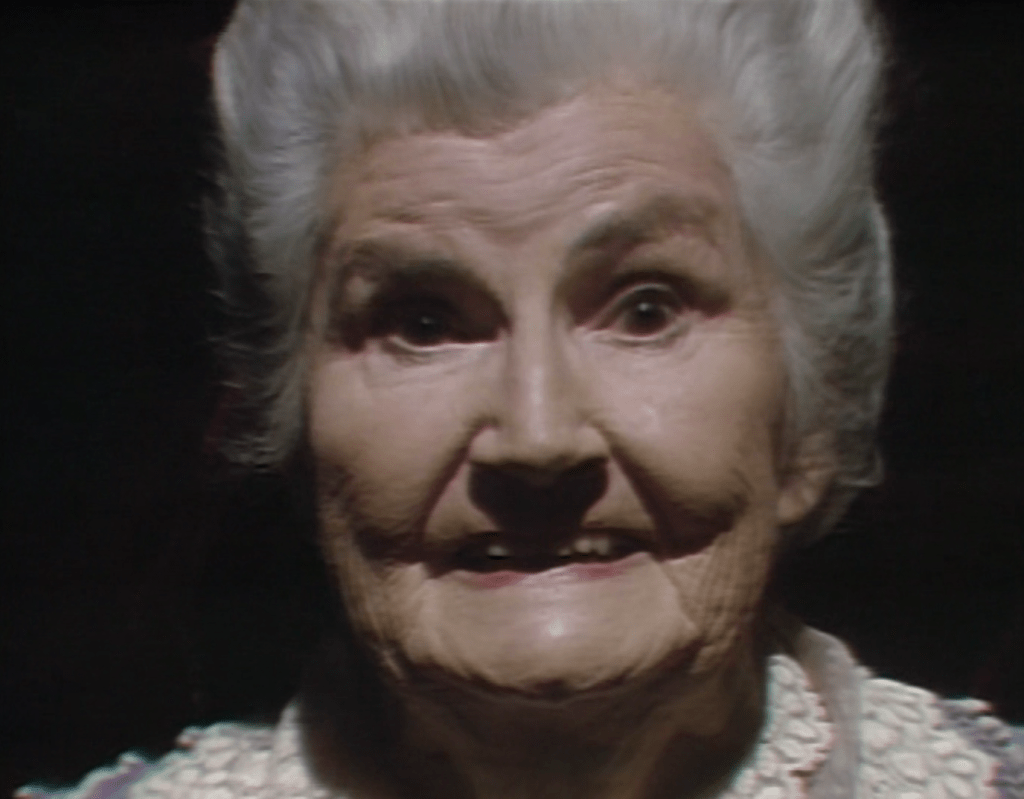
Libertine Quentin Collins has stolen his late grandmother Edith’s will, intending to forge a substitute that will give him control of her vast estate. His distant cousin, the recently arrived and thoroughly mysterious Barnabas, has warned Quentin that Edith’s ghost will haunt him if he persists in this plan. Quentin hears a loud pounding emanating from the walls of the great house of Collinwood. He goes to the study, where Edith lies in her coffin. He sees her there, grinning at him. Quentin returns to his room; the still-grinning Edith sashays in and taunts him. He tells her she is dead; this does not seem to bother her. She just keeps on grinning.
Edith may be dead, but she is clearly having a blast. Screenshot by Dark Shadows Every Day.
Quentin strangles Edith. She falls into an armchair in his room, unmoving but still grinning. He buries her somewhere on the grounds of the estate; her hand sticks up from the earth. He wakes up.
Quentin’s friend, unethical lawyer Evan Hanley, comes calling. Evan asks Quentin to give him the will so he can take it to a forger of his acquaintance. Quentin tells Evan about the dream, and how shaken he is. He also tells him about Barnabas, and his concern that Barnabas is a formidable enemy who may have uncanny powers. When Evan tries to dismiss Quentin’s worries, Quentin responds that he is the last person who should make light of the supernatural. When Quentin speaks of Evan’s “devil-callings,” we learn that the clandestine “meetings” they spoke of the other day are Satanist ceremonies. Evan agrees to meet Quentin at 8:00 that night in the groundskeeper’s cottage on the estate to summon one of the spiritual forces of darkness to fight Barnabas.
Returning viewers know that Quentin is right to fear Barnabas’ connections to the supernatural. Barnabas is a vampire, and his powers include the ability to send hallucinations to torment people with guilty consciences. He is also a time-traveler, who has come to 1897 from 1969 on a mission to prevent Quentin from becoming a ghost who will drive the Collins family of that year out of the great house and plague strange and troubled boy David Collins to the point of death.
First time viewers will not learn that today; aside from the opening voiceover, this episode tells us nothing about Barnabas. It does tell us something about Quentin and Evan. They are super-racist against Romani and Sinti people.
Evan has decided to hire Sandor Rákóczi to forge the will. Sandor and his wife Magda have been staying at the Old House on the estate for some time as Edith’s guests. Quentin’s brother Edward and sister Judith are offended by the presence of these “gypsies” in their midst. Unknown to Evan and Quentin, and unmentioned in today’s episode, Barnabas has bitten Sandor, enslaving him. Presumably Sandor has no secrets from Barnabas, making him a bad choice to be Quentin and Evan’s henchman.
Three times today, Evan addresses Sandor as “Gypsy.” When he is putting it to him that he wants him to forge the will, he barks at him with “Now, one moment, Gypsy.” He insists Sandor fix his price in advance. When Sandor tells Evan he is sad that he does not trust him, he replies “Well, then, be sad, Gypsy, but give me your price, now!” Later, Sandor will express curiosity about Quentin and Evan’s plans, to which Evan will reply “Well, don’t be curious, Gypsy, just do as you’re told.”
Evan told Quentin that the “devil-calling” at the cottage should involve twelve year old Jamison Collins as a “sacrificial lamb.” Quentin sincerely cares about his nephew Jamison, and he protests that he won’t do anything to hurt him. Evan assures him that Jamison will simply be a symbol of the innocence that their dark lord exists to despoil and that the boy himself will not be harmed. When Quentin is talking Jamison into joining him and Evan for a secret meeting that night, he tells him they will look into the future. Jamison asks”How, with a crystal ball?” Quentin replies “No, of course not. That kind of thing is for gypsies. It’s not for men, like you and me.” Scripted television in the US in the 1960s rarely gave such flagrantly racist remarks to recurring characters, not only because the audience included members of minority groups, but also because they are so unattractive that they limit the utility of the characters who make them. In this case, Quentin and Evan are already in league with the Devil, and Quentin is on track to die soon and become a ghost. So we know that they are due for a comeuppance. Moreover, their prejudices may lead them to underestimate Sandor, both on his own account and as a tool of Barnabas, so it is useful to the plot that they are in the grip of such ugly attitudes.
Sandor is in the cottage, preparing to forge a new will for Edith, when Jamison drops in. Jamison does not see what he is doing. He and Sandor spend a couple of minutes sparring verbally. Sandor ends the match when he points out to Jamison that it is getting dark. The boy looks alarmed and runs home while Sandor laughs.
In #701, Sandor and Magda mentioned that the Collinses were afraid of the night. Shortly after, they found out about Barnabas, and learned that they had good reason to be. But Sandor can still laugh when he sees that a boy as old as Jamison runs away at the news that the sun is setting.
Sandor is still in the cottage when Quentin brings Jamison by. Evidently Evan plans to let Sandor participate in the ceremony. Regular viewers will remember that in 1969 the first place Quentin manifested himself outside the little room in the great house where David and his friend Amy discovered him was in the cottage, and that he showed considerable power there. That he and Evan have their Satanic “meetings” in the cottage suggests that the evil he did in 1969 has its roots in what he did during them.
Evan directs Jamison to stare into the fire burning in the hearth. This will ring another bell for longtime viewers. Jamison is played by David Henesy, as is David Collins. From December 1966 through March 1967, David Collins’ mother Laura Murdoch Collins lived in the cottage. She was an undead blonde fire witch, and her plan was to lure David to join her in a fiery death. She would rise from the dead as a humanoid Phoenix, as she had done at least twice before. On each of those previous occasions, she went into the flames with a son named David; the Davids did not rise again, as becomes clear when one of them is available to speak in a séance in #186. Laura often urged David to join her in her favorite pastime, staring into fire. So when Evan urges Jamison to do the same, we wonder if Jamison, too, is in danger of being consumed by its fascination.
As the ceremony goes on, Jamison becomes alarmed. He runs out, and Evan orders Sandor to follow him. Quentin, too, runs to the door and protests that they have gone too far. He points to the flames, in which the likeness of a skull wearing a wig takes shape. We may wonder if more will be added to the skull, perhaps so much as to make up a whole woman, and if this woman will be someone we have met before.
Edith’s role in Quentin’s dream unfortunately marks Isabella Hoopes’ final appearance on Dark Shadows. She was just terrific. I wish they had done a parallel time story set around the period of the Civil War in which Hoopes played an aged Sarah Collins. Her nose, chin, and cheekbones resembled those of Sharon Smyth sufficiently that you can imagine an elderly Sarah looking like her, and she had a playfulness that would make longtime viewers remember the nine year old ghost we met in June 1967.
Matriarch Edith Collins has died. Her grandson Edward stands with recently arrived distant cousin Barnabas in the study of the great house of Collinwood, viewing Edith’s body. Edward asks Barnabas if Edith told him the family’s celebrated secret. Barnabas assures him she did not. Edward claims that the oldest son of the family has known the secret in every generation for a century. This does not appear to be true- Edward is the oldest son in his generation, and he has never known it. We have learned that the family has many false ideas about the secret. That it has been passed from father to son may well be one of these.
We cut to the foyer. Edward’s brother, libertine Quentin, enters with a character we have not seen before. He is lawyer Evan Hanley. Evan and Quentin conspire to replace Edith’s will with a forgery that will leave her money to Quentin. Quentin inveigles Evan into this plot by talking about their “meetings” and intimating that they may become known if he doesn’t get his way. Since Evan is played by Humbert Allen Astredo, whom longtime viewers know as warlock Nicholas Blair, and since Quentin was first introduced as the malevolent ghost of a man who may have been involved with black magic, we might assume that these “meetings” have something to do with the occult.
Quentin exits, and Barnabas and Edward enter. Edward introduces Barnabas to Evan, then he and Evan leave to attend to business. Barnabas gives them a hard look as they go. Barnabas’ conversation with Edward about the secret had grown quite heated, and returning viewers know that he has reason to be uncomfortable about the topic. He knows that the secret in fact concerns him, and that if the family learns it he will be in big trouble. So his expression may be entirely due to the apprehension he still feels as the result of that discussion. On the other hand, Barnabas did know Nicholas and do battle with him, and it is possible that he recognizes a trace of Nicholas in Evan. Astredo plays Evan as a subdued version of Nicholas, with no noticeable difference of posture or manner or cadence. Even if Barnabas can’t see that the two are played by the same actor, he may well have observed the similarity.
Barnabas hears laughter from the walkway at the top of the foyer stairs. He looks up to see twelve year old Jamison. Jamison says that Evan is lying when he says that he had a deep regard for Edith- they hated each other, since Evan knew that Edith believed he was a “shyster.” I’m sure it was possible in central Maine in 1897 for a rich Protestant kid with red hair and an Irish name to drop a shmekndik of Yiddish here and there, but it does get your attention.
Jamison tells Barnabas he is reluctant to view Edith’s body, as he has never seen a dead person. That’s what he thinks- Barnabas is a vampire, so he’s talking with a dead person right now. Barnabas asks Jamison if he likes Quentin. Something about his tone reveals to Jamison that Barnabas is hostile to Quentin, and so Jamison yells at him that he is “just like the others” who disapprove of his favorite uncle. He storms out.
Edith’s grandchildren are scrambling to find her will. Quentin suggests they make a game of the search; stuffy Edward objects that they most certainly will not make a game of it. Of course they will, since the search for a secret will is obviously a comedy plot.
Blackmailing Evan into joining his plot to forge a will in Edith’s name is not Quentin’s only crime today. He also assaults Edith’s friend Magda Rákóczi. Magda and her husband Sandor have been living in the Old House on the estate as Edith’s guests; now Barnabas is staying there. He has bitten Sandor and made him his slave, and bribed Magda into going along with his plans. Quentin calls at the Old House, where he chokes Magda and threatens her with a knife until she tells him where the will is. He then goes back to the great house and exploits Jamison’s trust to manipulate him into stealing the will and giving it to him. Quentin is such a horrible stinker that if he were played by any actor less charming than David Selby he would be intolerable to watch. As it is, we just keep wishing that Quentin would straighten up and fly right.
At the end of the episode, Barnabas accuses Quentin of having the will and threatens to do something “drastic” if he does not give it up. As a matter of fact, Jamison has not yet handed the will over to Quentin at this point, so what Barnabas says is not true. Worse, there is no tactical advantage for Barnabas in openly declaring himself to Quentin as an enemy at this point. Quite the contrary; he has traveled back in time to 1897 to prevent Quentin’s ghost haunting the great house in 1969 and making it uninhabitable, and has no idea what will be involved in doing that. He needs to be on friendly terms with as many people as possible to get the information he needs, and he particularly needs to get as close to Quentin as he can if he is to have any hope of thwarting whatever disaster is in store for him.
This isn’t the first time Barnabas has rashly shown his enemies what he thinks of them. When wicked witch Angelique returned to torment him in the spring of 1968, Barnabas repeatedly confronted her about her evil schemes, keeping her up to date on exactly what he did and did not know, while concealing everything from the people who wanted to help him fight her. Longtime viewers can see that there is no danger that Barnabas will learn anything from his experiences.




 Dark Shadows Commentary