
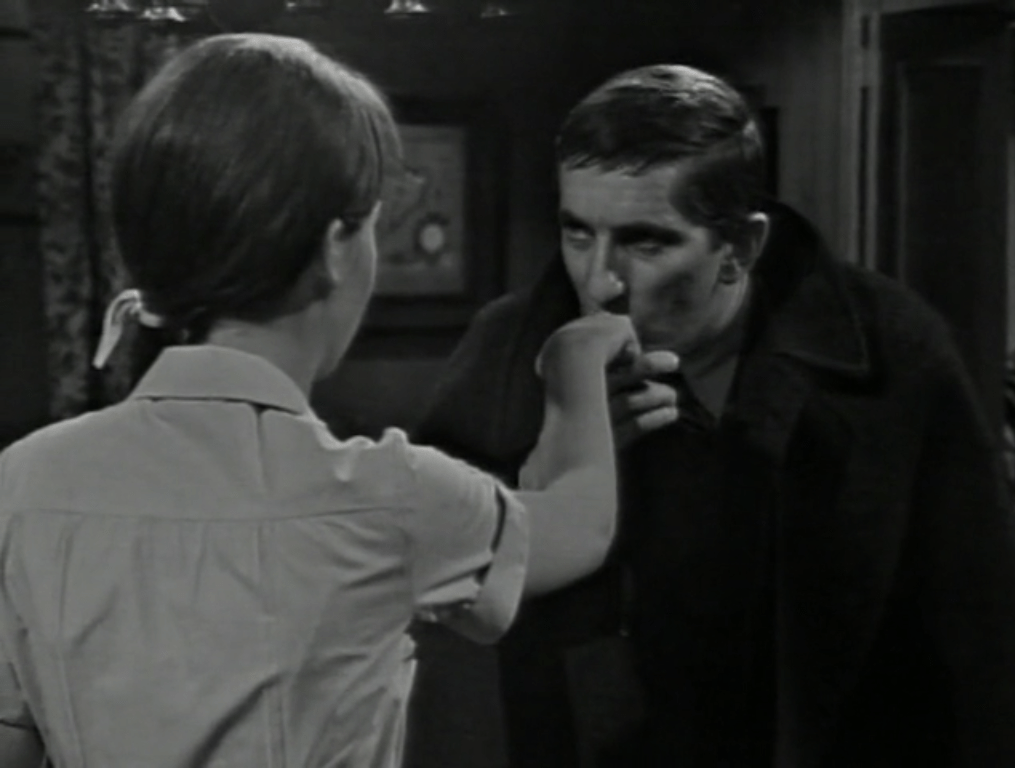
Maggie Evans, The Nicest Girl in Town, is closing up shop in the restaurant at the Collinsport Inn. A stranger startles her. He is the mysterious Barnabas Collins. Barnabas recently left his long-time residence in the cemetery five miles north of town and has been hanging around the great estate of Collinwood, but this is the first time we’ve seen him in Collinsport proper.
In the opening months of Dark Shadows, the restaurant, like the rest of the inn, was coded as the base from which dashing action hero Burke Devlin mounted his campaign to avenge himself on the ancient and esteemed Collins family. As the Revenge of Burke Devlin storyline ran out of steam, the restaurant emerged as a neutral space where new characters could be introduced without defining their relationships to the established cast all at once. In that period, Maggie was Collinsport’s one-woman welcoming committee.
Now, even Burke has given up on his storyline. The only narrative element of the show with an open-ended future is Barnabas, and once the audience has figured out that he is a vampire there’s no such thing as a neutral space where he is concerned. So it is not clear what, if any, role the restaurant will have from now on.
Barnabas asks if it is too late to get a cup of coffee. Maggie tells him it is, but relents after about a minute and reopens to serve him. She is charmed by his old-world manners and excited to learn that “there is a new Collins in Collinsport.” He tells her he is staying at the long-abandoned Old House on the grounds of Collinwood, prompting her to marvel at the idea of someone living in a dilapidated ruin that is probably haunted. When she admires his cane, he explains that it is not only quite valuable, but is also a family heirloom and on that account his most prized possession.
Barnabas appears to drink the coffee, as he appeared to drink the sherry his distant cousin Roger served him when he visited Collinwood in #214. Usually vampires are supposed to limit their diet strictly to human blood, but just a few weeks ago Dark Shadows wrapped up a long story about Laura Murdoch Collins, a humanoid Phoenix, who raised everyone’s suspicions by never being seen to eat or drink. So they may have thought that it would be repetitious to follow the Laura arc so closely with another undead menace who betrays himself with the same sign.
Maggie’s boyfriend, hardworking young fisherman Joe, comes bustling into the restaurant seconds after Barnabas leaves. Maggie is surprised that Joe and Barnabas didn’t pass each other, and puzzled when Joe tells her there was no one in sight anywhere near the inn. Neither of them had heard of Barnabas before.
Joe tells Maggie that a woman named Jane Ackerman had an unpleasant run-in with a man she couldn’t see earlier in the night. The fellow retreated before doing her any serious harm, but Joe seems fairly sure that whoever it was is a real threat to the women of Collinsport. So he wants to keep Maggie company. Maggie doesn’t seem worried, either for her own sake or for Jane’s. She’s just happy to see Joe, and gladly agrees when Joe suggests they go to the local tavern, the Blue Whale.
As Dark Shadows’ principal representatives of Collinsport’s working class, Maggie and Joe illustrate the point the opening voiceover made when it said that people “far away from the great house” of Collinwood would soon be “aware of” Barnabas and of “the mystery that surrounds him.” As a name we have never heard before and are unlikely to hear again, “Jane Ackerman” reminds us that there is a whole community of people for Barnabas to snack on.
As Joe and Maggie are heading out of the restaurant, she notices that Barnabas left his precious cane behind. She wants to go straight to the Old House to return it to him. Joe would rather wait until morning, but Maggie explains that she doesn’t want to be responsible for it overnight. This is a bit odd- they are in a hotel, after all, a business that specializes in keeping valuable property safe while its owners sleep.
Perhaps Maggie wants to see the Old House. Joe has been there many times. When we saw him there with Burke, searching for well-meaning governess Vicki in #118, he mentioned that when he and flighty heiress Carolyn were children, they would occasionally play there. He returned there during the Laura storyline. Even Maggie’s father has visited the Old House, participating in a séance there in #186 and #187. Maggie has never been there at all. So perhaps she just feels left out.
Maggie and Joe knock on the doors of the Old House. No one comes. As they turn to go, there is a closeup of the door knobs turning. Maggie and Joe hear a door open, and go in. They don’t see anyone, but candles are burning and Joe remarks that the front parlor has been fixed up. Joe goes upstairs and leaves Maggie behind, explaining that he knows his way around the place and it isn’t safe up there for someone who doesn’t.
Once Maggie is alone, Barnabas appears next to her. She is startled and cannot see how he could have got there without her knowing. He apologizes for once more catching her unawares. He seems surprised that she is not alone. When Joe comes downstairs, he is exceedingly polite to both of them.
After Maggie and Joe excuse themselves, Barnabas’ blood-thrall, the sorely bedraggled Willie Loomis, appears. With obvious difficulty, Willie forces out one word after another, and manages to ask Barnabas what he plans to do to Maggie. Barnabas is displeased with Willie’s presence and with his presumption that he has the right to question him. He climbs the stairs and looks down at Willie, full of menace and demanding that he go out and do the work Barnabas has ordered him to do. Willie tries to refuse, but cannot stand the look Barnabas is giving him.

During this staring contest, Barnabas and Willie are standing on the spots where strange and troubled boy David Collins and Barnabas had stood when we first saw Barnabas in the Old House in #212. In that scene, David and Barnabas were more or less eye-to-eye, and for a moment it seemed that Barnabas was contemplating violence against David. In this scene, Barnabas shows how committed he is to violence. He has a power over Willie that he gained by the extreme violence of drinking Willie’s blood, and Willie’s inability to resist Barnabas’ stare shows that power in use. Willie’s horror at the task Barnabas has assigned suggests that it also is violent.
My wife, Mrs Acilius, believes that the confrontation between Willie and Barnabas solves one of the behind-the-scenes mysteries about Dark Shadows. Why was James Hall replaced by John Karlen in the role of Willie? She points out that Hall, while he is a fine actor, had a lot of trouble with Willie’s lines, particularly in the long he shared with Dennis Patrick’s Jason McGuire. By the time Willie was recast, Jonathan Frid had been attached to the role of Barnabas for some days, and Frid never made it a secret that he was a slow study. So if there were going to be a lot of long conversations between Willie and Barnabas, Willie had to be played by an actor who could get his dialogue letter perfect day after day. That was John Karlen.
After Willie scurries off to do whatever evil chore Barnabas has ordained for him, Barnabas wanders over to the window. On his way, we see that the portrait of Josette Collins is no longer hanging in the spot over the mantle where we have seen it since our first look at the Old House in #70. At the end of that episode, Josette’s ghost emanated from the portrait and danced around the outside of the house. From that point, the Old House was chiefly a setting for Josette. Crazed handyman Matthew Morgan learned that to his cost when he tried to hold Vicki prisoner there and Josette and other ghosts ganged up on him and scared him to death in #126. Laura knew that she was entering the territory of a powerful enemy when her son David took her to the Old House in #141, and when Vicki had formed a group to oppose Laura’s evil plans she and parapsychologist Dr Guthrie went there to contact Josette. In #212, Barnabas addressed the portrait and told Josette that her power was ended and he was now the master of the house. Removing the portrait tells us that Barnabas is confident that he is not only a new Collins in Collinsport, but that he is now the Collins at Collinwood.
Barnabas then does something Laura did several times- he stares intently out his window. When Laura stared out her window, David would be violently disturbed, no matter how far away he was or how many obstacles were between him and his mother. These incidents were a big enough part of Laura’s story that regular viewers, seeing Barnabas stare out the window, will expect someone at a distance from him to react intensely.
We cut from Barnabas to Joe and Maggie at her house. Joe asks what time he should pick Maggie up tomorrow, and Maggie suddenly becomes disoriented. Kathryn Leigh Scott has a sensational turn playing that moment of lightheadedness, creating the impression that she is having a scene with Barnabas. As she recovers, she explains to Joe that she has the feeling she is being stared at. Then we dissolve to Barnabas in his window. Barnabas may not be Maggie’s mother, but apparently there is some kind of link between them. Perhaps kissing Maggie’s hand in the restaurant was enough to give Barnabas the power to creep her out even when he is miles away from her.


