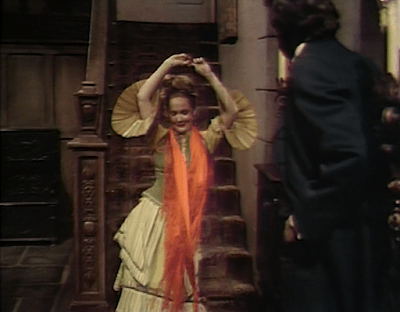
Episode 882: The show must go on. That’s the one and only rule there is.

Many fantastic tales dwell on a sense that dreams have a great power in the world, and so their characters are often afraid of falling asleep. Dark Shadows has several times referenced Edgar Allan Poe, who explored that fear in stories like “The Premature Burial,” “The Tell-Tale Heart,” and “The Man of the Crowd.” The show brought up another writer of fantastic tales preoccupied with the fear of sleep in #808. Aristide, henchman of sorcerer Count Petofi, threatened an enemy of Petofi’s with “the mysterious shadow he can cast, the shadow that isn’t your own that follows you.” That was a reference to George MacDonald’s 1858 novel Phantastes, in which a man named Anodos is plagued by a shadow that moves about on its own, following him and blighting his existence. Not only does Anodos fear sleep from time to time in Phantastes, but the main theme of MacDonald’s other very popular novel, 1895’s Lilith, is Mr Vane’s long refusal to sleep and the great battle he must wage in the dream-world when he finally does allow himself to nod off.

Aristide’s threat suggested that the show was about to give us a story based on Anodos and the autonomous shadow. Aristide is dead now, and Petofi is running out of story, so that isn’t going to happen, at least not in the segment of Dark Shadows set in the year 1897. But today we do get a little bit of George MacDonald in the form of a battle against sleep. Petofi is casting a spell over himself and handsome young rake Quentin Collins. If Quentin loses conscious control of his mind for even a moment, he and Petofi will evacuate their respective bodies and be re-embodied as each other. Petofi will then transport himself, in Quentin’s body, to the year 1969. Quentin will be left behind in 1897, occupying Petofi’s aging form and waiting helplessly for Petofi’s mortal enemies to come and kill him, thinking they are taking their long-delayed revenge.

By the time Quentin finds out what’s going on, it is the wee hours of the morning, after he hasn’t slept for a couple of nights. His friends, Cockney showgirl/ mentalist Pansy Faye and time-traveler/ recovering vampire Barnabas Collins, keep marching him around the drawing room of the great house of Collinwood in an effort to keep him awake. They don’t brew up any coffee, strangely enough. But Barnabas does call on wicked witch Angelique and appeals to her to use her powers to put some kind of barrier between Quentin and Petofi.

Angelique tells Barnabas that she is reluctant to help Quentin because she is upset that he wants to go to New York and look for a woman named Amanda Harris. She had wanted Quentin to fall in love with her, and is jealous that he chose Amanda instead. Barnabas points out that if she doesn’t help Quentin, he won’t exist in the form that either she or Amanda knew. Angelique explains that she has a reason for her attitude:

Before I came here this time, I was in the everlasting pits of Hell, where other creatures of my kind live. Only, my stay here on Earth made me dissatisfied with my life there. I longed to come back here… To Earth, to become a human being. I begged my master for the chance.

Finally, he gave it to me on one condition and one condition only… That I make one man fall in love with me, without any use of supernatural spells or powers. One man, one chance. That’s what I was granted.

Since Quentin is the one man who represented Angelique’s one chance, letting him go to Amanda might mean that Angelique has to go back down. My favorite part of her speech is “Only, my stay here on Earth made me dissatisfied with my life there.” Sure, she could have been happy in the everlasting pits of Hell, as one is, but how ya gonna keep ’em down on the farm after they’ve seen Pa-ree. Or, since Angelique’s sojourns in the upper world have all brought her to Collinsport, after they’ve had the lobster roll at the Blue Whale.

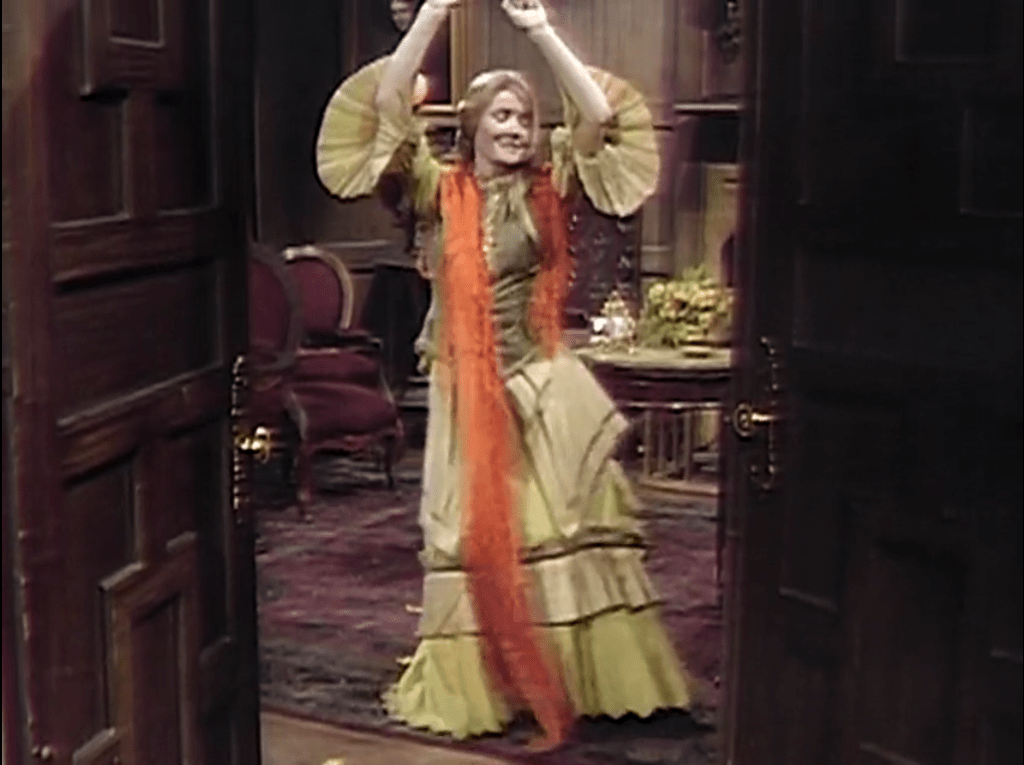
While Barnabas is talking with Angelique, Pansy is on Quentin duty. She decides to keep him awake by compelling him to join in a performance of her song. A record of this song, performed by Nancy Barrett and David Selby, hit the stores the very day this episode was first broadcast, so this is product placement. But Pansy is doing exactly what she would do in this situation, Quentin is reacting just as he would react, and it is a charming moment.

The musical number is preceded by Pansy making what literary critics call a programmatic statement. “Feel like it or not, you gotta do it, the show must go on. That’s the one and only rule there is, love. So let’s have a bright chorus from that new team, Pansy Faye and Quentin Collins.” Pansy is not only a good pal and a gifted psychic, she is an accomplished scientist. She has indeed stated the complete physics, metaphysics, and every other operating principle of the universe of Dark Shadows when she says that “The show must go on.”

Angelique and Barnabas enter. Angelique insists on some time alone with Quentin. He says that once he gets to New York he most definitely will be looking for Amanda and that he has no interest in a relationship with Angelique. She looks away from him and talks herself into believing it will be OK if he falls in love with her after Amanda “has ceased to exist.” Longtime viewers can be fairly sure this means that Angelique is planning to murder Amanda, but at the moment the important thing is to get Angelique involved in helping Quentin against Petofi.

Angelique opens the door to the foyer, where we catch a glimpse of Nancy Barrett and Jonathan Frid doing a really marvelous mime depicting “intense conversation.” It’s one of those deliberately stagey bits of business that these twentieth century New York actors do so well.
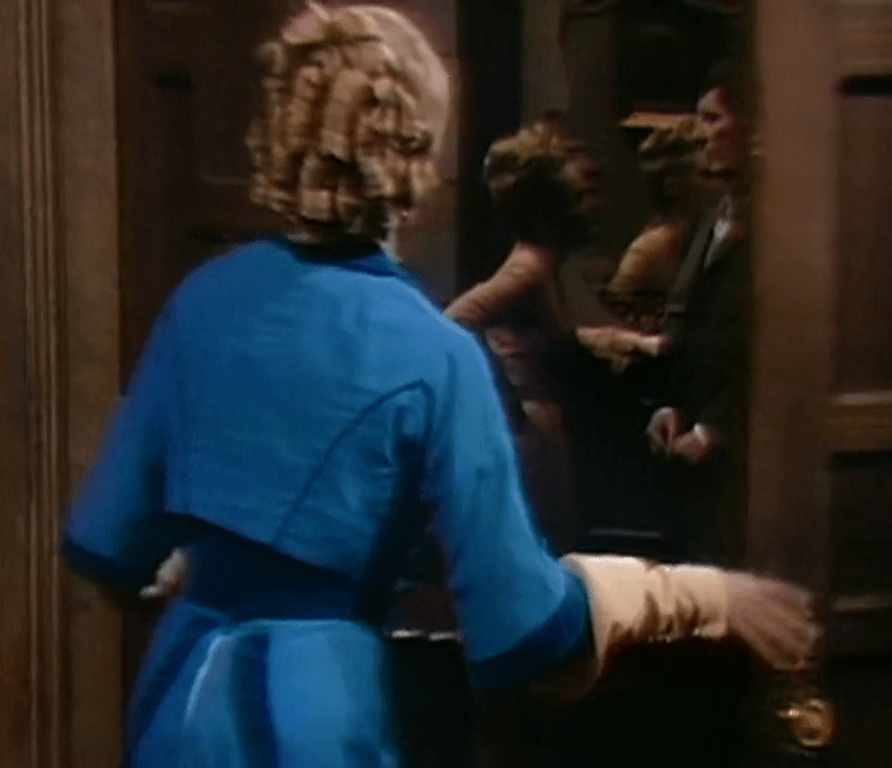
Angelique opens the door on a silent “conversation.”

Angelique stares into the fire and tries to project psychic power Petofi-ward. We get a process shot simultaneously depicting Angelique in the drawing room and Petofi in his lair. The shot is not very successful, and Angelique explains that her efforts aren’t working either. She says that Petofi is in so deep a trance that she cannot reach him as she has done before.

Petofi’s surroundings are so heavily decorated that this shot just looks cluttered to me. I suppose having Petofi low in the shot and behind the flames is meant to remind us of Angelique’s old neighborhood, but the visual metaphor is spoiled by the cruddy 1960s TV color palette.
In black and white, as most viewers would have seen it in 1969, the shot has different problems- while the more abstract visual style does make the Petofi-as-Satan metaphor legible, it is less clear which shapes are in Angelique’s space and which are in Petofi’s.

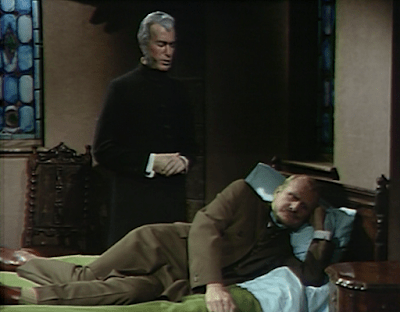
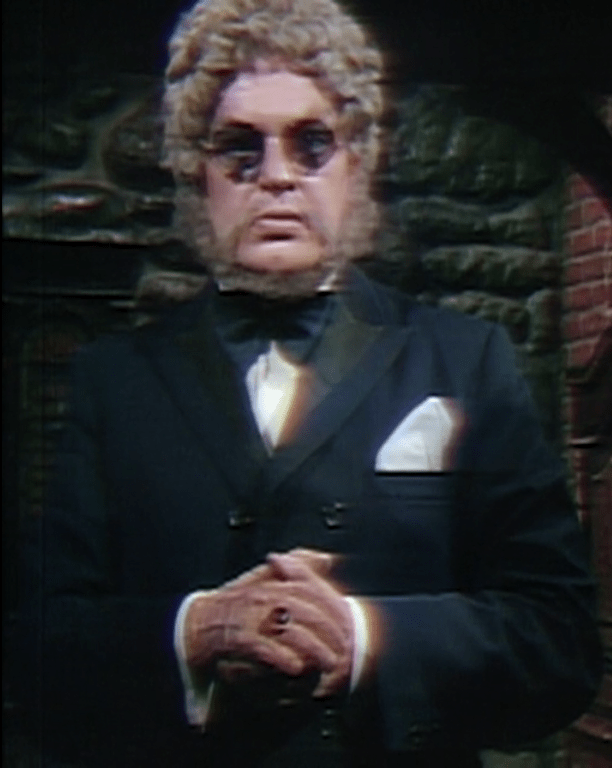
Pansy, eavesdropping from the foyer, hears Angelique say that she will need to have something Petofi is wearing right now, something still warm from contact with him, in order to reach him with her powers. Pansy resolves to provide this, and she sneaks out. She makes her way to his lair, and is about to undo Petofi’s necktie when he comes out of his trance and tells Pansy she has interfered with his plans once too often. We have flashed to the motionless Petofi several times today, leading us to think that Thayer David was going to collect his fee without having to deliver a line. So it is quite effective when he springs into action.

Episode 873: Charming and exquisitely dangerous

In October 1897, sorcerer Count Petofi has used his magical powers to swap bodies with Quentin Collins. I refer to the villainous Petofi who looks like Quentin as Q-Petofi, and to the forlorn Quentin who looks like Petofi as P-Quentin.

We open with Q-Petofi meditating on a lineup of I Ching wands. He goes into a trance which unlocks a cosmic force that transports him to the great house of Collinwood in 1969. He wanders into the drawing room, finds a newspaper dated 28 October of that year, and starts exulting. Maggie Evans, governess in the great house in the late 60s, hears him and comes downstairs.

As the segment of Dark Shadows set in 1897 winds down, we’ve been thinking of ways they might have moved forward. Some of the possibilities involve splitting the week between episodes set in 1897 and others set in 1969. Maggie has been on the show from episode #1, and has been central to several of the storylines that take place in contemporary dress. The last of these stories before the move to 1897 centered on Quentin’s malevolent ghost haunting Collinwood and making it impossible for anyone to live there. In the course of that, he appeared to Maggie several times. In #682, Maggie had a dream in which Quentin’s ghost strangled her to death. Though the events we have seen in 1897 have changed the future, we saw in #839 that the 1960s characters remember Quentin’s haunting. So when Maggie is on her way to meet someone who is to all outward appearances Quentin, we have a hint that a story might be brewing in which Q-Petofi finds himself carrying the can for all of the horrors Quentin’s ghost wrought between December 1968 and September 1969.

Alas, it is not to be. By the time Maggie reaches the drawing room, Q-Petofi has vanished. A few moments after he left 1897, maidservant Beth scattered the wands and brought him back. He is furious when he comes to, and she explains that she had to do it. The magical portrait that keeps Quentin, and presumably also Q-Petofi, from becoming a werewolf is not in the suitcase Q-Petofi gave her earlier in the evening to bury. Q-Petofi has been in possession of Quentin’s body and of his portrait for weeks, and he has vast powers of sorcery, so you’d think he would have hidden the portrait long before. His magic powers would seem to give him the ability to do anything at all to hide it. My favorite idea is that he would impose onto Quentin’s portrait an exact copy of the portrait that hangs above the mantel in the drawing room of the great house and hang it in its place, so that it would be hidden in plain sight for years to come.

Besides, if Q-Petofi was going to bury the portrait surely he would at least have put it in something airtight and made of metal, not a wooden suitcase that doesn’t close all the way and that will likely rot to dust in a year or two. Apparently he isn’t as big on long-term plans as he led us to believe when he claimed he was working on a design to become the ruler of the cosmos.

Q-Petofi orders Beth to bring Pansy Faye, a deceased Cockney showgirl/ mentalist who has for some time been inhabiting the body once occupied by the stunningly dreary Charity Trask, to Quentin’s room at Collinwood. He demands information which she refuses to give. She storms out.

Pansy has a dream in which she and Quentin dance in the drawing room of Collinwood while a specially recorded version of her song, I Wanna Dance for You, featuring the voices of Nancy Barrett and David Selby, plays in the background. Colors flare on the screen while we hear them sing. Miss Barrett was an excellent singer, Mr Selby an adequate one. He does speak a few of his lines, which damages the rhythm of the song, and the flaring colors often obscure the actors completely. Mr Selby and Miss Barrett are so lovable that we very much want to overlook these flaws in the number’s conception.

The dream ends with Quentin turning into Petofi and laughing evilly at Pansy. She awakes in horror. She has known for some days that Q-Petofi isn’t Quentin, and she knows enough about Petofi that it is strange she hasn’t already figured out that he is the one hiding inside his body. But when she sits up with a gasp, we know that she has finally put it all together.

Time-traveler Barnabas Collins, a recovering vampire, meets Q-Petofi in the drawing room at Collinwood. Q-Petofi is convinced that Barnabas stole the portrait of Quentin, and is very aggressive about pressing his suspicions. Barnabas has been playing dumb ever since his vampirism went into remission, but after a couple of minutes of Q-Petofi’s hectoring he addresses him as “Count Petofi.” When Barnabas cannot tell him what he wants to hear, Q-Petofi declares that he will restore the vampire curse to its full potency. He touches Barnabas’ forehead with the right hand in which his powers are concentrated. Barnabas squeezes his eyes shut for a moment, then opens them with a look of triumph. He asks Q-Petofi what has become of his powers.

The rest of the episode revolves around yet another possessed person. Kitty Soames, a young American woman who is the dowager countess of Hampshire, is also Josette DuPrés, who plunged to her death from the cliff at Widow’s Hill 101 years before. Barnabas was supposed to marry Josette at one point, and he has been obsessed with recreating her ever since.

In May and June of 1967, when the show was set in the present, Barnabas abducted Maggie and tried to brainwash her into becoming Josette. In those days, the show was ambiguous about why Barnabas picked Maggie. Strange and troubled boy David Collins was an intimate friend of Josette’s ghost, and when he saw Maggie in Josette’s dress in #240 and #241, he thought she was Josette, looking just as she always did. Indeed, Miss Scott had played the ghost a few times, always behind a veil. When Barnabas was about to give up on Maggie in #260 he very earnestly told her “But you are Josette!” Yet after Maggie escaped, he picked another girl and planned to repeat the experiment with her, explaining to his sorely-bedraggled blood thrall Willie in #274 that all you have to do is “Take the right individual, place her under the proper conditions and circumstances, apply the required pressure, and a new personality is created.”

But when the show made its first trip back in time, visiting the 1790s from November 1967 to March 1968, Kathryn Leigh Scott played Josette. That was a bold move. Longtime viewers were left with the uncomfortable feeling that Barnabas may have had a point when he devised the horrifying program of torture that made the show so terribly bleak for several weeks. When we see Miss Scott playing Kitty, who really is Josette and really does have to accept that fact, longtime viewers can only squirm as they remember Barnabas shoving Maggie into his old coffin and later walking down the long gray corridors of his basement on his way to the prison cell where he was going to murder her. We’ve since come to know Barnabas as an endearingly ineffectual comic villain, but it is a stretch to remind us of him as he was in those grim days and ask us to concede that he was in any sense right.

Kitty confronts Barnabas at Collinwood and accuses him of orchestrating her Josettifying psychosis. He denies that he is responsible, and claims to know that Josette’s spirit lives in her and that she ought to yield to it. When she asks how he knows, he makes up a story about being a boy in England, falling in love with a portrait of Josette, and reading her diaries. She is unconvinced.

Later, Josette goes to P-Quentin in Petofi’s old squat, the abandoned mill on the North Road. She believes he is Petofi, and asks him to use his power to resolve her identity crisis. He tries to explain that he only looks like Petofi, and has none of his power, but she refuses to believe him. Having nothing to lose, he decides to play along. He tells the right hand to tell Kitty the truth about herself, and touches her forehead. She suddenly realizes that she is both Josette and Kitty. P-Quentin just as suddenly realizes that Petofi’s power has returned to the body in which he is now an unwilling tenant.

Kitty/ Josette keeps telling P-Quentin that she remembers what he was able to do with his right hand when he was staying with her and her late husband in England a few years before. This is a pretty bad continuity error. For eight weeks from #778, the most dynamic story on the show centered on the fact that Petofi’s hand was cut off in 1797 and kept in a box by a Romani tribe for the hundred years since, until broad ethnic stereotype Magda Rákóczi stole it in an attempt to lift the werewolf curse from Quentin. It was only in #815, in August, that Petofi reattached his hand and with it regained the bulk of his power. Granted, #815 is eleven and a half weeks ago, but the show now takes so little time to onboard new viewers by recapping that the writers are clearly counting on the audience to have a great deal of information about the story so far in their heads. As such, it is very surprising that they would break from established continuity on such a major point of the recent months.

Episode 860: I just say things

Edward Collins isn’t what he seems. His stuffy manner is real enough, as are his kind impulses when he sees people in distress. But he allows those who meet him to believe that he is the heir to the vast Collins family fortune, which in fact belongs in its entirety to his sister Judith. Judith is currently an inmate in a mental hospital. During her absence, her husband, the odious Gregory Trask, exercises control of all the family’s assets. Edward hopes to get out from under Trask’s thumb by marrying the dowager countess of Hampshire, a young American woman named Kitty Soames. He befriended Kitty while a houseguest of the late Earl’s, and now that she is widowed and is his guest at the great house of Collinwood he sees an opportunity to take over the Hampshire interests.

Kitty isn’t what she seems. The Earl was bankrupt when he died. He had lost all his wealth and been driven to suicide by sorcerer Count Petofi. Kitty wrote a letter to her mother the other day saying that unless she marries Edward and becomes the mistress of Collinwood she didn’t think she could raise train fare from central Maine to her home in Pennsylvania. Nor is this all. If Kitty were simply without funds, she and Edward would be on an even footing. But she is not what she seems in a metaphysical sense as well as a financial one. She is intermittently possessed by the ghost of the late Josette Collins. Regular viewers have reason to believe that she is Josette’s reincarnation, and that the fits of possession are part of the process by which Josette is reuniting her spirit with her body. But the characters don’t know what we know. As far as they are concerned, Kitty seems to be a plain lunatic.

At rise, Edward catches Kitty in his brother Quentin’s room. She is rummaging through an armoire, apparently looking for something. He asks her what she is doing, and she feigns one of her fits. Kitty is not nearly as good an actress as Kathryn Leigh Scott; she doesn’t fool us for a minute. But Edward believes her. He gently escorts her out of the room. As they leave, we see a face peering at them from the shadows. It is Quentin’s face.

Downstairs, we hear Kitty’s thoughts as she takes satisfaction in having fooled Edward into thinking she was having a fit. Mental health professionals often talk about how people learn to use the resources they have, so that patients who carry diagnoses of major disturbances will sometimes find ways to exaggerate their symptoms for effect. It’s true that psychotic episodes are not usually an asset in the husband-hunting business, but everyone in the segment of Dark Shadows set in 1897 has some issue or other, and Edward really does have a soft spot for mentally ill women (unless they are married to Quentin, but that’s another thing altogether.) So Kitty may as well play up her particular case of dissociative identity disorder.

Kitty was in Quentin’s room trying to steal a portrait of him. She was doing this from her fear of Petofi, whom she believed to have ordered her to bring him the portrait before 9 PM lest he use his magical powers and make her vanish. It is almost that time now, and she has no idea how to find the portrait, let alone get it to him before the deadline. While she is worrying about this situation, a woman named Angelique enters.

Angelique isn’t what she seems. She is one of Quentin’s fiancées, and Edward takes her to be an innocent woman, about 30 years old, who has been hard done by in the course of the supernatural doings of the last several months. In fact, she is a wicked witch who wrought immense destruction the first time she was at Collinwood, in the 1790s, and again the second time, in 1968. She has traveled back in time to 1897, and has been one of the most powerful participants in all of the strange goings-on.

Kitty tells Angelique that she saw Petofi in the vacant rectory on Pine Road, and that he told her the woman who had been squatting there vanished into thin air before his eyes. At this, Angelique turns and rushes off to investigate. It dawns on Kitty that Angelique knows more than she is saying. We cut to the drawing room, where Edward is bracing for a conversation with Quentin.

Quentin isn’t what he seems. In fact, he isn’t Quentin at all. Petofi forcibly swapped bodies with him a few days ago. It is Petofi, using Quentin’s body as a disguise, who confronts Edward and demands to know what he and Kitty were doing in the room. I refer to this form of Petofi as Q-Petofi, and the Quentin who looks like Petofi as P-Quentin.

Q-Petofi confronts Edward. Screenshot by Dark Shadows Before I Die.

Edward tells Q-Petofi that Kitty had had a “seizure.” Q-Petofi expresses skepticism about this claim. He proceeds to tell Edward that Kitty’s late husband died in poverty, shortly after being released from prison for a jewel theft. Edward is thunderstruck. He calls the story a lie, and forbids Q-Petofi from repeating it to anyone.

Kitty goes to the village of Collinsport, and pays a visit to The Blue Whale, the local tavern. She wants to see the entertainer, Miss Pansy Faye.

Pansy isn’t what she seems. She has met the Collinses twice. Miss Charity Trask, daughter of Gregory and enforcer in his operation, came to the great house in #727 and took up residence when her father married Judith. Pansy Faye, mentalist and Cockney showgirl, came to the estate in #771 as the coldly cynical fiancée of the childlike Carl Collins. Pansy was killed the night she arrived. A few weeks later, Pansy started to take possession of Charity, and in #819 Petofi erased Charity’s personality altogether and gave her body over to Pansy.

When Kitty enters, Pansy is alone in the bar. She is picking out her theme song on the piano. When Petofi was in the process of switching bodies with Quentin, Quentin was with Pansy in this room. Petofi took control of him briefly and played the same song on this piano. He played it very impressively.

Kitty is desperate to find out what is happening to her, and she knows that Pansy has powers. Once Pansy assures her that she doesn’t work for Count Petofi, Kitty offers her a diamond-encrusted brooch in return for information. Pansy is offended. She says that she will take a gift in return for her services after she has rendered them, but that she does not accept payment in advance. She tells Kitty that there is one way to find out what is happening to her, which is to have a séance. Kitty gets up to leave, and Pansy presses the brooch on her.

The diamond brooch is a puzzle. Perhaps Kitty was lying to her mother when she said that she couldn’t buy a train ticket to Pennsylvania? Or perhaps the brooch is part of the late Earl’s ill-gotten gains, and Kitty doesn’t want to show it to anyone more reputable than Pansy.

Nancy Barrett’s approach to all her roles on Dark Shadows was to throw herself completely into whatever the character was doing at any given moment. That isn’t to say that her performances lacked nuance or that she didn’t support her scene partners, but that her method was to take her part from the outside in, letting the action supply the motivation. As Kitty, Miss Scott has opportunities to take this same approach. But in Kitty and Pansy’s scene in the Blue Whale, she deliberately lets Miss Barrett drive the action. Since Pansy has already completed a process of possession and transformation like that into which Kitty is now entering, Miss Scott can convey a great deal of information about Kitty’s state of mind by giving rather subtle reactions to Pansy’s behavior.

Back at Collinwood, Edward and Q-Petofi are drinking. Edward shakes his head at his brother’s ability alternately to enrage him and charm him. Q-Petofi asks him to be the best man at his wedding to Angelique; Edward agrees at once. Angelique enters, and Edward exits.

Angelique says that she doesn’t want to get married after all. Q-Petofi insists they go ahead. She points out that it was her idea, and he was extremely reluctant to agree to it. This is true- the engagement was part of Angelique’s price for invoking the power of Satan to break spells Petofi had cast on Edward and his son Jamison. While Q-Petofi has managed to copy Quentin’s behavior towards Edward almost exactly, his behavior towards Angelique has been radically different than was Quentin’s. We don’t know what Angelique has made of this.

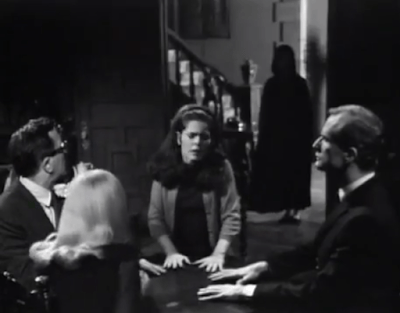
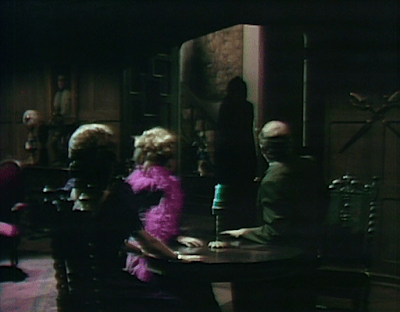
Edward finds Kitty and Pansy preparing the séance. After an initial protest, he declares he will join them. It ends with a visual quote from Dark Shadows‘ first séance, back in #170. As in that episode, a hooded figure appears in the doorway.

The hooded figure in #170 turned out to be undead blonde fire witch Laura Murdoch Collins. Another iteration of Laura was on the show as Edward’s estranged wife in April and May. It seems unlikely she is coming back, so longtime viewers are in suspense as to the significance of the allusion.

The hooded figure today is Natalie Norwick, making the last of her seven appearances as an uncredited stand-in on Dark Shadows. Norwick was in many plays on Broadway, as the lead in more than one, appeared in three feature films, and worked steadily in television from 1945 until the mid 1960s. She retired from acting in 1982, returning to the Broadway stage as understudy to her friend Julie Harris in 145 performances of The Gin Game from 1997 and 1998 when she was in her mid-70s. When Harris had a fall in 1999, Norwick took over the part, playing it in Florida and Washington, DC. She was chiefly based in Los Angeles in the late 1960s; perhaps she took the stand-in work to pay some bills during visits back east.

Norwick is best remembered for a single supporting performance on television in 1966. She appeared in “The Conscience of the King,” an episode of the original Star Trek, as Martha Leighton, the wife of Captain Kirk’s troubled friend Tom. She didn’t get much screen time, but she made the most of it. After Tom is murdered, she plays Martha’s understated reaction with a quietness that startles you no matter how many times you’ve seen it. Norwick is another of the significant talents one wishes Dark Shadows had found more to do with.

Episode 855: The winds of change

The Point of Return

Barnabas Collins went into a trance at the end of February 1969 and came to in March 1897, a time when he was a vampire. Barnabas took the audience with him, so that Dark Shadows has been a costume drama set in 1897 ever since. We’ve had a few glimpses of 1969- we can see that time is passing there, that twelve year old David Collins has been saved from death, that the ghosts of rakish libertine Quentin Collins and maidservant Beth Chavez have stopped haunting the great house of Collinwood, and that Barnabas’ physical body has vanished, leaving him no avenue of return to the 1960s. We’ve also had indications at several points that the show was about to put the 1897 segment into its climactic crisis, each of which was followed by a restart of that segment. Some of those false signs probably reflected long-range plans that were abandoned when they saw how popular 1897 was.

Now, they are in a position when they can go back to 1969 whenever they wish. There are only a few unresolved story points in 1897. Most of those can be wrapped up quickly, and the rest can be forgotten. If they wanted to, they could write a single slam-bang episode in which the evil Gregory Trask is forced to accept the annulment of his marriage to Judith Collins and to relinquish control of Collinwood, the family is persuaded that Barnabas never really was a vampire after all, and Kitty Soames, the dowager countess of Hampshire, turns into Barnabas’ lost love Josette and finds a way to leave him that will make him even more miserable than he already is. Sorcerer Count Petofi might be left watching helplessly as Barnabas, his friend Julia Hoffman, and the living Quentin all escape into the future. We could then assume that the rest of the characters just toddled off and led quiet lives.

They could equally well take another tack on their way back to contemporary dress. Barnabas and Julia came to 1897 separately; there is no reason why they, or any other characters, should have to go to 1969 together. Today, Petofi is performing some kind of mumbo-jumbo that is supposed to lead to a body swap that will cause him to trade forms with Quentin. After that, he is confident he will travel to 1969 and be safe from his foes, the Rroma people. He seems to be succeeding. So perhaps a Petofi who looks and sounds like Quentin will appear in 1969, in a Collinwood based on the events that have taken place so far in 1897.

In that pocket universe, Collinwood would be known as Traskwood. Its owner in 1969 would be Trask’s son by a subsequent marriage. Call him Gregory, Junior. It would be unclear at first what happened to Judith and to her presumptive heir, her twelve year old nephew Jamison. The revelation of their fates could set us up for some big twists and the introduction of new characters with familiar faces.

Since Gregory, Junior would be in his sixties, he could have a couple of adult children who would carry on some story points. Gregory III could be played by Jerry Lacy without old age makeup, and could be a morally ambiguous character who might emerge as a protagonist and would certainly become prominent in the pages of the fan magazines. None of the Trasks would have any legal obligation to let Quentin stay in any of their houses or to work for any of their businesses, nor would any surviving Collinses. Moreover, everyone in the area would know full well that there used to be a vampire on the estate named Barnabas Collins, and no one would ever have heard of Julia.

Petofi begins his incantation. Screenshot by Dark Shadows Before I Die.

If the show goes that direction, we could spend half of each week with Petofi-as-Quentin while he makes a place for himself in that pocket universe version of 1969, while we would spend the other half with Barnabas and perhaps Julia back in 1897, where they are in an uneasy alliance with wicked witch Angelique as they try to set history right. Kitty’s Josettification would threaten to destroy this alliance, since Barnabas is obsessed with his love for Josette and Angelique is equally obsessed with her hatred for her.

The body-swap theme of today’s episode, along with the emphasis on the procedure Petofi is following, will remind longtime viewers of The Experiment, a theme that ran from April to May 1968. Barnabas and Julia built a Frankenstein’s monster with the intention of killing Barnabas and bringing him to life again in the new body. Some viewers may have wondered if Jonathan Frid was actually going to leave the show, and if the actor playing the monster was going to take over the role of Barnabas.

This time a larger fraction of the viewers are likely to think the transfer might work, since it would not require a popular star to leave the show. On the contrary, casting David Selby as Petofi in an altered twentieth century would give him the chance to wear up-to-date clothing, have magical powers, inflict cruel punishments on people who get in his way, run con games, hint at an ambiguous sexual orientation, and generally have a wonderful time. Since Mr Selby had by this point become the pin-up of a huge percentage of America’s teenaged and preteen girls, that sounds like a recipe for sky-high ratings. Meanwhile, casting Thayer David as a Quentin estranged from his body and his social environment would present an expert character actor with a challenge worthy of his skills.

It might sound like it would be too confusing to intercut between a parallel version of 1969 and a continuation of 1897, but the show will try almost exactly the same tactic a couple of years from now, as they set up for the storyline that carries the series through its final nine weeks. That closing bit is not widely regarded as one of the better phases of Dark Shadows, but the intercutting timelines that lead to it are an intriguing gambit. Maybe the idea for it came when they were trying to figure out how to get from 1897 back to 1969, in which case it is possible that the scenario I have outlined above may be very much like what the writers had in mind at some point in the development of the story.

Corridors of Trial and Error

We do get a few hints today about what we might see in the 1897 half of the show if it does split. Broad ethnic stereotype Magda Rákóczi shows up for the first time since #834, before Julia came to 1897. We had begun to fear we wouldn’t see her again. It’s good to have her back, but since Magda is also played by Grayson Hall, it raises the possibility that Julia might go away for a long time. Maybe the action will be split between 1897 and 1969 for some months, and during those months Julia will be in 1969, running her hospital, entirely unaware that there ever was a Barnabas Collins.

Beth is a servant of Petofi’s now, and she spends the episode bickering with her colleague Aristide. It turns out that she still has feelings for Quentin. At the end, she runs out of Petofi’s lair to try to help Quentin. This suggests that Beth’s conflicted loyalties will be a source of drama. Aristide shouts after her not to go, then says that “You’ll ruin everything.” He delivers this line in such a mild tone that the resulting laugh must have been intentional. This raises the possibility of Aristide emerging as a source of laughs. In the hands of actor Michael Stroka, that is a distinct possibility.

Quentin rambles into the Blue Whale, the tavern in the village of Collinsport. It’s after hours, and the only person in the barroom to tell him to stop knocking on the door is cabaret performer Pansy Faye, whose body Quentin first met when it was occupied by Trask’s daughter Charity. He still calls her Charity, which she overlooks because she has the hots for him. Pansy lets Quentin in, and invites him to her place.

Charity lived at Collinwood with her father, and after Pansy took over she stayed on there for some time. The other day she talked about wanting to leave Collinwood and go “home,” but it was not at all clear what that meant. Her invitation to Quentin is the first time she explicitly says that she has her own apartment now. Perhaps, if we stay in 1897, we will see that apartment. Maybe when Thayer David takes over the part of Quentin, Pansy’s psychic gifts will enable her to recognize who he really is, and she will take him in. In those days, of course, a man and a woman would have to get married to rent a lodging, so presumably that would have involved a wedding. Since Quentin would appear to be Petofi, Pansy would thereby become a countess, Kitty’s equal in rank. It already makes Kitty exceedingly uncomfortable to be around Pansy, so that would be an occasion for a great deal of comedy. Moreover, any viewer who saw that both women had the same title and both were involved in supernatural changes of personality would be convinced that the writers had planned that phase of their story all along.

Pansy goes into her act. She sings her song; Quentin is seized with a fit of brio. He gives a little speech addressed to the absent bartender, picks Pansy up, spins her around, kisses her passionately, then sits down at the piano and bangs out the tune of her song. She admires his piano playing and he says that he used to be able to play quite well, before “they” came. Then he suddenly sinks back into his previous depression. He denies that he ever played the piano in his life. We know that it was Petofi who had that moment of brightness, and that Petofi’s mood darkened when he remembered the Rroma who cut his hand off 100 years before. Quentin has no recollection of anything his body does or says when Petofi is using it.

A piano is prominently featured in the drawing room at Collinwood in the 1960s- perhaps there will also be one there when the estate is renamed Traskwood, and when Petofi, as played by David Selby, wangles an invitation to the great house, he will play it. That might set us up for a moment when Quentin returns to his proper body, tries to explain what has happened, and finds that his inability to play the piano marks him as an impostor. You could build a lot of story on that- you might make it look for a while like Quentin could find a home in the Traskwood universe, then show that no, the people back in 1897 have to reset the past before anything can work again.

Episode 846: Advantage of an unfortunate creature

Tim Shaw was a poor put-upon fellow when first we met him in #731, an episode set in April 1897. He had spent his childhood among the pupils imprisoned at Worthington Hall, a dungeon masquerading as a school, and when he was of age the headmaster, the evil Gregory Trask, coerced him into staying on as a teacher. In company with another man, Trask contrived to use Tim as an unwitting instrument in his plot to murder his wife Minerva. Trask’s plan to frame Tim for the murder fell apart, and Tim managed to keep his freedom. Not only that- he stole the legendary Hand of Count Petofi and took it to New York City, where within weeks he used its magical powers to make himself very rich. In August, he returned to Collinsport determined to take revenge on Trask.

Shortly after coming back to his hometown, Tim lost the Hand. (Which, to be clear, was an actual human hand severed from a sorcerer named Count Petofi a century before.) The 150 year old Petofi himself reclaimed it, and reattached it to his wrist. The ill-fortune Tim suffered in his youth left him a weak and cowardly man, who betrayed his only friend when Trask was looking for her. But his good fortune when he was in possession of the Hand has corrupted him much more severely. He used to be kind to children and even risked his life to rescue nine year old Nora Collins when Worthington Hall burned down in #736, but in #816 he violently shook Nora when he found that she had let the box containing the Hand out of her sight. In his pursuit of another gimmick that will enable him to continue getting rich, he has developed a number of schemes, the worst of which do not stop at murder.

This morning, Tim is sitting at a table in the Blue Whale, Collinsport’s tavern. The place isn’t open yet, and Tim does not appear to have any connection with it, so it is simply a mystery how he got in and why he wants to be there. The only other person in the room is sitting at the bar. She is a woman who used to be Trask’s daughter Charity, but who has since been transformed into Cockney showgirl and sometime mentalist Pansy Faye, who died in June.

Pansy’s presence makes some kind of sense, as she works at the tavern doing her act. But returning viewers know that she isn’t still there from the night before. After closing, she went back to the great house of Collinwood, where Trask and she live, and talked with the rakish and profoundly drunk Quentin Collins. After dawn, Pansy followed Quentin from the house to a cave. In the cave, she found a mallet and stake Quentin left behind, and next to them the coffin occupied by vampire Barnabas Collins. She drove the stake into Barnabas’ heart. Now she wants a good stiff drink, and she doesn’t care if she has to pour it herself.

Tim stops Pansy’s attempt to pilfer her employer’s stock, and she tells him that she has destroyed Barnabas. Dollar signs flash in his eyes as he calculates what it is worth to the Collins family to know that their single most embarrassing relative is no longer going to be exsanguinating the locals. Pansy does not want to go back to the great house or even to tell the Collinses what happened, and she steadfastly declares she does not want any of their money. But Tim insists.

At the house, stuffy Edward Collins makes it clear he wants nothing to do with Tim and that he regards Pansy as a lunatic. When Tim makes him listen to the story, Edward dismisses it out of hand. But Edward finally agrees to go to the cave with Tim while Pansy stays in the drawing room.

Edward sees that Pansy was telling the truth, and returns to Collinwood in time to see the aftermath of a strange conversation. Pansy meets Edward’s guest, a young American woman named Kitty Soames who is the widow of the Earl of Hampshire. Pansy’s reaction when the dowager countess introduces herself as “Lady Hampshire” is a very characteristic “Well, la-dee-dah!”

Pansy’s delighted smile and relaxed manner suggest that in Kitty she has recognized a kindred spirit. Returning viewers know she’s onto something- we’ve heard Kitty’s interior monologue as she’s screwed up her courage to try to connect with the rich Collinses. We also know that she and her husband were mixed up with Petofi, who is not an individual who often attracts the innocent. And while she is so quick to deny to Edward that her husband’s suicide had anything to do with business reverses that he assumes she is still imposingly rich, later today we will hear the text of a letter in which she tells her mother that if she doesn’t get something going with Edward, she won’t be able to raise enough money to pay the train fare from Maine to Pennsylvania. So Kitty’s presentation of herself is misleading, and she is not so different from the living Pansy, who was what in the parlance of the 1890s might have been called an adventuress.

In her letter to her mother, Kitty mentions that she first came to the earl’s home as the governess. This circumstance reminds us of two other characters played by the same actress. In the parts of Dark Shadows set in 1969, Kathryn Leigh Scott’s Maggie Evans was the governess at Collinwood. And in the first part of the 1897 segment, she took the role of neurotic intellectual Rachel Drummond, who held the same job in that year.

Rachel was the friend whom Tim betrayed to Trask, and the contrast between her and Kitty reflects the change in Tim. Rachel and Tim were both well-meaning but helpless before Trask. They stood out in the 1897 segment as almost the only characters who weren’t playing an angle of their own. Rachel died in Tim’s arms, in the same room where he would later find the Hand. As his discovery of the Hand opened the way for Tim to become a schemer, so the death of Rachel allowed Miss Scott to return as a someone who could keep up with the quick-witted and merrily vicious characters who make 1897 such a delight. Moreover, we are in suspense as to what sort of person Kitty will turn out to be. She could end up being as innocent as Miss Scott’s previous roles, she could be as detestable as Tim has become, or she could land anywhere in between.

Pansy has a vision of a music box. She vocalizes its tune, and tells Kitty that if she ever receives one like it she must destroy it at once. If she does not, she will die. Kitty is upset by the whole conversation. Pansy tells Kitty that she ought to listen to her, because she has “powers.” “I guess… I didn’t use to have, but now I do.” Pansy often mentions this point, which harks back to her first appearance. In #771, the living Pansy came to Collinwood as the fiancée of the childlike Carl Collins. She was astounded to find that in the spirit-charged atmosphere of the estate her phony “mentalist” act really did conjure up a voice from the supernal realms. In turn, that echoed #400, when Charity’s ancestor, the fanatical Rev’d Mr Trask, was delighted that an exorcism he was performing seemed actually to work.

When Edward comes back, he assures Kitty that Pansy is mad and that he will “deal with her.” Kitty goes upstairs to her room, where she will later find that the music box Pansy described has materialized. This music box has a long history, and in 1967, when the show was set in contemporary times, Barnabas used it to try to convince girls that they were his lost love Josette. Even if Barnabas hadn’t been staked, we wouldn’t suspect him of planting the music box in Kitty’s room- it appears there during the daytime. Viewers who have been with the show from the beginning will remember that Josette’s ghost used to be quite active around Collinwood, and might wonder if she did it.

In the drawing room, Edward talks with Tim and Pansy. He refuses to call Pansy anything other than “Charity Trask”; she is indignant at being live-named, but he won’t relent. He asks her to stay in the house, and offers to provide her with the best possible mental health care. She angrily declares “I! Ain’t! Sick!”

Tim is sure his angle will open up any second now. Screenshot by Dark Shadows Before I Die.

Tim says that he will see to it that Pansy doesn’t tell anyone about Barnabas; Edward doesn’t bother to conceal his contempt for Tim, and makes it clear that he will not pay him for this or any other service he might offer to perform. Pansy tells Tim that it is time for them to leave. She invites Edward to catch her act at the Blue Whale; he says he doesn’t expect to find the time, but that he is sure Tim will come back to Collinwood when he wants something.

When Tim first came back to town, he had a girlfriend named Amanda whom he planned to use in the game he was going to run on Trask. Eventually we learned that this plan was to involve the murders of the former Judith Collins, who is now Trask’s wife, and of Trask himself. Amanda would marry Trask after she had incited him to kill Judith, they would then kill Trask, and Tim would marry Amanda, thereby becoming the master of Collinwood. Amanda was never fully sold on the homicides, and she and Tim now seem to have gone their separate ways. So Tim is left without friends and without a plan. Nor does he seem to understand how dangerous the people he is dealing with truly are. He thinks that he can bluff his way into partnership with the enormously powerful and thoroughly evil Petofi, and is only dimly aware of the other monsters lurking in the area. One might surmise that Tim’s happiest days are firmly behind him.

Episode 822: I’ll give you some spins

For some time after the Rev’d Mr Gregory Trask first appeared in #725, he projected an intense evil that overshadowed everything around him. Trask’s daughter Charity debuted in #727. Charity was Trask’s enforcer, and was herself so intensely joyless that her mere presence could drain the life out of anyone she disapproved of. The Trasks are triumphs of acting by Jerry Lacy and Nancy Barrett, but they are so intense they threaten to overload the show. So even as devoted a fan as my wife, Mrs Acilius, chose to skip many of the Trask-driven episodes on this watch-through.

In #771, inveterate prankster Carl Collins brought Cockney showgirl Pansy Faye home to the estate of Collinwood. At that point, Dark Shadows was quite somber; when Pansy starts singing and dancing, she seems to have wandered in from another universe altogether. Pansy bills herself as a mentalist; when she tries to do her act at Collinwood, an actual message from the supernatural interrupts her, much to her astonishment.

Pansy was killed by a vampire named Dirk Wilkins the very night she arrived at Collinwood, leading us to assume that the note of brightness she represented was at an end. But strangely, she has now returned. Charity and Pansy never met; when Carl was looking for Pansy in #772, he asked Charity if she had seen her, and the sheer idea of the two of them sharing a scene was enough to raise a chuckle. But now they share more than that. Sorcerer Count Petofi has cast a spell causing Pansy’s spirit to take up residence in Charity’s body. Now, Charity’s personality seems to have faded away altogether, and all that’s left is Pansy.

Charity/ Pansy has a scene with Trask that blasts away the excessive tension he once introduced. He keeps demanding that she behave as he is used to seeing Charity behave, and she keeps singing, dancing, and making fun of him. Miss Barrett and Mr Lacy are both highly accomplished comic actors, and this scene is among their finest achievements in that field.

It also includes a serious moment that further confirms Charity really is channeling Pansy, not acting out some kind of delusion. At one point she becomes very still and prophesies the circumstances of Trask’s death. As she completes this pronouncement, she says that it is different now when she speaks of things unseen. It used to be a game, but now she hears another voice and reports what it tells her. This picks up on Pansy’s astonishment at her own success in #771, something Charity could not possibly have known about.

Charity/ Pansy puts the “boom” in Ta-Ra-Boom-De-Yay. Screenshot by Dark Shadows Before I Die.

Episode 819: You’re a bit of all right, you are!

Evil sorcerer Count Petofi tells the disastrously repressed Charity Trask that he will show her a vision of her own death. He’s tried that twice before on other characters, with mixed success, and it doesn’t work at all with Charity. He can’t see the visions he causes her to have; when she describes them to him, he is afraid that she has seen, not her own impending demise, but his. He casts a spell on her and rushes out.

Petofi meets his boyfriend Aristide and takes him on a shopping trip through the cemetery. What he wants with the body he orders Aristide to exhume is not made clear.

The importance of the episode is in the spell Petofi casts on Charity. He effectively murders her. For the rest of the segment of Dark Shadows set in the year 1897, Nancy Barrett will play, not Charity, but Pansy Faye, Cockney showgirl who came to the great estate of Collinwood as the fiancée of the daffy Carl Collins. The show often tends towards the somber, so it is a joyous thing to see Charity/ Pansy enthusiastically shake her moneymaker.

It is sometimes said that Petofi makes Charity believe that she is Pansy, but this is not correct. Charity never met Pansy, and barely knew the late Carl. She certainly never saw Pansy perform on stage. Yet she sings Pansy’s theme song word for word and note for note as she did, and does the dance that went with it just as Pansy did it. She has Pansy’s garish sense of style, her not-very-convincing East London accent, and her memories of Carl. Petofi has caused Pansy to take possession of Charity and to live again through her body, as he has caused David Collins, strange and troubled boy indigenous to the mid-twentieth century, to take possession of his grandfather Jamison Collins. While David’s spirit is killing Jamison’s body, Pansy seems to be having a wonderful time in Charity’s person, certainly far more than Charity ever had herself. As for Charity’s mind, that seems no longer to exist.

Episode 811: A man’s investment in the future

In #797, the ghost of Rroma maiden Julianka appeared and placed a curse on her fellow grievous ethnic stereotype, Magda Rákóczi. Julianka blamed Magda for her death, and decreed that everyone Magda loved would die. Today, Magda is trying to prevent Julianka’s curse from taking the life of her desperately ill infant niece Lenore, daughter of her late sister Jenny. Magda goes to Lenore’s crib in company with Lenore’s father, Quentin Collins. Magda and Quentin try to conjure up Julianka’s ghost to plead for Lenore’s life, but instead they get the ghost of another Rroma woman- Jenny.

Jenny assumes physical form. She picks up Lenore and sings the lullaby “All the Pretty Little Horses.” We’ve heard Jenny sing this almost every time she has been on the show. It appears to be the only song she knows. For his part, Quentin has a phonograph and only one record, which he plays obsessively over and over. When they lived together, their home must have been a pretty grim place, playlist-wise.

Jenny lifts Lenore’s illness, and says that if Quentin looks into his heart he will know what he must do to ensure that Lenore has a bright future. She vanishes, and Quentin mutters dismissively at the idea that his heart will be a source of useful information.

Later, Quentin will have a dream while sleeping in the drawing room at the great house on the estate of Collinwood. Jenny visits and tells him that he must have nothing to do with Lenore and that she must grow up far from Collinwood. So far, dream sequences on Dark Shadows have always represented visits from the supernatural, but this one might be an exception. Jenny did say that the information Quentin needed to help Lenore was already in his heart. He is clearly not the stuff of which good fathers are made, and as Jenny explicitly says in the dream no one has ever been happy at Collinwood. So the advice she gives does seem to be correct. Perhaps this is just Quentin’s own knowledge taking a shape he can recognize.

Quentin goes on dreaming that his brother Edward is choking him. He wakes up to find that Edward is in fact choking him. This might seem like a prophetic dream, but it too might just be a natural expression of Quentin’s own unprocessed knowledge. Edward, because of a magic spell not directly connected with today’s events, is under the mistaken impression that he is a valet formerly in the service of the Earl of Hampshire. Quentin has followed the Collinses’ long-established protocol for dealing with mentally ill family members, and locked Edward up in the room on top of the tower in the great house. He knows this makes Edward miserable, and it is reasonable to suppose that he would expect Edward to express anger about it. Strangulation is Quentin’s own preferred method of expressing anger, especially towards members of his immediate family, so it can’t have been hard for him to see that coming.

Edward’s motivation is not as simple as Quentin’s would be if their positions were reversed. The evil Gregory Trask has been visiting Edward in the tower room, and has told him that Quentin is determined to keep him imprisoned in that room forever. He asks him to kill Quentin. Edward apparently has decided to comply.

Earlier in the episode, Edward had been more punctilious about cooperating with Trask. Trask presented him with a document to sign, promising that by signing it he would secure his freedom. Edward read the document, even after Trask very loudly insisted that it was unnecessary to do so. When Edward saw that it involved making Trask guardian of his son, Edward protested that he had no son. Trask said that this did not matter, but Edward would not be moved. Edward later tells Quentin about this encounter.

The tower room is a re-dress of the set used as the bedroom of strange and troubled boy David Collins in the parts of Dark Shadows set in the 1960s. Today it includes the bed from that set, and we see Edward trying to sleep in it. This is a powerful image for longtime viewers. Louis Edmonds plays Edward in this costume drama segment and David’s father Roger in contemporary dress. Edward is the father of Jamison, who like David Collins is played by David Henesy. Not only has the spell robbed Edward of the memory of Jamison and of his role as a father, it has reduced him to curling up in a bed made for a boy rather than a man.

Edward in the child’s bed. Screenshot by Dark Shadows Before I Die.

Roger was, for the first year of Dark Shadows, a spectacularly bad father. He openly hated David and exploited David’s miseries to try to manipulate him into doing his own criminal dirty work. He was indifferent to the family’s name and the fate of its businesses, would go to any lengths to hide from the consequences of his actions, had killed someone, and was an alcoholic. Edward shares none of these shortcomings. On the contrary, he goes to the opposite extreme. He is as brave as Roger is cowardly and tenderly loves his children, Jamison and Nora. But he is also stuffy, name-proud, and money-grubbing. The contrast with Roger shows these failings, not simply as negatives, but as the overgrowth of the virtues that separate Edward from Roger. Though Louis Edmonds and Jerry Lacy are such accomplished comic actors that Edward’s scenes with Trask are funny enough to be worthy of a staging of the Jeeves and Wooster stories, Edward’s loss of his identity as father of Jamison and Nora is a genuine tragedy.

Quentin is fond of Jamison, and once he learns that his children exist he seems to wish them well. Nonetheless, he shares most of the other vices of early Roger. As Edward shows us what Roger might have been had he had stronger moral fiber, Quentin is Roger with his vices magnified by black magic. When Jenny tells Quentin that he must not raise Lenore, longtime viewers remember Roger as he was when first we knew him, and remember how grim David’s future seemed at that time. It was only after well-meaning governess Vicki became the chief adult influence in his life that we could have hopes for David. So we cannot doubt that Jenny is right.

This is the last of 21 episodes of Dark Shadows directed by executive producer Dan Curtis. When Curtis first took the helm in #457, he had no experience as a director, and it showed. But he learned very quickly. This one looks great and the scenes play very smoothly. He would later direct the feature films House of Dark Shadows and Night of Dark Shadows, as well as six episodes of the 1991 prime time revival of Dark Shadows and many other productions.

Episode 808: The mysterious shadow he can cast

Sorceror Count Petofi has taken possession of twelve year old Jamison Collins. He has also cast a spell on broad ethnic stereotype Magda Rákóczi, compelling her to lead him and his henchman Aristide to the hiding place of vampire Barnabas Collins.

Magda, Jamison/ Petofi, and Aristide. Screenshot by Dark Shadows Before I Die.

Jamison/ Petofi and Aristide are ready to drive a stake through Barnabas’ heart. They open his coffin and find that he is away from home today. Magda does not know where his other hiding place is. Jamison/ Petofi becomes intrigued with Barnabas and decides to search through Magda’s home, the Old House on the estate of Collinwood, for papers that might give him information about Barnabas.

He and Aristide find a book published in 1965. Since the dramatic date is currently 1897, this seems to be a matter of some interest. Jamison/ Petofi calls for Magda, who tells him that Barnabas told her that the book had been brought back in time from the 1960s by “a girl named Vicki.” Barnabas’ utterance of the name “Vicki” in #797 was the first reference to well-meaning governess Victoria Winters in the 1897 segment, and this is the second. Vicki was the main character of the show for its first year, and remained in the cast for over a year after that. That the name “Vicki” would be heard only in rare and trivial echoes is not something longtime viewers would likely have predicted before she was written out of the show last year.

Magda goes on to explain that Barnabas himself traveled back in time from 1969. She has a vague idea that he was trying to save a dying child, and hasn’t the faintest clue how he made this remarkable journey. Jamison/ Petofi says that they will get the rest of the story from Barnabas himself. He also says that if he can travel in time, he will be able to live forever, a proposition which would seem to require further explanation.

Jamison/ Petofi is satisfied Magda is telling them everything she knows, but Aristide keeps making threats. The most intriguing refers to something Petofi might do to her: “You’ve heard of his powers. Hasn’t anyone in your tribe ever told you about the mysterious shadow he can cast? The shadow that isn’t your own that follows you?” Writer Sam Hall was probably familiar with a novel called Phantastes by George MacDonald, a bestseller of the nineteenth century that was influential among English fantasy writers of the first half of the twentieth century. It tells of a character named Anodos, who is tormented by a malicious shadow that moves by itself and won’t leave him alone. So perhaps Hall is planning to mine MacDonald’s works for an upcoming story.

Meanwhile, in the great house on the estate, Charity Trask has a dream. She sees Jamison/ Petofi with a portrait of rakish libertine Quentin Collins. The portrait is identical to the one she saw turn into a picture of a werewolf the night before, and she asks Jamison/ Petofi if he saw the same thing. He laughs, then tells her Quentin is a lost soul.

Quentin shows up. Charity’s father, the evil Gregory Trask, has directed her to marry Quentin, and she has set out to comply with this command. Quentin has never shown the slightest interest in her in their time awake together, and he isn’t much friendlier in this dream. He asks her to do something to lighten his mood. “Can’t you be happy? Can’t you be gay?  Don’t you want to make me happy?” We’ve never seen her happy; as Gregory’s daughter, it’s hard to see how she could be. She has probably never tried to be gay, either, but it would have to be better than marrying Quentin. She does try to make him happy by imitating Cockney showgirl Pansy Faye, whom she never met or saw or heard, but whose spirit has been possessing her off and on for several days now. She sings Pansy’s theme song and does the highly suggestive dance that goes with it, only to find that Quentin has vanished.

Charity turns and finds Quentin embracing and kissing another girl. They are laughing. Quentin tells Charity that, as she can see, she has succeeded in cheering him up, and therefore she should run along. He and the girl then disappear and Magda enters. Magda tells Charity that she should forget Quentin, because he has a terrible secret. She leaves, and Quentin and the other woman reappear, still laughing at Charity.

Charity decides to ask Magda to explain the dream. Before she reaches the Old House, she finds Quentin and the girl from the dream lying on the ground in the woods. Quentin’s clothing is torn and he is unconscious, but he does not appear to be injured. The girl’s face is covered with what in black and white look like slash marks, but in color are obviously purple makeup. She opens her eyes and gasps Quentin’s name. Whether she was calling for Quentin because he was with her when they were attacked or crying out because he is the one who attacked her would not be clear to first time viewers, though returning viewers know that Quentin is a werewolf and will assume he was the attacker.

Episode 804: He is a gem, isn’t he

The evil Count Petofi, a 150 year old sorcerer, has taken possession of twelve year old Jamison Collins and is wreaking havoc in the great house of Collinwood. Due to Petofi’s spells, Jamison’s father Edward thinks he is a valet recently separated from the service of the Earl of Hampshire. Edward’s brother Quentin tries to explain to him what is actually going on, but Edward merely concludes that he is Quentin’s valet now. When Quentin follows the Collinses’ long-established protocol for dealing with mentally ill family members and locks Edward in the tower room, Edward bangs on the door and protests that he won’t be able to do his job if he is locked up. “And I will do it!” he vows.

Charity Trask, disastrously uptight step-daughter of Quentin and Edward’s sister Judith, falls under Petofi’s influence and is possessed by the spirit of Cockney showgirl Pansy Faye. Pansy was on the show briefly in June. The childlike Carl Collins, brother to Judith, Edward, and Quentin, was engaged to marry Pansy before she was killed by vampire Dirk Wilkins. Pansy and Charity never met; when Carl asked Charity if she had seen Pansy, the scene was staged to make it seem absurd that the two women could exist in the same universe. Now, they exist in the same body.

Ta Ra Boom De Ayyyy… Screenshot by Dark Shadows Before I Die.

If Petofi has caused startling changes in Jamison, Edward, and Charity, the change in Quentin is perhaps the most jarring of all. He has been a ghost, a homicidal maniac, a Satanist, a zombie, and a werewolf, but always and everywhere a source of total chaos, who destroys all recognized order and is perfectly at home in the midst of sheer madness. Today, Quentin keeps making earnest attempts to restore everyone to their right minds and reestablish the proper and respectable relations within the household.

First time viewers will immediately catch on that the preteen David Henesy is not the actor who would usually play a 150 year old Hungarian nobleman, and when Nancy Barrett suddenly takes on an East London accent and enters wearing a garish costume and doing a dance with lot of hip shaking and pelvic thrusts, they will know that Charity is turning into someone else. The dialogue in the scenes involving Edward explains what is happening to him. They may not know that Quentin is not supposed to be the defender of the status quo. That information is supplied in two scenes. Charity/ Pansy receives a psychic message from the world beyond telling her that Quentin was involved in the murder of Carl, and she announces this information. Also, Quentin calls for help, and the helper who materializes is his distant cousin, Barnabas Collins the vampire.

At the end of the episode, Barnabas lays hold of Jamison/ Petofi and drags him into the secret passage leading from the drawing room to the west wing. It is usually bad news when a vampire abducts a child and shoves him into a dark space, but David Henesy brings such joy to the role of Jamison/ Petofi that we can hardly doubt that what comes next will be equally fun to watch.

Meanwhile, a painter named Charles Delaware Tate has presented himself. Tate’s first appearance will cause a sinking sensation in longtime viewers; he is played by Roger Davis, a terrible actor who delivers much of his dialogue by shouting while clenching the sphincter muscles in his buttocks, and who routinely assaults the women and children in the cast while on camera. We may have hoped we had seen the last of Mr Davis when his most recent character, Dirk, was destroyed shortly after murdering Pansy. But evidently Pansy’s return in the form of another actress has come at the price of Mr Davis’ return in the guise of another character.

For much of 1968, Mr Davis played a man known variously as Peter Bradford and Jeff Clark. His approach to characterization consisted of shouting “My name is Jeff Clark!” When this technique was played out, he took to shouting “My name is Peter Bradford!” He doesn’t shout today, mercifully. But he does say the name “Charles Delaware Tate” quite a few times.

Today’s story about Tate is potentially interesting. Jamison/ Petofi finds him when he answers the front door. Tate asks to see Jamison Collins; Jamison/ Petofi confirms that despite his appearance, he is indeed the person Tate has come to see. Tate accepts this with a blandness that suggests that he knows he is dealing with a magical personage.

Jamison/ Petofi gives Tate a photograph of Quentin and says that he wants a portrait of him. When Quentin comes to the drawing room and finds Tate sketching, he asks who he is. Again, Quentin adopts a stern tone which suits someone defending the sanctity of private property against an unknown intruder. Tate introduces himself and shows him a handwritten letter which Quentin instantly accepts as the product of his grandmother Edith. He tells Tate that Edith has been dead for some time and that he is not interested in a portrait of himself. Tate says that he has already accepted the commission and the money that Edith sent with it, and so he will rent lodgings in the village of Collinsport and finish the job regardless. Quentin does what viewers have hoped everyone who shared a scene with one of Mr Davis’ characters would do, and throws him out.

The forged letter is a fascinating touch for returning viewers. Petofi made himself welcome as a guest at Collinwood by showing Edward forged papers creating the impression that he shared Edward’s friendship with the Earl of Hampshire. That he has also created papers that Quentin immediately accepts as coming from Edith, who died long before Petofi had any reason to come to Collinwood, suggests that his powers of forgery are very extensive indeed.

Tate not only seems to know that Petofi has magical powers; he also shows an acquaintance with Petofi’s henchman Aristide.* When Tate mentions Aristide, he calls him “Aristeedy,” a sort of pet name with a diminutive suffix. This is probably just a blooper on the part of Mr Davis, but since Petofi is continually telling Aristide how lovely he is and how he is more attractive when he doesn’t speak, it does remind us of the gay subtext that runs through their scenes together. We might suspect that Petofi and Aristide’s sexuality is in one way or another one of the reasons they are connected to Tate.

The script opens all of these questions about Tate. Had he been played by an actor who was capable of depicting depth and highlighting ambiguity, it could have been a lot of fun to speculate about just what their answers might be. In #137, future movie star Frederic Forrest was a featured extra on the dance floor at The Blue Whale tavern; it’s easy to suppose he would have taken a speaking part. So when the show puts Mr Davis in front of us, I like to make the time a little more tolerable by imagining what Forrest might have brought to the role of Tate.

*His name is spelled “Aristede” in the closing credits, but it was “Aristide” in the original scripts.