Episode 541: Creating a living human being

When Dark Shadows began in the summer of 1966, its most intelligent character was also its most dangerous, strange and troubled boy David Collins. David twice came within an inch of committing the perfect murder, first when he sabotaged his father Roger’s car, then when he trapped his governess Vicki in a room in the long-deserted west wing of the great house of Collinwood.

The only story that consistently worked in those days was the relationship between David and Vicki, and that was solely due to actors David Henesy and Alexandra Moltke Isles. While the writers gave them terrible dialogue- at one point having Vicki read aloud to David from a reference book on the geography of Maine- they used their faces, voices, and movements to show us what was going on inside the characters. Mr Henesy always looked like an angry boy who was grimly determined to keep hating his governess even though he couldn’t help but like her, while Mrs Isles always looked like a fearless young woman who was determined to befriend a boy who might make an attempt on her life at any moment. As David relented from his hatred, we could see a friendship budding between them, even if the words were still no good.

The story of Vicki and David had its climactic phase from December 1966 to March 1967, when his mother Laura Murdoch Collins was on the show. Laura was Dark Shadows’ first supernatural menace, an undead fire witch who planned to incinerate herself and David so that she could attain a new life. When David ran from the burning Laura into Vicki’s arms in #191, he chose her and life over Laura and death. She thus became his new mother, and their story was complete.

Since then, the show has found very little for David to do. Yesterday, he was wandering around the house with a tape recorder. He told his stepmother Cassandra that he couldn’t figure out how to play a tape. The preoccupied Cassandra sent him away, and he asked his cousin Carolyn to help him. Carolyn made it clear that all you do is press the button labeled “Play.” Two years ago, David could sabotage a brake cylinder to fail at precisely the spot on the road where it would be likeliest to lead to a fatal crash, but now he can’t grasp the concept of “Press play to listen to the tape”?

Longtime viewers will see a missed opportunity here. Cassandra is a wicked witch, also known as Angelique. In #492, Angelique/ Cassandra cast a spell that caused David to forget some incriminating information about her, so we know that he is subject to her power. Vicki knows a great deal about Angelique/ Cassandra; they could easily give us a series of scenes in which Vicki tries to warn David about his stepmother, but his mind is clouded. Instead, we never see Vicki and David alone together during this phase of the show, and Angelique/ Cassandra rarely does anything more with David than display irritation and order him to go away.

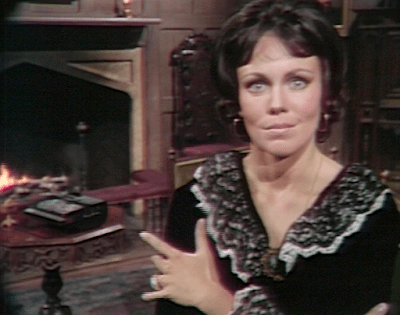
David eventually played the tape for Angelique/ Cassandra. She reacted with great excitement, since it included a message that explained why she failed in her attempt to restore the vampire curse she once placed on David’s distant cousin Barnabas Collins. She sends David away and keeps the tape recorder.

Angelique/ Cassandra won’t let David take the tape recorder back to his room. Screenshot by Dark Shadows Before I Die.

Angelique/ Cassandra informs her supervisor, suave warlock Nicholas, that she can re-vamp Barnabas if she kills Frankenstein’s monster Adam. Fascinated by the idea of an artificially constructed human being, Nicholas loses interest in Barnabas and instructs Angelique/ Cassandra to find out more about Adam.

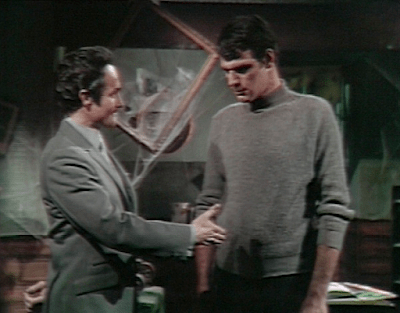
In #532/533, Nicholas met Maggie, The Nicest Girl in Town. Nicholas was obviously smitten with Maggie, putting the lie to his taunting of Angelique/ Cassandra for her ability to feel an emotional attachment to Barnabas and his own claim to be motivated solely by a devotion to evil for its own sake. After he gives Angelique/ Cassandra her orders, Nicholas goes to Maggie’s house. Ostensibly this is to find out if she knows where Adam might be, but she so obviously does not that it is clear he just wants to see her. He asks her about her hospitalized fiancé Joe, admires her late father’s paintings, and offers to buy one of them at a high price and lend it back to her. Maggie seems to be quite charmed by him. Nicholas’ “Evil, be thou my good” schtick can be fun to watch for short periods, but if he is going to be a major character for any length of time he will need a more complex inner life. His attraction to Maggie is a step towards giving him one.

David goes to Barnabas’ house. He tells Barnabas’ friend Julia that at least twice this evening he has listened to a message on a tape recorder that had something to do with Barnabas and Adam, but he can’t remember any of the details. He does remember that Angelique/ Cassandra got excited when he played it for her, but that’s it. If Angelique/ Cassandra had cast a spell on David, his forgetfulness would be understandable. If Vicki and Angelique/ Cassandra were locked in battle for David’s allegiance, it could be dramatic. But as it is, the show has chosen simply to present David as an abject moron, and that is infuriating.

Julia and David go back to the great house, where they find Nicholas and Angelique/ Cassandra with the tape recorder. Nicholas and Angelique/ Cassandra leave, and Julia and David play the tape. It no longer has the original message, but instead has the witches’ sabbath portion of Berlioz’ Symphonie Fantastique. David furrows his brow, then comes up with the bright suggestion that Angelique/ Cassandra, who has been in possession of the tape the entire time, may just possibly be the one who made the change. Again, since we have not seen Angelique/ Cassandra cast a spell to confuse David’s thinking, this incredible stupidity can do nothing but exasperate the audience.

They don’t even have the excuse that the current writing staff doesn’t know that David used to be interesting. The gimmick of replacing important information on a reel-to-reel tape with an audio signature suggestive of the culprit is a callback to #172, when Laura thwarted parapsychologist Dr Peter Guthrie by replacing an audio recording of a séance with the sound of fire crackling. If they can recall that bit, surely they can remember that David used to have a functioning brain.

In the early days of the show, Vicki was on a quest to find out who her parents were and why they left her at a foundling home when she was an infant. In #60, Vicki stumbled upon a portrait Maggie’s father Sam painted twenty years before of a woman who looked just like her. Vicki wondered if this woman, whose name was Betty Hanscombe, might have been her mother or aunt. Sam gave Vicki the painting then, but it is back in Maggie’s house today, and Nicholas picks it up at one point. We don’t get a very good look at it, but you can buy a reproduction of it on canvas for $25.99 plus shipping from someone on Etsy, it looks nice.

Nicholas examines the Betty Hanscombe portrait. Screenshot by Dark Shadows Before I Die.

Episode 539: Child’s play

The wicked witch known variously as Angelique and Cassandra is standing in the drawing room of the great house of Collinwood, thinking evil thoughts. The camera zooms out and we see that her stepson, strange and troubled boy David Collins, is standing next to her. She starts to speak her thoughts out loud, saying “You will pay!” David asks “Who will pay?” Angelique/ Cassandra is startled to discover that David is there, and is flustered when she tries to change the subject. She so often delivers incriminating soliloquys while standing out in the open that the comic effect of this scene must be intentional.

Angelique/ Cassandra oblivious to David’s presence.

David asks Angelique/ Cassandra to help him figure out the correct operation of a tape recorder he received some time ago as a present from permanent houseguest Julia Hoffman. After Angelique/ Cassandra refuses to help, he goes upstairs and finds his cousin, heiress Carolyn Collins Stoddard, emerging from the long-deserted west wing of the house. He asks Carolyn what she was doing in the west wing. She asks him why he thinks she was in the west wing. When he says he saw her coming out of it, she drops her attempt to evade his question and tells him she was looking for some old family photos to show well-meaning governess Vicki. She has enough trouble remembering this story that it must be obvious to David that it is a lie, but he isn’t interested enough to follow it up. He just wants someone to help him figure out which buttons to push on the tape recorder.

On their Dark Shadows Before I Die, John and Christine Scoleri speak for longtime viewers of the show when they say that it is surprising David needs help with the tape recorder. When the show started, David was two years younger and had the mechanical skill to sabotage his father’s car in a very creditable attempt at patricide. All Carolyn has to do to get the tape going is read the label that identifies the play button. This apparent loss of cognitive function is of a piece with David’s massive loss of narrative function. For the first 39 weeks of Dark Shadows, David was the fulcrum on which every story turned, and actor David Henesy had abundant opportunities to show a level of professional skill that would be remarkable in a performer of any age. But he has been receding into the background for a long time now, and his extraordinary dim-wittedness today marks a low point for him.

Once the tape starts playing, Carolyn makes a hasty exit. David listens to a minute or so of Eine Kleine Nachtmusik, hoping it will end and he will hear “something spooky.” His wish is granted when the music abruptly stops, giving way to a voice addressing itself to Julia. The voice rambles about David’s distant cousin Barnabas Collins, saying that if both he and “my creation” live, Barnabas will be all right, but that if “Adam” dies, “Barnabas will be as he was before.” The name “Adam” should mean something to David. He shared a confused and frightening moment with a mysterious man of that name in #495. That man subsequently abducted Carolyn, and is still the object of a police search.

What only Julia, Barnabas, and Barnabas’ servant Willie know is that Adam is a Frankenstein’s monster created in an experiment that freed Barnabas of the effects of the vampire curse that Angelique/ Cassandra placed on him in the 1790s. The voice on the tape is that of Eric Lang, the mad scientist who began the experiment. Minutes before he died of the effects of one of Angelique/ Cassandra’s spells, Lang recorded this message for Julia. The audience has heard this message approximately a gazillion bajillion times, but until now, the only character to have heard it was Adam, and he could make no sense of it.

Angelique/ Cassandra recently made an unsuccessful attempt to renew Barnabas’ curse, and is desperately searching for the obstacle that prevented it from working. Carolyn’s actual task in the west wing was showing Adam to a hiding place there. So Angelique/ Cassandra is now under the same roof with both the information she needs to identify her obstacle and the person she can remove that obstacle by killing. Things are looking bad for Barnabas and for Adam.

While David is upstairs with the tape recorder, Vicki is sobbing in the drawing room. Suave warlock Nicholas, who is staying in the house in the guise of Angelique/ Cassandra’s brother, enters and asks her what’s wrong. She says that she has just learned that Barnabas is dead. His back to her, Nicholas smiles brightly when he first hears this news, then puts on a sad face and turns to her with sympathetic words. In response, Vicki reveals that she knows all about Angelique/ Cassandra and that she has little patience for Nicholas’ pretensions. Carolyn enters and doubts Vicki’s news. Angelique/ Cassandra is the last to enter. She says that she saw Barnabas alive and well after the time when he is supposed to have been dead. Vicki and Carolyn look at each other, and do not see Nicholas’ look of disappointment. They go upstairs, and Nicholas and Angelique/ Cassandra go into the drawing room.

Nicholas scolds Angelique/ Cassandra for her failure. He addresses her as “dear sister.” He suggests she may not hate Barnabas sufficiently to impose a curse on him. When she denies this, he leans to her ear and teasingly asks if she loves him. He threatens to send her back where she came from if she doesn’t re-vamp Barnabas by midnight, and to focus her mind replaces her arm with a fleshless bone.

Director John Weaver was not much of a visual artist, and in his post about the episode on Dark Shadows Every Day Danny Horn analyzes the dismally inept blocking of the scene between Vicki and Nicholas. Danny also has some unkind words for writer Ron Sproat, but I think those are unfair. It’s true the opening scene between Adam and Carolyn goes on too long, David’s helplessness with the tape recorder is dismal, and Vicki and Carolyn’s reaction to Angelique/ Cassandra’s report that Barnabas is still alive doesn’t make sense. That’s a long enough list of flaws that we might fairly classify Weaver and Sproat as the B-team, not on a par with director Lela Swift and writers Sam Hall and Gordon Russell.

But it is genuinely funny when we first see David standing next to Angelique/ Cassandra, David’s questioning of Carolyn is intelligently written, Lang’s message is for once an actual source of suspense, Vicki’s lines to Nicholas as Alexandra Moltke Isles delivers them show the character’s strength, Nicholas’ teasing Angelique/ Cassandra with her alleged love of Barnabas raises a laugh as it makes them sound like a couple of kids, and the final gag with the arm bone is at once goofy enough to keep up the humor in the episode and startling enough to be effective as a touch of horror. All in all, it’s an enjoyable episode, if not one that fans would be tempted to use to turn their friends on to the show.

Episode 528: Old girl

In his post about this episode on Dark Shadows Every Day, Danny Horn remarks on the recapping that permeates the dialogue and reckons it as writer Sam Hall’s critique of the ongoing storylines. That assessment will be familiar to those who, unlike Danny, have been watching the show from the beginning. When Ron Sproat joined the writing staff in October 1966, his first several scripts featured a systematic inventory of the available narrative material, with each plot very explicitly marked as suitable or unsuitable for further development.

In its first year, very little happened on Dark Shadows; now, it has swung to the opposite extreme, and there is a climax at every commercial break. But the result is oddly similar. They don’t take the time to explore the overall situation, so that little seems to be at stake even when a spectacular event takes place. No matter how much happens per minute of screen time, it feels like the pace is slow. We see suave warlock Nicholas in the gazebo on the grounds of the estate of Collinwood summoning his subordinate, the wicked witch known variously as Angelique and Cassandra, and hear him complain that she has spent weeks attempting to do what she should have accomplished in minutes. Thus Hall assures us that the pace will be picking up.

Angelique/ Cassandra comes to the gazebo, to which Nicholas refers as a “ga-ZAY-bo” in a bit of Collinsport English Angelique/ Cassandra herself introduced in #489. There, the two of them quarrel about her dilatory approach. They stand behind columns and look like debaters at podiums.

The debaters. Screenshot by Dark Shadows Every Day.

Danny Horn’s commenter “lakeplacidskater” made an interesting observation about the moment screenshotted above:

Maybe I’m reading too much into the set design, but in one of the photos Angelique and Nicholas are sperated by a statue of a Goddess (I assumed Venus). Wouldn’t it be awesome if it was Venus and that statue between them was to represent Angelique’s love for Barnabas blocking her efforts at villainy? More likely that the shot just looked better composed with the statue in the middle but how awesome if it was meant to be subtle symbolism! 🙂

“lakeplacidskater,” posted 25 February 2015 on Danny Horn, “Episode 528: This Tawdry Affair,” 21 November 2014.*

The statue appears to me to represent not Venus, but a harvest goddess. She is fully clothed, and there is a sack at her feet which seems to be full of grain. That makes a lot less sense than does the suggestion “lakeplacidskater” made. The Collinses derive their wealth from fishing and shipping, not from farming, so it is surprising that they would put a symbol of agriculture in such a prominent place. Perhaps she stands for wealth in general, but not for so much wealth that the family could afford to commission a statue of a sea goddess. And neither a bountiful harvest in particular nor wealth in general is any sort of obstacle between Nicholas and Angelique/ Cassandra. I suppose the visual metaphor might be emphasizing the image of the two of them as debaters, with the goddess serving as moderator.

Nicholas dominates Angelique/ Cassandra thoroughly and rather cruelly. Viewers who remember her from the portion of Dark Shadows set in the late eighteenth century may be taken aback by this. In those days, her power often seemed to be limited only by her own carelessness. That made for something of a shapeless narrative, since no one could oppose her effectively. Not only does Nicholas reduce her to a lowly state today, but he himself bungles a simple task when he sets out to do something nasty to well-meaning governess Vicki. Thus we see that the villains will have their work cut out for them.

Later, Vicki is in bed at her friend Maggie’s house. She has gone there to escape a curse Angelique/ Cassandra has placed that has caused several people to have the same nightmare. Since Maggie was at home when she was the first person to have the nightmare, and Vicki’s boyfriend Peter was sleeping there when he had it, it is hard to understand why Vicki thinks it is a place of safety.

We have several closeups of the face of the clock while Vicki goes to sleep. It’s an Ingraham eight day clock, apparently they wanted to make sure we knew that. When Vicki finally nods off, Angelique/ Cassandra materializes in the room with a jar of rose water that is supposed to make Vicki have the nightmare. Ever since the days when humanoid Phoenix Laura Murdoch Collins was on the show, we’ve been seeing undead witches materialize in people’s bedrooms while they sleep. This time, Maggie walks in and sees Angelique/ Cassandra. She screams at the sight. All of the women in the cast were required to scream frequently, so frequently that fans become connoisseurs of screaming. Kathryn Leigh Scott was one of the better screamers, not far behind Clarice Blackburn, so that makes for a satisfying ending.

*I can’t help but point that when “lakeplacidskater” left her post, all the members of the cast were still alive. Humbert Allen Astredo would die in 2016 and Lara Parker in 2023; Alexandra Moltke Isles, Roger Davis, and Kathryn Leigh Scott are still with us.

Episode 525: Tree in the forest

Beginning in #365, well-meaning governess Vicki Winters spent nineteen weeks in the 1790s. Ever since Vicki brought Dark Shadows back to a contemporary setting in March 1968, the show has been dealing with the consequences of her journey.

Today, we open with a dream sequence. The boyfriend who followed Vicki from the 1790s, a man named Peter, came to the twentieth century with total amnesia and a belligerent personality that kept him from listening when Vicki tried to explain who he was. His dream is about people and events from 1796, and it finally breaks down his insistence that he is someone else. That insistence was never at all interesting- it wasn’t as if his name were Watt Iduno Hu, in which case he and Vicki could at least have done a version of Abbott and Costello’s “Who’s on First?” But now that it is over, there are no obstacles at all between Peter and Vicki, and no reason for either of them to be on the show.

Meanwhile, suave warlock Nicholas Blair has carried a portrait of wicked witch Angelique from the bedroom where he is staying in the great house on the estate of Collinwood down to the drawing room. He makes a tremendous display of effort as he concentrates on the portrait, talks to it in an urgent voice, and makes many movements with his hands, all in an attempt to make contact with Angelique’s spirit so that he can reconstitute her body. Vicki walks in on him as he is doing this, and he breaks off, embarrassed. He finds out that Vicki owns the portrait, and she refuses him permission to borrow it.

Nicholas caught in the act.

Later, Nicholas finds out about Vicki’s visit to the 1790s. He is intrigued that in those days the same witchfinder who has disincorporated Angelique mistook Vicki for a witch and tried to perform an exorcism on her. He decides that the spot on which this rite took place must be the same as that where Angelique’s ashes are now deposited. So he casts a spell on Vicki, causing her to lead him to the place.

Other fansites feature complaints that Nicholas could just have cast a spell on Vicki during their first scene together. In his post about the episode on Dark Shadows Every Day, Danny Horn writes of their first scene that “Nicholas actually has the power to mesmerize Vicki and get her to do whatever he wants, so technically he could just put the whammy on her right now, and tell her to clear the room.” And on Dark Shadows Before I Die, Christine Scoleri wonders “If Blair could make Vicki ‘listen and obey’ so easily, then why didn’t he just make her give him the portrait instead of getting all pissy when she refused to loan it to him?”

That didn’t bother me. When Vicki walked in on Nicholas in the drawing room, he was straining himself to make contact with the spirit of Angelique. He again puts himself deeply into his mumbo-jumbo when he casts his spell on Vicki. So it seemed perfectly reasonable to me that he couldn’t just drop what he was doing with the portrait and go directly into another spell.

The obvious sexual symbolism of the scene in the drawing room reinforces that point. On the Dark Shadows Daybook, Patrick McCray describes the display Nicholas makes while interacting with the painting depicting his putative sister as suggestive of incestuous feelings;* and the awkwardness Humbert Allen Astredo and Alexandra Moltke Isles bring out when Vicki walks in on Nicholas getting all worked up as he stares at a woman’s picture and puts all his energy into imagining her physical presence will likely seem familiar to anyone who has ever had a room-mate. Since Nicholas’ mind is so intensely engaged with the idea of Angelique, it isn’t hard to imagine that he would need time to redirect his attention to Vicki.

*His actual words were “uncomfortably Kentuckian,” but Mrs Acilius was born in Kentucky and is tired of incest jokes about her onetime neighbors. [UPDATE: Patrick points out his own Kentuckian heritage, and protests that his little joke was an irony fondly intended.]

Episode 523: Back to Hell, from whence thee came!

The first episode of Dark Shadows, broadcast on ABC-TV on 27 June 1966, was a moody, atmospheric Gothic drama, characterized above all by its hushed tone. For months afterward, the show was almost an essay on the theme of quietness. Now we come to the second anniversary of that premiere, and quietness is the last thing we hear.

This installment marks the final farewell of the show’s single loudest character, revenant witchfinder the Rev’d Mr Trask. In #519, Trask performed an exorcism on the witch variously known as Angelique Bouchard Collins and Cassandra Blair Collins. The exorcism seemed to be a great success; it ended with Angelique/ Cassandra vanishing into thin air, and she has not been seen since. That might have left someone watching Dark Shadows for the first time with the impression that it is a specifically Christian show and Trask is one of its heroes.

Today, they take steps to correct that impression. A man calling himself Nicholas Blair and claiming to be Angelique/ Cassandra’s brother has turned up on the great estate of Collinwood. In the basement of the Old House on the estate, he finds Trask’s skeleton. He conjures Trask up and interrogates him. Trask declares Nicholas to be a tool of the devil. Regular viewers know that this is something Trask says to all the fellas, but this time he is obviously correct. He goes into the same exorcism rite that produced such spectacular results with Angelique/ Cassandra. Nicholas simply turns around and gives him a sarcastic little round of applause. Nicholas keeps making demands of Trask. Trask takes a cross from under his cloak. Nicholas recoils from that. Trask vanishes, but his skeleton is still missing, suggesting that he has not found peace.

Trask draws his secret weapon. Screenshot by Dark Shadows Before I Die.

That Trask’s exorcism worked on Angelique/ Cassandra but not on Nicholas suggests that it is not a means through which God acts in the world, but is just another magical weapon that can be wielded with greater or lesser effect depending on the skill and strengths those involved. His loyalty to “THE ALMIGHTY!!!” has given Trask enough power to defeat Angelique/ Cassandra, but Nicholas ranks higher than she does in the hierarchy of “THE DE-VILLL!!!,” high enough that Trask’s mumbo-jumbo cannot reach him. The cross has its effect, but with that Trask is setting aside his own efforts and calling directly on the boss. Nicholas is quite certain that he can undo the effects of the exorcism, so for all we know, he might be able to call his own home office for help sufficient to overcome his aversion to the sign of the cross.

The show not only puts Christianity and the spiritual forces of darkness on a par as sources of magical power, they aren’t even the only such sources. Though we don’t hear about any of them today, scientists and doctors Peter Guthrie, Julia Hoffman, Eric Lang, and Timothy Eliot Stokes apparently acquired supernatural abilities along with their advanced degrees. We even know that Guthrie was a professor of psychology at Dartmouth College. So the Dartmouth Department of Psychological and Brian Sciences joins Christianity and diabolism as reservoirs of uncanny might.

In the great house on the estate, heiress Carolyn Collins Stoddard tells Nicholas that Angelique/ Cassandra alienated the Collins family by her dalliance with local attorney Tony Peterson. Nicholas goes to the village of Collinsport and calls on Tony, whom he realizes Angelique/ Cassandra ensorcelled into serving as her cat’s paw. Angelique/ Cassandra put Tony into a trance by having him strike his cigarette lighter; Nicholas achieves the same effect by opening his cigarette case. Tony really needs to stop smoking.

When he first sees Tony, Nicholas is stunned by his resemblance to Trask. They are both played by Jerry Lacy, and Angelique/ Cassandra told him that she chose him because he reminded her of her old acquaintance. We already know that there is a mystical connection between Tony and Trask; Tony was the medium through whom Trask spoke at the séance which led to his return to the world of the living. While he has Tony entranced, Nicholas extracts information from him that only Trask could have known. This suggests a notion of reincarnation that would have reminded viewers of what many of them probably thought Hindus and Buddhists believed, and would thus suggest a syncretistic approach to religion that would represent another step away from the Sunday-morning flavor that the ending of #519 might have left.

We return to the great house. Well-meaning governess Vicki opens the front door and finds her boyfriend, an unpleasant man named Peter who prefers to be called Jeff. With this, a Christian world-view is pushed still further into the background, as a scene featuring Peter/ Jeff is enough to make anyone doubt the existence of a just and loving God.

Vicki and Peter/ Jeff talk about various events that don’t have anything to do with the show. He paws her awkwardly, and his hands dart to her neck as if he were about to strangle her. While he is out of the room for a moment, Trask materializes and tries to warn Vicki that “THE DE-VILLL!!!” is nearby. Before he can tell her that it’s Nicholas she should be worried about, Peter/ Jeff comes back in and starts yelling. At the sight of Peter/ Jeff, Trask wrinkles his nose and fades into nothingness, never to be seen again. Peter/ Jeff probably got a lot of that.

Episode 522: Brother devil

A stranger comes to the great house on the estate of Collinwood and introduces himself as Nicholas Blair, brother of Cassandra Blair Collins. Cassandra’s husband Roger Collins is shocked; Cassandra had never mentioned that she had a brother. Moreover, she has been missing for the last 24 hours, and Roger is convinced something terrible has happened to her. Roger’s distant cousin Barnabas Collins and Dr Julia Hoffman are also shocked, but for a different reason. They know that Cassandra is actually Angelique, a wicked witch who, in the 1790s, turned Barnabas into a vampire. She recently returned to the world of the living when Barnabas’ vampirism went into remission, and she tried to implement a plan to bring it back in full force. When Angelique/ Cassandra went missing, they hoped it meant that she had been defeated. Nicholas’ arrival replaces their hopes with the fear of new battles.

Nicholas at first assumed that Barnabas was Angelique/ Cassandra’s husband, and told him “I should have recognized you anywhere!” This is a sure sign of trouble- Barnabas, who was in fact briefly married to Angelique in 1796, has not been out of the state of Maine since 1795, and has never been photographed. Nicholas says that he has recently been on Martinique, where Barnabas first met Angelique in the eighteenth century, and that he is a “citizen of the world” with no fixed address. He assures Roger that it is Cassandra’s way to disappear abruptly, and that she is sure to return.

Roger, Julia, Barnabas, and Nicholas in the drawing room.

Roger takes Nicholas to the bedroom he and Angelique/ Cassandra share. He shows Nicholas a portrait of Angelique which returning viewers know to have a mysterious connection with Angelique/ Cassandra’s physical being. Roger leaves the room, and Nicholas talks to the portrait. He asks Angelique if she can hear him, and a musical cue associated with her plays on the soundtrack. The cue cuts out, and Nicholas follows up with another question. Dark Shadows stood out from the daytime soaps of the period in having an orchestral score instead of an organ accompanying the action. The meta-theatrical touch of a character who can hear that score is a major departure. It is something people at the time would have seen in animated shorts from Warner Brothers, but likely not anywhere else. Since the biggest and fastest-growing share of Dark Shadows’ audience at this point was children under the age of 13, there was a risk that adult viewers might take that association with cartoons as a sign that it was time for them to find something else to do with their mid-afternoons.

Back in his own house on the same estate, Barnabas finds his servant Willie Loomis holding a rifle. Willie says that he is afraid that man named Adam will come to the house. Barnabas dismisses that fear and orders Willie to put the rifle away. Willie objects. Barnabas repeats the command and leaves. Willie grumbles, but does as he was told. We see a face peering in at the window.

The face belongs to hardworking young fisherman Joe Haskell. Returning viewers know that Barnabas held Joe’s fiancée Maggie prisoner from May to June of 1967 and was extremely cruel to her. When the case was being investigated, Barnabas framed Willie for those crimes. Willie was sent to a mental hospital, and Barnabas had Willie released and brought him back to work for him some weeks ago. Joe thinks that Willie is the perpetrator, and has no patience with him. He knocks on the door and demands Willie let him in.

Joe insists that Willie tell him what he knows about Adam. Willie tries to evade his questions. When Willie says that Adam dislikes him, Joe responds”that means he knows you.” Joe twists Willie’s arm while repeating his questions. Once Joe releases him, Willie runs off and comes back with the rifle. He points it at Joe and orders him out of the house. Joe complies, but says that he will be back, and that he will be having words with Barnabas.

Later, Willie is in the basement. Some bricks are missing from a wall, exposing a skeleton hanging from the ceiling. Viewers who have been with Dark Shadows all along will recognize the basement of Barnabas’ house as a redress of the set that represented the basement of the main house in the first year of the show. The spot with the missing bricks was where a door stood that was always locked in those days. For the first 54 weeks of Dark Shadows, matriarch Liz thought that her husband’s corpse was buried behind that door. That belief turned out to be mistaken, but now we see that there are indeed human remains in the most similar possible spot. We might wonder what else Liz might have been less wrong about than at first sight appeared.

We watch Willie preparing to fill in the missing bricks, leaving the skeleton in place. After all, judging by Liz’ old way of thinking, that’s what ought to be in a space like that. We hear Willie’s interior monologue. He is making himself laugh with a pun on his own name when a stagehand wanders into the shot.

Uh, hello?

That moment of unintentional humor gives way to a scene rich in intentional comedy. Willie goes upstairs and finds that Nicholas has let himself into the house. Nicholas entrances him and extracts information from him. Willie tells him about a meeting with a ghost- “the one downstairs,” he specifies. Nicholas directs Willie to sit down, to remain in a blissed-out state until he leaves, and then to forget all about their encounter.

Nicholas goes to the basement, looks at the skeleton, and calls it “Reverend Trask!” Willie hadn’t given him this name; evidently he recognizes Trask the same way he recognized Barnabas.

The gang’s all here.

Episode 521: All the words

Professor Timothy Eliot Stokes (Thayer David) comes home and greets his house-guest Adam (Robert Rodan.) He says that he envies Adam his freedom from the responsibility of attending lectures delivered by people who are “inferior” to him. However snobby Stokes’ attitude towards his faculty colleagues may be, we immediately see that it does not extend to people who lack educational credentials. He takes out a deck of flashcards with words as short as “car” and as long as “dictionary” and is delighted with Adam’s ability to read them aloud.

The Professor takes pleasure in his pupil’s progress.

From November 1967 to March 1968, Dark Shadows was a costume drama set in the 1790s and Thayer David played Stokes’ ancestor Ben, a servant indentured to the mighty Collins family. We saw kindly scion Barnabas Collins (Jonathan Frid) teach Ben to read. Barnabas became a vampire in those days; his vampirism went into remission only a few months ago, when he went through an experimental treatment that involved Adam’s creation as a Frankenstein’s monster. To the extent that Adam is Barnabas’ responsibility, Stokes is repaying his ancestor’s debt to him in kind.

Barnabas and his friend Dr Julia Hoffman (Grayson Hall) knock on Stokes’ door. Stokes does not know that Barnabas used to be a vampire or what he and Julia had to do with Adam’s creation, but he knows enough to distrust them deeply. He insists Adam hide in the back bedroom before he will let Barnabas and Julia in.

Barnabas and Julia tell Stokes that they telephoned him earlier. He explains that he was out, and they say that someone answered the phone and breathed audibly into the receiver, but did not speak. Before he can suggest they misdialled, they notice that his receiver is still off the hook. He speculates that his cleaning lady, who obviously does not exist, must have done it. He furrows his brow and sounds quite stern when he expresses his disapproval of this imaginary person’s behavior. Barnabas and Julia can’t do anything with that, so they change the subject to the matters they originally wanted to discuss.

Those amount to a recap of the storyline concerning wicked witch Cassandra Blair Collins, who in the 1790s was known as Angelique Bouchard Collins. As Angelique, she was the one who made Barnabas a vampire. She returned to the world of the living in the spring of 1968 in a bid to reactivate that curse. Now she has gone missing, and Barnabas and Julia are hoping she is gone forever. While Stokes is in the dark about Barnabas’ past and his true nature, he knows plenty about Angelique/ Cassandra. He tells Barnabas and Julia that to test their hypothesis, they must find the portrait of Angelique that turned up shortly before Angelique/ Cassandra herself returned.

Barnabas and Julia search for the portrait in the great house of Collinwood, where Angelique/ Cassandra has been living as the wife of Roger Collins (Louis Edmonds.) Julia keeps Roger busy downstairs while Barnabas roots around in Roger and Angelique/ Cassandra’s bedroom. The soundtrack plays a recording of Barnabas’ thoughts about his search while we see him staring at the room. When these interior monologues were new to the show, they tended to be very informative. Lately they’ve had less substance, and this one is totally unnecessary.

It turns out that the search itself was equally unnecessary. As soon as Barnabas makes his way back to the drawing room, Roger pulls out the portrait and shows it to him and Julia. Roger found it in the back of a dark closet, but is badly faded, as if it had been left in direct sunlight for a great many days. Barnabas and Julia know that the portrait has some mysterious connection with Angelique’ Cassandra’s physical being, so this is grounds for hope that she is on the way out.

That hope is dashed within seconds. Barnabas answers the front door, and finds a stranger. The man tells Barnabas he should have recognized him at once- “Cassandra’s husband!” Barnabas was briefly Angelique’s husband, 172 years before, but does not bring that up. Instead, he directs the man’s attention to Roger. The man is unfazed when Roger announces that he, not Barnabas, is married to Cassandra. The man then introduces himself as “Cassandra’s brother!” Barnabas and Julia react with shock.

Dark Shadows and the legends of the Holy Grail

In 281 of the posts that follow, I link to comments I made on Danny Horn’s blog, “Dark Shadows Every Day.”

I added most of these comments in the months between the shutdown of live theater in March of 2020 and the completion of the blog in April of 2021. But I have added some comments since. Yesterday, I read Julius Evola’s The Mysteries of the Grail (translated by Guido Stucco; Rochester, Vermont, 1997.) Evola is not someone I agree with about things, to put it mildly, but that book describes dozens of moments from legends about the Quest for the Holy Grail that may have been in the minds of people making Dark Shadows.

In this long comment on Danny’s post about episode 559, I collect various moments in the medieval romances concerning the quest for the Holy Grail that may have inspired story points on Dark Shadows. The whole thing starts as a response to Danny’s exasperated remark about the apparently uncharacteristic infatuation of evil wizard Nicholas Blair for nice girl Maggie Evans, an infatuation that will lead to Nicholas’ downfall. I do not claim that the show does a good job of fitting this relationship into the story, but I do use it as a jumping-off point for a long catalog of similarities:

“Also, Nicholas is in love with Maggie.

“Sorry to spring it on you like that, but it’s that kind of storyline. Nicholas Blair is some kind of evil wizard man, and so far we haven’t had any indication that he’s looking for a girlfriend. In fact, he’s been mocking Angelique relentlessly for having human emotions. And yet, here we are.”

I think there’s a possible explanation for this. By the end of the 1960s, the legends of King Arthur, the Knights of the Round Table, and the Holy Grail had been in vogue for decades. New York theater people like those involved in Dark Shadows would of course have been keenly mindful of Lerner and Loewe’s CAMELOT, which was a hit on Broadway from 1960 to 1963 and which appeared as a feature film in 1967. As part of that fashion, bookstores generally would carry paperback translations of Thomas Malory’s 1453 LE MORTE D’ARTHUR and of selections from the romances about the Holy Grail written in the years 1175-1225 on which the legends of Arthur and his group were based.

Nicholas is a representative of the Devil. In Malory (especially Book 14, verses 9 and 10,) we see a theme that recurs in several of the Grail romances, that Lucifer fell from Heaven because he had conceived a passion for a mortal woman.

In fact, many of the themes of the Grail romances show up in DARK SHADOWS. The title of the novel on which the musical CAMELOT was based is THE ONCE AND FUTURE KING, harking back to a legend that King Arthur only appears to be dead- he is in suspended animation, confined to a coffin in a hidden tomb, awaiting a hero who will revive him and restore his dynasty. There are many many such figures in the Grail romances and in similar legends in Norse and Celtic myth. Obviously vampires like Dracula, Barnabas Collins, and Mamuwalde* represents a dark inversion of this legend, as do figures like The Mummy of the Universal and Hammer horror movies.

One of the more interesting of the Hidden Kings in the Grail romances is Amfortas. As the tale is told in Heinrich of Turlin’s THE CROWN, Amfortas was a king who was wounded, paralyzed and confined to a hidden coffin because of a wound he received from a sorceress he disappointed in love, the mighty Orgeluse. Sir Gawain found Amfortas and restored to him both his strength and his ability to die. Barnabas’ transformation into a vampire at the hands of Angelique recalls the wounding of Amfortas; his reemergence as a mortal man under the ministrations of Dr Lang recalls Amfortas’ restoration by Gawain.

After he is restored, Amfortas yields his kingdom to Sir Percival, marking the end of the original dynasty of the Grail. Barnabas’ attempt to replace himself with Adam, whether Adam has the face he actually has or Peter/Jeff’s face, an attempt which will eventually lead Adam to ask him “How can you hate yourself so much?,” brings this self-effacement to mind.

After his abdication, Amfortas’ wound reappears and seems to make him a leper. Again, Barnabas’ eventual return to vampirism, accompanied as it is by all the Grail-inflected imagery of the Leviathans, may have echoes of this story.

The dynasty of the Grail appears in several of the romances in connection with the figure of Joseph of Arimathea. This Joseph of Arimathea is very different from the man of the same name who appears in the New Testament. There he is a Jewish elder, a member of the Council, and a secret disciple of Jesus. In the Grail legends, Joseph is a pagan knight, who was never Jewish and is never quite Christian. He comes to be associated with Simon Peter and with Jesus’ other fisherman followers, and is known as The Rich Fisherman or the Fisher King. His dynasty rules over the Grail itself and all of its heads are known by these same titles. Again, that the Collinses are supposed to have derived their wealth from the Atlantic fisheries of Maine is not only historically plausible, since the first prosperity of upper New England came from the cod industry, but also mythically resonant, as it would make them a line of Rich Fishermen.

There is more. For a series of writings that appeared in northwestern Europe around the turn of the twelfth century, the Grail romances are startlingly cool to the whole idea of Christianity. There are no good guy priests, and the Christian imagery overlaid on the stories is so inconsistent with the traditions of the church that it must be deliberately opposed to it. Indeed, Sir Percival explicitly renounces the whole idea of serving God on his way to attain the highest honors. For its part, the church repaid the compliment by declaring that there was no such thing as the Holy Grail and denouncing the whole cycle of the romances. That the only identifiable representatives of organized Christianity in the show are the Reverends Trask, and that it is in general, as Danny says, “one of your more Satan-friendly TV shows,” is at least consistent with a connection to the Arthurian stories.

Also, when the various knights are initiated into the mysteries of the Grail, their first response is usually an overwhelming sense of nostalgia. Again, this connects us to DARK SHADOWS, where most of the characters seem to be torn between a desire to return to the past and a desire to reinvent it.

*Also known as “Blacula.”

I considered adding one more point. Throughout the Grail romances, there are moments when knights and kings fail in their missions because they fail to ask a crucial question- usually, “Where is the Grail?” Time and again watching Dark Shadows, we find ourselves frustrated with the characters for their failure to communicate with each other. This could be a sign that the writers, producers, and others were not reading the Grail romances while they were creating the show.

They may not have had to read them, or works derived from them, at all to achieve the similarities noted above. As I said, the stories were prominent enough in the English-speaking world in the twentieth century, and certainly in the New York theater world in the 1960s, that a group of creative people could be influenced by them at second-hand or third-hand. It’s a shame, though- if they’d read Wolfram of Eschenbach calling Sir Percival a tool of the Devil for his failure to ask the right question, they may have seen a way to convert the characters’ taciturnities into productive story points.