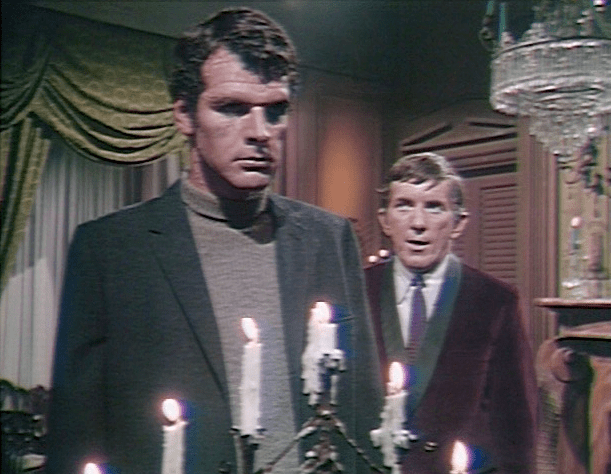
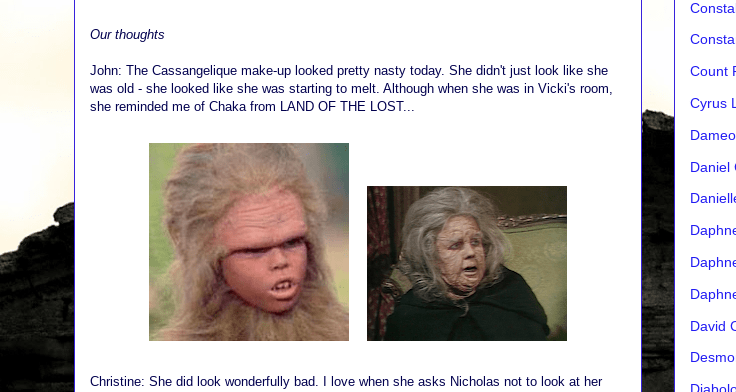
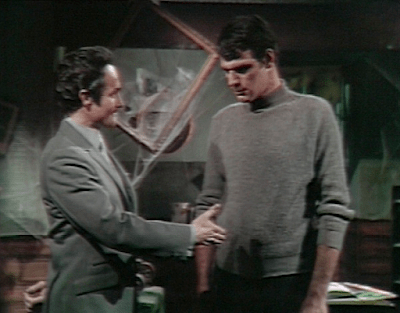
Suave Nicholas Blair, a middle manager in Satan’s terrestrial operations, has met with considerable success in his efforts to corrupt Frankenstein’s monster Adam. Today, Nicholas finds that Adam has abducted well-meaning governess Vicki Winters as part of his effort to force old world gentleman Barnabas Collins to create a mate for him. Nicholas praises Adam’s plan, and persuades Adam to let him take Vicki from his hiding place in the west wing of the great house of Collinwood. Nicholas says that he can keep Vicki far more securely in his own house.
Nicholas gives Adam a vial full of drugs and tells him to put them in Vicki’s drink when she comes to so that she will be easier to handle. In #528, Nicholas described himself as “much too talented to spend my time drugging drinks.” Perhaps he is, but the writers have to pump out five scripts a week, so whaddaya gonna do.
When Vicki wakes up, she pleads with Adam to let her go. She asks what reason he has for abducting her, and he immediately says “No reason!,” then scrunches up his face and says “No, I have a reason.” He won’t tell Vicki what that reason is, but he is interesting to listen to. Vicki makes a run for the door; he grabs her and puts her back on the bed. He asks her, with genuine concern, whether he hurt her. She assures him he did not. He gives her the drugged drink.
Nicholas comes to take Vicki. We cut directly from Vicki unconscious on Adam’s bed to her unconscious on a bed in Nicholas’ house. I don’t think this is the first time Dark Shadows has used a jump cut, but we certainly haven’t seen it often. Abrupt editing is so much at odds with the stately visual grammar of the show that it qualifies as a special effect. Unfortunately, it is an effect that does not make any particular point here, and so is wasted.
The other day, the corpse of Nicholas’ subordinate, wicked witch Angelique, disappeared. We then saw a coffin in Nicholas’ basement. Nicholas talked to the coffin, calling it “Angelique,” indicating that her body was inside. Yesterday, there was a vampire attack. We didn’t see the vampire, but there couldn’t be much doubt that it was her. That is confirmed in the final shot of today’s episode, when we see Angelique in the coffin, her fangs showing.
Recovering vampire Barnabas Collins is in the woods on the estate of Collinwood, searching for well-meaning governess Vicki Winters. He hears dogs howling, as they used to howl when he was in the grip of bloodlust. He goes to pieces at the memory.
Barnabas’ fellow searcher, Vicki’s fiancé Peter Bradford, sees him standing petrified. Barnabas asks him if he can hear the dogs. Peter says he can, and is puzzled that Barnabas was afraid he was hallucinating their sounds. Peter asks Barnabas if he is all right. Barnabas insists that he is just worried about Vicki, and resumes searching.
Shortly after, Barnabas finds himself in the foyer of the great house on the estate, slumped in a chair under his own portrait. He makes a sad contrast with the haughty figure in the painting. His friend Julia Hoffman enters, and he gives her a pleading look that emphasizes the contrast between his present weakness and the arrogant power he wielded when he posed for the portrait, more than 170 years before.
Barnabas tells Julia that he does not know how he got into the house. The last he remembers, he was in the woods and heard the dogs howling. She suggests that their noise may not mean anything, but he is sure there is some unearthly horror afoot.
Barnabas tells Julia something else he is sure of. Earlier this evening, Frankenstein’s monster Adam came to his house. Adam mistakenly believes that Barnabas created him, and demanded that he build a woman to be his mate. When Barnabas told him that would be impossible, Adam vowed to make him sorry, then left. Shortly after, Vicki came by for a brief visit. Barnabas is certain that Adam abducted Vicki to use as a hostage, and that the only ransom he will accept is the artificially created woman he has no way of supplying.
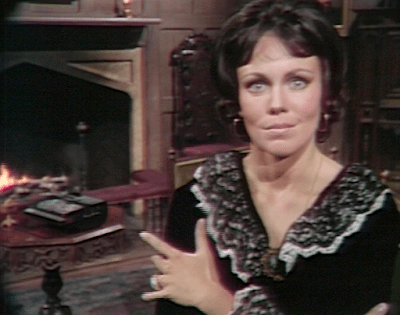
Barnabas goes to the telephone and announces he is going to tell the police what he knows about Adam. Julia objects that Adam can tell the police enough about the two of them to expose them both to prosecution. Barnabas says that he is willing to take that risk for Vicki’s sake, and begins dialing. Julia says she is not, and places her finger on the telephone receiver to end the call.
Julia has never been able to entirely conceal her dislike for Vicki, rolling her eyes when Vicki talks to her and making sarcastic remarks when Barnabas praises her, so regular viewers can hardly be surprised that Julia does not volunteer to go to prison for her sake. Still, Julia has often enough shown a troubled conscience about the many crimes she has committed during her association with Barnabas that her utter coolness represents a new step in the character’s development. The other day she wanted to shoot wicked witch Angelique, but Angelique was not really human and was enormously dangerous. Even so, Julia was deeply upset when she made up her mind to kill her, and she backed down when she came face to face with Angelique. But Vicki is resolutely, unfailingly, rather tediously good, Good with a capital G. That Julia is so blandly willing to consign her to death at Adam’s hands suggests that her sense of right and wrong will no longer serve as a brake on any sinister plans that might advance whatever goals she and Barnabas are pursuing.
Barnabas looks at Julia, shocked. Perhaps her coldness shocks him. Perhaps what shocks him is that he is so dependent on her that he does not resume dialing.
Meanwhile, another drama has played out not so far away. Electrician Tom Jennings was inspecting the wiring in a house that suave warlock Nicholas Blair is renting from the ancient and esteemed Collins family. Tom told Nicholas that he wanted to inspect the cellar to make sure the foundation was in good repair. Nicholas replied that this would not be necessary, but Tom insisted. He opened the cellar door, and found a coffin. Nicholas told him that the coffin was there when he moved in. Tom asked if he’d called the police, and Nicholas replied there was no need, since the coffin was empty.
On his way home, Tom told himself that the Collinses wouldn’t leave a coffin in the basement of one of their houses. That shows what he knows- for the first 55 weeks of the show, matriarch Elizabeth Collins Stoddard thought that her husband was buried in a box in the basement of the great house, and when he was a vampire Barnabas kept his coffin in the basement of his house. It wouldn’t be a Collins house if it didn’t have a coffin in the basement, and a dungeon too.
Tom sees someone and asks who it is. The part of the other person is played by the camera, so we do not know. The camera zooms in, and Tom collapses.
Later, Peter finds Tom propped against a tree. He touches Tom, and Tom falls over, apparently dead. He has two bloody wounds on his neck. Peter goes back to the great house. He tells Barnabas and Julia that he must use the telephone. They hear him describe Tom’s wounds to the police. Afterward, Barnabas and Julia realize that there is another vampire operating in the area.
Tom’s appearance is the debut of Don Briscoe, who would be a big part of Dark Shadows for almost two years. On his Dark Shadows Every Day, Danny Horn told an amazing story about Briscoe:
Many years ago, when I was in high school, my mother walked into the room while I was watching Dark Shadows.
She looked at the guy on the screen, and said, “Is his name Don?”
I said, yeah, that’s Don Briscoe, and she said, “I thought so. I knew him, when I was in grad school. He asked me out once.”
Seriously, true story. She said that they were both getting a master’s in English — he was at Columbia University, and she was at Barnard, which is right across the street. He asked her out on a date, and he was very handsome, and very nice, but he wasn’t Jewish, so she said no.
At the time, I had no way to verify this, and I never really knew what to think about it. I mean, she knew the guy’s first name, but maybe she confused him with some other brown-haired guy named Don.
But now I have this excellent book called Barnabas & Company, which has extensive bios on everybody in the cast. It turns out that he really did get a master’s degree in English at Columbia University, and that means that Don Briscoe is kind of my dad.
Granted, hundreds of actors had parts on Dark Shadows over the five years of its run, a great many people have blogged about the show, and I’m sure Danny’s mother was a very attractive young woman who had offers from lots of fellows. But Briscoe was one of the more important members of the cast, and Danny is as good as any of the bloggers. So it really is a noteworthy coincidence that they are connected to each other in that particular way.
Craig Slocum tops many fans’ lists of Dark Shadows‘ worst actors, so I would be remiss in my duty as a commentator if I did not mention that he does a genuinely good job today as unlovely ex-convict Harry Johnson. Harry brings a tray of food to the very tall, very strong Adam, who is in a dusty room in the long deserted west wing of the great house of Collinwood, hiding from the police as the guest of heiress Carolyn Collins Stoddard. Harry finds that Adam is trying to stab himself to death, and calmly talks him into giving up the effort and handing over his knife.
Harry goes to the drawing room in search of Carolyn, and finds the suave and mysterious Nicholas Blair. Nicholas tells him that Carolyn is out. He shocks Harry by asking if Adam is in trouble. Harry had no idea anyone but he and Carolyn knew Adam was in the house, and Carolyn has scared him out of his few wits with her orders to keep the secret.
Nicholas takes command of the situation. He insists Harry tell him what happened, and posts him in the foyer to wait for Carolyn to return while he goes up to talk to Adam. When Carolyn comes back, Harry tells her about Adam’s suicide attempt and about his encounter with Nicholas. She angrily reminds Harry that Collinwood is her house, not Nicholas’, and Harry had damn well better remember to take his orders from her and no one else. Harry is left with nothing to say but a meek “Yes, ma’am.”
Slocum is convincing as someone who is not intimidated by a physically imposing man with a knife, but who is entirely out of his league when confronted with people who outrank him in social class. So far as I can tell, none of the other fansites mentions his good work today. Dark Shadows fans are accustomed to ghosts and witches and vampires and Frankensteins and time travel, but a good performance by Craig Slocum is such an unexpected sight that they cannot bring themselves to admit that they have seen it.
Nicholas is a middle manager in Satan’s terrestrial operations, a member of Hell’s bourgeoisie.* He knows that Adam is a Frankenstein’s monster. The other day, he persuaded Adam to try to rape Carolyn. Adam’s attempt doesn’t seem to have got very far, but it has convinced Carolyn that she can no longer harbor Adam in her house. The audience knows that Nicholas has plans for Adam; presumably he knew that if Adam attacked Carolyn, she would want him to leave Collinwood, paving the way for him to take the big guy into his own house where he would have unlimited access to him. While Carolyn is downstairs chewing Harry out, Nicholas is up in Adam’s hiding place adding to the evil ideas he has planted in his impressionable mind.
Carolyn goes up to Adam’s room and finds Nicholas still there. Nicholas tells her that the crisis is past, then leaves the room. Carolyn finds that Adam is perfectly composed and looking forward to some improvement in his circumstances, but is unwilling to talk to her about anything substantial.
Carolyn goes down to the drawing room, where Nicholas is playing the piano. This is the first time we have seen anyone play the piano since #330, when sarcastic dandy Roger Collins banged out a few notes. Carolyn has been suspicious of Nicholas since she met him and was angry with him when she first learned he had gone into the west wing and found Adam, but can only thank him when she sees that he has talked the big guy out of suicidal despair.
Later, we see that Adam has left the great house of Collinwood and gone to the Old House on the same estate. The Old House is home to old world gentleman Barnabas Collins. Adam knows that Barnabas was present when he first awoke, in a laboratory, ten weeks ago, and that he spent the first weeks of his life as a prisoner in Barnabas’ dungeon. When he learned yesterday that he was an artificially constructed man, he jumped to the conclusion that it was Barnabas who created him.
Adam knocks on Barnabas’ door. Barnabas is astonished to see that Adam has returned. Adam announces that they will talk and walks in.
Barnabas marvels at Adam’s fluent speech. When last they saw each other, he could speak only a few words, such as “music!,” “food!,” “friend,” and, most importantly, “kill Barnabas!” Now, he tells Barnabas that he no longer plans to kill him, but says that he is right to be afraid of him. He has come for what he is entitled to. He wants Barnabas to make another creature like himself so that he will no longer be alone.
Barnabas tries to explain that he did not create Adam, that Dr Eric Lang did. Adam has never heard of Lang, and dismisses Barnabas’ statement as a lie. Barnabas goes on saying that he isn’t even a doctor, but Adam won’t listen. He will be provided with a mate, or he will take his revenge.
My wife, Mrs Acilius, pointed out that Adam’s demand for a woman who shares his nature should sound familiar to Barnabas. When Barnabas first came on the show in the spring and summer of 1967, he was a vampire, and was obsessed with turning a living woman into a vampiric replica of his lost love Josette. Adam, who came to life by an infusion of Barnabas’ “life force,” shares his longing for a female counterpart.
In 1973, Dark Shadows creator Dan Curtis produced an adaptation of Mary Wollstonecraft Shelley’s Frankenstein for ABC-TV. The second half of that long movie was devoted to the creature’s demand that Frankenstein build him a mate, and the terrible vengeance he exacted when the scientist refused to comply. The original audience of this episode can’t have known that that production was in the future, but they would have been aware of the 1935 Universal film Bride of Frankenstein and Hammer’s 1967 Frankenstein Created Woman. It seems likely they had assumed that Adam would sooner or later set aside his bachelor ways, and were waiting for a development such as this.
*Mrs Acilius has an advanced degree in sociology, and she coined the phrase “Hell’s bourgeoisie.”
Wicked witch Angelique defied her supervisor, suave warlock Nicholas, one too many times. Yesterday, Nicholas stripped Angelique of her powers, including her immunity to aging. Since she is 194 years old, this leaves her with a sharply limited future.
Today, Nicholas tells Angelique he will think of sparing her from her imminent demise if she can persuade recovering vampire Barnabas to forgive her for her extreme abuse of him and of everyone he has ever cared about. She goes to Barnabas and begs him for forgiveness. Barnabas replies that when he asked her for forgiveness, she responded by turning him into a vampire. He does show signs of concern for her, but cannot pardon everything she has done. He specifically mentions The Dream Curse, a three month storyline that not only brought great suffering to him and a dozen other characters, but which also made the audience miserable. She dies.
Nicholas’ only acknowledged motivation to this point has been a selfless devotion to evil for its own sake. That makes it odd that he would place a value on forgiveness. Dark Shadows is pervaded with ghost stories, and ghost stories are, first and foremost, explanations of how unresolved conflicts in the past can poison relationships among people in the present. It is also a soap opera, and the biggest events in soaps are changes in the way particular characters feel about each other. So both genres tend to elevate forgiveness, not only as a virtue, but as the highest form of The Good in human life. We saw this in the first year of the show, when well-meaning governess Vicki kept forgiving strange and troubled boy David for his attempts to kill her, acts of forgiveness which culminated in #191 when David ran from the mother who was trying to lure him to his own death into Vicki’s arms and an acceptance of life. Two weeks later, in #201, dashing action hero Burke closed another narrative thread left over from episode #1 when he forgave sarcastic dandy Roger for an old grievance he had against him. With those events, it was pardoning that cleared the flotsam left over from Dark Shadows 1.0, paving the way for the introduction of Barnabas and the advent of Dark Shadows 2.0.
Perhaps Nicholas was so certain Barnabas would not be able to bring himself to forgive Angelique in the time available before her death that making her beg for forgiveness was his way of perverting the world’s best thing into yet another instrument of cruelty. Certainly he suggests this interpretation when he introduces the idea with a laugh and a comment that he might find it “amusing.”
When Nicholas stands over Angelique’s corpse, he tells her that her own hatred had made it impossible for Barnabas to forgive her because it had “become too much a part of him.” That Angelique’s hatred became a part of Barnabas rings a bell for longtime viewers. The show has always depicted supernatural beings, not as self-contained individuals, but as complexes of phenomena that operate more or less independently, often without each other’s knowledge, sometimes in pursuit of mutually exclusive goals. For example, in 1967 the ghost of Barnabas’ little sister Sarah visited David during the day and tried to prevent him finding out Barnabas was a vampire, but she also appeared to David in a dream and showed him everything the daytime ghost wanted to keep hidden. When David told the Sarah of the waking hours what her dream visitation form had shown him, she was horrified and forbade him from following up on any of that information.
When Angelique places a curse, she sometimes seems to create a little version of herself, give it possession of the person she is targeting, and turn it loose in the world. Sometimes that little Angelique turns against her. For example, she raised the body of Barnabas’ uncle Jeremiah from the dead to use for her own nefarious purposes, only to find that it would not return to its grave when she was finished with it. When Barnabas was a vampire, he had some obsessions that were strikingly similar to obsessions Angelique had shown. So Angelique wanted Barnabas to love her, and had the power to cast a spell that would make him do so, but instead wrought immense havoc on everyone else with one wild scheme after another, because she wanted him to come to her “of his own will.” Likewise the vampire Barnabas wanted to make Vicki his victim, but passed up one opportunity after another to bite her because he wanted her to come to him “of her own will.” That similarity is so close that it makes us wonder if the Barnabas we first met was simply Angelique in disguise. Not only her hatred, but all of her quirks had become part of him.
Angelique came from the 1790s to 1968 by some magical process that involved a portrait of her that is now on a stand in Vicki’s room. Today she uses a secret panel to let herself into the room and look at the portrait. We first saw that panel open when the show was a costume drama set in the 1790s. The room was occupied then by gracious lady Josette, and it was the vampire Barnabas who used the panel to enter. We haven’t seen the panel since, leaving it strongly associated with Barnabas in the minds of regular viewers. Angelique’s use of it today further suggests her identity with him when he is in his vampire state.
Suave warlock Nicholas has expressly forbidden his subordinate, the wicked witch known variously as Angelique and Cassandra, from killing Frankenstein’s monster Adam. But now he has twice caught her trying to do just that. He punishes her by stripping her of her powers. He tells her that she is now a human being, and that she will die soon.
Nicholas de-witches Angelique/ Cassandra, while also trying to hold her wig in place. Screenshot by Dark Shadows Before I Die.
Angelique/ Cassandra’s husband, sarcastic dandy Roger, comes downstairs and confronts her about her indifference to him. She responds that there never was anything between them and never will be, and rushes out of the house. My wife, Mrs Acilius, is a soap opera fan from way back, and she says that as far as she is concerned this archetypal soap moment makes for a “Genuinely Good Episode.”
Angelique/ Cassandra goes to see recovering vampire Barnabas. He opens the door and asks what she wants. She says that she was once the mistress of the house and that as such she has a right to enter.
Ever since she showed up in the year 1968, Angelique/ Cassandra has been trying Barnabas’ patience and the audience’s by pretending that she was not the witch he married in the 1790s. He asks her why she has dropped that pretense now, and she says that she, like he, has become human. She also says that she will die at dawn. It is unclear why she thinks this- all Nicholas told her was that her life expectancy was to be measured in “minutes.” She declares her intention to kill Barnabas, and is pointing a gun at him when the episode ends.
If it does not lead to her immediate demise, depriving Angelique/ Cassandra of her powers would be an intriguing way of making her a more flexible character. In the costume drama segment set in the late eighteenth century, she was so powerful that she painted herself into a corner, facing no real opposition. The only suspense she could generate came when she was indecisive or distracted and got in her own way. In 1968, her subordination to Nicholas has pushed her to the opposite extreme. She has been very busy, but hasn’t done much. If she survives without her powers, it might be interesting to see her learn how to live as a human after all this time.
Angelique/ Cassandra’s appearance reflects the end of her dual identity perhaps more clearly than was intended. When she answered to the name Angelique in the 1790s, she had blonde hair; when she turned up in 1968 calling herself Cassandra, she wore a black wig. Throughout this episode, the wig keeps sliding around on her head.
This episode includes another of the innumerable replays of an audiotape message about Barnabas and Adam. The other day, it seemed that Nicholas and Cassandra had taped over the message, as undead fire witch Laura Murdoch Collins taped over a recording she didn’t want parapsychologist Peter Guthrie to hear in #172. But Friday they played it for us yet again. When Nicholas threatens Angelique/ Cassandra with death if she keeps disobeying him, Mrs Acilius said to the screen “I’ll kill you myself if you play that tape again!” I am glad to report that this is the last time we will hear the thing.
Danny Horn’s Dark Shadows Every Day post about this episode juxtaposes screenshots and dialogue from the scene in which Nicholas strips Angelique/ Cassandra of her powers with screenshots and dialogue from a contemporary episode of General Hospital. The contrast is hilarious. It also shows why even the conventionally soapy scenes with Roger and Barnabas stand out from the other daytime dramas of the period. Director Lela Swift’s use of the camera was incomparably more dynamic and ambitious than anything General Hospital was doing, Robert Cobert’s original orchestral score is comprehensible to a modern audience in a way that an organ playing in the background would never be, and the action is paced so that it takes less time for Angelique/ Cassandra to lose her supernatural powers, end her marriage to Roger, and pull a gun on Barnabas than it took Lucille to explain to Audrey that she had an idea about how she could learn to play bridge.
Suave warlock Nicholas Blair has learned that Frankenstein’s monster Adam is hiding in a room in the long-deserted west wing of the great house of Collinwood. He materializes there and talks as if he’s trying to recruit Adam into a self-esteem cult. He says “You mustn’t worry about what other people think, Adam. And you needn’t always do what other people want you to do. You must learn to be a strong-willed individual.” In response, Adam carefully articulates the new vocabulary item: “In-di-vi-du-al.” It sounds like the big guy will be signing up for courses at the Nathaniel Branden Institute in no time.
Later, we see Adam in the main part of the house. He has let himself into the bedroom where his patroness Carolyn Collins Stoddard, the acting mistress of Collinwood, is sleeping. He wakes her and tells her of Nicholas’ visit. Carolyn tells him to wait there while she goes to the drawing room and scolds Nicholas for wandering into parts of the house he had no permission to explore. Nicholas apologizes, and tells Carolyn her secret is safe with him.
In the final part of the episode, the wicked witch known variously as Angelique and Cassandra makes her way to Adam’s room in the west wing. She finds his door locked, and makes a graceful little hand gesture to magically open it. Standing over Adam while he sleeps, she decides that she cannot use magic to kill him, since Nicholas wants Adam to live and she would like him to believe that a human committed the murder. Therefore, she lifts an ax and is ready to chop into him when the episode ends. The ax wasn’t there earlier and she didn’t conjure it up; presumably she found it in “hammerspace,” the dimension where fans of animated cartoon say characters find whatever tools they need to do whatever the script calls for them to do at any given moment.
Adam’s residence in the west wing is a drab storyline, but longtime viewers will notice that it marks a change in the geography of Collinwood. The west wing was introduced as an area separated from the rest of the house, not only by a locked door, but some kind of metaphysical rift. In #14, well-meaning governess Vicki Winters saw the locked door inexplicably open and close itself; that was the clearest indication up to that point that in Collinwood, the word “ghost” referred to something more than unresolved conflicts among people. A reminiscence of that moment in #27 reinforced the suggestion that there was something supernatural about breaching the barrier between that wing and the main part of the house.
From #84 to #87, Vicki’s charge, strange and troubled boy David Collins, locked her up in a room in the wing; that was such an isolated place that it seemed Vicki might die before the family found her. Again, the distance was not only physical- while in captivity there she saw a full fledged ghost, a glowing figure dripping seaweed and singing to her. When sarcastic dandy Roger went to look for Vicki in #87, we saw him open the first of Dark Shadows‘ secret panels, a bit of the wall in the drawing room that opens to a long, dusty passage leading to the west wing. That was startling to see then, and we haven’t had a look at it since. Viewers who remember it have been looking at that spot on the wall ever since, wondering what worlds lie behind it.
Adam’s presence in the west wing fits in with its unearthly character, as do Nicholas and Angelique/ Cassandra’s activities there. But since those two witches live at Collinwood, the rest of the house has taken on that character as well. The separation of the west wing from the main part thus comes to lose its significance. Why shouldn’t Adam be able to visit the rest of the house, and why shouldn’t he know his way around well enough that he goes directly to Carolyn’s bedroom? Why shouldn’t unlovely ex-convict Harry Johnson, the most mundane character on the show now, have adventures in the west wing?
Angelique, the camera in front of her, the secret panel to the west wing behind her. Screenshot by Dark Shadows Before I Die.
Mad scientist Julia Hoffman and suave warlock Nicholas Blair each want to find Frankenstein’s monster Adam before the other does. Julia is sure that occult expert Timothy Eliot Stokes knows where Adam is; while he sits at a chessboard and plays both sides of a game, she asks Stokes to tell her. He says he wants answers to some questions of his own, but the audience knows that the information he wants is just what Julia will never tell him.
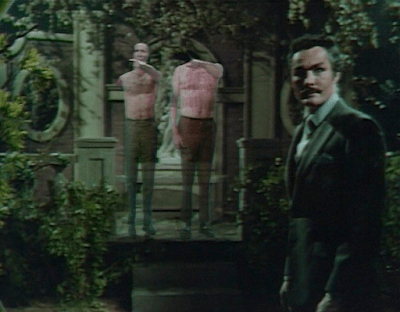
Nicholas takes a less conventional approach. He raises the ghosts of a couple of the dead men whose corpses supplied the raw materials from which Adam’s body was constructed. One lacks a right arm, the other a head. He asks them where Adam is, and they turn in unison to point with their left arms at the great house of Collinwood. It’s such a smoothly coordinated move that it looks like they must be spending their time in the afterlife starting a boy band.
The Boneyard Boys showing off their signature move, the Postmortem Point. Screenshot by Dark Shadows Before I Die.
The arm donor is played by David Groh, who less than a decade later would become a star as Joe on the sitcom Rhoda. Groh was such a charismatic performer that it’s hard not to think of speaking parts on Dark Shadows that other actors played badly and wonder what would have happened had he played them instead. I went on about that in a comment I left on Danny Horn’s Dark Shadows Every Day in 2020; here, I will just mention that if Groh, instead of the lamentably unaccomplished Craig Slocum, had played ex-convict Harry Johnson, we would probably have seen a red-hot love triangle in which Harry vied with Adam for the affections of heiress Carolyn Collins Stoddard.
Earlier in the episode, Adam had asked Stokes why it was not allowed for him to kiss Carolyn. Thayer David makes the most of this scene. Stokes freezes and looks up when Adam starts posing his questions, then seems genuinely shaken when he says that he is inadequate to the task of answering them, since he himself has never raised children. We can see that, in that moment, Stokes feels as incomplete as Adam. It’s touching to see Stokes’ usually supreme self-assurance give way to shamefaced uncertainty. When Stokes tells Adam to put away his budding sexual desires and to concentrate on his books, we catch a glimpse of the tragic side of Stokes’ own celibate, scholarly life.
But not even a father of twenty would be prepared for this situation. In the ten weeks he has been alive, Adam has become fluent in English and able to read with facility; he has the body of a grown man and moves with agility and force. Yet he knows absolutely nothing of human relationships beyond a basic understanding of the words “Friend” and “Kill!” It is hard to imagine that anyone has ever lived who needed the instruction Adam needs now.
When Dark Shadows began in the summer of 1966, its most intelligent character was also its most dangerous, strange and troubled boy David Collins. David twice came within an inch of committing the perfect murder, first when he sabotaged his father Roger’s car, then when he trapped his governess Vicki in a room in the long-deserted west wing of the great house of Collinwood.
The only story that consistently worked in those days was the relationship between David and Vicki, and that was solely due to actors David Henesy and Alexandra Moltke Isles. While the writers gave them terrible dialogue- at one point having Vicki read aloud to David from a reference book on the geography of Maine- they used their faces, voices, and movements to show us what was going on inside the characters. Mr Henesy always looked like an angry boy who was grimly determined to keep hating his governess even though he couldn’t help but like her, while Mrs Isles always looked like a fearless young woman who was determined to befriend a boy who might make an attempt on her life at any moment. As David relented from his hatred, we could see a friendship budding between them, even if the words were still no good.
The story of Vicki and David had its climactic phase from December 1966 to March 1967, when his mother Laura Murdoch Collins was on the show. Laura was Dark Shadows’ first supernatural menace, an undead fire witch who planned to incinerate herself and David so that she could attain a new life. When David ran from the burning Laura into Vicki’s arms in #191, he chose her and life over Laura and death. She thus became his new mother, and their story was complete.
Since then, the show has found very little for David to do. Yesterday, he was wandering around the house with a tape recorder. He told his stepmother Cassandra that he couldn’t figure out how to play a tape. The preoccupied Cassandra sent him away, and he asked his cousin Carolyn to help him. Carolyn made it clear that all you do is press the button labeled “Play.” Two years ago, David could sabotage a brake cylinder to fail at precisely the spot on the road where it would be likeliest to lead to a fatal crash, but now he can’t grasp the concept of “Press play to listen to the tape”?
Longtime viewers will see a missed opportunity here. Cassandra is a wicked witch, also known as Angelique. In #492, Angelique/ Cassandra cast a spell that caused David to forget some incriminating information about her, so we know that he is subject to her power. Vicki knows a great deal about Angelique/ Cassandra; they could easily give us a series of scenes in which Vicki tries to warn David about his stepmother, but his mind is clouded. Instead, we never see Vicki and David alone together during this phase of the show, and Angelique/ Cassandra rarely does anything more with David than display irritation and order him to go away.
David eventually played the tape for Angelique/ Cassandra. She reacted with great excitement, since it included a message that explained why she failed in her attempt to restore the vampire curse she once placed on David’s distant cousin Barnabas Collins. She sends David away and keeps the tape recorder.
Angelique/ Cassandra won’t let David take the tape recorder back to his room. Screenshot by Dark Shadows Before I Die.
Angelique/ Cassandra informs her supervisor, suave warlock Nicholas, that she can re-vamp Barnabas if she kills Frankenstein’s monster Adam. Fascinated by the idea of an artificially constructed human being, Nicholas loses interest in Barnabas and instructs Angelique/ Cassandra to find out more about Adam.
In #532/533, Nicholas met Maggie, The Nicest Girl in Town. Nicholas was obviously smitten with Maggie, putting the lie to his taunting of Angelique/ Cassandra for her ability to feel an emotional attachment to Barnabas and his own claim to be motivated solely by a devotion to evil for its own sake. After he gives Angelique/ Cassandra her orders, Nicholas goes to Maggie’s house. Ostensibly this is to find out if she knows where Adam might be, but she so obviously does not that it is clear he just wants to see her. He asks her about her hospitalized fiancé Joe, admires her late father’s paintings, and offers to buy one of them at a high price and lend it back to her. Maggie seems to be quite charmed by him. Nicholas’ “Evil, be thou my good” schtick can be fun to watch for short periods, but if he is going to be a major character for any length of time he will need a more complex inner life. His attraction to Maggie is a step towards giving him one.
David goes to Barnabas’ house. He tells Barnabas’ friend Julia that at least twice this evening he has listened to a message on a tape recorder that had something to do with Barnabas and Adam, but he can’t remember any of the details. He does remember that Angelique/ Cassandra got excited when he played it for her, but that’s it. If Angelique/ Cassandra had cast a spell on David, his forgetfulness would be understandable. If Vicki and Angelique/ Cassandra were locked in battle for David’s allegiance, it could be dramatic. But as it is, the show has chosen simply to present David as an abject moron, and that is infuriating.
Julia and David go back to the great house, where they find Nicholas and Angelique/ Cassandra with the tape recorder. Nicholas and Angelique/ Cassandra leave, and Julia and David play the tape. It no longer has the original message, but instead has the witches’ sabbath portion of Berlioz’ Symphonie Fantastique. David furrows his brow, then comes up with the bright suggestion that Angelique/ Cassandra, who has been in possession of the tape the entire time, may just possibly be the one who made the change. Again, since we have not seen Angelique/ Cassandra cast a spell to confuse David’s thinking, this incredible stupidity can do nothing but exasperate the audience.
They don’t even have the excuse that the current writing staff doesn’t know that David used to be interesting. The gimmick of replacing important information on a reel-to-reel tape with an audio signature suggestive of the culprit is a callback to #172, when Laura thwarted parapsychologist Dr Peter Guthrie by replacing an audio recording of a séance with the sound of fire crackling. If they can recall that bit, surely they can remember that David used to have a functioning brain.
In the early days of the show, Vicki was on a quest to find out who her parents were and why they left her at a foundling home when she was an infant. In #60, Vicki stumbled upon a portrait Maggie’s father Sam painted twenty years before of a woman who looked just like her. Vicki wondered if this woman, whose name was Betty Hanscombe, might have been her mother or aunt. Sam gave Vicki the painting then, but it is back in Maggie’s house today, and Nicholas picks it up at one point. We don’t get a very good look at it, but you can buy a reproduction of it on canvas for $25.99 plus shipping from someone on Etsy, it looks nice.
The wicked witch known variously as Angelique and Cassandra is standing in the drawing room of the great house of Collinwood, thinking evil thoughts. The camera zooms out and we see that her stepson, strange and troubled boy David Collins, is standing next to her. She starts to speak her thoughts out loud, saying “You will pay!” David asks “Who will pay?” Angelique/ Cassandra is startled to discover that David is there, and is flustered when she tries to change the subject. She so often delivers incriminating soliloquys while standing out in the open that the comic effect of this scene must be intentional.
Angelique/ Cassandra oblivious to David’s presence.
David asks Angelique/ Cassandra to help him figure out the correct operation of a tape recorder he received some time ago as a present from permanent houseguest Julia Hoffman. After Angelique/ Cassandra refuses to help, he goes upstairs and finds his cousin, heiress Carolyn Collins Stoddard, emerging from the long-deserted west wing of the house. He asks Carolyn what she was doing in the west wing. She asks him why he thinks she was in the west wing. When he says he saw her coming out of it, she drops her attempt to evade his question and tells him she was looking for some old family photos to show well-meaning governess Vicki. She has enough trouble remembering this story that it must be obvious to David that it is a lie, but he isn’t interested enough to follow it up. He just wants someone to help him figure out which buttons to push on the tape recorder.
On their Dark Shadows Before I Die, John and Christine Scoleri speak for longtime viewers of the show when they say that it is surprising David needs help with the tape recorder. When the show started, David was two years younger and had the mechanical skill to sabotage his father’s car in a very creditable attempt at patricide. All Carolyn has to do to get the tape going is read the label that identifies the play button. This apparent loss of cognitive function is of a piece with David’s massive loss of narrative function. For the first 39 weeks of Dark Shadows, David was the fulcrum on which every story turned, and actor David Henesy had abundant opportunities to show a level of professional skill that would be remarkable in a performer of any age. But he has been receding into the background for a long time now, and his extraordinary dim-wittedness today marks a low point for him.
Once the tape starts playing, Carolyn makes a hasty exit. David listens to a minute or so of Eine Kleine Nachtmusik, hoping it will end and he will hear “something spooky.” His wish is granted when the music abruptly stops, giving way to a voice addressing itself to Julia. The voice rambles about David’s distant cousin Barnabas Collins, saying that if both he and “my creation” live, Barnabas will be all right, but that if “Adam” dies, “Barnabas will be as he was before.” The name “Adam” should mean something to David. He shared a confused and frightening moment with a mysterious man of that name in #495. That man subsequently abducted Carolyn, and is still the object of a police search.
What only Julia, Barnabas, and Barnabas’ servant Willie know is that Adam is a Frankenstein’s monster created in an experiment that freed Barnabas of the effects of the vampire curse that Angelique/ Cassandra placed on him in the 1790s. The voice on the tape is that of Eric Lang, the mad scientist who began the experiment. Minutes before he died of the effects of one of Angelique/ Cassandra’s spells, Lang recorded this message for Julia. The audience has heard this message approximately a gazillion bajillion times, but until now, the only character to have heard it was Adam, and he could make no sense of it.
Angelique/ Cassandra recently made an unsuccessful attempt to renew Barnabas’ curse, and is desperately searching for the obstacle that prevented it from working. Carolyn’s actual task in the west wing was showing Adam to a hiding place there. So Angelique/ Cassandra is now under the same roof with both the information she needs to identify her obstacle and the person she can remove that obstacle by killing. Things are looking bad for Barnabas and for Adam.
While David is upstairs with the tape recorder, Vicki is sobbing in the drawing room. Suave warlock Nicholas, who is staying in the house in the guise of Angelique/ Cassandra’s brother, enters and asks her what’s wrong. She says that she has just learned that Barnabas is dead. His back to her, Nicholas smiles brightly when he first hears this news, then puts on a sad face and turns to her with sympathetic words. In response, Vicki reveals that she knows all about Angelique/ Cassandra and that she has little patience for Nicholas’ pretensions. Carolyn enters and doubts Vicki’s news. Angelique/ Cassandra is the last to enter. She says that she saw Barnabas alive and well after the time when he is supposed to have been dead. Vicki and Carolyn look at each other, and do not see Nicholas’ look of disappointment. They go upstairs, and Nicholas and Angelique/ Cassandra go into the drawing room.
Nicholas scolds Angelique/ Cassandra for her failure. He addresses her as “dear sister.” He suggests she may not hate Barnabas sufficiently to impose a curse on him. When she denies this, he leans to her ear and teasingly asks if she loves him. He threatens to send her back where she came from if she doesn’t re-vamp Barnabas by midnight, and to focus her mind replaces her arm with a fleshless bone.
Director John Weaver was not much of a visual artist, and in his post about the episode on Dark Shadows Every Day Danny Horn analyzes the dismally inept blocking of the scene between Vicki and Nicholas. Danny also has some unkind words for writer Ron Sproat, but I think those are unfair. It’s true the opening scene between Adam and Carolyn goes on too long, David’s helplessness with the tape recorder is dismal, and Vicki and Carolyn’s reaction to Angelique/ Cassandra’s report that Barnabas is still alive doesn’t make sense. That’s a long enough list of flaws that we might fairly classify Weaver and Sproat as the B-team, not on a par with director Lela Swift and writers Sam Hall and Gordon Russell.
But it is genuinely funny when we first see David standing next to Angelique/ Cassandra, David’s questioning of Carolyn is intelligently written, Lang’s message is for once an actual source of suspense, Vicki’s lines to Nicholas as Alexandra Moltke Isles delivers them show the character’s strength, Nicholas’ teasing Angelique/ Cassandra with her alleged love of Barnabas raises a laugh as it makes them sound like a couple of kids, and the final gag with the arm bone is at once goofy enough to keep up the humor in the episode and startling enough to be effective as a touch of horror. All in all, it’s an enjoyable episode, if not one that fans would be tempted to use to turn their friends on to the show.
In his post about this episode on Dark Shadows Every Day, Danny Horn remarks on the recapping that permeates the dialogue and reckons it as writer Sam Hall’s critique of the ongoing storylines. That assessment will be familiar to those who, unlike Danny, have been watching the show from the beginning. When Ron Sproat joined the writing staff in October 1966, his first several scripts featured a systematic inventory of the available narrative material, with each plot very explicitly marked as suitable or unsuitable for further development.
In its first year, very little happened on Dark Shadows; now, it has swung to the opposite extreme, and there is a climax at every commercial break. But the result is oddly similar. They don’t take the time to explore the overall situation, so that little seems to be at stake even when a spectacular event takes place. No matter how much happens per minute of screen time, it feels like the pace is slow. We see suave warlock Nicholas in the gazebo on the grounds of the estate of Collinwood summoning his subordinate, the wicked witch known variously as Angelique and Cassandra, and hear him complain that she has spent weeks attempting to do what she should have accomplished in minutes. Thus Hall assures us that the pace will be picking up.
Angelique/ Cassandra comes to the gazebo, to which Nicholas refers as a “ga-ZAY-bo” in a bit of Collinsport English Angelique/ Cassandra herself introduced in #489. There, the two of them quarrel about her dilatory approach. They stand behind columns and look like debaters at podiums.
Maybe I’m reading too much into the set design, but in one of the photos Angelique and Nicholas are sperated by a statue of a Goddess (I assumed Venus). Wouldn’t it be awesome if it was Venus and that statue between them was to represent Angelique’s love for Barnabas blocking her efforts at villainy? More likely that the shot just looked better composed with the statue in the middle but how awesome if it was meant to be subtle symbolism! 🙂
“lakeplacidskater,” posted 25 February 2015 on Danny Horn, “Episode 528: This Tawdry Affair,” 21 November 2014.*
The statue appears to me to represent not Venus, but a harvest goddess. She is fully clothed, and there is a sack at her feet which seems to be full of grain. That makes a lot less sense than does the suggestion “lakeplacidskater” made. The Collinses derive their wealth from fishing and shipping, not from farming, so it is surprising that they would put a symbol of agriculture in such a prominent place. Perhaps she stands for wealth in general, but not for so much wealth that the family could afford to commission a statue of a sea goddess. And neither a bountiful harvest in particular nor wealth in general is any sort of obstacle between Nicholas and Angelique/ Cassandra. I suppose the visual metaphor might be emphasizing the image of the two of them as debaters, with the goddess serving as moderator.
Nicholas dominates Angelique/ Cassandra thoroughly and rather cruelly. Viewers who remember her from the portion of Dark Shadows set in the late eighteenth century may be taken aback by this. In those days, her power often seemed to be limited only by her own carelessness. That made for something of a shapeless narrative, since no one could oppose her effectively. Not only does Nicholas reduce her to a lowly state today, but he himself bungles a simple task when he sets out to do something nasty to well-meaning governess Vicki. Thus we see that the villains will have their work cut out for them.
Later, Vicki is in bed at her friend Maggie’s house. She has gone there to escape a curse Angelique/ Cassandra has placed that has caused several people to have the same nightmare. Since Maggie was at home when she was the first person to have the nightmare, and Vicki’s boyfriend Peter was sleeping there when he had it, it is hard to understand why Vicki thinks it is a place of safety.
We have several closeups of the face of the clock while Vicki goes to sleep. It’s an Ingraham eight day clock, apparently they wanted to make sure we knew that. When Vicki finally nods off, Angelique/ Cassandra materializes in the room with a jar of rose water that is supposed to make Vicki have the nightmare. Ever since the days when humanoid Phoenix Laura Murdoch Collins was on the show, we’ve been seeing undead witches materialize in people’s bedrooms while they sleep. This time, Maggie walks in and sees Angelique/ Cassandra. She screams at the sight. All of the women in the cast were required to scream frequently, so frequently that fans become connoisseurs of screaming. Kathryn Leigh Scott was one of the better screamers, not far behind Clarice Blackburn, so that makes for a satisfying ending.
*I can’t help but point that when “lakeplacidskater” left her post, all the members of the cast were still alive. Humbert Allen Astredo would die in 2016 and Lara Parker in 2023; Alexandra Moltke Isles, Roger Davis, and Kathryn Leigh Scott are still with us.