Suave warlock Nicholas has expressly forbidden his subordinate, the wicked witch known variously as Angelique and Cassandra, from killing Frankenstein’s monster Adam. But now he has twice caught her trying to do just that. He punishes her by stripping her of her powers. He tells her that she is now a human being, and that she will die soon.
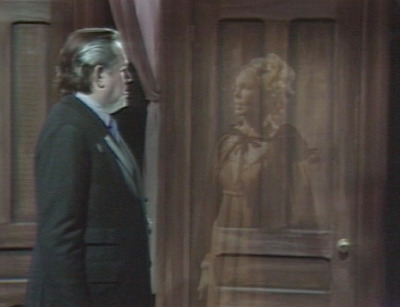
Nicholas de-witches Angelique/ Cassandra, while also trying to hold her wig in place. Screenshot by Dark Shadows Before I Die.
Angelique/ Cassandra’s husband, sarcastic dandy Roger, comes downstairs and confronts her about her indifference to him. She responds that there never was anything between them and never will be, and rushes out of the house. My wife, Mrs Acilius, is a soap opera fan from way back, and she says that as far as she is concerned this archetypal soap moment makes for a “Genuinely Good Episode.”
Angelique/ Cassandra goes to see recovering vampire Barnabas. He opens the door and asks what she wants. She says that she was once the mistress of the house and that as such she has a right to enter.
Ever since she showed up in the year 1968, Angelique/ Cassandra has been trying Barnabas’ patience and the audience’s by pretending that she was not the witch he married in the 1790s. He asks her why she has dropped that pretense now, and she says that she, like he, has become human. She also says that she will die at dawn. It is unclear why she thinks this- all Nicholas told her was that her life expectancy was to be measured in “minutes.” She declares her intention to kill Barnabas, and is pointing a gun at him when the episode ends.
If it does not lead to her immediate demise, depriving Angelique/ Cassandra of her powers would be an intriguing way of making her a more flexible character. In the costume drama segment set in the late eighteenth century, she was so powerful that she painted herself into a corner, facing no real opposition. The only suspense she could generate came when she was indecisive or distracted and got in her own way. In 1968, her subordination to Nicholas has pushed her to the opposite extreme. She has been very busy, but hasn’t done much. If she survives without her powers, it might be interesting to see her learn how to live as a human after all this time.
Angelique/ Cassandra’s appearance reflects the end of her dual identity perhaps more clearly than was intended. When she answered to the name Angelique in the 1790s, she had blonde hair; when she turned up in 1968 calling herself Cassandra, she wore a black wig. Throughout this episode, the wig keeps sliding around on her head.
This episode includes another of the innumerable replays of an audiotape message about Barnabas and Adam. The other day, it seemed that Nicholas and Cassandra had taped over the message, as undead fire witch Laura Murdoch Collins taped over a recording she didn’t want parapsychologist Peter Guthrie to hear in #172. But Friday they played it for us yet again. When Nicholas threatens Angelique/ Cassandra with death if she keeps disobeying him, Mrs Acilius said to the screen “I’ll kill you myself if you play that tape again!” I am glad to report that this is the last time we will hear the thing.
Danny Horn’s Dark Shadows Every Day post about this episode juxtaposes screenshots and dialogue from the scene in which Nicholas strips Angelique/ Cassandra of her powers with screenshots and dialogue from a contemporary episode of General Hospital. The contrast is hilarious. It also shows why even the conventionally soapy scenes with Roger and Barnabas stand out from the other daytime dramas of the period. Director Lela Swift’s use of the camera was incomparably more dynamic and ambitious than anything General Hospital was doing, Robert Cobert’s original orchestral score is comprehensible to a modern audience in a way that an organ playing in the background would never be, and the action is paced so that it takes less time for Angelique/ Cassandra to lose her supernatural powers, end her marriage to Roger, and pull a gun on Barnabas than it took Lucille to explain to Audrey that she had an idea about how she could learn to play bridge.
A stranger comes to the great house on the estate of Collinwood and introduces himself as Nicholas Blair, brother of Cassandra Blair Collins. Cassandra’s husband Roger Collins is shocked; Cassandra had never mentioned that she had a brother. Moreover, she has been missing for the last 24 hours, and Roger is convinced something terrible has happened to her. Roger’s distant cousin Barnabas Collins and Dr Julia Hoffman are also shocked, but for a different reason. They know that Cassandra is actually Angelique, a wicked witch who, in the 1790s, turned Barnabas into a vampire. She recently returned to the world of the living when Barnabas’ vampirism went into remission, and she tried to implement a plan to bring it back in full force. When Angelique/ Cassandra went missing, they hoped it meant that she had been defeated. Nicholas’ arrival replaces their hopes with the fear of new battles.
Nicholas at first assumed that Barnabas was Angelique/ Cassandra’s husband, and told him “I should have recognized you anywhere!” This is a sure sign of trouble- Barnabas, who was in fact briefly married to Angelique in 1796, has not been out of the state of Maine since 1795, and has never been photographed. Nicholas says that he has recently been on Martinique, where Barnabas first met Angelique in the eighteenth century, and that he is a “citizen of the world” with no fixed address. He assures Roger that it is Cassandra’s way to disappear abruptly, and that she is sure to return.
Roger, Julia, Barnabas, and Nicholas in the drawing room.
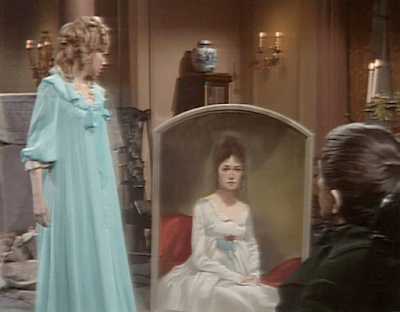
Roger takes Nicholas to the bedroom he and Angelique/ Cassandra share. He shows Nicholas a portrait of Angelique which returning viewers know to have a mysterious connection with Angelique/ Cassandra’s physical being. Roger leaves the room, and Nicholas talks to the portrait. He asks Angelique if she can hear him, and a musical cue associated with her plays on the soundtrack. The cue cuts out, and Nicholas follows up with another question. Dark Shadows stood out from the daytime soaps of the period in having an orchestral score instead of an organ accompanying the action. The meta-theatrical touch of a character who can hear that score is a major departure. It is something people at the time would have seen in animated shorts from Warner Brothers, but likely not anywhere else. Since the biggest and fastest-growing share of Dark Shadows’ audience at this point was children under the age of 13, there was a risk that adult viewers might take that association with cartoons as a sign that it was time for them to find something else to do with their mid-afternoons.
Back in his own house on the same estate, Barnabas finds his servant Willie Loomis holding a rifle. Willie says that he is afraid that man named Adam will come to the house. Barnabas dismisses that fear and orders Willie to put the rifle away. Willie objects. Barnabas repeats the command and leaves. Willie grumbles, but does as he was told. We see a face peering in at the window.
The face belongs to hardworking young fisherman Joe Haskell. Returning viewers know that Barnabas held Joe’s fiancée Maggie prisoner from May to June of 1967 and was extremely cruel to her. When the case was being investigated, Barnabas framed Willie for those crimes. Willie was sent to a mental hospital, and Barnabas had Willie released and brought him back to work for him some weeks ago. Joe thinks that Willie is the perpetrator, and has no patience with him. He knocks on the door and demands Willie let him in.
Joe insists that Willie tell him what he knows about Adam. Willie tries to evade his questions. When Willie says that Adam dislikes him, Joe responds”that means he knows you.” Joe twists Willie’s arm while repeating his questions. Once Joe releases him, Willie runs off and comes back with the rifle. He points it at Joe and orders him out of the house. Joe complies, but says that he will be back, and that he will be having words with Barnabas.
Later, Willie is in the basement. Some bricks are missing from a wall, exposing a skeleton hanging from the ceiling. Viewers who have been with Dark Shadows all along will recognize the basement of Barnabas’ house as a redress of the set that represented the basement of the main house in the first year of the show. The spot with the missing bricks was where a door stood that was always locked in those days. For the first 54 weeks of Dark Shadows, matriarch Liz thought that her husband’s corpse was buried behind that door. That belief turned out to be mistaken, but now we see that there are indeed human remains in the most similar possible spot. We might wonder what else Liz might have been less wrong about than at first sight appeared.
We watch Willie preparing to fill in the missing bricks, leaving the skeleton in place. After all, judging by Liz’ old way of thinking, that’s what ought to be in a space like that. We hear Willie’s interior monologue. He is making himself laugh with a pun on his own name when a stagehand wanders into the shot.
Uh, hello?
That moment of unintentional humor gives way to a scene rich in intentional comedy. Willie goes upstairs and finds that Nicholas has let himself into the house. Nicholas entrances him and extracts information from him. Willie tells him about a meeting with a ghost- “the one downstairs,” he specifies. Nicholas directs Willie to sit down, to remain in a blissed-out state until he leaves, and then to forget all about their encounter.
Nicholas goes to the basement, looks at the skeleton, and calls it “Reverend Trask!” Willie hadn’t given him this name; evidently he recognizes Trask the same way he recognized Barnabas.
Professor Timothy Eliot Stokes (Thayer David) comes home and greets his house-guest Adam (Robert Rodan.) He says that he envies Adam his freedom from the responsibility of attending lectures delivered by people who are “inferior” to him. However snobby Stokes’ attitude towards his faculty colleagues may be, we immediately see that it does not extend to people who lack educational credentials. He takes out a deck of flashcards with words as short as “car” and as long as “dictionary” and is delighted with Adam’s ability to read them aloud.
The Professor takes pleasure in his pupil’s progress.
From November 1967 to March 1968, Dark Shadows was a costume drama set in the 1790s and Thayer David played Stokes’ ancestor Ben, a servant indentured to the mighty Collins family. We saw kindly scion Barnabas Collins (Jonathan Frid) teach Ben to read. Barnabas became a vampire in those days; his vampirism went into remission only a few months ago, when he went through an experimental treatment that involved Adam’s creation as a Frankenstein’s monster. To the extent that Adam is Barnabas’ responsibility, Stokes is repaying his ancestor’s debt to him in kind.
Barnabas and his friend Dr Julia Hoffman (Grayson Hall) knock on Stokes’ door. Stokes does not know that Barnabas used to be a vampire or what he and Julia had to do with Adam’s creation, but he knows enough to distrust them deeply. He insists Adam hide in the back bedroom before he will let Barnabas and Julia in.
Barnabas and Julia tell Stokes that they telephoned him earlier. He explains that he was out, and they say that someone answered the phone and breathed audibly into the receiver, but did not speak. Before he can suggest they misdialled, they notice that his receiver is still off the hook. He speculates that his cleaning lady, who obviously does not exist, must have done it. He furrows his brow and sounds quite stern when he expresses his disapproval of this imaginary person’s behavior. Barnabas and Julia can’t do anything with that, so they change the subject to the matters they originally wanted to discuss.
Those amount to a recap of the storyline concerning wicked witch Cassandra Blair Collins, who in the 1790s was known as Angelique Bouchard Collins. As Angelique, she was the one who made Barnabas a vampire. She returned to the world of the living in the spring of 1968 in a bid to reactivate that curse. Now she has gone missing, and Barnabas and Julia are hoping she is gone forever. While Stokes is in the dark about Barnabas’ past and his true nature, he knows plenty about Angelique/ Cassandra. He tells Barnabas and Julia that to test their hypothesis, they must find the portrait of Angelique that turned up shortly before Angelique/ Cassandra herself returned.
Barnabas and Julia search for the portrait in the great house of Collinwood, where Angelique/ Cassandra has been living as the wife of Roger Collins (Louis Edmonds.) Julia keeps Roger busy downstairs while Barnabas roots around in Roger and Angelique/ Cassandra’s bedroom. The soundtrack plays a recording of Barnabas’ thoughts about his search while we see him staring at the room. When these interior monologues were new to the show, they tended to be very informative. Lately they’ve had less substance, and this one is totally unnecessary.
It turns out that the search itself was equally unnecessary. As soon as Barnabas makes his way back to the drawing room, Roger pulls out the portrait and shows it to him and Julia. Roger found it in the back of a dark closet, but is badly faded, as if it had been left in direct sunlight for a great many days. Barnabas and Julia know that the portrait has some mysterious connection with Angelique’ Cassandra’s physical being, so this is grounds for hope that she is on the way out.
That hope is dashed within seconds. Barnabas answers the front door, and finds a stranger. The man tells Barnabas he should have recognized him at once- “Cassandra’s husband!” Barnabas was briefly Angelique’s husband, 172 years before, but does not bring that up. Instead, he directs the man’s attention to Roger. The man is unfazed when Roger announces that he, not Barnabas, is married to Cassandra. The man then introduces himself as “Cassandra’s brother!” Barnabas and Julia react with shock.
In #473, we saw that wicked witch Angelique had traveled from the eighteenth century to the year 1968 to reimpose the vampire curse she had once placed on old world gentleman Barnabas Collins. In a single day, Angelique met Barnabas’ distant cousin Roger, bewitched him, and married him. This secured her a home in the great house on the estate of Collinwood. Barnabas lives in the Old House on the same estate. Calling herself Cassandra and wearing a black wig, she pretends not to understand why Barnabas doesn’t like her.
In #477, Angelique appeared to Barnabas in a dream and told him and the audience how she would go about turning him back into a vampire. Her approach would essentially be a distributed malware attack on the wetware inside the heads of the people of Collinsport. One person after another would have the same basic nightmare. Each nightmare would begin with a visit from a person who had not yet had it, and after the dreamer awoke they would feel an uncontrollable compulsion to describe the dream to that person. Once they had done so, that person would have the nightmare, and the cycle would repeat. When the dream got back to Barnabas, he would become a vampire again.
Yesterday, heiress Carolyn Collins Stoddard had the dream. Carolyn met with occult expert Timothy Eliot Stokes and mad scientist Julia Hoffman at the Old House. Stokes managed to insert himself into Carolyn’s dream as the person to whom she must tell it. Today, Stokes has the dream. He sets out to function as an antivirus program. He has learned what the dreamer usually does, and consciously makes himself defy all those rules. His hack-back works sufficiently to force Angelique/ Cassandra to appear in the dream herself and get into an argument with him.
Angelique/ Cassandra addresses Stokes by the name of his eighteenth century ancestor Ben, an indentured servant whom she ensorcelled and used for her own nefarious purposes. She refuses to believe that Stokes is not Ben, and does not react strongly when he tells her that he knows her name is Angelique. When he later addresses her as Cassandra Collins, she is horrified and vanishes. It’s a staple of stories about magic that the act of calling adversaries by their true names can defeat them; Mrs Acilius brought up the story of Rumpelstiltskin. That the name “Angelique” has no effect while “Cassandra” drives her away suggests that she was using a pseudonym when we first knew her, and she really is Cassandra.
The power of naming also explains what Barnabas may have been thinking when he kept confronting Angelique/ Cassandra and telling her exactly what he did and did not know about her. Perhaps he hoped that simply by addressing her as “Angelique” he would make her vanish.
When Stokes awakens, he tells Julia he is confident that he has stopped the curse. That confidence is put to the test immediately when a knock comes at the door. Stokes opens it, and sees the man from his dream. He does not know the man, but we do. He is Sam Evans, an artist recently blinded by one of Angelique/ Cassandra’s spells. He is accompanied by Joe Haskell, fiancé to Sam’s daughter Maggie. They mention that Maggie is spending the evening in the nearby city of Bangor, Maine. Sam says that he heard the name “Stokes” in his head earlier in the evening, and that he also felt an urge to come to the Old House. He has a strong feeling that Stokes has something to tell him, and insists that he do so.
Stokes is disquieted to see Sam, but feels no compulsion to tell the dream. Sam is furiously dissatisfied. It is unclear whether his frustration at not hearing the dream will be as intense or as persistent as is the upset previous dreamers felt when they resisted telling it.
Sam and Joe leave. In front of Sam’s house, Joe reaches to open the front door. Sam is irritated with him. He not only insists on opening the door himself, but won’t do so until Joe leaves. Joe explains that Maggie made him promise to keep an eye on him, to which Sam replies with a threat to forbid their marriage unless he backs off. Joe mentions that a strange, very tall man who recently abducted Carolyn might still be at large; Sam replies that the man jumped off Widows’ Hill, which means certain death to “anything human.”
Inside the house, Sam finds that a window Joe had closed before they left is open. He hears someone in Maggie’s room. It turns out to be the strange, very tall man, badly cut from his recent fall and wielding a kitchen knife.
They don’t explain what Maggie is doing in Bangor. From episode #1 until she was attacked by Barnabas in #227, Maggie was the principal waitress at the restaurant in the Collinsport Inn. After some time as Barnabas’ prisoner and a longer period as a patient in Julia’s hospital, she returned to town in #295. For all they’ve told us since then, Maggie may have got her job back or taken another one. But if she had, they would have told us today that she was working the night shift, not that she was on some unexplained trip out of town. So now we know that nobody in the Evans house is gainfully employed.
Sarcastic dandy Roger Collins has remarried. His previous wife, undead blonde witch Laura Murdoch Collins, was Dark Shadows’ first supernatural menace, posing a threat to the life of their son David from #123 until she vanished amid a cloud of smoke in #191. The ghost of gracious lady Josette joined in the battle against Laura. Among other things, Josette compelled artist Sam Evans to paint a series of pictures warning of Laura’s evil plans. Laura responded to those paintings in #145 and #146 by causing a fire that burned Sam’s hands so badly it seemed he might never again be able to paint.
Roger’s new wife is also an undead blonde witch, though she wears a black wig all the time. This wiggéd witch calls herself Cassandra, but is actually Angelique, who in the 1790s killed many of Roger’s ancestors and turned his distant cousin Barnabas into a vampire. Angelique/ Cassandra has returned to the world of the living because Barnabas’ vampirism is now in remission, and she is determined to restore it.
Before he met Angelique/ Cassandra, Roger became obsessed with a portrait of her. Barnabas concludes that this portrait is essential to her power. He orders his servant Willie to steal it from the great house of Collinwood. Barnabas takes the portrait to Sam and commissions him to paint over it so that Angelique will look tremendously old. He doesn’t offer Sam any explanations, but we heard him tell Willie his theory that what happens to the painting will also happen to Angelique. If her likeness is aged to reflect her actual years, then she will vanish from 1968 and be confined to the past. At the end of the episode, Angelique’s hands have aged dramatically, suggesting that Barnabas is correct.
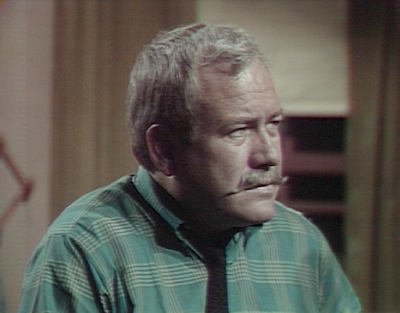
This is David Ford’s first appearance on the show since December, and he had shaved his mustache in the interim. The fake is not up to the makeup department’s usual standards. Screenshot by Dark Shadows Before I Die.
Portraits have been a very prominent part of the visual composition of Dark Shadows from the beginning, and a battlefield on which supernatural combat could be joined for almost as long. So it is hardly surprising that the show would eventually get around to doing a story based on Oscar Wilde’s The Picture of Dorian Gray.
It would seem Barnabas has little time to lose. Angelique/ Cassandra has distributed some malware to the minds of the people around Barnabas by means of a dream that one person after another will have. The first dreamer is beckoned into a Haunted House attraction by someone, opens some doors behind which there are scary images, is terrified, and cannot find relief until telling its details to the beckoner. That person then has the dream, changed in only two particulars, the identity of the beckoner and the image behind the final door. When everyone’s brain has been hacked, this worm is supposed to reset Barnabas as a vampire.
Yesterday, David had the dream, and Willie was his beckoner. Today, we open in Barnabas’ house, where Willie is paralyzed with fear. David has already told him the dream, and Willie knows he will have it. With all the previous instances of the dream, the audience had to sit through a highly repetitious dream sequence, then a scene in which the character agonizes about whether to tell the dream to the next person, and finally a speech repeating all the details of the dream. At least this time we skip the second and third of those rehashings.
Since Willie is so close to Barnabas, it seems likely that he will be the last to have the dream before it gets back to Barnabas and makes him a vampire again. So it’s no wonder that Barnabas decides it’s time for the high-stakes gamble of a burglary at Collinwood.
There’s also a scene in Barnabas’ basement. Barnabas’ vampirism is in remission because some mad scientists created a Frankenstein’s monster, whom Barnabas named Adam. They connected Barnabas to Adam in a way that drains the symptoms of the curse from Barnabas without manifesting them in Adam. Barnabas has no idea how to raise any child, let alone a 6’6″ newborn with the strength of several grown men, and so locks him up in the prison cell where he used to keep Sam’s daughter Maggie.
The imprisonment of Maggie was a dreary, unpleasant story, but Adam’s time in the cell is even harder to take. Maggie was established as a strong, intelligent person who knew her way around, she could speak, and she had many friends who cared about her. So we never quite gave up hope that she would get away and be all right in the end. But Adam has none of that. As a result, his scenes in the basement are a tale of extreme child abuse, made all the harder to watch by Robert Rodan’s affecting portrayal of the big guy’s misery.
Moreover, Maggie was a major character, introduced in the first episode and connected to everyone else. It’s unlikely they would kill her off unless the show had been canceled and they were going out with a bang. But only the people holding Adam prisoner know who he is, and Frankenstein’s monsters meet their deaths practically every time they feature in a story.
Worst of all, the show is basically very silly right now. A story about a child locked in a cell from birth can be made bearable only by joining it to some kind of deep insight into the human condition, and there is little prospect that anything like that will crop up among all the witches and vampires and other Halloween paraphernalia. My wife, Mrs Acilius, watched the whole series with me in 2020-2021. She was avidly rewatching it with me this time. But when they took Adam to the cell, she suggested I start watching it on days when I get home from work before she does. I’m sure she isn’t the only Dark Shadows fan who takes a pass on the Adam story.
This is the first episode credited to director Jack Sullivan. Lela Swift and John Sedwick took turns at the helm until #450, when executive producer Dan Curtis tried his hand at directing a week of episodes. Swift and Sedwick then returned to their usual pattern. Sedwick will be leaving in a few weeks; Sullivan, who has been with the show as an associate director since the third week, will be Swift’s alternate until November, and from #553 on will be credited as Sean Dhu Sullivan.
Today’s cast includes a vampire, a wicked witch, two mad scientists, a Frankenstein’s monster, and an irritable housekeeper. The deadly menace turns out to be the housekeeper.
In a laboratory in a house by the sea, mad scientists Eric Lang and Julia Hoffman are trying to transfer recovering vampire Barnabas Collins’ “life force” into the body of the creature Lang has built for the purpose, a creature Barnabas has named Adam. In the drawing room of the great house atop Widow’s Hill, wicked witch Angelique disrupts that attempt by sticking a pin into a clay figure that she addresses as “Dr Lang.” It is unclear how Angelique attached the clay figure to Lang, though since it has roughly the same acting ability as Addison Powell the pairing seems natural enough.
Lang gasps for air. Julia helps both him and Barnabas. Barnabas gets up from the operating table and declares he will go to the great house and stop Angelique. Lang tries to tell Julia how to carry on his work, but keeps breaking down. While Julia is out of the room getting some heart medicine, Angelique removes the pin from the clay figure. During that moment of relief, Lang is alone in the lab. He turns on his tape recorder and says that if both Barnabas and Adam live, Barnabas will be free of the vampire curse. Adam will drain it from him, but will not suffer from its symptoms. If Adam dies, Barnabas will revert to active vampirism.
Angelique resumes tormenting Lang as Julia returns to the laboratory. Lang cannot keep his breath long enough to tell Julia his message or make it clear that she should listen to the tape. Angelique says that Lang has suffered enough for tonight, and that she will put the pin away. As she is about to do so, the door to the drawing room opens and housekeeper Mrs Johnson comes in. Mrs Johnson startles Angelique, who inadvertently drives the pin through the clay figure, killing Lang.
This is the second death to which Mrs Johnson has contributed. The two cases are very similar. She unknowingly gave undead fire witch Laura Murdoch Collins the information she needed to cast the spell that killed parapsychologist Dr Peter Guthrie. Guthrie resembled Lang not only in holding a terminal degree, studying the uncanny, and doing battle with an undead witch, but also in his use of a tape recorder. In #170 and #171, Guthrie recorded the audio of a séance; in #172, Laura erased the recording and replaced it with the sound of fire; and in #185, he was on his way to get his tape recorder to use at another séance when Laura cast the spell that killed him. Mrs Johnson is a menace to a very specific kind of person.
Barnabas comes to the great house and threatens Angelique, calling her by the name “Cassandra,” the alias under which she has married sarcastic dandy Roger Collins and found a place in the house. At first he says he will burn her if Lang dies. She pretends not to know what he’s talking about, and says that she will expose him as a madman. He looks at her neck and leans in, a sign that his vampire urges are coming back. The telephone rings, and Mrs Johnson enters. Angelique/ Cassandra explains their compromising position by claiming that she was fainting; with that, she shows that her threat to air her complaints is a bluff, since she could easily have demanded Mrs Johnson call the police.
Mrs Johnson says the call is for Barnabas. It is Julia reporting Lang’s death. Barnabas makes some grim remarks to Angelique/ Cassandra, then goes back to the laboratory and talks with Julia. She is distraught, but agrees to pick up where Lang left off.
We end with a dream sequence. Angelique has loosed a “Dream Curse” on the people of Collinsport. One after another, they have the same basic dream, in each case beginning with an appearance by the next person to have the dream beckoning them into a haunted house attraction and ending with a door opening to expose something the previous dreamers didn’t see. Julia’s dream begins with Mrs Johnson, telling us she will be the next up. It proceeds with her walking through a foggy room, including a clear shot of the fog machine. It ends with the sight of a skeleton wearing a wedding dress and the sound of Angelique’s distinctive laugh, telling us that the position Angelique has gained by marrying Roger is particularly dangerous to Julia. Since Julia lives in the same house as Angelique and they know all about each other, this is not exactly a major revelation.
The dream involves the beckoner’s voice reciting a little bit of doggerel. As it goes on, some beckoners say “through endless corridors by trial and error,” others say “through endless corridors of trial and error.” I prefer “of trial and error.” That implies that the corridors are themselves made up of decisions people have made and of the consequences of those decisions. Saying that the characters are moving through the corridors “by trial and error” means that the corridors exist whether anyone engages with them or not. We saw Angelique start the curse, so we know it isn’t something that has been out there in reality all along, and it expresses itself in dreams, not in anything that persists when people stop paying attention to it. Besides, the whole idea of drama is to show decisions and their consequences, so “of trial and error” is better on every front.
Mad scientists Julia Hoffman (Grayson Hall) and Eric Lang (Addison Powell) are conferring in Lang’s lab. Lang is putting the finishing touches on a Frankenstein’s monster into which he plans to transfer the “life force” of recovering vampire Barnabas Collins. Julia, Barnabas’ best friend, has been opposed to this experiment, but now has accepted that she can’t stop Barnabas and Lang from going through with it. She volunteers to assist.
Lang is having trouble concentrating because of a nightmare he had last night. Unknown to him, the nightmare was part of the Dream Curse, a dead end storyline about wicked witch Angelique sending a dream that each of a series of people will have. When the last person has the dream, Barnabas is supposed to revert to full-on vampirism.
Lang tells Julia about his nightmare. He says that she was in it. When he tells her that she did not speak, she smiles comfortably and says that that was proof that it was a dream. This is not only a genuinely funny line as Grayson Hall delivers it, but it is an extraordinary moment of self-awareness from Julia, a character who usually exists at the outer edge of heightened melodrama. It’s a shame that Addison Powell doesn’t know how to get out of Hall’s way for the half second it would take for it really to land with the audience.
Barnabas and his ex-blood thrall Willie are at home in the Old House on the great estate of Collinwood. Willie is smirking and Barnabas is rigid with embarrassment while the dogs howl outdoors. Willie laughs a little as he makes a remark about how Barnabas hasn’t changed as much as he thought he had. This exchange reminds us of the moment in #346 when Julia and well-meaning governess Vicki noticed that some fresh flowers Barnabas touched had died and shriveled up. Like the howling of the dogs when Barnabas feels bloodlust, the shriveling of the flowers was a consequence of his vampirism, effectively a bodily function that he cannot control. He squirmed when Julia and Vicki looked at him then, and he is stiff and flustered when Willie laughs at him now.
Barnabas orders Willie to take a letter to matriarch Liz at the great house on the estate. It will explain that he is going away on a long trip, and that Adam Collins, a young cousin from England, will be coming to stay in the Old House. Willie is alarmed by this.
Willie asks what Barnabas will do if Liz won’t let him stay in the Old House when he is in the form of Adam. Barnabas is sure she will, and dismisses Willie’s doubts. This is an interesting sequence to regular viewers. The show has never made it clear whether Liz still owns the house or has signed it over to Barnabas. A whole year ago, in #223, Liz was talking to strange and troubled boy David as if the Old House and its contents were Barnabas’ legal property. Since then, there have been moments that tend to confirm that impression, as when Barnabas takes Liz’ keys to the house away from David and does not give them back to her, and other moments that conflict with it. Willie’s question and Barnabas’ response would seem to prove that the house still belongs to Liz.
Another question we might ask is why Barnabas doesn’t go to Liz himself. Certainly she will be unhappy that he went away without saying goodbye to her. Moreover, when he showed up at the great house in April 1967, Barnabas told Liz that he was the only survivor of the English branch of the family. Liz will be skeptical if another member of this imaginary branch presents himself and expects to take possession of a big mansion on her property. She has had unpleasant experiences with Willie, so much so that a letter he delivers seems unlikely to allay that skepticism.
When Willie gets to the great house, Angelique herself opens the door. She is living there under the name Cassandra. She has cast a spell on Liz’ brother, sarcastic dandy Roger, and married him so that she will have a residence at Collinwood while she works to restore Barnabas’ curse to its full potency. Showing his typical degree of strategic ability, Barnabas has not bothered to tell Willie about any of this.
Angelique/ Cassandra ushers Willie into the drawing room, sits him down, and chats with him. Willie answers her questions about Barnabas, not realizing that he has any more reason to be discreet with her than with anyone else. He tells her that Barnabas has been spending his days with Lang. Angelique/ Cassandra already knows that it was Lang who gave Barnabas the treatments that put his vampirism into remission and that Lang is preparing further treatments for him. Barnabas should know that she knows this, since she went to Lang’s house and tried to kill him. Willie also tells her that sometimes Barnabas doesn’t seem to have changed as much as you might expect. Angelique/ Cassandra’s reaction makes it clear this is new information to her, and that it might help her in her efforts.
The scene raises yet another question. Barnabas had expressed the hope that once the experiment was complete, Angelique would see that his old body was dead, would assume that meant that he no longer existed in any form, and that she would then go away and leave him alone. But he knows that she knows about Lang, and now he is planning to come back to Collinwood, where she lives, as another “cousin from England.” The question is this- how dumb does Barnabas think Angelique is?
Back in the lab, Lang and Julia are preparing for the experiment. Barnabas shows up. When he talks with the doctors, his face is reflected in the mirror above Lang’s creature. Not only does this suggest the idea of his personality moving into the creature’s body, it also reminds us that until Lang gave him his first course of treatment, Barnabas did not cast a reflection. The whole idea of Barnabas’ reflection will remind longtime viewers of #288, when Julia first confirmed her suspicion that Barnabas was a vampire by peeking at the mirror in her compact and not seeing him. That draws a contrast between Lang, whose initial success with Barnabas appears to be leading to disaster because his impersonal, hyper-masculine approach leaves him unable to recognize the threat Angelique poses, and Julia, whose own attempts to cure Barnabas of vampirism did not match Lang’s spectacular results, but whose femininity, as symbolized by the compact, represents a fighting chance against the forces that really govern this universe.
Barnabas takes his place on a bed. He tells Julia he is glad she is with him, and she smiles at him with the sad tenderness of someone saying a final farewell to a loved one. As with her self-deprecating joke in the opening part of the episode, this smile shows a new side of Julia. For a time in October 1967 she tried to launch a romance with Barnabas, and he rejected her. Hall played Julia’s unrequited love in the same larger-than-life style that the rest of her action called for. Her feelings seemed to be an outgrowth of despair- she was by that point so deeply entangled with Barnabas that there was little hope she could ever make a life with anyone else, so even though he was an active vampire, she had little to lose by committing herself to him. But this sweet little exchange is played so gently that it opens a window on a more complex inner life for Julia.
As Lang starts the experiment, we cut to Angelique in the drawing room at Collinwood. She is talking to a clay figure, calling it “Dr Lang,” and saying that it cannot overcome her powers, for they were a gift to her from the Devil himself. She jabs at the clay figure. In the lab, Lang writhes in pain, interrupting the experiment.
It was not until #450 that Dark Shadows let on that there might be anything to Christianity. In that episode, good witch Bathia Mapes held Barnabas at bay by showing him a cross. Up to that point, Barnabas had many times strolled comfortably through the old cemetery north of town, where half the grave markers are in the shape of the cross, and they hadn’t bothered him a bit. The only representatives of the faith who figured in the story were repressed spinster Abigail Collins and fanatical witchfinder the Rev’d Mr Trask, both of whom were fools whom Angelique easily twisted to her own purposes. Now we have a character named Adam, a New Adam through whom a resurrection is supposed to take place, and he is wearing a headpiece that is photographed to look like a crown of thorns. Angelique’s reference to the Devil suggests that she can be defeated only through the aid of a being more powerful than the Devil, and since we haven’t heard about Ahura-Mazda or any other non-Christian deities who represented a supreme principle of good pitted against an otherwise irresistible evil, it looks like we’re drifting Jesus-ward.
It is daring to take that direction, even if it is only for a little bit. Vampire legends are pretty obviously an inversion of the Christian story, in which a man comes back from the dead, not having destroyed the power of death once and for all, but only to die again every time the sun rises. While Jesus feeds us with his body and blood in the Eucharist and thereby invites us to share in his eternal life, the vampire feeds himself on our blood and thereby subjects us to his endlessly repeated death. That’s why Bram Stoker’s Dracula has all those crosses and communion wafers, because it is a religious story of the triumph of the promise of resurrection in Christ over the parody of that resurrection that the vampire has settled for. It also explains why Dark Shadows so studiously avoided Christian imagery for so long. Christianity is such a powerful part of the culture that once you let any of it in, it tends to take over the whole story.
There are many reasons the makers of the show would want to avoid that fate. Not least is the tendency of religions to fracture and stories based on their teachings to become sectarian. Dracula itself is an example of that; the vampire is a Hungarian nobleman from Transylvania, connected with the Szekely clan. There really was such a clan, and like other Hungarian nobles in Transylvania its members were Calvinists, supporters of the same version of Christianity that Abigail and Trask represented. Stoker was a Roman Catholic from Ireland, a country where most Protestants are Presbyterians, a tradition that grew out of Calvinism, and so his depiction of the vampire is clearly driven by sectarian animus. The Collinses have an Irish surname, settled in New England when that region was officially Calvinist, and did very well there. So it would be easy to present their troubles as a cautionary tale about Calvinism. That would seem to be a surefire way to shrink the audience drastically. Not only are there millions of Calvinists whom it would offend, there are billions of people to whom Calvinism means nothing at all, and they would be utterly bored by a denunciation of it.
The episode is daring in several other ways as well. When Barnabas and Willie were first on the show, ABC-TV’s office of Standards and Practices kept worrying that viewers might interpret their relationship, which was founded on Barnabas’ habit of sucking on Willie and swallowing his bodily fluids, as somehow homosexual. Not only is the scene between them at the Old House reminiscent of the scenes that attracted memos from that office in the spring and summer of 1967, but the whole idea of Barnabas draining his “life force” into the body of Adam would seem to invite the same concerns.
The experiment scene would only intensify such concerns. The experiment is a medical procedure that is supposed to bring a new life into the world, which by 1968 was how Americans usually thought of the process of birth. Barnabas is the patient, he is lying down, and the doctors sedate him. Thus he takes on all the medicalized marks of a mother-to-be. Julia asked Lang if the process would be painful for Barnabas; he does not disappoint, but ends the episode screaming in response to labor pains. Not only does turning Barnabas into Adam’s mother invert the expected gender performance, but it also introduces a homosexual side to Barnabas’ relationship with Lang, who is Adam’s other parent.
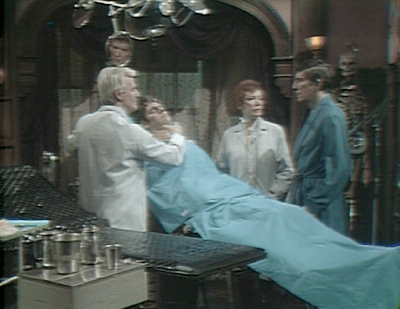
Somebody ought to be there telling Barnabas he’s doing great and urging him to push. Screenshot by Dark Shadows Before I Die.
Christian imagery and gender-nonconformity would have been rather a queasy combination for most Americans in 1968. That’s unusual, in historical terms. Before modern times, Christians didn’t hesitate to discuss ways that familiar gender roles break down in the relationship of humans to Christ. The “Fathers of the Church,” the prominent Christian intellectuals of the fourth and fifth centuries, talked about that all the time, going into depth not just with the image of the Church as the Bride of Christ but of each human soul, whether male or female, as one of Jesus’ wives, and of the physical contact between humans and Jesus in the Eucharist as a consummation of their marriage.
For their part, Calvinists tended to be skeptical of the physical aspect of the sacraments, but that didn’t mean that they shied away from conjugal metaphors to describe the relationship between the soul and Jesus. John Donne, like most priests in the Church of England in the 16th and early 17th centuries, was basically a Calvinist, yet his sonnet “Batter my heart, three-person’d God” is one of the most vivid and uncompromising statements of the ancient idea of an erotic dimension to Christian life that transcends the binaries between masculine and feminine, male and female. That tradition makes today’s conjunction of Christian and homoerotic themes all the bolder- imagine if Dark Shadows wrote itself into a corner where they had no choice but to explain nuptial imagery and mystical eroticism in the writings of Saint Ambrose. The whole audience could fit into a seminar room.
Closing Miscellany
Lang and Julia wear white lab coats. This is the first time Julia has worn a white coat. Her previous lab coat was light blue, which looks white on the black and white TV sets most households had in 1968, but now that the show is being produced in color they are buying costumes and props for color televisions.
The idea of a machine that would cause a person to go to sleep in one body and wake up in another was a big deal on TV in the 1960s. Just today I saw this screenshot from The Avengers on Tumblr:
This episode marks the first appearance of Robert Rodan. When Adam was a nameless heap of flesh under a blanket, he was played by a stand-in named Duane Morris. Rodan had a few small parts on TV shows in 1963 and 1964 and was in a couple of commercials between 1964 and 1968. Adam was his first, and last, recurring role on a series. In 1969, he appeared in a little-seen feature film called The Minx, then spent the rest of his life selling real estate in Southern California.
Well-meaning governess Vicki is in jail, about to be tried on a capital charge of witchcraft. That couldn’t happen in the New England that existed in 1795 in our timeband, but many things were possible in the world of Dark Shadows that we don’t see in ours.
Gallant gentleman Barnabas Collins has figured out that Vicki is innocent and that the real witch is his new wife, Angelique. Rather than go to the authorities with his evidence, he decides to take a more direct approach and murder Angelique. That won’t be much use to Vicki, but Barnabas can’t be bothered with details.
The longest sequence of the episode is a farce in which Barnabas pours two glasses of sherry, puts poison in the one he then gives Angelique, and tries to get her to drink. They don’t do “the old switcheroo” and mix up the glasses, but instead go with an equally hoary device of having Barnabas’ mother show up and take Angelique’s glass. Barnabas has to claim the glass is cracked and knock it from her hand.
After the failure of his attempt to poison Angelique, Barnabas opens a hidden compartment of his desk and takes out a dagger. If it weren’t for Robert Cobert’s solemn musical score, the effect would be that of seeing Wile E. Coyote open yet another crate from the Acme Corporation. He goes up to Angelique’s bedroom and lifts the dagger. Since there has been no indication that she has got into her bed, and all we see on it are a lump of covers, the audience has no reason to suppose she is in there. We end with the distinct impression that Barnabas, having barely avoided matricide, is stabbing a mattress.
We first knew Barnabas in the year 1967, when he will be a vampire and will develop from a profoundly bleak presence and an urgent threat to our favorite characters into a comic villain for whom we can’t help but feel a kind of affection as we watch him fail again and again in his elaborate schemes. In that way, his maladroit attempts on Angelique’s life today are entirely typical of the Barnabas we had met before Vicki traveled back in time in November.
In another way, this episode represents one of the biggest retcons in the whole series. Throughout his first eight months on the show, Barnabas nursed a bitter hatred for his uncle Jeremiah Collins. In the first weeks of the 1795 segment, we saw that Jeremiah eloped with Barnabas’ beloved fiancée, the gracious Josette, and that Barnabas responded to this betrayal by killing Jeremiah in a duel. When Barnabas is talking today about Angelique’s black magic, he realizes that Jeremiah and Josette ran off together only because they were under a spell, and that neither was responsible for betraying him. He has no hostility left for Jeremiah.
In the various accounts the vampire Barnabas gave in 1967 of his last years as a living being, he never mentioned Angelique. Nor did he ever say that he, Josette, or Jeremiah had been the victim of witchcraft. Instead, he had indicated that he himself had gotten involved in black magic. In #345, he told his sometime friend, mad scientist Julia Hoffman, that he became a vampire after trying to gain eternal youth, and that Josette killed herself when he offered her that eternal youth. In #358, he uses “the secret magic number of the universe,” which he had learned while studying witchcraft under a warlock on Barbados, to torment Julia. The Barnabas we met when we came to 1795 hadn’t done any of that. Until he learned the truth about Angelique, Barnabas was a man of the Enlightenment and didn’t believe that witches even existed.
Perhaps this is a change Vicki’s arrival and her bizarre behavior have wrought. The stories Barnabas tells in #345 and #358 both took place years after Josette and Jeremiah were married. So perhaps in the original timeline, with no one around yammering about what the first 73 weeks of the show were like, events moved much more slowly. The change of loves took place gradually enough that Barnabas did not feel he had to challenge Jeremiah to a duel, but he was still full of hatred and resentment. Angelique was able to cover her tracks so that no one suspected witchcraft was underway. She gradually lured Barnabas into the occult arts, perhaps giving up the idea of marrying him at some point, certainly losing his attention. By the time he brought the vampire curse on himself, the version of Barnabas in that timeline would have forgotten Angelique and would have come to be consumed by his grievance against Jeremiah. That fits far better with the April-November 1967 Barnabas than does the character we have seen so far in 1795.
Barnabas asks a key question in this episode. When Angelique says that she will always love him, he asks her what she thinks love is. She answers “Why of course I do!,” which probably means that the script called for him to ask if she knew what love was, but “What do you think love is, Angelique?” is a better question. She’s been destroying every relationship that makes him the man he is in order to have him all to herself, suggesting that if Barnabas pressed Angelique to explain what love is, she would wind up saying that it means having total control over someone. As a vampire, that’s going to be Barnabas’ working definition too, suggesting that he will be more like Angelique then than he already is now.
In this episode, the portrait of Josette is delivered to Barnabas’ home, the Old House on the estate of Collinwood. This portrait, haunted by Josette’s ghost, was the dominant presence in the Old House from its first appearance in #70 until Barnabas moved back in there in #221, and was important as a symbol of Barnabas’ obsession with Josette thereafter. The makers of the show left it on the wall of Josette’s bedroom at the beginning of the 1795 segment; we see it there in #374, but they replace it with a different portrait in #377. It’s hard to understand why it would already have been there before Josette formally became a member of the family- perhaps it was just a slip-up that it was there in #374, and they’d always planned to show its arrival at Collinwood.
Yesterday, the ghost of Jeremiah Collins started to bury wicked witch Angelique alive. Today, we see that he barely got her dress dirty. She’s lying on a mound next to the empty grave when we find her.
This is the one where Angelique marries Barnabas. It ought to be packed with incident. There is a lot of activity, but like the live burial, it doesn’t amount to much. It’s a real disappointment.
One particular weak spot in the episode is the officiant at the wedding, the aptly named Reverend Bland. Actor Paul Kirk Giles does what he can, but as soon as the Rev’d Mr B realizes that something unwholesome is going on he declares that he is getting out of the place. Apparently his conception of the duties of a pastor consists of avoiding people who might need help confronting the spiritual forces of darkness. It doesn’t matter- Bland’s squeamishness disappears after Barnabas orders him to stay and perform the wedding.
After the wedding, Angelique returns to her bedroom. There is a gift that hadn’t been there before. Opening it, she finds a music box. The music box was a big deal in 1967, when Barnabas was a vampire and he thought that a woman who listened to it would turn into his lost love, the gracious Josette. This is the first time we have seen the music box during the segment of Dark Shadows set in 1795. In 1967, Barnabas told various stories about the origin of the music box, but the one thing that remained consistent was that it was meant for Josette.
Barnabas and Josette were engaged when the 1795 segment began, but that ended when Josette and Jeremiah conceived a mad passion for each other and eloped. Unknown to Barnabas, that was the result of a spell Angelique cast in hopes of getting Barnabas for herself. Barnabas responded to the elopement by killing Jeremiah in a duel. He has told Angelique that he still loves Josette and always will, but that he knows there can never again be anything between them. Moments after he had told her that, Angelique agreed to marry him. Evidently it was to be a sham marriage.
Jeremiah’s ghost has been railing at Angelique for raising him from his grave, and apparently he wants to be avenged by making the sham marriage even shammier. When Barnabas comes into the room, he sees the music box, explodes in rage, and storms out.
In life, Jeremiah never knew that Angelique was behind his and Josette’s passion. He has evidently learned that and other of her secrets, and is using them against her. Perhaps Angelique put more of herself into him than she intended.
On The Collinsport Historical Society, Patrick McCray says that this is an important episode because Barnabas and Angelique’s wedding is the basis for some developments much later in the series. That’s true, but by the time he’s talking about the show isn’t very good any more. So I consign it to the ranks of the “Stinkers.”
Up to this point, Dark Shadows has been scrupulous about avoiding references to Christianity. Of course, that was necessary- you can more or less casually drop in an image from ancient Greek mythology, for example, because not many people put a lot of energy into wondering whether they ought to be worshiping Zeus. But Christianity is very much a live option nowadays, with the result that even a subtle allusion to it tends to take over the audience’s reaction to whatever story you’re telling and turn their reception of it into a theological debate.
It can be particularly hard to steer clear of Christian ideas when you draw elements from stories that were first told in cultures where Christianity was so heavily dominant that people simply took its major concepts for granted and used them without thinking. To take an obvious example, vampires are an inversion of Jesus. Where Jesus is the ultimate example of self-sacrifice, the vampire is a metaphor for selfishness. Where Jesus’ resurrection represents his final victory over death, the vampire’s resurrection leaves him under the power of death every dawn. Where Jesus invites us to drink his blood and eat his flesh and thereby join him in eternal life, the vampire drinks our blood and annihilates our flesh in order to subject us to his indefinitely prolonged dying. Where Jesus commands his followers to spread truth wherever they go, the vampire’s existence depends on lies and secrecy. It’s no wonder that Bram Stoker’s Dracula is all about people using crucifixes and communion wafers to contain and destroy the sinister Count.
The scene that closed Friday’s episode and that is reprised in today’s opening is, I think, the first to include a recognizable allusion to the Christian story. In the Gospels, the first human being to learn that Jesus has been resurrected is Mary Magdalene. She learns this when Jesus interrupts her attempt to mourn his death and calls her by name, and that act of naming creates a new kind of relationship between them and a new place for her in the history of the cosmos. In Dark Shadows, the first person to find out that Barnabas Collins is a vampire otherwise than by becoming his victim is Dr Julia Hoffman. Barnabas learns that Julia has caught on to him when she interrupts his attempt to kill her and calls him by name, and that act of naming creates a new kind of relationship between them and a new place for her in the narrative arc of Dark Shadows.
Furthermore, Jesus had, before his death and resurrection, freed Mary of seven demons who possessed her. The memory of that past liberation was the original basis of her devotion to him. In this scene, Julia, as the anti-Mary Magdalene, promises that she will free Barnabas of the force that has made him a vampire. Hope for that future liberation is what stops Barnabas from murdering Julia, and will become the basis of their initial collaboration. Julia’s promise is not based in any claim of divine power, but in a lot of pseudo-scientific gibberish derived from the 1945 film The House of Dracula, in which a mad scientist tries to cure Dracula of vampirism by an experimental treatment that involves the participation of several other characters from Universal Studios’ existing intellectual property. The echo of the Mary Magdalene story also evokes the “meddling in God’s realm” theme of that and the other monster movies Universal made in the 1930s and 1940s.
Julia is not the first scientist on Dark Shadows to offer to help an undead menace to rejoin the world of the living. That was Dr Peter Guthrie, parapsychologist, who in #184 told blonde fire witch Laura Murdoch Collins that if she would stop trying to incinerate her son, strange and troubled boy David Collins, he would help her. Laura laughed at Guthrie’s offer, and when he said that his research into conditions like hers “has been my life,” she remarked that she found his choice of words strangely apt.
As a humanoid Phoenix, periodically burning herself and her sons to death and then reappearing in a living form, Laura was not part of any mythology as familiar and well-articulated as are the vampire stories from Bram Stoker, Universal Studios, or Hammer Films. The only really well-known thing about Phoenixes, beyond their rebirth from ashes, is their elusiveness. That the Fire Bird can be seen alive or not at all is a recurring theme of medieval and early modern literature based on Celtic and Germanic folklore, and a reason why the Phoenix is so often associated with the mysterious realms that figure in the legends of the Holy Grail. It is essential to Laura that we cannot understand what she is thinking, or even be sure if she has an inner mental life at all. Not only can Laura not give up her plan to burn David alive and retain a sense of menace. If we so much as catch her thinking about Guthrie’s offer, she will cease to be any kind of monster. So it is no surprise that she responds to Guthrie by killing him the moment opportunity presents itself.
Vampires, by contrast, combine decades of prominence in popular culture with a deep resonance for those who identify with their individual compulsions and social isolation. That gives storytellers a whole warehouse of resources to use when shaping a vampire into an image in which the audience can recognize themselves. So when Julia tells Barnabas that she has spent her whole life looking for someone like him to use as an experimental subject, he doesn’t have to make a snappy remark like that Laura made to Guthrie. He takes it in, and spends the rest of the episode weighing whether to cooperate with Julia or kill her.
Barnabas takes Julia back to his house. While she is in the basement picking out a room to use as a laboratory, Barnabas tells his sorely bedraggled blood thrall Willie that he has decided to kill her after all. Willie protests, and Barnabas goes back and forth on the question. When Julia comes back upstairs, Barnabas sends Willie away.
As Barnabas moves in to kill Julia, she tells him that her survival guarantees his. She explains that this is because his former victim, Maggie Evans, The Nicest Girl in Town, is not dead as everyone has been told, but alive and well-hidden. Maggie is suffering from amnesia covering her time with Barnabas. Julia is Maggie’s psychiatrist, and if Barnabas cooperates with her experiment she will see to it that Maggie does not recover her memory.
From our first glimpse of Julia in #265, she has been a mysterious, forbidding figure, harsh with Maggie and indifferent to the usual norms of medical ethics. But she is, after all, a doctor, and so we’ve been willing to give her the benefit of the doubt. Now that we’ve heard her tell the vampire that she will abet his crimes by using her professional skills to ensure that Maggie’s psychological injury will not heal, we realize that she is not a maverick, but a mad scientist.
Again, the echo of the story of Mary Magdalene in the opening adds to the shock of Julia’s willingness to betray Maggie at the end. Mary was Jesus’ most faithful disciple, accompanying him to the cross when the men he had called were all busy denying him and looking for places to hide. It is also traditional among Eastern Orthodox, Oriental Orthodox, and Roman Catholics to name her in prayers for healing, because of old stories that she had healed people of blindness, mobility impairments, and leprosy, among other conditions. So Mary Magdalene is the most trustworthy of healers, and it is startlingly appropriate that Julia, as her exact opposite, is the least.









 Dark Shadows Commentary