Episode 665: Burn, witch, burn!

Vampire Barnabas Collins has traveled back in time to the year 1796 in order to save well-meaning governess Vicki Winters from being hanged. To his disappointment, she was hanged yesterday, and now appears to be dead. The audience knows that wicked witch Angelique intervened so that Vicki would survive the hanging and appear to be dead so that she can be buried alive. Angelique explains at the beginning of today’s episode that she will lift the spell once Vicki is in the ground so that she can die a slow, painful, terrifying death.

When Barnabas left 1969 on his mission of mercy, matriarch Elizabeth Collins Stoddard had been dealing with the effects of a curse Angelique cast on her in 1968 that caused her to be obsessed with a fear of being buried alive. In fact, Liz appeared to have died, and was in a coffin. That story was unexciting when it was introduced, and had been dragging on for months and months.

Regular viewers may sigh when they see that Angelique is still hung up on the idea of live burial, but this time the whole thing moves very swiftly. Angelique goes to Barnabas in the tower room of the great house of Collinwood. She tells him Vicki is still alive and that if he goes away with her she will save her. He disbelieves her, and signals his servant Ben to rush in with a burning torch and immolate Angelique. Lara Parker enjoys the part of the burning Angelique so hugely that I laughed out loud watching it, but that didn’t detract from the episode. On the contrary, the joy Parker took in performance was one of the most appealing things about her.

Angelique’s dying screams attract the attention of a long-term guest in the house, the Countess DuPrés. The countess goes to the tower room to investigate, and catches sight of Barnabas. The countess had seen Barnabas die, and is shocked that he appears to be alive. She talks with perpetually confused heiress Millicent Collins, who has also seen Barnabas and who has discussed him with her husband, roguish naval officer Nathan Forbes. The countess gathers from what Millicent says that Barnabas is a vampire. This doesn’t quite fit with the previously established continuity- Barnabas returned to a night sometime after the events of episodes 449-451, when the countess helped Barnabas’ father Joshua in an effort to free Barnabas of his curse. It seems rather unlikely that it would slip the countess’ mind that Barnabas is a vampire. At any rate, this time she vows to destroy him at the first opportunity.

When Angelique is destroyed, her spell is broken and Vicki revives. Barnabas goes to the drawing room of the great house and is astounded that Vicki is alive. We may wonder if he would have gone away with Angelique had he known she was telling the truth when she said Vicki was not really dead. He urges Vicki and her boyfriend, the irksome Peter Bradford, to go away as quickly as possible, as far as possible. Vicki asks for a few seconds alone with Barnabas; Peter leaves them, and she tells Barnabas that she will always feel close to him. She gives him a little kiss, and rushes off. Barnabas was hung up on Vicki for a long time; his facial expression as he watches her leave with another man suggests that he has for the first time managed to perform a selfless act. It’s a lovely moment. I only wish Vicki had been played by Alexandra Moltke Isles, who played the part for the first 126 weeks of Dark Shadows, instead of Carolyn Groves. Miss Groves wasn’t a bad actress, but if the goal is to give the character some kind of closure it is unsatisfying to see her as someone who only had the part for three episodes as opposed to the person who was there in 335.
Barnabas sees Vicki go.

Barnabas sees that the time has come to return to 1969. Ben does not know that Barnabas has traveled through time; as far as he knows, he was there all along. But when Barnabas announces he will be leaving, Ben insists on following him. Ben stands by and watches while Barnabas stands in a graveyard and calls out to his friend Julia. Ben does not know who Julia is, any more than he knows that Barnabas was standing on this same spot in #661 when he left 1969. Neither he nor Barnabas knows that the countess and Millicent are spying on them from the bushes.

Barnabas keeps calling out to Julia, but nothing happens. Barnabas decides that he will have to make the trip to the 1960s the same way he did before- as a vampire chained in a coffin hidden in the secret room of the Collins family mausoleum. He takes Ben to that room, and tells him to chain the coffin up after dawn. He tells him they will never see each other again. In its own way, this farewell is as poignant as the one Barnabas shared with Vicki. It is also shadowed with menace, as we see the countess and Millicent still watching.

The next morning, the countess comes to the mausoleum with Nathan. It is a bit puzzling to see Nathan. The night before, Barnabas bit Nathan and forced him to confess to many serious crimes; we last saw him in gaol. Yet here he is, not only free but wearing his federal coat with officer’s braid. The countess says that she got him out of gaol to stake Barnabas. Even in Soap Opera Land, this is a bit of a stretch. It’s an even bigger stretch that, having been under Barnabas’ power, Nathan is now able to stake him.

Nathan is holding the stake over Barnabas’ heart and raising the hammer when the lights go down. We hear a loud bang, and the episode ends.

In his post about this one at the Collinsport Historical Society, Patrick McCray outlines its slam-bang plot, full of sudden reversals and poignant farewells. Patrick does such a great job of capturing the verve and joy of this Genuinely Good Episode that I wondered whether I should even bother writing a post about it. At the opposite extreme, Danny Horn’s post on Dark Shadows Every Day was so full of irritable complaints about continuity problems and other imperfections in Ron Sproat’s script that I was inclined to write a long and impassioned defense.

But I will leave the debate to the two of them. I’ll just say that if anyone is curious about what Dark Shadows is like and wants to watch a single episode to get the flavor of the thing, this would be as good a choice as any.

Episode 662: The course of history

Vampire Barnabas Collins has traveled back in time to the year 1796, where he plans to change what happened on one crucial night.

Yesterday’s episode was a clip show excerpted from #456-#460, the last full week of a period when Dark Shadows was a costume drama set in the 1790s. Today’s consists largely of reenactments of those scenes. It all pays off in the last minute, when a confrontation between Barnabas and roguish naval officer Nathan Forbes ends differently than it had the first time round. As before, Nathan loads a crossbow with a wooden bolt and waits for Barnabas to come to him, hoping that he will shoot the bolt through Barnabas’ heart and thereby achieve the same effect as a wooden stake. The first time, Nathan missed Barnabas’ heart and Barnabas killed him. Unlike the first time, Barnabas knows what Nathan is planning. So he opens the door, but does not enter the room. Nathan can hear Barnabas’ voice, but cannot see him. Finally Barnabas jumps Nathan from behind, evidently biting him.

Barnabas originally killed Nathan as revenge for Nathan’s role in his mother’s death. This time he is willing to let Nathan live. He wants to take control of him and force him to tell the authorities that he lied when he testified against governess Victoria Winters and her boyfriend, an unpleasant man named Peter. Victoria is herself a time-traveler, and Barnabas got to be quite fond of her in her original period, the 1960s. She is scheduled to be hanged tonight for her many crimes, and Peter is also condemned to the gallows. Barnabas has come to rescue them.

During the opening title sequence, Thayer David announces that “Today the part of Victoria Winters will be played by Carolyn Groves.” When we first see her, Victoria is asleep in her cell at the Collinsport gaol, and her face looks very much like that of Alexandra Moltke Isles, the original Victoria.

A rude awakening for Vicki C. Screenshot by Dark Shadows Before I Die.

Barnabas wakes Victoria. She is puzzled to see him. He has never told her that he was a vampire; even when he was biting her on the neck and sucking her blood for a week in March 1968, she didn’t seem to catch on. She just seemed to think he had a particularly aggressive make-out technique. She thinks that the Barnabas she knew in the 1960s was a descendant of the one she knew in the 1790s, and that the one from the 1790s is dead. Barnabas would rather not get into the weeds about his personal history, such as the countless murders he has committed, and gives Victoria a truncated account of how he, the man from the 1790s, is laboring under a curse that made it seem that he was dead. He doesn’t explain how he got into her cell, how he knows who Peter is, or how he plans to free the two of them from their death sentences. He asks her to take all of that on faith.

Miss Groves plays Victoria as so happy to see Barnabas she smiles all through her account of her imminent and, she believes, inevitable execution. That’s odd to see, but it fits so perfectly with the delight Victoria always took in Barnabas’ company that it shouldn’t bother longtime viewers.

Mrs Isles was cast as the original Victoria in large part because she looked so much like Joan Bennett that Bennett famously mistook her for her daughter when she first saw her. In the Collinsport Historical Society’s 30 December 2017 post for this episode, Patrick McCray not only tells us that Miss Groves appeared in a play with Joan Bennett in 1960, but provides a still of the cast in which the two women look like they could be mother and daughter:

Screenshot from The Collinsport Historical Society, 30 December 2017.

The show spent much of its first year hinting heavily that Victoria was the unacknowledged daughter of Bennett’s character, matriarch Elizabeth Collins Stoddard. They never collected those hints and built them into a story, and the question of Victoria’s parentage was left as one of Dark Shadows’ most annoying loose ends. Perhaps Miss Groves’ casting is a sign that the failure to resolve that question bothered the makers of the show as much as it did the audience.

Episode 632: A new mate

Two arcs overlap today. Suave warlock Nicholas Blair is in one that is coming to its end, while mysterious drifter Chris Jennings is in one that is beginning.

The fansites I consult when I write these posts vary in how much detail they give about what happens in the episodes. At one pole is John and Christine Scoleri’s Dark Shadows Before I Die, which gives detailed summaries of every plot point, usually illustrating each with at least one screenshot. Their post about this one is no exception.

At the other pole is Patrick McCray and Wallace McBride’s Dark Shadows Daybook. They typically present a brief essay about one key point in an episode. Halfway between the two is Danny Horn’s Dark Shadows Every Day, which occasionally drifts towards one or the other of those extremes and occasionally disregards the episode altogether to focus on some other Dark Shadows related topic, but which as a rule focuses on two or three points and weaves them together as it runs through an overview of the day’s narrative outline. It’s a sign of the thickness of today’s story that not only Danny’s post, but even Patrick’s, approaches a Scoleri-esque level of retelling.

Nicholas is under orders from his boss, Satan, to do two things in a very short time. He must sacrifice Maggie Evans, The Nicest Girl in Town, in a Black Mass. For this, he will be rewarded with Maggie’s eternal companionship in Hell. He doesn’t exactly seem happy about this, but he does drug Maggie, dress her up, and put her on an altar, so it seems like he’s going to comply.

Nicholas’ other task is to create a humanoid species entirely subject to the spiritual forces of darkness. This would seem like a big project, but he already has a start on it. A male Frankenstein’s monster known as Adam lives in his house, and at Nichol;as’ bidding Adam has coerced mad scientist Julia Hoffman and her friend, old world gentleman Barnabas Collins, to revive a female of the same breed known as Eve. As their names suggest, Adam and Eve are to be the parents of this new race of people.

Nicholas finds that Adam has grown reluctant. Eve needs reviving because Adam killed her the first time she was brought to life. She hated Adam and rebelled against Nicholas’ command that she mate with him, and at the end the big guy murdered her. Adam says that if Eve comes back to life with the same personality, he will kill her again. Nicholas tells Adam that the reason Eve was so hard to live with was that the woman who donated the “life force” Julia used to animate her was evil, and that the woman who takes that role when Eve is brought back to life will be very sweet and loving. When Adam is skeptical, Nicholas tells him that Maggie will donate the “life force.” Knowing Maggie, Adam finds this acceptable.

Nicholas doesn’t have time to recruit any other woman, since the experiment must take place tonight. It seems he must be telling Adam the truth about Maggie. Perhaps he will take her to Barnabas’ basement and tell Julia to hook her up to the machinery. But even before the end of the episode, when we see her on the altar, her throat apparently about to be cut, it puzzles returning viewers how this can be. Yesterday Barnabas forced Nicholas to promise he would not harm Maggie in any way, and said that he and Julia would not continue working to revive Eve unless he honored that promise. So it is a mystery how he can expect them to cooperate if he shows up with Maggie and tells them to subject her to a procedure that is more likely than not to kill her.

Meanwhile, Chris is visiting his little sister in the hospital. The hospital is Windcliff, a sanitarium about a hundred miles north of Collinsport; Julia is its nominal head. The sister was first mentioned in #627; her name was “Molly” then. It’s “Amy” now. There’s good precedent for such an identity change. When Julia was first mentioned in #242, she was simply “Dr Hoffman,” and she was “one of the best men in the field” of rare blood diseases. A change from “Molly” to “Amy” isn’t so drastic as that.

Amy reacts blankly to Chris. He offers her a box of paints. He tries to get her to say something in response; at length, she replies “Why didn’t you come before?” He doesn’t have a satisfactory answer to that, and she says “You did what you had to do. You brought me the present. You can go now.” He looks for words to express his wish that he could be with her, and all she hears is that he is about to go away again. He breaks down and promises to stay “right here in Collinsport.” Regular viewers will recognize that as a continuity error, but if we imagine it to be a slip on Chris’ part it is intriguing- he has been so far away for so long that any location in Maine seems like Collinsport. He repeats his promise, and finally she throws her arms around him, bursts into tears, and pleads with him to stay.

This is our introduction to Denise Nickerson. In the hands of another actress, Amy’s transition from suspecting Chris to embracing him could have seemed very pat indeed, but she is so utterly cold to him in the first part of the scene, so subtle in showing signs of hope in the middle of it, and so abrupt when time comes to warm up, that the whole thing plays as a real surprise. When we see that she has those skills, we can be confident that the show will be in good hands as long as Nickerson is part of the cast.

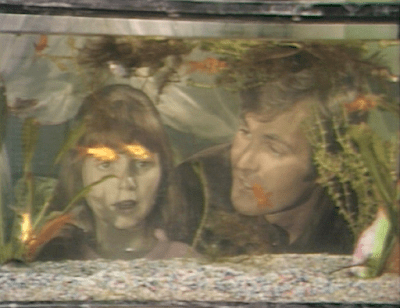
Nickerson and Don Briscoe play part of their scene behind an aquarium. We last saw that aquarium in #276. In that one, we were supposed to be uneasy about Windcliff and about Julia as its director. When we saw her feed the fish, it was a metaphor for her role as the mistress of a strange, self-contained little world whose inhabitants were at her mercy. Julia has been living on the estate of Collinwood for well over a year now, and the only member of Windcliff’s staff whom we see today is a nurse whose bit part was a prize given to beauty contest winner Bobbi Ann Woronko. So our attention is directed not to whoever is in charge of the place, but to Nickerson and Briscoe’s faces distorted in the water as the goldfish pass in front of them. This is rather a heavy-handed way of telling the audience that they are, each in their own way, as much prisoners as are the fish.

In the tank. Screenshot by Dark Shadows Before I Die.

Chris has seen the weather report in the newspaper and realized that the moon will be full tonight. This alarms him. Back at the Collinsport Inn, he asks the innkeeper, whom longtime viewers met in #1 and know as Mr Wells, if he can change his room. He wants the most isolated room in the place. He also wants Mr Wells to lock the door from the outside and to leave the door closed no matter what he hears inside. Mr Wells is reluctant, but agrees to all of these conditions.

Even viewers who stumbled onto Dark Shadows never having heard of it would know from what we have seen between Maggie and Nicholas that it is a horror story. Those who have been to the movies will add Chris’ status as a mysterious drifter to his alarm at the full moon and his request to be locked up and left alone no matter what Mr Wells may hear and will come up with the irresistible conclusion that he is a werewolf. They will also be sure that Mr Wells will eventually decide the sounds coming from behind the door are so terrible he cannot leave Chris alone, and that when he unlocks it Chris will kill him. Of course this is exactly what does happen. Our last shot of Mr Wells shows his face streaked with red and blue markings. The red ones presumably signify blood, and the others signify that most TV sets in the USA in 1968 received only in black and white, so blue lines would look like bruises.

Blue and red. Screenshot by Dark Shadows Before I Die.
The same shot in black and white.

Mr Wells, played by veteran character actor and future TV star Conrad Bain, had last appeared in #61. That was one of the longest gaps between appearances by a cast member, though the record belongs to Albert Hinckley, who like Bain appeared in #1. Hinckley, a train conductor in that one, will return playing a doctor in #868. That’s quite an extended absence from the show, but a remarkably short period to make it all the way through medical school, he must have been very bright.

Also in #1 was Alexandra Moltke Isles as well-meaning governess Victoria Winters; Mrs Isles left the show three days before this episode was taped. Victoria was Dark Shadows’ chief protagonist for its first year, and Mrs Isles’ presence in the cast was a powerful reminder of the show’s history even after the character was relegated to the sidelines of the action. Combining her departure with Mr Wells’ on-screen death, it might seem plausible that Maggie, another survivor from the first episode, might really die on Nicholas’ altar.

Episode 568: The unchaperoned

In May 1967, seagoing con man Jason had for long months been blackmailing matriarch Liz into letting him stay at the great house of Collinwood. He told Liz that people in the village of Collinsport were starting to talk about the presence of an unmarried man in her house. He informed Liz that they would solve this problem by getting married. She laughed in his face, but he pressed his threats to expose her terrible secret, and they were in the middle of a wedding ceremony when Liz broke down and announced her secret to everyone. It then turned out that there never really was a secret- the whole thing was a sort of misunderstanding. A few days later, Jason was dead, and he hasn’t been mentioned since March 1968.

Today, Liz’ brother Roger shows up at the Old House on the estate, home of their distant cousin Barnabas. He is looking for Julia, a permanent houseguest who settled in at the great house a few weeks after Jason disappeared. Barnabas, a bachelor, tells him that Julia is staying with him for a few days. Roger’s startled response makes it clear that the mores Jason mentioned in #243 have not changed. But Roger is not in a position to insist on propriety, and he has come on an urgent matter. Liz has escaped from Windcliff, the mental hospital of which Julia is the nominal director, and he wants her to come back with him at once to the great house so that she can consult with her staff on the telephone.

Roger is momentarily stunned to learn that Julia is sleeping at Barnabas’ house.

Barnabas tells Roger that Julia is ill and cannot help him. He insists, so Barnabas goes up to her bedroom. Not only does he tell her about Roger and his news, but he also informs her that he earlier found an unpleasant man named Peter who prefers to be called Jeff in the basement. Since the basement houses a lot of technical equipment and a stolen corpse which they are planning to use as material for a Frankenstein’s monster, Julia finds this alarming. But Barnabas has talked Peter/ Jeff into helping them with their little arts & crafts project, and he assures her that he has Peter/ Jeff under control.

Julia is in fact ill, and she tells Barnabas she cannot see Roger. Julia has been bitten by a vampire named Tom. Barnabas, a recovering vampire himself, plans to use her as bait to lure Tom into the bedroom tonight so that he can shoot him with a silver bullet. He explains to her that he took a candlestick to the local silversmith earlier this morning and that the silversmith melted it down and forged five silver bullets. No wonder people are reluctant to leave Collinsport, even much bigger places don’t have same-day service like that.

We cut to the basement, where Julia is wearing her lab coat. Barnabas tells her it is 5 PM. There is no sign they have been working on the project; for all we can tell, they waited around her bedroom all day and decided to get to work shortly before sundown. Peter/ Jeff enters and reports for work. They tell him to work on a particular piece of equipment. Barnabas takes Julia back up to her bedroom, leaving Peter/ Jeff alone with the corpse. Since he was just recruited for the project, this shows a remarkable degree of confidence in his loyalty.

Julia is sitting in a chair and Barnabas is hiding in the closet when Tom materializes. Julia puts herself between Barnabas and Tom, and Tom vanishes. Julia apologizes; Barnabas knows enough about the compulsions that afflict the vampire’s victim that he does not seem to be really upset with her. He frets that they will never have such a good shot at Tom again now that he knows to be on his guard. He looks out the window and thinks he sees Tom on the lawn. He turns, and finds that Julia, too, is gone. He realizes that she must now be alone with Tom.

In his Dark Shadows Daybook post about this episode, Patrick McCray makes some apt remarks about the acting. As Barnabas, Jonathan Frid starts the episode with an unusually self-assured tone in his confrontation with Peter/ Jeff. That’s what the scene calls for, since we need to believe that Barnabas’ force of personality is sufficient to overpower Peter/ Jeff’s aversion to the gruesome project. But it all falls apart about halfway through, when Frid has some line trouble, and as a result we wind up listening to the arguments with which Barnabas defends his position. Patrick doesn’t say anything about those arguments, but on Dark Shadows Every Day Danny Horn does a fine job explaining how utterly unconvincing they are.

Playing Julia as an addict needing a fix, Grayson Hall falls far short of her usual standard, but Patrick doesn’t blame her: “These are the heavy blinking, o-mouthed, head vacillating performances that critics of Hall use against her. I don’t call it bad acting… there’s only so much you can do with a cartoon. But seeing Julia like that is always evidence of a questionable match.” I like the tenderness Barnabas and Julia show each other in their scenes yesterday and today; for me, Barnabas’ earnest concern for Julia and her quiet trust in him outweigh the deficiencies in Frid’s memory for dialogue and Hall’s attempt to show Julia’s weakness. But those deficiencies are impossible to overlook, unfortunately.

Episode 557: Unannounced visitors

Act One consists of recovering vampire Barnabas and mad scientist Julia standing around Barnabas’ front parlor recapping various ongoing storylines.

Danny Horn devotes his post about this episode to a detailed analysis of this scene. He shows that Jonathan Frid’s performance and Grayson Hall’s are open to many objections. They fall short in such technical categories as “knowing their lines” and “standing on their marks” and “having the slightest idea what is going on.” But they are fascinating to watch nonetheless. Danny declares that “[t]he point of these scenes is to see how long two adults can stand around in a room saying preposterous things to each other.” Frid and Hall operate at such a high level of tension that the prospect of either of them breaking character generates enough suspense to keep us on the edge of our seats.

Patrick McCray wrote two separate posts about this episode. In the one that went live 13 September 2017, he too focuses on the performances in Act One. He writes:

Poor Jonathan Frid. He must have had a rough night. I am usually oblivious to his infamous (and completely understandable) line trouble, but in this one, it is so palpable that I totally understand why he retired from TV after DARK SHADOWS left the air. In his early dialogue with Grayson Hall, you can see sheer terror in the eyes of both performers as Barnabas haltingly recalls a trip to the hospital. This is followed by the “Frid Surge,” where Barnabas becomes far more committed and energetic when he turns to face the teleprompter. Of course, this gives him that great sense of vulnerability that was the secret to Barnabas’ success. 

Patrick McCray, “The Dark Shadows Daybook: August 13,” posted on the Collinsport Historical Society, 13 September 2017.

This is the only post on the Collinsport Historical Society tagged “Frid Surge”; that’s too bad, I’d like to see that phenomenon tracked throughout the series. I should also mention that Patrick goes on in this post to express his “confidence that Frid could have acted the doors off the collected ensemble had the poor guy just been given another frickin day to study his sides.”

Barnabas and Julia’s recap scene ends when an unexpected visitor barges in. He is an unpleasant man named Peter, who prefers to be called Jeff. Peter/ Jeff is fiancé to well-meaning governess Vicki, whom Barnabas and Julia know to have been abducted by Frankenstein’s monster Adam. Adam came to Barnabas’ house yesterday and threatened to kill Vicki unless Barnabas and Julia created a mate for him.

Peter/ Jeff was assistant to Eric Lang, the mad scientist who created Adam, and he knows that Barnabas and Julia were connected to the experiment. He does not know for sure that Adam is Lang’s creation, that Barnabas and Julia brought Adam to life after Lang’s death, or that Adam has abducted Vicki. He does, however, have grounds to suspect that each of these things might be true. In this scene, he announces his suspicions to Barnabas and Julia. They huddle in one corner of the room while he shouts his lines in his singularly irritating voice. They deny all three of his points. One of the commenters on Danny’s post, “Straker,” summed up their reaction admirably:

Frid and Hall were too professional to show it but I sensed they were both annoyed when Roger Davis marched in and started yelling. It’s kind of like how you feel when you’re at a party and the host’s five year old son throws a tantrum. Sort of an embarrassed tolerance.

Comment left by “Straker” at 6:21 am Pacific time 31 July 2020 on “Episode 557: A Race of Monsters,” by Danny Horn, Dark Shadows Every Day, 1 January 2015
Roger Davis as Peter/ Jeff, in one of the most subtle moments of his performance. Screenshot by Dark Shadows Before I Die.

After Peter/ Jeff’s scene, it is Barnabas’ turn to be an unwelcome guest. He calls on occult expert Timothy Eliot Stokes. Barnabas and Julia suspect that Stokes may be the evil mastermind who has turned the previously gentle Adam toward evil plans. When Stokes hears Barnabas knocking on his door, he looks up and rasps to himself “Go away… No one is home…” This is one of my favorite lines in the whole series. Stokes was quite cheerful when he first involved himself in the strange goings-on, but as he has found himself drawn deeper and deeper into the unholy world of Collinsport he has come to regret his decisions.

Stokes is quite impatient with Barnabas’ demands that he tell him what he knows and his refusal to reciprocate with information about himself. It is only because Vicki is in danger that Stokes tells Barnabas anything at all.

Stokes already knows how Adam came into being, and Barnabas tells him about Adam’s conversation with him. This brings up a question about the scene with Peter/ Jeff. Why couldn’t Barnabas and Julia have trusted Peter/ Jeff with as much information as Barnabas here gives Stokes? Peter/ Jeff can no more go to the police than Stokes can, he will not tell Vicki anything about Lang’s experiment, and Barnabas and Julia have no reason to suspect him of being behind Adam’s turn to evil. These questions don’t come to mind during the scene with Peter/ Jeff, partly because he is so disagreeable a presence that we want him off screen as soon as possible, and partly because it has long been Barnabas’ habit to tell his enemies everything he knows while he zealously guards his secrets from potential helpers.

Patrick McCray’s second post about this episode, published 30 July 2018, includes an analysis of Thayer David’s portrayal of Stokes:

Professor Eliot Stokes gains fascinating dimension in 557. Normally, jovial and helpful, we see his protectiveness of Adam reveal an irascible and sternly just man within. Anton LaVey extolled “responsibility to the responsible,” and there are few other places where Barnabas gets both barrels of that. Stokes is perhaps the most inherently good man in Collinsport since his fellow freemason, Bill Malloy, took his last diving lesson. (Ironically, at the hands of Thayer David’s first character.) Stokes’ prime reason for siding with Adam and not Barnabas? The former vampire and Julia have withheld vital information for months. Yes, they have necessary trust issues, but this is Stokes we’re talking about. Adam may be a wildly unpredictable man-beast, capable of leveling Collinsport to sand before breakfast, but he’s also (until later in the episode) a prime graduate of Rousseau’s Finishing School for Noble Savages. He’s nursed greedily on the milk of morality that spurts abundantly from the ripe and straining teat of of Eliot Stokes’ moral tutelage. It takes a Nicholas Blair — so often Stokes’ foil — to teach him the less savory lessons in humanity. Stokes knows that there’s only so much danger in which Adam can find himself… Victoria Winters is another matter.

Patrick McCray, “The Dark Shadows Daybook: Episode 557,” published on The Collinsport Historical Society, 30 July 2018

Barnabas passes the baton to Stokes, who becomes the third character in the episode to pay an unwelcome visit. He goes to Adam. He asks the big guy who has taught him to be cruel and amoral, and gets nothing but lies in return. He tries to persuade him that he must not hurt an innocent person, and Adam angrily declares that it is “fair” for him to make Barnabas watch him kill Vicki if Barnabas will not make a mate for him.

In Patrick McCray’s 2017 post, he praises Robert Rodan’s performance as Adam:

Robert Rodan issues a highly cerebral, emotionally packed performance. Rodan never receives the credit he deserves. Much of Adam’s stint on the show finds him equipped with an eloquent, even sesquipedalian command of the language. His inner conflict is as existential as it gets… Where do you turn? Rodan balances this absurd chimera of conflicts with effortless aplomb that makes Cirque du Soleil look as clumsy as a Matt Helm fight scene.

Patrick McCray, “The Dark Shadows Daybook: August 13,” posted on the Collinsport Historical Society, 13 September 2017.

Patrick amplifies that praise in his 2018 post:

Robert Rodan is an unsung hero of an actor, delivering his existential angst with passion and truth. It’s a shame that his identification with an eventually unpopular character was probably a factor in Rodan not being recycled by Dan Curtis, despite being the dark-haired, blue-eyed “type” that typified the ruggedly handsome, DS norm (such as Selby, Lacy, Crothers, George, Ryan, Prentice, Storm, Bain, etc.)

Patrick McCray, “The Dark Shadows Daybook: Episode 557,” published on The Collinsport Historical Society, 30 July 2018

While I always found the sight of Conrad Bain a guarantee of a fine performance, I can’t say it ever occurred to me to class him as “ruggedly handsome” in the way that one might class the other men Patrick lists. There’s no accounting for taste, I suppose.

Episode 525: Tree in the forest

Beginning in #365, well-meaning governess Vicki Winters spent nineteen weeks in the 1790s. Ever since Vicki brought Dark Shadows back to a contemporary setting in March 1968, the show has been dealing with the consequences of her journey.

Today, we open with a dream sequence. The boyfriend who followed Vicki from the 1790s, a man named Peter, came to the twentieth century with total amnesia and a belligerent personality that kept him from listening when Vicki tried to explain who he was. His dream is about people and events from 1796, and it finally breaks down his insistence that he is someone else. That insistence was never at all interesting- it wasn’t as if his name were Watt Iduno Hu, in which case he and Vicki could at least have done a version of Abbott and Costello’s “Who’s on First?” But now that it is over, there are no obstacles at all between Peter and Vicki, and no reason for either of them to be on the show.

Meanwhile, suave warlock Nicholas Blair has carried a portrait of wicked witch Angelique from the bedroom where he is staying in the great house on the estate of Collinwood down to the drawing room. He makes a tremendous display of effort as he concentrates on the portrait, talks to it in an urgent voice, and makes many movements with his hands, all in an attempt to make contact with Angelique’s spirit so that he can reconstitute her body. Vicki walks in on him as he is doing this, and he breaks off, embarrassed. He finds out that Vicki owns the portrait, and she refuses him permission to borrow it.

Nicholas caught in the act.

Later, Nicholas finds out about Vicki’s visit to the 1790s. He is intrigued that in those days the same witchfinder who has disincorporated Angelique mistook Vicki for a witch and tried to perform an exorcism on her. He decides that the spot on which this rite took place must be the same as that where Angelique’s ashes are now deposited. So he casts a spell on Vicki, causing her to lead him to the place.

Other fansites feature complaints that Nicholas could just have cast a spell on Vicki during their first scene together. In his post about the episode on Dark Shadows Every Day, Danny Horn writes of their first scene that “Nicholas actually has the power to mesmerize Vicki and get her to do whatever he wants, so technically he could just put the whammy on her right now, and tell her to clear the room.” And on Dark Shadows Before I Die, Christine Scoleri wonders “If Blair could make Vicki ‘listen and obey’ so easily, then why didn’t he just make her give him the portrait instead of getting all pissy when she refused to loan it to him?”

That didn’t bother me. When Vicki walked in on Nicholas in the drawing room, he was straining himself to make contact with the spirit of Angelique. He again puts himself deeply into his mumbo-jumbo when he casts his spell on Vicki. So it seemed perfectly reasonable to me that he couldn’t just drop what he was doing with the portrait and go directly into another spell.

The obvious sexual symbolism of the scene in the drawing room reinforces that point. On the Dark Shadows Daybook, Patrick McCray describes the display Nicholas makes while interacting with the painting depicting his putative sister as suggestive of incestuous feelings;* and the awkwardness Humbert Allen Astredo and Alexandra Moltke Isles bring out when Vicki walks in on Nicholas getting all worked up as he stares at a woman’s picture and puts all his energy into imagining her physical presence will likely seem familiar to anyone who has ever had a room-mate. Since Nicholas’ mind is so intensely engaged with the idea of Angelique, it isn’t hard to imagine that he would need time to redirect his attention to Vicki.

*His actual words were “uncomfortably Kentuckian,” but Mrs Acilius was born in Kentucky and is tired of incest jokes about her onetime neighbors. [UPDATE: Patrick points out his own Kentuckian heritage, and protests that his little joke was an irony fondly intended.]

Episode 472: Witches, curses, spirits!

Sarcastic dandy Roger, possessed by the spirit of wicked witch Angelique, visits mad scientist Dr Lang. The village of Collinsport was once a whaling center, and Lang is mindful enough of that long-ago history that he collects harpoons. Roger appears to be fascinated by Lang’s collection. He holds one of the finer pieces, admires it, fondles it, and tries to kill Lang with it. At the last moment, the murder is prevented by recovering vampire Barnabas and Julia, who is a scientist as mad as Lang but infinitely more interesting. As is typical of supernatural beings on Dark Shadows, Angelique projects her power through a portrait of herself; the portrait also has some adventures today.

There is a lot of great stuff in this one, as other bloggers have well explained. The 1960s were the heyday of Freudianism in the USA, and in the first year of the show the influence of that school of thought could often be traced in the scripts of Art Wallace and Francis Swann. Patrick McCray documents in his post on The Dark Shadows Daybook that this was an episode where writer Gordon Russell allowed himself to cut loose and have fun with the sillier side of the Freudian approach.

Roger caresses Lang’s harpoon. Screen capture by Dark Shadows Daybook.

On his Dark Shadows Every Day, Danny Horn focuses on the scene where Barnabas and Julia decide to go and stop Roger. He points out that it is the first conversation they have had about something other than themselves, the first time Barnabas shares with Julia the secret of how he became a vampire, the first time they take heroic action, and the first time they are recognizably friends. It is that friendship that will drive the action of the show from now on.

Barnabas takes his friend Julia by the arm. Screenshot by Dark Shadows Every Day.

In their meticulously detailed summary of the action of the episode on their Dark Shadows Before I Die, John and Christine Scoleri capture the effect on the audience of the steady accumulation of one absurdity upon another as the episode goes on. Reading their unfailingly matter-of-fact description of the ever-mounting lunacies we witness in this half-hour is almost as exhilarating as it was watching them in the first place.

Barnabas calls Julia’s attention to the closing cliffhanger. Screenshot by Dark Shadows Before I Die.

Episode 460: Lies beyond the grave

In #365, well-meaning governess Vicki came unstuck in time and found herself in the year 1795. Now, Vicki is about to be hanged for witchcraft, and the last of the story threads that have been playing out around her are about to be tied up.

Yesterday’s episode ended in the study at the great house of Collinwood, where naval officer/ sleazy operator Nathan Forbes shot a wooden bolt from a crossbow into the chest of vampire Barnabas Collins. At the top of today’s episode, Barnabas pulls the bolt out, telling Nathan that the bolt didn’t hit him. Barnabas’ voice is dubbed in over this, clarifying that Nathan missed his heart. We then switch to Nathan’s point of view and see Barnabas approaching for the kill.

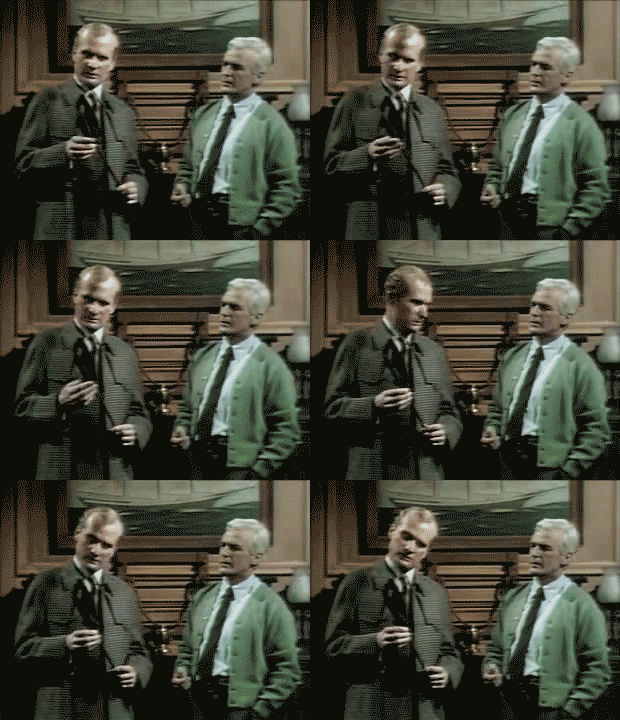
After the opening title, we see that Barnabas is still in the study. Time has apparently passed. Barnabas’ father Joshua enters. Barnabas asks him if Nathan has been buried. Joshua says that he has, and lists the stories that he will tell to cover up all the deaths that Barnabas has been involved with over the last few months. Barnabas wants Joshua to shoot him through the heart with a silver bullet right now and destroy him forever. Joshua cannot do that, but he promises that he will put Barnabas out of his misery come daylight, when he is in his coffin. Barnabas asks two more favors of his father, that he free much put-upon servant Ben and that he prevent the execution of the wrongly convicted Vicki. Joshua promises to do these things as well.

Joshua and Barnabas. Screenshot by Dark Shadows Before I Die.

Throughout this scene, actors Louis Edmonds and Jonathan Frid hold back tears. Patrick McCray remarks: “Crying is not the most powerful thing an actor can do on stage. Rather, it is the attempt not to cry that seizes audiences. In these moments, Frid and Edmonds seize. In a medium of love scenes, there is none more poignant.”

The performers have a powerful theme to work with, one that Danny Horn explicates when he considers the question of why Joshua is still alive at the end of this storyline. When she made Barnabas a vampire, wicked witch Angelique decreed that everyone who loved him would die. Yesterday, Joshua confessed that he feared he was incapable of love, and Barnabas told him that such a disability might save his life. But when we see Edmonds and Frid struggling against the urge to weep, we know that Joshua loves Barnabas very deeply indeed, as we have in recent weeks seen that he loved others he has lost. Danny explains:

The reason why Joshua is spared from the curse is that the love he feels for Barnabas isn’t the kind of love that Angelique recognizes, and so he slips under her radar.

Angelique’s love is selfish, and spiteful. She uses it as a convenient excuse for running over anyone who gets in her way. She doesn’t understand love that arises from respect, and strength of character. And she will never feel the kind of deep, honest love that Joshua now realizes for the first time that he is in fact capable of.

Danny Horn, from “Eats, Shoots, and Leaves,” posted on Dark Shadows Every Day 16 August 2014

Danny goes on to explain that, while others had love for Barnabas that included a selfless element, there was also something in their feelings that Angelique could recognize, while Joshua’s love for him comes entirely from this higher plane. The portion of Dark Shadows set in the years 1795-1796 turns out to be The Tragedy of Joshua Collins, not only because Joshua has the highest social status among the characters, makes the most important decisions, and is played by one of the best actors, but because he grows into the sort of person who is governed by this kind of love. When the world around him is being ground down into dishonesty and cheapness, largely due to the consequences of his own misguided actions, Joshua discovers a new kind of strength within himself. Even amid the ruins of a world he himself did as much as anyone to wreck, Joshua represents the hope that something better might yet come into being.

After daybreak, Joshua stands beside Barnabas’ coffin in the secret chamber hidden inside the Collins family mausoleum, the pistol in his hand. Joshua cannot bring himself to fire the silver bullets into his son’s heart. Ben enters. Joshua orders him to affix a silver crucifix to the inside of the coffin to immobilize Barnabas there, and then to chain the coffin shut. Joshua and Ben assure each other that Barnabas will never be released. Later, we see Ben in the chamber, alone with the chained coffin. He looks at it and says “Goodbye, Mr Barnabas, goodbye.” Thayer David delivers that line with an unforgettable simplicity.

Returning viewers know that Joshua’s plan to keep Barnabas confined will work only until April of 1967, when Barnabas will be freed to prey upon the living once more. That July, in #276, Barnabas will stand in the hidden chamber and say that, while in chaining the coffin rather than destroying him his father “thought he was being merciful, what he did was no act of mercy.” This remark, combined with a story he told Vicki in #214 about his conflict with Joshua, just may have been the germ from which the whole story of Joshua grew. At any rate, the promise ABC-TV made to its viewers when it aired this promotional spot in November 1967 has been fulfilled:

Back in the study, Joshua frees Ben and gives him a severance packet of $100, worth about $2500 in 2024 dollars. When Ben thanks him for his generosity, Joshua denies that he is being generous. I have to agree with Joshua there- that amount might get a fellow out of town, but he’d have to find a new job pretty fast if he wanted to stay in the habit of sleeping indoors.

Another servant brings a note while Joshua and Ben are in the study. The governor has refused Joshua’s plea that Vicki’s execution be stayed. She will be hanged tonight.

At the gaol, Vicki’s boyfriend, an unpleasant man named Peter, is brought to her cell. The gaoler tells them they have five minutes before Vicki will be taken to her death. It is little wonder Vicki’s last request was to have time with Peter. Spending five minutes with him is like living to a ripe old age. Peter vows to overcome death and reunite with her. The last time we heard that was when Barnabas died the first time. In #409, he used his dying breaths to ask gracious lady Josette to wait for him to return to her. Fool that she was, Josette did, leading to disaster for her. Returning viewers may well wince, not only at the ominous parallel with Josette’s grim fate, but also at the memory of the many tedious scenes in which Josette at first insisted that Barnabas was coming back and was then at a loss when asked to explain herself. Besides, we don’t want to see any more of Peter.

The scene of Vicki’s hanging is quite elaborate by Dark Shadows standards. They’ve built a fairly realistic gibbet, hired several extras, put hats on them, and given them burning torches to hold. They test the equipment with a heavy sack, slowly lead Vicki to the place of honor, ask her if she wants a mask, and command the Lord to have mercy on her unrepentant soul. The camera drifts up to the top of the rigging, leaving Vicki out of the shot. When the time comes, we hear the drop and see the rope tighten.

Swing time for Vicki. Screenshot by Dark Shadows Before I Die.

This marks the end of the 1795 flashback, but not necessarily of Dark Shadows 3.0. In #437, Vicki told Peter that she often had nightmares in her childhood, so often that she became a connoisseur of nightmares. She would stay asleep throughout the whole process, waking up only at the very moment she was about to be killed. That was a rather heavy-handed way of telling the audience that Vicki would ascend the gallows, put her head in the noose, and find herself back in the 1960s. Once she is back in her own time, what she has learned in the 1790s will have consequences for what she does next. So we can expect an epilogue of some kind before Dark Shadows 4.0 begins.

Episode 449: To provide a witch

In the parts of Dark Shadows set in the 1960s, Grayson Hall plays mad scientist Julia Hoffman, sometime confidant of ancient vampire Barnabas Collins. Now it is 1796, Barnabas has only recently become a vampire, and Hall is the Countess DuPrés. Like Julia, the countess is deeply versed in the supernatural, and like her she is a long-term guest at the great house on the estate of Collinwood.

Barnabas’ father Joshua has learned of his son’s curse, and is desperate to find a way to free him of it. Today, we open in the Old House on the estate. Joshua has summoned the countess to meet him there. Joshua brings the countess up to date about Barnabas’ condition. He also informs her that the one who played the curse was not the luckless Victoria Winters, who is currently in gaol awaiting execution on charges of witchcraft, but was in fact the countess’ one-time maid Angelique. At this, the portrait above the mantel vanishes and is replaced with one of Angelique.

Portrait of the wicked witch. Screenshot by Dark Shadows Before I Die.

This is the first we have seen the portrait of Angelique. As Danny Horn points out in his post about this episode on Dark Shadows Every Day, it is a message to the audience. Barnabas killed Angelique weeks ago, and her ghost, which was pretty busy on the show for a little while after that, has not been prominent lately. They are running out of unresolved storylines, and will be returning to the 1960s soon. When they show us that they have commissioned and paid for a portrait of Angelique, the makers of Dark Shadows are telling us that she will be back when they return to a contemporary setting.

Joshua asks the countess if she can help lift the curse. At first the countess shows incredulity that Joshua thinks she can “provide a witch” who will counteract Angelique’s spell, but she immediately follows this display by announcing exactly how they will go about summoning such a person.

Back in the great house, naval officer/ sleazy operator Nathan Forbes is continuing with his efforts to drive his new wife Millicent insane so that he can get his hands on her share of the Collins family fortune. Millicent has seen a light in the room on top of the mansion’s tower. Nathan denies having seen the light, and Millicent takes his denial, not as a sign that his vision is failing, but as a reason to fear that she is hallucinating. Nathan insists that she go to the tower room and prove to herself that no one is there.

Returning viewers will be startled by this insistence of Nathan’s. Nathan has deduced that Barnabas is in the tower room. He does not know that Barnabas is a vampire, but does know that he is responsible for the many killings that have taken place in the area recently. When he presses Millicent to go to the room, he is not only trying to unhinge her mind, but is sending her to surprise a crazed murderer in his lair.

Perhaps Nathan hopes only that Millicent will be shocked to see her cousin. But he has been using his knowledge of Barnabas’ presence on the estate to blackmail Joshua. Millicent is a compulsive talker. If she learns that Barnabas is at home, it will only be a matter of time before she tells everyone about it, making Nathan’s information worthless as leverage over Joshua. Unless Nathan does in fact calculate that Barnabas will kill Millicent, it is hard to see what he thinks will happen when Millicent goes to the room.

Joshua and the countess return to the great house. Joshua hustles everyone out, commanding them to go into town to attend a speech by the governor of Massachusetts.* Nathan resists; alone with Joshua, he asks if Barnabas will still be in the tower when everyone gets back. Joshua refuses to discuss the matter.

Joshua and the countess begin their summoning ceremony in the drawing room. Nathan eavesdrops at the door. Joshua finds him there and drives him from the house; the ceremony begins again.

Millicent goes to the tower room. She lets herself in. Barnabas confronts her. He tells her that he will let her go if she will promise never to tell anyone she saw him there; she cannot do that. Patrick McCray puts it well in his post on The Dark Shadows Daybook: “Millicent’s tragedy is that her nature compels her to tell the truth. She knows it will kill her and she knows that she is consigned to it. She is addicted to chatter and chatter will kill her. When she screams at Barnabas’ attack, I think she’s not so much screaming at the terror of the vampire as she is screaming at herself.”

In the drawing room, the countess and Joshua continue the ceremony. We hear the wind. One draft blows out the candle; another blows open the door. An old woman appears in the doorway. She enters the foyer, and says that it is too late- the man they have summoned her to help has already gone.

Enter the good witch. Screenshot by Dark Shadows Before I Die.

*In our time-band, Samuel Adams held that office in 1796. We might imagine that Adams had a counterpart in the universe of Dark Shadows. If so, it would have struck people odd that Joshua was not already committed to attending the speech, and indeed that he had not invited Governor Adams to spend the night at Collinwood. When Joshua first met the countess, he proudly claimed that the French Revolution was an imitation of the USA’s War of Independence; by that point in history, such a claim marked its maker as a supporter of the faction in American politics that the governor represented, the more militant wing of Thomas Jefferson’s party. In fact, much later in the series we will see a portrait of Jefferson prominently displayed at Collinwood. Joshua must surely have been the richest and most eminent Jeffersonian in the region, so much so that even though his family was in mourning they would still have been expected to host the governor in their mansion.

Episode 446: You have given me nothing I can understand

Haughty tyrant Joshua Collins goes to the basement of the Old House on his estate and finds his son Barnabas rising from a coffin. Barnabas explains to his father that he has become a vampire.

Joshua and Barnabas in the coffin room. Screenshot by Dark Shadows Before I Die.

This scene prompts considerable discussion in fandom about gay subtext. In his post about the episode on Dark Shadows Every Day, Danny Horn points out that actors Jonathan Frid and Louis Edmonds were both gay, and speculates that this fact might have had some influence on the way they play Barnabas’ coming out to his father. “I’m not suggesting that this situation is intended to be a metaphor for a gay child talking to his father about his terrible, shameful secret life… But the ‘keep the secret, don’t tell my mother’ part — there’s some resonance, isn’t there? At least, it’s a hook into the story that helps us to get closer, and really feel some of the horror of this moment. A father hands a gun to his son, and says, Kill yourself, so that your mother never finds out.”

Even this tentative raising of the question, with its “I’m not suggesting” and “some resonance” and “at least,” is too much for Patrick McCray. In his Dark Shadows Daybook post about #446, he concedes that “homosexuality is the obvious choice” for an interpretive lens through which to read the scene, but goes on to flatly assert that “this isn’t a veiled metaphor for something like homosexuality.” For him, as for Danny, Barnabas figures in the scene as a murderer first and last, and Joshua as a man finding himself irrevocably severed from the world of rationally explainable phenomena.

For my part, I think that we have to remember that intentionality is always a more complicated thing in a work of art than it is when lawyers are interpreting a contract or cryptographers are cracking a cipher. Certainly the scene is not simply a coming-out scene played in code. Barnabas’ murders do not map onto any metaphor for sexual encounters. While the vampire’s bite is often a metaphor for the sexual act, Barnabas presents his acknowledgement in this scene that he has murdered three women in terms of the secrets he calculated he could keep by killing them and maintains a cold, matter-of-fact tone while doing so. When in the course of the scene Barnabas exasperates Joshua by attempting to murder him, there is nothing erotic between the men. No doubt the scene is at one level meant to be what Danny Horn and Patrick McCray say it is, the point when Joshua realizes he is part of a supernatural horror story and the audience realizes that Barnabas is a cold-blooded killer. As such, it is one of the key moments that defines the 1795 flashback as The Tragedy of Joshua Collins.

But there are other levels of intentionality here as well. One has to do with the word “vampire.” When Barnabas is trying to tell his story to Joshua, his first approach is to give him the facts and leave it to him to apply the correct label. But the facts are so alien to Joshua that they only deepen his confusion. Seeing his father’s bewildered reaction, Barnabas’ frustration mounts until he finally shouts “I am a vampire!”

We have heard this word only once before on Dark Shadows, when wicked witch Angelique mentioned it in #410, but it figured in the show as a metaphor for outness long before it was spoken. In #315, Barnabas’ associate, mad scientist Julia Hoffman, urges him not to murder strange and troubled boy David Collins. She catches herself, breaking off after saying that David deserves better than “to die at the hands of a-” Barnabas grins and teases her, asking “At the hands of a what, doctor?” He dares her to say the word and taunts her for her faux pas in coming so close to using it. Julia and Barnabas have a tacit understanding that they will discuss his vampirism only in euphemisms and circumlocutions. To say the word would be to push beyond the limits of Barnabas’ outness to Julia.

When he tries to avoid calling himself a vampire, Barnabas is trying to establish a relationship in which his father will know enough that he is no longer inclined to ask questions, but not enough to achieve any real understanding of his feelings. When he realizes that he cannot keep from using the embarrassing, ridiculous, utterly necessary word, Barnabas is forced to come out to Joshua in a way he had desperately wanted to avoid.

Moreover, Jonathan Frid’s performance as Barnabas departs starkly from anything else he does on Dark Shadows. After he calls himself a vampire, Frid’s whole body relaxes. His neck, shoulders, and hips are looser than we have ever seen them; even his knees bend a little. His voice shifts a bit away from the old-fashioned mid-Atlantic accent he typically uses as Barnabas, a bit toward twentieth century Hamilton, Ontario. At that point, he is not playing a murderer or a creature from the supernatural or an eighteenth century aristocrat- he is playing himself, enacting a scene from his own life.

Barnabas’ coming out to his father is not today’s only story about information management. Joshua rules his corner of the world by parceling out just that information he thinks people ought to have. We have seen this habit lead to disaster after disaster. In his scene with Barnabas, we see another such instance. Joshua has come to the basement because naval officer/ sleazy operator Nathan Forbes told him that he had seen Barnabas at the Old House, and that Barnabas had attacked Joshua’s second cousin Millicent. After Barnabas admits to his various murders, Joshua brings up the attack on Millicent. Barnabas denies that he had any involvement in that attack, sparking an angry response from Joshua. When Barnabas later asks Joshua why he came to the basement, he swears that Barnabas will never know why.

Had Joshua told Barnabas that Nathan sent him to the basement, the two of them might have figured out that Nathan faked the attack on Millicent as part of his scheme to trick her into agreeing to marry him and to blackmail Joshua into consenting to the marriage. That in turn might have helped Joshua find a way to prevent Nathan from carrying out his evil schemes. But his parsimony with information leaves Joshua believing Nathan’s story about the attack, and therefore puts him and the rest of the Collinses entirely at Nathan’s mercy. When we see the effect that the radical honesty of coming out as a vampire had on Barnabas, we can’t help but wonder how many misfortunes the Collinses might have avoided if they had not lived according to Joshua’s code of truthlessness.

A voice comes from the upstairs. Naomi Collins, wife to Joshua and mother to Barnabas, has entered the house. Joshua leaves his gun with Barnabas and tells him to do the honorable thing, then hastens up to meet her.

Naomi tells Joshua that she he came to the Old House because Nathan told her he had gone there. She insists that Joshua explain what is going on; he pleads with her not to ask. She tells him to think of her; a quiver in his voice, he says “I am thinking of you now.” Naomi is as mystified and as frustrated by Joshua’s refusal to explain himself as Joshua had been with Barnabas’ story, but even as she plays these reactions Joan Bennett also shows us Naomi softening towards her husband. She catches a glimpse of the lover hidden beneath the lord of the manor, peeking out from below the massive superstructure of his pride.

Back in the great house, Nathan is sprawled on the sofa, his boots resting on a polished table, guzzling the Collinses’ fine liqueurs. When Joshua and Naomi return, Nathan offers Joshua a snifter of brandy and invites him to drink it with him in the drawing room. Joshua reacts indignantly, protesting that he is not accustomed to a guest offering him the hospitality of his own house.

This exchange is familiar to longtime viewers. From March to June of 1967, when Dark Shadows was set in contemporary times, the great house was dominated by seagoing con man Jason McGuire, who was blackmailing reclusive matriarch Liz. Several times, most notably in #200 and #264, Jason poured himself a drink and invited Liz’ brother, high-born ne’er-do-well Roger Collins, to join him. Roger would protest that he was not accustomed to being offered a drink of his own brandy in his own house, often drawing the rejoinder that it was Liz’ brandy and Liz’ house, and that he was as much her guest as Jason was.

Roger and Joshua are both played by Louis Edmonds. Roger represents the final stage of decay from the height Joshua represents. He has squandered his entire inheritance, committed acts of cowardice that cost the lives of two men, and let a more or less innocent man go to prison in his place. In #4 he tried to sneak into well-meaning governess Vicki’s room while she slept, and when Liz caught him he told her he didn’t want to be lectured on his “morals,” leaving no doubt that he was looking for some kind of cheap sexual thrill at Vicki’s expense. He openly scorns his responsibilities as a father, cares nothing for the family’s traditions, and the one time we see him working in his office at the headquarters of the family’s business all he does is answer the telephone and tell the caller to contact someone else instead. He drinks constantly, is always the first to give up on a difficult task, makes sarcastic remarks to everyone, and backs down whenever he faces the prospect of a fair fight. In #273, he even admitted to Liz that, had he known what Jason knew about her, he probably would have blackmailed her too.

Joshua’s relentlessly dishonest approach to life may be rooted in fear, and it is never difficult to see that its end result would be to produce a man as craven as Roger. But Joshua himself is as strong as Roger is weak. It is impossible to imagine Roger shaking off an attempt on his life as Joshua shakes off Barnabas’ attempt to strangle him today. While Roger is prepared to sacrifice any member of his family for his own convenience, Joshua will go to any lengths to protect Naomi from the truth of Barnabas’ horrible secret. Nor does Joshua take the easy way out even when he is knuckling under to Nathan. In their scene today, Nathan makes it clear that he is willing to accompany Joshua back to the Old House. Had Roger known what Joshua knows about that basement, he would never have missed an opportunity to send Jason there and let Barnabas do his dirty work for him. But Joshua cuts Nathan off the moment he raises the subject.

Joshua does go back to the coffin room, and he finds Barnabas standing around. He is disappointed that his son has not killed himself. Barnabas tries to explain that he cannot die by a gunshot, but Joshua dismisses his words. He takes the gun himself and, with a display of anguish, shoots Barnabas in the heart. Only thus, he believes, can he keep the unbearable truth from coming to light.