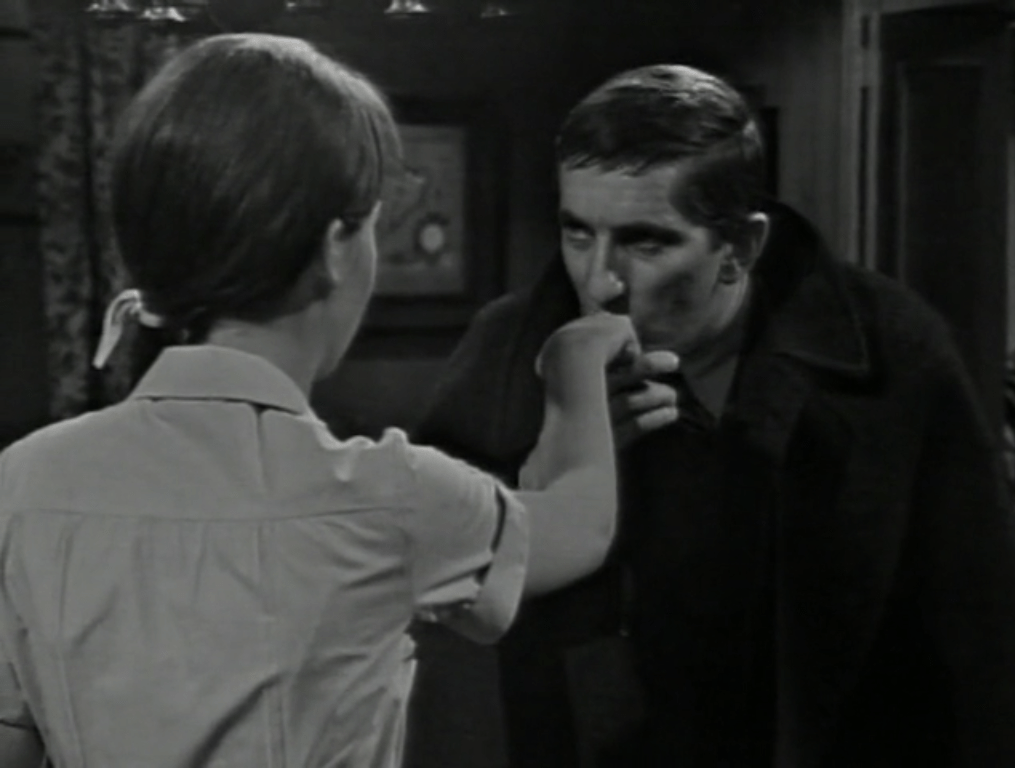
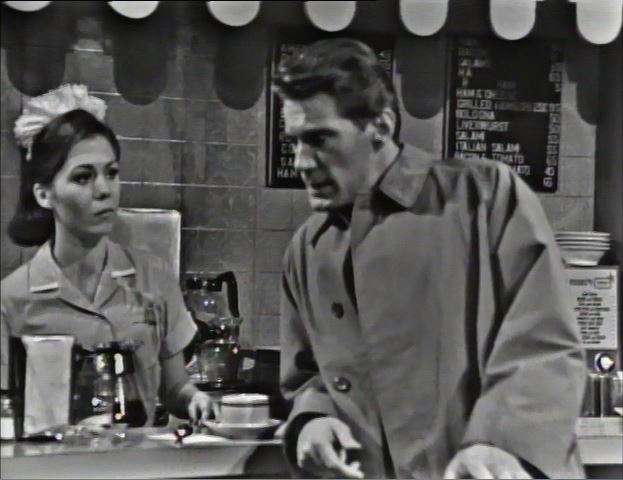
Episode 813: All things, good or evil, come to the same end

This is the first episode to feature a scene in the restaurant at the Collinsport Inn since #227 in May 1967. The show was in black and white then; apparently the restaurant set cannot be seen in color, since this one, set in the year 1897, survives only in kinescope.
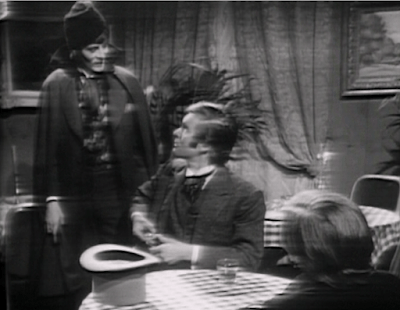
Aristide, Tim, and Jamison/ Petofi in the restaurant at the Collinsport Inn. Screenshot by Dark Shadows Before I Die.

Schoolteacher turned adventurer Tim Shaw is at a table in the restaurant when he is joined by twelve year old Jamison Collins, a former student of his. Unknown to Tim, Jamison’s body is currently a vessel for the spirit of 150 year old sorcerer Count Petofi. Tim is startled to see Jamison, and tells him he had heard he was ill. Jamison asks where he heard this. Tim pauses, then claims that he telephoned Jamison’s home, the great house of Collinwood. He says that Jamison’s nine year old sister Nora answered the phone and told him of his illness. Tim tells Jamison that he is waiting for a young lady, and that after she arrives he would like to be alone with her.

A man enters and talks with Tim. After he goes, Jamison asks who he is. Tim says he has only met him once, and that he knows almost nothing about him beyond the fact that his name is Aristide. We have seen Aristide in the woods with Jamison/ Petofi, and know that he is Petofi’s servant. Jamison/ Petofi told him in that scene that he felt weak and had only a few hours left if he did not recover “The Hand.”

We also saw Aristide in Tim’s room with Amanda, the young lady Tim is waiting to meet. He confronted Amanda, roughed her up, and threatened her with a prop representing a dagger with a curved blade. He wanted Amanda to tell him where “The Hand of Count Petofi” is. Amanda asked if “The Hand of Count Petofi” was a piece of jewelry or something. She had no idea it is literally a severed hand, cut from the wrist of Count Petofi 100 years ago. Aristide questioned her and learned that Tim took a box from the Inn earlier that night and returned without it.

Tim excuses himself, saying that he will go to the front desk to ask if Amanda left a message there explaining why she is so late. Jamison/ Petofi meets Aristide back in the woods. When Aristide tells him that Tim took a box from the Inn and returned without it, he remembers that Tim said he had talked on the telephone with Nora. He deduces that Tim actually talked to Nora in person when he took the box to Collinwood and enlisted Nora’s help hiding it there.

Jamison/ Petofi goes to Nora’s room and wakes her. He tricks her into telling him that Tim was there, but she refuses to tell him where the box is. He twists her arm until she does so. In the parts of Dark Shadows set in the 1960s, David Henesy played strange and troubled boy David Collins, and Denise Nickerson played nine year old Amy Jennings. David and Amy were intermittently possessed by Jamison and Nora in late 1968 and early 1969, and when Amy/ Nora resisted David/ Jamison in #667 and #679, he twisted her arm. When we see the same violent act here, we see a dramatization of a cycle of abuse. We may also wonder if they are going to retcon that “Haunting of Collinwood” segment to include Petofi as a driving force.

Jamison/ Petofi takes the box from Nora’s armoire, opens it, and holds up the Hand. Regular viewers can expect Petofi to return to his own physical form, reattach the Hand to his wrist, and increase his magical powers greatly.

All of the male cast members have trouble with their dialogue today, even the usually line-perfect David Henesy. I wonder if writer Gordon Russell was late finishing the script. Mr Henesy and Michael Stroka manage to give good enough performances that their bobbles don’t really matter, but Don Briscoe is just bad today. When Tim is talking with Nora in the teaser, his intonations are bizarre, and in his later scenes he is flat and lifeless, including a long stretch when he is openly reading off the teleprompter. Perhaps that’s because of his acting style- he worked from the inside out, finding his character’s motivations and developing those first, adding the dialogue last. Give an actor like that less time than he needs, and he might not have anything at all to offer.

One unfair criticism that Briscoe gets from many of the fans who post comments online is that Tim does not have romantic chemistry with any of the women he is paired with. He isn’t supposed to have romantic chemistry with them! At first we see him linked with neurotic intellectual Rachel Drummond. Tim and Rachel were students together at the boarding school run by the sadistic Gregory Trask. When Jamison and Nora are sent to the same school, Tim and Rachel illustrate the horror that lies in store for them. If Tim and Rachel were a hot and exciting couple, they would send the message that kids subjected to Trask’s abuse can grow up to be happy adults, muffing the whole point of the story.

The second woman attached to Tim was Trask’s daughter Charity. Nora points out to Jamison today that Tim and Charity never got along with each other, and regular viewers remember that this is true. Trask forced them to get engaged, a situation that made them both miserable, and then led them both to believe that Tim had murdered Charity’s mother. Again, the whole point of the relationship is to demonstrate how cruel Trask is.

Now Tim is traveling with Amanda. We met Amanda yesterday, and saw that she is impatient with Tim and tolerates him only because he has a lot of money and keeps spending it on her. As possessor of the Hand of Count Petofi, Tim has managed to get rich quick and turn into a tragic version of the character W. C. Fields played in vaudeville routines and stage plays and films set in the Gay Nineties. Amanda is the sort of woman Fields’ characters invariably failed to impress. Again, the last thing you would want would be for Amanda to seem actually to be attracted to Tim.

Though Michael Stroka, in spite of his line bobbles, does a good job as Aristide, there is one moment today when he does make a bad mistake. Aristide makes a big deal out of his dagger, which he initially called “The Dancing Girl.” The prop is obviously just a flat piece of wood, which we might be able to accept if we don’t have to look at it for an extended period. But when he is threatening Amanda today, he holds “The Dancing Girl’s” blade in the palm of his hand, squeezes it, rolls it around, and caresses it. If there were a sharp edge anywhere on it, his hand would be bleeding profusely. They really are not making it easy for us to believe Aristide is going to cut anyone.
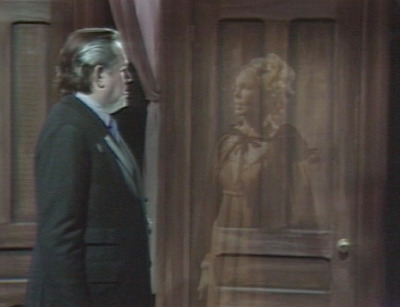
Episode 508: Old tricks

In #473, we saw that wicked witch Angelique had traveled from the eighteenth century to the year 1968 to reimpose the vampire curse she had once placed on old world gentleman Barnabas Collins. In a single day, Angelique met Barnabas’ distant cousin Roger, bewitched him, and married him. This secured her a home in the great house on the estate of Collinwood. Barnabas lives in the Old House on the same estate. Calling herself Cassandra and wearing a black wig, she pretends not to understand why Barnabas doesn’t like her.

In #477, Angelique appeared to Barnabas in a dream and told him and the audience how she would go about turning him back into a vampire. Her approach would essentially be a distributed malware attack on the wetware inside the heads of the people of Collinsport. One person after another would have the same basic nightmare. Each nightmare would begin with a visit from a person who had not yet had it, and after the dreamer awoke they would feel an uncontrollable compulsion to describe the dream to that person. Once they had done so, that person would have the nightmare, and the cycle would repeat. When the dream got back to Barnabas, he would become a vampire again.

Yesterday, heiress Carolyn Collins Stoddard had the dream. Carolyn met with occult expert Timothy Eliot Stokes and mad scientist Julia Hoffman at the Old House. Stokes managed to insert himself into Carolyn’s dream as the person to whom she must tell it. Today, Stokes has the dream. He sets out to function as an antivirus program. He has learned what the dreamer usually does, and consciously makes himself defy all those rules. His hack-back works sufficiently to force Angelique/ Cassandra to appear in the dream herself and get into an argument with him.

Angelique/ Cassandra addresses Stokes by the name of his eighteenth century ancestor Ben, an indentured servant whom she ensorcelled and used for her own nefarious purposes. She refuses to believe that Stokes is not Ben, and does not react strongly when he tells her that he knows her name is Angelique. When he later addresses her as Cassandra Collins, she is horrified and vanishes. It’s a staple of stories about magic that the act of calling adversaries by their true names can defeat them; Mrs Acilius brought up the story of Rumpelstiltskin. That the name “Angelique” has no effect while “Cassandra” drives her away suggests that she was using a pseudonym when we first knew her, and she really is Cassandra.

Stokes makes Angelique/ Cassandra disappear. Screenshot by Dark Shadows Before I Die.

The power of naming also explains what Barnabas may have been thinking when he kept confronting Angelique/ Cassandra and telling her exactly what he did and did not know about her. Perhaps he hoped that simply by addressing her as “Angelique” he would make her vanish.

When Stokes awakens, he tells Julia he is confident that he has stopped the curse. That confidence is put to the test immediately when a knock comes at the door. Stokes opens it, and sees the man from his dream. He does not know the man, but we do. He is Sam Evans, an artist recently blinded by one of Angelique/ Cassandra’s spells. He is accompanied by Joe Haskell, fiancé to Sam’s daughter Maggie. They mention that Maggie is spending the evening in the nearby city of Bangor, Maine. Sam says that he heard the name “Stokes” in his head earlier in the evening, and that he also felt an urge to come to the Old House. He has a strong feeling that Stokes has something to tell him, and insists that he do so.

Stokes is disquieted to see Sam, but feels no compulsion to tell the dream. Sam is furiously dissatisfied. It is unclear whether his frustration at not hearing the dream will be as intense or as persistent as is the upset previous dreamers felt when they resisted telling it.

Sam and Joe leave. In front of Sam’s house, Joe reaches to open the front door. Sam is irritated with him. He not only insists on opening the door himself, but won’t do so until Joe leaves. Joe explains that Maggie made him promise to keep an eye on him, to which Sam replies with a threat to forbid their marriage unless he backs off. Joe mentions that a strange, very tall man who recently abducted Carolyn might still be at large; Sam replies that the man jumped off Widows’ Hill, which means certain death to “anything human.”

Inside the house, Sam finds that a window Joe had closed before they left is open. He hears someone in Maggie’s room. It turns out to be the strange, very tall man, badly cut from his recent fall and wielding a kitchen knife.

They don’t explain what Maggie is doing in Bangor. From episode #1 until she was attacked by Barnabas in #227, Maggie was the principal waitress at the restaurant in the Collinsport Inn. After some time as Barnabas’ prisoner and a longer period as a patient in Julia’s hospital, she returned to town in #295. For all they’ve told us since then, Maggie may have got her job back or taken another one. But if she had, they would have told us today that she was working the night shift, not that she was on some unexplained trip out of town. So now we know that nobody in the Evans house is gainfully employed.

Episode 383: Between men now

In 1966 and the early weeks of 1967, the Collinsport Inn was an important place on Dark Shadows. The restaurant there, presided over by Maggie Evans (Kathryn Leigh Scott,) The Nicest Girl in Town, was a place where people could meet each other unexpectedly and characters new to town could be introduced. Dashing action hero Burke Devlin (Mitch Ryan) lived in a suite at the inn, and the place often represented his territory, the base from which he conducted his war against the ancient and esteemed Collins family.

The sign. Screenshot by Dark Shadows Before I Die.

We haven’t seen Burke’s room since #206, at which point he had given up his vendetta against the Collinses and proceeded far down the road to irrelevance. We haven’t seen the restaurant since vampire Barnabas Collins (Jonathan Frid) met Maggie there in #221. By the time Anthony George took over the part of Burke in #262, Burke seemed to live in the Blue Whale tavern. He made business calls from the pay phone there, and in one episode apparently stayed behind when the bartender locked the place up for the night.

The inn makes a return appearance at the top of today’s episode. It is 1795, and Jeremiah Collins (Anthony George) is sharing a suite with Josette DuPrés (Kathryn Leigh Scott.) They are on their honeymoon.

Jeremiah and Josette eloped from the estate of Collinwood on the night when Josette was supposed to marry Jeremiah’s nephew, kindly gentleman Barnabas Collins (Jonathan Frid.) Josette truly loved Barnabas and Jeremiah was his dearest friend, but they were under a spell cast by wicked witch Angelique, who wanted Josette out of the way so she could have Barnabas for herself. The power of the spell waxes and wanes. When Josette and Jeremiah are in the grip of it, a trident shaped mark appears on their hands; when they return to their senses, the mark disappears.

Tridents showing. Screenshot by Dark Shadows Before I Die.

When the episode begins, the tridents are showing, and the newlyweds are inflamed with passion. Shortly after, Josette’s mark is gone, Jeremiah’s still showing. She is filled with regret, he is still ardent.

Back in the manor house of Collinwood, Barnabas has a conversation with Josette’s father André and his own father Joshua. He resists André’s suggestion that Josette and Jeremiah must have left together, and resists even more strenuously Joshua’s declaration that they did so because they are the victims of witchcraft. Joshua says that his sister Abigail and André’s sister, the Countess DuPrés, found a blasphemous trinket in the quarters of governess Victoria Winters, and that a witch-hunting divine, the Reverend Trask, is coming to investigate the matter. Barnabas is appalled at the notion of an inquiry into witchcraft, and vows to defend Victoria if Trask comes. Joshua forbids him to do so.

Barnabas’ reaction to the idea of a witchcraft trial, coupled with what we have seen of him so far in the 1795 segment, looks like a retcon. In #358, only a week and a half before we began this uncertain and frightening journey to the past, vampire Barnabas told a story about studying witchcraft under a warlock on Barbados who taught him “the secret magic number of the universe.” Events are moving so fast that it doesn’t look like Barnabas will have time to sail to the Caribbean before he becomes a vampire, and he won’t be crossing any waters after that. But now he is a man of the Enlightenment, who scoffs at the idea of witchcraft today as he scoffed at the tarot when the countess introduced him to it in #368/369.

Jeremiah returns to the house. There is an exquisite little scene with a servant, Riggs, who is uncomfortable at the sight of the disgraced Mr Jeremiah. Riggs stands in for the establishment of Collinwood and the whole working class of the town of Collinsport, and in his reaction we see the disquiet that bad news from the big house on the hill would spread among the people whose livelihoods are at stake when trouble comes to the family there. Riggs makes haste when Jeremiah tells him to go out and fetch Joshua.

When Riggs is gone, Josette enters. The audience sees that the mark is gone from Jeremiah’s hand, and Josette can tell that his passion for her is gone. She tells him that he no more loves her than she loves him. He begins with a protest against this remark, but ends by saying that they must be kind to each other.

Joshua and André enter. André embraces his daughter and tells her everything will be all right; Joshua looks at his brother with distaste and demands an explanation.

Jeremiah says that he and Josette are married. He further says he realizes they are not welcome, and that they will return to the inn. This raises the prospect of a recreation of the early days, with the inn as a territory separate from and opposed to Collinwood. Joshua rejects the idea at once. He will not have the scandal of Jeremiah and his new wife living in town because they have been estranged from the rest of the Collinses. He decrees that they will live at Collinwood and put on a happy face for the townsfolk.

Barnabas enters. Joshua tells him that Jeremiah and Josette are married. He refuses to believe it until Josette confirms it herself. He takes the glove from Jeremiah’s hand and slaps him in the face. He gives him a choice of weapons.

Dueling may have been as alien to the ideals of the Enlightenment as were Barbadian warlocks, but so too is Joshua’s plan of forcing the whole family to commit itself to a massive lie in order to preserve its hereditary privileges. Joshua, the proud apostle of Jeffersonian republicanism, is simply being a hypocrite, but Barnabas is a more complicated figure. Seeing his every hope turned to dust before him, his ideals have become useless. He has only a moment to choose among the evils the Enlightenment had promised to stamp out, and he chooses the most macho one available.

Joshua forbids the duel, but Barnabas disregards his father’s authority and insists on it. In 1795 and for some time after, dueling was widely practiced in much of the United States, and particularly in the South and West a gentleman lost face if he refused a challenge. No such stigma attached in New England, where dueling was condemned by law and religion. Had Joshua or Jeremiah gone to the police, Barnabas would have been arrested. In 1719, Massachusetts, of which Maine was a part until 1821, passed a law making it an offense punishable by a fine of £100 (equivalent to about $7000 today) to challenge someone to a duel. Massachusetts law already considered it murder to kill someone in a duel, and prescribed death by hanging as punishment. Of course, Joshua’s declaration that Jeremiah and Josette will live in the house and the family will present a “united front” to deter scandal makes it clear he will never turn his son over to the police, and the pattern of cover-up with the support of law enforcement we saw among the Collinses in 1966 and 1967 leads us to doubt that anything a member of the family does will ever be a matter for the courts to judge.

There is a missed opportunity in the show’s lack of interest in Massachusetts’ actual laws about dueling. The 1719 law was amended to be even stricter in 1730. Among the provisions added to the law at that time was a requirement that anyone who had either been killed in a duel or been put to death for winning a duel would “be given an unchristian burial at a gallows or crossroads, with a stake driven through their body.” Since the audience knows that Barnabas is fated to become a vampire, there is a chilling irony in seeing him volunteer for a staked burial.

Episode 221: A new Collins in Collinsport

Maggie Evans, The Nicest Girl in Town, is closing up shop in the restaurant at the Collinsport Inn. A stranger startles her. He is the mysterious Barnabas Collins. Barnabas recently left his long-time residence in the cemetery five miles north of town and has been hanging around the great estate of Collinwood, but this is the first time we’ve seen him in Collinsport proper.

In the opening months of Dark Shadows, the restaurant, like the rest of the inn, was coded as the base from which dashing action hero Burke Devlin mounted his campaign to avenge himself on the ancient and esteemed Collins family. As the Revenge of Burke Devlin storyline ran out of steam, the restaurant emerged as a neutral space where new characters could be introduced without defining their relationships to the established cast all at once. In that period, Maggie was Collinsport’s one-woman welcoming committee.

Now, even Burke has given up on his storyline. The only narrative element of the show with an open-ended future is Barnabas, and once the audience has figured out that he is a vampire there’s no such thing as a neutral space where he is concerned. So it is not clear what, if any, role the restaurant will have from now on.

Barnabas asks if it is too late to get a cup of coffee. Maggie tells him it is, but relents after about a minute and reopens to serve him. She is charmed by his old-world manners and excited to learn that “there is a new Collins in Collinsport.” He tells her he is staying at the long-abandoned Old House on the grounds of Collinwood, prompting her to marvel at the idea of someone living in a dilapidated ruin that is probably haunted. When she admires his cane, he explains that it is not only quite valuable, but is also a family heirloom and on that account his most prized possession.

Barnabas appears to drink the coffee, as he appeared to drink the sherry his distant cousin Roger served him when he visited Collinwood in #214. Usually vampires are supposed to limit their diet strictly to human blood, but just a few weeks ago Dark Shadows wrapped up a long story about Laura Murdoch Collins, a humanoid Phoenix, who raised everyone’s suspicions by never being seen to eat or drink. So they may have thought that it would be repetitious to follow the Laura arc so closely with another undead menace who betrays himself with the same sign.

Barnabas kisses Maggie’s hand in farewell

Maggie’s boyfriend, hardworking young fisherman Joe, comes bustling into the restaurant seconds after Barnabas leaves. Maggie is surprised that Joe and Barnabas didn’t pass each other, and puzzled when Joe tells her there was no one in sight anywhere near the inn. Neither of them had heard of Barnabas before.

Joe tells Maggie that a woman named Jane Ackerman had an unpleasant run-in with a man she couldn’t see earlier in the night. The fellow retreated before doing her any serious harm, but Joe seems fairly sure that whoever it was is a real threat to the women of Collinsport. So he wants to keep Maggie company. Maggie doesn’t seem worried, either for her own sake or for Jane’s. She’s just happy to see Joe, and gladly agrees when Joe suggests they go to the local tavern, the Blue Whale.

As Dark Shadows’ principal representatives of Collinsport’s working class, Maggie and Joe illustrate the point the opening voiceover made when it said that people “far away from the great house” of Collinwood would soon be “aware of” Barnabas and of “the mystery that surrounds him.” As a name we have never heard before and are unlikely to hear again, “Jane Ackerman” reminds us that there is a whole community of people for Barnabas to snack on.

As Joe and Maggie are heading out of the restaurant, she notices that Barnabas left his precious cane behind. She wants to go straight to the Old House to return it to him. Joe would rather wait until morning, but Maggie explains that she doesn’t want to be responsible for it overnight. This is a bit odd- they are in a hotel, after all, a business that specializes in keeping valuable property safe while its owners sleep.

Perhaps Maggie wants to see the Old House. Joe has been there many times. When we saw him there with Burke, searching for well-meaning governess Vicki in #118, he mentioned that when he and flighty heiress Carolyn were children, they would occasionally play there. He returned there during the Laura storyline. Even Maggie’s father has visited the Old House, participating in a séance there in #186 and #187. Maggie has never been there at all. So perhaps she just feels left out.

Maggie and Joe knock on the doors of the Old House. No one comes. As they turn to go, there is a closeup of the door knobs turning. Maggie and Joe hear a door open, and go in. They don’t see anyone, but candles are burning and Joe remarks that the front parlor has been fixed up. Joe goes upstairs and leaves Maggie behind, explaining that he knows his way around the place and it isn’t safe up there for someone who doesn’t.

Once Maggie is alone, Barnabas appears next to her. She is startled and cannot see how he could have got there without her knowing. He apologizes for once more catching her unawares. He seems surprised that she is not alone. When Joe comes downstairs, he is exceedingly polite to both of them.

After Maggie and Joe excuse themselves, Barnabas’ blood-thrall, the sorely bedraggled Willie Loomis, appears. With obvious difficulty, Willie forces out one word after another, and manages to ask Barnabas what he plans to do to Maggie. Barnabas is displeased with Willie’s presence and with his presumption that he has the right to question him. He climbs the stairs and looks down at Willie, full of menace and demanding that he go out and do the work Barnabas has ordered him to do. Willie tries to refuse, but cannot stand the look Barnabas is giving him.

Barnabas gives Willie his orders

During this staring contest, Barnabas and Willie are standing on the spots where strange and troubled boy David Collins and Barnabas had stood when we first saw Barnabas in the Old House in #212. In that scene, David and Barnabas were more or less eye-to-eye, and for a moment it seemed that Barnabas was contemplating violence against David. In this scene, Barnabas shows how committed he is to violence. He has a power over Willie that he gained by the extreme violence of drinking Willie’s blood, and Willie’s inability to resist Barnabas’ stare shows that power in use. Willie’s horror at the task Barnabas has assigned suggests that it also is violent.

My wife, Mrs Acilius, believes that the confrontation between Willie and Barnabas solves one of the behind-the-scenes mysteries about Dark Shadows. Why was James Hall replaced by John Karlen in the role of Willie? She points out that Hall, while he is a fine actor, had a lot of trouble with Willie’s lines, particularly in the long he shared with Dennis Patrick’s Jason McGuire. By the time Willie was recast, Jonathan Frid had been attached to the role of Barnabas for some days, and Frid never made it a secret that he was a slow study. So if there were going to be a lot of long conversations between Willie and Barnabas, Willie had to be played by an actor who could get his dialogue letter perfect day after day. That was John Karlen.

After Willie scurries off to do whatever evil chore Barnabas has ordained for him, Barnabas wanders over to the window. On his way, we see that the portrait of Josette Collins is no longer hanging in the spot over the mantle where we have seen it since our first look at the Old House in #70. At the end of that episode, Josette’s ghost emanated from the portrait and danced around the outside of the house. From that point, the Old House was chiefly a setting for Josette. Crazed handyman Matthew Morgan learned that to his cost when he tried to hold Vicki prisoner there and Josette and other ghosts ganged up on him and scared him to death in #126. Laura knew that she was entering the territory of a powerful enemy when her son David took her to the Old House in #141, and when Vicki had formed a group to oppose Laura’s evil plans she and parapsychologist Dr Guthrie went there to contact Josette. In #212, Barnabas addressed the portrait and told Josette that her power was ended and he was now the master of the house. Removing the portrait tells us that Barnabas is confident that he is not only a new Collins in Collinsport, but that he is now the Collins at Collinwood.

Barnabas then does something Laura did several times- he stares intently out his window. When Laura stared out her window, David would be violently disturbed, no matter how far away he was or how many obstacles were between him and his mother. These incidents were a big enough part of Laura’s story that regular viewers, seeing Barnabas stare out the window, will expect someone at a distance from him to react intensely.

We cut from Barnabas to Joe and Maggie at her house. Joe asks what time he should pick Maggie up tomorrow, and Maggie suddenly becomes disoriented. Kathryn Leigh Scott has a sensational turn playing that moment of lightheadedness, creating the impression that she is having a scene with Barnabas. As she recovers, she explains to Joe that she has the feeling she is being stared at. Then we dissolve to Barnabas in his window. Barnabas may not be Maggie’s mother, but apparently there is some kind of link between them. Perhaps kissing Maggie’s hand in the restaurant was enough to give Barnabas the power to creep her out even when he is miles away from her.

Episode 195: It looked pretty dead to me

In Dark Shadows Version 1.0, well-meaning governess Vicki represents our point-of-view. In the 1930s and 40s, radio soap operas would often have a character to whom they would assign that role, one person to whom everything has to be explained so that the audience can be brought into the story. That may have worked on a show in a 15 minute time slot, but it’s a stretch to build a 30 minute daily drama around one character, and today’s hour-long daytime serials couldn’t possibly keep one person on the spot the whole time. In part, that’s because you’d wear the actor out. More importantly, it’s because soap operas are usually about abruptly disclosing secrets to the audience and gradually leaking them out to the characters. A character who has no secrets from the audience can’t generate that kind of action, and will sooner or later turn into dead wood.

Today, we start with reclusive matriarch Liz recruiting Vicki to help her keep one of her secrets. Vicki found Liz in the basement late last night, a fact which Liz has made her promise she will not share with anyone. Vicki does not see why anyone should care whether Liz goes into the basement of her own house at night or any other time, and indeed no one does care. But Liz insists she keep quiet about it, and when Liz’ daughter Carolyn mentions having heard her up in the middle of the night, she makes Vicki lie and say that she was the one who was up.

Since Vicki can have no secrets from us, she cannot be particularly good at keeping secrets from the other characters. If she were able to tell a convincing lie, a person just tuning in to the show might be deceived by Vicki. She has tried her hand at lying a few times so far, always with disastrous results when the lie immediately collapsed. This time, Carolyn doesn’t catch on, and there don’t seem to be any ill effects, but that’s just because it’s a topic Carolyn doesn’t care about. Vicki changes her whole demeanor when she’s getting ready to tell these lies, stiffening her spine, plastering on a smile, and speaking a little bit too loudly. On previous occasions she had different tells, looking down and taking a breath before she speaks, or looking around and stammering while she speaks, etc. A supercut of those scenes might serve as a catalog of the various types of inept liars. Alexandra Moltke Isles renders each type convincingly enough that such a video could be useful to students of acting, of psychology, and of poker. But it would also show why Vicki is facing a limited future as a soap opera character.

We’re supposed to be saddened that Vicki has had to damage her friendship with Carolyn by lying to her, but I was on Liz’ side, rooting for the lie to work and Carolyn to stop asking questions. Otherwise, we’ll have to hear more about Liz’ attitude towards her basement, and that is such a stupefyingly dull topic it makes us yearn for the days when they spent 21 episodes showing people wondering where Burke Devlin’s fountain pen might be. Besides, Liz is an accomplished liar. If Vicki can study under her and learn her skills, she might be able to continue as a major character.

While Vicki is struggling with the rules of the genre in which she exists, another character is comfortably embodying one of the most familiar stock figures of soapdom. That’s Jason McGuire, a con man who has a history with the matriarch of the powerful family. He’s in the restaurant at the Collinsport Inn having a breezy chat across the counter with Maggie, The Nicest Girl in Town, who is impressed by his habit of putting lemon peel in his coffee. Hey, you work for tips, you find ways to be impressed by the customers.

Vicki comes into the restaurant and chats with Maggie about Liz’ recovery from the mysterious illness that recently put her in the hospital. Overhearing Liz’ name, Jason sidles up to Vicki and questions her about the residents of the great house at Collinwood. He won’t give Vicki his name, but gets her to tell him about everyone who lives there. She describes her own duties as “governess… companion… tutor,” to which Jason replies that she sounds busy.

Coupled with the fact that we first saw her today sorting Liz’ mail, the word “companion” suggests that the show is changing Vicki’s job so that she will be the first involved, not only in stories that center on strange and troubled boy David, but also in those centering on Liz. That’s promising- not only would it give Vicki a chance to learn how to lie, but it also suggests that they might have figured out how to mirror the one consistently interesting relationship on the show so far, that between Vicki and David. Perhaps it will be as much fun to watch Vicki as Liz’ pupil as it has been to watch David as Vicki’s.

After Jason questions her, he tells Vicki that he will definitely be seeing her again soon. He then leaves, still not having told her his name. Vicki asks Maggie who he is. She tells Maggie that Jason made her uncomfortable with his questions about the residents of Collinwood, and that the theme of those questions was “not so much how they are… as where they are.” Dark Shadows has been heavy with recapping, but this may be the first example of a conversation in which two characters recap the conversation immediately preceding it, without even a commercial break in between.

Back at Collinwood, a knock sounds at the front door. Carolyn comes downstairs to answer it. As she does so, we see a mirror in a spot by the door. For some time, the mirror has been alternating on that spot with a metallic decoration. We saw the metallic decoration most recently, but now the mirror is back.

Carolyn opens the door to find Jason. He claims to be an old acquaintance of the family, but refuses to give his name. Carolyn eventually gives in and admits him to the house. While Jason is saying that nothing in the house has changed in many years, the mirror is filled with the reflection of a portrait. When we were watching the episode, this brief glimpse led us to believe that the mirror had been replaced with a portrait. We haven’t seen this effect before, and it is so striking that it is hard to believe it was an accident. Indeed, precisely the same image will be used under the closing credits of an episode coming up four years from now, suggesting that it is something they’ve given a great deal of thought.

The portrait by the door

In the drawing room, Jason continues to withhold his name, telling Carolyn that he doesn’t want to spoil the surprise he has in store for her mother. He charms Carolyn with his claims to have gone ten times each to Hong Kong, Naples, Madagascar,* and every other place that pleased him the first nine times he visited.

When Liz comes downstairs, Carolyn tells her that an old acquaintance of hers is waiting to see her. Liz smiles at this news, but when she sees Jason her expression turns to one of utter despair.

*In 139, David’s mother, blonde fire witch Laura Murdoch Collins, mentioned that when he was a little boy he was interested in Madagascar. When Carolyn brings up Madagascar today, we wonder if the Collinses have some connection to the island.

Episode 177: The glare of our scientific era

Maggie Evans, The Nicest Girl in Town, is at her job running the restaurant in the Collinsport Inn. Not that she’s working, exactly. There are no customers; the only other person there is her boyfriend, hardworking young fisherman Joe.

They’re hugging and kissing, and Joe is bringing up the idea of marriage. Maggie doesn’t think they can get married, since she has to look after her father, drunken artist Sam. Joe doesn’t think that is much of a problem. In previous episodes, we’ve seen that Joe likes Sam and doesn’t mind helping Maggie with him. He does say that he would rather Sam not come along on their honeymoon, and suggests that Sam might be ready to cut back on his drinking. Maggie isn’t getting her hopes up.

Flighty heiress Carolyn comes into the restaurant and asks to speak with Joe privately. Carolyn is Joe’s ex and Maggie is worried the two of them will get back together, but since she only wants to go to a table where they will be in Maggie’s line of sight she goes along with the idea. We do see Maggie looking vigilantly at them while they talk.

Maggie watching Joe and Carolyn

As it happens, Carolyn isn’t trying to win Joe back. She wants him to help Dr Peter Guthrie, visiting parapsychologist, in his efforts to determine whether her aunt, Laura Murdoch Collins, is the reincarnation of two women who died by fire in 1767 and 1867. Guthrie hasn’t told Carolyn what exactly he is planning to do, but he has said he needs the help of a strong young man and that what he is going to do is “not strictly legal.”

Carolyn leads off by telling Joe that she is going to ask him to do something to help her mother, reclusive matriarch Liz, who is in the hospital with a mysterious ailment. Joe immediately agrees to do anything that will help Liz. When she starts explaining that she wants him to work with Guthrie, and that Guthrie is a parapsychologist, Joe is incredulous. At length, he reluctantly agrees to go, and to keep what he will do secret from everyone, even Maggie.

When he tells Maggie that they have to cancel their date so that he can go to Carolyn’s house, she is dismayed. He assures her that he is not getting back together with Carolyn, but that Carolyn made him promise to keep it a secret just what he will be doing. Maggie vows to fight if Carolyn does try to take him back.

This scene is the current phase of Dark Shadows in a nutshell. It appears to be a more-or-less typical daytime soap opera of the sort you would see on American television in February of 1967, where good-looking young people in wholesome, everyday settings struggle about who will have a conspicuously chaste romance with whom. That’s what Maggie thinks she is watching when she keeps her eyes on Joe and Carolyn.

But in fact the series is heading towards becoming a full-time supernatural thriller, and stories like those are going to be tossed out and left by the roadside before long. That development doesn’t bode well for Joe and Maggie. Joe tells her today that their relationship is “the simplest thing in the world”- he loves her, she loves him, that’s all you need. Of course, a couple is only allowed to be on screen in a soap opera if they are participants in a conflict of some kind, and are only the main figures in a storyline if they are in conflict with each other. But the show Maggie thinks she’s on might supply them with conflicts that would make sense to the sensible, practical-minded people she and Joe are written to be.

When they start dealing with ghosts and fire witches and who knows what else, Maggie and Joe will have a limited amount of time to show us how level-headed real-world people might react to supernatural crises. Once they’ve exhausted that theme, they will have either to adapt to their new surroundings and become different sorts of people or to leave the show. The prospect of reconceiving the characters might be good news to the actors Kathryn Leigh Scott and Joel Crothers. But Maggie and Joe would be appalled to hear that they will have to discard their personalities and invent new ones, and Joe’s alarmed reaction when Carolyn starts talking about parapsychology is a foretaste of what the characters will be going through as this comes upon them.

As the show’s representatives of Collinsport’s working class, Joe and Maggie are the designated representatives of daylight sanity. From the first week of Dark Shadows, we’ve known that Carolyn and the other residents of the great house of Collinwood are in too close proximity to the supernatural back-world of ghosts and ghoulies for that kind of attitude to be possible.

That contrast is dramatized in three moments in today’s show. In the opening portion, Carolyn and Dr Guthrie spend approximately 500 hours* in the drawing room of the great house recapping all the uncanny elements of the current storyline. When Guthrie asks Carolyn if she has considered the idea of reincarnation, she says that she has considered it and dismissed it. When he starts in with an explanation of how the idea of reincarnation connects to their conflict with Laura, Carolyn is all in.

When Carolyn is in the restaurant telling Joe about Guthrie the parapsychologist, Joe says he is surprised she is taking this sort of thing seriously. “I always thought you were a level-headed girl.” Regular viewers may be startled by this comment. In the last few weeks, Carolyn has had to take over her mother’s duties as head of the household and of the family business, and has shown some maturity in discharging them. But the whole time Joe and Carolyn were a couple, she was fickle and irresponsible to the point of madness. In this context, where Joe is conscious of Maggie’s eyes on him and is trying to project a particular image of himself, he rewrites the history of his relationship with Carolyn. He isn’t the sort of fellow who would spend years chasing after a flighty heiress- he is a sensible man who would only ever be involved with an equally sensible woman. That self-image is going to take a beating as he participates in the kinds of stories we’re going to see from now on.

In the last scene, Joe is in the drawing room and Guthrie puts the same question to him that he had earlier put to Carolyn- has he thought about the idea of reincarnation? Joe says he’s never thought about it, and flatly refuses to entertain the notion. Finally he absorbs Guthrie’s request that he help open the graves of the previous Laura Murdochs, but he never says he believes in reincarnation, and he never shows the enthusiasm that Carolyn has for Guthrie’s theories. Carolyn can afford to be enthusiastic- she’s lived in the great house all her life, and so has never been more than one step away from the unearthly. But Joe is giving up a substantial part of his identity by even being in the same shot as Guthrie, and once he shows up with a shovel in a graveyard at night, the Joe we’ve known will be on his way out.

*The counter on my computer says the scene between Carolyn and Guthrie in the drawing room lasts only 6 minutes and 44 seconds, but I’m sticking with my estimate of 500 hours.

Episode 123: A nice dungeon

The restaurant at the Collinsport Inn appeared in the very first episode of Dark Shadows. Well-meaning governess Vicki arrives in town, and stops there on her way to her new home in the great house on the estate of Collinwood. Counter-woman Maggie Evans, The Nicest Girl in Town, gave Vicki a bit of a hard time at first, but quickly emerged as the person likeliest to be her friend. And indeed, Vicki and Maggie have visited each other, had heart-to-heart talks, etc.

We’ve seen the restaurant many times since. As part of the inn, it has always figured as territory associated with dashing action hero Burke Devlin, arch-nemesis of Vicki’s employers, the ancient and esteemed Collins family. It was Burke who brought Vicki to the inn and therefore sent her Maggie’s way, and the major scenes in the restaurant since have revolved around Burke and his doings. By making the whole complex of the inn an extension of Burke’s personality, it established him as a force equal to the Collinses with their mansion and its precincts.*

Today marks a shift in the use of the set from a symbol of Burke’s power to a neutral space where new characters are introduced without giving away their relationships to the ongoing storylines. While Burke figures in the conversation, he doesn’t appear in the episode, and the action does not depend on what he has done.

Maggie presides over the place. Her interactions with newcomers begin from the fact that she works there. The only other public spaces we’ve seen are the Blue Whale tavern, where the bartender does not speak and any conversations start as part of whatever story the speakers are involved in, and the sheriff’s office, which is nobody’s idea of a casual hangout. So Maggie is elected Welcoming Committee.

A blonde woman in a stylish hat takes a seat at a table while Maggie is at the counter bantering with her boyfriend-in-waiting, hardworking young fisherman Joe. Joe tells Maggie that the woman looks familiar, but that he can’t quite place her. After Joe leaves, Maggie gives the woman a menu, pours her a cup of coffee, and talks with her.

The mystery woman in her stylish hat. Screenshot by Dark Shadows Before I Die

The woman asks about Grace, whom Maggie replaced at the restaurant five years ago. She confirms that she lived in Collinsport when Grace ran the restaurant. Since she is from Collinsport, Maggie is surprised that she came to town on the bus and is staying at the inn. The woman asks about the Collinses. Maggie says that high-born ne’er-do-well Roger Collins is the same as ever, only more so. When the woman asks what that means, Maggie explains that he is the person in town likeliest to play the role of Ebenezer Scrooge.** The woman asks about Roger’s son, strange and troubled boy David Collins. She is happy when Maggie says that David is a cute, clever boy, and startled when she says that “a nice dungeon would help” him to be easier to live with.

The woman is never named, but returning viewers will have a very short list of people she might be. The ongoing storylines are:

  • Vicki’s quest to learn the identity of her birth parents. The woman doesn’t look anything like Vicki, and the one potential lead Vicki has discovered in her time in Collinsport is a portrait of a woman who looks exactly like her. If the woman is connected with that storyline, therefore, it would likely be in some roundabout way- we wouldn’t expect them to cast a blonde actress as a close relative of the brunette Vicki after the big deal they made of that portrait.
  • The mistress of Collinwood, reclusive matriarch Liz, hasn’t left home in eighteen years and no one knows why. Liz is the first person the woman asks about, so it could be that she has come to shed some light on this puzzle. The only women who lived in the house eighteen years before who have gone away since were the servants, so it could be that this woman is a former Collins family servant who has come into money.
  • Homicidal fugitive Matthew’s abduction of Vicki. Matthew has always been friendless, and his only relative is an elderly brother. He has always lived in poverty, and did not know the servants who were connected with the house before Liz became a recluse. So it is difficult to see what connection he could have to this woman. On the other hand, the ghosts with whom the show has been teasing us since the first week have been making their presence very strongly felt as that story reaches its climax. The woman may have some connection with the supernatural back-world of the series, and that may somehow link her to Matthew or Vicki.
  • Vicki’s love-life. Vicki and Burke had been spending a lot of time together, but she has told him that because he is the enemy of her employers they can never see each other again. Burke doesn’t seem to be ready to accept this. Since she has been missing, Burke has taken an aggressive part in searching for her. Vicki has been seeing instantly forgettable young lawyer Frank, but we haven’t seen him since she’s been abducted (that I recall; the guy is very forgettable.) The woman seems to be a bit too sophisticated for Frank, but she may be a rival for Burke’s affections.
  • Joe’s breakup with flighty heiress Carolyn and his budding romance with Maggie. Maggie doesn’t recognize the woman at all, Joe can’t identify her, and their working-class backgrounds make her almost as unlikely a connection for them as she is for Matthew. Still, if she is a former servant at Collinwood, she might have some connection with one or the other of their families.
  • Burke’s quest to avenge himself on the Collinses in general and Roger in particular. There is a woman involved in Burke’s grudge against Roger- Roger and a woman named Laura were in Burke’s car when it killed a pedestrian. They both testified that Burke was driving, saw him sentenced to prison for manslaughter, then married each other. Burke swears that Roger was driving, and Laura was apparently Burke’s girlfriend, certainly not Roger’s, before the night of the fatal collision. Laura is still married to Roger, though they have lived apart for some time, and she is David’s mother. The mystery woman’s reactions to Maggie’s descriptions of Roger and David would make sense if she were Laura, as would her evident affluence and her separation from friends or relatives.
  • Vicki’s effort to befriend David. If the woman is David’s mother, she could complicate this, the quietest but most consistently successful of all the show’s storylines.

Maggie’s reference to “a nice dungeon” is ironic. There are dungeons about, both literal and figurative. Matthew is keeping Vicki bound and gagged in one inside the long-abandoned Old House on the grounds of Collinwood, where his helper David visits him today. David doesn’t know that Matthew is holding Vicki until the end of the episode, when he stumbles upon her. As David Collins, David Henesy gives a splendid reaction to this shocking sight:

Old friends meet in new places. Screenshot by Dark Shadows Before I Die

Before the mystery woman enters, Maggie herself seems to be in a kind of dungeon. Her dungeon is built not of stone walls or iron bars, but of careless writing. Joe is filthy and exhausted after many long hours searching for Vicki, who is missing and may be in the clutches of a murderer. Even though she is Vicki’s close friend and The Nicest Girl in Town, Maggie doesn’t show a moment of concern for her. She giggles, jokes, and smiles all the way through her conversation with Joe. Not only is her dialogue out of character, it is composed entirely of cliches that remind you forcibly that you’re watching a 56 year old soap opera. For example, when Joe mentions that he crossed paths with Carolyn in Burke’s hotel room, she exclaims, “That is a convention!” The dread Malcolm Marmorstein strikes again…

*My wife, Mrs Acilius, developed this point in our discussion of the episode.

**Louis Edmonds would indeed have made a marvelous Scrooge. It’s too bad the cast of Dark Shadows didn’t get round to performing A Christmas Carol until 2021, two full decades after his death. It was a great performance, highly recommended, and is followed by a Q & A every fan of the series will find fascinating.

Episode 79: I’ll hate you in public

Problem child David Collins enters the restaurant at the Collinsport Inn. Mrs Sarah Johnson, longtime housekeeper to the late Bill Malloy, is confronting dashing action hero Burke Devlin, declaring that he is to blame for Bill’s death. David angrily defends Burke. Burke whisks him out of the restaurant into the hotel lobby.

Screenshot by Dark Shadows Before I Die

Little does David know that the confrontation between Burke and Mrs Johnson was staged for the benefit of his family, the ancient and esteemed Collinses. The two of them are scheming to have Mrs Johnson placed on the Collinses’ domestic staff as housekeeper so that she can spy on Burke’s enemy, David’s father, high-born ne’er-do-well Roger Collins.

Burke and David have a charming little scene in the lobby. David stumbles over many of his words. These are probably flubs, but they fit so perfectly with what we would expect a highly agitated nine year old to sound like that the writer might have wished he’d put them in the script. David says that he and Burke are two of a kind, that everyone in the world is against them, and that he wants to murder them all. Burke asks if this wouldn’t be a bit of a drastic solution. While David ponders that question, Burke ushers him up to his suite.

There, David asks if it is true that he told his aunt, reclusive matriarch Liz, that he would use any means at his disposal to strip the family of all its assets. Burke says that he offered to buy the house, and reminds David that he himself had suggested Burke do that so the two of them could enjoy a freewheeling bachelor existence there. David accepts this at once and is all smiles. He then tells Burke that his governess, Miss Victoria Winters, has been teaching him about the Civil War. The theme of divided loyalties has been weighing on him- how can he choose between two sides led by Liz and Burke, the only two people he likes? Burke tells him they will just have to work out a peaceful solution, and David smiles again.

Screenshot by Dark Shadows Before I Die

David Henesy and Mitchell Ryan were not only excellent actors- preternaturally so, in the case of the preteen Henesy- but were also such appealing personalities that scenes featuring the two of them are irresistible. These particular scenes build Burke up as a villain. In his conversations with Mrs Johnson and in a couple of phone conversations, he has made it clear that he is indeed committed to destroying the Collinses. Even if this is the first episode we have seen, we know that he is lying to David and tricking him into helping with the annihilation of his birthright. Returning viewers have seen him being even more explicit about his plans on many occasions. So our loyalties are as divided as David’s- we are eager to see more interactions between Mitch Ryan and David Henesy, but are appalled by what is going on between Burke Devlin and David Collins.

Episode 57: All we do is talk about death

Screenshot by Dark Shadows from the Beginning

In the opening teaser, dashing action hero Burke Devlin is having lunch in the restaurant at the Collinsport Inn. As usual, he’s alone there. He strikes up a conversation with Maggie Evans, who runs the place. She listens sympathetically while he tells her that he’s worried about the missing man, plant manager Bill Malloy. He goes on about the great meal he’ll buy for his dear friend Bill when he finally turns up. Maggie has to break the news to him that the Coast Guard has fished Bill’s corpse out of the sea.

Burke suspects that his bitter enemy, high-born ne’er -do-well Roger Collins, is responsible for Bill’s death. After he telephones the sheriff’s office to ask for information and doesn’t get answers, he returns to the restaurant, agitated. Well-meaning governess Vicki walks in; Burke snaps at her about Roger, and they quarrel. Burke goes to the sheriff’s office with this suspicion. So far from enlisting the sheriff as an ally against Roger, Burke finds himself being questioned as a suspect.

Burke returns to the restaurant. Vicki is still there, having had a heart-to-heart with her new friend Maggie. Burke yet again asks Vicki for a date; she yet again refuses him, this time because she’s planning to have dinner at Maggie’s house where she will be introduced to Maggie’s father, Burke’s former friend Sam.

Patrick McCray and Marc Masse write characteristically admirable posts about this episode on their blogs. McCray cites this episode as a fine example of the kind of story-telling that defined the show in its first 42 weeks:

Episode 57 is a focused study in how much the show would change in its first year. That’s not damning with faint praise nor stating the obvious about supernatural vs secular threats. It’s a compelling little episode that moves faster than many in the post-1897 run of the series. Within it is an entirely different approach to storytelling. Far more than other soaps, DARK SHADOWS was a show about action. Characters did things in the present rather than just talk about things done in the past. And when time, space, morality, and death are irrelevant to many of your main characters, it’s easy to present a Nietzschean amusement park of action and story twists. That’s not how the program began, though. It was only with the introduction of Laura Collins that DARK SHADOWS became a series about possibilities, not limits. But limits, and seeing attractive, interesting people struggle against them, is the bread and butter of terrestrial TV drama, and episode 57 is a beautifully executed cage.

Patrick McCray, Dark Shadows Daybook

He goes on to talk about the sorts of characters they can have in this period of the show who would become impossible in later days. Bill Malloy, for example: “Malloy was too good at getting things done to coexist with incredibly vulnerable monsters whose only protection came from how unobservant everyone else was.” Because of the centrality of the character of Liz and the theme of her seclusion in this period of the show, I’d always thought of the first 42 weeks as a study in the social and psychological effects of the refusal to face unpleasant facts. But of course denial is still the show’s great theme all the way through.  

Masse discusses the apparent discontinuity of Burke’s wistful tone before he learns that Bill is dead with Burke and Bill’s relationship as we saw it when Bill was alive:

And since when has Burke even cared about Malloy as a person? If he really had revered Malloy for having given him his start as he claims today, then how come he didn’t buy Malloy that best meal ever upon his return to Collinsport, instead of just toying with him at the Blue Whale in episode 3, hanging up the phone on him in episode 9, and then deftly evading his questions before showing him the door when Bill [paid] an unannounced visit to Burke’s hotel room in episode 21?

The above three episodes along with number 57 were all written by story creator and developer Art Wallace, which shows that already by September 1966 Dark Shadows was reinventing itself storywise to such a significant degree that contradictions in continuity would present themselves even if episodes in question were written by the same writer. Burke did acknowledge to Malloy in episode 45, a Francis Swann episode, that he’d been a fair employer to him when he was just starting out working on the boats of the Collins fleet; but in keeping with the opportunistic nature of Burke’s character, this was only after Malloy had offered to make a deal with him, which Burke must have surely understood would greatly benefit his own interests.

Marc Masse, Dark Shadows from the Beginning

I think there is a bit more grounding in what we see for Burke’s rhapsody about Malloy in today’s episode than Masse gives the show credit for. Also, that it is misleading to suggest that only now are we seeing abrupt changes.

I’ll deal with the second of these points first. When Burke came to town in episode 1, he was cold to everyone. They retconned this aspect of his personality in episode 21, where he revisits the sets where he dealt some of his harshest snubs in #1 and is a hail-fellow-well-met even to people whom he had reason to avoid. That was a necessary revision. Soap opera writing is largely a matter of filling screen time with conversation, so a character who isn’t on speaking terms with anyone is useless. But it wasn’t a very well-motivated change in terms of what has happened in the story. Viewers who remembered episode 1 would have had a hard time explaining why Burke’s attitude is so different now.

This time, though, Art Wallace’s script makes it clear time and again that Burke is isolated and getting lonely. He had expected Sam to be his friend, but has learned that Sam fears him. Sam’s daughter Maggie listens sympathetically to him, but he’s a customer of hers, and that’s her job. He certainly can’t expect a social invitation to the Evans house. He thinks he might be able to join forces with the sheriff, but is lucky to get out of his office without a bail ticket. He arrived on the same train as Vicki, and was attracted to her from the first. Every time he sees her, he asks her out and she turns him down. When he finds out that Vicki will be having dinner with the Evanses, it makes the picture of his isolation complete. Burke hasn’t made a single friend all the time he’s been in town, and it’s getting to him.

This takes us back to Patrick McCray’s point, about the “incredibly vulnerable monsters whose only protection came from how unobservant everyone else was.” As time goes on and Dark Shadows becomes more and more a show for young children, it will often be laughable just how unobservant the human characters are. But the first of the incredibly vulnerable monsters will meet a family buffeted by hostility, suspicion, and blackmail, surrounded by enemies even inside the walls of their big dark house on the hill. He will present himself to the Collinses as a warm-hearted, charming, unworldly visitor from a foreign land who wants nothing but their friendship. The lonely people he meets will all but collapse into his arms. In Burke’s rhapsody about Bill, we see the same neediness at work.