Episode 851: Common cause

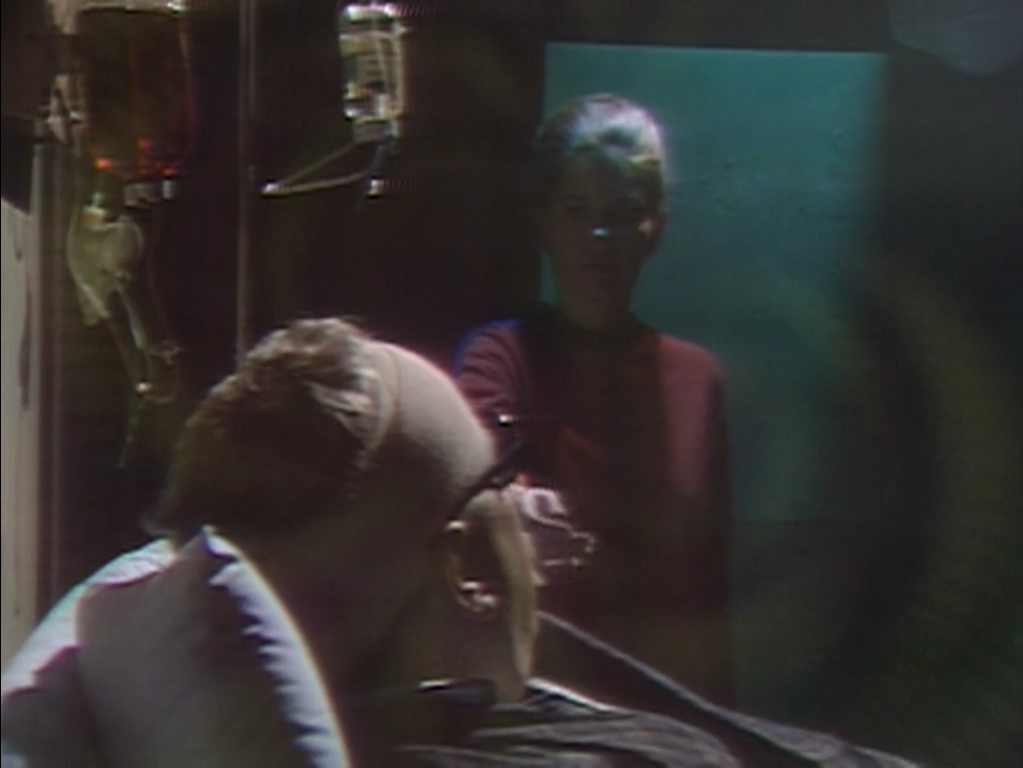
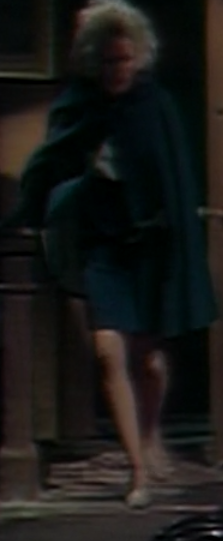
Rakish libertine Quentin Collins races to the train station to meet his fiancée, the lovely and mysterious Amanda Harris. He thinks he sees her, but it is actually another young woman wearing a remarkably similar outfit. She tells him the train to New York City left a few minutes ago; Quentin knows Amanda was on it, and that she thinks his absence means that their relationship is over. The young woman was quite miffed when Quentin first approached her, but by the time he offers his second apology her look has gone from indignant to concerned to yearning. The guy’s got game, you have to grant him that.

It’s been less than a minute since he made a bad first impression on her, and she’s ready to run off with him. Screenshot by Dark Shadows Before I Die.

Quentin was detained by a fistfight with a repulsive little man called Charles Delaware Tate. Tate is an artist whose works sometimes have magical powers. His portrait of Quentin, for example, keeps Quentin from turning into a werewolf and ensures him against physical harm. Since Tate is obsessed with Amanda, he stole the portrait from Quentin when he learned Amanda was planning to leave with him. Quentin dared not leave without it, and went to Tate’s studio to demand its return. He very satisfyingly beat Tate senseless, but he did not find the portrait, and now he fears he has lost Amanda forever.

We cut to Tate’s studio. Tate is lying on the floor where he fell when Quentin finished hitting him. Unfortunately, he gets up. Sorcerer Count Petofi, who granted Tate the power to make magical artworks some years ago, enters. He tells Tate that it was stupid to steal Quentin’s portrait. Tate pretends not to know what Petofi is talking about, irritating him and us. Petofi says that he will have to be punished. After he forces Tate to draw a sketch of a pretty woman, he squeezes his wrists, helps himself to Quentin’s portrait, and says what sounds very much like a final goodbye. He exits, and Tate sits down with his pad and pencil. He discovers that he is no longer able to draw, not even a straight line.

These days, Dark Shadows is a costume drama set in 1897. Most of the time between 1966 and 1968, it took place in a contemporary setting. In those days, the set now used as Tate’s studio was the Evans cottage, home to artist Sam Evans, a drunken sad sack, and his daughter Maggie, The Nicest Girl in Town. In December of 1966 and January of 1967, the ghost of the gracious Josette compelled Sam to paint alarming images of Laura Murdoch Collins.

It turned out Josette was doing this because she knew the characters were not all that bright and she had to literally paint them a picture to explain that Laura was an undead fire witch bent on incinerating her young son David. Laura tried to thwart Josette’s plan by harming Sam. In #146, Laura caused a fire at the Evans cottage that burned Sam’s hands, temporarily depriving him of the ability to paint. Petofi’s disabling of Tate on the same set will bring this incident back to longtime viewers. Especially so, since Josette is in the air at this point in the show. In #844, a character named Kitty joined the cast. She keeps having mental flashbacks to things only Josette would remember, and Josette’s music box appeared on Kitty’s table at a time when Josette’s ghost seemed to be the likeliest agency to have put it there. Perhaps she will insert herself into Tate’s story for some reason.

When we were watching the scene between Tate and Petofi, my wife, Mrs Acilius, said that she very much wished someone else were playing Tate. Violet Welles’ script gives whoever is playing Tate a lot of opportunity to show what he can do in that scene. Roger Davis is a highly trained actor who has a long list of stage and screen credits, but he is almost always very unpleasant to watch on Dark Shadows, and he wastes the potentially fascinating dialogue Welles gave him. When Mr Davis is particularly trying, I usually try to make the scenes bearable by imagining what Frederic Forrest, who was a featured background player in #137, would have done in his place. But the echo of the story about Sam makes me wonder what David Ford would have done as Tate. Ford was in his forties, smallish and pudgy, so a David Ford Tate could not believably have had a fistfight with a character played by the very tall and fit 28 year old David Selby. But he might have been a subtle enough villain that such an exchange would not have been called for. Moreover, the incestuous undertone of Tate’s desire for Amanda, who is the product of one of his magical paintings and therefore a kind of daughter to him, would have been all the more disturbing had Tate been played by the man we knew as Maggie’s father in the 1960s and, when the show was set in the 1790s, as Josette’s.

Back home at the great house of Collinwood, Quentin receives a visit from Tim Shaw, Amanda’s ex and a would-be sleazy operator. He demands Tim tell him what he knows about Amanda’s life in New York before they came to Collinwood. Tim declares he will tell him nothing, to which Quentin responds by choking him and flinging him to the floor. Tim then burbles out everything he knows, which turns out to be nothing of the slightest use. Quentin picks Tim up and throws him out the front door in the most humiliating possible way. We cheer this on almost as joyously as we cheered Quentin’s beating of Tate Friday, but for the opposite reason. Mr Davis is a genuinely disagreeable person who ruins episode after episode, and it was him we were angry with. We chanted at the screen, not “Quen-tin! Quen-tin! Quen-tin!,” but “Da-vid! Da-vid! Da-vid!” hoping Mr Selby would pay him back for all his on-screen assaults on the women and children in the cast. But Don Briscoe was as nice a guy as Tim has become despicable, and he and Mr Selby enjoyed working together. You can see Briscoe’s joy in performance in the way he holds on to a little yellow piece of paper representing a note from Amanda all through the beating Quentin administers. Even the shot of Quentin shoving Tim out with his buttocks prominent is the product of Briscoe’s enthusiastic use of his body to demonstrate Tim’s total defeat.
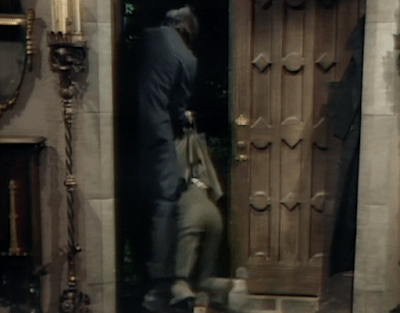
Quentin throws Tim’s sorry ass out the door. Screenshot by Dark Shadows Before I Die.

Quentin’s other fiancée, wicked witch Angelique, comes downstairs to ask what the ruckus was about. Quentin makes up a transparent lie about having a financial interest in some firm in Boston, and says that he and Tim were quarreling about the details of it. Angelique lets him go on with this for a while and to say that he is leaving for Boston, then insists that they set a date for their wedding. He begs off, claiming not to know how long he will be away.

Petofi enters, and tells Angelique about Quentin’s plan to go to New York and look for Amanda. He also tells her that they now have a common cause, and proposes an alliance. Each of them is so powerful, and so evil, that this is a sobering prospect.

When Quentin returns to the foyer, it is his turn to be alone with Petofi. Quentin knows that Petofi gave Tate both the power to create the portrait that freed him of his curse and the commission to do so, and that he is therefore beholden to Petofi for his continued humanity. Part of his motivation for fleeing to New York with Amanda was his hope that he could escape the slavery Petofi has imposed on him as the price of that benefice. When Petofi tells Quentin he has come to see him before he goes, Quentin is momentarily stunned, and then makes a brave little noise to the effect that Petofi can’t stop him. Petofi assures him that he does not want to stop him. It doesn’t matter in the least to him where Quentin is- he can control him from anywhere.

Petofi calls on Tim at his room in the inn. He deepens Tim’s misery by pretending he doesn’t believe what Tim told him about Tate’s magical powers. As he leaves, he takes a brooch that belonged to Amanda.

Quentin is at the train station. Angelique appears there, and tells him not to go. He says that he doesn’t care if she kills him. It will be consolation enough to have died walking away from her. She says that she will not harm him in any way. This causes him to open his eyes wide in terror as it dawns on him what she means. She produces Amanda’s brooch and a doll. She positions the pin of the brooch over the doll’s chest and says that no matter where Amanda is, she will die a horrible death when the pin impales the doll.

Closing Miscellany

The actress who plays the young woman Quentin meets at the train station is billed in the credits as “Amy Yaekerson,” the only person known to Google ever to be called “Yaekerson” and known only for this appearance. But in a comment on Danny Horn’s post about the episode at his great Dark Shadows Every Day, a commenter known as “miles” pointed out that there are lots of people named “Yakerson.” He went on to identify an Amy Yakerson born in New York City on 1 April 1946, and to find a 1966 notice of a play featuring an actress of that name and probably of that age in the New York Daily News. I followed that up with some Googling of my own; the only Amy Yakerson I can find who is online today was born in Connecticut in 1954, so I don’t know where Amy Yakerson, star of stage and screen, is now.

We saw some of Sam’s paintings in Tate’s studio Friday and today, twenty-some years before Sam was born. Tate hides the portrait of Quentin behind one of Sam’s seascapes, and Sam’s portrait of Maggie’s mother is on the floor next to him when we see him lying there in the aftermath of the fight. John and Christine Scoleri have the details in their post about Friday’s episode at Dark Shadows Before I Die.

Episode 530: A fine line between love and hate

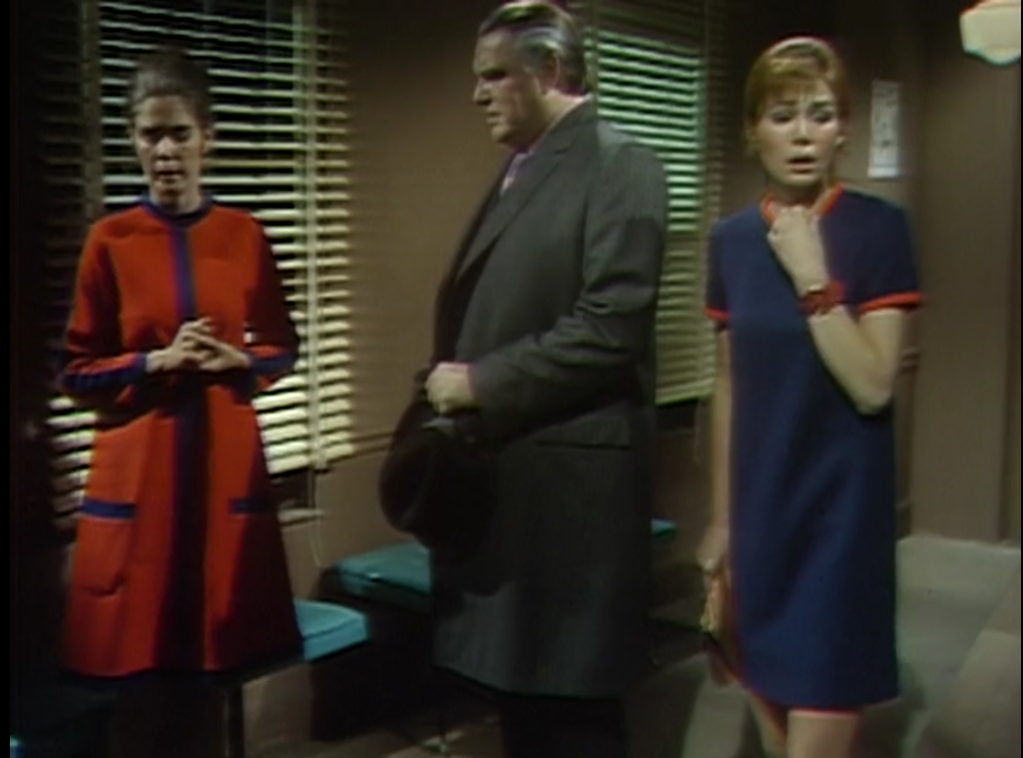
In the eighteenth century, wicked witch Angelique loved scion Barnabas Collins. He betrayed her in those days, rejecting her in favor of the gracious Josette, and ever since she has been casting deadly spells on him and everyone close to him. Today she encounters him in the woods. After a brief confrontation, she is left thinking about the feelings of love for him that still linger in her and undermine her killing power.

A few months ago, Frankenstein’s monster Adam imprinted on Barnabas when he saw him at the moment he came to life. Barnabas betrayed Adam’s filial love time and again, chaining him to a wall in a windowless basement cell, leaving him alone for all but a few minutes a day, and entrusting his care to his abusive servant Willie. When Barnabas beat Adam with his cane to stop him retaliating against Willie, Adam’s love turned to hate and he adopted “Kill Barnabas!” as his motto.

Today, well-meaning governess Vicki stops by Barnabas’ house to update him on the progress of Angelique’s latest attempt to destroy him. Vicki is to be the next to have a nightmare that Angelique has sent to a series of people, and after she has it she will pass it to Barnabas. Vicki doesn’t know that Barnabas was a vampire from the 1790s until 1968, much less that Angelique is trying to turn him back into one, but she does know that if Barnabas has the nightmare he is supposed to die as a result.

While Barnabas and Vicki confer, Angelique raises the ghost of Sam Evans from his grave. Sam was supposed to tell Vicki the nightmare, causing her to have it, but died before he could do so. Sam resists Angelique’s commands, but finds that Angelique can prevent him from returning to his grave. His soul needs rest, so he complies.

Back at Barnabas’ house, the sound of a gunshot interrupts the conversation. Barnabas goes out to investigate while Vicki waits in the parlor. Sam materializes there. Evidently his need to rest is quite urgent, since he sits down in an armchair while he talks to Vicki. The dead must rest! Or at least take a load off, it’s very tiring being dead apparently.

Vicki pleads with Sam not to tell her the dream, since she does not want to bring death to Barnabas. Sam says that in Barnabas’ case, death might come as a welcome relief. He declines to explain to Vicki what he means, but longtime viewers will be intrigued. Sam now knows about Angelique, so presumably he knows about Barnabas’ vampirism as well. Sam was the father of Maggie, The Nicest Girl in Town, whom Barnabas attacked, imprisoned, tried to brainwash into thinking she was Josette, and set out to kill when his brainwashing plan failed. If Sam knows about that part of Barnabas’ career, you’d think he would be a bit more peeved with him than he seems to be. At any rate, Vicki can’t stop Sam telling her the dream. When Barnabas comes back, she tells him what happened, and tells him she is already tempted to tell him the dream. She must go far away for his sake.

Many people have already had the dream, and none of them had the compulsion to tell it until they awoke from it. Vicki’s relationship to Barnabas is an odd one; shortly after his attempt to Josettify Maggie failed, he decided to repeat the experiment with her. Yet he never made much of an effort to get close to her, even though she time and again went out of her way to present him with opportunities to have his way with her. She even invited herself to his house for a sleepover in #285, only to have him back off the opportunity to suck her blood. He finally bit her in #462, only for his vampirism to be put into remission less than a week later. In this scene, Vicki keeps looking at Barnabas with wide, longing eyes, while he reacts coolly. So perhaps Vicki’s compulsion suggests that her attachment to Barnabas causes the Dream Curse to affect her differently.

Back at the grave, Angelique asks Sam’s ghost whether he told Vicki the dream. He said he did. She heaves a sigh of relief and exclaims “Excellent!,” and lets him go back to his grave. She doesn’t ask any follow-up questions or require any evidence. Clearly she couldn’t read Sam’s mind, or she wouldn’t have had to ask the question in the first place. So he could just as easily have gone off to haunt someone else, then lie to her.

We cut back to Barnabas’ house. Evidently he went somewhere after Vicki left, because he is walking in the front door. He looks around, apparently sensing a presence. He calls for Willie and gets no response. He opens a closet door, and hardworking young fisherman Joe falls out, unconscious. He hears a loud dirty laugh and sees Adam at the window, jeering at him.

This episode marks the final appearance of Sam Evans and of actor David Ford. Ford brought a fresh energy to the show when he took over the part of Sam from the execrable Mark Allen in #35, prompting blogger Marc Masse to discern what he called “The David Ford Effect” in the brightened performances of all the cast in the weeks that followed. But ever since the major storyline he was part of fizzled out in #201, Sam has been at the outer fringes of the plotlines, and Ford has been coasting. He inhabits his characters comfortably enough that he is always pleasant to watch, but it’s easy to forget the verve he originally brought to the show.

A few months after leaving Dark Shadows, Ford would join many other Dark Shadows alumni in the original Broadway cast of the musical 1776. He played John Hancock on Broadway and in the 1972 movie, and John Dickinson in the national touring company. I’ve been in the habit of watching the movie every year on or around the Fourth of July since the 1980s, and so it’s oddly fitting that Ford should depart Dark Shadows early in July. Fitting too that Sam Evans’ grave should be decorated with what looks to be a red, white, and blue floral wreath.

Screenshot by Dark Shadows Before I Die.
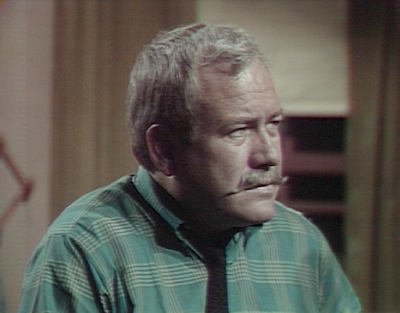
Episode 518: How to speak to people

We open in a hospital room where Sam Evans is in bed, wearing dark glasses. This would tell a first time viewer that Sam is blind, and also that he’s reckless about his glasses.

Sam is begging his daughter Maggie to bring her friend Vicki around so he can tell her about a dream he just had. Vicki shows up and invites Sam to tell her the dream. This leads to a dramatic musical sting and a cut to the opening title. The first time viewer, still worried that Sam might nod off and break his glasses, will be unlikely to see why Vicki’s willingness to listen to Sam’s dream should be a concerning development.

Sam starts to describe his dream. A knock on the door interrupts him. It is Timothy Eliot Stokes. Stokes orders Vicki out of the room. Stokes is wearing a suit, not a white coat, and is addressed as “Professor.” So it should be clear to the first-time viewer that he is not a medical doctor, has no authority in the hospital, and is not particularly close to Vicki, Maggie, or Sam. The women resist his commands, but when it becomes clear he won’t back down they humor him.

In the corridor outside Sam’s room, Vicki tells Stokes “I hope you have some explanation.” He replies “The situation required drastic action.” “Is that all you have to say?” “No, I might add you should be grateful to me.” Thus the first-time viewer learns that Stokes does not feel obligated to be polite to young, pretty women.

Stokes tells Vicki that “Your recent experience in the past has taught you some rather frightening things about witchcraft.” Vicki agrees with this statement. Maggie turns away and looks out into space, wondering what the heck these lunatics are talking about. At last the first-time viewer has an on-screen representative.

Stokes describes a “Dream Curse,” in which a series of people all have the same nightmare. Each dreamer is compelled to tell the nightmare to a particular person who appeared in it. That person then has the nightmare, featuring a third person, and awakens with the same compulsion to tell the nightmare to that person, keeping the cycle going. Vicki declares that she doesn’t know what Stokes is talking about, but Maggie seems to. Vicki grudgingly agrees not to go into Sam’s room, but refuses to leave the corridor.

Maggie reacts to Stokes’ explanation.

Returning viewers know that Maggie was the first to have the nightmare. It will also stretch their credulity that Vicki hasn’t heard about it. Maggie is one of Vicki’s dearest friends, and the nightmare was a terrifying experience that weighed on her for quite some time. The person Maggie passed the nightmare to was Vicki’s boyfriend Peter, who prefers to be called Jeff. Not only has neither Maggie nor Peter/ Jeff told Vicki about the nightmare, neither has any of the three people who have already had the nightmare and who live with her in the great house of Collinwood. These are heiress Carolyn, whom Vicki has addressed as “my best friend”; strange and troubled boy David, who is Vicki’s charge in her job as governess and who feels very close to her; and housekeeper Mrs Johnson, who habitually tells everyone everything she knows.

It will also be strange to those who have been watching the show that Stokes does not tell Vicki the key thing about the Dream Curse, that it is aimed at old world gentleman Barnabas Collins. Vicki is extremely fond of Barnabas; Stokes knows this, because in #509, he told her that he was doing battle with a witch whose goal was to kill Barnabas, and she was most eager to help him. If he told her that by listening to Sam’s account of the dream she would be bringing Barnabas one step closer to death, surely he would have persuaded her to go home. But, as my wife Mrs Acilius pointed out while we were watching the episode, that would let Vicki back into the story. Stokes, like Barnabas and several other major characters, is working to keep Vicki from becoming relevant to any ongoing plot.

Stokes has to leave the hospital to attend to another matter. While Maggie was leading the way out of the hospital room, he looked out the window and saw a man looking in. The man is Adam, a very tall, phenomenally strong, peculiarly inarticulate fellow whom Stokes met at Sam and Maggie’s cottage a few days ago. Stokes is eager to get to know Adam. He lets himself into the cottage and waits there until Adam comes by. Adam is confused to find him there, but Stokes quickly persuades him to come home with him. Stokes promises to give him food and become his friend. The two of them are quite cheerful as they walk out the front door.

The camera repeatedly focuses on a stickpin Stokes dropped on the rug, suggesting that he will get in trouble for having let himself into the cottage without Maggie’s permission. That suggestion is clearer to the first-time viewer than to those who know what’s been happening. Stokes had been in the cottage with Sam not long before, and could easily claim to have dropped the stickpin on that occasion.

Back in the hospital corridor, Vicki hears Sam crying out in agony. She goes to his room. Maggie joins her there, and Sam starts describing the nightmare. Maggie recognizes it as the one that caused her such distress when she had it, and her eyes dart to Vicki. She tells Vicki she doesn’t have to stay. Vicki insists, and a look of panic starts to form on Maggie’s face. Sam doesn’t get far into the nightmare before he dies.

Returning viewers will remember that the luckless Willie Loomis was interrupted in his attempt to tell Carolyn the nightmare in #506, and that when she next went to sleep she could have only the part of the nightmare he had described. So we wonder if Vicki will have the same problem.

We may wonder about something else. Stokes, as an expert on witchcraft, has several times said that a Dream Curse is designed to “end with a death.” We may wonder if Sam’s death will end it before it gets to Barnabas.

That would represent a stinging defeat for the witch. Sam was once a fairly important character, but long ago receded to the margins of the show. He made his debut in #5, and has been played by David Ford since #35. Originally he was a tormented alcoholic, driven to drink by his part in the injustice done long ago to dashing action hero Burke Devlin. Burke’s storyline fizzled out completely in #201, and since then Sam has made only intermittent appearances, mostly as support for Maggie, who is herself usually a secondary character. To launch an attack on the show’s breakout star and hit a tertiary player would be quite embarrassing to any villain. Maybe the witch’s next plan will wind up falling on Bob the Bartender, and the one after that will hit one of the sheriff’s feeble-minded deputies.

Kathryn Leigh Scott tells some stories about Sam’s death scene that do not fit with what is on the tape. In her 1986 book My Scrapbook Memories of Dark Shadows, she writes about the teleprompter falling over and making a loud noise and Ford shouting “Where is it!?” In appearances at Dark Shadows conventions, she has said that the lines Ford improvised to replace the ones he couldn’t read ran over time, and that in her desperation to get to the next break she pushed a pillow on his face and nearly smothered him while saying “Don’t die, Pop!” In his post on Dark Shadows Every Day, Danny Horn says that Miss Scott’s “anecdote was entirely made up. None of that happened.”

I reserve judgment. Maybe the episode we have is a second take. It runs unusually smoothly up to Sam’s death scene, as if the cast had had more practice with its parts than usual. We know that, in spite of all the spectacular bloopers and other production errors they left in, they did sometimes start over, and the incidents Miss Scott described might well have been enough to warrant that.

Episode 517: Tell me your dream

Wiggèd witch Cassandra shakes off an attempt to burn her and finds out that Sam Evans, an artist whom she blinded a little while ago, is in the hospital with a severe head injury. Sam is on the critical list.

Cassandra has cast an elaborate spell that takes the form of a series of nightmares one person after another has. Sage Timothy Eliot Stokes managed to stop the dream curse a while ago, but Cassandra is determined to restart it. Sam must be the next person to have the dream, so she goes to his hospital room and puts a powder in his drinking water that does the trick.

We see Sam’s dream, as we saw the dream when each of the previous nine people had it. The dream is an opportunity for the actors to emote as fiercely as they want, and most of them seem at least a little bit silly as they go through the exercise. Today, David Ford is the most ridiculous yet. He has to scream several times, and we find that screaming was not one of his strengths as an actor. In fact, every time he did it Mrs Acilius and I laughed out loud. The other person in his dream, the well-meaning Vicki, is played by Alexandra Moltke Isles. Mrs Isles has a ghostly quality that makes her very effective as a mysterious figure in a nightmare. Next to her, Ford seems to be some random guy in a bathrobe who just wandered onto the set.

Vicki beckons Sam to the dream room.

Sam wakes up from his dream and begs his daughter Maggie to get her friend Vicki to come over. Only by telling her about it can he be relieved of the agony that comes to those who have had the dream. Regular viewers know that if he does this, Vicki will have the dream. In a soliloquy, Cassandra tells us that Vicki will pass the dream to recovering vampire Barnabas. Her purpose in setting the curse was to turn Barnabas back into an active vampire; this will therefore be the last step to her success.

Stokes knows how the curse works and knows that Barnabas will die if the dream gets back to him. He does not know that Barnabas was a vampire, much less that Cassandra wants him to revert to vampirism. Maggie was the first to have the dream and knows that Stokes is an expert on it. She does not know that it is designed to kill someone at its culmination. So she sends for both Vicki and Stokes. At the end of the episode, Vicki is at Sam’s bedside, inviting him to tell her the dream; Stokes is still on his way.

Cassandra chose Maggie to be the first to have the dream because she resembles Barnabas’ lost love, gracious lady Josette. They look so much alike that they are the same actress. She does not tell us why she chose Vicki to be the last, but Vicki had extensive contact with Josette’s ghost in the first 39 weeks of the show, and from November 1967 to March 1968 traveled back in time and got to know Josette as a living being. When Josette was alive, Cassandra was known as Angelique. She was a lady’s maid in Josette’s family’s home, and secretly hated the young mistress. Barnabas had an affair with Angelique until he realized he could marry Josette, when he discarded the servant and pursued the mistress. Eventually, Barnabas’ attachment to Josette led the enraged Angelique to turn him into a vampire. So it is logical that Angelique/ Cassandra uses the two women closest to Josette as the first and last instruments in her campaign to revamp Barnabas. It does make it all the more ironic that Stokes lumped strange and troubled boy David, who for the first months of the show was more involved with Josette’s ghost than anyone else, among the “comparative strangers” who have the dream when Barnabas is in relatively little danger.

Episode 515: A word you’re saying

A lot of wonderful acting in this one. We start off with Willie Loomis (John Karlen,) staggering into the cottage Maggie Evans (Kathryn Leigh Scott) shares with her father Sam (David Ford.) Yesterday, Maggie’s boyfriend Joe beat Willie up. Maggie invites Willie in, comforts him, tries to treat his wounds, and agrees to drive him home. Joe had excellent reasons for insisting Willie stay away from Maggie, and those reasons might lead returning viewers to react to the beginning of the scene with frustration. But Karlen and Miss Scott are so good together that they very smoothly defuse that frustration, and we soon find ourselves as absorbed in the scene as we were in the many scenes the same actors shared in May and June of 1967, when Maggie was the prisoner of Barnabas the vampire* and Willie, as Barnabas’ slave, was trying desperately to reduce her suffering.

A very tall man named Adam (Robert Rodan) comes to the open front door and announces “Willie bad!” Maggie has no idea who Adam is. Adam enters the cottage and clarifies his intention with a declaration of “Kill Willie!” Willie tries to talk Adam out of this plan, and reminds him of the good times they had together. Maggie tells Adam that Willie is hurt, and Adam looks concerned when he responds “Willie hurt?” Rodan gets the same flicker of light into Adam’s eyes that you might see in the eyes of a toddler who is intrigued to hear that someone is having feelings he wouldn’t have expected them to have. Before long, though, Adam is angry again. Maggie takes a hammer and tries to hit Adam, leading Adam to state a new plan- “Kill Maggie!”

Sam comes home. Sam befriended Adam during a trip Maggie recently took out of town. He tells Maggie to stand behind him. She does, and he talks to Adam about their friendship. Adam agrees that Sam is his friend and that he would never hurt him, but he refuses to agree when Sam tells him that Maggie is also his friend. Maggie makes a move that confuses Adam. Trying to get at her, Adam hits Sam very hard. Adam sees that he has knocked Sam down, and he runs away.

We see Adam in the woods, and for the first time hear his voice in a pre-recorded monologue telling us his thoughts. “Afraid! Adam afraid! Adam bad! Adam hurt friend!” Rodan’s acting is more than sufficient to enable us to figure out that this was what Adam was thinking even without the monologue, but he does such a good job of voice acting that I don’t really begrudge it. Crude as the lines are, Rodan simultaneously expresses fine shades of fear and guilt through them.

Willie and Maggie have another scene in the Evans cottage. She is stern with him now, demanding to know what Willie knows about Adam. Willie denies that he knows anything, and she points out that when he was trying to calm Adam he appealed to several facts from their previous acquaintance. Willie tells a story to cover that up, essentially the same story Barnabas made up to tell the sheriff in #505. Maggie is a lot smarter than the sheriff- that isn’t saying much, chewing gum is a lot smarter than the sheriff- and even he didn’t buy this line when Barnabas was pushing it. She tells Willie in a firm tone that she will continue to ask questions until she gets answers she can believe. She explicitly tells him she will ask Barnabas. Maggie’s firmness and Willie’s barely controlled panic make for another gripping encounter.

Willie goes back home to Barnabas’ house. Barnabas’ best friend Julia Hoffman (Grayson Hall) is there. Willie tells Julia they have to find Adam before the police do, since he now knows enough words to get them all in a lot of trouble. Usually when Julia and Willie have their staff conferences, she is firmly in charge and full of ideas. But she is at a complete loss today. She has no idea how to capture Adam, and she doesn’t know where Barnabas is.

What’s more, Julia has just seen a ghost. She heard sobbing coming from the basement, and when she went down there she saw a woman in white whom she recognized as Josette Collins, deceased. Josette dematerialized in front of her. Now the sobbing starts back up, and Julia accompanies Willie to the basement.

Josette is already gone when they get there. Julia tells Willie what she saw earlier. She figures out that Barnabas is bricked up behind the wall where Josette’s ghost had stood. She explains her reasoning in terms that viewers who have seen the last several episodes will be able to follow, but which don’t make a bit of sense to Willie. His sharp befuddlement and her vague certitude make for a laugh-out-loud funny scene.

The bricked-up alcove in the basement of Barnabas’ house. Screenshot by Dark Shadows Before I Die.
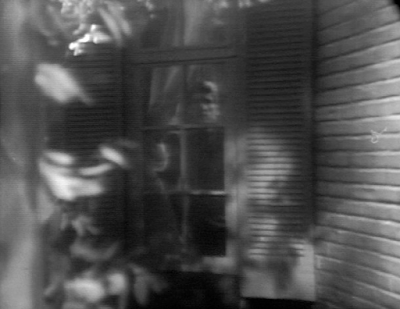
In the early months of the show, several characters heard a sobbing woman in the locked room in the basement of the great house of Collinwood. It was strongly implied in a number of those episodes that the woman was the ghost of Josette. In #272, matriarch Liz said that she herself was the one who did the sobbing. That didn’t fit very well with what we had seen, but by that point the show had reconceived Josette as part of Barnabas’ story and stopped involving her ghost in the action. Longtime viewers have a strong reminder of the “Sobbing Woman” story today, since Barnabas’ basement is a redress of the set used for the basement of the great house and the alcove where he is walled up is in the same place as the door to locked room in basement of great house.

*Maggie has amnesia about all that, and thinks Barnabas is her friend. His vampirism is in remission now.

Episode 514: Serious talking

Hardworking young fisherman Joe Haskell is engaged to marry Maggie Evans, The Nicest Girl in Town. Early in their relationship, Maggie warned Joe that they might never be able to get married, because her father Sam was an alcoholic and would always need her to come rescue him. Joe liked Sam, drunk or sober, and was always quick to lend him a hand. He didn’t seem to understand Maggie’s worries.

Now, it’s Joe who is worried, and Maggie who doesn’t understand why. Sam’s drinking doesn’t seem to be as much of a problem as it was then. But he has been struck blind, ending his career as a painter. Joe still wants to marry Maggie, and is still glad to help Sam. But Sam has befriended a very tall, phenomenally strong man named Adam, who is wanted by the police because he abducted heiress Carolyn Collins Stoddard several days ago. Sam doesn’t consider the abduction to be a strike against Adam, whose ignorance of social customs he considers to be a disability equal to his own blindness. Joe is convinced that Adam is a violent felon and is alarmed that Sam insists on inviting him to the Evans cottage. Maggie has been out of town and doesn’t know about Adam.

Today, Joe finds a reason to be as alarmed about Maggie’s judgment of men as he is about Sam’s. Maggie was missing for some weeks in May and June of 1967, and when she was found she was so severely traumatized that she could barely talk. She spent months in a mental hospital called Windcliff after that, during which time she had regressed to childhood and developed a tendency to become wildly agitated. She seems to be her old self now, but she still has amnesia covering the whole period from her disappearance through her time at Windcliff.

Like the rest of the village of Collinsport, Joe believes that Maggie was abducted and brutalized by Willie Loomis, servant to old world gentleman Barnabas Collins, and that Willie was trying to kill Maggie when the police shot him in #322 and #323. When he survived his gunshot wounds, Willie was sent to Windcliff. In #483, Joe was appalled to find that Barnabas had arranged Willie’s release and brought him back to work for him. Joe informed Barnabas that he intended to kill Willie if he ever again saw him near Maggie.

Joe is on his way to the Evans cottage when he sees Willie heading for the front door. He confronts him and reminds him of what he told Barnabas. Willie tells him Maggie is no longer afraid of him, that they are friends now, that she visited him at Barnabas’ house earlier that evening, and that it wasn’t the first time she had gone there. Willie is going on about himself as Joe’s “competition” for Maggie’s attention when Joe hits him a couple of times and knocks him out.

Joe goes into the house and tells Maggie what happened. She admits that she did go to Barnabas’ house earlier, that she talked to Willie, and that it wasn’t the first time. Joe reacts with incredulity and says that Willie tried to kill her. Maggie insists that Willie is innocent. Joe asks why she believes that; she can’t explain. He asks why she went to Barnabas’ house. Again, she can’t explain. She says that she does not know why she went there, but that she is sure it wasn’t to see Willie. Joe is shocked that Maggie can’t explain something she did just an hour or two before. He keeps asking, but she insists that she does not know why she went to the Old House.

Joe becomes more and more alarmed. Maggie turns away from him, and he grabs her arm. All the fansites remark on the roughness of this move; it looks like an act of domestic violence. It certainly is not what we would expect of Nice Guy Joe, who was Carolyn’s doormat in the early months of the show and has been a Perfect Gentleman in his relationship with Maggie since then. The 1960s were a particularly bad time for intimate partner violence on screen, so it speaks relatively well of actors Joel Crothers and Kathryn Leigh Scott, and especially of director John Sedwick, that this moment passes briefly. Joe doesn’t follow it up with any further violence, and Maggie seems to forget about it instantly, as if it were an accident. In those days, it might just easily have been highlighted as a proof of Joe’s manliness.

Joe gets rough. Screenshot by Dark Shadows Before I Die.

The arm-grab is not defensible, but Joe’s intense feelings in response to Maggie’s inability to explain her behavior are. Joe and Sam visited Maggie at Windcliff in #265. She didn’t recognize them and started shrieking lyrics to “London Bridge” in what I think is the single most frightening scene in the whole of Dark Shadows. Maggie’s amnesia blotted that out, but Joe can hardly have forgotten it. He also remembers Willie as he was in his first weeks on the show, when he seemed determined to rape all the young women and beat up their boyfriends. The idea of Maggie’s mental health regressing to such a low point that she would wander off with a man like that must terrify Joe.

In his post about this episode on his Dark Shadows Every Day, Danny Horn lists eight ongoing storylines it references. They are:

#1. Sam recently went blind; that’s why Joe has to pick him up at the bar.

#2. “Cassandra” is really Angelique, who’s cast a complicated Dream Curse spell that will eventually lead to Barnabas’ death. The gift that she brought was pipe tobacco, laced with a magic powder that would make Sam have the dream.

#3. Professor Stokes is fighting Cassandra, and trying to stop the Dream Curse. He stole the pipe tobacco, because he doesn’t want Sam to have the dream.

#4. Willie has a crush on Maggie, so he stole a pair of Josette’s earrings from Barnabas, and left them in Maggie’s purse while she wasn’t looking. When she puts the earrings on, she has a flashback to the period when Barnabas held her captive, and tried to convince her that she was Josette — a period that should be blocked from her memory.

#5. Adam, the newborn Frankenstein, has befriended Sam, and is now looking for him…

[#6.] Barnabas… was chained up a couple episodes ago and trapped behind this wall. Now he’s kicking at the wall, desperate for someone to come and rescue him. 

[#7. A] man… abducted Carolyn a few weeks ago.

[#8.] Cassandra putting a curse on Liz, and making her think about death all the time. 

Danny Horn, “Episode 514: That Endless Summer,” Dark Shadows Every Day, published 2 November 2014.

Danny might have mentioned several other stories that don’t come up today, but of which regular viewers are aware and on which the ones that do come up depend. For example, Barnabas’ vampirism has gone into remission, and as a result his sometime victims were freed of the effects of his bites. It is unclear what this means for them, particularly for Willie, who often seems to have become once more the dangerously unstable ruffian whom Joe and the others knew when he first came to Collinsport. Also, a man named Peter is dating well-meaning governess Vicki, and Vicki has trouble remembering that Peter would prefer to be called Jeff. That may not be too exciting, but it’s no duller than Liz moaning endlessly about death. We could also bring up strange and troubled boy David, who has come into possession of a tape recorder with a message that has been played for the audience approximately umpteen billion gazillion times, but that no character other than Adam has heard, and if anyone else does there will be consequences. And Harry, the ex-convict son of housekeeper Mrs Johnson, is staying at Collinwood, and may someday be mentioned again. If he is, there is a danger that the audience will once more have to watch Craig Slocum try to act, truly a grim prospect.

Danny argues that the dense packing of so many storylines into the show makes watching it a stimulating cognitive exercise that “actually teaches people how to process information more efficiently.” As this blog makes obvious, I enjoy this kind of complexity very much. Not only do I keep talking about how ongoing storylines relate to each other, I reach back and find echoes of plot elements from months or years before and consider the significance of the common themes they develop; I look at the way the show borrows stories from books and plays and movies and folklore and notice how they put those source materials in dialogue with each other; and sometimes, my dissatisfaction with stories that didn’t work leads me to think up other stories that might have turned out better, adding yet another layer of narrative accretion to the already extremely intricate existing dramatic text.

I think Danny goes overboard, though, in his presentation of his case. He suggests that an increase in the number of storylines per minute of airtime is equivalent to an increase in the intellectual power of the show. But analysis and collation of plot elements is only one of many kinds of mental activities audiences engage in, and is far from the most important one. If that was all you wanted, you wouldn’t need actors. When an actor creates a character, s/he transforms the story points into the experiences of a person and the audience into witnesses of those experiences. When the drama is well executed, those experiences, even if they can be assigned to some category that is familiar to us, strike us as fresh and unique. When that happens, you don’t need a large number of interlocking storylines to generate complexity- your responses, emotionally and intellectually, will be as complex as your own background can support.

The audience’s background matters. There’s an old saying that when you engage with a literary work, it isn’t just you who read the book, but the book reads you. I often see how true this is in my job as a faculty member in ancient Greek and Latin at a state university in the interior of the USA. When I teach courses on ancient Mediterranean literature in translation, students aged 18-25 have an entirely different reaction than do the “non-traditional” students, those coming back to school after some years doing something else. Most of the students who are in the traditional college age group make interesting connections with a wide variety of topics, while others in that group get bored and can’t see a point in reading old books. But of the dozens of students I’ve taught when they were over the age of 40, every single one has found the reading to be a deeply rewarding experience. The literature that we have from the ancient world was written for adults, and the average American post-adolescent is only going to get so much out of it.

At this point in 1968, Dark Shadows is very much a show for children. The biggest and fastest-growing share of the audience is under 13 years old. So if it is going to be a smart show, it’s going to be smart in the sense that IQ tests measure, transmitting large amounts of information and giving the audience a short period of time to absorb, analyze, and recombine that information before it is followed by another close-packed message. It’s no wonder that an actor like Joel Crothers would become discontented with the show and go away complaining that the cast was being crowded out. He has ever less basis for the hope that he will be able to present the audience with a recognizable human feeling and leave them with hard thinking to do about what that feeling means.

Episode 512: A jury of the dead!

For nineteen weeks from November 1967 to March 1968, Dark Shadows was a costume drama set in the late eighteenth century. Among the more interesting characters introduced in that period were fanatical witchfinder the Rev’d Mr Trask; roguish naval officer Nathan Forbes; fast-talking con artist Suki Forbes; and streetwalkers Ruby Tate and Maude Browning. All five of these characters were murdered by vampire Barnabas Collins, and all five of them are among those who return today for an impromptu trial of Barnabas.

Barnabas killed Trask by luring him to his basement and bricking him up in an alcove, as Montresor did to Fortunato in Edgar Allan Poe’s 1846 story “The Cask of Amontillado.” Some other characters invited themselves to the basement yesterday and held a séance there. As a result of the séance, the bricks fell away and Trask came back to life. Now, Trask has confined Barnabas to the same alcove. He declares that he will give him a trial before he bricks him up.

In the eighteenth century, Trask was the prosecutor in the trial of time traveling governess Vicki Winters. Victoria was convicted of witchcraft and sentenced to death. Vicki’s trip from the 1960s to the 1790s inverted Barnabas’ displacement in time; as Vicki’s witchcraft trial was so chaotic it did not seem to follow rules of any kind, neither does the murder trial Trask improvises for Barnabas fit any conceivable model of procedure. Vicki’s trial stretched over two weeks, from #427 to #437; Barnabas’ begins and ends today, during the second half of the episode.

Trask conjures up Nathan, Suki, Ruby, Maude, and Barnabas’ first homicide victim, his uncle Jeremiah, to serve as a jury; he conjures up a man named Ezra Simpson, of whom we have never previously heard, to act as judge. Trask is the prosecutor, and Nathan is his sole witness. This court of “the damned!,” as Trask calls them, recalls the rogues who confront Jabez Stone as jurors and judge in Stephen Vincent Benét’s 1936 story “The Devil and Daniel Webster.” Unlike Jabez Stone, however, Barnabas does not have a right to counsel.

Court is in session. Screenshot by Dark Shadows Before I Die.

Trask asks Nathan how he died. After Nathan says that Barnabas strangled him, Trask asks him how Suki died. Barnabas objects that Nathan shouldn’t be allowed to speak for others; regular viewers sympathize with this, since Suki, played today as she was originally by Jane Draper, was sensational every second she was on screen, and when we saw Miss Draper again we were happy to think that she would have another chance to show what she could do. Barnabas also shouts at one point that he is innocent; this is less likely to attract the audience’s sympathy. Mrs Acilius and I certainly got a good laugh from it.

Barnabas asks to be allowed to present a defense. Trask invites him to question Nathan. He is about to do so when Nathan smiles at him, turns around, and vanishes. Trask explains that Nathan has already said all that needs to be said. Later, Trask looks at the recompleted wall and laughs with vicious glee, delighted at what is behind it.

Barnabas has neither the powers nor the limitations of a vampire now. The effects of the curse went into remission when mad scientists Eric Lang and Julia Hoffman created a man from parts scavenged from the cemetery and connected Barnabas to him as they electrified him and brought him to life. Barnabas named this man Adam.

Now Adam has escaped from the horribly abusive home Barnabas and Julia provided for him. He has found a friend in Sam Evans, an artist who was blinded when Barnabas enlisted him in one of his hare-brained schemes. Sam is teaching Adam to speak, and is so impressed with his ability to learn that he wonders aloud if he will be able to teach him to paint professionally.

Adam develops a sudden pain in his wrists. He moans “Barnabas! Hurt!” A shot of Barnabas hanging by his wrists in the basement alcove is laid over a closeup of Adam. Evidently the bond between them is such that Adam can sense Barnabas’ pain, even though they are miles apart. Apparently it is mid-1840s day on Dark Shadows; the scene in Barnabas’ house recalls “The Cask of Amontillado,” and the scene at Sam’s house is based on Alexandre Dumas’ 1846 novella The Corsican Brothers. “The Devil and Daniel Webster” was set in that decade or a bit earlier, and while Frankenstein was written in 1818 many adaptations of it, including the one Dark Shadows creator Dan Curtis would make in 1973, are set in the 1840s.

Adam becomes agitated. He cannot explain what is happening to him, no matter how patiently Sam asks. Sam’s son-in-law-to-be Joe Haskell comes in; Adam brushes against Joe as he runs out the door. Though Joe is a tall and sturdy man, Adam is so tremendously strong that this casual contact sends him flying.

It dawns on Joe that Adam is the man who abducted heiress Carolyn Collins Stoddard and then fell from the cliff on Widows’ Hill. Sam calmly replies that he had already figured that out. Joe is shocked that Sam hasn’t called the police; Sam replies that Adam is as disabled as he is, and that he means no one any harm. Joe is not at all convinced of the second of these points, and worries that “Barnabas! Hurt!” might not have reflected a fear that Barnabas is hurt, as Sam thinks it does, but might rather express Adam’s resolution to hurt Barnabas. Joel Crothers and David Ford bring out the full comic value of this scene; Mrs Acilius laughed at the blandness with which Ford’s Sam confirms that he knows who Adam is.

Joe goes to Barnabas’ house to warn him, but finds it locked and apparently empty. Later, Julia goes there too. She has a key, and lets herself in. She doesn’t see any evidence that Barnabas is or has been home; she goes downstairs, and is mystified to see that the alcove wall, which was broken when she was there for the séance, is now bricked up again.

Several times, Dark Shadows has contrasted Barnabas’ home, the Old House on the great estate of Collinwood, with the Evans cottage, a working class residence in the village of Collinsport. Today they draw this contrast in sharp relief. The basement of the Old House is always dark, but even the upstairs is lit by candles today; the scenes in the Evans cottage, taking place at the same time, are sunlit. The basement is the most haunted part of the most haunted house on the haunted estate, and eight characters in costume dress materialize from thin air there; the Evans cottage is a part of the modern world where Sam and Joe can use reason to arrive at agreement about facts, even if they make different judgments about the significance of those facts. When Julia and Joe go to the Old House, each wanders about alone, finding no one to talk to; at the Evans cottage, even Adam is able to have a conversation, and while there he can receive a message from Barnabas by some mysterious means. Trask seizes control of the basement of the Old House to make a parody of the criminal justice system and enact his vengeance on Barnabas; in the Evans cottage, Sam refuses to call the sheriff because he wants to shield Adam from punishment for the crimes he inadvertently committed.

Episode 499: Fair warning

From #133, artist Sam Evans was compelled to paint a series of pictures that explained the evil intentions of undead blonde witch Laura Murdoch Collins, estranged wife of sarcastic dandy Roger Collins. In #146, Laura put a stop to Sam’s work by starting a fire that burned his hands so badly it seemed for a time he might never be able to paint again.

Sam shares his home, the “Evans cottage,” with his daughter Maggie, who is The Nicest Girl in Town and a waitress at the diner in the Collinsport Inn. Between her earnings there and the paintings Sam sells, the Evanses make a living, but it isn’t such a grand living that he can turn down any commissions, even very eccentric ones. Moreover, his work space entirely dominates the interior of the cottage. In the early days of the show, Sam’s old friend Burke Devlin often stopped by, and the conversation always turned to reminiscences of Burke’s youthful days of honest poverty. Nowadays the most frequent visitor is Maggie’s fiancé, hardworking fisherman Joe Haskell. Sam is delighted with the prospect of this upwardly mobile laborer as a son-in-law. When a representative of the moneyed world visits Sam or Maggie at home, as New York art dealer Portia Fitzsimmons did in #193 and old world gentleman Barnabas Collins did in #222, the contrast between their manner and the humble surroundings is meant to jolt us. The Evans cottage is therefore our window on the working class of Collinsport. When the troubles of the ancient and esteemed Collins family have an effect there, Dark Shadows is telling us that the whole town is dependent on the businesses they own and suffers as a result of their problems.

Yesterday, Barnabas came back to the cottage and brought Sam a very odd commission indeed. He presented a painting of a lovely young woman in eighteenth century garb and offered Sam $500* to paint over the image so that before morning the woman would look to be “about 200 years old.” Sam wasn’t in a position to refuse that much money, even though Barnabas wouldn’t explain why he wanted him to do such a thing.

If Sam knew what the audience knows, he would likely have turned the job down even if Barnabas had offered $500,000,000. The woman in the portrait is Angelique, and like Laura she is an undead blonde witch. In the 1790s, Angelique cursed Barnabas and made him a vampire. In #466, Barnabas’ vampirism went into remission. Shortly thereafter, the portrait made its way to the great house of Collinwood, where Roger became obsessed with it. In #473, Roger returned from an unexplained absence with a new wife. She is Angelique, wearing a black wig and calling herself Cassandra. From #366-#461, Dark Shadows had been a costume drama set in the 1790s; during this segment, we saw that Angelique was a far more dynamic and brutal menace than Laura ever was. Sam would hardly want to involve himself in a battle with this wiggéd witch.

For his part, Barnabas first appeared on camera in #210 and #211. But his portrait was first seen hanging in the foyer at Collinwood in #205, having been prefigured in #195. Dangerously unstable ruffian Willie Loomis became obsessed with the portrait of Barnabas. Willie could hear a heartbeat pounding from the portrait in #208 and #209, and followed its sound to the crypt where Barnabas was trapped in his coffin. As Roger’s obsession with Angelique’s portrait would bring her back to the world of the living, so Willie’s obsession with Barnabas’ portrait led to his return.

In the opening teaser, we see Sam working on the painting. He tells it that he can’t understand why Barnabas would want to disfigure such a pretty face, then resumes his task. The camera zooms in on the painting, as it had zoomed in on Barnabas’ portrait in #208 and #209, and the soundtrack plays the same heartbeat. Sam doesn’t react- he can’t hear it. It is addressed to the audience, especially to those members of the audience who remember the show as it was 13 months ago.

Angelique/ Cassandra is in the gazebo on the grounds of Collinwood. She is wearing a hooded cloak to conceal the aging she has already experienced as a result of Sam’s work. Her cat’s paw Tony Peterson, a local attorney, shows up, responding to her psychic summons. She entrances him with a flame and he tells her that the artist who has been in touch with the Collinses most frequently of late is Sam Evans. From this she concludes that Sam is aging her portrait at Barnabas’ bidding. Before Angelique/ Cassandra and Tony can go their separate ways, heiress Carolyn Collins Stoddard comes upon them.

Tony and Carolyn met in #357. In that episode, he was an instance of Jerry Lacy’s Humphrey Bogart imitation. A hard-boiled materialist, Tony had grown up in Collinsport as a working-class boy. He resented the Collinses and attributed all of their unusual characteristics to their wealth and social prominence. At that time, Barnabas was still a vampire and Carolyn was under his power. As a blood thrall, she knew that there was more to life than could be explained by Tony’s reductive logic, but she wasn’t free to offer any explanations. When Tony saw Barnabas biting Carolyn in #463, he interpreted their embrace as a sign of a sexual relationship.

Now their roles are reversed. It is unclear what Carolyn remembers from her time under Barnabas’ control; Nancy Barrett often plays the character as if she remembers everything, but the dialogue doesn’t give her much support for that, and in this scene she is as this-worldly as Tony was in the Autumn of 1967. She interprets Tony and Angelique/ Cassandra’s meeting at the gazebo as proof positive of an adulterous liaison, and declares she will report it to Roger. When Tony tells her that Angelique/ Cassandra has some mysterious power, Carolyn is dismissive, declaring that the Collinses are the ones who have all the power in this town. Tony tries to explain that the power Angelique/ Cassandra has is of an entirely different order from the power their ownership of capital gives the Collinses, and Carolyn responds with unconcealed contempt.

Angelique/ Cassandra knocks on the door of the Evans cottage. Sam opens the door. She ignores his objections and enters. While he keeps ordering her to get out of his house, she stands next to the portrait as he has aged it and points out her resemblance to it. He is astounded, but keeps telling her to leave. She says that she has no grievance against him and that no harm will come to him if he hands the painting over to her. He refuses. She heads out.

Angelique/ Cassandra and her portrait. Screenshot by Dark Shadows Before I Die.
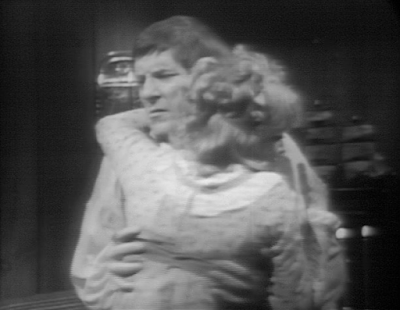
Angelique/ Cassandra has barely closed the door behind her when Sam has trouble seeing. After a moment, he realizes he has been struck blind. She comes back in, takes the painting, tells him she warned him, and leaves.

Sam realizes he is blind. Screenshot by Dark Shadows Before I Die.

Closing Miscellany

Over the years, several members of the cast said on the record that Sam’s blindness was actor David Ford’s idea. He thought that if he could wear dark glasses it wouldn’t bother the audience that he read all his lines off the teleprompter.

In 2022, a commenter on Danny Horn’s post about this episode on his blog Dark Shadows Every Day identified the portraits of Angelique as the work of ABC Art Department specialist Joseph Guilfoyle:

You asked if anyone knew who painted these portraits. I can verify that the portraits of Angelique were painted by Joseph Guilfoyle. He was an artist in the Art Department at ABC. He was my Godfather and his daughter remembers this very well as it made her a bit of a celebrity at the time. Portraits were not commissioned out but instead were created in the Art Department as it was filled with many talented artists.

“Erin Allan,” posted at 5:55 PM Pacific Time 26 February 2022 on “Episode 499: A Senior Moment,” Dark Shadows Every Day, Danny Horn, 10 October 2014

Also worthy of note are the two facial makeups representing Angelique’s aging. It’s no wonder they didn’t have the personnel to make David Ford’s fake mustache look convincing when they were lavishing all the work on turning Lara Parker into two quite distinct old crones.

The costumers were involved in a famous production error in the final scene. Angelique/ Cassandra’s hooded cloak cuts off above her knees. There is no old age makeup on her legs, which are featured from every angle, making a ludicrous contrast with her face and wig.

*In 2024’s money, that’s $4544.17.

Episode 498: One step closer to the dream

Sarcastic dandy Roger Collins has remarried. His previous wife, undead blonde witch Laura Murdoch Collins, was Dark Shadows’ first supernatural menace, posing a threat to the life of their son David from #123 until she vanished amid a cloud of smoke in #191. The ghost of gracious lady Josette joined in the battle against Laura. Among other things, Josette compelled artist Sam Evans to paint a series of pictures warning of Laura’s evil plans. Laura responded to those paintings in #145 and #146 by causing a fire that burned Sam’s hands so badly it seemed he might never again be able to paint.

Roger’s new wife is also an undead blonde witch, though she wears a black wig all the time. This wiggéd witch calls herself Cassandra, but is actually Angelique, who in the 1790s killed many of Roger’s ancestors and turned his distant cousin Barnabas into a vampire. Angelique/ Cassandra has returned to the world of the living because Barnabas’ vampirism is now in remission, and she is determined to restore it.

Before he met Angelique/ Cassandra, Roger became obsessed with a portrait of her. Barnabas concludes that this portrait is essential to her power. He orders his servant Willie to steal it from the great house of Collinwood. Barnabas takes the portrait to Sam and commissions him to paint over it so that Angelique will look tremendously old. He doesn’t offer Sam any explanations, but we heard him tell Willie his theory that what happens to the painting will also happen to Angelique. If her likeness is aged to reflect her actual years, then she will vanish from 1968 and be confined to the past. At the end of the episode, Angelique’s hands have aged dramatically, suggesting that Barnabas is correct.

This is David Ford’s first appearance on the show since December, and he had shaved his mustache in the interim. The fake is not up to the makeup department’s usual standards. Screenshot by Dark Shadows Before I Die.

Portraits have been a very prominent part of the visual composition of Dark Shadows from the beginning, and a battlefield on which supernatural combat could be joined for almost as long. So it is hardly surprising that the show would eventually get around to doing a story based on Oscar Wilde’s The Picture of Dorian Gray.

It would seem Barnabas has little time to lose. Angelique/ Cassandra has distributed some malware to the minds of the people around Barnabas by means of a dream that one person after another will have. The first dreamer is beckoned into a Haunted House attraction by someone, opens some doors behind which there are scary images, is terrified, and cannot find relief until telling its details to the beckoner. That person then has the dream, changed in only two particulars, the identity of the beckoner and the image behind the final door. When everyone’s brain has been hacked, this worm is supposed to reset Barnabas as a vampire.

Yesterday, David had the dream, and Willie was his beckoner. Today, we open in Barnabas’ house, where Willie is paralyzed with fear. David has already told him the dream, and Willie knows he will have it. With all the previous instances of the dream, the audience had to sit through a highly repetitious dream sequence, then a scene in which the character agonizes about whether to tell the dream to the next person, and finally a speech repeating all the details of the dream. At least this time we skip the second and third of those rehashings.

Since Willie is so close to Barnabas, it seems likely that he will be the last to have the dream before it gets back to Barnabas and makes him a vampire again. So it’s no wonder that Barnabas decides it’s time for the high-stakes gamble of a burglary at Collinwood.

There’s also a scene in Barnabas’ basement. Barnabas’ vampirism is in remission because some mad scientists created a Frankenstein’s monster, whom Barnabas named Adam. They connected Barnabas to Adam in a way that drains the symptoms of the curse from Barnabas without manifesting them in Adam. Barnabas has no idea how to raise any child, let alone a 6’6″ newborn with the strength of several grown men, and so locks him up in the prison cell where he used to keep Sam’s daughter Maggie.

The imprisonment of Maggie was a dreary, unpleasant story, but Adam’s time in the cell is even harder to take. Maggie was established as a strong, intelligent person who knew her way around, she could speak, and she had many friends who cared about her. So we never quite gave up hope that she would get away and be all right in the end. But Adam has none of that. As a result, his scenes in the basement are a tale of extreme child abuse, made all the harder to watch by Robert Rodan’s affecting portrayal of the big guy’s misery.

Moreover, Maggie was a major character, introduced in the first episode and connected to everyone else. It’s unlikely they would kill her off unless the show had been canceled and they were going out with a bang. But only the people holding Adam prisoner know who he is, and Frankenstein’s monsters meet their deaths practically every time they feature in a story.

Worst of all, the show is basically very silly right now. A story about a child locked in a cell from birth can be made bearable only by joining it to some kind of deep insight into the human condition, and there is little prospect that anything like that will crop up among all the witches and vampires and other Halloween paraphernalia. My wife, Mrs Acilius, watched the whole series with me in 2020-2021. She was avidly rewatching it with me this time. But when they took Adam to the cell, she suggested I start watching it on days when I get home from work before she does. I’m sure she isn’t the only Dark Shadows fan who takes a pass on the Adam story.

This is the first episode credited to director Jack Sullivan. Lela Swift and John Sedwick took turns at the helm until #450, when executive producer Dan Curtis tried his hand at directing a week of episodes. Swift and Sedwick then returned to their usual pattern. Sedwick will be leaving in a few weeks; Sullivan, who has been with the show as an associate director since the third week, will be Swift’s alternate until November, and from #553 on will be credited as Sean Dhu Sullivan.

Episode 368/369: Whole future

In 1966 and 1967, supernatural menaces Laura Murdoch Collins and Barnabas Collins would often be seen staring out the windows of their houses on the great estate of Collinwood, sending psychic energy towards the targets of their sinister plans. In 1795, Barnabas is neither supernatural nor menacing, but we already see him peering out one of those windows. He is not projecting bad vibes into the world, but is worried about his beloved fiancée, Josette DuPrés. She is supposed to arrive soon, in fact was supposed to arrive some time ago. Now there is a storm, and he hopes she is not at sea.

Earliest window-stare, by dramatic date. Screenshot by Dark Shadows Before I Die.

The audience’s main point-of-view character in 1966 and for most of 1967 was well-meaning governess Vicki. Now Vicki has come unstuck in time, and found herself in this extended flashback to the eighteenth century. Since she will know Barnabas and regard him as a close friend in the 1960s, she is at her ease talking to him now. Although she is a member of the staff in his family’s house in a period when it was customary for masters to summon their servants with bells and communicate with them only in direct commands, Barnabas is a remarkably genial and democratic sort who welcomes her casual manner.

Vicki has already annoyed the audience several times by blurting out information that makes it obvious to the other characters that she does not belong in their world. She does that again in this scene. Barnabas is worried something may have happened to Josette, and Vicki tells him that she will arrive safely. He is surprised by the assurance with which she delivers this prediction, and asks if she is clairvoyant. She realizes that she has been indiscreet, and denies that she is. He is unconvinced.

Barnabas’ father, haughty overlord Joshua Collins, enters. He is appalled to find his son socializing with a servant. He dispatches Vicki to the nursery to look after her charge, his young daughter Sarah. He demands to know why Barnabas is not tending to his own duties at the family’s shipyard. They begin to quarrel, when a knock comes at the door.

Barnabas opens the door to find a woman named Angelique, whom he identifies as maid to Josette’s aunt, the Countess DuPrés. Angelique says that the countess was on her way to Collinwood, but that her carriage is stuck in the mud. Joshua orders Barnabas to send a footman to rescue her. Angelique is the first character we have met in 1795 who is not played by a performer we have seen in the first 73 weeks of the show.

Enter Angelique. Screenshot by Dark Shadows Before I Die.

Joshua goes to his wife, Naomi. Naomi is an alcoholic, a fact of which we are made aware because almost her every scene begins with a shot of her drinking alone. That’s what she is doing before Joshua finds her. He scolds her for her drinking; she complains that he doesn’t allow her to do anything else. She can’t even pass the time with a book- we saw Monday that Naomi is completely illiterate.

Glug glug glug. Screenshot by Dark Shadows Before I Die.

Naomi’s alcoholism is both a nod to the concern of first-wave feminism with the atrophy of the elite housewife, and a suggestive side-light on Barnabas as we knew him in the 1967 segment. Then, Barnabas abducted Maggie Evans, The Nicest Girl in Town, and tried by more or less magical means to replace her personality with that of Josette. For the first 40 weeks of Dark Shadows, Maggie’s father’s alcoholism had been a substantial story element, and she would always retain a number of classic Adult Child of an Alcoholic (ACoA, in the lingo of the recovery movement) characteristics, such as beginning utterances with a little laugh to prove that she is happy. Now that we know that Barnabas is also an ACoA, we can wonder if that shared experience was part of the reason he was drawn to Maggie.

The countess arrives. Since she is played by Grayson Hall, who also plays mad scientist Julia Hoffman in the parts of the show set in the 1960s, Vicki blurts out “Julia!” when she sees her. Hall had also been nominated for an Academy Award for her performance as Judith Fellowes in the 1964 film Night of the Iguana; if Vicki is going to keep the audience up to date on the cast’s resumes, it would have been more interesting if she’d exclaimed “Judith!” Vicki explains that the countess looks like someone she once knew who was named Julia, a remark which irritates the countess, who would like to think her appearance is distinctive. Vicki has certainly not made a favorable impression on this grand lady.

Joshua tells the countess he is surprised that “You still affect a title” when “France has followed our example and become a republic.” His pride in this development, after the Terror and in the bloodiest year of the wars in the Vendée, marks Joshua as a member of the Jeffersonian party in US politics. The Federalists and others had long since turned against the French Revolution by that year.

The countess tells Joshua that it is precisely because France has become a republic that she chooses to live on the island of Martinique. That answers a question that some fans ask about Angelique- why is she white? If the DuPrés family lives on Martinique and are major sugar planters there, they must hold a great many African people in slavery. When we hear that they are bringing a servant with them, we expect that servant to be Black. When we learn that the the countess is an emigré, we realize that she brought Angelique with her from France.

The countess may solve one puzzle for us in her exchange with Joshua, but she presents us with another. Josette’s father André is the countess’ brother, yet he is never referred to as a count. Indeed, when he appears, we will see him answer to “Mr DuPrés.” Perhaps he renounced his title, as many French aristocrats did during the Revolution.

Whatever the explanation, “DuPrés” would seem to represent a missed opportunity. When Josette was first mentioned, in the early months of Dark Shadows, her maiden name was given as “LaFrenière.” It would have been a nice touch to have kept that name for Josette and her father, and to have reserved “DuPrés” as the name of the countess’ late husband.

“LaFrenière” had been a perfect choice because of its class ambiguity for a show about an aristocratic family in the state of Maine- it was originally the family name of the barons of Fresnes, and could therefore be a sign of a senior order of nobility, but is also a very widespread name in Quebec. So “Josette LaFrenière” might either have been a French noblewoman who deigned to marry into the mercantile Collins family at the apex of their prestige, or a working class girl from the north who eloped with the boss’ son.

The choice of Martinique as Josette’s place of origin might add a new twist to this class ambiguity. The Empress Josephine grew up there as a member of the untitled but ancient Tascher family, who, like the fictional DuPrés family, owned an enormous sugar plantation on the island. The Taschers of Martinique went back and forth between Martinique and metropolitan France, and Josephine herself was living there in 1779 when she married her first husband, the Vicomte de Beauharnais. Josephine herself was in prison when the vicomte was guillotined in 1794, one of the last to die in the Reign of Terror, and she was freed just a few days later. The next year, she recovered her husband’s property, and a year after that married the young general Napoleon Bonaparte. It seems likely that the similarity between the names “Josephine” and “Josette” was writer Sam Hall’s inspiration for placing Josette’s origins on Martinique. Association with a figure who was at once a grand lady and an example of very steep upward social mobility could synthesize the two possible Josettes LaFrenière into a single figure.

Had they developed the story of the family’s relationship with the town of Collinsport more richly in Dark Shadows 1.0 and 2.0, they could have used this ambiguity to build up suspense that would be resolved today, in the third episode of Dark Shadows 3.0. Since they did so little with that theme in those days, when the story was moving very slowly and it would have been relatively easy to fit just about anything in, I suppose we shouldn’t be surprised that they drop it so completely at this period of the show, when the story is flowing at a breakneck speed.

The countess’ lofty aristocratic manner stings Joshua. Alone with Naomi, he loudly proclaims his belief that all men are equal. We already know enough about Joshua’s tyranny over his household that this absurd little speech must be an intentional spoof of the rich landowners who supported the Jeffersonian party in the early decades of the Republic. Again, this would be funnier and more poignant if the show had done more with social class in its first 73 weeks.

Barnabas sees the countess dealing out tarot cards. He tells her she is too sophisticated for them, and is reluctant to sit with her while she uses them to read his fortune. The moment she says that the cards suggest a connection between him and the concept of infinity, his skepticism evaporates instantly and he excitedly asks if that means he will live forever. The countess cautions that his jubilation at this idea may be misplaced. She notices the “Wicked Woman” card, and takes a significant look at Vicki. Evidently the audience is not alone in objecting to Vicki’s brainless nattering about what the show used to be like.*

Angelique comes to Barnabas’ room. It turns out the two of them had a brief affair when he was first on Martinique, and she expects to resume it. He is not at all pleased at her attentions.

Not how every man would react to a passionate embrace from Lara Parker… Screenshot by Dark Shadows Before I Die.

Barnabas explains that he was already falling in love with Josette when he and Angelique had their fling, but that he didn’t really know her. He couldn’t believe that she would reciprocate his feelings, and consoled himself by dallying with Angelique. This explanation goes over with her about as well as you’d expect, and she storms out of the room, vowing that she will get her way in the end.

We know that the tarot cards are giving accurate information, because the show leans heavily on the uncanny and they wouldn’t have spent so much time on a gimmick that wasn’t meant to advance the plot. We also know that Vicki is not the Wicked Woman the countess is looking for. That leaves Angelique, and we can assume that her wickedness will express itself in some supernatural action taken to avenge herself on Barnabas. Since we know that Barnabas will become a vampire, we wonder if it is Angelique who makes him one.

Closing Miscellany

I usually refer to surviving cast members with courtesy titles and to deceased ones by surname alone. So Alexandra Moltke Isles is “Mrs Isles,” which has been her professional name for 56 years, David Henesy is “Mr Henesy,” Nancy Barrett is “Miss Barrett,” etc, while Jonathan Frid, Joan Bennett, Louis Edmonds, and Grayson Hall are just “Frid,” “Bennett,” “Edmonds,” and “Hall.” Until last month, I’d been looking forward to saying lots of things about “Miss Parker” and her portrayal of Angelique, but Lara Parker died on 12 October 2023. So she’s just going to be “Parker,” and I’m going to be sad about it.

Artist Teri S. Wood has created a number of short animations about Angelique and Barnabas. This one is based on their two-scene at the end of today’s episode:

https://www.youtube.com/watch?v=pyxI0q2aOIk

Patrick McCray has a post about this episode that mystifies me. He writes that “After seven months of hearing about Angelique, today, she enters. So, no pressure Lara. You only have to live up to a half year of build-up.” Uh, what? There has been absolutely no reference to Angelique on the show before today. I can think of an interpretation of the story that might retroject Angelique into episodes #211-365, and I will talk about it next week. But I don’t think it is an interpretation Patrick would favor.

He also talks about David Ball’s method of reading plays from the ending back to the beginning and then from the beginning forward, so that the ending comes to seem implicit in everything else. He allows that Dark Shadows has more than one ending, but I would say he doesn’t go far enough. I’d say the series has ten endings. The first came in #191, when Laura went up in smoke while her son David found refuge in Vicki’s arms. That ending defined Dark Shadows 1.0 as the story of David’s escape from his evil, undead mother Laura, and his adoption of Vicki as his new, life-affirming mother. The second came in #364, when Barnabas met the ghost of his little sister Sarah, she commanded him to be nice to the living, and he went right on with his murderous plans. That ending defined Dark Shadows 2.0 as the story of Barnabas’ irredeemable evil.

Two of the other endings will feature Angelique dying in Barnabas’ arms, and Patrick suggests that those make the whole show the story of their relationship. I don’t buy it at all. Each of the ten parts is about what it is about, and even those two episodes with Angelique dying derive more dramatic charge from other moments.

*Making connections with the first 73 weeks is my job!