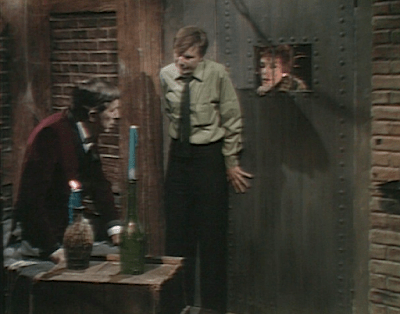
Episode 807: An award-winning performance, wouldn’t you say?

From #1 to #274, each episode of Dark Shadows began with a voiceover narration by Alexandra Moltke Isles, usually in character as well-meaning governess Vicki. This identified Vicki with our point of view and suggested that she would sooner or later learn everything we knew.

Jonathan Frid joined the cast as vampire Barnabas Collins in #211, and quickly became the show’s great breakout star. If the upright Vicki found out what we knew about Barnabas, one of them would have to be destroyed. Vicki was the favorite of longtime viewers and Barnabas was attracting new ones, so that was out of the question. Therefore, other members of the cast started taking turns reading the voiceovers, and doing so not as their characters, but in the role of External Narrator.

Today marks the first time Frid himself reads the narration. His training first in Canada, then at Britain’s Royal Academy of Dramatic Arts, and later at Yale School of Drama prepared Frid well in the art of dramatic reading, and in later years he would concentrate on that aspect of his craft. Several of his colleagues are his equals in these voiceovers- I would particularly mention Kathryn Leigh Scott, whose conception of The Narrator is always arresting, and Thayer David, who could consistently achieve the most difficult of all effects in voice acting, a perfectly simple reading. So I can’t say I wish Frid had done all of them, but he is always good, and today’s performance is among his most gorgeous.

The action opens on a set known to longtime viewers as the Evans cottage, where from 1966 to 1968 artist Sam Evans and his daughter Maggie served as Dark Shadows‘ principal representatives of the working class of the village of Collinsport. In those days, it was on this set that we saw how the misdeeds of the ancient and esteemed Collins family had consequences that spilled out of the estate of Collinwood and warped the lives of people trying to make a more or less honest living nearby.

Now the dramatic date is 1897, and Sam hasn’t been born yet. But the cottage is already an artist’s studio. It is temporarily occupied by the nationally famous Charles Delaware Tate, who is painting a portrait of rakish libertine Quentin Collins at the behest of evil sorcerer Count Petofi. Charity Trask, a resident of the great house of Collinwood, is visiting Tate in the cottage when she sees the face in the portrait change from that of Quentin. It takes on a great deal of fur and long fangs, and reminds Charity of a wolf.

By the time Tate looks at the painting again, it has resumed its normal appearance. He tells Charity that the transformation must have been in her imagination. She is willing to consider the possibility, but we know better. Quentin is a werewolf, a condition Petofi knows how to cure. Portraits on Dark Shadows have had supernatural qualities at least since #70, including portraits we saw Sam execute on this set in 1966, 1967, and 1968, and the show has borrowed from The Picture of Dorian Gray before. Moreover, Tate’s reaction to Charity is one of barely controlled panic. Nancy Barrett has to ramp up Charity’s own emotional distress to the limit to make it plausible she would not notice Tate’s extreme agitation. Perhaps if Tate were played by a better actor than the ever-disappointing Roger Davis, his response might have been ambiguous enough that Miss Barrett could keep the tone a bit lower, but his unequivocal display of alarm leaves her nowhere to go but over the top.

Mr Davis was under no obligation to play the scene transparently, since Tate later goes to Petofi’s henchman Aristide and lays out in so many words his precise relationship to Petofi’s operations and his knowledge of them. Tate’s career is his reward for selling his soul to Petofi, and he has already experienced great sorrow as a result of that bargain. Tate knows that the portrait changed to reflect the full Moon’s influence on Quentin and that Petofi is currently in possession of twelve year old Jamison Collins. Aristide tells us that Petofi’s own body is in suspended animation while he acts through Jamison. He also says that it was in 1797 that Petofi’s right hand was cut off, and that if he does not reclaim the hand in a few weeks, by the date of the one hundredth anniversary of the amputation, he will die and so will Tate.

Jamison/ Petofi is in the prison cell in the basement of the Old House on the estate of Collinwood. Barnabas has traveled back in time from the 1960s with some vaguely good intentions and is hanging around 1897 causing one disaster after another. Now, he is doing battle with Petofi and has locked him, in the form of Jamison, in the cell. Barnabas’ reluctant sidekick, broad ethnic stereotype Magda Rákóczi, guards Jamison/ Petofi during the day. Early in the episode, Jamison/ Petofi calls Magda and pleads with her to release him. He tells her that he is “just a little boy” and that she is a “rather heartless creature.” She says she wishes he were a little boy again, but that she isn’t stupid and he won’t fool her. Indeed, the phrase “rather heartless creature” and Jamison/ Petofi’s manner in delivering it sound so much like Thayer David as Petofi that they hardly count as an attempt to deceive Magda.

Later, Jamison/ Petofi casts a spell to summon Aristide, then calls to Magda again. When Magda arrives, Jamison/ Petofi gives himself a better script than the one from which he had acted in his previous scene with her. He pretends not to remember how he got into the cell and to be shocked that Magda knows he is there. Perhaps the utter transparency of his earlier pleadings was an attempt to get Magda to underestimate his abilities as a trickster.

In #803, we saw that when Petofi took possession of him Jamison’s right hand disappeared from his wrist, matching Petofi’s own mutilated condition. When Jamison/ Petofi feigns the amnesia that might come upon recovery from possession, we might therefore expect Magda to demand that he remove his gloves to prove that he is himself again. But he plays the part of Jamison so convincingly that we are not really surprised he does fool Magda. She goes into the cell, embraces Jamison/ Petofi, and he kisses her on the cheek. It is this kiss that spreads his magical power, and she realizes too late that she has been had.

Aristide arrives a moment later, and Jamison/ Petofi calls his portrayal of an innocent boy “an award-winning performance.” Indeed, if there had been daytime Emmys in 1969, David Henesy might have won one for his portrayal of Thayer David playing Petofi playing Jamison.

Aristide wants to kill Magda; Jamison/ Petofi forbids this. Under his power, she announces that she is responsible for all the evil that has happened in 1897. She was responsible for releasing Barnabas and therefore for all the murders and other harm he has done; she made Quentin a werewolf, and is to blame for his killings in his lupine form and for the curse his descendants will inherit; she stole Petofi’s severed hand and is at fault for the deaths of Rroma maiden Julianka and of her own husband Sandor that resulted from the hand’s presence. She even takes the blame for Quentin’s murder of her sister Jenny, the act for which the werewolf curse was meant as vengeance. Magda says she must be punished. Jamison/ Petofi tells her that he is not interested in punishing her. He has another use in mind for Magda She will lead him and Aristide to Barnabas’ coffin today, and they will destroy him.

Longtime viewers will perk up twice when Aristide says that Petofi lost his hand in 1797 and that he has exactly one hundred years to recover it. From December 1966 to March 1967, Dark Shadows’ first supernatural menace was undead blonde fire witch Laura Murdoch Collins, who at intervals of exactly one hundred years incinerated herself and a young son of hers, who was always named David, in an unholy ceremony that renewed her existence, but not that of the Davids. Since the usual laws of nature don’t apply, the show needs some other causal mechanism to create suspense, and anniversaries will do as well as anything else. Another iteration of Laura was on earlier in the 1897 segment. It was fun to see her again, but they could shoehorn her into that year only by retconning away the one hundred year pattern in her immolations. It’s reassuring in a way to see that Petofi is bringing centenaries back.

The date 1797 is also significant. It was in 1796 that Barnabas died and became a vampire. We flashed back to that period for the show’s first costume drama segment in November 1967 to March 1968, and Barnabas went back to 1796 for a week in January 1969. So we may go back again some day, and if Petofi was alive and in his prime in 1797, we might run into him there.

Barnabas and Petofi are not the only characters from the 1790s who might be on the minds of attentive longtime viewers. Barnabas’ little sister Sarah died in 1796, and as a ghost was an extremely important part of the show from June to November 1967. We’ve been getting reminders of Sarah for the last several days. In #792 wicked witch Angelique produced a toy soldier of Barnabas’ that Sarah gave to strange and troubled boy David in #331. In #805, Charity found Sarah’s recorder, a prop that often served as Sarah’s calling card in 1967, and talked about learning to play it. And today, we see a portrait standing on the floor of the Evans cottage, a set which Sarah visited in #260, depicting a girl wearing a bonnet very much like the one Sarah wore as a ghost in 1967 and a pink dress just like the one she wore when we saw her as a living being in the flashback to the 1790s.
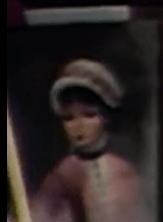
Portrait at the cottage.

I wonder if, when they were making up the flimsies for this part of the show, they had thought of reintroducing Sarah. That would have required a recasting of the part- Sharon Smyth was noticeably older when we saw Sarah die in January 1968 than she was when Sarah was a ghost in June 1967, and by now we would wonder what she has been eating in the afterlife that has made her get so much taller. Besides, Miss Smyth* had stopped acting by this point.

The process of planning the stories was in two stages, a rough sketching of themes six months in advance, and a capsule of each episode written thirteen weeks ahead of time. There was a lot of flexibility when it came to putting those plans into effect. Some stories that were supposed to end within thirteen weeks were extended over years, while others that were expected to be a big deal petered out before they got going. In an interview preserved by Danny Horn at his great blog Dark Shadows Every Day, writer Violet Welles said that many of the moments on the show that made the least sense were those written when the plans hadn’t worked out: “toward the end of the cycle, you’d have characters who were really not a lot of interest who had to play scenes with other characters who really didn’t have a lot of interest, dealing with things that basically didn’t concern them. Those were hard to write.”  

This episode was taped on 25 July 1969; thirteen weeks before that was 21 May. Six months before was 25 January. By 25 January, Denise Nickerson had been on the show for two months as Amy Jennings. Nickerson was actually born on 1 April 1957, but they several times say that Amy is nine years old. When the show goes to 1897, Nickerson plays Nora Collins, who is also nine. On 19 May, Nickerson taped #761, the last episode she would appear in until #782. She is currently in the middle of a second long absence from 1897, unseen between #783 and #812. Her characters were so important in the months leading up to the 1897 segment and she played them so well that we wonder what they were thinking leaving her in the background so long.

Maybe they were thinking of bringing her back as Sarah. Nickerson didn’t look all that much like Sharon Smyth, and was a far more accomplished young actress than was Miss Smyth, but she did have brown hair, and the show prioritized hair color above all else in recasting parts. For example, two actresses followed Mrs Isles in the role of Vicki, neither of whom had much in common with her either in acting style or in looks, but who both had black hair. So perhaps there was a time when they intended to travel between 1897 and the 1790s and to meet Sarah, played by Denise Nickerson. If Nickerson were still alive, perhaps someone would ask her if she posed for the portrait that is standing on the floor of the Evans cottage today.

*She’s been using her married name for decades now, but when talking about her as a child it’s pretty weird to refer to her as “Mrs Lentz.” Since I use surnames for people associated with the making of the show and attach courtesy titles to surnames of living people, I have to call her “Miss Smyth.”
Episode 712: A pawn in this cruel game

Dark Shadows first developed its conception of the supernatural in depth when undead blonde fire witch Laura Murdoch Collins was on the show from December 1966 to March 1967. Laura was not so much one person as she was a complex of at least three distinct beings. There was a charred corpse in the morgue in Maricopa County, Arizona; a phantom that Laura’s son, strange and troubled boy David Collins, can sometimes see through his window as she flickers above the lawns of the estate of Collinwood; and a living woman who carries on conversations with people but is never seen eating or drinking. People who encounter Laura also experience dream visitations that resemble her and unaccountable compulsions to do things relating to her, but it is never clear which of those psychic phenomena come from Laura and which from her arch-nemesis, the ghost of the gracious Josette. It is clear that the various parts that make up Laura are not always aware of each other, and sometimes work at cross-purposes with each other.

Laura’s successor as Dark Shadows‘ chief supernatural menace was vampire Barnabas Collins, who joined the show in April 1967. Like Laura, Barnabas comes in several parts, not all of them working together harmoniously. For example, sometimes doors slam shut when he is in a house, and only he can open them. This is never shown as something he deliberately makes happen, and it does not always serve any intelligible purpose of his. Also, when he is active dogs start howling. Sometimes that immobilizes his targets with fear and confusion, but just as often it costs him the element of surprise and foils his plans. So whatever uncanny forces cause these things to happen are clearly not subject to Barnabas’ will. They accompanied him out of the darkness.

Shortly after Barnabas’ arrival, the show retconned Josette as his lost love and cast her as Princess Ankh-Esen-Amun to his Imhotep in a remake of the 1932 film The Mummy. In that film, the undead man tried to remake contemporary woman Helen Grosvenor in the image of the ancient Ankh-Esen-Amun. Taking that role in Barnabas’ attempt to recreate Josette was Maggie Evans, The Nicest Girl in Town. As in the 1932 film Zita Johanns played Helen in the contemporary scenes and Ankh-Esen-Amun in a flashback to ancient Egypt, so in #70 and #126 had Miss Scott already played the ghost of Josette.

While Barnabas pursued his crazed and evil plan to Josettify Maggie, the ghost of his little sister Sarah showed up. Sarah befriended Maggie and helped her escape from her “big brother.” Sarah did more and more, ultimately sending well-meaning governess Vicki back in time so that from November 1967 to March 1968, Dark Shadows was a costume drama set in the 1790s, when Barnabas and Sarah were alive.

Like Laura and Barnabas, Sarah may have looked like single person, but was in fact a complex of independent beings. In #325, she visits David in a dream and gives him information only she would have. In #327, David sees Sarah during waking hours and tells her about the dream, and it all comes as news to her. This daylight Sarah makes it clear to David that she does not want him to have the information the dream version of her gave him so shortly before.

Moreover, child actress Sharon Smyth was instructed to play Sarah as Barnabas’ conscience. When Barnabas is freed to prey upon the living, he unknowingly pulls Sarah out of the supernatural back-world behind the action of the show, the unseen realm where Josette’s ghost, the “Widows,” the ghost of Bill Malloy, and the rest of them lurk, and brings her with him into 1967. Sarah, however many of her there are, is part of the same complex that includes Barnabas and the forces that surround him.

In the 1790s portion, we met wicked witch Angelique and saw her place the curse that turned Barnabas into a vampire. Like the other supernatural forces, Angelique was a complex of multiple beings, some of which were opposed to each other. In her case, spellcasting was a matter of breaking off little bits of herself that took on lives of their own. Angelique was obsessed with the idea that Barnabas would fall in love with her. She could easily cast a spell to make him do that, but insisted to her helper that Barnabas must come to her “of his own will.” Those were the exact words Barnabas used when talking to his own thrall about Vicki, who succeeded Maggie as the object of his gruesome fantasies. When we heard Angelique take the same line, it dawned on us that the Barnabas we saw from April to November 1967 was not merely cursed by Angelique, he was possessed by her. His thoughts were her thoughts, his plans were her plans. When Barnabas fights Angelique, it is one of her replicas of herself coming back to oppose her, as the zombie version she created of Barnabas’ uncle Jeremiah came back to bury her alive in #396.

Now, Barnabas has traveled back in time to 1897. He has met governess Rachel Drummond, who is played by Kathryn Leigh Scott and whom he recognizes as a double of Josette. Angelique has also come to 1897, conjured up by some Satanists whom Barnabas has antagonized for no apparent reason. Angelique peered through the windows of the great house of Collinwood just in time to see Barnabas giving Rachel Josette’s music box. Dismayed, she went to the Old House on the estate, looked at Josette’s portrait, and declared “I am Angelique, and I hate you!” She, like Barnabas, looks at Rachel and sees another Josette.

Angelique’s motivation in the 1790s segment was ostensibly about her desire for Barnabas, but it was her hatred for Josette that drove her at every turn. Now we see that Barnabas is compelled to create another Josette whom he can love; Angelique is just as powerfully compelled to create another Josette to hate. Since Barnabas’ “love” involves killing its object and raising her as a vampire, it would seem to be as hateful as is Angelique’s overt hostility.

After Angelique proclaimed her hatred to the portrait, she took a cloth doll representing Rachel and strangled it. Rachel herself collapsed, unable to breathe. Angelique mouthed words; Rachel spoke them, leading Barnabas to believe that they were a message from Josette.

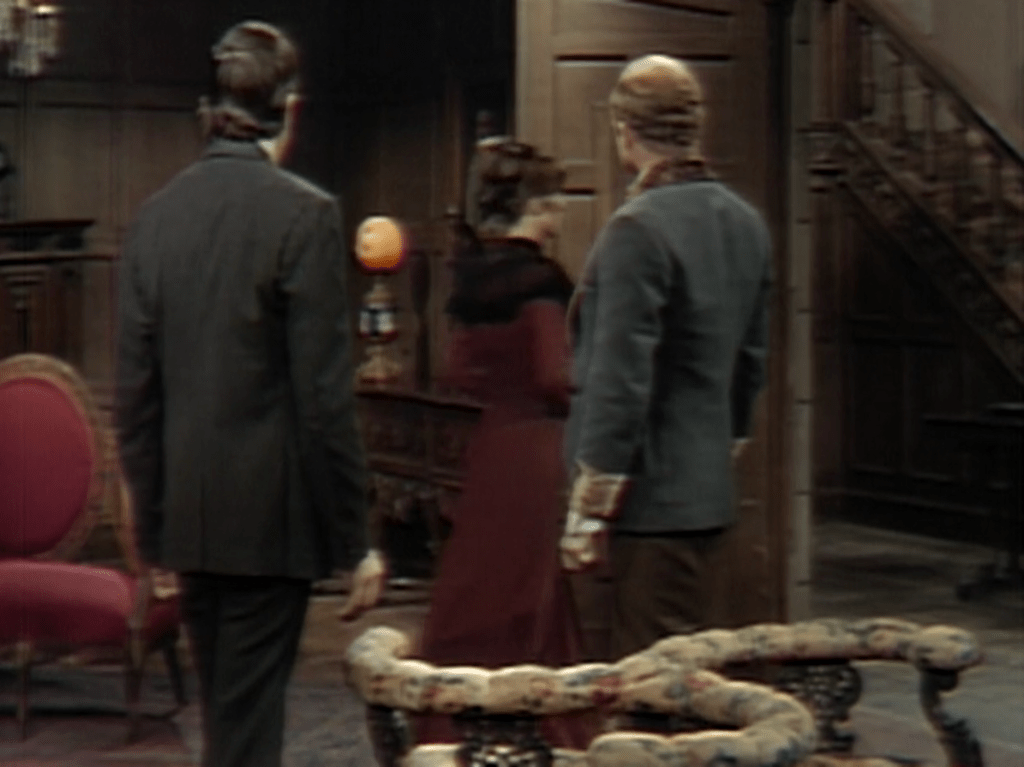
Today, Rachel is in the drawing room at the great house, recovering from her choking episode. Barnabas is holding her and looking longingly at her neck when stuffy Edward Collins enters. Edward demands to know what is going on, and Barnabas explains that Rachel had trouble breathing and fainted. Edward becomes concerned and wants to call a doctor; he becomes suspicious when Rachel, who he just met a few days ago, does not want to see a doctor. Barnabas manages to distract Edward from his suspicions with some chatter about the circumstances under which Rachel fainted.

In the groundskeeper’s cottage on the estate, Angelique casts a spell to summon Rachel. Back in the great house, Rachel suddenly looks up, her eyes wide open and focused at a point in the middle distance. She stands up and walks with her neck very still, moving like a wind-up doll. She announces to Edward and Barnabas that she will be going outside for a breath of fresh air. She refuses Barnabas’ offer to accompany her. Edward and Barnabas watch her wonderingly as she marches out with her robotic gait.

Barnabas and Edward wonder what has got into Rachel all of a sudden

Rachel arrives at the cottage and finds Angelique. Angelique calls Rachel “Josette.” When she protests that her name is Rachel, Angelique echoes the Barnabas we first knew and tells her that, when she wills it, her name will be Josette. She tells Rachel that she will not understand what is happening to her, but that Barnabas will soon understand very well.

Back in the great house, a servant tells Edward that he found a woman in the cottage. Barnabas is there, and he reacts to the description with alarm. He goes to the cottage, clearly afraid that he will find Angelique there. Before he can complete a search, a rooster crows and Barnabas hastens back to his coffin in the basement of the Old House on the estate.

Barnabas opens the coffin, and finds Rachel lying in it, unconscious. This sets up a comedy of manners. He hardly knows her well enough to lie down with her, and he can’t very well wake her and ask her to make way for him. We end with him facing this problem in etiquette.

We may also remember #248, when Barnabas expressed his frustration with Maggie’s refusal to turn into Josette by forcing her into his coffin. Perhaps Angelique knows that he did that, and is taunting him with a memory of which he has since shown an ability to be ashamed. If so, the point of the taunt is that he is not different from her. Angelique called Rachel a “pawn” in the “cruel game” she is playing with Barnabas. Angelique, who when we first saw her in the 1790s segment was so monomaniacally devoted to her goals that she could not see events from any perspective other than her own, can now understand that what she is doing to Rachel is horrible. That’s why she is doing it, to show Barnabas that he is part of the same horror as herself and that he can never transcend it.

Episode 648: Her name is Madame

This is the second of three episodes featuring Cavada Humphrey as Madame Janet Findley, a medium called in to investigate the strange goings-on at the great house of Collinwood. Humphrey’s performance so utterly dominates the segment, and I have so little to add to what I said about her style in yesterday’s post, that all I can do is make a series of more or less miscellaneous observations about its other aspects.

Today Madame Findley meets children David Collins and Amy Jennings. Amy and David are coming under the influence of evil spirit Quentin Collins. She questions them in the drawing room, and finds a hidden panel that leads to the long-abandoned west wing of the house. Over the children’s objections, she enters the secret passage. As soon as she is in, they hurriedly close the panel, locking her in. Evidently their objections were part of a ruse designed to lead her to Quentin’s stronghold. All too often on Dark Shadows, the audience knows too much about what characters are trying to do. This scene stands out, because they really do keep us guessing whether the children want Madame Findley to go into the secret passage. We don’t really know what their goals are until we see them shut her in.

Madame Findley goes into the darkness. Screenshot by Dark Shadows Before I Die.

Earlier in the episode, Amy’s brother Chris dropped in. He was very eager to see permanent houseguest Julia Hoffman, MD. Amy mentioned to Chris that there was another visitor in the house. When Chris asked who it was, Amy replied, “Her name is Madame- Madame something- at least that’s what they call her.”

I heard these lines in the voice of T. S. Eliot. The rhythm is reminiscent of a section of his poem The Waste Land, which in 1968 was an extremely familiar text to people with literary ambitions:

Madame Sosostris, famous clairvoyante,

Had a bad cold, nevertheless

Is known to be the wisest woman in Europe,

With a wicked pack of cards. Here, said she,

Is your card, the drowned Phoenician Sailor,

(Those are pearls that were his eyes. Look!)

Here is Belladonna, the Lady of the Rocks,

The lady of situations.

Here is the man with three staves, and here the Wheel,

And here is the one-eyed merchant, and this card,

Which is blank, is something he carries on his back,

Which I am forbidden to see. I do not find

The Hanged Man. Fear death by water.

I see crowds of people, walking round in a ring.

Thank you. If you see dear Mrs. Equitone,

Tell her I bring the horoscope myself:

One must be so careful these days.

It was indeed a mysterious Tarot card that prompted matriarch Elizabeth Collins Stoddard to call for help, and that call brought Madame Findley to the house. The card she interprets is the Tower of Destruction, which unlike the cards Eliot’s Madame Sostris describes actually appears in existing Tarot decks. She doesn’t have a cold, and she isn’t in the business of selling horoscopes door to door. On the contrary, as Humphrey plays her she is a dazzling presence.

Liz did not call Madame Findley directly. She telephoned occult expert Timothy Eliot Stokes, who introduced her to La Findley. At first sight, Stokes appears to be a stuffy academic with an impossible Anglophile manner, but as we get to know him he turns out to be very much at home in the bizarre netherworld in which the show takes place, so much so that his supernatural adversaries fear that he may have powers surpassing theirs. T(homas) St(earn)s Eliot was so much like T(imothy) Eliot St(oke)s in the first impression he made, so highly regarded by the sort of people who wrote Dark Shadows, and so generally famous in the 1960s that it is very likely that Stokes’ name was at least partly inspired by him.

It’s true that Madame Findley’s name lacks the exotic glamour Eliot gave his character. I suppose if you have all of Europe to choose from, you can take your stray Tarot cards to someone named “Madame Sosostris,” but if you are limited to central Maine, you have to settle for “Janet Findley.”

I made a remark about Madame Findley’s name in the comments on Danny Horn’s post about episode #647 on his great Dark Shadows Every Day:

It’s just delightful that they introduce an otherworldly, mystical character, played with an actress who brings a genuinely eerie note to her performance, and her name is… “Janet Findley.” It’s like Monty Python and the Holy Grail, when they meet the wizard who is known as “Tim.”

I wonder if there’s any connection between the name “Janet Findley” and the name “Janet Fisher,” whom Carolyn mentioned as a friend once of twice in the first season. Seems like a lot of Janet Fs. For that matter, I wonder if there’s a connection between Tim the Wizard from Monty Python and Tim(othy Eliot) Stokes, who a couple of episodes back had to tell Vicki that he isn’t a wizard.

Comment left by Acilius, 8 October 2020, on Danny Horn, “Episode 647: The Wire,” Dark Shadows Every Day, 12 May 2015

That remark drew a response from a commenter who posts as “Mary”:

Findley is a popular name on Dark Shadows. In addition to Janet, Margaret Findley is one of the ghostly widows, Thomas Findley is one of Jeb’s zombies in the Leviathan storyline and Findley’s cove is the location of Carolyn’s cottage in 1995.

Comment left by “Mary,” 18 February 2021, on Danny Horn, “Episode 647: The Wire,” Dark Shadows Every Day, 12 May 2015

When Madame Findley asks about the closed-off parts of the house, Liz tells her about both the west wing and an east wing. The phrase “east wing” had come up a couple of times in the first year of the show, but it always seemed to be either a case of the writers not having made up their minds which side of the house the deserted wing was on or a slip of the tongue by the actors. This is the first time the show makes it clear that the house really does have two deserted wings.

Humphrey was too perfect for Dark Shadows to play only one role. In a comment on Danny’s post about this episode, I indulged in a little fanfic about another part that would have been right for her:

Cavada Humphrey looks quite a bit like Jonathan Frid. I wonder what 1795 would have been like if Barnabas had had an older sister who bossed him around, stood around during his ridiculously childish fits of petulance, occasionally acted as his conscience, and time and again serve as his enabler and protector. It would have been funny to see Grayson Hall’s Countess express disapproval of such a relationship.

Heck, that older sister could have been Sarah. Just because she’s a child in her ghost form doesn’t mean she has to have died at that age. Maybe she comes back in the form in which her relationship to her brother took its permanent shape, when she was about nine and he was about seven. Of course, that possibility is foreclosed at Sarah’s first appearance, when she tells Maggie not to let her “big brother” know she saw her, but I suppose they could have retconned that away with a phony flashback where she says “little brother.”

Comment left by Acilius, 8 October 2020, on Danny Horn, “Episode 648: Astral Disturbances,” Dark Shadows Every Day, 14 May 2015.

I’m very fond of Sharon Smyth, and Sarah’s last appearance in the 1795 segment was so poignant it would have been a substantial loss for her not to have been in it. On the other hand, she had so much less to do when she was playing a living being than she did in the preceding months when Sarah was a ghost, and so much of what she did get to do was outside her rather sharply limited range, that it is not difficult to imagine a different kind of Sarah making the eighteenth century insert a more compelling drama.

Episode 616: When a woman has a man in her power

In June 1967, vampire Barnabas Collins locked his victim Maggie Evans, The Nicest Girl in Town, in the prison cell in the basement of the Old House on the estate of Collinwood. The ghost of Barnabas’ little sister Sarah appeared to Maggie several times while she was in the cell. Sarah told Maggie that no one could know she had been to the cell, and particularly warned her not to tell her “big brother” she had seen her. With some reluctance, Sarah eventually gave Maggie a clue that led her to a hidden passage. Sarah’s father had sworn her to secrecy about the passage, and that not even her big brother knew about it. Maggie finally puzzled out the clue, enabling her to escape just moments before Barnabas came to the cell with the intention of killing her. When Barnabas chased Maggie through the hidden passage in #260, the wondering expression on his face confirmed that he had never had any idea the passage was there.

From November 1967 to March 1968, Dark Shadows was a costume drama set in the years 1795 and 1796, the period when Barnabas and Sarah were living beings and the Old House was their home. We saw how cruelly their father, haughty overlord Joshua, treated his indentured servant Ben, and we saw that Joshua had the great house of Collinwood built with a prison cell in its basement. Joshua confined Ben to that cell in #401. With that, we could be sure that Maggie’s cell was already in the basement of the Old House when Barnabas and Sarah lived there, and could surmise that Joshua really did forbid the living Sarah to share with Barnabas or anyone else what she had found about the hidden passage.

The show never explained how Sarah found out about the passage. We might imagine her hiding and watching Joshua or someone else do maintenance on the cell. But the fact that Joshua kept the existence of the escape hatch from Barnabas suggests he wanted the option of locking his son in the cell. Why not his daughter as well? Perhaps Sarah found the passage while confined in the cell herself. Or perhaps some other, older ghost appeared to her while she was there and told her about it. That the clue she gives Maggie is in the form of a rhyme (“One, two, away they flew…”) would suggest this latter possibility. Sarah may have memorized the rhyme as she memorized the lyrics to “London Bridge” and may have solved the riddle as Maggie solves it.

Shortly after Dark Shadows came back to a contemporary setting in March 1968, Barnabas was cured of vampirism. That cure was stabilized in May, when he donated some of his “life force” to the creation of Frankenstein’s monster Adam in an experiment completed by his friend, mad scientist Julia Hoffman. Barnabas and Julia locked Adam up in the basement prison cell for the first weeks of his life. Vampires and mad scientists are metaphors for selfishness, so it is hardly surprising that they are horribly bad parents. But if Joshua was in the habit of locking his children in that same cell, the moments when Barnabas takes fatherly pride in the imprisoned Adam take on a special pathos. It really does seem like a normal situation to him.

Adam escaped from the cell in #500, demolishing the doorway in the process. Today we see that it has been rebuilt. Perhaps to Barnabas, a house just isn’t a home unless it has a prison cell in the basement.

Now, Barnabas has himself become the blood thrall of a vampire, his ex-wife Angelique. Discovering the bite marks, Julia decides to address the situation by locking Barnabas and his servant Willie in the cell. Barnabas won’t be able to get out to heed Angelique’s summons, and Willie hangs a cross over the door to keep her from materializing inside it.

Left to right: Barnabas Collins (Jonathan Frid); Willie Loomis (John Karlen); Julia Hoffman (Lady Elaine Fairchilde.) Screenshot by Dark Shadows Before I Die.

We cut to Maggie’s house. Maggie’s memory of her ordeal as Barnabas’ victim has been wiped from her mind a couple of times. She receives a visitor, the suave Nicholas Blair. Unknown to Maggie, Nicholas is a warlock and Angelique’s master. He has a crush on Maggie which has distracted him from his managerial responsibilities, which to be frank he had not been handling very diligently in the first place. Maggie gives Nicholas several pieces of news that he really ought to have been aware of for some time. She tells him that her ex-fiancé, Joe Haskell, is still alive; that she visited Joe twice while he was at the Old House recovering from some injuries; that Joe is now in the hospital under police guard; and that Joe tried to kill Barnabas and keeps vowing that he will try again, since he believes Barnabas is trying to kill him. Nicholas is flummoxed by all of this, and meekly goes along when Maggie insists on visiting the Old House to pay a call on dear, sweet Barnabas.

The scene in Maggie’s house has an odd feature. We’ve just had a closeup of Willie hanging a cross above the door in the cell to keep Angelique away. In the early days of the vampire storyline, it was not at all clear that the cross would deter vampires in the world of Dark Shadows, since Barnabas was often seen strolling comfortably through a cemetery where half the grave markers were cross-shaped. It was not until #450, during the 1790s flashback, that we saw Barnabas recoil from a cross. In #523, we learned that the cross also immobilizes Nicholas. Yet Maggie is today wearing a dress the front of which is dominated by a red cross, and it doesn’t bother Nicholas a bit. The show is drifting into a spot where it may have to stop and spend time explaining its theurgy. Does the cross only work against a demonic creature if it is specifically aimed at that creature? Or if the person setting it up knows about the creature? Or is there some other qualification? It’s getting confusing.

At the Old House, Julia tells Maggie and Nicholas that they cannot see Barnabas, because he is resting. Maggie keeps insisting, and Julia shifts her ground, claiming that Barnabas went out, she knows not where. When Julia says this, Maggie is incredulous, but Nicholas brightens. Evidently he wants to believe that Barnabas has gone off to respond to Angelique’s call, and accepts Julia’s statement happily. Maggie apologizes for demanding to see Barnabas, and she and Nicholas leave.

Meanwhile, Barnabas is scheming to get out of the cell. While Willie is complying with his request to pour a glass of water, Barnabas bashes him on the head with an empty bottle. He then goes to the hatch for the secret panel, remembers that “Maggie found it a long time ago!” and figures out how to open it. Since we saw Willie open the hatch and show Adam Barnabas’ jewel box in #494, you would think Barnabas already knew how it worked. At that time, it also seemed that the passage behind the hatch had been sealed up, so that it no longer led to the beach. Apparently we aren’t supposed to remember that. Barnabas crawls out and closes the hatch behind him before Julia comes back.

As Barnabas, Jonathan Frid usually moves in the stateliest possible manner. When he escapes from the cell today, the camera lingers on him crawling, driving home the contrast with his typical gait. That is quite different from what we saw in #260, when he followed Maggie into the hatch- then, we saw him move toward the opening, but cut away before he had to take an ungainly position. Today, the makers of the show want us to hold the image of a crawling Barnabas in our minds.

Crawling suggests Barnabas’ weakness under Angelique’s power, certainly, but in this setting it suggests more. This is the house where he was born, and what he is crawling into is a lightless passage that it looks like he will have to squeeze through to emerge outside. He has regressed not only to infancy, but all the way back to birth. If Joshua did indeed confine him to this cell in his childhood, Barnabas would likely have experienced that same regression in those days as well.

The sign of the cross reminds us of one who said that we must be born again to receive a life in which our hopes will be fulfilled more abundantly than we can ask or imagine; Barnabas labored for 172 years under a curse that compelled him to die at every dawn and revive at every sunset, but perhaps even before that he was the prisoner of a cycle of abuse that forced him to experience the trauma of birth over and again, each time finding himself in the same narrow space, a stranger to all hope. Indeed, when Barnabas first became a vampire in the 1790s, he put his coffin in this basement, near the cell, and he persisted in putting it there even after it became obvious that it was very likely to be discovered. That persistence made no logical sense in terms of Barnabas’ need for operational security, but if he saw his vampirism as a continuation of his childhood experience of confinement in the basement cell, it would make all the sense in the world. That is his place, that is where he belongs, that is his reality.

Episode 474: A Collins does the unexpected

Wicked witch Angelique (Lara Parker,) pretending to be named Cassandra, met sarcastic dandy Roger Collins (Louis Edmonds) one day and married him the next. Roger’s sister, matriarch Liz (Joan Bennett,) confronts Angelique/ Cassandra. Liz tells her that Roger has not been well and urges her to annul their marriage.

In the course of her confrontation with Liz, Angelique/ Cassandra reveals that she is not all-knowing. She thinks that Roger owns the great estate of Collinwood and the family’s business. Liz quickly explains that Roger owns nothing. He lives as a guest in her house and works as an employee of her company. Angelique/ Cassandra takes this in stride, and stands up to Liz’ insistence that the marriage must end. The only sign that Liz’ words are having an effect on anyone at all comes in the very last syllable of the scene. Unfortunately for Liz, it is not Angelique/ Cassandra who is intimidated by her, but Lara Parker who is intimidated by Joan Bennett. Angelique/ Cassandra’s mid-Atlantic accent vanishes and the purest musical note of Parker’s native Tennessee sounds as the word “you” emerges as “yeww.” If there had been another page or two of dialogue, she might have ended with a honeyed smile and a lethal “Bless your heart!”

From #395 to #461, Dark Shadows was a costume drama set in the late 1790s. In that segment, Angelique came to Collinwood as a servant girl and used her magical powers to manipulate scion Barnabas Collins (Jonathan Frid) into marrying her. Barnabas’ parents, Joshua (Louis Edmonds) and Naomi (Joan Bennett) were unhappy about the marriage. Joshua demanded that it be annulled, as Liz today demands Roger and Angelique/ Cassandra’s marriage be annulled. Naomi took a more conciliatory approach. Advocating Joshua’s position and but showing Naomi’s temperament, Liz combines two challenges Angelique has already shown herself able to overcome easily. Returning viewers will therefore have little hope that Liz will be able to stave off the disasters Angelique has in mind for the Collinses.

Angelique/ Cassandra is eager to get to work on the evil plans she has for the people at Collinwood, and so she is trying to stop Roger taking her on a honeymoon. She contrives to injure her ankle. We see permanent houseguest/ medical doctor/ mad scientist Julia Hoffman (Grayson Hall) in the bedroom Angelique/ Cassandra will be sharing with Roger, bandaging her ankle. Angelique/ Cassandra asks a series of questions about old world gentleman Barnabas Collins (Jonathan Frid,) making Julia visibly uncomfortable.

Barnabas is the same man Angelique married in the 1790s. He is here in 1968 because she turned him into a vampire then. He was relieved of the symptoms of vampirism only a couple of weeks ago. He and Julia are becoming fast friends, and on Tuesday he told her all about Angelique. He identified her as the woman in a portrait that has obsessed Roger, and expressed his belief that Roger’s obsession was a sign that Angelique herself was returning to Collinwood. Julia can see how strongly Cassandra resembles the portrait, and knows that Roger’s obsession led directly to his marrying her, so she really ought to have figured out by now that she is Angelique.

Like the scene between Angelique/ Cassandra and Liz, the scene between her and Julia makes an instructive comparison with the parts the same actresses played in the 1790s segment. Angelique was originally lady’s maid to the Countess DuPrés. We saw her helping the Countess put herself together in a bedroom that was a different dressing of the set on which Julia is now attending to her foot. This apparent reversal of roles illuminates the extent to which Angelique’s command of black magic always made her a mightier figure than her nominal mistress. As a mad scientist, Julia is far more formidable than was the countess, but this scene leaves us wondering if she will be able to stand up to Angelique for any longer than could her counterpart.

Well-meaning governess Vicki (Alexandra Moltke Isles) had traveled back in time and was at Collinwood through the 1790s segment. She recognizes Angelique, knows well how dangerous she is, and is desperate to stop her. She tries to tell Liz about the situation, but Liz has a very limited tolerance for information about the supernatural. Vicki later meets Julia at the gazebo on the grounds of the estate and shares her information with her. Julia knows as much as anyone about the strange goings-on, and what Vicki tells her confirms what she already has reason to suspect. However, Julia pretends to have trouble believing Vicki.

This pretense enables Julia to probe the limits of Vicki’s own knowledge. Barnabas and Julia do not want Vicki to know any of Barnabas’ secrets. Julia incredulously asks Vicki if she thinks the Barnabas Collins of 1968 is the same person she knew in the eighteenth century. Vicki turns away from Julia, looks troubled, and says that she does not believe this. Vicki has encountered plenty of evidence to that effect, not least when Barnabas bit her and sucked her blood, and the audience wonders what she knows. We see Julia studying her, trying to find the answer to the same question. In the first year of Dark Shadows, Vicki represented the audience’s point of view, the resolutely normal outsider getting to know the Collinwood crazies. In this moment, we see Vicki through Julia’s eyes. We identify, not with any sane person from the world of sunlight and natural laws, but with a mad scientist who has cast her lot with a vampire.

Vicki thinking about Barnabas, with a facial expression straight out of MAD magazine. Screenshot by Dark Shadows Before I Die.

Angelique/ Cassandra and Roger chat in their bedroom. He seems utterly delighted to be married to her, until she slips something into his drink. Suddenly he starts having doubts. Nothing we have seen leads us to expect she would want him to feel this way. The scene leaves us scratching our heads.

We end with Angelique/ Cassandra alone in the foyer of the great house, looking at the portrait of Barnabas that hangs there and vowing to restore the curse that had made him a vampire. We know that she is Angelique and that such is her goal, so her speech doesn’t set up any new story points.

It does give us some world-building information. Angelique says that the only way she knew that Barnabas was walking among the living in the 1960s was that Vicki had traveled back in time to the 1790s and told her. That explodes a theory some fans like that Angelique herself called Vicki back in time. When Vicki left the 1960s in #365, it was quite clear that the ghost of Barnabas’ little sister Sarah was sending her on the journey. Sarah has been fading steadily from our awareness, not least because child actress Sharon Smyth aged out of the part, and so it is not surprising that people expect a retcon to attribute the time travel story to a different force. But not only does Angelique rule herself out with this line, Sarah’s name comes up in the conversation between Julia and Vicki, reminding regular viewers of the original explanation.

More importantly, it confirms that once one person has made a wrong-way journey through time, a gate opens through which other unexpected things may come. To some extent we saw this when Barnabas himself was released from his coffin and Sarah’s ghost began showing up around the estate. The cosmological point will become extremely important for the rest of Dark Shadows, as one time-travel story keeps leading to another. Dark Shadows is often described as the story of the house, and so I can’t resist an inelegant metaphor from the building trades. It’s as if Vicki wrecked the plumbing of the universe when she went through the pipes backwards and then abruptly forward. Time will never flow the right way again.

Episode 415: Sarah Collins

Sarah dies. Screenshot by Dark Shadows Before I Die.

When Dark Shadows first aired in June 1966, it kept hinting that behind the action we saw there was a back-world of supernatural presences some of whom might eventually interact with the characters. Often these hints occurred in conversations between a character native to the village of Collinsport and newly arrived governess Vicki. The local would use the word “ghost” metaphorically to refer to unresolved conflicts around the estate of Collinwood, Vicki would shriek “You don’t mean you believe in ghosts!?,” and the other would say that he damn well did believe in ghosts and that if Vicki stuck around long enough she would, too.

The first ghost whose name we heard was Josette, mentioned in #5 as a grand lady from France who came to town to marry Jeremiah Collins, was unhappy with him, and threw herself to her death from the precipice known as Widows’ Hill. Josette manifested herself on camera in #70 and rescued Vicki from murderous groundskeeper Matthew Morgan in #126. In that climactic encounter, we saw Josette and a group of other wraiths. Joining the ghosts of women who jumped from Widows’ Hill at various points in the 19th century was the ghost of Bill Malloy, who had been a living character in the first ten weeks of the show and had shimmered into view as a ghost and sang a song in #85. This assemblage suggests that the spectres haunting Collinwood know each other and act with a common purpose at least occasionally.

The first supernatural menace to appear on the show was undead fire witch Laura Murdoch Collins, mother of strange and troubled boy David. Josette warned several characters of the threat Laura posed to David. Josette herself was unable to fight Laura directly. In #165, she manifested in the room where Laura held the sleeping David, but had to retreat when Laura ordered her to go. Thereafter it was up to Vicki, advised by Josette, to organize the opposition to Laura. If #126 showed that the benevolent spirits can act together to defeat a threat from a mortal man, #165 and its aftermath showed that they must withdraw into the back-world when the enemy is of an uncanny nature.

In April of 1967, vampire Barnabas Collins succeeded Laura as the show’s new danger from beyond the grave. In #212, Barnabas went to the Old House at Collinwood, the place where Josette is most present, and told her portrait above the mantel that her power was at an end. In #223 and #240, Josette’s friend David felt her absence from the Old House and lamented that the family had lost its tutelary spirit. With that, we bid farewell to the wispy presences we had seen in #126. A vampire is too dynamic an adversary for them. It seemed for a period that the show had simplified its ontology- there are those who live by the laws of nature we know, there is Barnabas, and that is that.

That period ended in #255. Barnabas has passed himself off as a cousin from the Collins family’s long-lost English branch and settled in to the Old House. He is keeping Maggie Evans, The Nicest Girl in Town, as a prisoner in a barred cell in the basement. Maggie looks out her window and sees a little girl in 18th century garb sitting in the corridor. The girl is holding a doll and singing “London Bridge.” She does not respond to Maggie’s attempts to get her attention.

In the next several episodes, we learn that the little girl’s name is Sarah, that she has a big brother, and that she can’t find anyone she knows. Even if the closing credits hadn’t immediately given away the fact that she is the ghost of Barnabas’ little sister, we would be able to gather that she is a supernatural being who was pulled out of the back-world when Barnabas rose from the grave. For the next 22 weeks, Sarah keeps popping up in the world of 1967. We wonder what she will do next, when she and Barnabas will confront each other, and what other paranormal beings are waiting to erupt into the visible world.

In #365, the major characters held a séance to contact Sarah and ask her what she was trying to tell them. Sarah spoke through Vicki and said that she would not appear to them again. She also said that she wanted to “tell the story from the beginning.” With that, Vicki vanished from the table and a woman in an 18th century dress appeared in her place. The woman identified herself as Phyllis Wick, governess to Sarah Collins, and demanded to know where she was. Meanwhile, Vicki found herself in the year 1795, in Phyllis’ place. At a stroke, the back-world and the foreground are interchanged.

Now it is 26 January 1796, Sarah’s eleventh birthday. She is not having a happy one. Last night she found Barnabas in the family mausoleum with blood smeared on his face. She may not know that he has become a vampire, but she knows that something has gone horribly wrong with him. She runs off and hides behind a tombstone. By the time faithful servant Ben finds her and carries her home, she is severely weakened by exposure. She cannot speak, but mouths Barnabas’ name and looks distressed. Her mother Naomi and cousin Millicent keep vigil at her bedside.

Night falls; Barnabas rises again, and Ben tells him that Sarah is gravely ill. Barnabas resolves to visit her. Unable to talk him out of this plan, Ben offers to help him get into her room unobserved.

Ben relieves Naomi and Millicent, then ushers Barnabas into the room. Barnabas tries to reassure Sarah. Eventually she warms to him. She regains the power of speech, and with her first words she asks her brother to hold her. He does. She tells him she will always love him, then dies in his arms.

This is Sharon Smyth’s last appearance on Dark Shadows. As a child, she had some rather obvious limitations as an actress, a fact Sharon Smyth Lentz cheerfully acknowledges nowadays. During her first 22 weeks, she was playing a ghost, so there were many scenes where all she had to do was seem vague and detached and she could be effective. The story moved very slowly during that period, giving the writers and directors time to figure out her strengths. Near the end of it, she excelled in two scenes with a lot of dialogue. In #348 she had a complicated, serious conversation with heiress Carolyn Collins Stoddard, and in #364 she had her confrontation with Barnabas. Supported by Nancy Barrett and Jonathan Frid, she executed those scenes very well indeed.

In 1795, Sarah is alive and the plot moves at a breakneck pace. Under those conditions, it would have taken intricate advance planning to craft scenes that would have been in Sharon Smyth’s range. But the writers of Dark Shadows rarely had time to do any advance planning. When the show was moving slowly enough, they could usually hit all the major points the audience would expect to see, but there are some glaring omissions in 1795. Young Daniel Collins will be played by David Henesy, who also plays David Collins. Since the relationship between Vicki and David had been the core of the first 39 weeks of the show and the relationship between Sarah’s ghost and David had been one of the most intriguing elements of the 22 weeks she was haunting Collinwood, it is particularly disappointing that we barely see Vicki with Sarah and never see Sarah and Daniel together at all.

I first saw Dark Shadows on the SciFi Channel, as it was then called, in the 1990s. I saw a handful of episodes on random mornings when I happened to be off work. They whetted my curiosity about the show, but I left it to chance until I saw an episode with Sarah’s ghost. Then I decided to set my VCR and watch regularly until I found an explanation for what was going on with her. The whole idea of supernaturalism is that there are phenomena which defy explanation, so of course I never reached that point. Naturally, I got hooked on the show within a couple of weeks.

On his Dark Shadows Every Day, Danny Horn rather unfairly, albeit hilariously, griped that “Sharon stopped acting after Dark Shadows, or possibly during.” When she looks back on her days as a child actress, Mrs Lentz talks about how excited her mother was to meet show biz celebrities, and says that her main gratification was in pleasing her. But she has fond memories of many castmates, and says that her favorite person to run lines with was Jonathan Frid. So there is something sweet about her ending her time on the show in his arms.

Episode 414: Walks the night

There was a lunar eclipse on the night of 24 January 1796; it reached its maximum at 10:09:20 Eastern time. In our time-band, that eclipse was not easily visible in central Maine, but in this episode we see that in the universe of Dark Shadows, it was spectacular there. Caddish naval officer Nathan Forbes and fluttery heiress Millicent Collins come inside from the terrace of the great house of Collinwood after watching the eclipse.

In the drawing room, Nathan proposes marriage to Millicent. She gladly accepts. Matriarch Naomi Collins enters. Millicent is worried Naomi will disapprove of them being alone together so late, while Nathan wants to tell her of the engagement. Before they can say anything, Naomi tells them that her daughter Sarah, whose eleventh birthday is day after tomorrow on the 26th, has gone missing. Nathan volunteers to take charge of the search parties.

Sarah had been looking for her big brother Barnabas. Unknown to her, Barnabas has become a vampire and has been snacking on the women who frequent the waterfront of the village of Collinsport. In yesterday’s episode, Sarah caught a glimpse of Barnabas, followed him to the cemetery, and wound up in the outer room of the family mausoleum, near the secret panel behind which Barnabas’ coffin is hidden. At the top of today’s episode, the door out of the mausoleum slams itself shut and Sarah is unable to open it.

That moment suggests a solution to a riddle that has been part of Dark Shadows ever since Barnabas joined the cast of characters in April 1967, when the show was set in contemporary times. Doors in structures associated with Barnabas would close themselves and trap people. Sometimes this advanced Barnabas’ objectives, but just as often it was an inconvenience to him. Today, he most definitely does not want Sarah to be in the mausoleum. Part of the curse that made Barnabas a vampire is that everyone who loves him will die. Barnabas has killed the malign Angelique, the witch who placed the curse on him, but he is still a vampire- the curse lives on. So perhaps the curse itself has a power that makes the doors slam shut, keeping Sarah in this cold room until she falls ill.

At the waterfront, Barnabas meets a woman named Ruby Tate. Ruby is fashion-forward, to say the least; her outfit would become stylish nearly a century later. It’s the sort of thing that might have been admired by the women Jack the Ripper killed in the Whitechapel section of London in 1888-1891. Indeed, this foggy scene is a fairly obvious reference to the Whitechapel murders.

Ruby smiles for the last time. Screenshot by Dark Shadows Before I Die.

Barnabas is alarmed when Ruby recognizes him and calls him by name. He is befuddled when she tells him she had heard that he went to England- he doesn’t know that his father Joshua is spreading that story to conceal his death, which Joshua believes to have been the result of the plague. Ruby keeps saying that the other girls will be jealous when she tells them she spent the night with Mr Barnabas Collins, alarming him further.

In the early months of the show, the story of Burke Devlin’s quest for revenge on the Collinses had occasionally brought up the contrast between the working class village of Collinsport and the lordly family on the estate of Collinwood and suggested class conflict as a theme. Those suggestions were never very richly developed, and lately we have spent so much time holed up with the Collinses in their mansions that it is startling to see them through the eyes of the villagers. Ruby’s excitement at pairing off with one of the area’s grand aristocrats reminds us that the curse threatens the future of more than one family.

Ruby promises Barnabas not to tell anyone about him, but does notice him looking at her strangely. Something clicks, and she cries out “It’s you!” Barnabas draws closer. Fleeing him, she falls into the water. Barnabas calls Ruby’s name, but cannot stop her drowning.

Apparently Barnabas found someone else to attack after Ruby drowned, because his face is smeared with blood when next we see him. He returns to the mausoleum. Sarah sees him. He keeps his face turned away from her while she pleads with him to take her home. He keeps telling her to go without him. He finally turns to look at her. She sees the blood and shouts “You’re not Barnabas! You’re not, you’re not!” She runs out of the mausoleum, and dawn breaks.

Ruby Tate is played by Elaine Hyman. Hyman was busy as an actress in New York for decades before her death in 2020. She was in three plays that made it to Broadway, and her TV credits included episodes of The Sopranos, Broad City, and several iterations of the Law and Order franchise. She’s a sensation as Ruby, it’s a shame this is her only appearance on Dark Shadows.

Episode 413: So sad for such a long time

Sarah Collins is going to turn 11 two days from now, on 26 January 1796. Sarah misses her big brother Barnabas. She has been told that Barnabas has gone to England, and today her mother, Naomi, tells her that Barnabas may not be back for a long time, maybe not until Sarah is grown up. Sarah refuses to believe this. She insists that if she lights a candle in the window of the bedroom where Barnabas’ onetime fiancée, the gracious Josette, has been staying, Barnabas will “somehow know it’s there” and come home.

Naomi lies to Sarah.

Sarah is right to disbelieve her mother. On the orders of her husband, haughty overlord Joshua, Naomi is repeating a lie to conceal Barnabas’ death. Joshua believes that Barnabas died from the plague, and that if that word gets out the men won’t report for work at the family’s shipyard. In fact, Barnabas never had the plague. He died of a witch’s curse. As a further result of the curse, he is now a vampire. The last few nights, he has been snacking on the women who frequent the waterfront of the village.

Josette is out of town, so Sarah takes the candle to her room, meaning to leave it there as a surprise. Looking out the window, she sees Barnabas on the lawn, peering up. Sarah is excited to see her brother, and runs out of the house after him. He doesn’t want her to know what has become of him, and runs off.

Barnabas on the lawn.
Sarah spots Barnabas.

Seconds after she exits the front door, Sarah is in the cemetery. It has been established many times that this cemetery is miles from the house; earlier in this very episode, Barnabas’ helper Ben visited him in his tomb there, and made it clear he had plenty of opportunity to shake anyone who might be following him as he journeyed there from the house. This inconsistency bothers a lot of people, but I kind of like it. We got to know Sarah as a ghost in 1967, and she was at the center of a number of very intriguing surrealistic sequences. She’s alive now, but the whole situation is so bizarre that it only seems right she moves as she would in a dream. Watching the scene this time, I was surprised- I had remembered the set behind Sarah being blurred as she ran and some other visual effects that would have presented it as an eldritch moment, but none of those was actually there.

The episode ends with Sarah in the outer part of the tomb, near the secret panel behind which Barnabas’ coffin is hidden. She is calling out to him. We have been warned that Sarah will die on her birthday as a result of exposure; when Barnabas does not come to her, she complains of the cold, and we end on an ominous note.

Sarah in the mausoleum.

When Sarah sees Barnabas standing on the lawn, we echo earlier phases of Dark Shadows. We often saw characters looking out that window during the first 73 weeks of Dark Shadows, when the dramatic date was 1966 or 1967 and the room was occupied by well-meaning governess Vicki. We also saw Barnabas peer up at Vicki’s window from the lawn several times. The first time was at the end of #214, when the camera stuck with him so long we wondered if he really was a vampire and not just a garden gnome.

The closing shot of #214, set in 1967. Compare with the image of Barnabas on the lawn above.

Barnabas’ penchant for staring at windows in turn echoed his predecessor as the show’s supernatural menace, undead fire witch Laura Murdoch Collins. As ten year old Sarah Collins looks out a window and sees her big brother Barnabas looking up at her from the lawn today, so in #134 did another child of the same age, strange and troubled boy David Collins, look out a window and see his mother Laura looking up at him from the same lawn.

Vicki is in this episode. Sarah’s ghost yanked her here from November 1967 so that she could “tell the story from the beginning.” It isn’t so much Vicki who has been getting the story as it is the audience. Vicki is left out of most of the key developments; in particular, she has no clue Barnabas is a vampire. She has done such a poor job of fitting into her new environment that even though witchcraft laws had been repealed throughout the English-speaking world sixty years before, the village of Collinsport has brought them back just for her. She is in gaol, and from there has continued to find ways to make her situation so much worse that she is now all but certain to be hanged.

Today, Vicki asks for Naomi to visit her in the gaol. Barnabas and Ben are the only ones who know who the witch really was, but neither of them is in a position to talk to the authorities and clear Vicki’s name. Naomi and Sarah are the only other people who believe that Vicki is innocent. Vicki tells Naomi that she has a book printed in the twentieth century that tells her Sarah will die of exposure on her eleventh birthday. In response, Naomi looks at her in wonderment and says that she is starting to believe she really is a witch. Vicki dismisses that topic, and pleads with her to keep Sarah indoors for the next few days. Naomi agrees to do so.

Vicki’s warnings not only make Naomi suspect that the charges against her are true; it is because Naomi is not home that no one stops Sarah running out and getting stuck in a cold place. I suppose there is meant to be a dramatic irony in seeing Vicki bring about the very disasters she is trying to prevent, but the character’s foolishness throughout the whole segment set in the late eighteenth century blunts that irony.

If we saw a smart person operating at the top of her form and still causing a series of calamities, we might have a sense of tragic inevitability, a feeling that the course of history cannot be changed whatever we do. But Vicki has not been that person. Movie reviewer Roger Ebert famously called stories that depend on the characters doing things the average member of the audience would be too smart to do “idiot plot.” For all the strengths of the 1795 segment, there is an idiot plot at the center of it, and Vicki is the Designated Dum-Dum. That undercuts the arc and destroys the character.

Episode 401: The A V club

At the top of the episode, much-put-upon servant Ben is locked in a barred cell in the basement of the great house of Collinwood. Haughty overlord Joshua Collins and his family just moved into the house a week or two ago, and parts of it are still under construction. Evidently the basement cells are an essential part of any well-appointed home in the area, and had to be among the first amenities installed.

Until November of 1967, Dark Shadows was set in contemporary times, largely in this house. We saw the basement several times, but never had any indication that there were prison cells there. The old manor house had a cell in its basement, and in June 1967 vampire Barnabas Collins kept the lovable Maggie Evans prisoner in that cell. Maggie escaped when the ghost of Barnabas’ little sister Sarah appeared to her in #260 and told her a riddle that pointed to a secret passage out of it. Sarah told Maggie that her father had forbidden her to tell anyone about the passage, and that even Barnabas doesn’t know about it.

Joshua is Sarah and Barnabas’ father, so when he, they, and their mother Naomi moved out of the Old House in #393 without any reference to the cell downstairs we wondered if the show had decided to retcon away Sarah’s knowledge of it. The first indication that there were not going to do this came in #399, when Sarah visited her sometime governess, Vicki. Vicki had been accused of witchcraft and was hiding in the Old House as the guest of Barnabas, who is at this time alive and gallant. During their conversation, Vicki needs a place to hide while the house is being searched, and Sarah leads her to a room upstairs that Sarah says “everyone else has forgotten about- even Barnabas.” That Sarah knows parts of the house that are secret even from Barnabas is an unmistakable reference to #260, and shows that her knowledge was not a postmortem development. When we see today that Joshua has installed a cell in the basement of the new house, it is confirmed for us that there is one in the basement of the Old House as well.

Dark Shadows is set in and near the fictional town of Collinsport, Maine. This segment of the show takes place in 1795, when Maine was part of Massachusetts. Slavery was abolished in Massachusetts in the early 1780s, at which point the Old House would have been in use for many years. It is never made clear whether the Collinses held any African or indigenous people as slaves, but indentured servants like Ben were subject to beatings and confinement at the command of those who had purchased their labor. Their obligation was limited to a term of years and was not passed on to their offspring, unlike the status of slavery, but the treatment Joshua routinely metes out to Ben makes it clear that he was accustomed to regarding humans as his property. So it is hardly surprising that he maintains a dungeon to which he confines members of his household establishment who have displeased him.

Vicki has been caught and is now a prisoner in Collinsport’s public jail. Barnabas meets her there. He has come to suspect that his new wife, Angelique, is the real witch. During their visit, Vicki makes some remarks which convince him that this is so.

Barnabas believes that Angelique has put a spell on Ben to force him to do her bidding. The audience knows that this is correct. He finds Ben hiding in a fishing shack on the Collins family property. Angelique’s spell prevents Ben from speaking her name, but he does manage to draw her initial in the dust on a barrel top when Barnabas asks him to indicate the real witch’s name.

Ben writes a letter. Screenshot by Dark Shadows Before I Die.

We spent a fair bit of time in the fishing shack in February and March of 1967. It was introduced in #173 as a favorite haunt of strange and troubled boy David Collins, and in #191 David’s mother, undead fire witch Laura Murdoch Collins, tried to burn him to death in the flames which destroyed the shack. There was a clear echo of #191 at the moment when Vicki was captured in Friday’s episode, and the return of the fishing shack today amplifies that echo for regular viewers. Today’s script is credited to Ron Sproat, the only writer from those days who was still with the show at this point. Sproat would have remembered that #191 marked the end of the first version of Dark Shadows, and would have known that by invoking it he would be telling regular viewers that the events taking place in these episodes are going to have major consequences for the show.

Sproat’s script is clean and direct, one of his best contributions. Lela Swift’s direction is typically crisp and tight. But what really elevates this episode is Jonathan Frid’s performance. Barnabas is alternately transparent and opaque. In the first scene he is open with Ben about his doubts concerning Vicki and Angelique. In the second he talks with Joshua and holds back all the most important information. In the third he is open with Vicki about his problems with her story. In the last, he knows exactly what he wants from Ben, and gets it by deceiving him about his attitude towards Vicki and Angelique. Whether Barnabas is showing his mental processes or hiding them, he is equally fascinating. In the transparent scenes, he draws us into his struggle to choose between two apparently impossible alternatives, and in his guarded ones he prompts us to try to discern his hidden thoughts. It’s a wonderful job, and well worth seeing.

Danny Horn’s post about this episode on his Dark Shadows Every Day is an essay about the similarities between Angelique on Dark Shadows and Samantha on Bewitched. He provides such an extensive and detailed list that there can be no doubt that the connection was intentional and that the audience was supposed to recognize it. I’m not sure what the makers of Dark Shadows wanted us to think when they drew so heavily on that popular prime-time show; in tone, Bewitched was light and silly, Dark Shadows absurdly serious, so I guess it could have been whatever the opposite of satire is. Or the reference to Bewitched could be a sign to the audience that Angelique’s relationship with Barnabas, horribly and all-consumingly destructive as it is now, might eventually settle into something that will run for years and years, as that show already had.

Episode 399: Fraud in this house

Little Sarah Collins misses her governess, the well-meaning Vicki. Unknown to Sarah or her elders, Vicki is a time-traveler, displaced from 1967 by Sarah’s own ghost to come to this year 1795 and see how the troubles that will afflict the Collins family in days to come began. Vicki has utterly failed to adapt to her new surroundings, and is now in hiding, suspected of witchcraft.

Vicki is secreted in the Old House on the great estate of Collinwood, the guest of its owner, gallant gentleman Barnabas Collins. Unfortunately for her, Barnabas’ new wife Angelique is the real witch, and by her harebrained behavior Vicki has volunteered for the role of Angelique’s patsy. Angelique takes advantage of Vicki’s presence in the house to cast spells directing ever more suspicion her way and increasing the likelihood she will be caught.

We see Sarah in the foyer of the great house, tossing a ball in the air. Tossing a ball was one of her favorite pastimes as a ghost in 1967. In those days, she usually sang “London Bridge” while playing ball, but she is silent now. Indeed, we have yet to hear the tune in connection with the living Sarah. She is interrupted by Vicki’s disembodied voice calling her to the Old House. Regular viewers, remembering Sarah as the calmest and most adroit of ghosts, will be intrigued to see the living Sarah bewildered by a supernatural phenomenon.

The voice stops, and we cut to the Old House, where a puzzled Barnabas catches Angelique doing something weird with candles. She makes up a story about having needed the light to search a dark corner for a piece of jewelry she dropped. In the course of the story, she says that she was crawling about “like a cat.” It’s a bit startling to hear her compare herself to a cat, since in #378 she turned Barnabas’ father, haughty overlord Joshua, into a cat. It doesn’t make an impression on Barnabas, though, and he quickly disregards the whole thing.

Back in the great house, repressed spinster Abigail meets her brother Joshua in the drawing room of the great house. She is sure Vicki is a witch and that Barnabas is sheltering her in the Old House. Joshua had earlier given Abigail and her favorite divine, the Rev’d Mr Trask, free rein to investigate Vicki; he now seems to regret that decision, and on no account does he want any member of the family to go to his disowned son Barnabas’ house. When Abigail finds Sarah and forces her to tell the story about hearing Vicki’s voice calling her to the Old House, she seizes the high ground. She insists that Sarah go to the Old House and that she and Joshua follow her there. When Abigail says “Come, Joshua,” she leaves him little choice but to comply.

Sarah enters the Old House through the front door, and for the first time in 1795 the strains of “London Bridge” play on the soundtrack. Apparently Sarah’s visit to her former home marks a step towards her postmortem fate. She calls for Vicki. Barnabas asks Sarah what she’s doing there. Abigail and Joshua appear at the threshold and ask to be admitted. Angelique, as lady of the house, invites them in and offers to make tea. Abigail refuses the offer and announces their purpose. While the adults quarrel, Sarah slips out. We cut to Vicki’s room; evidently Sarah went directly to her, for they are already in the middle of a conversation.

In 1967, the spectral Sarah was an expert in the arts of concealment and escape. She has some of those talents already in her living form. She takes Vicki to a compartment in the attic that none of the adults, not even Barnabas, remembers. Vicki hides there while Abigail and Joshua search the house.

Having found Sarah, Abigail questions her closely. Sarah stands with her back to her aunt; it is uncharacteristic of Abigail to allow this, and we wonder why she does. Young Sharon Smyth plays the scene so well that we are glad to see her face. Abigail asks if Sarah knows that “curious and terrible forces” beset them; Sarah replies with a crisp “Yes, ma’am!” She asks if she knows what happens to little girls who lie, especially to their elders; “Yes, ma’am!” We see the struggle on Sarah’s face as she denies having seen Vicki.

Sarah makes herself lie to Abigail. Screenshot by Dark Shadows Before I Die.

After they complete their search, Joshua agrees that Vicki is not there and is embarrassed by the whole thing. Abigail insists that she is there, citing Sarah’s lies as proof. Now we understand why she let Sarah turn her back on her- she didn’t intend to extract the truth from her, since a lie would serve equally well. Abigail demands that Trask be brought back to perform a rite of exorcism. Joshua reacts to this demand with distaste, Barnabas with indignation, but Angelique persuades her husband to allow it.

After the visitors have left and Barnabas has gone to be alone, Angelique gives a soliloquy about how she will turn Trask’s fraudulent mumbo-jumbo to her own purposes. Vicki’s face is superimposed over hers in an effect we have not seen since the days of blonde fire witch Laura Murdoch Collins. Laura’s face was superimposed over those of people on whom she cast spells, most significantly over parapsychologist Dr Peter Guthrie in #185. Laura’s spell killed Guthrie; evidently Angelique’s plans for Vicki are equally final.