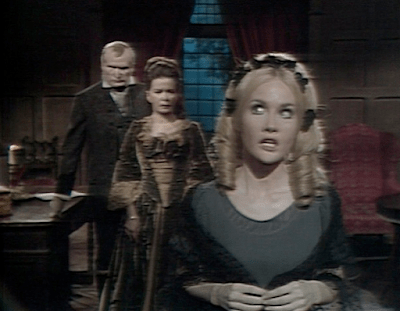
Episode 411: No longer really human

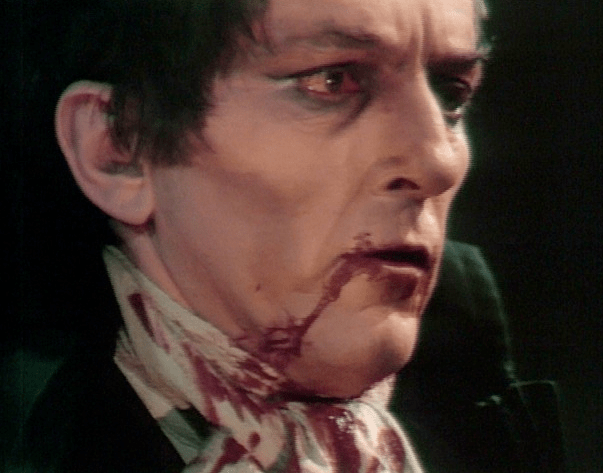
Messy eater. Screenshot by Dark Shadows Before I Die.

At the top of the episode, wicked witch Angelique is in the secret chamber hidden inside the Collins family mausoleum. She is standing before the open coffin of Barnabas Collins, a stake in one hand and a mallet in the other. The sun is setting; once it does, Barnabas will rise as a vampire. She would drive the stake through his heart to prevent this outcome, but she is moving in time with the background music, and it is too slow. Barnabas awakes, knocks the equipment from her hands, and grabs her throat.

In 1967, throat-grabbing was Barnabas’ reflex when someone opened his coffin at dusk. The character first appeared in #210 as a hand darting to the throat of would-be grave robber Willie Loomis; Barnabas would bite Willie and enslave him. In #275, seagoing con man Jason McGuire opened the coffin; again the hand darted to the throat, and in #276 we learned that Jason was dead. That was the first time in 1967 Barnabas killed someone.

Now it is 1795. When we return from the opening title sequence, Barnabas has let go of Angelique. He has questions, and she is trying to avoid answering them. He realizes that she is afraid of him. When he figures out that she has turned him into a monster, he strangles her. In 1967, thirteen weeks separated Willie’s freeing of Barnabas from the death of Jason; this time, Barnabas chokes the life out of Angelique only eight minutes after he first awakens as a vampire.

Barnabas opens the door to the outer part of the mausoleum. The mechanism that opens this door is hidden inside one of the stairs leading out, and the camera lingers on it long enough to show that Barnabas must already be very familiar with the room to have gone directly to it. Returning viewers will remember that Angelique seemed unable to find it yesterday, and committed fans will remember that strange and troubled boy David Collins spent a whole week trapped in the secret chamber in September 1967 because it was so well hidden. The ghost of Barnabas’ little sister Sarah had to manifest to David in #315 and show him the door opener before the plot could move forward.

In the outer part of the mausoleum, Barnabas finds much put-upon servant Ben. Ben had been Barnabas’ devoted friend, but Angelique cast a spell on him and forced him to do her evil bidding. He is glad to hear Angelique is dead, and pledges to help Barnabas. As a living man, Barnabas had always gone out of his way to reciprocate Ben’s friendship, but throughout their conversation in the mausoleum he keeps telling Ben about the reasons he has to kill him. Only when Ben points out that he will need someone to protect him during the day does Barnabas agree to let him live. This was the same appeal that mad scientist Julia Hoffman made to Barnabas in #351. Since Barnabas was busily preparing to kill Julia a few episodes after that, this echo does not inspire much hope for Ben’s future.

Barnabas and Ben are having a little talk about how to dispose of Angelique’s corpse when they hear someone approaching the mausoleum. Barnabas hustles back into the secret chamber. Ben turns to the entrance, an appropriately helpless expression on his face.

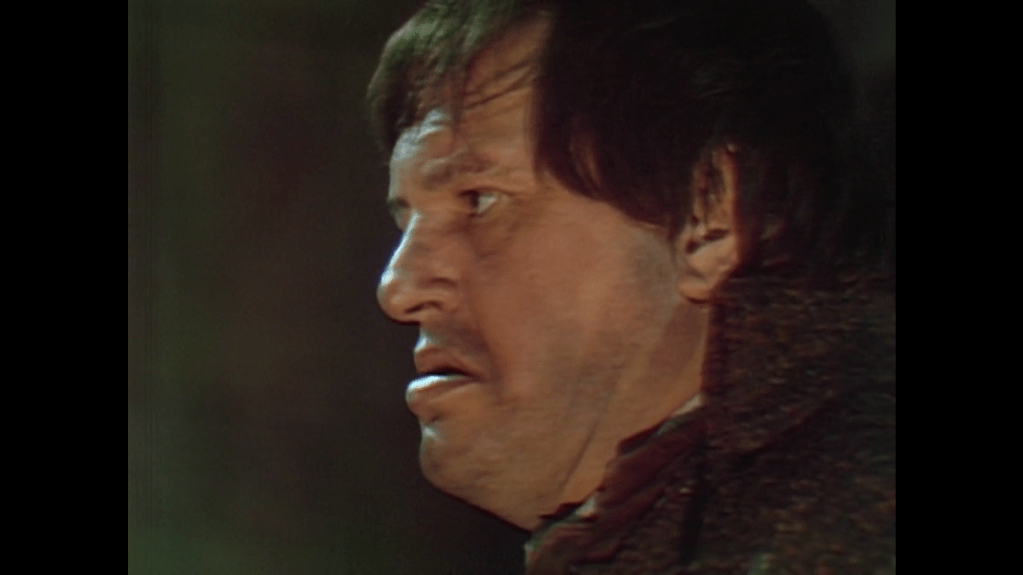
Ben faces the darkness, waiting for whatever fresh hell may be approaching.

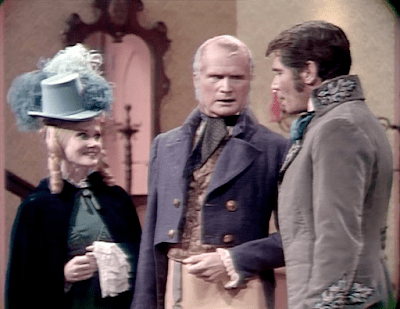
Haughty overlord Joshua Collins enters. Joshua is Barnabas’ father and Ben’s legally recognized master. Joshua accuses Ben of coming to rob Barnabas’ grave. Ben denies it. Joshua demands to know who he was talking to a moment before. Ben says that he was praying and that the only way out of the chamber is the way Joshua came. Joshua says that it is not the only way- Ben’s confederate could have gone into the secret chamber. Joshua opens the secret chamber, looks inside, and sees only Barnabas’ coffin. He is about to close the panel again when a bat flies out and flusters him. After the bat is gone, he agrees to let Ben stay and say more prayers for Barnabas.

Ben is in the graveyard when Barnabas materializes in front of him. Barnabas tells Ben that his new existence has brought him new powers. When the two of them return to the mausoleum, Ben sees that Barnabas’ face is streaked with blood. Barnabas tells him that he has discovered that along with his new powers, he has a new need- he must drink other people’s blood in order to survive. Tomorrow, Ben will hear of an unfortunate woman in the village killed by a wild animal. Barnabas says that he should have let Angelique destroy him; Ben protests that he oughtn’t say things like that. Evidently Ben is going to stick with Barnabas no matter how gruesome his deeds become.

Episode 398: The only real witch there is

Wrongly suspected of witchcraft, bewildered time-traveler Vicki has found refuge in the home of young gentleman Barnabas Collins. Vicki doesn’t know it yet, but last night Barnabas married a woman named Angelique. Vicki knew Angelique when they were both working in the home of Barnabas’ family, Vicki as a governess, Angelique as a lady’s maid. Unknown to almost anyone, Angelique is the real witch and is glad Vicki has fallen into taking the blame for her evil deeds.

Angelique herself is in the dark about Vicki’s presence in the house. She chances upon Vicki in the morning. Angelique is the only character in the segment of Dark Shadows set in the year 1795 to address her as “Vicki”; everyone else insists on calling her “Victoria” or “Miss Winters.” Since we have known Vicki since the first episode, and we know that her friends call her “Vicki,” hearing her use that form of the name tells us that Angelique has presented herself to Vicki as a friend.

Angelique tells Vicki that she and Barnabas are now married. If Vicki had learned anything from the long string of failures to adapt to the mores of 1795 that have brought her to her current state, she would respond to this by lowering her eyes, curtsying, and saying “Mrs. Collins.” But instead, she reacts with a blank stare. Angelique asks what if she is merely startled by the news, or is shocked. Vicki resumes babbling, still calling Angelique by her first name, still referring to Barnabas by his.

Not only is Vicki continuing to flout the modes of address conventional to the period in which she finds herself, she seems genuinely unaware that a newlywed might be disturbed to stumble upon an attractive young woman her husband is hiding in the house. After a minute or two, it occurs to her to ask Angelique if she wants her to stay. Angelique says that because Barnabas is the master of the house, it is not for her to object. Vicki responds by jumping into her face and exclaiming “But you’re the mistress!” Even after that, she keeps on with her first-naming of Barnabas and Angelique and shows absolutely no sign of awareness that Angelique might be concerned about the nature of Barnabas’ attachment to her.

“But you’re the mistress!”

Downstairs, Angelique asks Barnabas about Vicki. He asks incredulously if she is jealous. Barnabas didn’t visit Angelique in her bedroom on their wedding night and she knows that he tends to make free with servant girls, since that’s how they met. Even so, he can’t figure out why Angelique might be unhappy to find that he has Vicki stashed in the house. It really is a shame Barnabas and Vicki didn’t marry, just imagine what oblivious children they might have had. They might have been the progenitors of a whole line of Detective Frank Drebins.

Later, Angelique has a spell she wants to cast on Barnabas’ aunt, repressed spinster Abigail Collins. She summons indentured servant Ben, whom she has enslaved. She orders Ben to steal Abigail’s hair ribbon from her night-stand. Ben is horrified by the command. It would have been bad enough if he had been caught sneaking into one of the gentlemen’s bedrooms, but he might have been able to talk his way out of that. If he is found in a lady’s bedroom, he’ll be lucky if all that happens is that he’s sent back to prison for several years. Impatient, Angelique tells him not to get caught.

Abigail does catch Ben in her room with the hair ribbon in his hand. She was the first to suspect witchcraft at Collinwood, before there even was any. Ben begs her not to ask him any questions, but she isn’t having it. She presses him, and he says that the witch sent him. She demands he say the witch’s name, wanting to hear him say “Victoria Winters.” He is about to say “Angelique” when we see her, in the Old House, cast the spell that causes him to choke. This scene takes about a minute to make all the points the story needs, but goes on for several times that long. That doesn’t hurt a thing- Clarice Blackburn and Thayer David were such a pair of pros that they could hold the audience’s attention for a good deal longer with a lot less to work with. It’s a fine ending.

Episode 374: A woman decides, and it happens

No two performers did more to pioneer what would become the Dark Shadows house style of acting than Thayer David and Lara Parker. When David first appeared as gruff groundskeeper Matthew Morgan in #38, he stood out in a cast of theater actors who tended to play their parts somewhat larger than life by his exceptional intensity. In the 1795 period piece, he brings the same quality to his portrayal of kindly indentured servant Ben Stokes. As wicked witch Angelique, Parker is the first member of the cast to find a kind of ferocity that outdoes even David. Today, the two of them are the main characters in the episode, yet each shows great restraint and understatement. Their performances are admirably precise.

Angelique is maidservant to Countess Natalie DuPrés, a French lady who took her to the island of Martinique when she fled the Revolution. The countess hasn’t been much in evidence, so that Angelique spends most of her time working for her niece Josette, fiancée of young gentleman Barnabas Collins. Before Barnabas and Josette became a couple, he had a brief affair with Angelique, to which Angelique attached great importance. When she finds that Barnabas does not love her and cares only for Josette, she sets about casting spells to ruin their happiness.

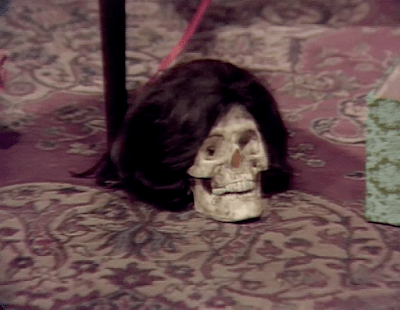
Today, Josette opens a gift box to find a skull wearing a wig. She is altogether undone by this. Barnabas confronts Angelique about it. While he does not seem to have any idea that Angelique is a witch, he is sure she is responsible for the nasty surprise. She denies everything, and he has no evidence against her.

The first bewigged skull to appear on Dark Shadows. Screenshot by Dark Shadows Before I Die.

Ben had tried to tell Barnabas and Josette about Angelique, but being under her power, he cannot. But Barnabas could tell Josette the truth about his past with Angelique. Because he does not, she goes on trusting Angelique, giving her full access to her things and to her person, enabling her to cast whatever spell she wishes. Had Barnabas trusted Josette with the truth, they might have been able to fight Angelique. Because he insists on hiding it from her, they are utterly helpless and will lose absolutely everything.

When Dark Shadows started, the 1960s version of the Collins family was isolated from the community, unable to make anything happen, and vulnerable to a wide variety of enemies, all because matriarch Liz and her brother Roger clung desperately to shameful secrets. When those secrets came to light, they lost nothing and found themselves with a new freedom. Now, in 1795, the Collinses are the lords of the town, running a dynamic business, and apparently unassailable in their wealth and prestige. But in Barnabas’ failure to come clean with Josette, we see the beginning of the process that will lead them to the precarious state in which they are trapped in 1966.

Today, Angelique completes a spell that causes Josette to conceive a mad passion for Barnabas’ uncle and best friend Jeremiah. After Josette sneaks into Jeremiah’s room and makes a fool of herself by propositioning him, she runs back to her own room and sobs on the bed. Angelique is there, feigning puzzlement and sympathy, quietly accepting the young mistress’ refusal to tell her what is wrong.

This is the first episode of the 1795 segment not to include time-traveling governess Vicki. While actors Kathryn Leigh Scott, Thayer David, and Anthony George all appeared in the main time frame (debuting in episodes #1, #38, and #262, respectively,) only Jonathan Frid, as Barnabas, is playing a character we had met there. There’s a heavy-handed moment of self-reference today when Josette tells Barnabas that sometimes he is “too modern,” and he thinks about it during a close-up. That close-up goes on so very long that there is no doubt they are giving us reading instructions, telling us that Barnabas, rather than Vicki, is now our point of view character.

Episode 373: Not a lady yet

Angelique, lady’s maid/ wicked witch, has cast a spell over kindly indentured servant Ben Stokes, making him her slave in an even deeper sense than he was already Joshua Collins’ slave. She gives Ben various tasks in support of her current project, black magic that will make the lovely Josette forget her fiancé Barnabas and conceive a mad passion for Barnabas’ uncle and dear friend Jeremiah. Most notably, she needs an unbroken spider web from an oak tree, and Ben brings her one.

Unbroken web. Screenshot by Dark Shadows Before I Die.

Meanwhile, cousin Millicent Collins has come to the estate of Collinwood. Millicent is giggly, afraid of germs, and very, very rich. Joshua means for his bachelor brother Jeremiah to marry Millicent, a prospect that repels Jeremiah.

Joshua suggests Jeremiah show Millicent upstairs. Screenshot by Dark Shadows Before I Die.

Time-traveling governess Vicki enters. When she sees Millicent, Vicki calls her “Carolyn,” because she is played by Nancy Barrett, who plays a character named Carolyn in the parts of Dark Shadows set in the twentieth century. The makers of the show wanted Vicki to keep the audience up to date on the cast members’ resumés, even though it makes all the other characters think she is a lunatic.

Alone with Vicki, Jeremiah confides that he does not want to marry Millicent. Vicki had studied Collins family history when she was living in the 1960s and has an idiotic compulsion to verbalize her every thought, so she declares that Millicent will never marry. Jeremiah remarks that she says the strangest things.

This scene is more tolerable than the others in which Vicki blurts out information she wouldn’t know if she belonged in 1795 because of the casting of Anthony George as Jeremiah. George was a cold actor who kept the audience guessing what was going on inside his characters’ heads. That made him a disaster as the second to play the hot-blooded Burke Devlin, but when we see him as Jeremiah we take his ready acceptance of Vicki’s bizarre behavior as a sign that he has something up his sleeve. If they can stop giving Vicki such tiresome lines, Jeremiah might be a promising love interest for her.

Episode 60: Double, double

Soap operas are supposed to have a weekly rhythm. Fridays bring a whirlwind of flashy, unexpected events, building up to a big cliffhanger. On Monday, the cliffhanger is resolved and the flashy, unexpected stuff is sorted out so that new viewers can find their way into the show. On Tuesdays and Wednesdays, you experiment with new storylines that may or may not go anywhere, and on Thursdays you set up for another boffo Friday.

At no point in its run did Dark Shadows adhere to this pattern. This week, for example, has had four relatively fast-paced episodes on Monday through Thursday, then slows down for a Friday episode consisting of a couple of leisurely conversations. Conversations in which the audience is presented with a lot of basic exposition, but still, a big shift down in dramatic intensity from the four days leading up to it. A bit later, after writer Art Wallace leaves the show, there will be weeks with no apparent structure at all, certainly no boffo whirlwind Fridays. After the show becomes a hit and Sam Hall takes the lead among the writing staff, every day will be a whirlwind, and every commercial break a cliffhanger.

One of today’s conversations takes place in the home Maggie Evans, the nicest girl in town, shares with her father, drunken artist Sam. The other takes place in the sheriff’s office.

Maggie has brought well-meaning governess Vicki home for dinner. They talk about Vicki’s quest to learn the secret of her origins and about the manslaughter case that sent dashing action hero Burke Devlin to prison ten years ago. Meanwhile, Burke has barged into the sheriff’s office and is demanding information about the ongoing investigation into the mysterious death of plant manager Bill Malloy. The sheriff gives Burke more answers than it would be proper for an investigator to give a member of the public in real life, but nonetheless frustrates his need to dash into heroic action. Burke leaves the sheriff’s office, and barges into the Evans cottage as dinner is served. The Friday cliffhanger is Burke asking if he may join the Evanses and Vicki for dinner.

I suppose you could call this one of Art Wallace’s diptychs. Both conversations feature insistent questioners and reluctant responders. Burke improperly demands information from the sheriff. The sheriff parries his demands, observing Burke’s reactions as he sizes him up as a suspect in the case. The sheriff remains very much in control of the situation. As in previous episodes, we see that the sheriff alone exercises power in the sheriff’s office. By contrast, Sam loses control entirely in the face of his two questioners. Again as in previous episodes, we see that Sam has no power to resolve a conflict, whether at home or anywhere else.

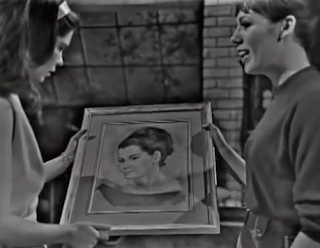
That’s the dramatic content of the episode. The expository content is much more involved. Vicki looks through Sam’s paintings, and finds a portrait that strongly resembles her. When Sam tells her that the painting is 25 years old and that the model was a Collinsport girl, Vicki is excited, thinking she may have found a relative. Sam tells her he doesn’t believe that’s possible. He had heard that the model, whose name was Betty Hanscombe, had died a few months after he painted her portrait, years before Vicki was born, and that she had no living relatives.

Vicki and Maggie hold the portrait of Betty Hanscombe
Screenshot by Dark Shadows Before I Die

Note that Sam had only heard that Betty died. She had left town before then, and had no close connections to anyone with whom Sam was in touch. He could easily have heard wrong. So experienced soap opera watchers will brace themselves for the possibility that Betty Hanscombe will make a surprise entrance at some point and reveal herself to be Vicki’s mother and someone else’s secret half-sister.

When Maggie and Vicki ask Sam about the manslaughter case, he becomes agitated. Trapped into telling the story, he takes a drink and looks away from the young women. He tells essentially the same story high-born ne’er-do-well Roger had told his sister, reclusive matriarch Liz, in episode 32, but with some details added.

Burke and Roger were extremely close in those days, ten years ago. For a moment, Sam seems to be having trouble finding the words to express just how close. Along with Burke’s girlfriend Laura, they went drinking one night at a bar on the road between Collinsport and Bangor. Witnesses at the bar testified that Burke was so drunk they had to carry him to his car, and that he insisted on driving. Roger and Laura were his passengers. Burke himself admitted that he blacked out and couldn’t remember the drive. At some point, the car hit and killed a man named Hansen and kept going. At the trial, Roger and Laura testified that Burke was driving when his car hit Hansen. Burke thought that he might have got out of the driver’s seat and handed the keys to Roger before the accident. Burke was convicted, and publicly swore that he would avenge himself on Roger. A week after he was sentenced, Roger and Laura were married.

So that’s the basis for “The Revenge of Burke Devlin” storyline. I’m not a criminal lawyer, but I wonder if Burke wouldn’t have been guilty of manslaughter no matter who was behind the wheel at the moment of the collision. By all accounts, Burke drove drunk, and was drunk in his car when it killed someone. If at some point he stopped driving and handed the keys to someone else whom he knew also to be drunk, that would indeed add to that person’s culpability, but I don’t see how it would clear Burke’s name. To do that, Burke would have to change the events themselves.

To make sense of the storyline, perhaps we can revisit the tale of the night of the accident. Two lovers and their friend were in a car involved in a hit and run. Afterward, one lover turned against the other, and took up with the friend. Everyone thought the lovers before that night were Burke and Laura, and that the friend was Roger. But if the men were lovers and Laura were the friend tagging along on their date, Burke’s frantic campaign to alter the past and Roger’s grim determination to hide it take on a new significance.

The cast of the show and its writing staff were largely drawn from Broadway, where in the 1950s, 60s, and 70s many playwrights had hits with dramas in which some people try to rewrite history and others try to conceal it in desperate attempts to erase unconventional sexual relationships. Indeed, when Sam stumbles in his attempt to find words to describe the bygone intimacy Roger and Burke shared, we can’t help but remember that Sam is played by David Ford, fresh off a long engagement as Big Daddy in a production of Cat on a Hot Tin Roof. It is by no means fanciful to wonder if that stumble hints at the suspicion of a relationship Tennessee Williams would have found interesting.

Miscellaneous:

At the end of his post about this episode on Dark Shadows from the Beginning, Marc Masse goes on at length about other things you might have seen on television in mid-September 1966. This is not my favorite feature of his blog, but this time it includes a couple of irresistible bits from commercials featuring Dark Shadows cast members. Here’s a still from a spot in which David Henesy sells cereal (with a side of racism, but it’s hard to imagine that was his fault):

Screenshot by Dark Shadows from the Beginning

The same post features an audio clip of Thayer David selling NyQuil. Here’s the commercial:

Episode 38: The Count in his castle

Vicki first met Matthew in the basement of Collinwood, back in episode 6. So the basement is Matthew’s territory. Not even the cottage where he lives is more so. Before we ever saw it, we heard him go on about how it was a gift from Liz. When we do see him there he’s having an uncharacteristic moment, baking muffins. The basement is the dusty, forbidding workspace is where we expect to find a dusty, forbidding workman like Matthew.

In his remarks on episode 37, Patrick McCray complained about “writing shortcuts that occasionally make Victoria look like a moron.” I didn’t quote him in my post on that episode, because I don’t agree with his assessment of the scene- he thinks Vicki is falling for Roger’s obvious lies, I think she is disregarding them because she knows she has him where he wants him and is about to squeeze some information out of him. But this opening scene is definitely a case of Idiot Plot. Vicki chased David into the basement in episode 6, only to be menaced by Matthew and scolded by Elizabeth; she followed the sound of the sobbing woman there in 37, to be yelled at by Roger. Those were moments of hot pursuit, when she could claim that in the heat of the moment she forgot Elizabeth’s prohibition on going to the basement. But now, she’s just looking for some books. There’s no reason she couldn’t have asked Liz about the books before going to the basement. What’s more, she’s going after those books only because David, last seen telling her he’d make her wish she had never come to the house, suggested she go after them. I realize she’s had a stressful few days, but unless she’s had a massive head injury off-camera, going to the basement at David’s suggestion is inexplicable.

Of course, the out-of-universe explanation is obvious- a new actor is taking over the role of Matthew, and they want to introduce him on this set. On the one hand, the scene is a reprise of the first introduction of Matthew, thereby making it clear that this is a new start for the character. On the other hand, because it is his territory, and our point of view character is trespassing there, he is all the more menacing to us than he would be if we met him in someone else’s space.

I think Danny Horn described Thayer David’s acting style well when he said that “He’s loud, and disruptive, and he plays to the balcony. Not this balcony, naturally; I mean the balcony in the theater next door.” He’s relatively subdued in his first outing as Matthew, but the appliances the makeup shop constructed on his face prepare us for the titanic approach he’ll be taking in the weeks ahead.

Matthew goes upstairs. In the foyer, a more or less neutral space among the residents of the estate, Liz gives him a shopping list to take into town. She then asks him into the drawing room, her home base. There, she asks him to do something horrible- take the blame for Roger’s car crash. He is shocked at the request, and asks for an explanation. She doesn’t give him one, but he agrees anyway. Thayer David’s anguished face shows the terrible price Matthew is paying for Liz’ insistence on covering up what really happened between David and Roger.

This encounter closes the story of Roger’s crash. Along with the Mystery of the Locked Room, Vicki’s search for something David might like, and the talk about ghosts, it ties Thayer David’s Matthew in to four of the stories we’ve been following.

We next see him in town, ordering coffee at the restaurant in the Collinsport Inn. There he’s tied in to a fifth story, The Revenge of Burke Devlin. The Inn is Devlin’s territory, and Matthew encounters him there. Still unhappy because of Liz’s shocking request, Matthew is in no mood to be diplomatic with the known enemy of the family he is sworn to serve. He tells Devlin that if he makes trouble for Liz, “I’ll kill you.” Devlin tries to reason with him, asking if it makes a difference whether the family deserves trouble, to which Matthew does not respond kindly.

Even before Matthew came to town, Devlin had met another Collinwood resident at the restaurant. Carolyn sits at his table and notices he is reading The Count of Monte Cristo. She summarizes the plot, and realizes that it is one of the sources of The Revenge of Burke Devlin story-line. She’s so self-aware it wouldn’t be surprising if she and Burke started gossiping about what the new writers coming on board next week have in mind for their characters. She drops the subject, and immediately starts wheedling him for a date. When he begs off, she deliberately leaves a ring behind.

Back at Collinwood, Carolyn and Vicki talk on the landing overlooking the foyer. This is the first conversation we’ve seen in that space. A couple of times, we’ve seen David Collins standing up there by himself, looking menacing, or as menacing as a not-very-tall nine year old boy could. In the years to come, a succession of villains will take turns declaring themselves to be Master of Collinwood by standing on this spot and looking at the camera. The last of these will be the ghost of Gerard, played by an adult actor about the same height as the nine year old David.

This time, the space is not being used to suggest menace, even though the camera is shooting up at the same drastic angle. Instead, it is a relatively intimate place, separated from the public-facing foyer by the stairs and leading to the bedrooms. Carolyn and Vicki are there because they are at home. Carolyn confides in Vicki about her plan to leave the ring where Burke would find it, obligating him to call her and return it. Vicki confides in Carolyn about the sobbing woman, and Carolyn admits to having heard her many times, and to having lied when Vicki asked her about the sounds her first morning in Collinwood. The friendship between Carolyn and Vicki is settling in as a wide-open information exchange, a regular channel not only to keep the audience up to date on what’s happened in previous episodes, but to make it possible for characters to learn enough about what’s going on to make plans and take action.

Back down in the foyer, Liz talks to Vicki about the basement. Vicki tells her that she can’t believe in ghosts; Liz assures her there’s no one being held in the locked room. Liz offers Vicki the key to the room and invites her to let herself into it and search it. Vicki declines the offer. Liz repeats it, doing everything she can to show that she has nothing to hide. Vicki declines again, and turns away. As soon as Vicki can’t see her, Liz’ face resolves into an expression of immense relief.

Over the closing credits, ABC staff announcer delivers the usual blurb for “Where the Action Is.” He trips over the title. It sounds like he’s stifling a laugh or is distracted or something. Unusual to hear him commit a blooper!

Episode 6: “Winters! Victoria Winters!”

Looking for David in the basement of Collinwood, Vicki encounters caretaker Matthew Morgan. No one has bothered to tell Matthew that a new person will be coming to the house, so he assumes she is a burglar and confronts her accordingly. Liz shows up, telling Matthew that Vicki belongs in the house and telling Vicki that she doesn’t belong in the basement.

In week one, Liz refused all requests for information about who Vicki was and why she hired her to be David’s governess. But at least she had told the other members of the household that Vicki would be coming. She hasn’t told even that to Matthew, notwithstanding the fact that, as she will explain to Vicki in this episode 13, Matthew is a “strange and violent man.” By taking the job and living in the house, Vicki, our point of view character, has made herself dependent on Liz; we the audience are also dependent on Liz, in that the stories in these first months all revolve around actions Liz will or won’t take. So it’s doubly unnerving that she is so very stingy with information.

George Mitchell, who plays Matthew here and in his next few appearances, is the sort of actor we often see in the first 42 weeks of the show. He is essentially a miniaturist, who builds a character one finely etched mannerism at a time. His successor in the role, Thayer David, worked at the opposite extreme, becoming the first exponent of the Dark Shadows house style of acting (often called “Go Back to Your Grave!” because of Lara Parker’s explanation of it.) Without that style, the show wouldn’t have become what it did in the period which people remember, so I can’t regret the recasting. But I do wish we could somehow see what it would have been like had George Mitchell carried the character through his whole arc of development. He could have played something I think Art Wallace could have written, a closely observed, sensitively explored psychological study.

There’s another what-might-have-been moment when Vicki tries to make friends with Matthew. He introduces himself to her with a gruff “Morgan! Matthew Morgan!” To which she replies, mimicking his down-east accent, “Wintahs! Victoria Wintahs!” It isn’t much of a joke, and Matthew isn’t amused. But it’s hard not to wonder what Vicki might have become if she’d been allowed to make the occasional joke as the series went on.