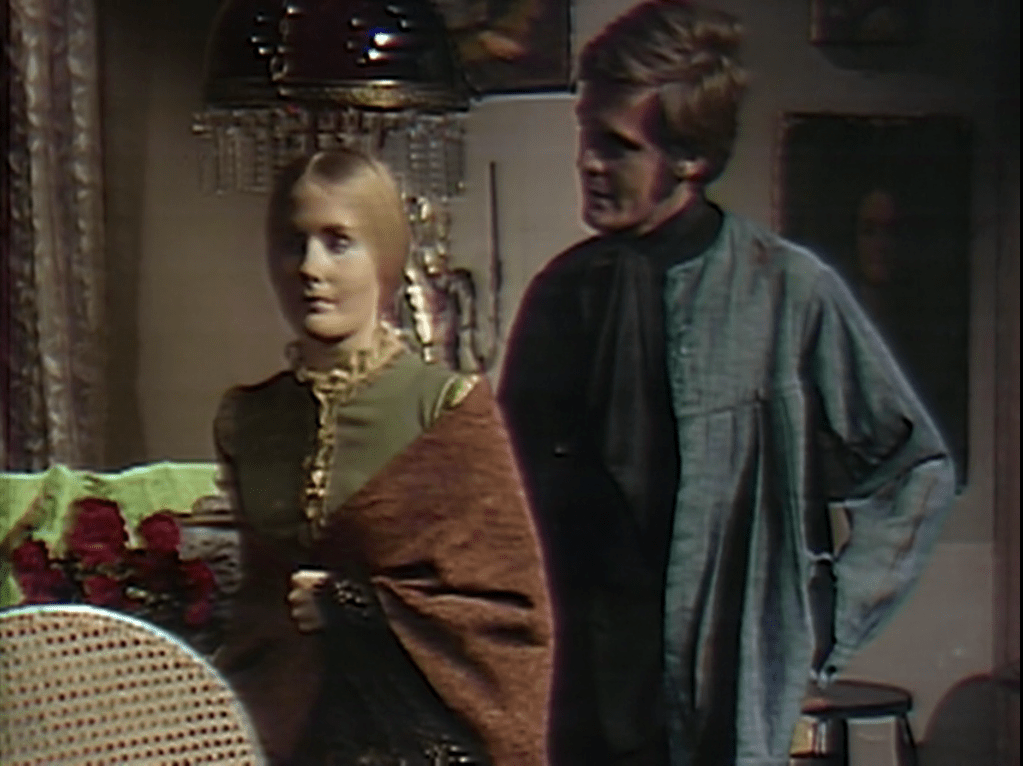
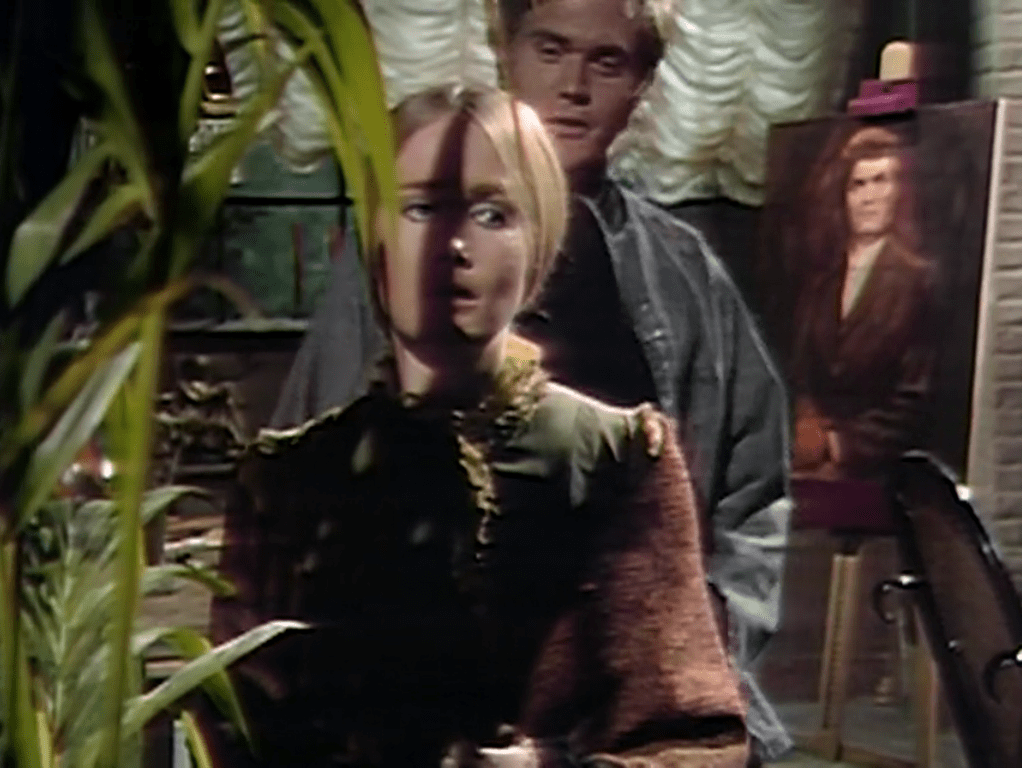
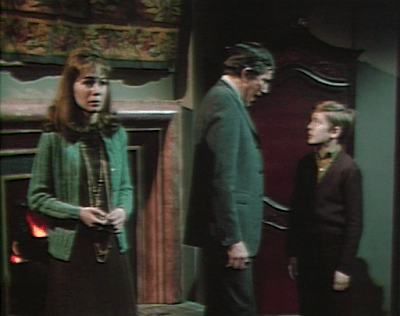
Episode 891: The only one there is

About Time

Dark Shadows committed itself to supernatural stories in late 1966 and early 1967, when the chief villain was undead blonde fire witch Laura Murdoch Collins. Since the usual laws of nature weren’t going to restrain Laura, they needed another set of rules that could predict her behavior sufficiently to create suspense. One of the things they settled on was that the barrier between past and present grows thin on the anniversaries of deadly events. So when well-meaning governess Vicki and the team she had assembled to fight Laura discovered that, in a previous iteration, she had taken a young son of hers to his fiery death “exactly one hundred years ago,” they knew that the crisis was at hand.

Anniversaries continued to have this effect in subsequent periods. So when in January 1969 recovering vampire Barnabas Collins wanted to take a day trip to the 1790s, he stood in a graveyard and shouted at a man who had died exactly 172 years previously to ask for a ride. It worked.

Barnabas was using a different form of mumbo-jumbo at the end of February, trying to contact the ghost that had made the great house of Collinwood uninhabitable, when he came unstuck in time and found himself in the year 1897.

In the middle of Barnabas’ long stay in 1897, the show decided to take its conceit that two events occurring on the same date in different years were mystically connected and show us both sides of the link. In #835, Barnabas was locked up in a cell with a secretary cabinet that he knew would be in the front parlor of his home, the Old House at Collinwood, in 1969. He wrote a letter to his friend, mad scientist Julia Hoffman, and hid it in a secret compartment of the secretary. We cut to the front parlor in 1969, exactly 172 years later, where a series of events leads Julia to discover the letter, travel back in time, and precipitate Barnabas’ rescue.

By #839, the events of 1897 had played out differently enough from whatever happened the first time through that year that the ghosts found peace. As we cut back and forth between that year and 1969, we saw that the 1960s characters remembered the haunting and the disasters that accompanied it and were relieved that they were over.

That gives us the present as the result, not of any one series of events in the past, but of a composite of many separate and mutually incompatible pasts. This idea is the logical culmination of substituting anniversaries for natural laws. In the first part of Barnabas’ trip to 1897, he had not yet done enough to lay the ghosts to rest. So the haunting continued, because it was happening on the anniversaries of events that were much the same as those that took place originally. By the time the living people of 1897 who would become the ghosts of 1969 had changed enough that they were no longer doomed to haunt the house, the date was one that would fall almost ten months into the haunting. In #836, Julia had a conversation in which one of the ghosts tells her about events in 1897 that could not have happened in the original timeline without Barnabas’ intervention, and which do not happen in #838 after Julia herself travels to that year. So each anniversary creates another past that becomes another ingredient in the stew that makes up the present.

This conception of the relationship between past and present shows the difference between a set of fantastic tales like Dark Shadows and a science fiction story exploring more-or-less plausible consequences of open questions in science. The “Copenhagen Interpretation” of quantum mechanics posits that the cosmos is made up of countless parallel universes, and that everything that could ever have happened did happen in at least one of those universes. Since that is a defensible position within science, an author can incorporate as much fact and reality as s/he likes in a story based on it. But since the idea that one period of history is the result of a confluence of many conflicting pasts is not only not a live option in science, but does not really make any practical sense except as a metaphor, the logic that really matters is dream logic. As dreams seem perfectly convincing to us when the only connections that lead from one moment to another are random similarities in names or shapes, so all that matters in a fantastic tale is that there is a pattern the audience can follow, whether or not that pattern corresponds to anything in the world where we spend our waking hours.

Now Barnabas has returned to 1969, brought back by a mysterious cult that has brainwashed him and adopted him as its leader. The characters he knew before he left are delighted to see him again. Today, matriarch Elizabeth Collins Stoddard comes to the Old House and is overjoyed that the haunting is over and that she and her family have been able to return to the great house. She is grateful to Barnabas for undertaking his harrowing journey back in time.

Liz and Barnabas talk about Chris Jennings, a young man in whom Liz’ daughter Carolyn is interested. Barnabas gives it as his firm opinion that Carolyn should avoid Chris, and he urges Liz to encourage her to do this. Barnabas knows that Chris is a werewolf, and we saw last week that the cult that has co-opted him has plans for Carolyn which do not include her death as one of Chris’ victims, so this will not surprise returning viewers.

Chris himself is another example of the weird metaphysics the show has stumbled upon. When Barnabas left 1969 for 1897, Chris was in his wolfish form all the time, apparently never to become human again. We learned during the 1897 segment that his lycanthropy is a curse inherited from his forebear, Quentin Collins. The version of 1897 we saw was changed sufficiently from the original that Quentin avoided his own death and was for a time relieved of the effects of the werewolf curse, though at the end of the segment it looked like they might be on their way back. That he is now human part of the time but still subject to transformation suggests that the difference in Quentin’s experiences in the later part of the 1897 stories had some effect on him. It’s unclear whether Chris’ condition fluctuated every time the date marked the 72nd anniversary of something happening to Quentin that hadn’t happened when he was living in a Barnabas-free zone, but it wouldn’t contradict anything we’ve seen if it did.

The Time to Come

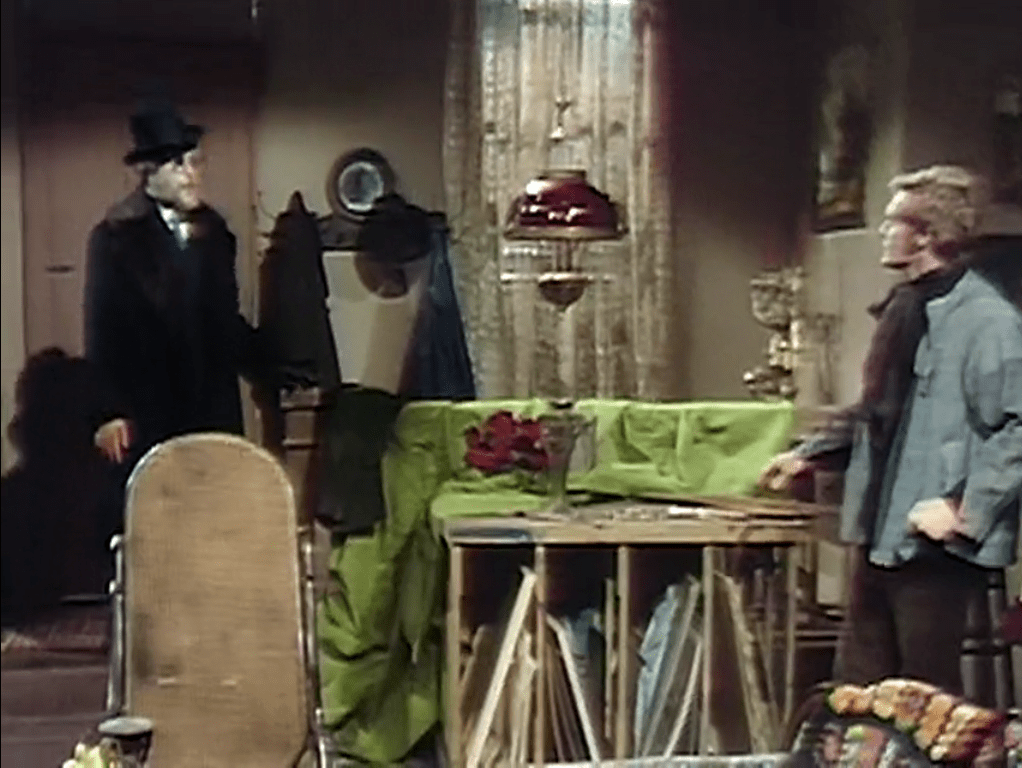
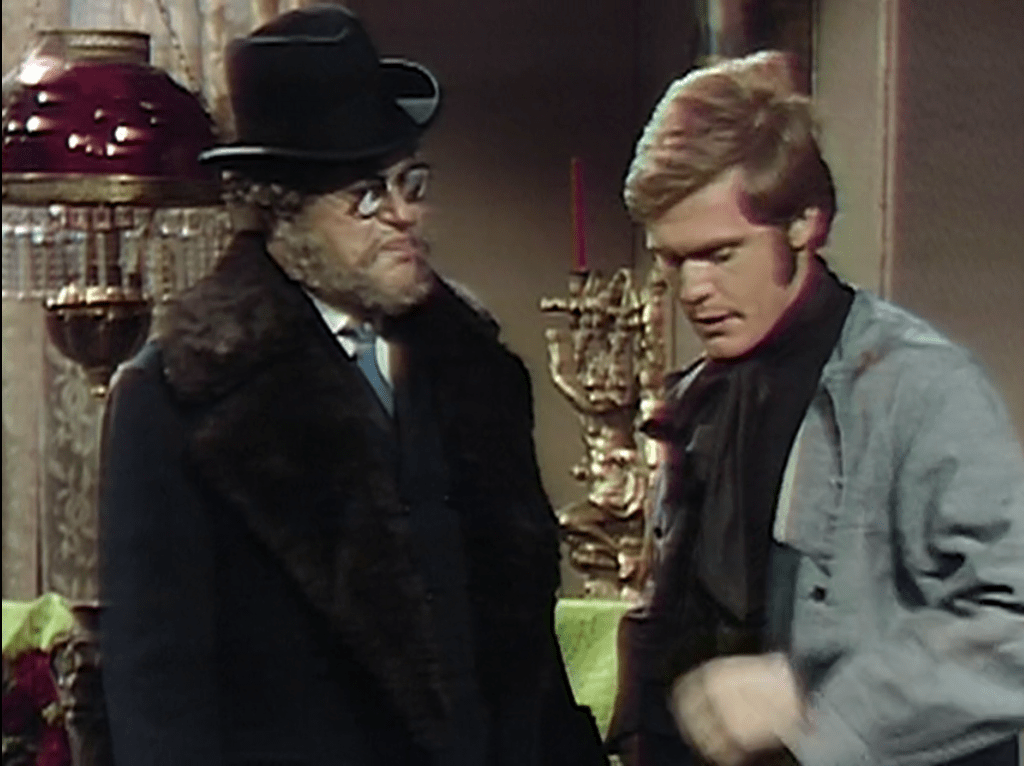
Barnabas brought one object back with him from the past, a wooden box. The box must be opened only at a certain time, by certain people, for the cult’s plan to take effect. Today, Barnabas receives a visit from the people. They are Megan and Philip Todd, owners of the new antique shop in the village of Collinsport. Carolyn sent them, thinking that Barnabas would likely have some things they could add to their inventory. He sees that Megan is wearing a necklace with a symbol representing intertwined snakes, which Barnabas calls a “Naga.” When Megan is unable to explain just how she came into possession of the necklace, he shows them the box, which is topped with an oval in which the same symbol is carved. They are both thrilled at the prospect of buying the old furniture he has in the upstairs rooms of his house, but Megan is particularly fascinated by the box.

Later, Philip and Megan are back in their shop. They are confident they can buy a great deal of furniture from Barnabas, but are also sure that they wouldn’t be able to afford the box, even if he were willing to part from it. This is a bit odd- we get a good look at the box, and it is absolutely nothing special. The actors manage to sell the scene, but it would be better if they had either invested in a showier prop or been more sparing about putting it on camera.

Megan and Philip with the box. Screenshot by Dark Shadows Before I Die.

Barnabas comes to the shop and gives Megan and Philip the box as a present. After he goes, Megan is overwhelmed by an urge to open the box, which is locked. She is so consumed by this urge that she actually says “Let’s force it!” Since they had just minutes before been talking about it as if it were more expensive than anything they have for sale in their shop, this is a startling line. But when Philip opens the envelope Barnabas left to look at the list of furniture he is willing to sell them, he finds a key.

Philip is reluctant to open the box, having a strange feeling that if they do, nothing will ever be the same for them again. The other day it was Megan who had a strange feeling of impending doom. She wanted to sell the shop and flee Collinsport forever, lest they suffer an irretrievable disaster. That time it was Philip’s turn to urge her to set her misgivings aside. We’ve seen this kind of back and forth before. At the end of 1968, the great house of Collinwood was coming under the control of ghosts. Children Amy Jennings and David Collins kept trading the roles of possessed agent of the ghosts and unwilling sidekick. That alternation showed that the ghosts were not yet powerful enough to possess both children at once, and it faded as the haunting became more intense. It built suspense by suggesting that possible avenues of escape were gradually but inexorably closing.

As Philip and Megan begin to open the box, there is a whistling sound. They are unsettled, but decide they have to finish opening it anyway. They do, and we see their reaction to whatever is inside. Longtime viewers have seen similar reactions as cliffhangers many times; always before, they have indicated amazement that the container is empty.

New People

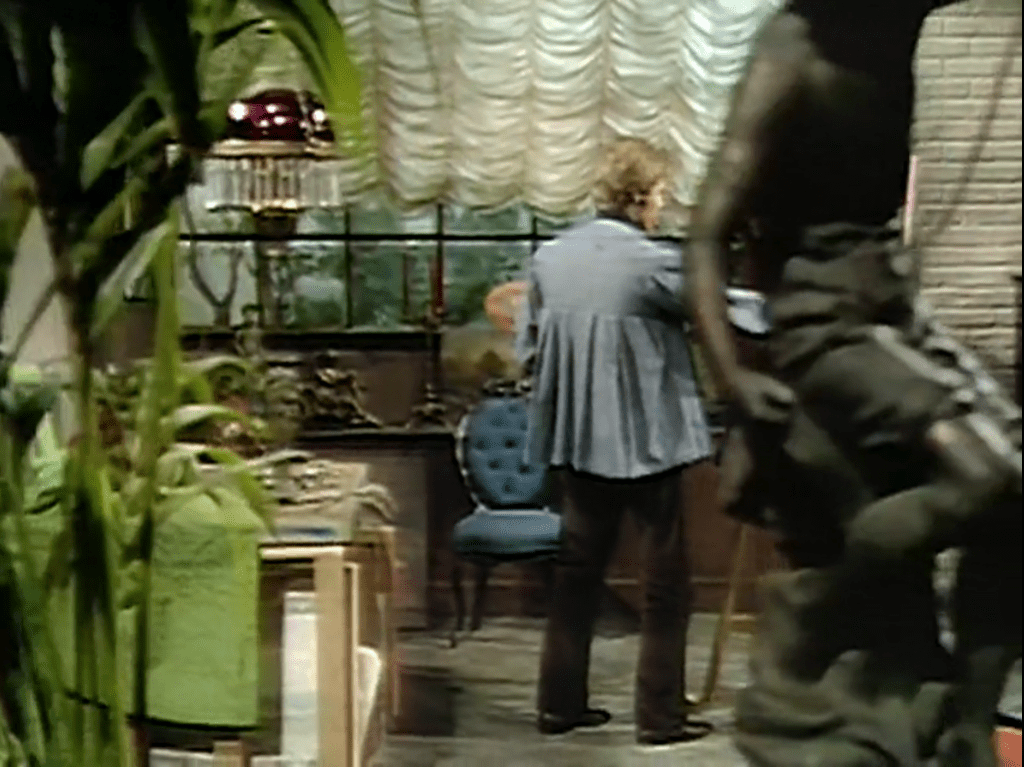
One of the less appealing villains of the 1897 segment was magically gifted artist/ surly criminal lowlife Charles Delaware Tate. Tate lived in a house that in the parts of Dark Shadows set in the 1960s was known as “the Evans Cottage,” home to drunken artist Sam Evans and his daughter Maggie, The Nicest Girl in Town. The cottage burned down in #883, leading us to wonder if it would still be there when the show returned to 1969.

Sam died last year, and Maggie now lives at Collinwood, where she is David and Amy’s governess. Today she goes to the cottage to prepare it for some tenants to whom she will be renting it. Evidently it must have been rebuilt before the Evanses moved in.

The only movable property in the cottage is a portrait of Maggie’s mother which her father painted. That portrait also appeared in the cottage a few times when Tate was living there; that was just carelessness on the part of the production staff, but it is kind of reassuring to see it again.

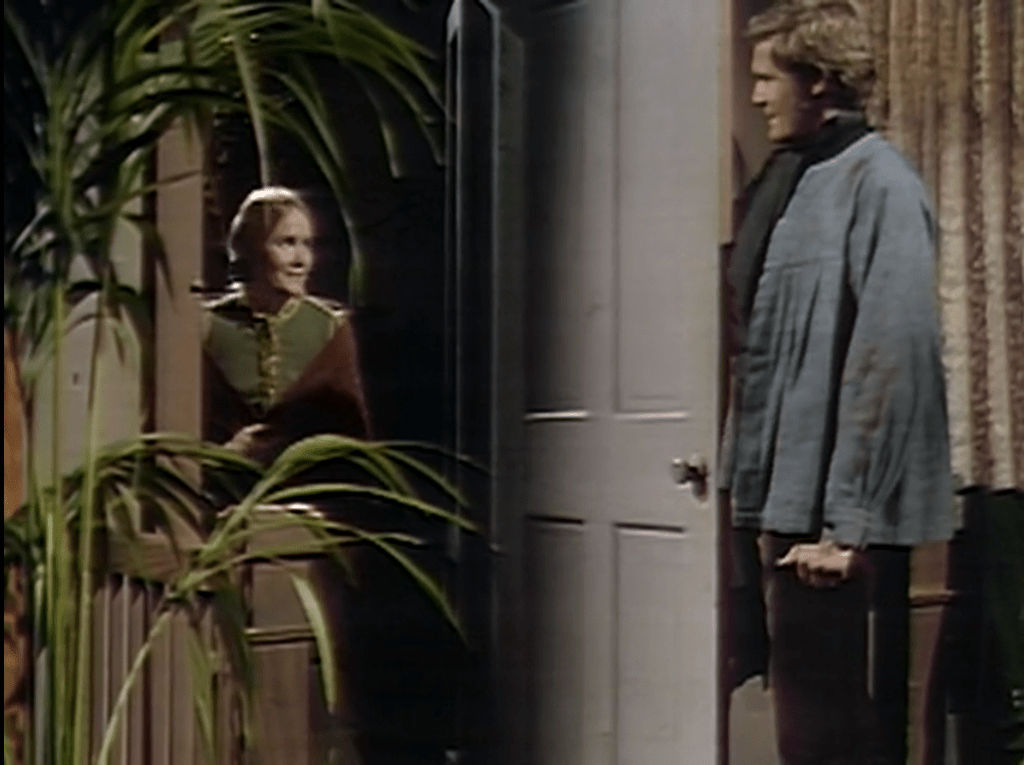
A man who has been in a couple of episodes knocks on the door. He identified himself as a friend of Sam’s and is saddened to hear of his death. He enters and asks Maggie to do him a favor. He keeps refusing to give her his name. We haven’t heard his name at all; evidently his identity is supposed to be a mystery to us. Word of that apparently did not reach the department responsible for making up the credits; they’ve been billing actor Dennis Patrick as Paul Stoddard, whom regular viewers know as the long-missing husband of matriarch Liz and father of Carolyn. They do that again today.

This is the last time we will see the Evans Cottage. In 1966 and 1967, the set was a symbol of the village of Collinsport, and scenes there showed the consequences that the doings of the rich people in the big house on the hill had for the working class who live in its shadow. By the time Maggie moved into Collinwood, they had long since given up on those kinds of stories. Dark Shadows is sometimes called “Star Trek for agoraphobes”; as we go, less and less of the action takes place anywhere other than Collinwood, and eventually they won’t even let us outside.

Liz agreed to let Barnabas live in the Old House in #218; by #223, she was talking about it, not only as his home, but as if he owned it and its contents. For while they went back and forth on the question of Barnabas’ legal status regarding the property, but when, at the suggestion of Liz’ daughter Carolyn, he gives the Todds a list of its furnishings that he is prepared to sell to them, I think we can take it for granted that Liz no longer has any claim on it.

Episode 884: Departure date

It is November 1897, and time traveler/ recovering vampire Barnabas Collins is searching through the burned remains of a cottage recently occupied by famed artist/ criminal lowlife Charles Delaware Tate. Barnabas finds a pair of glasses just outside the front door and a length of chain just inside. The glasses belonged to Tate’s master, evil sorcerer Count Petofi, the chain to a creature named Garth Blackwood whom Petofi and Tate summoned from the depths of Hell. When Barnabas was last in the house, Blackwood had taken Petofi prisoner there and announced his intention to kill him. Petofi couldn’t get far without his glasses, and the chain was Blackwood’s very favorite murder weapon. So Barnabas has reason to believe both of them died in the fire.

Tate shows up. Barnabas demands he paint another portrait of Quentin Collins to replace the one destroyed in the fire. Quentin is Barnabas’ friend and distant cousin, and, because of some magical powers Petofi long ago gave Tate, the portrait kept Quentin from turning into a werewolf. Tate is a jerk about Barnabas’ demands, as he is a jerk about everything, but finally says he will comply. He tells Barnabas to come back to the ruins of the cottage at 10 PM to pick up the portrait. Barnabas is surprised to hear that Tate can work so quickly, and Tate does not explain why he needs so little time. But after all, the important thing is simply that the magic spell is renewed- the portrait doesn’t have to have any particular aesthetic quality. Perhaps a simple sketch will serve that purpose as effectively as did the full oil painting Tate did previously.

Meanwhile, back at the great house of Collinwood, Quentin’s sister Judith is busy with a project of her own. She is torturing her husband to death. He is the odious Gregory Trask, so she has the audience’s sympathy, at least up to a point. She has had Trask bricked up in Quentin’s old room. There is a telephone there which can receive incoming calls, but not make outgoing calls. Judith has been using it to torment Trask. Today, she directs Trask’s attention to two objects which he has somehow overlooked in his time in the room. One is a portrait of Amanda Harris, a woman he tried to seduce while he had Judith imprisoned in a sanitarium. The other is a loaded gun. When she calls him for the last time, she does not receive an answer, evidently because he has shot himself to death.

Judith is the third role Joan Bennett played on Dark Shadows. In the parts of the show set in the 1960s, she plays matriarch Elizabeth Collins Stoddard. Liz is a depressive personality who keeps trying to kill herself. When from November 1967 to March 1968 the show was set in the 1790s, she played Naomi Collins, Barnabas’ mother, who actually did kill herself when she found out that her son was a vampire. Now she plays someone who, though she was introduced as a psychologically fragile individual, does not kill herself, but drives one of the major villains to commit suicide. Judith’s method of disposing of Trask is not morally defensible, but it is interesting to see Bennett playing a more assertive character.

Trask’s discovery of the portrait of Amanda leads to an interlude in New York City, a place the show hasn’t taken us since #8. Quentin is in a hotel lobby there, waiting for Amanda. She is surprised to see him. They had been lovers, and had planned to leave Collinsport together. He did not meet her at the train station. She had told him that if he did not, she would understand that he had given up on their relationship, so she had gone ahead without him. She says she is so overjoyed at the sight of him that she won’t ask for explanations, but he gives one anyway. He tells her about the portrait. Since she herself came to life as the result of another of Tate’s magical paintings, she can’t very well dismiss the story out of hand. He says that because he does not know where the portrait is, he cannot be sure he won’t become a mindless ravening beast at the next full moon, so he will have to leave her.

Oddly, Judith takes time out from her torture of Trask to perform the same function of motherly talk-to that Liz and Naomi often served. Kitty Soames, the dowager countess of Hampshire, has been staying at Collinwood for the last eight weeks, and is engaged to marry Judith’s stuffy but lovable brother Edward. Contrary to what her title would suggest, Kitty is an American woman in her twenties. Judith sees Kitty coming downstairs with two leather overnight bags. Kitty explains that she will be leaving at once and never returning. She has realized that she cannot marry Edward. She says that she has not told Edward this. Judith says that she is disappointed that they will not be sisters, but that she admires her for facing the truth and doing something about it.

Later, Barnabas comes to the great house. He finds Judith worried that Kitty’s bags are still in the foyer, though she has been gone for hours. He says that he knows where she is. She is waiting for him. They will be married later tonight. Judith is bewildered by this. Barnabas says that they will come back after their wedding and tell Edward what they have done, and that they will then leave Collinwood forever. She is sad to think that they will be going.

In fact, Kitty is two people at once. The young dowager shares her body with the soul of the late Josette DuPrés, whom Barnabas loved when he was a living being in the 1790s and whom he tried to recreate when he was a vampire in the 1960s. Ever since Kitty arrived at Collinwood in #844, Josette has been forcing her way into her conscious mind, triggering psychotic episodes and from time to time pushing Kitty aside and living through her body. Now Kitty is in the bedroom once meant for Josette in the Old House on the grounds of the estate. Josette’s voice keeps speaking to Kitty through the portrait of her that hangs there, urging her to let go and accept her place as part of a combined entity that will love Barnabas and live with him in the bonds of matrimony. Kitty struggles against the voice. For a time she hopes Barnabas will help her thwart Josette’s attempt to come back to life and take the leading part in their symbiotic existence, but when he enters he urges her to give up the fight and become Josette.

Kitty is alone in the room when she suddenly finds herself wearing Josette’s white dress. She floats off the floor and into the portrait. Barnabas enters just in time to see Kitty merge with the portrait. He reaches up to the Kitty/ Josette entity in the frame above the mantel, and he and Kitty both disappear from the screen at the same time.

Josette puts Kitty in the picture. Screenshot by Dark Shadows Before I Die.

Josette was first mentioned in #5 as the lady who went over the cliff at Widows’ Hill, and her ghost emerged as the tutelary spirit of Collinwood in the months that followed. In #70, our first view of the Old House involved the first truly ambitious special effect, when Josette’s ghost, who was Kathryn Leigh Scott in a veil and a white dress, emanated from the portrait and took three steps from it down to the floor. When Miss Scott’s Kitty rises up into the same portrait today, longtime viewers will see that momentous little journey in reverse.

Barnabas was not dreamed of until long after Josette’s ghost emerged. When we first saw him in the Old House in #212, he delivered a speech to her portrait telling her that her power on the estate was ended, and for several weeks afterward strange and troubled boy David Collins, who had been the ghost’s close friend, lamented that he could no longer feel her presence. In those days it sounded like Josette was Barnabas’ grandmother, and she had sided with his father in the fateful conflict that led to his becoming a vampire.

Later, Josette was retconned as Barnabas’ lost love. In a plot borrowed from the 1932 film The Mummy, Barnabas decided that Maggie Evans, The Nicest Girl in Town, was Josette’s reincarnation, and he tried to torture her into accepting this fact. Maggie resisted Barnabas. She ultimately escaped, only to have her memory of his abuse wiped clean by her psychiatrist, Barnabas’ accomplice and future best friend Julia Hoffman, MD.

Maggie was another Kathryn Leigh Scott character. When Miss Scott played Josette in the 1790s segment, the show was sticking to its source material, in which Zita Johanns played Imhotep’s victim Helen Grosvenor in the contemporary sequences and his lost love, Princess Ankh-Esen-Amun, in the flashback to ancient Egypt. It also left us with the uncomfortable feeling that perhaps Barnabas was onto something when he devised his horrifying program of cruelty towards Maggie. Sure, his methods were wrong, but if she “really” was Josette, he wasn’t just crazy.

With Kitty, they take us a step further. Barnabas’ attempt to Josettify Maggie made the show so bleak for so many weeks that longtime viewers will flinch at the thought that Kitty would be right to yield to Josette’s importunings, and even more at the idea that this will lead to a happy marriage between the Kitty/ Josette symbiont and Barnabas. Yet within the context of what we have seen in the 1897 segment, these would seem to be plausible conclusions. The body they share is as much Josette’s as it is Kitty’s, and Kitty has nothing to lose by merging fully into the being who lurks in the substrata of her mind.

For his part, Barnabas’ relationship to Kitty represents almost as drastic a departure from the personality he showed in his relationships to Miss Scott’s previous characters as the reinvention of Josette as his lost love rather than his estranged grandmother did in his early days on the show. He does not abduct her, torture her, or even give her Josette’s hypnotic music box. It is Josette’s ghost, always before shown as a benevolent force, that keeps pressing the transformation on Kitty. Barnabas is a gentle and considerate lover to the Josette part of the Kitty/ Josette complex, and is solicitous to the Kitty part. When Barnabas disappears with Kitty, we reverse not only the walk Josette’s ghost took in #70, but also the speech he gave in #212. So far from wanting to expel Josette from the world of the living as he did then, or turn her into his vampire bride as he tried both with Maggie in 1967 and with the living Josette in 1796, he wants to revive her as herself.

Barnabas’ function on the show, both when he is an outright villain and when he is trying to be the good guy, is to create problems that other characters will have to solve. So this moment of benevolence and rationality cannot last. It is the ultimate indication that the 1897 segment has indeed ended. But it is a beautiful little thing, for the few minutes it lasts.

This episode marks the final appearance of Trask and of Judith. We will see Kitty again tomorrow, but only in a reuse of today’s closing scene. After that she will only be implied as a feature of Josette’s unconscious mind.

Episode 883: The stone of justice

In the parts of Dark Shadows set in 1966 and 1967, the home of artist Sam Evans and his daughter Maggie, The Nicest Girl in Town, was a frequent set. Sam and Maggie were important characters in several storylines, and in their cottage they represented the working class of the village of Collinsport, as against the rich people in the big house on the hill.

Now, the show is a costume drama set in 1897. In that year, the Evans Cottage is already an artist’s studio. It is occupied by Charles Delaware Tate, who became a nationally renowned painter by making a deal with evil sorcerer Count Petofi. Today, Petofi is staying in the cottage, and Tate is functioning as his goon.

Petofi is deep in a trance, trying to cast a spell that will cause him and handsome young rake Quentin Collins to switch bodies. Once he has accomplished this switch, he will cast another spell to take himself, in Quentin’s body, to the year 1969, leaving Quentin behind in 1897 to face the vengeance of Petofi’s mortal enemies.

Cockney showgirl/ mentalist Pansy Faye has caught on to what Petofi is attempting to do, and has sneaked into the cottage to stop him. He snaps out of his trance and declares he will punish her. She grabs his glasses and runs to the door; Tate enters and grabs her. At Petofi’s behest, Tate ties Pansy up. Petofi then sends Tate to the great house of Collinwood to fetch Quentin. He is to say that Petofi will kill Pansy unless Quentin comes within the hour.

At the great house, Tate finds that Quentin has fled and cannot be reached. Quentin’s friend and distant cousin, time traveler/ recovering vampire Barnabas Collins, insists on going back to the cottage with him. When he arrives, it occurs to Petofi that Barnabas’ body is just as well suited to his purposes as is Quentin’s. He lists some of the characters who are waiting for Barnabas in 1969, and predicts they will receive him “with open arms” when he arrives in Barnabas’ form. Regular viewers are perhaps chilled, and certainly intrigued, by the idea that the show might go forward with Petofi impersonating Barnabas in a contemporary setting while a Barnabas who looks like Petofi tries to make his way back from the past, though there are so few surviving characters and unresolved story points left in 1897 that it is hard to imagine many more episodes even partially set in this period. Petofi uses his magic powers to knock Barnabas unconscious, and goes into a trance to effect the body swap.

The door swings open, and someone called Garth Blackwood enters. The other day, Petofi had Tate draw a picture of Blackwood, a picture endued with magical powers. It brought Blackwood back to life. Some years ago, Blackwood was a jailer murdered by an escaping convict named Aristide. Petofi found Aristide and took him on as a servant. Aristide has recently proven to be unreliable, and Petofi has decided he wants to be rid of him once and for all. He was amused by the idea of resurrecting Blackwood to perform the task. Blackwood has killed Aristide, but Petofi found on Monday that there is more to him than his own magical powers created. He cannot lay Blackwood to rest. Now, Blackwood has resolved to kill Petofi and Tate.

Tate flees at the sight of Blackwood. Pansy, free, asks if he is the police. He identifies himself as the master of Dartmoor Prison. Pansy, being English, is impressed. She points to Petofi and tells Blackwood that he must act against him. Blackwood puts handcuffs on Petofi, then slaps him until he comes out of his trance.

Petofi pleads with Blackwood to drop all charges against him, since he was the one who gave him the chance to kill Aristide. Barnabas comes to and asks what is going on. When Blackwood asks if he testifies for Petofi or against him, Barnabas gladly pronounces “Guilty!” He starts to say that Petofi must be killed immediately, and Blackwood cautions him against giving opinions. The witnesses are to offer only facts. So he asserts that Petofi and Aristide traveled the world together for years and committed every possible crime. At that, Blackwood bids him and Pansy leave. Once he is alone with Petofi, Blackwood picks up a metal can, douses the place with fluid, and lights a fire.

Back at the great house of Collinwood, Barnabas and Pansy talk about what just happened. Barnabas says he is confident Blackwood will kill Petofi, but he thinks he and Pansy may have to fight Blackwood later. Pansy has a vision of Blackwood and Petofi struggling with each other amid the flames in the Evans Cottage. She also sees the portrait of Quentin burning there. Since this portrait has a magical charge that keeps Quentin from turning into a werewolf, that’s bad news.

Garth Blackwood and Count Petofi, battling in the blazes. Screenshot by Dark Shadows Before I Die.

Petofi has been so powerful that it has long seemed likely that his destruction could come only as the result of his own action. When his right hand, the locus of most of his powers, was reattached to his wrist in #815, the show was giving hints it might wrap 1897 up soon. We kept hearing that the Hand had developed a mind of its own in the century it had been separated from Petofi; we could easily imagine it deciding to strangle him, and indeed in #841 it nearly did. But 1897 was such a big hit that they kept restarting it, and for some time now the Hand has done more or less what Petofi wanted it to do.

It would have been fitting had Pansy killed Petofi, since she is, in her present form, one of his creatures. The original Pansy Faye was killed in #771. In #819, Petofi erased the personality of minister’s daughter Charity Trask and gave Charity’s body to Pansy. Pansy’s light-heartedness and apparent harmlessness would have added to her suitability as the instrument of Petofi’s demise. The whole idea of the supernatural is that what appears to be weak is in fact irresistibly strong, so it would be fitting to have a tiny woman who is a character from very broad comedy conquer the great wizard.

Blackwood has only been on Dark Shadows since #878, was never previously mentioned, and is the shallowest character possible. But those weaknesses, too, give him a logical place as Petofi’s executioner. Petofi was never more smug in his self-assurance than he was when he used Tate to bring Blackwood into being in order to murder Aristide. Petofi has so easily defeated efforts by characters who had long records of dominating the action of the show, such as Barnabas and wicked witch Angelique, that we can understand why it would not occur to him that a day player could present him with any serious difficulty. That self-assurance leads him to carelessness, as he creates in Blackwood a being whose strength comes not only from him, but from the fires of Hell from which he came. Indeed, Petofi’s only thought when he brought Blackwood back from the dead was of the suffering he would inflict on Aristide, and his only feeling was delight in contemplating that suffering. Coming as the price of his overconfidence and his gleeful cruelty, it puts a moral at the end of the story when Petofi falls at Blackwood’s hands.

This episode marks the final appearance of the characters Petofi and Blackwood. It is also the final on-screen appearance of Pansy, though her voice will be heard once more, in an episode next week.

Episode 851: Common cause

Rakish libertine Quentin Collins races to the train station to meet his fiancée, the lovely and mysterious Amanda Harris. He thinks he sees her, but it is actually another young woman wearing a remarkably similar outfit. She tells him the train to New York City left a few minutes ago; Quentin knows Amanda was on it, and that she thinks his absence means that their relationship is over. The young woman was quite miffed when Quentin first approached her, but by the time he offers his second apology her look has gone from indignant to concerned to yearning. The guy’s got game, you have to grant him that.

It’s been less than a minute since he made a bad first impression on her, and she’s ready to run off with him. Screenshot by Dark Shadows Before I Die.

Quentin was detained by a fistfight with a repulsive little man called Charles Delaware Tate. Tate is an artist whose works sometimes have magical powers. His portrait of Quentin, for example, keeps Quentin from turning into a werewolf and ensures him against physical harm. Since Tate is obsessed with Amanda, he stole the portrait from Quentin when he learned Amanda was planning to leave with him. Quentin dared not leave without it, and went to Tate’s studio to demand its return. He very satisfyingly beat Tate senseless, but he did not find the portrait, and now he fears he has lost Amanda forever.

We cut to Tate’s studio. Tate is lying on the floor where he fell when Quentin finished hitting him. Unfortunately, he gets up. Sorcerer Count Petofi, who granted Tate the power to make magical artworks some years ago, enters. He tells Tate that it was stupid to steal Quentin’s portrait. Tate pretends not to know what Petofi is talking about, irritating him and us. Petofi says that he will have to be punished. After he forces Tate to draw a sketch of a pretty woman, he squeezes his wrists, helps himself to Quentin’s portrait, and says what sounds very much like a final goodbye. He exits, and Tate sits down with his pad and pencil. He discovers that he is no longer able to draw, not even a straight line.

These days, Dark Shadows is a costume drama set in 1897. Most of the time between 1966 and 1968, it took place in a contemporary setting. In those days, the set now used as Tate’s studio was the Evans cottage, home to artist Sam Evans, a drunken sad sack, and his daughter Maggie, The Nicest Girl in Town. In December of 1966 and January of 1967, the ghost of the gracious Josette compelled Sam to paint alarming images of Laura Murdoch Collins.

It turned out Josette was doing this because she knew the characters were not all that bright and she had to literally paint them a picture to explain that Laura was an undead fire witch bent on incinerating her young son David. Laura tried to thwart Josette’s plan by harming Sam. In #146, Laura caused a fire at the Evans cottage that burned Sam’s hands, temporarily depriving him of the ability to paint. Petofi’s disabling of Tate on the same set will bring this incident back to longtime viewers. Especially so, since Josette is in the air at this point in the show. In #844, a character named Kitty joined the cast. She keeps having mental flashbacks to things only Josette would remember, and Josette’s music box appeared on Kitty’s table at a time when Josette’s ghost seemed to be the likeliest agency to have put it there. Perhaps she will insert herself into Tate’s story for some reason.

When we were watching the scene between Tate and Petofi, my wife, Mrs Acilius, said that she very much wished someone else were playing Tate. Violet Welles’ script gives whoever is playing Tate a lot of opportunity to show what he can do in that scene. Roger Davis is a highly trained actor who has a long list of stage and screen credits, but he is almost always very unpleasant to watch on Dark Shadows, and he wastes the potentially fascinating dialogue Welles gave him. When Mr Davis is particularly trying, I usually try to make the scenes bearable by imagining what Frederic Forrest, who was a featured background player in #137, would have done in his place. But the echo of the story about Sam makes me wonder what David Ford would have done as Tate. Ford was in his forties, smallish and pudgy, so a David Ford Tate could not believably have had a fistfight with a character played by the very tall and fit 28 year old David Selby. But he might have been a subtle enough villain that such an exchange would not have been called for. Moreover, the incestuous undertone of Tate’s desire for Amanda, who is the product of one of his magical paintings and therefore a kind of daughter to him, would have been all the more disturbing had Tate been played by the man we knew as Maggie’s father in the 1960s and, when the show was set in the 1790s, as Josette’s.

Back home at the great house of Collinwood, Quentin receives a visit from Tim Shaw, Amanda’s ex and a would-be sleazy operator. He demands Tim tell him what he knows about Amanda’s life in New York before they came to Collinwood. Tim declares he will tell him nothing, to which Quentin responds by choking him and flinging him to the floor. Tim then burbles out everything he knows, which turns out to be nothing of the slightest use. Quentin picks Tim up and throws him out the front door in the most humiliating possible way. We cheer this on almost as joyously as we cheered Quentin’s beating of Tate Friday, but for the opposite reason. Mr Davis is a genuinely disagreeable person who ruins episode after episode, and it was him we were angry with. We chanted at the screen, not “Quen-tin! Quen-tin! Quen-tin!,” but “Da-vid! Da-vid! Da-vid!” hoping Mr Selby would pay him back for all his on-screen assaults on the women and children in the cast. But Don Briscoe was as nice a guy as Tim has become despicable, and he and Mr Selby enjoyed working together. You can see Briscoe’s joy in performance in the way he holds on to a little yellow piece of paper representing a note from Amanda all through the beating Quentin administers. Even the shot of Quentin shoving Tim out with his buttocks prominent is the product of Briscoe’s enthusiastic use of his body to demonstrate Tim’s total defeat.

Quentin throws Tim’s sorry ass out the door. Screenshot by Dark Shadows Before I Die.

Quentin’s other fiancée, wicked witch Angelique, comes downstairs to ask what the ruckus was about. Quentin makes up a transparent lie about having a financial interest in some firm in Boston, and says that he and Tim were quarreling about the details of it. Angelique lets him go on with this for a while and to say that he is leaving for Boston, then insists that they set a date for their wedding. He begs off, claiming not to know how long he will be away.

Petofi enters, and tells Angelique about Quentin’s plan to go to New York and look for Amanda. He also tells her that they now have a common cause, and proposes an alliance. Each of them is so powerful, and so evil, that this is a sobering prospect.

When Quentin returns to the foyer, it is his turn to be alone with Petofi. Quentin knows that Petofi gave Tate both the power to create the portrait that freed him of his curse and the commission to do so, and that he is therefore beholden to Petofi for his continued humanity. Part of his motivation for fleeing to New York with Amanda was his hope that he could escape the slavery Petofi has imposed on him as the price of that benefice. When Petofi tells Quentin he has come to see him before he goes, Quentin is momentarily stunned, and then makes a brave little noise to the effect that Petofi can’t stop him. Petofi assures him that he does not want to stop him. It doesn’t matter in the least to him where Quentin is- he can control him from anywhere.

Petofi calls on Tim at his room in the inn. He deepens Tim’s misery by pretending he doesn’t believe what Tim told him about Tate’s magical powers. As he leaves, he takes a brooch that belonged to Amanda.

Quentin is at the train station. Angelique appears there, and tells him not to go. He says that he doesn’t care if she kills him. It will be consolation enough to have died walking away from her. She says that she will not harm him in any way. This causes him to open his eyes wide in terror as it dawns on him what she means. She produces Amanda’s brooch and a doll. She positions the pin of the brooch over the doll’s chest and says that no matter where Amanda is, she will die a horrible death when the pin impales the doll.

Closing Miscellany

The actress who plays the young woman Quentin meets at the train station is billed in the credits as “Amy Yaekerson,” the only person known to Google ever to be called “Yaekerson” and known only for this appearance. But in a comment on Danny Horn’s post about the episode at his great Dark Shadows Every Day, a commenter known as “miles” pointed out that there are lots of people named “Yakerson.” He went on to identify an Amy Yakerson born in New York City on 1 April 1946, and to find a 1966 notice of a play featuring an actress of that name and probably of that age in the New York Daily News. I followed that up with some Googling of my own; the only Amy Yakerson I can find who is online today was born in Connecticut in 1954, so I don’t know where Amy Yakerson, star of stage and screen, is now.

We saw some of Sam’s paintings in Tate’s studio Friday and today, twenty-some years before Sam was born. Tate hides the portrait of Quentin behind one of Sam’s seascapes, and Sam’s portrait of Maggie’s mother is on the floor next to him when we see him lying there in the aftermath of the fight. John and Christine Scoleri have the details in their post about Friday’s episode at Dark Shadows Before I Die.

Episode 842: Some kind of an unnatural creature

Mad scientist Julia Hoffman has traveled back in time to the year 1897 to help her friend, vampire Barnabas Collins. Julia has fallen into the clutches of sorcerer Count Petofi and is bound and gagged in Petofi’s lair. A loaded revolver is tied to the doorknob, rigged to fire a round through her heart when the door opens.

Barnabas has learned where Julia is, but not about the death-trap in which she is ensconced. He storms into the building, turns the doorknob, and thereby discharges the gun. He sees Julia slumped over in her chair, and shouts at Petofi’s henchman that he will kill him. He then goes to Julia and finds that she is alive. There is a bullet-hole through the back of her chair, but she herself is unharmed.

Julia declares that there is only one explanation for this phenomenon that makes sense. Considering the kinds of stories that play out on Dark Shadows, we would think that an explanation that makes sense would be the one we could discard immediately, but Julia plows ahead. When she traveled back in time, only her “astral body” made the trip. Her physical body is still in 1969. For his part, Barnabas had a body in 1897, trapped in a sealed coffin. That body is hosting his personality, which is why he is subject to physical injury. But Julia is in no danger. When she later says that she can disregard Petofi’s threats, Barnabas says that if he finds out the truth, Petofi will just find another way to immobilize her, so she has to lie low.

Petofi is so powerful that Barnabas does not believe that he and Julia can fight him by themselves. So he tells Julia to summon wicked witch Angelique. Barnabas and Angelique have been enemies for centuries, but he thinks they have a common cause now. Angelique is determined to marry his cousin Quentin, whom he has befriended and Petofi has enslaved. So Barnabas expects she will agree to help fight Petofi.

Angelique does come in response to Julia’s message. She remembers Julia from time she herself spent in the 1960s, and is shocked to find her in 1897. Julia refuses to explain how she made her way back in time. She says that if Angelique can come to 1897 from 1968, she oughtn’t to be surprised she has come there from 1969. Angelique responds that Julia is not like herself and Barnabas. “I’m human,” says Julia. Since she is separated from her proper body, she isn’t fully human, not at the moment, but she still takes evident satisfaction in applying the label to herself. This marks a contrast with Angelique, who was offended earlier in the episode when Petofi laughed and taunted her for being “so human.” Julia and Angelique then snipe at each other about their respective relationships to Barnabas.

Julia says that it is essential Barnabas should “complete his mission” and solve the problems they were facing in 1969. Angelique responds that he will never be able to do that, because he has changed history too much in the time he has spent in 1897. This remark is intriguing for regular viewers. Barnabas’ six months of bungling around, picking fights, and committing murders must have had major consequences for what came after. That gives the show two ways forward. When Barnabas and Julia go back to a contemporary setting, they might meet an entirely different cast of characters and have to find a place for themselves in an alternate universe. Or they might do what they did when the show’s first time-travel story ended in March 1968, and dramatize the force of the Collins family’s propensity for denial. The head of the family in the 1790s decided to compel everyone in and around the village of Collinsport to pretend that none of the events we had seen had ever taken place, and when the costume drama segment ended we found that he had made that pretense stick ever since.

After Julia points out that it is to her advantage to emancipate Quentin from his bondage to Petofi, Angelique agrees to help. She still will not answer Julia’s questions. After she leaves the room, Julia looks in the mirror, sees an image of Angelique, and says that now she understands what she is going to do and believes it will work. That puts her one up on the audience.

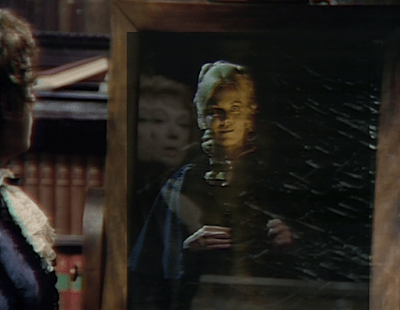
Julia looks for an image of herself, and finds Angelique. Screenshot by Dark Shadows Before I Die.

The scene pairs Julia and Angelique as two women whose lives have been shaped by their pursuit of Barnabas. Their bickering makes this similarity explicit. When Julia looks in the mirror and sees Angelique, they put very heavy emphasis on the similarity. In a brilliant, but now inaccessible, post on the great Collinsport Historical Society,* Wallace McBride wrote that “On Dark Shadows, your reflection always tells the truth.” He demonstrated that on the show, reflections are very strongly coded as true, so much so that they must be making a serious statement when they give us an image like this one. They are committing to the idea that Julia is, in some important way, the same as Angelique.

There are also a couple of scenes featuring the repulsive Roger Davis as artist Charles Delaware Tate. Mr Davis is especially hard to take in a scene with Donna McKechnie as the mysterious Amanda Harris. Miss McKechnie had already done outstanding work on Broadway as a singer and dancer by this time, but she felt herself to be a beginner as an actress, and she could not conceal her discomfort when Mr Davis shouted his lines. The 4:3 aspect ratio of old-time American television meant that the performers spent much of their time only a few inches from each other, and when Mr Davis yells in Miss McKechnie’s ear, she winces. He clutches at her arm, and she recoils; before she can relax from that invasion of her space, he slams down on a table, making a loud noise and causing her to jump.

Mr Davis’ incessant shouting will bring back memories for viewers who have been with the show from the beginning. The scene takes place on a set which is known in the parts of Dark Shadows set in the 1960s as the Evans Cottage. The Evans Cottage was home to drunken sad-sack Sam Evans and his daughter Maggie, The Nicest Girl in Town. Sam, like Tate, was an artist, and the artworks scattered around the set in the 1897 segment remind us of the cottage’s iconography.

The first seven times we saw Sam, between #5 and #22, he was played by an actor called Mark Allen. Like Mr Davis, Allen had considerable training as an actor and a long resume of stage and screen appearances. Also like him, he is just terrible. Mr Davis did have extensive skills and could on occasion give nuanced performances, though he rarely chose to do so. He much preferred spending his time roughing up the women and children in the cast.

But Allen never once did a good job of acting. In each of his episodes, he either shouted every line with the same ear-splitting bellow, or whined every line in the same putrid snivel. Allen didn’t assault his scene partners on camera, as Mr Davis routinely did, though Kathryn Leigh Scott, who played Maggie, has made it clear that she did not feel safe in scenes where they embraced. Moreover, in some corners of fandom there are persistent rumors about abusive behavior off-camera that led to Allen’s dismissal. People claim to have heard remarks cast members and others associated with the show let drop at Dark Shadows conventions over the years, and from those remarks they come to some alarming conclusions about what Allen did behind the scenes. Who knows if those conclusions are correct, or if the people who report the remarks even heard them clearly, but Allen was so unpleasant as a screen presence that it is tempting to believe the worst about him.

The point of Tate’s scene with Amanda is that she does not want to believe that she is an artificial being who came to life when he painted a portrait that looked like her. Tate’s success as an artist is the result of magic powers Petofi gave him; he just recently learned that he can make things pop into existence by drawing or painting them. To convince Amanda that he has this power, Tate sketches an imaginary man. She screams, and we see her looking at the man who has come into being.

This seems like a bad choice on Tate’s part. Why not draw an inanimate object instead? If he’d drawn a hat or a gold bar or a gemstone, he could just have given it to Amanda with his compliments. But now he has a 25 year old man whom he is obligated to help make his way in the world. If an inanimate object wasn’t a striking enough image to send the episode out with a dash of spectacle, then Tate could have created a farm animal, such as a donkey or a goat. If Amanda didn’t want such an animal, Tate could just shoo it outside and be confident someone would claim it- Collinsport is supposed to be a tiny town in the middle of a rural area, after all. But for all the irresponsible behavior we’ve come to accept from characters on Dark Shadows, we are not going to be able simply to forget about this human being. They are going to have to do something to account for him.

*A site which has now been taken over by a “crypto-based casino” outfit! You’d be safer at Collinwood.

Episode 818: I have but one, and his name is Petofi

The disastrously repressed Charity Trask knows that rakish libertine Quentin Collins is a werewolf, and she wants to warn everyone about him without actually saying the facts out loud. She corners maidservant Beth Chavez in the drawing room of the great house at Collinwood and urges Beth to end her romance with Quentin.

Charity keeps saying that there is something about Quentin that Beth does not know. In fact, Beth not only knows everything Charity does about Quentin’s curse, but a great deal more. She was the very first person to know that Quentin was a werewolf, before Quentin himself knew. She was with him the first time he transformed, and when he became human again in the morning she refused to tell him what she had seen. She had previously seen Quentin murder his wife Jenny, she knows that Jenny’s sister Magda placed the curse as vengeance for that murder, and she was the one who told Magda that Jenny had borne children to Quentin who would inherit their father’s curse. Beth is the foremost authority on Quentin’s condition. But she is protecting him anyway.

Charity then goes to a set known to longtime viewers as the Evans cottage. In the parts of Dark Shadows set between 1966 and 1968, this set is home to artist Sam Evans and his daughter Maggie, The Nicest Girl in Town. Today the dramatic date is 1897, but the cottage is already an artist’s studio. It is occupied by Charles Delaware Tate, a nationally renowned painter who was commanded by the evil sorcerer Count Petofi to execute Quentin’s portrait. When we first saw Tate in the cottage, he said that he rented it because he’d heard about it from a friend who had stayed there some time before.

The cottage is full of paintings and sculptures. This is odd for a rental. Several possible explanations come to mind. Did Tate bring a dozen or more of his own works to keep him company? Did his friend or other artists who had rented it leave their completed pieces behind? Did the landlords display their own collection there for the edification of their tenants? Easy as these explanations are to think of, none of them seems very likely, and the question is never addressed in the show. The out-of-universe explanation is of course that when the audience looks at an artist’s studio, it expects to see a lot of artwork, and the artwork here gives director Lela Swift a chance to make good use of color.

At any rate, the set is gorgeous today, full of bright greens and mixed reds. Swift was a highly ambitious visual artist, and she outdoes herself here. The first shot in the cottage begins with a closeup of the portrait of Quentin. It then pulls back further than any previous shot of this very familiar set, showing us a lattice that used to be part of the set representing the kitchen/ breakfast nook area at Collinwood. Behind it is a plant with some large, intensely green foliage. We then track around the set to see several sculpted pieces in black, paintings in a variety of tones, and a whole array of vivid colors in the furniture and other decorations. Dark Shadows has come a long way from the clumsiness that marked its use of color when it first switched from black and white in #295.

Charity is unaware that she and Tate are not alone. Tate’s master, Petofi, is in the next room eavesdropping. Charity is horrified to see the portrait of Quentin, and reminds Tate that she saw Quentin’s features in the portrait change into those of a wolf when she visited the cottage on the night of a full Moon. Tate tries to convince her she did not really see such a thing, but she will not have it. Charity gives Tate a warning somewhat less incoherent than the one she had given Beth. After she exits, Petofi and Tate talk. Tate had suspected Quentin was a werewolf, and now is sure. Petofi says that his plans for Quentin are none of Tate’s concern.

Petofi goes to the great house. Quentin confronts him there, demanding to know by what gods he swears. He replies “I have but one, and his name is Petofi!” Charity sees Petofi and vehemently demands he leave. I don’t know why she does this. As far as I can recall, Charity knows Petofi only as Victor Fenn-Gibbon, an honored guest of the Collins family. He did cast rather a nasty spell on her when he was using that alias, but I don’t see why she would realize that he was to blame for it, or for any of his other misdeeds.

Whatever the motive for Charity’s angry reaction to him, Petofi responds by magically robbing her of the power of speech. When he tells her that he has a healing touch, his manner and the background music indicate that after he touches her, what Charity will say will never again be up to her.

Episode 807: An award-winning performance, wouldn’t you say?

From #1 to #274, each episode of Dark Shadows began with a voiceover narration by Alexandra Moltke Isles, usually in character as well-meaning governess Vicki. This identified Vicki with our point of view and suggested that she would sooner or later learn everything we knew.

Jonathan Frid joined the cast as vampire Barnabas Collins in #211, and quickly became the show’s great breakout star. If the upright Vicki found out what we knew about Barnabas, one of them would have to be destroyed. Vicki was the favorite of longtime viewers and Barnabas was attracting new ones, so that was out of the question. Therefore, other members of the cast started taking turns reading the voiceovers, and doing so not as their characters, but in the role of External Narrator.

Today marks the first time Frid himself reads the narration. His training first in Canada, then at Britain’s Royal Academy of Dramatic Arts, and later at Yale School of Drama prepared Frid well in the art of dramatic reading, and in later years he would concentrate on that aspect of his craft. Several of his colleagues are his equals in these voiceovers- I would particularly mention Kathryn Leigh Scott, whose conception of The Narrator is always arresting, and Thayer David, who could consistently achieve the most difficult of all effects in voice acting, a perfectly simple reading. So I can’t say I wish Frid had done all of them, but he is always good, and today’s performance is among his most gorgeous.

The action opens on a set known to longtime viewers as the Evans cottage, where from 1966 to 1968 artist Sam Evans and his daughter Maggie served as Dark Shadows‘ principal representatives of the working class of the village of Collinsport. In those days, it was on this set that we saw how the misdeeds of the ancient and esteemed Collins family had consequences that spilled out of the estate of Collinwood and warped the lives of people trying to make a more or less honest living nearby.

Now the dramatic date is 1897, and Sam hasn’t been born yet. But the cottage is already an artist’s studio. It is temporarily occupied by the nationally famous Charles Delaware Tate, who is painting a portrait of rakish libertine Quentin Collins at the behest of evil sorcerer Count Petofi. Charity Trask, a resident of the great house of Collinwood, is visiting Tate in the cottage when she sees the face in the portrait change from that of Quentin. It takes on a great deal of fur and long fangs, and reminds Charity of a wolf.

By the time Tate looks at the painting again, it has resumed its normal appearance. He tells Charity that the transformation must have been in her imagination. She is willing to consider the possibility, but we know better. Quentin is a werewolf, a condition Petofi knows how to cure. Portraits on Dark Shadows have had supernatural qualities at least since #70, including portraits we saw Sam execute on this set in 1966, 1967, and 1968, and the show has borrowed from The Picture of Dorian Gray before. Moreover, Tate’s reaction to Charity is one of barely controlled panic. Nancy Barrett has to ramp up Charity’s own emotional distress to the limit to make it plausible she would not notice Tate’s extreme agitation. Perhaps if Tate were played by a better actor than the ever-disappointing Roger Davis, his response might have been ambiguous enough that Miss Barrett could keep the tone a bit lower, but his unequivocal display of alarm leaves her nowhere to go but over the top.

Mr Davis was under no obligation to play the scene transparently, since Tate later goes to Petofi’s henchman Aristide and lays out in so many words his precise relationship to Petofi’s operations and his knowledge of them. Tate’s career is his reward for selling his soul to Petofi, and he has already experienced great sorrow as a result of that bargain. Tate knows that the portrait changed to reflect the full Moon’s influence on Quentin and that Petofi is currently in possession of twelve year old Jamison Collins. Aristide tells us that Petofi’s own body is in suspended animation while he acts through Jamison. He also says that it was in 1797 that Petofi’s right hand was cut off, and that if he does not reclaim the hand in a few weeks, by the date of the one hundredth anniversary of the amputation, he will die and so will Tate.

Jamison/ Petofi is in the prison cell in the basement of the Old House on the estate of Collinwood. Barnabas has traveled back in time from the 1960s with some vaguely good intentions and is hanging around 1897 causing one disaster after another. Now, he is doing battle with Petofi and has locked him, in the form of Jamison, in the cell. Barnabas’ reluctant sidekick, broad ethnic stereotype Magda Rákóczi, guards Jamison/ Petofi during the day. Early in the episode, Jamison/ Petofi calls Magda and pleads with her to release him. He tells her that he is “just a little boy” and that she is a “rather heartless creature.” She says she wishes he were a little boy again, but that she isn’t stupid and he won’t fool her. Indeed, the phrase “rather heartless creature” and Jamison/ Petofi’s manner in delivering it sound so much like Thayer David as Petofi that they hardly count as an attempt to deceive Magda.

Later, Jamison/ Petofi casts a spell to summon Aristide, then calls to Magda again. When Magda arrives, Jamison/ Petofi gives himself a better script than the one from which he had acted in his previous scene with her. He pretends not to remember how he got into the cell and to be shocked that Magda knows he is there. Perhaps the utter transparency of his earlier pleadings was an attempt to get Magda to underestimate his abilities as a trickster.

In #803, we saw that when Petofi took possession of him Jamison’s right hand disappeared from his wrist, matching Petofi’s own mutilated condition. When Jamison/ Petofi feigns the amnesia that might come upon recovery from possession, we might therefore expect Magda to demand that he remove his gloves to prove that he is himself again. But he plays the part of Jamison so convincingly that we are not really surprised he does fool Magda. She goes into the cell, embraces Jamison/ Petofi, and he kisses her on the cheek. It is this kiss that spreads his magical power, and she realizes too late that she has been had.

Aristide arrives a moment later, and Jamison/ Petofi calls his portrayal of an innocent boy “an award-winning performance.” Indeed, if there had been daytime Emmys in 1969, David Henesy might have won one for his portrayal of Thayer David playing Petofi playing Jamison.

Aristide wants to kill Magda; Jamison/ Petofi forbids this. Under his power, she announces that she is responsible for all the evil that has happened in 1897. She was responsible for releasing Barnabas and therefore for all the murders and other harm he has done; she made Quentin a werewolf, and is to blame for his killings in his lupine form and for the curse his descendants will inherit; she stole Petofi’s severed hand and is at fault for the deaths of Rroma maiden Julianka and of her own husband Sandor that resulted from the hand’s presence. She even takes the blame for Quentin’s murder of her sister Jenny, the act for which the werewolf curse was meant as vengeance. Magda says she must be punished. Jamison/ Petofi tells her that he is not interested in punishing her. He has another use in mind for Magda She will lead him and Aristide to Barnabas’ coffin today, and they will destroy him.

Longtime viewers will perk up twice when Aristide says that Petofi lost his hand in 1797 and that he has exactly one hundred years to recover it. From December 1966 to March 1967, Dark Shadows’ first supernatural menace was undead blonde fire witch Laura Murdoch Collins, who at intervals of exactly one hundred years incinerated herself and a young son of hers, who was always named David, in an unholy ceremony that renewed her existence, but not that of the Davids. Since the usual laws of nature don’t apply, the show needs some other causal mechanism to create suspense, and anniversaries will do as well as anything else. Another iteration of Laura was on earlier in the 1897 segment. It was fun to see her again, but they could shoehorn her into that year only by retconning away the one hundred year pattern in her immolations. It’s reassuring in a way to see that Petofi is bringing centenaries back.

The date 1797 is also significant. It was in 1796 that Barnabas died and became a vampire. We flashed back to that period for the show’s first costume drama segment in November 1967 to March 1968, and Barnabas went back to 1796 for a week in January 1969. So we may go back again some day, and if Petofi was alive and in his prime in 1797, we might run into him there.

Barnabas and Petofi are not the only characters from the 1790s who might be on the minds of attentive longtime viewers. Barnabas’ little sister Sarah died in 1796, and as a ghost was an extremely important part of the show from June to November 1967. We’ve been getting reminders of Sarah for the last several days. In #792 wicked witch Angelique produced a toy soldier of Barnabas’ that Sarah gave to strange and troubled boy David in #331. In #805, Charity found Sarah’s recorder, a prop that often served as Sarah’s calling card in 1967, and talked about learning to play it. And today, we see a portrait standing on the floor of the Evans cottage, a set which Sarah visited in #260, depicting a girl wearing a bonnet very much like the one Sarah wore as a ghost in 1967 and a pink dress just like the one she wore when we saw her as a living being in the flashback to the 1790s.

Portrait at the cottage.

I wonder if, when they were making up the flimsies for this part of the show, they had thought of reintroducing Sarah. That would have required a recasting of the part- Sharon Smyth was noticeably older when we saw Sarah die in January 1968 than she was when Sarah was a ghost in June 1967, and by now we would wonder what she has been eating in the afterlife that has made her get so much taller. Besides, Miss Smyth* had stopped acting by this point.

The process of planning the stories was in two stages, a rough sketching of themes six months in advance, and a capsule of each episode written thirteen weeks ahead of time. There was a lot of flexibility when it came to putting those plans into effect. Some stories that were supposed to end within thirteen weeks were extended over years, while others that were expected to be a big deal petered out before they got going. In an interview preserved by Danny Horn at his great blog Dark Shadows Every Day, writer Violet Welles said that many of the moments on the show that made the least sense were those written when the plans hadn’t worked out: “toward the end of the cycle, you’d have characters who were really not a lot of interest who had to play scenes with other characters who really didn’t have a lot of interest, dealing with things that basically didn’t concern them. Those were hard to write.”  

This episode was taped on 25 July 1969; thirteen weeks before that was 21 May. Six months before was 25 January. By 25 January, Denise Nickerson had been on the show for two months as Amy Jennings. Nickerson was actually born on 1 April 1957, but they several times say that Amy is nine years old. When the show goes to 1897, Nickerson plays Nora Collins, who is also nine. On 19 May, Nickerson taped #761, the last episode she would appear in until #782. She is currently in the middle of a second long absence from 1897, unseen between #783 and #812. Her characters were so important in the months leading up to the 1897 segment and she played them so well that we wonder what they were thinking leaving her in the background so long.

Maybe they were thinking of bringing her back as Sarah. Nickerson didn’t look all that much like Sharon Smyth, and was a far more accomplished young actress than was Miss Smyth, but she did have brown hair, and the show prioritized hair color above all else in recasting parts. For example, two actresses followed Mrs Isles in the role of Vicki, neither of whom had much in common with her either in acting style or in looks, but who both had black hair. So perhaps there was a time when they intended to travel between 1897 and the 1790s and to meet Sarah, played by Denise Nickerson. If Nickerson were still alive, perhaps someone would ask her if she posed for the portrait that is standing on the floor of the Evans cottage today.

*She’s been using her married name for decades now, but when talking about her as a child it’s pretty weird to refer to her as “Mrs Lentz.” Since I use surnames for people associated with the making of the show and attach courtesy titles to surnames of living people, I have to call her “Miss Smyth.”

Episode 806: You’re not thinking of the foolish things

Charity Trask walks into the drawing room of the great house on the estate of Collinwood and finds a paper on the desk. It is a full confession to the murder of her mother, the late Minerva Trask, signed by her father Gregory and by Collins family attorney Evan Hanley. It also bears a red seal.

Trask enters and Charity tells him what she has read. He rants and raves for a while, claiming that she must be under the Devil’s power if she believes the confession. He forces her onto her knees and orders her to pray, then tries to destroy the paper.

Charity prays. Screenshot by Dark Shadows Before I Die.

Later, Gregory Trask is alone in the drawing room. It goes dark, a violent storm suddenly breaks out, the windows blow open, and the flames surge much higher in the fireplace than we have ever seen them. Trask cries out for Minerva to leave him alone. When he calls himself an innocent man, the storm rages more fiercely than ever.

The storm ends as quickly as it began, and a man appears in the doorway. He asks who Trask was talking to, and Trask denies that he was talking to anyone. Trask mentions the storm, and the man says there hasn’t been a bit of wind all day. Trask turns and sees that the window is closed and there is no sign of a storm outside.

The man identifies himself as Charles Delaware Tate. Trask recognizes the name as that of a nationally famous painter. Tate explains that the late Edith Collins commissioned him to paint a portrait of her grandson, Quentin Collins, but that Quentin has refused to sit for him. He asks Trask for a photograph of Quentin. Trask remembers that there is such a photograph in a drawer in the desk. When he opens the drawer, the confession falls out, undestroyed.

Returning viewers know that Tate is associated with a 150 year old sorcerer known as Count Petofi. We also know that Petofi is currently residing in the body of twelve year old Jamison Collins and is casting spells to expose the secrets of various people connected with Collinwood. Jamison’s distant cousin Barnabas Collins the vampire is doing battle with Petofi, and has locked Jamison/ Petofi in the prison cell in the basement of the Old House on the estate. That has done little to curb his power; from the cell, he was able to project himself into a dream of Evan’s, cast a spell on him, and compel him to draw up the paper Trask keeps trying to destroy. Jamison/ Petofi does seem anxious to get out of the cell, however. He offers to cure Quentin of lycanthropy if he lets him out. When broad ethnic stereotype Magda Rákóczi talks Quentin out of accepting the offer, Jamison/ Petofi growls a threat at her.

We do not know why Petofi wants Tate to paint a portrait of Quentin, but we get a clue at the end of the episode. Tate has rented a house which longtime viewers will recognize as the Evans cottage. For the first two years of the show, the Evans cottage was a frequent set. It was home to artist Sam Evans and his daughter Maggie, The Nicest Girl in Town. In December 1966 and January 1967, an unseen force compelled Sam to paint portraits of undead blonde fire witch Laura Murdoch Collins. Those portraits had supernatural powers. They were not alone. Portraits have been a prominent part of the show’s set decoration from the very beginning, and have been a gateway between the world of the living and the world of the dead since #70. We may well assume, then, that Tate’s portrait of Quentin will also have uncanny powers.

Charity is visiting Tate in the cottage and looking at the portrait. He has only been working for a day or two, and he says it will take him about two weeks to finish. Yet the figure is almost finished now. As Charity studies it, Quentin’s face turns into that of the werewolf. In May and June of 1968, they did a story partly based on Oscar Wilde’s The Picture of Dorian Gray, and in #701, the very first episode in which he could speak, Quentin compared pictures and people, saying that one changes while the other stays the same. So we are prepared to see Quentin’s curse transferred from his body to his portrait.

Episode 657: We will never leave this house

Old world gentleman Barnabas Collins, temporarily in charge of the great estate of Collinwood, has decided to place children David Collins and Amy Jennings in boarding school in Boston. Under the influence of the evil ghost of Quentin Collins, Amy and David want to remain in the house. While they pretend to be enthusiastic about Barnabas’ plan, they try to thwart it by talking about when exactly certain clothes had been in or out of certain closets. As it plays out on screen, this plan is somehow even more tedious than you might expect. Eventually Barnabas sets aside the idea of Boston, not because of anything the children have done or know about, but because the ghost of their former governess, the well-meaning Victoria Winters, made its presence known. Barnabas is attached to Vicki and he doesn’t want to miss a visit from her.

David and Amy’s new governess is Maggie Evans, The Nicest Girl in Town. For the first year of the show, Maggie was a waitress, her father Sam was a drunken artist, and their house was a counterpoint to Collinwood. As a working-class residence in the village of Collinsport, it represented all the homes affected by the crises the Collinses put themselves through, and scenes there suggested that there is a whole community of people whose futures hinge on what happens on top of the hill. In 1966, there were even stories about the Collins family business and its employees, and events at the Evans cottage were key to those.

When Barnabas joined the cast in April 1967, he was a vampire, and he soon took Maggie as his victim. In time, she escaped, her memory was erased, and he was cured of vampirism. Sam died in #518 and left the show in #530. Maggie’s engagement to hardworking young fisherman Joe Haskell ended a while ago; there isn’t much left to happen in the Evans cottage. When Maggie was hired to replace Vicki in #652/653, she moved into the mansion. The show formally bade farewell to the Evans cottage as a place in its own right at the end of that episode and beginning of the next, when Joe went there to get Maggie’s things and was attacked by a werewolf. From now on our excursions out of Collinwood will be brief; we don’t have any place left to stay.

Maggie looks like she’s rethinking her decision to move into the mansion. Screenshot by Dark Shadows Before I Die.

For some time one of the cameras has been on its last legs. In this one, it is almost completely unusable. It is something of a peculiar effect to cut back and forth between two cameras, one of them up to the broadcast standards of the period, the other of which produces only ghostly green images. The episode was directed by Henry Kaplan, who was a poor visual artist under any circumstances. The only remotely ambitious composition he tries today is a shot from a point of view inside a fireplace. They did this several times between December 1966 and March 1967, when David’s mother, undead blonde fire witch Laura Murdoch Collins, was on the show, often to good effect. But this time it is done with the defective camera, and it is simply difficult to see what is going on.

Episode 654: After you see what happens, you will never be the same again

One of the duller storylines in the first several months of Dark Shadows was the relationship between hardworking young fisherman Joe Haskell and flighty heiress Carolyn Collins Stoddard. Carolyn and Joe were thoroughly bored with each other before we ever saw them, and we were treated to scene after scene of them having nothing to say while they were out on dates. They only kept going out to humor reclusive matriarch Liz, who was both Carolyn’s mother and Joe’s employer.

Eventually Joe and Carolyn went their separate ways, and Joe struck up a much happier romance with Maggie Evans, The Nicest Girl in Town. There were too few obstacles between Joe and Maggie to make for exciting drama. There were long stretches when the show had established that they wanted to get married and couldn’t give us a single reason why they didn’t. Occasionally one of them would be caught up in the strange goings-on, and then we would see the other being all anguished and determined to get to the bottom of all this. As Dark Shadows‘ principal representatives of the working class of the village of Collinsport, Maggie and Joe were appealing when they went into that mode, suggesting a whole community of people who struggle to make sense of the inexplicable disasters that continually emanate from the big house on the hill.

Joe is on his way out of the show now. Actor Joel Crothers has taken a part on another soap, and will be leaving any day. In recent months, supernatural beings have cast spells on Joe and Maggie that have caused each to think the other had fallen out of love. Yesterday they met at her house. He told her he would be leaving town soon, probably never to return. They agreed to part as friends.

This scene of parting was cut short when a telephone call came summoning Maggie to the great house of Collinwood. Joe drove her there, and was downstairs when Liz offered Maggie a job as governess to the two children living there, strange and troubled boy David Collins and Joe’s orphaned cousin Amy Jennings. Maggie accepted the job, which Liz stipulated would start immediately. Joe drove back to her house to get the things she would need to stay the night.

Joe had only been in the Evans cottage a moment when a window burst open and a werewolf entered in a shower of broken glass. We open today with Joe fighting the werewolf. He manages to stab the werewolf with a pair of scissors. The werewolf does not appear to be gravely wounded, but he does run away.

The werewolf drops in on Joe. Screenshot by Dark Shadows Before I Die.

Back at Collinwood, Maggie is worried that it is taking Joe so long to get her things. Old world gentleman Barnabas Collins suggests that Joe might be having trouble finding the items on the list she made; she rules that out, saying that it was a very short list. She calls home. Joe picks up the telephone and immediately passes out. This alarms Maggie. She stays at Collinwood while Barnabas goes to the cottage to investigate.

Barnabas finds an unconscious, bloodied Joe in the midst of the wreckage strewn throughout the Evans cottage. Joe comes to, and resists Barnabas’ offer to call a doctor.

Shortly after, Barnabas enters Collinwood, Joe leaning heavily on his shoulder. Barnabas went to the Evans cottage alone, and he cannot possibly have carried Joe all the way back. Later, it will come up that Joe’s car is still at the cottage. So Barnabas must have learned to drive and acquired a car at some point in the last several months.

In the drawing room, Joe receives medical attention from permanent houseguest Julia Hoffman, MD. When Julia asks if he is ready to talk to the police, she is surprised to find that he hasn’t called them, isn’t going to call them, and doesn’t want anyone else to call them. She and Barnabas try to reason with him. When Julia points out that the werewolf might attack someone else tonight, Joe asks if it did any good when Liz saw the werewolf and called the sheriff. Julia looks down and, sounding like a chastened child, says “No.” Regular viewers know that calling the sheriff’s office never does any good in Collinsport, and Julia’s reaction is so much that of a person who is aware of this fact that I suspect the humor is intentional.

Barnabas and Julia reluctantly agree not to call the sheriff. They leave Joe alone with Maggie, who says she feels guilty that this terrible thing happened to him while he was doing her a favor. He says he’s just glad it didn’t happen to her. She says “We keep on hurting each other, and it just isn’t right!,” apparently expecting to finish the parting-of-the-ways scene that was interrupted yesterday. He is not interested. She notices that he is clutching a strip of fabric, and asks him what it is. He says that it is “nothing at all.”

The next day, we see mysterious drifter Chris Jennings in his apartment. We hear his thoughts in voiceover as he worries that he may have killed his cousin Joe the night before, when he was the werewolf. This does not imply that Chris remembers what he did in his lupine form; he knew that a pentagram had been seen on Joe’s face, and that this marks the werewolf’s next victim.

Chris goes to Collinwood to see Julia. He had hoped she would give him a sedative powerful enough to make him sleep through his time as the werewolf. Had he told her his real problem, she would likely have been very helpful, since she specializes in treating patients who are based on monsters from Universal Studios movies of the 1930s, but all she knew when he came to her was that he was a hobo demanding narcotics. It’s against Julia’s nature to deny anyone sedatives, so she did give him a few pills, but they didn’t help.

Chris sees Maggie. She tells Chris that she just left his sister Amy playing at Barnabas’ house. She explains that she is the governess now, a fact in which Chris feigns interest for almost five seconds. “Oh, that’s… that’s really great, that’ll be great for her” he says. He then tells Maggie he has been looking for Joe. When she indicates that Joe was attacked the night before, he grabs her by the arms so hard he hurts her and shouts his questions in her face.

As it happens, Joe is also looking for Chris. At nightfall, Chris returns home to find Joe waiting for him. Joe had brought the strip of fabric that Maggie had seen him holding at Collinwood and matched it to a gap torn in Chris’ shirt. He confronts Chris, who tries desperately to get him to leave. When he realizes he cannot get rid of Joe, he tells Joe where he keeps his gun, and tells him to use it “when it happens.” Joe sees Chris turn into the werewolf and does empty the revolver into his chest, but it only slows him down. As the episode ends, the werewolf is closing in on Joe.

In his posts about this episode and the preceding one, Danny Horn remarks on Maggie and Joe’s inability to have an extended breakup scene as a sign that Dark Shadows is very different from other soap operas, and on Maggie’s inability to get anyone interested in her new job as a sign that Dark Shadows has changed- “This is not that kind of show anymore,” her writes. I would go further, and say that they amount to a programmatic statement. The first 38 weeks of the show were all about the well-meaning Victoria Winters’ attempt to find her place as a governess; Maggie can’t get us to pay attention to her thoughts about the position for 38 seconds. Carolyn and Joe’s months-long relationship amounted to about one-fifth of a breakup scene, the part where the former lovers realize they’ve said everything they had to say but neither wants to be the first to leave the room. But Joe and Maggie no sooner start talking about the end of their far more substantial relationship than it is time to rush off and do battle with a werewolf. That’s what Dark Shadows is about now, and they want us to know it.

Maggie’s brief remark to Chris that she left Amy playing at Barnabas’ house will also strike longtime viewers as a programmatic statement. That house, the Old House on the estate, was introduced in #70 as a haunted ruin. David’s habit of sneaking into it caused the adults no end of concern, especially after Barnabas moved into it in #220. Barnabas was a vampire then. That was a secret, but everyone could understand that he did not want to look up and find David in his house. In those days, the governess would never have dreamed of leaving her charge to play in Barnabas’ house.

That Maggie is now the governess adds an extra charge to this moment. In May and June of 1967, Maggie was Barnabas’ victim and he held her prisoner in the Old House. Julia used her preternatural powers of hypnosis to erase Maggie’s recollection of that ordeal, but several times since the show has teased the idea that her memory might come back. When Maggie so blithely mentions that she left Amy at Barnabas’ house, it is clear to use that Dark Shadows has no further plans for its previous storylines about the place.

I was puzzled as to why Joe suspected that the strip he tore from the werewolf’s shirt would match Chris’. There is nothing at all distinctive about Chris’ clothing even in the full light of day, and in a few moments of pitched battle in a dimly lit room there is no way anyone would have recognized the werewolf’s clothes as the ones Joe had seen Chris wearing earlier that evening. I think it would have been better if, when Joe saw Chris in his room in yesterday’s episode, Chris had spilled some brightly colored fluid or powder on his shirt. He could easily have done that, it is a small room and the two of them were both very upset. Joe could then have recognized the smudge during the fight, and that would have explained why he thought that it was his cousin under the fur.