Wicked witch Angelique made her first appearance in #368/369, set in the year 1795. We first saw Angelique when she entered the doors of the Old House on the estate of Collinwood, working as a lady’s maid and hiding her powers.
Today, it is 1970 and Angelique is back in the Old House. Her ex-husband, vampire Barnabas Collins, has summoned her and asked her to lift a curse she placed on Jabe, the husband of his distant cousin Carolyn. Barnabas tells Angelique that her quarrel was never with Jabe, but with suave warlock Nicholas Blair. Earlier in the episode we had seen Angelique and Nicholas having a discussion about how much they hate each other. He taunted her by claiming she has not changed in the last 200 years. When Barnabas invites Angelique to redirect her wrath towards Nicholas, she perks up. She orders Barnabas to fetch Carolyn’s husband and leave him alone in the Old House with her.
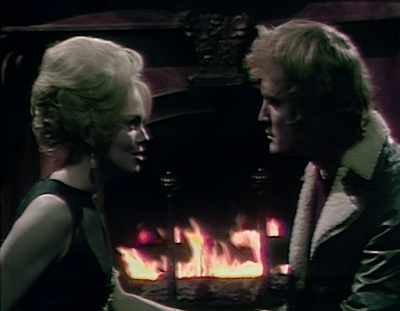
Angelique sits by the fire with Jabe and explains that she cannot simply liquidate the curse. It must end with someone’s death. But the good news is that it does not have to be his death. He can transfer it to someone else. He says he doesn’t want to kill anyone. She tells him that the person she has in mind is Nicholas. Suddenly he’s all ears as she explains the process for handing the curse over.
Angelique finds the limit of Jabe’s newfound reverence for life. Screenshot by Dark Shadows Before I Die.
Longtime viewers know that Nicholas was quite wrong to say Angelique has never changed. She was monomaniacal and utterly narcissistic in 1795. She wasn’t so very different when we next saw her in 1968, though the show’s pace was a bit slower at that point and so Lara Parker was free to play her with more nuance. That made a difference that the show underlined early in 1969, when Barnabas took a brief trip back in time to the 1790s and ran into Angelique as she was when first we knew her. Even though they were still enemies in 1968, they occasionally had to tell each other the truth, and occasionally had to leave each other alone to fight other adversaries. The unbending hostility the eighteenth century version of Angelique showed Barnabas startled him and us after we had seen the relatively circumspect approach she took to conducting a cold war against him.
Throughout most of 1969, Dark Shadows was set in 1897. Angelique showed up then, and she remembered the events of 1968. Barnabas and his friend, mad scientist Julia Hoffman, were there as time travelers. Julia actually befriended Angelique, and Angelique became Barnabas’ ally in the battles he attempted to wage in that period. Angelique even let go of her erotic obsession with Barnabas, transferring her affections to his distant cousin Quentin Collins.
After the show came back to contemporary dress, Julia stumbled upon Angelique. She found that Angelique had sworn not to use her powers, had married a man who made her happy, and had lost all interest in Barnabas or anyone else at Collinwood. She was as relaxed and attentive to others as in 1795 she had been frantic and self-absorbed. Only after it turned out the same supernatural enemies Barnabas and Julia were fighting had corrupted her husband did Angelique start casting spells again, and then in pursuit of more rational, identifiable goals than she had ever sought in the eighteenth century.
That arc of character development ends with this episode. We will see Lara Parker as several more characters up to and beyond the end of the series, some of them named Angelique, but none of whom went through the transformations we have seen.
Today also marks the final appearances of werewolf Chris Jennings and his girlfriend Sabrina Stuart. Evidently the makers of the show planned to bring them back in a few months, after an upcoming story plays out, but by that time actor Don Briscoe was unable to work. He had bipolar personality disorder and tried to self-medicate with street drugs.
Quentin was such a big hit in 1897 that they had a magic spell put on him that immunized him against aging and brought him intact to the contemporary setting. Today, Barnabas takes Quentin to a room in the long disused east wing of Collinwood where you can occasionally catch glimpses of an alternate universe. The effect manifests while they are looking in, then winks out, leaving the dark, bare room that is in that space in their universe. Once that happens, Barnabas announces “You have just seen Parallel Time.” Those of us who have been watching from the beginning know that he got the line wrong. You’re supposed to say “Parallel Time is a Dan Curtis Production.”
In May and June of 1967, vampire Barnabas Collins held Maggie Evans, The Nicest Girl in Town, prisoner. He drank her blood, tortured her, and drove her insane. When Maggie escaped, he turned his attentions to well-meaning governess Vicki Winters. Maggie’s imprisonment was the storyline that first made Dark Shadows a hit, but it was bleak and often difficult to watch, and if its horrors had shortly after been reenacted with Vicki as the victim many viewers would likely have given up on the show. So Barnabas decided that he wanted Vicki to come to him of her own will. That avoided the problem, but left the show stuck in a rut. For the next several months, Barnabas did not have a coherent goal. Since he was the main figure in the A story, that left Dark Shadows spinning in circles.
They escaped from that rut in November 1967, when Vicki went back in time to the 1790s. The audience followed her there, and we found out how Barnabas first became a vampire. He had fallen afoul of wicked witch Angelique. Angelique wanted Barnabas to love her. Since her enormous powers were explicitly shown to include the ability to make people fall in love with each other, we wondered why she didn’t simply use that ability on Barnabas. They answered that question by having Angelique declare that she wanted him to come to her of his own will. She tried to attract his love by casting a series of spells on everyone around him, spells that resulted in death and ruin for the people he most cared about. When Barnabas found out what was going on and tried to kill Angelique, she turned him into a vampire.
Now it is January 1970, and Barnabas’ vampire curse is in abeyance. A race of Elder Gods called the Leviathan People are trying to retake the Earth from humankind, and have threatened to reactivate the curse if he does not help them. The Leviathans control a group of people whom they have formed into a cult devoted to their service. The Leviathans have brought a shape-shifting monster to life, and it is written that the monster will marry Barnabas’ distant cousin Carolyn Collins Stoddard and turn her into a creature like himself.
Angelique has renounced her powers and is trying to live as a mortal woman. The other day, Barnabas asked her to help him protect Carolyn from the Leviathans. Angelique no longer wants anything to do with Barnabas or anyone else from the estate of Collinwood, but she understands the threat the Leviathans pose and is willing to help Barnabas against them, provided she can do so without losing what she has in her current life. Barnabas arranged for Carolyn and her mother, matriarch Elizabeth Collins Stoddard, to hide out at Angelique’s house while he tried to figure out a way of fighting the monster. Liz is a dedicated member of the cult, and believes Barnabas to be its faithful leader, so when Barnabas told her to take Carolyn to Angelique’s she complied at once.
Unknown to Angelique, her husband, hard-charging businessman Sky Rumson, is himself a member of the Leviathan cult. Thursday, he telephoned the monster and told him Carolyn was at the house; Friday he opened the door to the monster, and the monster went to Carolyn. Today, the monster decides that he will not impose the transformation on Carolyn after all. Instead, he will wait for her to come to him of her own will. This keeps the story from ending here, but it makes it unclear where it can go.
The monster’s decision poses a deeper problem for him as a presence on the show than the similar decisions did for Barnabas and Angelique. They pursued identifiable goals, and were influenced by thoughts and feelings they had while they interacted with others. The only goal the monster has is to take possession of Carolyn, and now it is unclear what that means. Nor is anything at stake for him in any encounter with another person. He keeps saying that he doesn’t need anyone, and that seems to be true- there is no reason to pay attention to him in any scene. He has, in short, been established not as a character at all, but simply as a function. All he has ever been is Threat. Now that he has decided to be nice to Carolyn, he will no longer even fulfill that function. His future would appear to be quite limited.
Sky also appears to be a short-timer. When Dark Shadows started, one of its most dynamic characters was hard-charging businessman Burke Devlin, played ably by the charismatic Mitchell Ryan. Despite all of Ryan’s magnetism, they could never come up with anything very interesting for Burke to do. Hard-charging businessman just isn’t a type they have much use for. They signal that Sky won’t be around long by casting Geoffrey Scott in the role. Scott was very handsome and would go on to a long career on screen, but in early 1970 he did not appear to have any skills of any kind as an actor. Not only does he deliver his dialogue as if he were reading a series of nonsense syllables aloud, but he is noticeably bad at hitting his mark. For example, on Friday Sky at one point backed away from Carolyn during a conversation. He took a step too far, with the result that his rear end was a few inches from a hearth with a vigorously burning fire. It was hard not to watch the seat of his pants and wait for it to ignite. There were times when they cast actors who still needed a lot of training and kept them around for quite a while, but Scott was at this point in his career so amazingly inept that it is hard to imagine they meant to use him for anything more than the decorative value his good looks offered.
Liz is at home in the great house of Collinwood when a man she has not seen before appears on the walkway above the foyer and starts giving her orders. He comes down and introduces himself to her by the name Bruno. He shows her that he is wearing a ring that identifies him as a member of the Leviathan cult. Liz says that he must have come to give her instructions. He confirms that this is so.
A howling resounds outside, and Bruno asks Liz about it. She tells him that she long ago met a wolf-like creature in the woods, and she suspects the howling comes from that creature. Returning viewers know that the Leviathans are vulnerable to werewolves and that the monster is terrified of them. Bruno knows this too, so he goes out to hunt for it.
The monster, in the form of a tall young man, comes to the great house to introduce himself to Liz. She is concerned when he tells her to stop taking orders from Barnabas, but delighted when he says that Carolyn has a future with “us.” Carolyn telephones from Angelique’s house, and Liz puts the monster on the phone.
Carolyn is all smiles when she is talking to the monster. They’ve met a few times, and he has been nothing but a jerk to her. She had objected to his behavior, and his responses had ranged from frightening to slimy. That she is all of a sudden attracted to him undercuts her character almost as badly as nerfing his threat to her undercuts his position on the show.
After the phone call, Bruno returns. He tells the monster he couldn’t find the werewolf. The monster declares that he will go to the Old House on the estate to confront Barnabas, whom he labels a traitor. Bruno points out that it is almost daybreak, and if he waits just a little while he will not be in danger from the werewolf. The monster says that it is too important to wait.
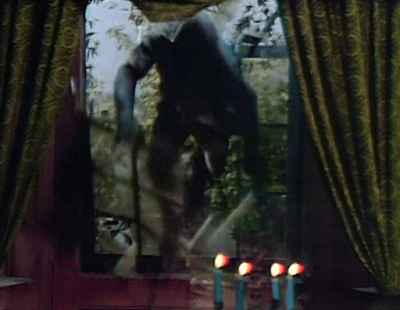
The werewolf chases the monster through the woods. By the time the monster gets to the Old House, he is shouting for Barnabas, the “traitor” he was planning to deal with, to come and help him. Barnabas is nowhere to be seen, and we end with the werewolf bursting through the window. The werewolf got a few closeups earlier in the episode, when he was nosing around in the woods. These always make him look like a cute widdle doggie. If they hadn’t given us those ridiculous images, his entrance through the window might have been a genuinely scary moment.
Carolyn’s scene at the beginning involves a couple of notable wardrobe-related points. She went to bed Friday fully dressed, even wearing shoes, and is still that way when she is back in bed today. Several times we have seen men go to bed shoes and all, but usually the women wear nighties. I think this is the first time we have seen a shod woman asleep in bed.
Carolyn falls on her back in the opening reprise. She is wearing a very short skirt, and this fall exposes her underwear. She is lying on the bed in several subsequent shots, and it must have taken some doing to keep the undies from making another unscheduled guest appearance.
Strange and troubled boy David Collins has stolen an old book from an antique shop. He didn’t want the book, but had damaged it slightly and was terrified that he would be punished if this was discovered and his father had to pay for the rare volume.
David’s friend and fellow resident of the great house of Collinwood, Amy Jennings, catches him with the book in the drawing room. He tells her he is going to burn it in order to conceal his crime. She points out that this will make a bad situation much worse. As a creature of Soap Opera Land, David can have no higher calling than to make bad situations worse, so this does not deter him.
While Amy offers to take the book to the nearest grownup and to claim that she was the one who stole it, David opens it to a page depicting a group of intertwined snakes, a symbol the show refers to simply as “the Naga.” He is transfixed by the symbol. His whole manner changes. His posture becomes more rigid, his voice grave and authoritative. He tells Amy he no longer wants to burn the book. Instead, he will read it. Since the book is written in a script neither of them has seen before, Amy tells David he cannot read it, but he assures her he can. She asks him to read it to her, and he says that it is forbidden for her to hear any of it. She says that she doesn’t like the game David is playing and would rather turn to another; he says it is no game. She leaves him alone with the book.
The book was not in fact part of the antique shop’s merchandise, though it was on a display table there. The owners of the shop, Megan and Philip Todd, have been inducted into a mysterious cult led by David’s distant cousin, old world gentleman Barnabas Collins, and the book is one of that cult’s most sacred objects. The Todds flew into a panic when they realized the book was missing, and Barnabas told Philip that he faced a severe penalty for losing it. Those reactions make it hard to understand why Philip and Megan left the book on the table in the first place.
Longtime viewers know that many of the major plot-lines on Dark Shadows start with David. So we may suspect that the supernatural forces behind the cult, unknown to Barnabas or the Todds, caused the book to be left on the table and led David to take it so that he could become part of the story. Indeed, once he is alone with the book David intones a statement from it: “And then those who have been hidden so long shall rise and show themselves, and the others will know their time is ended and the time of the people of the Leviathan will begin.” Later, he goes to the mysterious cairn in the woods that is the center of the Leviathan cult’s ceremonial activity, and announces that he is one of them now. The stones at the bottom of the cairn part, revealing a small opening. David crawls into it. The words are solemn, the music melodramatic, the action of the boy stuffing himself into the little hole preposterous. It is the perfect Dark Shadows sequence.
David Henesy was nine years old when the show started, and was thirteen by this time. It would seem no one told the carpenters he had grown in the interval. That gap is such a tight fit for him that he has to wiggle his rear end at the camera for quite a while as he tries to wedge himself into it. Screenshot by Dark Shadows Before I Die.
We Actresses are Vain
As David is leaving to go to the cairn, he has to refuse a request from permanent houseguest Julia Hoffman. Julia wants him to go to the Old House on the estate and give a note to Barnabas. She keeps telling him that it is urgent, but he tells her he is already on his way to do something urgent.
Julia does not know about the Leviathan cult, much less about Barnabas’ connection with it. All she knows is that Barnabas has been her best friend for a year and a half, and when last they had a chance to spend time together they were concerned with the rakish Quentin Collins, whose whereabouts they do not know. Now it is 4:45 PM, and Julia is expecting a Mr Corey to come to the house at 5:00 and look at a painting she bought from the Todds a little while ago. She thinks this Mr Corey might be Quentin, and is keen for Barnabas to meet him.
When David cannot help her, Julia decides to take the note to the Old House herself. The show is usually fairly vague and inconsistent about the geography of Collinwood, but several times they have said that it takes about fifteen minutes to walk between the great house and the Old House. They stick with this today. Julia leaves at 4:45, and returns as the clock is striking 5:15. Barnabas was not at home, so she just turned right around.
Julia hears voices in the drawing room. They are heiress Carolyn Collins Stoddard and another woman. Julia gathers that Mr Corey is actually Ms Olivia Corey. When she enters the room, she sees that Olivia is a dead ringer for Amanda Harris, a woman who lived in 1897. Julia became aware of Amanda in September, when she and Barnabas were traveling in time and met each other in that year. Julia did not meet Amanda, but evidently must have seen at least one of the many portraits of her that magical artist/ dreary goon Charles Delaware Tate painted. She mentions these portraits to Olivia, who claims that Amanda was her grandmother. Amanda was in love with Quentin, and Julia takes an excited breath when she asks Olivia who her grandfather was. Olivia gives his name as Langley. Quentin may well have used an alias, so that doesn’t rule out the possibility that Olivia may be his granddaughter, though Dark Shadows fans looking back in these later days will think of another member of the Collins family when they hear that name.
Olivia is a famous New York actress. Julia tells her that she has seen her on stage and has seen her photograph in the newspapers, but that she never noticed her resemblance to Amanda. Olivia asks where Julia heard about Amanda; she says that she must have read about her somewhere in connection with one of the portraits. She also tells Olivia that she isn’t likely to want the painting, since it is not a portrait. Olivia says that she wants any painting of Tate’s she can get. Julia tells her there is no portrait of Quentin Collins in the house; Olivia pauses for a fraction of a second, then blandly asks if she is supposed to know who that is.
Some of Tate’s paintings had supernatural effects. When Tate painted pictures of his ideal woman, Amanda came into being as their embodiment, like Galatea emerging from Pygmalion’s statue. And when he painted Quentin’s portrait, Quentin was freed of the effects of the werewolf curse. Like a Halloween version of The Picture of Dorian Gray, the portrait turned into a wolf on the nights of the full moon, while Quentin remained human.
As long as the portraits of Amanda and Quentin are intact, they themselves will remain alive and well and youthful. So Julia’s hope that Quentin might still be traveling the world and using false names 72 years after the period when she and Barnabas knew him is not ill-founded, and her surmise that Olivia might be, not Amanda’s granddaughter, but Amanda herself, is also plausible.
Dark Shadows committed itself to supernatural stories in late 1966 and early 1967, when the chief villain was undead blonde fire witch Laura Murdoch Collins. Since the usual laws of nature weren’t going to restrain Laura, they needed another set of rules that could predict her behavior sufficiently to create suspense. One of the things they settled on was that the barrier between past and present grows thin on the anniversaries of deadly events. So when well-meaning governess Vicki and the team she had assembled to fight Laura discovered that, in a previous iteration, she had taken a young son of hers to his fiery death “exactly one hundred years ago,” they knew that the crisis was at hand.
Anniversaries continued to have this effect in subsequent periods. So when in January 1969 recovering vampire Barnabas Collins wanted to take a day trip to the 1790s, he stood in a graveyard and shouted at a man who had died exactly 172 years previously to ask for a ride. It worked.
Barnabas was using a different form of mumbo-jumbo at the end of February, trying to contact the ghost that had made the great house of Collinwood uninhabitable, when he came unstuck in time and found himself in the year 1897.
In the middle of Barnabas’ long stay in 1897, the show decided to take its conceit that two events occurring on the same date in different years were mystically connected and show us both sides of the link. In #835, Barnabas was locked up in a cell with a secretary cabinet that he knew would be in the front parlor of his home, the Old House at Collinwood, in 1969. He wrote a letter to his friend, mad scientist Julia Hoffman, and hid it in a secret compartment of the secretary. We cut to the front parlor in 1969, exactly 172 years later, where a series of events leads Julia to discover the letter, travel back in time, and precipitate Barnabas’ rescue.
By #839, the events of 1897 had played out differently enough from whatever happened the first time through that year that the ghosts found peace. As we cut back and forth between that year and 1969, we saw that the 1960s characters remembered the haunting and the disasters that accompanied it and were relieved that they were over.
That gives us the present as the result, not of any one series of events in the past, but of a composite of many separate and mutually incompatible pasts. This idea is the logical culmination of substituting anniversaries for natural laws. In the first part of Barnabas’ trip to 1897, he had not yet done enough to lay the ghosts to rest. So the haunting continued, because it was happening on the anniversaries of events that were much the same as those that took place originally. By the time the living people of 1897 who would become the ghosts of 1969 had changed enough that they were no longer doomed to haunt the house, the date was one that would fall almost ten months into the haunting. In #836, Julia had a conversation in which one of the ghosts tells her about events in 1897 that could not have happened in the original timeline without Barnabas’ intervention, and which do not happen in #838 after Julia herself travels to that year. So each anniversary creates another past that becomes another ingredient in the stew that makes up the present.
This conception of the relationship between past and present shows the difference between a set of fantastic tales like Dark Shadows and a science fiction story exploring more-or-less plausible consequences of open questions in science. The “Copenhagen Interpretation” of quantum mechanics posits that the cosmos is made up of countless parallel universes, and that everything that could ever have happened did happen in at least one of those universes. Since that is a defensible position within science, an author can incorporate as much fact and reality as s/he likes in a story based on it. But since the idea that one period of history is the result of a confluence of many conflicting pasts is not only not a live option in science, but does not really make any practical sense except as a metaphor, the logic that really matters is dream logic. As dreams seem perfectly convincing to us when the only connections that lead from one moment to another are random similarities in names or shapes, so all that matters in a fantastic tale is that there is a pattern the audience can follow, whether or not that pattern corresponds to anything in the world where we spend our waking hours.
Now Barnabas has returned to 1969, brought back by a mysterious cult that has brainwashed him and adopted him as its leader. The characters he knew before he left are delighted to see him again. Today, matriarch Elizabeth Collins Stoddard comes to the Old House and is overjoyed that the haunting is over and that she and her family have been able to return to the great house. She is grateful to Barnabas for undertaking his harrowing journey back in time.
Liz and Barnabas talk about Chris Jennings, a young man in whom Liz’ daughter Carolyn is interested. Barnabas gives it as his firm opinion that Carolyn should avoid Chris, and he urges Liz to encourage her to do this. Barnabas knows that Chris is a werewolf, and we saw last week that the cult that has co-opted him has plans for Carolyn which do not include her death as one of Chris’ victims, so this will not surprise returning viewers.
Chris himself is another example of the weird metaphysics the show has stumbled upon. When Barnabas left 1969 for 1897, Chris was in his wolfish form all the time, apparently never to become human again. We learned during the 1897 segment that his lycanthropy is a curse inherited from his forebear, Quentin Collins. The version of 1897 we saw was changed sufficiently from the original that Quentin avoided his own death and was for a time relieved of the effects of the werewolf curse, though at the end of the segment it looked like they might be on their way back. That he is now human part of the time but still subject to transformation suggests that the difference in Quentin’s experiences in the later part of the 1897 stories had some effect on him. It’s unclear whether Chris’ condition fluctuated every time the date marked the 72nd anniversary of something happening to Quentin that hadn’t happened when he was living in a Barnabas-free zone, but it wouldn’t contradict anything we’ve seen if it did.
The Time to Come
Barnabas brought one object back with him from the past, a wooden box. The box must be opened only at a certain time, by certain people, for the cult’s plan to take effect. Today, Barnabas receives a visit from the people. They are Megan and Philip Todd, owners of the new antique shop in the village of Collinsport. Carolyn sent them, thinking that Barnabas would likely have some things they could add to their inventory. He sees that Megan is wearing a necklace with a symbol representing intertwined snakes, which Barnabas calls a “Naga.” When Megan is unable to explain just how she came into possession of the necklace, he shows them the box, which is topped with an oval in which the same symbol is carved. They are both thrilled at the prospect of buying the old furniture he has in the upstairs rooms of his house, but Megan is particularly fascinated by the box.
Later, Philip and Megan are back in their shop. They are confident they can buy a great deal of furniture from Barnabas, but are also sure that they wouldn’t be able to afford the box, even if he were willing to part from it. This is a bit odd- we get a good look at the box, and it is absolutely nothing special. The actors manage to sell the scene, but it would be better if they had either invested in a showier prop or been more sparing about putting it on camera.
Barnabas comes to the shop and gives Megan and Philip the box as a present. After he goes, Megan is overwhelmed by an urge to open the box, which is locked. She is so consumed by this urge that she actually says “Let’s force it!” Since they had just minutes before been talking about it as if it were more expensive than anything they have for sale in their shop, this is a startling line. But when Philip opens the envelope Barnabas left to look at the list of furniture he is willing to sell them, he finds a key.
Philip is reluctant to open the box, having a strange feeling that if they do, nothing will ever be the same for them again. The other day it was Megan who had a strange feeling of impending doom. She wanted to sell the shop and flee Collinsport forever, lest they suffer an irretrievable disaster. That time it was Philip’s turn to urge her to set her misgivings aside. We’ve seen this kind of back and forth before. At the end of 1968, the great house of Collinwood was coming under the control of ghosts. Children Amy Jennings and David Collins kept trading the roles of possessed agent of the ghosts and unwilling sidekick. That alternation showed that the ghosts were not yet powerful enough to possess both children at once, and it faded as the haunting became more intense. It built suspense by suggesting that possible avenues of escape were gradually but inexorably closing.
As Philip and Megan begin to open the box, there is a whistling sound. They are unsettled, but decide they have to finish opening it anyway. They do, and we see their reaction to whatever is inside. Longtime viewers have seen similar reactions as cliffhangers many times; always before, they have indicated amazement that the container is empty.
New People
One of the less appealing villains of the 1897 segment was magically gifted artist/ surly criminal lowlife Charles Delaware Tate. Tate lived in a house that in the parts of Dark Shadows set in the 1960s was known as “the Evans Cottage,” home to drunken artist Sam Evans and his daughter Maggie, The Nicest Girl in Town. The cottage burned down in #883, leading us to wonder if it would still be there when the show returned to 1969.
Sam died last year, and Maggie now lives at Collinwood, where she is David and Amy’s governess. Today she goes to the cottage to prepare it for some tenants to whom she will be renting it. Evidently it must have been rebuilt before the Evanses moved in.
The only movable property in the cottage is a portrait of Maggie’s mother which her father painted. That portrait also appeared in the cottage a few times when Tate was living there; that was just carelessness on the part of the production staff, but it is kind of reassuring to see it again.
A man who has been in a couple of episodes knocks on the door. He identified himself as a friend of Sam’s and is saddened to hear of his death. He enters and asks Maggie to do him a favor. He keeps refusing to give her his name. We haven’t heard his name at all; evidently his identity is supposed to be a mystery to us. Word of that apparently did not reach the department responsible for making up the credits; they’ve been billing actor Dennis Patrick as Paul Stoddard, whom regular viewers know as the long-missing husband of matriarch Liz and father of Carolyn. They do that again today.
This is the last time we will see the Evans Cottage. In 1966 and 1967, the set was a symbol of the village of Collinsport, and scenes there showed the consequences that the doings of the rich people in the big house on the hill had for the working class who live in its shadow. By the time Maggie moved into Collinwood, they had long since given up on those kinds of stories. Dark Shadows is sometimes called “Star Trek for agoraphobes”; as we go, less and less of the action takes place anywhere other than Collinwood, and eventually they won’t even let us outside.
Liz agreed to let Barnabas live in the Old House in #218; by #223, she was talking about it, not only as his home, but as if he owned it and its contents. For while they went back and forth on the question of Barnabas’ legal status regarding the property, but when, at the suggestion of Liz’ daughter Carolyn, he gives the Todds a list of its furnishings that he is prepared to sell to them, I think we can take it for granted that Liz no longer has any claim on it.
The opening voiceover, delivered by Kay Frye, tells us that a vampire named Dirk Wilkins has been destroyed. We hear that Dirk was the pawn of someone called Barnabas Collins, who hoped to use him to conceal a secret of his own. The narrator also says that “certain things cannot be forgotten, as Judith Collins will learn this day.” This implies that the day’s action will center on challenges in information management.
Returning viewers may not recognize Miss Frye’s voice. We have seen her as Pansy Faye, Cockney showgirl, improbable fiancée of prankster Carl Collins, and victim of Dirk’s first murder. As narrator, Miss Frye forgoes Pansy’s rather uncertain East London accent. She also takes a different approach to the role of narrator than she had to that of Pansy. When we first saw her, Pansy was putting on an act for Carl’s benefit, and Pansy is a terrible actress. When Carl left, Pansy dropped her act and we could see that Miss Frye is as capable a performer as the character is a poor one. Today’s voiceover gives Miss Frye a still better role. The crass and cynical Pansy did not call for much nuance. But as narrator, Miss Frye speaks with a quiet urgency and subtle modulation of the voice that leaves us wondering what might have been had she been cast in a bigger part.
We cut to what regular viewers recognize as the drawing room of the great house of Collinwood in the year 1897, where a man in a cassock is talking tenderly with a woman in a colorful dress. The man is very affectionate, even stroking the woman’s neck with two fingers.
The woman is the Judith Collins mentioned in the opening voiceover; the man is the Rev’d Gregory Trask. It is not mentioned in the episode, but Trask is the keeper of a boarding school called Worthington Hall. Also unmentioned is that Trask conspired with a Satanist named Evan Hanley to brainwash a young man named Tim Shaw, one of the teachers at Worthington Hall, and that once he was under their control they used Tim to murder Trask’s wife Minerva. Trask wanted Minerva out of the way, evidently because he plans to marry Judith and take control of her vast fortune.
Judith is disconsolate at the thought that she was under Dirk’s control. While Trask is talking sweetly to Judith, Tim enters. Trask pulls a gun on him and instructs Judith to call the police and report that Minerva’s murderer has been captured.
Tim, who has up to this point ranged from mousy to timid to utterly defeated, is suddenly assertive. He tells Judith that she won’t want to telephone the sheriff. He says that there are two murderers at Collinwood, and she is one of them.
Tim says that he came upon Judith in the act of shooting neurotic intellectual Rachel Drummond to death. Returning viewers know that this is true; Tim, Judith, and Rachel were all under Dirk’s power at the time, and for reasons that made sense only to the dim-witted Dirk he ordered Judith to kill Rachel. A vague memory comes back to Judith and prompts her to confess; when Trask realizes that Tim will not back down from his accusation and Judith will not participate in a cover-up, he tells Tim he will make a deal with him.
Trask calls the sheriff. He addresses himself to “Sheriff Furman,” a name we have not heard before. It quickly becomes clear that we are not likely to hear it again. He tells the sheriff that Tim was out of town the night Minerva was poisoned and that, in his grief, he had forgotten this fact. Returning viewers know that Evan has told the sheriff that he saw Tim with Minerva while she was dying. One might assume that Trask would at least have to call Evan first to ensure that he gave the sheriff a story to account for this discrepancy, but Trask doesn’t bother to contact Evan at all. Evidently the sheriff is such an abysmal moron that Trask can safely assume he won’t think of any questions.
Sheriff Furman’s manifest incompetence prompts one of Danny Horn’s funniest posts at Dark Shadows Every Day, in which he writes a series of hypothetical police reports about the killings we have seen so far in the 1897 segment. One of Danny’s recurring themes is that law enforcement characters on Dark Shadows serve only to delay the plot. There is so much story in 1897 that the producers saw no need to slow things down, so it shouldn’t be surprising that neither Sheriff Furman nor any of his deputies appear on-screen.
For my part, I wish they had stayed in 1897 considerably longer, so I would have liked to spend one day a week or so without much forward narrative movement. That might have included some episodes when the police show up and you do a lot of recapping, some built around character studies of the type Joe Caldwell wrote so well in 1967, some in which we reconnect with Collinwood as it is on the night in 1969 when Barnabas left for the past, and so on. Not only would that have extended the show’s strongest period and helped new viewers catch up to what is going on, it would also have enabled them to make more use of the many fine actors whom we go weeks on end without seeing. Even David Selby, whose handsome rake Quentin Collins is breaking out as a pop culture sensation at this point, hasn’t been on the show since #768. Other fan favorites are in the midst of even longer unexplained absences; for example, Lara Parker’s wicked witch Angelique has not been seen since #760.
Tim, who was out of the room while Trask was on the phone, returns. He “gladly!” agrees to leave Trask’s employ, and at first says that he will “gladly” leave the village of Collinsport. But then it dawns on him that he needs a job, and he blackmails Judith into assuring him that she will find a place for him in her business.
This will remind longtime viewers of the spring and early summer of 1967. At that time, Dark Shadows took place in a contemporary setting, and there were two major storylines. One was the introduction of the vampire Barnabas Collins. The other was the blackmail of matriarch Elizabeth Collins Stoddard by seagoing con man Jason McGuire. Like Judith, Liz owns all of the Collins family’s assets; also like her, she is played by Joan Bennett. Threatening to expose the terrible secret that she was a murderer, Jason forced Liz to take him into her home, pay his debts, give him a job, and agree to marry him. When she finally balked rather than go through with the marriage, it turned out Liz wasn’t a murderer after all, the whole thing was a scam Jason cooked up.
Jason was a short-term character brought on to tie up the last non-supernatural narrative loose ends and fill time while Barnabas found his footing, as witness the casting of Dennis Patrick, who refused to sign a contract for the role since he wanted to be free to move to Los Angeles without giving more than 24 hours notice. But in those days, before the internet or soap opera magazines, the audience had no way of knowing that. They may well have thought that Barnabas would be destroyed and Jason’s oppression of Liz would become the show’s backbone.
In yesterday’s episode, a vampire was in fact destroyed. In May and June 1967, Barnabas’ chief victim was Maggie Evans, who like Rachel was played by Kathryn Leigh Scott. It was possible then that he would kill Maggie and that she would rise as a vampire, as Lucy Westenra did in Bram Stoker’s Dracula, compelling the good guys to stake her. Rachel doesn’t become a vampire, but Trask does tell the sheriff that it was the men hunting Dirk who shot her, accidentally. So when the final appearances of Dirk and Rachel lead to Judith both submitting to blackmail because of her mistaken belief that she is a murderer and taking steps towards marrying an overwhelmingly evil man, longtime viewers will remember a resolution that seemed to be on the horizon back in 1967.
Carl enters. Judith has no patience for her childish brother, and dismisses his concerns about Pansy. She tells Carl to go with Tim to the Old House on the estate. Tim took Rachel to the Old House when she was dying. Barnabas, who has traveled back in time to 1897, is staying there, and he had befriended Rachel. Tim had hoped Barnabas would help them, but it was daylight and he was not available. Rachel died in the Old House, and Tim left her corpse there when he came to the great house.
When Carl and Tim leave, Trask warns Judith that she almost gave herself away. “You must be more cautious, Judith! Even Carl was suspicious.” Judith agrees, showing that Trask is luring her into his world of lies.
We see Tim and Carl at the Old House. Rachel’s body is no longer there. Who took it, and why didn’t Tim and Carl leave with them? We are not told. Carl goes on about how wonderful Pansy is, and says he is going to the police because he thinks someone at Collinwood has done her harm. Evidently Carl’s suspicions are more highly developed than Trask realizes. Trask underestimates Carl because he is focused exclusively on Rachel and Tim. He never met Pansy, and knows nothing about her.
Carl leaves the house, and Pansy’s ghost appears to Tim. Tim is bewildered, and asks Pansy if she is looking for Barnabas. That is a natural assumption- after all, it is Barnabas’ house and Tim has no idea who Pansy is. When she vanishes into thin air, he shouts for Carl. He finds Carl not far outside the door, and describes the woman he saw. Carl jumps to the conclusion that she is Pansy, and starts calling for her. He sends Tim along to the great house, and continues searching for Pansy.
Evidently Carl’s search did not take long, because we see him standing next to Tim in the drawing room at the great house in the next shot. It is Rachel’s funeral.
Trask delivers a eulogy in which he says of Rachel that “The littlest angels have a new teacher.” Even first-time viewers are likely to laugh out loud at this ridiculous turn of phrase, and those who have been with the show for a while will see more in it than that. From childhood on, Rachel was Trask’s prisoner, first as one of the pupils imprisoned in his horrible school, then when he extorted her into staying on as a teacher with threats that he would have her prosecuted on false charges of theft and murder if she tried to leave. He made flagrant sexual advances to her as well, all the more hideous because he has been responsible for her since she was a small girl. In Rachel and Tim’s helpless personalities, we saw what can happen when a criminal like Trask is given an opportunity to turn a person into filet of human being, and an ominous sign of what might lie in store for Judith’s nephew and niece Jamison and Nora, who are currently among the inmates at Worthington Hall.
Tim and Carl bury Rachel themselves. My wife, Mrs Acilius, asked “Isn’t this usually handled by professionals?” Presumably whoever took Rachel’s body from the Old House would have been a better choice for the work than are Tim and Carl, but that isn’t the Collins way.
Tim announces his intention to get drunk. Carl brings up other things they might do, and Tim says that those will have to wait until after he gets drunk. After Tim leaves to pursue his eminently sound plan, Carl hears Pansy singing. He wonders if she is dead. He realizes that her voice is coming from the mausoleum which we know to have been Barnabas’ longtime home. Carl is played by John Karlen, who in the parts of Dark Shadows set in the 1960s plays the luckless Willie Loomis. It was Willie who inadvertently released Barnabas from the mausoleum, so longtime viewers who see this actor on this set will expect something important to happen in the story.
Tim Shaw, uptight teacher turned victim of brainwashing turned fugitive murder suspect, makes his way into an abandoned root cellar. He finds a coffin there. Naturally, he opens the coffin. That’s what everyone does on Dark Shadows when they find a coffin where one shouldn’t be. You meet the most interesting people that way.
Tim finds that the coffin is empty, and goes into a dark corner to hide. Someone comes to the door, and Tim gets up to greet whoever it might be. He hasn’t been a fugitive very long, and hasn’t quite perfected all the skills that the status calls for.
Tim sees Dirk Wilkins, a dimwitted servant of the ancient and esteemed Collins family who has been missing for several days. Tim calls out “Dirk!” This is the first time we learn the two men know each other. They are unlikely to have been friends. Tim rarely left the school where he worked. The school has been housed in a building on the Collins family’s estate for several weeks, so it makes sense that he and Dirk would have met, but Dirk has been unpleasant to everyone we have seen him with, including his employers and pretty girls he wants to attract. It is hard to imagine the painfully shy Tim befriending him.
Dirk turns out to be a vampire, and he bites Tim. We then cut back to the school. The headmaster, the overwhelmingly evil Gregory Trask, is browbeating Tim’s fellow teacher and onetime girlfriend, neurotic intellectual Rachel Drummond. Returning viewers will recall that Trask has made flagrant passes at Rachel, and also know that Trask conspired with a local Satanist to cast a spell on Tim which caused him to kill Trask’s wife Minerva. Trask is pretending to be upset about Minerva’s murder and to believe that Rachel plotted with Tim to commit it. He tells Rachel that if she does not leave the school, he will accept that she is innocent. She goes to her room, distraught. Later in the episode, Trask will telephone his co-conspirator, gloating that the authorities are on their side.
Spinster Judith Collins, sole proprietor of all her family’s great wealth, shows up to offer her condolences to Trask. They find that Rachel is gone, and he tells her that she must have gone with Tim. Trask realizes that Tim and Rachel have no money, and wonders if there is anyone who might give them enough to allow them to flee the state. Judith says that her distant cousin Barnabas Collins, who is currently staying at the Old House on the estate, is very fond of Rachel and that he might give them some money. She says that she will get in her carriage and go to the Old House before Rachel can get there. She will tell Barnabas about the murder and about Tim and Rachel’s involvement in it, thereby ensuring that he will not give them any money.
Judith knocks on the front door of the Old House and gets no answer. She enters, and finds the house empty. She is still in the front parlor when Dirk enters. She chastises him for staying on her property after she dismissed him, and tells him she will call the police if he is not gone within 24 hours. He walks towards her, backing her against the wall and ignoring her demands that he let her leave. He says that he is no longer her servant, but that she will soon be his. He bites her.
Judith was right when she told Trask that Rachel would go to the Old House. Rachel does go there. She peeks in the window, sees Judith sitting in a chair, and scurries off. This is rather an odd moment- Judith told Trask just a few minutes before that she would go to the Old House in her carriage. It seems unlikely that she drove her own carriage and there is no driver waiting outside, but even if if she did the carriage must still be sitting there in full view. How did Rachel fail to notice it?
Trask comes to the Old House and tells Judith he wanted to offer her his support in her conversation with Barnabas. Trask knows how fond Barnabas is of Rachel, and may well suppose that he would want more details about Minerva’s death than Judith could offer before he agreed to regard Rachel as a criminal. Judith says Dirk’s name when Trask enters, and when Trask notices the bleeding wounds on her neck he quickly realizes that Dirk inflicted them.
We cut back to the root cellar, which we see Rachel entering. She sees the coffin, and of course opens it. That’s just good manners. She turns, and sees Dirk in the entryway.
In his post about this episode at Dark Shadows Every Day, Danny Horn transcribes a conversation among Roger Davis, Jerry Lacy, and director Lela Swift captured on video when the three were on a panel at a convention:
Roger Davis: I do remember being very excited when I got to be a vampire on the show, so excited, and the first person that I got to bite was Joan Bennett, and I was so enthusiastic and excited I knocked her over — flat on her back!
Jerry Lacy: I remember when you did it, it was rehearsal in the morning.
Roger: Was it?
Jerry: Yeah. You grabbed her, and you bit her, and then you just threw her. And she was already sixty years old then.
Lela Swift: Then we had to pick Joan up and put her together again.
Danny Horn, “Episode 774: What’s Up, Dirk,” posted at Dark Shadows Every Day, 21 November 2015.
To which my comment is, fuck that guy. I don’t make a habit of swearing, but there are not enough curse words in the language to express my reaction to Mr Davis chortling through his reminiscences of physically abusing his female scene partners. He can fuck off straight to hell.
This story gives an extra dimension to the scene between Judith and Trask in the Old House. Mr Lacy plays Trask’s relentless evil so effectively that he is difficult to watch; my wife, Mrs Acilius, refuses to watch his episodes this time through the series. It usually makes a viewer’s skin crawl to see Trask posing as a representative of something good. But knowing that behind Trask in the position of standing by Judith after she had been attacked by Dirk was Jerry Lacy standing by Joan Bennett after she had been attacked by Roger Davis, our response is much more complex. After all the times we might have wondered how anyone could fail to see through Trask’s blatant hypocrisy, this time enough of the thoroughly decent humanity of Jerry Lacy peeks through that we can understand why Judith has been so supportive of Trask.
The cast went into makeup after the morning rehearsal. From the looks of Dirk’s fake mustache and artificial pallor, makeup artist Vincent LoScalzo must not have brought his usual enthusiasm to his work when Mr Davis sat in his chair. The mustache in particular is so crudely affixed that it looks like Mr Davis might have done his own makeup today.
Broad ethnic stereotypes Sandor and Magda Rákóczi are in the parlor of their home, the Old House on the great estate of Collinwood, quarreling about a locket. Shortly before, Magda found maidservant Beth Chavez and libertine Quentin Collins in the parlor, and she noticed Beth snatch a locket from a table and try to hide it. Beth claimed that the locket was hers, but Magda declared that it was not, and that she knew who it really belonged to. Now Beth and Quentin have left, Magda has the locket, and Sandor is pleading with Magda to stop trying to figure out what it means that the locket is in the house. “She is far away!” he protests.
Returning viewers know that the locket belongs to madwoman Jenny, Quentin’s estranged wife. Unlike Magda, we also know that Quentin’s brother and sister, with the assistance of Beth and another servant, have been keeping Jenny prisoner in a series of cells deep in the great house ever since Quentin left her the previous year. Yesterday Jenny had a strong reaction to Magda’s name, in the course of which she started muttering about Sandor as well, hinting that the Rákóczis are of some importance to Jenny.
Sandor and Magda hear a voice from an upstairs bedroom. They go there, and are astonished to find Jenny. They ask her where she went when Quentin left her; she denies that Quentin ever did leave her, and talks about being locked up in a room. It dawns on Magda and Sandor that the Collinses locked Jenny up in the house and have been keeping her there. Jenny angrily says that yesterday she was horrified when Sandor and Magda’s caravan pulled up at the home she and her husband share, and that she told them never to speak to her again; they tell her that happened years ago. She is shocked and disbelieving.
Jenny sneeringly calls Magda and Sandor “Gypsies.” Magda replies “You are a Gypsy, too.” Jenny replies that “What I was is not what I am.” After a few more moments, Magda and Jenny embrace and Magda calls her sister.
The revelation that Jenny is Magda’s sister is one of the most effective twists in the whole series. When Mrs Acilius and I first watched the show through, we were thunderstruck by it. The most amazing thing is that it makes so much sense we couldn’t believe we hadn’t figured it out. The Collinses have disdain for Jenny, not only because their black sheep brother brought her into the family, but also because she is of obscure birth. So when she became mentally ill, why didn’t they just ship her off to an institution and have done with it? The answer is racism. They are not simply embarrassed that Quentin chose an unsuitable wife; they are frozen with horror that a Romani person now bears their family name. They cannot take the chance that anyone, even the staff of a discreet, high-end sanitarium, will learn of this shame, and so they hide her away in their own house.
In #701, the first episode of the part of Dark Shadows set in the year 1897, it was established that Beth came to Collinwood as Jenny’s maid and that it is surprising she stayed after Jenny ceased to be a visible member of the family. In the same episode, Magda mentioned some Romani folklore to Beth, said, “But you wouldn’t know anything about that!,” and laughed tauntingly while Beth looked alarmed. The implication that Beth has been trying to conceal her own Romani heritage, combined with her association with Jenny, was something else we were surprised we didn’t pick up on the first time through the show. Perhaps that is because of the visuals. As Sandor and Magda, Thayer David and Grayson Hall wear heavy brownface makeup and dark curly wigs. As Beth, the tall, wasp-waisted Terrayne Crawford has her own light blonde hair, pale skin, and blue eyes. So it was easy to take Magda’s line as a reflection of something that was in the flimsies months before they cast the part of Beth Chavez with an obviously Anglo actress, and to assume that we would never hear of it again.
There are some flaws on screen today. Early on, Quentin walks in front of a green-screen with a picture of the Old House, and it is ludicrously fake even by the standards of special effects on Dark Shadows.
The real house in this photo burned down about this time, perhaps because it couldn’t stand the disgrace of having appeared in this shot. Screenshot by Dark Shadows Before I Die.
Later, there are three goofs in thirty seconds. Sandor leaves Magda alone in the room with Jenny. Jenny is supposed to slam a book down on Magda’s head to stun her, but we can clearly see that the book sweeps through a space several inches to Magda’s left. When Magda falls and Jenny runs out, Sandor isn’t supposed to see Jenny, but the two of them are on screen together and their shoulders actually brush against each other. Once downstairs, Jenny is supposed to try the front door, find it locked, and look for a hiding place. But when she touches the door, it opens, and she has to pull it shut before she can play her scene about being unable to get out.
Thayer David joined the cast of Dark Shadows in August 1966, taking over the role of moody handyman Matthew Morgan from George Mitchell starting with #38. In that first episode, Matthew brawled in a barroom and left dashing action hero Burke Devlin gasping. The main storyline of the next few months was the investigation into the death of beloved local man Bill Malloy; it turned out Matthew had unintentionally killed Bill when they got into a fight and Matthew didn’t know his own strength.
Those two events explain the recast. George Mitchell was a slender little man whose white hair and craggy face made him look older than his 61 years. He was a fine actor, but no one would have believed that he could win a fight with Burke or that he was so strong that he would accidentally kill Bill. David was Mitchell’s equal in acting ability, but more importantly was a burly fellow in his late 30s.
Today, we hark back to David’s original function on the show. The setting is the year 1796; vampire Barnabas Collins has traveled back from the 1960s to rescue his fellow time traveler, well-meaning governess Victoria Winters, from death by hanging. David plays another servant. As Matthew was fanatically loyal to matriarch Elizabeth Collins Stoddard, so Ben Stokes is utterly devoted to Barnabas. Ben finds roguish naval officer Nathan Forbes and visiting Countess Natalie DuPrés about to drive a stake through Barnabas’ heart. Ben demands they stop; Nathan aims his pistol in Ben’s direction and squeezes the trigger. The gun misfires. Ben reflexively clutches at his chest, but finding he is not hurt he advances on Nathan. They fight. As Matthew was so strong he could not fight Bill without accidentally killing him, so Ben accidentally kills Nathan. Ben then tells the countess he doesn’t want to hurt her and that she will be all right if she stays put until he can figure out what to do; she is unable to assure him she will do so, and in his attempt to restrain her he inadvertently kills her, too.
Barnabas had originally lived in the eighteenth century. He passed from that time into the 1960s because he was chained in his coffin in 1796 and discovered in 1967 by would-be grave-robber Willie Loomis. Now, he has rescued Victoria, and he is eager to go back to 1969, when he is free of the effects of the vampire curse. He traveled back by standing in an old graveyard and calling to the spirit of Vicki’s boyfriend, an unpleasant man known variously as Peter and Jeff, to pull him into the past. He went to the same graveyard yesterday and tried the same trick in reverse. Peter/ Jeff isn’t in 1969, so he calls instead to his friend, mad scientist Julia Hoffman. That didn’t work, so he decided to have Ben chain him in the coffin and take the long way back.
Barnabas is unhappy to wake up this evening. He leaves his crypt to find Ben using a shovel to pat down some earth nearby. He asks why Ben did not chain the coffin as he was instructed. Ben tells him about Nathan and the countess; evidently he is only now finishing their shallow graves. Ben has never murdered anyone before, so he asks Barnabas’ expert opinion about the next steps. Barnabas tells him to get rid of the countess’ things and to tell whoever asks that she left for Paris.
The reference to Paris is a bit unexpected to longtime viewers. When the countess first appeared in #368/369, she said that she chose to live on the island of Martinique because metropolitan France had become a republic. She and her servant Angelique came to Collinwood along with the countess’ brother André DuPrés and André’s daughter Josette, who was at that time engaged to marry the still-human Barnabas. André is identified as the owner of a sugar plantation on Martinique.
In 1796, France was of course still a republic. But the Terror had ended shortly after the execution of Robespierre in the summer of 1794. Among the beneficiaries were the real-world counterparts of the DuPrés family, the vaguely aristocratic owners of a sugar plantation on Martinique. Their name was Tascher; the daughter of the family was named, not Josette, but Josephine, the widow of the Vicomte de Beauharnais. Josephine was imprisoned in Paris during the Terror, but she was freed, reunited with her son, and restored to her property by June 1795. In May of 1796, Josephine would marry an up-and-coming artillery officer named Napoleon Bonaparte. It would indeed be plausible that the countess would want to go back to Paris and take the opportunity to reestablish a life there.
After the story of Matthew Morgan and the consequences of the death of Bill Malloy ended in December 1966, Dark Shadows was for 13 weeks dominated by the battle between undead fire witch Laura Murdoch Collins and the forces of good, led by Victoria with assistance from the ghost of Josette. Laura was the show’s first supernatural menace.
The ghost of Josette had been introduced in #70 as the tutelary spirit of the long-deserted Old House on the estate of Collinwood. Matthew held Victoria prisoner in the Old House late in 1966, and in #126 he decided to kill her. Josette led the other ghosts out of the supernatural back-world that exists somewhere behind the action to save Victoria by scaring Matthew to death. During the Laura story, Josette’s ghost was deeply involved in the action, literally painting a picture to explain to the characters what was going on.
Prompted by Josette’s ghost, Victoria figured out that Laura was going to burn her son, strange and troubled boy David Collins, to death on the anniversary of similar immolations. This would turn out to be a key turn in Dark Shadows’ world-building. When you are telling stories about supernatural beings, you can’t rely on the laws of nature or logic to shape the audience’s expectations. You need to give them some other mechanism of cause and effect if you are going to create suspense. So from that point on, the show would use anniversaries as causal forces. “It happened exactly one hundred years ago tomorrow night!” means it will happen again then.
That was the basis of Barnabas’ trip to 1796 and of his hope to return by standing on the same spot. Tombstones indicating that Victoria and Peter/ Jeff had been hanged materialized at times related to the anniversaries of those events, and Barnabas must leave 1969 at a certain point to arrive at a certain point in 1796. Eight o’clock on a given night in 1796 corresponds to eight o’clock on a given night in 1969, and those are the times when Barnabas and Julia go to the graveyard from which he vanished and call out to each other.
Even though the conjoined eight o’clocks don’t facilitate Barnabas’ return trip, the structure of today’s episode plays on the same idea of intercutting timelines. We alternate between scenes of Barnabas and Ben in 1796, and of Julia and Willie in 1969. Barnabas bit Willie and enslaved him when he opened his coffin; by the time Barnabas was cured of the effects of the vampire curse, Willie had let go of any hard feelings about that. Barnabas has made the Old House his home, and Willie voluntarily lives there as his servant. Julia has been a permanent guest in the great house on the estate since 1967, but now is apparently staying at Barnabas’.
Julia is determined that Barnabas will return by rematerializing on the spot from which he vanished, and she keeps going back there. Willie doesn’t believe this will happen, but in a long interior monologue comes up with the idea that he might reappear in his old coffin. In her turn, Julia dismisses that idea. They quarrel about these competing absurdities, and Willie decides to put his hypothesis to the test. He goes to the old mausoleum to check on the coffin, and finds it empty. He returns to the house to report this to Julia.
Julia decides it’s time to sleep, so she goes upstairs- apparently to her own bedroom. Seconds later, a ghost appears to Willie. He recognizes it as Josette. She vanishes, and he calls Julia. When Julia comes he tells her that Josette had never appeared to either of them unless Barnabas was in danger. As far as I can recall the audience has never known Josette to appear to Willie or Julia at all, and Barnabas is always in danger, so that remark is a bit of a mystery to longtime viewers.
In the days leading up to Willie’s discovery of Barnabas in April 1967, he, and he alone, heard a heartbeat coming from the eighteenth century portrait of Barnabas that hangs in the foyer of the great house. While he is talking with Julia, Willie turns to the portrait of Barnabas that artist Sam Evans painted in May 1967 and hears the heartbeat again. Julia cannot hear the heartbeat. Willie combines the sound of the heartbeat with the sight of Josette and concludes that Barnabas has returned and the old coffin is no longer empty. We cut to the hidden room in the mausoleum. Chains materialize around the coffin, and we see Barnabas inside it, struggling to escape.
We may wonder if Barnabas has been struggling that way every night since he was chained there in his attempt to return to the 1960s. That would be 173 years, added to the 171 years the first time. It would seem that 344 years confined to a box would make Barnabas even screwier than he is. In a much later episode, we will see Barnabas released after a long entombment and he will be surprised that more than one day has passed. The 2012 film adaptation of Dark Shadows includes a humorous scene based on the idea that time does not pass for Barnabas while he is chained in his coffin. But when he was first released in April 1967, there were indications that he had undergone a nightly torment through the centuries, and the closing image of Barnabas in the box today echoes those indications.
Nathan’s death marks the final appearance of actor Joel Crothers, who has been one of Dark Shadows’ most valuable cast members since his debut in #3, when he played hardworking young fisherman Joe Haskell. We said goodbye to Joe last week; it was nice to have another glimpse of Crothers in his villainous role before he left for the last time.
One of the duller storylines in the first several months of Dark Shadows was the relationship between hardworking young fisherman Joe Haskell and flighty heiress Carolyn Collins Stoddard. Carolyn and Joe were thoroughly bored with each other before we ever saw them, and we were treated to scene after scene of them having nothing to say while they were out on dates. They only kept going out to humor reclusive matriarch Liz, who was both Carolyn’s mother and Joe’s employer.
Eventually Joe and Carolyn went their separate ways, and Joe struck up a much happier romance with Maggie Evans, The Nicest Girl in Town. There were too few obstacles between Joe and Maggie to make for exciting drama. There were long stretches when the show had established that they wanted to get married and couldn’t give us a single reason why they didn’t. Occasionally one of them would be caught up in the strange goings-on, and then we would see the other being all anguished and determined to get to the bottom of all this. As Dark Shadows‘ principal representatives of the working class of the village of Collinsport, Maggie and Joe were appealing when they went into that mode, suggesting a whole community of people who struggle to make sense of the inexplicable disasters that continually emanate from the big house on the hill.
Joe is on his way out of the show now. Actor Joel Crothers has taken a part on another soap, and will be leaving any day. In recent months, supernatural beings have cast spells on Joe and Maggie that have caused each to think the other had fallen out of love. Yesterday they met at her house. He told her he would be leaving town soon, probably never to return. They agreed to part as friends.
This scene of parting was cut short when a telephone call came summoning Maggie to the great house of Collinwood. Joe drove her there, and was downstairs when Liz offered Maggie a job as governess to the two children living there, strange and troubled boy David Collins and Joe’s orphaned cousin Amy Jennings. Maggie accepted the job, which Liz stipulated would start immediately. Joe drove back to her house to get the things she would need to stay the night.
Joe had only been in the Evans cottage a moment when a window burst open and a werewolf entered in a shower of broken glass. We open today with Joe fighting the werewolf. He manages to stab the werewolf with a pair of scissors. The werewolf does not appear to be gravely wounded, but he does run away.
Back at Collinwood, Maggie is worried that it is taking Joe so long to get her things. Old world gentleman Barnabas Collins suggests that Joe might be having trouble finding the items on the list she made; she rules that out, saying that it was a very short list. She calls home. Joe picks up the telephone and immediately passes out. This alarms Maggie. She stays at Collinwood while Barnabas goes to the cottage to investigate.
Barnabas finds an unconscious, bloodied Joe in the midst of the wreckage strewn throughout the Evans cottage. Joe comes to, and resists Barnabas’ offer to call a doctor.
Shortly after, Barnabas enters Collinwood, Joe leaning heavily on his shoulder. Barnabas went to the Evans cottage alone, and he cannot possibly have carried Joe all the way back. Later, it will come up that Joe’s car is still at the cottage. So Barnabas must have learned to drive and acquired a car at some point in the last several months.
In the drawing room, Joe receives medical attention from permanent houseguest Julia Hoffman, MD. When Julia asks if he is ready to talk to the police, she is surprised to find that he hasn’t called them, isn’t going to call them, and doesn’t want anyone else to call them. She and Barnabas try to reason with him. When Julia points out that the werewolf might attack someone else tonight, Joe asks if it did any good when Liz saw the werewolf and called the sheriff. Julia looks down and, sounding like a chastened child, says “No.” Regular viewers know that calling the sheriff’s office never does any good in Collinsport, and Julia’s reaction is so much that of a person who is aware of this fact that I suspect the humor is intentional.
Barnabas and Julia reluctantly agree not to call the sheriff. They leave Joe alone with Maggie, who says she feels guilty that this terrible thing happened to him while he was doing her a favor. He says he’s just glad it didn’t happen to her. She says “We keep on hurting each other, and it just isn’t right!,” apparently expecting to finish the parting-of-the-ways scene that was interrupted yesterday. He is not interested. She notices that he is clutching a strip of fabric, and asks him what it is. He says that it is “nothing at all.”
The next day, we see mysterious drifter Chris Jennings in his apartment. We hear his thoughts in voiceover as he worries that he may have killed his cousin Joe the night before, when he was the werewolf. This does not imply that Chris remembers what he did in his lupine form; he knew that a pentagram had been seen on Joe’s face, and that this marks the werewolf’s next victim.
Chris goes to Collinwood to see Julia. He had hoped she would give him a sedative powerful enough to make him sleep through his time as the werewolf. Had he told her his real problem, she would likely have been very helpful, since she specializes in treating patients who are based on monsters from Universal Studios movies of the 1930s, but all she knew when he came to her was that he was a hobo demanding narcotics. It’s against Julia’s nature to deny anyone sedatives, so she did give him a few pills, but they didn’t help.
Chris sees Maggie. She tells Chris that she just left his sister Amy playing at Barnabas’ house. She explains that she is the governess now, a fact in which Chris feigns interest for almost five seconds. “Oh, that’s… that’s really great, that’ll be great for her” he says. He then tells Maggie he has been looking for Joe. When she indicates that Joe was attacked the night before, he grabs her by the arms so hard he hurts her and shouts his questions in her face.
As it happens, Joe is also looking for Chris. At nightfall, Chris returns home to find Joe waiting for him. Joe had brought the strip of fabric that Maggie had seen him holding at Collinwood and matched it to a gap torn in Chris’ shirt. He confronts Chris, who tries desperately to get him to leave. When he realizes he cannot get rid of Joe, he tells Joe where he keeps his gun, and tells him to use it “when it happens.” Joe sees Chris turn into the werewolf and does empty the revolver into his chest, but it only slows him down. As the episode ends, the werewolf is closing in on Joe.
In his posts about this episode and the preceding one, Danny Horn remarks on Maggie and Joe’s inability to have an extended breakup scene as a sign that Dark Shadows is very different from other soap operas, and on Maggie’s inability to get anyone interested in her new job as a sign that Dark Shadows has changed- “This is not that kind of show anymore,” her writes. I would go further, and say that they amount to a programmatic statement. The first 38 weeks of the show were all about the well-meaning Victoria Winters’ attempt to find her place as a governess; Maggie can’t get us to pay attention to her thoughts about the position for 38 seconds. Carolyn and Joe’s months-long relationship amounted to about one-fifth of a breakup scene, the part where the former lovers realize they’ve said everything they had to say but neither wants to be the first to leave the room. But Joe and Maggie no sooner start talking about the end of their far more substantial relationship than it is time to rush off and do battle with a werewolf. That’s what Dark Shadows is about now, and they want us to know it.
Maggie’s brief remark to Chris that she left Amy playing at Barnabas’ house will also strike longtime viewers as a programmatic statement. That house, the Old House on the estate, was introduced in #70 as a haunted ruin. David’s habit of sneaking into it caused the adults no end of concern, especially after Barnabas moved into it in #220. Barnabas was a vampire then. That was a secret, but everyone could understand that he did not want to look up and find David in his house. In those days, the governess would never have dreamed of leaving her charge to play in Barnabas’ house.
That Maggie is now the governess adds an extra charge to this moment. In May and June of 1967, Maggie was Barnabas’ victim and he held her prisoner in the Old House. Julia used her preternatural powers of hypnosis to erase Maggie’s recollection of that ordeal, but several times since the show has teased the idea that her memory might come back. When Maggie so blithely mentions that she left Amy at Barnabas’ house, it is clear to use that Dark Shadows has no further plans for its previous storylines about the place.
I was puzzled as to why Joe suspected that the strip he tore from the werewolf’s shirt would match Chris’. There is nothing at all distinctive about Chris’ clothing even in the full light of day, and in a few moments of pitched battle in a dimly lit room there is no way anyone would have recognized the werewolf’s clothes as the ones Joe had seen Chris wearing earlier that evening. I think it would have been better if, when Joe saw Chris in his room in yesterday’s episode, Chris had spilled some brightly colored fluid or powder on his shirt. He could easily have done that, it is a small room and the two of them were both very upset. Joe could then have recognized the smudge during the fight, and that would have explained why he thought that it was his cousin under the fur.
Suave warlock Nicholas has botched his main project, and is in big trouble with his supervisor. He is called into the corner office, which apparently represents Hell, and talks the boss into giving him another chance.
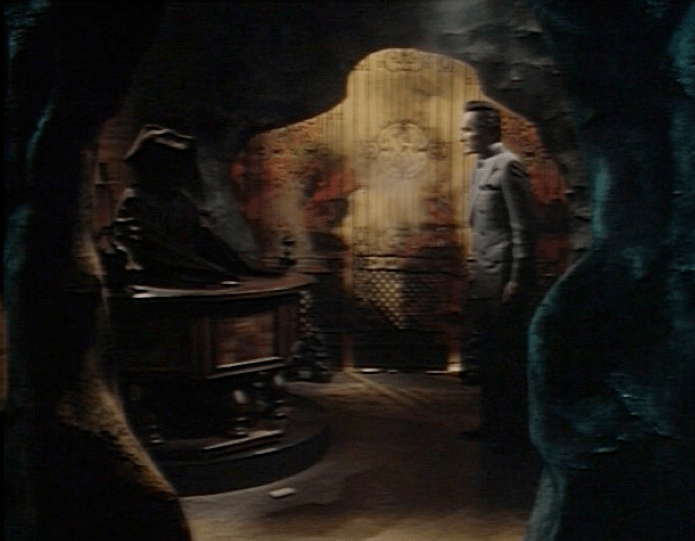
Regular viewers will immediately recognize Hell as a redress of the basement of the Old House on the great estate of Collinwood, home to old world gentleman Barnabas. Strangely enough, this is not the first time it has seemed that Hell is in a corner of Barnabas’ basement. In #325, strange and troubled boy David had a dream in which the ghost of Barnabas’ sister Sarah brought him to the basement. The set was decorated much as we see it today. David met a faceless figure and saw Barnabas, who was at that time a vampire, rise from his coffin. In #512, the ghost of the Rev’d Mr Trask, a witchfinder whom Barnabas murdered in the late eighteenth century, conjured up the spirits of many of Barnabas’ victims, and put him on trial in the basement. Again, we see that it is the abode of the unhappy dead.
Nicholas has to admit to his boss that he has fallen in love with Maggie, The Nicest Girl in Town. Contemptuous of warm human feelings, the boss tells Nicholas that he and Maggie can indeed be together for all time, but only “here”- confirming that the set does represent Hell. Nicholas is horrified, but the boss yields nothing. He will have to sacrifice Maggie in a Black Mass so that she can be damned along with him. He must also get his original project back on track, breeding a race of Frankenstein’s monsters who will be loyal to the spiritual forces of darkness.
Returned to the world of the living, Nicholas goes to the great house of Collinwood, where he tries to persuade mad scientist Julia to help him with the Frankenbabies plan. She can see that he is desperate, and is therefore unimpressed with him. She presses him for more information, and he tells her to read the Book of Genesis. His boss figures in it, as the one who tempted Adam and Eve. Julia gasps at the idea that Nicholas is one of Satan’s direct reports. Nicholas explains what he wants her to do. Julia calls the idea “monstrous,” a description which Nicholas considers apt. She refuses to have any part in such an enterprise, but she capitulates when he threatens her dear friend Barnabas.
Danny Horn’s post about this episode on his great Dark Shadows Every Day is devoted to the packet of View-Master reels featuring images related to episodes made around this time. I’ve always enjoyed View-Master; I think it’s a shame it was slotted as something for young children only. I find it refreshing to spend three or four minutes peering into its little worlds. I left this comment:
Some years ago I bought a bunch of ViewMaster reels. I’d liked them when I was a kid, and I was curious about the non-cartoon ones, the reels depicting landscapes and such. I found that it was a meditative exercise looking into the viewer and teasing out all the 3-D effects.
Anyway, I still have those reels, including the Dark Shadows set. Inspired by this post, I looked at them this morning. There are a bunch of very good shots with high contrast between actors and background. Bud Astredo was particularly good at striking poses that would make him stand out. Grayson Hall is just as good, it’s a shame she’s only in the one picture.
(20 October 2020, 11:12 am Pacific time)
Danny’s post also links to this wonderful piece about the packet on a blog called View-Master 3D.





 Dark Shadows Commentary