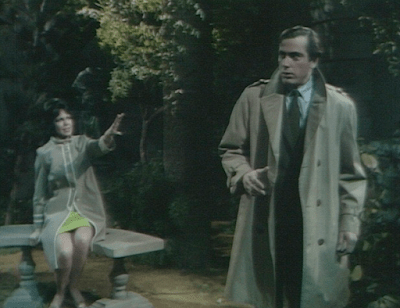
Episode 762: You called the Devil, and you got me

In December 1967, Dark Shadows was a costume drama set in the 1790s. In that month it introduced the Rev’d Mr Trask, a witch-hunter from Salem, Massachusetts, came to central Maine* to drive witchcraft out of the village of Collinsport and off the estate of Collinwood. Trask was bad at this job; wicked witch Angelique easily deceived him into blaming well-meaning governess Victoria Winters for her own crimes, leading to Vicki’s hanging and exacerbating the consequences of Angelique’s evil spells.

Now the show has relocated to the year 1897, and a descendant of Trask is among the villains. He is the Rev’d Mr Gregory Trask, and he runs a boarding school along lines dictated by his own sadistic delight in punishing innocent children.

Fans often say that while the original Trask** was a sincere believer who did harm because of his fanaticism, Gregory is a hypocrite who uses a pretense of religion to enable his perversions and his greed. I think the truth is more complicated, and more interesting, than this. In #441, the original Trask found the strangled body of a professionally agreeable lady named Maude Browning in his bed; it had been placed there to frame him for Maude’s murder. Trask’s principles, were he to follow them, would seem to imply that he should go directly to the authorities. If the worst happened and they hanged him, to the extent that he was targeted because of his Christian witness his death would win for him an everlasting crown of martyrdom. But fear got the better of Trask. He enlisted a man named Nathan Forbes to help him hide Maude’s remains, and went on from there to expand his conspiracy to suborn Nathan’s perjured testimony against Vicki. Considering the emphasis the Reformed movement put on the Ten Commandments, Trask could not have been unaware of the sinfulness of bearing false witness against a neighbor.

I think Trask’s fanaticism led him to overestimate the importance of the success of his mission in this world. It is not enough that he will be vindicated in the courts of God; God must be vindicated through Trask’s success in the courts of Massachusetts. Thus it is his very sincerity that turns Trask into a hypocrite. Eric Hoffer’s book The True Believer was one of the most influential publications of the 1960s; Trask, the fanatic-turned-hypocrite, could easily have found a home in its pages.

Gregory Trask is certainly a hypocrite. Today we hear Gregory’s wife Minerva talk about women he has dallied with over the years. Gregory comes upon Satanists Quentin Collins and Evan Hanley in the act of summoning the Devil; Gregory’s response is to blackmail Evan into using his command of the black arts to cast a spell to brainwash hapless schoolteacher Tim Shaw into murdering Minerva. We have seen in previous episodes that Gregory has plans for spinster Judith Collins and her enormous fortune; Minerva’s death, if it can be arranged just so, will leave him well-positioned to marry Judith and become the Master of Collinwood.
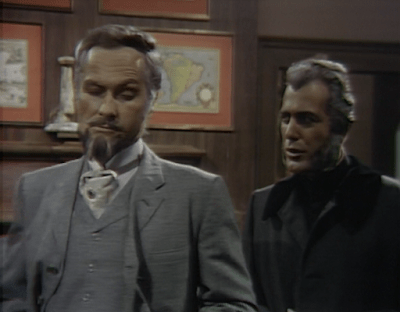
Trask tells Evan the price of his silence. Screenshot by Dark Shadows Before I Die.

As his ancestor’s very sincerity turned him into a hypocrite, so Gregory’s hypocrisy occasionally turns him into a sincere believer in his own powers, if not exactly in God. We saw in #735 that Gregory does not take the same pleasure in reading the Bible that he does in leafing through his “Punishment Book,” a ledger which evidently details his abuse of the children attending his school. But he does read it and quote it, and when in #726 he encountered a case of possession, he immediately and with untroubled self-assurance set to work performing an exorcism. The possession was real, and so far as Gregory could tell his exorcism was successful. He reacted to that apparent success with a serenity that betrayed no suggestion that he had ever doubted that he was the right person to cast out the spiritual forces of darkness.

As the original Trask was a stranger to the routine play-acting that makes ordinary social life bearable and therefore gave himself permission to become a party to the most horrendous deceptions, so Gregory wears his mask so tightly that his face grows to fit it. Dark Shadows was often very self-conscious about showing characters who were acting; its greatest success, vampire Barnabas Collins, won over the audience when they saw him trying desperately hard to play the role of a living man native to the twentieth century. In the Trasks, we see men who do not know that they are acting and therefore cannot manage the effect that the parts they play in everyday life have on their personalities.

Gregory does have a tight mental focus on his projects. When he goes to Evan with his blackmail demands, Evan has learned of his eye for the ladies, and is hoping to use that information to lower his price. So his opening gambit is to describe himself as a man who drifts from one idea to another as other men drift from one woman to another. Three times he says the word “woman,” in each case as the last word of a sentence, in each case about twice as loudly as the words before it. Gregory is unimpressed, and Evan realizes he doesn’t have anything definite to use against Gregory. He crumbles and agrees to Gregory’s extreme demand.

Gregory’s academic standards seem considerably less exacting than are his expectations of his co-conspirators. He mentions to Tim today that when he was a young teacher, the first class he ever taught was in elementary Latin. He challenges Tim to translate the words amo, amas, amat; Tim wearily replies “I love, you love, he loves.” “Very good!” exclaims Gregory. Traditionally the first words students learned on the first day of Latin class were amo, amas, amat, amamus, amatis, amant– I love, you love, s/he loves, we love, you (plural) love, they love. “Very good!” would seem to be an outrageously inflated appraisal to apply to someone who has merely recognized the first three of those six words.

Gregory sends Tim to Evan’s house to read a Latin document that has some bearing on a legal matter that has come up in Evan’s work as an attorney. As it happens, I went to graduate school in ancient Greek and Latin at the University of Texas at Austin, and local attorneys would sometimes call our department asking for someone to help them translate Latin they had found in old Spanish legal documents. They would usually refer those calls to the ablest Latinists among us, since the legal Latin used in the Spanish Empire in the days it ruled Texas was rather a specialized form of the language. Tim can virtually speed-read Evan’s document, suggesting that “amo, amas, amat” was not a particularly stringent test of his abilities.

*Maine was part of Massachusetts until 1821.

**Who is never given a first name. One of the Big Finish audio dramas refers to him as “Vilorus Trask” and actor Jerry Lacy once said he thought his name should have been “Orville.” Neither of those sounds like a very plausible name for a junior-grade Puritan divine of the late eighteenth century. So we are left calling him “the original Trask.” My wife, Mrs Acilius, points out that this seems to suggest that Gregory should be “the extra-crispy Trask.” Maybe he will die by fire, as others have done.

Episode 523: Back to Hell, from whence thee came!

The first episode of Dark Shadows, broadcast on ABC-TV on 27 June 1966, was a moody, atmospheric Gothic drama, characterized above all by its hushed tone. For months afterward, the show was almost an essay on the theme of quietness. Now we come to the second anniversary of that premiere, and quietness is the last thing we hear.

This installment marks the final farewell of the show’s single loudest character, revenant witchfinder the Rev’d Mr Trask. In #519, Trask performed an exorcism on the witch variously known as Angelique Bouchard Collins and Cassandra Blair Collins. The exorcism seemed to be a great success; it ended with Angelique/ Cassandra vanishing into thin air, and she has not been seen since. That might have left someone watching Dark Shadows for the first time with the impression that it is a specifically Christian show and Trask is one of its heroes.

Today, they take steps to correct that impression. A man calling himself Nicholas Blair and claiming to be Angelique/ Cassandra’s brother has turned up on the great estate of Collinwood. In the basement of the Old House on the estate, he finds Trask’s skeleton. He conjures Trask up and interrogates him. Trask declares Nicholas to be a tool of the devil. Regular viewers know that this is something Trask says to all the fellas, but this time he is obviously correct. He goes into the same exorcism rite that produced such spectacular results with Angelique/ Cassandra. Nicholas simply turns around and gives him a sarcastic little round of applause. Nicholas keeps making demands of Trask. Trask takes a cross from under his cloak. Nicholas recoils from that. Trask vanishes, but his skeleton is still missing, suggesting that he has not found peace.

Trask draws his secret weapon. Screenshot by Dark Shadows Before I Die.

That Trask’s exorcism worked on Angelique/ Cassandra but not on Nicholas suggests that it is not a means through which God acts in the world, but is just another magical weapon that can be wielded with greater or lesser effect depending on the skill and strengths those involved. His loyalty to “THE ALMIGHTY!!!” has given Trask enough power to defeat Angelique/ Cassandra, but Nicholas ranks higher than she does in the hierarchy of “THE DE-VILLL!!!,” high enough that Trask’s mumbo-jumbo cannot reach him. The cross has its effect, but with that Trask is setting aside his own efforts and calling directly on the boss. Nicholas is quite certain that he can undo the effects of the exorcism, so for all we know, he might be able to call his own home office for help sufficient to overcome his aversion to the sign of the cross.

The show not only puts Christianity and the spiritual forces of darkness on a par as sources of magical power, they aren’t even the only such sources. Though we don’t hear about any of them today, scientists and doctors Peter Guthrie, Julia Hoffman, Eric Lang, and Timothy Eliot Stokes apparently acquired supernatural abilities along with their advanced degrees. We even know that Guthrie was a professor of psychology at Dartmouth College. So the Dartmouth Department of Psychological and Brian Sciences joins Christianity and diabolism as reservoirs of uncanny might.

In the great house on the estate, heiress Carolyn Collins Stoddard tells Nicholas that Angelique/ Cassandra alienated the Collins family by her dalliance with local attorney Tony Peterson. Nicholas goes to the village of Collinsport and calls on Tony, whom he realizes Angelique/ Cassandra ensorcelled into serving as her cat’s paw. Angelique/ Cassandra put Tony into a trance by having him strike his cigarette lighter; Nicholas achieves the same effect by opening his cigarette case. Tony really needs to stop smoking.

When he first sees Tony, Nicholas is stunned by his resemblance to Trask. They are both played by Jerry Lacy, and Angelique/ Cassandra told him that she chose him because he reminded her of her old acquaintance. We already know that there is a mystical connection between Tony and Trask; Tony was the medium through whom Trask spoke at the séance which led to his return to the world of the living. While he has Tony entranced, Nicholas extracts information from him that only Trask could have known. This suggests a notion of reincarnation that would have reminded viewers of what many of them probably thought Hindus and Buddhists believed, and would thus suggest a syncretistic approach to religion that would represent another step away from the Sunday-morning flavor that the ending of #519 might have left.

We return to the great house. Well-meaning governess Vicki opens the front door and finds her boyfriend, an unpleasant man named Peter who prefers to be called Jeff. With this, a Christian world-view is pushed still further into the background, as a scene featuring Peter/ Jeff is enough to make anyone doubt the existence of a just and loving God.

Vicki and Peter/ Jeff talk about various events that don’t have anything to do with the show. He paws her awkwardly, and his hands dart to her neck as if he were about to strangle her. While he is out of the room for a moment, Trask materializes and tries to warn Vicki that “THE DE-VILLL!!!” is nearby. Before he can tell her that it’s Nicholas she should be worried about, Peter/ Jeff comes back in and starts yelling. At the sight of Peter/ Jeff, Trask wrinkles his nose and fades into nothingness, never to be seen again. Peter/ Jeff probably got a lot of that.

Episode 519: Poor suffering servant of Satan!

Roger Collins is on the telephone in the foyer of the great house of Collinwood. He is assuring the caller that it will be fine if Maggie, whom returning viewers know to be The Nicest Girl in Town, comes to stay. He says that he and Cassandra will be glad to have her for as long as she wants to be with them, and that he is sure Liz will approve. First time viewers thus learn that Roger has a wife named Cassandra, and that they live as guests in a house belonging to someone called Liz. A moment later, Liz enters, and is too distracted to hear anything Roger says to her.

Roger ends the phone call, and follows Liz into the drawing room. She stares out the window and makes a gloomy remark about death. He says he understands she must be very upset about Sam Evans. Returning viewers know that Sam was Maggie’s father, and that he died in yesterday’s episode. Roger goes on about how it is natural to be grieved at the loss of a friend like Sam, but soon learns that Liz’ mood has nothing to do with Sam’s demise- it’s news to her that he is dead.

Roger’s lines will startle longtime viewers. For the first 40 weeks of the show, Roger and Sam were united by a deep and abiding mutual hatred, and since then they have had no contact at all. Roger’s words about Sam as a family friend are so far from what we have previously seen that they should be considered a retcon.

Liz and Roger spend several minutes in the drawing room. She keeps going on about the all-pervasive reality of death, and he keeps urging her to see a doctor. There isn’t much to their lines, but Joan Bennett and Louis Edmonds were such extraordinary screen performers that it’s always fun to watch them together. This scene might be a particular pleasure to longtime viewers, who have rarely seen Roger as the responsible adult in any encounter.

We dissolve to a bedroom where a young woman in a black wig is sifting through some powders, looking directly into the camera, and telling Liz that her obsession with death will become even worse than it already is and will have dire consequences. Liz will believe that she is someone else, a woman who lived and died in another century, and may die by the same poison that killed that person.

There is a knock at the door. It is Roger. The woman hides her powders and lets him in. He addresses her as Cassandra and asks why the door was locked. Thus first-time viewers learn that she is his wife, that this is their room, that she is a witch, and that Liz’ problem is the result of a spell she has cast.

Cassandra tells Roger that she locked the door because David kept pestering her about Sam’s death and she wanted a moment to herself. With that, first-time viewers find out that David is Roger’s son, that Cassandra is his stepmother, and that she expects Roger to consider locking him out of the room an appropriate response to his grief about Sam.

Roger does not so consider it, and is bewildered by what Cassandra tells him. He tells Cassandra that Liz is in a bad way, and he is worried about her. Cassandra says she did not know that Roger was so concerned about his family. Baffled by this, Roger says that of course he is concerned, Liz is his sister. This tells first time viewers both what Roger’s relationship to Liz is, and that Cassandra has so little sense of family that she cannot imagine how other people feel.

Regular viewers will learn more. In the first year of the show, Roger’s keynote was his lack of loyalty to the family. That has now been set aside once and for all, and his normal attachment to his son and his sister provide a contrast with Cassandra’s apparently sociopathic coldness. Further, we saw a great deal of Cassandra from November 1967 through March 1968, when the show was a costume drama set in the 1790s and she was called Angelique. We saw then that Angelique had no conception of family or friendship, and that her idea of love begins and ends with her control over a person.

Cassandra promises to join Roger downstairs for a game of bridge in half an hour. He leaves, and she gets back to work spellcasting. As she does so, a figure in a black cassock materializes behind her. She turns, and the figure vanishes. In a quizzical tone, she says Roger’s name, revealing that she did not see the figure or realize that it is a supernatural presence. Together with her locking the door, scrambling to hide her magical paraphernalia when Roger knocked, lying to cover what she was doing, and failing to understand what a person with a reasonable amount of human empathy would consider acceptable behavior, her puzzlement shows that whatever her powers may be, they have definite limits.

Back in the foyer, another young woman with black hair lets a man into the house. She calls him Joe, and he calls her Vicki. Joe and Vicki talk about Sam’s death and about Maggie. Joe says that he wants to marry Maggie as soon as possible and to move away. Vicki is all for their marriage, but does not want them to go. Joe talks about how close he and Sam were. Longtime viewers will remember that when Sam and Roger were enemies, Sam was the town drunk. Even then, Joe was always happy to help him in whatever way he could, and did not see his condition as any obstacle to marrying Maggie.

Liz enters and angrily addresses Joe as “Lieutenant Forbes.” Joe has never heard of Lieutenant Forbes, and cannot understand why Liz, who knows him well, would not recognize him. Vicki clearly does know who Liz is talking about, and manages to calm her down. After Liz apologizes and hastens away, Vicki answers Joe’s questions only by saying that Forbes is someone from “the past.” Since we heard Cassandra talk about Liz taking on the personality of someone who lived in “another century,” this suggests that Vicki, too, has an unnatural familiarity with that same century.

Joe wants to go upstairs to the room where Maggie is sleeping so that he will be the first person she sees when she wakes up. Vicki is about to lead him to Maggie when Cassandra insists she join her in the drawing room to talk about David. Vicki tells Joe which door to open, and complies with Cassandra’s directions. This shows that Vicki is a member of the household staff whose responsibilities have to do with David. Regular viewers know that she is his governess, and that they are very close.

Cassandra tells Vicki that David has been asking about Sam’s last words. Vicki says that he addressed them to Maggie, not to her, and implies that she did not hear them. When Cassandra continues probing, Vicki protests. She asks if Cassandra can’t see that she is upset. Considering how clueless Cassandra was about human feelings in her conversation with Roger, it is entirely possible that she cannot. Vicki tells her that Liz is deeply depressed; Cassandra feigns ignorance. Vicki says in a cold voice, “You wouldn’t know anything about that,” then leaves.

Longtime viewers know that it was Vicki who came unstuck in time in #365 and took us with her to the 1790s. During her nineteen weeks in the past, Vicki came to know not only Forbes, but Angelique. She knows perfectly well that Angelique and Cassandra are the same person, that she is a witch, and that she is a deadly menace to everyone. She likely suspects that Liz’ depression is the consequence of one of Cassandra’s spells, and the tone of her parting remark would suggest that she does. Further, those who saw the show yesterday know that Vicki is lying about Sam’s last words. They were addressed to her, and she heard them clearly. She is choosing not to repeat them to Cassandra lest Cassandra use them for her nefarious purposes.

Cassandra is alone in the drawing room for only a few seconds. She is joined there by the same figure who had appeared in her room. This time she sees him. He confronts her.

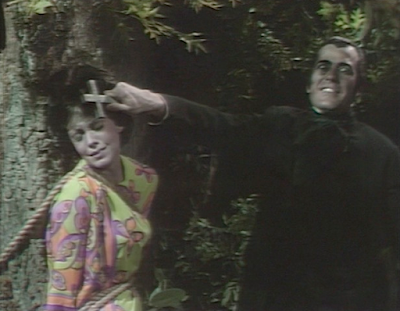
Regular viewers know that the figure is the Rev’d Mr Trask, a fanatical witchfinder who mistook Vicki for the witch in the 1790s and sent her to the gallows. He tells Cassandra that he now has the opportunity to correct that error. He shows her a cross, from which she recoils. We cut to a scene in the woods. Trask has tied Cassandra to a tree and performs an exorcism on her. This is Trask’s go-to technique; he tied Vicki to a tree in #385 and performed an exorcism on her in #386. Since Cassandra actually is in league with the devil (or as Trask would say, THE DE-VILLL!!!,) he has more success this time. Cassandra vanishes and leaves the ropes hanging on the tree.

Trask exorcises Cassandra. Screenshot by Dark Shadows Before I Die.

A first-time viewer might take this climax as an indication that Dark Shadows is a Christian show and Trask is its hero. Not only is Trask going after the right target, he is clearly making some headway. He says all the right things about casting the evil out of Cassandra and saving whatever good is left in her. His delivery of his lines is so fervent that Mrs Acilius, a vigorous Christian, cheered him on. In fact, Trask’s wild incompetence throughout the 1790s segment led to one disaster after another, and was of a piece with the show’s light regard for religion. Not until #450 did a cross provoke a reaction from a monster; that was the first suggestion the show gave that there might be anything to Christianity, and the scenes between Cassandra and Trask today are the second.

Dark Shadows borrows story points freely from all sorts of books, plays, movies, and folklore. So far, it has steered clear of Christianity as a source. For obvious reasons- most of the audience is at least nominally Christian, and Christianity is, in one way or another, a live option for the rest. So it’s a topic that can take over very quickly once it is introduced. I suppose a specifically Christian version of Dark Shadows could have worked, but I can’t imagine that the staff they had would have been particularly interested in making a show like that. So when it looks like they are going to let Trask have even a temporary win, we see the show running one of its boldest risks yet.

Episode 516: Man of God

We open with a reprise of yesterday’s close, with mad scientist Julia Hoffman and servant Willie Loomis in the basement of the Old House on the estate of Collinwood. They hear a sobbing in the air; Julia knows it is the sound of the ghost of gracious lady Josette. Yesterday, the sobbing sounded like Kathryn Leigh Scott, who played Josette in the part of Dark Shadows set in the 1790s; today, it is a recording used in the early months of the series when a mysterious sobbing was heard coming from the basement of the great house on the estate. That sobbing was implied at that time to be Josette also, but in #272 it turned out to be matriarch Elizabeth Collins Stoddard. Using the same recording for Josette, and playing it on a redress of the set used for the basement at the great house, would seem to be a way of admitting to longtime viewers that it was a mistake to resolve the Mystery of the Sobbing Woman that way.

The performer on the old recording is Florence Stanley. Stanley would become nationally famous in the 1970s as Bernice, wife of Sergeant Fish on Barney Miller and later on a spinoff series titled Fish. Fish was played by Abe Vigoda, who will later appear in a couple of episodes of Dark Shadows. I doubt very much Stanley and Vigoda ever talked with each other about their experiences on the show, but it makes me happy that they were both alums.

Abe Vigoda and Florence Stanley as Phil and Bernice Fish.

Julia figures out that recovering vampire Barnabas Collins has been bricked up behind a wall in the basement by the vengeful spirit of eighteenth century witchfinder the Rev’d Mr Trask. She orders Willie to chisel away the bricks and rescue Barnabas. Willie is confused and frightened by what Julia has told him, and resists her command. As he chips away, he is interrupted first by a strange, sudden chill and then by the feeling of a hand on his shoulder. Julia conjured Trask up at a séance held on this spot a few days ago. But she at first refuses to acknowledge that he can be a real obstacle to Willie’s compliance with her commands, so she tells Willie to “shut up!” and get back to work. When Trask becomes visible to them both, Julia has no choice but to address herself to him.

Trask strikes a characteristic pose. Screenshot by Dark Shadows Before I Die.

Julia tells Trask that, as a man of God, he must know that murder is wrong. This changes nothing; evidently Trask’s moral theology has evolved considerably since his physical death. Then she tells him that if he wants to correct a terrible mistake he made in life, he should forget about Barnabas and turn to the witch he hunted then, who now calls herself Cassandra Collins and lives at the great house on the estate. Again, no change. When Julia says that Cassandra is the one who ultimately caused Trask’s own misfortunes and that if he is going to take revenge on someone, it should be her, he disappears and the cold, clammy feeling of a ghostly presence goes with him. Willie gets back to work, and they get Barnabas out of his predicament in the nick of time.

In the great house, Cassandra plays a scene with Elizabeth. Cassandra has caused Elizabeth to be obsessed with death, and now causes her to believe she is one of her own collateral ancestors, Naomi Collins, who died in 1796. Cassandra leads Elizabeth to Naomi’s tomb and shows her the stone wall plates inscribed with the dates of the people buried there.

Cassandra does some more spellcasting to deepen Elizabeth’s misery and confusion. Elizabeth resists and runs out; Cassandra laughs gleefully. Her laughter stops when Trask appears to her, a torch glowing in his hand. He tells her that she is the witch, and that he has come to burn her. He commands “Burn, witch, burn!” and she bursts into flames.

The scene in the basement is great fun, as is Cassandra’s confrontation with Trask. But the parts with Cassandra and Elizabeth drag. This is the second time Elizabeth has moped around hopelessly and thought of nothing but death; the first time was a year ago, in late June and early July 1967. It was deadly dull then, and is no better now. The show simply does not know what to do with Elizabeth, and usually wastes the great talents of Joan Bennett.

There are a couple of famous production faults at the tomb. When they get there, the plate over Naomi’s casket still reads “born, 1761; died, 1821,” as it did before the show settled on the 1790s as the decisive period. When Cassandra causes Elizabeth to see the tomb as incomplete and still awaiting Naomi’s interment, the inscription is covered by a piece of cardboard painted to match the stone and clumsily pasted on it.

Episode 511: It’s not fair to come into someone’s house

In the first months of Dark Shadows, the audience’s point of view was represented by well-meaning governess Vicki, who needed to have explained to her everything we might want to know and who reacted to all the strange goings-on with the mixture of disquiet and curiosity that the makers of the show hope we will feel.

Vicki has long since been replaced as our representative by mad scientist Julia. We no longer want characters to tell us what has been going on, nor are we making up our minds about our moral evaluation of the events in the stories. We find ourselves in the middle of a whole clutch of fast-moving plots, trying to keep up with them all and hoping that nothing will stop the thrills. Julia’s loyalty to her best friend, sometime vampire Barnabas, and her supremely well-developed capacity for lying put her in the same position, and her vestigial conscience is no obstacle to any juicy storyline.

When Vicki was our on-screen counterpart, her charge, strange and troubled boy David, was the show’s most powerful chaos agent. David precipitated a series of crises that seemed likely to expose the secrets of the ancient and esteemed Collins family, to kill one or more of the major characters, or both. In #70, David led Vicki to his favorite playground, the long-vacant Old House on the estate of Collinwood. David would keep sneaking into the Old House even after Barnabas took up residence there in #218.

Today, David again lets himself into the Old House. He is caught there by Julia and a man he has not seen before. Julia is stern with him for entering the house without Barnabas’ permission; he defends his presence there, reminding Julia that she promised him he could play with the tape recorder on Barnabas’ desk. He asks who the man is.

The man introduces himself to David as “Timothy Eliot Stokes.” This is the first time time we have heard his middle name. Soon, the show will phase “Timothy” out, and his friends will address Stokes as “Eliot.” I suppose that’s because he’s a professor, and “Eliot” suggests Harvard.

Stokes introduces himself to David.

In 1966, Thayer David played crazed groundskeeper Matthew. Suspected of murder, Matthew hid out in the Old House and kept Vicki prisoner there until some ghosts scared him to death in #126. David didn’t believe Matthew was a killer and didn’t know he was holding Vicki, so when he stumbled upon him in the Old House he brought him food and cigarettes. Even after he found Vicki bound and gagged behind a hidden panel, he kept Matthew’s secret. When David meets another character played by the same actor on the same set, longtime viewers can see that Stokes is as genteel and urbane as Matthew was rough-hewn and paranoid. For her part, Julia recalls Vicki when she scolds David for sneaking into the Old House, but where Vicki was doing her job as David’s governess and trying to enforce the rules of the household as a governess might, Julia is scrambling to keep David from finding out about her own secret activities.

Julia tells David to take the tape recorder and go home to the great house on the estate. As he makes his way to the front door, Stokes takes Julia aside and tells her that it will not be well if it is known in the great house that David has seen him. Julia hurries to David and tells him to keep quiet about the fact that he has seen Stokes. She says that she hates to ask him to lie; at this, I mimicked Julia and said “I know you share my devotion to the truth,” prompting Mrs Acilius to laugh out loud. Later, Julia will go to the great house, where she lives as a permanent guest, and David will cheerfully assure her that he kept her secret. The two of them seem quite relaxed together, leading us to believe that he will continue to do so.

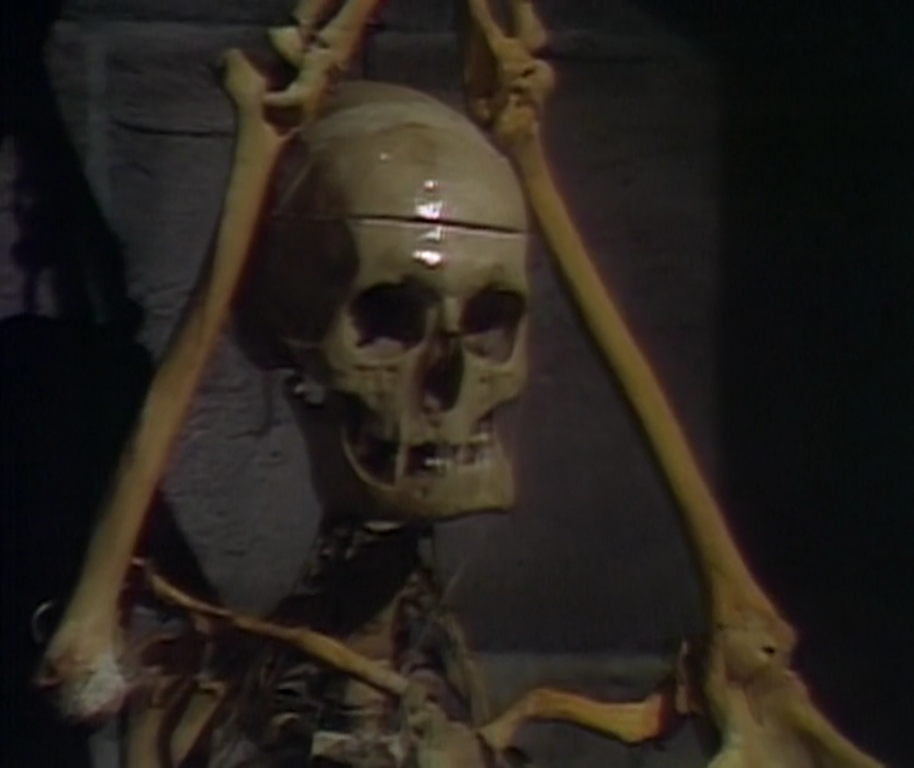
There is a bit of irony in Julia’s harshness with David for entering Barnabas’ house without his permission. She and Stokes didn’t have Barnabas’ permission to be there, either. Indeed, if he had known what they were up to he would likely have objected most strenuously. Along with a man named Tony, they held a séance in the part of the basement where Barnabas kept his coffin when he was under the full effect of the vampire curse. They were trying to contact the Rev’d Mr Trask, a Puritan divine whom Barnabas bricked up to die in the eighteenth century. The séance was so successful that the bricks crumbled, exposing Trask’s bones, still held together somehow in the shape of a skeleton hanging from the ceiling. At the end of the episode, Trask has resumed his corporeal form and set about taking revenge on Barnabas by walling him up in the same spot.

Odd that Trask’s skeleton holds together after all the ligaments and tendons have rotted away, odder that there is a straight cleavage separating the top of the skull from the rest, oddest of all that the section is attached to the rest of the skull by a piece of Scotch tape.

Episode 510: One passion in death

Yesterday, wiggéd witch Angelique/ Cassandra sent her cat’s paw Tony to kill sage Timothy Eliot Stokes. Stokes pulled “the old switcheroo” on him, and Tony drank from the glass into which he had put Angelique/ Cassandra’s poison. Today, we learn that Stokes gave Tony an emetic to save his life. Stokes calls mad scientist Julia Hoffman, MD to examine Tony and assist with the next stage of the battle against Angelique/ Cassandra.

Recovered, Tony has no idea why he obeyed Angelique/ Cassandra’s command to kill Stokes, and is ready to surrender to the police. Stokes tells him he is under the power of a witch, and enlists him in the battle against her.

Stokes takes out the memoirs of his ancestor Ben, who was Angelique’s cat’s paw in the eighteenth century. He does some automatic writing in Ben’s hand and finds that they must contact the spirit of the Rev’d Mr Trask, a witchfinder who inadvertently helped Angelique in those days. Fortunately, Trask, like Tony, was played by Jerry Lacy, so it shouldn’t be too hard to get hold of him. Stokes also finds that Trask was walled up in “the coffin room,” which Julia tells him is for some mysterious reason a nickname given to the space at the foot of the stairs in the basement of the Old House on the estate of Collinwood. Stokes decrees that he, Julia, and Tony must go to this room and hold a séance there.

On his way to the Old House, Tony follows Stokes’ instructions and stops at the main house on the estate and tells Angelique/ Cassandra that Stokes is dead. This follows a scene between Angelique/ Cassandra and her husband, sarcastic dandy Roger, in which Roger complains about her lack of interest in him. Her mind isn’t on the game of chess they are playing, she hasn’t been attentive to him for several nights, and she refuses to go on a honeymoon. Angelique/ Cassandra ensorcelled Roger into marrying her so that she could have a perch at Collinwood, and he seems to be slipping out of the spell’s power.

Stokes, Julia, and Tony gather in the coffin room. They begin the séance. This is the fifth séance we have seen on Dark Shadows, but the first that does not include well-meaning governess Vicki. In four of the previous five, it had been Vicki who went into the trance. On the other occasion, it was strange and troubled boy David who became the vessel through which the dead spoke to the living. The first three times Vicki served as the medium, she channeled the gracious Josette Collins, and when David filled that role he gave voice to David Radcliffe. In those days, Vicki was closely connected to Josette, perhaps a reincarnation of her, as David was another version of the cursed boy David Radcliffe. The final time Vicki spoke for the dead, she spoke for nine year old Sarah Collins, with whom she was no more closely connected than were any of a number of other characters. Sarah has no present-day counterpart, so her appearance at a séance suggested that Dark Shadows was moving away from its use of necromancy as a way of connecting characters from different time periods.

This time, Tony goes into the trance. In #481, Angelique/ Cassandra told Tony that she chose him as her cat’s paw because he resembled Trask, so when he is the medium through whom Trask speaks we are returning to Dark Shadows‘ original conception of how séances work. Trask mistakes Stokes for Ben, as Angelique did in a dream visitation last week. The brick wall behind which Trask’s remains are hidden bulges and is about to crumble when we fade to the credits.

True fans of Dark Shadows know that the episode’s real climax comes during those credits. Thayer David strolls onto the set under Louis Edmonds’ credit for Roger. He even looks into the camera when he realizes what he has done.

Screenshot by Dark Shadows Before I Die.

Episode 481: Every time, it will be the same story

Dr Julia Hoffman is in the front parlor of the house of her fellow mad scientist, Eric Lang. She is on the telephone, asking the operator to connect her with the police. Even though she has lived in the Collinsport area for months now, she is still surprised that the sheriff’s office doesn’t have an emergency number.

Julia locked the door to the parlor; Lang is outside it with a gun, and recovering vampire Barnabas Collins is knocking and calling her name. They want to stop her reporting to the police that Lang is building a Frankenstein’s monster with body parts retrieved from the cemetery, and that he was planning to cut a living man’s head off to use as the last piece of the creature. Lang plans to bring the body to life by draining Barnabas’ “life-force” into it. Barnabas hopes this will free him of the vampire curse once and for all, and is desperate to complete the experiment.

Barnabas shouts that Julia should remember “someone.” When he can’t come up with the name, Lang prompts him with a yell of “Dave Woodard!” Barnabas and Julia killed local physician Dave Woodard in #341; Julia hangs up the phone, realizing that if the operator ever does manage to find a police officer any investigation of Lang would likely expose her as a murderer.

Barnabas has told Lang a great deal about himself. For example, in #467, Lang was the first person Barnabas told that his vampirism was the result of a curse placed on him by wicked witch Angelique. So returning viewers can believe that Barnabas might have confided in Lang about the murder of Dr Woodard. But it would be strange for him to have done so off-screen. And just Friday, Barnabas explained to Lang that the reason he thinks Julia can be trusted with the secret of the experiment is that she has a crush on him.* He hasn’t had much time to share more information with Lang since then, and if Lang had already known that Julia couldn’t call the cops without exposing herself to a murder charge Barnabas wouldn’t have needed to mention her crush on him. The likeliest explanation is that the loud and clear exclamation of “Dave Woodard!” is not Lang prompting Barnabas at all; rather, it was Addison Powell prompting Jonathan Frid. The result is a blooper that seriously confuses the relationships among Lang, Barnabas, and Julia. It’s early enough in the episode that it really is odd they didn’t stop tape and start over.

At any rate, they never mention Woodard again. He was introduced early in the vampire storyline. He was the counterpart to Dr John Seward, the physician in Dracula who realizes that all the patients who are suddenly showing up with puncture wounds on their necks and massive blood loss need care he is not trained to provide, and calls in his old med professor, Dr Van Helsing. Julia was the Van Helsing analogue, but she wound up siding with the vampire and killing her onetime friend. It is appropriate that the last reference to Woodard comes in this, the second episode of Dark Shadows with no cast members introduced before Barnabas. From now on, the daylight world Woodard represented and tried to restore is no longer present even as a memory.

Julia lets Barnabas and Lang into the parlor, and asks Lang to promise that he won’t kill anyone. He gives such a promise. She is unconvinced, but agrees not to call the police. She also tells Lang she will continue to oppose the experiment.

On the terrace of the great house of Collinwood, Barnabas and Julia talk about Lang’s experiment. Angelique, wearing a black wig and calling herself Cassandra, lives in the house as the wife of sarcastic dandy Roger, and the terrace is surrounded by trees, fences, and other prime screens for eavesdroppers. Barnabas and Julia know this well, as each of them has eavesdropped on important conversations here themselves.

Of course Angelique/ Cassandra comes by and hears everything. Barnabas does catch her, grab her, call her by her right name, and vow that she won’t stop him. After he lets her go, he moans to Julia that it was foolish of them to discuss their plans there. That underlines the foolishness of an idea key to the plan, that after Lang’s creature has been animated Angelique will never realize that Barnabas is dwelling within it and place a fresh curse on it. Barnabas assumes that Angelique, who has transcended time itself to pursue him, will just give up and go away once she sees that his original body is dead, and won’t have any questions about the new guy living at his doctor’s house.

Angelique summons her new cat’s paw, lawyer Tony Peterson. Jerry Lacy plays Tony. From #365 to #461, Dark Shadows was a costume drama set in the 1790s. In that phase of the show, Mr Lacy played the Rev’d Mr Trask, a fanatical witchfinder who inadvertently gave Angelique a great deal of assistance in her campaign to destroy the Collins family and those close to them. Most of the characters in the 1790s segment represent a commentary of some kind on the characters the same actors play in the parts of Dark Shadows set in the 1960s. Tony and Trask have seemed to be an exception. In 1967, Tony was introduced through his profession and served mainly as an instance of Mr Lacy’s famous Humphrey Bogart imitation. Trask did end up functioning as a lawyer in a witchcraft trial, and his lunatic shouting about “THE ALMIGHTY!!” and “THE DE-VILLLL!!!!” were occasionally suggestive of what Bogart might have ended up doing if Captain Queeg’s testimony before the court-martial in The Caine Mutiny had gone on for nineteen weeks. Otherwise, there didn’t seem to be any fruitful points of comparison between the two.

Angelique tells Tony that the reason she chose him as her servant was that he reminded her of Trask. She orders him to go to Lang’s and steal a talisman that can guard against witches. At that, Tony shouts “Against you!,” and he sounds very much like Trask. Perhaps we are to think that a secular education and a steady diet of Hollywood movies could have turned the farcically warped Trask into a basically reasonable fellow like Tony, but that there is no strength in those things to stand up to a force like Angelique.

Angelique zaps Tony. Screenshot by Dark Shadows Before I Die.

The talisman was a gift to Lang from Barnabas. Lang refuses to keep it on his person, even though it saved his life to clutch it when Angelique was making his heart beat so fast it was about to burst. Lang shows up at Barnabas’ house, under the false impression he received a telephone call from Barnabas. Barnabas, who has no telephone in his house, explains to Lang that Angelique has lured him away. When he learns that Lang has left the talisman in his desk drawer at home, he insists on accompanying him back there.

It is too late. Tony has already stolen the talisman and delivered it to Angelique. She looks at it and says that Lang will not be able to save either Barnabas or himself. Presumably, not even by reminding him of his lines.

*My wife, Mrs Acilius, pointed this out.

Episode 442: For the love of God, Montresor!

When vampire Barnabas Collins rose from his grave to prey upon the living in April 1967, he was a bleak, frightening presence. As the show went on, we saw him spend a great deal of time ruminating on murders he might like to commit, but he had few opportunities to act on those thoughts. By November, when well-meaning governess Vicki came unstuck in time and wound up in the year 1795, Barnabas had killed only two people, only one of them with premeditation. Both of those victims, seagoing con man Jason McGuire and addled quack Dave Woodard, had long since lost their relevance to the plot, and neither has been mentioned more than a few times since his death. As a result, Barnabas’ talk of killing comes to seem like nothing more than a series of hostile fantasies.

Soon, Dark Shadows will have to return to a contemporary setting. It was the frightening impression Barnabas created in his first weeks that made Dark Shadows a hit, and to keep it going the show will have to make him seem dangerous again. In the fifteen and a half weeks they have been in the 1790s, he has killed at least six people, including his uncle, his aunt, his wife, two streetwalkers, and a woman named Suki. That’s an adequate rate of murders to reestablish Barnabas as a fiend, but volume will only get you so far. They need to give us some shocking images of cruelty, preferably as the result of crimes committed with slender motives, to get him back in place as a truly scary creature.

Today, the show addresses both that need and the need to give a fitting sendoff to a character who has been one of the standouts of the eighteenth century flashback. The Rev’d Mr Trask, visiting witchfinder, was, along with repressed spinster Abigail, one of the two bright lights of the show’s otherwise dreary reworking of Arthur Miller’s The Crucible. Now the witch trial is over, Vicki has been convicted, and she is waiting to be hanged. In #437, Vicki gave a speech which left little doubt that at the moment appointed for her execution she would return to the 1960s and the costume drama period would end. Therefore, Trask can hardly reopen the case without confusing the whole plot. As a personality totally warped by fanaticism, he can’t very well branch out into other kinds of stories without a long buildup, much longer than they are likely to stay in the 1790s. Yet Trask has been so much fun that the audience would feel cheated if he simply went back where he came from.

So Barnabas lures Trask to his basement, ties him to the ceiling, and seals him up behind a brick wall. Unfortunately, this homage to Edgar Allan Poe’s “Cask of Amontillado” does not adapt the most celebrated line of that story and have Trask cry out “For the love of God, Mr Collins!”

Barney’s bricklaying project. Screenshot by Dark Shadows Before I Die.

Closing Miscellany

In a moment of black humor, the closing credits run over an image of the completed brick wall. We might imagine Jerry Lacy still dangling from the ceiling behind the wall. Mr Lacy was often a model of an actor’s devotion to his craft, but I very much doubt that even he took matters that far.

Hey Jerry, you OK in there until tomorrow? Screenshot by Dark Shadows Before I Die.

A recording of Jonathan Frid reading “The Cask of Amontillado” made in the spring of 1992 can be found on YouTube, posted by Frid’s longtime business partner Mary O’Leary.

In #264, high-born ne’er-do-well Roger Collins visited Barnabas at home. When it was time for a drink, Barnabas offered him a glass of amontillado. Poe’s story is so famous and amontillado is such an unusual variety of sherry that it must have been a deliberate reference. Perhaps the idea of Barnabas sealing someone up behind bricks was floating around among the writing staff for months and months.

Several fansites label it a continuity error that Trask reacts to the sight of Barnabas by exclaiming that he is dead. The family has been covering up Barnabas’ death, putting word about that he went to England. Many think Trask should not be among those privy to the Collinses’ secret. But as Danielle Gelehrter points out in a comment on Danny Horn’s Dark Shadows Before I Die, Trask and the gracious Josette discussed Barnabas’ death in #412.

I am writing this post on 19 February 2024. In a bit of synchronicity, yesterday, I saw this post on the site that all normal people still call Twitter:

Episode 441: The subject of vicious gossip

When well-meaning governess Vicki came unstuck in time and found herself in the year 1795, regular viewers of Dark Shadows could expect certain plot points to be resolved before she returned to the 1960s. We would learn how Barnabas Collins became a vampire, and how he wound up trapped in a chained coffin in the secret chamber of the Collins family mausoleum. We would learn how Barnabas’ little sister Sarah died. We would see Barnabas’ lost love, gracious lady Josette, marry his uncle Jeremiah Collins. We would see Josette jump to her death from the precipice atop Widows’ Hill. And we would see Vicki escape from some dangerous situation and find herself back in her own time.

Now, the only items on that list left unresolved are Barnabas’ chaining and Vicki’s return. The show has made it clear to people paying close attention how each of those events will happen, and they could fit them both into one episode. Into any given episode, in fact- they’ve given us all the foundation we need for both stories.

But they aren’t going home to a contemporary setting quite yet. The eighteenth century segment has been a ratings hit, Dan Curtis Productions owns the period costumes, and several fun characters are still alive. So they have decided to restart some storylines they had shut down earlier and to build up some new ones.

The main thing that happens today is the first step towards restarting an apparently concluded story. Fluttery heiress Millicent Collins had shared a series of wonderful comedy scenes with untrustworthy naval officer Nathan Forbes, become engaged to him, and discovered that he was already married to someone else. Since that discovery, Millicent has been grimly determined to exact revenge on Nathan, and the rest of the Collins family has regarded him with icy disdain.

Nathan has made a discovery of his own. He has learned that Barnabas did not go to England, as his family has been telling everyone, but that he is still in Collinsport, and is the serial killer preying on the young women of the town. Last week, he made it clear to the audience he had a plan to turn this information into money, apparently by blackmailing the Collinses. Today, we learn that his plans are more complicated, and involve a renewal of his relationship with Millicent. Late at night, he shows up at the lodgings of a visiting witchfinder, the Rev’d Mr Trask. He asks Trask to take a letter to Millicent.

Trask does not want to let Nathan into his room, since the corpse of a prostitute is sprawled across his bed. She is Maude Browning. Barnabas murdered her in Friday’s episode. As part of his campaign to make life difficult for Trask, he deposited her remains at his place.

Nathan won’t take no for an answer, so Trask throws a blanket over Maude and lets him in. Nathan notices Maude’s arm sticking out from under the blanket and is delighted to think that Trask is not the fanatical ascetic he seems to be. Trask breaks down and starts telling Nathan what happened. He tells him that he was astounded to find Maude’s body on his bed, and he asks him to help get rid of it. Nathan agrees to do so on condition he deliver the letter to Millicent.

The scene is just marvelous. Danny Horn devotes most of his post about this episode on Dark Shadows Every Day to a rave review of it, to which I happily refer you.

We then cut to the great house at Collinwood, where Millicent is studying a layout of Tarot. All the Dark Shadows fansites point out that Millicent misidentifies the Queen of Cups as the High Priestess. This is not the fault it is often made out to be. On Dark Shadows Before I Die, Christine Scoleri reminds us that the Countess DuPrés made the same mistake in #368. Since the countess introduced the Tarot to Collinwood and presumably taught Millicent how to read the cards, it would have been a break in continuity had she called it anything else.

Millicent looks at the cards and addresses the absent Nathan, telling him that she is filled with hatred for him and that he faces certain destruction as punishment for his mistreatment of her. Naomi Collins, mistress of the house, enters and asks Cousin Millicent to whom she is speaking. When she answers that she is talking to Nathan, Naomi tells her Nathan is not there. Millicent replies that he does not need to be present to hear her voice. Since Barnabas was able to magically project his own taunting voice across space into Trask’s hearing in Thursday and Friday’s episodes, this claim of Millicent’s has a curious resonance for returning viewers.

Trask shows up with Nathan’s letter. He wants to meet with Millicent alone in the drawing room to give it to her, but Naomi insists on being present. They stay in the foyer. When Naomi forces Trask to tell them that the letter is from Nathan, Naomi takes it and tears it to pieces. Millicent says that she approves of Naomi’s action, but we can see a flicker in her eye and hear a quiver in her voice that suggest the hatred of Nathan she spoke of a few minutes before may not be quite so undiluted as she would like to believe. Trask leaves the house, Naomi leaves the foyer, and Millicent gathers up the shredded pieces of the letter.

Back in his room, Trask goes to sleep. He has a dream. The dream sequence begins with an image reminiscent of pieces moving in a kaleidoscope.

Trask goes into a dream world. Screenshot by Dark Shadows Before I Die.

That kaleidoscopic pattern was part of a visual effect we saw when Dark Shadows was still set in 1967. That effect introduced scenes that took place in #347, #352, and #354, when mad scientist Julia Hoffman hypnotized Vicki and took her to the Old House at Collinwood. At Collinwood, Barnabas’ helper Carolyn spotted Julia and Vicki, putting Julia in great danger.

The echo of those episodes is startling coming on the heels of the scene we just saw, in which Millicent figures as a student of the countess. Julia and the countess are both played by Grayson Hall, and Millicent and Carolyn are both played by Nancy Barrett. The relationships between their characters are different now, shifted as the colored pieces shift in a turning kaleidoscope. But remembering those earlier episodes, we might remember that what is seen in a semiconscious state might be a message sent to manipulate and deceive, and we certainly remember that people who go to the Old House are in danger from Barnabas.

Trask’s dream brings him face to face with the ghost of Maude, accusing him of having her remains dumped in the sea, so that she cannot rest. She predicts that everyone will learn that her dead body was in his bed. He denies both her accusation and her prediction, but does not convince either her or himself.

The ghost of Maude tells Trask the score. Screenshot by Dark Shadows Before I Die.

Another ghost then appears. It is that of Trask’s great supporter, repressed spinster Abigail Collins. Trask tries to tell Abigail that he is innocent of Maude’s charges, but she tells him she has no idea what he is talking about. She wants to tell him that there is a great evil he must destroy. Trask has a vision telling him the evil is lurking in the Old House. He resolves to go there.

All of the acting is excellent in this one. That’s no more than we would expect from most of the cast members we see today, but Vala Clifton’s two turns as the living Maude were pretty bad, so that it is a pleasant surprise that she is so good as Maude’s ghost. The physical space gives her a hard job. She is standing a very few feet in front of Jerry Lacy with only a couple of wispy stage decorations indicating that she is separated from him, but she strikes a pose and maintains a degree of stillness that really does create the sense that she is speaking to him from another realm. She also manages to keep up an ethereal quality while making it clear that Maude is determined to be avenged. I wonder what her first appearances would have been like if she had had more time to rehearse. If they had been as good as this one, Ms Clifton and Maude would be among the more fondly remembered parts of the eighteenth century segment.

Episode 440: You’re bein’ more stupid now

Vampire Barnabas Collins arises from the dead, goes to the front parlor of his house, and finds a friend of his passed out drunk in an armchair. The friend, much put-upon servant Ben Stokes, had left the house the night before after saying that he would no longer help Barnabas in his murderous schemes. Barnabas brings this up, but apparently Ben has decided he has nowhere else to go, so he’s back.

Barnabas tells Ben that he has two projects going at the moment. He dropped his cane with its instantly recognizable silver handle in the shape of a wolf’s head at the scene of an attempted murder last night; the victim, a streetwalker named Maude Browning, screamed and someone came running. Barnabas orders Ben to find the cane and bring it back before it leads to his exposure.

The other project is Barnabas’ attempt to take revenge on the Rev’d Mr Trask, a visiting witchfinder who has wrought considerable havoc in town. Barnabas recently discovered he had some magical powers, and he has been using those powers to drive Trask insane. He says that he will stay in the house and cast more spells on Trask while Ben goes to Maude’s room over the feed store to look for the cane.

In his room at a local inn, Trask can’t keep a candle lit. He hears Barnabas’ laughter, and declares that it is the voice of the Devil. Or as Trask calls him, THE DE-VILLL!!!! A knock comes at the door. Trask is fearful, but answers when the knocker identifies himself as naval officer Nathan Forbes.

Trask believes hapless time traveler Vicki Winters to be the witch. A court has agreed with him, convicting Vicki of witchcraft and sentencing her to hang. Trask tells Nathan that the witch has started tormenting him. Since Nathan testified against Vicki, Trask warns that she might do the same to him next. When Nathan takes Trask’s warning lightly, he responds with some overheated rhetoric. To this, Nathan remarks that it’s never man-to-man with Trask. When he listens to him, he gets the feeling that sitting in a pew and that the rest of the congregation is absent.

Trask then tries to tell Nathan about the terrible visions he has been suffering. While he does so, he hears Barnabas’ voice and sees his hand. Nathan, of course, can neither see nor hear these manifestations.

Lately Nathan has established himself as a rather cold villain, but he used to be a good-hearted sort, though with some glaring personality defects. We catch another glimpse of the friendly Nathan when he tells Trask the trial must have taken a toll on him. He offers to take Trask out of his room and give him a place to rest. Trask responds indignantly to this offer, and demands Nathan leave him alone.

We cut to Ben searching Maude’s room. When Ben leaves, Nathan catches sight of him. Nathan follows Ben back to Barnabas’ house. Nathan stands at the window and eavesdrops as they talk about Ben’s search of the docks and of Maude’s room, of his failure to find the cane, and of the drunken ramblings with which Maude has been confusing the barroom patrons who want her to tell them about the attack she suffered.

Nathan eavesdrops on Barnabas and Ben. Screenshot by Dark Shadows Before I Die.

When the show was set in 1967, we saw several characters stand at this window and listen as Barnabas held incriminating conversations with his henchmen. Most notably in #274, seagoing con man Jason McGuire eavesdropped as Barnabas handled a box of jewelry and told his sorely bedraggled blood thrall Willie Loomis of his evil plans for Vicki. As Nathan has become more and more a villain, he has become more and more reminiscent of Jason. The night after Jason listened to Barnabas and Willie, Barnabas killed him. Seeing Nathan in this position, regular viewers will wonder if it implies that his death is as near today as Jason’s was then.

Barnabas and Ben leave the house. Ben suggests they leave Collinsport and go someplace where Barnabas will not be recognized. Barnabas will not hear of it. He moans that the house is the place where he and his lost love Josette were supposed to live and be happy. Ben pleads with him to let go of the memory of Josette. Having seen Barnabas in 1967, we know that this plea will fall on deaf ears. Barnabas calls himself “stupid” for leaving the cane at the scene of the crime; the ever-forthright Ben tells him he’s being more stupid now. None of Barnabas’ twentieth century confederates would have dared say a thing like that to him, making Ben’s boldness a refreshing change for regular viewers.

We cut back to Maude’s room. Nathan is bringing Maude home. She is much the worse for drink. He urges her to stay in her room with the door and window locked, then goes.

A bat squeaks at the window, Maude panics, and Barnabas materializes in the room. He asks her about the cane. She tells him she doesn’t have it, and he strangles her. It’s one of the most brutal on-screen murders we have seen so far.

From Maude’s room, we cut to the door to Trask’s. He stands in front of it and we hear him deliver a monologue in a recorded voiceover. This is the first time we have heard an interior monologue from Trask. He shouts so much that it often seems that if you could read his mind you’d see nothing but all-caps disquisitions about THE ALMIGHTY! and THE DE-VILLL! But in fact, he’s telling himself that Nathan must have been right and that all the visions he saw and voices he heard must have been the result of nervous strain brought on by his hard work during Vicki’s trial. He goes into his room, telling himself to calm down. He looks at his bed, and finds Maude’s strangled corpse sprawled there.