Episode 693: Contemptuous and evil spirits

Dark Shadows showed its first exorcism in #400. At that point the show was a costume drama set in the 1790s. The fanatical Rev’d Mr Trask was convinced that time-traveling governess Victoria Winters was a witch and that she was hiding in the Old House on the estate of Collinwood. He stood outside that house with a forked stick. He set the points of the stick on fire and shouted commands for the forces of darkness to come out.

Vicki was indeed hiding in the house, but she was not alone there. The actual witch, the wicked Angelique, set a fire of her own. She built a house of cards and burned it to cast a spell that caused Vicki to see flames in her room and respond by running out into Trask’s clutches. What surrounded Vicki were special effects superimposed on the screen, but what was in Angelique’s room was real fire, and it flared alarmingly close to actress Lara Parker’s lovely face. You’d think they’d have learned from #191, when an on-camera fire went out of control and nearly killed the entire cast, or perhaps from #290, when an off-camera electrical mishap led to fire extinguisher noise almost drowning out some dialogue. But apparently the prevailing philosophy was no injuries, no problem, so they went right on playing with fire.

Today we have another unsuccessful exorcism, and its failure leads them to make another attempt to burn down the set. Occult expert Timothy Eliot Stokes is informed that the evil spirit of the late Quentin Collins is haunting the great house of Collinwood and taking possession of strange and troubled boy David Collins. Stokes follows Trask’s rubric of standing outside the house, pointing a forked stick at it, and shouting inhospitable remarks at the spirits, but he doesn’t set fire to the points of the stick as Trask had done. There is a lot of excitement while he is performing the ritual, and once he finishes all of it dies down. Unsure of the outcome, he arranges to stay the night; while he is getting ready for bed, the curtains in his room catch fire. These are not special effects images; the curtains are really on fire, they are burning rapidly, and they are putting out a lot of smoke. The little building at 442 West 54th Street where Dark Shadows was made was packed with sets made of plywood and crammed with props, many of them highly flammable. Several sets were draped with huge fake cobwebs; I’m not sure what those were made of, but I doubt it was anything that would make a fire marshal very happy. It’s just amazing anyone who worked on the show lived to see 1971.

Hey, what’s the worst that could happen? Screenshot by Dark Shadows Before I Die.

There is a lot of very good stuff in this one. All of the acting is top-notch. David Henesy and Thayer David had scenes together as several characters, first as David Collins and crazed handyman Matthew Morgan in 1966, then as young Daniel Collins and much put upon indentured servant Ben Stokes when the show was a costume drama set in the 1790s, and now in 1969 as Ben’s descendant Professor Stokes and David. Those scenes all crackled, and today when Stokes catches David hiding behind the secret panel in the drawing room, demands he tells him the truth about what is happening to him, tricks him into admitting that he is afraid of Quentin, and warns him of the dangers ahead, the two make the exchange work magnificently.

There is also a scene in the drawing room between David Collins, his cousin Carolyn Collins Stoddard, and permanent houseguest Julia Hoffman while Stokes is performing the exorcism. He has to shout and writhe around a lot during this scene, very difficult things for child actors to do convincingly. But Mr Henesy had been acting professionally for four years before he joined the cast of the show in 1966, at the age of nine, and had studied acting under several distinguished teachers, among them Uta Hagen.

That background pays off; violent as the symptoms of the incipient possession are, Mr Henesy does not overplay them. It helps that he has support from Grayson Hall and Nancy Barrett; Hall plays Julia as firmly in control of herself, but obviously uneasy with the situation, while Miss Barrett shows Carolyn’s anxieties mounting until she shouts that David might be in real trouble. Since he is in convulsions and the crepuscular sound of the creaky old waltz that plays when Quentin is exercising power is emanating from the walls of the house, it would seem obvious that David is in real trouble. The line shows that Carolyn is starting to panic. When we see that neither the determinedly calm Julia nor the increasingly anxious Carolyn is having any particular influence on David’s emotions, we know that they are coming from someplace far removed from his visible surroundings.

Episode 692: The only existing link

There are two ongoing narrative threads in this part of Dark Shadows. One is the story of mysterious drifter Chris Jennings. Mad scientist Julia Hoffman knows Chris to be a werewolf and she is trying to help him. The other is the story of Quentin Collins, a ghost who is gradually gaining power and planning to drive everyone away from the great estate of Collinwood so that he can have the place to himself. Chris’ story had been the fast-paced A plot that kept expanding to involve more and more characters, while Quentin’s was the slow-paced B plot that consistently involved only Chris’ nine year old sister Amy, strange and troubled boy David Collins, and their governess Maggie Evans, with intermittent small parts for other established characters and the occasional chance for a day player to act a death scene. That changed yesterday, when Quentin decided that he had grown so strong he no longer needed to conceal himself from matriarch Elizabeth Collins Stoddard or the other adults in the great house. Quentin’s story is now the main topic, and Chris is the secondary feature.

We open today with Liz telling Julia what happened the night before. Julia tells Liz that she and old world gentleman Barnabas Collins had suspected that an evil ghost was at work in the house, and that they have seen another spirit that seems to be opposed to it. Liz says she has called occult expert Timothy Eliot Stokes. Stokes arrives and questions everyone.

Liz is alone at the desk in the drawing room when a secret panel leading to a passage to the long-deserted west wing opens. A cutout meant to suggest a disembodied hand appears on the screen. It picks up a letter opener from the desk and is about to stab her when Stokes enters.

Stokes shouts. The hand drops the letter opener and vanishes. He tells Liz what he saw. He notices the panel is open, and asks Liz about it. She says that it leads to the west wing, but that, as far as she knows, no one has used it in years. That answers a question that has been on the audience’s minds since October 1966. In that month, we saw Liz’ brother, high-born ne’er-do-well Roger, use the panel to play a dirty trick on well-meaning governess Victoria Winters. The panel was not seen or mentioned again until David and Amy started using it to do Quentin’s bidding several weeks ago. This line is our first confirmation that Liz knows that the panel and the passage behind it exist. Stokes asks Liz’ permission to perform an exorcism.

Meanwhile, Julia gets a telephone call from Chris. Liz’ daughter, heiress Carolyn Collins Stoddard, has taken a fancy to Chris and installed him in a cottage on the estate. Chris tells her that he is facing an emergency. Someone has come to the village of Collinsport who might know his secret.

In the cottage, Chris tells Julia that an unpleasant man named Ned Stuart has brought his sister Sabrina to the village and that he is demanding Chris meet with Sabrina. Chris had assumed Sabrina was dead, because she was in the room with him one night two years before when he underwent the transformation into his lupine form. Ned had told Julia and Barnabas that he was looking for Chris because he wanted to know what happened to his sister; he had always referred to Sabrina in the past tense, leading them to assume she was dead. Now Chris is in a panic, convinced that Sabrina will tell the police about him and that he will be punished for the many, many homicides he has committed as the werewolf.

Julia points out that if Sabrina were going to do that, she could have done so at any time. He would already have been arrested. Sabrina must not have told Ned or anyone else what she saw, and Ned must be telling the truth when he says he does not know what happened the last time Chris and Sabrina were together. She persuades Chris to go to visit the Stuarts in their suite at the Collinsport Inn.

Julia accompanies Chris on the visit. Ned is irritated that Chris did not come alone. His remarks are uncomfortable to hear, chiefly because of actor Roger Davis’ habit of clenching his anal sphincters when he raises his voice, making him sound like he is suffering from agonizing constipation.

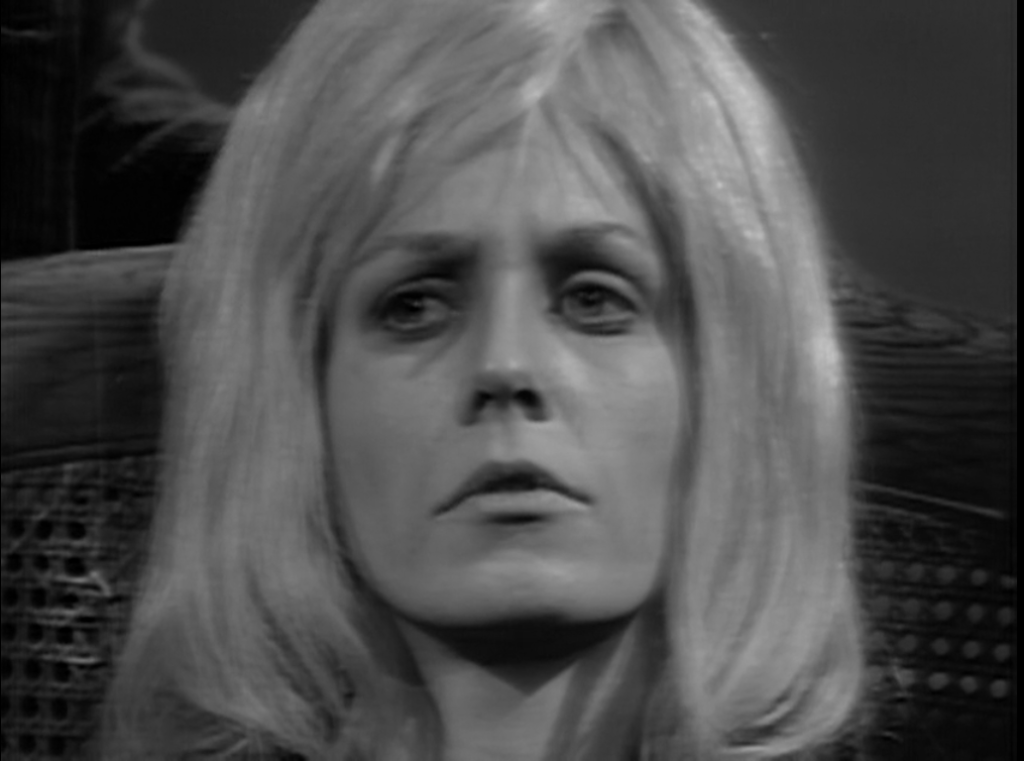
After Ned makes this fingernails-on-a-blackboard noise for a couple of minutes, he lets Chris and Julia into Sabrina’s room. She is in a catatonic state. Her hair is white, and her face is tinged with light blue makeup. The makeup makes her look haggard in color, but most TV sets in the USA in the 1960s received only in black and white. In black and white, the makeup is not very effective.

Ned says that Sabrina was like that when he found her, the morning after she paid her last visit to Chris’ apartment. Several takes of a framed copy of actress Lisa Blake Richards’ professional headshot invite us to imagine the before-and-after. Ned calls Sabrina’s attention to Chris; she rises from her chair, starts towards him, and collapses.

Episode 660: Suppose I am from another century

A couple of weeks ago well-meaning governess Victoria Winters vanished into a rift in the fabric of space and time, traveling back to the 1790s to be with her husband, a loudmouthed idiot known variously as Peter and Jeff. Now evidence is accumulating that when Vicki and Peter/ Jeff were reunited, they were immediately put to death for their many crimes. Old world gentleman Barnabas Collins is determined to follow Vicki into the past and thwart the course of justice.

Barnabas and his best friend, mad scientist Julia Hoffman, call on occult expert Timothy Eliot Stokes. Barnabas pleads with Stokes to work the same mumbo-jumbo for him that enabled Peter/ Jeff to go back to the 1790s. Stokes says that the procedure would have no effect on Barnabas. He explains that it transported Peter/ Jeff only because Peter/ Jeff properly belonged to that period. It would do nothing to a person who was already living in his own time. Barnabas then asks “Suppose I am from another century?” Stokes replies “Then it’s one of the best-kept secrets in Collinsport, isn’t it?” while Julia coughs and looks panic-stricken.

Julia and Stokes react to Barnabas’ invitation to suppose that he is from another century.

In fact, Barnabas is a native of the eighteenth century. He finds himself in the 1960s because he was, for 172 years, a vampire. This is indeed one of the best-kept secrets in town. If any part of it leaks out he and Julia will be spending the 1970s and 1980s in prison, so it is no wonder she tries to shut him down before he can make any indiscreet revelations to Stokes. But it is an exciting moment for longtime viewers. As it stands, Julia is the only character who knows Barnabas’ secret, and therefore the only one who can speak freely with him or interpret new information in the light of what the audience already knows. Stokes is a highly dynamic character; if he joins the inner circle, there is no telling how fast the action might move or in what direction. It is a bit of a letdown that Barnabas decides not to come out to him.

Stokes makes a little speech that puzzles many viewers. He says that he has reached the conclusion that Peter/ Jeff really was two people. The spirit of an eighteenth century man named Peter Bradford must have come to the year 1968 and taken possession of the body of a living man named Jeff Clark. Now that Peter has returned to the past, Jeff must have regained control of his physical being and is out there in the world someplace. This theory does not fit with anything we have seen over the last several months, and it won’t lead to any further story development.

Peter/ Jeff himself suggested the same idea a few weeks ago, but he had so little information about himself that we could discount it. Stokes, though, is one of the mouthpieces through which the show tells us what we are supposed to believe.

Many science fiction and fantasy fans like to take the world-building elements of their favorite franchises as seriously as they possibly can, and treat every apparent contradiction or dead end as a riddle to be solved. That kind of analysis doesn’t get you very far with Dark Shadows, a narrative universe whose structure star Joan Bennett summarized by saying “We ramble around.” It is tempting to go to the opposite extreme, and to assume that they didn’t do any advance planning at all. But we know from an interview that writer Violet Welles gave to the fanzine The World of Dark Shadows in 1991 that they did the same planning exercises that other daytime soaps did. They would make up six month story forecasts called “flimsies” and fill those out with more detailed plans covering periods of 13 weeks. Welles explains the resulting difficulty:

The difficult ones were — we were in 13-week segments, and there were sometimes characters that didn’t work, and because they didn’t work, they didn’t use them as much, they weren’t part of the plot. So at the end of the 13 weeks, toward the end of the cycle, you’d have characters who were really not a lot of interest who had to play scenes with other characters who really didn’t have a lot of interest, dealing with things that basically didn’t concern them. Those were hard to write. But you never felt particularly overwhelmed.

Violet Welles interviewed by Megan Powell-Nivling, The World of Dark Shadows, issue #59/60, June 1991. Preserved by Danny Horn on Dark Shadows Every Day, 30 August 2015.

In other words, while the writers definitely did long-range planning, those long-range plans come into the audience’s view not a source of secret message to decode, but in the residue left over from stories that didn’t work out. During his months on the show, Peter/ Jeff spent a lot of time getting violently angry when people called him “Peter,” responding in his grating whine “My na-a-ame is JEFF! CLARK!” That disagreeable habit made up about 90 percent of Peter/ Jeff’s personality, and the other 10 percent was no picnic either. Coupled with this Goes Nowhere/ Does Nothing story about Peter appropriating the body of Jeff Clark, I would guess that in some early stage of planning they kicked around the possibility of having two Peter/ Jeffs. But it has long since become clear that one Peter/ Jeff is already one too many. That leaves them to fill out some scenes that would otherwise run short with material that may have seemed like a good idea when they made up the flimsies six months ago, but that is pointless now.

Also in this episode, children Amy Jennings and David Collins visit Eagle Hill cemetery and have questions. Amy suggests they go see the caretaker, a suggestion David derides. He declares that the caretaker is as old as the tombstones, and that he won’t answer any of their questions. Amy insists, and they go looking for him.

The caretaker appeared on the show four times when David’s mother, undead fire witch Laura Murdoch Collins, was the chief supernatural menace. He then made five more appearances early in Barnabas’ time as a vampire. As played by veteran stage actor Daniel F. Keyes, he was a delight, a boundlessly befuddled old chap who seemed to have strayed in from the pages of EC Comics. Sadly, David and Amy don’t find the caretaker today.

Eagle Hill cemetery itself was introduced as one of several burial grounds in the Collinsport area. It is the old graveyard north of town, and Barnabas and his immediate family were the only Collinses buried there. The rest of the Collins ancestors were interred in a private family cemetery, and there was also a public cemetery somewhere in or around the village of Collinsport. They stuck with this geography longer than you might have expected. But today Amy explicitly says that Eagle Hill is on the grounds of the estate of Collinwood, just outside the front door of the main house. This contributes to the effect, growing very noticeable lately, that the imaginary space in which the drama takes place is collapsing in on itself. The occasional excursions the show took to the town of Bangor, Maine in its early days are long gone, and now we barely even see the village of Collinsport. It’s often said that Dark Shadows is Star Trek for agoraphobes; it is starting to feel as if it is retreating into a very small cocoon indeed.

Episode 641: Your time is now

In #2, high-born ne’er-do-well Roger Collins saw governess Victoria Winters standing at the edge of a high cliff overlooking the ocean. She didn’t know he was there until he startled her by asking her if she was planning to jump. As the weeks go on, Vicki will learn of other women who have leapt to their deaths from that spot, including a story that over the years two governesses were among them and that legend says a third will someday follow suit. The cliff is the face of Widows’ Hill, named after women whose husbands never returned home from the sea; several times during storms an eerie note sounds in the wind, a note known as “The Widows’ Wail,” which the locals believe to be the ghosts of the Widows announcing that a tragic death will soon take place.

Vicki stands at the edge of the cliff again at the end of this installment while the Widows’ Wail sounds. She is distraught that she has herself become a widow and is dwelling on the idea that she can be reunited with her husband in death.

Though occult expert Timothy Eliot Stokes told her earlier in the episode that “Your time is now!,” Vicki’s time as a lively part of the show in fact ran out in March 1967, with the resolution of the story about her effort to befriend her charge, Roger’s strange and troubled young son David. Actress Alexandra Moltke Isles finally gave up on the character and left Dark Shadows after #627. Her successor in the role, Betsy Durkin, has essentially nothing to work with. We do not share her grief for the husband she is mourning; he was one of Dark Shadows‘ most repellent characters, and it is such a relief that he is away that we sympathize only too much with everyone who tells her to stop bringing him up. Nor do we have any other reason to care about her, since she is relevant to no ongoing plotlines. Even longtime viewers who remember the foreshadowing of Vicki’s possible death by a jump off the cliff will not react strongly to the sight of her there, since Miss Durkin is not Mrs Isles and does not bring her screen iconography to the reprise of the theme.

This phase of the show actually belongs to a character introduced in #632, eleven year old Amy Jennings. When Amy meets Stokes today she announces that she likes him because he is funny; he replies that he is pleased to find that “My appeal extends to all ages now.” Indeed it does; in its first year, Dark Shadows was very much aimed at adults, some of whom remembered Joan Bennett as one of the great movie stars of the 1930s and 1940s and were impressed by her presence in the cast as matriarch Liz, some of whom appreciated it as a specimen of slow-paced, highly atmospheric Gothic romance, and some of whom were fascinated by the story of Vicki and David and its theme of a grownup trying to make a difference in the life of a troubled child. But by the time Stokes arrived in #464, Dark Shadows had become a kids’ show. As Thayer David plays him, Stokes is amusing enough that anyone can like him, but the absolute seriousness with which he regularly expounds the most preposterous mumbo-jumbo is designed to make him a favorite of the very young.

Amy likes Stokes. Screenshot by Dark Shadows Before I Die.

Amy’s friendship with David develops in scenes that kids will find engaging, as they go exploring the big haunted house of Collinwood and find their way into spooky adventures. She also takes the lead in her relationships with adults more consistently than David ever did. While in the first year and a half of the show David often knew things the adults didn’t know, that was usually because he accepted the facts they refused to see. No matter what he said or did, he couldn’t move them from their habits of denial and evasion. But Amy has sources of information that the grownups around her don’t have. So today she has a vision of her brother Chris in some kind of terrible trouble. When she tells Vicki and Liz about her vision, Liz tries to telephone Chris and is deeply disturbed when he doesn’t answer. As my wife, Mrs Acilius, pointed out, it is after one o’clock in the morning, so you wouldn’t expect her to attach great importance to his failure to pick up the phone. That she does suggests that she is taking Amy seriously.

Returning viewers know that Amy’s vision is correct. Chris is a werewolf, and he just killed a barmaid. That Amy not only has a paranormal means of knowing how Chris is doing, but that she is also able to get through to the adults and influence their actions, suggests that she will have a major impact on the werewolf story as long as it continues. Indeed, she already has- the werewolf was about to eat Liz the other day, but backed off when he saw Amy nearby.

Amy is central to the other storyline that is beginning at this point. That is “The Haunting of Collinwood,” in which the ghost of Liz and Roger’s’ great-uncle Quentin Collins is going to be creating difficulties for everyone. Amy and David went into the long-deserted west wing of the house and retrieved an antique telephone from a room there. Though its cord is cut, Amy can sometimes hear Quentin’s voice through its receiver. When she is alone and worried about Chris, she picks the telephone up and asks for Quentin. She is disappointed he does not answer. None of the adults knows about Quentin’s ghost or the telephone. Not even David has heard more than Quentin’s breathing through the receiver. Again, Amy is uniquely positioned to understand and affect the action.

According to the closing credits, this week’s five episodes were directed by “Penberry Jones.” The name “Penberry Jones” is unknown to Google aside from these credits, and it sounds like a joke of some sort. Though the fansites all mention the improbability of Jones’ name and the likelihood that it is a pseudonym, none that I could find offers any clue as to who might have been behind that pseudonym. From the early 1970s until the quarantines of Covid-19 in 2020, Dark Shadows fans would organize festivals a couple of times every year at which panels of people who had been involved in making the show took questions from the audience. If any of those audiences asked who Penberry Jones was, either they did not get an answer or that answer was not recorded.

The name “Penberry” may remind longtime viewers of Dark Shadows of episode #83, which is about Roger burying a pen. Roger was a major villain then, and his part gave actor Louis Edmonds an opportunity to show what he could do. Roger has long since been demoted to occasional comic relief; one might imagine that Edmonds wanted to take a turn in the director’s chair, and that he chose his whimsical pseudonym as a nod to his character’s origins. Appealing as that idea may be, it does not seem at all likely. So many of the panel discussions among cast members abounded in fond stories about Edmonds that surely someone would have mentioned it if he had directed five episodes.

Indeed, most of the longer-lived members of the cast participated in so many of those panels that they all had moments when they had to grope more or less desperately for something fresh to say. If anyone whose name fans would recognize and who worked closely with the cast were “Penberry Jones,” it’s hard to imagine that one or another of them wouldn’t have brought it up in one of those moments.

Whoever it was must have been known to executive producer Dan Curtis and line producer Bob Costello, and probably quite well known to them. The Directors Guild of America does allow its members to change the names under which they are credited, as for example John Walter Sullivan was allowed to direct several episodes of Dark Shadows as “Jack Sullivan” and several more as “Sean Dhu Sullivan.” But it does not allow them simply to use pseudonyms at will. It wasn’t until 1969 that directors working in features could be billed as “Alan Smithee,” and then they had to prove that they did not really have control of the final product before they were allowed to substitute that name for their own. The first television production credited to “Alan Smithee” didn’t appear until 1970. So it is unlikely that “Penberry Jones” directed any screen productions under any other name. Curtis and Costello probably wouldn’t have chosen a first-time director with no imminent prospects of other screen work unless it were someone they already knew and trusted.

If “Penberry Jones” didn’t cover anyone the cast knew well or a director who worked under another name, but was someone who was close to Dan Curtis or Bob Costello, it should be possible to compile a short list of suspects. I’m not so deeply immersed in the behind-the-scenes lore that I can compile that list myself, but maybe you are. If so, I’d like to hear from you in the comments!

The director’s name isn’t the only puzzle in the closing credits. Every previous episode of Dark Shadows ended with the credits playing in front of a stationary shot of one or another set. It was always one shot per closing credits sequence. This time they start with a stationary shot of Vicki’s room, then cut to a stationary shot of the foyer. It’s hard to see what the point of that transition is. Perhaps we could ask “Penberry Jones,” if we had any idea who that was.

Episode 636: The old Adam

Unique among the narrative arcs in Dark Shadows, the story of Frankenstein’s monster Adam has a clear structure. It consists of a prologue and five acts, with an interlude between the second and third acts.

The prologue is about the process of building a patchwork man and animating him. It begins when mad scientist Eric Lang meets vampire Barnabas Collins in #466 and ends in #490, when Barnabas and another mad scientist, Julia Hoffman, bring Adam to life.

The next two weeks make up Act One of Adam’s story. Vampires and mad scientists are both metaphors for extreme selfishness, and so it is unsurprising that Barnabas and Julia turn out to be the worst possible parents. Though he has the body of a grown man, Adam has just begun to live. Barnabas and Julia lock their newborn in the prison cell in the basement of Barnabas’ house and leave him alone there for hours on end, chaining him to the wall. Robert Rodan’s facial expressions convey the heartbreak of this horrific act of child abuse unforgettably. We can’t help but take his suffering seriously. This is the first major difficulty for the storyline. Barnabas and Julia are the core of Dark Shadows, so that if we feel bad about them, we feel bad about the show.

Act Two begins at the end of #500, when Adam escapes from his cell and fights Barnabas. Adam can speak only a few words, has no idea how people interact with each other, and does not know his own strength. As a result, he hurts everyone he meets. He makes one friend during this period, blind artist Sam Evans. In a moment of confusion, Adam hits Sam in #515, causing an injury that leads to Sam’s death. Again, we pity Adam throughout this period, but can see no way he will be able to contribute anything to the story but more death and sorrow.

In #518, occult expert Timothy Eliot Stokes persuaded Adam to come home with him. Adam stays in Stokes’ apartment for some time, learning to talk, to read, and to do various other things. Aside from a few glimpses of these lessons, Adam is off-screen and not involved in the action during this period. That is why I say his time as a guest at Stokes’ place is an interlude, not an Act.

Act Three begins in #539, when Adam has to leave Stokes’ place to avoid the police and heiress Carolyn Collins Stoddard lets him live in the long-deserted west wing of the great house of Collinwood. In this period, Adam falls in love with Carolyn. She is attracted to him, but struggles against her feelings. This situation may sound more likely than either severe child abuse or lethal awkwardness to lead to an engaging story, but it suffers from its setting. Week after week, we see Adam cooped up in his dusty little room, alone with books and a chess set. The Creature in Mary Shelley’s Frankenstein reads The Sorrows of Werther, Plutarch’s Lives, and Paradise Lost; Adam reads the poems of Elizabeth Barrett Browning and the works of Sigmund Freud. He is marginally better off than he was in Barnabas’ basement cell, but he is still a prisoner, and it is still depressing to be confined along with him.

In Act Four, Adam is under the influence of suave warlock Nicholas Blair. In #549 Nicholas talks Adam into trying to rape Carolyn; that attack draws a line under their budding romance. By #551, Nicholas has talked Adam into confronting Barnabas and demanding that he build a woman to be his mate. Adam tells Barnabas that if he does not comply, he will murder everyone who lives in the great house of Collinwood, starting with well-meaning governess Vicki. Longtime viewers remember that Vicki spent the first 38 weeks of the show befriending strange and troubled boy David Collins, healing the psychological wounds David had suffered in his early years with his own unsuitable parents. If anyone could help Adam recover from the abuse he himself suffered from Barnabas and Julia in his first two weeks of life, it would be Vicki. His threat to kill her therefore shows just how little hope there is for Adam.

The project to build Adam’s mate reached its climax in #596, when she came to life and was given the name Eve. This began Act Five, which was all about Eve’s unconcealed hatred for Adam. Nicholas persuaded her to pretend to like him in #624; there is a jump cut in that episode which suggests that they may have had sex. Adam found out that she had been faking her interest in him, and murdered her in #626. Nicholas then persuaded him that if Barnabas and Julia could bring Eve’s body back to life, she would have a sweeter temperament. Adam renewed his demands upon them, and they ran the experiment again in #633/634, but it was a total failure, destroying Eve’s body so that it no further attempt would be possible.

Deranged with fury, Adam went to Vicki’s bedroom in the great house to abduct her. Carolyn found him there; she saw him hit Vicki in the face and flatten her. This not only alienated whatever sympathy Carolyn might have retained for Adam, it also shows how far he has come since the days when he was a danger because he didn’t know his own strength. The blow he delivers to Vicki is the same as the one he dealt to Sam, but while Sam wound up in the hospital and eventually died in part because of it, Vicki is only knocked out. He is still a deadly menace, but now he kills intentionally. This is emphasized when he chokes Carolyn in the same way as he had Eve, but she makes a full recovery a bit later.

Adam took Vicki to the laboratory in Barnabas’ basement where the equipment is still set up and Eve’s charred remains are still on a bed. He hooked Vicki up to the equipment and was trying to use it to torture her to death when Barnabas and Julia made their way to him. He laughs at Barnabas. Since the laboratory is only a few steps from the cell where Adam was kept in his early days, it was clear that this was closing the loop on the child abuse theme of Act One. Barnabas shot Adam in the shoulder, ending the threat to Vicki, and Adam escaped.

Stokes is the last friend Adam has left, and he sneaks into his apartment today. The telephone rings; Adam picks it up but does not say anything. Adam had done the same thing in #521, during the interlude when he was staying with Stokes. In those days, he didn’t know what a telephone was. But now, he is consciously trying to be stealthy. He recognizes the voice on the telephone as that of an intensely unpleasant man known variously as Peter and Jeff, and a moment later he picks up a knife. This is a perfectly understandable reaction to any reminder of Peter/ Jeff.

Stokes comes in, and Adam puts the weapon down. Stokes sees his gunshot wounds, and goes to call a doctor. “Not Julia!,” Adam objects, to which Stokes replies with the assurance that “Dr Hoffman is not my resident physician.” Before Adam can explain how he came to be shot, Stokes announces that “I won’t even ask you what has happened. Curiosity is the most boring obsession.” He telephones a doctor whom he calls “Carl,” and says that he knows he can count on his discretion. That Stokes knows a doctor who will come to his apartment, treat a fugitive from justice for a gunshot wound, and as a matter of course keep the matter between them is a sign that he is someone who will be able to look after Adam quite well.

Stokes gives Adam a new shirt. Adam tells him that he despairs of ever being loved because of the prominent scars on his face. Stokes introduces him to the concept of plastic surgery and tells him that the scars should be easy enough to correct. He is talking to Adam about the prospect of a new life when a knock comes at the door. Adam exits, never to be seen again.

Plaid Adam. Screenshot by Dark Shadows Before I Die.

One of the big surprises for me on this rewatch of Dark Shadows has been how good an actor Robert Rodan really was. The Adam story was such a downer that Mrs Acilius and I hadn’t liked anything about it before, and Rodan was caught up in our overall rejection of it. But he was excellent every step of the way. Whatever is going to happen to Adam after his exchange with Stokes will happen far from Collinsport, which is to say, not on Dark Shadows, so when we wish for more Rodan on the show we are wishing he could have been cast later as another character. I think his height- 6’6″- probably kept that from happening. Two other actors who are almost as tall as Rodan would become major cast members later. One of those, David Selby, will join the cast in just two weeks, much too soon for Rodan to reappear as someone else. The other, Christopher Pennock, won’t show up until #936, by which time Rodan had moved to Los Angeles.

Rodan did some commercials for Cheer detergent when he was in California. Here he is in a Star Trek themed bit where he wears pointed ears. Evidently he was the laundry officer aboard a Vulcan ship.

Episode 605: Ordinary people like us

Recovering vampire Barnabas Collins has determined to let himself into a house occupied by suave warlock Nicholas Blair. He knows that Nicholas is harboring Frankenstein’s monsters named Adam and Eve, that Eve is the reincarnation of a homicidal maniac, and that Nicholas has sinister plans for the pair. Once in the house, he intends to kill Eve.

Most of the episode is taken up with Barnabas’ preparation for this mission. He works with his friends, mad scientist Julia Hoffman and occult expert Timothy Eliot Stokes, to ensure that Nicholas will be out of the house when Barnabas gets there. When he goes into the room where he expects to find Eve, Barnabas discovers that she is not there. Instead, he is greeted by his erstwhile wife, Angelique. Angelique is now a vampire. We end with her baring her fangs at him.

Beneath all the homicidal and fantastic elements is a classic situation of farce. A man sneaks into a house hoping to meet a young woman, only to come face to face with his ex-wife. There are several notes of intentional comedy. Keeping Nicholas distracted, Stokes gives him a long lecture about the history of the Collins family. When he starts in on the details of their shipping interests, Nicholas squirms, jumps up, and thinks of someplace else he ought to be. Stokes and Julia destroy that excuse, and Nicholas sinks sadly back into his chair, bracing himself to hear more.

It dawns on Nicholas he will have to listen to the rest of Stokes’ disquisition. Screenshot by Dark Shadows Before I Die.

When Barnabas first enters Eve’s room, he thinks he sees a figure in her bed, only to find that there are pillows piled up under the covers. Angelique pulled that on him in #403, and Julia did the same thing in #291. Longtime viewers are left wondering when he will fall for the same trick a fourth time.

I do wish writer Gordon Russell had called on his frequent collaborator Violet Welles for help with this one. There are four or five nice laughs, but the tone immediately subsides back to seriousness between them. Welles had a gift for glittering dialogue that could have kept us chuckling throughout.

Episode 596: She can speak

An experimental procedure has killed one woman and brought another to life. Yesterday someone identifying herself as Leona Eltridge turned up out of the blue and volunteered to be the “life force” donor who would help animate a bride for Frankenstein’s monster Adam. Mad scientist Julia and old world gentleman Barnabas capitulated to Adam’s insistence and went through with the procedure. Leona died, but the Bride, whom Adam has taken to calling Eve, is alive.

After a few minutes in a daze, Eve starts talking. This surprises Julia, Barnabas, and Adam. When Adam came to life, he didn’t know any words or anything else. They puzzle over the difference. Even after Eve starts alluding to her previous existence, they do not remember the original plan when Adam was created. Barnabas was Adam’s “life force” donor, and it was expected his body would die and his spirit would awaken in Adam. Evidently this is what has happened with Eve. Her memory comes back in bits and pieces; she is bewildered to find herself in Barnabas’ basement, and is quite anxious for an explanation as to how she got there. Eve faints, and Adam takes her to the upstairs bedroom. Julia examines her there, and concludes that she will be all right.

Meanwhile, occult expert Timothy Eliot Stokes has come to the house. In Friday’s episode, he reacted to the name “Leona Eltridge” by rushing off to do something terribly important. Today, we see that what he had to do was reenact a scene from Rosemary’s Baby. In that film, released 12 June 1968, Rosemary uses Scrabble tiles to figure out that two names are anagrams of each other. In this episode, recorded 30 September 1968, Stokes uses alphabetic refrigerator magnets to figure out that “Leona Eltridge” is an anagram of “Danielle Roget,” the name of an eighteenth century homicidal maniac. Barnabas and Julia don’t get to the movies much, so they don’t realize that this is proof positive that Eve is now the reincarnation of that hyper-violent personage.

Screenshot by Dark Shadows Before I Die.

In the upstairs bedroom, Eve demands a kiss from Adam. He is shy at first, but obliges. After he leaves her alone to go downstairs and confront Barnabas, Julia, and Stokes, spooky music plays, wind blows the bedroom door open and lifts the window treatments, and we hear chimes. Eve is standing in front of a portrait of gracious lady Josette, who like Danielle Roget was a Frenchwoman of the late eighteenth century; when Eve reacts to the ghostly manifestations by saying “I remember you!” we might think that Josette’s ghost, a major presence in the first year of Dark Shadows, has returned to do battle with an old foe. Eve rules this out when she addresses the ghost as “mon petit,” not “ma petite.”

Screenshot by Dark Shadows Before I Die.

As soon as Marie Wallace starts delivering lines, it is obvious she is going to be on the show for a while. She is firmly in command of a larger than life acting style of the sort the directors liked, and she dominates every shot she is in. She also solves another riddle. Thursday and Friday, Erica Fitz played Danielle/Leona. A technical description of Miss Fitz’ approach to that role would be quite similar to one of Miss Wallace’s approach to Eve. Each woman speaks her lines one word at a time, often giving a special inflection to a particular word in the middle of a sentence. Their posture and basic facial expressions are also similar. But while Miss Fitz did a stupefyingly bad job, Miss Wallace holds the audience’s attention easily, and leaves us with the sense that we are seeing a character with a coherent set of motivations. I suspect Miss Fitz must have seen Miss Wallace rehearsing, and made a woeful attempt to mimic her style.

Miss Wallace’s prominence in this episode adds a special piquancy to the reference to Rosemary’s Baby. In a comment on Danny Horn’s Dark Shadows Every Day, “Rob Staeger” points out that “Marie was in Nobody Loves an Albatross — which is actually one of the plays Rosemary’s husband had in his credits in Rosemary’s Baby!” Which is true- Rosemary says that Guy “was in Luther and Nobody Loves an Albatross and a lot of television plays and commercials.” That only two titles are given makes it quite a coincidence that one of the thirteen members of the opening night cast of one of them has her first lines in an episode that references the movie.

(I should mention that Barnard Hughes, a very distinguished actor who appeared in #27, was also in Nobody Loves an Albatross. I don’t know if he and Marie Wallace ever ran into each other and compared notes about their subsequent work on Dark Shadows.)

Episode 575: This rotten collection of death

How Revolting and Disgusting You Really Are

Suave warlock Nicholas Blair has a job for a woman. Talking to his subordinate, vampire Angelique, he says that the job must go to “the most evil woman who ever lived.” At this, Angelique breaks into a smile, then raises her head proudly. Nicholas then says, “Someone like Lucrezia Borgia.” At this, Angelique’s face falls, and she protests that Lucrezia is dead.

Angelique, flattered when she thinks Nicholas is describing her as “The most evil woman who ever lived.”

Nicholas brushes this objection off, saying that “The spirit of evil can be made to live again.” Longtime viewers may have been wondering whether Lucrezia Borgia would make an appearance, since her name has come up more than once. In #152, sarcastic dandy Roger insulted his sister, reclusive matriarch Liz, by comparing her to Lucrezia; in #178, Roger insulted his niece, heiress Carolyn, in the same way; and in #523, Carolyn brought up Lucrezia to insult Angelique, whom she knew when Angelique was calling herself Cassandra and was married to Roger. Perhaps we might have imagined some kind of story where Roger turns out to have some kind of supernatural connection to Lucrezia.

Nicholas continues teasing Angelique, bringing up the Countess Elizabeth Bathory, alleged serial killer and blood drinker of the 16th and 17th centuries. Angelique calls that lady “a vile woman,” in a tone that suggests she knew her personally. From November 1967 through March 1968, Dark Shadows was a costume drama set in the 1790s, and Angelique was its chief villain. She was not a vampire then, but a witch. Her spells were very powerful, but she was quite clumsy in her use of them, suggesting that she was a young woman new to witchcraft. Perhaps this line is meant to open the door to a retcon, one which will make it possible to tell stories about Angelique set in even earlier periods than the 1790s segment.

Nicholas agrees that the countess was “a vile woman,” and repeats that epithet as the first in a list of her qualifications for the job he has in mind- “ambitious, cunning, devious, unprincipled, decadent!” He finally concludes his teasing of Angelique and tells her that he will not hire her for the job. She is disappointed, as one of the benefits of the job is release from vampirism. She leaves the room. In the corridor, she flashes a smile which regular viewers recognize as a sign that she is going to defy Nicholas and try to seize what he would not give her.

The Only Filthy Way It Could Be Done

The job is an unusual one. Nicholas has persuaded Frankenstein’s monster Adam to confront old world gentleman Barnabas Collins and mad scientist Julia Hoffman with a threat. If Julia and Barnabas do not repeat the procedure that created Adam and produce a woman who will be his mate, Adam will kill everyone in and around the great house of Collinwood. Subjected to that extortion, they undertake the project.

The procedure not only involves building a body from parts of corpses and running electrical charges through it, but also requires that the body be somehow connected to a person who will serve as its “life force.” It is energy drained from this person that will animate the body. Barnabas was Adam’s “life force.” Before the procedure, Barnabas was a vampire. Serving as Adam’s “life force” put his vampirism into remission. Nicholas talked about this with Angelique, raising her hopes that he would let her escape from vampirism the same way, only to dash those hopes cruelly.

Julia completed the experiment that brought Adam to life after the death of another mad scientist, Eric Lang. Lang had built the body and the apparatus, and had left detailed notes. Julia had studied those notes for some time before she knew which switches to throw and which dials to turn. Under Adam’s threat, Julia has rebuilt the apparatus in Barnabas’ basement and she has a cadaver there which she is using for parts. Barnabas has ordered his servant Willie to help with the grave robbing. Barnabas has also enlisted the aid of Lang’s former grave robber, an unpleasant man named Peter who prefers to be called Jeff. The equipment needs a lot of tending, and Peter/ Jeff is the lab tech on that detail.

A Nice, New, Clean Slab of Flesh

Peter/ Jeff is by himself in the basement lab when Professor Timothy Eliot Stokes walks in. It’s news to Peter/ Jeff that Stokes is aware of the project, but he tells him that he knows everything about it. Stokes stays so calm as he examines the apparatus and looks at the cadaver that one supposes he must know a great deal.

Stokes asks Peter/ Jeff how the equipment runs when Barnabas’ house has no electricity. Peter/ Jeff says that Julia installed a generator. This must be some unusual kind of generator, since it runs in absolute silence. Later in the episode, Stokes will have a conversation with another character about how Barnabas doesn’t have a telephone.

When Barnabas was a vampire, he didn’t want meter readers or other workers dropping by unannounced and he had no use for modern conveniences. So of course he did not connect his house to the electric grid or to telephone service in those days. As for other utilities, it is a fairly prominent bit of lore that vampires cannot tolerate running water, so of course he wasn’t going to have any plumbing. But he’s been unvamped for almost six months now, so he may as well just update his house. Stokes’ lines today lampshade the problems he creates by refusing to do so.

Another unannounced visitor interrupts Stokes’ conversation with Peter/ Jeff. It is Adam. He is upset to find Stokes in the lab. Stokes once took Adam in and taught him English, and in those days Adam considered Stokes to be his best friend. But Stokes shocked Adam when he broke the news to him that he was an artificially constructed man, and has thoroughly alienated him by trying to talk him out of the violent lifestyle Nicholas has persuaded him to adopt.

Adam goes on a self-pitying rant when Stokes tries to reason with him. Peter/ Jeff interrupts and tells Adam something Stokes left out of his birds and bees talk, that he was built out of parts of dead bodies. Peter/ Jeff taunts Adam about this in a speech that is full of such gems that I suspect it was written, not by the credited author of today’s script, Gordon Russell, but by Russell’s frequent uncredited collaborator Violet Welles. Welles’ name will start to appear in the credits in 711, and fans of the show recognize the sparkle that marks her dialogue.

Peter/ Jeff tries to stab Adam. Adam easily disarms him and holds the knife at his throat. Stokes tells Adam that without Peter/ Jeff the project will be delayed. Adam then flings Peter/ Jeff to the floor. Peter/ Jeff is played by Roger Davis, an actor who had a big television career and was irritating in every part. Mr Davis is so annoying on Dark Shadows that Mrs Acilius and I can’t be the only ones who are disappointed when Adam doesn’t kill his character off the show and who cheer when he throws him to the floor.

Peter/ Jeff gets up and leaves the lab. Adam demands Stokes bring him back to resume working. Knowing how violent Adam is, Stokes follows Peter/ Jeff to the great house of Collinwood. Peter/ Jeff is meeting his fiancée, well-meaning governess Vicki, there, planning to take her out for a date. Stokes tells him that they will be in grave danger from Adam unless he goes back to the lab at once. Peter/ Jeff looks out the window, and sees Adam peering in. Adam actually opens the window and reaches into the drawing room while Vicki and Peter/ Jeff are there; it is hard to understand how Vicki doesn’t notice him. Peter/ Jeff makes an excuse, and goes back to the lab.

We see him back at work. The camera pans up to a mirror. It holds on the mirror for several seconds while we see Angelique’s reflection. Previously, they have stressed that vampires do not cast reflections. There have been several moments when actors have missed their marks or other production faults have occurred that left us seeing a vampire in a mirror, but this is obviously intentional, and it is jarring to regular viewers.

Angelique’s reflection

Angelique and Peter/ Jeff talk for a moment, then she bites him. Evidently she plans to enslave him and use his access to the laboratory to force her way into the role of “life force” for Adam’s mate. So far, almost every victim of a vampire we have seen has been left unable to do the work s/he was doing before being bitten, so regular viewers might suspect that Angelique’s ploy will simply incapacitate Peter/ Jeff from helping with the project. This expectation becomes all the more substantial when we remember the many times Angelique’s schemes have blown up in her face. The less likely it seems to us Angelique will succeed, the less effective this week-ending cliffhanger will be.

Episode 557: Unannounced visitors

Act One consists of recovering vampire Barnabas and mad scientist Julia standing around Barnabas’ front parlor recapping various ongoing storylines.

Danny Horn devotes his post about this episode to a detailed analysis of this scene. He shows that Jonathan Frid’s performance and Grayson Hall’s are open to many objections. They fall short in such technical categories as “knowing their lines” and “standing on their marks” and “having the slightest idea what is going on.” But they are fascinating to watch nonetheless. Danny declares that “[t]he point of these scenes is to see how long two adults can stand around in a room saying preposterous things to each other.” Frid and Hall operate at such a high level of tension that the prospect of either of them breaking character generates enough suspense to keep us on the edge of our seats.

Patrick McCray wrote two separate posts about this episode. In the one that went live 13 September 2017, he too focuses on the performances in Act One. He writes:

Poor Jonathan Frid. He must have had a rough night. I am usually oblivious to his infamous (and completely understandable) line trouble, but in this one, it is so palpable that I totally understand why he retired from TV after DARK SHADOWS left the air. In his early dialogue with Grayson Hall, you can see sheer terror in the eyes of both performers as Barnabas haltingly recalls a trip to the hospital. This is followed by the “Frid Surge,” where Barnabas becomes far more committed and energetic when he turns to face the teleprompter. Of course, this gives him that great sense of vulnerability that was the secret to Barnabas’ success. 

Patrick McCray, “The Dark Shadows Daybook: August 13,” posted on the Collinsport Historical Society, 13 September 2017.

This is the only post on the Collinsport Historical Society tagged “Frid Surge”; that’s too bad, I’d like to see that phenomenon tracked throughout the series. I should also mention that Patrick goes on in this post to express his “confidence that Frid could have acted the doors off the collected ensemble had the poor guy just been given another frickin day to study his sides.”

Barnabas and Julia’s recap scene ends when an unexpected visitor barges in. He is an unpleasant man named Peter, who prefers to be called Jeff. Peter/ Jeff is fiancé to well-meaning governess Vicki, whom Barnabas and Julia know to have been abducted by Frankenstein’s monster Adam. Adam came to Barnabas’ house yesterday and threatened to kill Vicki unless Barnabas and Julia created a mate for him.

Peter/ Jeff was assistant to Eric Lang, the mad scientist who created Adam, and he knows that Barnabas and Julia were connected to the experiment. He does not know for sure that Adam is Lang’s creation, that Barnabas and Julia brought Adam to life after Lang’s death, or that Adam has abducted Vicki. He does, however, have grounds to suspect that each of these things might be true. In this scene, he announces his suspicions to Barnabas and Julia. They huddle in one corner of the room while he shouts his lines in his singularly irritating voice. They deny all three of his points. One of the commenters on Danny’s post, “Straker,” summed up their reaction admirably:

Frid and Hall were too professional to show it but I sensed they were both annoyed when Roger Davis marched in and started yelling. It’s kind of like how you feel when you’re at a party and the host’s five year old son throws a tantrum. Sort of an embarrassed tolerance.

Comment left by “Straker” at 6:21 am Pacific time 31 July 2020 on “Episode 557: A Race of Monsters,” by Danny Horn, Dark Shadows Every Day, 1 January 2015
Roger Davis as Peter/ Jeff, in one of the most subtle moments of his performance. Screenshot by Dark Shadows Before I Die.

After Peter/ Jeff’s scene, it is Barnabas’ turn to be an unwelcome guest. He calls on occult expert Timothy Eliot Stokes. Barnabas and Julia suspect that Stokes may be the evil mastermind who has turned the previously gentle Adam toward evil plans. When Stokes hears Barnabas knocking on his door, he looks up and rasps to himself “Go away… No one is home…” This is one of my favorite lines in the whole series. Stokes was quite cheerful when he first involved himself in the strange goings-on, but as he has found himself drawn deeper and deeper into the unholy world of Collinsport he has come to regret his decisions.

Stokes is quite impatient with Barnabas’ demands that he tell him what he knows and his refusal to reciprocate with information about himself. It is only because Vicki is in danger that Stokes tells Barnabas anything at all.

Stokes already knows how Adam came into being, and Barnabas tells him about Adam’s conversation with him. This brings up a question about the scene with Peter/ Jeff. Why couldn’t Barnabas and Julia have trusted Peter/ Jeff with as much information as Barnabas here gives Stokes? Peter/ Jeff can no more go to the police than Stokes can, he will not tell Vicki anything about Lang’s experiment, and Barnabas and Julia have no reason to suspect him of being behind Adam’s turn to evil. These questions don’t come to mind during the scene with Peter/ Jeff, partly because he is so disagreeable a presence that we want him off screen as soon as possible, and partly because it has long been Barnabas’ habit to tell his enemies everything he knows while he zealously guards his secrets from potential helpers.

Patrick McCray’s second post about this episode, published 30 July 2018, includes an analysis of Thayer David’s portrayal of Stokes:

Professor Eliot Stokes gains fascinating dimension in 557. Normally, jovial and helpful, we see his protectiveness of Adam reveal an irascible and sternly just man within. Anton LaVey extolled “responsibility to the responsible,” and there are few other places where Barnabas gets both barrels of that. Stokes is perhaps the most inherently good man in Collinsport since his fellow freemason, Bill Malloy, took his last diving lesson. (Ironically, at the hands of Thayer David’s first character.) Stokes’ prime reason for siding with Adam and not Barnabas? The former vampire and Julia have withheld vital information for months. Yes, they have necessary trust issues, but this is Stokes we’re talking about. Adam may be a wildly unpredictable man-beast, capable of leveling Collinsport to sand before breakfast, but he’s also (until later in the episode) a prime graduate of Rousseau’s Finishing School for Noble Savages. He’s nursed greedily on the milk of morality that spurts abundantly from the ripe and straining teat of of Eliot Stokes’ moral tutelage. It takes a Nicholas Blair — so often Stokes’ foil — to teach him the less savory lessons in humanity. Stokes knows that there’s only so much danger in which Adam can find himself… Victoria Winters is another matter.

Patrick McCray, “The Dark Shadows Daybook: Episode 557,” published on The Collinsport Historical Society, 30 July 2018

Barnabas passes the baton to Stokes, who becomes the third character in the episode to pay an unwelcome visit. He goes to Adam. He asks the big guy who has taught him to be cruel and amoral, and gets nothing but lies in return. He tries to persuade him that he must not hurt an innocent person, and Adam angrily declares that it is “fair” for him to make Barnabas watch him kill Vicki if Barnabas will not make a mate for him.

In Patrick McCray’s 2017 post, he praises Robert Rodan’s performance as Adam:

Robert Rodan issues a highly cerebral, emotionally packed performance. Rodan never receives the credit he deserves. Much of Adam’s stint on the show finds him equipped with an eloquent, even sesquipedalian command of the language. His inner conflict is as existential as it gets… Where do you turn? Rodan balances this absurd chimera of conflicts with effortless aplomb that makes Cirque du Soleil look as clumsy as a Matt Helm fight scene.

Patrick McCray, “The Dark Shadows Daybook: August 13,” posted on the Collinsport Historical Society, 13 September 2017.

Patrick amplifies that praise in his 2018 post:

Robert Rodan is an unsung hero of an actor, delivering his existential angst with passion and truth. It’s a shame that his identification with an eventually unpopular character was probably a factor in Rodan not being recycled by Dan Curtis, despite being the dark-haired, blue-eyed “type” that typified the ruggedly handsome, DS norm (such as Selby, Lacy, Crothers, George, Ryan, Prentice, Storm, Bain, etc.)

Patrick McCray, “The Dark Shadows Daybook: Episode 557,” published on The Collinsport Historical Society, 30 July 2018

While I always found the sight of Conrad Bain a guarantee of a fine performance, I can’t say it ever occurred to me to class him as “ruggedly handsome” in the way that one might class the other men Patrick lists. There’s no accounting for taste, I suppose.

Episode 550: Much given to melodrama

Professor Timothy Eliot Stokes is just the person to consult if you need to know what kind of amulet will ward off the spells of the nearest wicked witch, but as a committed bachelor and a workaholic, he does not have a very sensitive touch when called upon to give advice in matters of the heart. We saw this in #544. Stokes’ friend Adam had questions for him. Adam is a mysterious man who has no memories prior to ten weeks ago and no conception of human relationships beyond a vague happiness associated with the word “Friend!” and an intense rage associated with the word”Kill!” He wanted Stokes to explain what was wrong with his attempts to kiss his patroness, heiress Carolyn Collins Stoddard. Stokes, usually the most self-assured of men, reacted with a sudden display of insecurity, squirming a bit before admitting that his solitary lifestyle left him at a loss for answers to Adam’s questions.

Yesterday, Adam took the advice of suave warlock Nicholas Blair and assaulted Carolyn. He forcibly kissed her and pushed her to the floor of the room where she is hiding him from the police. We ended the episode unsure how far Adam took his attack. As we open today, we see Carolyn in the main part of her house looking shaken and with her hair mussed, but with her clothes intact. Perhaps she managed to stop Adam before he went beyond what we saw, or perhaps he didn’t try to go further. Not since the references to strange and troubled boy David Collins’ uncertain paternity in #32 and #147 has it been clear that sexual intercourse even exists in the universe of Dark Shadows, and it doesn’t seem that anyone would have told Adam about it. So he may have stopped with kissing because he doesn’t know there is anything more involved in a rape.

Carolyn telephones Stokes and asks him to come to the house at once. By the time he gets there, she is unavailable. Well-meaning governess Vicki greets him, explaining that Carolyn is in the kitchen mediating a dispute between housekeeper Mrs Johnson and Mrs Johnson’s son Harry. Vicki smiles, laughs a little, and describes this dispute sarcastically as a potential tragedy, suggesting a condescending attitude towards the Johnsons that doesn’t really fit with her character as it has been developed up to this point. Stokes flatly tells Vicki that he is not interested in her, and she turns to go. He apologizes, and she comes back. They talk a little about some recent plot points. When Carolyn comes in, she and Stokes dismiss Vicki.

Carolyn tells Stokes what Adam did, and he goes to the big guy’s room in the long deserted west wing of the house. Stokes decides that the time has come for a birds-and-bees talk. This is not the standard version. Adam does not have parents; he is a Frankenstein’s monster. When Stokes tells him what he knows of the circumstances of his creation, Adam is horrified. He tells Stokes they are no longer friends and orders him out of the room. Once he is alone, Adam looks in the mirror, focuses on the scars where he was stitched together, and pronounces himself ugly. He smashes the mirror, picks up a knife, and declares that because no one will ever love him, he must die.

Broken Adam. Screenshot by Dark Shadows Before I Die.

In 2020, Wallace McBride wrote that “On Dark Shadows, your reflection always tells the truth.” But the characters do not always interpret their reflections correctly, so that they sometimes miss the truth. When Dark Shadows began, Vicki was on a quest to find out who her parents were. As Wallace McBride points out, that story was hobbled from its beginning. In episode #1, reclusive matriarch Elizabeth Collins Stoddard opens the doors to Vicki, and the resemblance between Joan Bennett and Alexandra Moltke Isles is so strong that it looks like the two women are reflections of each other. Indeed, Mrs Isles was cast as Vicki largely because she looked so much like Joan Bennett, and Bennett famously mistook Mrs Isles for her daughter when she first saw her. As the show went on Liz came to treat Vicki so much like a daughter that it would have been hard to find a point in a story confirming that she really was, and so the whole question of Vicki’s parentage fizzled out.

As Vicki failed to interpret the reflection that told her the truth about her origins, so Adam misinterprets what his reflection means about someone who came into the world as he did. It’s true he has conspicuous scars and some odd coloring, but you get used to that pretty quickly, and aside from those he is movie star handsome. So “I am ugly!” is a misinterpretation. Stokes told Adam in so many words that at the rate he has been learning he will soon be indistinguishable from people who were born and grew to maturity; regular viewers have seen him acquire so many skills so rapidly that we cannot doubt this is true. His attempt at suicide, like his decision to take Nicholas’ advice and try to rape Carolyn, is the result of his underestimation of his own capacity to develop. That underestimation, in turn, is the result of his failure to fully absorb the information about himself his surroundings are reflecting back to him.

Adam’s plight is thrown into stark relief for us by a scene that took place before Stokes’ visit to him. He looks out the window of his room and sees the terrace, where Vicki is with her boyfriend, an unpleasant man named Peter who prefers to be called Jeff. Peter/ Jeff proposes marriage to Vicki, and she receives the offer warmly. Peter/ Jeff, like Adam, has memories that go back only a few months. As Stokes has told Adam of his unusual origin and elicited a deeply hostile response from him, so Vicki has told Peter/ Jeff that she has reason to believe he has a supernatural origin, and he reacted just as bitterly. Peter/ Jeff is surprised that Vicki would marry someone with his background, but she makes it clear it doesn’t bother her at all. If Peter/ Jeff could find love with Vicki, then there must be a woman somewhere who would love Adam.