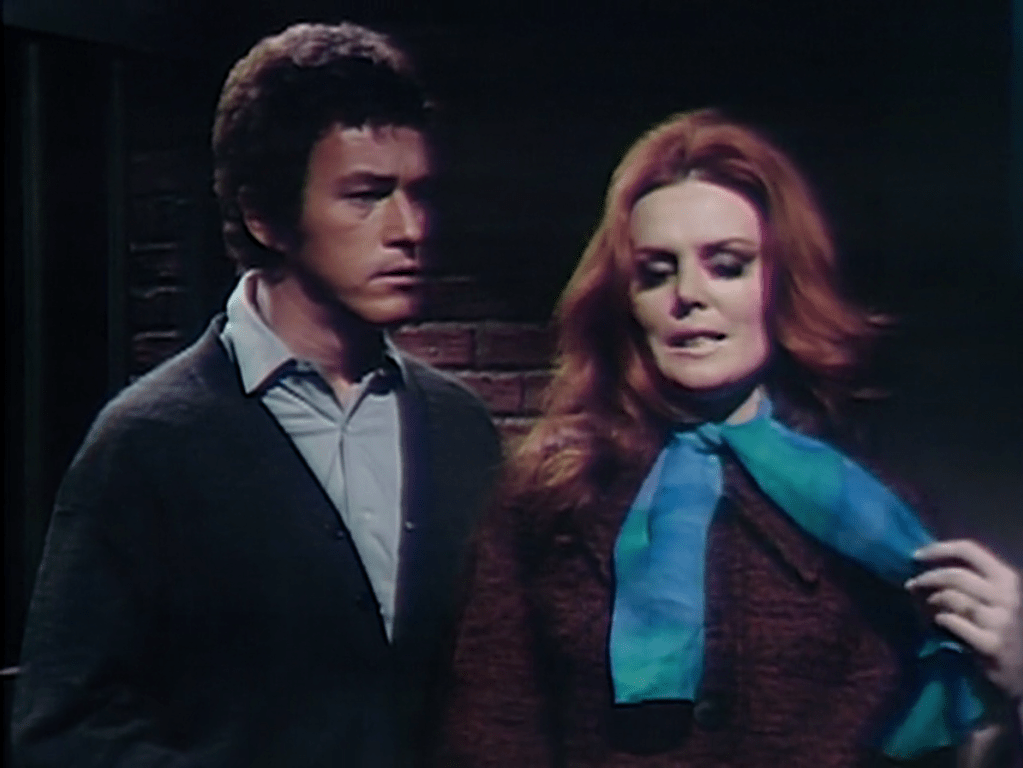
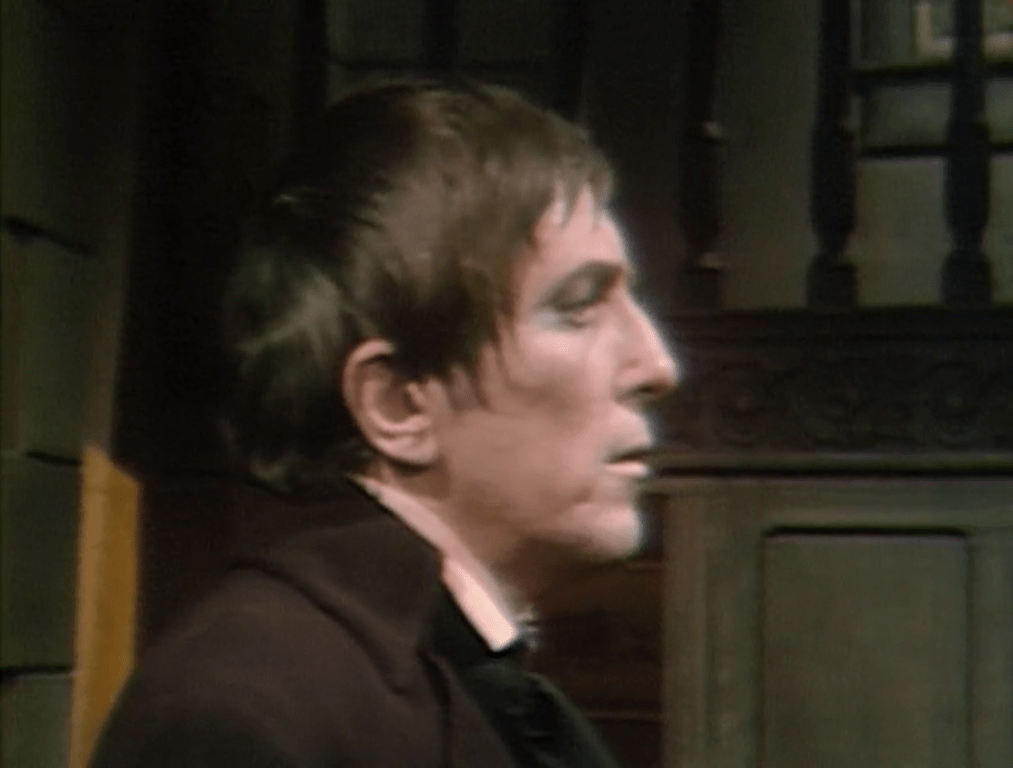
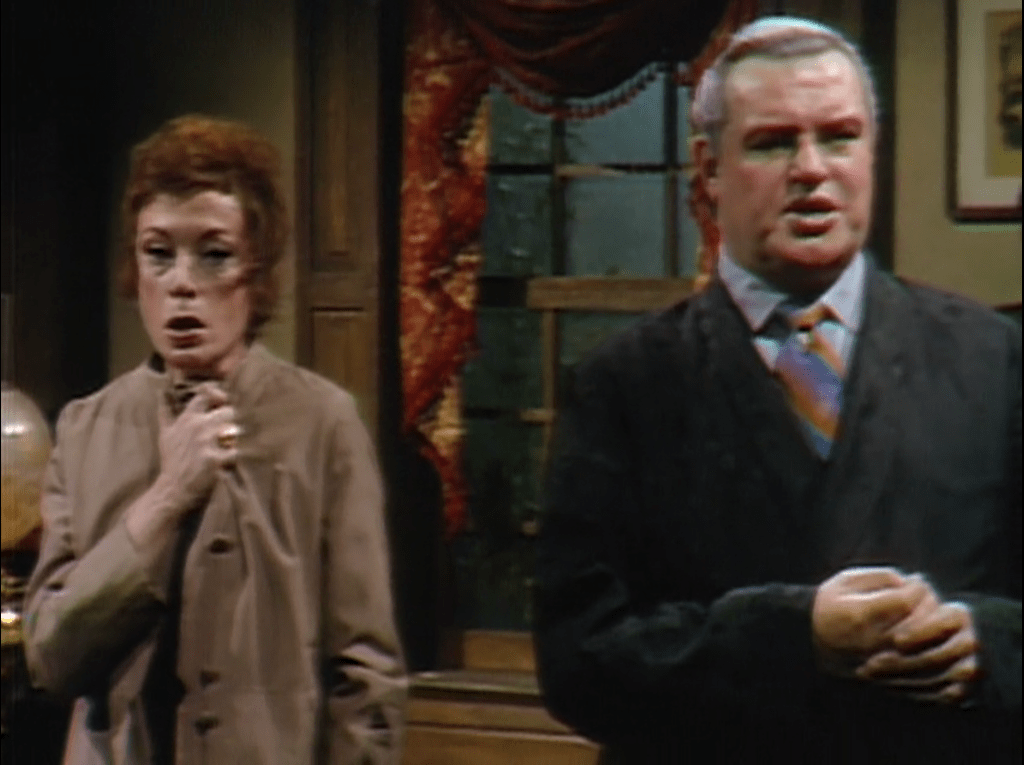
Episode 820: The music and the mirror

Help Me Return to the World of the Living

In Dark Shadows #1, set in 1966, two people came to Collinsport, Maine. They were the well-meaning Vicki Winters and dashing action hero Burke Devlin. Vicki had taken a job as the governess in the great house of Collinwood, hoping that she would find the answers to questions she had about her own mysterious origins. Those questions had left her feeling that she knew nothing about herself.

Burke was a working class boy from Collinsport who had gone to New York City five years before, fresh out of prison and penniless. By 1966 he was a corporate raider, a millionaire many times over. He came back to his hometown because he wanted revenge on high-born ne’er-do-well Roger Collins, who used Burke’s car to kill someone while Burke was passed out drunk in the backseat, then persuaded the court that Burke was solely responsible for the homicide. Burke and Vicki ultimately became a couple, but for some months Burke strung Roger’s niece Carolyn along and used her to cause trouble for the Collinses.

Now the show is set in 1897, and Burke and Vicki are both long gone. Carolyn and Roger are waiting for us when the show returns to contemporary dress, and the actors who play them are in the cast in other roles. But we’ve been reminded of Burke recently. Tim Shaw is a working class boy from Collinsport who, after spending time as a teacher at a miserable boarding school run by the evil Rev’d Gregory Trask, was chosen by Trask to take the fall for the murder of his wife, Minerva Trask. As Burke was physically present but mentally compromised at the killing for which he went to prison, so Tim was present at the killing of Minerva, but not in his right mind. The show is about the supernatural now, so it was a magic spell, not booze, that kept Tim from knowing what was going on when he poisoned Minerva. And the pace is too fast for arrests and trials, so Trask’s plan went wrong and he had to tell the police Tim wasn’t guilty after all. So Tim went straight to New York, and just a few weeks later came back to Collinsport, very rich and out for revenge.

Like Burke, Tim arrives in Collinsport with a woman. Unlike Vicki, Amanda Harris knew Tim before they got on the train. But we learn today that Amanda, like Vicki, is tormented by her ignorance of her own background. Again, the starker palette in which the show draws its stories at this period means that instead of not knowing who her birth parents were, Amanda has no memories at all prior to two years ago.

Amanda first appeared as a hardboiled operator who was attached, not to Tim, but to his money, and who gave him expert assistance in the con game he was running on Trask. As Tim was an elaboration on Don Briscoe’s W. C. Fields’ imitation, Amanda was a nod to Mae West. But the show has decided to make Amanda a long-term addition to the cast, and they already have an all-villain cast. So they soften Amanda’s edges. We see her packing her bags and telling Tim she is going to leave because he doesn’t really care about her and she can’t stand what she is doing with Trask. When she complains that Tim is just using her, she echoes speeches Carolyn made after her bitter realization about Burke’s true intentions. Now that her relationship to Tim mirrors both Vicki and Carolyn’s relationships to Burke, Amanda can inherit the goodwill longtime viewers have towards both of those characters.

To Have Something I Can Believe In

Tim’s sudden wealth came from his possession of a magical object, The Hand of Count Petofi. When Amanda first heard of the Hand, she asked if it was a piece of jewelry or some other kind of artifact. It did not occur to her that it was literally the severed hand of a Hungarian nobleman. This gruesome thing had been cut a century before, in 1797, by nine Rroma men, and had ever since been in the custody of the leader of their tribe.

In #778, broad ethnic stereotype Magda Rákóczi returned to her home in the Old House on the grounds of Collinwood. She had gone to Boston, where King Johnny Romana, possessor of the Hand, was staying with his caravan. She had pleaded with King Johnny to help her remove a curse she had placed that made rakish libertine Quentin Collins and all his male descendants into werewolves. Magda had not known when she placed the curse that Quentin was the father of her sister Jenny’s children. She hoped that King Johnny would take pity on the Rroma children and use the Hand to end the curse. When he did not, she stole it, intending to use its powers herself. Magda soon found that the Hand did no one’s bidding. It helped some people, hurt others, and was stolen by each of a long series of scheming characters.

After Tim brought the Hand back to Collinsport, it was stolen again. This time, the thief turned out to be none other than Count Petofi himself, 150 years old and on the point of death. Once he had the Hand back, it reattached itself to his wrist and he regained his health.

Petofi has some sort of plans for Quentin. He has retained one of his minions, nationally renowned artist Charles Delaware Tate, to paint a portrait of Quentin. That project is finished, but Tate is still living in a cottage he has rented in Collinsport. Today Petofi visits Tate there.

Petofi finds Tate sketching an imaginary woman, one he has been obsessively drawing and painting for about two years. Petofi sets himself up as Tate’s analyst. “Only little boys invent ideal women,” says he. He has a plan to relieve Tate’s childish fixation. It is another project. If Tate had seen A Chorus Line, he might appreciate Petofi’s theory of work as therapy, as explained in the lyric “Give me a job and you instantly get me involved, if you give me a job then the rest of the crap will get solved.” But that show won’t premiere for another 78 years, so Tate resists.

It doesn’t help that the job Petofi has in mind involves another severed hand. The Rroma are on their way, and they want the Hand back. Petofi, whose magical powers were formidable even when he was one-handed, is much mightier now, but the thought of the Rroma agitates him violently. Evidently they know about some weakness of his that enables them to defeat him. King Johnny and his men don’t know that Petofi is in Collinsport. He has cast a spell to silence Magda, but they won’t leave the area without the Hand. Several people know about Petofi and have no reason to protect him. If the Rroma start asking questions, it won’t be long before they close in. So Petofi has exhumed a recently deceased local man, cut off his right hand, and brought it to Tate for detailing.

Tate owes his talents, and his life, to Petofi, so the outcome of their meeting is never really in doubt. His next encounter does involve a surprise. Amanda comes to Petofi’s hiding place, sent by Tim, and asks for his help. Petofi tells Amanda that Tim has a poor strategic sense. Indeed, Petofi has already told Tim that, lovely as Amanda is, he has no use for her at the present time. But when he sees her face to face, Petofi recognizes her as the imaginary woman in Tate’s pictures.

Returning viewers already know that Tate’s portrait of Quentin takes on the features of a wolf when the Moon is full, so it is no surprise that his works, like several other portraits we have seen on Dark Shadows, have magical powers. When we learn that Tate first painted Amanda two years ago and she has no history prior to that time, we figure out that he inadvertently used those powers to conjure her into being.

Tate is played by Roger Davis, an unpleasant man who figured as Vicki’s love interest in her last, woefully ill-conceived storyline. In that arc, made and set in 1968, Mr Davis’ part was variously known as Peter Bradford and Jeff Clark. He had amnesia, and Vicki kept trying to help him recover memories which would prove to him that he has no roots in the 1960s, but that he is an uncanny being who was brought to life by an adventure she had outside the bounds of space and time. Once we recognize what they are suggesting about Amanda’s origin, longtime viewers might expect an inversion of that story, with Mr Davis playing the person trying to persuade his lover that he accidentally created her by a magical process he himself did not understand.

Somebody to Dance For

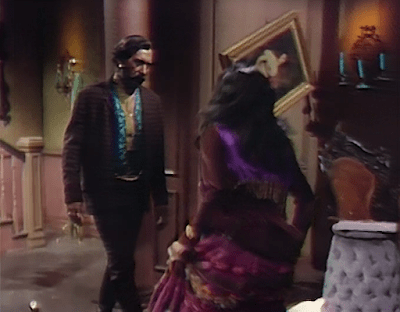
While all of this action is taking place downstream of Count Petofi, the person who set in motion the events that first brought Petofi to town is in big trouble. Magda comes home to find King Johnny himself waiting for her. He menaces her, calls her names, and twice hits her in the face very hard.

King Johnny closes in on Magda. Screenshot by Dark Shadows Before I Die.

Ever since Violet Welles joined the writing staff, men have been slapping women quite a bit on Dark Shadows. Welles was by far the best writer of dialogue on the show, but I for one could do without the slapping. Fortunately King Johnny is played by Paul Michael, a well-trained actor; no matter how brutally King Johnny abuses Magda, Grayson Hall is in no danger. One could never say the same of Mr Davis’ screen partners.

King Johnny tells Magda that he will take her back to his caravan in Boston to stand trial for the death of Julianka, a Rroma maiden whom he sent to kill her some weeks ago. Since Magda cannot say Petofi’s name, she cannot tell King Johnny that it was he who killed Julianka. Magda is terrified of the trial, and King Johnny tells her that there is a way she can avoid it. If she does not give him the Hand, he will slit her throat immediately.

King Johnny searches the house, and does not find the Hand. He is about to carry out his promise to kill Magda when he sees the wooden box in which the Hand was long kept lying on the floor. He opens it. What he sees inside resembles the Hand closely enough to convince him, and keep Magda alive for another day. Clever as she has been so far, we may wonder how many days are left for her. There doesn’t seem to be anyone around to throw Magda a rope to grab onto.

Episode 808: The mysterious shadow he can cast

Sorceror Count Petofi has taken possession of twelve year old Jamison Collins. He has also cast a spell on broad ethnic stereotype Magda Rákóczi, compelling her to lead him and his henchman Aristide to the hiding place of vampire Barnabas Collins.

Magda, Jamison/ Petofi, and Aristide. Screenshot by Dark Shadows Before I Die.

Jamison/ Petofi and Aristide are ready to drive a stake through Barnabas’ heart. They open his coffin and find that he is away from home today. Magda does not know where his other hiding place is. Jamison/ Petofi becomes intrigued with Barnabas and decides to search through Magda’s home, the Old House on the estate of Collinwood, for papers that might give him information about Barnabas.

He and Aristide find a book published in 1965. Since the dramatic date is currently 1897, this seems to be a matter of some interest. Jamison/ Petofi calls for Magda, who tells him that Barnabas told her that the book had been brought back in time from the 1960s by “a girl named Vicki.” Barnabas’ utterance of the name “Vicki” in #797 was the first reference to well-meaning governess Victoria Winters in the 1897 segment, and this is the second. Vicki was the main character of the show for its first year, and remained in the cast for over a year after that. That the name “Vicki” would be heard only in rare and trivial echoes is not something longtime viewers would likely have predicted before she was written out of the show last year.

Magda goes on to explain that Barnabas himself traveled back in time from 1969. She has a vague idea that he was trying to save a dying child, and hasn’t the faintest clue how he made this remarkable journey. Jamison/ Petofi says that they will get the rest of the story from Barnabas himself. He also says that if he can travel in time, he will be able to live forever, a proposition which would seem to require further explanation.

Jamison/ Petofi is satisfied Magda is telling them everything she knows, but Aristide keeps making threats. The most intriguing refers to something Petofi might do to her: “You’ve heard of his powers. Hasn’t anyone in your tribe ever told you about the mysterious shadow he can cast? The shadow that isn’t your own that follows you?” Writer Sam Hall was probably familiar with a novel called Phantastes by George MacDonald, a bestseller of the nineteenth century that was influential among English fantasy writers of the first half of the twentieth century. It tells of a character named Anodos, who is tormented by a malicious shadow that moves by itself and won’t leave him alone. So perhaps Hall is planning to mine MacDonald’s works for an upcoming story.

Meanwhile, in the great house on the estate, Charity Trask has a dream. She sees Jamison/ Petofi with a portrait of rakish libertine Quentin Collins. The portrait is identical to the one she saw turn into a picture of a werewolf the night before, and she asks Jamison/ Petofi if he saw the same thing. He laughs, then tells her Quentin is a lost soul.

Quentin shows up. Charity’s father, the evil Gregory Trask, has directed her to marry Quentin, and she has set out to comply with this command. Quentin has never shown the slightest interest in her in their time awake together, and he isn’t much friendlier in this dream. He asks her to do something to lighten his mood. “Can’t you be happy? Can’t you be gay?  Don’t you want to make me happy?” We’ve never seen her happy; as Gregory’s daughter, it’s hard to see how she could be. She has probably never tried to be gay, either, but it would have to be better than marrying Quentin. She does try to make him happy by imitating Cockney showgirl Pansy Faye, whom she never met or saw or heard, but whose spirit has been possessing her off and on for several days now. She sings Pansy’s theme song and does the highly suggestive dance that goes with it, only to find that Quentin has vanished.

Charity turns and finds Quentin embracing and kissing another girl. They are laughing. Quentin tells Charity that, as she can see, she has succeeded in cheering him up, and therefore she should run along. He and the girl then disappear and Magda enters. Magda tells Charity that she should forget Quentin, because he has a terrible secret. She leaves, and Quentin and the other woman reappear, still laughing at Charity.

Charity decides to ask Magda to explain the dream. Before she reaches the Old House, she finds Quentin and the girl from the dream lying on the ground in the woods. Quentin’s clothing is torn and he is unconscious, but he does not appear to be injured. The girl’s face is covered with what in black and white look like slash marks, but in color are obviously purple makeup. She opens her eyes and gasps Quentin’s name. Whether she was calling for Quentin because he was with her when they were attacked or crying out because he is the one who attacked her would not be clear to first time viewers, though returning viewers know that Quentin is a werewolf and will assume he was the attacker.

Episode 807: An award-winning performance, wouldn’t you say?

From #1 to #274, each episode of Dark Shadows began with a voiceover narration by Alexandra Moltke Isles, usually in character as well-meaning governess Vicki. This identified Vicki with our point of view and suggested that she would sooner or later learn everything we knew.

Jonathan Frid joined the cast as vampire Barnabas Collins in #211, and quickly became the show’s great breakout star. If the upright Vicki found out what we knew about Barnabas, one of them would have to be destroyed. Vicki was the favorite of longtime viewers and Barnabas was attracting new ones, so that was out of the question. Therefore, other members of the cast started taking turns reading the voiceovers, and doing so not as their characters, but in the role of External Narrator.

Today marks the first time Frid himself reads the narration. His training first in Canada, then at Britain’s Royal Academy of Dramatic Arts, and later at Yale School of Drama prepared Frid well in the art of dramatic reading, and in later years he would concentrate on that aspect of his craft. Several of his colleagues are his equals in these voiceovers- I would particularly mention Kathryn Leigh Scott, whose conception of The Narrator is always arresting, and Thayer David, who could consistently achieve the most difficult of all effects in voice acting, a perfectly simple reading. So I can’t say I wish Frid had done all of them, but he is always good, and today’s performance is among his most gorgeous.

The action opens on a set known to longtime viewers as the Evans cottage, where from 1966 to 1968 artist Sam Evans and his daughter Maggie served as Dark Shadows‘ principal representatives of the working class of the village of Collinsport. In those days, it was on this set that we saw how the misdeeds of the ancient and esteemed Collins family had consequences that spilled out of the estate of Collinwood and warped the lives of people trying to make a more or less honest living nearby.

Now the dramatic date is 1897, and Sam hasn’t been born yet. But the cottage is already an artist’s studio. It is temporarily occupied by the nationally famous Charles Delaware Tate, who is painting a portrait of rakish libertine Quentin Collins at the behest of evil sorcerer Count Petofi. Charity Trask, a resident of the great house of Collinwood, is visiting Tate in the cottage when she sees the face in the portrait change from that of Quentin. It takes on a great deal of fur and long fangs, and reminds Charity of a wolf.

By the time Tate looks at the painting again, it has resumed its normal appearance. He tells Charity that the transformation must have been in her imagination. She is willing to consider the possibility, but we know better. Quentin is a werewolf, a condition Petofi knows how to cure. Portraits on Dark Shadows have had supernatural qualities at least since #70, including portraits we saw Sam execute on this set in 1966, 1967, and 1968, and the show has borrowed from The Picture of Dorian Gray before. Moreover, Tate’s reaction to Charity is one of barely controlled panic. Nancy Barrett has to ramp up Charity’s own emotional distress to the limit to make it plausible she would not notice Tate’s extreme agitation. Perhaps if Tate were played by a better actor than the ever-disappointing Roger Davis, his response might have been ambiguous enough that Miss Barrett could keep the tone a bit lower, but his unequivocal display of alarm leaves her nowhere to go but over the top.

Mr Davis was under no obligation to play the scene transparently, since Tate later goes to Petofi’s henchman Aristide and lays out in so many words his precise relationship to Petofi’s operations and his knowledge of them. Tate’s career is his reward for selling his soul to Petofi, and he has already experienced great sorrow as a result of that bargain. Tate knows that the portrait changed to reflect the full Moon’s influence on Quentin and that Petofi is currently in possession of twelve year old Jamison Collins. Aristide tells us that Petofi’s own body is in suspended animation while he acts through Jamison. He also says that it was in 1797 that Petofi’s right hand was cut off, and that if he does not reclaim the hand in a few weeks, by the date of the one hundredth anniversary of the amputation, he will die and so will Tate.

Jamison/ Petofi is in the prison cell in the basement of the Old House on the estate of Collinwood. Barnabas has traveled back in time from the 1960s with some vaguely good intentions and is hanging around 1897 causing one disaster after another. Now, he is doing battle with Petofi and has locked him, in the form of Jamison, in the cell. Barnabas’ reluctant sidekick, broad ethnic stereotype Magda Rákóczi, guards Jamison/ Petofi during the day. Early in the episode, Jamison/ Petofi calls Magda and pleads with her to release him. He tells her that he is “just a little boy” and that she is a “rather heartless creature.” She says she wishes he were a little boy again, but that she isn’t stupid and he won’t fool her. Indeed, the phrase “rather heartless creature” and Jamison/ Petofi’s manner in delivering it sound so much like Thayer David as Petofi that they hardly count as an attempt to deceive Magda.

Later, Jamison/ Petofi casts a spell to summon Aristide, then calls to Magda again. When Magda arrives, Jamison/ Petofi gives himself a better script than the one from which he had acted in his previous scene with her. He pretends not to remember how he got into the cell and to be shocked that Magda knows he is there. Perhaps the utter transparency of his earlier pleadings was an attempt to get Magda to underestimate his abilities as a trickster.

In #803, we saw that when Petofi took possession of him Jamison’s right hand disappeared from his wrist, matching Petofi’s own mutilated condition. When Jamison/ Petofi feigns the amnesia that might come upon recovery from possession, we might therefore expect Magda to demand that he remove his gloves to prove that he is himself again. But he plays the part of Jamison so convincingly that we are not really surprised he does fool Magda. She goes into the cell, embraces Jamison/ Petofi, and he kisses her on the cheek. It is this kiss that spreads his magical power, and she realizes too late that she has been had.

Aristide arrives a moment later, and Jamison/ Petofi calls his portrayal of an innocent boy “an award-winning performance.” Indeed, if there had been daytime Emmys in 1969, David Henesy might have won one for his portrayal of Thayer David playing Petofi playing Jamison.

Aristide wants to kill Magda; Jamison/ Petofi forbids this. Under his power, she announces that she is responsible for all the evil that has happened in 1897. She was responsible for releasing Barnabas and therefore for all the murders and other harm he has done; she made Quentin a werewolf, and is to blame for his killings in his lupine form and for the curse his descendants will inherit; she stole Petofi’s severed hand and is at fault for the deaths of Rroma maiden Julianka and of her own husband Sandor that resulted from the hand’s presence. She even takes the blame for Quentin’s murder of her sister Jenny, the act for which the werewolf curse was meant as vengeance. Magda says she must be punished. Jamison/ Petofi tells her that he is not interested in punishing her. He has another use in mind for Magda She will lead him and Aristide to Barnabas’ coffin today, and they will destroy him.

Longtime viewers will perk up twice when Aristide says that Petofi lost his hand in 1797 and that he has exactly one hundred years to recover it. From December 1966 to March 1967, Dark Shadows’ first supernatural menace was undead blonde fire witch Laura Murdoch Collins, who at intervals of exactly one hundred years incinerated herself and a young son of hers, who was always named David, in an unholy ceremony that renewed her existence, but not that of the Davids. Since the usual laws of nature don’t apply, the show needs some other causal mechanism to create suspense, and anniversaries will do as well as anything else. Another iteration of Laura was on earlier in the 1897 segment. It was fun to see her again, but they could shoehorn her into that year only by retconning away the one hundred year pattern in her immolations. It’s reassuring in a way to see that Petofi is bringing centenaries back.

The date 1797 is also significant. It was in 1796 that Barnabas died and became a vampire. We flashed back to that period for the show’s first costume drama segment in November 1967 to March 1968, and Barnabas went back to 1796 for a week in January 1969. So we may go back again some day, and if Petofi was alive and in his prime in 1797, we might run into him there.

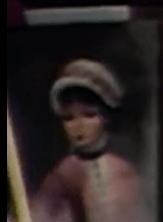
Barnabas and Petofi are not the only characters from the 1790s who might be on the minds of attentive longtime viewers. Barnabas’ little sister Sarah died in 1796, and as a ghost was an extremely important part of the show from June to November 1967. We’ve been getting reminders of Sarah for the last several days. In #792 wicked witch Angelique produced a toy soldier of Barnabas’ that Sarah gave to strange and troubled boy David in #331. In #805, Charity found Sarah’s recorder, a prop that often served as Sarah’s calling card in 1967, and talked about learning to play it. And today, we see a portrait standing on the floor of the Evans cottage, a set which Sarah visited in #260, depicting a girl wearing a bonnet very much like the one Sarah wore as a ghost in 1967 and a pink dress just like the one she wore when we saw her as a living being in the flashback to the 1790s.

Portrait at the cottage.

I wonder if, when they were making up the flimsies for this part of the show, they had thought of reintroducing Sarah. That would have required a recasting of the part- Sharon Smyth was noticeably older when we saw Sarah die in January 1968 than she was when Sarah was a ghost in June 1967, and by now we would wonder what she has been eating in the afterlife that has made her get so much taller. Besides, Miss Smyth* had stopped acting by this point.

The process of planning the stories was in two stages, a rough sketching of themes six months in advance, and a capsule of each episode written thirteen weeks ahead of time. There was a lot of flexibility when it came to putting those plans into effect. Some stories that were supposed to end within thirteen weeks were extended over years, while others that were expected to be a big deal petered out before they got going. In an interview preserved by Danny Horn at his great blog Dark Shadows Every Day, writer Violet Welles said that many of the moments on the show that made the least sense were those written when the plans hadn’t worked out: “toward the end of the cycle, you’d have characters who were really not a lot of interest who had to play scenes with other characters who really didn’t have a lot of interest, dealing with things that basically didn’t concern them. Those were hard to write.”  

This episode was taped on 25 July 1969; thirteen weeks before that was 21 May. Six months before was 25 January. By 25 January, Denise Nickerson had been on the show for two months as Amy Jennings. Nickerson was actually born on 1 April 1957, but they several times say that Amy is nine years old. When the show goes to 1897, Nickerson plays Nora Collins, who is also nine. On 19 May, Nickerson taped #761, the last episode she would appear in until #782. She is currently in the middle of a second long absence from 1897, unseen between #783 and #812. Her characters were so important in the months leading up to the 1897 segment and she played them so well that we wonder what they were thinking leaving her in the background so long.

Maybe they were thinking of bringing her back as Sarah. Nickerson didn’t look all that much like Sharon Smyth, and was a far more accomplished young actress than was Miss Smyth, but she did have brown hair, and the show prioritized hair color above all else in recasting parts. For example, two actresses followed Mrs Isles in the role of Vicki, neither of whom had much in common with her either in acting style or in looks, but who both had black hair. So perhaps there was a time when they intended to travel between 1897 and the 1790s and to meet Sarah, played by Denise Nickerson. If Nickerson were still alive, perhaps someone would ask her if she posed for the portrait that is standing on the floor of the Evans cottage today.

*She’s been using her married name for decades now, but when talking about her as a child it’s pretty weird to refer to her as “Mrs Lentz.” Since I use surnames for people associated with the making of the show and attach courtesy titles to surnames of living people, I have to call her “Miss Smyth.”

Episode 665: Burn, witch, burn!

Vampire Barnabas Collins has traveled back in time to the year 1796 in order to save well-meaning governess Vicki Winters from being hanged. To his disappointment, she was hanged yesterday, and now appears to be dead. The audience knows that wicked witch Angelique intervened so that Vicki would survive the hanging and appear to be dead so that she can be buried alive. Angelique explains at the beginning of today’s episode that she will lift the spell once Vicki is in the ground so that she can die a slow, painful, terrifying death.

When Barnabas left 1969 on his mission of mercy, matriarch Elizabeth Collins Stoddard had been dealing with the effects of a curse Angelique cast on her in 1968 that caused her to be obsessed with a fear of being buried alive. In fact, Liz appeared to have died, and was in a coffin. That story was unexciting when it was introduced, and had been dragging on for months and months.

Regular viewers may sigh when they see that Angelique is still hung up on the idea of live burial, but this time the whole thing moves very swiftly. Angelique goes to Barnabas in the tower room of the great house of Collinwood. She tells him Vicki is still alive and that if he goes away with her she will save her. He disbelieves her, and signals his servant Ben to rush in with a burning torch and immolate Angelique. Lara Parker enjoys the part of the burning Angelique so hugely that I laughed out loud watching it, but that didn’t detract from the episode. On the contrary, the joy Parker took in performance was one of the most appealing things about her.

Angelique’s dying screams attract the attention of a long-term guest in the house, the Countess DuPrés. The countess goes to the tower room to investigate, and catches sight of Barnabas. The countess had seen Barnabas die, and is shocked that he appears to be alive. She talks with perpetually confused heiress Millicent Collins, who has also seen Barnabas and who has discussed him with her husband, roguish naval officer Nathan Forbes. The countess gathers from what Millicent says that Barnabas is a vampire. This doesn’t quite fit with the previously established continuity- Barnabas returned to a night sometime after the events of episodes 449-451, when the countess helped Barnabas’ father Joshua in an effort to free Barnabas of his curse. It seems rather unlikely that it would slip the countess’ mind that Barnabas is a vampire. At any rate, this time she vows to destroy him at the first opportunity.

When Angelique is destroyed, her spell is broken and Vicki revives. Barnabas goes to the drawing room of the great house and is astounded that Vicki is alive. We may wonder if he would have gone away with Angelique had he known she was telling the truth when she said Vicki was not really dead. He urges Vicki and her boyfriend, the irksome Peter Bradford, to go away as quickly as possible, as far as possible. Vicki asks for a few seconds alone with Barnabas; Peter leaves them, and she tells Barnabas that she will always feel close to him. She gives him a little kiss, and rushes off. Barnabas was hung up on Vicki for a long time; his facial expression as he watches her leave with another man suggests that he has for the first time managed to perform a selfless act. It’s a lovely moment. I only wish Vicki had been played by Alexandra Moltke Isles, who played the part for the first 126 weeks of Dark Shadows, instead of Carolyn Groves. Miss Groves wasn’t a bad actress, but if the goal is to give the character some kind of closure it is unsatisfying to see her as someone who only had the part for three episodes as opposed to the person who was there in 335.

Barnabas sees Vicki go.

Barnabas sees that the time has come to return to 1969. Ben does not know that Barnabas has traveled through time; as far as he knows, he was there all along. But when Barnabas announces he will be leaving, Ben insists on following him. Ben stands by and watches while Barnabas stands in a graveyard and calls out to his friend Julia. Ben does not know who Julia is, any more than he knows that Barnabas was standing on this same spot in #661 when he left 1969. Neither he nor Barnabas knows that the countess and Millicent are spying on them from the bushes.

Barnabas keeps calling out to Julia, but nothing happens. Barnabas decides that he will have to make the trip to the 1960s the same way he did before- as a vampire chained in a coffin hidden in the secret room of the Collins family mausoleum. He takes Ben to that room, and tells him to chain the coffin up after dawn. He tells him they will never see each other again. In its own way, this farewell is as poignant as the one Barnabas shared with Vicki. It is also shadowed with menace, as we see the countess and Millicent still watching.

The next morning, the countess comes to the mausoleum with Nathan. It is a bit puzzling to see Nathan. The night before, Barnabas bit Nathan and forced him to confess to many serious crimes; we last saw him in gaol. Yet here he is, not only free but wearing his federal coat with officer’s braid. The countess says that she got him out of gaol to stake Barnabas. Even in Soap Opera Land, this is a bit of a stretch. It’s an even bigger stretch that, having been under Barnabas’ power, Nathan is now able to stake him.

Nathan is holding the stake over Barnabas’ heart and raising the hammer when the lights go down. We hear a loud bang, and the episode ends.

In his post about this one at the Collinsport Historical Society, Patrick McCray outlines its slam-bang plot, full of sudden reversals and poignant farewells. Patrick does such a great job of capturing the verve and joy of this Genuinely Good Episode that I wondered whether I should even bother writing a post about it. At the opposite extreme, Danny Horn’s post on Dark Shadows Every Day was so full of irritable complaints about continuity problems and other imperfections in Ron Sproat’s script that I was inclined to write a long and impassioned defense.

But I will leave the debate to the two of them. I’ll just say that if anyone is curious about what Dark Shadows is like and wants to watch a single episode to get the flavor of the thing, this would be as good a choice as any.

Episode 664: Consigned to this time forever

In January 1969, old world gentleman Barnabas Collins learned that governess Vicki Winters had traveled through time to the year 1796, where she and her boyfriend Peter Bradford were hanged for their many crimes. Barnabas decided to follow Vicki to that year in order to save her and Peter. Barnabas himself lived in the 1790s, and is alive in the 1960s because for 172 of the years between he was a vampire. Once he made his way back to 1796, Barnabas reverted to vampirism.

Yesterday, Barnabas killed a streetwalker named Crystal. After he watched her corpse sink in the bay, he went home to the great house of Collinwood to get to work on his main occupation, feeling sorry for himself. To his shock and bewilderment, he found that Crystal’s body had materialized in an armchair in the study.

Today, Barnabas calls his servant Ben Stokes to help him dispose of Crystal’s body. We have seen that when characters go from the foyer to the study, they walk past the camera, exiting stage right. Once, it seemed the camera might follow a character into the space beyond the foyer. That was in #196, when matriarch Elizabeth Collins Stoddard took several steps towards the camera while telling seagoing con man Jason McGuire that if he wanted to stay at Collinwood he could use a room that direction. Jason called Liz back before she went too far, and insisted on a room upstairs. This time, Barnabas leads Ben all the way off the set. They walk through some darkened space for a couple of minutes before entering the study.

Barnabas and Ben leave the set.

The camera is tight on the two of them throughout this sequence, concealing the fact that there is no set decoration behind them. The episode was directed by executive producer Dan Curtis. Barnabas and Ben’s walk through the void bears Curtis’ directorial signature. Curtis was extremely audacious in everything he did, but had very little experience as a visual artist. He wanted to create the illusion that Collinwood was a big place, but the tight closeup results in a static composition and leaves the audience guessing where Barnabas and Ben are supposed to be. Moreover, making the sequence work at all requires that half the studio be plunged into darkness, creating problems throughout the episode.

In the study, Barnabas and Ben find that Crystal is gone and Barnabas’ ex-wife, wicked witch Angelique, is sitting in the chair. Angelique and Barnabas send Ben away so they can talk privately. Barnabas hasn’t tried to explain to Ben that he is on a return trip to the eighteenth century after 20 months in the 1960s; he hasn’t even told Vicki that he is the man she knew in her own time. But he recognizes that Angelique is not a continuation of her 1795 self, but is a fellow time traveler from 1968. Once Ben is gone, he asks her why she has returned to the era.

Barnabas and Angelique play out their big scene in the lighting dictated by the walk through the nonexistent hallway.

She explains that after she failed to advance the plot in 1968, her demonic masters punished her by sentencing her to remain in “this time forever.” It is not at all clear what that means. Will she relive the year 1796 over and over, like Bill Murray in the 1993 movie Groundhog Day? Or will she just go on living forever and experience time in the usual linear fashion? In the latter case, she would rejoin the 1960s in episodes to be broadcast in the 2130s. Not only would that negate all the timelines we’ve heard about and establish a whole new continuity, it would also mean that Lara Parker had secured the longest-term contract in the history of professional acting.

Angelique tells Barnabas she will help him free Vicki if he will agree to stay and resume their marriage. He is appalled by the notion, but she asks if he can save Vicki without her. He says that he cannot. This is a bit of a puzzle. Barnabas’ vampirism comes with a wide array of powers he could use to break someone out of jail. He could bite the jailers and establish control over them sufficient to force them to let Vicki out. If he isn’t thirsty, he has great physical strength, and is invulnerable to most weapons, so he could just force his way in to the gaol and carry Vicki off. He might not even have to bother with the front door. In #242, Barnabas ripped the iron bars out of the windows of a doctor’s office, and Vicki’s cell at the Collinsport gaol has a window with bars that can’t be much stronger than those were. But I suppose he is worried about distorting the course of subsequent history if he does something spectacular, and he certainly doesn’t want Vicki to find out that he is something other than a human. So he makes a deal with Angelique.

The idea is that Vicki will go to the gallows, appear to drop dead before the hangman does his thing, and that after Barnabas and Peter take Vicki’s body back to Collinwood Angelique will revive her. Both Peter and Ben are horrified at the idea of trusting Angelique, but Barnabas seems to think he has no choice. He insists that Vicki and Peter both wait patiently for Angelique to accomplish her part.

The hanging goes ahead as scheduled. Peter is enraged that Barnabas let Angelique cheat them out of the chance to thrash around and scream during the execution. They take the body to Collinwood and lay it out in the study, a few feet from where Crystal’s body had been at the beginning of the episode. They leave it alone, and Angelique appears. Evidently she does intend to bring Vicki back to life, but she vows that Vicki will be under her power from now on.

Episode 662: The course of history

Vampire Barnabas Collins has traveled back in time to the year 1796, where he plans to change what happened on one crucial night.

Yesterday’s episode was a clip show excerpted from #456-#460, the last full week of a period when Dark Shadows was a costume drama set in the 1790s. Today’s consists largely of reenactments of those scenes. It all pays off in the last minute, when a confrontation between Barnabas and roguish naval officer Nathan Forbes ends differently than it had the first time round. As before, Nathan loads a crossbow with a wooden bolt and waits for Barnabas to come to him, hoping that he will shoot the bolt through Barnabas’ heart and thereby achieve the same effect as a wooden stake. The first time, Nathan missed Barnabas’ heart and Barnabas killed him. Unlike the first time, Barnabas knows what Nathan is planning. So he opens the door, but does not enter the room. Nathan can hear Barnabas’ voice, but cannot see him. Finally Barnabas jumps Nathan from behind, evidently biting him.

Barnabas originally killed Nathan as revenge for Nathan’s role in his mother’s death. This time he is willing to let Nathan live. He wants to take control of him and force him to tell the authorities that he lied when he testified against governess Victoria Winters and her boyfriend, an unpleasant man named Peter. Victoria is herself a time-traveler, and Barnabas got to be quite fond of her in her original period, the 1960s. She is scheduled to be hanged tonight for her many crimes, and Peter is also condemned to the gallows. Barnabas has come to rescue them.

During the opening title sequence, Thayer David announces that “Today the part of Victoria Winters will be played by Carolyn Groves.” When we first see her, Victoria is asleep in her cell at the Collinsport gaol, and her face looks very much like that of Alexandra Moltke Isles, the original Victoria.

A rude awakening for Vicki C. Screenshot by Dark Shadows Before I Die.

Barnabas wakes Victoria. She is puzzled to see him. He has never told her that he was a vampire; even when he was biting her on the neck and sucking her blood for a week in March 1968, she didn’t seem to catch on. She just seemed to think he had a particularly aggressive make-out technique. She thinks that the Barnabas she knew in the 1960s was a descendant of the one she knew in the 1790s, and that the one from the 1790s is dead. Barnabas would rather not get into the weeds about his personal history, such as the countless murders he has committed, and gives Victoria a truncated account of how he, the man from the 1790s, is laboring under a curse that made it seem that he was dead. He doesn’t explain how he got into her cell, how he knows who Peter is, or how he plans to free the two of them from their death sentences. He asks her to take all of that on faith.

Miss Groves plays Victoria as so happy to see Barnabas she smiles all through her account of her imminent and, she believes, inevitable execution. That’s odd to see, but it fits so perfectly with the delight Victoria always took in Barnabas’ company that it shouldn’t bother longtime viewers.

Mrs Isles was cast as the original Victoria in large part because she looked so much like Joan Bennett that Bennett famously mistook her for her daughter when she first saw her. In the Collinsport Historical Society’s 30 December 2017 post for this episode, Patrick McCray not only tells us that Miss Groves appeared in a play with Joan Bennett in 1960, but provides a still of the cast in which the two women look like they could be mother and daughter:

Screenshot from The Collinsport Historical Society, 30 December 2017.

The show spent much of its first year hinting heavily that Victoria was the unacknowledged daughter of Bennett’s character, matriarch Elizabeth Collins Stoddard. They never collected those hints and built them into a story, and the question of Victoria’s parentage was left as one of Dark Shadows’ most annoying loose ends. Perhaps Miss Groves’ casting is a sign that the failure to resolve that question bothered the makers of the show as much as it did the audience.

Episode 660: Suppose I am from another century

A couple of weeks ago well-meaning governess Victoria Winters vanished into a rift in the fabric of space and time, traveling back to the 1790s to be with her husband, a loudmouthed idiot known variously as Peter and Jeff. Now evidence is accumulating that when Vicki and Peter/ Jeff were reunited, they were immediately put to death for their many crimes. Old world gentleman Barnabas Collins is determined to follow Vicki into the past and thwart the course of justice.

Barnabas and his best friend, mad scientist Julia Hoffman, call on occult expert Timothy Eliot Stokes. Barnabas pleads with Stokes to work the same mumbo-jumbo for him that enabled Peter/ Jeff to go back to the 1790s. Stokes says that the procedure would have no effect on Barnabas. He explains that it transported Peter/ Jeff only because Peter/ Jeff properly belonged to that period. It would do nothing to a person who was already living in his own time. Barnabas then asks “Suppose I am from another century?” Stokes replies “Then it’s one of the best-kept secrets in Collinsport, isn’t it?” while Julia coughs and looks panic-stricken.

Julia and Stokes react to Barnabas’ invitation to suppose that he is from another century.

In fact, Barnabas is a native of the eighteenth century. He finds himself in the 1960s because he was, for 172 years, a vampire. This is indeed one of the best-kept secrets in town. If any part of it leaks out he and Julia will be spending the 1970s and 1980s in prison, so it is no wonder she tries to shut him down before he can make any indiscreet revelations to Stokes. But it is an exciting moment for longtime viewers. As it stands, Julia is the only character who knows Barnabas’ secret, and therefore the only one who can speak freely with him or interpret new information in the light of what the audience already knows. Stokes is a highly dynamic character; if he joins the inner circle, there is no telling how fast the action might move or in what direction. It is a bit of a letdown that Barnabas decides not to come out to him.

Stokes makes a little speech that puzzles many viewers. He says that he has reached the conclusion that Peter/ Jeff really was two people. The spirit of an eighteenth century man named Peter Bradford must have come to the year 1968 and taken possession of the body of a living man named Jeff Clark. Now that Peter has returned to the past, Jeff must have regained control of his physical being and is out there in the world someplace. This theory does not fit with anything we have seen over the last several months, and it won’t lead to any further story development.

Peter/ Jeff himself suggested the same idea a few weeks ago, but he had so little information about himself that we could discount it. Stokes, though, is one of the mouthpieces through which the show tells us what we are supposed to believe.

Many science fiction and fantasy fans like to take the world-building elements of their favorite franchises as seriously as they possibly can, and treat every apparent contradiction or dead end as a riddle to be solved. That kind of analysis doesn’t get you very far with Dark Shadows, a narrative universe whose structure star Joan Bennett summarized by saying “We ramble around.” It is tempting to go to the opposite extreme, and to assume that they didn’t do any advance planning at all. But we know from an interview that writer Violet Welles gave to the fanzine The World of Dark Shadows in 1991 that they did the same planning exercises that other daytime soaps did. They would make up six month story forecasts called “flimsies” and fill those out with more detailed plans covering periods of 13 weeks. Welles explains the resulting difficulty:

The difficult ones were — we were in 13-week segments, and there were sometimes characters that didn’t work, and because they didn’t work, they didn’t use them as much, they weren’t part of the plot. So at the end of the 13 weeks, toward the end of the cycle, you’d have characters who were really not a lot of interest who had to play scenes with other characters who really didn’t have a lot of interest, dealing with things that basically didn’t concern them. Those were hard to write. But you never felt particularly overwhelmed.

Violet Welles interviewed by Megan Powell-Nivling, The World of Dark Shadows, issue #59/60, June 1991. Preserved by Danny Horn on Dark Shadows Every Day, 30 August 2015.

In other words, while the writers definitely did long-range planning, those long-range plans come into the audience’s view not a source of secret message to decode, but in the residue left over from stories that didn’t work out. During his months on the show, Peter/ Jeff spent a lot of time getting violently angry when people called him “Peter,” responding in his grating whine “My na-a-ame is JEFF! CLARK!” That disagreeable habit made up about 90 percent of Peter/ Jeff’s personality, and the other 10 percent was no picnic either. Coupled with this Goes Nowhere/ Does Nothing story about Peter appropriating the body of Jeff Clark, I would guess that in some early stage of planning they kicked around the possibility of having two Peter/ Jeffs. But it has long since become clear that one Peter/ Jeff is already one too many. That leaves them to fill out some scenes that would otherwise run short with material that may have seemed like a good idea when they made up the flimsies six months ago, but that is pointless now.

Also in this episode, children Amy Jennings and David Collins visit Eagle Hill cemetery and have questions. Amy suggests they go see the caretaker, a suggestion David derides. He declares that the caretaker is as old as the tombstones, and that he won’t answer any of their questions. Amy insists, and they go looking for him.

The caretaker appeared on the show four times when David’s mother, undead fire witch Laura Murdoch Collins, was the chief supernatural menace. He then made five more appearances early in Barnabas’ time as a vampire. As played by veteran stage actor Daniel F. Keyes, he was a delight, a boundlessly befuddled old chap who seemed to have strayed in from the pages of EC Comics. Sadly, David and Amy don’t find the caretaker today.

Eagle Hill cemetery itself was introduced as one of several burial grounds in the Collinsport area. It is the old graveyard north of town, and Barnabas and his immediate family were the only Collinses buried there. The rest of the Collins ancestors were interred in a private family cemetery, and there was also a public cemetery somewhere in or around the village of Collinsport. They stuck with this geography longer than you might have expected. But today Amy explicitly says that Eagle Hill is on the grounds of the estate of Collinwood, just outside the front door of the main house. This contributes to the effect, growing very noticeable lately, that the imaginary space in which the drama takes place is collapsing in on itself. The occasional excursions the show took to the town of Bangor, Maine in its early days are long gone, and now we barely even see the village of Collinsport. It’s often said that Dark Shadows is Star Trek for agoraphobes; it is starting to feel as if it is retreating into a very small cocoon indeed.

Episode 659: Changing of the guard

Old world gentleman Barnabas Collins, in temporary charge of the great house of Collinwood, has decided to pack children David Collins and Amy Jennings off to boarding schools in Boston. They pretend to be happy about this, but in fact want to stay in the house, where they have come under the power of the evil ghost of Quentin Collins. Neither they nor Quentin can figure out a way to stop Barnabas’ plan. David takes a photo of Barnabas standing with heiress Carolyn Collins Stoddard; when the photo is developed, a mysterious figure appears in the background, hanging by the neck. Barnabas believes that the figure represents vanished governess Victoria Winters, and that he must travel back in time to rescue her. He therefore has no time to go to Boston and put the children in schools, so the plan is off.

Hanging out. Screenshot by Dark Shadows Before I Die.

Several characters see the photo, but only Barnabas recognizes the hanged woman as Vicki. No wonder- Vicki has been played by two actresses, and neither of them posed for it. The original Vicki was Alexandra Moltke Isles; the second was Betsy Durkin. This is Carolyn Groves, who will play Vicki in a couple of upcoming episodes. The usual rule of nomenclature when discussing recast parts is to give the performers numbers, and so Mrs Isles would be Vicki #1, Miss Durkin Vicki #2, and Miss Groves Vicki #3. But in deference to their first names, we might call them Vicki A, Vicki B, and Vicki C.

Craig Slocum appears on the show for the last time today. He plays Harry Johnson, a household servant. When Carolyn Stoddard orders Harry to fetch the children’s luggage, the camera lingers on the look of distaste she gives him. Carolyn and Harry had some unpleasant dealings several months ago, when she was hiding a Frankenstein’s monster named Adam in the long deserted west wing of the house and Harry tried to use this information to blackmail her. Carolyn kept control of that situation, but her facial expression as she looks at him today shows that she remembers Harry’s behavior and does not regard him as a man to be trusted.

Upstairs, Harry finds the children in David’s room. He catches them using an antique telephone through which they have been able to communicate with Quentin. He wants to know what they have been doing. David says that they might as well tell him, prompting an alarmed reaction from Amy. He gives a partly accurate account. The true parts are the ones Harry instantly disbelieves. This wouldn’t have worked with any of the other grownups at Collinwood; they have all had too much experience of the supernatural to disregard such a story. But Harry is relatively new to the house, and is too dim-witted to understand what he has seen. Their secret is safe with him.

Slocum ‘s performances were uneven in quality. He first appeared as Noah Gifford, a criminally inclined sailor who figured in five episodes from #439 to #455, a period when Dark Shadows was a costume drama set in the 1790s. He was very bad in those five. He didn’t know what to do with his voice, so that he always sounded like he was reading words one at a time off a teleprompter that kept speeding up and slowing down on its own. Dark Shadows returned to contemporary dress a few weeks after Noah’s last appearance, and Slocum returned to the cast as Harry. He had the same trouble with his speech in his early stabs at that role, but he did eventually learn to relax. In #551, he amazed the world by doing a genuinely good job. He has been passable most of the time since, and he is all right today. Still, Harry doesn’t have much room to grow, and Slocum was so bad so many times that it’s a relief to see him go.

There is an intriguing little blooper near the beginning. Barnabas is supposed to say that he is on his way to see Carolyn. Jonathan Frid actually says that he is going to see “Barrah- Carolyn.” In a recent episode, a day player asked to see “Mister Jonathan” and was ushered to Barnabas, so perhaps he caught the bug and is going to call Carolyn “Barrett, Nancy.”

Episode 657: We will never leave this house

Old world gentleman Barnabas Collins, temporarily in charge of the great estate of Collinwood, has decided to place children David Collins and Amy Jennings in boarding school in Boston. Under the influence of the evil ghost of Quentin Collins, Amy and David want to remain in the house. While they pretend to be enthusiastic about Barnabas’ plan, they try to thwart it by talking about when exactly certain clothes had been in or out of certain closets. As it plays out on screen, this plan is somehow even more tedious than you might expect. Eventually Barnabas sets aside the idea of Boston, not because of anything the children have done or know about, but because the ghost of their former governess, the well-meaning Victoria Winters, made its presence known. Barnabas is attached to Vicki and he doesn’t want to miss a visit from her.

David and Amy’s new governess is Maggie Evans, The Nicest Girl in Town. For the first year of the show, Maggie was a waitress, her father Sam was a drunken artist, and their house was a counterpoint to Collinwood. As a working-class residence in the village of Collinsport, it represented all the homes affected by the crises the Collinses put themselves through, and scenes there suggested that there is a whole community of people whose futures hinge on what happens on top of the hill. In 1966, there were even stories about the Collins family business and its employees, and events at the Evans cottage were key to those.

When Barnabas joined the cast in April 1967, he was a vampire, and he soon took Maggie as his victim. In time, she escaped, her memory was erased, and he was cured of vampirism. Sam died in #518 and left the show in #530. Maggie’s engagement to hardworking young fisherman Joe Haskell ended a while ago; there isn’t much left to happen in the Evans cottage. When Maggie was hired to replace Vicki in #652/653, she moved into the mansion. The show formally bade farewell to the Evans cottage as a place in its own right at the end of that episode and beginning of the next, when Joe went there to get Maggie’s things and was attacked by a werewolf. From now on our excursions out of Collinwood will be brief; we don’t have any place left to stay.

Maggie looks like she’s rethinking her decision to move into the mansion. Screenshot by Dark Shadows Before I Die.

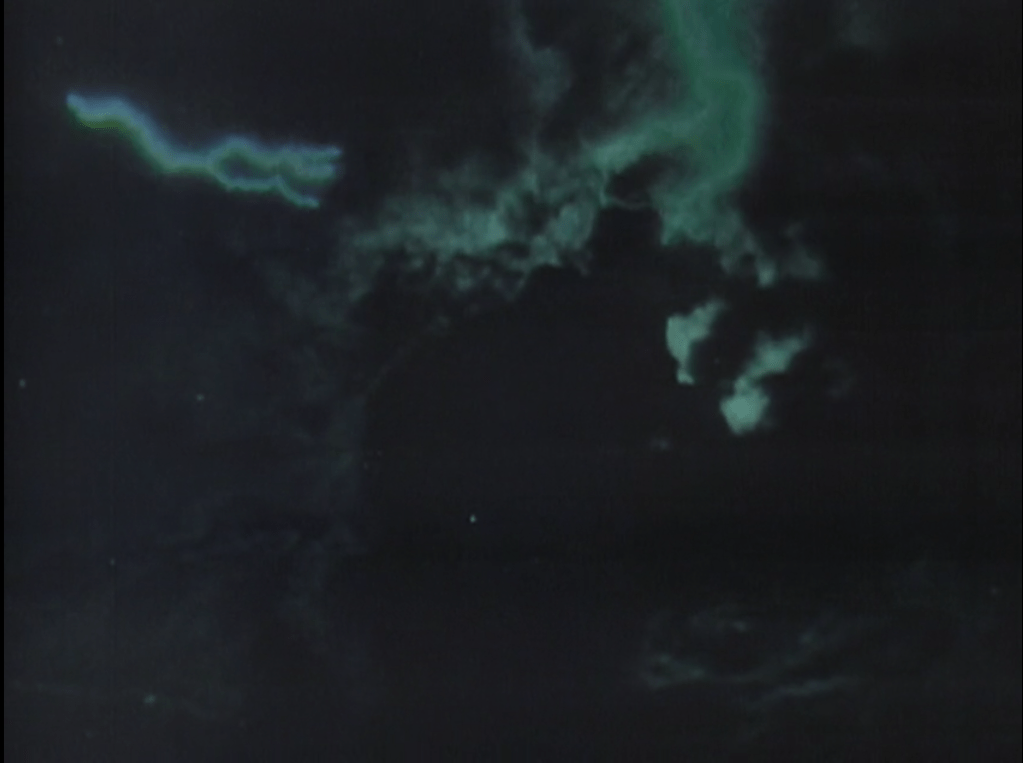
For some time one of the cameras has been on its last legs. In this one, it is almost completely unusable. It is something of a peculiar effect to cut back and forth between two cameras, one of them up to the broadcast standards of the period, the other of which produces only ghostly green images. The episode was directed by Henry Kaplan, who was a poor visual artist under any circumstances. The only remotely ambitious composition he tries today is a shot from a point of view inside a fireplace. They did this several times between December 1966 and March 1967, when David’s mother, undead blonde fire witch Laura Murdoch Collins, was on the show, often to good effect. But this time it is done with the defective camera, and it is simply difficult to see what is going on.

Episode 656: Mister Jonathan

The residents of the estate of Collinwood are under the impression that the mistress of the great house, Elizabeth Collins Stoddard, is dead. Her brother, Roger Collins, is on a business trip to London, and cannot be reached, even by the executives of the business he is there to represent. Liz’ daughter Carolyn is her heir, but she is apparently too doped up on sedatives prescribed by permanent houseguest Julia Hoffman, MD, to take any part in the action of today’s episode. So it falls to Barnabas Collins, Liz’ distant cousin and the master of the Old House on the estate, to move in and start making decisions.

Barnabas is the show’s chief protagonist and its main attraction, and he ran out of story three and a half weeks ago. The ongoing plot-lines both involve Amy Jennings, a nine year old girl who is staying at the great house as Liz’ guest. Amy’s brother Chris is a werewolf, and she and strange and troubled boy David Collins are under the power of the evil ghost of Quentin Collins. The urgent thing is to make Barnabas responsible for Amy so that he can take the lead in addressing both Chris’ lycanthropy and Quentin’s haunting. To that end, it is key that he should be in charge of the great house for a while.

A stranger comes to the door and asks housekeeper Mrs Johnson if he can speak to “Mister Jonathan.” Without batting an eye, she leads him to Barnabas. This proves that Barnabas has become such a breakout hit that even the other characters know that he is played by Jonathan Frid. Perhaps we are to imagine them reading about him in the fan magazines.

The stranger is a mortician who received a telephone call about Liz’ death. Barnabas informs him that they have made other arrangements, and his services will not be needed. Barnabas and Mrs Johnson are puzzled as to who made the call. It turns out that David did it at Quentin’s bidding; how this advances Quentin’s purposes is not clear.

Amy and David’s governess, the well-meaning Victoria Winters, vanished into a gap in the space-time continuum the other day and is not expected to return. Liz hired Maggie Evans, The Nicest Girl in Town, to replace her. Barnabas sticks up for Maggie when Mrs Johnson makes an unflattering comparison of her with Vicki, but he has evidently decided to eliminate her position almost immediately. He wants her to accompany him and the children on a trip to Boston where he will choose boarding schools for them to attend.

Barnabas has not spoken with Roger, who is David’s father. It is not clear who Amy’s legal guardian is. Her parents are dead, and her brother Tom was taking care of her before he died (the first time- he became a vampire and kept coming back.) Chris was away spending the nights of the full moon in the woods at that time, so Amy was sent to Windcliff, a sanitarium a hundred miles north of town. Julia is the nominal head of Windcliff and is Amy’s doctor, so it is possible she is Amy’s legal guardian. Julia is also Barnabas’ closest friend and most frequent accomplice, so it is possible she has agreed to his plan.

Even though Maggie’s job may not last for more than another week, she still needs a place to stay. So she, Mrs Johnson, and Barnabas clear Vicki’s stuff out of her room. Barnabas was hung up on the idea that he and Vicki might someday fall in love, an idea he did remarkably little to put into practice, and so he finds it distressing to be around her clothes. He demands that Mrs Johnson destroy them all. This shocks her. She finds an antique music box, and asks what to do with that. Barnabas orders her to destroy that too. Maggie takes the music box, listens to it for a second, grows wide-eyed, then hurriedly hands it to Mrs Johnson.

I can name that tune in three tinkles. Screenshot by Dark Shadows Before I Die.

This moment amounts to a programmatic statement. In May and June of 1967, Barnabas was a vampire and Maggie was his victim. He forced her to listen to the music box for hours on end, believing that it had a hypnotic power that would erase her personality and replace it with that of his lost love Josette. Several times it has seemed that her memory of what Barnabas was and what he did to her would come back, only for her to be subjected to one magical mind-wipe after another. That she is so quick to give Mrs Johnson the box when Barnabas has ordered her to destroy it, and that her relaxed and friendly attitude towards Barnabas does not change for one second, is a sign that the question “Will Maggie’s memory come back?” will not be coming up in Dark Shadows version 5.0.

Maggie looks for David and Amy and finds them in the drawing room. Amy is playing “London Bridge” on the piano. We have seen David interact with only one other child, the ghost of Barnabas’ nine year old sister Sarah. Sarah sang and played the recorder, and the only song she seemed to know was “London Bridge.” Evidently, David has a type.

Mrs Johnson can’t bring herself to destroy Vicki’s clothes. She tells Maggie she has closed them up in a storeroom in the basement. The only room we have heard referred to this way is the one that was kept locked for the first 54 weeks of the show because Liz was under the mistaken impression that the corpse of her husband Paul was buried there, so that must be the room she means. Longtime viewers will appreciate the reference; Vicki herself was intrigued by the room in the early days of the show, and now her things have found a home there.

They don’t stay there for long. Maggie goes to hang up her own clothes, only to find that Vicki’s are back in the closet. She asks Mrs Johnson what could have happened. In #69, her second appearance, Mrs Johnson declared that “I believe in signs and omens!” Ever since, she has shown an attitude that might be called superstitious in our world, but that in the universe of Dark Shadows is just plain common sense. She ends the episode with a monologue about how “no human hand” had moved the clothes, that it must have been some supernatural force announcing that Vicki will be coming back.

This is disappointing for a couple of reasons. First, the character of Vicki was played out at the end of #192, and the show refused to find anything interesting for her to do for the 90 weeks that followed. Alexandra Moltke Isles finally gave up and used her pregnancy as grounds to get out of her contract early, but they recast the part to continue wasting screen time on this exhausted figure. The second Vicki, Betsy Durkin, was condemned to be a fake Shemp, moping her way through utterly pointless activities unconnected with anything the audience could care about. It was a great relief when she finally vanished.

Second, the show has a poor record of using objects to evoke its themes. The music box was an exception, but most have been pretty bad. The most famous example is Burke Devlin’s filigreed fountain pen, which was the main focus of 21 episodes spread from August through November of 1966. It was supposed to be evidence in a homicide investigation and to suggest a number of things about Roger’s feelings towards his friend-turned-nemesis Burke, but at the end it was just a bunch of people looking for a pen. The most recent at this point was a wristwatch that fake Vicki gave to her husband shortly before his disappearance. It turned up after he was gone and would occasionally start ticking when his spirit was near. Miss Durkin had to play scene after scene with that watch as her main partner, and it is no reflection on her acting ability that the results were so uniformly dismal. There’s a definite sinking feeling when we see Vicki’s wardrobe presented as another symbolic object.